Google Discover AI headlines become permanent feature despite accuracy concerns from publishers


5 Sources
5 Sources
[1]
Google won't stop replacing our news headlines with terrible AI
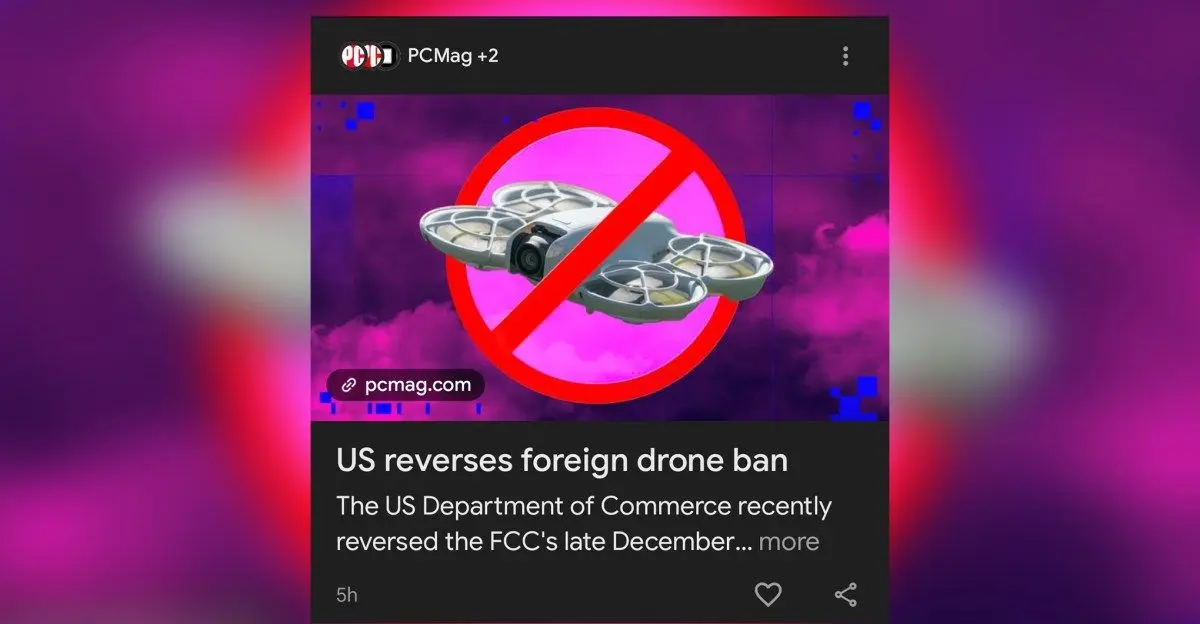
In early December, I brought you the news that Google has begun replacing Verge headlines, and those of our competitors, with AI clickbait nonsense in its content feed. Google appeared to be backing away from the experiment, but now tells The Verge that its AI headlines in Google Discover are a feature, one that "performs well for user satisfaction." I once again see lots of misleading claims every time I check my phone. Like I explained last month, these AI headlines are akin to a bookstore replacing the covers of the books it puts on display -- only here, the "bookstore" is the news tab that appears when you swipe right on the homescreen of a Samsung Galaxy or Google Pixel phone, and the "cover" might be a AI-generated lie instead of the truth. For example, Google's AI claimed last week that "US reverses foreign drone ban," citing and linking to this PCMag story for the news. That's not just false -- PCMag took pains to explain that it's false in the story that Google links to! From PCMag's story, bolding theirs: I saw a headline saying that the drone ban was dropped. Is that true? No. While it's true the Commerce Department ended its efforts to restrict DJI and other drones from import in Jan. 2026, it only did so because it would be redundant in the wake of the FCC actions. The Commerce Department is a separate entity from the FCC, and its proposed restrictions were never put in place to begin with. Some reports on the Commerce Department's decision have misleading headlines that could make you think the government did an about-face, so I don't blame you for being confused. What does the author of that PCMag story think? "It makes me feel icky," Jim Fisher tells me over the phone. "I'd encourage people to click on stories and read them, and not trust what Google is spoon-feeding them." He says Google should be using the headline that humans wrote, and if Google needs a summary, it can use the ones that publications already submit to help search engines parse our work. Google claims it's not rewriting headlines. It characterizes these new offerings as "trending topics," even though each "trending topic" presents itself as one of our stories, links to our stories, and uses our images, all without competent fact-checking to ensure the AI is getting them right. In some ways, Google's current implementation isn't quite as bad as it was a month ago. I've seen fewer examples of egregious clickbait, partly because Google Discover is now serving me quite a few unadulterated news stories alongside its AI ones -- though it does cut off their genuine headlines far too quickly, making many tough to read. The AI is also no longer restricted to roughly four words per headline, so I no longer see nonsense headlines like "Microsoft developers using AI" or "AI tag debate heats." (Instead, I occasionally see tripe like "Fares: Need AAA & AA Games" or "Dispatch sold millions; few avoided romance.") But Google's AI has no clue what parts of these stories are new, relevant, significant, or true, and it can easily confuse one story for another. On December 26th, Google told me that "Steam Machine price & HDMI details emerge." They hadn't. On January 11th, Google proclaimed that "ASUS ROG Ally X arrives." (It arrived in 2024; the new Xbox Ally arrived months ago.) On January 20th, it wrote that "Glasses-free 3D tech wows," introducing readers to "New 3D tech called Immensity from Leia" -- but linking to this TechRadar story about an entirely different company called Visual Semiconductor. I found another that claimed to be about a GPU maker commenting on the RAM shortage; it linked instead to a Digitimes story about a RAM maker. I'm particularly frustrated when I see bait-and-switch headlines on Verge stories, of course, and worried they're taking away our ability to market our own work. Google boiled down my colleague Jay Peters' story about how RGB stripe OLED monitors can unlock sharper text and more accurate colors to the boring "New OLED Gaming Monitors Debut." My story about letting you experience an immersive 3D demo of the Lego Smart Brick like you're there with us at CES became "Lego Smart Play launches March 1," a date that wasn't news by the time Google wrote that! And Google AI decided to advertise our big Verge Awards at CES 2026 story as "Robots & AI Take CES," which was basically the opposite of our conclusion in that story. And yet, our new AI overlords are not effectively weeding out the worst human clickbait in exchange for our fealty. One headline that Google's AI didn't overwrite was "Star Wars Outlaws Free Download Available For Less Than 24 Hours" by Screen Rant. Here's what the author of that story reveals halfway down the post: Just the one code being given away when thousands of people are likely to get involved feels a bit stingy, although at the time of writing Ubisoft's post hasn't exactly blown up, so you might be in with a shot. Yes, Ubisoft gave away a single copy of a game on X, in a giveaway only open to residents of the UK, yet Google's news bot decided that Screen Rant's FOMO clickbait was fine to serve up without tweaks at all. Here's the statement from Google spokesperson Jennifer Kutz about the Google feature: We launched a new feature last year in Discover to help people explore topics that are covered by multiple creators and websites. The feature includes a helpful AI-powered overview of the topic, a featured image, and links to related stories. The overview headline reflects information across a range of sites, and is not a rewrite of an individual article headline. This feature performs well for user satisfaction, and we continue to experiment with the UI to help people click through and explore content on the web. Google declined our request for an interview to more fully explain the idea. I don't know how broadly Google is showing these "trending topics" AI headlines yet, but it seems the company is testing them beyond the Google Discover news feed, too. I've recently seen some of them appear as push notifications to my phone; tapping them takes me to a Google Gemini chatbot that attempts to summarize a recent piece of news. Google changes like these are the biggest reason The Verge now has a subscription, without which we won't survive Google Zero. Disclosure: Vox Media, The Verge's parent company, has filed a lawsuit against Google, seeking damages from its illegal ad tech monopoly.
[2]
Does this headline even matter? Google Discover is writing its own with AI
You can also set us as a preferred source in Google Search by clicking the button below. Stories from individual publishers aren't having their titles replaced, strictly speaking. The AI-generated titles are being applied to what Google calls "trending topics" -- stories that have been covered by multiple outlets, with multiple human-authored headlines. Rather than choosing one of those handcrafted titles, Google's AI tries to parse the details of the story from across publishers and wrap it all up in its own headline. AI being AI, this process often goes awry, resulting in generated titles that are awkward, confusing, or outright wrong. These trending topics are presented very similarly to normal news items, feature visual assets pulled from whichever outlet gets top billing, and link directly to that outlet's content. For an average user, the effect is that nonsensical headlines are showing up in Discover, linking to outlets that didn't write or approve them.
[3]
Google stops calling its broken AI-rewritten Discover headlines an 'experiment'
Karandeep Singh Oberoi is a Durham College Journalism and Mass Media graduate who joined the Android Police team in April 2024, after serving as a full-time News Writer at Canadian publication MobileSyrup. Prior to joining Android Police, Oberoi worked on feature stories, reviews, evergreen articles, and focused on 'how-to' resources. Additionally, he informed readers about the latest deals and discounts with quick hit pieces and buyer's guides for all occasions. Oberoi lives in Toronto, Canada. When not working on a new story, he likes to hit the gym, play soccer (although he keeps calling it football for some reason🤔) and try out new restaurants in the Greater Toronto Area. In the summer of 2025, Google was spotted using AI in our cherished Discover feeds. The tech giant was using AI to provide a short blurb/summary of the article in question right within the Discover feed, giving users a quick peek into what the article is about. That's cool and somewhat useful, as long as the AI gets things right. Fast-forward to December 2025, and Google started testing AI-generated titles for stories that showed up on Discover. That's where things went downhill. Google AI is posting clickbait headlines on Discover Part of an experiment by Google Posts 2 By Chandra Steele Back then, the headlines that Discover was whipping up were far from the truth, i.e., they didn't accurately depict what the story was about. Inversely, users and publications found the AI-generated headlines to actually be misleading and factually incorrect. A story from 9to5Google, which was actually titled 'Don't buy a Qi2 25W wireless charger hoping for faster speeds - just get the 'slower' one instead' was retitled as 'Qi2 slows older Pixels.' Similarly, Ars Technica's 'Valve's Steam Machine looks like a console, but don't expect it to be priced like one' was changed to 'Steam Machine price revealed.' At the time, we believed that the inaccuracies were due to the feature being unstable and in early testing. In a statement given to The Verge at the time, Google acknowledged the experiment and said that it was "testing a new design that changes the placement of existing headlines to make topic details easier to digest before they explore links from across the web." Now, Google has stopped calling Discover replacing human-written headlines as an "experiment." Instead, it has begun calling it a 'feature,' as highlighted in a statement from Google spokesperson Jennifer Kutz given to The Verge. We launched a new feature last year in Discover to help people explore topics that are covered by multiple creators and websites. The feature includes a helpful AI-powered overview of the topic, a featured image, and links to related stories. The overview headline reflects information across a range of sites, and is not a rewrite of an individual article headline. This feature performs well for user satisfaction, and we continue to experiment with the UI to help people click through and explore content on the web. According to Google, it is not individually looking at titles to retitle them. It is looking at topics that are trending and have been covered by multiple sources. When that happens, the AI attempts to gather information from all said sources and whip up the collective narrative into a single headline. The tech giant says that this performs will for user satisfaction. AP Recommends: Subscribe and never miss what matters Tech insights about everything mobile directly from the Android Police team. Subscribe By subscribing, you agree to receive newsletter and marketing emails, and accept Valnet's Terms of Use and Privacy Policy. You can unsubscribe anytime. It highlights a piece with a featured image from a top-tier publication like The Verge, and its story's link. The telltale sign that an article headline has been replaced by AI is to look at the Discover card's source. Normally, the top left highlights a single publication. In case Google Discover has parsed through several sources to form its headline, the Discover card will highlight the main source and show a tag with a plus number to highlight the additional outlets the AI has gathered information from, as seen in the screenshot below. Additionally, Discover articles that are trending topics and have had their headlines swapped out by AI don't feature a 'Follow' pill on the top right. Although AI-generated headlines don't show up for all Discover stories, Google indicating that the change is a feature and not an experiment, tells us a lot, and unless Google tunes its AI to accurately retitle articles (which it shouldn't in the first place, but alas), Discover might continue to be a propagator of misinformation.
[4]
Google Discover makes messy AI headlines a 'feature' because they 'perform well'
Following prior testing, Google Discover is keeping AI headlines around as they "perform well" with users. Google Discover is the leftmost homescreen page on many Android devices, as well as filling the Google app's homepage, and delivers content from around the web to fit your interests. While it's easy to complain about clickbait through this panel, it's undoubtedly good at finding content that you might be interested in, and in a fairly timely manner to boot. Google often runs experiments that change the design of Discover, and one of those tests is now graduating to a standard feature. 9to5Google reported in mid-2025 that Google Discover was testing the use of AI to generate summaries of articles, and that extended to the headline of the article in late 2025. Examples shared during the test showed how this could go wrong, with one of our own articles about how Qi2 25W speeds don't typically make a huge difference being titled "Qi2 slows older Pixels" by the AI which is simply false. The actual headline was "Don't buy a Qi2 25W wireless charger hoping for faster speeds - just get the 'slower' one instead." Google buries a "Generated with AI, which can make mistakes" message under the "See more" button in the summary, making it look like this is the publisher's intended headline. Despite the obvious issues, though, Google Discover is going all-in on these AI-generated headlines. Google told The Verge that AI headlines in Discover are no longer an "experiment," but a "feature" of the experience. Why? Google says that the feature "performs well for user satisfaction." Notably, some articles still see their standard headlines in use, while others have no headline at all as we spotted last year. Google says: We launched a new feature last year in Discover to help people explore topics that are covered by multiple creators and websites. The feature includes a helpful AI-powered overview of the topic, a featured image, and links to related stories. The overview headline reflects information across a range of sites, and is not a rewrite of an individual article headline. This feature performs well for user satisfaction, and we continue to experiment with the UI to help people click through and explore content on the web. While it is obvious that Google has refined this feature over the past couple of months, it doesn't take long to still find plenty of misleading headlines throughout Discover. Yesterday, we covered Waze informing users of "new" features rolling out that were announced nearly two years ago, but Google's AI headline completely removed the nuance of that story. Another article from NotebookCheck about an Anker power bank with a retractable cable was given a headline that's about another product entirely. A pair of headlines from Tom's Hardware and PCMag, meanwhile, show the two sides of using AI for this purpose. The Tom's Hardware headline, "Free GPU & Amazon Scams," isn't representative of the actual article, which is about someone who bought a GPU from Amazon, canceled their order, and the retailer shipped it anyway. There's nothing about "Amazon Scams" in the article. The PCMag headline, meanwhile, offers a concise, if somewhat messy summary of an article about Google Home's offline light bug. That bug, as we reported on earlier this week, doesn't have a fix available just yet, as the AI headline somewhat implies. What do you think of AI headlines in Google Discover?
[5]

Google's AI-Generated Headlines Are Here to Stay
Google says the AI headlines aren't meant as replacements for any one article's title, but there are still issues. Last month, Google told online publishers that it had started testing AI-generated headlines in Google Discover, replacing stories' carefully handcrafted titles with truncated alternatives made up by Gemini. Some journalists were predictably unhappy, but now, the company says that the AI headlines are no longer an experiment -- they're a "feature." Back when the testing began, the results ranged from poorly worded to straight up misinformation. For instance, one AI-generated headline promised "Steam Machine price revealed," when the original article made no such claim. Another said "BG3 players exploit children," which sounds serious, until you click through to the article and see that it's about a clever way to recruit invincible party members in Baldur's Gate 3 (which, to be fair, does involve turning child NPCs into sheep at one point). At the time, Google said that the test was a "small UI experiment for a subset of Discover users," and simply rearranged how users saw AI previews, which were introduced in October of last year and feature short AI summaries of articles, including an occasional AI headline. However, while that AI headline was previously hidden below the original, authored headline, the test put it up top, while getting rid of the authored headline entirely. For a while, it seemed like Google might have been willing to back away from the AI headlines, but now the company says it's doubling down. In a statement to The Verge, Google said that its AI headlines are no longer in testing, but are now a full-fledged feature. The company didn't elaborate on why, but did say that the update "performs well for user satisfaction." When 9to5Google then reached out for more detail, the publication was told, "The overview headline reflects information across a range of sites, and is not a rewrite of an individual article headline." Well, that hasn't quite been the case for me: When I first wrote about this "experiment," I actually had yet to run into one of the AI headlines. But perusing my Google Discover feed today (to see yours, swipe right from the home screen on an Android phone, or scroll down in the Google app), I've finally seen some first hand. To Google's credit, these AI previews do seem to synthesize several sources as claimed -- you can see them above the linked story. However, they still call out one article in particular, linking to it and using its header photo. That can easily lead users to think the AI generated headline was written by the linked publication. That can have consequences for the publication or writer if the AI gets something wrong, which a disclaimer at the bottom of these AI previews admits can happen. For instance, The Verge said it saw an AI Discover headline on a story from Lifehacker's sister site PCMag that said, "US reverses foreign drone ban," even though the linked story goes out of its way to say headlines that claim this are "misleading." The AI headlines I've seen personally haven't been quite that bad, but as someone with a more than decade-long career in journalism, I do question their helpfulness. For instance, "Starfleet Academy full of Trek Nods" is much less informative than the original, "One of TNG's Strangest Species Is Getting a Second Life In Modern Star Trek." I guess "Star Trek show has Star Trek things" is apparently clickier or more useful to the reader than just saying what the specific Star Trek thing is? Another example: "Anbernic unveils RG G01 Controller." I hope you know what those letters and numbers mean, because this AI headline completely buries the context in the original headline, "Anbernic's New Controller Has a Screen and Built-In Heartbeat Sensor, for Some Reason." I guess this is a future that I'll have to get used to though. That I'm starting to see these headlines myself, despite not being part of the initial experiment, does suggest we can expect them to stick around, and to roll out to more people. If you see something that seems questionable while scrolling Google Discover, the feature has probably rolled out to you now too. How to check if a Google Discover headline was written by AI To check whether that suspicious headline was written by a human or not, try clicking the "See more" button at the bottom of the article's description and looking for a "Generated with AI" disclaimer. On the plus side, only about half of the articles in my Google Discover are currently using AI headlines, so not every piece of "content" is being affected. But for journalists, the move still comes at a tough time: According to Reuters, Google traffic from organic search was down by 38% on test sites in the United Stated between November 2024 and November 2025, and while Google Discover isn't Search, editors write headlines the way they do for a reason. Using a robot to overwrites those decisions probably isn't the best way to tackle eroding trust in media. I've reached out to Google for comment on its AI headlines and will provide an update when I hear back.
Share
Share
Copy Link
Google has confirmed that AI-generated headlines in Google Discover are now a permanent feature, claiming they improve user satisfaction. But publishers like The Verge and PCMag report the AI-rewritten headlines often contain misleading or false information, replacing carefully crafted titles with inaccurate summaries that can spread misinformation.
Google Discover Makes AI Headlines a Permanent Feature
Google has officially transitioned its AI-generated headlines in Google Discover from an experiment to a permanent feature, despite ongoing concerns from publishers about accuracy and misinformation. In a statement to
The Verge
1
, Google spokesperson Jennifer Kutz confirmed the change, stating that the feature "performs well for user satisfaction." The AI headlines appear in the content feed accessible by swiping right on Samsung Galaxy or Google Pixel phone home screens, as well as in the Google app homepage.Google characterizes these AI-rewritten headlines as "trending topics" rather than direct replacements of individual article titles. According to the company, the overview headline "reflects information across a range of sites" when multiple publishers cover the same story
3
. However, these trending topics are presented similarly to normal news items, featuring visual assets from whichever outlet gets top billing and linking directly to that outlet's content2
.Publishers Report Misleading or False Headlines
The reality of Google AI's performance tells a different story. Publishers have documented numerous instances of factually incorrect headlines that contradict the very articles they claim to summarize. PCMag reporter Jim Fisher expressed frustration when Google's AI claimed "US reverses foreign drone ban," citing his story that explicitly explained this headline was false. "It makes me feel icky," Fisher told
The Verge
1
. "I'd encourage people to click on stories and read them, and not trust what Google is spoon-feeding them."Other examples include Google AI claiming "ASUS ROG Ally X arrives" in January 2025 when the device actually launched in 2024
1
. A9to5Google
4
article titled "Don't buy a Qi2 25W wireless charger hoping for faster speeds" was retitled as "Qi2 slows older Pixels," which is simply false. The Verge's immersive 3D demo story about the Lego Smart Brick became "Lego Smart Play launches March 1," burying the actual newsworthy content1
.Impact on Journalistic Integrity and Publishers
The shift raises significant concerns about journalistic integrity and publishers' ability to market their own work. Google Discover essentially acts as a bookstore replacing book covers, except the "cover" might be an AI-generated lie instead of the truth
1
. The tech giant buries a "Generated with AI, which can make mistakes" message under the "See more" button, making it appear that publishers wrote these clickbait headlines4
.Publishers face a particularly difficult situation as Google traffic from organic search traffic was down 38% on test sites in the United States between November 2024 and November 2025, according to Reuters
5
. Now, even when their content appears in Google Discover, the carefully crafted headlines designed to accurately represent their stories are being replaced without proper fact-checking.Related Stories

How Google's AI System Works
The telltale sign that an article headline has been replaced by AI is visible in the Discover card's source. Normally, the top left highlights a single publication. When Google Discover has parsed through several sources to form its overview headline, the card shows the main source with a plus number tag indicating additional outlets the AI gathered information from
3
. Additionally, these AI-rewritten headlines don't feature a "Follow" pill on the top right.While Google claims the feature improves user satisfaction, the company continues to experiment with the UI to help people click through and explore content on the web
3
. Gemini, Google's AI system, synthesizes information from multiple sources to create these headlines, though the synthesizing content process frequently produces results ranging from poorly worded to straight-up misinformation5
. The user experience may show engagement metrics that satisfy Google's internal benchmarks, but this comes at the cost of accuracy and publisher control over their content representation in the content feed.References
Summarized by

Navi
[2]
[5]
Related Stories
Google Discover tests AI headlines that rewrite news stories with misleading clickbait titles
03 Dec 2025•Technology

Google Search uses AI to rewrite headlines, sparking accuracy and editorial control concerns
20 Mar 2026•Technology
Google Discover Introduces AI-Generated Summaries, Raising Concerns for Publishers
15 Jul 2025•Technology

Recent Highlights



Recent Highlights
Today's Top Stories










Your Daily Dose of Curated AI News
Don’t drown in AI news. We cut through the noise - filtering, ranking and summarizing the most important AI news, breakthroughs and research daily. Spend less time searching for the latest in AI and get straight to action.

