Alphabet doubles AI spending to $185B, sells $20B bonds and rare 100-year notes to fund buildout


43 Sources
43 Sources
[1]
Alphabet selling very rare 100-year bonds to help fund AI investment
Alphabet has lined up banks to sell a rare 100-year bond, stepping up a borrowing spree by Big Tech companies racing to fund their vast investments in AI this year. The so-called century bond will form part of a debut sterling issuance this week by Google's parent company, said people familiar with the matter. Alphabet was also selling $20 billion of dollar bonds on Monday and lining up a Swiss franc bond sale, the people said. The dollar portion of the deal was upsized from $15 billion because of strong demand, they added. Century bonds -- long-term borrowing at its most extreme -- are highly unusual, although a flurry was sold during the period of very low interest rates that followed the financial crisis, including by governments such as Austria and Argentina. The University of Oxford, EDF, and the Wellcome Trust -- the most recent in 2018 -- are the only issuers to have tapped the sterling century market. Such sales are even rarer in the tech sector, with most of the industry's biggest groups issuing up to 40 years, although IBM sold a 100-year bond in 1996. A banker familiar with Alphabet's transaction said the company's multi-currency bond offering is an effort to expand the investor pool given the massive amount of capital needed by Big Tech companies. "There might be a supply-demand imbalance if you were to try to come back to the US dollar market over and over again," the banker said. Issuing a century bond in the sterling market is more cost-effective than in the dollar market, where the interest rate is higher, the banker added. While a century bond is "highly unusual" for tech companies, it could appeal to buyers such as life insurance companies and pension funds, which have a mandate to buy long-term assets, said Nicholas Elfner, co-head of research at Breckinridge Capital Advisors. Tony Trzcinka, a US-based senior portfolio manager at Impax Asset Management, which purchased Alphabet's bonds last year, said he skipped Monday's offering because of insufficient yields and concerns about overexposure to companies with complex financial obligations tied to AI investments. "It wasn't worth it to swap into new ones," Trzcinka said. "We've been very conscious of our exposure to these hyperscalers and their capex budgets." Big Tech companies and their suppliers are expected to invest almost $700 billion in AI infrastructure this year and are increasingly turning to the debt markets to finance the giant data center build-out. Alphabet in November sold $17.5 billion of bonds in the US including a 50-year bond -- the longest-dated dollar bond sold by a tech group last year -- and raised €6.5 billion on European markets. Oracle last week raised $25 billion from a bond sale that attracted more than $125 billion of orders. Alphabet, Amazon, and Meta all increased their capital expenditure plans during their most recent earnings reports, prompting questions about whether they will be able to fund the unprecedented spending spree from their cash flows alone. Last week, Google's parent company reported annual sales that topped $400 billion for the first time, beating investors' expectations for revenues and profits in the most recent quarter. It said it planned to spend as much as $185 billion on capex this year, roughly double last year's total, to capitalize on booming demand for its Gemini AI assistant. Alphabet's long-term debt jumped to $46.5 billion in 2025, up more than four times the previous year, though it held cash and equivalents of $126.8 billion at the year-end. Investor demand was the strongest on the shortest portion of Monday's deal, with a three-year offering pricing at only 0.27 percentage points above US Treasuries, versus 0.6 percentage points during initial price discussions, said people familiar with the deal. The longest portion of the offering, a 40-year bond, is expected to yield 0.95 percentage points over US Treasuries, down from 1.2 percentage points during initial talks, the people said. Bank of America, Goldman Sachs, and JPMorgan are the bookrunners on the bond sales across three currencies. All three declined to comment or did not immediately respond to requests for comment. Alphabet did not immediately respond to a request for comment.
[2]
TSMC Revenue Jumps 37% in January While AI Spending Marches On
Taiwan Semiconductor Manufacturing Co.'s January sales grew at their fastest clip in months, a sign of sustained global AI spending even as concerns persist about an industry bubble. The contract chipmaker for Nvidia Corp. reported a 37% rise in January revenue to NT$401.3 billion ($12.7 billion), above the 30% revenue growth TSMC expects for the full year. The year-ago comparison, however, may have been affected by the Lunar New Year holidays, which in 2025 fell in January. TSMC, which also produces chips for Apple Inc., has been one of the biggest beneficiaries of a surge in artificial intelligence-related investment, due to its role in manufacturing advanced AI accelerators. Demand for data center chips in particular is spurring TSMC to earmark as much as $56 billion in capital spending this year, which would be up a quarter from 2025. Last week, Nvidia Chief Executive Officer Jensen Huang called the capex spree a "once-in-a-generation infrastructure buildout." But the mammoth spending by large technology companies like Amazon.com Inc. and Meta Platforms Inc. is also worrying investors who wonder if artificial intelligence will benefit those betting the most. The circular nature of many data center agreements is also causing trepidation among those who've been hurt by boom-and-bust tech cycles in the past. Alphabet Inc. is borrowing far and wide to finance the unprecedented spending plan behind its artificial intelligence ambitions, and investors can't seem to get enough. The Google parent raised $20 billion in its biggest ever US dollar bond saleBloomberg Terminal on Monday -- more than the $15 billion initially expected, after racking up one of the biggest order books of all time. It's also planning debut deals in Switzerland Bloomberg Terminaland the UKBloomberg Terminal, including a rare sale of 100-year bonds -- marking the first time a tech company has tried such an offering since the dotcom frenzy of the late 1990sBloomberg Terminal. The big borrowing spree comes just days after tech companies from Meta Platforms Inc. to Amazon.com Inc. said they were ramping up spending to meet their ambitious artificial intelligence plans. Their plans fanned fears that the AI arms race, and the billions of dollars of debt needed to help fund it, would weigh on credit markets. Investors appeared to push those concerns to the side on Monday, as the Alphabet bond sale drew more than $100 billion of orders. Bloomberg Intelligence Alphabet Looks to Raise About $15 Billion From US Bond Sale Arrow Right 23:06 "Clearly we're not in a typical capex cycle, and after previously being net savers, the companies involved are now going deep into the well for financing to secure the resources to compete," said Andrew Dassori, chief investment officer at Wavelength Capital Management LLC. "This is a major transition, and a critical one when thinking about potential risk and return for corporate bonds in the US." Alphabet last week said it's planning for as much as $185 billion of capital expenditures this year, more than it has spent in the past three years combined, as it invests heavily in the data centers critical to its AI ambitions. The company said the investments are already boosting revenue, as AI encourages more online searching. As other companies known as hyperscalers boost spending too, capital expenditures for the four biggest US tech companies are forecast to reach about $650 billion in 2026, driving a financing boom and a potentially disruptive technology that could completely reshape the global economy. A chunk of that spending is being funded in the bond market. Just last week, Oracle Corp. raised $25 billion from a bond that attracted a recordBloomberg Terminal $129 billion of orders at its peak. Alphabet's US dollar bondBloomberg Terminal sale on Monday came in seven parts, according to people with direct knowledge of the matter. The yield on the longest portion of the offering -- a bond maturing in 2066 -- was 0.95 percentage point more than Treasuries, a tighter risk premium than the roughly 1.2 percentage point discussed earlier. Morgan Stanley expects hyperscalers to borrow $400 billion this year, up from $165 billion in 2025. The offering spree will likely drive high-grade debt issuance to a record $2.25 trillion this year, Vishwas Patkar, head of US credit strategy at the bank, wrote in a note on Monday. Some credit strategists -- including Patkar and JPMorgan Chase & Co.'s Nathaniel Rosenbaum -- expect the massive issuance to push corporate bond spreads wider. "We think that the playbook is similar to 1997/98 or 2005; credit underperforms, but not 'end of cycle,'" Patkar wrote, referring to a period when defaults rise and credit availability tightens. Read Credit Weekly: Tech's AI Push Risks a Bond Market Blowback Alphabet didn't respond to a comment request. JPMorgan Chase & Co., Goldman Sachs Group Inc. and Bank of America Corp., which are helping manage the US dollar bond sale, declined to comment. Deutsche Bank AG, Royal Bank of Canada and Wells Fargo & Co. also managed the deal. Alphabet last tapped the US bond market in November, when it raised $17.5 billion in a deal that attracted about $90 billion of orders. As part of that transaction, it sold a 50-year note -- the longest corporate tech bond offering in US dollars last year, according to Bloomberg-compiled data -- which has tightened in secondary markets. The company also sold €6.5 billion of notes in Europe at the time. Capital spending in artificial intelligence, cloud infrastructure and data centers is expected to reach $3 trillion in aggregate by 2029, according to a Bloomberg Intelligence estimateBloomberg Terminal.
[3]
Google looks to plow approx $180B into datacenters this year
With revenue topping $400B for the first time, the Chocolate Factory is at no risk of putting itself in the poor house Google's parent Alphabet is doubling down on generative AI in 2026. On Wednesday's earnings call, the search and advertising giant boosted its full-year capital expenditures target to between $175 and $185 billion, roughly twice what it spent last year. The search and ads giant will use that massive pile of cash to build datacenters and buy the kit to fill them, to support its own products and the infrastructure needs of partners like Apple, OpenAI, and Anthropic. Speaking during Alphabet's earnings call, CFO Anat Ashkenazi said roughly 60 percent of the company's 2026 capex spend, or about $105 to $111 billion, will go toward fast-depreciating assets like servers. The remaining 40 percent, or $70 to $74 billion, will support the construction and networking of new datacenter facilities. Much of the server spend will go toward the deployment of AI infrastructure, which includes both Google's own in-house tensor processing units (TPUs) and Nvidia GPUs. Ashkenazi said investment in compute infrastructure will split evenly between internal workloads and the Google Cloud platform. Spending all that money won't be easy. On the company's earnings call, analysts asked CEO Sundar Pichai what keeps him up at night. He replied that scaling compute capacity while managing the power, land, and supply chain constraints necessary to meet demand for AI services remains a persistent concern for the company. Just like Meta, Alphabet isn't just shoehorning generative AI into every user-facing product it can. The company is also using the models to enhance its online ad businesses. According to Philipp Schindler, Google's chief business officer, Gemini has helped improve the relevance of the ads it delivers alongside results from Google searches. "Gemini's understanding of intent has increased our ability to deliver ads on longer, more complex searches that were previously challenging to monetize," he said. "Gemini models also have a significant impact on core understanding in non-English languages, expanding opportunities for businesses to scale." Alphabet's ad revenues across Google's Search, YouTube, and Network segments topped $82.28 billion during the quarter, an increase of more than 13 percent from this time last year. Google's Cloud Platform (GCP) also ended the 2025 fiscal year on a high note. Q4 cloud revenues jumped 47 percent year-over-year, to reach $17.66 billion. Strong demand for both AI and enterprise compute drove the growth. "GCP's performance was driven by accelerating growth in enterprise AI products, which are generating billions in quarterly revenues," Ashkenazi said, adding that the cloud's core services, including things like cybersecurity and data analytics services, also experienced heavy revenue gains during the quarter. Put together, Alphabet raked in $34.45 billion in profits in Q4 on revenues of $113.82 billion. For the full year, meanwhile, revenues topped $402.84 billion of which Alphabet counted $132.17 billion in profits. ®
[4]
Alphabet sells bonds worth $20 billion to fund AI spending
Feb 10 (Reuters) - Alphabet (GOOGL.O), opens new tab said it sold bonds worth $20 billion in a seven-part offering, tapping the debt market to fund its surging spending on artificial intelligence infrastructure. Big Tech's appetite for debt is surging, after years of relying on strong cash flows to fund investments. Alphabet is also planning a debut sterling offering that may include a rare 100-year bond, the tech industry's first since a Motorola issuance in 1997, according to media reports. Big Tech's pivot to the bond market, however, has raised investor concerns as payoffs have not kept pace with the huge AI spending from U.S. tech giants, while businesses adopting the technology have so far seen limited productivity gains. Capital expenditure from Alphabet, Microsoft (MSFT.O), opens new tab, Amazon.com (AMZN.O), opens new tab and Meta Platforms (META.O), opens new tab is expected to total at least $630 billion this year, with most of spending focused on data-centers and the AI chips that power them. The seven tranches of Alphabet's dollar notes mature every few years, starting in 2029, and go all the way up to 2066, according to a regulatory filing on Tuesday. Some analysts said Big Tech's greater use of debt reflects a pivot from asset-light models toward long-term infrastructure. "Century bonds are usually the preserve of governments or regulated utilities with very predictable cash flows, so this deal shows that, at least for now, investors are willing to take on very long-dated risk tied to AI investment," said Lale Akoner, global market analyst at eToro. Oracle (ORCL.N), opens new tab had also disclosed a $25 billion note sale on February 2 in a securities filing. The AI hyperscalers - a group that also includes Oracle - issued $121 billion in U.S. corporate bonds last year, according to a January report by BofA Securities. (This story has been refiled to add the dropped word 'said' in paragraph 1) Reporting by Zaheer Kachwala in Bengaluru; Editing by Arun Koyyur Our Standards: The Thomson Reuters Trust Principles., opens new tab
[5]

Google adds $55bn to capex plans as it boosts AI spending
Google said it plans to spend at least $55bn more on capital expenditure this year than Wall Street had forecast, as it doubles down on its huge spending on AI. The search giant increased its forecast for capex in 2026 to a range of $175bn to $185bn, far exceeding analysts' expectations for around $120bn, Google's parent company Alphabet said on Wednesday. Fourth-quarter capital expenditure was up to $27.9bn, almost doubling from $14bn last year and exceeding expectations for $27.7bn. It spent $91.4bn over the course of 2025, indicating that capex will double this year. "We're seeing our AI investments and infrastructure drive revenue and growth across the board," said chief executive Sundar Pichai. He said the capex forecasts were "to meet customer demand and capitalise on the growing opportunities we have ahead of us". The spending spree overshadowed a second successive quarter of $100bn-plus revenue, driven by strong earnings for the search giant's advertising and cloud computing divisions as demand for AI continues to grow. Fourth-quarter net income increased 30 per cent from the year before to $34.5bn, beating analysts' expectations of $31.9bn. The company made $132bn of profit during the whole of 2025. Revenue rose 18 per cent to $113.8bn in the three months to the end of December, beating the average estimate of $111.3bn, according to FactSet data. Annual sales surpassed $400bn for the first time. Google's core search and advertising business grew 17 per cent to $63.1bn, hitting estimates of $61.3bn. YouTube ads rose 9 per cent to $11.4bn. Cloud revenues rose 48 per cent to $17.7bn against the average $16.3bn estimate, as demand for computing power to train and run AI models escalates. Alphabet shares have rallied 61 per cent in the past 12 months, pushing its market cap past $4tn to surpass Microsoft as the third-largest company in the world. The stock initially fell more than 7 per cent in after-hours trading following the earnings report but recovered to trade down 2 per cent.
[6]

Alphabet calls out new AI-related risks, as it taps debt market to fund buildout
Google CEO Sundar Pichai gestures to the crowd during Google's annual I/O developers conference in Mountain View, California, on May 20, 2025. As Alphabet returns to the debt market to fund its artificial intelligence buildout, the company is acknowledging new risks tied to the rise of AI and its hefty investments in infrastructure. In its annual financial report late last week, the Google parent highlighted the potential impact of AI on the company's core advertising business and the possibility of ending up with "excess capacity" from its costly commitments. "To meet the compute capacity demands of AI training and inference, as well as traditional cloud computing services, we are entering into significant leasing arrangements with third party operators, which may increase costs and operational complexity," the company stated in the filing with the SEC. Large commercial agreements could also increase "liabilities and obligations in the event of nonperformance by us, our counterparties, or vendors," Alphabet said. One of the headline numbers in Alphabet's earnings report was $185 billion, representing the high end of what the company says it may shell out in capital expenditures this year, more than double its 2025 capex. To help finance its AI ambitions, Alphabet is planning to raise $20 billion from a U.S. dollar bond sale, according people familiar with the matter who asked not to be named because the details are confidential. The planned sale would take place over four tranches, including a 100-year bond deal in sterling, the people said, with one adding that the deal is five times oversubscribed. Bloomberg first reported on the planned debt funding, which was originally expected to reach $15 billion. Alphabet held a $25 billion bond sale in November. Its long-term debt quadrupled in 2025 to $46.5 billion. CFO Anat Ashkenazi said on last week's earnings call that as the company considers its total investment, "we want to make sure we do it in a fiscally responsible way, and that we invest appropriately, but we do it in a way that maintains a very healthy financial position for the organization." When asked on the call what keeps executives up at night, CEO Sundar Pichai responded "compute capacity," adding, "power, land, supply chain constraints, how do you ramp up to meet this extraordinary demand for this moment?"
[7]
Alphabet to Blow Past Investor Expectations for AI Spending
The company has quickly improved its Gemini model and integrated it throughout its products -- an effort that has required massive investment in data centers and chips for model improvement and cloud customers. Alphabet Inc. topped projections for quarterly revenue and outlined an ambitious capital spending plan, far surpassing predictions, leveraging its growth to build out the data centers and infrastructure needed to lead in the AI age. The Google parent said capital expenditures would reach as much as $185 billion this year, compared with the $119.5 billion analysts expected. The company's fourth-quarter sales, excluding partner payouts, were $97.23 billion, surpassing the $95.2 billion expected on average by analysts, according to data compiled by Bloomberg. Chief Executive Officer Sundar Pichai said the investments are paying off. "We're seeing our AI investments and infrastructure drive revenue and growth across the board," he said Wednesday in a statementBloomberg Terminal. "Search saw more usage than ever before, with AI continuing to drive an expansionary moment." Google Cloud revenue was $17.7 billion, beating the $16.2 billion analysts expected. The shares fell more than 7.5% in after-market trading before recovering. Google has raced to reinvent its business for the AI age, working to keep consumers in the habit of going to its search page even when they could also go to chatbots from rivals like OpenAI. The company has quickly improved its Gemini model and integrated it throughout its products -- an effort that has required massive investment in data centers and chips for model improvement and cloud customers. The industry has leaned on Google's progress. Google is supplying up to one million of its specialized AI chips to Anthropic, cementing Google's position as a key infrastructure provider in the AI space. Gemini will also be a provider of AI for Siri on Apple Inc.'s iPhones. The Gemini app has 750 million monthly active users. To justify its heavy spending, Alphabet needs to demonstrate momentum in its cloud and search advertising businesses. The company has said its massive investments in AI -- funding new infrastructure, research and talent -- are essential for competing against rivals including Amazon.com Inc., Microsoft Corp. and OpenAI.
[8]
Google goes from laggard to leader as it pulls ahead of OpenAI with stellar AI growth
SAN FRANCISCO, Feb 4 (Reuters) - Alphabet (GOOGL.O), opens new tab is taking on OpenAI with a gusto that underscores Wall Street's perception that the Google parent is the leader in AI, a turn of events from a year ago when investors thought it was badly lagging behind rivals and punished its stock. Alphabet executives struck a more confident tone on the company's post-earnings call on Wednesday, the first since it released the Gemini 3 model, which has wowed users and helped Google catch up in the artificial intelligence race. Though it did not mention its chief AI rival by name, Alphabet's newly confident messaging emphasized a key contrast: Investments in AI have begun to reap returns throughout the entire company. That served as Alphabet's justification to potentially double its capital expenditures in 2026 - to between $175 billion and $185 billion - as a result of massive investments into AI computing capacity. Alphabet's prepared remarks about AI in 2025 had focused on product usage and AI revenues generated specifically via its cloud-computing unit. "Overall, we're seeing our AI investments and infrastructure drive revenue and growth across the board," CEO Sundar Pichai said. Google's fresh conviction about AI-fueled revenue is backed by growth in both its consumer and enterprise businesses. Pichai said the Google Gemini app, which competes with OpenAI's ChatGPT, exceeded 750 million monthly active users at the end of the December quarter, up from 650 million at the end of the prior period. That still trails ChatGPT, which OpenAI CEO Sam Altman said in October had eclipsed 800 million weekly active users. "We are also seeing significantly higher engagement per user, especially since the launch of Gemini 3," Pichai said. Gemini 3 has also been integrated into "AI Mode" in Google's search engine and powers Google's enterprise version of Gemini, which Pichai said on the call had reached 8 million paying licenses. Google's surging capex forecast initially alarmed investors, sending the stock down by as much as 6% in after-hours trading. But a strong showing from its cloud unit - revenue was up 48% in the December quarter - and an AI-powered boost across the rest of its business quickly reinforced Wall Street's confidence that Google's AI bets are beginning to pay off. The stock recouped the first post-market shock to trade flat after hours, further validating Wall Street's current message to tech companies: Soaring AI spending can continue only if tech companies demonstrate commensurate financial returns. TURNING TIDE Since the start of last year, Alphabet has gone from laggard to leader among the "Magnificent Seven" megacap companies and is now matched by only Nvidia (NVDA.O), opens new tab and Apple (AAPL.O), opens new tab among companies with market capitalizations of more than $4 trillion. Despite taking a comparably modest tone on capital spending for the year, Microsoft's (MSFT.O), opens new tab shares took a massive beating last week, due in part to heightened concerns about its reliance on OpenAI. The company said its fiscal third-quarter spending would decrease from the record $37.5 billion it shelled out in the October-to-December period. With OpenAI striking a string of multi-billion-dollar deals despite still losing money, investors have grown concerned about the company's ability to finance those commitments, souring sentiment around major tech firms with which it has close links. Paul Meeks, head of tech research at Freedom Capital Markets, said Alphabet was benefiting from a contrast in sentiment, despite a capex forecast that was "eye-watering." "I do think there's a narrative emerging here where the market is favoring Google versus OpenAI," Meeks said. "This time last year, every announcement by OpenAI to do business with somebody was applauded. But then in late 2025, now people are saying, 'Oh my god, too much of my revenue backlog or AI infra spending is coming from OpenAI.'" Shares of Oracle, whose contract backlog of more than $500 billion hinges largely on OpenAI, are down about 49% since the start of October. Microsoft, which holds a 27% stake in OpenAI and counts it as a massive customer, has slid more than 20% over the same period. Meanwhile, Alphabet has jumped about 36%. "The deals that OpenAI has with Microsoft and Oracle are highly tied to their ability to raise future funds," said Dan Morgan, portfolio manager at Synovus Trust. "I think that is why you are seeing the street favor Alphabet." Alphabet's deep war chest has been filled by major deals that it has struck in recent months to power products and infrastructure at tech firms Meta (META.O), opens new tab and Apple. "If you are software and you are connected to OpenAI, you're doubly not intriguing to people. Right now, Google has the hot hand," said Eric Clark, portfolio manager of the LOGO ETF. Reporting by Deborah Sophia in Bengaluru and Kenrick Cai in San Francisco; Editing by Sayantani Ghosh and Thomas Derpinghaus Our Standards: The Thomson Reuters Trust Principles., opens new tab * Suggested Topics: * Artificial Intelligence Kenrick Cai Thomson Reuters Kenrick Cai is a correspondent for Reuters based in San Francisco. He covers Google, its parent company Alphabet and artificial intelligence. Cai joined Reuters in 2024. He previously worked at Forbes magazine, where he was a staff writer covering venture capital and startups. He received a Best in Business award from the Society for Advancing Business Editing and Writing in 2023. He is a graduate of Duke University.
[9]
Alphabet's strong quarter eases fears about the search giant's sky-high spending
Alphabet reported fantastic fourth-quarter results on Wednesday, proof that its eye-popping spending on artificial intelligence is accelerating growth across all its businesses. Revenue in the fourth quarter ended Dec. 31 increased 18% to $113.83 billion, well ahead of the $111.43 billion expected, according to LSEG. Earnings per share (EPS) increased 31% year over year to $2.82, also breezing past estimates of $2.63, according to LSEG. GOOGL 1Y mountain Alphabet 1-year return Bottom line Alphabet posted beats in its search, network, and cloud businesses, more than offsetting a slight underperformance in YouTube ads and subscriptions, platforms, and devices. The only other blemish was a lighter operating margin, resulting in a miss on operating income. Cash flow results were superb. However, investors were most focused on management spending guidance for the current year. Capital expenditures are forecast to range from $175 billion to $185 billion, well above the Street's estimate of $115 billion and roughly double the $91 billion spent in 2025. Much of that spending will go toward its artificial intelligence buildout, which is why we see its suppliers Broadcom and Nvidia trading higher in the aftermarket. More capex from the hyperscalers means more revenue for the semiconductor and AI hardware companies. Management said that about 60% of 2025 capex went toward machine line servers, with the remaining 40% going to longer-duration assets, including data centers (including the physical building) and networking equipment. The team expects a similar ratio for 2026 capex. The Street is taking this jaw-dropping jump in spending in stride. Though the stock initially sold off on the print, it's clear that all this spending is driving significant growth and will continue to do so. We saw a similar dynamic when Meta reported last week: The social media giant's guidance offset worries about its sky-high spending on artificial intelligence. What's increasingly clear is that the Street has an issue not with the absolute level of spending, but with the expected return. While that was a bit less certain this time last year, Alphabet is now showing that the spending is paying off. Not only did sales in search and cloud outpace expectations, but growth for both key segments also accelerated sequentially. "We're seeing our AI investments and infrastructure drive revenue and growth across the board," CEO Sundar Pichai said in the release. Another concern specific to Alphabet was that adopting AI would cannibalize its Search revenue. That is not the case. Instead, even with its Gemini app now seeing more than 750 million monthly active users (MAUs), 100 million more than last quarter, and Gemini, the company's large language model, processing over 10 billion tokens per minute, Search usage broke a quarterly record. Clearly, AI is a tailwind driving even more traffic to Google Search. On the post-earnings call with investors, Pichai also noted a "sharp increase" in engagement on the Gemini app. "So all the metrics, be it active usage, the intensity of usage, retention, all showed distinct progress across iOS, web, Android, etc., and geographically, globally," he said. We've beaten ourselves up over exiting Alphabet last March. At the time, we were worried that the search business was in trouble and that the Department of Justice was pushing for a breakup of the company. Both fears proved unfounded, which is why we reinitiated our position in December. We can't let a bad call cloud our thinking. We're happy we got back in for this exceptional quarter. The eye-popping spending on AI is justified, given the accelerated growth in its most consequential businesses. As a result, we are reiterating our 1 rating on Alphabet shares and are reviewing our price target. (Jim Cramer's Charitable Trust is long GOOGL. See here for a full list of the stocks.) As a subscriber to the CNBC Investing Club with Jim Cramer, you will receive a trade alert before Jim makes a trade. Jim waits 45 minutes after sending a trade alert before buying or selling a stock in his charitable trust's portfolio. If Jim has talked about a stock on CNBC TV, he waits 72 hours after issuing the trade alert before executing the trade. THE ABOVE INVESTING CLUB INFORMATION IS SUBJECT TO OUR TERMS AND CONDITIONS AND PRIVACY POLICY , TOGETHER WITH OUR DISCLAIMER . NO FIDUCIARY OBLIGATION OR DUTY EXISTS, OR IS CREATED, BY VIRTUE OF YOUR RECEIPT OF ANY INFORMATION PROVIDED IN CONNECTION WITH THE INVESTING CLUB. NO SPECIFIC OUTCOME OR PROFIT IS GUARANTEED.
[10]

Alphabet keeps the AI spending frenzy going
But shares of companies that benefit from that spending rose. Driving the news: Alphabet plans to spend $180 billion at the midpoint of its projections for the year. * Analysts tracked by Bloomberg expected Alphabet, Google's parent company, to spend just under $120 billion. * This comes after Alphabet spent over $90 billion in 2025. Zoom out: More spending presents a challenge for investors who have bid up Alphabet as their AI darling given its penchant for responsible spending. * Capex as a proportion of cash flow is the lowest for Alphabet among the hyperscalers. * But 2026 investors want a story on how this spend is benefiting profits. * That's why Meta soared after its earnings report: Yes, the company increased spending, but it told a story about how that spending is fueling great ad revenue. Follow the money: Of course, there are beneficiaries of Alphabet opening its pocketbook. * Chipmakers Nvidia, Broadcom and AMD popped up after the market close, even though all three were down during the trading day as investors rotated out of tech. Between the lines: Even if the spending isn't viewed as justified longer term, it's going to lead to boosted earnings near term for the companies providing the chips to power the AI buildout. The bottom line: Investors are more skeptical of the AI buildout.
[11]

Google parent earnings beat projections amid plans to invest deeply in AI
Alphabet reports $34.5bn profit and revenue soars 48% in recent quarter as it plans a sharp increase in AI spending Google's parent company, Alphabet, beat Wall Street expectations on Wednesday, and is planning a sharp increase in capital spending in 2026 as it continues to invest deeply in AI infrastructure. Alphabet on Wednesday reported profit of $34.5bn in the recently ended quarter, as revenue from cloud computing soared 48%. The company forecasted spending between $175bn and $185bn this year; a figure much higher than analysts expectations' of roughly $115bn. "We're seeing our AI investments and infrastructure drive revenue and growth across the board, Sundar Pichai, the Alphabet chief executive, said. Alphabet's annual revenue exceeded $400bn for the first time, Pichai added. The company reported $113.83bn in revenue for the fourth quarter of 2025 - surpassing Wall Street estimates of $111.43bn. Earnings per share (EPS) also beat Wall Street expectations: the company reported $2.82 in EPS, compared to $2.63 in EPS. The report comes after several months of good news for the company in the AI race. The newest version of Gemini, released by Google in November, is considered to be at the forefront of the generative AI industry, a development that has prompted panic at competitor OpenAI. Alphabet's stock jumped 3% when Google debuted the model. Then in January, Google and Apple announced the company will start using Gemini to power AI features like Siri; the Apple assistant has previously faced criticism for not being as advanced and accurate as its competitors. Google's valuation shot up to $4tn after the deal, making it the second-most valuable company in the world. Analysts viewed the multi-year agreement as a huge win for Google: the tech giant beat out competitors like OpenAI, and got access to Apple's user base of 2.5bn active devices. "Gemini is becoming the AI engine for the world's most successful software companies," Pichai said on Wednesday. Alphabet's projected spending on AI infrastructure means its capital expenditure could as much as double this year. Shares were volatile in after-hours trading, with investors weighing the swell in spending against surging revenue and profit. Like larger rivals Amazon Web Services and Microsoft's Azure, Google Cloud has been grappling with capacity constraints, and Pichai said the expenditures were necessary "to meet customer demand and capitalize on the growing opportunities we have ahead of us". But investors have increasingly grown concerned about payoffs from AI investments, as the big big cloud companies collectively spend massive amounts building out their infrastructure. Meta last week hiked capital investment for AI development this year by 73%. As the AI arms race heats up, Google's Gemini AI assistant app exceeded 750 million users per month, Pichai said, up by 100 million compared with November.
[12]
Google picks most spots on the AI roulette wheel
NEW YORK, Feb 4 (Reuters Breakingviews) - If the artificial intelligence trade is a casino, why not take as many chances as possible to win? That's the apparent philosophy at Google owner Alphabet (GOOGL.O), opens new tab. Once menaced, opens new tab by fears that chatbots would replace its ubiquitous search engine, the internet titan's valuation now challenges machine-learning hardware kingpin Nvidia (NVDA.O), opens new tab. Boss Sundar Pichai boasts everything from chips to models to servers and more. As disintermediation worries jump from victim to victim, that will give investors more opportunities to find comfort in a colossal new spending pledge. It's a tenuous way to brutalize rivals. Strong results, opens new tab for the final three months of 2025, unveiled on Wednesday, are a necessary boon but hardly the main story. Instead, the big question for Big Tech is whether financial pressure will cause anyone to blink on once-unthinkable capital expenditures on servers and chatbot infrastructure. Pichai's promise to dole out between $175 billion and $185 billion in 2026, roughly double what it spent last year, is a huge new escalation, exceeding even Meta Platforms' (META.O), opens new tab free-spending forecasts by 50%. It's a delicate moment for something so big. OpenAI, which started off the machine-learning mania when it released ChatGPT, internally declared a "code red" as it scrambles to fend off a late-awakening but resurgent Google, the Wall Street Journal reported, opens new tab. Stocks of Microsoft (MSFT.O), opens new tab and Oracle (ORCL.N), opens new tab, key partners and backers of CEO Sam Altman, have wobbled over worries about their immense exposure to his company. Wall Street, even if only vaguely and far-off, foresees the possibility of capitulation: analysts now expect the two companies to finally cut capital expenditures in 2030, even as Google and Meta keep ramping up, according to Visible Alpha. If fears rise further, the predicted timing of that moment may become a benchmark for the state of the AI race. Alphabet, by contrast, has seen its valuation as a multiple of EBITDA rise from trailing these peers to now outshining them, nearly converging with chipmaker Nvidia, once the unquestioned beneficiary no matter what happens in AI. Its in-house chips, known as TPUs, promise a cost-competitive alternative for key tasks. Gemini, its silicon-powered assistant, has taken market share from OpenAI. Anthropic, the fast-growing independent developer of coding darling Claude, uses Google's chips, Google's servers, and counts Google as a backer. Versions of Gemini and Claude are five of the top ten models used on OpenRouter, opens new tab. All of this may yet evaporate amid fierce competition, and Alphabet's ubiquity offers vulnerabilities to whatever the next panic strikes, as well as opportunities. With others wavering, though, even uncertain promises to dominate by financial force will make their mark. Follow Jonathan Guilford on X, opens new tab and LinkedIn, opens new tab. Context News* Google owner Alphabet said on February 4 that it generated $114 billion in revenue in the final three months of 2025, an 18% increase from the same period a year prior. Operating income rose 32% to $36 billion, narrowly below analysts' expectations, according to Visible Alpha. * In a press release, Alphabet said that it expects between $175 billion and $185 billion in capital expenditures in 2026. Analysts anticipated roughly $121 billion in such spending this year. Editing by Rob Cyran; Production by Pranav Kiran * Suggested Topics: * Breakingviews Breakingviews Reuters Breakingviews is the world's leading source of agenda-setting financial insight. As the Reuters brand for financial commentary, we dissect the big business and economic stories as they break around the world every day. A global team of about 30 correspondents in New York, London, Hong Kong and other major cities provides expert analysis in real time. Sign up for a free trial of our full service at https://www.breakingviews.com/trial and follow us on X @Breakingviews and at www.breakingviews.com. All opinions expressed are those of the authors. Jonathan Guilford Thomson Reuters Jonathan Guilford is Breakingviews U.S. Editor, based in New York. He has covered financial news across Europe and the United States for 10 years. He joined Reuters Breakingviews in 2021 from Dealreporter, where he led risk arb coverage strategy from New York while covering the technology, media and telecommunications space. He previously covered the European healthcare services market. He studied English and Italian at Royal Holloway, University of London.
[13]

Alphabet earnings: Google beats expectations and bets big on AI
Wall Street came into Wednesday looking for earnings proof that Google $GOOGL can grow in the AI era without breaking its own margins. After the bell, Alphabet obliged -- Search rose, Cloud surged, profits followed. And then -- almost as if the company didn't trust the market to stay focused -- Google handed investors a number so large it hijacked the conversation within minutes: a 2026 capital spending plan that reads like a geopolitical project. The market wasn't sure what to do with that: Shares fell and then rose and then dipped and then leveled out and then rose 3% about 30 minutes after the print. But first, start with the part Wall Street claims to care about: results. Alphabet's fourth quarter brought in $113.8 billion in revenue, up 18% year over year, and $2.82 in earnings per share, up 31%. Before the print, investors had been modeling something closer to $111.3 billion in revenue and an adjusted EPS around $2.64, so Alphabet didn't just clear the bar; it left it behind. Net income climbed to $34.5 billion. Google Services -- the sprawling profit machine that includes Search, YouTube, Android, Chrome, and the rest of the consumer empire -- grew 14% to $95.9 billion. Search and other revenue rose 17%, so for all of the noise about generative AI turning search boxes into nostalgia, Google's tollbooth is still collecting. Search looks like it has found a way to absorb the AI era without surrendering its cash register. The softer spot, as usual, was the more old-school ad plumbing: Google Network revenue slipped 2% to $7.8 billion, a reminder that not every ad surface ages gracefully. YouTube also did its job. Ads grew 9% to $11.4 billion -- not a breakout, not a slump, just steady. But no one watching the print came in expecting YouTube to be spectacular. They just wanted to see whether the core machine was humming and whether the next machine was turning on. But even if the story ended here, the market's reaction would be simple: This is what dominance looks like when it's still getting bigger. But it didn't end there, because perhaps the biggest surprise in the release wasn't a revenue line. It was Cloud. Google Cloud revenue jumped 48% to $17.7 billion -- the kind of acceleration that stops being a segment update and starts being a plot twist. Better, Cloud operating income surged past $5.3 billion, more than doubling from the year-ago quarter, pushing operating margin to just over 30%. That's what investors have been begging Big Tech to deliver: proof that the AI buildout isn't just a bonfire of GPUs, but something that can throw off real profit while it scales. There were, of course, some footnotes -- because there are always footnotes. Alphabet's EPS got a boost from investment gains, including a $2.3 billion gain on equity securities that the company said added about $0.15 to diluted EPS. "Other Bets" remained what it has always been: a bucket of ambition with a negative sign in front of it. Losses widened, and Waymo alone came with a $2.1 billion employee compensation charge that pushed expenses higher. You can call that the cost of moonshots. You can also call it a reminder that Alphabet isn't merely an ad company with a side hustle; it's a conglomerate that still enjoys spending money on the future, even when the future sends invoices. None of that is what spooked investors. For 2026, Alphabet expects capex in the range of $175 billion to $185 billion -- way, way, way above the roughly $115 billion to $120 billion the street was modeling. Yes: $175 billion. Read that again, slowly, the way investors did. On an earnings night where the company had every right to brag about margins and momentum, it chose instead to underline what it's becoming: an infrastructure company, not in branding, but in behavior. Investors love the idea of "AI everywhere" -- right up until "AI everywhere" shows up as a capital plan that competes with small nations. Alphabet isn't alone in spending aggressively (the entire Big Tech cohort is building -- and building bigger), but Google is making the most explicit, most expensive statement of intent. Meta $META's capex plan for the year is $115-135 billion; Microsoft $MSFT is spending about $37.5 billion in a single quarter right now. You can already see the tension in the cash flow math. Operating cash flow rose 34% to $52.4 billion in the quarter, but free cash flow slipped to $24.6 billion because capex ate the incremental gains. Over the last 12 months, free cash flow was basically flat, up less than 1%. Alphabet can afford this. That's not the point. The point is that Alphabet is asking investors to underwrite a new phase of the company's identity, one where "discipline" is measured less by margins this quarter and more by conviction about what the next platform looks like. There's a version of this story that ends in triumph: Cloud keeps compounding, AI products become default habits, and the spend looks prescient -- the price of buying the future before someone else does. There's also a version where the returns arrive slower than depreciation, and Wall Street starts treating AI like a lifestyle choice with bad unit economics. Tonight, Alphabet gave investors both stories at once. It delivered a quarter so strong that it could have ended the debate about whether Google can compete in AI, then immediately raised a different question: How comfortable investors are watching Google compete with a checkbook? The quarter blew nearly everything out of the water. The capex plan blew up the mood. That may be the most honest snapshot of the AI era yet: The growth is real, the profits are real, and the spending is the part that makes everyone suddenly remember what "risk" means.
[14]

Alphabet is confident about plans to double capex spending to a possible $185 billion -- but it's keeping CEO Sundar Pichai up at night | Fortune
Alphabet is the latest example. During its Wednesday fourth quarter earnings call, CEO Sundar Pichai and chief financial officer Anat Ashkenazi revealed that the $4 trillion tech giant will spend between $175 billion to $185 billion in capex in 2026, possibly doubling the $91.4 billion it spent in 2025 and a far cry from the $52.5 billion spent as recently as 2024. In Q4 alone, Alphabet's capex investment reached $27.9 billion. The move is part of what Pichai described as maintaining a brutal pace to compete in AI, which is driving every single dominant player in the space -- Alphabet, Anthropic, OpenAI, Meta, Microsoft, and others -- to invest heavily in innovation and infrastructure in a fierce competition that shifts quarter to quarter. "We are in a very, very relentless innovation cadence, and I think we are confident about keeping that momentum as we go through 2026," Pichai said on the company's Q4 earnings call Wednesday. At the same time, when asked what keeps him up at night during the call, Pichai's response showed his concern about the capex surge and the longer timeline needed to convert that investment into actual working data centers, to overcome power bottlenecks, increase chip manufacturing, and master the skills needed to make it all happen. "I think specifically at this moment, maybe the top question is definitely around compute capacity [and] all the constraints -- be it power, land, supply chain constraints," Pichai said. "How do you ramp up to meet this extraordinary demand for this moment, get our investments right for the long term, and do it all in a way that we are driving efficiencies and doing it in a world-class way?" Pichai admitted to investors that all those constraints will continue to be an issue for the Google DeepMind AI lab as well as for the company's cloud services unit, despite the massive ramp up in spending and significant demand. "I do expect to go through the year in a supply constrained way," Pichai said. Alphabet's massive increase in AI infrastructure spending sets a new high water mark just one week after Meta stunned the Street by announcing plans to nearly double its capex to between $115 billion and $135 billion this year. Investors seemed unsure how to react to Alphabet's plans. The stock initially nosedived more than 6% in after hours trading Wednesday, then rose more than 2% as Pichai and his team spoke during the earnings call, only to dip slightly back into the red, down 0.4%. The company beat Wall Street profit and revenue targets during the final three months of 2025, and delivered a record year, with annual revenues exceeding $400 billion for the first time ever, and net income growing 15% to $132.2 billion. YouTube crossed the $60 billion annual revenue threshold. The total number of subscriptions across consumer services rose to more than 325 million, fueled by cloud storage business Google One and YouTube Premium. Revenues from services rose 14% to $95.9 billion, driven in part by 17% growth in Google search. Alphabet executives emphasized the various ways in which the hefty AI investments are translating into benefits for the company. Google users are searching more in AI mode than via traditional web searches, and they're spending more time on Google's sites, the company said. Business customers are taking advantage of Google Cloud's AI capabilities and using more products in the portfolio. "It's already delivering results across the business," CFO Ashkenazi said during the call, regarding the company's AI spending. According to Ashkenazi, the majority of Alphabet's capex spend was invested in technical infrastructure, with about 60% going to servers and 40% to data centers and networking equipment. Ashkenazi said those investments support "frontier model development by Google DeepMind, ongoing efforts to improve the user experience and drive higher advertiser [return on investment] in Google services, significant cloud customer demand, as well as strategic investment and other bets." She added the cloud backlog -- future contracted orders showing demand -- rose 55% this quarter and more than doubled year-over-year, hitting $240 billion at the end of Q4. The quarter capped off some major news from Alphabet in other areas. Last month, Google and Apple joined forces to announce the two behemoths will use Google's AI to power up Apple's Siri and other AI services. Apple has a reach that hits 2.5 billion devices, which could be huge for Gemini. This month, autonomous robotaxi subsidiary Waymo announced it had raised $16 billion in an investment round that valued the company at $126 billion, led by Alphabet. Prior to Alphabet's earnings release after Wednesday's market close, a broader selloff dragged various tech stocks down for a second consecutive day. The tech selloff is due to fears that AI could disrupt software and data firms like Salesforce and ServiceNow. Pichai addressed the issue on the earnings call, noting that AI is an "enabling tool," and not necessarily a threat, and that the best companies will incorporate it into their workflows. This will make them better cloud customers, he said. "The companies who are seizing the moment, I think, have the same opportunity ahead," said Pichai.
[15]
Alphabet resets the bar for AI infrastructure spending
Sundar Pichai, chief executive officer of Alphabet Inc., during the Bloomberg Tech conference in San Francisco, California, US, on Wednesday, June 4, 2025. Google parent Alphabet beat Wall Street's expectations for its fourth quarter but a new, high bar for expected spending on artificial intelligence infrastructure tempered enthusiasm. Despite exceeding expectations on revenue, earnings per share and cloud, the Google parent's shares kept dipping in extended trading Wednesday, showing Wall Street remains sensitive toward AI spending. Alphabet said it expects 2026 capital expenditures to be in the range of $175 billion to $185 billion. The top end of that forecast would be more than double its 2025 capex spend. With the projection, Alphabet is resetting the year's expectations for how it'll spend in 2026 and testing its favor with Wall Street. The company said in October that it expected "a significant increase" to capex in 2026, but the projections shared Wednesday surpassed those of its hyperscaler peers. In its quarterly report last week, Microsoft didn't provide a specific forecast for the year, but said capex will "decrease on a sequential basis" this quarter, after the company reported spending of $37.5 billion in the latest period. Meta said it expects to spend between $115 billion and $135 billion in 2026, which at the high end would be almost double last year's figure of $72.2 billion. Amazon reports results on Thursday. Analysts expect the company's capex for 2025 to close at about $124.5 billion and for that figure to increase 18% this year to $146.6 billion, according to FactSet. Alphabet's spend increase comes at a time when Wall Street has been particularly sensitive to extra AI spend. Despite positive tech earnings, the software sector as a whole has lost 30% of its value in the last three months, CNBC's Michael Santoli said. That's due to concerns that AI tools will upend existing software tools and make higher spending riskier. Up until this point, Alphabet has been largely spared from any major stock moves, especially after it was one of the top performers of 2025. But while Wall Street balks at the bountiful spending, tech companies are racing to build more infrastructure to keep up with customer demand for AI services. Google's cloud unit, which houses most of its AI products and services, saw its backlog surge 55% sequentially and more than double year-over-year, reaching $240 billion at the end of the fourth quarter, Alphabet finance chief Anat Ashkenazi told analysts on a call Wednesday. Google recorded a nearly 48% increase in cloud revenue compared to a year ago.
[16]

Google's annual revenue tops $400 bn for first time, AI investments rise
San Francisco (United States) (AFP) - Google parent Alphabet on Wednesday reported blockbuster earnings, its revenue climbing as it invests massively in cloud computing services enhanced with artificial intelligence. The tech giant said revenue jumped 18 percent year-on-year in the quarter, and overall annual revenue topped $400 billion for the first time at the company founded by Larry Page and Sergey Brin in 1998. But Alphabet said it will nearly double its investments this year in the technology arms race gripping Silicon Valley. The company expects capital expenditures between $175 billion and $185 billion in 2026, double its 2025 spending, to meet customer demand for AI products. Despite Alphabet relentlessly investing in computing infrastructure for AI, demand outstrips supply, according to chief executive Sundar Pichai. "We've been supply constrained even as we've been ramping up our capacity," Pichai said on an earnings call. Alphabet shares were down slightly more than one percent in after-market trades. Gemini wins fans Google's Gemini AI continued to grow quickly, ending the year with 750 million monthly users in an increase of 100 million from the previous quarter. "We expect Google to overtake OpenAI this year for the top spot in AI," said Emarketer analyst Nate Elliott. Alphabet brought in $113.8 billion in the final three months of 2025, powered by its core search business and cloud computing, earnings figures showed. Alphabet reported profit of $34.5 billion in the recently ended quarter as revenue from cloud computing soared 48 percent to $17.7 billion. "We're seeing our AI investments and infrastructure drive revenue and growth across the board," Pichai said. Google's core search and advertising business remained the primary revenue driver, generating $82.3 billion, up from $72.5 billion a year earlier. YouTube advertising revenues also grew strongly to $11.4 billion from $10.5 billion. The cash flowing in from online advertising gives Alphabet an advantage when it comes to investing in AI infrastructure. Google said it now counts over 325 million paid subscriptions across consumer services, including Google One and YouTube Premium. The cloud division, which competes with Amazon Web Services and Microsoft Azure, has become a key growth engine for Alphabet. Keeping Chrome Alphabet continues to benefit from a US court ruling late last year that spared the Internet giant from having to sell off its Chrome browser to address monopoly concerns. Google recently notified the court it will appeal the federal judge's ruling that it held an illegal monopoly on online search, court records show. Despite the robust growth, Alphabet's experimental "Other Bets" division, which includes autonomous vehicle unit Waymo, posted a loss of $3.6 billion on revenues of just $370 million. Self-driving car star Waymo said this week that it raised $16 billion in a funding round that valued the Alphabet subsidiary at $126 billion. Alphabet was the majority investor in that funding round. Waymo co-chief executives Tekedra Mawakana and Dmitri Dolgov touted the massive investment as a sign that the age of large-scale autonomous mobility has arrived. "This infusion of capital will ensure we are positioned to move forward with unprecedented velocity, while maintaining our industry-leading safety standards," Dolgov and Mawakana said in a blog post. Last year, Waymo more than tripled its annual volume to 15 million rides and now provides more than 400,000 rides weekly in the six major US metropolitan areas where it operates, according to the company.
[17]

Wall Street has another funny turn over Alphabet's plans to ramp up spending to further boost cloud successes. Who is going to teach the red braces brigade about the math of investing in the future?
Google Cloud turned in another strong quarter to end its current fiscal year, but Wall Street had its by now customary and increasingly tedious fit of the vapors as the firm's parent Alphabet confirmed plans to increase data center build-out spend dramatically over the next 12 months. Total Q4 Alphabet revenue was up 18% year-on-year to $113.83 billion, with net income of $34.45 billion. Google Cloud revenue soared 48% year-on-year to $17.66 billion, an annual run-rate of north of $70 billion, with its year end order back log topping $240 billion, up 55% year-on-year. But the firm's investment plans, alluded to back in October, scared the investor horses as the estimated range of between $175 billion and $185 billion is more than double total CapEx spend in 2025. And most of that will be going on AI compute infrastructure to meet customer demand, according to CFO Anat Ashkenazi, citing the example that just over half of 2026 Machine Learning compute will go on the already-booming cloud business: We're investing in AI compute capacity to support Frontier model development by Google DeepMind, ongoing efforts to improve the user experience and drive higher advertiser ROI in Google Services, significant cloud customer demand as well as strategic investments in Other Bets. Keep in mind that the availability of supply, pricing of components and timing of cash payments can cause some variability in the reported CapEx number. And as if that wasn't enough to rile the 'show me the AI money' short-termists, the CFO added the warning: The significant increase in our investments in technical infrastructure will continue to put pressure on the P&L in the form of higher depreciation expense and related data centers operations costs such as energy. In 2025, depreciation increased by nearly $6 billion or 38% from $15.3 billion in 2024 to $21.1 billion in 2025. Given the increase in our CapEx investments in recent years, we expect the growth rate in 2026 depreciation to accelerate in Q1 and meaningfully increase for the full year. And Wall Street better get used to more of the same, warned Alphabet CEO Sundar Pichai, as underlying issues are going to take time to address: We've been supply-constrained even as we've been ramping up our capacity. Obviously, our CapEx spend this year is an eye towards the future. And you have to keep in mind some of the time horizons that are increasing in the supply chain, et cetera. So we are constantly planning for the long term and working towards that. And obviously, how we close the gap this year is a function of what we have done in the prior years, right? And so there is that time delay to keep in mind. I expect the demand we are seeing across the board across our services, what we need to invest for future work for Google DeepMind as well as for cloud, I think, is exceptionally strong. And so I do expect to go through the year in a supply-constrained way. On a more positive noted, he said of Google Cloud success: We are winning more new customers faster. We exited the year with double the new customer velocity compared to Q1. Two, we are also signing larger customer commitments. The number of deals in 2025, over $1 billion surpassed the previous 3 years combined. And three, we continue to deepen our relationships with existing customers who are outpacing their initial commitments by over 30%. Nearly 75% of Google Cloud customers have used our vertically-optimized AI from chips to models to AI platforms and enterprise AI agents, which offer superior performance, quality, security and cost-efficiency. These AI customers use 1.8x as many products as those who do not, enabling us to diversify our product portfolio, deepen customer relationships and accelerate revenue growth. Our product line has multiple monetization levers spanning infrastructure, platform and high-margin AI-powered products and services with 14 product lines each exceeding $1 billion in annual revenue. Demand for enterprise AI agents is also making good progress, said Pichai: We have sold more than 8 million paid seats of Gemini Enterprise, our enterprise AI platform to more than 2,800 companies, including BNY and Virgin Voyages to streamline knowledge management and automate processes. Gemini Enterprise managed over 5 billion customer interactions in Q4, growing 65% year-over-year for customers, including Wendy's, Kroger and Woolworths Group. Our integration of Gemini and Google Workspace is driving wins with global brands like Schwarz Group and public sector organizations like the US. Department of Transportation. Pichai expects 2026 to be year when consumers make more use of the agentic foundations now in place in areas such as commerce: I definitely think '25 was more about laying the foundation, getting the models to start being more robust in agentic use cases. And obviously, coding is an area where the progress was the most felt. In areas like commerce, I think we spent the year working with the ecosystem to develop the underlying protocol that's going to be needed for this agentic world. So I think the launch of Universal Commerce Protocol at NRF in January with a bunch of partners, founding partners, I think has been super well received. So I'm excited now that we have laid the foundation of interoperability on which agentic commerce can work. And now we are integrating those experiences into Gemini, AI Mode and so on. So I think this is a year where you will see consumers actually being able to use all of this We look at [CapEx levels] with a highly rigorous framework to make sure that we're making the right decision. It was exciting to see the fact that we're already monetizing and you saw it in the results that we just issued this quarter, the investments that we've made in AI, it's already delivering results across the business. I know it in cloud it's very obvious externally...We want to make sure we do it in a fiscally responsible way and that we invest appropriately, but we do it in a way that maintains a very healthy financial position for the organization. Keep saying it over and over again, Ashkenazi - there's a chance that one time you do that the nervous Nellies on Wall Street will take the red braces off from over their ears and pay attention to what's being said to them.
[18]

Alphabet to jack up AI spending as Google Cloud and ad business revenues shine - SiliconANGLE
Alphabet to jack up AI spending as Google Cloud and ad business revenues shine Google LLC's parent company Alphabet Inc. beat expectations as it delivered its fourth-quarter financial results today, but its stock was trading lower after it revealed plans for a dramatic increase in its investments in artificial intelligence data centers over the next year. The company reported earnings before certain costs such as stock compensation of $2.82 per share, easily beating the analyst consensus estimate of $2.63 per share. Revenue for the period came to $113.83 billion, up 18% from a year earlier and above Wall Street's target of $111.43 billion. All told, Alphabet generated $34.45 billion in net income, up from $26.53 billion one year ago. The most concerning number was not Alphabet's top or bottom line but its capital expenditure forecast for fiscal 2026. The company said in October that it was planning a "significant increase" in spending in the new year, and that wasn't a lie. Today, it forecast capex in the range of $175 billion to $185 billion, which is more than double its 2025 spending. Alphabet Chief Financial Officer Anat Ashkenazi told analysts on a conference call that most of the capex will go toward investing in artificial intelligence compute capacity for Google DeepMind and meeting "significant cloud customer demand." In addition, some of the money will go toward strategic investments in the company's "Other Bets" segment and on driving higher returns for advertisers. Despite Ashkenazi's assurances that the increased spending is a good thing, investors reacted negatively to the forecast, and the company's stock was down more than 2% in late trading. Nonetheless, the performance of Google's ad business went a long way toward quelling fears that its competitors in the AI industry might erode its main source of revenue in future. Ad revenue from Google Search was up 17% from a year earlier, easily surpassing Wall Street's consensus. YouTube ad sales were less spectacular, falling just shy of the analysts' consensus estimate, but it was a strong quarter for ads overall. "Our advertising results were negatively affected from the lapping of the strong spend on U.S. election in the fourth quarter of 2024," Ashkenazi said, indicating that the year-over-year comparison would have been even more impressive if not for that. About a year ago, investors were becoming increasingly concerned that Alphabet's core business, Google Search, could be in trouble. The company had the shock of its life when OpenAI Group PBC's ChatGPT first emerged in late 2022, and for a long time it struggled to match the capabilities of its rivals' leading AI models. However, that has now changed. With the arrival of Gemini 3 in November, Google's top model is widely considered to be at least on a par with those built by OpenAI and other AI companies, such as Anthropic PBC. Google has made Gemini a core feature of Search with the introduction of AI Overviews, which provides AI-generated summaries of search results above its traditional list of links. It has proven to be highly effective, helping the company to maintain a near 90% market share. Meanwhile, the Google Cloud business is also going strong. Revenue from the unit, which houses most of Google's AI services and products, jumped 48% from a year earlier, to $17.66 billion, surpassing the Street's $16.18 billion forecast. Its order backlog increased 55%, reaching $240 billion by the end of the quarter, Ashkenazi said. Google Cloud's growth is an encouraging sign that reinforces the idea that Alphabet's core monetization engine remains intact and is scaling aggressively enough that it can support an elevated investment cadence, said Investing.com analyst Thomas Monteiro. "Despite increased investor scrutiny, this print supports the view that Google is spending into strength and differentiation, not spending to stay relevant," he added. "The capex step-up is being pulled forward by real product and platform momentum rather than being purely defensive." Alphabet Chief Executive Sundar Pichai (pictured) said on the call that the Gemini AI app now counts more than 750 million monthly active users, up from 650 million at the end of the last quarter. "As we scale, we are getting dramatically more efficient," he said. "We were able to lower Gemini serving unit costs by 78% over 2025 through model optimizations, efficiency and utilization improvements." Valoir analyst Rebecca Wettemann told SiliconANGLE that Google has made significant strides, both in terms of Gemini's performance and its efficiency. "Since its release, fans have raved about Gemini's improvements in reasoning, multimodal handling, and enlarged context windows," she said. "But Google is focused not just on delivering AI, but making it more efficient. This is really important as the market continues to grumble about an AI bubble and the cost of delivering on data centers." Alphabet's Other Bets segment, which includes the self-driving car unit Waymo and the life sciences business Verily, posted revenue of $370 million in the quarter, down 7% from a year earlier. Its overall loss came to $3.61 billion, up more than 200%. About $2.1 billion of that loss stemmed from stock-based compensation charges related to Waymo's research and development expenses. The robotaxi firm is making good progress, though, recently closing on a fresh round of funding that increased its value to $16 billion. It served more than 15 million trips across five major U.S. cities in 2025, including Austin, Texas, Atlanta, Los Angeles, Phoenix and the San Francisco Bay Area.
[19]

Google parent Alphabet predicts a sharp surge in 2026 capital spending on AI
Subscribe to the Daily newsletter.Fast Company's trending stories delivered to you every day Cloud computing majors have poured hundreds of billions of dollars to grow their AI infrastructure, both to meet the growing enterprise demand for their cloud services and to fuel their own development of AI technologies and products. Like larger rivals Amazon Web Services and Microsoft's Azure, Google Cloud has been grappling with capacity constraints that have dented its ability to fully cash in on AI demand from its customers. Along with Meta, the three cloud companies are expected to collectively shell out more than $500 billion on AI this year. Meta last week hiked its capital investment for AI development this year by 73%, targeting spending between $115 billion and $135 billion, while Microsoft also reported record quarterly capital expenditure.
[20]
Google parent Alphabet says it could double capital spending in 2026
Feb 4 (Reuters) - Alphabet (GOOGL.O), opens new tab said on Wednesday that capital expenditure could as much as double this year, in yet another aggressive spending ramp-up by the Google parent as it deepens investments to push ahead in the AI race. Alphabet shares were volatile in after-hours trading - falling 6% before recouping losses, as investors weighed the swell in spending against surging revenue and profit, both of which beat expectations in the December quarter. The company said it was targeting capital expenditure of $175 billion to $185 billion this year, a massive jump compared with average analyst expectations that it would spend about $115.26 billion this year, according to data compiled by LSEG. CEO Sundar Pichai said in a release that Alphabet hiked its forecast spending "to meet customer demand and capitalize on the growing opportunities we have ahead of us." He added: "We're seeing our AI investments and infrastructure drive revenue and growth across the board." The company spent $91.45 billion in 2025, primarily on AI infrastructure including servers, data centers and networking equipment. That compares with its projections for total spending of between $91 billion and $93 billion last year. Growth in Google's cloud division, where the company is enjoying early returns on AI investment, helped the stock pare losses. The unit's revenue grew 48% to $17.7 billion in the fourth quarter ended December, compared with analysts' average estimate of a 35.2% jump, according to data compiled by LSEG. "Google Cloud growth was far ahead of expectations and importantly higher growth than Microsoft Azure for the first time in several years," said Gil Luria, D.A. Davidson analyst. "The acceleration in Google Cloud seems to justify the increased [capex] investment." The company reported total revenue of $113.83 billion for the quarter, beating analyst estimates of $111.43 billion, per LSEG data. Adjusted profit per share of $2.82 also beat estimates of $2.63. Cloud computing majors have poured hundreds of billions of dollars to expand their AI infrastructure, both to meet the growing enterprise demand for their cloud services and to fuel their own development of AI technologies and products. Like larger rivals Amazon Web Services (AMZN.O), opens new tab and Microsoft's (MSFT.O), opens new tab Azure, Google Cloud has been grappling with capacity constraints that have dented its ability to fully cash in on AI demand from its customers. Along with Meta (META.O), opens new tab, the big cloud companies are expected to collectively shell out more than $500 billion on AI this year. Meta last week hiked capital investment for AI development this year by 73%, targeting spending between $115 billion and $135 billion, while Microsoft also reported record quarterly capital expenditure. The aggressive expansion in outlay comes at a time when investors have increasingly grown concerned about payoffs from AI investments. However, Google has been able to show strong progress in its AI efforts. The launch of its latest Gemini 3 model in November saw strong reception and propelled the company forward in the AI arms race. Following the launch, Sam Altman, CEO of AI frontrunner and ChatGPT creator OpenAI, reportedly issued an internal "code red" to push teams to accelerate development. Google's Gemini AI assistant app exceeded 750 million users per month, Pichai said, up by 100 million compared with November. Last month, Google struck a deal to power Apple's (AAPL.O), opens new tab revamped Siri voice assistant with its Gemini models, a partnership that unlocks a huge market for Google, with Apple's installed base of over 2.5 billion devices. Reporting by Deborah Sophia in Bengaluru and Kenrick Cai in San Francisco; Editing by Pooja Desai, Sayantani Ghosh and Matthew Lewis Our Standards: The Thomson Reuters Trust Principles., opens new tab * Suggested Topics: * Artificial Intelligence Kenrick Cai Thomson Reuters Kenrick Cai is a correspondent for Reuters based in San Francisco. He covers Google, its parent company Alphabet and artificial intelligence. Cai joined Reuters in 2024. He previously worked at Forbes magazine, where he was a staff writer covering venture capital and startups. He received a Best in Business award from the Society for Advancing Business Editing and Writing in 2023. He is a graduate of Duke University.
[21]

Google's quarterly results paint a picture of an internet powerhouse getting stronger in AI age
SAN FRANCISCO (AP) -- Google's latest quarterly report provided further evidence that its internet empire is withstanding an artificial intelligence shakeup that's turning into another potential boon for the company. The numbers released Wednesday marked Google's third consecutive quarter of digital ad growth of more than 10% from the previous year, while also posting more than 30% sales growth in its division that powers data centers for AI services. Those increases during the October-December period propelled Google's corporate parent Alphabet Inc. well past the earnings forecasts of stock market analysts. Alphabet's fourth-quarter profit rose 30% from the prior year to $34.5 billion, or $2.82 per share, while revenue climbed 18% to $113.8 billion. The collective momentum of Google's main business in search and advertising and the still-nascent AI field indicates a company born during the late 1990s internet boom is becoming even stronger during another technology phenomenon nearly 30 years later. "Search saw more usage than ever before, with AI continuing to drive an expansionary moment," Alphabet CEO Sundar Pichai said. Google's successful evolution has helped drive up Alphabet's stock price nearly 60% in the past five months, giving it a $4 trillion market value. That may have raised the bar for Alphabet to impress investors as the company's shares dipped 1% in extended trading following the report. Apple, also currently worth $4 trillion, thinks so highly of Google's AI that the iPhone maker recently struck a deal to use Google's Gemini technology in a long-delayed upgrade to its virtual assistant, Siri. Google is also embedding more of its Gemini AI into its long-dominant search engine, Gmail and Chrome browser as it tries to avoid complacency and being outmaneuvered by up-and-coming companies such as OpenAI, Anthropic and Perplexity. To meet the challenge, Alphabet has been on a spending spree to expand its AI capacity. After pouring $91 billion into capital expenditures devoted mostly to AI last year, the Mountain View, California company is expected to spend even more this year. Its capital expenditure budget has ballooned from about $30 billion annually since 2022 when OpenAI released its ChatGPT chatbot to much acclaim, prompting Google to pull out all the stops to catch up. Google's thriving digital ad business is helping finance the spree. Its digital ad sales totaled $82.3 billion in the fourth quarter, up 14% from the previous year. Google Cloud, which oversees the data centers behind many AI services, posted revenue of $17.7 billion, a 48% increase. Search saw more usage than ever before, with AI continuing to drive an expansionary moment
[22]

Google Q4 results paint picture of an internet powerhouse getting stronger in AI age
SAN FRANCISCO -- Google's latest quarterly report provided further evidence that its internet empire is withstanding an artificial intelligence shakeup that's turning into another potential boon for the company. The numbers released Wednesday marked Google's third consecutive quarter of digital ad growth of more than 10% from the previous year, while also posting more than 30% sales growth in its division that powers data centers for AI services. Those increases during the October-December period propelled Google's corporate parent Alphabet Inc. well past the earnings forecasts of stock market analysts. Alphabet's fourth-quarter profit rose 30% from the prior year to $34.5 billion, or $2.82 per share, while revenue climbed 18% to $113.8 billion. The collective momentum of Google's main business in search and advertising and the still-nascent AI field indicates a company born during the late 1990s internet boom is becoming even stronger during another technology phenomenon nearly 30 years later. "Search saw more usage than ever before, with AI continuing to drive an expansionary moment," Alphabet CEO Sundar Pichai said. Google's successful evolution has helped drive up Alphabet's stock price nearly 60% in the past five months, giving it a $4 trillion market value. The company's shares gained about 2% in extended trading after initially dipping amid investor concerns about the soaring costs of building more data centers to support Google's charge into the AI age. . Apple, also currently worth $4 trillion, thinks so highly of Google's AI that the iPhone maker recently struck a deal to use Google's Gemini technology in a long-delayed upgrade to its virtual assistant, Siri. Google is also embedding more of its Gemini AI into its long-dominant search engine, Gmail and Chrome browser as it tries to avoid complacency and being outmaneuvered by up-and-coming companies such as OpenAI, Anthropic and Perplexity. To meet the challenge, Alphabet has been on a spending spree to expand its AI capacity. After pouring $91 billion into capital expenditures devoted mostly to AI, the Mountain View, California, company disclosed Wednesday that it expects to double down by spending another $175 billion to $185 billion this year. Its capital expenditure budget has ballooned from about $30 billion annually since 2022 when OpenAI released its ChatGPT chatbot to much acclaim, prompting Google to pull out all the stops to catch up. Alphabet's projected budget for capital expenditures represents nearly half of its 2025 revenue of $403 billion -- a "jarring" commitment, said Ethan Feller, a stock strategist for Zacks Investment Research. But the past quarter "supports the view that Google is spending into strength and differentiation, not spending to stay relevant," said Investing.com Thomas Monteiro. Google's thriving digital ad business is helping to finance the spending spree. Its digital ad sales totaled $82.3 billion in the fourth quarter, up 14% from the previous year. Google Cloud, which oversees the data centers behind many AI services, posted revenue of $17.7 billion, a 48% increase. It looked like Google might be facing a potentially huge setback in 2024 when a federal judge condemned its search engine as an illegal monopoly in a case brought by the U.S. Justice Department. To curb Google's abuses, the Justice Department proposed a breakup that would have required the sale of its Chrome browser. But U.S. District Judge Amit Mehta rejected that idea and ordered less severe changes, partly because he believed the rise of AI would help rein in Google. Both the Justice Department and Google are appealing that decision.
[23]

Google Says Spending Could Double This Year Amid Its AI Push. Investors Don't Seem Excited
The company's fourth-quarter results topped estimates as cloud revenue surged. Alphabet (GOOGL) shares slumped Thursday after the Google and YouTube parent laid out massive spending plans to support its AI ambitions. The shares were down over 5% in recent trading, after the company forecast $175 billion to $185 billion in capital expenditures this year as it builds out its AI infrastructure, roughly double the $91.45 billion Alphabet spent in 2025. With Thursday's move, Alphabet shed some $170 billion of its market value, pulling its market capitalization back below $4 trillion. Some Wall Street analysts said they've only become more bullish about the stock after the company's latest results, however. Analysts from JPMorgan, Citi, and Wedbush lifted their price targets following Wednesday's earnings report, given what they viewed as strong signals of AI demand. "We acknowledge the concern around investments," Citi analysts wrote. "But given clear AI demand signals, we believe Google should be investing in product and in alleviating capacity challenges." The tech giant topped fourth-quarter estimates with $113.83 billion in revenue and $2.82 earnings per share, as cloud revenue soared 48% year-over-year to $17.7 billion. With Thursday's drop, Alphabet shares have erased most of their gains year-to-date, but are still up more than 60% in the last 12 months.
[24]

Alphabet to sell rare 100-year bond to fund AI expansion, bookrunner memo shows
Alphabet is set to price a rare 100-year bond, a memo from the lead manager seen by Reuters showed, as artificial intelligence-driven spending sparks a surge in borrowing at US tech giants. The company is selling 5.5 billion pounds ($7.53 billion) worth of sterling bonds in a five-part deal, according to the memo. The 100-year tranche aims to raise 1 billion pounds. Alphabet is set to price a rare 100-year bond, a memo from the lead manager seen by Reuters showed, as artificial intelligence-driven spending sparks a surge in borrowing at US tech giants. The company is selling 5.5 billion pounds ($7.53 billion) worth of sterling bonds in a five-part deal, according to the memo. The 100-year tranche aims to raise 1 billion pounds. Alphabet's sale of the century bond is the tech industry's first since Motorola's 1997 issuance, according to media reports. The Google parent also raised 3.055 billion Swiss francs through a five-part bond sale spanning maturities of three to 25 years, according to a memo from a separate bookrunner. The bookrunners declined to be named as they are not authorized to speak publicly. The sale of a century bond by a company is a rarity. Sales of such bonds grew during the period of ultra-low interest rates that followed the great financial crisis. But they died down after 2022 as central banks raised interest rates sharply in the aftermath of the Covid-19 pandemic. "You have an extraordinary time period that we're living through now with the change in technology," said Jason Granet, chief investment officer at BNY. "Today it comes with a 100-year debt issuance out of Google... That's representative and indicative of a lot of the capital spending, a lot of the investment that's going through in markets and technology." Alphabet shares were down 1.8% on Tuesday. The Google parent also sold bonds worth $20 billion in a seven-part offering on Monday that mature every few years, starting in 2029, and go all the way up to 2066. Big Tech's pivot to the bond market, however, has raised investor concerns as payoffs have not kept pace with the huge AI spending from US tech giants, while businesses adopting the technology have so far seen limited productivity gains. Capital expenditure from Alphabet, Microsoft, Amazon.com and Meta Platforms is expected to total at least $630 billion this year, with most of the spending focused on data-centers and AI chips, according to Reuters calculations. Some analysts said Big Tech's greater use of debt reflects a pivot from asset-light models toward long-term infrastructure. "Century bonds are usually the preserve of governments or regulated utilities with very predictable cash flows, so this deal shows that, at least for now, investors are willing to take on very long-dated risk tied to AI investment," said Lale Akoner, global market analyst at eToro. Oracle had also disclosed a $25 billion note sale on February 2 in a securities filing. The AI hyperscalers - a group that also includes Oracle - issued $121 billion in US corporate bonds last year, according to a January report by BofA Securities.
[25]

Alphabet's $70B Debt Signals End of Capital-Light Tech - Alphabet (NASDAQ:GOOG), Alphabet (NASDAQ:GOOGL)
From $11B To $70B: Alphabet's Debt Explosion Signals The End Of 'Capital-Light' Tech Alphabet Inc (NASDAQ:GOOGL) (NASDAQ:GOOG) used to look like a tech company. Now it looks like an industrial giant with a balance sheet to match. In barely a year, Google's parent has leapt from a neat $11 billion in long-term debt to roughly $70 billion -- a transformation that says more about the future of tech than any earnings call ever could. How The Debt Blew Up This Fast At the end of 2024, Alphabet was still a classic "capital-light" software behemoth: oceans of cash, minimal borrowing, pristine margins. Then the AI arms race hit. By late 2025, debt had already swollen to $46.5 billion, a 327% jump. On Feb. 9, Alphabet layered on another $20 billion bond sale -- plus a sterling century bond -- pushing total debt near $70 billion. This isn't liquidity management. It's akin to war financing. Why The Century Bond Really Matters The 100-year bond is the sharpest part of this story. It hasn't been used by a major tech firm since Motorola in 1997 -- a company that soon lost its dominance. Alphabet's version functions like a financial "human shield": pension funds and insurers now have a direct stake in protecting Google from antitrust outcomes. If the DOJ's breakup appeal succeeds, these bonds could suffer -- turning global institutions into Alphabet's quiet defenders. The $650B AI Infrastructure Tax Alphabet isn't borrowing because it's weak; it's borrowing because AI is brutally capital-intensive. The company plans to spend $175 billion-$185 billion on capex in 2026, nearly double last year. The Confession Investors Can't Ignore In its Feb. 4 10-K, Alphabet admitted that AI-powered search (Gemini AI etc.) could threaten its 90% ad-margin engine (Google Search). That's the paradox: Wall Street is lending $100 billion to a company openly saying its core business might be disrupted by the very tech this debt is funding. Tech isn't capital-light anymore -- and Alphabet's balance sheet proves it. Photo: Shutterstock Market News and Data brought to you by Benzinga APIs To add Benzinga News as your preferred source on Google, click here.
[26]

Alphabet CEO: AI Is Driving Growth 'Across The Board'
"Overall, we are seeing our AI investments and infrastructure drive revenue and growth across the board to meet customer demand and capitalize on the growing opportunities ahead of us,' says Alphabet CEO Sundar Pichai. Google parent company Alphabet ended its latest fiscal year with what CEO Sundar Pichai called a "tremendous quarter," one that saw the Mountain View, Calif.-based company's annual revenue breach the $400 billion mark for the first time thanks to growth in its AI and Google Cloud business. On the AI side, Alphabet sold more than 8 million paid seats of its Gemini Enterprise business AI platform, which was launched just four months ago, Pichai told analysts in his prepared remarks during the company's fiscal fourth quarter 2025 financial conference call. The company's Gemini AI app now has over 750 million monthly active users, he said. "We are also seeing significantly higher engagement per user, especially since the launch of Gemini 3 in December," he said. "Overall, we are seeing our AI investments and infrastructure drive revenue and growth across the board to meet customer demand and capitalize on the growing opportunities ahead of us." [Related: Google's CEO Pichai On Six Key Product Areas For Business Users As Quarterly Revenue Tops $100B] Growth in Alphabet's AI business comes from what Pichai called an "unrivaled" infrastructure. "Our unrivaled infrastructure serves as the bedrock of our AI stack," he said. "We have the industry's widest variety of compute options that includes GPUs from our partner Nvidia, who announced at CES that we'll be among the first to offer the latest Vera Rubin GPU platform, plus our own TPUs (Tensor Processing Units) that we have been developing for a decade." Alphabet in December also unveiled plans to acquire Intersect, which provides data center and energy infrastructure solutions, Pichai said. "As we scale, we are getting dramatically more efficient," he said. "We were able to lower Gemini serving unit costs by 78 percent over 2025 through model optimizations, efficiency, and utilization improvements." Alphabet's new Gemini 3 technology is driving the state of the art in reasoning and multimodal understanding, and has enjoyed the fastest adoption of any model in the company's history, Pichai said. "Since launch, Gemini 3 Pro has consistently processed three times as many daily tokens on average as [Gemini] 2.5 Pro," he said. "Our latest model powers Google Antigravity, our new development platform where agents can autonomously plan and execute complex software tasks. It already has more than 1.5 million weekly active users after launching just over two months ago. Our first-party models like Gemini now process over 10 billion tokens per minute via direct API used by our customers, up from 7 billion last quarter." When it comes to Google Cloud, Alphabet's growth in revenue, operating margin, and backlog highlights the strength of its entire portfolio, Pichai said. Alphabet exited fiscal year 2025 with double the new customer velocity compared to the first fiscal quarter of the year, he said. "We are also signing larger customer commitments," he said. "The number of deals in 2025 over a billion dollars surpassed the previous three years combined." Google Cloud also continues to see deeper relationships with existing customers who are outpacing their initial commitments by over 30 percent, Pichai said. "Nearly 75 percent of Google Cloud customers have used our vertically optimized AI from chips to models to AI platforms and enterprise AI agents, which offer superior performance, quality, security, and cost efficiency," he said. "These AI customers use 1.8 times as many products as those who do not, enabling us to diversify our product portfolio, deepen customer relationships, and accelerate revenue growth." The Google Cloud product line has multiple monetization levers including infrastructure, platform. and high-margin AI-powered products and services, with 14 product lines that each exceed $1 billion in annual revenue, Pichai said. "We offer leading infrastructure for AI training and inference to our cloud customers, with the industry's widest variety of compute options from our own seventh-generation Ironwood TPU to the latest Nvidia GPUs," he said. "Our 10-year track record in building our own accelerators with expertise in chips, systems, networking, and software translates to leading power and performance efficiency for large scale inference and training." Alphabet By The Numbers For its fourth fiscal quarter 2025, which ended December 31, Alphabet reported total revenue of $113.83 billion, up 17 percent from the $96.47 billion the company reported for its fourth fiscal quarter 2024. This includes Google Cloud revenue of $17.66 billion, up from last year's $11.96 billion; search revenue of $63.07 billion, up from $54.03 billion; YouTube revenue of 8.83 billion, down from $7.95 billion; subscription, platform, and device revenue of $13.58 billion, up from $11.63 billion; and "other" revenue of $370 million, down from $400 million. The U.S. accounted for $55.44 billion in revenue up from $47.38 billion. Total revenue beat analyst expectations by $2.34 billion, according to Seeking Alpha. GAAP net income for the quarter was $34.46 billion or $2.82 per share, up from last year's $26.54 billion or $2.15 per share. GAAP earnings beat analyst expectations by 18 cents per share, according to Seeking Alpha. At the end of the quarter, Alphabet had a total of 190,820 employees, up from 183,323 employees at the end of fiscal 2024. Total revenue for full fiscal year 2025 was $402.84 billion, up from last year's $350.02 billion. Alphabet also reported full fiscal year 2025 GAAP net income of $132.17 billion or $10.81 per share, up from last year's $100.12 billion or $8.04 per share. Company shares were down a little more than 1 percent in after-hours trading.
[27]

Alphabet sells bonds worth $20 billion to fund AI spending, including rare 100-year bond
Alphabet sold $20 billion in bonds in a seven-part offering, tapping the debt market to fund its surging spending on artificial intelligence infrastructure. Big Tech's appetite for debt is surging, after years of relying on strong cash flows to fund investments. Alphabet is also planning a debut sterling offering that may include a rare 100-year bond, the tech industry's first since Motorola's 1997 issuance, according to media reports. Big tech pivots to bond market Big Tech's pivot to the bond market, however, has raised investor concerns as payoffs have not kept pace with the huge AI spending from US tech giants, while businesses adopting the technology have so far seen limited productivity gains. Capital expenditures by Alphabet, Microsoft, Amazon.com, and Meta Platforms are expected to total at least $630 billion this year, with most of the spending focused on data centers and the AI chips that power them. The seven tranches of Alphabet's dollar notes mature every few years, from 2029 through 2066, according to a regulatory filing on Tuesday. Some analysts said Big Tech's greater use of debt reflects a pivot from asset-light models toward long-term infrastructure. "Century bonds are usually the preserve of governments or regulated utilities with very predictable cash flows, so this deal shows that, at least for now, investors are willing to take on very long-dated risk tied to AI investment," said Lale Akoner, global market analyst at eToro. Oracle had also disclosed a $25 billion note sale on February 2 in a securities filing. The AI hyperscalers - a group that also includes Oracle - issued $121 billion in US corporate bonds last year, according to a January report by BofA Securities. Alphabet enables new AI features for Google The announcement came a month after Alphabet unveiled new features for its Google AI users. The new AI system, called Personal Intelligence, will deliver personalized search results based on the content of emails and images in the Google Photos gallery, the company announced on Thursday in its official blog. "With Personal Intelligence, recommendations don't just match your interests, they fit seamlessly into your life. You don't have to constantly explain your preferences or existing plans; it selects recommendations just for you, right from the start," wrote Robby Stein, VP of Product at Google Search, in the blog entry. According to the release, the function will be available only to American Google AI Pro and AI Ultra subscribers.
[28]

Alphabet Just Delivered Great News for Nvidia Stock Investors | The Motley Fool
Alphabet is doubling its capex spend to $175 billion-$185 billion this year. Alphabet (GOOG 0.60%) (GOOGL 0.20%) delivered solid results across the board in its fourth-quarter earnings report on Wednesday night. However, after the stock had doubled in the last six months, it wasn't enough to keep the rally going, especially as the AI trade has come under pressure in recent weeks. Alphabet beat estimates on the top and bottom lines, but investors were wary of its aggressive capital expenditure plans in 2026 to fuel its AI ambitions. The Google parent said it planned to spend $175 billion-$185 billion in capex this year, which is double what it spent last year. While that level of spending adds risks for Alphabet, there is at least one big winner from the move: Nvidia (NVDA 1.33%), the dominant maker of data-center GPUs to run AI applications. Alphabet management touted the return from investments it's already made in AI, and it plans to step up investing in AI compute to "support frontier model development by Google DeepMind," meaning cutting-edge AI that likely requires Nvidia hardware, in addition to improvements in core businesses like advertising. Management also called out Nvidia as a key partner, and said it would be among the first to get access to Nvidia's new Vera Rubin GPU platform. That's also a reminder that for all of the talk about big tech companies like Alphabet challenging Nvidia with its TPUs, the hyperscalers like Alphabet, Amazon, Microsoft, and Meta Platforms are still largely dependent on Nvidia hardware. Alphabet also gave a full-throated defense of the AI boom, saying it had sold 8 million paid seats for Gemini Enterprise just four months after its launch, and it added, "Overall, we are seeing our AI investments and infrastructure drive revenue and growth across the board to meet customer demand and cap on the growing opportunities ahead of us." Last week, Meta Platforms announced plans to nearly double its capital expenditures this year, and now Alphabet is doing the same. At a time when software stocks are plunging on fears of disruption from AI, which is bringing down chip stocks like Nvidia, these capital expenditures show that the AI boom is not only alive but accelerating, and it bodes well for continued growth for Nvidia. The Wall Street consensus for Nvidia's fiscal 2027, which just began, is for Nvidia's revenue to jump 52%. Based on the capex forecasts from Alphabet and Meta, it wouldn't be a surprise to see the AI chip leader beat that.
[29]
Google parent Alphabet sells bonds worth $20 billion to fund AI spending
Alphabet has sold bonds worth $20 billion in a seven-part offering stretching out to 2066, tapping the debt market to fund its surging spending on artificial intelligence infrastructure. Alphabet has sold bonds worth $20 billion in a seven-part offering stretching out to 2066, tapping the debt market to fund its surging spending on artificial intelligence infrastructure. The disclosure on Tuesday underscored Big Tech's growing appetite for credit, in a shift away from years of relying on strong cash flows to fund investment in new technologies. The pivot has raised investor concerns as payoffs remain small from the hundreds of billions of dollars U.S. tech giants are pouring into AI. Their capital expenditure is expected to total at least $630 billion this year, with most of spending focused on data-centers and the AI chips that power them. Alphabet's announcement follows a $25 billion note sale by Oracle disclosed on February 2 in a securities filing. Last week, Alphabet said it would spend as much as $185 billion this year.
[30]
Alphabet's Outlook In Focus As AI Budget Doubles; Shares Slip - Alphabet (NASDAQ:GOOG), Alphabet (NASDAQ:GOOGL)
Alphabet (NASDAQ:GOOGL) (NASDAQ:GOOG) shares dropped lower after the company reported fourth quarter earnings Wednesday after the closing bell, disappointing investors despite results that pointed to a strong quarter overall. Alphabet delivered positive revenue growth and rising profits, but many investors appear less focused on the strong results and more on the company's future plans. The earnings report highlighted continued strength in Alphabet's fundamentals. Revenue grew at a strong rate, resulting in $113.83 billion for the quarter and surpassing estimates of $111.43 billion. Earnings per share also exceeded expectations, coming in at $2.82 versus the $2.63 estimate. Alphabet posted 18% year-over-year revenue growth, with Google Cloud and Advertising serving as the primary growth drivers. Google Cloud posted a strong 48% increase, significantly exceeding estimates, while advertising revenue advanced 18% year over year. Despite these positive results, the company's shares declined as markets reacted to the outlook, as well as continued skepticism in the technology market. Alphabet announced a significant increase in spending, specifically towards its artificial intelligence development, data centers, and custom chips. The company plans to spend around $180 billion towards these ventures during 2026, which would be more than double what it spent in 2025. While the investments are aimed at spurring long-term growth, particularly with AI, this increase in spending also raises concerns among investors about short-term cash flow and profitability. Over the past year, Alphabet has significantly expanded the integration of AI across its different products. Key platforms including Search, Cloud, Android, and YouTube have been the primary focus, with the goal of driving higher user engagement across these services. The main questions investors are wondering are how quickly these initiatives can generate high level revenue, and what does the long term viability look like as the AI industry continues to develop with more competition, which only creates more uncertainty. Our Take Benzinga Disclaimer: This article is from an unpaid external contributor. It does not represent Benzinga's reporting and has not been edited for content or accuracy. Market News and Data brought to you by Benzinga APIs To add Benzinga News as your preferred source on Google, click here.
[31]
Google Plans to Double Capex Spending as Cloud Growth Soars 48% | The Motley Fool
The search leader's artificial intelligence (AI) strategy is paying off. Questions about the future of artificial intelligence (AI) have surged in recent months. The biggest question among investors is whether companies can recoup the massive investments they're making to capitalize on demand for AI. Amid this uncertainty, Alphabet (GOOGL 1.96%) (GOOG 2.08%) sought to answer that question when it reported its quarterly results after the market close on Wednesday. What became immediately apparent is that demand for AI continues to fuel rapid cloud growth, and Alphabet plans to continue heavy investment to capitalize on the opportunity. For the fourth quarter, revenue of $113.8 billion jumped 18% year over year, and 17% in constant currency. Operating margin held steady at 32%, driving diluted earnings per share (EPS) up 31% to $2.82. To give those numbers context, analysts' consensus estimates called for revenue of $111.48 billion and EPS of $2.64, so Alphabet cleared both hurdles with room to spare. Google search and the related advertising account for the lion's share of Alphabet's revenue. Fears that AI could funnel ad revenue away led investors to watch the segment results closely. Google's search revenue climbed 17% year over year, which was partially offset by weakness at YouTube, which grew about 9%. In all, Google ad revenue grew 14%, helping quell those concerns for now. The other area of particular interest to investors in Google Cloud which also serves as the repository for much of the company's AI strategy. Continuing demand for AI services was on full display, as cloud revenue of $17.7 billion surged 48%, accelerating from 34% growth in the third quarter. This far outpaced Microsoft's Azure Cloud growth of 39%, showing that Google is gaining on its rival. Perhaps more telling is the segment's operating margins, which climbed to 30.1%, up from 23.7% in Q3. This shows that Google Cloud is leveraging its assets to drive more profits to the bottom line. During the earnings call, Alphabet said it sold more than 8 million paid seats of Gemini Enterprise, and noted that the Gemini app now has more than 750 million monthly active users. Furthermore, it's seeing significant increases in user engagement since the release of Gemini 3. As a result, demand for cloud and AI is currently outstripping supply. It should come as no surprise, then, that Alphabet announced plans to boost its investment in cloud and AI. As such, it expects to roughly double its capital expenditures (capex), spending between $175 billion and $180 billion in 2026, up from roughly $91 billion last year. Alphabet is sitting in the sweet spot, with accelerating cloud growth and unmet demand. Investors have rewarded the company by driving its share price up 65% over the past year. Despite its success, the search leader is still attractively priced, selling for less than 30 times forward earnings. That makes Alphabet stock a buy.
[32]
US Stocks Today | Is Alphabet's $20 billion bond sale the start of a record AI debt boom?
Alphabet, the parent company of Google, tapped the U.S. high-grade bond market, raising $20 billion as part of a surge in debt funding by artificial intelligence-focused companies that analysts expect to drive corporate bond issuance to record levels this year, according to Reuters. The company sold the funds through a seven-part series of senior unsecured notes, based on data from International Financing Review. The move adds to a growing wave of borrowing by major technology firms as they ramp up spending on data centres and advanced processors to support expanding AI operations. In addition to the U.S. offering, Alphabet is planning a debut sterling bond sale that could include a rare 100-year bond, the Financial Times reported, citing people familiar with the matter. Monday's deal follows Oracle's $25 billion bond sale disclosed on February 2, highlighting how major AI players are increasingly turning to debt markets to fund aggressive capital expenditure plans. Oracle also did not immediately respond to a request for comment. According to a January report from BofA Securities cited by Reuters, the five major AI hyperscalers -- Amazon, Google, Meta, Microsoft and Oracle -- issued $121 billion in U.S. corporate bonds last year. Amazon, Meta and Microsoft also did not immediately respond to requests for comment. Bond issuance from the sector gathered pace in late 2025, with Oracle selling $18 billion in September, followed by Meta's $30 billion deal in October -- the largest-ever individual non-M&A high-grade bond sale. Alphabet raised $17.5 billion in November, while Amazon followed with a $15 billion sale. Moody's Ratings estimates that the six largest U.S. hyperscalers are on track to spend a combined $500 billion this year, reflecting the scale of infrastructure investment required to support AI growth. Barclays analysts project that overall U.S. corporate bond issuance will reach $2.46 trillion in 2026, up nearly 12% from last year. Morgan Stanley estimates hyperscaler bond issuance alone could total $400 billion, helping drive total issuance as high as $2.3 trillion this year. The heavy borrowing underscores the scale of capital spending underway across the sector, as companies compete to build out AI capacity. The rapid pace of investment has also begun to affect other areas of the market, with pressure emerging on software company valuations following recent developments in AI models and platforms. Market participants have noted that the shifting AI landscape is forcing widespread reassessment of financial assumptions, as competitive dynamics and cash flow projections are being reworked in response to the accelerating pace of technological change, Reuters said. (Disclaimer: Recommendations, suggestions, views, and opinions given by experts are their own. These do not represent the views of the Economic Times.)
[33]

Google Parent Alphabet Secures $32B in Bond Sale, Signals Investor Faith in AI Growth
In one of the largest corporate bond deals in recent times, Alphabet tapped credit markets for $32 billion, reflecting sustained appetite for AI-focused giants. This biggest-ever corporate bond sale in the UK and Swiss markets showed the enthusiasm and strong appetite in credit markets to fund the financing needs of tech giants competing in the AI space. On Tuesday (February 10, 2026), . raised nearly $32 billion in debt in 24 hours to support its AI initiatives, according to Bloomberg. The deal hit the market less than a week after Alphabet said its capex could reach nearly $185 billion this year, marking almost double the amount it spent last year on financing its AI ambitions. "Notably, the deals followed Monday's $20 billion debt sale, and the sterling issue included an ultra-rare 100-year note -- the first sale with such an extreme maturity by a technology firm since the dot-com era," a added.
[34]

Alphabet sells bonds worth US$20 billion to fund AI spending
Alphabet has sold bonds worth US$20 billion in a seven-part offering, tapping the debt market to fund its surging spending on artificial intelligence infrastructure. The disclosure on Tuesday underscored Big Tech's growing appetite for credit, in a shift away from years of relying on strong cash flows to fund investment in new technologies. The pivot to bond market has raised investor concerns as payoffs have not kept pace with the mounting AI spending from U.S. tech giants, while businesses adopting the technology have so far seen limited productivity gains. Capital expenditure from Alphabet, Microsoft, Amazon.com and Meta Platforms is expected to total at least $630 billion this year, with most of spending focused on data-centers and the AI chips that power them. The seven tranches of Alphabet's notes mature every few years, starting in 2029, and go all the way up to 2066. The company is also planning a debut sterling offering which could include a rare 100-year bond, according to some media reports. "Century bonds are usually the preserve of governments or regulated utilities with very predictable cash flows, so this deal shows that, at least for now, investors are willing to take on very long-dated risk tied to AI investment," said Lale Akoner, global market analyst at eToro. Alphabet's announcement follows a $25 billion note sale by Oracle disclosed on Feb. 2 in a securities filing. The AI hyperscalers - a group that also includes Oracle - issued $121 billion in U.S. corporate bonds last year, according to a January report by BofA Securities.
[35]

Google parent Alphabet latest tech giant to announce plans to spend...
Alphabet said Wednesday that capital expenditure could as much as double this year, in yet another aggressive spending ramp-up by the Google parent as it deepens investments to push ahead in the AI race. Alphabet shares were volatile in after-hours trading -- falling 6% before recouping losses, as investors weighed the swell in spending against surging revenue and profit, both of which beat expectations in the December quarter. The company said it was targeting capital expenditure of $175 billion to $185 billion this year, a massive jump compared with average analyst expectations that it would spend about $115.26 billion this year, according to data compiled by LSEG. CEO Sundar Pichai said in a release that Alphabet hiked its forecast spending "to meet customer demand and capitalize on the growing opportunities we have ahead of us." He added: "We're seeing our AI investments and infrastructure drive revenue and growth across the board." The company spent $91.45 billion in 2025, primarily on AI infrastructure including servers, data centers and networking equipment. That compares with its projections for total spending of between $91 billion and $93 billion last year. Growth in Google's cloud division, where the company is enjoying early returns on AI investment, helped the stock pare losses. The unit's revenue grew 48% to $17.7 billion in the fourth quarter ended December, compared with analysts' average estimate of a 35.2% jump, according to data compiled by LSEG. "Google Cloud growth was far ahead of expectations and importantly higher growth than Microsoft Azure for the first time in several years," said Gil Luria, D.A. Davidson analyst. "The acceleration in Google Cloud seems to justify the increased [capex] investment." The company reported total revenue of $113.83 billion for the quarter, beating analyst estimates of $111.43 billion, per LSEG data. Adjusted profit per share of $2.82 also beat estimates of $2.63. Cloud computing majors have poured hundreds of billions of dollars to expand their AI infrastructure, both to meet the growing enterprise demand for their cloud services and to fuel their own development of AI technologies and products. Like larger rivals Amazon Web Services and Microsoft's Azure, Google Cloud has been grappling with capacity constraints that have dented its ability to fully cash in on AI demand from its customers. Along with Meta, the big cloud companies are expected to collectively shell out more than $500 billion on AI this year. Meta last week hiked capital investment for AI development this year by 73%, targeting spending between $115 billion and $135 billion, while Microsoft also reported record quarterly capital expenditure. The aggressive expansion in outlay comes at a time when investors have increasingly grown concerned about payoffs from AI investments. However, Google has been able to show strong progress in its AI efforts. The launch of its latest Gemini 3 model in November saw strong reception and propelled the company forward in the AI arms race. Following the launch, Sam Altman, CEO of AI frontrunner and ChatGPT creator OpenAI, reportedly issued an internal "code red" to push teams to accelerate development. Google's Gemini AI assistant app exceeded 750 million users per month, Pichai said, up by 100 million compared with November. Last month, Google struck a deal to power Apple's revamped Siri voice assistant with its Gemini models, a partnership that unlocks a huge market for Google, with Apple's installed base of over 2.5 billion devices.
[36]
Google goes from laggard to leader as it pulls ahead of OpenAI with stellar AI growth - The Economic Times
Alphabet executives struck a more confident tone on the company's post-earnings call on Wednesday, the first since it released the Gemini 3 model, which has wowed users and helped Google catch up in the artificial intelligence race.Alphabet is taking on OpenAI with a gusto that underscores Wall Street's perception that the Google parent is the leader in AI, a turn of events from a year ago when investors thought it was badly lagging behind rivals and punished its stock. Alphabet executives struck a more confident tone on the company's post-earnings call on Wednesday, the first since it released the Gemini 3 model, which has wowed users and helped Google catch up in the artificial intelligence race. Though it did not mention its chief AI rival by name, Alphabet's newly confident messaging emphasized a key contrast: Investments in AI have begun to reap returns throughout the entire company. That served as Alphabet's justification to potentially double its capital expenditures in 2026 - to between $175 billion and $185 billion - as a result of massive investments into AI computing capacity. Alphabet's prepared remarks about AI in 2025 had focused on product usage and AI revenues generated specifically via its cloud-computing unit. "Overall, we're seeing our AI investments and infrastructure drive revenue and growth across the board," CEO Sundar Pichai said. Google's fresh conviction about AI-fueled revenue is backed by growth in both its consumer and enterprise businesses. Pichai said the Google Gemini app, which competes with OpenAI's ChatGPT, exceeded 750 million monthly active users at the end of the December quarter, up from 650 million at the end of the prior period. That still trails ChatGPT, which OpenAI CEO Sam Altman said in October had eclipsed 800 million weekly active users. "We are also seeing significantly higher engagement per user, especially since the launch of Gemini 3," Pichai said. Gemini 3 has also been integrated into "AI Mode" in Google's search engine and powers Google's enterprise version of Gemini, which Pichai said on the call had reached 8 million paying licenses. Google's surging capex forecast initially alarmed investors, sending the stock down by as much as 6% in after-hours trading. But a strong showing from its cloud unit - revenue was up 48% in the December quarter - and an AI-powered boost across the rest of its business quickly reinforced Wall Street's confidence that Google's AI bets are beginning to pay off. The stock recouped the first post-market shock to trade flat after hours, further validating Wall Street's current message to tech companies: Soaring AI spending can continue only if tech companies demonstrate commensurate financial returns. Turning tide Since the start of last year, Alphabet has gone from laggard to leader among the "Magnificent Seven" megacap companies and is now matched by only Nvidia and Apple among companies with market capitalizations of more than $4 trillion. Despite taking a comparably modest tone on capital spending for the year, Microsoft's shares took a massive beating last week, due in part to heightened concerns about its reliance on OpenAI. The company said its fiscal third-quarter spending would decrease from the record $37.5 billion it shelled out in the October-to-December period. With OpenAI striking a string of multi-billion-dollar deals despite still losing money, investors have grown concerned about the company's ability to finance those commitments, souring sentiment around major tech firms with which it has close links. Paul Meeks, head of tech research at Freedom Capital Markets, said Alphabet was benefiting from a contrast in sentiment, despite a capex forecast that was "eye-watering." "I do think there's a narrative emerging here where the market is favoring Google versus OpenAI," Meeks said. "This time last year, every announcement by OpenAI to do business with somebody was applauded. But then in late 2025, now people are saying, 'Oh my god, too much of my revenue backlog or AI infra spending is coming from OpenAI.'" Shares of Oracle, whose contract backlog of more than $500 billion hinges largely on OpenAI, are down about 49% since the start of October. Microsoft, which holds a 27% stake in OpenAI and counts it as a massive customer, has slid more than 20% over the same period. Meanwhile, Alphabet has jumped about 36%. "The deals that OpenAI has with Microsoft and Oracle are highly tied to their ability to raise future funds," said Dan Morgan, portfolio manager at Synovus Trust. "I think that is why you are seeing the street favor Alphabet." Alphabet's deep war chest has been filled by major deals that it has struck in recent months to power products and infrastructure at tech firms Meta and Apple. "If you are software and you are connected to OpenAI, you're doubly not intriguing to people. Right now, Google has the hot hand," said Eric Clark, portfolio manager of the LOGO ETF.
[37]
Alphabet Doubles AI Capex to $185B, Now Outspends Meta & Amazon Combined
Alphabet beats estimates but Rs-heavy AI capex plan rattles Wall Street Alphabet, Google's parent company, delivered a stronger-than-expected fourth quarter, beating Wall Street forecasts on revenue, earnings per share, and cloud growth. Yet, these results failed to reassure investors. Alphabet's shares slipped in extended trading on Wednesday as the company unveiled a massive new spending outlook for artificial intelligence infrastructure. The pressure point was capital expenditure. Alphabet said it expects 2026 capital expenditures (capex) to range between $175 billion and $185 billion, more than double its 2025 spending at the upper end. While the company had previously flagged a 'significant increase,' the new range surpassed expectations, outpacing forecasts from . The projection resets the bar for Big Tech. Microsoft recently said its capex would decline sequentially after spending $37.5 billion last quarter, without offering a full-year outlook. Meta guided for $115-$135 billion in 2026, with analysts expecting Amazon to lift spending to about $146.6 billion. Alphabet's top-end figure now sits well above the pack. Google Cloud reported a 55% sequential jump in backlog to $240 billion, more than doubling year-on-year. Cloud revenue rose almost 48%; CFO Anat Ashkenazi said most 2026 spending will fund AI compute for Google DeepMind, expand cloud capacity, and improve advertiser returns.
[38]
Investor Outlook: Google DeepMind drives sharp jump in AI capex
Alphabet shares moved lower despite beating earnings and revenue expectations, as investors focused on the company's plan to sharply increase capital spending on artificial intelligence infrastructure. The pullback comes amid a broader selloff in software stocks, driven by concern that AI tools could disrupt traditional software models and pressure profitability. BNN Bloomberg spoke with Angelo Zino, senior equity analyst at CFRA Research, about what investors are reacting to in the results, how to interpret Alphabet's aggressive AI investment strategy and the risks tied to rising capital expenditures across the tech sector. Read the full transcript below: LINDSAY: Alphabet plans to double its capital expenditures toward AI compute capacity. That comes amid growing market concern that AI tools could replace traditional software products. For more, we're joined now by Angelo Zino, senior equity analyst at CFRA Research. It's good to have you with us today. Thanks for taking the time. ANGELO: Great. Thanks for having me. LINDSAY: Before we get into some of the details Alphabet announced, what do you think investors are reacting to most in the latest earnings report? ANGELO: If you look at the decline today, there are a couple of things going on. First, this stock had been on fire. It was the best-performing of the so-called Magnificent Seven since April of last year. It was trading at about a 25 per cent premium to Microsoft, so it probably needed to cool off a bit. The company gave the market a reason to do that, and that was the capital expenditure number. It was significantly above our expectations of about $120 billion to $130 billion, and also above the Street, which was closer to $115 billion to $120 billion. When you look at capex nearly doubling in 2026 versus last year's levels, that's going to weigh on free cash flow assumptions for 2026 and into 2027, and that's really what's driving the stock lower today. LINDSAY: That would be record spending, particularly to build out AI compute capacity for DeepMind. How should investors be reading that move? ANGELO: I think the positive takeaway is the growth story. Alphabet looks better today than it has in a very long time. The cloud business grew 48 per cent, versus our expectation of about 32 to 33 per cent. You're seeing a clear upward inflection there. They also reported backlog of roughly $240 billion, up 55 per cent sequentially and nearly double over the past six months. That gives them strong visibility for the next two to three years, which helps explain why they're spending so aggressively. The other positive is the core business outside of cloud. Search is growing faster than we anticipated, and there are new opportunities to monetize advertising, which remains far more profitable than cloud at this point. The company is really firing on all cylinders, and that's why you're seeing this level of investment. LINDSAY: Given that aggressive spending, how long should investors expect to wait before seeing results? ANGELO: Alphabet, like other hyperscalers such as Meta, has been increasing capex significantly for a couple of years now, but we have seen successful monetization. The challenge is that a lot of this spending is front-loaded, which does put pressure on free cash flow. That said, it's translating into meaningfully higher revenue, particularly in cloud and search. We expect that to continue into 2026. Investors probably won't have to wait years to see revenue benefits, but free cash flow growth like we've seen in the past is likely to take a back seat while the company continues investing for the future. LINDSAY: We've also seen a sharp selloff in software stocks, with worries that AI could replace traditional software. Where does Alphabet fit into that shift? ANGELO: In some respects, Alphabet has tried to be supportive of software-as-a-service vendors, pointing out that there will be opportunities for companies that can build strong tools, particularly on the agentic AI side. But it's going to be a very selective market. There is a lot of stickiness in some platforms -- Salesforce is one example we like -- but there will clearly be increased competitive pressure, whether from OpenAI, Anthropic or Alphabet itself. That does put pressure on SaaS business models. So yes, some of the multiple compression we've seen in software over the past couple of weeks is justified, but there are still opportunities for companies that can execute. LINDSAY: How should investors think about balancing heavy AI investment with near-term profitability? ANGELO: The biggest risk is that higher capex from Alphabet sets a new bar for the rest of the industry. As companies continue to increase spending, the concern becomes whether supply eventually outpaces demand. If that happens, companies with large, fixed cost structures could face pressure. We're not there yet. Demand still looks very strong. As long as that holds, the spending is manageable. To their credit, these companies have done a decent job offsetting higher costs by moderating headcount and managing expenses elsewhere. But supply-demand balance is the key risk investors should be watching.
[39]

Alphabet sells bonds worth $20 billion to fund AI spending
Feb 10 (Reuters) - Alphabet has sold bonds worth $20 billion in a seven-part offering stretching out to 2066, tapping the debt market to fund its surging spending on artificial intelligence infrastructure. The disclosure on Tuesday underscored Big Tech's growing appetite for credit, in a shift away from years of relying on strong cash flows to fund investment in new technologies. The pivot has raised investor concerns as payoffs remain small from the hundreds of billions of dollars U.S. tech giants are pouring into AI. Their capital expenditure is expected to total at least $630 billion this year, with most of spending focused on data-centers and the AI chips that power them. Alphabet's announcement follows a $25 billion note sale by Oracle disclosed on February 2 in a securities filing. Last week, Alphabet said it would spend as much as $185 billion this year. (Reporting by Zaheer Kachwala in Bengaluru; Editing by Arun Koyyur)
[40]
The dollar is no longer enough to finance AI investments
Alphabet is preparing to issue debt in pound sterling and Swiss francs. AI is taking an ever-larger place in corporate credit markets. After Oracle's $25bn issue last week, it's now Alphabet's turn to milk the market. On Monday, Alphabet sold $20bn in bonds. The deal was a success, as Alphabet raised over the initially planned amount ($15bn), thanks to strong demand: for info, orders exceeding $100bn were recorded for the issue. However, the company is not stopping there. It is also planning a first issue in sterling, which could include an exceptional 100-year bond, according to a Financial Times report citing sources close to the matter. A Swiss-franc deal is also on the cards. So why is Alphabet raising capital in other currencies when demand for its latest dollar issue was very strong? In the Financial Times, a banker familiar with the transaction said that the strategy is aimed at broadening the investor pool, as funding needs are very large. The banker also pointed to lower interest rates in the sterling market compared with the dollar. When publishing their results, the hyperscalers - Alphabet, Amazon, Meta, Microsoft - all raised their 2026 capex forecasts: these four companies are expected to invest $660bn this year to beef up their AI infrastructure. Cash flows will not be enough to finance everything, however, so debt will be needed. The aim, then, is not to saturate the market, which explains issuance in multiple currencies. According to a Barclays note, issuance by US companies is expected to reach $2,460bn in 2026, up 11.8% y-o-y. Last year, Alphabet already raised €6.5bn in European markets.
[41]
Alphabet announces record increase in investment to accelerate in AI
Alphabet plans to invest between $175bn and $185bn in 2026, well above market expectations, which on average had been forecasting $115.3bn. The announcement, met coolly by investors with the stock flat in after-hours trading, underscores the group's determination to strengthen its position in the global race for artificial intelligence. The massive spending is meant to enable Google to bolster its infrastructure capacity, as demand for its cloud services and AI products continues to grow. The Google Cloud segment posted a 48% rise in revenue in Q4, reaching $17.7bn, well above the 35.2% expected. Like Amazon Web Services and Microsoft Azure, Google is grappling with capacity constraints that are slowing its ability to scale up fully. Alphabet and Meta alone are expected to account for more than $500bn in AI investment this year, illustrating the scale of the technology battle under way. Despite growing questions about the profitability of such spending, Alphabet is pointing to tangible progress. The Gemini 3 model, launched in November, marked a significant step in the group's AI strategy, prompting an urgent reaction at OpenAI. The Gemini app now claims more than 650 million monthly users, and the AI Overviews feature integrated into search exceeds 2 billion monthly users. The partnership struck with Apple to power Siri with Gemini also gives Google strategic access to an installed base of over 2.5 billion devices.
[42]
Google goes from laggard to leader as it pulls ahead of OpenAI with stellar AI growth
SAN FRANCISCO, Feb 4 (Reuters) - Alphabet is taking on OpenAI with a gusto that underscores Wall Street's perception that the Google parent is the leader in AI, a turn of events from a year ago when investors thought it was badly lagging behind rivals and punished its stock. Alphabet executives struck a more confident tone on the company's post-earnings call on Wednesday, the first since it released the Gemini 3 model, which has wowed users and helped Google catch up in the artificial intelligence race. Though it did not mention its chief AI rival by name, Alphabet's newly confident messaging emphasized a key contrast: Investments in AI have begun to reap returns throughout the entire company. That served as Alphabet's justification to potentially double its capital expenditures in 2026 - to between $175 billion and $185 billion - as a result of massive investments into AI computing capacity. Alphabet's prepared remarks about AI in 2025 had focused on product usage and AI revenues generated specifically via its cloud-computing unit. "Overall, we're seeing our AI investments and infrastructure drive revenue and growth across the board," CEO Sundar Pichai said. Google's fresh conviction about AI-fueled revenue is backed by growth in both its consumer and enterprise businesses. Pichai said the Google Gemini app, which competes with OpenAI's ChatGPT, exceeded 750 million monthly active users at the end of the December quarter, up from 650 million at the end of the prior period. That still trails ChatGPT, which OpenAI CEO Sam Altman said in October had eclipsed 800 million weekly active users. "We are also seeing significantly higher engagement per user, especially since the launch of Gemini 3," Pichai said. Gemini 3 has also been integrated into "AI Mode" in Google's search engine and powers Google's enterprise version of Gemini, which Pichai said on the call had reached 8 million paying licenses. Google's surging capex forecast initially alarmed investors, sending the stock down by as much as 6% in after-hours trading. But a strong showing from its cloud unit - revenue was up 48% in the December quarter - and an AI-powered boost across the rest of its business quickly reinforced Wall Street's confidence that Google's AI bets are beginning to pay off. The stock recouped the first post-market shock to trade flat after hours, further validating Wall Street's current message to tech companies: Soaring AI spending can continue only if tech companies demonstrate commensurate financial returns. TURNING TIDE Since the start of last year, Alphabet has gone from laggard to leader among the "Magnificent Seven" megacap companies and is now matched by only Nvidia and Apple among companies with market capitalizations of more than $4 trillion. Despite taking a comparably modest tone on capital spending for the year, Microsoft's shares took a massive beating last week, due in part to heightened concerns about its reliance on OpenAI. The company said its fiscal third-quarter spending would decrease from the record $37.5 billion it shelled out in the October-to-December period. With OpenAI striking a string of multi-billion-dollar deals despite still losing money, investors have grown concerned about the company's ability to finance those commitments, souring sentiment around major tech firms with which it has close links. Paul Meeks, head of tech research at Freedom Capital Markets, said Alphabet was benefiting from a contrast in sentiment, despite a capex forecast that was "eye-watering." "I do think there's a narrative emerging here where the market is favoring Google versus OpenAI," Meeks said. "This time last year, every announcement by OpenAI to do business with somebody was applauded. But then in late 2025, now people are saying, 'Oh my god, too much of my revenue backlog or AI infra spending is coming from OpenAI.'" Shares of Oracle, whose contract backlog of more than $500 billion hinges largely on OpenAI, are down about 49% since the start of October. Microsoft, which holds a 27% stake in OpenAI and counts it as a massive customer, has slid more than 20% over the same period. Meanwhile, Alphabet has jumped about 36%. "The deals that OpenAI has with Microsoft and Oracle are highly tied to their ability to raise future funds," said Dan Morgan, portfolio manager at Synovus Trust. "I think that is why you are seeing the street favor Alphabet." Alphabet's deep war chest has been filled by major deals that it has struck in recent months to power products and infrastructure at tech firms Meta and Apple. "If you are software and you are connected to OpenAI, you're doubly not intriguing to people. Right now, Google has the hot hand," said Eric Clark, portfolio manager of the LOGO ETF. (Reporting by Deborah Sophia in Bengaluru and Kenrick Cai in San Francisco; Editing by Sayantani Ghosh and Thomas Derpinghaus) By Kenrick Cai and Deborah Mary Sophia
[43]
Google parent Alphabet says it could double capital spending in 2026
Feb 4 (Reuters) - Alphabet said on Wednesday that capital expenditure could as much as double this year, in yet another aggressive spending ramp-up by the Google parent as it deepens investments to push ahead in the AI race. Alphabet shares were volatile in after-hours trading - falling 6% before recouping losses, as investors weighed the swell in spending against surging revenue and profit, both of which beat expectations in the December quarter. The company said it was targeting capital expenditure of $175 billion to $185 billion this year, a massive jump compared with average analyst expectations that it would spend about $115.26 billion this year, according to data compiled by LSEG. CEO Sundar Pichai said in a release that Alphabet hiked its forecast spending "to meet customer demand and capitalize on the growing opportunities we have ahead of us." He added: "We're seeing our AI investments and infrastructure drive revenue and growth across the board." The company spent $91.45 billion in 2025, primarily on AI infrastructure including servers, data centers and networking equipment. That compares with its projections for total spending of between $91 billion and $93 billion last year. Growth in Google's cloud division, where the company is enjoying early returns on AI investment, helped the stock pare losses. The unit's revenue grew 48% to $17.7 billion in the fourth quarter ended December, compared with analysts' average estimate of a 35.2% jump, according to data compiled by LSEG. "Google Cloud growth was far ahead of expectations and importantly higher growth than Microsoft Azure for the first time in several years," said Gil Luria, D.A. Davidson analyst. "The acceleration in Google Cloud seems to justify the increased [capex] investment." The company reported total revenue of $113.83 billion for the quarter, beating analyst estimates of $111.43 billion, per LSEG data. Adjusted profit per share of $2.82 also beat estimates of $2.63. Cloud computing majors have poured hundreds of billions of dollars to expand their AI infrastructure, both to meet the growing enterprise demand for their cloud services and to fuel their own development of AI technologies and products. Like larger rivals Amazon Web Services and Microsoft's Azure, Google Cloud has been grappling with capacity constraints that have dented its ability to fully cash in on AI demand from its customers. Along with Meta, the big cloud companies are expected to collectively shell out more than $500 billion on AI this year. Meta last week hiked capital investment for AI development this year by 73%, targeting spending between $115 billion and $135 billion, while Microsoft also reported record quarterly capital expenditure. The aggressive expansion in outlay comes at a time when investors have increasingly grown concerned about payoffs from AI investments. However, Google has been able to show strong progress in its AI efforts. The launch of its latest Gemini 3 model in November saw strong reception and propelled the company forward in the AI arms race. Following the launch, Sam Altman, CEO of AI frontrunner and ChatGPT creator OpenAI, reportedly issued an internal "code red" to push teams to accelerate development. Google's Gemini AI assistant app exceeded 750 million users per month, Pichai said, up by 100 million compared with November. Last month, Google struck a deal to power Apple's revamped Siri voice assistant with its Gemini models, a partnership that unlocks a huge market for Google, with Apple's installed base of over 2.5 billion devices. (Reporting by Deborah Sophia in Bengaluru and Kenrick Cai in San Francisco; Editing by Pooja Desai, Sayantani Ghosh and Matthew Lewis)
Share
Share
Copy Link
Google's parent company Alphabet is doubling down on artificial intelligence with capital expenditure reaching up to $185 billion this year—roughly double last year's total. To finance this unprecedented AI infrastructure buildout, the company sold $20 billion in dollar bonds and is issuing rare 100-year sterling bonds, the first by a tech company since the 1990s.
Alphabet Unveils Massive Capital Expenditure Plan for AI Infrastructure
Alphabet has announced plans to spend between $175 billion and $185 billion on capital expenditure in 2026, nearly doubling its spending from the previous year as it accelerates investments in artificial intelligence infrastructure
3
5
. The forecast significantly exceeds Wall Street expectations of around $120 billion, signaling Google's parent company is betting heavily on AI to drive future growth. CFO Anat Ashkenazi revealed that approximately 60 percent of the 2026 capex spend—between $105 billion and $111 billion—will go toward fast-depreciating assets like servers, while the remaining 40 percent will support data center construction and networking3
.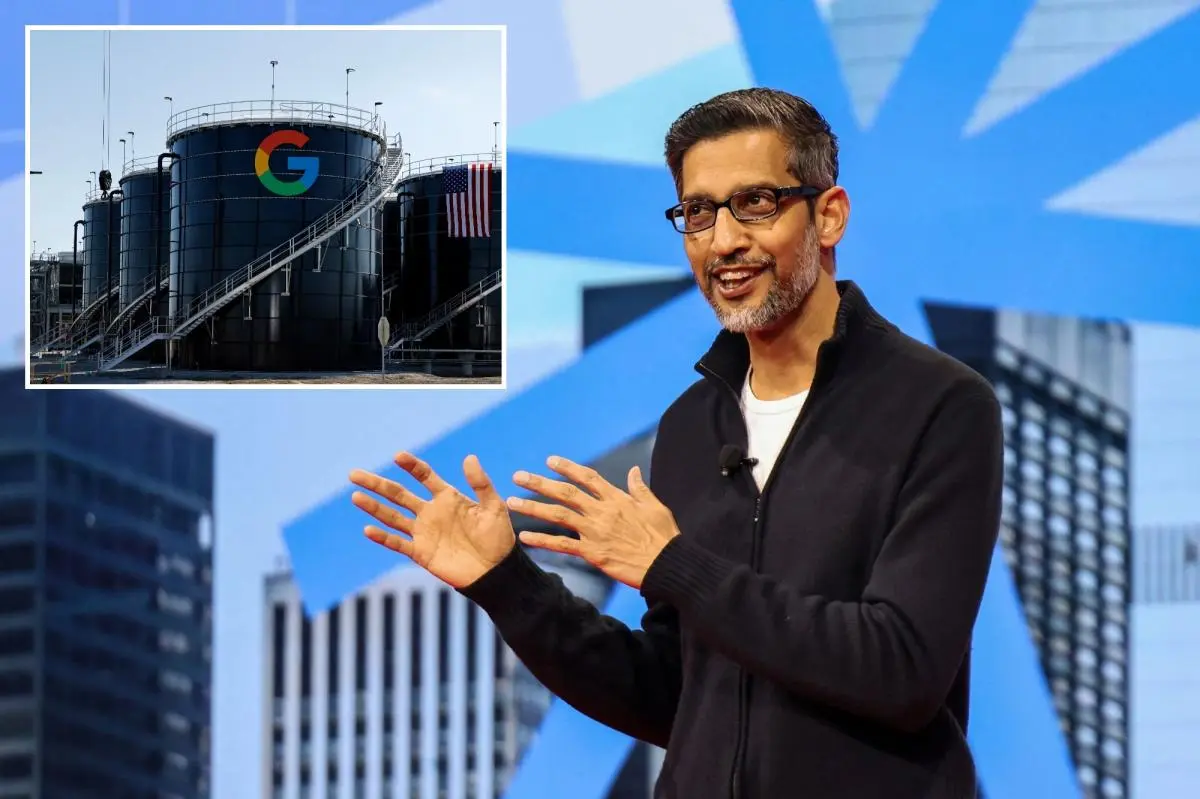
Source: New York Post
The increased capital expenditure reflects Alphabet's determination to compete in the AI arms race alongside other hyperscalers like Meta, Amazon, and Microsoft. CEO Sundar Pichai stated that the company is seeing its AI investments drive revenue growth across the board, with particular strength in its Gemini AI assistant
5
. The spending will split evenly between internal workloads and Google Cloud platform infrastructure, supporting both the company's own products and partners including Apple, OpenAI, and Anthropic3
.Financing AI Investments Through Historic Corporate Bond Sales
To help fund this unprecedented spending plan, Alphabet sold $20 billion in dollar bonds on Monday through a seven-part offering, marking its biggest-ever US dollar bond sale
2
4
. The offering was upsized from an initial $15 billion due to overwhelming demand, attracting more than $100 billion in orders—one of the biggest order books of all time1
2
. The seven tranches mature at intervals starting in 2029 and extending to 2066, with the 40-year portion pricing at 0.95 percentage points above US Treasuries1
4
.
Source: Market Screener
Alphabet is also making a debut sterling bond issuance that includes a rare 100-year bond—the first such offering by a tech company since Motorola in 1997 during the dotcom era
1
4
. Century bonds are highly unusual outside of governments and regulated utilities, with only the University of Oxford, EDF, and the Wellcome Trust having tapped the sterling century market previously1
. A banker familiar with the transaction explained that the multi-currency approach helps expand the investor pool given the massive capital needs, while issuing in sterling proves more cost-effective than the dollar market due to lower interest rates1
.Big Tech Pivot to Debt Markets Raises Investor Concerns
Alphabet's borrowing spree represents a significant shift for Big Tech companies that previously relied on strong cash flows to fund investments. The company's long-term debt jumped to $46.5 billion in 2025, up more than four times from the previous year, though it still held cash and equivalents of $126.8 billion at year-end
1
. Morgan Stanley expects hyperscalers to borrow $400 billion this year, up from $165 billion in 2025, with total high-grade debt issuance potentially reaching a record $2.25 trillion2
.The massive borrowing has sparked investor concerns about whether artificial intelligence will benefit those betting the most. Some portfolio managers are growing cautious about overexposure to companies with complex financial obligations tied to AI investments
1
. Tony Trzcinka, a senior portfolio manager at Impax Asset Management, skipped Monday's offering due to insufficient yields and concerns about hyperscaler capex budgets1
. Analysts note that payoffs have not kept pace with huge AI spending from US tech giants, while businesses adopting generative AI have seen limited productivity gains so far4
.
Source: ET
Related Stories

Revenue Growth Supports Ambitious AI Infrastructure Buildout
Despite the concerns, Alphabet reported strong financial performance that supports its ambitious spending plans. The company's annual sales topped $400 billion for the first time, with fourth-quarter revenue rising 18 percent to $113.8 billion and net income increasing 30 percent to $34.5 billion
5
3
. Google Cloud revenues jumped 48 percent to $17.7 billion in Q4, driven by accelerating growth in enterprise AI products that are generating billions in quarterly revenues3
5
.The company's advertising business also benefited from AI integration, with Gemini AI improving ad relevance for longer, more complex searches that were previously challenging to monetize
3
. Alphabet's ad revenues across Search, YouTube, and Network segments topped $82.28 billion during the quarter, an increase of more than 13 percent year-over-year3
. Capital expenditure from the four biggest US tech companies—Alphabet, Microsoft, Amazon, and Meta—is expected to total at least $630 billion in 2026, with Big Tech companies and their suppliers projected to invest almost $700 billion in AI infrastructure this year1
4
. Nvidia CEO Jensen Huang has characterized this as a "once-in-a-generation infrastructure buildout"2
.References
Summarized by

Navi
[3]
Related Stories
Tech Giants Turn to Bond Markets as AI Infrastructure Spending Triggers Market Concerns
20 Nov 2025•Business and Economy

AI Hyperscalers' Massive Borrowing Boom Raises Shadow Debt Concerns as Companies Chase AI Goals
10 Mar 2026•Business and Economy
Amazon Launches $12 Billion Bond Sale to Fund AI Infrastructure Expansion
17 Nov 2025•Business and Economy

Recent Highlights



Recent Highlights
Today's Top Stories



Your Daily Dose of Curated AI News
Don’t drown in AI news. We cut through the noise - filtering, ranking and summarizing the most important AI news, breakthroughs and research daily. Spend less time searching for the latest in AI and get straight to action.

