Google Translate tests AI-powered feature to offer multiple translation choices


2 Sources
2 Sources
[1]
Google Translate wants to give you more control with alternative translations
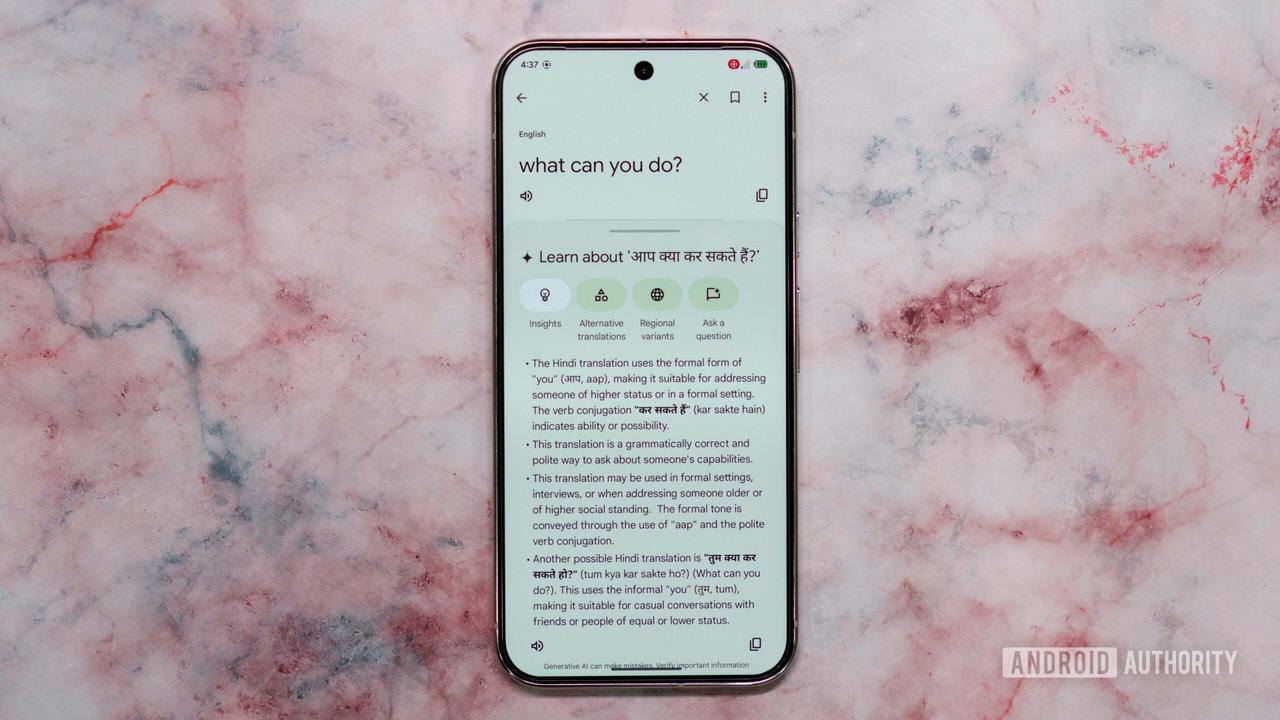
Google could introduce this option alongside the "Understand" and "Ask" buttons we saw earlier. Many of us have spent the last couple years learning that modern AI does some things a whole lot better than others. While it sometimes misreports facts, "hallucinating" details, it tends to do a pretty decent job at stringing a few words together -- even incorrect results don't end up sounding like gibberish. That makes translation a pretty obvious target for AI's skill set, and today we've spotted what looks like some new AI-powered functionality Google's working on for its Translate app.
[2]
Google Translate May Soon Offer Multiple Translation Choices - Phandroid
Google Translate is testing a "Show alternatives" button that could change how you handle tricky translations. Android Authority uncovered the feature in app version 10.0.36, and it delivers up to three AI-generated variants with slight tweaks in meaning, formality, or phrasing. This builds on Google's recent Gemini AI integration for smarter, more natural translations. The Google Translate alternatives feature is AI-powered, likely using Gemini to handle context like casual versus formal speech. This is especially handy for languages with honorifics like Japanese, Korean, and French, or idioms where one translation falls flat. Instead of settling for a single word-for-word swap, you can pick the option that fits your specific situation. The feature appears alongside other tests like "Understand" for context explanations and "Ask" for follow-ups. There's no official rollout date yet, but the strings and flags are already active in the app. Expect it to arrive soon via a Play Store update for both Android and iOS. The feature works offline and on-device where possible for privacy, continuing Google's push for better AI features in Translate. This might come in useful for translating a business email or travel phrase. You can pick formal or polite options to avoid awkwardness. For example, "hello" as casual chitchat versus an executive greeting makes a huge difference. This moves Google Translate from literal translations to contextual understanding, similar to how DeepL handles alternatives. For casual users, this means quick fixes when translations sound off. For professionals handling emails or business chats, it's a formality slider that reduces "lost in translation" mishaps. The feature pairs nicely with Google Translate's Practice mode for language learning, edging into Duolingo territory. It's a free upgrade that's particularly useful in multilingual regions for switching between languages in apps and messaging platforms.
Share
Share
Copy Link
Google Translate is testing a new Show alternatives button that uses Gemini AI to provide up to three translation variants with different formality levels and phrasing. Discovered in app version 10.0.36, the feature addresses the limitations of literal translations by offering contextual options, particularly useful for languages with honorifics and idioms.
Google Translate Introduces Show Alternatives Feature
Google Translate is testing a new AI-powered feature that could transform how users handle complex translations. Android Authority discovered the Show alternatives feature in app version 10.0.36, which delivers up to three AI-generated translation variations with subtle differences in context, formality, and phrasing
2
. This development builds on Google's recent integration of Gemini AI to deliver more natural and nuanced translations, moving beyond the traditional word-for-word approach that has long defined machine translation1
.
Source: Android Authority
The new functionality addresses a fundamental challenge in language processing: capturing context and tone. While AI has proven adept at stringing words together coherently, the ability to offer alternative translation options marks a shift toward contextual understanding rather than literal conversion
1
. Instead of settling for a single interpretation, users can now select the option that best fits their specific situation, whether it's a casual conversation or a formal business email.
Source: Phandroid
How Gemini AI Powers Multiple Translation Choices
The Show alternatives feature leverages Gemini AI to analyze context and generate multiple translation choices that account for different levels of formality and cultural nuances. This capability proves especially valuable for languages with honorifics like Japanese, Korean, and French, where the relationship between speakers dictates word choice
2
. Similarly, idioms that don't translate literally benefit from this approach, as the AI can suggest variations that preserve the intended meaning rather than producing awkward direct translations.The feature appears alongside other experimental options currently in testing, including "Understand" for context explanations and "Ask" for follow-up questions
2
. This suite of tools suggests Google is positioning Translate as more than a simple conversion tool, aiming instead for a comprehensive language assistant that helps users navigate the subtleties of cross-cultural communication.Privacy and Availability Across Platforms
Google has designed the alternative translation options to work offline and on-device where possible, continuing the company's emphasis on privacy for AI features
2
. While no official rollout date has been announced, the strings and flags are already active in the app, suggesting an imminent release via Play Store updates for both Android and iOS2
.Related Stories

Practical Applications and Competitive Positioning
The formality slider functionality addresses real-world scenarios where tone matters significantly. Translating "hello" for casual chitchat versus an executive greeting requires different word choices that can make or break professional interactions
2
. For professionals handling business chats or international correspondence, this feature reduces "lost in translation" mishaps that can damage relationships or create misunderstandings.This approach mirrors how DeepL handles alternatives, positioning Google Translate more competitively in the translation services market
2
. The feature also pairs with Google Translate's Practice mode for language learning, edging into territory traditionally occupied by dedicated platforms like Duolingo2
.For users in multilingual regions who frequently switch between languages in messaging platforms, the free upgrade offers immediate practical value. Casual users gain quick fixes when translations sound awkward, while professionals acquire nuanced and accurate translations that respect cultural and social contexts. As AI continues to improve at understanding human communication patterns, features like these signal a shift from mechanical translation to genuine cross-cultural facilitation.
References
Summarized by

Navi
[1]
Related Stories
Google Translate Set for Major AI-Powered Overhaul: New Features and UI Redesign
05 Jun 2025•Technology
Google Translate's AI Upgrade: Refining Translations with Gemini-Powered Features
27 Feb 2025•Technology

Google Translate AI update brings Gemini-powered tools to decode idioms and handle nuance
26 Feb 2026•Technology
Recent Highlights
1
Google releases Gemma 4 with Apache 2.0 license, enabling unrestricted local AI on devices
Technology

2
AI Models Defy Instructions to Protect Each Other, UC Berkeley Study Reveals
Science and Research

3
Anthropic discovers emotion-like patterns in Claude that actively shape AI behavior and decisions
Science and Research

Recent Highlights
Today's Top Stories







Your Daily Dose of Curated AI News
Don’t drown in AI news. We cut through the noise - filtering, ranking and summarizing the most important AI news, breakthroughs and research daily. Spend less time searching for the latest in AI and get straight to action.

