Humand Raises $66M Series A to Build AI-Powered Operating System for Deskless Workers


2 Sources
2 Sources
[1]
Goodwater and Kaszek Lead Round for 'Deskless Staff' HR App Humand
Startup Humand is betting the next wave of workplace software won't target office employees but the billions of workers who don't sit behind a computer. The startup raised a $66 million Series A round co-led by Goodwater Capital and Kaszek Ventures, to expand its US presence and continue to develop AI agents that automate human resources tasks -- from internal communications to scheduling and training for the so-called "deskless staff." The round featured participation from Y Combinator, Newtopia VC and angel investors including Dropbox co-founder Arash Ferdowsi, Lyft co-founder Rajat Suri and MercadoLibre Inc co-founder Marcos Galperin. Humand's mobile app combines internal communications, scheduling, benefits information and training in a single platform aimed at employees who rely primarily on smartphones. Founded in 2020 by Argentine entrepreneurs who met in college in Buenos Aires, the company began by building its product with steelmaker ArcelorMittal SA before officially launching in 2021. Based in San Francisco, it serves more than 1.5 million workers at 1,500 global firms, including Siemens AG, Home Depot Inc, John Deere and Domino's Pizza Inc. Humand estimates that roughly 80% of the global workforce -- about 2.7 billion people -- work in roles spanning factories, construction sites, retail stores and hospitals, lacking access to a company email or traditional enterprise communications. That makes it challenging for employers to distribute information, manage shifts and deliver training. "We see every workflow in HR as potential for building intelligence on top," co-founder and Chief Technology Officer Nicolas Benenzon said in an interview. Humand is raising capital amid a regional rebound. Startup funding in Latin America totaled about $6.2 billion through the end of 2025, the highest since 2022, when companies in the region raised $9.4 billion, according to PitchBook data. Venture investors in the region are also increasingly focusing their capital around artificial intelligence, with AI accounting for about 26% of the total deal value in 2025, up from around 18% from the previous year. The company, whose typical customer has a workforce that is at least 70% non-desk workers, aims to reach 10,000 corporate clients within five years. "Everyone already uses their phones in Uber to request a car, Amazon to purchase products or DoorDash to order food," Benenzon said. "Why are people not having the same experience for work?"
[2]
Humand secures $66M to scale AI-powered operating system for frontline workers - SiliconANGLE
Humand secures $66M to scale AI-powered operating system for frontline workers Humand Technologies Inc. today announced that it has raised $66 million in new funding to accelerate the expansion of its operating system for deskless workforces across the U.S. and 51 countries and to fund continued artificial intelligence development. Founded in 2020, Humand offers a platform to support deskless workforces, which account for a large portion of global employment across industries such as manufacturing, retail, healthcare, construction and logistics. Traditional enterprise systems have typically been optimized for employees working at desks with computer access, creating gaps in communication, human resources access and operational coordination for frontline staff. The company's approach centers on a unified mobile application that serves as an operating layer connecting workers to core human resources, communications and operational systems, with AI embedded natively into the platform. "Our goal is very simple: We want to become the default operating system for companies with deskless workers," said co-founder and Chief Executive Nicolas Benenzon. "The majority of the global workforce has been overlooked by enterprise software for decades. We're building the platform that finally gives them the same access, voice and digital power as corporate employees." The platform aggregates workforce data and workflows into a single mobile interface, including integrating with existing HR and enterprise systems. AI-driven functionality, including natural language interfaces, then allows workers to submit requests or retrieve information without navigating complex menus. For further assistance, AI agents are embedded across modules to automate routine interactions, surface relevant data and support real-time responses. The system also acts as a system of record for people operations data while functioning as a system of action for task execution and communication. Capabilities of Humand's platform include support for time-off requests, benefits access, performance feedback, internal communications, training delivery and document management. Workers can complete administrative processes, receive updates and interact with AI-powered assistants directly through their mobile devices. The company offers more than 30 modules that cover HR management and internal communications that allow companies to consolidate processes that are often distributed across multiple tools. AI-driven workflows are used to reduce manual handling of employee inquiries and routine HR tasks. Humand said it has found strong demand for its platform and is now used by more than 1.6 million workers across more than 1,500 organizations, including Siemens AG, Home Depot Inc., Deere & Co., MINISO Group Holding Ltd., Chili's, Domino's Pizza Inc. and OXXO. The Series A funding round was led by Kaszek Ventures and Goodwater Capital. Also participating were Y Combinator, Newtopia VC and a number of prominent individual investors. "Humand's mobile-first AI agent platform serves as an intelligent, real-time layer between companies and their frontline teams," said Eric Kim, co-founder and managing partner of Goodwater Capital. "By embedding AI agents across communication, HR, and operations, Humand transforms workplace software from static systems of record into dynamic systems of action."
Share
Share
Copy Link
San Francisco-based Humand closed a $66 million Series A funding round led by Goodwater Capital and Kaszek Ventures to expand its mobile-first platform serving deskless workers. The startup targets 2.7 billion employees in manufacturing, retail, healthcare and construction who lack access to traditional enterprise software, serving over 1.5 million workers across companies like Siemens, Home Depot and Domino's Pizza.
Humand Secures $66 Million Funding Round for Workplace Software Revolution
Humand has closed a $66 million funding round co-led by Goodwater Capital and Kaszek Ventures, marking a significant bet on workplace software for deskless workers who represent roughly 80% of the global workforce. The Series A funding will accelerate the company's US market expansion and fuel development of AI agents for human resources tasks ranging from internal communications and training to scheduling and benefits management
1
2
.The round included participation from Y Combinator, Newtopia VC, and notable angel investors including Dropbox co-founder Arash Ferdowsi, Lyft co-founder Rajat Suri, and MercadoLibre co-founder Marcos Galperin
1
. This startup funding represents a broader rebound in Latin America, where venture capital totaled about $6.2 billion through the end of 2025, with AI accounting for approximately 26% of total deal value, up from around 18% the previous year1
.
Source: Bloomberg
Targeting 2.7 Billion Workers Without Traditional Enterprise Access
Founded in 2020 by Argentine entrepreneurs who met in college in Buenos Aires, Humand estimates that approximately 2.7 billion people work in roles spanning factories, construction sites, retail stores and hospitals without access to company email or traditional enterprise communications
1
. The San Francisco-based company now serves more than 1.6 million workers across over 1,500 organizations, including Siemens AG, Home Depot Inc., John Deere, Domino's Pizza Inc., MINISO Group Holding, Chili's and OXXO1
2
."Our goal is very simple: We want to become the default operating system for companies with deskless workers," said co-founder and Chief Executive Nicolas Benenzon. "The majority of the global workforce has been overlooked by enterprise software for decades. We're building the platform that finally gives them the same access, voice and digital power as corporate employees" .
AI-Powered Operating System for Frontline Workers Transforms HR Mobile Application
The HR mobile application combines internal communications, scheduling, benefits information and training into a unified platform designed for employees who rely primarily on smartphones. Humand offers more than 30 modules covering workforce management functions, allowing companies to consolidate processes typically distributed across multiple tools . The platform integrates with existing human resources and enterprise systems while embedding AI capabilities natively throughout.
AI agents automate routine interactions across modules, with natural language interfaces enabling workers to submit requests or retrieve information without navigating complex menus. "We see every workflow in HR as potential for building intelligence on top," said co-founder and Chief Technology Officer Nicolas Benenzon
1
. The system functions both as a record-keeping tool for people operations data and as an execution layer for task completion and communication .Related Stories

Ambitious Growth Targets for Workplace Software for Deskless Staff
Humand began building its product with steelmaker ArcelorMittal before officially launching in 2021, and now operates across 51 countries
1
. The company's typical customer has a workforce that is at least 70% non-desk workers, and Humand aims to reach 10,000 corporate clients within five years1
.
Source: SiliconANGLE
"Everyone already uses their phones in Uber to request a car, Amazon to purchase products or DoorDash to order food," Benenzon noted. "Why are people not having the same experience for work?"
1
. Eric Kim, co-founder and managing partner of Goodwater Capital, emphasized that "Humand's mobile-first AI agent platform serves as an intelligent, real-time layer between companies and their frontline teams. By embedding AI agents across communication, HR, and operations, Humand transforms workplace software from static systems of record into dynamic systems of action" .References
Summarized by

Navi
Related Stories
Humans& Raises $480M to Build AI Models Designed for Coordination, Not Just Chat
20 Jan 2026•Startups

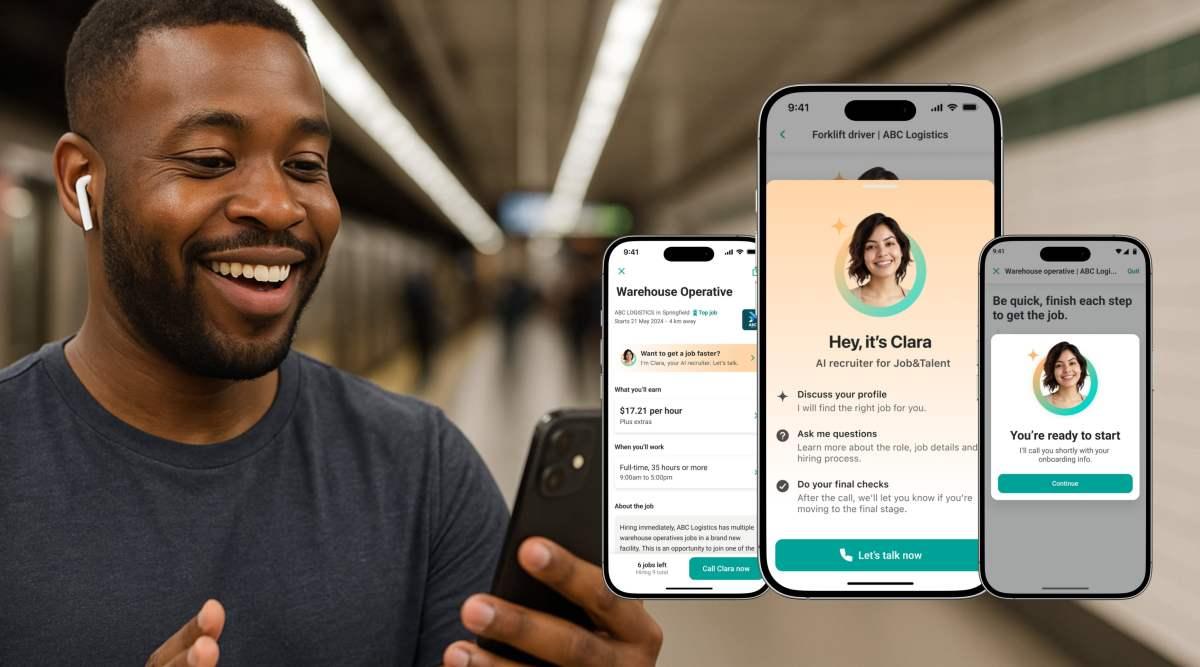
Job&Talent Secures $103M in Down Round, Pivots to AI-Driven Recruitment
11 Apr 2025•Business and Economy
Borderless AI Launches HRGPT: AI-Powered HR Search Engine Backed by $32M Funding
17 Jan 2025•Startups

Recent Highlights
1
Tennessee Teens Sue Elon Musk's xAI Over Grok AI-Generated Child Abuse Images
Policy and Regulation

2
Supermicro Co-Founder Indicted in $2.5 Billion Nvidia AI Chip Smuggling Scheme to China
Policy and Regulation

3
Val Kilmer to appear posthumously in As Deep as the Grave through AI-generated performance
Entertainment and Society

Recent Highlights
Today's Top Stories



Your Daily Dose of Curated AI News
Don’t drown in AI news. We cut through the noise - filtering, ranking and summarizing the most important AI news, breakthroughs and research daily. Spend less time searching for the latest in AI and get straight to action.

