India hosts AI Impact Summit as Modi positions nation to challenge Western tech dominance


42 Sources
42 Sources
[1]
Could India challenge tech boss power at Delhi AI Impact Summit?
Those who shout the loudest about artificial intelligence tend to be in the West, notably the US and Europe. So it's significant that a gathering of powerful leaders is being held in the Global South, a region of the world that runs the risk of being left behind in the AI race. Tech bosses, politicians, scientists, academics and campaigners are meeting at the AI Impact Summit in India this week for top-level discussions about what the world should be doing to try to marshal the AI revolution in the right direction. At last year's AI Action Summit, as it was then known, an ugly power struggle broke out between some Western countries over who should be in charge. The various Western powers jostled for pole position in Paris, and US vice president JD Vance delivered a blistering speech in which he said America's place at the top of the pack was non-negotiable. I suspect there may be a more humble vibe this week in Delhi: the capital of a country which has helped to build the foundations that support this mega-powerful new tech - but is not reaping as much reward as the more affluent west. There are some significant AI hubs in India, including in Bengaluru, Hyderabad and Mumbai. It has a large tech workforce, and has attracted some big infrastructure investments from the likes of Google, Nvidia and Amazon. At the same time, low-paid workers there have long been carrying out the unseen and painstaking task of manually categorising the vast amounts of data used to train the world's AI tools. In her book Empire of AI, the journalist Karen Hao writes about an unnamed firm in India which was contracted to do content moderation of AI-generated images: she claimed it included workers looking at horrifying ones to decide which should be blocked from being reproduced. According to the recruitment website Glassdoor, the average salary for an AI data trainer in Chennai is 480,000 rupees - less than £4,000 ($5,000) per year. It's an essential role, but to put this into perspective OpenAI, the creator of ChatGPT, is valued at over $500bn. The 2026 International AI Safety Report notes that while "in some countries over 50% of the population uses AI, across much of Africa, Asia, and Latin America adoption rates likely remain below 10%." The world's biggest US AI chatbots do not work in all of India's 22 official languages - let alone the hundreds of dialects that exist within them. ChatGPT and Claude currently support around half of them. Google's Gemini supports nine. "Without tech that understands and speaks these languages, millions are excluded from the digital revolution - especially in education, governance, healthcare, and banking," Professor Pushpak Bhattacharyya, from IIT Mumbai, told the BBC last summer. To counter this, India is building its own sovereign AI platforms - the Indian government calls this the AI Mission - but progress is relatively slow. While the US products - as well as Chinese ones such as DeepSeek and ByteDance - race ahead with new releases, many of India's remain in development. The Indian government budget of $1.2bn for this project pales into comparison of the deep pockets of the multi-billion dollar corporations. Before Christmas, an Indian government official told me, perhaps unsurprisingly, that India has little interest in AI's geopolitical power struggles. The country's focus is on harnessing the tech to drive its own growth. "For India, this is about more than technology, it is about economic transformation, digital sovereignty and building capability at scale," said Rajan Anandan, managing director at one of India's biggest tech investors Peak XV. "Within the country there is a strong sense of momentum and confidence." The US, meanwhile, may find itself rather unusually forced into more of a back seat. I imagine it's not going to like that very much. "The Americans will have less to say with the Summit's proposed bottom-up, Global South approach to AI governance that focuses on people, planet and progress," says Professor Gina Neff, an AI ethics expert from Queen Mary University London. "We need governments to act together to shape a more inclusive, democratic and people-centred vision of AI in the face of unprecedented corporate power," argues Jeni Tennison, executive director of the think tank Connected by Data. "As the world's largest 'middle power', India could make that happen," she adds. AI expert Henry Ajder agrees. "I hope we will see pragmatic efforts to move beyond a legislative patchwork towards meaningful consensus in addressing AI harms, maliciously caused or otherwise," he told me. Amanda Brock, chief executive of tech industry body OpenUK, thinks the answer is to force the AI companies to share how their products work so that others can build their own versions, make improvements and properly scrutinise the tech. "For this summit to have any real impact for the Global South, there needs to be access for all to AI and that can only be achieved by opening it up," she argues. There has been movement in that direction, but many of the AI giants are still keeping key elements, such as what training data they use, confidential. Some AI experts have told me privately that they are concerned about how far down the agenda safety and responsibility appears to have slipped. After the first AI Safety Summit, held in the UK in 2023, the word "safety" was quietly dropped from its title. One expert told me they have decided not go to Delhi at all this week as they have little confidence in any meaningful outcomes from it. British computer scientist Professor Dame Wendy Hall is attending the Summit but told me she shares these concerns. She fears there will be "nothing significant" from the event about how to minimise the dangers posed by AI. "It's important that we go but my expectations of anything useful coming out of it are very low," she said. Sign up for our Tech Decoded newsletter to follow the world's top tech stories and trends. Outside the UK? Sign up here.
[2]
Tech billionaires fly in for Delhi AI expo as Modi jostles to lead in south
Google, Anthropic and OpenAI bosses to mingle with global south leaders wrestling for control over technology Silicon Valley tech billionaires will land in Delhi this week for an AI summit hosted by India's prime minister, Narendra Modi, where leaders of the global south will wrestle for control over the fast-developing technology. During the week-long AI Impact Summit, attended by thousands of tech executives, government officials and AI safety experts, tech companies valued at trillions of dollars will rub along with leaders of countries such as Kenya and Indonesia, where average wages dip well below $1,000 a month. Amid a push to speed up AI adoption across the globe, Sundar Pichai, Sam Altman and Dario Amodei, the heads of Google, OpenAI and Anthropic, will all be there. Rishi Sunak and George Osborne, a former British prime minister and a former chancellor, will each be pushing for greater adoption of AI. Sunak has taken jobs for Microsoft and Anthropic and Osborne leads OpenAI's push to deepen and widen the use of ChatGPT beyond its existing 800 million users. Meanwhile Modi, who will address the summit on Thursday, is positioning India as the AI hub for south Asia and Africa. On the agenda will be AI's potential to transform agriculture, water supplies and public health. Governments in Kenya, Senegal, Mauritius, Togo, Indonesia and Egypt will send ministers. Modi's enthusiasm for AI has a darker side, civil liberties campaigners say. Last week they raised serious concerns about India deploying AI to increase state surveillance, discriminate against minorities and sway elections. But Modi this week spoke of "harnessing artificial intelligence for human-centric progress" and India has given the summit the strapline: "Welfare for all, happiness for all." Summit observers talk of a battle between a new kind of AI colonialism from the US tech firms and an alternative "techno-Gandhism", in which AI is used for social justice and to benefit marginalised people. After global AI summits in the UK, Korea and France, the Delhi meeting is the first to be held in the global south. Indian commentators say the test of AI's value is not in its technical sophistication but whether it can improve the lives of people living in some of the toughest circumstances in the global south. By contrast, US AI companies are racing for supremacy, competing with each other and China, and rolling out AI for shopping, personal companionship and agentic systems that could slash corporate labour costs by making white-collar jobs redundant. If a referee between the two sides is needed, António Guterres, the secretary general of the United Nations, will speak in Delhi. This week he said it would be "totally unacceptable that AI would be just a privilege of the most developed countries or a division only between two superpowers". India's AI Impact Summit is the fourth iteration of the event, which Sunak launched in 2023 at Bletchley Park in the UK, with a focus on international coordination to prevent catastrophic risks from the most advanced AI models. Summits followed in Seoul in 2024 and Paris in 2025, where the US vice-president, JD Vance, appeared to abandon the White House's interest in safety saying: "The AI future will not be won by hand-wringing about safety; it will be won by building." Safety is once again on the agenda, with Yoshua Bengio, one of the "godfathers" of AI, on hand to repeat his fears about the risk of powerful AI systems enabling cyber- and bioweapons attacks. "The capabilities of AI have continued to advance, and although mitigation and risk management of AI has also progressed [it has happened] not as quickly," he said on Tuesday. "So it becomes urgent that leaders of this world understand where we could be going and it needs their attention and intervention as soon as possible." One of those working at the summit to make sure AI remains safe will be Nicolas Miaihle, co-founder of the AI Safety Connect group, who noted that the summit was taking place in the shadow of AI-enabled warfare in Ukraine and the Middle East. "The existential risks are not going anywhere," he told the Guardian. "When Rishi Sunak started this, the race was not raging as hard. The trillions are pouring in but we are very far away from securing these models. This is profound for democracy, profound for the mental health of our kids and profound for warfare." But the Trump administration continues its policy of refusing to bind US AI companies with red tape. The White House is not expected to send a high-level representative to Delhi, with Sriram Krishnan, its senior AI policy adviser, the highest-ranked speaker listed in the programme. "Given where we are with the US administration it's pretty unlikely you're going to have a massive breakthrough on any consensus on what a regulatory framework will look like," said one senior AI company source. Companies such as Google are focused on the use of AI in education in India, where large language models' ability to function in many of the country's dozens of languages is an advantage. "[There's] a big focus on access and adoption, how can you make sure that the technology is available as broadly as possible," said Owen Larter, head of frontier AI policy and public affairs at Google DeepMind. "We're excited on the education front in India. It's a remarkable story of an incredibly intense adoption. About 90% of teachers and students already using AI in their learning. We've had a big promotional programme where 2 million students have access to our pro subscription for free." Google's investments in India include a $15bn spend, in partnership with the conglomerate of Gautam Adani, one of India's richest billionaires, on an gigawatt-scale AI datacentre hub in the coastal city of Visakhapatnam, in Andhra Pradesh, with subsea cables connecting to other parts of the world.
[3]
PM Modi, top tech bosses to address India AI summit
New Delhi (AFP) - Indian Prime Minister Narendra Modi and tech CEOs including OpenAI's Sam Altman will give their take on the opportunities and threats posed by artificial intelligence at a global summit in New Delhi on Thursday. They are among those scheduled to speak at the AI Impact Summit as well as Google DeepMind head Demis Hassabis and Microsoft founder Bill Gates. Frenzied demand for generative AI has turbocharged profits for many tech companies, but that has fuelled anxiety about the risks to society and the planet as the technology develops. One fear is disruption to the job market, especially in India where millions of people are employed in call centres and tech support services. "We are creating human imitators. And so of course, the natural application for that type of system is replacing humans," leading computer science researcher Stuart Russell told AFP. This week's summit is the fourth annual international gathering focused on AI, following previous summits in Paris, Seoul and Britain's wartime code-breaking hub Bletchley. It is the biggest one yet, with tens of thousands of attendees including dozens of world leaders and ministers. French President Emmanuel Macron is set to join Modi on stage Thursday at the summit site, which also includes a vast technology expo. The pair met this week in Mumbai where they celebrated their countries' ties, calling them a force for global stability. A multibillion dollar fighter jet deal is also on the table -- with officials travelling with Macron expressing confidence that a contract for India to buy 114 Rafale aircraft can be finalised. New investments As the first global AI meeting held in a developing country, the five-day summit has also been a chance for India to boost its position in the booming sector. The nation expects more than $200 billion in investments over the next two years, IT minister Ashwini Vaishnaw said Tuesday. Google, Nvidia and other US tech titans have unveiled new deals, investments and infrastructure for the South Asian country. "Since my childhood growing up in Chennai, India has undergone an incredible transformation," Google CEO Sundar Pichai told reporters on Wednesday. "India is going to have an extraordinary trajectory with AI and we want to be a partner," he said, pledging to build subsea cables as part of an existing $15 billion AI infrastructure investment. US chip behemoth Nvidia -- the world's most valuable company -- said it was teaming up with Indian cloud computing providers to provide advanced processors for data centres that can train and run AI systems. AI data centres are under construction wordwide on a massive scale, as companies race to develop super-intelligent systems. The huge amounts of electricity needed to power them and water to cool hot servers has sparked alarm at a time when countries have pledged to decarbonise their grids to try and slow climate change. Gridlock Last year India leapt to third place in an annual global ranking of AI competitiveness calculated by Stanford researchers, although experts say it has a long way to go before it can rival the United States and China. Brazil's President Luiz Inacio Lula da Silva is in town to attend the AI summit and hold talks with Modi, including on rare earths. Delhi's chaotic roads have been gridlocked at points and summit organisers have faced criticism over crowded entry points and other disarray, especially on the first day. Leaders are expected to deliver a statement at the end of the week about how they plan to handle AI technology. But some say the broad focus of the event and vague promises made at previous global AI summits mean that concrete commitments are unlikely. Many researchers and AI safety campaigners believe stronger action is needed to combat issues ranging from sexualised deepfakes to AI-enabled online scams and intrusive surveillance. Siddharth Soni, the 23-year-old founder of an Indian AI-designed jewellery startup, said he could see both sides. "We're losing artisans. We're losing the value of art, using AI, actually. That is one of the sad parts," he told AFP.
[4]
Mistral Sees AI as Utility, Emphasis More on Efficiency
AI is becoming an "infrastructure" play and should therefore be treated as a utility, with the focus on efficiency and cost effectiveness, said Arthur Mensch, founder of European AI giant Mistral AI, in an interview with Surabhi Agarwal. AI is becoming an "infrastructure" play and should therefore be treated as a utility, with the focus on efficiency and cost effectiveness, said Arthur Mensch, founder of European AI giant Mistral AI, in an interview with Surabhi Agarwal. The Paris-headquartered firm raised over $2 billion in Series C funding in September 2025, led by chip equipment maker ASML, taking its valuation to $14 billion and making it the most valuable European AI company. Mensch, 33, said the company is looking to partner with sovereign cloud providers in India. Edited excerpts: What lessons can India draw from Europe since there are parallels between the AI ecosystems of the two? What India can do, which we are starting to do as an ecosystem in Europe, is to actually behave as an ecosystem and make sure that Indian entrepreneurs are running their companies from here and not from Silicon Valley. Because if all this innovation power flows to the US, then it is lost to you. In Europe, we are getting there. The ecosystem is younger than the US and, of course, there are some frictions in certain places, but it is getting older and becoming easier to hire people. In India, it is going to be the same. Is there too much concentration of technology creation in the US? The problem of market concentration is that it gives excessive leverage to your supplier... who is buying digital services. It puts our customers at a disadvantage, because some of their suppliers are coming to them and telling them, "Look, you're running your data... it's hosted by us. It's going to be more expensive for you." And tomorrow, the problem is that it's not the data, it's going to be the processes and the digital workers that are going to be operated by them.It's a control that can be used for geopolitical reasons, or to just increase the economic imbalance and so on. At Mistral, it puts us at an advantage because suddenly our customers at the end point are realising that the market concentration is currently too high. We happen to have made a software style that can be downloaded and deployed for free. That business proposition is actually a way to increase the leverage of our customers against their suppliers who are promoting a centralised deployment. What can India learn from your approach? A lot of our researchers are actually from India, and we have much more to learn from India than we have to teach it. We've seen Indian labs use our models to make them better at certain languages. So the bet on open source is the way to reduce the leverage that a handful of providers have today.Second is, building infrastructure oneself. It is something we are doing in Europe, because our customers ask for more decoupling from their digital service providers. We see India making a lot of investments in it, not only to serve US providers, but also Indian providers. We can be a partner to these constructions because we can bring some of the software bricks that can then be deployed.The third thing is going all the way to the creation of value for enterprises. We walk with the subject matter experts to transform a description of a process or a description of how a machine is operating to build an AI system to either automate the process or actually activate the machine better. Enterprises come to us because we can help them automate their core businesses. Do you feel there is already some froth in the US market, since there are concerns over an AI bubble, that the investments going into building compute are not justified by the returns? I'm not going to comment on our competitors, but the market to build the business is large. Leverage is good, but leverage has a price. For us, that means we need to be very careful -- to scale but focus on efficiency. Are you scaling fast enough? Everybody sets their level of risk appetite. It's pretty clear that some are taking pretty heavy risks. But it is important to think that when you have a lower market concentration, you need to be more efficient. The amount of competition is very high, which means most of the market will not be concentrated with a few businesses. It will reduce.What that means is that with AI being an infrastructure business, you should run it as an infrastructure business. When you run an infrastructure business, you also focus on the return on investment on capital invested and metrics that are boring for a tech company but are very well known for a utility company. And as technology is becoming a utility, AI is very much a utility. Your peers are investing heavily in data centres and compute capacity. Do you feel Mistral also needs to expand on this significantly? We're scaling aggressively, and we will have more than 200 MW by the end of 2027 under management. We are doing it in a financially reasonable way, working towards having a stable profitability. And we've been very capital efficient when it comes to training on models, focusing on efficiency rather than scale. Do you feel disadvantaged being headquartered in Europe, in terms of funding, since it's capital intensive? We have a Palo Alto office that I spend a lot of time in, and (Mistral) is headquartered in Paris, where I live. But access to capital has not been a problem. Capital is global, and it basically goes wherever investors think the market is going to be.I would even say a part of our value proposition is actually anchored in not being a US company. That attracts a different kind of investor. ASML invested in us because we are helping them, but there is a secondary European story behind it as well. Investing in India, investing in Europe is also a way for investors to be smarter than the others and diversify. How do you look at your global strategy? What are your expectations for the India market, in terms of creation and adoption of your models? India is a new market for us -- we are starting to hire locally on the commercial side for the moment. It is a market where we had some strong connections with GSIs (global service integrators), as our customers were working with either Indian providers or with global providers with a very big Indian footprint.We are very eager to work in two areas: startups who are using our open source models and the other sector where there is some convergence -- defence.We are very strong at making small models that are specifically made for a purpose. And small models have a lower footprint, which means that they are less expensive. The fact that we can place a software stack on top of local infrastructure means we are looking to partner with sovereign cloud providers. Are you in talks with companies for partnerships on this visit? We have met a few, but I have nothing to announce yet. What are key takeaways from Prime Minister Narendra Modi's plenary session at the AI summit? Prime Minister Modi made a very interesting point about artificial intelligence being a technology that needs to be brought to everyone and about self-reliance: this was too important a technology for them to depend on others.What that meant was local infrastructure, Indian local models, and applications. (Mistral) has built the entire full-stack offering on artificial intelligence in a way where we can enable self-reliance in every country and for every business. In the keynote I gave after, I made a point that if you want such a technology to be decentralised, (one) needs to bet on open source. We have led the way in that -- leasing open-source models and building our business model atop that. India must bet on open source to reduce the leverage that a handful of providers have today... We can be a partner to help India build critical infrastructure and create value for enterprises.
[5]
What's happening in India with AI is really amazing: Sam Altman lauds speed of tech adoption
Highlighting the rapid adoption of tools like Codex, which he expects to become the world's largest market "pretty quickly", Altman signalled that India's tech ecosystem is on the verge of a massive, AI-driven entrepreneurial explosion. "What's happening in India with AI is really quite amazing". That was the verdict from OpenAI CEO Sam Altman on Thursday as he signalled a major vote of confidence in India's tech landscape. Altman praised India's current "conviction" to invest across the entire AI stack. Highlighting the rapid adoption of tools like Codex, which he expects to become the world's largest market "pretty quickly", Altman signalled that India's tech ecosystem is on the verge of a massive, AI-driven entrepreneurial explosion. "What's happening in India with AI is really quite amazing. The country's conviction to invest in everything from the infrastructure layer to the model layer to the application layer on top, and the rapid adoption of the tools by people here is really quite something," he said. India is the fastest-growing market for Codex, he said in a reference to OpenAI's specialised artificial intelligence system designed specifically for computer programming. "Someone told me, I think it'll be the biggest Codex market in the world pretty quickly. I don't know what this is going to mean for the country, but I don't know of any country that is adopting AI with more vigour or faster, and my sense is there will be, at a minimum, an incredible new generation of startups very quickly," he said. On when Stargate can be expected to expand to India, Altman said, "That is more of India than us, but we like to see it happen fast". To a question of India's big AI infrastructure with a big line up of USD 100 billion investments in pipeline and whether OpenAI would be open to partnering with India in a bigger way, Altman said, "We would love to". On India's regulations on AI labelling and its dialogue with industry on age-gating, Altman believes different countries will try different approaches, and there will be learnings from what works and what doesn't. "And I suspect we'll move more towards global standards. But even then, it will never be all the same everywhere...in different countries, people will try different things. I suspect different countries will say...total ban on social media for young people, partial ban, no ban at all. And we'll observe how it goes over time," Altman said. For AI, it would be something similar. "People will say, if content is used as an AI tool for assistance at all, it comes to AI content. Other countries will say it makes no difference. Some people try something in the middle. And this is like one thing I like about national serenity in different countries," he said. Altman expects AI to have a big impact on "current kinds of jobs". " (For) Many jobs, it'll be a partial impact. Some jobs will change entirely, and new jobs will be created completely," he said. New technology and new kinds of jobs emerge quickly, he said, adding that this is also the reason why the reskilling question is so hard. "But I think right now, we're in a period where saying exactly what the most, the best jobs are going to be in another 10 years feels very hard. There are skills like resilience, adaptability, fluency, with AI tools, for sure, it is a good idea," he said, adding that "I think everybody does need to learn to get good at using AI tools". Addressing the potential cognitive impact of AI on students, Sam Altman recalled how teachers "panicked" when Google first launched, warning students that their "brains are going to rot" because there was "no point to teach history" if facts could be looked up instantly. Ultimately, Altman observed that "the system adapted" as society realised that brainpower could be used in "some different way", while tools handled basic information retrieval. "It's very important to learn how to think. And there are things that I learned, like learning to write an essay, even if today I might use ChatGPT...I'm glad I learned the old-fashioned way, because I learned something about how to think, and it is still useful to me. And if we don't make any changes to the way that we teach and evaluate our students, maybe they will do too much cognitive offloading into ChatGPT or whatever," he said. Looking toward the future, Altman said people will have AI tools, emphasising the need to come up with new ways to teach, challenge and evaluate students. "...assume they have the tools, but still make them think and be creative and figure out how to stretch their brain. I have no doubt we can do that. When the tools get better, the expectations have to go up," he said.
[6]

AI is the new trade language -- and India is shaping the chip currency of trust
Insights from Industry Leaders on the Future of Enterprise AI Ashok Chandak, President : IESA and SEMI India "The India AI Impact Summit inaugurated by honourable Prime Minister Narendra Modi today comes at a pivotal moment when technology, trade, and geopolitics are converging. For India, AI is no longer just a digital transformation story -- it is an industrial and strategic one. The summit signals India's intent to build a trusted, scalable AI ecosystem anchored in strong semiconductor and electronics capabilities, and this aligns closely with the momentum we are seeing in the India-EU FTA discussions, the India-US technology and trade partnership, and several emerging G2G technology corridors. Across these bilateral and multilateral engagements, one message is consistent: AI leadership will depend on secure supply chains for semiconductors, electronics systems, compute infrastructure, and advanced manufacturing. As nations look to diversify and de-risk technology ecosystems, India is increasingly seen as a reliable partner for design, innovation, and trusted electronics production. The AI push therefore reinforces India's role in global semiconductor value chains -- from chip design and embedded systems to packaging, materials, and next-generation electronics. What struck me most about Minister Vaishnaw's address today is the parallel he drew between the Semiconductor Mission and the upcoming 'Create in India' mission for AI. Now, India is truly replicating that playbook for AI, and it's brilliant. For those of us who've watched India's semiconductor journey from the sidelines, today feels like vindication -- and a glimpse of what's next. From the industry side, the response has been very strong. Over 50 global and Indian leaders from SEMI and IESA member companies are participating in the Summit as speakers, panelists, and strategic partners. Many more companies are showcasing technologies and solutions in the exhibition and engaging in government and industry dialogues. This collective participation reflects the industry's commitment to align semiconductor and electronics growth with India's AI ambitions -- accelerating innovation, strengthening supply-chain resilience, and enabling real-world AI deployment across sectors. The AI momentum we are witnessing today is inseparable from semiconductor momentum. Chips, systems, and AI algorithms are now layers of the same innovation stack. As India deepens partnerships with the US, EU, and other leading economies, the integration of AI strategy with semiconductor and electronics manufacturing will be central to building a trusted, globally connected, and innovation-led digital economy." Aman Singh, Co-founder, S45 "At the India AI Impact Summit 2026, the defining shift is from experimentation to operationalisation. The real conversation is no longer about access to models or compute, but about embedding AI into core industry workflows at scale. Across regulated sectors like capital markets, the bar is materially higher. Systems must be compliant, auditable and aligned with governance frameworks from inception. Infrastructure, policy clarity and workforce readiness are becoming as critical as technical capability. Competitive advantage will accrue to firms that can translate AI capability into production-grade systems with measurable outcomes. In capital markets specifically, this means moving beyond analytics overlays toward AI-native operating layers that redesign document workflows, due diligence processes and transaction intelligence. The broader takeaway from the Summit is clear: India's AI opportunity will be realised not through pilots, but through disciplined deployment into the economic rails that power growth." Saurabh Nigam, President & Chief AI Solutions Officer, iStreet Network "As India positions itself as a global AI powerhouse, the real challenge is not access to AI -- but adoption at scale. Many enterprises are still grappling with fragmented data, legacy infrastructure, talent gaps, and concerns around security and compliance. At iStreet Network, we see these not as barriers, but as transformation opportunities. Our focus is on helping organizations move from AI experimentation to enterprise-wide impact. We enable this by building scalable AI and Generative AI frameworks, modernizing data architectures on secure cloud environments, and embedding responsible AI governance into every deployment. One of the biggest challenges today is aligning AI investments with measurable ROI. We work closely with CXOs to design use cases that directly improve operational efficiency, customer experience, and revenue growth -- rather than deploying AI for novelty. Another critical area is change management. AI adoption requires cultural transformation, not just technology implementation. Through structured capability building, cross-functional collaboration, and automation-led workflows, we help enterprises future-proof their workforce. India has the scale, talent, and digital maturity to lead in AI. With the right strategy and responsible execution, we can overcome today's AI challenges and turn them into sustainable competitive advantage." Padmanabhan Desikachari, Non - Executive Director, iStreet Network Limited India is at a defining moment in AI. For the first time, barriers to digital participation are breaking down through voice interfaces and AI systems that understand Indian languages, bringing millions into the formal digital economy. This is transformational. But India's scale changes the equation -- experimentation is not enough. AI deployments must operate reliably across vast populations and deliver meaningful cost efficiency. With constrained and premium-priced GPU infrastructure, production systems have to be architected for resilience, optimization, and affordability from day one. At the same time, the software workforce is entering a structural shift. Routine coding will increasingly be automated by AI agents, and engineers who remain focused only on syntax risk becoming irrelevant. The future belongs to those who can architect systems, validate outputs, ensure security and governance, and align AI to real business outcomes. If we combine multilingual AI access, scalable infrastructure, and rapid upskilling of talent, India can move beyond adoption and emerge as a global leader in population-scale, economically viable AI deployment
[7]
AI to profoundly transform global economy, world equilibrium in the coming years: Mistral AI CEO
Mensch highlighted India's "extremely large" opportunity in artificial intelligence, driven by its vast talent pool, cultural diversity, ambition, and massive market size. By controlling its own AI, India can emerge as a "global hub for innovation" and "lead the way for the entire world", he asserted. Artificial intelligence will profoundly transform the global economy and world equilibrium in the coming years, but excessive leverage must be banned for stability, Mistral AI CEO and Co-founder Arthur Mensch said on Thursday. "AI is going to change pretty profoundly the way economy is being run in next few years...the equilibrium in the world. And in order for the equilibrium to remain sustainable and stable, we need to have to ban excessive leverage, and India is a leader in betting on self-reliance, which is absolutely critical for a country of this size," he said. Mensch highlighted India's "extremely large" opportunity in artificial intelligence, driven by its vast talent pool, cultural diversity, ambition, and massive market size. "We believe that India opportunity is extremely large in its talent. A quarter of our researchers are actually Indians. Its diversity of culture and its ambition, and the size of the market and the size of its industry is giving it immense leverage when it comes to building artificial intelligence that will be differentiated," Mensch said during the AI Impact Summit here. By controlling its own AI, India can emerge as a "global hub for innovation" and "lead the way for the entire world", he asserted. Addressing businesses, Mensch advised that adopting AI "is going to take some time, but it's going to bring immense leverage". "You have unique assets in your companies. You have IP, you have knowledge, you have folklore knowledge, the way you're processing... the way you're operating your business is different from the way your competitors are operating it," he noted. He also stressed that AI is not about replacing humans; it's about giving them a way to delegate many of their tasks. "It's about enhancing what serves them, and it's about solving real problems. So at this time, we work with public services. We work with healthcare. We work on making sure that citizens can access information in an easier way, in a faster way. We work on making sure that unemployed people ...are able to find a job faster...," he explained. AI should be a tool that empowers people, businesses and ensures that governments can improve the quality of their services and the lives of the citizens. However, it only works if everybody can access it and if everybody understands how to use it. "That's why multilingual AI is actually a very strong necessity. That's also why we need to focus on training people and on bringing them the technology at an affordable price," he explained.
[8]
AI Summit 2026: Building India's sovereign AI is key to productivity and resilience, says Jeet Adani
AI Summit 2026: India needs to build its own artificial intelligence infrastructure to secure its future. Jeet Adani of Adani Group emphasizes energy, compute, and cloud sovereignty. This approach ensures AI benefits Indian citizens first, enhancing productivity and national capabilities. The Adani Group plans a significant investment in a sovereign, green-energy-powered AI platform. India must develop its own artificial intelligence (AI) infrastructure to safeguard national sovereignty and not depend on imports, Jeet Adani, executive director of the Adani Group, said on Thursday, warning that AI will fundamentally reshape global power dynamics. Speaking at the India AI Impact Summit, Adani outlined a vision for what he termed India's "Intelligence Century," anchored on three pillars of sovereignty: energy, compute and cloud, and services. He stressed that AI should first serve Indian citizens, enhancing productivity and infrastructure, rather than merely generating profits for global corporations. Also Read: Superintelligence soon? OpenAI CEO Sam Altman predicts advanced AI could arrive within a few years "AI is written in code. But it runs on electricity... energy security is intelligence security. And sustainable energy becomes a competitive advantage," he said, highlighting plans to integrate renewable energy clusters with AI data centres and industrial corridors. Adani emphasised the importance of compute and cloud autonomy. "Cloud sovereignty does not mean isolation. It means autonomy... India must host critical AI workloads domestically. Domestic access to high-performance compute is essential for our startups, academia, defence, healthcare, and manufacturing," he said. He warned that reliance on foreign infrastructure concentrates strategic leverage abroad, creating national fragility. On the services front, Adani noted that while India's IT revolution made it a global services powerhouse, much of the productivity gains flowed elsewhere. "Our AI must first amplify Indian productivity... enhance our agricultural resilience, personalise education at scale, optimise networks of logistics and ports, improve energy distribution efficiency, modernise manufacturing competitiveness, expand healthcare diagnostics across rural India and deepen financial inclusion across Tier 2/3 towns and villages," he said. He reiterated that this approach is not protectionism but strategic preparedness. "AI must become a force multiplier for Indian citizens before it becomes a margin multiplier for others. This is not isolation. This is strategic maturity." Also Read: AI Impact Summit: PM Modi gives MANAV vision, pitches 'develop in India, develop for the world' Adani also highlighted the group's commitment to invest USD 100 billion in a sovereign, green-energy-powered AI platform, describing it as "the trigger for a 5-gigawatt, USD 250 billion integrated energy-and-compute ecosystem engineered to anchor India's Intelligence Revolution." By integrating renewable energy, grid resilience, and hyperscale computing into a unified system, the initiative aims to ensure that India's AI future is powered, secured, sovereign, and nationally scaled. He framed AI infrastructure as a matter of national security, drawing parallels to historical shifts in geopolitics. "Just as electricity-powered industry reshaped nations, oil reshaped geopolitics, and the internet transformed commerce, artificial intelligence will redefine sovereignty," he said. Adani concluded with a broader message on India's role in the AI century: "The central question before the country is not whether to adopt AI, it is, will India import intelligence -- or architect it? Will it consume productivity -- or create it? Will it plug into someone else's system -- or build the system? The time for asking is now over... The question is whether the AI century will carry India's imprint in its infrastructure, in her intelligence, in her standards, and most importantly -- in her values. I believe - deeply and without hesitation -- that she will."
[9]
Superintelligence soon? OpenAI CEO Sam Altman predicts advanced AI could arrive within a few years
OpenAI CEO Sam Altman has issued a striking prediction about the near-term future of artificial intelligence, suggesting that early forms of superintelligence could appear within just a few years. Speaking at a public forum in India, Altman said, "By the end of 2028, more of the world's intellectual capacity could reside inside data centers than outside them." Altman, speaking at the AI Impact Summit, highlighted the rapid progress of AI systems. Under his leadership, OpenAI launched ChatGPT and reshaped global conversations about artificial intelligence. Also Read: AI Summit: 'AI won't kill work,' says Mukesh Ambani amid job market panic "We've gone from AI systems that struggle with high school-level math to systems that can do research-level mathematics and derive novel results in theoretical physics," he said. He also praised India's role in AI development, noting the country's efforts to put AI to work broadly and inclusively. "One in 100 million people in India uses ChatGPT every week. More than a third of them are students. India is also the fastest-growing market now for Codex, our coding agent that helps people develop software faster and better," Altman said. He underscored the unique position of India, "India, the world's largest democracy, is well-positioned to lead in AI -- not just to build it, but to shape it and decide what our future is going to look like." Altman described the potential impact of superintelligence on society and the economy. "A superintelligence, at some point on its development curve, would be capable of doing a better job as CEO of a major company than any executive could, or certainly doing better research than our best scientists," he said, emphasising both the promise and the uncertainty of these systems. He outlined three guiding principles for OpenAI's approach to AI development. First, democratisation of AI: "Democratisation of AI is the only fair and safe path forward. The future...has got to look like a world of liberty, democracy, widespread flourishing, and an increase in human agency. Some people want effective totalitarianism in exchange for a cure for cancer. I don't think we should accept that trade-off, nor do I think we need to." Also Read: AI Summit: PM Modi pushes three-point agenda for responsible AI Second, AI resilience: "We need a society-wide approach for how we're going to defend against risks, such as extremely capable bio models that could help people create new pathogens. No AI lab, no AI system can deliver a good future on its own." Third, broad societal involvement: "The future of AI is not going to unfold exactly like anyone predicts...Most of the important discoveries happen when technology and society meet. Sometimes there is friction, and we co-evolve." Altman highlighted uncertainties around AI in governance, warfare, and global social contracts, stressing the need for debate and preparedness. A key part of OpenAI's strategy is iterative deployment, giving society time to integrate and respond to each new level of AI capability. Altman argued this method has allowed people to use and understand AI safely while preparing for more advanced systems. He also addressed the economic implications: AI could make many products and services cheaper and accelerate growth, while also disrupting existing jobs. "As AI can do more and more of the things that drive our economy today, it'll be very hard to outwork a GPU in many ways -- but easier in some other ways. Technology always disrupts jobs. We always find new and better things to do." Altman framed the development of AI as a generational challenge: "Each generation builds on the work of previous generations, and with new tools, the scaffolding gets taller...It is a moral imperative to make sure our great-great-grandchildren can have the same opportunities. Technology, and especially AI, is how we're going to get there for a democratic AI future." He concluded with a warning about global governance: "The next few years will test global society. As this technology continues to improve at a rapid pace, we can choose to either empower people or concentrate power...something like the IAEA may be needed for international coordination of AI, especially to rapidly respond to changes in circumstances."
[10]
India to become global testbed for tangible AI use cases: Nandan Nilekani
India is set to become the world's hub for artificial intelligence, moving it from theory to practical use. Nandan Nilekani and Dario Amodei discussed how India's digital infrastructure can help deploy AI widely. The focus is on ensuring AI benefits everyone, not just a few. India will become the global testbed where artificial intelligence moves from hype to real-world impact, Infosys co-founder and non-executive chairman Nandan Nilekani said on stage at the India AI Impact Summit. "India will be where you will see most of the deployment of AI in a tangible way," Nilekani said during a fireside chat with Dario Amodei, CEO of Anthropic.Also Read: AI Summit 2026: Tata's N Chandrasekaran makes bold AI bets while Dalal Street anxiety grips TCS For Nilekani, the question is no longer whether AI models will become powerful -- but whether societies can diffuse that power at scale. Drawing on India's experience building digital public infrastructure such as Aadhaar and UPI, he argued that technology adoption is as keeping as much about institutions, trust and execution as it is about code. "Diffusion is difficult. It's not a simple task," he said. "If all the investments in AI are going to deliver value to society -- not just to individuals -- we have to build pathways to take this to everyone." He announced a global initiative to create "100 diffusion pathways by 2030" -- playbooks that combine technology, guardrails, policy alignment and institutional coordination to deploy AI safely and at population scale. The idea, he said, is to shorten implementation cycles from months to weeks by building on lived experience. Amodei, whose essay Machines of Loving Grace imagines a world transformed by advanced AI, struck a complementary note. While model capabilities are improving at exponential speed, he said, real economic impact takes time. "There's a duality between the fundamental capabilities of the technology and the time it takes for those capabilities to diffuse into the world," he said. Even if AI progress froze at today's level, he added, the economic upside could be far larger than what is currently visible if enterprises are able to adopt it effectively. Also Read: AI Impact Summit: PM Modi gives MANAV vision, pitches 'develop in India, develop for the world' On India, Amodei said the country presents a "particularly key distillation" of AI's promise and risks. With strong technical talent, rapid developer adoption and enthusiasm across enterprises, he sees India as uniquely positioned to accelerate growth potentially even enabling unusually high growth rates if AI is embedded effectively across sectors. But both leaders cautioned that benefits must be broad-based. Nilekani warned that if AI only leads to job disruption, deepfakes or higher electricity bills, it will face backlash similar to the resentment triggered by globalisation. "This AI has to carry everybody. Everybody must feel it. Everybody must benefit from it," he said, pointing to agriculture, healthcare, language access and education as early areas where tangible use cases are already emerging. Amodei also emphasised the need to balance opportunity with safeguards, especially in democracies. From economic displacement to system safety and geopolitical risks, he said, the Global South may have more to gain from AI-driven catch-up growth but cannot ignore the risks. The conversation ended on a note of ambition. "India needs AI, and AI needs India," Nilekani said. The world, he argued, needs to see AI working at scale -- improving farmer incomes, healthcare outcomes and access to services in local languages. And that proof, he suggested, will likely come from India first.
[11]
AI Summit: India has central role in shaping AI's future, Anthropic CEO Dario Amodei says
AI Impact Summit 2026: India has an "absolutely central role" to play in shaping both the opportunities and risks of artificial intelligence, Anthropic CEO Dario Amodei said on Thursday, underlining the country's importance in the global AI ecosystem and pointing towards the company's scale-up intitatives in the country. Speaking at the AI Impact Summit in New Delhi, Amodei said India, as the world's largest democracy, can emerge as a leader in addressing the economic, societal and security challenges posed by advanced AI systems. Also Read: Tata's N Chandrasekaran makes bold AI bets while Dalal Street anxiety grips TCS "India has an absolutely central role to play in these questions and challenges, both on the side of the opportunities and on the side of the risks," he said. 'Country of Geniuses in a Data Centre' Amodei described AI's trajectory as exponential over the past decade, comparing it to a "Moore's Law for intelligence". He said AI models are only a few years away from surpassing the cognitive capabilities of most humans across many tasks. "We're increasingly close to what I've called a country of geniuses in a data centre -- a set of AI agents more capable than most humans at most things, coordinating at superhuman speed," he said. While such capabilities could help cure long-incurable diseases, radically improve health outcomes and lift billions -- including across the Global South -- out of poverty, he cautioned that the technology also poses serious risks. Among the concerns he flagged were autonomous AI behaviour, potential misuse by individuals or governments, and economic displacement. Anthropic Expands India Presence Signalling its commitment to India, Anthropic this week opened an office in Bengaluru and appointed Irina Ghose as Managing Director for Anthropic India. The company also announced partnerships with major Indian enterprises, including Infosys. He said the company has announced partnerships with major Indian enterprises, including Infosys, to advance practical AI adoption across sectors. The collaboration will focus on deploying Anthropic's AI models to drive innovation in areas such as digital infrastructure, enterprise transformation and locally relevant applications, reinforcing India's central role in shaping the global AI ecosystem. Also Read: Infosys partners with Anthropic to deliver enterprise AI solutions Amodei said technologies pioneered in India have historically helped set standards across the Global South. Anthropic is working with Indian non-profits such as EkStep Foundation, Pratham and Central Square Foundation to deploy AI models in digital infrastructure, education, agriculture and health. The company is also partnering with global institutions to evaluate its Claude model's performance across India's regional languages and locally relevant tasks such as agriculture, legal services and education. Economic Disruption and Policy Collaboration Amodei said Anthropic is keen to work with India on safety testing and economic research as part of the New Delhi Frontier AI commitments. Amodei thanked Prime Minister Narendra Modi for convening the summit, saying the "energy and ambition" in India's technology ecosystem was "palpable, unlike anywhere else".
[12]
ET GBS 2026: 'India's edge is in applying AI where it matters most'
New Delhi: In a room full of policymakers, executives and investors debating the future of artificial intelligence (AI), Raul John Aju, a 16-year-old AI prodigy and founder of AIRealm, posed a deceptively simple question: What does India have? He let the silence linger before answering it himself. "I'm not saying India needs another image generator. I'm not saying India needs another video generator," he said during his session at the ET Now Global Business Summit. "We need to solve real problems. That is how we are going to set ourselves apart." At a time when the global AI conversation revolves around scale, such as bigger models, larger data centres and deeper pockets, Aju's argument was different. India's edge, he suggested, would not come from competing with Silicon Valley or Beijing on compute power. It would come from applying AI where it mattered most. Rewinding to the dot-com bubble, he invoked the companies that survived when others collapsed. "Google and Amazon... they both have one thing in common - they solved a real problem," he said. "New, innovative ideas - that is what set them apart." That, he argued, is the playbook India must follow. He began with education. On the screen flashed an image of a 1957 Ambassador car, followed by a sleek AI-enabled vehicle from 2025. Then came two classroom images, decades apart but nearly identical in format. "We are developing cars, but what about our classrooms? Still a teacher standing in front of 60 people. Does that make any sense?" he asked. "School should not teach us what to think. It should teach us how to think." AI, he argued, offered a way to personalise learning for different styles and interests. "Everyone learns differently," he said. "Education also can't be one-size-fits-all." Aju pointed to Thinkraft Academy, a free AI learning initiative he launched. "More than 7 lakh people have watched these courses, and it's completely free," he said, describing modules that take learners from understanding AI basics to building applications in 30 days. The demand, he suggested, proved people want accessible, practical AI education. Another example showed that "more than 56% of chemicals were saved" through targeted fertiliser use. Yet adoption remains low because the technology costs $57-90 on average. "We have the technology... we just have the accessibility issue. We just have to make it cheaper," he said. Aju then turned to agriculture, a sector employing more than 50% of India's workforce. "Right now, farmers are just doing guesswork," he said, referring to fertiliser and water use. He pointed to an Indian startup using sensors and AI to optimise farm inputs. "Twelve thousand farmers have already used it... and they have saved more than 50% of water," he said. But adoption remains limited because of cost barriers. "We have the technology... we just have the accessibility issue. We just have to make it cheaper," he said. In defence, he said, AI is already embedded at India's borders through swarm bots and secure in-house models for the armed forces. Despite spending "around 50 million only" compared to billions elsewhere, he said, India is innovating strategically. Aju's own company, AIRealm, applies AI to legal assistance, helping users identify relevant laws and connect with lawyers. "Rather than trying to create a full ChatGPT for everything," he said, his focus is domain-specific tools. By the end of the session, the thesis was clear. "The most powerful thing AI can do has nothing to do with size, but everything to do with solving what matters," Aju said. "Stop competing in someone else's race and start building your own race. That is what will set you apart."
[13]
'Prioritise Applied AI': Kore.ai CEO urges pivot toward practical innovation to lead global wave
Kore.that India should prioritise "applied AI" over creating expensive models. He dismissed job-loss fears, asserting that people will adapt by learning new skills. Koneru emphasised that India's vast human potential makes it uniquely suited to lead the global AI revolution. Raj Koneru, founder and CEO of Kore.ai, on Wednesday asserted that India is better suited than any other nation to lead the next wave of artificial intelligence, urging the country to prioritise building "applied AI" to fully leverage its massive human potential. Speaking to in the national capital, Koneru highlighted India's unique position in the global AI landscape. While acknowledging that developing foundational models is resource-intensive and India lags in that area, he emphasised that the real opportunity lies in practical application and enablement. "I think India should focus on creating applied AI, not creation of new models. I think creation of new models is way too expensive, and India is way behind in that. But using the models and using every other innovation that's happening in the world, building applied AI is the opportunity," Koneru stated. He pointed out that Kore.ai, a company "born out of India," has been developing AI products for over 12 years using local talent. This expertise is now helping global enterprises optimise operations through automation. "We provide an enterprise AI platform and applications for enterprises to build out their use cases. So these use cases span customer service automation, employee experience and productivity process automation. So these result in huge outcomes in terms of reducing cost, improving service, improving customer satisfaction and overall increasing the speed of business," he said. Addressing the rapidly evolving nature of the technology, Koneru noted that intelligence itself is being redefined as it is "taught to machines," describing the process as both exciting and unpredictable. "Machines are becoming more intelligent, thanks to all of the innovation that humans are doing in terms of AI. So you can't predict how far intelligence can be fed to a machine. A machine can use that intelligence to make humanity better. Basically, it's very difficult to predict that," he remarked. Despite the fast pace of innovation, Koneru dismissed fears of large-scale job losses, comparing the current AI revolution to the arrival of email or the internet. He stressed human adaptability and the emergence of new roles. "I don't think the fear is real. I think job displacement happens anytime there's new technology. But people adapt. People learn new skills. I say that there are two types of jobs. One where you do a job by using AI. The other one is you create AI for other people to do their jobs. That's how people will change their skill sets," he explained. Looking ahead, Koneru envisioned AI becoming deeply integrated into every aspect of Indian life, from personal assistants to enterprise efficiency, with the country's large population and diverse culture providing a unique advantage. "India has to focus on training more humans on how to build with AI, not just use AI. It should start in schools, it should be in colleges, it should be in work environments. Enablement is the key. After enablement comes creation, and after creation comes value. Basically, India is better suited than most other countries to take advantage of that," he said. Koneru's comments come amid the ongoing India AI Impact Summit 2026 at Bharat Mandapam, New Delhi, from February 16 to February 20. The summit has brought together government policymakers, industry AI experts, academicians, technology innovators, and civil society representatives from across the world to advance global discussions on artificial intelligence. As the first global AI summit hosted in the Global South, the event aims to reflect on the transformative potential of AI, aligning with India's national vision of "Sarvajana Hitaya, Sarvajana Sukhaya" (welfare for all, happiness for all) and the broader global principle of AI for Humanity. The summit features participation from more than 110 countries and 30 international organisations, including around 20 heads of state or government and about 45 ministers. It forms part of an evolving international process focused on strengthening global cooperation on AI governance, safety, and societal impact. Guided by the three foundational Sutras -- People, Planet, and Progress -- the India AI Impact Summit 2026 promotes human-centric AI that safeguards rights and ensures equitable benefits across societies, environmentally sustainable advancement of AI, and inclusive economic and technological progress.
[14]
India's billion-strong users set to rule the AI game as creators barely get a slice
The benefits of artificial intelligence, experts at the AI Impact Summit said, are measured less by who builds the models and more by who uses them. "If a billion people in India use AI for everyday tasks, that's more value than a small population elsewhere," said Anshu Sharma, Co-founder and CEO of Skyflow, highlighting the user-centric impact of the technology. Also Read:'Please don't use LLMs as a search engine alternative,' says HCL Software's Kalyan Kumar "We protect enterprise data in AI. But broadly speaking, think of intellectual property economics. Nobel Prize winners studied the economy of ideas and showed that creators often capture almost no value." He added, "The Green Revolution -- wheat and rice GMOs were created in the US, but people in Vietnam, India, and China consumed the benefits. AI is similar: value is captured by the users, not the creators." The summit brought together industry leaders Mustafa Furniturewala, CTO of Coursera; Hari Shetty, Chief Strategist and Technology Officer at Wipro; Sharma, for a panel discussion on AI democratisation, governance, and talent development. The discussion began with the question of model ownership. Shetty explained that while data remains critical today, the long-term value will shift to the models themselves. "In the short term, ownership of data is critical, but eventually, ownership of the model itself becomes more important," he said, pointing to the evolving economics of AI. Also Read: IndiaAI Impact Summit enters Guinness records for highest responsible AI use pledges Furniturewala addressed the democratisation of talent, emphasising that India's AI potential extends far beyond its tier-one cities. "First, ensure everyone has access to the tools. More importantly, train them to use those tools well," he said, advocating for role-specific AI fluency, certification, and feedback loops to empower professionals across the country. Governance and power control were another major topic. Shetty noted that policy plays a key role in preventing AI concentration and ensuring fairness. "Anytime there's scarcity, governance must step in. Frameworks should reduce friction in AI more than merely act as compliance checks," he said, highlighting the government's role in facilitating equitable AI adoption. The panel wrapped up with a rapid-fire session on India's readiness to build native frontier AI models. Furniturewala estimated it could take about a year, Shetty emphasised the importance of mindset and leveraging existing models, and Sharma added that India can build on global advancements rather than starting from zero.
[15]
AI Summit 2026: Policy Convergence and India's AI Investment Push
With participation from heads of state, senior ministers, global technology CEOs, multilateral institutions, and domestic innovators, discussions sharpened around a critical question: how can artificial intelligence move from strategic aspiration to measurable economic transformation? One of the clearest signals emerging from the summit floor has been investor confidence in India's AI trajectory. Multiple bilateral meetings and industry roundtables focused on accelerating compute capacity, strengthening data ecosystems, and building public-private partnerships to support foundational AI development. The government's push under the IndiaAI Mission gained further traction, particularly its plan to onboard more than 38,000 GPUs to create shared national infrastructure. For startups and research institutions that have historically faced constraints, this move is seen as a structural enabler. Industry leaders described it as a shift from fragmented access toward coordinated scale, an essential requirement if India aims to compete in training and deploying large AI models. Estimates circulating among industry participants suggest potential investment pipelines that could cumulatively run into tens of billions of dollars over the coming years, spanning cloud infrastructure, semiconductor partnerships, AI-driven manufacturing systems, and sector-specific AI deployment in healthcare and agriculture. While formal announcements remain staggered, the tone of investor engagement suggests sustained capital interest rather than symbolic participation. A defining theme that gathered momentum is India's attempt to move from being a large consumer of AI technologies to becoming a producer of core capabilities. Conversations increasingly centered on indigenous foundation models, domain-specific AI systems, and multilingual AI tools tailored for Indian languages. Officials highlighted progress on the development of 12 indigenous foundation models, positioning them as critical to ensuring technological sovereignty and reducing dependence on external AI ecosystems. The ambition extends beyond language models to sectoral solutions, AI tools for crop yield prediction, disease diagnostics, and digital public service delivery. Global technology leaders participating in the summit acknowledged India's unique advantage: scale of data, digital public infrastructure such as Aadhaar and UPI, and a vast developer ecosystem. Several executives emphasized that India represents one of the few markets where AI solutions can be tested at population scale, providing both economic and operational learning that can be exported globally. Economic conversations at the summit were not limited to growth metrics. A recurring point of emphasis was the recalibration of labor policy in response to automation. India's demographic dividend, with more than 65% of the population under 35, was framed as both an opportunity and a responsibility. Policymakers stressed the need for large-scale reskilling programs, AI literacy initiatives, and curriculum redesign across higher education institutions. The focus is not merely on producing AI researchers but on equipping the broader workforce to work alongside intelligent systems. Concerns were also voiced about the displacement of routine white-collar tasks, particularly in sectors such as IT services, legal research, and financial analytics. Rather than treating automation as a binary threat, speakers advocated phased transition strategies, including apprenticeship models and AI-augmented job design to maintain employment elasticity. This balanced framing, embracing productivity gains while acknowledging transitional friction, reflects a growing maturity in India's economic AI discourse. Beyond infrastructure and investment, the summit increasingly evolved into a platform for regulatory dialogue. India's Electronics and IT leadership confirmed ongoing discussions with more than 30 nations to collaboratively address AI misuse, including deepfakes, misinformation, and algorithmic bias. Participants from multilateral institutions and global policy think tanks underscored the need for interoperable governance frameworks rather than fragmented national rules. There was broad consensus that AI regulation must avoid stifling innovation while protecting public trust. India's approach, emphasizing inclusivity, transparency, and development-oriented AI, appears designed to bridge the divide between advanced economies focused on safety and emerging markets prioritizing access and growth. The framing positions India as a potential mediator in shaping a globally acceptable AI governance architecture. An understated but symbolically powerful development has been the extension of NPCI's UPI One World wallet service to international visitors, enabling seamless payments for delegates from over 40 countries. While operational in nature, it reinforces a broader message: India's digital public infrastructure is becoming a diplomatic and economic export. Industry analysts at the summit suggested that AI layered atop digital public goods could create a distinct model of development, where scalable infrastructure supports both domestic inclusion and international partnerships. Even as strategic discussions advanced, conversations among delegates reflected lessons in event execution and coordination. The scale of participation tested logistical systems, and stakeholders noted that infrastructure readiness must match policy ambition if India is to host recurring global technology forums of this magnitude. However, most participants framed these issues as operational learning curves rather than structural weaknesses. The overwhelming sentiment remains that the summit has successfully elevated India's visibility in the global AI ecosystem. What emerges from the latest deliberations is a clearer picture of India's AI ambition: not merely to participate in global AI development, but to influence its economic direction. By combining infrastructure, policy engagement, workforce strategy, and digital public goods, India is attempting to articulate a model of AI growth that is both competitive and inclusive. For global investors, the message is one of scale and continuity. For policymakers, it is about alignment and preparedness. For the domestic ecosystem, it signals that AI is no longer a peripheral technology agenda; it sits at the heart of economic planning. Whether these conversations translate into sustained investment flows, institutional capacity, and long-term productivity gains will depend on execution in the months ahead. But the signals from the summit floor are unmistakable: artificial intelligence has moved from strategy decks to statecraft, and India intends to remain at the center of that transformation. Follow https://ai.economictimes.com/ai-summit for comprehensive coverage.
[16]
ET Q&A: Decisions taken a decade ago to make Google AI-first were critical: Sundar Pichai - The Economic Times
Sundar Pichai also explained how Google was able to go from being perceived as an AI laggard to a frontrunner and why "there hasn't been a more exciting time to be a computer scientist or engineer." Edited excerpts:Sundar Pichai, CEO of Google and Alphabet, spoke to Sruthijith KK about partnering closely with India on artificial intelligence in an interview ahead of the AI Impact Summit. He also explained how Google was able to go from being perceived as an AI laggard to a frontrunner and why "there hasn't been a more exciting time to be a computer scientist or engineer." Edited excerpts: What are going to be your key messages to the world when you're in Delhi for the AI summit, and what do you hope to achieve from your participation here? It's an extraordinary time of what seems like hyper progress on such a pivotal technological shift. AI summits are important convening moments for industry, the public sector and governments to come together, debate and articulate where we are all headed. The fact that it's happening in India makes it even more meaningful. India is one of the most dynamic countries in the world, and the scale of the opportunity it has with AI is immense. That excites me. We are coming with a very clear message: we want to be a partner to India. I believe India is going to have an extraordinary trajectory and opportunity with AI. Our role can span the full stack-providing the infrastructure and compute needed for this transformation, investing in the sustainable energy required to power it, offering open models and open datasets, conducting research with local partners and creating opportunities for the country's talent base, too. The goal is to help diffuse AI through the economy in a way that benefits people at scale. We want to be a long-term partner in that journey. That's consistent with our mission. So yeah, I'm really excited for it. Alphabet has taken the unusual step of issuing a 100-year bond and is investing aggressively in AI. What are you seeing in terms of business outcomes that AI sceptics may be missing? I think we have a tendency to take for granted the progress that happens with technology. The fact that there are these cars which are driving around without anyone in San Francisco. If you had told people 10 years ago this would happen, that almost one third of the drives in San Francisco would work that way, it would have sounded like science fiction. Today it just happens. There was a time when we debated whether the Turing Test would ever be solved. We don't even have that debate anymore. At a personal level, when I use AI tools across a wide range of topics, I can spend an hour going deep on a subject I know well and realise I'm effectively interacting with an expert. As a developer, you see people using these tools on large, complex codebases. Within Google, a majority of check-ins and commits are now AI-assisted. Take AlphaFold. India is the fourth-largest user base for it, with over 180,000 researchers and practitioners using the tool. Our flood forecasting systems help warn millions of people in India ahead of monsoons. These are tangible, real-world applications. There's nothing abstract about this technology. It has fundamentally transformed workflows, including my own. The improvements are already meaningful. If anything, we risk underestimating how much progress has already been made. You mentioned how much work within Google is now AI-assisted. Dario Amodei has said most code at Anthropic is written by AI. Can you give us a sense of what that looks like inside Google? The default coding workflow at Google today is AI-assisted. It's integrated into the IDE (Integrated Development Environment) our engineers use. There are code completions, suggestions and increasingly agentic tasks. Engineers can assign structured tasks and get meaningful output. Month on month, the progress has been remarkable. It has made our engineers significantly more productive. If a developer had gone into hibernation four years ago and returned to Google today, the environment would feel dramatically different. But what's even more interesting is that it's not limited to engineers. Someone in product marketing can sketch out an idea and quickly see it translated into code. A site reliability engineer who receives a ping about an incident can now get a root cause analysis from Gemini within minutes. So you're not starting from scratch. These are fundamentally new ways of working. The productivity impact is real and visible. You've been an engineer and product manager. Today there's widespread anxiety among engineers and technology workers about job security. What would you advise people to do to remain relevant in the age of AI? We are clearly in a phase of acceleration of these technologies. My advice would be to become AI-native in how you work. Embrace these tools deeply in your workflows. It's similar to when spreadsheets emerged. The analysts who learned to use them became much more effective. And many more people could become analysts because spreadsheets gave them access to capabilities they previously didn't have. This is a similar moment. If you retrain yourself to use AI tools in a deep way, you will likely discover that you are far more productive. Lean into the technology. Seek opportunities to work in environments that are forward-looking in adopting these tools. Adapt to the new paradigm rather than resist it. When ChatGPT launched in 2022, there was a sense that Google was not fast enough to go to market. That criticism has now gone away, with all the progress with Gemini and other tools. How did you execute this turnaround? A lot of it traces back to decisions made a decade ago to make the company AI-first. We invested deeply across the full stack-from infrastructure and research to models and product integration. That foundation was critical. Most of the foundational breakthroughs in AI were developed at Google and Alphabet. We understood the technology at a fundamental level. In consumer tech, it's common for products to appear suddenly from the outside, even when incumbents have been working on related ideas internally. But because we had invested deeply, we had the capacity to respond. The rest was execution. We aligned teams, created Google DeepMind, separated AI infrastructure efforts, set up labs to accelerate product innovation and established roles that allowed us to move faster. Did you really get the company to lean in with lots of late nights, sprints, bootcamps and suchlike? Was there a phase of accelerated frenetic activity? I think it's just the reality of how fast the technology was progressing, and you realise the moment was the point of inflection. We naturally realised we had to move much faster, so you're right. The speed of decision-making within the company is something I focused on. Setting up smaller teams, getting people physically in the location more, doing more sprints... all of that. So there was a cultural change as well and that definitely played a big role. But none of that would have been possible without the long-term foundation. You've had a long career in tech and you've been through many paradigm shifts. Does this moment feel fundamentally different? To me, it does. I view this as the most profound technology humanity has worked on since fire or electricity. We've seen technology shifts before, but this is different because of the depth and speed. The platform itself is improving rapidly, and it is improving the very tools used to build these technologies. That creates a compounding feedback loop. It's changing how we live and work in ways that are both immediate and expansive. The multiplicative effect is unlike anything we've experienced before. Is the size and scale of Alphabet an asset or a liability in the AI era? It can be both, but fundamentally it's an asset. Scale gives you the talent and resources to take a long-term view. That's why we've been able to invest in areas like Waymo, quantum computing and AI over decades. It also allows you to apply concentrated focus to a problem and move quickly when needed. At the same time, large organisations can become slow and risk averse. You are constantly competing with nimble startups that can move very fast. So you have to stay vigilant-minimise the downside of scale while maximising its advantages. You have announced a $15 billion data centre in India. Can you give us a sense of the infrastructure build-out you are planning in India? Our commitment to India is deep and full-stack. It begins with our $15-billion AI hub in Vizag, which has machines, subsea cables and energy infrastructure including transmission and generation. We are also partnering separately with Reliance Jio to build a purpose-built cloud region in Jamnagar. We're working with energy providers across the ecosystem, including renewable energy projects such as a 150 MW project in Rajasthan, and partnerships with companies like Adani Group and CleanMax. Beyond infrastructure, we are building real AI products and solutions for Indian consumers and businesses. We're partnering on open datasets, supporting efforts like AI4Bharat and contributing models such as Google Gemma to the ecosystem. We're growing our employee base in India. We're building for India and building from India for global customers. It's a comprehensive approach. Have you been following native Indian AI efforts such as Sarvam under the India AI mission? Yes, at a high level. It's exciting to see local companies taking advantage of this moment. Given India's scale and diversity, there's enormous opportunity. The work we're doing around open models and open datasets should benefit the broader ecosystem. These companies are focused on specific use cases and are making progress. That's terrific for India. Being on the frontier of AI takes a lot of money and compute. There's concern that this could become a 'rich man's game,' concentrated mostly in the US and China. How should countries like India approach this moment and make sure we're not left behind? For any country, the key question is how to maximise the potential of this technology to improve national competitiveness. That means ensuring infrastructure is in place so industry and citizens can use it. It means adopting AI within government to modernise public services, improve efficiency and enhance transparency. Just as mobile technology propelled India's digital revolution and solar is accelerating its energy transition, AI offers an opportunity to leapfrog. The focus should be on adoption and transformation across the economy. We live in times of great polarisation along geopolitical lines. Are you hopeful that countries will approach it in the optimistic fashion that you describe? Or will concerns like who gets access to our data and how data travels across political borders stymie progress? I don't believe geopolitical tensions will slow adoption. Countries that adopt AI effectively will gain advantages. Those that don't risk falling behind. The internet functioned in an interoperable way, which drove enormous global progress. I hope AI develops similarly, with open and interoperable systems across borders. There will be debates around privacy and data sovereignty, and those are important. But consumer and business demand for systems that work seamlessly will create strong pressure toward interoperability. On hardware, what's the road map for TPUs (Tensor Processing Units), and how close is quantum computing to being useful for AI? We are about a decade into the TPU programme and on our seventh-generation design. We offer a choice of accelerators in Google Cloud, and Gemini models are trained on TPUs. The road map is exciting-not just in performance but also in efficiency. Efficiency gains can be passed on to users. On quantum, we've made substantial progress, including in error correction and in demonstrating specific problems where quantum outperforms classical systems. But practical, widespread applications are still a few years away. When quantum meaningfully intersects with AI, that will be a major inflection point. We're not there yet, but the progress is real. Could you give us a sense of your energy road map? AI famously requires a lot of energy. Data centres consume both energy and water and generate little local employment. How do you view this entire paradigm and what's your vision on energy to power AI? Energy is a critical input. In some sense, you're converting power into intelligence. We have always taken a long-term approach to energy. We became carbon neutral in 2007. We've invested in solar, geothermal and other renewables. We're exploring small modular nuclear reactors and fusion partnerships. We're working on grid efficiency and transmission. We recently announced the purchase of a power company to deepen our role in accelerating the energy transition. AI data centres are foundational infrastructure for the digital age-similar to railroads or highways in earlier eras. Done well, they will drive GDP growth and prosperity. The key is to build them responsibly and sustainably. There is an intense talent war in AI, with talk of $100 million pay checks and so on. Do you wish you were an AI engineer being recruited today? And how do you retain top talent? There hasn't been a more exciting time to be a computer scientist or engineer. The tools available today allow you to make visible, tangible progress. When I sit with our pre-training or post-training teams, I can feel the excitement. I would love to be an engineer at this moment for that reason alone. People come to Google because of the critical mass of extraordinary talent, the values we uphold and our mission-oriented approach. We are committed to compensating and investing in our people. But beyond compensation, what drives people is the ability to see the impact of their work. Finally, how do you personally use AI in your own work? I've rewired how I work. From reviewing medical reports for my parents and asking AI to flag anything important, to coding, to deep research before meetings-I use it extensively. If I'm meeting a team that's say working on geothermal energy or data centres in space, I can request a detailed analysis covering total investment, key players and current developments, structured into a concise briefing. That gives me a superpower-I can enter meetings deeply prepared. I use multiple tools, including those built by other companies, to understand their strengths. Recently, I created a gaming world in minutes using generative tools. The ability to imagine something and see it visualised almost instantly is powerful.
[17]
Google Wants to Partner India Across the AI Stack
Google wants to be a partner to India across the AI stack at an "extraordinary time of hyperprogress in a pivotal technology," said Sundar Pichai, chief executive of Google and Alphabet, in a candid and wide-ranging virtual interview from Mountain View, California, ahead of his trip to New Delhi for the AI Impact Summit. One of the most influential figures in AI globally, Pichai has revealed for Google a capex plan of $185 billion. He has played a pivotal role in the industry, with Google's open-sourced foundational research into AI about a decade ago, as well as the company's recent surge to the frontier of compute (TPUs), models (Gemini), labs (DeepMind), AI infra (data centres) and energy. "We are coming with a very clear message: We want to be a partner to India. I believe India is going to have an extraordinary trajectory and opportunity with AI," Pichai said. "Our role can span the full stack -- providing the infrastructure and compute needed for this transformation, investing in the sustainable energy required to power it, offering open models and open datasets, conducting research with local partners and creating opportunities for the country's talent base." The infrastructure plans are wide-ranging. "We are partnering with Reliance Jio to build a cloud region. We're working with energy providers across the ecosystem, including renewable energy projects such as a 150 MW project in Rajasthan, and partnerships with companies like Adani Group and CleanMax," he said. "We are building real AI products and solutions for Indian consumers and businesses." Google, initially perceived as an AI laggard, has famously sped up to the forefront. "A lot of it traces back to decisions made a decade ago to make the company AI-first... because we had invested deeply, we had the capacity to respond," he said.
[18]
India leapfrogged decades of progress as systems built on open-source architecture, open APIs: Former Niti Aayog CEO Amitabh Kant
Artificial intelligence will transform life, says Amitabh Kant. He stresses AI must be accessible, affordable, accountable, and multilingual. This ensures it benefits everyone, especially those below the poverty line. India's digital infrastructure success shows the power of open systems. India is building its own AI models using its data and talent. New Delhi: AI is a hugely transformational technology which is going to disrupt every single way of life, former Niti Aayog CEO Amitabh Kant said on Tuesday, emphasising it must be accessible, affordable, accountable, and multilingual to avoid deepening global inequalities. Speaking at the AI Impact Summit here, he also said India leapfrogged decades of progress in a short span because its systems were built on open-source architecture, open APIs, and global interoperability. "Make no mistake that this is a hugely transformational technology. It's going to cut across every sector, it's going to disrupt every single way of life and therefore it's very, very important that AI is made accessible, affordable and accountable," he said at a session on AI for India's Next Billion: Intergenerational Insights for Inclusive and Future-Ready Growth. The former G20 Sherpa further said huge sums are being invested in AI, leading to a huge amount of disruption and may end up creating a highly unequal society. He said AI systems must be multilingual, otherwise vast sections of the population would be excluded. "The challenge is whether we can ensure that AI reaches those below the poverty line... whether AI can be used to transform lives of citizens and whether AI can be used to improve learning outcomes, health outcomes, improve nutritional standards which are major challenges before the world," he said. Kant stressed that as the world progresses it is important that the power of technology is used to transform lives of citizens in the global south. "If it is not used to the benefits of (people) below poverty line, they will remain poor forever. If you are not able to use it for improving education, which is the key to improve learning outcomes, and what was physically not possible is today possible because of the power of AI. Kant also emphasised that it is important that when India or the global south builds its models, they are made on their own data. "We've learned from our own digital public infrastructure, which enabled India to leapfrog in seven years, what the Bank of International Settlements said, 'India achieved 50 years of progress in seven years'," he said. He said India was able to do it because the systems were built on open source architecture, open APIs and global interoperability. "And, therefore, today, we do fast payment, we do stock market transactions, we do insurance, we do credit to the last mile on the basis of this open source, because we created the digital public infrastructure layer. But on top of that, we allow private sector to innovate and compete in the market space," he added. Kant further said India is building 10 large language models, opening up data sets and providing computing power to startups and researchers at lower cost. "India must use its data, its talent, and spread out computing power to its citizens so that we can benefit from this power," he said.
[19]
Revolution or inequality trap? Amitabh Kant flags big risks, warns of artificial intelligence push backfiring at AI Summit
AI Impact Summit Day 2 saw Amitabh Kant urge a reality check on AI. He stressed that AI must not deepen societal divides but help close them. Kant challenged if AI can truly reach the poor and transform lives in the Global South. He stated AI's success will be measured by its impact on classrooms and nutrition, not market value. As Day 2 of the AI Impact Summit kicked off at Bharat Mandapam, former G20 Sherpa Amitabh Kant called for a stark reality check to the developments of AI. Kant warned that if the artificial intelligence push leads to an unequal society, it would mean it had "failed." The ex-NITI Aayog CEO urged that the technology must not deepen existing divides but help close them, during a discussion on inclusive growth at the India AI Summit 2026. Speaking at the panel 'AI for India's Next Billion: Intergenerational Insights for Inclusive and Future-Ready Growth', Kant posed a challenge: can AI genuinely reach those below the poverty line and improve the lives of citizens across the Global South? Also Read | Cabinet Secretariate asks top officials to track India AI summit, submit action notes For him, the technology's success will not be measured by market capitalisation, but by whether it strengthens classrooms, improves nutrition and expands opportunity for those long excluded from economic progress. "The challenge is whether we can ensure that AI reaches those below poverty line, vast segments of population, whether AI can be used to transform lives of citizens in the Global South, and whether AI can be used to improve learning outcomes, improve nutrition standards, which are major challenges before the world," he said. "AI is going to disrupt every sector, and therefore it is very important that it's made accessible, affordable and accountable. If we end up creating an inequal society...we have failed," he added. A warning from history Drawing parallels with the post-World War II economic rise of Western nations, especially the United States, Kant cautioned that rapid growth does not automatically produce equality. Economic expansion, he noted, often leaves deep inequalities in its wake. The same risk now confronts the AI revolution. He warned that the current surge in global AI investments could create a "highly unequal society" if access to technology and computing power remains concentrated in a handful of corporations or countries. Kant also pointed to India's expanding role in shaping the global AI ecosystem. Also Read | India AI Summit may issue declaration for democratised AI Referring to platforms such as OpenAI and its chatbot ChatGPT, he said Indian users are generating more data than those in the United States. That data, much of it originating from the Global South, is helping refine large language models and make them more sophisticated. "The important thing is that today, we in India, if you look at OpenAI, ChatGPT, we are providing more data than the United States of America. 33% more data than the United States of America is doing. These large language models are getting better and better on the basis of data from the Global South," he said. Yet this contribution raises a critical concern. If AI systems are trained and improved using data from developing nations, there is a risk that the resulting products could later be commercialised and sold back to those same markets at high cost. "So the models are getting refined, and data for the Global South, they will create business models and sell you products at a very high cost tomorrow," Kant warned. The panel featured a broad mix of voices, including Amandeep Singh Gill from the United Nations, Arunabha Ghosh of the Council on Energy, Environment and Water (CEEW), Awais Ahmed of Pixxel Space Technologies, Claire Melamed and Kunalika Gautam of the UN Foundation, Ruchira Goyal of Sustainable Food Systems, Safiya Husain of Karya, and Vishal Tripathi of CEEW.
[20]
What silicon valley still gets wrong about AI and why India has a different advantage?
While Silicon Valley focuses on AI capability, India has the opportunity to build intelligence as infrastructure. This approach embeds AI into essential systems, restructuring coordination and driving economic transformation across diverse markets. India's structural realities and demographic momentum position it to lead in this next phase of AI adoption. For over a decade, the global imagination around artificial intelligence has been shaped by Silicon Valley, where capital concentration, research depth, and platform ambition have produced extraordinary advances in model development and computational scale. Each successive breakthrough reinforces the belief that intelligence itself is the ultimate prize and that the race will be won by those who build the most powerful foundational systems. It is an impressive story of capability expansion, but capability alone does not determine economic transformation. The structural shift unfolding beneath the surface is more consequential than the technical race. Silicon Valley is building intelligence as capability. India has the opportunity to build intelligence as infrastructure. Capability demonstrates what is possible and often commands attention. Infrastructure alters behaviour because it embeds intelligence into the systems people depend on every day. Capability can dominate headlines. Infrastructure rewires institutions. In mature Western enterprises, AI is frequently layered onto already digitised systems to summarise meetings, automate documentation, optimise analytics, or enhance developer productivity. These applications are meaningful, but they refine existing workflows rather than reorganising them. In contrast, within a mid-sized Indian enterprise navigating multilingual compliance frameworks, fragmented vendor ecosystems, evolving regulatory interpretation, and varying degrees of digitisation, embedded intelligence can become connective architecture. It can translate regulatory complexity into operational clarity, unify departments that previously relied on informal coordination, and reduce dependence on individual institutional memory. In such environments, intelligence does not merely increase efficiency; it restructures coordination itself. India's structural realities make this infrastructure orientation not optional, but necessary. The country operates across extraordinary diversity in language, income distribution, geography, and regulatory nuance. Technology deployed in such an environment cannot remain ornamental or experimental. It must function under imperfect conditions, justify its cost within constrained budgets, and integrate into systems that are themselves still evolving. Over time, this exposure to complexity produces integration discipline. Builders are compelled to focus less on demonstration value and more on embedded utility. Intelligence therefore becomes part of procurement engines, compliance systems, public digital platforms, and financial decision architecture rather than existing as an isolated layer of capability. Demography reinforces this positioning. India's young and rapidly expanding workforce is entering the economy at a moment when digitisation and artificial intelligence adoption are unfolding simultaneously. In many sectors, digital systems are still being constructed even as AI tools are being introduced, which allows intelligence to be architected into foundational workflows rather than retrofitted onto legacy infrastructure decades later. This sequencing creates the possibility of leapfrogging, where systems evolve with intelligence embedded from inception rather than appended as an afterthought. In contrast, developed markets must often integrate AI into entrenched enterprise stacks, legacy databases, and rigid compliance structures, which slows adaptation and fragments implementation. There is also a persistent global narrative that equates Silicon Valley with frontier AI talent while positioning India primarily as a services or implementation economy. This framing increasingly fails to reflect reality. Indian engineers contribute significantly to global AI research, infrastructure optimisation, and large-scale system deployment, often powering the very platforms that define the frontier. The distinction is not a deficit of technical capability but a difference in strategic emphasis. India does not need to replicate frontier laboratories for symbolic parity. Its differentiated edge lies in contextual intelligence at scale, where deep domain understanding intersects with heterogeneous markets and rapidly digitising sectors. As artificial intelligence matures, the debate must evolve beyond model supremacy toward orchestration. The next economic frontier will not be decided by parameter counts or benchmark scores alone, but by how effectively intelligence is coordinated across workflows, teams, institutions, and regulatory layers without creating fragmentation or cognitive overload. Organisations experimenting with multiple AI tools are already experiencing the limits of unstructured adoption, where data resides in silos, insights fail to circulate, and automation introduces complexity instead of reducing it. The decisive advantage of the next decade will depend on the architecture that governs how intelligence moves through systems. Infrastructure thinking becomes determinative in this context because infrastructure does not simply provide access to intelligence; it structures its flow. It ensures that compliance insights inform financial decisions, that operational data supports strategic planning, and that automated reasoning reinforces rather than destabilises institutional coherence. India's digital evolution over the past decade, including large-scale public platforms, payment systems, identity frameworks, and enterprise technology stacks, provides a foundation upon which such orchestration can be built. Integrating AI into these systems represents not incremental enhancement but a redesign of economic coordination at scale. Global enterprises are already transitioning from fascination to scrutiny. Boards are increasingly focused on measurable productivity gains, integration risk, governance exposure, and long-term sustainability. Investors are evaluating durability rather than spectacle. In this environment, ecosystems shaped by capital discipline, demographic momentum, and applied integration may hold structural advantages. Indian founders have historically built under resource constraints that reward early revenue clarity and demonstrable return on investment. What once appeared to be limitation increasingly resembles preparation for a phase of AI adoption defined by accountability and systemic embedding rather than exuberant experimentation. Technological revolutions ultimately reshape economies not through isolated breakthroughs but through deep integration into institutional life. Intelligence becomes transformative when it is woven into supply chains, healthcare administration, financial underwriting, regulatory interpretation, and public services in ways that alter behaviour across entire sectors. The next phase of artificial intelligence will therefore not be defined by demonstration power alone. It will be defined by embedded coordination across complex, living systems. Ecosystems capable of transforming intelligence into infrastructure, and of orchestrating that intelligence across diverse economic realities, will shape the durable centre of gravity of the AI era. In that contest, advantage will belong not to those who build the loudest capabilities, but to those who construct the quiet systems that economies cannot function without. The writer is Founder, Our Highest Mantra (OHM) and CEO at Sute AI.
[21]
Summit may Issue Declaration for Democratised AI
With a focus on expanding the generational benefits of artificial intelligence to the Global South, the India AI Impact Summit, which opened in the National Capital on Monday, may culminate in a Delhi Declaration, said people with knowledge of the matter. With a focus on expanding the generational benefits of artificial intelligence to the Global South, the India AI Impact Summit, which opened in the National Capital on Monday, may culminate in a Delhi Declaration, said people with knowledge of the matter. The PM inaugurated the largest exhibition of AI use cases and services ever brought under one roof at the expo taking place at the summit. The multilateral agreement is expected to call for greater democratisation of AI resources and a standardised framework for its deployment across sectors, they said. Establishing a formal global creative commons regime for AI will also feature in the joint statement. The statement is being given finishing touches. It will be deliberated upon by Prime Minister Narendra Modi and other world leaders on Thursday. Beyond multilateral deliberations, Modi is expected to hold bilateral talks with French President Emmanuel Macron and Swiss President Guy Parmelin, said the people cited. He is also likely to hold discussions with Abu Dhabi Crown Prince Khaled bin Mohamed bin Zayed Al Nahyan and Dutch PM Dick Schoof, among others. "AI today is transforming several sectors, including healthcare, education, agriculture, governance and enterprise," the PM posted on X. "The AI Impact Summit will enrich global discourse on diverse aspects of AI, such as innovation, collaboration, responsible use and more. I am confident that the outcomes of the summit will help shape a future that is progressive, innovative and opportunity-driven." Ashwini Vaishnaw, Union minister for electronics and IT, said India is trying to reach a consensus on the challenges between AI and copyright. Instead of a single regulation, a series of techno-legal solutions and broad consensus would be needed, he said on the sidelines of the summit. The Centre last year proposed allowing AI models to use copyrighted content for training, while sharing revenue with rights holders, a process which officials have said would be complex but necessary. The summit runs through February 16-20. Global tech leaders including OpenAI's Sam Altman, Anthropic's Dario Amodei, Google chief executive Sundar Pichai and Microsoft president Brad Smith are also scheduled to make the case for AI, and outline their India bets later this week at the summit. They will be joined by top Indian business leaders including Reliance Industries chairman and managing director Mukesh Ambani, Infosys chairman Nandan Nilekani and Wipro executive chairman Rishad Premji, among others. Industry participation is key to shoulder the massive capital burden of establishing AI infrastructure in India. This comes at a time when there is a race between the US and China over AI supremacy and India is trying to carve out a stronghold for itself. The government has announced a Rs 10,000-crore AI Mission to subsidise compute, fund local language models and is supporting research and development. Meanwhile, AI giants such as OpenAI, Anthropic and Perplexity are doubling down on India, which offers a large user base. In the past year, most of the firms have expanded their presence, opening dedicated offices and offering India-specific products. Given the constraints of how much public resources will be actually expended on AI, the vision of India's AI Mission was to create partnerships, whether in creating compute capacity, skilling, or establishing models and databases, electronics and IT secretary S Krishnan said at the summit. "Instead of directly subsidising the establishment of AI-based compute, we've said we would subsidise access," he told ET. "We have underwritten the market and ensured that researchers, innovators, small and medium enterprises, students, all have access at reasonable prices to AI compute."
[22]
At Global AI Summit, India stakes claim as tech's safe harbor
India is hosting a Global AI Summit to showcase its potential as a leading AI technology destination. The nation highlights its successful adoption of new technologies like Aadhaar, UPI, and Covid vaccines. This citizen-centric approach builds trust and creates a large market. India aims to develop a positive AI ecosystem, focusing on chip manufacturing, energy, and job creation. New Delhi: India hosting the Global AI Summit bears a significant strategic message of positioning itself as the least controversial, most adaptable and investible destination for AI tech expansion - a stark contrast to the US-China sparring that forces tech majors to factor in political implications. India has a good case to make. There are broadly four pillars to a credible AI ecosystem - a robust chip-making industry; energy capacity to support the ecosystem; chip research and design capacity; and deployment plus diffusion in a growing market. The last two are advantageous for India while it needs to catch up on the other two. This is a good score compared to many other countries. But the most important part which buttresses India's case is that it comes with no controversial political overhang, neither international nor domestic, in deeply divided times. In this context, the successful conclusion of the two trade deals with the US and the European Union were vital in admonishing any doubt created by the Trump administration's Russia-linked tariffs. A strong US presence at the summit, led by Trump's chief science advisor Michal Kratsios, conveys both trust and intent that both sides want to be on the same page on this conversation. Internally, India's experience is quite different. In fact, this effort seeks to leverage domestic political capital for strategic gain at a time democracies are struggling with fractious polity. How? A story of the last decade that often gets lost in the din is the relative ease with which new tech has found acceptability in larger India as a reliable medium for delivery of social goods, thus creating a ready big market with opportunity. In fact, regardless of debates elsewhere, the credibility of new technology in India as a tool for social empowerment, hence economic opportunity, is quite high. Three examples stand out over the past decade 1) Acceptability of Aadhaar and the successful evolution of the JAM trinity, enabling direct transfer of welfare money into beneficiary accounts 2) UPI payment revolution, accounting for a majority chunk of the world's digital payment transactions 3) Acceptability of Covid vaccines, allowing for one of the fastest vaccination exercises of almost the entire eligible population. The common strand in all three was that citizen-centric benefits from new tech far outweighed the doubts that often clouded debates elsewhere, like with vaccines. There were concerns here too, be it around data privacy with Aadhaar, possibility of financial fraud through UPI and long-term health complications with new vaccines. But they were dealt with, because generally popular support was with sustenance of new technology as it was dramatically changing the way daily lives were being lived. India's AI pitch is another extension on this citizen-centric model, positioning new technology as a force for good. India's own showcasing of AI use is around service delivery for public benefit. This unanimity around how AI can improve governance is, perhaps, the biggest plus for an industry looking for both credibility and acceptability - away from controversy and politics. From an Indian standpoint, this positioning gives it the best opportunity to help develop a positive AI ecosystem, especially with chip making and energy options besides jobs. But as has been the case with India in the past, the promise often fails to convert. Which is why it's vital not to forget the strategic purpose behind this summit, its importance in the current geopolitical context and the imperativeness of making it work.
[23]
India AI Impact Summit opens today in New Delhi; PM Modi to welcome world leaders - The Economic Times
Prime Minister Narendra Modi, who will inaugurate the summit, said the event will focus on harnessing AI for "human-centric progress", anchored in the theme "Sarvajana Hitaya, Sarvajana Sukhaya" or welfare for all, happiness for all.The India AI Impact Summit will open today at Bharat Mandapam in New Delhi, bringing global tech leaders, policymakers and researchers in one place, as the government looks to position the country at the forefront of the artificial intelligence (AI) movement. Prime Minister Narendra Modi, who will inaugurate the summit, said the event will focus on harnessing AI for "human-centric progress", anchored in the theme "Sarvajana Hitaya, Sarvajana Sukhaya" or welfare for all, happiness for all. The three-day summit will see participation from top executives of leading AI companies across the globe, including a keynote by OpenAI CEO Sam Altman, senior leaders from major cloud and chipmakers, as well top executives from Indian IT services companies, startups and academic researchers. Nvidia CEO Jensen Huang, who was earlier expected to attend, has cancelled his India visit, though the semiconductor giant's role in the AI ecosystem will feature prominently in discussions. In a series of posts on X ahead of the summit, Modi said AI is already transforming sectors such as healthcare, education, agriculture, governance and enterprise. "The AI Impact Summit will enrich global discourse on diverse aspects of AI, such as innovation, collaboration, responsible use and more. I am confident that the outcomes of the Summit will help shape a future that is progressive, innovative and opportunity-driven," Modi wrote on X. The summit will host sessions on innovation, global collaboration, responsible AI and safety, as well as country-specific showcases and industry roundtables. Entry will be restricted on the first day of the event, and the expo being organised along with it will open for all from February 17. The Expo will feature 13 country/region pavilions, showcasing international collaboration in the AI ecosystem, from Australia, Japan, Russia, the United Kingdom, France, Germany, Italy, the Netherlands, Switzerland, Serbia, Estonia, Tajikistan, and Africa. In all, the expo will host over 300 curated exhibition pavilions and live demonstrations, structured across three thematic chakras: people, planet and progress.
[24]
India stands at forefront of AI transformation: PM Modi
Prime Minister Narendra Modi on Monday said India stands at the forefront of the artificial intelligence transformation and its strides in AI reflect both ambition and responsibility. His remarks came on a day when he is set to inaugurate the India AI Impact Expo 2026 at the Bharat Mandapam here. The India AI Impact Expo 2026 will be held from February 16-20, alongside the India AI Impact Summit at the Bharat Mandapam. In a post on X, Modi said, "Bringing the world together to discuss AI! Starting today, India hosts the AI Impact Summit at Bharat Mandapam in Delhi. I warmly welcome world leaders, captains of industry, innovators, policymakers, researchers and tech enthusiasts from across the world for this Summit." The theme of the summit is "Sarvajana Hitaya, Sarvajana Sukhaya" or welfare for all, happiness for all, reflecting our shared commitment to harnessing artificial intelligence for human-centric progress, he said. Modi pointed out that AI today is transforming several sectors, including healthcare, education, agriculture, governance and enterprise. The AI Impact Summit will enrich global discourse on diverse aspects of AI, such as innovation, collaboration, responsible use and more, he said. "I am confident that the outcomes of the Summit will help shape a future that is progressive, innovative and opportunity-driven," Modi said. "Thanks to the 1.4 billion people of India, our nation stands at the forefront of the AI transformation. From digital public infrastructure to a vibrant StartUp ecosystem and cutting-edge research, our strides in AI reflect both ambition and responsibility," the prime minister said. Modi on Sunday pitched India as a global hub for digital infrastructure and artificial intelligence, saying the country is ready to host the world's data and lead the next wave of the technology revolution. "The tax incentives announced in the Budget are designed to accelerate investment in this space, lower the cost of building advanced facilities and position India as a globally-competitive destination for data infrastructure," Modi said in an exclusive interview to PTI. In a strong global-outreach message, the prime minister had said, "We invite the whole world's data to reside in India!"
[25]
"World is coming to India": PM Modi welcomes delegates to the AI-India Impact Summit 2026
Tech leaders converge in New Delhi for the AI India Impact Summit, inaugurated by Prime Minister Narendra Modi. The event, featuring a massive expo and over 500 sessions, highlights India's rapid progress in AI and its commitment to shaping an inclusive global AI future. The summit also unveils 12 indigenous foundation models developed for India's diverse linguistic landscape. New Delhi: The tech leaders of the World are in India today as the Medga AI-India Impact summit gets underway in the capital. The AI India Expo will be inaugurated later in the day by Prime Minister Narendra Modi. The Prime Minister on Monday welcomed the delegates to the mega event highlighting the role of the country's youth in driving technological progress. In a post on X, PM Modi wrote," It is a matter of immense pride for us that people from all over the world are coming to India for the India AI Impact Summit. This also shows the capability of our country's youth. This occasion is further proof that our country is progressing rapidly in the field of science and technology and is making an important contribution to global development." PM Modi will inaugurate the India AI Impact Expo 2026 at the Bharat Mandapam in the national capital. The India AI Impact Expo 2026 will be held from February 16 to 20 alongside the India AI Impact Summit and is envisioned as a national showcase of artificial intelligence in action, bringing together policy, innovation, and large-scale implementation under one platform. The Expo will be held across 10 arenas covering more than 70,000 square metres and will host global technology companies, startups, academia, research institutions, Union Ministries, State Governments, and international partners. Thirteen country pavilions will highlight international collaboration in the AI ecosystem, including participation from Australia, Japan, Russia, the United Kingdom, France, Germany, Italy, the Netherlands, Switzerland, Serbia, Estonia, Tajikistan and African nations. ALSO READ: India AI Summit: Nvidia CEO Jensen Huang cancels trip to New Delhi More than 300 curated exhibition pavilions and live demonstrations will be organised across three thematic "chakras"--People, Planet, and Progress--reflecting AI's broad-based impact across sectors. Over 600 high-potential startups are set to participate, many of which are building globally relevant and population-scale AI solutions already deployed in real-world settings. The Expo is also expected to attract over 2.5 lakh visitors, including international delegates, and aims to foster global partnerships and business opportunities within the AI ecosystem. In addition, more than 500 sessions featuring over 3,250 speakers and panellists will be conducted during the event. Meanwhile, the Impact Summit, the first international AI summit hosted in the Global South, will showcase New Delhi's ambition: to shape an AI future that is inclusive, responsible, and impactful. Under the IndiaAI Mission, the country is unveiling 12 indigenous foundation models developed by homegrown startups and consortia, trained on vast Indian datasets and tailored to the nation's 22 official languages. The summit will showcase them alongside the AI Impact Expo, a sprawling 70,000-square-metre showcase of real-world applications, from precision farming to accessible education. For India, a nation projected to see its AI market surge past USD 17 billion by 2027, this summit is more than a diplomatic triumph - it's a declaration of intent. With 800 million internet users, a booming startup scene, and world-class digital public infrastructure, India is positioning itself as the bridge between innovation and impact. (ANI)
[26]

AI only works if everybody can use it: Mistral AI CEO at India AI Impact Summit
HIGHLIGHTS AI must empower nations, not concentrate global power Open source and decentralisation key to AI sovereignty India positioned to lead next global AI wave There are keynotes, and then there are manifestos. On stage at the India AI Impact Summit 2026 in New Delhi - with Prime Minister Narendra Modi and French President Emmanuel Macron in the audience - Arthur Mensch, Co-founder and CEO of Mistral AI, wasn't selling an AI model. He was asking us to imagine the possibilities. "AI should be a tool for empowerment and not for dominance," Mensch said, among other things. It would be a big bullet point of his sermon on what AI should and shouldn't be going ahead. While much of the global AI conversation has fixated on bigger models, faster GPUs and trillion-parameter arms races, Mensch zoomed out to a more uncomfortable question. Who controls this infrastructure that is about to run the global economy? "While others may speak about scale or speed, I want to talk about something a bit more fundamental, which is who is in control of AI deployment, who benefits from it, and how we can ensure that it serves the many and not the few," the Mistral AI CEO and co-founder said, plain and simply. Control, for Mensch, isn't philosophical. It's an essential operational guideline for AI. Also read: Mistral AI study highlights the environmental impact of LLMs "In a world where multiple digits of the GDP are going to be produced by AI in the coming two years, we need to ensure that everyone that runs AI workloads actually has access to the turn on and turn off button. And that they are not dependent on external providers that can actually turn off that button." In saying all of this, Mensch isn't subtle in his warning. His antidote comes in the form of decentralisation of AI. And the first brick, he said plainly, is open source. "We need to decentralize AI deployments, and the first brick for that is open source." For Mensch, open source isn't an ideological rebellion, but it's a historical and essential precedent. "Open source isn't a radical idea, it is what has actually allowed us to build the cloud infrastructure that today we rely on. It is what has allowed us to build a secure internet." He framed today's AI landscape as a fork in the road - one path where models are shared foundations for ecosystems, and another where "a few large private corporations use them as leverage against their users." His implication was clear, that excessive concentration of AI power isn't just unhealthy, but destabilising. Also read: Anthropic CEO Dario Amodei: India may benefit most from AI revolution "I would say that we are at a risk today in the world. We're facing too much concentration of power in artificial intelligence." And then he pivoted to India. If AI is about sovereignty, scale and multilingual reach, India isn't a footnote anymore but a key frontline. "Mistral models have always focused on making rare languages more usable, and it's especially the case for Indian languages, which has this 22 languages diversity." Multilingual AI, he argued, is not a feature anymore - but an essential necessity. AI only works "if everybody can access it, and if everybody understands how to use it," said Mensch. More provocatively, he suggested India has structural leverage in this new AI economy. "India is a leader in betting on self-reliance, which is absolutely critical for a country this size. By controlling its own AI, India can become a global hub for innovation and it can also lead the way for the entire world," Mensch outlined. Finally, Mensch closed his speech with urgency, not just optimism for optimism's sake. "The future is ours to shape. The AI revolution is here." The real question is this: who owns the switch?
[27]
Yann LeCun: Education will define AI success in India
India and Global South will increasingly drive AI innovation At a moment when the AI hype cycle is hitting peak decibel levels, Yann LeCun - considered one of the Godfathers of AI - is choosing sobriety over spectacle. Speaking on stage at the India AI Impact Summit 2026 in New Delhi, the ex-Meta chief AI scientist offered a sweeping, sometimes contrarian view of what artificial intelligence will actually become - and where countries like India fit into that future. For LeCun, the defining promise of AI isn't some mythical superintelligence or AGI arriving overnight. It's far more pragmatic - and arguably more powerful. It's anybody's guess, as to when that moment will actually arrive, according to LeCun. "Maybe in the lifetime of some people here, possibly not in mine, we'll see. It will take a while. But I think the more interesting thing that we're going to build is an amplifier for human intelligence," LeCun said. "So maybe not an entity that surpasses human intelligence in all domains, but at least something that will amplify human intelligence in ways that will accelerate progress," emphasized Yann LeCun, in his opening remarks at the India AI Impact Summit 2026. That idea, that AI is augmentation rather than replacement, runs throughout Yann LeCun's worldview. Current large language models, he argues, are useful but misunderstood. Also read: Meta chief AI scientist Yann LeCun thinks LLMs are a waste of time "LLMs are incredibly useful and they do amplify human intelligence. But LLMs, to some extent... are mostly information retrieval systems. They can compress a lot of factual knowledge that has been previously produced by humans and can give easy access to it, like a natural evolution of the printing press, the libraries, the internet, and search engines," he explained. The real breakthrough, Yann LeCun insisted, will come when AI develops what researchers call "world models." Humans learn through observation, interaction and building mental models of reality - something machines still struggle with, as LeCun pointed out. "So the big buzzword in AI today is world models, mental models of the world that allow us to think ahead and reason, and predict the consequences of our actions. And LLMs don't do this, really," he said. That gap explains why AI can ace exams but can't match a teenager's driving instincts. "Why do we have systems that can pass the bar exam and win mathematics olympiads, but we don't have domestic robots? We don't even have self-driving cars. So we're still missing something big," according to Yann LeCun. When asked about AI's impact on India and the Global South, however, LeCun sees enormous long-term opportunity rooted in demographics and education. "Long term it's going to come from countries that have favourable demographics and that means India, Africa. Youth is the most creative part of humanity. The scientists, the top scientists of the future, many of them presently are from India and in the future will be from mostly Africa." Also read: Godfather of AI Yann LeCun raises concerns over Meta's AI shake-up and Alexandr Wang's leadership role But that future depends on sustained investment in learning. "The idea that somehow we don't need to study anymore because AI is going to do it for us, that's completely false," LeCun said emphatically. "On the contrary, we're going to have to study more. There's more demand for education, not less. For countries in the global south, that means investing in education and youth." AI's benefits will also depend on accessibility. Today, inference costs remain too high for mass adoption in countries like India. Once that barrier falls, LeCun expects AI to reshape everything from education to agriculture. If AI is often compared to electricity, LeCun offers a different metaphor. "I think it's more like the new printing press," he said - less a sudden explosion, more a steady expansion of knowledge. The real revolution, in his view, will be gradual, human-led, and deeply shaped by India and the Global South.
[28]
Anthropic CEO Dario Amodei: India may benefit most from AI revolution
AI could accelerate catch-up growth across Global South economies When Dario Amodei takes the stage, he doesn't deal in small futures, that's for sure. At the India AI Impact Summit 2026 in New Delhi, the Anthropic CEO and co-founder framed AI not as a Silicon Valley inevitability, but as a fork in the road, particularly for India and the Global South. "I think in the global south, there's an opportunity for AI to accelerate catch-up growth, to solve a bunch of problems that are in the way of catch-up growth," Dario Amodei said, during a special interview where he sat alongside Nandan Nilekani, co-founder of Infosys and architect of UIDAI, at the India AI Impact Summit 2026. "I think AI is a technology that has big risks and big benefits. But in the global south, and for India, the benefits may be even bigger than they are anywhere else," Amodei said. While responding to questions from the Indian moderator on stage, the Claude AI chatbot maker's tone was measured and without any hyperbole. The Anthropic CEO wasn't harping about wanton techno-utopianism. Far from it, Amodei was all about strategic arithmetic. Amodei repeatedly returned to a core tension: AI capability versus AI diffusion. Where diffusion meant proliferation of all the good that's possible by unlocking AI's potential for countries like India and in the global south. Also read: Ahead of India AI Impact Summit 2026, Anthropic launches Bengaluru office, expands India push "There is this duality between the fundamental capabilities of the technology and the time that it takes for those capabilities to diffuse into the world," he explained. Even if progress froze today, "the economic impact could be much greater than it is because it just takes time. There are just frictions to adopt things through enterprises. And I think even more so in the developing world." In other words, AI models like Claude, ChatGPT and Gemini may be sprinting. Institutions are only just starting to jog in response, Amodei noted. Also read: Anthropic's Claude Code creator says AI can make software engineer title fade starting in 2026 Yet in India, the Anthropic CEO senses something different. "There's just an excitement here and a technical acumen," he said. Usage patterns reflect it. "Use of Claude for technical kinds of programming and software engineering, mathematical tasks, the fraction is substantially higher here in India than it is in most other places in the world." Similar sentiment has been expressed by Google CEO Sundar Pichai and DeepMind's Demis Hassabis while speaking at the India AI Impact Summit 2026, as well. More telling than the metrics is the mood, according to Dario Amodei. "Every time I go to speak at one of these builder or developer events in India, there's a lot of excitement. I can feel the brimming excitement of what is something that we can build." This isn't passive consumption of AI, it's builder energy. And Amodei believes India may be uniquely positioned to convert that energy into macroeconomic acceleration. "There is so much technical potential and technical adeptness in India," he observed. "AI could really accelerate economic growth because it seems like the base ingredients are kind of all there and AI could help to tie them together." Then came the line that's sure to give the economists some serious pause. "India is one of the few places in the world where I wonder, could there be 20 or 25% growth, it kind of stacks all the factors for a very bullish picture of how that growth could happen," Amodei said, with exaggeration. That optimism is tempered with realism. "That doesn't mean, of course, that the risks aren't real," he cautioned. "India's the world's largest democracy. We need to think about how democracies handle AI." Still, his thesis is clear, that AI will enlarge the economic pie. "The signature of this technology is that it greatly grows the economic pie for the whole world," he said - even if disruption comes with it. For Amodei, India isn't just another market. It's a stress test for the idea that AI can compress decades of development into a handful of years. And if the energy at India AI Impact Summit 2026 in New Delhi is any indicator, the experiment may well and truly be underway.
[29]
Sam Altman at India AI Impact Summit 2026: 5 key highlights
The energy in New Delhi feels different this week. The India AI Impact Summit 2026 has officially begun, and the city has turned into the centre of the global AI conversation. Leaders from across the world have flown in, including policymakers, researchers and some of the most powerful names in technology. OpenAI CEO Sam Altman also attended the event, not just as a guest but as a speaker. In his keynote he made some bold predictions about superintelligence, job disruption and the future of governance. Here are five major highlights from his keynote. Also read: SKOAR! College Cup - Delhi Edition finale begins today: What to expect Altman began by praising India's progress in AI adoption and infrastructure. "It's really a treat to be here in India. And it's incredible to see the country's leadership in advanced AI," he said. He also noted how much had changed in just over a year, pointing out that AI systems have moved from struggling with high school level maths to handling research level mathematics and even producing novel results in theoretical physics. He described India as "the world's largest democracy" and said it is well positioned not just to build AI systems but to shape how they are governed. According to him, leadership in sovereign AI infrastructure and small language models shows that India is serious about owning its technological future. One of the boldest moments in the keynote came when Altman spoke about superintelligence, something he has been talking about for years. He warned that early versions of "true superintelligence" could emerge within the next few years. "If we are right, by the end of 2028, more of the world's intellectual capacity could reside inside of data centres than outside of them," he said. He admitted that this is an extraordinary claim and that OpenAI could be wrong. But he stressed that the possibility deserves serious attention. According to Altman, if AI systems continue to improve at the current pace, they could outperform humans not just in repetitive tasks but in advanced roles as well. He even suggested that a sufficiently advanced AI system could be capable of being the CEO of a major company or conducting better research than top scientists. Altman did not avoid the hard topic of employment. "It will be very hard to outwork a GPU in many ways," he said, explaining that AI will reshape roles driven by cognitive repetition, data processing and even parts of software development. He acknowledged that many current jobs will be disrupted as AI systems grow more capable. However, he framed this as part of a larger historical pattern. "Technology always disrupts jobs. We always find new and better things to do," he said. Drawing comparisons with earlier industrial revolutions, he suggested that future generations may look at today's jobs as stepping stones toward greater capabilities. At the same time, he pointed out the positive side of productivity gains. AI driven automation of supply chains and robotics could make physical goods cheaper. AI tutors and healthcare systems could expand access to essential services. Faster economic growth, he implied, may soften the blow of job losses. Still, he made it clear that societies cannot stay passive. New forms of governance, policy innovation and social contracts will be required. The real challenge is whether countries can redesign skilling and education fast enough so that AI augments human ambition rather than replaces it. Altman strongly argued that the future of AI must not be concentrated in one company or one country. "We believe that democratisation of AI is the only fair and safe path forward," he said. According to him, centralising such powerful technology could lead to dangerous outcomes. He outlined three core beliefs. First, democratization ensures that humanity flourishes. Second, AI resilience is a core safety strategy. And third, the future of AI will not unfold exactly as anyone predicts, which means many stakeholders must have a say in shaping it. He acknowledged that AI will influence geopolitics, warfare, governance models and social contracts. Because of this, he suggested that the world may eventually require an institution similar to the International Atomic Energy Agency to oversee advanced AI systems and enable rapid global response mechanisms. Altman also talked about the importance of humility. With technology this powerful, he said, it is important to admit what we do not know. Many of the most important discoveries, he noted, happen when technology and society meet, sometimes clash and then evolve together. In his view, open debate and international coordination will be critical. Beyond philosophy and predictions, Altman also made concrete announcements. OpenAI confirmed plans to open two new offices later this year in Bengaluru and Mumbai, adding to its existing presence in New Delhi. The expansion is part of what he described as building AI "with India, for India, and in India." He also announced a collaboration with Tata companies and introduced the first cohort of higher education institutions under a new academic initiative. The institutions include Indian Institute of Technology Delhi, Indian Institute of Management Ahmedabad, Manipal Academy of Higher Education and All India Institute of Medical Sciences among others. According to OpenAI, the initiative is expected to support more than one lakh students, faculty members and staff over the next year. The aim is to integrate AI tools into research, education and institutional operations. By the end of his keynote, one thing was clear. Disruption is coming fast. But if India moves quickly, invests wisely and keeps AI open and democratic, it could help decide what the next chapter of human progress looks like.
[30]
Pichai and Hassabis: India uniquely positioned for AI leadership
AI leapfrog could transform every sector and workflow, says Pichai If India needed a validation moment for its AI ambitions, it arrived in stereo. On one side sat Sundar Pichai, the CEO who helped scale Google into a global nervous system. On the other, Demis Hassabis, the scientist building the mind of tomorrow. Between them at the India AI Impact Summit 2026 was a simple consensus, that India isn't just riding the AI wave - it could help shape the tide. For Sundar Pichai, the mood was unmistakably deja-vu. "It's a transformational moment. I'm a bit nostalgic reflecting on maybe a decade ago, coming to India and seeing the digital India transition, and the similar excitement there." A decade ago, India digitised payments and governance at population scale. Today, Pichai suggested, the country stands at the "beginning of a decade-long shift with AI." Hassabis had just arrived from Bengaluru, where he faced a lecture hall packed with 700 students at IISc. Speaking at the India AI Impact Summit, what struck Hassabis wasn't just the turnout, but the energy in the room. "The amount of enthusiasm and energy for AI, and excitement about the opportunities that will bring was really interesting to see," Hassabis said, indicating how India's AI future isn't theoretical but already sitting in classrooms across the country. Also read: Google announces fresh AI investments in India, launches America-India Connect initiative: All details The big question, of course, is what success looks like five years from now. User base? Builder? Rule-maker? Pichai's answer was characteristically expansive. "India is uniquely positioned at this moment, it has a chance to play a big role in all three." He even framed India as a "full-stack player in AI," mirroring Google's own strategy that spans across AI infrastructure, models, and applications. But ambition needs plumbing, highlighted Pichai. "You have to make sure you're investing in all the foundational things you need - in the research, in knowledge, in the institutions, and making sure it's reaching people." For Pichai, AI success won't be measured in model benchmarks but in diffusion. Whether India's farmers, students and doctors feel its impact "on a day-to-day basis." The infrastructure announcements this week, he hinted, are just the opening move. Hassabis, meanwhile, urged India to make sharper strategic bets. His advice? Double down on existing strengths. "Perhaps it's agriculture... and then be the leaders in applying AI to that space that you're already world-leading in." Climate-resilient crops, for instance, could benefit from tools like AlphaFold. And then there's culture. "Maybe Bollywood and the creative industries making use of the latest AI tools," was another example highlighted by Hassabis. In other words, India's AI leadership may emerge as much from farms and film sets as from server farms. Also read: DeepMind CEO Demis Hassabis on the "Golden Era" of scientific discovery by AI On AGI - that ever-looming acronym - Hassabis struck a measured tone. True AGI, he said, would be "a system that exhibits all the cognitive capabilities that humans have." We're not there yet. "Today's systems... they're impressive, but they're not there yet, in my opinion." Still, within a decade or two, he sees AI as "the ultimate enhancement tool" for scientists, creators and young entrepreneurs - especially in countries like India where access to cutting-edge tools is rapidly democratising. And what does an AI leapfrog moment look like? For Pichai, it's not a single breakthrough but systemic rewiring. "I literally expect every sector... every workflow to be transformed by it." From AI-assisted diagnostics at AIIMS to new models of learning and governance, the goal is to radically improve how things get done. Perhaps the most telling moment came at the end, when Pichai was asked a personal question. What would it take for the next Sundar Pichai to build the world's most magical AI company from India - and stay? His answer was almost casual: "It's already changed, the entrepreneurship ecosystem here is thriving, I just don't see any impediments to that." For a country long seen as AI's back office, that might be the biggest signal of all. India isn't just participating in the AI era anymore, but preparing to architect it at scale.
[31]
IndiaAI Impact Summit 2026: India's move from buying to making semiconductors
The IndiaAI Impact Summit 2026 has served as the official bridge between two eras of Indian chip-making. ISM 1.0 has reached a critical milestone with the announcement that the first of 10 approved projects will begin commercial production by the end of February 2026. This first wave, led by Micron's memory facility in Sanand, focuses on the fundamental components used in AI systems. Building on this, the government unveiled ISM 2.0, which pivots toward high-value Design IP and R&D Centres. While the first phase was about building the factories (fabs), the second phase is about owning the "brains" of the devices. At least 50 deep-tech startups are expected to emerge under this new phase, focusing on complex tasks like high-density memory and chip equipment manufacturing. Also read: India AI Impact Summit 2026: Union Railway Minister Ashwini Vaishnaw on sovereign AI models A standout theme of the summit was the emergence of "Moonshot" startups that are directly challenging global monopolies. Agrani is leading the charge by developing India's first indigenous GPUs, aiming to reduce the nation's reliance on Western hardware for AI training. Meanwhile, C2I is tackling the energy crisis of the AI age by building specialized power-management chips that make data centers more efficient. Also read: India AI Impact Summit 2026: BharatGen Param 2, SarvamAI, and the rise of Indian LLM models so far Other players like Mind are focusing on the "Edge" - the microcontrollers that live in our smartphones and drones. By focusing on these vertical depths, from power management to edge intelligence, Indian companies are proving they can innovate across every layer of the hardware stack. The shift to domestic making is also a move for national security. Currently, India imports the vast majority of its chips from a handful of countries like Taiwan and Singapore. By establishing sovereign AI models and the hardware to run them, India is insulating its critical infrastructure - from defense to healthcare - against global supply chain disruptions. Investment is following this intent, with projections of over $200 billion in AI and semiconductor-related funding expected over the next two years. This capital is being funneled into five layers: infrastructure, models, applications, energy, and semiconductors, ensuring that India's move to "making" is backed by the world's largest digital-ready workforce and a massive clean-energy grid. For the average reader, the importance of this shift lies in "inference costs." Processing AI data in the cloud is expensive and poses privacy risks. By manufacturing chips like the Vikram 32-bit processor and the new Panther Lake-integrated AI PCs locally, India can bring AI directly to the device. This "on-device" processing lowers costs for education and healthcare apps, making advanced technology accessible to the masses without the need for high-speed internet or expensive subscriptions. Also read: Claude Sonnet 4.6 explained: What is Anthropic's new 'context compaction'
[32]
India AI Impact Summit 2026: Union Railway Minister Ashwini Vaishnaw on sovereign AI models
The India AI Impact Summit 2026 has marked a pivotal moment in the nation's technological journey, with Union Minister Ashwini Vaishnaw delivering a powerful vision for Bharat's role in the global artificial intelligence landscape. Speaking to a massive audience of young innovators and industry leaders, the Minister detailed how India is no longer just a consumer of technology but a primary architect of it. The summit highlighted a palpable shift toward strategic independence, underpinned by massive infrastructure investments and the exceptional performance of homegrown intelligence. Also read: DeepMind CEO Demis Hassabis on the "Golden Era" of scientific discovery by AI A central theme of the Minister's address was the success of India's sovereign AI models. These models, developed on frugal resources, have begun to consistently outperform established global benchmarks. Vaishnaw noted that several Indian models are now rating higher than some of the most prominent international counterparts on key technical parameters. This success has solidified India's position as a top three AI nation globally, as recognized by Stanford's latest rankings. By prioritizing "Sovereign AI," the government is ensuring that the nation's strategic requirements - ranging from data security to cultural context - remain under domestic control, reducing long-term dependency on foreign platforms. The scale of India's ambition is supported by a staggering financial roadmap. The Minister revealed that the country is on track to see over $200 billion in investment across the five layers of the AI stack within the next two years. This capital is being directed toward deep-tech startups, cutting-edge mathematical innovation, and physical infrastructure. To fuel this growth, the government is aggressively expanding its compute capabilities. Building on the foundation of AI Mission 1.0, an additional 20,000 GPUs are being ordered to complement the existing 38,000-unit cluster, ensuring that researchers and startups have the high-performance resources necessary to compete at the highest levels. Also read: Sarvam to Yotta: NVIDIA shows India AI ecosystem scale Unlike many nations where AI infrastructure is concentrated in the hands of a few tech giants, India is following a "Digital Public Infrastructure" model. Vaishnaw emphasized that the government's goal is to democratize technology, making AI compute accessible to a vast section of the population. This infrastructure is also uniquely sustainable; more than 50% of India's power generation capacity is now derived from clean sources. This green energy advantage is a critical differentiator for India, as it allows for the scaling of massive data centers and AI training facilities with a significantly lower carbon footprint than other global tech hubs. While promoting rapid innovation, the Minister was equally vocal about the need for robust safety guardrails. He called for significantly stronger regulations to combat the growing threat of deepfakes, emphasizing the need to protect children and the broader society from digital harms. The government is currently in dialogue with industry stakeholders and Parliament to create a "techno-legal" framework that prevents the misuse of AI without stifling creativity. This balanced approach, modeled after the Digital Personal Data Protection Act, ensures that while innovation is encouraged, the "harmful impacts" are contained through technical solutions and clear legal boundaries. Looking toward the future, the Minister highlighted the synergy between the AI and semiconductor missions. Under Semicon 2.0, India is shifting its focus toward chip design and the commercial production of memory chips, with a large-scale manufacturing facility set to begin operations shortly. This hardware foundation will be supported by a massive upskilling effort involving over 100 colleges and the AICTE. By integrating AI into the national curriculum and creating a steady pipeline of talent, Bharat is preparing its youth for what Vaishnaw described as the "Fifth Industrial Revolution," ensuring that the country's destiny remains firmly in its own hands.
[33]
Equinix India is democratising AI through infrastructure at the India AI Impact Summit 2026
Focusing on AI inferencing ensures fast, local customer responses. In an insightful discussion at the India AI Impact Summit, Manoj Kaur, Managing Director for Equinix India, shared his vision for the future of digital infrastructure in India. We discussed the role of AI in transforming the future landscape in India, and he emphasised how the true power of AI lies not just in the creation but in accessibility to the common citizen. Let's get a deep dive into what I gathered from our conversation. Also Read: India AI Summit: MIT's Ramesh Raskar says AI's real impact lies beyond tech First off Mr. Manoj walked me down to what exactly Equinix does. He explained, "We are a co-location service provider. We have 270 plus datacentres across the world. We have datacentres in India, we have 3 datacentres in Mumbai. " Furthermore, he explained, "And then we also have interconnection products where we enable enterprises to connect to multiple clouds simultaneously with ease and also have a hybrid multi-cloud setup." He suggested that companies keep their steady-state workloads on their own hardware because it's cost-effective, but they use Equinix's interconnection products to use the cloud services during high-demand campaigns or for disaster recovery. Given how big a service provider Equinix is, I also wanted to understand from Mr Manoj whether or not he thinks India is becoming self-reliant in AI or not. Not only that, but also his thoughts on the current landscape and the challenges we face. He answered by saying, "I think self-reliant should not be the only focus area today. We should ensure that AI and its benefits should be omnipresent. I mean, it should be available to anybody and everybody. That should be the focus area." "Our focus should be that a student in Jharkhand should have access to, say, a dedicated tutor so that he can talk and discuss and get explanations and then study and then grow. Or a medical practitioner in Odisha should be able to ask questions that, I have a patient and what should I do? And he gets advice online through an AI agent." In a similar line, I also wanted to understand from Mr Manoj on how AI can be democratised in India. He explained this and said, "The power is expensive, data center space and all that is expensive. So that's one constraint and that's a big challenge because if you want to allow AI to be able to serve 1.4 billion or at least 60-70% of the population, you need a lot of resources to get it to that." "We have to find out ways of using some normal GPUs or normal CPUs to build up some services so that we can offer these services to the public at large."
[34]
Microsoft's Puneet Chandok says India must build AI for all
HIGHLIGHTS India positioned to define inclusive, trusted global AI Microsoft is betting big on India's AI-first future AI as public infrastructure for population-scale impact Puneet Chandok's video message from Day One of the India AI Impact Summit 2026 doesn't sound like a routine corporate update. More of a sophisticated rallying cry. "Every technology wave asks us the same question," the Microsoft India & South Asia president says in the clip. "Who does the technology truly work for and who does it benefit?" Chandok doesn't take too long to deliver his decisive take. "With AI, India has a once-in-a-generation opportunity to answer this question differently by designing AI for our people, for the planet and for the shared progress of every Indian citizen right from the start," In classic Microsoft fashion, the framing is expansive. But Chandok's remarks aren't operating in isolation. They're part of a broader narrative that Satya Nadella has been building across his Microsoft AI Tour stops in Bengaluru and Mumbai through 2025. According to Nadella, India will not just adopt AI at scale, it could define how the world deploys it - a sentiment echoed by Chandok at the beginning of India AI Impact Summit 2026. Chandok's argument begins with India's digital public infrastructure success. "India has shown the world the power of digital public infrastructure," he says. "We've unlocked inclusion at population scale in our country but the next leap for all of us, the next leap for India is even bigger." That next leap, in his telling, is straightforward. "AI is the public infrastructure for India. AI that amplifies human capability for every Indian across education, healthcare, agriculture, governance." This is the same framing Nadella leaned into during his India AI Tour. Where AI isn't merely a technology stack, but as an economic and societal multiplier. Also read: Yotta to Adani: India building sovereign, frontier AI with Global South relevance Microsoft's CEO has repeatedly positioned India as one of the most consequential markets for AI deployment, backed by the company's largest-ever investment in Asia - $17.5 billion over four years to build infrastructure, skills and sovereign AI capabilities in the country. Microsoft's logic implies that if AI is going to be deployed at citizen scale anywhere, it will be in India. And if it works here, it can work across the Global South. Chandok's messaging mirrors that conviction almost line-for-line. "At Microsoft, our conviction is clear. We want to make India truly AI first," he says. "We must scale AI responsibly in our country, scale millions of Indians for an AI-powered economy and build sovereign trusted platforms that India can rely on, truly rely on for its most critical needs." Also read: Global AI commons: India's most ambitious tech diplomacy pitch yet That emphasis on scale - and responsibility - is where Microsoft's India strategy becomes visible. It's also where Nadella's repeated messaging on "trusted, sovereign and inclusive AI" finds its on-ground articulation. Microsoft's push in India has focused as much on skilling and sector partnerships as on models and compute, embedding AI across healthcare, financial services, agriculture and governance. Chandok captures that ambition in his closing lines, delivered less like corporate positioning and more like a national call-to-action. "My message to every Indian right now is one of confidence and responsibility," he says. "If we get this right, and we will get this right, we won't just adopt AI at scale. We will define how the world builds AI that is inclusive, sustainable and trusted." That, ultimately, is the Microsoft thesis for India. The place where AI's largest real-world impact - at population scale - will be designed, tested and proven.
[35]
BharatGen CEO Rishi Bal on why India needs sovereign AI foundation models
The global race for artificial intelligence often feels like a closed-circuit marathon dominated by a few giants in the West and China, but Rishi Bal, CEO and VP of BharatGen, is ready to introduce a new contender. Ahead of the India AI Impact Summit, Bal describes India as a "sleeper" in the AI space - a nation with untapped talent and a unique mission for "digital self-determination". Operating as a government-funded non-profit, BharatGen isn't just building another chatbot; it is constructing a sovereign foundation designed to ensure that India's digital future cannot be "turned off" by shifting global policies or foreign dependencies. "BharatGen is India's sovereign foundation model builder, but it's also a lot more than that. BharatGen's mission is to raise the overall AI ecosystem in India. And that's part of the reason that we constituted this company as a non-profit. BharatGen is entirely government funded." Also read: AI Impact Summit 2026: PM Modi invites global data to "reside in India" The crown jewel of this effort is the Param 2 17B model, an architecture built "from first byte to final model" entirely within India. Unlike many global models that treat Indian data as a 2% footnote, Param 2 is infused with up to 50% Indian-centric data. Bal is quick to distinguish this from simply fine-tuning an existing model; this is a ground-up engineering feat designed to handle the linguistic nuances of 22 different languages. To navigate the country's diversity without dominant languages like Hindi "washing out" dialects like Tulu or Marathi, BharatGen utilizes a Mixture of Experts (MoE) architecture. This system mimics the human brain by activating only the specific "neurons" needed for a task, which Bal notes is essential for making AI cost-effective and sustainable in a price-sensitive market. By avoiding "dense" models where every neuron fires for every question, they reduce the immense compute costs typically associated with frontier AI. "Our 17B model is inherently a lot more Indian. So we use somewhere between 25 and 50 percent of Indian source data or Indian related data compared to some of the large language models trained abroad, which we estimate between two and five percent. In India, you have to be thinking about cost from day one. And so that MOE architecture gives us the benefit of both superior performance and then also lower cost." Solving the "data paucity" of Indian languages required BharatGen to go beyond the surface of the internet. The team has launched a massive ground-level operation, partnering with local radio stations to capture authentic accents and digitizing ancient manuscripts with advanced OCR techniques. This "Bharat Data Saga" ensures that the models are trained on authentic human interactions rather than falling into the trap of low-quality synthetic data that lacks cultural context. This commitment to factual reliability is further bolstered by Param 2's status as a "thinking model". Before providing an answer, the AI undergoes a reasoning process to verify its own logic, a crucial safeguard for high-stakes applications like the "Bharatiya Nyaya Samhita" legal system or agricultural advisory where a hallucination could have real-world consequences. Bal admits that while the hallucination problem isn't fully solved globally, their post-processing and verification steps significantly mitigate the risk. "We actually have a team on the ground that is working with publishers, radio stations, media outlets to actually have them contribute data so that we can actually digitize it and be able to use it for LLM building. Take a 17B model, it's actually a thinking model. And so one of the things that we do before we spit out an answer is that we actually go through a reasoning process." The genesis of BharatGen lies at the intersection of academia and industry, utilizing a consortium of premier institutes like IIT Bombay and IIT Madras. This partnership isn't just about research; it's about "building the builders". Over 100 interns are currently learning to develop LLMs while still in college, ensuring India has a pipeline of talent that understands the intersection of deep research and heavy engineering. As the Prime Minister prepares to launch these models on the global stage, Bal envisions BharatGen as a piece of Digital Public Infrastructure. By releasing models on Hugging Face - including vision models and domain-specific versions for highways and finance - they are providing a sovereign platform for Indian startups to innovate without relying on "black box" technology from abroad. The goal is to move past the era of being a consumer of foreign tech and prove that India's specific approach to AI, focused on sovereignty, Indianness, and accessibility is a global game-changer. "I suspect a lot of people just may not have, I think India is a sleeper in the AI space today, right? I don't think they understand the level of talent and execution that's happening on this front. This AI summit would be a great opportunity for industries and governments to see the different approach that India has taken to AI, and hopefully to find ways to partner and move the state of the art forward together."
[36]
AI Impact Summit 2026: PM Modi invites global data to "reside in India"
Prime Minister Narendra Modi's invitation for the world's data to "reside in India" marks a shift in the country's economic focus, moving from being a major consumer of digital services to becoming the physical host of the global digital economy. In an interview with PTI, the Prime Minister described data centers as the "foundational layer" of the modern era. This pitch served as a strategic prelude to the Global AI Impact Summit, signaling that India is ready to anchor the world's information within its borders, backed by unprecedented fiscal policy and infrastructure scaling. Also read: Global AI commons: India's most ambitious tech diplomacy pitch yet India's ambition to lead the AI revolution is being built on a massive expansion of its data center capacity, which is projected to surge to approximately 2 gigawatts (GW) by 2027. During his interview, the Prime Minister emphasized that while software often captures the imagination, the physical servers and cooling systems are the true engines of progress. This industrial push involves an estimated $90 billion investment pipeline already announced, with major hubs expanding in Navi Mumbai, Chennai, and Hyderabad. By localizing data storage, India intends to bridge the gap between its high data consumption and its processing power, ensuring that the "raw material" of the AI age stays close to the chips that refine it. Also read: India AI Impact Summit 2026: Why India's global south AI Summit changes everything Aggressive incentives in the Union Budget 2026-27 provide the commercial teeth to this invitation, specifically targeting global cloud giants. To encourage long-term residency, the government has introduced a tax holiday that extends until 2047, the centenary of India's independence, for foreign companies providing global cloud services from Indian soil. This two-decade guarantee is paired with a new 15% Safe Harbour margin for related-party transactions, designed to eliminate the tax friction and transfer pricing disputes that often deter multinational investors. By offering a predictable, low-tax environment, India is positioning itself as a stable sanctuary for the capital-intensive assets of companies like Google, Microsoft, and Amazon. Leadership in the AI age requires more than just high-speed connectivity; it requires a seat at the global table of compute power and data sovereignty. The Prime Minister remarked that while India was a bystander in previous industrial revolutions, it refuses to be left behind in the data-driven shift. As world leaders like Emmanuel Macron and Lula da Silva gather at Bharat Mandapam for the summit, they are meeting a nation that has integrated its fiscal, digital, and energy policies into a single cohesive vision. By 2047, the goal is for India to be a "full-stack" AI leader, where the world's data is not just stored, but where global intelligence is actively manufactured and governed. The current strategy reflects a sophisticated understanding of the AI supply chain. By securing the "physical layer" - the land, power, and hardware - India is ensuring that it does not merely export talent, but imports the very infrastructure that will define 21st-century power. As the Prime Minister noted, the expansion of these data centers will create massive opportunities for India's youth, transforming the "Yuva Shakti" into the architects of a global digital backend. This is not just an infrastructure play; it is a declaration that the road to a "Viksit Bharat" is paved with silicon and cooled by the innovations of a rising tech superpower.
[37]
Yotta to Adani: India building sovereign, frontier AI with Global South relevance
Device-led deployment to democratise AI at population scale India has spent three decades as the world's software workshop, we all know that by this point. But if key voices at the India AI Impact Summit 2026 are any indication, the next decade could see India become the architect of sovereign, frontier artificial intelligence for itself - and for the Global South. On stage, industry leaders weren't merely discussing model sizes or GPU clusters. They were sketching out a distinctly Indian blueprint for AI based on local compute, rooted in local context, and deployed at population scale. The goal is not just technological self-reliance, but relevance - especially for billions of users across emerging economies. Sunil Gupta, Co-founder and CEO of Yotta Data Services, framed the opportunity quite starkly. "While India is creating and consuming 20% of the world's data, how much of it is actually hosted in India? Just 3%, and that shows the scale of the problem, but also the opportunity." The imbalance between data generation and local compute capacity, he argued, is the defining infrastructure challenge of India's AI moment. That challenge, however, is rapidly turning into an investment cycle. Over the past seven years, India's data centre capacity has multiplied several times. But Gupta's message was nuanced, that infrastructure isn't just about catching up, that it's ultimately about sovereignty. "Unless India has got its own digital infrastructure, which is in terms of compute, India cannot do that. India cannot be just sitting on imported technology... it is the right time for India to create its own infrastructure," Gupta emphasized. Also read: Microsoft-Yotta to power IndiaAI Mission, where Shakti Cloud meets Azure AI This isn't infrastructure for its own sake, but infrastructure that will define what Indian AI looks like, Gupta explained further. "Once we do that, we will be defining what type of model we create... what type of data sets our model will take... which use cases Indians prefer - in agriculture, in healthcare, in education, in space." In Gupta's telling, sovereign compute is all about shaping AI that solves for mass-scale development rather than niche enterprise value. That development-first framing is central to India's pitch to the Global South. "India is talking about impact. Instead of AI filling the pockets of deep tech companies, India is talking about AI actually serving the needs of billions of people... and that is how India can take its use cases to the whole world." The ambition is clear: build AI not for the top 1% of global users, but for the next five billion. Rangarajan V, Senior VP and CDO at Adani Defence and Aerospace, extended the sovereignty argument into language, security, and context. For him, India's need for local AI models is as much ideological as it is practical. "You need local models handled by local people in order to be truly relevant for the full population. You can get to 60-70% relevance with base languages, but transforming the remaining 30% means serving a population larger than the entire US." That last 30% - dialects, local nuances, cultural context - is where imported models often fall short. In defence and security applications, those gaps can be critical, argues Rangarajan. "You cannot expect somebody sitting in the US to appreciate the nuances we need to understand as Indians to protect the security of our borders," Rangarajan said, pointing to the need for AI systems trained on local linguistic and strategic realities. Also read: Nvidia eyes India as AI export hub, partners with Reliance and other Indian IT giants Data sovereignty also plays a central role. With sensitive data often hosted abroad, control becomes a strategic issue. "When it is on-premise on our own soil, we have better control over who accesses the data. If we are building for the Global South, if we are building for the world, then it is truly ours." Rangarajan's proposal for an "India Context Protocol" - an ICP for AI - reflects a growing belief that contextual intelligence will be as important as model scale. Yet sovereign AI isn't just about building models or data centres. It's about deployment at India-scale. That's where Qualcomm India's Sahil Arora sees the next frontier. "AI has to be served, has to be democratized, it has to go in people's hands. Smaller models on device will bring latency and connectivity requirements down," said Arora. In India, deployment rarely follows Western enterprise-first patterns. Instead, it moves through devices - smartphones, vehicles, and embedded systems - reaching users directly. "With GPU and NPU coming into devices... from mobile to cars to even a sound box - that's where real deployment happens... hybrid architecture is what will drive India-scale deployment." The convergence of sovereign infrastructure, localised models, and device-level deployment is what could define India's AI trajectory. Or, as Gupta put it in policy terms, "Compute infrastructure for AI has to be treated as an essential commodity." This means digital highways - data centres, networks, and GPU clusters - may soon be viewed as critical as physical ones. If that vision holds, India's AI journey will be less about catching up with Silicon Valley and more about charting a parallel path.
[38]
India AI Impact Summit 2026: PM Modi welcomes world leaders, says AI is transforming healthcare, education and beyond
The Prime Minister stressed that India stands at the forefront of AI transformation, driven by digital public infrastructure. India AI Impact Summit 2026: India's biggest AI Summit has started. On the very first day, Indian Prime Minister Narendra Modi will be hosting the inaugural event at 5 PM at Bharat Mandapam. Ahead of the inaugural ceremony of the mega AI event, PM Modi has welcomed the world leaders. He also mentioned that the AI Impact Summit theme will be Sarvajana Hitaya, Sarvajana Sukhaya, or welfare for all. He also stated that AI is transforming different sectors in the world, including healthcare, education, agriculture, governance and more. In his post on X, PM Modi also stated that the country is hopeful that this Summit will help shape the future better. "Starting today, India hosts the AI Impact Summit at Bharat Mandapam in Delhi. I warmly welcome world leaders, captains of industry, innovators, policymakers, researchers and tech enthusiasts from across the world for this Summit," PM Modi stated in his post on X. "AI today is transforming several sectors, including healthcare, education, agriculture, governance and enterprise. The AI Impact Summit will enrich global discourse on diverse aspects of AI, such as innovation, collaboration, responsible use and more. I am confident that the outcomes of the Summit will help shape a future that is progressive, innovative and opportunity-driven," he added. Also read: Apple iPhone 17e vs Google Pixel 10a: Price, camera, display, battery and other leaks compared He also stated that India stands at the forefront of the AI transformation. He also stressed that India is leading in digital infrastructure and the startup ecosystem responsibly. "Thanks to the 1.4 billion people of India, our nation stands at the forefront of the AI transformation. From digital public infrastructure to a vibrant Startup ecosystem and cutting-edge research, our strides in AI reflect both ambition and responsibility," he added.
[39]
India AI Impact Summit 2026 starts today: Massive AI security grid, PM Modi to inaugurate, traffic advisory issued and more
Heavy traffic curbs around Pragati Maidan, with commuters advised to use the Delhi Metro and expect delays of up to 90 minutes. India AI Impact Summit 2026, a 5-day event, will bring together global tech leaders, ministers, companies, startups and good minds. With some big names like PM Modi to OpenAI's Sam Altman to Google CEO Sundar Pichai, the authorities are deploying an extensive, technology-driven security grid across key venues. The summit is being hosted at Bharat Mandapam and Sushma Swaraj Bhawan, with the main AI expo and plenary sessions centred at Bharat Mandapam and the authorities have ensured safety with the AI tools. Security agencies, including the Delhi Police, have deployed AI-assisted surveillance systems to monitor the sprawling venue. More than 10,000 security personnel have been deployed, backed up by paramilitary forces. The area has been divided into several zones and sectors to improve crowd control. Around Bharat Mandapam, officials have stationed anti-sabotage units, bomb disposal squads, anti-drone systems, and air defence guns. Over 350 AI-powered cameras and hundreds of CCTV units will monitor movement in real time, with senior officers overseeing operations directly. Entry restrictions may be imposed at specific points based on security assessments. Authorities have advised visitors to arrive early and follow the layered screening protocols. Along with the security, the summit also promises some of India's biggest AI showcases. The expo will feature more than 300 curated pavilions structured around three themes, including People, Planet and Progress. As per the authorities, over 600 startups are set to demonstrate solutions already operating at scale, while more than 700 exhibitors are expected to participate daily. Registration for the summit is free but mandatory through the official portal, with entry granted via QR code verification and government-issued identification. Specific gates have been designated for access to each venue, and shuttle services will operate from nearby parking hubs due to limited on-site parking. Medical teams, emergency services, food courts and helpdesks have been set up to manage the expected footfall. Organisers have cautioned that programme timings or access rules may change at short notice in view of security requirements, with updates to be communicated to registered delegates via email. The authorities have warned against the heavy congestion and strict measures around Central Delhi this week, specifically Pragati Maidan and the C-Hexagon. The Delhi Traffic Police has marked Mathura Road, Bhairon Marg and Purana Quila Road as high-restriction stretches, with intermittent closures for VVIP movement. With Prime Minister Narendra Modi set to inaugurate the Expo at 5 PM today, delays are likely on Sardar Patel Marg, Akbar Road and Tilak Marg. Commuters are advised to use the Delhi Metro, especially the Supreme Court station, as parking is limited. Those driving should prefer Ring Road or Outer Ring Road and avoid ITO and Mandi House. Travellers heading to IGI Airport or major railway stations should allow an extra 60-90 minutes.
[40]
AI India Summit 2026 kicks off today: Venue, timings, global leaders attending and what to expect
The 70,000+ sq. metre expo will feature 300+ exhibitors, 600+ startups, and 13 country pavilions focused on AI in healthcare, governance, agriculture and industry. AI Impact Summit 2026 is kicking off today in New Delhi. It is positioned as the first major global AI Summit gathering hosted in Global South. It aims to move artificial intelligence beyond labs and pilot projects into large-scale, real-world deployment. Policymakers, technology leaders, startup founders and global heads of state are arriving in the Indian capital to showcase the AI tech. Prime Minister Narendra Modi will be hosting the event today. Check out all the details including the AI India Summit 2026 Date, timings, registration, the guests who are attending and more details. The primary venue for the summit and expo is Bharat Mandapam, which is located at Pragati Maidan in New Delhi. Select sessions will also be held at Sushma Swaraj Bhawan and Ambedkar Bhavan. Most sessions are scheduled between 9:30 AM and 6:00 PM. Prime Minister Narendra Modi will be inaugurating the Expo at 5:00 PM. The five-day event will last until February 20. Do note that the Expo opens to the general public from February 17. The attendees may attend for free, but they must register in advance. Attendees must sign up through the official online portal, providing personal and professional information. After confirmation, an email with a digital QR code pass is sent. After scanning the QR pass, visitors will be allowed to enter Bharat Mandapam only through designated gates numbered 4, 7, or 10. Organisers expect over 2.5 lakh visitors across five days, including more than 10,000 international delegates representing over 100 countries. Among the global leaders expected are Emmanuel Macron and Luiz Inacio Lula da Silva, alongside Prime Minister Narendra Modi. The summit will also see participation from some of the most influential names in technology, including Google CEO Sundar Pichai, OpenAI CEO Sam Altman, Nvidia chief Jensen Huang, Dario Amodei, and DeepMind Chief Demis Hassabis. Indian industry heavyweights such as Mukesh Ambani, N. Chandrasekaran, and Sridhar Vembu are also expected to attend. Running alongside the summit is the India AI Impact Expo, spread across more than 70,000 square metres and divided into 10 arenas. Over 300 exhibitors and 600+ startups will showcase AI applications already being deployed in sectors such as healthcare, governance, agriculture, education, robotics and enterprise automation. The exhibition pavilions are structured around three themes- People, Planet and Progress- focusing on citizen services, sustainability and industrial innovation. Thirteen country pavilions, including participants from the UK, Japan and France, will present collaborative research and cross-border AI initiatives.
[41]
Data centres to be massive job creator: PM Modi
This comes a day before the PM opens the India AI Impact Summit and Expo at the Bharat Mandapam in New Delhi. The high-powered event, being held from February 16 to 20, will be the first-ever AI summit hosted in the global south and is anchored in the three guiding principles of 'People, Planet, and Progress'. Prime minister Narendra Modi said on Sunday that data centres will be a massive job creator for India's youth. "We invite the whole world's data to reside in India," he told PTI in an exclusive interview. "India is laying the foundation for a thriving AI ecosystem by expanding computing power and data centre infra," he said. This comes a day before the PM opens the India AI Impact Summit and Expo at the Bharat Mandapam in New Delhi. The high-powered event, being held from February 16 to 20, will be the first-ever AI summit hosted in the global south and is anchored in the three guiding principles of 'People, Planet, and Progress'. The government, in the union budget this year, proposed a 20-year tax holiday for foreign companies providing cloud services from India. Finance minister Nirmala Sitharaman had said the incentive is aimed at drawing long-term capital and strengthening India's rapidly expanding data centre ecosystem. India is witnessing some of the largest data centre investments globally, led by cloud computing giants such as Google, Microsoft, and Amazon Web Services, which have together committed about $40 billion in investments in 2025 alone.
[42]
PM Modi to inaugurate India AI Impact Expo on Feb 16
Prime Minister Narendra Modi will inaugurate the India AI Impact Expo 2026 on Monday at the Bharat Mandapam, his office said. The India AI Impact Expo 2026 will be held from February 16-20, alongside the India AI Impact Summit at the Bharat Mandapam, a statement issued by the Prime Minister's Office (PMO) said. The exhibition will serve as a national demonstration of AI in action, where policy meets practice, innovation meets scale, and technology meets the everyday citizen. Prime Minister Modi will inaugurate the India AI Impact Expo 2026 on February 16 at 5 pm at Bharat Mandapam here, the statement said. Spread across 10 arenas covering more than 70,000 square metres, the Expo will bring together global technology firms, startups, academia and research institutions, Union ministries, state governments and international partners. The Expo will also feature 13 country pavilions, showcasing international collaboration in the AI ecosystem. These include pavilions from Australia, Japan, Russia, the United Kingdom, France, Germany, Italy, the Netherlands, Switzerland, Serbia, Estonia, Tajikistan and Africa. It will host over 300 curated exhibition pavilions and live demonstrations, structured across three thematic chakras -- people, planet and progress, the statement said. In addition, the Expo will feature over 600 high-potential startups, many of them building globally relevant and population-scale solutions. These startups will demonstrate working solutions that are already deployed in real-world settings, it said. The India AI Impact Expo 2026 is expected to witness the participation of over 2.5 lakh visitors, including international delegates. The event aims to foster new partnerships and create business opportunities within the global AI ecosystem. Over 500 sessions will be organised, featuring more than 3,250 visionary speakers and panel members. These sessions will focus on acknowledging the transformative impact of AI across sectors and deliberating on future actions to ensure that AI benefits every global citizen.
Share
Share
Copy Link
India's AI Impact Summit brings tech billionaires like Sam Altman and Sundar Pichai to Delhi, where Prime Minister Narendra Modi is positioning the nation as an AI hub for the Global South. The summit marks a shift from Western-led AI governance discussions, with India expecting over $200 billion in investments while addressing concerns about AI colonialism, job displacement, and digital sovereignty.
India Takes Center Stage in Global AI Governance
India is hosting the AI Impact Summit in Delhi this week, marking the first time a global AI gathering of this scale has been held in the Global South
1
. Prime Minister Narendra Modi will address thousands of tech executives, government officials, and AI safety experts on Thursday, positioning India as the AI hub for south Asia and Africa2
. The summit represents a significant shift from previous gatherings in the UK, Korea, and France, where Western powers jostled for control over artificial intelligence development and regulation1
.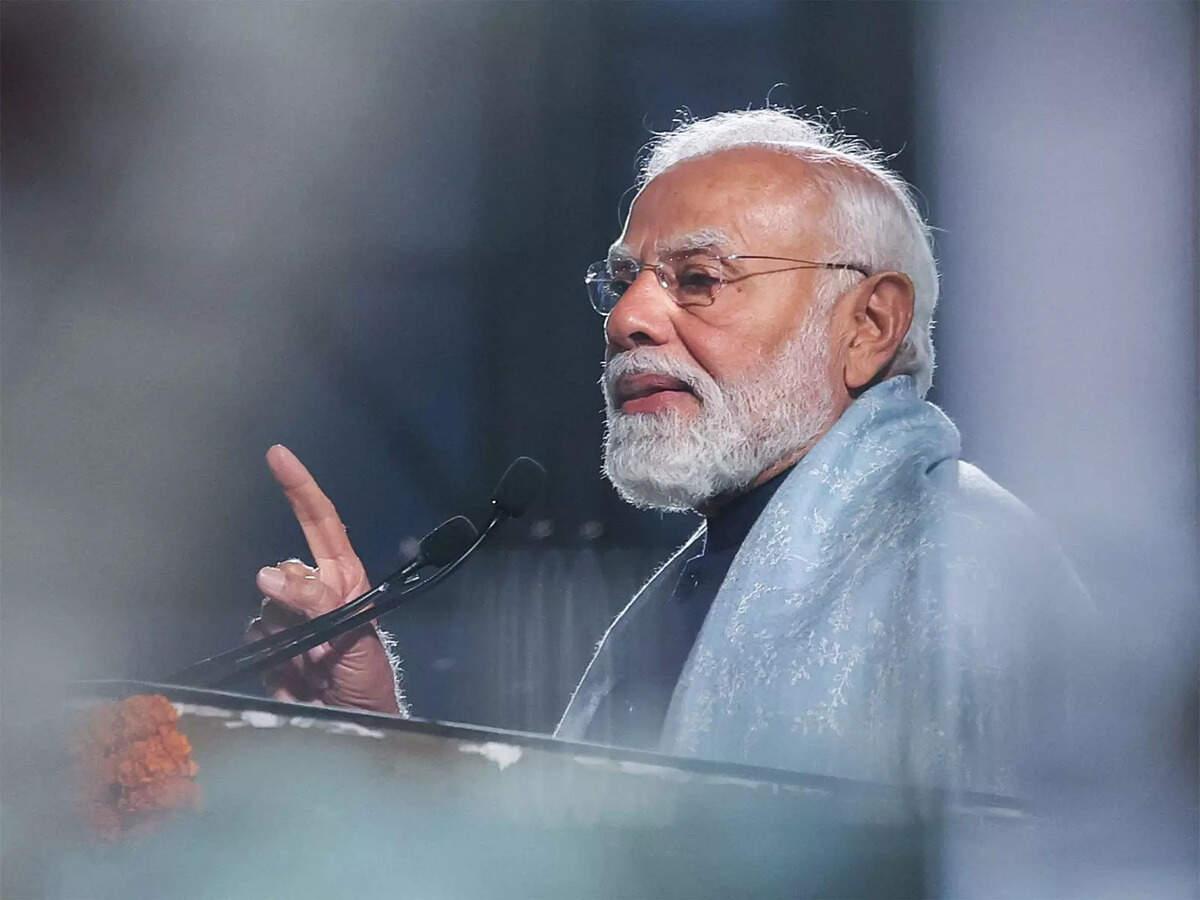
Source: ET
Tech billionaires including Sam Altman of OpenAI, Sundar Pichai of Google, and Dario Amodei of Anthropic are attending the five-day event, alongside leaders from Kenya, Senegal, Mauritius, Togo, Indonesia, and Egypt
2
. Former British Prime Minister Rishi Sunak and former Chancellor George Osborne will also participate, pushing for greater AI adoption2
. The summit has drawn tens of thousands of attendees including dozens of world leaders and ministers3
.Massive Infrastructure Investments Signal India's AI Ambitions
India expects more than $200 billion in investments over the next two years, according to IT minister Ashwini Vaishnaw
3
. Google CEO Sundar Pichai pledged to build subsea cables as part of an existing $15 billion AI infrastructure investment, telling reporters that "India is going to have an extraordinary trajectory with AI and we want to be a partner"3
. US chip behemoth Nvidia announced partnerships with Indian cloud computing providers to supply advanced processors for data centers that can train and run AI systems3
.
Source: Digit
The Indian government has allocated $1.2 billion for its AI Mission to build sovereign AI platforms
1
. While this budget pales in comparison to multi-billion dollar corporations, Rajan Anandan, managing director at Peak XV, one of India's biggest tech investors, emphasized that "for India, this is about more than technology, it is about economic transformation, digital sovereignty and building capability at scale"1
.Rapid Technology Adoption Draws Praise from Industry Leaders
Sam Altman delivered strong praise for India's AI ecosystem, stating "What's happening in India with AI is really quite amazing"
5
. The OpenAI CEO highlighted the rapid adoption of tools like Codex, which he expects to become the world's largest market "pretty quickly," signaling that India's tech ecosystem is on the verge of a massive, AI-driven entrepreneurial explosion .
Source: Digit
"I don't know of any country that is adopting AI with more vigour or faster, and my sense is there will be, at a minimum, an incredible new generation of startups very quickly," Altman said
5
. Last year India leapt to third place in an annual global ranking of AI competitiveness calculated by Stanford researchers, although experts say it has a long way to go before it can rival the United States and China3
.Challenging Tech Dominance Through Open-Source and Efficiency
Arthur Mensch, founder of European AI giant Mistral AI, emphasized that AI is becoming an "infrastructure" play and should be treated as a utility, with focus on efficiency and cost effectiveness
4
. The Paris-headquartered firm raised over $2 billion in Series C funding in September 2025, taking its valuation to $14 billion and making it the most valuable European AI company4
.Mensch told the summit that market concentration gives excessive leverage to suppliers and creates geopolitical risks
4
. "The bet on open-source is the way to reduce the leverage that a handful of providers have today," he said, noting that Mistral is looking to partner with sovereign cloud providers in India4
. The company is scaling aggressively and will have more than 200 MW by the end of 2027 under management4
.Global South Seeks People-Centered AI Governance
Summit observers describe a battle between AI colonialism from US tech firms and an alternative "techno-Gandhism," in which artificial intelligence is used for social justice and to benefit marginalised people
2
. Professor Gina Neff, an AI ethics expert from Queen Mary University London, noted that "the Americans will have less to say with the Summit's proposed bottom-up, Global South approach to AI governance that focuses on people, planet and progress"1
.UN Secretary General António Guterres will speak at the summit, having stated this week that it would be "totally unacceptable that AI would be just a privilege of the most developed countries or a division only between two superpowers"
2
. The 2026 International AI Safety Report notes that while in some countries over 50% of the population uses AI, across much of Africa, Asia, and Latin America adoption rates likely remain below 10%1
.Related Stories
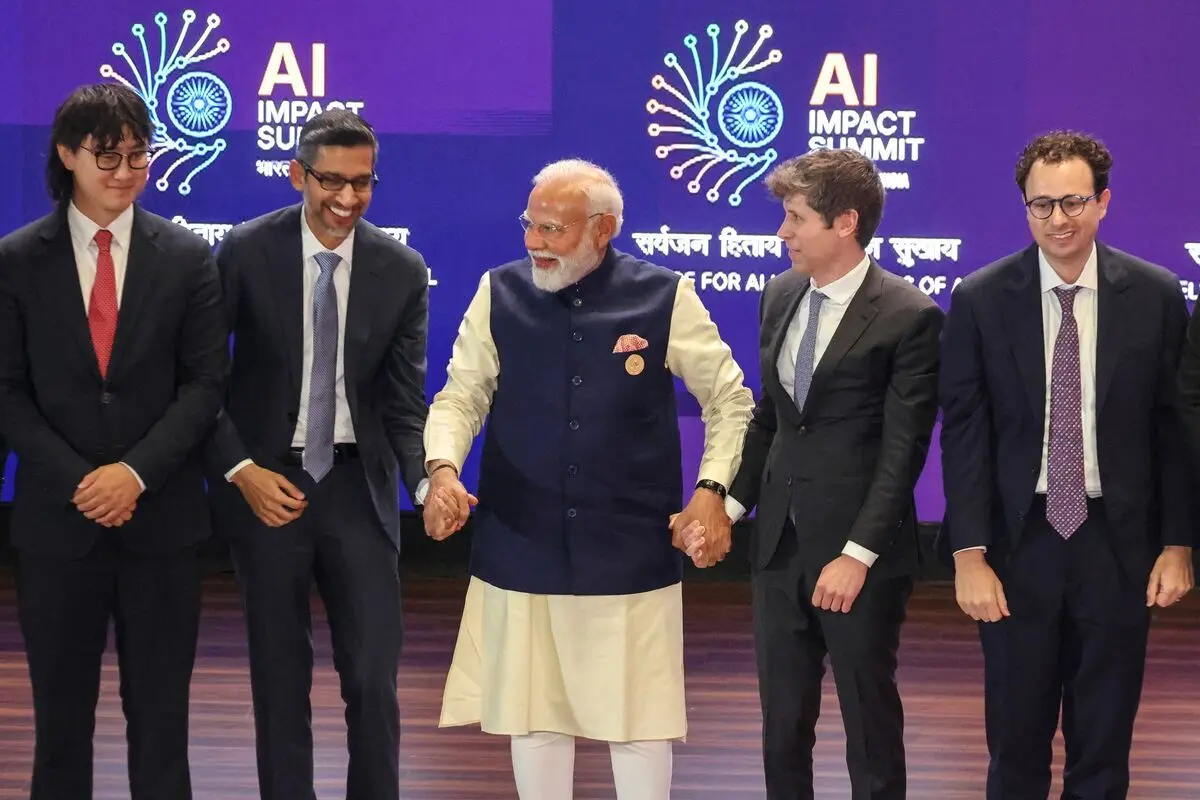
AI Safety and Risks Remain on the Agenda
Yoshua Bengio, one of the "godfathers" of AI, will repeat his fears about the risk of powerful AI systems enabling cyber- and bioweapons attacks
2
. "The capabilities of AI have continued to advance, and although mitigation and risk management of AI has also progressed [it has happened] not as quickly," he said2
. Nicolas Miaihle, co-founder of the AI Safety Connect group, noted that the summit is taking place in the shadow of AI-enabled warfare in Ukraine and the Middle East2
.Many researchers and AI safety campaigners believe stronger action is needed to combat issues ranging from sexualised deepfakes to AI-enabled online scams and intrusive surveillance
3
. Civil liberties campaigners raised serious concerns about India deploying AI to increase state surveillance, discriminate against minorities and sway elections2
.AI's Impact on Jobs and India's Tech Workforce
One fear is disruption to the job market, especially in India where millions of people are employed in call centres and tech support services
3
. Leading computer science researcher Stuart Russell told AFP: "We are creating human imitators. And so of course, the natural application for that type of system is replacing humans"3
.India has significant AI hubs in Bengaluru, Hyderabad and Mumbai with a large tech workforce
1
. However, low-paid workers there have long been carrying out the unseen task of manually categorising vast amounts of data used to train the world's AI tools1
. According to recruitment website Glassdoor, the average salary for an AI data trainer in Chennai is 480,000 rupees—less than £4,000 ($5,000) per year1
. This stands in stark contrast to OpenAI, the creator of ChatGPT, which is valued at over $500 billion1
.References
Summarized by

Navi
[3]
Related Stories
India bets on tax breaks and data centers to attract AI investment, but funding cuts raise concerns
02 Feb 2026•Policy and Regulation

India's AI Ambitions: Balancing Innovation, Accessibility, and Cultural Relevance
31 Jan 2025•Technology

India AI push at Davos 2026: Infrastructure, sovereignty and real-world use cases take center stage
21 Jan 2026•Policy and Regulation

Recent Highlights
1
AI chatbots validate you too much, making you less kind to others, Stanford study reveals
Science and Research

2
Anthropic's Claude Code Source Leak Reveals Hidden AI Agent Plans and Extensive System Access
Technology

3
Judge blocks Pentagon from branding Anthropic a security risk over AI safety guardrails dispute
Policy and Regulation

Recent Highlights
Today's Top Stories








Your Daily Dose of Curated AI News
Don’t drown in AI news. We cut through the noise - filtering, ranking and summarizing the most important AI news, breakthroughs and research daily. Spend less time searching for the latest in AI and get straight to action.

