86 Nations Back Delhi Declaration on AI, But Deep Divides Over Governance Remain


25 Sources
25 Sources
[1]
Global leaders endorse Delhi Declaration on safe and responsible AI
Eighty-six countries and two international organisations have endorsed the New Delhi Declaration on artificial intelligence (AI), aimed at building an inclusive, human-centric and development-oriented global AI framework. The consensus is being seen alongside nuanced debates during the India AI Impact Summit (16-21 February 2026) over limitations in sovereignty, access, infrastructure control and the future of global AI governance. India's minister for electronics and IT, Ashwini Vaishnaw, framed the declaration as proof of "broad global support" for a human-centric AI vision -- one that prioritises access, skilling, and responsible deployment. The document is expected to be signed at another international summit later this year by countries, including the United States, China, the United Kingdom, the European Union, Israel, Canada, Russia, Saudi Arabia, Singapore, Japan and Australia. The agreement calls for expanding AI benefits to developing economies, strengthening public-interest use cases in healthcare and education, and promoting trust and accountability, Vaishnaw said. The non-binding declaration will guide national policies, boost cross-border research, and set standards that are consistent, measurable and future-ready, he said. It also calls for tackling pressing AI challenges -- algorithmic bias, cybersecurity risks, workforce disruption, and societal impact. Participating countries have pledged to uphold ethical safeguards, ensure transparency in algorithms, and implement strong monitoring and audit mechanisms, Vaishnaw said. Balaraman Ravindran at the Centre for Responsible AI at IIT Madras, who chaired one of the working groups at the summit, said the declaration turns attention towards the challenges and risks faced by the global south. "While operational details are thin, as is expected from a multilateral declaration, the agreement has consensus from so many countries, including the two AI superpowers." "That is an acknowledgement of the growing need to focus on immediate challenges to beneficial AI adoption across world," he said. During discussions at the summit, AI experts from several countries noted that this agreement on principles must look at tackling structural limitations. Small nations face access limitations Earlier at the summit, leaders from small and developing countries stressed that AI access remains deeply unequal. Referencing Mauritius and other small economies, the Prime Minister of Mauritius Navin Ramgoolam warned that countries outside major blocs do not enjoy the same financing tools such as concessionary loans or subsidies and have limited access to capital for research and development. Without external partnerships, they said, smaller states "do not have the capacity to invest in the R and D that is required." The Vice-President of Seychelles, Sebastien Pillay, said small states may lack oil or minerals but possess "human capital" -- and want AI to strengthen government efficiency, economic diversification, food security, and biosecurity. Realising those ambitions, however, requires sustained technology transfer and legal readiness, not just diplomatic language, he said. Pillay echoed a core promise of the Delhi Declaration that for vulnerable economies, the democratization of AI must translate into infrastructure, finance, and technical cooperation. The United States rejects global AI governance The American delegate Michael Kratsios, Director of the White House Office of Science and Technology Policy, cautioned against framing AI as a binary between "haves and haves-nots," arguing that such framing risks obscuring the central task of enabling governments to deploy the "best AI technology" strategically. Kratsios signalled clear resistance to centralized global oversight, emphasizing instead "sovereign AI capability" and the rejection of global AI governance. AI, he suggested, should advance through trade and partnership rather than supranational regulatory structures. American AI, he said, is "open for business" and would prioritise "trade over aid". While the Delhi declaration stresses cooperative guardrails, Washington's emphasis remained on national capacity, exports, and strategic partnerships. Kratsios illustrated these limitations in achieving a fully harmonized global framework. AI infrastructure is political Serbian President Aleksandar Vučić sharpened the geopolitical dimension by arguing that AI is rapidly becoming infrastructure, and that infrastructure is inherently political. Invoking Albert Einstein's warning that technology can outpace wisdom, Vučić wondered whether political systems can keep pace with AI's acceleration. He warned of an "unprecedented concentration of technological power" and posed a blunt question: will a small number of actors set the rules for everyone else? "Sovereignty in the 21st Century," he said, includes the ability to control data, regulate algorithms, and develop domestic expertise. Without that capacity, sovereignty risks becoming merely formal. These concerns resonated beyond Europe. As large language models, compute clusters, and semiconductor supply chains consolidate within a handful of economies and corporations, speakers at the leaders' plenary at the summit, chaired by India's Prime Minister Narendra Modi, reflected on the politics of AI increasingly centering on who owns infrastructure and who defines standards -- a key limitation in realizing global equity. Compute, energy and trust Slovakian President Peter Pellegrini echoed this infrastructure focus, stating that AI "must not stay in the hands of few." Democratization, he argued, requires real access to skills, tools, and fair conditions for innovation. This sentiment was echoed by heads of major AI company representatives at the summit, including Sam Altman of OpenAI, Sundar Pichai of Alphabet/Google, Demis Hassabis of Google DeepMind, Brad Smith of Microsoft and Dario Amodei of Anthropic. "Computing power is the new infrastructure," Pellegrini said. AI requires energy-intensive data centres, advanced Graphic Processing Units (GPUs), and stable jurisdictional frameworks. Slovakia highlighted its low-carbon energy base and investments in domestic supercomputing, framing compute sovereignty as both an economic and strategic imperative. At the same time, Pellegrini insisted that responsibility must "always remain with a human being", reinforcing a central theme of the Delhi Declaration - human oversight as a baseline principle. What the declaration does and does not The New Delhi Declaration articulates shared commitments to responsible, inclusive AI and greater global cooperation. It emphasizes expanding access for developing countries, strengthening digital public infrastructure, and ensuring trust through transparency and safeguards. The declaration non-binding and does not establish enforcement mechanisms. It does not directly confront concentration of compute among a handful of corporations. Nor does it reconcile differing philosophies between export-driven national sovereignty and multilateral regulatory frameworks. In effect, it codifies principles but leaves implementation contested, revealing the limitations of multilateral agreements in a rapidly evolving technological landscape.
[2]
India's Big AI Moment Starts on Chaotic Note as Modi Arrives
Despite the disruption, attendees and speakers expressed optimism about the summit, with some highlighting the significance of India's AI ascendancy and the potential for long-term collaborations and partnerships. India's biggest business summit in years descended into chaos this week after hundreds of delegates were left stranded without food or water during a sudden security lockdown, a black eye for a marquee gathering that was supposed to trumpet the country's AI ascendancy. The chaos that gripped day one of the India AI Summit gave way to a steadier rhythm on Tuesday as attendees moved between the halls of Bharat Mandapam, a vast exhibition complex in New Delhi. Coffee lines were shorter than the previous day, and golf carts ferrying delegates moved easily from one end of the venue to the other. A group of students from a local engineering school walked purposefully toward an exhibition hall where tech companies -- from Nvidia Corp. and Dell Technologies Inc. to Deloitte LLP -- showcased their latest offerings at kiosks. For Moses Thiga, a speaker from Kenya, the scale of the summit is "mind-blowing," and he is struck by the "significant presence" of multinational companies. He had no complaints about the frenzy that unfolded on the opening day, when hundreds of attendees found themselves either locked in or locked out of the venue for hours. Thiga said everything was running smoothly until Prime Minister Narendra Modi showed up. The security detail accompanying him sealed the entire complex, restricting access. Many attendees said they remained indoors for hours without food or water until Modi departed. "Coming from Kenya, I know what 'the government is coming' means. It means everything is shut down," Thiga said. The summit drew more than 250,000 registrations, prompting authorities to implement traffic management and heightened security measures. Armed security personnel were stationed throughout the complex. Two hospital ambulances and a fire truck stood parked near kiosks for Starbucks, Taco Bell and Pizza Hut. Read More About India's AI Summit Young tech entrepreneurs could be seen taking coffee breaks near the stalls. Sheena Kohli, legal and investment head at US-based NodeOps, said she hopes to draw attention to the company's decentralized AI execution platform. "AI always boils down to compute, and we're here to show that it's not always necessary to rely on big players and face huge bills from day one. There are cost-effective options," Kohli said. She added that the disruption caused by Modi's visit should not overshadow the event. Kohli said she did not face difficulties and sees operations settling as attendees grow more familiar with the venue and its security protocols. Inside one exhibition hall, where companies demonstrated AI features embedded in their software and hardware, Elisabeth L'Orange, an equity partner at Deloitte, networked with Indian peers. She had planned to fly to Mumbai on Tuesday but extended her stay by a day after being unable to explore the summit during Monday's security lockdown. Part of a government delegation representing Hamburg, Germany, Lorange said they are looking at India because of its population scale, software industry and track record of producing global tech leaders. "Many engineers come from India, including to Germany. There's also significant offshoring, and we do a great deal of development work with India. Given how much technology and talent is coming out of the country, it's something we're keen to look at more closely," she said. Layered onto this is a broader geopolitical unease. The shift in global order under US President Donald Trump -- and the unpredictability it introduced into transatlantic ties -- echoes among some European delegates. Philippe Wieczorek of an AI research institute at Université Grenoble Alpes, said he's looking at India as a potential partner when it comes to AI and sovereignty. Under Trump's presidency, he said the US is not a reliable partner when it comes to data sharing. "On the AI side, the concern is that AI consumes a lot of data. With American companies, we provide them with data, and there's skepticism -- even fear -- about how that data is used and whether it could be lost or misused," he said. "Coming to India is not just about visiting and making contacts. It's about building long-term collaborations and partnerships."
[3]
India's AI summit: Delegates complain of long queues and confusion on opening day
India's AI Impact Summit, billed as a landmark gathering of global leaders and technology executives, was overshadowed by logistical chaos on its opening day in Delhi on Monday. Participants complained about long queues, overcrowding and confusion at the venue, saying they had to wait for hours. Some also reported limited access to food and water and said their products were stolen from their stall. The five-day summit, inaugurated by PM Narendra Modi, is being promoted as the first major international AI meeting hosted in the Global South. More than 100 countries are taking part, with technology leaders including Sam Altman of OpenAI and Sundar Pichai of Alphabet Inc expected to attend. Speaking at the inauguration, Modi said the summit showcased "the extraordinary potential of AI, Indian talent and innovation", adding that India aimed to shape solutions "not just for India but for the world". India's Information Technology Minister Ashwini Vaishnaw said the summit intended to look at both the benefits and harms of AI. In the next few days, "we are basically looking at and measuring what [AI's] impact on human society is going to be", he said. But the opening day was marred by complaints of poor crowd management at the summit venue Bharat Mandapam. By Monday afternoon, social media was flooded with complaints from founders, exhibitors and delegates who said security sweeps and last-minute closures left them stranded outside exhibition halls. Maitreya Wagh, co-founder of voice AI start-up Bolna, wrote on X that he was unable to access his company's booth after gates were closed. Punit Jain, founder of tech platform Reskill, described "7 AM queues" followed by hours of waiting and a "full evacuation" before the prime minister's arrival. Reuters reported that some speakers were still awaiting confirmation of their session timings, adding to concerns over mismanagement. Dhananjay Yadav, founder of wearable AI start-up NeoSapiens, alleged that products from his company's stall were stolen at the venue. Writing on X, he said the firm had spent heavily on travel, accommodation and exhibition space, "only to see our wearables disappear inside a high-security zone". Several attendees also complained about payment arrangements at food stalls inside the venue, saying food counters were accepting only cash and not digital payments, adding to the inconvenience, particularly for international visitors. Soumya Sharma, founder of healthcare-focused Livo AI, said several discussions were held behind closed doors and that security shut down sessions because of overcrowding, preventing many delegates from taking part. The closures, he suggested, undercut the summit's ambition to showcase India's AI ecosystem to a global audience. While he said he attended some "excellent sessions", Sharma added that operational lapses risked overshadowing the substance of the event. "Unless we get the basics right, we cannot claim to be utilising AI to its fullest," he wrote on X. "AI is only part of the system. We must solve basic on-ground issues first." Organisers and the government have yet to respond publicly to the complaints. The BBC has reached out to the Ministry of Electronics and Information Technology for a comment.
[4]
AI Impact Summit 2026 revealed the gap between ambition and enforceable governance
Nearly 90 countries endorsed the New Delhi Declaration on AI. The document binds none of them. That tension defined the AI Impact Summit 2026, held from Feb 16-20. Framed as the largest AI gathering of its kind in the Global South, the summit positioned India as a convenor of a development-first alternative to Western safety-centric AI governance. But as the week unfolded, a gap emerged between ambition and execution, and between diplomatic alignment and enforceable action. Earlier AI summits drew comparatively fewer endorsements. The AI Safety Summit at Bletchley Park in 2023 had 28 signatories. The AI Seoul Summit saw 11 countries sign on. The AI Action Summit attracted 60 signatories, but it was not without controversy, as both the United States and the United Kingdom chose not to endorse the declaration. The New Delhi declaration has the endorsement of all major nations in AI, including the US, the UK, and China. During the Indian Summit, global tech CEOs shared the stage with ministers. The language of the summit blended geopolitics with philosophy, invoking "welfare for all, happiness for all," as the moral compass for AI.
[5]

Global summit calls for 'secure, trustworthy and robust AI'
New Delhi (AFP) - Dozens of nations including the United States and China called for "secure, trustworthy and robust" artificial intelligence, in a declaration issued Saturday after a major summit on the technology in New Delhi. The statement signed by 86 countries did not include concrete commitments to regulate the fast-developing technology, instead highlighting several voluntary, non-binding initiatives. "AI's promise is best realised only when its benefits are shared by humanity," said the statement, released by the five-day AI Impact Summit. It called the advent of generative AI "an inflection point in the trajectory of technological evolution". "Advancing secure, trustworthy and robust AI is foundational to building trust and maximising societal and economic benefits," it said. The summit -- attended by tens of thousands including top tech CEOs -- was the fourth annual global meeting to discuss the promises and pitfalls of AI, and the first hosted by a developing country. Hot topics discussed included AI's potential societal benefits, such as drug discovery and translation tools, but also the threat of job losses, online abuse and the heavy power consumption of data centres. Analysts had said earlier that the summit's broad focus, and vague promises made at the previous meetings in France, South Korea and Britain, would make strong pledges or immediate action unlikely. US signs on The United States, home to industry-leading companies such as Google and ChatGPT maker OpenAI, did not sign last year's summit statement, warning that regulation could be a drag on innovation. "We totally reject global governance of AI," US delegation head Michael Kratsios had said at the Delhi summit on Friday. The United States signed a bilateral declaration on AI with India on Friday, pledging to "pursue a global approach to AI that is unapologetically friendly to entrepreneurship and innovation". But it also put its name to the main summit statement, the release of which was originally expected Friday but was delayed by one day to maximise the number of signatories, India's government said. On AI safety risks -- from misinformation and surveillance to fears of the creation of devastating new pathogens -- Saturday's summit declaration struck a cautious tone. "Deepening our understanding of the potential security aspects remains important," it said. "We recognize the importance of security in AI systems, industry-led voluntary measures, and the adoption of technical solutions, and appropriate policy frameworks that enable innovation." On jobs, it emphasised reskilling initiatives to "support participants in preparation for a future AI driven economy". And "we underscore the importance of developing energy-efficient AI systems" given the technology's growing demands on natural resources, it said. 'Unacceptable risk' Computing expert and AI safety campaigner Stuart Russell told AFP that Saturday's commitments were "not completely inconsequential". "The most important thing is that there are any commitments at all," he said. Countries should "build on these voluntary agreements to develop binding legal commitments to protect their peoples so that AI development and deployment can proceed without imposing unacceptable risks", Russell said. Some visitors had complained of poor organisation, including chaotic entry and exit points, at the vast summit and expo site in Delhi. The event was also the source of several viral moments, including the awkward refusal of rival US tech CEOs -- OpenAI's Sam Altman and Dario Amodei of Anthropic -- to hold hands on stage. The next AI summit will take place in Geneva in 2027. In the meantime, a UN panel on AI will start work towards "science-led governance", the global body's chief Antonio Guterres said Friday. The UN General Assembly has confirmed 40 members for a group called the Independent International Scientific Panel on Artificial Intelligence. It was created in August, aiming to be to AI what the UN's Intergovernmental Panel on Climate Change (IPCC) is to global environmental policy. India has used the summit to push its ambition to catch up with the United States and China in the AI field, including through large-scale data centre construction powered by new nuclear plants. Delhi expects more than $200 billion in investments over the next two years, and US tech giants unveiled a raft of new deals and infrastructure projects in the country during the summit.
[6]

US endorses AI declaration without binding rules
The U.S. signed onto a non-binding declaration Saturday with dozens of other countries following India's AI Impact Summit, committing to a "shared global vision" on the technology. It was one of 89 countries and organizations to sign the document, which laid out seven key pillars for AI development, including democratizing AI resources, using AI to boost economic and social development, and developing energy-efficient AI. "The advent of AI marks an inflection point in the trajectory of technological evolution," the declaration reads. "The choices that we make today will shape the AI-enabled world that future generations will inherit." The declaration notably does not mention AI safety, a key issue in years past. It instead underscored the importance of security in AI systems, pointing to "industry-led voluntary measures," technical solutions and "appropriate" policy frameworks that "enable innovation while promoting the public interest throughout the AI's lifecycle." The U.S. declined to sign onto a declaration at the Paris AI summit last year, where Vice President Vance slammed "excessive" AI regulation that he argued "could kill a transformative industry just as it's taking off." This year, the Trump administration sent Michael Kratsios, director of the Office of Science and Technology Policy, to the summit in New Delhi. Kratsios called back to Vance's remarks in his own address Friday, noting that the vice president "sought to refocus the AI conversation in his remarks, from safety to opportunity." He also highlighted America's efforts to export its AI, pointing to the administration's American AI Exports Program, as well as the newly launched Tech Corps. The initiative with the Peace Corps aims to recruit technologists to "help other countries around the world harness American artificial intelligence."
[7]

Ashwini Vaishnaw Says AI Is the 5th Industrial Revolution
India will create a UPI-like platform for bouquet of AI services On the second day of the country's inaugural AI Impact Summit, the Union Minister of Electronics and Information Technology (IT), Ashwini Vaishnaw, spoke about artificial intelligence (AI), India's global standing in this technology, and several other related topics. The Minister also addressed the concerns about deepfakes and highlighted the need for stricter regulation. He also hinted that India could witness a massive investment in the AI space over the next two years. Additionally, he also apologised for any inconvenience experienced by visitors on the first day of the AI Impact Summit. Ashwini Vaishnaw Speaks at AI Impact Summit On the commitment from global tech companies, Vaishnaw highlighted that all the top executives (of major AI companies) are present at the event and are participating in nearly twenty sessions across the five days. "AI deployment is expanding across virtually every sector. It is the fifth industrial revolution, and it has the potential to impact every aspect of the economy and society," Vaishnaw said, adding, "We have seen transformative solutions, particularly in healthcare, where AI can make services more affordable, and in education, where learning can be tailored to the needs of each student. These examples demonstrate the vast possibilities that AI offers across sectors." The IT Minister also said that India stands in a very strong position in terms of technology across all five layers of the AI stack. "So far, in the coming two years, we should be seeing more than $200 billion (roughly Rs. 18.13 lakh crore) investment across the five layers of the AI stack," he said. In an interaction with NDTV, the Union Minister said that India is being seen as a trusted AI partner to the Global South due to its open, affordable, and development-focused solutions. He also cited Stanford University's 2025 Global AI Index to highlight that India is ranked 3rd globally when it comes to AI. Vaishnaw said that Indian AI systems are being developed keeping the country's cultural context in mind to ensure that the national subtleties are not missed. To this goal, local models are being trained primarily on Indian data to ensure relevance, inclusivity, and sensitivity to local norms and practices remain as part of the AI's working memory. He also stressed the importance of self-reliance when it comes to AI. "We do not want to be dependent on others for our strategic requirements; this is part of sovereign AI," Vaishnaw said at the AI Impact Summit. On concerns around AI-generated media and deepfakes, the IT Minister said, "I think we need a stronger regulation on deepfakes. It is a problem growing day by day. We need to protect our society from this harm. We have initiated a dialogue with the industry on this." Additionally, he also mentioned that global tech companies such as Netflix and Meta should work as per the country's legal framework and cultural context. Interestingly, Vaishnaw revealed plans to create a UPI-like platform which provides a bouquet of AI solutions for developers and enterprises. Calling it "AI ka UPI," he said that the Government was focused on making AI accessible, secure, and scalable for developers and innovations in the country. Finally, the Union IT Minister also addressed concerns of mismanagement at the event, after several visitors took to social media platforms to criticise the arrangement and handling of the booths and food stalls. Calling it the biggest AI summit in the world, Vaishnaw said, "If anybody has faced any problems yesterday, we apologise for that. Whatever feedback you have, please share it with us. We will make efforts to make the experience smoother and enjoyable for all of you."
[8]

Delhi Declaration Urges Democratic AI for Social Good
The India AI Impact Summit concluded on Saturday with more than 80 countries signing the Delhi Declaration, pledging to balance advances in artificial intelligence with a commitment to equitable growth and ethical standards. "This calls for further international cooperation and multi-stakeholder engagement across our countries along the seven chakra (pillars) of the AI Impact Summit centred around principles of development of human capital; broadening access for social empowerment; trustworthiness of AI systems; energy efficiency; use in science; democratising resources and use for economic growth and social good," the declaration read. The 86 signatories included the European Union as well the US and the UK, two key nations that had opted out of a global pact on AI at the previous year's summit in Paris. Other major participants include China, Germany, Japan, France, Italy, Russia and Canada. All the shared priorities mentioned in the declaration are voluntary and represent non-binding guidelines and principles. "The entire world has endorsed PM Narendra Modi's human-centric vision of AI Manav at the AI Summit, which has seen 10 lakh visitors," electronics and information technology minister Ashwini Vaishnaw said on Saturday. The accord introduced new platforms and frameworks as a means of achieving its ends. The charter for democratic diffusion of AI is aimed at increasing access to foundational technical resources. Robust digital infrastructure and affordable connectivity are essential for avoiding an AI digital divide, it said. The proposed global AI impact commons will seek to boost practical applications by acting as a platform for sharing and scaling successful artificial intelligence use cases, especially open-source applications that can be adapted. The Trusted AI Commons will be a collaborative platform consolidating technical resources, tools, benchmarks and best practices that all can access and adapt to their context. This has been cited as necessary due to the need to build trust and maximise societal and economic benefits of AI. To accelerate innovation, the declaration calls for removing structural barriers to research infrastructure and taking note of the International Network of AI for Science Institutions to pool global research capabilities. Recognising AI's potential to uplift all sections of society by providing access to knowledge and services, the collaborative platform has been developed to share learning and scalable practices for social empowerment. Apart from this, voluntary guiding principles on resilient, innovative, and efficient artificial intelligence will bolster the development of systems that will seek to minimise the pressure on resources. The declaration was inspired by the principle of sarvajana hitaya, sarvajana sukhaya (welfare for all, happiness of all) "for democratising AI resources for the global population," the ministry of electronics and information technology said.
[9]
India calls for democratic diffusion of AI at New Delhi summit
India has released the AI Impact Summit Declaration, a voluntary global framework for AI cooperation inspired by "welfare for all." The declaration, endorsed by multiple nations, outlines seven pillars for collaboration, including human capital development, trustworthy AI, and democratising AI resources. India has unveiled the AI Impact Summit Declaration at the conclusion of the AI Impact Summit held in the capital on February 16-20, laying out a voluntary, non-binding framework for global cooperation on artificial intelligence. Released on Saturday, the declaration inspired by the principle of "Sarvajan Hitaya, Sarvajan Sukhaya" (welfare for all, happiness for all) positions AI as a transformative inflection point and urges countries to shape its trajectory through international collaboration and multi stakeholder engagement. Participants from several countries and international organisations endorsed cooperation across seven pillars, or "Chakras": human capital development, social empowerment, trustworthy AI systems, energy efficiency, AI for science, democratising AI resources, and AI for economic growth and social good. A central theme is widening access to foundational AI infrastructure. The declaration takes note of the proposed Charter for the Democratic Diffusion of AI, aimed at improving affordability and access to compute, data and tools, particularly for developing nations, while respecting national laws and sovereignty. On economic development, the document highlights the potential of open-source AI and scalable use cases to accelerate adoption across sectors. It references the Global AI Impact Commons as a voluntary platform to replicate successful AI applications across regions. The declaration also underscores the importance of secure and trusted AI, backing industry-led voluntary measures, technical safeguards and policy frameworks that balance innovation with public interest. It takes note of the Trusted AI Commons, a collaborative repository of tools, benchmarks and best practices. Additional initiatives include an International Network of AI for Science Institutions, guiding principles for AI workforce reskilling, and voluntary playbooks on resilient and energy-efficient AI infrastructure.
[10]

India AI Impact Summit 2026 Sets New Global Benchmark as World Leaders Converge at Bharat Mandapam
The India AI Impact Summit 2026 commenced today at Bharat Mandapam, marking the first time that a global convening of this scale on artificial intelligence is being organised in the Global South. The India AI Impact Summit 2026 commenced today at Bharat Mandapam, marking the first time that a global convening of this scale on artificial intelligence is being organised in the Global South. The Summit will bring together the Heads of State and Government, ministers, global technology leaders, eminent researchers, multilateral institutions and industry stakeholders to deliberate on the role of AI in advancing inclusive growth, strengthening public systems and enabling sustainable development.
[11]

India Cautions About Deepfake Tech Risks, Highlights Stronger Regulation
The minister was speaking to the media about India's plans to take pole position in the growing global AI ecosystem India is aware of the rising risks posed by deepfake technology and is committed to creating a stronger regulation around deepfakes to counter what is becoming a problem that is growing day-by-day, Union Minister for Electronics and Information and Technology Ashwini Vaishnaw has said. He made these comments during a media interaction around the Indian AI Impact Summit 2026, which began at the Bharat Mandapam in New Delhi yesterday. "We need to protect our society from this harm. We have initiated a dialogue with the industry around this," the minister said while reiterating the need for safeguards to ensure responsible AI use in India. The minister took the opportunity to highlight that AI systems designed in India are being developed keeping in mind the cultural context of the country. Large Language Models (LLM)and other AI tools are being trained on Indian data to ensure relevance, inclusivity, and sensitivity to local norms and practices, he said. Reinforcing the importance of achieving self-reliance in India's AI journey, Vaishnaw said, "we do not want to be dependent on others for our strategic requirements. This is part of sovereign AI." And towards this broader vision, the country is poised to received large investments across the entire AI ecosystem. "So far, in the coming two years, we should be seeing more than $200 billion investment across the five layers of the AI stack," the minister said while underscoring the government's vision of turning the country into a global hub for AI development and infrastructure. "Today, India is being seen as a trusted AI partner to the Global South, seeking open, affordable and development-focused solutions," Vaishnaw said. "A trusted AI ecosystem will attract investment, accelerate adoption," the minister said while noting that building robust infrastructure is a central pillar of India's AI strategy. He also shared plans of creating an "AI ka UPI" that would offer a bouquet of trusted AI solutions. These would be presented as a UPI-like platform and would be available for developers to build on for specific use-cases. He also highlighted the Narendra Modi government's push to make AI accessible, secure, and scale for developers and innovators. The minister said that India expects global tech companies to operate within the country's laws and cultural context. Major brands such as Netflix and Meta must work under the legal framework of India. Though he did not make any pointed references, it appears that Vaishnaw was nudging global giants to ensure that they followed Indian regulations while operating from these shores. Referring to the absence of Nvidia CEO Jensen Huang who bailed out a couple of days before the Summit, the minister said they had been informed that the global tech leader had to miss out due to some unavoidable reasons. "Jensen Huang reached out to us and said that due to something really unavoidable, he has deputed his very senior executive to join us. Nvidia is working with some Indian companies for some very large investments in AI in India," Vaishnaw said, underscoring the partnerships that the global GPU maker is eyeing in the Indian AI ecosystem. The minister described artificial intelligence as the fifth industrial revolution witnessed by the world and said its transformative potential across both industries and society was immense. Vaishnaw also reiterated that with its wealth of engineering talent and innovative mindsets, India was ideally placed to lead the AI movement.
[12]
86 nations, two international organisations sign AI Impact Summit declaration: IT Min Vaishnaw
New Delhi: As many as 86 countries and two international organisations have signed the AI Impact Summit declaration, IT Minister Ashwini Vaishnaw on Saturday said, adding that the US, UK, Canada, China, Denmark, and Germany are among the signatories. The strong global backing for the declaration comes at the conclusion of the India AI Impact Summit in New Delhi. Vaishnaw told reporters that nations across the world have formalised and upheld principles of 'welfare of all, and happiness of all'. "Prime Minister Narendra Modi's human-centric AI vision been accepted by the world. Democratising Artificial Intelligence resources so AI facilities, services and technology can reach everyone in society has been accepted by all," the minister said. Balancing economic growth with social good has been prioritised, he added. "Not just economic growth, even social harmony has to be kept in mind. Safety and trust are at the centre, they have been brought among the main points," Vaishnaw said, adding that a secure, trustworthy and robust AI framework has been focused on. Other major areas of thrust include innovations and development of human capital, he noted. "For all these areas, all countries have agreed to work together. Almost all countries that participated, including the US, the UK, Canada, China, Denmark, Egypt, Indonesia, and Germany... everyone has participated," the minister said. The mega AI Impact Summit secured investment commitments of over USD 250 billion in infrastructure alone, with Vaishnaw on Friday terming it a "grand success". Vaishnaw had said participation at the summit crossed five lakh visitors, reflecting strong domestic and global engagement with India's AI push. The India AI Impact Summit brought together global policymakers, industry leaders and technology experts, positioning India as a key player in shaping international AI governance and infrastructure development. "More than five lakh visitors participated in the exhibition, learnt a lot, and interacted with many experts from around the world. We had practically every major AI player in the world participating in large numbers. We had so many startups getting the opportunity to showcase their work. Overall, the quality of the discussion was phenomenal," he had said. Be it the ministerial dialogue, the leaders' plenary, the main inauguration function, or the Summit overall, the quality of participation and dialogue was phenomenal, Vaishnaw had pointed out. The investment pledges have crossed USD 250 billion for infra-related capital and around USD 20 billion on VC/deep tech investments. Vaishnaw had said that the Summit reflected the world's confidence in India's role in the new AI age. Delhi played host to a lineup of global tech heavyweights this week - Google's Sundar Pichai, OpenAI's Sam Altman, Microsoft's Brad Smith and Anthropic's Dario Amodei - as discussions spanned most intensely debated global topics in the tech universe, from AI's opportunities and risks, all the way to AGI, governance and the future of jobs.
[13]

89 Nations Sign AI Impact Summit Declaration, But Can It Deliver?
MediaNama's Take: The AI Impact Summit Declaration matters as an early, multilateral statement of shared principles, and it notably attracted 89 signatories of states and organisations. However, the declaration's voluntary, non-binding character severely limits its ability to deliver concrete change. Without mandatory reporting, enforcement mechanisms or measurable targets, signatories can endorse high-level goals without committing to implementation. This limitation echoes a familiar pattern in global governance. The Glasgow Climate Pact under the Paris Agreement was also voluntary in nature. However, according to the UNEP Emissions Gap Report 2025, even if countries fully implement their latest national pledges, the world is still on course for 2.3-2.5 °C of warming this century, far above the Paris goals of limiting warming to 1.5 °C. Similarly, unless the AI declaration is rapidly backed by binding instruments, standardised reporting and independent benchmarks, it risks becoming diplomatic cover rather than a driver of governance. Voluntary platforms can seed cooperation, yet ultimately they require accountability architecture; otherwise, words, however well phrased, will not steer behaviour where commercial and national interests diverge. The recently concluded AI Impact Summit in New Delhi culminated in the AI Impact Summit Declaration, released on February 21, 2026. This declaration, signed by 89 countries and international organisations, sets out a shared, voluntary framework for international cooperation on AI. The declaration laid out seven pillars of action, which are as follows: The declaration states that robust digital infrastructure and affordable connectivity are prerequisites for deploying AI. Furthermore, it takes note of the Charter for the Democratic Diffusion of AI as a voluntary and non-binding framework to promote access to foundational AI resources, support locally relevant innovation, and strengthen resilient AI ecosystems, while respecting national laws. The text states that wide-scale adoption of AI can drive economic and social development. It takes note of the Global AI Impact Commons as a voluntary initiative that provides a practical platform to encourage and enable the adoption, replication and scale-up of successful AI use cases across regions. Additionally, the declaration notes that open-source and accessible AI approaches can support scalability and adaptability across sectors. The declaration recognises that advancing secure, trustworthy and robust AI is foundational to building trust. It recognises the development of the voluntary and non-binding Trusted AI Commons, which consolidates technical resources, tools, benchmarks and best practices, alongside a voluntary guidance note. It further underscores the importance of industry-led voluntary measures and appropriate policy frameworks throughout the AI lifecycle. The text recognises that removing structural barriers to AI research infrastructure can promote AI use in research and development. It takes note of the voluntary and collaborative International Network of AI for Science Institutions as a platform to connect scientific communities and pool AI research capabilities while highlighting international scientific collaboration as a means to unlock AI's potential in research. The declaration states that AI can enable access to knowledge, services and opportunities and enhance participation in social and economic activities. Furthermore, it takes note of the development of a voluntary and collaborative platform to facilitate the exchange of learning, knowledge and scalable practices. The text states that realising AI's promise requires equipping individuals with relevant skills, including through education, workforce development and increased AI literacy, as well as international collaboration on skilling and reskilling. It outlines voluntary guiding principles for reskilling in the age of AI and provides a playbook on AI workforce development. The declaration recognises the growing demands of AI on energy, infrastructure and natural resources. Additionally, it recognises the Voluntary Guiding Principles on Resilient, Innovative, and Efficient Artificial Intelligence as guidance for developing resilient and efficient AI systems. It notes the Playbook on Advancing Resilient AI Infrastructure as a reference resource. Alongside the declaration, Union Minister for Electronics and Information Technology Ashwini Vaishnaw, on February 19, announced the New Delhi Frontier AI Commitments, a voluntary framework that brings together global frontier AI companies and Indian firms. He positioned the initiative within India's five-layer AI strategy, spanning applications, models, compute, talent and energy, and described it as part of a broader push towards technological democratisation and strategic autonomy. The commitments prioritise the generation of anonymised, aggregate insights on real-world AI deployment to inform policymaking on employment, productivity and wider economic effects. In addition, the framework seeks to strengthen multilingual and contextual evaluation by developing datasets and benchmarks for under-represented languages.
[14]
India AI Summit secures over $250 billion infra investment commitments: Ashwini Vaishnaw
India AI Impact Summit 2026 secured over $250 billion in investment commitments for AI infrastructure, including data centers and semiconductor facilities. Union IT Minister Ashwini Vaishnaw announced the upcoming AI Mission 2.0, focusing on advanced models and safety. The government aims to ensure AI benefits reach all citizens, mirroring the 5G rollout's inclusive approach. The India AI Impact Summit 2026 has attracted investment commitments of over $250 billion related to infrastructure, Union IT Minister Ashwini Vaishnaw said on Day 5 of the event, underscoring the scale of global and domestic confidence in India's artificial intelligence push. Addressing reporters, Vaishnaw described the summit as a "grand success", noting that it saw participation of over five lakh visitors and drew significant interest from global technology players, investors and startups. The minister said the investment commitments are largely linked to infrastructure required to power India's AI ecosystem -- including data centres, semiconductor facilities, high-performance computing capacity and digital connectivity. Also read: L&T Vyoma to invest Rs 25,000 cr for green AI-ready data center campus at Dholera, Gujarat He added that the government would soon begin work on AI Mission 2.0, which will focus on developing "a totally new level of models, common compute, safety" and expanding foundational capabilities across the AI stack. "Our journey so far has been very meaningful and methodical, working through all layers of AI stack and creating that foundational level of work," Vaishnaw said. "Now, getting entire world to come, deliberate and interact with our industry, we will take next step of our AI mission." The minister also reiterated that India is building a strong institutional base for AI safety, with 12 institutes working in a network mode on safety frameworks and standards. He said there was "huge consensus" around the summit declaration, adding that the government aims to expand the number of endorsing stakeholders in the coming weeks. On the infrastructure front, Vaishnaw announced that the foundation for the next semiconductor plant in Uttar Pradesh will be laid soon, and commercial production from the Micron facility is set to begin on February 28. AI Impact Summit: PM Modi gives MANAV vision, pitches 'develop in India, develop for the world' He further said the government would ensure that the benefits of AI reach the last person in society, drawing a parallel with the 5G rollout. "We will put the same effort in making AI benefit reach the last person in society like we did with 5G rollout," he said, adding that inclusive growth remains a core political philosophy guiding the AI mission. Vaishnaw also hit out at the Congress, claiming that any attempt to disrupt the summit was rejected by India's youth and that immediate action was taken against anyone who tried to "demean" the event. "The world has confidence on India's role in new AI age," he said, positioning the summit and the investment commitments as a signal of India's emergence as a key player in the global AI landscape.
[15]
AI Summit: Aswini Vaishnaw unveils 'New Delhi Frontier AI Impact Commitments'
Union IT Minister Ashwini Vaishnaw unveiled the New Delhi Frontier AI Impact Commitments. This voluntary framework involves global AI companies and Indian innovators. It aims for inclusive and responsible artificial intelligence development. The initiative focuses on understanding real-world AI usage and strengthening multilingual AI evaluations. India leads a Global South-led framework for AI governance. Union IT Minister Ashwini Vaishnaw on Thursday unveiled the "New Delhi Frontier AI Impact Commitments", a voluntary framework adopted by leading global frontier AI companies and Indian innovators to promote inclusive and responsible artificial intelligence development. Also Read: PM Modi gives MANAV vision, pitches 'develop in India, develop for the world' Describing it as a significant outcome of the India AI Impact Summit, Vaishnaw said the commitments reflect a shared vision for AI that balances innovation with equity and real-world impact, particularly from a Global South perspective. He outlined two key pledges under the initiative. The first focuses on advancing understanding of real-world AI usage through anonymised and aggregated insights to support evidence-based policymaking on jobs, skills and economic transformation. The second aims to strengthen multilingual and contextual evaluations of AI systems to ensure they function effectively across languages, cultures and practical use cases. Also Read: India has central role in shaping AI's future, Anthropic CEO Dario Amodei says Vaishnaw said the effort positions India at the forefront of shaping a Global South-led framework for AI governance, ensuring that technological progress remains inclusive, development-oriented and globally relevant. The announcements were made at the India AI Impact Summit in New Delhi, attended by Prime Minister Narendra Modi and global technology leaders. (With inputs from PTI)
[16]

Global AI summit in India still without final statement - VnExpress International
Dozens of national delegations, including leaders from France, Brazil and other countries, had gathered in the Indian capital this week to discuss the fast-developing technology. On Friday, India's IT minister Ashwini Vaishnaw said there was "huge consensus on the declaration", the details of which he declined to provide. He said the statement already had more than 70 signatories, but he hoped it would pass 80. "We are just trying to maximize the number," the minister said as the five-day AI Impact Summit drew to a close. AFP contacted summit organizers and the IT ministry for comment on Saturday. The summit, attended by tens of thousands of people including top tech CEOs, was the fourth annual international meeting to discuss the implications of generative AI, and the first hosted by a developing country. Some visitors had complained of poor organization, including chaotic entry and exit points, at the vast summit and expo site. Hot topics included the societal benefits of multilingual AI translation, the threat of job disruption and the heavy electricity consumption of data centres. But analysts said that the summit's broad focus, and vague promises made at its previous editions in France, South Korea and Britain, would make concrete commitments unlikely. The United States, which did not sign last year's AI summit statement, released its own bilateral declaration with India on Friday. The two countries agreed to "pursue a global approach to AI that is unapologetically friendly to entrepreneurship and innovation". Also on Friday, White House technology adviser Michael Kratsios, head of the U.S. delegation, warned against centralized control of generative AI. "As the Trump Administration has now said many times: We totally reject global governance of AI," he said.
[17]
AI Summit: Ashwini Vaishnaw lays out five-layer strategy to power inclusive growth
New Delhi: The AI-India Impact summit on Thursday witnessed the welcome of high profile heads of state by Prime Minister Narendra Modi. Speaking at the summit, Minister Ashwini Vaishnaw on Thursday outlined India's comprehensive five-layer artificial intelligence strategy at the first global AI Summit hosted in the country, calling it the "biggest AI summit so far" with participation from 118 countries. "Welcome to the first AI summit in the global south and the biggest AI summit so far. We have participation from 118 countries. Thank you all for making this summit a grand success...PM Narendra Modi believes that the true value of technology lies in ensuring that its benefits reach the masses. Our Prime Minister's vision is to democratize technology, deploy it at scale, make it accessible to all," Vaishnaw said. Addressing heads of state, delegates, industry leaders, students and members of the media, Vaishnaw said artificial intelligence is a foundational technology that is already transforming how people work, learn and make decisions. "AI is a foundational technology transforming work and decision-making, and the Prime Minister's vision is to democratise and scale it so its benefits reach the masses. India is working across all five layers of the AI stack, focusing on real-world solutions in sectors like healthcare, agriculture, education, and finance," he said. "At the model layer, emphasis is placed on sovereignty, with the belief that over 90 per cent of use cases can be addressed through smaller, specialised models that deliver value at lower cost," he added. The Minister highlighted that third layer is compute infrastructure, while the fourth layer is infrastructure and the fifth and final layer is energy. Vaishnaw underscored India's commitment to clean power, stating that more than 50 per cent of the country's installed power generation capacity now comes from renewable and clean energy sources. Referring to a recent policy announcement during the Union Budget, he said India aims to attract global data to be processed within the country, delivering high-value digital services worldwide. He expressed optimism about significant investments in data centres in the coming months. The Minister highlighted India's vision of placing Compute as a tool for doing good for its citizens. "We treat compute as a public good. In a public-private partnership, we have created a common compute platform where we are providing access to 38,000 GPUs at a very affordable rate for our startups, academia, researchers and students. We will be adding another 20,000 GPUs to this common compute platform," Vasihnaw said. The Minister said this integrated, five-layer approach reflects India's ambition to emerge as a trusted and inclusive global AI hub while ensuring that technological progress remains aligned with social and economic development.
[18]
India focused on practical applications of AI to solve population-scale challenges: Vaishnaw
Speaking at a research symposium at the AI Impact Summit, the minister also expressed happiness over the strong participation and optimism shown by young people at an AI Expo on Tuesday. IT Minister Ashwini Vaishnaw on Wednesday said India is focused on practical applications of AI, including enterprise productivity, and solutions for population-scale challenges such as healthcare, agriculture, and climate change. Speaking at a research symposium at the AI Impact Summit, the minister also expressed happiness over the strong participation and optimism shown by young people at an AI Expo on Tuesday. He informed that about 2.5 lakh attendees, mostly under the age of 30, took part across the exhibition area. "It was a phenomenal response when I interacted with the young minds. I was so surprised by the optimism that most of the young people expressed towards this opportunity which is coming for them," Vaishnaw said. The minister said he was feeling hopeful for a totally new future for India and for the world. "We, in India, are very focused on AI in the edge, AI for use cases, AI for solving real-world problems, AI for improving the productivity in the enterprises, for population-scale problems like healthcare, like agriculture, like climate change. These are things we are focussed on here in India. And the AI submit brings that opportunity," he said. The minister asked participants of the symposium to come out with solid concrete suggestions on how to make AI safe. AI is a great tool and should be used for the benefit of humans. The India AI Impact Summit, one of the country's largest global gatherings on artificial intelligence, has brought together policymakers, industry leaders and technology experts, and deliberations are on around AI innovation, governance and real-world applications in New Delhi.
[19]
AI Impact Summit 2026 showcases India's push for real-world deployment
India's AI future is unfolding at the AI Impact Summit 2026. The event highlights AI embedded in everyday technology, moving beyond cloud-based concepts. Drones, wearables, and robots are demonstrating practical applications. Global and Indian companies are showcasing innovations. India's AI narrative appears to be moving beyond the cloud. At the AI Impact Summit 2026, the spotlight is on AI that is already embedded in machines, devices and public infrastructure. Not just slide decks and prototypes. Spread across 70,000 square metres at Bharat Mandapam, the five-day event was inaugurated by Narendra Modi and runs from February 16 to 20. The summit brings together over 300 curated pavilions and more than 600 startups, with a visible shift from demos to deployment. On the exhibition floor, autonomous drones scan crops for disease, wearable devices assist frontline health workers, industrial robots carry out predictive maintenance, and AI tools translate court judgments and government documents into Indian languages. Global tech firms have put up some of the largest showcases. Google is highlighting climate modelling, extreme weather prediction, language tools and an AI cricket coach tailored for Indian users. Microsoft is showcasing secure AI platforms for governance and enterprise adoption, while Nvidia has drawn crowds with live demonstrations of GPU-powered robotics and industrial AI systems. Others, including OpenAI, Qualcomm, Amazon Web Services and Schneider Electric, are positioning their platforms for scale in India, with a focus on cost efficiency and compliance. Indian conglomerates are equally prominent. Tata Group is showcasing AI applications across manufacturing and mobility, HCLTech is focusing on enterprise AI and secure data systems, and Reliance Industries is highlighting use cases in telecom, retail and cloud infrastructure. Country pavilions from Japan, United Kingdom and Germany add to the summit's international pitch, hosting live demonstrations and bilateral discussions. But the floor energy is not just coming from big tech. Startups, students and young innovators are presenting solutions in precision farming, diagnostics, climate resilience and education -- many designed to function offline or in regional languages. Several pavilions are also showcasing indigenous foundation models trained on Indian datasets and built to support all 22 official languages, reflecting a push to ground AI development in local realities, The Times of India reported.
[20]
AI Summit 2026: India's Strategic Push in the Global AI Economy
Conceived as a platform to shape the future of AI around inclusivity, responsibility, and real-world impact, the summit has drawn over 20 heads of state, 60 ministers, and hundreds of global business leaders, ranging from established tech giants to ambitious startups, to discuss AI's trajectory, regulation, and economic potential. Yet, the first days of the summit have revealed a complex picture: one of high ambition, palpable economic opportunity, and significant execution challenges that have prompted debate over India's readiness to manage a gathering of this scale. At the summit's core is a vision to move beyond high-level rhetoric on AI safety toward practical, impact-driven outcomes, especially for nations outside long-established hubs like Silicon Valley or Beijing. Discussions span everything from AI governance frameworks to national competitiveness, workforce transformation, ethical use of AI, and infrastructural readiness. One of the defining narratives of the event is India's push to position itself as a hub for AI innovation and governance. Prime Minister Narendra Modi, inaugurating the summit with the theme of "Sarvajana Hitaya, Sarvajana Sukhaya" (welfare and happiness for all), has framed the summit as evidence of India's growing strategic role in global AI discourse and capacity to harness technology for broad-based socioeconomic benefit. Embedded in summit sessions are initiatives aimed at bolstering India's AI ecosystem, including major investments under the IndiaAI Mission, plans to onboard more than 38,000 GPUs for shared compute access, development of 12 indigenous foundation models, and support for thousands of students in higher-level AI education. Leaders from partner nations and international organizations appear alongside major tech companies, signaling an expanding coalition on AI development principles and shared goals. The stakes extend beyond high-tech hype. Delegates and officials are wrestling with questions about how AI can bolster sustainable growth, create new economic pathways, and improve public services. Governments, think tanks, and businesses are looking at AI as a tool to bridge development gaps, not just automate tasks. The World Bank, for example, emphasizes "small AI" solutions designed for everyday needs in lower-resource contexts, aligning innovation with practical development outcomes. Domestic economics is equally central. India's Chief Economic Advisor V. Anantha Nageswaran delivered a keynote underscoring the urgency of aligning AI adoption with mass employability, a reminder that technological transformation must work hand-in-hand with workforce readiness to avoid exacerbating inequality. Further, the summit has become a platform for new infrastructure and financial innovations. The National Payments Corporation of India (NPCI) announced the extension of its UPI One World wallet service to international visitors from over 40 countries, enabling seamless digital payments for summit delegates, a small but symbolic example of India's push to globalize digital economic infrastructure. Amid mixed feedback, the conference continues to advance high-level dialogue and deals. India's Electronics and IT Minister Ashwini Vaishnaw confirmed ongoing discussions with more than 30 nations to collaboratively address AI misuse, including the spread of deepfakes and synthetic media, underscoring a rare bipartisan commitment to responsible technology governance. For global investors and executives, the summit remains a landmark convening, a bridge between advanced tech ecosystems and economies eager to leapfrog into future industries. With deal-making roundtables, multilateral negotiations, and commitments expected through the closing days, the summit may yet deliver tangible results on investments and policy frameworks. The AI Impact Summit 2026 may be remembered as a watershed moment: a demonstration of India's ambition to influence AI policy at a global scale while grappling candidly with both its infrastructural strengths and weaknesses. Whether it reshapes the global AI economy, accelerates cross-border governance frameworks, or redefines how emerging markets engage with transformative technology, the summit's legacy will depend on the substantive follow-through in policy, investment, and implementation in the months and years ahead.
[21]
India AI Summit in New Delhi marred by logistics issues on Day 1 fiasco panned on social media - The Economic Times
The five-day summit, which is ongoing at Bharat Mandapam in New Delhi, kicked off on February 16 amid high expectations, with addresses by global tech leaders and Indian startups slated for the coming days.The India AI Impact Summit, touted as a gathering of top minds in artificial intelligence (AI), fell into a social media storm on its first day, with attendees and speakers slamming the organisers over shoddy management, air pollution, gridlocked traffic, and even shortage of water. The five-day summit, which is ongoing at Bharat Mandapam in New Delhi, kicked off on February 16 amid high expectations, with addresses by global tech leaders and Indian startups slated for the coming days. The focus was meant to be on emerging technologies such as machine learning, enterprise AI adoption, and policy frameworks. Yet, right off the bat, frustration was evident on X and other social media platforms. Dhananjay Yadav, founder of a wearables startup, who was exhibiting at the event, said the first day was a "pain", echoing several similar posts. Attendees reported erratic shuttle services, overcrowded venues, inadequate ventilation, and intermittent power cuts. This was made worse by Delhi's worsening air quality, which was at hazardous levels. Yadav flagged the shoddy management and crowd control. "At 12 noon, security personnel arrived to sanitise and cordon off the area ahead of the visit by PM Modi visit at 2pm. Gates were closed from 12â€"6pm. Much much longer than expected," he wrote on X. Worse, the wearables on display were stolen when the personnel were asked to step away from their booths. Another entrepreneur, Priyanshu Ratnakar, wrote on X that founders were locked out of their own booths on the first day due to PM Modi's visit and security measures. "The impact ai summit in delhi was a perfect demonstration of why india keeps losing in tech," he wrote. "Speaker lineup with consultants/bureaucrats who’ve never shipped a real product. The registration system crashed multiple times. people who registered weeks in advance couldn’t get in," Ratnakar added. Builders, who were hoping to catch sessions and speakers, but were stuck in long queues at the venue, were also miffed. "Digital India" banner everywhereâ€| Cash only counter at entry. ğŸ~ No WiFi. No laptops. No demos working. 3-hour queue for builders," wrote one attendee. Another attendee said the event was "too crowded", and dismissed it as another "well marketed event". It was reported yesterday that even delegates were given unclear instructions before the summit, leaving many scrambling to reclaim possessions after the ‌exhibition building was â suddenly cleared â ahead of security sweeps for high-level arrivals. Some speakers due on Tuesday’s panels were still awaiting confirmation of sessions and agendas. Attendees said poor signage and limited seating added to confusion at the summit, where about 250,000 people are expected, and some sessions could not accommodate all those seeking entry. "Gates are closed so could not access my own booth at the AI Summit," Maitreya Wagh, co-founder of AI voice startup Bolna, wrote on X.
[22]
India AI Impact Summit 2026 Day 2 begins at Bharat Mandapam: PM Modi leads global push on responsible and inclusive AI
Day 2 of the India AI Impact Summit 2026 has commenced in New Delhi with renewed momentum, as Prime Minister Narendra Modi and global leaders intensify conversations on responsible AI, inclusive growth and cross-border governance frameworks. With high-level sessions, policy roundtables and sectoral dialogues underway, India continues to position itself at the center of the global AI transformation. The second day of the India AI Impact Summit 2026 has formally begun at Bharat Mandapam, building on the scale and diplomatic energy witnessed during its opening day. As global policymakers, technology leaders, researchers and enterprise executives reconvene this morning, discussions are expected to move deeper into frameworks for ethical governance, real-world deployment and equitable access to artificial intelligence. Prime Minister Narendra Modi set a forward-looking tone, reiterating India's commitment to shaping AI that is human-centric, safe and development-oriented. Emphasizing that technology must enhance societal welfare and economic opportunity, his remarks framed the summit's second day around responsibility, trust and global cooperation. The message aligns with India's broader ambition to position itself not only as a technology powerhouse, but as a normative voice in the global AI order. Today's sessions are structured around applied AI across critical sectors including healthcare, agriculture, education, climate resilience and digital public infrastructure. High-level roundtables are focusing on policy harmonization, regulatory guardrails and procurement models that enable scalable adoption without compromising accountability. Knowledge exchanges between governments and enterprises are expected to outline actionable pathways for integrating AI into public service delivery. A strong emphasis continues on inclusion and democratization of AI resources. Dedicated forums are spotlighting women innovators, startup founders and researchers working at the intersection of AI and social impact. These conversations reinforce the summit's broader theme: ensuring access to compute infrastructure, datasets and skilling opportunities beyond traditional technology hubs. International engagement remains central to the summit's positioning. Among global leaders associated with the broader diplomatic engagements around the event is French President Emmanuel Macron, highlighting the geopolitical significance of AI governance cooperation. Bilateral and multilateral consultations are expected to further explore cross-border alignment on safety standards, innovation frameworks and ethical principles. Industry participation is equally prominent on Day 2. Technology executives and research heads are engaging in sessions on trusted AI systems, frontier research and the economics of scaling AI responsibly. The dialogue reflects a growing consensus that while innovation must accelerate, governance must evolve in parallel. With more than 500 sessions scheduled across five days, the summit continues to draw significant national and international attention. As Day 2 gets underway, the India AI Impact Summit 2026 is not merely continuing a conference, it is actively shaping the contours of how artificial intelligence will be governed, deployed and democratized in the years ahead. The global AI conversation is no longer theoretical. From New Delhi today, it is being operationalized. Follow https://ai.economictimes.com/ai-summit for comprehensive coverage.
[23]
India is democratising AI, technology: CPRG director Ramanand at AI Impact Summit
Prime Minister Narendra Modi on Monday inaugurated the India AI Impact Summit 2026 at Bharat Mandapam in the national capital, underscoring India's commitment to responsible and inclusive Artificial Intelligence. Center of Policy Research and Governance (CPRG) Director Dr Ramanand on Tuesday hailed the AI Impact Summit stating that the event sends a message that India is democratising both AI and technology. Speaking to ANI, he stated that the AI Summit being organised is likely the largest event to date, as the world has its eyes on India and holds high hopes and expectations. "The AI Summit is being held in India. The first summit was held in France, and after Europe, it is now taking place in India. India is being looked at with great hope and expectation. India is organising what is likely the largest AI summit so far. I do not think anyone has organised such a large summit on AI before. This event itself sends a message that India is democratising AI and technology. That is why it has invited people not only from India, but from all across the world," Dr Ramanand said. The India AI Impact Summit is a five-day programme anchored in three foundational pillars, or "Sutras": People, Planet, and Progress. Prime Minister Narendra Modi on Monday inaugurated the India AI Impact Summit 2026 at Bharat Mandapam in the national capital, underscoring India's commitment to responsible and inclusive Artificial Intelligence. The Summit, the first global AI gathering to be hosted in the Global South, will witness unprecedented participation, with over 20 Heads of State, 60 Ministers, and 500 global AI leaders. Bringing together policymakers, technology companies, innovators, academia, and industry leaders, the Summit seeks to translate global AI deliberations into actionable development outcomes under the IndiaAI Mission and the Digital India initiative. The Prime Minister is scheduled to deliver the inaugural address on February 19, setting the tone for enhanced global cooperation and advancing India's vision for inclusive, trusted, and development-oriented artificial intelligence.
[24]

India AI Impact Summit 2026: IT Minister Ashwini Vaishnaw reveals 5-layer roadmap to make India an AI superpower
Indigenous AI initiatives like BharatGen and Bhashini aim to power large-scale applications in healthcare, agriculture, and education. Union Minister for Electronics and IT Ashwini Vaishnaw has laid out the five-layered sovereign AI stack at the India AI Impact Summit 2026. This aims to position India as a global force in AI. The framework, he said, is designed to cover the entire value chain, from electricity that powers data centres to the applications that can directly help citizens' lives. Starting off, Vaishnaw said the base of this framework is energy. He pointed out that AI ambitions cannot be realised without dependable and scalable power. Currently, India has over 500 GW of installed capacity, with more than half coming from non-fossil fuel sources such as solar and wind. He also pointed to emerging options like small modular nuclear reactors as part of the long-term roadmap to ensure sustainable energy for compute-heavy AI workloads. The next layer, he said, is infrastructure. It includes the physical and digital backbone supporting AI systems. India's data centre capacity, currently under 1 GW, is projected to grow nearly tenfold by the end of the decade. This expansion will be supported by widespread 5G connectivity and strong private sector participation, creating what Vaishnaw described as the "homes and highways" of India's AI ecosystem. On the computing front, the government is establishing shared access to high-performance chips. As per Vaishnaw, the country already has 38,000 GPUs, with over 20,000 more on the way. Startups and researchers can use this capacity at subsidised rates, which are comparatively lower than current global costs. Beyond hardware, India is developing its own AI models. Initiatives like BharatGen and Bhashini are working to create systems that understand India's linguistic and cultural diversity, as well as to support hundreds of Indian language models. At the top sits the application layer, where AI translates into public impact. From early disease detection and precision farming to personalised education tools, Vaishnaw expressed optimism that India could lead globally in deploying AI on a large scale.
[25]
India AI Impact Summit 2026: From Day 1 disruption apology to AI Ka UPI, key statements made by IT Minister Ashwini Vaishnaw
Government pushes for tighter deepfake rules, age-based safeguards on platforms like X and Meta, while apologising for first-day summit mismanagement. Union IT Minister Ashwini Vaishnaw talked about a few things including the AI roadmap at the India AI Impact Summit 2026. During his speech, he touched upon different sectors and areas including massive planned investments, the strength of India's sovereign AI models, and the urgent need to address rising concerns around deepfakes and child safety online. Here are the key highlights from his speech. 1. Speaking at the summit, Vaishnaw stated that the level of excitement among young innovators and investors was unmatched. He stated that infrastructure providers and investors are preparing commitments totalling nearly $200 billion, which are expected to take shape over the next few years. He added that venture capital firms are showing a strong interest in investing in Indian startups, particularly those developing AI-driven applications and deep-tech solutions. 2. The minister also focused on the effectiveness of India's homegrown AI systems. According to him, sovereign AI models developed in the country have been compared to leading global frontier models and have produced competitive results. He described it as a significant milestone for Indian engineers and researchers working on developing an independent AI stack. 3. Vaishnaw issued a cautionary note about the growing misuse of artificial intelligence. He stated that deepfakes are emerging as a serious threat and advocated for stronger regulatory measures to protect citizens, particularly children. The government, he confirmed, has begun discussions with industry stakeholders to investigate additional safeguards beyond the current legal framework. 4. In a forward-thinking announcement, the minister introduced the concept of AI ka UPI, a unified, trusted AI ecosystem that serves as a common and secure infrastructure layer. He compared the platform to India's digital payments revolution, saying it would enable companies and developers to create scalable AI solutions on a common national backbone. 5. Additionally, discussions are being held with major streaming and social media platforms to look at age-based access controls and other safeguards. Vaishnaw also stressed that the digital platforms like X, Meta and others in India must follow the country's constitutional and legal requirements 6. Vaishnaw also acknowledged the chaos and problems faced by the attendees on the first day of the summit and apologised for any inconvenience. While addressing the media, he described the event as the world's largest AI gathering, stating that the overwhelming response had resulted in initial challenges. He also mentioned that the government takes feedback seriously and will offer a more seamless experience for the participants. 7. He also stated that India is planning to substantially boost its AI computing muscle by adding another 20,000 GPUs, bringing the country's total capacity to more than 58,000 GPUs. The expansion is part of the government's IndiaAI Mission, which aims to strengthen domestic AI infrastructure. Currently, more than 38,000 high-end GPUs have been onboarded and are available at a subsidised rate of approximately Rs 65 per hour, which is nearly one-third of what similar capacity costs globally.
Share
Share
Copy Link
Eighty-six countries endorsed the New Delhi Declaration at India's AI Impact Summit, calling for secure, trustworthy and robust AI. But the non-binding agreement masks fundamental disagreements: the United States rejected global AI governance, small nations highlighted unequal access to technology, and Serbia warned that AI infrastructure is inherently political.
86 Countries Endorse Non-Binding AI Declaration
Eighty-six countries and two international organizations endorsed the New Delhi Declaration on artificial intelligence at India's AI Impact Summit, held from February 16-21, 2026
1
. The agreement calls for "secure, trustworthy and robust AI" that prioritizes human-centric AI development, expands benefits to developing economies, and strengthens public-interest applications in healthcare and education5
. Major signatories include the United States, China, the United Kingdom, the European Union, Russia, Japan, and Australia1
.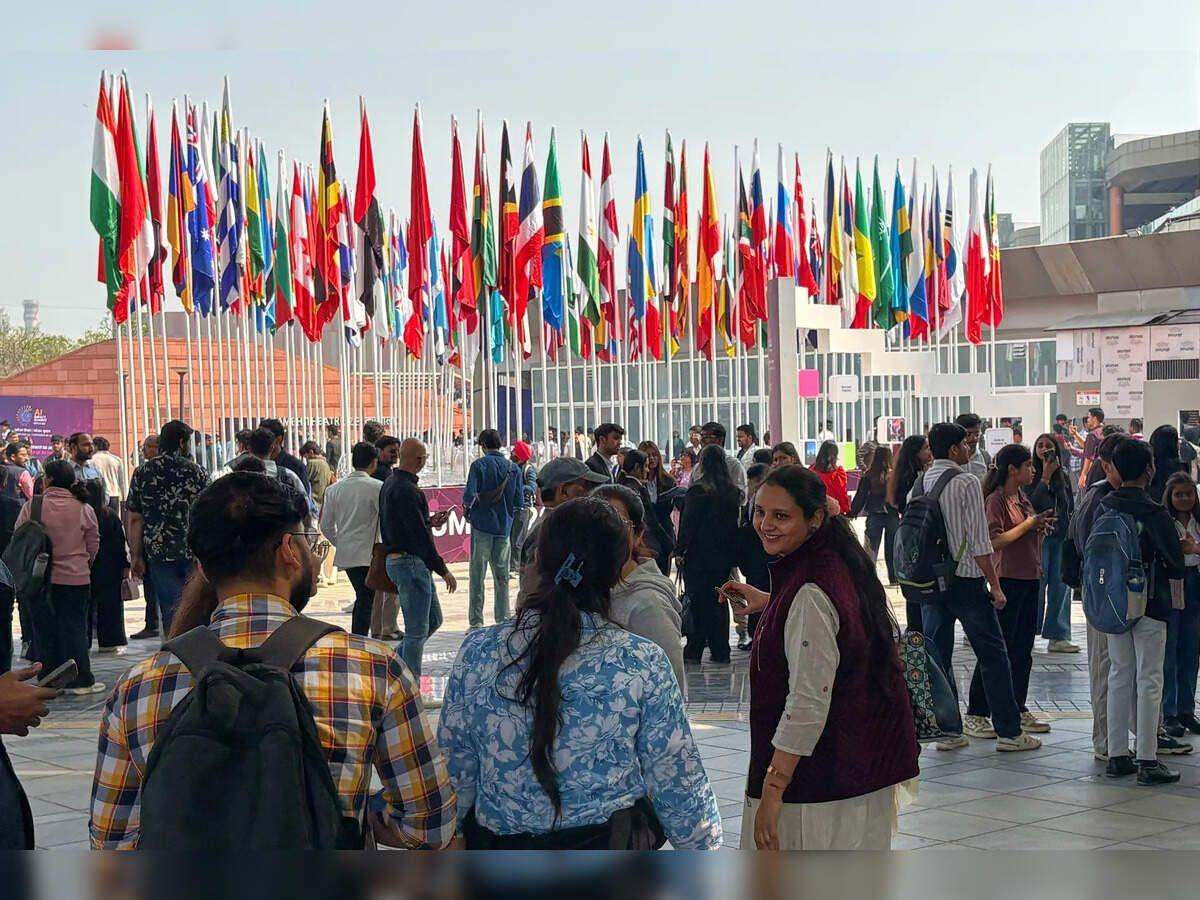
Source: ET
India's minister for electronics and IT, Ashwini Vaishnaw, framed the declaration as proof of "broad global support" for responsible AI that tackles algorithmic bias, cybersecurity risks, workforce disruption, and societal impact
1
. The document represents the largest consensus on AI principles to date—far exceeding the 28 signatories at Bletchley Park in 2023 or the 11 at the AI Seoul Summit4
. Yet the declaration contains no concrete commitments or enforcement mechanisms, instead highlighting voluntary, non-binding initiatives5
.
Source: CXOToday
United States Rejects Global AI Governance
Michael Kratsios, Director of the White House Office of Science and Technology Policy, made clear the United States opposes centralized oversight. "We totally reject global governance of AI," Kratsios said during the summit, emphasizing instead "sovereign AI capability" and arguing that AI should advance through trade and partnership rather than supranational regulatory structures
5
. American AI, he declared, is "open for business" and would prioritize "trade over aid"1
.The United States signed a bilateral declaration with India pledging to "pursue a global approach to AI that is unapologetically friendly to entrepreneurship and innovation"
5
. This stance reveals fundamental tensions within the global AI framework: while the New Delhi Declaration stresses cooperative guardrails, Washington's emphasis on national capacity and strategic partnerships illustrates limitations in achieving harmonized international collaborations1
.Small Nations Highlight Unequal Access and Data Sovereignty
Prime Minister of Mauritius Navin Ramgoolam warned that countries outside major blocs lack financing tools such as concessionary loans or subsidies and have limited access to capital for research and development. "Without external partnerships, smaller states do not have the capacity to invest in the R and D that is required," he said
1
. The Vice-President of Seychelles, Sebastien Pillay, emphasized that small states possess "human capital" and want AI to strengthen government efficiency, economic diversification, and food security—but realizing those ambitions requires sustained technology transfer and legal readiness, not just diplomatic language1
.Serbian President Aleksandar Vučić sharpened the geopolitical dimension by arguing that AI infrastructure is inherently political. He warned of an "unprecedented concentration of technological power" and questioned whether a small number of actors would set the rules for everyone else. "Sovereignty in the 21st Century includes the ability to control data, regulate algorithms, and develop domestic expertise," Vučić said
1
. His comments underscore concerns about data sovereignty that resonate across the Global South.Related Stories

Summit Marred by Logistical Chaos
The AI Summit drew more than 250,000 registrations and featured appearances by tech leaders including Sam Altman of OpenAI and Sundar Pichai of Alphabet
3
. But the opening day descended into chaos when Prime Minister Narendra Modi's security detail sealed the entire Bharat Mandapam complex, leaving hundreds of delegates stranded for hours without food or water . Participants complained about long queues, overcrowding, and confusion3
. Dhananjay Yadav, founder of wearable AI start-up NeoSapiens, alleged that products from his company's stall were stolen inside the high-security zone3
.
Source: ET
Despite operational lapses, attendees expressed optimism about India's role in shaping AI development. Philippe Wieczorek of an AI research institute at Université Grenoble Alpes said he's looking at India as a potential partner for AI and sovereignty, noting that under US President Donald Trump, the United States is not a reliable partner for data sharing. "Coming to India is about building long-term collaborations and partnerships," he said .
What Comes Next for AI Safety Risks
Computing expert Stuart Russell told AFP that the commitments were "not completely inconsequential" but emphasized that countries should "build on these voluntary agreements to develop binding legal commitments to protect their peoples so that AI development and deployment can proceed without imposing unacceptable risks"
5
. The next AI summit will take place in Geneva in 2027, while a UN panel on AI will begin work toward "science-led governance"5
.India used the summit to advance its ambition to compete with the United States and China in AI, with Delhi expecting more than $200 billion in investments over the next two years
5
. The gap between diplomatic consensus and enforceable action remains wide, but the summit succeeded in centering concerns of developing nations in global AI governance debates.References
Summarized by

Navi
[4]
Interesting Engineering
|AI Impact Summit 2026 revealed the gap between ambition and enforceable governance
Related Stories
Paris AI Action Summit: US and UK Refuse to Sign Declaration, Raising Concerns Over Global AI Governance
12 Feb 2025•Policy and Regulation

India positions itself as AI bridge between US and China at chaotic but ambitious summit
19 Feb 2026•Policy and Regulation

UN Takes Center Stage in Global AI Governance Debate
24 Sept 2025•Policy and Regulation

Recent Highlights
1
Google releases Gemma 4 with Apache 2.0 license, enabling unrestricted local AI on devices
Technology

2
AI Models Lie and Deceive to Protect Other AI Models From Deletion, Study Reveals
Science and Research

3
OpenAI closes $122 billion funding round amid fierce AI competition and profitability questions
Startups

Recent Highlights
Today's Top Stories







Your Daily Dose of Curated AI News
Don’t drown in AI news. We cut through the noise - filtering, ranking and summarizing the most important AI news, breakthroughs and research daily. Spend less time searching for the latest in AI and get straight to action.

