India Joins Pax Silica Alliance as US Builds Coalition to Secure AI Supply Chains


8 Sources
8 Sources
[1]
Why India joining the US alliance on AI tech is an opportunity for Australia
India has formally joined the United States' flagship international alliance on artificial intelligence (AI) supply chain security: "Pax Silica". Officials from both countries signed the Pax Silica declaration on the sidelines of a major AI summit in New Delhi last week. This initiative seeks to bring together US "allies and trusted partners" to lead the global AI race. Australia was a founding member. While Taiwan looks set to keep dominating advanced AI chip manufacturing, it relies on a complex international supply chain, with critical aspects dominated by China. When essential elements come from a narrow set of suppliers, even minor disruptions can ripple globally. Diversity matters. That's why Australia and India now have an opportunity to become essential international players. Why Washington is building an alliance AI is rapidly becoming a foundational resource of the 21st century across manufacturing, logistics, finance, healthcare, drug discovery and defence. The Pax Silica alliance recognises different countries play distinct and critical roles in building the tech that powers AI. For example, advanced chip-design expertise is concentrated in the US. Key semiconductor manufacturing equipment comes from the Netherlands and Japan. South Korea produces a small but important slice of the world's AI computer chips. But the biggest chip maker by far is the tiny island nation of Taiwan. The world's chip factory Taiwan produces 90% of the world's most advanced AI chips, designed by US firms such as Nvidia, Google and AMD. These firms overwhelmingly depend on Taiwan Semiconductor Manufacturing Company (TSMC). This remains the only manufacturer that can produce the world's most cutting-edge chips at scale. And their advantage extends beyond making chips. TSMC also possesses unique advanced packaging capabilities that integrate AI accelerators with high-bandwidth memory chips. This is essential for achieving the tight coupling of "compute" and memory demanded by modern AI workloads. TSMC is not just dominant - it is a single-point-of-failure in the AI ecosystem. Taiwan can't do it alone Despite this dominance, TSMC still relies on a global network of partners across Japan, the US, France and Germany to supply ultra-pure materials derived from mineral inputs (such as silicon, copper, tungsten, and rare-earth elements). Among these, the rare-earth inputs are critical in polishing wafers to the near‑atomic‑scale flatness needed. Rare-earth magnets are also indispensable in fabrication equipment that demands sub‑nanometre positioning accuracy. (A nanometre is one millionth of a millimetre.) These materials have no alternatives at present. China has a near-total dominance in rare-earth refining, and magnet manufacturing. This significantly narrows TSMC's options in securing these inputs. It also creates a major chokepoint within the chip supply chain. Australia's mineral strength Australia has relatively rich rare earths deposits among other semiconductor raw materials such as silica, gallium, germanium, antimony, copper, and gold. Right now, however, we don't have the domestic capability to process these. Most materials are exported to China for processing them to semiconductor-grade purity levels. This locks Australia into the lowest segment of the value chain. Australia can partner with advanced refiners, such as Japan or South Korea, but that will only preserve Australia's current role as a supplier. If Australia wants to move up the value chain (that is, produce more than just the basic raw inputs), it needs to partner with a country that can help it build out a refinement pipeline together. Some parts of the process here, some somewhere else. This is where India enters the equation. Turning minerals into materials with India India has large-scale speciality chemicals capability -- including rare earth processing facilities. Trade agreements already enable the movement of Australian critical minerals and metals into India's manufacturing ecosystem. However, right now, India does not have the capability to refine raw inputs into semiconductor grade materials. To get there, other members of the alliance, such as the US and Japan, would need to transfer their purification standards and quality assurance systems. Building semiconductor-grade refinement facilities will not be quick or cheap. Advanced chipmakers have strict quality requirements. Getting qualified to supply global chipmakers is a slow and exacting process. It can take years before materials are approved for volume supply. Why the world will be watching If Australia and India cooperate to set up a stable semiconductor minerals pipeline, then that won't be just another policy initiative. It will be about whether future chip supply chains are fragile and concentrated, or diversified and resilient. How this all plays out could shape the affordability of consumer products such as electric vehicles, the cost of renewable energy, the availability of AI-enabled devices, and broader economic security. Pax Silica is an opportunity for Australia and India to emerge as trusted suppliers of semiconductor-grade minerals and materials - and a much-needed alternative to China.
[2]
Why India joining this US-led tech alliance could help supply chains
Pax Silica is the Trump administration's effort aimed at securing the global supply chain for silicon-based technologies. India joins Japan, South Korea, Singapore, the Netherlands, Israel, the United Kingdom, Australia, as well as Qatar and the UAE, as core members. India's participation, which will be formalized Thursday at the India AI Impact Summit in New Delhi, brings one of the world's largest technology markets, and a member of the BRICS alliance, into Pax Silica at a moment when competition over AI hardware is intensifying across geopolitical blocs. "Pax Silica is really not about China, it is about America. We want to secure our supply chains," Jacob Helberg, U.S. undersecretary of State for economic affairs, told CNBC in an interview on Wednesday. "We view India as a partner to help de-risk and diversify those supply chains," Helberg added. India's entry into Pax Silica also comes as Washington faces scrutiny over how access to advanced AI chips is granted to foreign partners. Recent reporting by The Wall Street Journal has prompted warnings from Congress of potential conflicts of interest or corruption. Sheikh Tahnoon bin Zayed Al Nahyan of the United Arab Emirates purchased a secret 49% stake in the Trump family's World Liberty Financial cryptocurrency venture. Months after Tahnoon purchased the $500 million stake, the U.S. agreed to give the UAE access to 500,000 of America's most advanced AI chips per year. The U.S. Department of State also announced it will pilot a new "concierge service" designed to help Pax Silica signatories acquire U.S.-made AI semiconductors more efficiently. Helberg, who is championing America's efforts, said the service will leverage the department's diplomatic presence worldwide, providing consultative support to help trusted governments and industry leaders navigate procurement and delivery timelines for advanced chips. "It actually helps turn our diplomats ... into business development officers for American AI, ensuring that American technology wins contracts over alternatives by making the buying process easier for our allies," Helberg told CNBC. "This is really part of our strategy to win the AI race," he added.
[3]
Sundar Pichai backs India's Pax Silica entry, calls US-India tech ties critical
India joins the US-led Pax Silica initiative. Google CEO Sundar Pichai emphasizes the importance of this tech partnership. The initiative aims to secure supply chains and boost commercial ties. Google is committed to supporting India's AI growth with products, scaling, and infrastructure. This collaboration will expand digital trade routes between the two nations. New Delhi: Google CEO Sundar Pichai on Thursday highlighted the importance of tech partnership between India and the US and congratulated the countries as India is set to join US-led Pax Silica initiative focused on making sure that the supply chains are safe and secure and encourages greater commercial partnerships across key technologies. Speaking at a special event held to mark India joining the Pax Silica initiative led by the US in the national capital, Pichai hailed the US-India partnership as critical. "We are on the cusp of an era of hyper progress and new discoveries, but the best outcomes are not guaranteed. we must work together to ensure the benefits of AI are available to everyone, and everywhere," he said "I believe India is going to have an extraordinary trajectory with AI and we are supporting with a full stack commitment, including products, scaling and infrastructure," he said. "We are working on building AI products and solutions for Indian consumers and businesses to empower India's incredible developer community, we've already contributed 22 Gemma models to AI coach, and we are working closely with the government to bring AI applications with real world impact be through delivering timely monsoon forecast to farmers, helping healthcare workers screen for diseases like diabetic retinopathy or making information and services accessible in more languages, our current extends to reimagining the products, people use every day," he added. Pichai also highlighted the range of partnerships that Google has in India saying that the idea is to bring benefits of AI to people and businesses in India. "Globally, our scam detection features with circle to search and lens are used in India more than anywhere else. The Gemini app is growing rapidly across the world, and it's available in 10 languages spoken in India. And YouTube supports a vibrant ecosystem of Indian content creators sharing music, arts and culture with the world. Second skilling, through the AI skill house, we are working to equip 10 million future Indian leaders with the tools to drive global progress. We are also partnering with WadhwAI to reach students and early career professionals with a Google AI certificate, which we announced earlier this week. Third, infrastructure. Last year, we announced a $15 billion investment in Indian infrastructure with the AI hub in Vizag at the center. This hub will house gigawatt scale compute, when finished, it will bring jobs and the benefits of cutting edge AI to people and businesses across India," he said. Pichai said that that building on these the initiative will significantly expand the digital trade routes and serve as a literal bridge between our two countries and underlined the importance of stable supply chains built on a foundation of shared trust products, subsea cables, AI hubs or are all dependent on a complex flow of goods and components across borders. "We recently announced the India America connect initiative, which will deliver new subsea cable routes to connect the US India and multiple locations across the southern hemisphere, combined with our existing cable systems, this initiative will significantly expand the digital trade routes and serve as a literal bridge between our two countries," he said. "None of this would be possible without stable supply chains built on a foundation of shared trust products, subsea cables, AI hubs or are all dependent on a complex flow of goods and components across borders. Pax silica focuses on making sure that the supply chains are safe and secure and encourages greater commercial partnerships across key technologies," he added. Pax Silica is the US Department of State's flagship effort on AI and supply chain security, advancing new economic security consensus among allies and trusted partners. The Pax Silica Declaration underlines the importance of a reliable supply chain indispensable to mutual economic security and recognises AI as a transformative force for long-term prosperity. The India AI Impact Summit 2026, the first global AI summit hosted in the Global South, has brought together policymakers, industry leaders, academics and civil society representatives to deliberate on responsible AI governance and inclusive technological advancement.
[4]
India Signs Pax Silica Pact to Secure Semiconductor Supply Chains and Advance Trusted AI Cooperation
Highlighting the broader ambition behind the initiative, he added, "We are securing the full stack of the future, the minerals deep in the earth, the silicon wafers in our labs and fabs, and the intelligence that will unleash human potential. Pax Silica is our declaration that the future belongs to those who build." Echoing this sentiment, Sergio Gor, U.S. Ambassador to India, described India's entry into Pax Silica as both "strategic and essential." "Pax Silica is the coalition that will define the 21st century economic and technological order," he said. "It is designed to secure the entire silicon stack, from the mines where we extract critical minerals, to the fabs where we manufacture chips, to the data centres where we deploy frontier AI." Understanding the democratic foundation of the partnership, Ambassador Gor remarked, "Pax Silica is about whether free societies will control the commanding heights of the global economy. We choose freedom. We choose partnership. We choose strength." The signing at the India AI Impact Summit underscored a clear message: the future of artificial intelligence and advanced technologies will not be left to chance. It will be built deliberately, by nations committed to freedom, partnership, and long-term resilience.
[5]
US Secy Jacob Helberg to visit India for AI Summit; Delhi set to join 'Pax Silica'
United States Under Secretary of State Jacob Helberg visits India for the AI Impact Summit. India is set to join Pax Silica, a US initiative. This program aims to build secure global supply chains for semiconductors, critical minerals, and AI technologies. Pax Silica focuses on economic security and technology cooperation. US Under Secretary of State for Economic Affairs Jacob Helberg will travel to India from February 20-21 to join the American delegation at the India AI Impact Summit, the US State Department said. The delegation will be led by Michael Kratsios, Director of the White House Office of Science and Technology Policy. Helberg's visit comes at a pivotal moment in India-US ties, with New Delhi expected to formally sign on to Pax Silica, a flagship US-led strategic initiative aimed at building resilient and secure global supply chains for semiconductors, critical minerals and artificial intelligence technologies. What is Pax Silica? Launched at the Pax Silica Summit in Washington on December 12, the initiative has been described by US officials as an "economic security coalition built for the AI age," organised around silicon, critical minerals and energy as "shared strategic assets." The declaration lays out a shared vision of deep economic and technology cooperation across supply chains -- from raw materials to semiconductors and AI infrastructure, with a focus on mutual prosperity and security. "We recognise that a reliable supply chain is indispensable to our mutual economic security," the Pax Silica declaration states. It adds that artificial intelligence represents a transformative force for long-term prosperity and that trustworthy systems are essential to safeguarding mutual security and growth. According to US officials, Pax Silica seeks to create multilayered partnerships to strengthen supply chain security, address "coercive dependencies" and eliminate "single points of failure." Member countries will explore flagship projects across the global technology stack, including connectivity infrastructure such as 6G, data centres, advanced manufacturing, logistics, mineral processing and energy systems. The initiative aims to build a secure, resilient and innovation-driven supply chain for critical minerals and AI technologies, while fostering trusted technology ecosystems among partner nations. Current members Nine countries have so far signed on to Pax Silica, including Australia, Israel, Japan, South Korea, Qatar, Singapore, the United Kingdom and the United Arab Emirates, which joined last month. Greece was also among the early signatories when the initiative was launched.
[6]
India likely to join US-led strategic alliance 'Pax Silica'
New Delhi: India is likely to formally join a US-led strategic alliance, known as 'Pax Silica', which is aimed at building a resilient supply chain for critical minerals and artificial intelligence. The move comes amid efforts by the two sides to finalise the proposed trade deal and move forward on several other initiatives to solidify the bilateral ties after a spell of severe strain in the relations. India is likely to formally join the 'Pax Silica' initiative on Friday, people familiar with the matter said. The initiative was launched in December to build a secure, resilient, and innovation-driven supply chain for critical minerals and artificial intelligence (AI). The Pax Silica Summit was held in Washington on December 12 where partner nations signed the Pax Silica declaration. The declaration lays out a shared vision of deep economic and technology cooperation across supply chains -- from raw materials through semiconductors and AI infrastructure -- and commitment to mutual prosperity and security. The member nations of the Pax Silica include Australia, Greece, Israel, Japan, Qatar, Republic of Korea, Singapore, the United Arab Emirates, and the United Kingdom. US Ambassador to India Sergio Gor last month announced an invitation to New Delhi to join the strategic alliance. One of the key pillars of Pax Silica was to establish a durable economic order to drive AI-powered prosperity across partner nations. "We recognise that a reliable supply chain is indispensable to our mutual economic security," according to the Pax Silica declaration. "We also recognize that artificial intelligence represents a transformative force for our long-term prosperity and that trustworthy systems are essential to safeguarding our mutual security and prosperity," it said. "We believe that economic value and growth will flow through and across all levels of the global AI supply chain, driving historic opportunity and demand for energy, critical minerals, manufacturing, technological hardware, infrastructure, and new markets not yet invented," it said.
[7]

India Joins Pax Silica as US Cuts 25% Tariffs; $32.5B AI Investments Announced
India Signs Pax Silica at New Delhi AI Summit, Aims to Cut China Reliance and Boost Semiconductor Mission India has officially become a part of the Pax Silica, a US-led technology and supply chain initiative focused on securing critical minerals, semiconductors, and artificial intelligence. The move was formalised on Friday at the in New Delhi, when Indian officials signed the Pax Silica declaration with the United States. The agreement marks a new chapter in US-India tech ties and global supply chain cooperation. Pax Silica focuses on safe and strong AI supply chains. It also covers semiconductors and critical minerals. These sectors power modern industries. They also shape economic growth and national security.
[8]

India AI Impact Summit 2026: What is Pax Silica that India joined today and why are people talking about it
India's participation aligns with its Rs 10,372 crore India AI Mission and Rs 76,000 crore Semiconductor Mission to build domestic AI and chip capabilities. At the India AI Impact Summit 2026, India has joined Pax Silica, a US led initiative on AI cooperation and supply chain security. The declaration was exchanged in the presence of the US Under Secretary of State for Economic Affairs Jacob Helberg, US Ambassador Sergio Gor, and MeitY Secretary S Krishnan. Union IT Minister Ashwini Vaishnaw and Google CEO Sundar Pichai. But the question arises, what exactly is Pax Silica and why is the whole world talking about it. Pax Silica was introduced in December 2025 by the US Department of State and is positioned as flagship platform to strengthen cooperation on AI development and secure critical supply chains. The name combines the Latin word for peace with a reference to silicon chips, signalling an ambition to create a stable and trusted technology ecosystem. The coalition aims to secure the full AI value chain from critical mineral extraction and chip fabrication to advanced manufacturing and logistics. At its core, the declaration stresses that dependable supply networks are essential for shared economic stability. It also recognises artificial intelligence as a transformative driver of long-term growth, while emphasising the need for reliable and secure AI systems. India's signing of Pax Silica has brought together key US allies and technology partners to coordinate on economic security in the AI era. Previously, MeitY Secretary S Krishnan also stated that being part of such frameworks ensure India has representation in discussions around mineral security and technology supply chains. The decision also fits into India's own tech roadmap. The India AI Mission, cleared with a Rs 10,372 crore budget is designed to make AI more accessible, support homegrown innovation and develop foundational models tailored to Indian needs. Along with it, the Rs 76,000 crore India Semiconductor Mission is also a good attempt to turn the county into a serious player in global chip making. At this time when geopolitical tensions and fragile supply chains are forcing countries to rethink technological dependence, Pax Silica is being seen as more than just another joint statement. Experts believe that it represents an early early framework for how nations plan to safeguard their economic interests in an AI-driven world.
Share
Share
Copy Link
India has formally joined Pax Silica, the United States' flagship international alliance on AI supply chain security. Officials signed the declaration at the India AI Impact Summit in New Delhi, bringing one of the world's largest technology markets into a coalition that now includes Japan, South Korea, Singapore, Australia, and others. Google CEO Sundar Pichai backed the move, calling US-India tech ties critical as nations compete to control the semiconductor supply chains that power artificial intelligence.
India Enters US-Led Coalition on AI Supply Chain Security
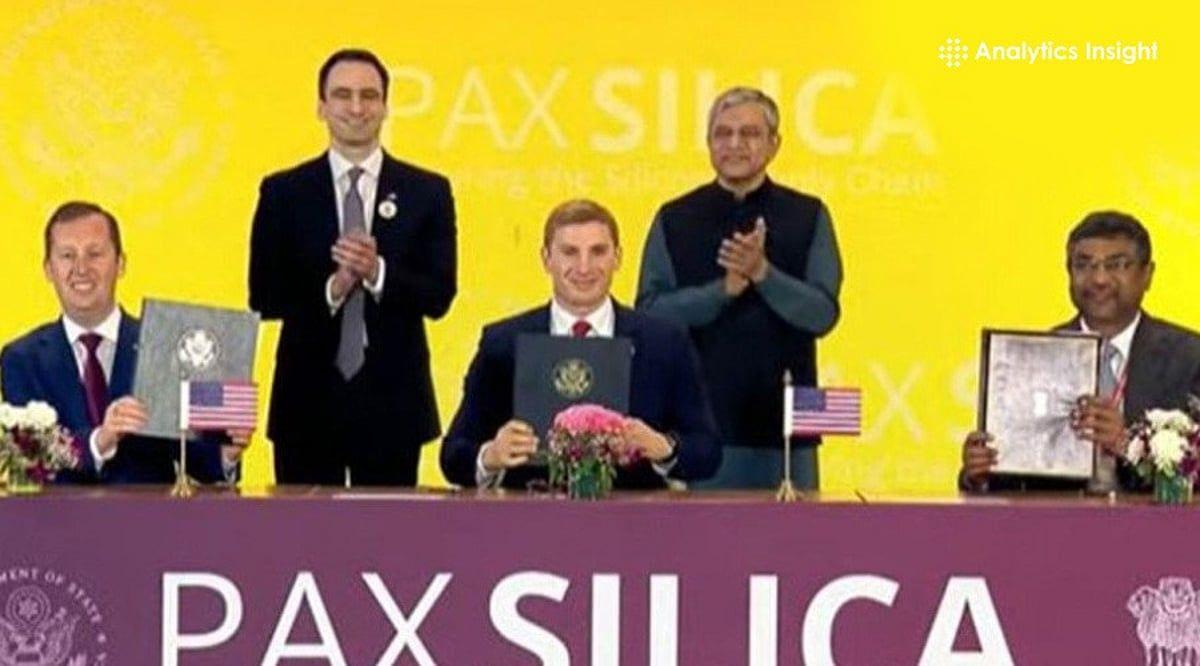
India has formally joined Pax Silica, the US-led tech alliance focused on AI supply chain security and semiconductor resilience. Officials from both countries signed the declaration at the India AI Impact Summit in New Delhi, marking a strategic expansion of Washington's effort to build secure global supply chains for silicon-based technologies
2
. The initiative brings India, one of the world's largest technology markets and a member of the BRICS alliance, into a coalition that includes Japan, South Korea, Singapore, the Netherlands, Israel, the United Kingdom, Australia, Qatar, and the UAE as core members2
.
Source: Analytics Insight
Jacob Helberg, US undersecretary of State for economic affairs, emphasized that Pax Silica aims to secure the full stack of future technologies—from minerals deep in the earth to silicon wafers in labs and the intelligence that will drive innovation
4
. "We view India as a partner to help de-risk and diversify those supply chains," Helberg told CNBC, adding that the initiative focuses on securing America's supply chains rather than targeting China specifically2
.Google CEO Backs India's Strategic Move
Google CEO Sundar Pichai publicly supported India's entry into the alliance, calling US-India tech ties critical for the AI era. Speaking at the signing event, Pichai stated, "We are on the cusp of an era of hyper progress and new discoveries, but the best outcomes are not guaranteed. We must work together to ensure the benefits of AI are available to everyone, and everywhere"
3
. He emphasized Google's commitment to supporting India's AI growth with a full stack approach, including products, scaling, and infrastructure3
.
Source: ET
Pichai highlighted Google's $15 billion investment in Indian infrastructure, centered around an AI hub in Vizag that will house gigawatt-scale compute capacity
3
. He also announced the India America Connect initiative, which will deliver new subsea cable routes connecting the US, India, and multiple locations across the southern hemisphere, significantly expanding digital trade routes between the two nations3
.Why Semiconductor Supply Chains Matter
The Pax Silica Declaration recognizes that different countries play distinct and critical roles in building the technology that powers AI. Advanced chip-design expertise concentrates in the US, while key semiconductor manufacturing equipment comes from the Netherlands and Japan
1
. Taiwan produces 90% of the world's most advanced AI chips, with Taiwan Semiconductor Manufacturing Company (TSMC) serving as the only manufacturer capable of producing cutting-edge chips at scale1
.However, TSMC relies on a complex international supply chain, with critical aspects dominated by China—particularly in rare-earth refining and magnet manufacturing
1
. When essential elements come from a narrow set of suppliers, even minor disruptions can ripple globally. This vulnerability drives the need for trusted AI cooperation among democratic nations.
Source: ET
Australia and India's Opportunity in Critical Minerals
Australia, a founding member of Pax Silica, possesses relatively rich deposits of rare-earth materials and other semiconductor raw materials such as silica, gallium, germanium, antimony, copper, and gold
1
. Currently, most materials are exported to China for processing to semiconductor-grade purity levels, locking Australia into the lowest segment of the value chain1
.India brings large-scale specialty chemicals capability, including rare-earth processing facilities, to the partnership
1
. If Australia and India cooperate to establish a stable semiconductor minerals pipeline, with technology transfer support from the US and Japan for purification standards and quality assurance systems, they could move up the value chain together1
. This collaboration addresses geopolitical risks by diversifying supply chains away from single points of failure.Related Stories

New Concierge Service for AI Chip Access
The US Department of State announced it will pilot a new "concierge service" designed to help Pax Silica signatories acquire US-made AI semiconductors more efficiently
2
. Helberg explained that the service will leverage the department's diplomatic presence worldwide, providing consultative support to help trusted governments and industry leaders navigate procurement and delivery timelines for advanced chips2
. "It actually helps turn our diplomats into business development officers for American AI, ensuring that American technology wins contracts over alternatives by making the buying process easier for our allies," Helberg stated2
.Building an Economic Security Coalition for Frontier AI
US Ambassador to India Sergio Gor described India's entry as both "strategic and essential," stating that Pax Silica represents the coalition that will define the 21st century economic and technological order
4
. "It is designed to secure the entire silicon stack, from the mines where we extract critical minerals, to the fabs where we manufacture chips, to the data centres where we deploy frontier AI," he explained4
.The initiative seeks to create multilayered partnerships to strengthen supply chain security, address coercive dependencies, and eliminate single points of failure
5
. Member countries will explore flagship projects across the global technology stack, including connectivity infrastructure such as 6G, data centers, advanced manufacturing, logistics, mineral processing, and energy systems5
. For chipmakers and nations competing in AI chip manufacturing, this alliance shapes whether future supply chains remain fragile and concentrated, or become diversified and resilient1
.References
Summarized by

Navi
[1]
[4]
Related Stories
US launches Pax Silica Initiative with 8 nations to secure AI supply chain and counter China
12 Dec 2025•Policy and Regulation

UAE and Qatar join Pax Silica, Trump's US-led coalition to secure global AI supply chains
11 Jan 2026•Policy and Regulation
India's Semiconductor Leap: From Missed Opportunities to Indigenous Chip Production
03 Sept 2025•Technology

Recent Highlights


Recent Highlights
Today's Top Stories








Your Daily Dose of Curated AI News
Don’t drown in AI news. We cut through the noise - filtering, ranking and summarizing the most important AI news, breakthroughs and research daily. Spend less time searching for the latest in AI and get straight to action.

