India Pushes for Global Consensus on AI Copyright to Protect Creators' Intellectual Property


2 Sources
2 Sources
[1]
Ashwini Vaishnaw bats for global consensus on AI, IP & copyright
India is pushing for global agreement on AI copyright. Minister Ashwini Vaishnaw stated the need for consensus to protect creators' rights. The country aims for techno-legal solutions to balance innovation and intellectual property. India is also investing in a creator economy, establishing content creator labs to nurture talent for the growing AVGC sector. New Delhi: India is seeking to achieve a global consensus on ensuring that artificial intelligence (AI) does not infringe upon the copyrights of content creators, a senior minister Monday said. "Given that the challenges between AI and copyright are very complex, we are, during the India AI Impact Summit, looking at some sort of consensus on this. If the creators get a chance to deploy their skills, protect their copyrights, and the fruits of their creative energy, then the growth (of the creative industry) between today and tomorrow will be very high," Ashwini Vaishnaw, Union Minister of Electronics & IT, Railways and I&B said. Vaishnaw was speaking at a fireside chat, organised by the Federation of Indian Chambers of Commerce & Industry (FICCI), as a part of India AI Impact Summit 2026 in New Delhi. Lately, this rapid proliferation of AI chatbots has been on a collision course with authors of copyrighted books, as well as news agencies and individuals, who allege that the AI companies are accessing copyrighted material in an unauthorised manner to develop models and enhance competitiveness in the market. The foundational models, including large language models (LLMs) and small language models (SLMs), are trained on knowledge that already exists, such as books, periodicals, and content sources, which maybe copyrighted. While the copyright infringement has led to class-action lawsuits, several entities, including news agencies, have entered into licensing deals with AI services providers as an interim measure. "For a right balance between IP and innovation, would a simple regulation do that? Probably not," Vaishnaw quipped, while addressing a joint conference with Charles Rivkin, chairman & CEO, Motion Picture Association. "That would require a lot of consensus-building. That would also require a lot of technological tools to be created. Our understanding so far is that for such complex problems, we have to have techno-legal solutions," the minister said. Techno-legal solutions, according to him, would address legal aspects while keeping technical guardrails in consideration, along with technical balancing features in the AI models as well as in the way AI is deployed. "We are very closely engaged with the industry to find out the right technical and legal structures for this. This will require a consensus-building across different countries." India's Principal Scientific Advisor, Ajay Sood, also told ET in an interview recently that the Centre aims to build a techno-legal framework for ensuring AI safety, following the success of the country's digital public infrastructure (DPI). "We believe that human creativity is the most important thing that we have in our entire civilisation. So we must protect it, we must make sure that any system which protects human creativity and enhances it is a better system," Vaishnaw said. "AI should have a complementing effect on human creativity, job creation, and talent pipeline." Meanwhile, the Prime Minister Narendra Modi-led government has been bullish on developing a robust homegrown creator economy through various policy measures. In the Union Budget for FY2026-27 announced earlier this month, the Centre has proposed establishing "AVGC (Animation, Visual Effects, Gaming, and Comics) Content Creator Labs" in 15,000 secondary schools and 500 colleges nationwide. By embedding creative skills within the formal education system and expanding access across regions, the initiative aims to create a new generation of talent in line with projections that the AVGC sector will require nearly 2 million professionals by 2030. "Throughout the country, we will be opening these content creator labs. We have partnerships with the entire industry, and like what we did in semiconductors, we have the world's best tools available to the students in 315 universities," the minister said. Industry estimates show that India's animation and visual effects sector is valued at nearly ₹10,300 crore, while the gaming sector is valued at about ₹23,200 crore. (You can now subscribe to our Economic Times WhatsApp channel)
[2]
We are looking to build some sort of consensus on AI and copyright", Minister Ashwini Vaishnaw at AI Impact Summit
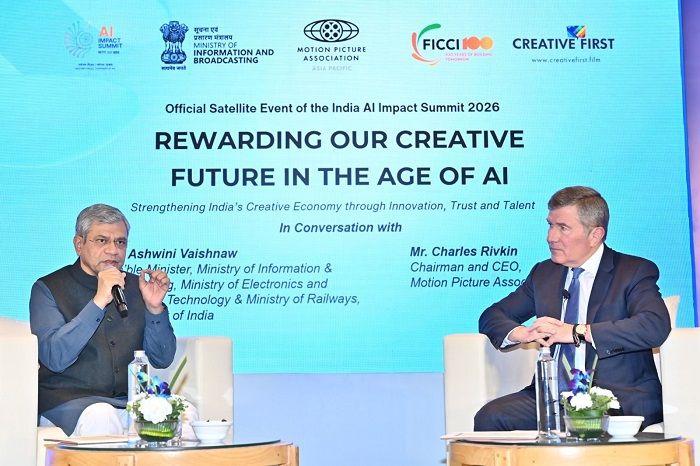
On the opening day of India's AI Impact Summit, Charles Rivkin, Chairman and CEO of the Motion Picture Association (MPA), joined Shri Ashwini Vaishnaw, Minister for Information & Broadcasting (MIB), Electronics & Information Technology (MeitY), and Railways, Government of India, for a fireside conversation on the future of Artificial Intelligence (AI) and the creative economy. The event, Rewarding Our Creative Future in the Age of AI - Strengthening India Through Innovation, Trust and Talent, was organised by the MPA in partnership with the Federation of Indian Chambers of Commerce and Industry (FICCI), MIB, and Creative First, with support from a broad cross-section of film, television, and streaming industry organisations. In his opening remarks, Rajiv Aggarwal, Chair of the FICCI IPR Committee, said, "As AI unlocks new opportunities across film, media, music, gaming, and digital content, it is equally important that innovation is anchored in a balanced and forward-looking IP ecosystem that ensures India continues to lead, both as a cultural and an economic powerhouse in the age of AI." During the fireside chat between Ashwini Vaishnaw and Charles Rivkin, both leaders acknowledged that AI represents a new and exciting frontier for the global creative industries, sectors with a long and proven history of embracing transformative technologies in pursuit of creative excellence. "AI can and must be used to expand creativity in a responsible way," Rivkin said. "Our member studios are at the forefront of this transformation, recognising the immense potential of AI to enhance storytelling while keeping human creativity at the heart of filmmaking. Strong copyright frameworks are indispensable; they anchor a vibrant creative economy, drive investment in the media and entertainment sector, and turn creative ingenuity and storytelling into world-class cultural exports." "I commend the Government of India for convening this forum at such a consequential moment," he added. Speaking about the aim of the AI Summit, Minister Vaishnaw said, "The challenges between AI and copyright are very, very complex, and at this summit, we are looking to build some sort of consensus on this. If creators are given the opportunity to deploy their skills, protect their copyrights, and safeguard the roots of their creative energy, then the growth between today and tomorrow will be significant. AI can then be used as a tool." The AI & Creative Economy track directly supports several of the key pillars underpinning the AI Impact Summit, especially around human capital, trusted AI, and AI for economic and social good. The programme builds on the momentum of last year's WAVES Summit and serves as a bridge to next year's gathering, reinforcing India's leadership at the convergence of creativity, technology, and culture, and recognising MPA member studios' continued contribution to the growth of the screen industry. In his closing remarks, Mr Prabhat, Additional Secretary, Ministry of Information & Broadcasting, GoI, said, "Our AI for All vision is guided by the principle that technology must ultimately serve people. AI should expand opportunities for creators across regions and languages, while remaining firmly aligned with ethical and constitutional values". The AI Impact Summit, convened at the invitation of Prime Minister Narendra Modi, is positioned as the first major global AI gathering in the Southern Hemisphere. It has drawn heads of state from 20 nations, ministerial delegations from 45 countries, and CEOs from the world's leading technology companies.
Share
Share
Copy Link
India is leading efforts to establish a global consensus on AI copyright protections at the AI Impact Summit. Minister Ashwini Vaishnaw advocates for techno-legal solutions to balance innovation with creators' rights as AI models trained on copyrighted content spark legal battles. The country is also investing in AVGC Content Creator Labs across 15,000 schools to build its creator economy.
India Leads Push for Global Consensus on AI Copyright Protection
India is spearheading efforts to establish a global consensus on AI copyright protections, addressing mounting concerns that artificial intelligence systems are infringing upon the intellectual property rights of content creators. Speaking at the AI Impact Summit in New Delhi, Ashwini Vaishnaw, Union Minister of Electronics & IT, Railways and Information & Broadcasting, emphasized the urgent need for international agreement on this complex issue
1
. "Given that the challenges between AI and copyright are very complex, we are, during the India AI Impact Summit, looking at some sort of consensus on this," Vaishnaw stated during a fireside chat organized by the Federation of Indian Chambers of Commerce & Industry1
.
Source: ET
The Intersection of Artificial Intelligence and the Creative Economy
The rapid proliferation of AI chatbots has created friction at the intersection of Artificial Intelligence and the creative economy, as AI models trained on copyrighted content continue to spark controversy. Foundational models, including large language models and small language models, are trained on existing knowledge such as books, periodicals, and other content sources that may be copyrighted
1
. This has led to copyright infringement allegations from authors, news agencies, and individuals who claim AI companies are accessing copyrighted material without authorization to develop models and enhance market competitiveness. While some entities have pursued class-action lawsuits, others have entered into licensing deals with AI service providers as an interim measure .Techno-Legal Solutions to Protect Creators' Intellectual Property Rights
Vaishnaw proposed techno-legal solutions as the path forward to protect creators' intellectual property rights while enabling innovation. "For a right balance between IP and innovation, would a simple regulation do that? Probably not," he remarked during a joint conference with Charles Rivkin, Chairman & CEO of the Motion Picture Association
1
. These solutions would address legal aspects while incorporating technical guardrails and balancing features in AI models and deployment methods. The minister stressed that achieving this requires consensus-building across different countries and close engagement with industry stakeholders1
. India's Principal Scientific Advisor has also indicated the Centre aims to build such a framework for ensuring AI safety, following the success of the country's digital public infrastructure1
.Strong Copyright Frameworks Enable Responsible AI Use
Both Indian and international leaders at the AI Impact Summit emphasized that strong copyright frameworks are essential for responsible AI use. Rivkin stated, "AI can and must be used to expand creativity in a responsible way. Our member studios are at the forefront of this transformation, recognising the immense potential of AI to enhance storytelling while keeping human creativity at the heart of filmmaking"
2
. He added that strong copyright frameworks "anchor a vibrant creative economy, drive investment in the media and entertainment sector, and turn creative ingenuity and storytelling into world-class cultural exports"2
. Vaishnaw reinforced this view, stating, "We believe that human creativity is the most important thing that we have in our entire civilisation. So we must protect it"1
.Related Stories

Building a Balanced Intellectual Property Ecosystem Through Innovation
The event, titled "Rewarding Our Creative Future in the Age of AI - Strengthening India Through Innovation, Trust and Talent," was organized by the Motion Picture Association in partnership with the Federation of Indian Chambers of Commerce & Industry, the Ministry of Information & Broadcasting, and Creative First
2
. Rajiv Aggarwal, Chair of the FICCI IPR Committee, emphasized that "innovation is anchored in a balanced intellectual property ecosystem that ensures India continues to lead, both as a cultural and an economic powerhouse in the age of AI"2
.
Source: CXOToday
India Invests in Creator Economy Through AVGC Initiatives
The government has been bullish on developing a robust homegrown creator economy through various policy measures. In the Union Budget for FY2026-27, the Centre proposed establishing AVGC (Animation, Visual Effects, Gaming, and Comics) Content Creator Labs in 15,000 secondary schools and 500 colleges nationwide
1
. This initiative aims to create a new generation of talent, as projections indicate the AVGC sector will require nearly 2 million professionals by 2030. Industry estimates show that India's animation and visual effects sector is valued at nearly ₹10,300 crore, while the gaming sector is valued at about ₹23,200 crore1
. The AI Impact Summit, convened at the invitation of Prime Minister Narendra Modi, has drawn heads of state from 20 nations, ministerial delegations from 45 countries, and CEOs from leading technology companies2
.References
Summarized by

Navi
Related Stories
Hollywood and Bollywood Unite to Protect Content from AI in India
08 Oct 2025•Policy and Regulation
India proposes mandatory AI training licence with central royalty body to balance innovation and copyright
09 Dec 2025•Policy and Regulation
Indian Minister Hardeep Puri: AI Not a Threat to Content Creation Economy
24 Aug 2024

Recent Highlights
1
Google releases Gemma 4 with Apache 2.0 license, enabling unrestricted local AI on devices
Technology

2
AI Models Lie and Deceive to Protect Other AI Models From Deletion, Study Reveals
Science and Research

3
OpenAI closes $122 billion funding round amid fierce AI competition and profitability questions
Startups

Recent Highlights
Today's Top Stories






Your Daily Dose of Curated AI News
Don’t drown in AI news. We cut through the noise - filtering, ranking and summarizing the most important AI news, breakthroughs and research daily. Spend less time searching for the latest in AI and get straight to action.

