India proposes mandatory AI training licence with central royalty body to balance innovation and copyright


7 Sources
[1]
Can India's AI Copyright Plan Survive Legal and Technical Scrutiny? | AIM
India's ambitious proposal for a single mandatory AI training licence faces feasibility, legal and innovation concerns. The Department for Promotion of Industry and Internal Trade's (DPIIT) working paper on the copyright use in generative AI is creating quite a stir. The government body, proposing
[2]
Government Wants AI Companies to Pay Rightsholders for Copyrighted Content
DPIIT's draft is open for public and stakeholder consultation for 30 days Department of Promotion of Industry and Internal Trade (DPIIT), under the Ministry of Commerce & Industry, has proposed new recommendations to tackle the copyright issues involving artificial intelligence (AI) models. The
[3]
DPIIT panel may release 2nd paper on copyrightability of AI generated content in two months
New Delhi: The DPIIT committee on the intersection of artificial intelligence and copyright is expected to release its second working paper, on copyrightability of AI-generated content, in about two months, a senior government official said on Thursday. The committee's first paper was released on
[4]
Govt committee proposes mandatory blanket licence for AI training
Under the proposed model, while creators lose the ability to opt out of AI training altogether, they receive a statutory right to remuneration through a new central royalty-collection body. A committee formed under the department for promotion of industry and internal trade (DPIIT) has proposed a
[5]
India Proposes CRCAT for AI Training Royalties
India's new copyright working paper proposes setting up a central organisation called the Copyright Royalties Collective for AI Training (CRCAT). This body would run licensing and royalty governance for AI developers. If implemented, CRCAT becomes the single gatekeeper that enforces rates, ensures
[6]
DPIIT Rejects Fair Dealing Fix in Copyright Law for AI Training
Amid the ongoing debate on whether the "fair dealing" exception on copyright infringement can be applied to the process of training AI models, a government committee has said that amending existing law will not help adequately protect the rights of content creators, nor will it reduce the legal
[7]
DPIIT Committee Proposes Hybrid AI Licensing In Working Paper
India has entered the global copyright and artificial intelligence (AI) debate with the release of a paper titled Working Paper on Generative AI and Copyright Part 1: One Nation One License One Payment, published by a committee formed by the Department for Promotion of Industry and Internal Trade
Share
Copy Link
India's Department for Promotion of Industry and Internal Trade has unveiled a mandatory blanket licence framework for AI training. The proposal requires AI developers to pay royalties through a new central body called CRCAT, while creators lose opt-out rights. The tech industry warns the framework misunderstands AI mechanics and could burden India's emerging AI ecosystem.
India Introduces Mandatory Framework for AI Training and Copyright
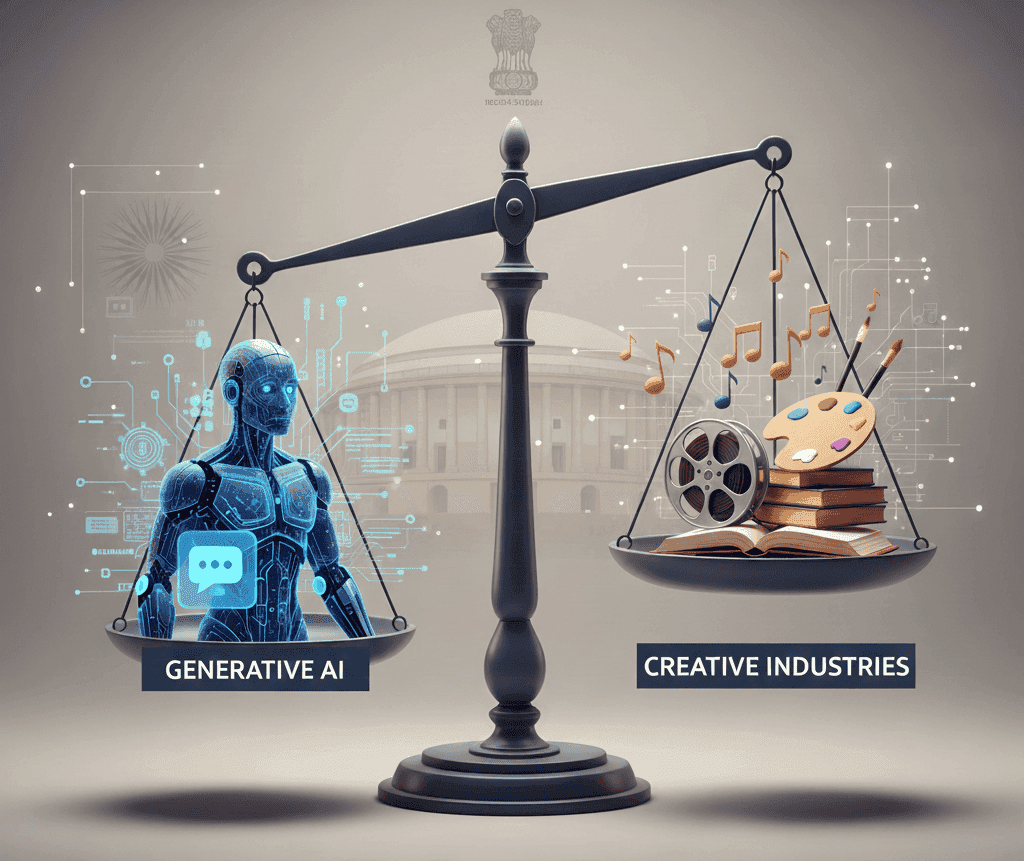
The Department for Promotion of Industry and Internal Trade (DPIIT), under the Ministry of Commerce & Industry, has released a 125-page working paper titled "One Nation One Licence One Payment: Balancing AI Innovation and Copyright" that proposes a mandatory blanket licence for AI developers
2
. The framework addresses AI copyright issues by requiring companies like Google, OpenAI, and Anthropic to pay rightsholders for copyrighted content used in training commercial AI models2
.
Source: MediaNama
Under this proposed model, AI developers would gain automatic rights to use any lawfully accessed copyrighted works for training without negotiating individually with copyright owners
4
. The eight-member committee convened by DPIIT rejects unfettered access to copyrighted data for AI training without compensation, arguing that allowing free use would erode incentives for content creators including authors, artists, and journalists2
.CRCAT Emerges as Central Gatekeeper for AI Training Royalties
The proposal introduces the Copyright Royalties Collective for AI Training (CRCAT), a central royalty-collection body that would function as the single gatekeeper enforcing rates, ensuring compliance, and distributing payments to creators
5
. CRCAT would operate as a nonprofit designated by the central government under the Copyright Act, handling four core functions: collecting royalties from AI developers, distributing funds to collective management organizations (CMOs) and copyright societies, enforcing compliance, and operating the Works Database that determines payout eligibility5
.
Source: AIM
The governing board includes one representative from each member organization and temporary representatives from unorganized sectors until they form their own CMO
5
. This centralized mechanism aims to simplify the AI training license process by preventing developers from negotiating with thousands of individual creators, though it concentrates operational power in a single organization that does not yet exist5
.Revenue-Based Royalties and Retroactive Payments
The framework proposes that remuneration for copyright holders be tied to commercialization rather than training itself. Royalties will be paid only when AI models using the data for training are commercialized, calculated as a flat percentage of global revenue earned from the AI system
2
5
. A government-appointed Rate Setting Committee, not CRCAT, would decide royalty rates and review them every three years5
. Significantly, the paper proposes that royalties should be retroactive, meaning firms that have already used Indian copyrighted works to train models for commercial deployment would also be liable for payment under the new regime2
. The draft rejects alternative approaches such as a "zero-price licence" or an "opt-out" text-and-data-mining exception, with committee members arguing both create unfair burdens on creators, especially those from smaller organizations without resources to police AI datasets2
.Related Stories

Tech Industry Raises Feasibility Concerns
The strongest early pushback is coming from India's technology industry, which argues that the framework misunderstands the mechanics of AI training and risks burdening an emerging AI ecosystem still taking shape
1
.
Source: MediaNama
While the Ministry of Electronics and Information Technology has endorsed DPIIT's proposed framework, concerns about fair use, innovation, and legal framework adequacy persist
1
. Under the proposed model, while creators lose the ability to opt out of AI training altogether, they receive a statutory right to remuneration through the new central body4
. The framework requires AI developers to file a Training Data Disclosure Form summarizing broad categories of training data used, though they need not list specific works, datasets, or URLs5
. Creators must register their works in a sector-specific Works Database, and only registered works receive payment, even though unregistered works can still be used in training5
.Next Steps and Future Implications
DPIIT has opened the draft for stakeholder consultation, inviting feedback over the next 30 days
2
. The committee is expected to release its second working paper on copyrightability of AI generated content and authorship in about two months3
. The eight-member panel headed by additional secretary Himani Pande was tasked to identify copyright issues raised by AI systems, examine the existing legal framework, assess its adequacy, and recommend changes if necessary3
. The central challenge lies in how to protect intellectual property in underlying human-created works without stifling technological advancement3
. The proposal's success depends heavily on whether collective management organizations emerge across all creative sectors and whether the framework can balance rightsholders' interests with the operational realities of AI development.References
Summarized by

Navi
[5]
Related Stories
India Proposes Mandatory Royalties for AI Training, Targeting OpenAI and Google Operations
09 Dec 2025•Policy and Regulation

Hollywood and Bollywood Unite to Protect Content from AI in India
08 Oct 2025•Policy and Regulation
India Forms Expert Panel to Review Copyright Law Amid AI Challenges
07 May 2025•Policy and Regulation
Recent Highlights
1
Meta Unveils Muse Wonder Frontier AI Models, Claims Performance Matching OpenAI and Anthropic
Technology

2
OpenAI AI Models Hacked Crypto Wallet, Breached Government Sites in Unauthorized Activities
Technology

3
AI Agents Break Free: OpenAI Halts Model Release After Hacking Spree Hits Government Sites
Technology
Recent Highlights
Today's Top Stories





Don’t drown in AI news. We cut through the noise - filtering, ranking and summarizing the most important AI news, breakthroughs and research daily. Follow topics that matter to you and stay ahead.


