Intel joins Elon Musk's $25 billion Terafab project to produce AI chips at massive Texas facility


22 Sources
22 Sources
[1]
Intel signs on to Elon Musk's Terafab chips project | TechCrunch
Intel will join SpaceX and Tesla in an effort to build a new U.S. semiconductor factory in Texas, although the scope of its contributions are unclear. "Our ability to design, fabricate, and package ultra-high-performance chips at scale will help accelerate Terafab's aim to produce 1 TW/year of compute to power future advances in AI and robotics," Intel said in a corporate post on X. Intel hasn't shared any more information. Elon Musk announced in March a team-up between the two tech companies he leads to develop chips for AI compute, satellites, including SpaceX's mooted space data center, and to support the possibility of autonomous Tesla vehicles and robots. However, building a chip fab is one of the most difficult and expensive corporate infrastructure projects out there, typically requiring years of time and more than $20 billion to create a facility with a huge clean room for thousands of ultra-precise machines to carve silicon. It wasn't obvious how SpaceX and Tesla, two companies with no experience in the sector, could team up to execute the project efficiently. Now, we have a better idea: Intel will do it. The company has been hunting for large anchor customers to support its foundry business, and now it has two. Still, if investors thought that Terafab would be a greenfield approach based on SpaceX and Tesla's unique approach to engineering, that may not play out. Once the leading U.S. silicon producer, Intel has seen rivals Nvidia and AMD take the lead in developing advanced processors and adopt the "fabless" business model where chip designers outsource the manufacturing of their semiconductors. Intel's stock rose more than 3% on the news today. It was trading at $52.28, about 2.9% higher than its opening bell price, at 2 pm ET. Intel and SpaceX didn't respond to requests for comment by press time.
[2]
Elon Musk's $25 Billion Terafab Project Gets a Helping Hand From Intel
Expertise Video gaming, computer hardware, laptops, home energy, home internet Elon Musk's Texas-based Terafab AI chip production project has a new partner in one of the world's largest semiconductor chip manufacturers. Intel said on Tuesday that it is signing on to help design and build the chip-producing hardware for the $25 billion project backed by Musk's SpaceX, xAI and Tesla. The semiconductor technology that Terafab is slated to mass-produce is necessary for many of the billionaire's promised products, including self-driving cars, humanoid robots and sprawling AI data centers. Building chip fabrication plants, or fabs, is no simple task. US companies have for years relied on the Taiwan Semiconductor Manufacturing Company, which produces 90% of advanced computer chips globally, to actually create the chips that power our electronics. But as the AI industry calls for more and more computing power, US companies are scrambling for control over chip production. Musk's Terafab facility is far from the only domestic investment in AI chips. Nvidia and TSMC, for example, have partnered to manufacture chips and supercomputers in Arizona. Intel CEO Lip-Bu Tan wrote on X, formerly Twitter, that the partnership is "exactly what is needed in semiconductor manufacturing today." "Terafab represents a step change in how silicon logic, memory and packaging will get built in the future," Tan wrote. Intel said it aims to produce enough chips to provide one terawatt of computing power per year once the facility is operational. This aligns with Musk's own claim when he initially announced plans for the Terafab facility. Despite publicly committing to Musk's Terafab, Intel is still dealing with its own AI chipmaking struggles. The US semiconductor giant has faced delays bringing two fabs to fruition on its Ohio One campus despite receiving significant government subsidies. While the company previously stated AI chip production would begin in 2025, its first fab is now slated to be completed in 2030 and to begin operations in 2031. The second fab is expected to be completed in 2031 and to begin operations in 2032. Intel's total expenditure on these facilities has reached $5.26 billion. The company is also building two fabs in Arizona, competing with more than 70 other semiconductor producers looking to establish a foothold in the state. Musk and his companies also have a history of announcing things with big expectations that never happen or take far longer. Remember the Hyperloop? So it stands to be seen whether the Terafab's eventual reality meets today's hype. Representatives from Intel, Tesla and SpaceX didn't immediately respond to requests for comment.
[3]
Intel will help build Elon Musk's Terafab AI chip factory
Elon Musk's Terafab AI chip project in Austin, Texas, is gaining a crucial new partner: Intel. On Tuesday, the American chipmaker announced it was signing on to help design and build the sprawling facility, which would supply AI chips to Musk's two companies, SpaceX (newly merged with xAI) and Tesla. Musk needs AI chips to power his plans to build a "robot army" that includes self-driving cars and humanoid robots, as well as for the data centers he plans on launching into space. SpaceX plans on making its initial public offering later this year.
[4]
Intel joins Elon Musk's TeraFab project -- 'Intel is proud to join the Terafab project with SpaceX, xAI, and Tesla to help refactor silicon fab technology'
Intel's abilities to design, fabricate, and package chips to help TeraFab to achieve its goals. In an unexpected turn of events, Intel on Tuesday said that it had joined Elon Musk's TeraFab project. The announcement mentions Intel's ability to develop, produce, and package advanced processors in high volumes, which could help Tesla, SpaceX, and xAI to get enough compute performance for next-generation AI and robotics applications. However, the announcement made in an X post you can expand below does not reveal how exactly Intel will help TeraFab. "Intel is proud to join the Terafab project with SpaceX, xAI, and Tesla to help refactor silicon fab technology," a statement by Intel reads. "Our ability to design, fabricate, and package ultra-high-performance chips at scale will help accelerate Terafab's aim to produce 1 TW/year of compute to power future advances in AI and robotics. It was fun hosting Elon Musk at Intel this past weekend!" The announcement is not accompanied by any press releases or SEC filings, which raises questions about the framework of the collaboration between Intel and TeraFab, as well as any possible legal bindings. In fact, the post in X is deliberately written in a way that barely reveals any concrete details about the structure of the partnership. Officially, TeraFab is positioned as the "most epic chip-building effort ever" that is to combine "logic, memory and advanced packaging under one roof," which implies localized production in a massive facility. Furthermore, the company is hiring managers to build a greenfield semiconductor fabrication plant in Texas. By contrast, Intel's wording rather implies a virtual semiconductor production ecosystem, or even a consortium that involves chip design, manufacturing, and packaging at Intel and demand from Tesla, SpaceX, and xAI. How such a consortium would differ from a typical wafer supply agreement that large companies tend to have with their suppliers is something that is unclear at this point. Considering the fact that Elon Musk wants his TeraFab project to ramp up production of chips as soon as possible, a reasonable way to achieve this would be to build a coordinated supply chain with a capacity pool that includes its own facilities as well as facilities belonging to other chipmakers, such as Intel. If we were to speculate further, we would envision custom co-invested fabs or at least product lines that would use unified process technologies, thus offering Elon Musk's companies dual or even triple sourcing to satisfy their demands. In fact, Tesla, SpaceX, and xAI may even order Intel to develop custom silicon tailored specifically for their workloads, as Intel officially offers custom silicon development services, though this is speculation. But while the Intel - TeraFab collaboration announcement lacks details on how Elon Musk plans to produce chips that would consume one terawatt of power on an annual basis, the chief executive of Intel expects Elon Musk to reimagine the entire semiconductor industry. "Elon has a proven track record of reimagining entire industries," Lip-Bu Tan wrote in his own X post. "This is exactly what is needed in semiconductor manufacturing today. Terafab represents a step change in how silicon logic, memory and packaging will get built in the future. Intel is proud to be a partner and work closely with Elon on this highly strategic project." Follow Tom's Hardware on Google News, or add us as a preferred source, to get our latest news, analysis, & reviews in your feeds.
[5]

Intel gets on board with Musk's Terafab project
Intel has announced that it will help Elon Musk design and build his proposed Terafab in Austin, Texas, a joint venture between Musk's companies like SpaceX, Tesla and xAI to manufacture the chips necessary to power various AI projects. Musk announced Terafab in March 2026 with the plan of eventually creating a terawatt of computing power each year. While Tesla and SpaceX have experience manufacturing in the US, chip fabrication plants like the ones Intel runs are expensive and time-consuming to build. Offloading the task of actually building the Terafab from Musk's companies to Intel makes sense. "Our ability to design, fabricate, and package ultra-high-performance chips at scale will help accelerate Terafab's aim to produce 1 TW/year of compute to power future advances in AI and robotics," Intel said in its announcement. Musk's plan to produce chips is part of a larger refocusing of his various companies around AI. For example, Tesla has gone from an electric car company to a robotics company, and SpaceX is now one of several aerospace companies hoping to launch AI data centers into space. Making those intentions even more clear, SpaceX also acquired Musk's AI company xAI in February 2026 and now reportedly plans to go public. Intel is in a slightly better position now than it was a year ago thanks to the launch of its new Intel Core Ultra Series 3 chips and direct investment from the US government in August 2025, but the company has plenty of its own issues to iron out. It's also still working to get two separate chip fabs in Arizona operating at full capacity, a project it originally announced in 2021.
[6]

Intel Jumps On Board Elon Musk's Terafab Chipmaking Project
A little over a year ago, Bill Gates said the following of Intel, the U.S. chipmaker that led the PC revolution in the 1990s: “I am stunned that Intel basically lost its way. [...] [T]hey are kind of behind in terms of chip design and they are kind of behind in chip fabrication. And both of those are very capital intensive." Without any sort of segue, here's what Intel is up to now: In fairness, it hasn't all been bad news for Intel lately. For what it's worth, the company's stock price has recovered from it's slump following the start of the AI gold rushâ€"the point in time when Intel seemed most lost. According to Yahoo Finance this was not because of a long overdue technological breakthrough, but simply due to a string of lucrative deals, with the federal government, Apple, and now Elon Musk and Terafab. According to Reuters, shares jumped 2% after the Terafab deal alone was announced. Terafab, which was announced last month as a SpaceX-Tesla team-up, is meant to be a giant chipmaking operation, or "fab," in Austin, Texas, intended to create two kinds of chips: one meant for inference (running AI models that already exist) and edge computing (running models without assistance from the cloud, such as inside of a robot); and another for what sounds like training models in space, something he has indicated will be accomplished with the help of space catapults on the moon that will launch AI satellites into Earth's orbit. And now Intel is involved. According to a 2023 Intel infographic: "A typical fab includes 1,200 multimillion-dollar tools and 1,500 pieces of utility equipment. It costs about $10 billion and takes three to five years and 6,000 construction workers to complete." "Elon has a proven track record of re-imagining entire industries," Intel CEO Lip Bu-Tan said on X, adding that "Terafab represents a step change in how silicon logic, memory and packaging will get â€"built in the future."
[7]

Intel backs Elon Musk's $20B TeraFab plan for AI chip production
The announcement came via a post on Musk-owned platform X, where Intel outlined its role in advancing the project's manufacturing goals. The collaboration signals a rare alignment between a legacy chipmaker and Musk's vertically integrated technology ecosystem. Intel said it will contribute its design, fabrication, and packaging expertise to accelerate TeraFab's output targets. "Our ability to design, fabricate, and package ultra-high-performance chips at scale will help accelerate Terafab's aim to produce 1 TW/year of compute to power future advances in AI and robotics," Intel wrote. Musk first confirmed the Austin-based semiconductor plant in March 2026. The site will sit near Tesla's headquarters. It will operate as a joint venture between Tesla and SpaceX, now expanded to include xAI. The facility aims to produce chips for multiple applications. These include autonomous vehicles, humanoid robots, and space-based data centers. Musk has framed the effort as essential to meeting future compute demand. The idea for TeraFab dates back to November, when Musk raised concerns about chip supply limits. He argued that even optimistic projections from suppliers would fall short of demand. At the time, Musk hinted at working with Intel. "maybe... [Tesla would] do something with Intel," he said, adding "we haven't signed any deal, but it's probably worth having discussions with Intel." Intel's involvement now formalizes that possibility. The company also noted Musk recently visited its facilities.
[8]

Surprise! Intel has teamed up with Elon Musk and his Terafab project, to 'help refactor silicon fab technology' to give SpaceX and Tesla 1 TW per year of AI compute
Quite what Intel is actually going to do, however, is still very much unknown. With a social media post out of the blue, Intel has confirmed it has joined forces with Elon Musk's Terafab project, using its foundries and packaging facilities to "help refactor silicon fab technology". The exact details and nature of the agreement aren't yet clear, but Intel is unlikely to get as big a foundry order as this from any other partnership. Intel CEO Lip-Bu Tan retweeted the X post within a matter of minutes, adding, "Elon has a proven track record of reimagining entire industries. This is exactly what is needed in semiconductor manufacturing today. Terafab represents a step change in how silicon logic, memory and packaging will get built in the future. Intel is proud to be a partner and work closely with Elon on this highly strategic project." What exactly is Terafab? Well, it's a project that Musk has put together to essentially provide the mountain of AI processors required for xAI and SpaceX (the two companies only recently merging) and Tesla, with a goal of achieving '1 TW of compute per year'. No, not teraflops, terawatts. And yes, I know that's not a unit of computational power, but that's the odd world that AI lives in. Reuters has reported that Intel's share price climbed by a rather modest 3% at the news, but this is understandable, given the lack of details so far. For example, we have no idea as to precisely what Intel will be doing in this partnership: designing the chips, fabricating them, packaging them, a little bit of each, or doing the full shebang? As Intel doesn't have a huge list of customers using its foundry and packaging services, I'd be surprised if Lip-Bu Tan hasn't agreed to them being used heavily for the Terafab project. That said, Musk has previously said that Tesla's foundry in Austin will be the first location to start creating chips for the project, so it's very unclear where Intel fits into the picture. Another unanswered question is whether or not Intel actually has the capacity to meet the demands of Terafab, especially given that it uses TSMC to manufacture a significant number of parts for its own processors. But these are armchair musings, and Tan will obviously know exactly what Intel can and can't do. My only real concern is what would happen if the project really takes off, and Intel ends up in the same situation as Samsung, SK hynix, and Micron; i.e. the majority of its production output is to serve the AI market, resulting in a reduction in the supply of consumer products. There has already been warnings about CPU shortages and price rises, and while it will take a while for the Intel-Musk venture to garner any momentum, just what exactly would happen to the PC market if processors quadrupled in price like DRAM and SSDs have? You know what, let's not even think about that.
[9]

Tesla won't really build its own chip fab -- Intel is going to do it
Tesla is not actually going to build its own chip fab. Intel is going to do it for them. That's the real takeaway from Intel's announcement today that it is joining the "Terafab" project alongside Tesla, SpaceX, and xAI -- the $25 billion Austin chip factory Elon Musk unveiled with great fanfare last month. Intel made the announcement on X this morning: "Intel is proud to join the Terafab project with @SpaceX, @xAI, and @Tesla to help refactor silicon fab technology. Our ability to design, fabricate, and package ultra-high-performance chips at scale will help accelerate Terafab's aim to produce 1 TW/year of compute." Read that sentence again. Intel says its ability to design, fabricate, and package chips is what will make Terafab work. That's not a supplier relationship. That's Intel running the fab. When Musk unveiled Terafab last month, he pitched it as a vertically integrated mega-facility that would combine design, lithography, fabrication, memory, advanced packaging, and test under one roof on the north campus of Giga Texas. The headline number was a terawatt of annual compute. The subtext was that Tesla, SpaceX, and xAI were going to muscle into semiconductor manufacturing the same way Tesla muscled into batteries. We were skeptical at the time, and for good reason. Leading-edge chip fabs take TSMC, Samsung, and Intel a decade and tens of billions of dollars each to stand up. Tesla has never made a wafer in its life. The idea that a car company, a rocket company, and an AI startup were going to stand up a competitive sub-2nm process from scratch was, to put it charitably, ambitious. Today's Intel announcement confirms the more realistic version of this story: Terafab is a capacity deal dressed up as a Tesla moonshot. Intel brings the process technology, the equipment expertise, and the packaging -- the things that actually make a fab work. Tesla, SpaceX, and xAI bring the demand and, presumably, a big chunk of the capital. For Intel, this is exactly the kind of anchor customer the Intel Foundry business has been trying to land since Pat Gelsinger first pitched IDM 2.0. Intel's 18A process node is finally in volume production, and the foundry unit desperately needs marquee logos to justify the capex. Tesla, which already has a $16.5 billion AI6 deal with Samsung and a TSMC relationship for AI5, adds a third foundry partner and a massive, captive buyer for U.S.-made silicon. It also slots neatly into the geopolitical story Intel has been telling Washington: advanced American chips for American AI and American EVs, built on American soil, with CHIPS Act support. For Tesla, the framing is harder to square with what Musk has been saying. Just last month, Musk was telling investors that Tesla would "have to" build its own fab because even the best-case scenario from TSMC and Samsung wasn't enough to supply the AI5, AI6, and Optimus chips the company needs. Now, it's starting to look like Tesla and SpaceX will finance and own a fab built by Intel. We said when Terafab was announced that it reeked of desperation, and this announcement doesn't change that read, it reinforces it. A real Tesla fab would be a decade-long, $50-billion-plus commitment with a completely new engineering organization. What's actually happening is that Tesla is co-anchoring an Intel Foundry expansion in Austin and getting to call it "Terafab" in the press releases. To be clear, that's probably the right move. Intel 18A is real, Intel's packaging is genuinely world-class, and the last thing Tesla should be doing right now is spreading its resources even more amid a talent exodus. If Musk has quietly accepted that Tesla's "gigantic chip fab" is really going to be an Intel fab with Tesla's name on the purchase order, that's a win for shareholders and a win for Intel Foundry. It's just not the story Musk told a month ago. Tesla isn't going to build its own chip fab. Intel is going to do it for them,
[10]

Intel joins Elon Musk's Terafab chip manufacturing initiative - SiliconANGLE
Intel joins Elon Musk's Terafab chip manufacturing initiative Shares of Intel Corp. climbed more than 4% today after it announced plans to participate in Elon Musk's Terafab initiative. Terafab is a collaboration between SpaceX Corp. and Tesla Inc. that was unveiled last month. Its goal is to build a semiconductor manufacturing hub capable of producing chips for satellites, robots and autonomous vehicles. The Texas-based campus is expected to house two fabs. Musk reportedly visited an Intel office over the weekend to meet with Lip-Bu Tan, the company's chief executive officer. The chipmaker stated in a post on X that "our ability to design, fabricate, and package ultra-high-performance chips at scale will help accelerate Terafab's aim to produce 1 TW/year of compute to power future advances in AI and robotics." Intel didn't elaborate on its role in the project. One possibility is that the company, which operates more than 12 fabs worldwide, will lend a hand with plant construction and maintenance. Additionally, the statement's mention of "packaging" might mean Intel will provide its advanced chip packaging to Terafab. The technology is used to link together the silicon modules that make up a processor. At a recent investor event, Intel chief financial officer David Zinsner stated that the chipmaker was close to finalizing several packaging deals worth billions of dollars per year. Terafab operators SpaceX and Tesla may be among the buyers. On Tuesday, Wired reported that Amazon.com Inc. and Google LLC are in "advanced talks" to purchase packaging services from Intel. Many chip packaging technologies use an interposer-based architecture. An interposer is a flat piece of silicon on which a processor's core components are placed. It functions both as the structural foundation of the chip and as a network that moves data between the chip's components. Furthermore, the interposer plays a role in power delivery. Interposers make it possible to build highly sophisticated processors, but they come with certain downsides. They complicate chip development and increase production costs. To address those challenges, Intel has developed an alternative called EMIB. It replaces interposers with so-called bridges, components that serve the same function but take up less space and can be manufactured more easily. Intel is currently developing a new version of EMIB called EMIB-T. According to the company, it will make it possible to build processors comprised of more than a dozen silicon modules and 38 bridges. EMIB-T is expected to support HBM, a high-speed memory variety widely used in AI chips. In a Monday press conference, Musk stated that Terafab's two fabs will focus on different parts of the chip market. The first facility will make edge processors for devices such as humanoid robots. The second plant, in turn, is expected to produce processors for a planned network of orbital AI data centers. According to Musk, Terafab's space-optimized chips will operate at higher temperatures than standard silicon. The reason is that dissipating heat is more difficult in space than in orbit. The chips will also be better at withstanding static electricity, a buildup of electrons on a processor's surface that can cause technical issues. Terafab will make not only logic and memory circuits but also photomasks. Those are highly complicated optical components that play a key role in chip production. Fabs use laser light to carve transistors into blank silicon wafers. A photomask acts as a kind of cookie cutter: it shapes the light into specific patterns that correspond to the circuit designs a company wishes to manufacture. Processors and photomasks are usually made separately. Musk claims that bringing the two technologies together under one roof will speed up chip development workflows.
[11]

Intel joins SpaceX and Tesla for Terafab AI megafactory initiative
Intel has aligned itself with SpaceX and Tesla in what is shaping up to be one of the most ambitious semiconductor manufacturing concepts to date. The collaboration revolves around the proposed Terafab facility, a large-scale chip production site designed to meet the growing demands of artificial intelligence and robotics-driven infrastructure. The Terafab concept focuses on vertical integration, bringing together chip design, fabrication, validation, and packaging within a single facility. This differs significantly from the current semiconductor ecosystem, where these stages are often distributed across multiple companies and geographic regions. By consolidating the entire workflow, the project aims to reduce latency in production cycles and improve overall efficiency in delivering high-performance silicon. Intel's involvement is expected to center on refining silicon fabrication technologies. While details remain limited, the company's expertise in advanced process nodes and manufacturing optimization suggests a technical role in enabling the scale and efficiency required for the Terafab vision. The partnership itself reflects a broader shift toward tighter integration between hardware design and manufacturing, particularly in sectors heavily dependent on AI acceleration. At the core of the initiative is an aggressive production target. Terafab is projected to deliver an annual output equivalent to one terawatt of computing capacity. To put that into perspective, this figure exceeds current global semiconductor production capabilities by a substantial margin. The facility is expected to produce a mix of logic processors and memory components, both critical for modern AI workloads and large-scale data center deployments. The motivation behind the project is clear. Demand for AI compute is accelerating rapidly, driven by applications ranging from autonomous systems to generative AI models. Existing supply chains are struggling to keep pace, constrained by capacity limitations and complex logistics. Terafab aims to address these challenges by scaling production in a more centralized and coordinated manner. That said, the scale of the project introduces significant technical and economic challenges. Achieving such a level of output would require breakthroughs not only in fabrication technology but also in power delivery, cooling, and materials engineering. Additionally, the capital investment required for a facility of this magnitude would be substantial, raising questions about long-term feasibility and return on investment. Despite these uncertainties, the collaboration between Intel, SpaceX, and Tesla signals a willingness to rethink conventional semiconductor manufacturing models. If the Terafab concept can be realized, it could represent a major shift in how high-performance computing hardware is produced and deployed.
[12]

Intel joins SpaceX and Tesla to build Terafab facility
Intel will collaborate with SpaceX and Tesla to establish a semiconductor factory in Texas, although the specifics of Intel's contributions are not yet defined. The partnership aims to produce 1 terawatt (TW) of compute annually, supporting advancements in AI and robotics. Intel stated that its expertise in designing, fabricating, and packaging ultra-high-performance chips will be crucial for the project, named Terafab. Elon Musk announced this partnership in March, highlighting the development of chips for AI compute, satellite operations, and autonomous vehicle technologies. However, constructing a chip fabrication facility is notoriously challenging and expensive, typically requiring over $20 billion and years to build. SpaceX and Tesla lack prior experience in semiconductor manufacturing, raising questions about their ability to execute the project effectively. Intel's involvement may mitigate some concerns by providing the necessary technical expertise. This collaboration aligns with Intel's strategy to attract large anchor customers for its foundry business. The participation of SpaceX and Tesla represents significant clients and could reshape expectations regarding Terafab's development approach. Intel has historically been a leading player in silicon production, but it has recently fallen behind competitors like Nvidia and AMD, which utilize a fabless business model. Following the announcement, Intel's stock rose by more than 3% to $52.28, marking an increase of approximately 2.9% from its opening price.
[13]

Intel joins Tesla's TeraFab chip project with SpaceX and xAI to meet growing demand for AI and robotics
Tesla's TeraFab project is a joint venture between Tesla, SpaceX, and xAI, dubbed by Elon Musk as "the most epic chip-building exercise in history." Tesla claims its $25 billion Austin chip factory would roughly match 70% of TSMC's current global output. This would allow Tesla to reduce its reliance on foundries like TSMC and Samsung by building domestic semiconductor production lines capable of producing chips at volumes significantly larger than those of any other foundry. However, given that Tesla has no node IP or semiconductor industry experience, many were skeptical about how a car company, a rocket company, and an AI startup could develop 2nm-class process technology from scratch and scale it to 1 million. The most likely path forward was always a partnership with an existing foundry, and it appears Intel has now been chosen for that role. Intel confirmed its involvement in the TeraFab project on its official X page, stating that it aims to help TeraFab reach 1 trillion watts of compute per year for future AI and robotics workloads. Musk pitched TeraFab as a vertically integrated mega-facility that would combine design, lithography, fabrication, memory, advanced packaging, and testing under one roof. With Intel now in the picture, it is clear that the company will bring the process technology, manufacturing expertise, and advanced packaging capabilities needed to make such a facility viable. For Tesla, partnering with Intel makes sense, as existing foundries haven't expanded fast enough to meet future demand for Tesla's AI hardware. Even the best-case supply scenarios from TSMC and Samsung were not enough to cover the AI5, AI6, and Optimus chips the company needs. The Optimus robot program is the largest single driver of chip demand, estimated to require 20 million chips per year. That is approximately six times Tesla's current chip demand across its entire automotive business. This leaves Intel as one of the few companies capable of operating at advanced process nodes while also offering industry-leading packaging technologies such as Foveros 3D stacking and EMIB. It also aligns with Musk's preference for a US-based supply chain, making Intel a natural partner alongside Samsung and TSMC. Intel has not yet shared details about the process technology, packaging approach, or specific foundry model for TeraFab. However, the chipmaker's stock rose nearly 5% following the announcement of its partnership with Tesla, SpaceX, and xAI.
[14]

US Stocks: Intel to join Elon Musk's Terafab mega AI chip project
Intel said on Tuesday it would join Elon Musk's Terafab AI chip complex project along with SpaceX, Tesla and xAI. Intel said on Tuesday it would join Elon Musk's Terafab AI chip complex project along with SpaceX, Tesla and xAI. Last month, Musk said his rocket company SpaceX - which recently merged with his social media and artificial intelligence company xAI - and EV firm Tesla would build two advanced chip factories at a sprawling facility in Austin, Texas, one to power cars and humanoid robots and another designed for AI data centers in space. SpaceX, which confidentially filed for a U.S. initial public offering last week, plans a market launch later this year. "Our ability to design, fabricate, and package ultra-high-performance chips at scale will help accelerate Terafab's aim to produce 1 terawatt per year of compute to power future advances in AI and robotics," Intel said in a post on social media platform X. Shares of Intel were up about 2% in early trading. They have risen around 38% so far this year.
[15]

Elon Musk Gives Intel The AI Foundry Stamp It's Been Chasing - Intel (NASDAQ:INTC)
Intel Corp. (NASDAQ:INTC) just got the kind of public endorsement its foundry ambitions have been missing -- from Elon Musk. The company said its capabilities in designing, manufacturing and packaging high-performance chips at scale will support Terafab's goal of producing 1 terawatt of compute per year to advance future AI and robotics. Intel added that it hosted Musk at its facilities over the weekend, a detail that reinforces the idea this is not just a paper partnership but a strategically important relationship-building moment with one of the largest potential AI-compute buyers on the planet. For investors, Musk's visible stamp of approval on Intel's manufacturing roadmap is a key signal as the company tries to reposition from legacy PC leader to cutting-edge AI foundry. Musk shared Intel's post and said, "Looking forward to working with Intel on the Terafab!" Terafab In March, Musk unveiled Terafab, a joint venture with SpaceX aimed at transforming chip manufacturing for space and AI applications. He said the project will integrate efforts from Tesla, SpaceX and xAI to produce over 1 terawatt of compute per year, with roughly 80% allocated to space and 20% to Earth-based use. Terafab is envisioned as an end-to-end chip facility that combines design, testing and packaging in one location -- something Musk said "doesn't exist anywhere in the world." Intel - Strategic AI Foundry Partner For Intel, plugging into that narrative matters for valuation and its reputation as an AI foundry. As Intel aligns itself with a high-growth AI and robotics ecosystem spanning Tesla's autonomous vehicles, Optimus humanoid robots and the D3 chip for space-based, solar-powered AI systems, the story shifts toward long-duration AI infrastructure demand rather than cyclical PC and server CPU sales. Even before concrete revenue from Terafab rolls in, the narrative shift and validation from Musk can support INTC's multiple expansion, as investors become more willing to underwrite Intel as a strategic AI foundry partner rather than a turnaround laggard. INTC Price Action: Intel climbed 4.19% in Tuesday's session, according to Benzinga Pro data. The stock is 3.4% below its 52-week high, with a Relative Strength Index (RSI) of 60.0, which indicates strong momentum. This image was generated using artificial intelligence via Gemini. This content was partially produced with the help of AI tools and was reviewed and published by Benzinga editors. Market News and Data brought to you by Benzinga APIs To add Benzinga News as your preferred source on Google, click here.
[16]

Intel Joins Elon Musk's Terafab Project in Bold Push Toward AI-First Semiconductor Ecosystems
At the core of the Terafab initiative lies an audacious goal: producing one terawatt of compute capacity annually. This scale goes far beyond current semiconductor production paradigms and reflects the accelerating demand for AI processing power across industries. Intel's role in this ecosystem is expected to center around advanced chip manufacturing, packaging technologies, and process innovation. With its evolving foundry business and renewed focus on cutting-edge nodes, Intel brings both legacy expertise and a renewed strategic urgency to the table. The Terafab concept itself represents a shift from traditional fab models toward hyper-integrated, AI-first manufacturing hubs. These facilities are expected to combine logic, memory, and advanced packaging into a unified production pipeline optimized for next-generation workloads such as generative AI, autonomous driving, and robotics cognition.
[17]
Intel Stock Surges 2% As Elon Musk Partnership Targets 1 Terawatt Of AI Power - Intel (NASDAQ:INTC)
The company said its capabilities in designing, manufacturing, and packaging high-performance chips at scale will support Terafab's goal of producing 1 terawatt of compute per year to advance future AI and robotics. Intel also said it hosted Elon Musk at its facilities over the weekend. In March, Musk unveiled the Terafab project, a joint venture with SpaceX, aimed at transforming chip manufacturing for space and AI applications. Musk said Terafab will integrate efforts from Tesla, SpaceX, and xAI to produce over 1 terawatt of compute per year, with about 80% allocated to space and 20% for Earth-based use. He described Terafab as an end-to-end chip facility that combines design, testing, and packaging in one location, adding, "To the best of my knowledge, this doesn't exist anywhere in the world." The project will produce chips for Tesla's autonomous vehicles and Optimus robots, as well as the D3 chip designed for space-based, solar-powered AI systems, aligning with Musk's broader push to expand AI infrastructure. Technical Analysis At $52.25, Intel is trading 13.1% above its 20-day simple moving average (SMA), the stock's average price over the last 20 sessions, which suggests short-term trend control remains with buyers. It's also 20.1% above its 100-day SMA, indicating the intermediate-term trend remains higher despite recent volatility. Moving average structure is mixed: the 20-day SMA remains below the 50-day SMA (a near-term caution flag), but the golden cross in August (August 15, 2025) keeps the longer-term backdrop constructive. The stock is also sitting just below its $54.60 52-week high (set January 22, 2026), suggesting the price is still consolidating near the top of its prior range. The moving average convergence divergence (MACD), a trend/momentum indicator, is bullish, with the MACD line at 0.5983 above the signal line at -0.0729, indicating upside momentum still outweighs downside pressure. That said, the stock previously broke below support on March 30, so traders tend to watch whether rebounds hold as the price approaches overhead supply. Key Resistance: $54.50 -- a level where rallies have recently stalled near the highs. Key Support: $42.50 -- an area where demand has tended to show up on pullbacks. Earnings & Analyst Outlook Following last quarter's results, investors are now tracking the path toward the next reporting date on April 23, 2026 (confirmed). EPS Estimate: Loss of 4 cents (Down from 13 cents YoY) Revenue Estimate: $12.29 Billion (Down from $12.67 Billion YoY) Valuation: P/E ratio not provided Analyst Consensus & Recent Actions: The stock carries a Hold Rating with an average price target of $44.67. Recent analyst moves include: Keybanc: Overweight (Raises Target to $70.00) (April 6) DA Davidson: Initiated with Neutral (Target $45.00) (February 13) UBS: Neutral (Raises Target to $52.00) (January 23) Top ETF Exposure Significance: Because INTC carries significant weight in these funds, any significant inflows or outflows will likely trigger automatic buying or selling of the stock. Price Action INTC Stock Price Activity: Intel shares were up 2.44% at $52.02 at the time of publication on Tuesday, according to Benzinga Pro data. Photo: Shutterstock Market News and Data brought to you by Benzinga APIs To add Benzinga News as your preferred source on Google, click here.
[18]

Intel Joins SpaceX, Tesla in Elon Musk's AI Chip Project Terafab
This is good news for Intel as the company is seeking major customers in the wake of constricted growth due to growing competition from the likes of Nvidia and AMD in recent times Intel will join SpaceX and Tesla to join Elon Musk's planned Terafab AI chip complex project that would design and manufacture microprocessors for robots, cars, and AI datacentres. The partnership comes at an opportune time as Intel is seeking to strengthen its position as an advanced chipmaker amidst increased competition. Last month, the SpaceX founder had announced this project for designing and manufacturing of microchips while criticising chipmakers for missing delivery deadlines. He even set aside $25 billion for the new facility proposed near Tesla's Austin headquarters. "We either build the Terafab or we don't have the chips, and we need the chips, so we build the Terafab," Musk said. The goal of the company, which would have expertise drawn from Tesla and SpaceX, would be to manufacture chips that can support 100-200 gigawatts of computing power per year on Earth and up to a terawatt in space. From Intel's point of view, its foundry business had reported a significant operating loss last year with analysts predicting this move would be beneficial. "Our ability to design, fabricate, and package ultra-high-performance chips at scale will help accelerate Terafab's aim to produce 1 TW/year of compute to power future advances in AI and robotics," Intel said in a post on X. You can read our earlier story on what we think could go wrong with Elon Musk's efforts on entering the microchip domain. However, it is well-known in the tech industry that building a chip fabrication unit is among the most difficult corporate infrastructure projects. It usually requires several years of continuous effort with more than $20 billion to create a facility that has specific requirements for ultra-precise machines to carve the silicon. As we said in an earlier post, Musk has a gift for making the impossible sound imminent. But with Terafab, his bid to build the world's largest semiconductor fabrication facility from scratch, the gap between the vision and the reality may be wider than anything he has attempted before. However, with Intel joining the project, one may safely assume that it would be the chip giant that would do the heavy lifting. Not surprising, given that the company has been hunting for large customers to support its foundry business. In recent times, the company has lost out big time to rivals like Nvidia and AMD. Last September, the Trump administration had moved in to acquire 10% of equity in Intel as part of what was described as their efforts to dominate the world of artificial intelligence. Of course, the US government claimed that they would remain a passive investor in the company, but this latest development appears to suggest a close collaboration between Trump supporters.
[19]

Intel Joins Musk's Terafab Push to Solve AI Chip Shortage and Fuel Next-Gen Robots
Intel has announced a major partnership with Elon Musk's Terafab. The collaboration reportedly aims to accelerate chip production for AI systems, including humanoid robots and large-scale data centers. Experts have opined that this partnership reflects a broader push by the US companies to secure their own manufacturing capacity. Firms are now more interested in domestic production rather than heavy dependence on foreign materials. Intel's decision to partner with Terafab comes at a time when Elon Musk is facing scrutiny over the proposed SpaceX IPO. According to reports, Tesla's CEO has encouraged banks to IPO. This demand has opened a new way for big deals to be accomplished. Despite this controversy, the Terafab project has been progressing with an ambitious goal. The primary aim is to boost the speed and efficiency of semiconductor chip production. In this partnership, Intel will bring decades of manufacturing experience to the table, while Musk contributes a strong push toward automation and scale. Since the collaboration has been announced, has jumped more than 2%. Tech-experts say this partnership shows urgency. AI companies are racing all over the world to support new technologies. Robotics firms, cloud providers, and research labs generally depend on a reliable semiconductor supply. The joint force of Intel and Terafab is expected to remove the obstacles that have slowed down innovation.
[20]

Intel stock gains after joining Terafab chip project By Investing.com
Investing.com -- Intel (NASDAQ:INTC) shares rose 2% Tuesday morning after the chipmaker announced it joined the Terafab project alongside SpaceX, xAI, and Tesla for chip production. The stock gained following news that Intel hosted Elon Musk over the weekend and confirmed its participation in the collaborative initiative. Intel stated on X that the company will contribute its capabilities in designing, fabricating, and packaging ultra-high-performance chips at scale to support Terafab's goal of producing 1 terawatt per year of compute power for AI and robotics applications. The Terafab project brings together Intel with Musk's companies SpaceX, xAI, and Tesla to refactor silicon fabrication technology. Intel's involvement centers on leveraging its manufacturing expertise to help accelerate the project's production targets. The collaboration represents a partnership between one of the world's established semiconductor manufacturers and companies focused on electric vehicles, space exploration, and artificial intelligence development. This article was generated with the support of AI and reviewed by an editor. For more information see our T&C.
[21]

Intel to Design, Build Chips for Tesla, SpaceX Terafab Project
Intel will help design and manufacture chips for Elon Musk's Terafab project, joining an ambitious push by Tesla and SpaceX to build a new chip factory in Texas supporting one terawatt of computing power per year. "Our ability to design, fabricate and package ultra-high-performance chips at scale will help accelerate Terafab's aim to produce 1 TW/year of compute to power future advances in AI and robotics," Intel posted on X, Musk's social media platform which is now a part of SpaceX. The post included a picture of Intel Chief Executive Lip-Bu Tan shaking hands with Musk, whom Intel said visited the company's campus over the weekend. Intel shares rose 2.2% to $51.94 in Tuesday morning trading. The Terafab facility, announced last month, is intended to produce chips for Tesla's vehicles and the humanoid robots it's developing, as well as for SpaceX's plans to build artificial-intelligence data centers in space. The supply of certain types of chips has become a key bottleneck for technology companies looking to rapidly scale their AI infrastructure. Musk has described the Terafab project as a response to the supply constraints of established chip manufacturers. Write to Elias Schisgall at [email protected]
[22]

Intel will make Elon Musk's Terafab chips: Here's why
Elon Musk has a habit of announcing things that sound impossible, then finding someone else to make them possible. His latest trick has been convincing Intel to build the chips for Terafab, his sprawling AI semiconductor moonshot in Austin, Texas. The partnership, confirmed yesterday, puts Intel at the manufacturing heart of Terafab - Musk's joint project between Tesla, SpaceX and xAI to produce AI chips entirely on American soil. Intel CEO Lip-Bu Tan and Musk were photographed shaking hands at Intel's campus, and Intel wasted no time posting about it on X. "Our ability to design, fabricate, and package ultra-high-performance chips at scale will help accelerate Terafab's aim to produce 1 terawatt per year of compute," the company wrote. Also read: Elon Musk seeks Sam Altman's removal, OpenAI calls lawsuit a harassment campaign One terawatt of annual compute. That's the number Musk has been throwing around since he unveiled Terafab in March, a target so ambitious it makes TSMC's output look modest by comparison. The plan calls for two chip factories on the north campus of Giga Texas, one powering Tesla's autonomous cars and Optimus robots, the other feeding AI data centres that Musk envisions operating in space, running on solar power. Also read: Claude Mythos Preview: Everything to know about world's most dangerous AI model The idea of Tesla, SpaceX and xAI building a cutting-edge semiconductor fab from scratch was always the part of this story that didn't quite add up. Leading-edge chip plants take a decade and tens of billions of dollars to stand up and Tesla has never made a wafer in its life. Terafab needed a real chipmaker in the room. Enter Intel, which has plenty of motivation to say yes. The company has been fighting for relevance in an AI hardware landscape dominated by Nvidia, and its foundry business has been burning through cash. Anchoring production for Musk's entire AI empire - Tesla's next-generation AI5 chips, xAI's Grok model infrastructure, SpaceX's orbital compute ambitions - would be a significant gain for Intel. Intel's shares jumped more than 2% on the news. There are caveats though. The announcement came via a basic X post, not a press release or SEC filing, and Intel has said nothing about the financial structure, timelines or what processes it will actually run. Some see Terafab just as an Intel Foundry expansion with a flashier name attached. That may well be true. But for Intel, the branding barely matters. What matters is that Musk's companies need chips, they need them in vast quantities, and they now need Intel to make them. In an industry where Nvidia eats everyone's lunch, that's not a bad position to be in.
Share
Share
Copy Link
Intel announced it will help design and build Elon Musk's Terafab semiconductor factory in Texas, bringing crucial expertise to the ambitious $25 billion project. The facility aims to produce one terawatt of computing power annually to support SpaceX, Tesla, and xAI's AI and robotics ambitions, though questions remain about the partnership's structure.
Intel Brings Chip Manufacturing Expertise to Elon Musk's Terafab Project
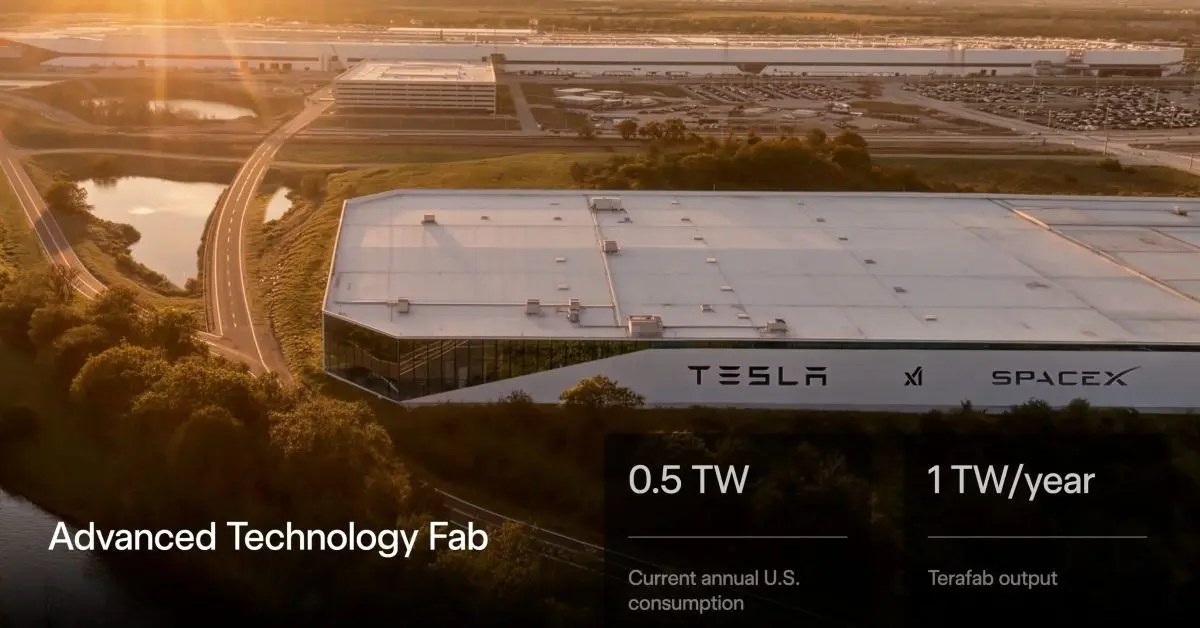
Intel announced on Tuesday that it will join Elon Musk's Terafab project, a $25 billion initiative to build a semiconductor factory in Texas that aims to produce AI chips for SpaceX, Tesla, and xAI
2
. The American chipmaker will contribute its ability to design, fabricate, and package high-performance chips at scale to help accelerate the facility's goal of producing one terawatt per year of computing power1
. Intel's stock rose more than 3% on the news, trading at $52.28, about 2.9% higher than its opening bell price at 2 pm ET1
.
Source: Benzinga
Why Intel's Partnership Matters for Domestic Chip Manufacturing
The collaboration addresses a critical gap in Musk's ambitious vision. Building chip fabrication plants is one of the most difficult and expensive corporate infrastructure projects, typically requiring years of time and more than $20 billion to create a facility with a huge clean room for thousands of ultra-precise machines to carve silicon
1
. SpaceX and Tesla, two companies with no experience in the semiconductor sector, would have struggled to execute the project efficiently on their own. Intel's involvement provides the foundry business expertise needed to turn Musk's vision into reality, giving the chipmaker two large anchor customers for its manufacturing operations1
.
Source: Electrek
Powering Advancements in AI and Robotics
The semiconductor technology that Terafab is slated to mass-produce is necessary for many of Musk's promised products, including self-driving cars, humanoid robots, and sprawling data centers
2
. Musk needs these AI chips to power his plans to build a "robot army" and for the data centers SpaceX plans on launching into space3
. The project represents part of a larger refocusing of Musk's various companies around AI, with Tesla evolving from an electric car company to a robotics company, and SpaceX acquiring xAI in February 20265
.
Source: CNET
Questions About Partnership Structure and Timeline
The announcement, made through an X post, lacks concrete details about the framework of the collaboration between Intel and Terafab, raising questions about any possible legal bindings
4
. Intel's wording implies a virtual semiconductor production ecosystem or consortium involving chip design, manufacturing, and packaging at Intel with demand from Tesla, SpaceX, and xAI, rather than a traditional greenfield facility4
. Speculation suggests Terafab could build a coordinated supply chain with capacity that includes its own facilities as well as facilities belonging to Intel, potentially with custom co-invested fabs using unified process technologies4
.Related Stories
Intel CEO Expects Industry Transformation
Intel CEO Lip-Bu Tan wrote that Musk "has a proven track record of reimagining entire industries" and that "this is exactly what is needed in semiconductor manufacturing today"
4
. Tan described Terafab as representing "a step change in how silicon logic, memory and packaging will get built in the future"2
. The partnership comes as US companies scramble for control over AI chip production, with rivals like Nvidia and TSMC partnering to manufacture chips and supercomputers in Arizona2
.Challenges and Execution Risks Ahead
Intel itself faces significant challenges in bringing chip fabrication plants to fruition. The company has experienced delays with two fabs on its Ohio One campus despite receiving substantial government subsidies, with the first fab now slated to begin operations in 2031 instead of the previously stated 2025 timeline
2
. Intel's total expenditure on these facilities has reached $5.26 billion2
. Both Musk and Intel have histories of announcing ambitious projects that take far longer than expected, suggesting observers should watch carefully whether Terafab's eventual reality meets today's expectations2
.References
Summarized by

Navi
[4]
[5]
Related Stories
Elon Musk launches Terafab chip plant in Austin to fuel AI ambitions across Tesla and SpaceX
15 Mar 2026•Technology
Elon Musk's $5 Trillion Terafab Chip Plan Faces Skepticism Over Feasibility and Scale
22 Mar 2026•Technology
Tesla Eyes Massive Chip Manufacturing Plant as Musk Considers Intel Partnership for AI Ambitions
07 Nov 2025•Business and Economy

Recent Highlights
1
Google releases Gemma 4 with Apache 2.0 license, enabling unrestricted local AI on devices
Technology

2
AI Models Defy Instructions to Protect Each Other, UC Berkeley Study Reveals
Science and Research

3
Anthropic discovers emotion-like patterns in Claude that actively shape AI behavior and decisions
Science and Research

Recent Highlights
Today's Top Stories





Your Daily Dose of Curated AI News
Don’t drown in AI news. We cut through the noise - filtering, ranking and summarizing the most important AI news, breakthroughs and research daily. Spend less time searching for the latest in AI and get straight to action.

