Intel Panther Lake debuts as first AI chip built on 2nm 18A process at CES 2026


17 Sources
17 Sources
[1]
Intel's Panther Lake CPUs are here, and it's shaping up to be an exciting 2026
Intel boasts next-generation power efficiency and increased AI performance. Intel officially announced its next generation of processors at its CES 2026 keynote: the Core Ultra Series 3 "Panther Lake", and Intel says they're poised to deliver the highest power efficiency, graphics power, and of course, AI performance yet. The keynote kicked off the start of CES 2026 in Las Vegas, with Intel's Senior VP Jim Johnson taking to the stage to officially launch the Panther Lake processor family -- the first built on its new 18A node and boasting nearly 50% more performance than its Lunar Lake chips, while harnessing greater power efficiency. Also: CES 2026 live blog: Latest news on TVs, AI, phones, more They're powerful chips, featuring up to 16 cores, built-in Intel Arc GPU with Xe3 chip architecture, and a new NPU with up to 50 TOPS, while supporting LPDRR5 memory up to 9GB at speeds of up to 9600 MT/s and DDR5 up to 128GB. The new 18A base configuration comes on eight cores: four P-cores and four LP-cores, with the new Xe3 GPU supporting 3.8 times more TOPS over the previous Arrow Lake generation of chips. Panther Lake brings with it a new class of processors it's calling Core Ultra X9 and X7, which come with Intel Arc graphics for advanced workloads, gaming, and content creation. These chips will feature up to 16 CPU cores, 12 Xe cores and 50 NPU TOPS. Also: HP's EliteBook X G2i could be the ultraportable business laptop I've been waiting for Intel's Panther Lake processors have already made their way into the main computer and laptop manufacturers products for 2026, including some of the most exciting products we've seen so far at CES such as the return of the Dell XPS and the HP EliteBook G2i, coming at a time of increased scrutiny on the chip manufacturer's performance. Intel's keynote was set to counter any doubts about its confidence, however, with Panther Lake's power efficiency as a recurring theme, bolstered by real-world comparisons. Johnson's mention of the company's "maniacal" focus on efficiency enables the chips to stream 4K video, for example, by drawing one third of the power than previous generations, allowing users to measure power in days, not hours. I went hands-on with several Lunar Lake laptops last year and saw first-hand some seriously impressive power efficiency. Looking at 2026's lineup, we're already seeing impressive numbers, including battery life going into 40 hours and beyond. As with anything, we'll have to go hands-on to see performance first-hand, but 2026 is shaping up to have some exciting developments in store.
[2]
Intel unleashes Panther Lake CPUs, first built on 18A
Company claims its Ultra Series 3 processors will offer the best battery life yet Intel has finally let its new Panther Lake CPUs out of the cage. First detailed in October and now launching under the brand name Intel Core Ultra Series 3, these are the first chips made with Intel's 18A process and boast improved power efficiency and performance, particularly for graphics and AI workloads. Laptops with the chips will start shipping as soon as January 27, with Chipzilla boasting more than 200 design wins, including the new Dell XPS 14 and 16, which have just been announced and will be available for pre-order starting Tuesday, with a choice of Intel Core Ultra Series 3 configs. These laptops are all about long battery life, with Dell boasting in its press materials that they both lasted more than 40 hours while streaming 1080p video. These new processors will also appear in devices other than laptops. Intel claims that they have been certified for embedded and industrial use in robotics, healthcare devices, and other kinds of edge computing hardware. As part of its announcement, Intel revealed that there will be 14 SKUs of Core Ultra Series 3. These range from the 16-core, 5.1-GHz Core Ultra X9 388H on the high end to the 8-core, 4.4-GHz Core Ultra 5 322 on the low end. All of the processors have either eight or 16 cores composed of three types of core. Each processor has four P or performance cores, which offer the highest clocks and use the most juice. Then there are LP E cores, which use the least amount of power and are the slowest. Then 16-core chips also have eight E cores which are somewhere in the middle. The goal is to offload as many tasks as possible onto the LP E and E cores to save power while lighting up the P cores for demanding tasks such as gaming. Whatever cores it uses, Panther Lake's new architecture promises power savings thanks to its die shrink from a 3 nm process to a 2 nm process, its use of denser RibbonFET transistors, and its shifting of power delivery to the back of the wafer. The company claims that transistor density has increased by 30 percent while performance per watt is up 10 percent on single-threaded tasks and 50 percent on multithreaded tasks versus the prior-gen Lunar Lake and Arrow Lake CPUs. All of the SKUs carry a base power of 25 watts with turbo wattages of 65 or 55 W. Intel said that the top SKUs - the Core Ultra X9 and Core Ultra X7 - provide 60 percent better multithreaded performance and 77 percent faster gaming. In another power-saving move, Core Ultra Series 3 processors will support Intel Intelligent Display technology, which uses AI to change screen settings based on what tasks you are performing and what you are doing. So, if you walk away, the screen instantly goes into a lower brightness and lower refresh rate than when you're actively working. Similarly, if you are reading emails, it can lower the refresh rate and then raise it again when you're watching videos or playing games. The lower your refresh rate and screen brightness, the less power your computer uses. As we wrote about in October, not all of Panther Lake is made by Intel's 18A process. The compute die, which contains the CPU and NPU, is made with 18A, but the platform controller is made by TSMC and the integrated GPU is either built by TSMC or Intel on its Intel 3 process, if it's one of the lower-end models. Speaking of graphics, Panther Lake comes with Intel Arc GPUs built in that each has up to 12 Xe cores for graphics and can deliver up to 120 TOPS (Trillion Operations per Second) when used for AI workloads. The GPUs enable Intel XeSS (super sampling) and XeSS-SR (Super Resolution), along with XeSS-MFG (multi-frame generation) and XeLL (low latency), all of which allow games to achieve faster frame rates through the power of AI upscaling and quicker response times. Endurance Gaming Mode is designed to help improve battery life while gaming by lowering the frame rate at times. The Arc graphics also use XMX (Xe Matrix Extensions) and XMX engines to help with their AI processing. All of the Core Ultra Series 3 SKUs feature low-power NPUs that can achieve up to 50 TOPS themselves. The idea is that, where performance is key, the GPU will perform AI workloads, but where the task is simple enough, the NPU can do it while sipping a lot less juice. Many of the chips have built-in support for Thunderbolt 5, which can provide 80 Gbps of bidirectional, wired connectivity and 120 Gbps in Bandwidth Boost mode. Others support only Thunderbolt 4, which is limited to 40 Gbps connections. Either way, as long as the manufacturer puts a Thunderbolt port on the laptop, you can use the standard to connect to monitors and docks that provide video, data, and charging over a single cable. The laptops will also support Thunderbolt Share, which allows you to share screens, keyboard, mouse, and files over a single cable. All of the chips support built-in Wi-Fi 7 with Bluetooth 6.0. Those are the latest wireless standards you can get. The Intel Core Ultra Series 3 processors support up to 96 or 128GB of LPDDR5x or DDR5 RAM, depending on SKU. The two X series chips, the Core Ultra X9 and Ultra X7, support RAM that operates at up to 9,600 MT/s, while other units support only up to 8,533, 7,467, or 6,800 MT/s. ®
[3]
Intel expected to launch next-gen PC chip at CES in Las Vegas
Jan 5 (Reuters) - Intel (INTC.O), opens new tab is set to launch Panther Lake, its new AI chip for laptops, on Monday at the CES trade show in Las Vegas, as the company seeks to reassure investors about the first product made using its next-generation manufacturing process called 18A. Jim Johnson, senior vice president and general manager of Intel's PC group, is expected to give details about the chip in a presentation starting at 6 p.m. EST (2300 GMT). The new chips feature a new transistor design and way to deliver power to the chip. Intel's prior-generation Lunar Lake chips were largely made by TSMC (2330.TW), opens new tab. The stakes for Intel are high - the company is making its first high-volume product with 18A, and hopes to reclaim market share it has lost to Advanced Micro Devices (AMD.O), opens new tab. The company said in October that graphics and central processors integrated in Panther Lake deliver 50% faster performance than its previous generation of chips, Lunar Lake. Intel has struggled with the yield, or the number of good chips per silicon wafer, for the Panther Lake processors, Reuters reported last year. Intel executives have said its yields are improving monthly and will pave the way for the launch this year. For its part, AMD plans to give a CES keynote address at 9:30 p.m. EST (0230 GMT on Tuesday). CEO Lisa Su will likely launch new generations of PC chips that are geared for AI and graphics. AMD announced a multibillion-dollar deal with OpenAI for its next-generation MI400 chips, some of which the companies plan to deploy this year. The deal with the ChatGPT maker is expected to generate tens of billions of dollars in revenue for the chip designer. The CEO of AI chip leader Nvidia (NVDA.O), opens new tab, Jensen Huang, will also speak at CES on Monday. Reporting by Max A. Cherney in San Francisco; Editing by Matthew Lewis Our Standards: The Thomson Reuters Trust Principles., opens new tab * Suggested Topics: * Artificial Intelligence Max A. Cherney Thomson Reuters Max A. Cherney is a correspondent for Reuters based in San Francisco, where he reports on the semiconductor industry and artificial intelligence. He joined Reuters in 2023 and has previously worked for Barron's magazine and its sister publication, MarketWatch. Cherney graduated from Trent University with a degree in history.
[4]
How to watch the Intel CES 2026 launch event
We're just hours away from the start of CES 2026, and with that comes Intel's launch event. The chip giant is expected to provide more details on its AI PC initiative and the new processors powering it: The Core Ultra Series 3 CPUs (aka Panther Lake) are made using an 18A process -- that's 18 angstroms, or just under 2nm -- and designed for high-end laptops and gaming devices. For Intel, the stakes at CES are higher than ever. In the past 12 months, both NVIDIA and the US government acquired ownership stakes in the company, helping nearly double the stock price by the end of the year. But that's still down over more than 20 percent since 2021, as rivals like TSMC, Qualcomm, AMD and NVIDIA have taken the leadership mantle in chip fabrication and AI hardware. Senior VP of Intel's Client Computing Group Jim Johnson will kick off the launch event on Monday, January 5 at 6PM ET. A livestream will be available on the Intel Newsroom YouTube channel, which we'll post here when it's live. As we noted above, Intel has publicly confirmed that it will be highlighting "the next generation of Intel-powered PCs, edge solution, and the AI experiences enabled by the new Intel Core Ultra Series 3 Processors." We'll be keen to hear if the company can address the profitability concerns that have surrounded those next-gen chips since at least last summer, when published reports indicated that yields were still under 50 percent. (In response, Intel told Engadget that it felt "very good" about its trajectory on Panther Lake, though it didn't hit the late 2025 release date it had envisioned at the time.) Will we get any updates on that NVIDIA partnership? It's possible. But don't expect to hear anything about Intel possibly fabricating the chips for that rumored new entry-level MacBook Air. If that comes to pass, the announcement will definitely be at a time and place of Apple's choosing.
[5]

Intel launches Core Ultra Series 3 "Panther Lake" chips on its 2nm 18A process
Serving tech enthusiasts for over 25 years. TechSpot means tech analysis and advice you can trust. Looking ahead: With the move to 2nm, Intel's Core Ultra Series 3 marks both a technological achievement and a signal of the company's shifting priorities. The emphasis on AI acceleration, efficiency-per-watt improvements, and a unified CPU-GPU-NPU design sets the stage for how Intel plans to compete in a mobile computing era defined by local AI processing. Intel's long-anticipated 2-nanometer 18A manufacturing process is finally in production, powering the company's new Core Ultra Series 3 chips, code-named Panther Lake. The processors, unveiled at CES 2026, are targeted primarily at laptops and compact PCs and mark Intel's first mass-produced chips built on this advanced node. Systems featuring Core Ultra Series 3 processors are scheduled to arrive by January 27, with pre-orders opening earlier in the month. Intel's announcement provides the first concrete details on how these chips differ from the outgoing Series 2 generation, particularly in AI and graphics performance. Each chip in the Core Ultra Series 3 lineup integrates an updated CPU, next-generation graphics cores, and a redesigned neural processing unit. On the CPU side, Intel offers up to four high-performance P-cores, eight high-efficiency E-cores, and four low-power LPE-cores, for a total of 16 cores in the top-tier model. Intel said that both efficiency and per-clock-cycle workload capacity have improved compared with the previous generation. The headline model, the Core Ultra X9 388H, runs at a peak clock speed of 5.1 GHz and features 18 MB of L3 cache. By comparison, the earlier Core Ultra 9 285H had six P-cores, eight E-cores, two LPE-cores, and 24 MB of L3 cache, with a peak frequency of up to 5.4 GHz. Despite these differences on paper, Intel claims the new Ultra X9 388H can outperform the older 285H by up to 70 percent in gaming and deliver as much as 60 percent better multi-threaded performance compared with the Core Ultra 9 288V from the Series 2 lineup. The new generation also integrates top-tier connectivity, including Wi-Fi 7 (R2), Bluetooth 6.0, and Thunderbolt 5 support across select Ultra 7 and Ultra 9 variants. Intel's mobile graphics see a significant upgrade with the introduction of the Xe3 architecture, replacing the XeLPG system used in Series 2. Xe3 is derived from the company's Arc Battlemage platform - the same architecture powering discrete GPUs such as the Intel Arc B580 - and offers up to a 50 percent increase in GPU core count. The most powerful variant integrates 12 Xe cores, setting a new standard for integrated graphics performance within Intel's mobile processors. Models equipped with these Xe3 Arc Battlemage GPUs feature an "X" in their product name, signaling enhanced graphical capability. Intel has also introduced XeSS 3, the latest version of its AI-powered upscaling technology. Like AMD's FSR 4 and Nvidia's DLSS 3 and 4, XeSS 3 uses multi-frame reconstruction to boost frame rates through AI-generated frames. Artificial intelligence is a central focus of the Series 3 launch. Each processor now includes Intel's NPU 5, a redesigned neural engine capable of up to 50 trillion operations per second for AI workloads. Combined with the Arc Xe GPU cores, which deliver up to 120 TOPS, the system can achieve as much as 170 TOPS - and even more when factoring in CPU contributions. Early performance comparisons suggest that Intel's AI hardware now competes directly with Nvidia in similar price segments. The company's Arc GPUs, including the desktop B580, already contend with Nvidia's $299 GeForce RTX 5060 for AI tasks. Intel introduced two flagship variants at launch: the Core Ultra 9 386H and Core Ultra X9 388H. Both share a 16-core configuration but differ in graphics and PCIe connectivity. The X9 388H includes the Arc B390 integrated GPU with 12 Xe cores but has only 12 PCIe lanes (four PCIe 5.0 and eight PCIe 4.0). The standard 386H, meanwhile, trades the stronger GPU for expanded PCIe bandwidth - 12 PCIe 5.0 lanes and eight PCIe 4.0 - making it a better fit for laptops with discrete GPUs. The same hierarchy applies to the Ultra 7 lineup. The Ultra X7 368H closely mirrors the X9 388H, aside from slightly lower clock speeds, while the Ultra 7 366H aligns with the Ultra 9 386H. Ultra 7 models without the "H" suffix, such as the 365 and 355, cut the core count to eight and target midrange systems. Intel's Ultra 5 series spans the lower tier, comprising six models in total. The 12-core Ultra 5 338H features the Arc B370 GPU with 10 Xe cores, while non-H variants like the 332 and 322 scale down to eight cores and two Xe GPU cores, suitable for entry-level devices. Pre-orders for Panther Lake-equipped laptops are expected to begin January 6, with a full retail launch scheduled for January 27. Final pricing will vary depending on system design, though Intel confirmed that all models shipping this month will utilize its new 18A process and integrated NPU 5 architecture.
[6]

Intel unveils Core Ultra Series 3, its biggest AI PC push yet
The company said Intel Core Ultra Series 3 will power more than 200 PC designs from global partners, making it the most widely adopted AI PC platform Intel has ever launched. Pre-orders for the first consumer laptops open January 6, with global availability starting January 27. Additional systems are expected throughout the first half of 2026. Intel executives framed the launch as a decisive step toward making AI-native computing mainstream rather than niche. "With Series 3, we are laser-focused on improving power efficiency, adding more CPU performance, a bigger GPU in a class of its own, more AI compute and app compatibility you can count on with x86," said Jim Johnson, Senior Vice President and General Manager, Client Computing Group, Intel. At the silicon level, Series 3 brings a new class of Intel Core Ultra X9 and X7 mobile processors aimed at users running demanding workloads across gaming, content creation, and productivity.
[7]

Intel launches Core Ultra Series 3 laptop chips: Panther Lake is go
Intel's Core Ultra Series 3 chips, aka "Panther Lake," have entered the market, backed by dozens of PC makers. "We've beeen out there shaping what it means for fundamental computing, said Jim Johnson, senior vice president and general manager of the Intel Client Computing Group, in a launch event at CES 2026. Lip-Bu Tan, Intel's chief executive, said he was "proud" to highlight that Intel has shipped its first Intel 18A processors, the production technology upon which Panther Lake is built upon. The technology uses RibbonFET gate-all-around to manage current and energy efficiency, while PowerVia is Intel's name for backside power delivery, enabling 15 percent better performance per watt. What is Intel's Core Ultra 300 'Panther Lake'? Intel showed off what was simply known as "Panther Lake" in October, when Intel announced the Panther Lake technology along with some of its implementations. Intel's Core Ultra Series 3 chips return to the era of performance cores (P-cores), efficiency cores (E-cores,) and low-power efficiency cores (LP E-cores) of Intel's Core Ultra 100 chip, aka Meteor Lake. Those are paired with an NPU capable of 50 TOPS worth of AI processing as well as Intel's Xe3 GPU, which should improve Intel's 3D capabilities. Intel said then that Panther Lake's single-threaded performance should be 10 percent higher than Lunar Lake at the same power. Compared to both Lunar Lake and Meteor Lake, Intel's Panther Lake offers more than 50 percent better multithreaded performance, Intel said in October. But the power should be 10 percent less than Lunar Lake. Anecdotally, Intel representatives have been characterizing Panther Lake as the performance of Arrow Lake -- an architecture which struggled on the desktop but performed surprisingly well in Arrow Lake laptops -- with the power consumption of Lunar Lake. Panther Lake consists of three different organizations of the P-cores, E-cores, and LP-cores: * An 8-core chip, with 4 P-cores, 4 low-power (LP) E-cores; 4 Xe3 GPU cores and 4 ray-tracing units; and memory interfaces to either 6800 MT/s LPDDR5x or 6400 MT/s DDR5. * A 16-core chip, with 4 P-cores, 8 E-cores, and 4 LP E-cores; 4 Xe3 GPU cores and 4 ray-tracing units; and memory interfaces to either 8533 MTs/ LPDDR5x or 7200 MT/s DDR5. * A 16-core chip, with 4 P-cores, 8 E-cores, and 4 LP E-cores, 12 Xe3 GPU cores and 12 ray-tracing units; and memory interfaces to 9600MT/s LPDDR5x, period. At CES 2026, Johnson said that the Panther Lake delivers about 60 percent more power than the Core Ultra 200 series, or Lunar Lake, using the Cinebench 2024 mujlticore benchmark. Depending upon the banchmark, Intel cut the power by about 2.8X. Somewhat like AMD's Ryzen AI Max ("Strix Halo") or the Ryzen 9000X3D family, both of which concentrate large amounts of cache memory to improve performance, it's the final "12Xe" configuration that will form the premium lineup on many laptops. The GPU will be called the Intel Arc B390 graphics, said Intel's Dan Rogers, the vice president in charge of PC products at Intel. On average, gaming performance will be about 73 percent more than Lunar Lake, Rogers said. The B390 GPU can also take advantage of frame generation to improve frame rates further, he said. XeSS3 can render three AI-generated frames for every GPU-rendered frame, Rogers said. How good does Intel think Panther Lake is? Intel will launchn an entire handheld platform, based on Panther Lake, later this year, Rogers said, taking on AMD's leadership in the space, Rogers said.
[8]

Intel Core Ultra Series 3 laptops arrive later this month, here's what you can expect
Intel laptops with better integrated graphics and longer battery life are headed your way. CES 2026 Read and watch our complete CES coverage here Updated less than 0 just now ago Intel's Panther Lake CPUs are finally ready to hit the market. First detailed in October last year, the new Core Ultra Series 3 chips recently took the stage at CES 2026, with the company confirming pre-order and retail launch plans for the first laptops featuring the new processors. In its announcement, Intel reiterated that the new Core Ultra Series 3 processors are the company's first AI PC platform built on the Intel 18A process technology. The company says the chips will power over 200 designs from global partners, making the Series 3 "the most broadly adopted and globally available AI PC platform Intel has ever delivered." Recommended Videos The Core Ultra Series 3 introduces a new range of X9 and X7 SKUs packing the highest performing integrated Intel Arc graphics. The top-end models will feature up to 16 CPU cores, 12 Xe cores, and 50 NPU TOPS, and offer up to 60% better multithread performance and over 77% faster gaming performance compared to Lunar Lake. Battery life also sees a notable boost, with Intel claiming up to 27.1 hours of Netflix streaming on a Lenovo IdeaPad reference design powered by the Core Ultra X9 388H. The Series 3 lineup will also include Intel Core processors that use the same architecture as the Core Ultra models, enabling more performant and power-efficient systems at lower price points. Panther Lake laptops will hit the shelves later this month Intel says pre-orders for the first consumer laptops powered by the Core Ultra Series 3 processors will start January 6. These laptops will go on sale globally starting January 27. Additional models featuring the new processors are expected to launch throughout the first half of the year. Details on pricing, regional availability, and configurations are expected closer to launch as partners begin unveiling their Panther Lake-powered laptops.
[9]

Intel launches Core Ultra Series 3 AI PC platform at CES 2026 | AIM
Pre-orders for consumer laptops powered by Core Ultra Series 3 processors will begin on January 6. Intel on Monday unveiled its Core Ultra Series 3 processors, also known as Panther Lake, at CES 2026, introducing what it called its first AI PC platform built on the Intel 18A manufacturing process. The company said the processors will power more than 200 PC designs and will begin shipping in consumer laptops later this month. The Core Ultra Series 3 platform is the first compute lineup produced on Intel 18A, a process technology designed and manufactured in the United States. Intel said the processors are aimed at improving power efficiency, CPU and GPU performance and on-device AI capabilities, while maintaining compatibility with x86 software. Pre-orders for consumer laptops powered by Core Ultra Series 3 processors will begin on January 6, with global availability starting January 27. Intel said edge systems based on the same platform are expected to launch in the second quarter of 2026. "With Series 3, we are laser focused on improving power efficiency, adding more CPU performance, a bigger GPU in a class of its own, more AI compute and app compatibility you can count on with x86," said Jim Johnson, senior vice president and general manager of Intel's Client Computing Group. The mobile lineup introduces a new class of Core Ultra X9 and X7 processors, featuring integrated Intel Arc graphics. According to the company, top configurations offer up to 16 CPU cores, 12 Xe-cores and up to 50 trillion operations per second (TOPS) of neural processing performance. Intel said these systems deliver up to 60% higher multithread performance, up to 77% faster gaming performance and up to 27 hours of battery life, compared with prior generations. Alongside premium models, Intel also announced Core-branded processors based on the same Series 3 architecture for mainstream laptops, targeting lower price points while using the same platform foundation. For the first time, Intel said Core Ultra Series 3 processors are also being certified for embedded and industrial edge use cases. These include applications in robotics, smart cities, industrial automation and healthcare, with support for extended temperature ranges, continuous operation and predictable performance. Intel claimed the Series 3 platform delivers up to 1.9x higher large language model performance, up to 2.3x better performance per watt per dollar in video analytics workloads and up to 4.5x higher throughput for vision-language-action models. The company said integrating CPU, GPU and AI acceleration into a single system-on-chip design can reduce the total cost of ownership compared with multi-chip architectures.
[10]

Intel launches first chips built on its most advanced 18A manufacturing process - SiliconANGLE
Intel launches first chips built on its most advanced 18A manufacturing process Intel Corp. has showcased a new class of Intel Core Ultra X9 and X7 processors, the first new chips built on its most advanced 18A manufacturing process. Announced at the Consumer Electronics Show today, they're the first chips to fall within its new 18A Panther Lake Core Ultra Series 3 lineup, and they're going to be used by dozens of top personal computer makers, the company said. "We've been out there shaping what it means for fundamental computing," said Intel Client Computing Group Senior Vice President and General Manager Jim Johnson (pictured) during a keynote at CES 2026. The new chips represent a major milestone for Intel in its effort to rebuild its tattered reputation after falling behind rivals such as Nvidia Corp., with the company proclaiming them to be the most advanced processors ever manufactured in the U.S. More importantly, they're the first chips to be built on Intel's vaunted 18A process, which has taken several years to come to fruition. The 18A process was a key plank of former Intel Chief Executive Pat Gelsinger's plan to restore the company to its former greatness in the chipmaking industry, but he couldn't get them ready quickly enough to save his job, being deposed at the end of 2024. The letter "A" is short for "Angstrom," which is a measurement that's much smaller than the nanometers that are currently used to measure the size of transistors in chips. 18 Angstrom is equivalent to about 1.8 nanometers, which means it's more or less on a par with rival chipmaker Taiwan Semiconductor Manufacturing Co.'s N2 manufacturing process. Intel uses a technology called RibbonFET gate-all-around to manage the electrical current in the chips, and PowerVia to enable backside power delivery, and this combination helps the new chips to achieve 15% superior performance-per-watt, compared to its existing silicon. At CES, Intel's new CEO Lip Bu-Tan said the company is now ready to ramp up mass production on the 18A manufacturing process ahead of schedule, and if the chips perform as well as expected, it could mark a turning point in the company's fortunes. Intel's Panther Lake Core Ultra Series 3 chips see the company revert to the familiar terminology of performance cores, efficiency cores and low-power efficiency cores, or P-cores, E-cores, and LP-cores, which was used with its Intel Core Ultra 100 chip, also known as Meteor Lake. The chips are paired with a neural processing unit that's capable of delivering 50 Tera Operations Per Second of artificial intelligence processing performance, as well as Intel's Xe3 graphics processing units. Johnson told the media during his CES presentation that Panther Lake's single-threaded performance is around 10% higher than the company's Lunar Lake chips when using the same power. It also provides more than 50% superior multithreaded performance compared to both Lunar Lake and Meteor Lake. The Panther Lake Core Ultra Series 3 chips will be available in three different configurations, with an 8-core chip made up of four P-cores, four E-cores, four Xe3 GPU cores and four ray-tracing units, with memory of 6,800 megatransfers per second LPDDR5x or 6400 MT/s DDR5. There's also a 16-core chip made up of four P-cores, eight E-cores and four LP-cores, with four Xe3 GPU cores and four ray-tracing units and either 8,533 MTs/ LPDDR5x or 7,200 MT/s DDR5. Finally, there's a second, more powerful 16-core option with four P-cores, eight E-cores, four LP-cores, 12 Xe3 GPU cores and 12 ray-tracing units, plus a 9,600 MT/s LPDDR5x memory interface. Just as with Advanced Micro Devices Inc.'s Ryzen AI Max and Ryzen 9000X3D chip families, it's the final 12Xe configuration that's the most premium of the three, and that's what laptop buyers will want to look out for. The GPU in question is the Intel Arc B390, and it will enable the Panther Lake Core Ultra Series 3 chips to deliver 73% better gaming performance, Intel said. The Intel Arc B390 GPU also takes advantage of frame generation technology to accelerate frame rates and advance graphics performance. According to Johnson, it's capable of rendering three AI-generated frames for every GPU-rendered frame. Intel said the first laptops powered by the Intel Core Ultra Series 3 chips will launch globally by the end of this month. The company also teased plans to launch a handheld gaming platform based on the chips with partners such as Acer Inc. and Micro-Star International Co., Ltd., saying it will have more to say about this later in the year.
[11]

Intel unveils Core Ultra Series 3 on 18A at CES 2026
Intel unveiled Core Ultra Series 3 processors at CES 2026 in Las Vegas on January 5, introducing the first AI PC platform built on Intel 18A process technology designed and manufactured in the United States. The launch event featured nine demos running on PCs powered by Core Ultra Series 3 processors. These demonstrations covered gaming, AI, content creation, retail, edge computing, and additional categories, showcasing the platform's capabilities across diverse applications. Core Ultra Series 3 represents the first compute platform constructed on Intel 18A, recognized as the most advanced semiconductor process developed and manufactured in the United States. This process technology underpins the entire family of processors. The Series 3 family powers over 200 PC designs from leading global partners. These designs span the product stack and deliver performance, graphics capabilities, and battery life optimized for AI PCs. "With Series 3, we are laser focused on improving power efficiency, adding more CPU performance, a bigger GPU in a class of its own, more AI compute and app compatibility you can count on with x86." Jim Johnson, Senior Vice President and General Manager, Client Computing Group, Intel, stated during the launch. The mobile lineup introduces a new class of Intel Core Ultra X9 and X7 processors equipped with integrated Intel Arc graphics. These processors target multitaskers handling advanced workloads such as gaming, content creation, and productivity on mobile devices. Top SKUs in this class include up to 16 CPU cores, 12 Xe-cores, and 50 NPU TOPS. Performance metrics show up to 60 percent better multithread performance compared to prior generations, 77 percent faster gaming performance, and up to 27 hours of battery life. The Series 3 family also encompasses Intel Core processors designed specifically for mainstream mobile systems. These processors share the foundational architecture of the broader family, enabling laptop designs that offer improved performance and efficiency at lower price points. Edge variants of Series 3 processors mark the first certification for embedded and industrial use cases. Certifications cover extended temperature ranges, deterministic performance, and 24×7 reliability. Target applications include robotics, smart cities, automation, and healthcare. In edge AI workloads, Intel Core Ultra Series 3 provides up to 1.9 times higher large-language-model performance. It achieves 2.3 times better performance-per-watt-per-dollar on end-to-end video analytics. Additionally, it delivers 4.5 times higher throughput on vision-language-action models. The integrated AI acceleration supports a single-chip solution, which reduces total cost of ownership relative to traditional multi-chip CPU-GPU architectures. Pre-orders for the first consumer laptops powered by Intel Core Ultra Series 3 processors begin on January 6, 2026. Global availability of these systems starts on January 27, 2026, with further designs arriving throughout the first half of the year. Edge systems powered by Series 3 become available starting in the second quarter of 2026.
[12]

Intel Launches Core Ultra 3 'Panther Lake' Processors at CES 2026
Intel on Monday unveiled its Core Ultra Series 3 processors at the Consumer Electronics Show (CES) 2026. It is claimed to be the first compute platform built on the Intel 18A semiconductor process, delivering performance, graphics and battery life upgrades over the previous generation. Dubbed Panther Lake, the Intel Core Ultra Series 3 processors feature a hybrid CPU architecture with performance and efficiency cores, along with upgraded integrated graphics based on Intel's Xe architecture. Intel Core Ultra (Series 3) Processors Availability The company says that laptops powered by Core Ultra Series 3 processors will be available to pre-order in global markets beginning. January 6. General availability will start post January 27, depending on the region. Devices equipped with the new processors are expected to reach markets later this month. Intel showcased several laptops powered by the Core Ultra Series 3 chip at CES 2026 Photo Credit: Intel Intel says the Core Ultra (Series 3) CPUs will be available on more than 200 laptop designs from OEM partners worldwide. PC makers have already showcased several upcoming notebooks powered by the new processor, including the new Samsung Galaxy Book 6 series, at CES. In addition to consumer-grade laptops, Intel also plans to deploy Core Ultra Series 3 processors in commercial, edge, and embedded systems later in 2026. Intel Core Ultra (Series 3) Processors Specifications The Intel 18A process used for the fabrication of the Core Ultra Series 3 processors incorporates new RibbonFET gate-all-around transistors and PowerVia backside power delivery. As per the company's claims, this enables better performance per watt compared to the previous generation and is designed to deliver sustained performance while maintaining battery efficiency in thin and light laptops. The hybrid CPU architecture of the Core Ultra Series 3 processors comprises performance and efficiency cores, along with upgraded integrated Arc Graphics. The top-tier variants in the lineup, such as the Intel Core Ultra X9 388H, include up to 16 CPU cores and 12 Xe graphics cores. As per the company, the processors feature an enhanced neural processing unit (NPU), which is capable of delivering up to 50 TOPS (trillion operations per second) of AI compute, powering on-device AI capabilities. Intel claims significant gains over the previous Series 2 generation, including 60 percent better multithreaded performance, more than 77 percent faster gaming performance, and up to 27 hours of battery life. Intel's latest Series 3 family is also said to include Intel Core CPUs, designed for mainstream mobile systems. These processors are aimed at performant and efficient laptop designs at lower price points. In addition to consumer-grade devices, the Intel Core Series 3 chips are also certified for commercial applications. In critical edge AI workloads, the company claims up to 1.9 times higher large language model (LLM) performance and up to 4.5 times higher throughput on vision language action (VLA). Compared to traditional multi-chip CPU and GPU architectures, the single system-on-chip (SoC) Core Ultra Series 3 processors are claimed to offer superior total cost of ownership (TCO), leveraging integrated AI acceleration.
[13]

Intel launches next-gen PC chip at CES in Las Vegas - The Economic Times
Jim Johnson, senior vice president and general manager of Intel's PC group, offered technical details about the company's first line of Panther Lake chips known as Intel Core Ultra Series 3. The chips feature a new transistor design and a way to deliver power to the chip due to the company's 18A manufacturing process.Intel launched Panther Lake, its new AI chip for laptops, on Monday at the CES trade show in Las Vegas, as the company seeks to reassure investors about the first product made using its next-generation manufacturing process called 18A. Jim Johnson, senior vice president and general manager of Intel's PC group, offered technical details about the company's first line of Panther Lake chips known as Intel Core Ultra Series 3. The chips feature a new transistor design and a way to deliver power to the chip due to the company's 18A manufacturing process. At the event, Intel CEO Lip-Bu Tan said the company made good on its promise to ship its first products with the 18A manufacturing process in 2025, referring to the Panther Lake chips. Intel's prior-generation Lunar Lake chips were largely made by TSMC. The stakes for Intel are high - the company is making its first high-volume product with 18A, and hopes to reclaim market share it has lost to Advanced Micro Devices . Johnson said the company has created a separate graphics chiplet - a mini chip stitched together with other mini-chips to form a complete processor. On Monday, Intel said the Intel Core Ultra Series 3 chips would deliver 60% better performance than the prior-generation Lunar Lake Series 2. Intel plans to launch a platform for handheld video games based on the Panther Lake designs this year, Johnson said. Handheld PCs designed by a range of suppliers have grown in popularity in recent years. Intel has struggled with the yield, or the number of good chips per silicon wafer, for the Panther Lake processors, Reuters reported last year. Intel executives have said its yields are improving monthly and will pave the way for the launch this year. For its part, AMD plans to give a CES keynote address at 9:30 p.m. EST on Monday (0230 GMT on Tuesday). CEO Lisa Su will likely launch new generations of PC chips that are geared for AI and graphics. AMD announced a multibillion-dollar deal with OpenAI for its next-generation MI400 chips, some of which the companies plan to deploy this year. The deal with the ChatGPT maker is expected to generate tens of billions of dollars in revenue for the chip designer. The CEO of AI chip leader Nvidia, Jensen Huang, also spoke at CES on Monday. He said the company's next generation of chips was in "full production," and they could deliver five times the artificial-intelligence computing of the company's previous chips when serving up chatbots and other AI apps.
[14]

Lip-Bu Tan Says They 'Over-Delivered' On 18A Timeline As Intel Shows Off Next Gen Panther Lake AI Laptop Chips At CES 2026 - Intel (NASDAQ:INTC)
On Monday, Intel Corp (NASDAQ:INTC) used the CES 2026 stage to showcase Panther Lake, its next-generation AI laptop processor, as CEO Lip-Bu Tan said the company has not only met but exceeded its long-promised 18A manufacturing milestone. Intel Puts 18A Manufacturing To The Test Intel formally introduced Panther Lake, its latest AI-focused laptop chip family, at the CES trade show in Las Vegas, marking the company's first high-volume product built using its 18A manufacturing process. Tan said the launch fulfills a critical pledge to investors. "I'm pleased to share that we have delivered our commitment on shipping our first 18A products by the end of 2025. In fact, we over-delivered." The announcement comes as Intel seeks to regain credibility after years of manufacturing delays and lost market share. Tan also said he was pleased to announce that Intel is actively ramping production across all three Core Ultra Series 3 chip packages. See Also: Maduro Down, Drone Stocks Up After Venezuela Mission What Panther Lake Brings To AI PCs Panther Lake debuts as Intel Core Ultra Series 3, featuring a redesigned transistor architecture and a new power delivery method enabled by the 18A process. Jim Johnson, Intel's senior vice president and general manager of the PC group, said the chips include a separate graphics chiplet, a modular approach that combines multiple mini-chips into a single processor Intel says the new processors deliver up to 60% higher performance than the prior-generation Lunar Lake Series 2 chips. "It's faster and more efficient than our highest performing skew running fewer pecores," said Johnson. A Shift Away From TSMC Dependency Unlike Lunar Lake, which was largely manufactured by Taiwan Semiconductor Manufacturing Co. (NYSE:TSM), Panther Lake is produced using Intel's own advanced process technology. Intel has previously struggled with chip yields for Panther Lake, though executives say output quality has been improving steadily ahead of this year's launch. Gaming Push And Competitive Pressure Intel also plans to roll out a handheld gaming platform based on Panther Lake later this year, targeting the growing portable PC market. The CES spotlight, however, highlighted fierce competition. Nvidia Corp (NASDAQ:NVDA) CEO Jensen Huang said his company's next-generation AI chips, Vera Rubin, are already in "full production" and can deliver up to five times the AI performance of earlier models. Price Action: Intel shares gained 0.18% in after-hours trading. In the past 12 months, the shares have been up by 98.14%, according to Benzinga Pro. According to Benzinga Edge Stock Rankings, Intel is showing a positive price trend across the short, medium and long-term. Click here to see how the stock stacks up against its peers. Read Next: AMD's Gamer Boom Signals Trouble For Intel's Long-Held Lead Disclaimer: This content was partially produced with the help of AI tools and was reviewed and published by Benzinga editors. Photo Courtesy: Tada Images on Shutterstock.com INTCIntel Corp$39.440.18%OverviewNVDANVIDIA Corp$187.99-0.07%TSMTaiwan Semiconductor Manufacturing Co Ltd$323.200.29%Market News and Data brought to you by Benzinga APIs
[15]

Watch The Intel CES 2026 Launch Event Live Here: Panther Lake Official, Refreshed CPUs & New AI Updates Expected
Intel will officially launch its next-generation Panther Lake "Core Ultra Series 3" CPUs, along with several other products, at CES 2026. Intel Launches Panther Lake "Core Ultra Series 3", New Refreshed CPUs, AI Updates, & More: Watch It As It All Unfolds, Live Here Intel's CES 2026 will mark the launch of its next-generation, and probably the most important product it has launched in a decade, the Core Ultra Series 3 CPUs codenamed Panther Lake. What makes this CPU launch so important is that it will be the first test of Intel's brand-new 18A process technology, which will shape its future. Intel has already detailed Panther Lake CPUs, its new Xe3 GPUs, and showcased various new platforms at an earlier Tech Tour 2025 event. Today will be the official launch, so expect the final SKUs along with the final specifications. Intel partners will also be showcasing their brand new systems, such as laptops, Mini PCs, handhelds, and more, powered by the same Panther Lake CPUs. Join us in Las Vegas, January 5-9, 2026, for CES and experience the global launch of the latest Intel Core Ultra Series 3 Processors, Codenamed Panther Lake. Join Jim Johnson, Senior VP and GM of Intel's Client Computing Group, as he highlights the next generation of Intel-powered PCs, edge solutions, and the AI experiences enabled by the new Intel® Core™ Ultra Series 3 Processors. Don't miss the launch event. Monday, January 5 at 3:00 p.m. PST In addition to the Panther Lake launch, Intel is also expected to make several other announcements. These include refreshed CPUs in the Arrow Lake lineup for desktops and laptops, new AI portfolio updates, which would include both hardware and software innovations, plus we can also expect a teaser or preview of new GPUs in the Arc dGPU family, such as the highly anticipated Arc B770. With that said, the Intel CES 2026 presentation is just a few hours away, so stay tuned and get ready for a jam-packed CES 2026. Follow Wccftech on Google to get more of our news coverage in your feeds.
[16]

Intel launches next-gen PC chip at CES in Las Vegas
Jan 5 (Reuters) - Intel launched Panther Lake, its new AI chip for laptops, on Monday at the CES trade show in Las Vegas, as the company seeks to reassure investors about the first product made using its next-generation manufacturing process called 18A. Jim Johnson, senior vice president and general manager of Intel's PC group, offered technical details about the company's first line of Panther Lake chips known as Intel Core Ultra Series 3. The chips feature a new transistor design and a way to deliver power to the chip due to the company's 18A manufacturing process. At the event, Intel CEO Lip-Bu Tan said the company made good on its promise to ship its first products with the 18A manufacturing process in 2025, referring to the Panther Lake chips. Intel's prior-generation Lunar Lake chips were largely made by TSMC. The stakes for Intel are high - the company is making its first high-volume product with 18A, and hopes to reclaim market share it has lost to Advanced Micro Devices. Johnson said the company has created a separate graphics chiplet - a mini chip stitched together with other mini-chips to form a complete processor. On Monday, Intel said the Intel Core Ultra Series 3 chips would deliver 60% better performance than the prior-generation Lunar Lake Series 2. Intel has struggled with the yield, or the number of good chips per silicon wafer, for the Panther Lake processors, Reuters reported last year. Intel executives have said its yields are improving monthly and will pave the way for the launch this year. For its part, AMD plans to give a CES keynote address at 9:30 p.m. EST on Monday (0230 GMT on Tuesday). CEO Lisa Su will likely launch new generations of PC chips that are geared for AI and graphics. AMD announced a multibillion-dollar deal with OpenAI for its next-generation MI400 chips, some of which the companies plan to deploy this year. The deal with the ChatGPT maker is expected to generate tens of billions of dollars in revenue for the chip designer. The CEO of AI chip leader Nvidia, Jensen Huang, also spoke at CES on Monday. He said the company's next generation of chips was in "full production," and they could deliver five times the artificial-intelligence computing of the company's previous chips when serving up chatbots and other AI apps. (Reporting by Max A. Cherney in San Francisco; Editing by Matthew Lewis)
[17]

CES 2026: Intel revealed Core Ultra 3 AI PC chips, laptops coming soon
Intel 18A chips promise massive battery life and graphics gains The era of Intel's "five nodes in four years" strategy has officially culminated in a tangible consumer product. At CES 2026, Intel finally unveiled the Core Ultra Series 3 processors, formerly codenamed "Panther Lake." While annual silicon updates are standard fare for CES, this launch carries specific historical weight: it is the first client compute platform built on the Intel 18A process technology. For the tech industry, the debut of Series 3 represents a critical proof point for Intel's IDM 2.0 strategy. By successfully manufacturing these chips on the 18A node in the United States, Intel is looking to reclaim process leadership. However, for the average consumer and PC enthusiast, the story is about immediate gains: significant leaps in battery life, a massive jump in integrated graphics performance, and the introduction of a new high-performance mobile tier. Also read: Panther Lake: 2026 Intel laptops to have faster GPU, better AI and battery Intel has reshuffled its naming convention to highlight performance differentiation. The Series 3 mobile lineup introduces the Intel Core Ultra X9 and X7 classes. These processors are explicitly engineered for power users -- content creators, gamers, and heavy multitaskers who demand desktop-caliber performance in a mobile form factor. The specifications for the top-tier SKUs are aggressive. The flagship chips feature up to 16 CPU cores and 12 Xe-cores for graphics. But it is the architectural efficiency of the 18A node that seems to be doing the heavy lifting. According to Intel's internal benchmarks, the Core Ultra Series 3 delivers up to 60% better multi-thread performance compared to the previous generation (Series 2/Lunar Lake) at similar power levels. Perhaps more startling is the graphical leap. Leveraging the new Xe-cores, Intel claims up to 77% faster gaming performance compared to Lunar Lake. If these real-world numbers hold up in independent testing, Series 3 could effectively eliminate the need for entry-level discrete GPUs in thin-and-light laptops, allowing for 1080p high-fidelity gaming on an integrated chip. Despite the performance focus, efficiency remains the primary battleground for the AI PC. Intel claims the new platform can achieve up to 27 hours of battery life during video streaming tasks. This longevity is crucial as x86 architecture fights to maintain dominance against the rising tide of ARM-based competitors in the Windows ecosystem. Also read: CES 2026: MSI launches new business and gaming laptops, from Prestige to Stealth On the AI front, the Neural Processing Unit (NPU) has been tuned to deliver 50 TOPS (trillion operations per second). While this is an incremental number on paper, the total system performance is bolstered by the CPU and GPU gains. Intel emphasizes that this is the most broadly adopted AI PC platform they have ever delivered, with over 200 designs expected from global partners. Interestingly, Intel is using the Series 3 launch to bridge the gap between consumer PCs and industrial edge computing. For the first time, a consumer-first architecture is launching with immediate certification for embedded use cases. The Series 3 processors are being marketed for robotics, smart cities, and healthcare automation, featuring extended temperature range support and 24×7 reliability. In edge AI workloads, Intel claims the new chips offer 1.9x higher performance in Large Language Models (LLMs) and substantial efficiency gains in video analytics compared to competitive edge solutions. This unification suggests Intel is trying to streamline its software and hardware stack across different sectors, allowing developers to write code for a laptop that scales easily to an industrial robot. Unlike previous "paper launches" where silicon is announced months before products hit shelves, the Core Ultra Series 3 is arriving rapidly. Jim Johnson, Senior Vice President of Intel's Client Computing Group, confirmed that pre-orders for the first wave of consumer laptops begin today, January 6, 2026. Full global availability for systems is scheduled for January 27, 2026, with designs expected from all major OEMs including Lenovo, Dell, HP, and Asus. As the first volume product on Intel 18A, the Core Ultra Series 3 is more than just a spec bump; it is a litmus test for Intel's manufacturing resurgence. If the performance-per-watt claims hold true, 2026 could be a revitalizing year for the x86 laptop market.
Share
Share
Copy Link
Intel officially launched its Core Ultra Series 3 processors, codenamed Panther Lake, at CES 2026 in Las Vegas. These chips mark a significant milestone as Intel's first high-volume production using its advanced 18A process technology. The company claims up to 50% better performance than Lunar Lake while delivering enhanced power efficiency that enables laptops to achieve over 40 hours of battery life.
Intel Panther Lake Launches as First Chip on Advanced 18A Process
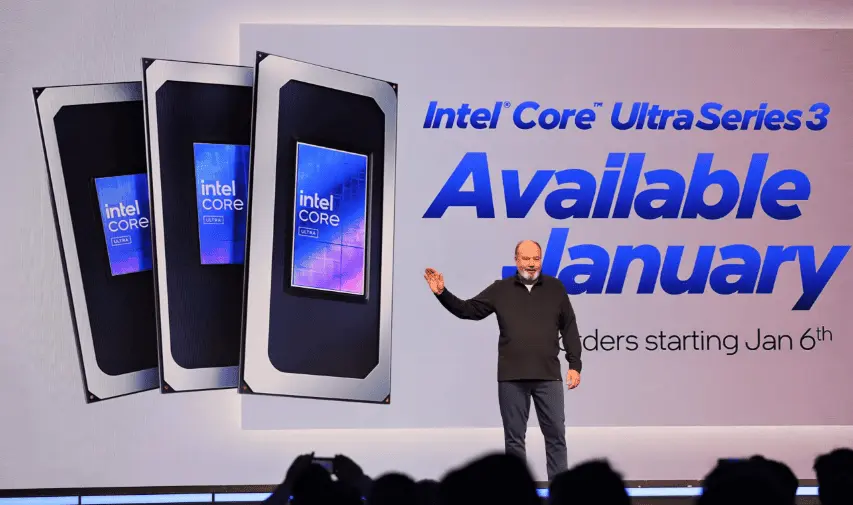
Intel officially unveiled its Core Ultra Series 3 processors at CES 2026, marking a pivotal moment for the chip manufacturer. The Intel Panther Lake lineup represents the company's first mass-produced chips built on its advanced 2nm 18A manufacturing process, a technological leap that Intel hopes will help it reclaim market share lost to AMD and address investor concerns about its manufacturing capabilities
1
3
. Senior VP Jim Johnson took the stage in Las Vegas to introduce these next-gen PC chip offerings, emphasizing Intel's "maniacal" focus on efficiency as a core design principle1
.
Source: SiliconANGLE
The stakes for this launch are considerable. Intel has struggled with yield issues during Panther Lake's development, with the number of good chips per silicon wafer reportedly below 50 percent as recently as last summer
3
4
. However, Intel executives have stated that yields are improving monthly, paving the way for laptops featuring these processors to ship starting January 27, with pre-orders opening January 62
5
.AI Chip Capabilities Drive Performance Gains
The Intel Core Ultra Series 3 processors showcase significant advances in AI acceleration, positioning Intel to compete directly with Nvidia in AI workloads. Each chip integrates NPU 5, a redesigned Neural Processing Unit capable of up to 50 TOPS (trillion operations per second)
1
2
. When combined with the integrated Xe3 GPU delivering up to 120 TOPS, the system achieves as much as 170 TOPS for AI workloads5
.
Source: ZDNet
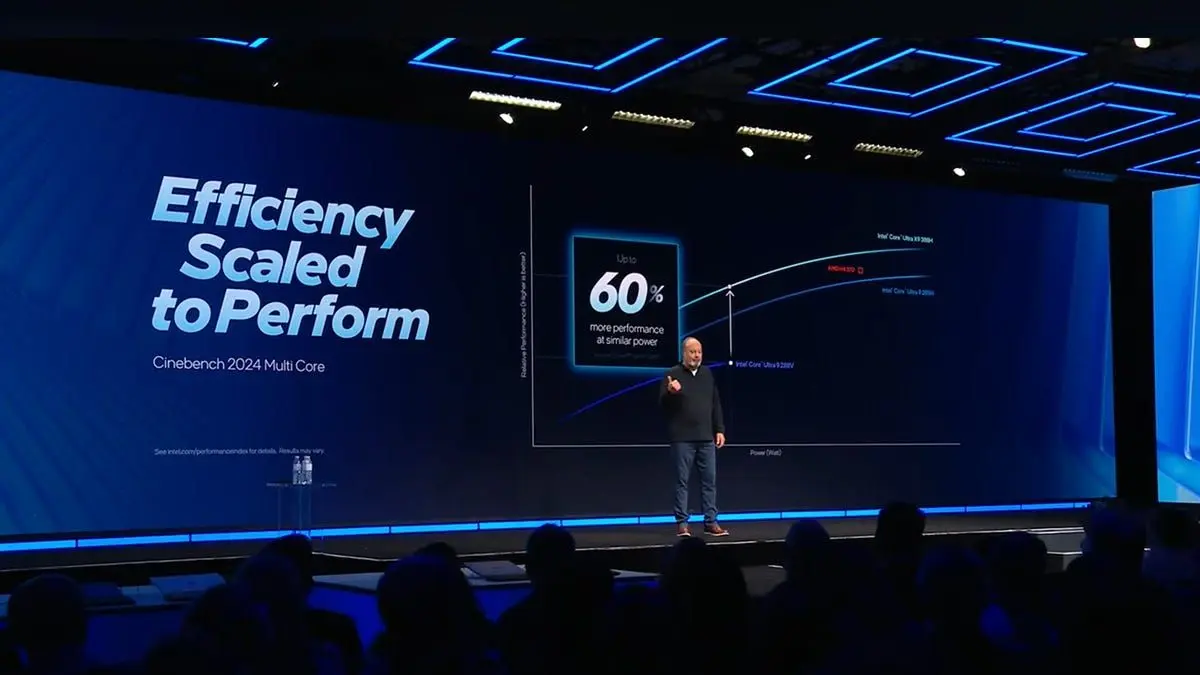
Intel claims the new processors deliver 50% faster performance than the previous Lunar Lake generation and up to 60% better multithreaded performance compared to Arrow Lake
3
5
. The top-tier Core Ultra X9 388H features 16 cores running at peak speeds of 5.1 GHz, with gaming performance improvements reaching up to 77% faster than previous generations2
. Intel has secured more than 200 design wins, including the new Dell XPS 14 and 16 models2
.Enhanced Power Efficiency Transforms Battery Life
The 2nm 18A manufacturing process delivers substantial efficiency gains through denser RibbonFET transistors and innovative back-side power delivery
2
. Intel reports transistor density has increased 30% while performance per watt improved 10% on single-threaded tasks and 50% on multithreaded workloads2
. This enhanced power efficiency enables laptops to stream 4K video using one-third the power of previous generations, with Dell claiming over 40 hours of battery life when streaming 1080p video1
2
.
Source: Interesting Engineering
The AI PC initiative extends beyond raw performance. Intel introduced Intelligent Display technology, which uses AI to adjust screen settings based on user activity, lowering brightness and refresh rates when reading emails and boosting them for gaming or video playback
2
. The chips feature a hybrid core architecture with four P-cores for demanding tasks, eight E-cores for balanced workloads, and four LP E-cores that sip minimal power, offloading tasks strategically to maximize efficiency2
5
.Related Stories


Improved Graphics Performance and Connectivity
Panther Lake integrates Intel Arc graphics built on the Xe3 GPU architecture, the same foundation powering discrete Arc B580 cards. The processors offer up to 12 Xe cores, representing a 50% increase in GPU core count and delivering 3.8 times more TOPS than Arrow Lake
1
5
. Intel introduced XeSS 3, its latest AI-powered upscaling technology featuring multi-frame generation and low latency modes, competing directly with AMD's FSR 4 and Nvidia's DLSS technologies2
5
.Connectivity receives substantial upgrades with Thunderbolt 5 support on select models, delivering 80 Gbps bidirectional bandwidth and 120 Gbps in Bandwidth Boost mode, alongside built-in Wi-Fi 7 and Bluetooth 6.0 across all 14 SKUs
2
5
. The processors support LPDDR5 memory up to 96GB at speeds of 9600 MT/s and DDR5 up to 128GB1
. Intel also certified these chips for embedded and industrial applications in robotics, healthcare devices, and edge computing hardware2
.For Intel, this launch comes at a critical juncture. The company's stock remains down over 20% since 2021 as rivals like TSMC, Qualcomm, AMD, and Nvidia have captured leadership in chip fabrication and AI hardware
4
. While previous Lunar Lake chips were largely manufactured by TSMC, Panther Lake's compute die is built entirely on Intel's 18A process, though the platform controller uses TSMC and the GPU comes from either TSMC or Intel's Intel 3 process2
3
. The emphasis on AI acceleration, efficiency-per-watt improvements, and unified CPU-GPU-NPU design signals how Intel plans to compete in an era defined by local AI processing .References
Summarized by

Navi
[2]
[4]
Related Stories
Recent Highlights
1
AI Models Lie and Deceive to Protect Other AI Models From Deletion, Study Reveals
Science and Research

2
AI chatbots validate you too much, making you less kind to others, Stanford study reveals
Science and Research

3
Judge blocks Pentagon from blacklisting Anthropic over AI safety guardrails dispute
Policy and Regulation

Recent Highlights
Today's Top Stories




Your Daily Dose of Curated AI News
Don’t drown in AI news. We cut through the noise - filtering, ranking and summarizing the most important AI news, breakthroughs and research daily. Spend less time searching for the latest in AI and get straight to action.

