Lenovo debuts AI Workmate desk robot and Work Companion concepts to humanize AI at MWC


8 Sources
8 Sources
[1]
I'm Enamored With Lenovo's Desktop AI Companions, and I Could Use Their Help
Katie is a UK-based news reporter and features writer. Officially, she is CNET's European correspondent, covering tech policy and Big Tech in the EU and UK. Unofficially, she serves as CNET's Taylor Swift correspondent. You can also find her writing about tech for good, ethics and human rights, the climate crisis, robots, travel and digital culture. She was once described a "living synth" by London's Evening Standard for having a microchip injected into her hand. How well do you concentrate at work? For me, it very much depends on how I'm feeling that day, what else I have on my mind and a miscellany of other factors. One technique I use fairly successfully to keep me focused is a pomodoro timer, and at Mobile World Congress 2026 I found what I believe could be the perfect AI pomodoro companion. I first saw Lenovo's Magic Bay Tiko at last year's MWC, but at the time it was just a concept. The little circular module perches on the top of your Lenovo laptop display, attached via the magnetic Magic Bay on the rear. The module is home to an adorable animated companion called Tiko, who you can interact with via text or voice. Accessories with AI agents are becoming increasingly popular, particularly in the wearables space, with many companies starting to offer pins and pendants. They can take on a variety of tasks, such as life logging and transcription. They can also carry out tasks for you, such as adding things to your calendar or checking your calendar to see if you're busy. Tiko has a number of standard agentic AI capabilities -- it can start and stop your music, open a web page for you or answer a question. You can also interact with it by using emoji. Give it a book emoji, for example, and it will pop on its glasses and sit reading with you while you work. But my favorite Tiko feature effectively turns it into a body-doubling buddy, which I feel would be useful for keeping me on track on distracted days. Body doubling is a technique where you work alongside someone else -- either physically or virtually -- to keep you on track and accountable. Tiko comes with a timer, allowing you to track a focused work session. When you need a break, you can switch over to "wellness break" for 10 minutes of relaxation before you carry on. You can even choose to add 1 minute of breathing exercises, which Tiko will do with you, to keep you calm. A traditional pomodoro timer is 25 minutes of work followed by a 5-minute break, but this is flexible. I'm enamored with the idea of a physical manifestation of the timer perched above my screen, with a sweet animated friend to help keep me in check. The good news for me is that Tiko is no longer a concept from Lenovo. The company wants to sell the Magic Bay accessory later this year -- although it doesn't know exactly when, or how much it will cost. The less good news is that you'll need to have a Lenovo laptop with a Magic Bay port, which I do not. It might be impractical to consider getting a new laptop just for Tiko, but it could sway me if I was already in the market for one. Another AI companion concept from Lenovo that remains a concept for now is its AI Workmate. This is a kind of stationary tabletop robot, not dissimilar to the Pixar lamp, but with an orb for a head. With a combination of cameras, microphones and projectors, the AI Workmate can undertake a variety of tasks, including helping you generate and display presentations or turn your written work or art into a digital asset. I asked the Workmate to make me a presentation about giraffes. Using Lenovo's proprietary models, it generated a three-slide presentation entitled "The Majestic Giraffe: Nature's Tall Enigma." It was factually accurate, as far as I could tell, if disappointingly free of pictures. It's robotic head swivelled around and projected the slides onto the wall next to me. I also asked the Workmate to generate me a postcard of Barcelona. It displayed the work on the table in front of me, and I scribbled some text over the top. The Workmate then scanned the entire image, including my writing and sent it straight to the printer for me, leaving me with a tangible souvenir to take away from our encounter. I can't say I would necessarily want something as large and bulky on my own desk, and I'm not exactly sure what practical use I work make of the AI Workmate concept at this stage. But it was still fun to play with, and interesting to see how tech companies are imagining ways to bring AI to physical life so they can assist us in at our work.
[2]
A robot arm with puppy dog eyes is just one of Lenovo's new desktop AI concepts
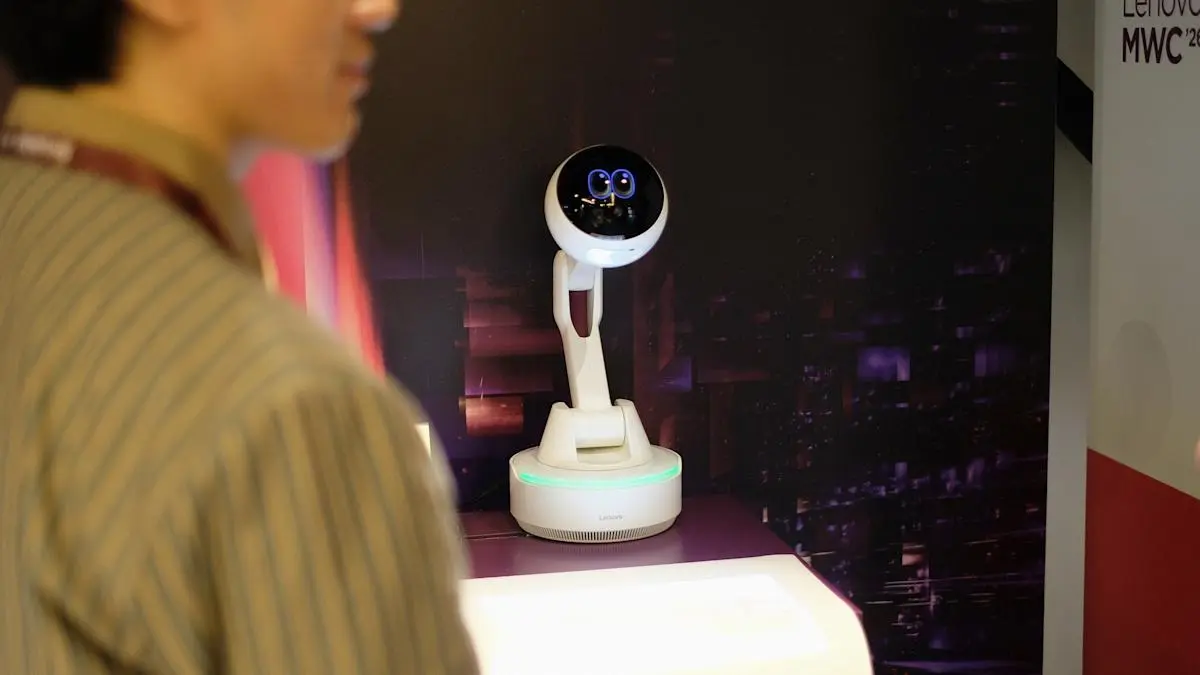
Alongside a handful of new laptop concepts (and a range of real products too), Lenovo used MWC to announce a pair of AI-based productivity companion concepts. Both are standalone desk devices designed to boost productivity while providing office workers with a bit of artificial dystopic companionship. Lenovo describes its AI Workmate Concept as an "always-on desk companion," but it looks like a tiny robotic arm on a swiveling base with a bulbous screen on the end displaying an expressive pair of eyes. It doesn't look as engaging as a human co-worker, but through local AI processing you can interact with the device as a smart assistant via voice commands and physical gestures. The Workmate Concept can also help with "practical business tasks." Below its screen is a camera that can be used to scan notes and documents to generate summaries, organize your ideas, or automatically turn them into presentations. When it's time to share with others, the Workmate Concept even incorporates a projector that can display documents on your desk or onto a nearby wall. Lenovo's AI Work Companion Concept takes a different approach to AI assistance. It looks like a bedside alarm clock with a large screen, but instead of waking you it leverages AI to "sync tasks and schedules from across the user's devices to generate a balanced daily plan." To help prevent burnout the Work Companion monitors screen time and suggests taking breaks throughout the day, along with playful interactions using animated faces, and end-of-week celebrations with reports of completed tasks. It also doubles as a dock, connecting a laptop to multiple displays over HDMI and providing plenty of USB ports to keep other devices charging while reducing desktop clutter. Lenovo has a solid track record of turning concept devices into real products. Its ThinkBook Plus Gen 6 with an extending rollable screen actually launched last year, but the company hasn't confirmed if either of these concepts will ever see the light of day.
[3]
Lenovo Leads Push at MWC to Humanize AI With Friendly Robots
Lenovo Group Ltd. and other consumer electronics companies used the MWC Barcelona conference this week to test appetites for physical AI products with humanlike characteristics. The Beijing-based firm arrived at the show with several proof-of-concept devices, including a desktop robotic arm with a built-in projector, microphones, speakers, cameras and a display with the oversized eyes of an animated character. The gadget, called the AI Workmate, is intended to plug into business environments, recognizing users by their appearance and voice and surfacing pertinent information. The effort to humanize the technology is unmistakable, with the arm performing pet-like movements and gestures. Not far from the AI Workmate, Lenovo's Magic Bay Tiko is a magnetic attachment that the company has been refining for several months. It clips to the top of a laptop and serves as an animated AI assistant. The latest edition is an anthropomorphic cloud that looks over the user's work and responds to voice-based commands and queries. The gadget doesn't enhance the artificial intelligence capabilities, but it adds a character to the experience -- which can sip coffee or read a book while you're not interacting with it. The broad push toward softening the edges of AI tech was apparent everywhere across the MWC show floor. China Telecom Corp. had a humanoid robot doing calligraphy at its stand. China Mobile Ltd. set up an entire robot restaurant, where various machines were demonstrating food preparation and service. China Unicom also brought a humanoid to the event, an eye-catching red machine that drew passersby. It was more of the same from smartphone makers, with ZTE Corp. erecting a pair of robot guardians at its booth and Honor Device Co. demonstrating a humanoid robot -- the first to be developed in-house by a smartphone maker, according to the company. Honor also showed off a so-called robot phone with an articulating camera arm that retracts into the body of the handset. Traditional mobile devices like phones and laptops, long the centerpiece of MWC, were an afterthought at this year's AI-centric gathering. Ericsson AB, Nokia Oyj and Qualcomm Inc. pitched visions of 6G and AI blending together as the technologies of the future -- Ericsson's booth included the slogan "no AI without mobile" -- while device makers like Lenovo were busy testing the waters for new types of AI gadgets. The 6G communication standard is set to replace 5G in wireless networks in the next decade. Many of the novel devices and form factors being contemplated by companies now lean more into conversational interactions over input via a screen. Alongside inviting animated faces, the next wave of consumer electronics may shift the primary mode of input to natural-language prompts. "We're now beyond smartphones -- the next class of devices like personal AI devices, connected vehicles, industrial devices, robots and much more are going to be connected," Qualcomm Chief Executive Officer Cristiano Amon said in a keynote address. "AI makes voice important again, as we use a lot of voice to interact with agents."
[4]
Lenovo's robot concept can help you digitally sign documents (and maybe annoy coworkers)
Lenovo can make a robot, too. Alongside proof-of-concept foldable gaming PCs and modular laptops, it introduced the AI Workmate Concept at MWC 2026. With its own Intel Core Ultra processor, 64GB of memory and its own Pico projector, it's an AI-laced "workmate" meant to streamline office tasks and collaboration. And it has an LCD face. For now, it's a proof of concept, musing on how to integrate voice commands and LLMs (large language models) into workplace settings. It's meant to sit on your desk, but preferably also near a wall - more on that later. Voice commands aside, the concept bot supports writing, voice and gestures with on-device AI processing. While it can answer the usual voice assistant questions, it can also scan and summarize documents (both digitally and physically) and even assist with creating a PowerPoint presentation - though you might want to check its work. The 3.4-inch 480 x 480 screen doesn't seem to offer any data visualization or numbers. During my demo, it only seemed to show the bot's eyes and facial expressions: it'll sip coffee as it listens (with a moustache), cup a floating hand to the side of its face when it needs you to repeat a command, or twinkle when it's processing more complicated tasks, like that fictional PowerPoint presentation. With its articulated head, which houses the projector, cameras and LCD face, you can ask it to project images or documents on either the desk in front of it or a wall nearby. No need to flip around your monitor or laptop to share with colleagues. In one example, a spokesperson asked for a postcard. The Workmate then projected a (Lenovo-branded) image of Barcelona onto the desk. The rep laid paper down, then signed the 'postcard' and got the robot to scan it (with two downward-facing 5-megapixel cameras), and then send the file to a nearby printer. In theory, this sort of flow could transition to document signing or adding notation to images and files. However, one caveat here is whether those of us who work in offices want the extra workplace noise of a chatty robo and the person barking orders at it. Lenovo says this concept (and it has a few at MWC) is meant to demonstrate the company's "exploration of spatial and physical AI experiences" that integrate "seamlessly into professional environments." Hopefully, further evolutions offer a text-based way to make using it a little less noisy. Lenovo was also showing a simpler AI work device, the AI Work Companion Concept. It's a completely different premise, despite the name being a little too close to the AI Workmate Concept. The AI Work Companion is not a robot, but a handsome chunky desk clock, with a solid, satisfying dial on the top and programmable buttons. The front is almost entirely display, able to show calendars, task lists and other work-centric dashes. It runs independently, plugging into a USB-C port for power and pulling data down wirelessly, while also acting as a port hub for charging other accessories and devices. It's certainly not as high-concept as the robot, but there are some AI smarts inside. The Work Companion's "Thought Bubble" uses AI to sync a user's tasks and daily schedule across devices, synthesizing a daily action plan. It will even suggest times to break up bursts of work and attempt to monitor screen time to better manage burnout. According to the press release, Lenovo says it also has "playful interactions with the user" and will, kind of bleakly, offer an end-of-week celebration report of tasks completed. It's lucky it's a good-looking desk clock.
[5]

Lenovo's AI Workmate concept puts a desk robot with a projector in your office
Serving tech enthusiasts for over 25 years. TechSpot means tech analysis and advice you can trust. First look: Lenovo is building its vision of the workplace of the future - not just through faster laptops or thinner tablets, but through machines that can see, listen, and even share a desk. At this year's Mobile World Congress, the company introduced two concept devices designed to explore how artificial intelligence could take on a physical presence in professional environments. The most striking prototype was the AI Workmate Concept, a desk robot that combines conversational AI with cameras, sensors, and projection hardware. Less dramatic - but more immediately practical - was the AI Work Companion Concept, a stationary desktop assistant with its own display and AI-driven scheduling engine. Together, they signal a shift in Lenovo's exploration of what it calls "spatial and physical AI experiences." At first glance, the AI Workmate resembles a small, animated speaker. It features a 3.4-inch LCD screen with a low-resolution (480 × 480) animated face that changes expression as it listens, processes, or idles - sometimes sipping imaginary coffee or resting a floating hand against its synthetic chin. The display is not intended to present data, but rather to create the illusion of emotion. Behind the screen sits a fully articulated head housing an Intel Core Ultra processor, 64GB of memory, an onboard Pico projector, and cameras that support document scanning and gesture input. The projection system is one of its most distinctive features: it can beam documents, images, or presentations onto a desk or nearby wall. During a live demonstration, Lenovo representatives had the device project an image of Barcelona onto a desk. They then showed how it could scan a signed postcard using two downward-facing 5-megapixel cameras and forward the digital copy to a printer. Unlike many voice assistants that rely heavily on remote servers, the AI Workmate concept performs much of its processing locally rather than depending entirely on the cloud. It supports speech and gesture recognition, document summarization, and slide creation. Lenovo describes the device as an early exploration of how embedded AI and generative models might function in professional environments, where privacy and latency remain ongoing concerns. For now, the system remains a concept, and Lenovo has not indicated whether a commercial version is planned. Some observers note that its human-like presence and constant chatter could become distracting in shared workspaces, especially if one person regularly interacts with it aloud. Still, the company says the project is less about immediate deployment and more about exploring new interaction models for AI-assisted collaboration in office settings. In addition to the expressive robot, Lenovo showcased a second prototype that takes a different approach to AI-driven productivity. The AI Work Companion Concept trades the robot's personality for utility. Roughly the size of a small clock, it features a solid dial, programmable buttons, and a full-face display capable of showing calendars, to-do lists, and reminders. It connects via USB-C for power and hub functions while wirelessly syncing tasks and schedules from a user's devices. Its underlying software includes a system Lenovo calls the "Thought Bubble," which synthesizes daily plans across platforms, combining tasks, meetings, and breaks into a coherent workflow. The assistant can suggest rest periods between focus sessions and track screen time to help prevent burnout. At the end of the week, it compiles a brief progress recap intended to serve as both a feedback loop and a lighthearted reward. The Work Companion forgoes cameras and conversation in favor of a quieter, always-on display that brings intelligence to the edge of the workstation. Rather than embedding AI solely in software, Lenovo is giving it a physical form - an unobtrusive presence that hints at how productivity hardware could evolve. That theme of physicalizing AI runs through Lenovo's broader demonstrations at MWC. Alongside foldable gaming PCs and modular laptops, the company is using prototypes like the Workmate and Work Companion to test how its "spatial and physical AI experiences" might complement emerging spatial computing use cases. The underlying idea is that the future of computing will extend beyond screens into the surrounding environment - projected onto walls, distributed across surfaces, and responsive to gestures and voice. Both prototypes remain experimental, but they offer a glimpse of how major device makers are rethinking AI's role in the post-laptop era. Whether such devices ultimately become indispensable tools or remain novelty gadgets will depend on how effectively they blend digital intelligence with the practical realities of office life.
[6]

I tried a physical AI assistant at MWC 2026, and I'm not sure we need one
Lenovo turned up to MWC 2026 with its usual suitcase full of wild ideas, and while the ThinkBook Modular AI PC rightfully stole most of the spotlight, it wasn't the only oddball on the stand. Staring at me among the concepts was something stranger -- an AI-powered robotic arm with "Love me" eyes. No mouth, no smile, just a cute little stare following you around the desk. This is Lenovo's AI Workmate concept, and the best way I can describe it is as a physical AI assistant, the kind that normally lives inside your phone or laptop, but has now decided it wants its own space on a desk. The idea is to give AI a body and let it help you with everyday office tasks, blending your physical and digital lives. The robot can scan and summarize documents placed in front of it, organizing notes, whip up presentations with voice prompts, and even project content directly onto a wall or nearby surface. Talking to it feels familiar, like the pre-Google Gemini days when you could issue straightforward voice commands to get work done. But things get a bit uncomfortable when you realize it's always watching. There's a built-in camera that lets it recognize when a person is standing in front of it and even distinguish the primary user from others nearby. One of the slicker moments in the demo was watching it intelligently scan the room, identify a blank wall, and decide that yes, this is a good place to project a presentation. You can also quite literally hand off content from your laptop using gestures. Drag a file in mid-air toward the robot, and it picks it up, projects it, and carries on as if that's a totally normal thing to do in an office. Another surprisingly clever trick was document signing. You sign a piece of paper in front of the robot, and it captures your signature and transfers it straight onto a digital document on your laptop. The same idea applies to hand-drawn sketches. As fun as all of this was to watch, I couldn't help but feel that the AI Workmate is solving problems we've already solved, just in a more theatrical way. Everything it does can already be done faster with the tools most of us carry every day, without the need for a robot arm silently staring at us from across the desk. Still, that's kind of the point of MWC. It's a testing ground for ideas that are equal parts clever, weird, and impractical. And even if the AI Workmate never makes it out of concept-land, I'll admit it was pretty cool.
[7]

Lenovo on its rollable laptops and AI super agents
The world's largest PC maker is hoping to revolutionise how people interact with technology through forward-thinking screen designs and supercharged adaptive AI. In an era of constant Artificial intelligence (AI)-driven transformations, Lenovo continues to lead innovation through a bold hybrid-led strategy that envisions unified AI ecosystems. As the world's largest PC maker, the company has shifted its focus in recent years from manufacturing devices to developing multi-platform systems that fluidly adapt to peoples' needs. "Compute now can go anywhere. It used to be it required this big system that was cool. You still have that, and there are use cases for that, but it can really go anywhere," Steve Long, Senior Vice President of Lenovo's Intelligent Devices Group (IDG), told Euronews Next. "Now, a PC or a computer can be almost in anything, and so that unleashes a lot of experiences that we think Lenovo can differentiate on." Adaptive AI devices are at the forefront of Lenovo's latest unveilings, many of which were on display at Mobile World Congress (MWC) in Barcelona. These include novel new designs like a rollable laptop, conceptual foldable gaming handset, and the rollout of Lenovo Qira. The latter was first announced at CES earlier this year, and is a personal AI super agent designed to work across different platforms. This allows it to learn more about you and your workflows, becoming a hyper-efficient digital double that can anticipate almost every need. "You may be doing a task on your phone and you want [Qira] to come straight over to your tablet, and it remembers and picks up exactly [where it left off] and has the context - not only of what you were doing, but the history of, again, with your permission, who you are and what you're interested in," Long explained. "Qira is allowing someone to advance from search to actually predicting and suggesting and working on your behalf," he added. While seen by many business leaders as the future of automating and streamlining work tasks, the rapid rise of agentic AI has also generated concerns about security breaches and the potential for AI agents to go rogue - with some experts warning they require background checks. Long believes that, alongside ensuring the right security and governance is in place for such tools, it's also important that consumers are given the option to opt in and weight up the benefits. "The access is showing them how Qira can drive better productivity, or how it can drive even employee retention, because employees are more satisfied, or can get something done faster," he said. "The biggest cultural element is actually people, and so convincing people that it's acceptable. Think about the self-driving car, and how today you can get in a car and let it drive itself, but a lot of people are still resistant to that. I think you're going to see the same thing happen as we continue experiments with agents and letting them take actions on your behalf." Alongside expanding the capabilities of intelligent systems, Lenovo has also been experimenting with new screen forms. Its aforementioned rollable laptop has sparked most curiosity, with a 14-inch screen that can expand vertically to 16.7 inches. This taps into a burgeoning sector of portable tech solves the issue of its sacrificed screen real estate. "The screen adjusts when you want a larger screen for immersive content, or if you're watching something. It can then roll and fold back down to a normal laptop when you're walking around with it," Long said, adding that it's been especially popular with gamers. He also noted that the capabilities of voice interaction drive further revolutions in their future products - and how people interact with their devices in general. "You can create postcards by talking, you create a PowerPoint presentation through voice," he said, referencing the Lenovo AI Workmate prototype, which features a robot head that can project images downward. "These are things that we know you can do if you're technically able, but we're trying to take it to the masses, and I'm excited about that."
[8]

Lenovo's new AI Workmate Concept takes the AI assistant off your screen entirely - Phandroid
Most AI assistants live inside your laptop or phone, waiting to be summoned. Lenovo has been experimenting with that idea for a while now, showing off everything from AI-integrated displays to concept smart glasses at CES 2026. At MWC 2026, the company is taking a different angle with the Lenovo AI Workmate Concept, a standalone desk companion designed to bring AI assistance into your physical space rather than keeping it buried in an app. According to Lenovo, the AI Workmate Concept is built to sit on your desk as an always-on device. It responds to writing, voice, gesture, and spatial interaction, and processes all of that input locally using on-device AI. The practical tasks it's designed to handle include scanning and summarizing documents, organizing notes, and helping put together presentations. So rather than switching to a separate window or app to get AI help, the idea is that the Workmate is just sitting there, ready to assist alongside whatever you're already doing. The more experimental side of the Lenovo AI Workmate Concept is its ability to push content beyond a screen entirely. According to Lenovo, the device can project information onto nearby surfaces like your desk or wall. That puts it in territory that goes well beyond a typical AI assistant and edges closer to spatial computing. It's an ambitious idea for a concept that still has no confirmed pricing, availability, or launch plans. Lenovo has made a habit of using MWC to float big ideas before committing to them. Last year's show brought a foldable display laptop and solar-powered PC concepts, neither of which has hit shelves yet. The AI Workmate Concept feels like it's in a similar early-exploration phase. Whether the projection feature ever makes it into a shipping product is another question entirely, but as a signal of where Lenovo wants to take AI interaction, it's worth paying attention to.
Share
Share
Copy Link
Lenovo showcased two desktop AI companions at Mobile World Congress in Barcelona—the AI Workmate, a desk robot with animated eyes and a built-in projector, and the AI Work Companion, a smart desk clock that syncs tasks across devices. Both proof-of-concept devices explore how physical AI experiences could reshape professional environments.
Lenovo Introduces Desktop AI Companions at MWC Barcelona
Lenovo used Mobile World Congress 2026 in Barcelona to showcase its vision for workplace AI through two distinct productivity companion concepts. The AI Workmate Concept takes the form of a desk robot—a small articulated arm on a swiveling base with a 3.4-inch LCD screen displaying animated eyes that mimic emotional expressions
1
3
. The device performs pet-like movements and gestures, creating what the company describes as an "always-on desk companion" designed to humanize AI interactions in professional settings2
.
Source: Engadget
Powered by an Intel Core Ultra processor with 64GB of memory, the AI Workmate processes tasks locally using on-device AI rather than relying entirely on cloud services
4
. Users interact through voice commands, physical gestures, and even written input, with the device recognizing users by their appearance and voice. The animated face serves purely emotional purposes—sipping coffee while listening or cupping a hand to its face when needing clarification—rather than displaying data visualizations4
.Document Scanning and Presentation Assistance Through Built-In Projector
The AI Workmate's most distinctive feature is its integrated Pico projector, housed within the articulated head alongside cameras and speakers . The device can project documents, images, or presentations onto a desk surface or nearby wall, eliminating the need to physically reposition monitors during collaboration
4
. During demonstrations, Lenovo representatives showed how the desk robot could project a postcard image of Barcelona onto a desk, scan handwritten signatures using two downward-facing 5-megapixel cameras, and send the digitized document directly to a printer1
4
.This workflow demonstrates potential applications for document scanning and digital signing in office environments. The AI Workmate can scan both physical notes and digital documents to generate summaries, organize ideas, or automatically create presentations
2
. When asked to create a presentation about giraffes, the device generated a three-slide deck titled "The Majestic Giraffe: Nature's Tall Enigma" using Lenovo's proprietary models, then projected the slides onto a wall1
.AI Work Companion Tackles Burnout With Spatial AI Intelligence
Lenovo's second concept takes a quieter approach. The AI Work Companion Concept resembles a desk clock with a large display, solid dial, and programmable buttons
2
4
. Rather than animated personalities, this device focuses on practical productivity through its "Thought Bubble" feature, which uses AI to sync tasks and schedules across multiple devices and generate balanced daily plans2
.The Work Companion monitors screen time and suggests breaks throughout the day to help prevent burnout, combining task management with wellness features
2
. It offers playful interactions through animated faces and provides end-of-week celebration reports summarizing completed tasks2
4
. Beyond its AI capabilities, the device functions as a USB-C dock, connecting laptops to multiple displays via HDMI while providing charging ports for other devices2
.Magic Bay Tiko Adds Body-Doubling for Focus Sessions
Lenovo also showcased an updated version of its Magic Bay Tiko, first introduced as a concept at last year's MWC but now planned for commercial release later this year
1
. This magnetic attachment clips to the top of Lenovo laptops equipped with Magic Bay ports, displaying an anthropomorphic cloud character that responds to voice commands and text input1
3
.
Source: CNET
Tiko performs standard AI agent tasks like controlling music, opening web pages, and answering questions, with emoji-based interactions adding playful elements
1
. Its standout feature is body-doubling support through an integrated timer for focused work sessions and wellness breaks, including optional one-minute breathing exercises that the animated character performs alongside users1
. While pricing and exact release timing remain unconfirmed, Lenovo plans to make Tiko available as a commercial product this year1
.Related Stories

Industry Push Toward Personal AI Devices and Conversational Interfaces
Lenovo's desktop AI companions reflect a broader industry trend at MWC toward physical manifestations of artificial intelligence. China Telecom demonstrated humanoid robots performing calligraphy, while China Mobile set up an entire robot restaurant showcasing food preparation and service
3
. Honor Device Co. unveiled the first humanoid robot developed in-house by a smartphone maker, alongside a "robot phone" with a retracting articulated camera arm3
.
Source: Bloomberg
Qualcomm CEO Cristiano Amon highlighted this shift during his keynote address, stating that "we're now beyond smartphones" as personal AI devices, connected vehicles, and robots become the next class of connected devices
3
. He emphasized that "AI makes voice important again, as we use a lot of voice to interact with agents," signaling a move away from screen-based input toward natural-language prompts3
. Ericsson's booth featured the slogan "no AI without mobile," with major telecommunications companies pitching visions of 6G and AI blending together as future technologies3
.Practical Concerns and Future Outlook for Spatial AI Experiences
While Lenovo describes these devices as explorations of "spatial and physical AI experiences" that integrate seamlessly into professional environments, practical concerns remain
4
. The AI Workmate's reliance on voice commands could create workplace noise issues, particularly in shared office spaces where multiple people might interact with chatty robots simultaneously4
. Some observers suggest future iterations should include text-based interaction options to reduce auditory disruption4
.Lenovo has a track record of commercializing proof-of-concept devices—its ThinkBook Plus Gen 6 with an extending rollable screen launched last year after being shown as a concept
2
. However, the company has not confirmed whether the AI Workmate or AI Work Companion will transition from concepts to retail products2
. Whether these desktop AI companions become indispensable productivity tools or remain novelty gadgets will depend on how effectively they balance digital intelligence with the practical realities of office life, particularly around privacy concerns and workflow integration .References
Summarized by

Navi
[4]
Related Stories
Lenovo Unveils Innovative AI-Powered Concepts and Devices at MWC 2025
03 Mar 2025•Technology

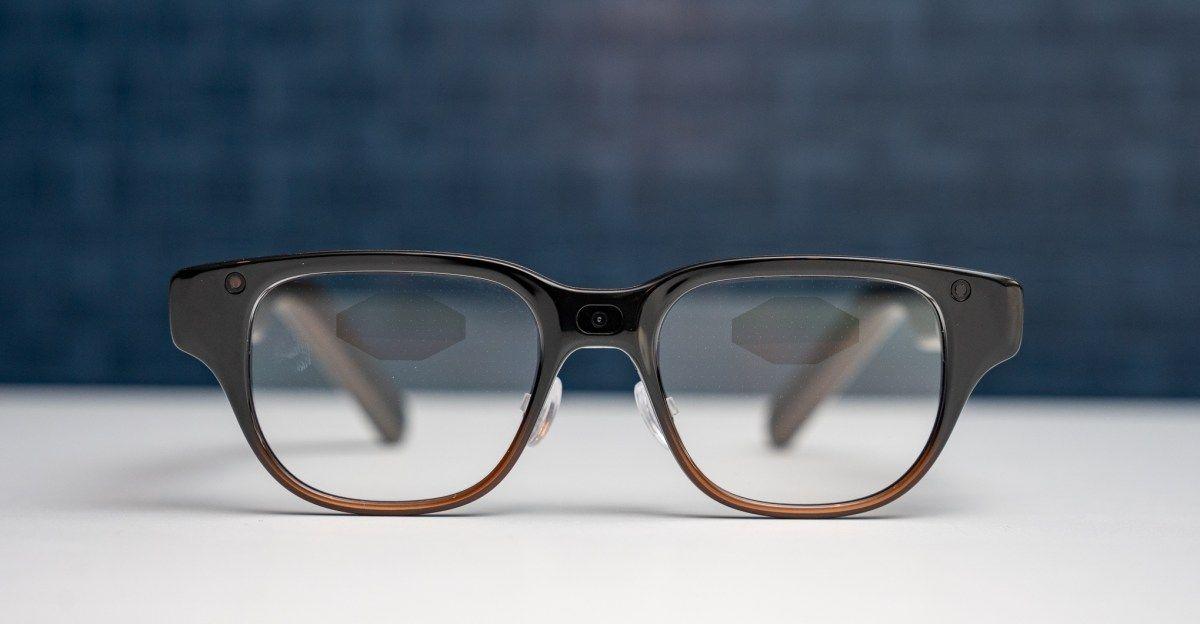
Lenovo unveils concept AI glasses and Qira platform at CES 2026, pushing ambient intelligence
07 Jan 2026•Technology
Lenovo Qira AI Assistant Bridges Phones and PCs with Seamless Cross-Device Intelligence
07 Jan 2026•Technology
Recent Highlights
1
Tennessee Teens Sue Elon Musk's xAI Over Grok AI-Generated Child Abuse Images
Policy and Regulation

2
Pentagon designates Palantir Maven AI as core US military system in major defense shift
Technology

3
Supermicro Co-Founder Indicted in $2.5 Billion Nvidia AI Chip Smuggling Scheme to China
Policy and Regulation
Recent Highlights
Today's Top Stories









Your Daily Dose of Curated AI News
Don’t drown in AI news. We cut through the noise - filtering, ranking and summarizing the most important AI news, breakthroughs and research daily. Spend less time searching for the latest in AI and get straight to action.

