Mercedes-Benz Drive Assist Pro brings AI-powered autonomous driving to US city streets


7 Sources
7 Sources
[1]
Mercedes teaches its driver assist how to handle surface streets
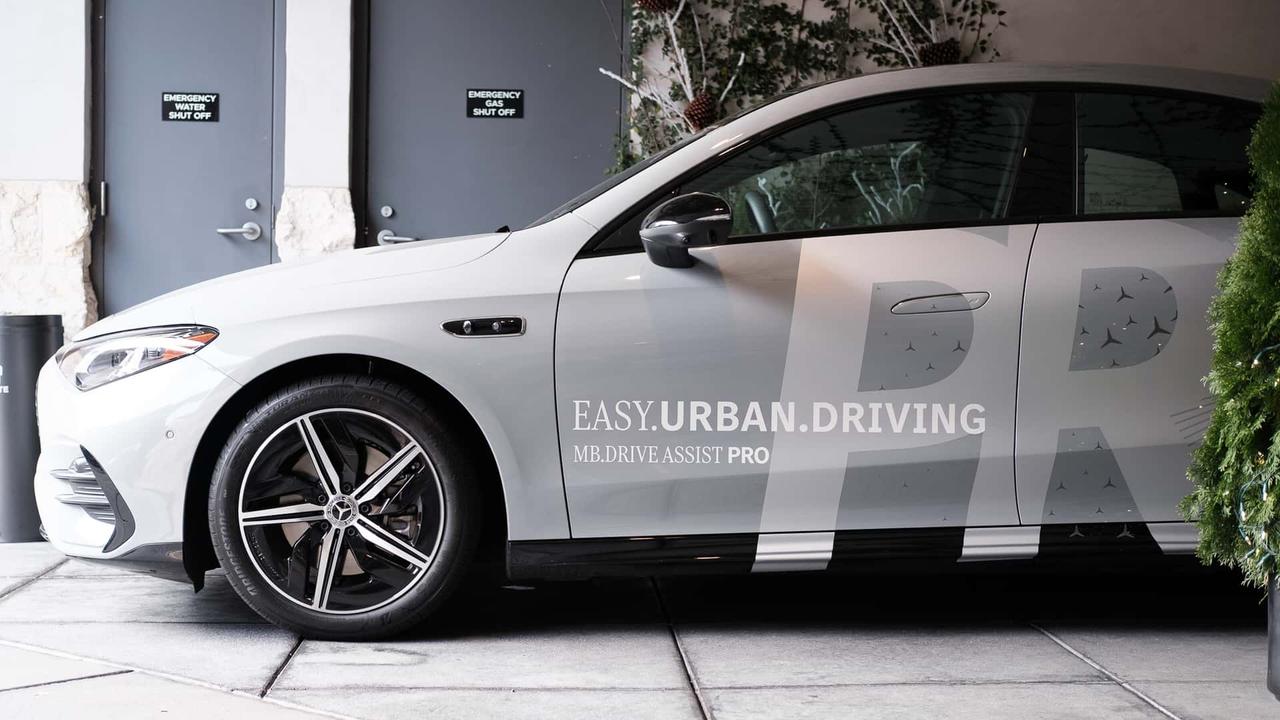
There's some debate as to when adaptive cruise control first showed up, but if you ask Mercedes-Benz, it will say in 1999 with that year's S-Class. Instead of just keeping a set speed, radar-enabled adaptive cruise control allowed the car to react to deceleration by the car ahead, and thus was created the first partially automated car. From there, automakers added a function to keep cars in their lanes, and now we have location-aware, GPS-geofenced vehicles that, as long as the driver is paying attention, will do most of the driving -- on the highway at least. But the goal for developers of both autonomous and partially automated vehicles is to remove as much of the burden of driving from the human as possible, not just on controlled access highways but at lower speeds, on surface streets. Which is what Mercedes' latest Drive Assist Pro has been designed to do. And after a recent demo -- albeit from the passenger seat -- on the streets of downtown San Francisco, it appears to be a very credible effort. CLA gets it first The big, powerful, comfortable S-Class is normally the standard-bearer for the latest and greatest tech Mercedes has cooked up, but not always. In December we drove the production version of its new entry-level EV, the CLA. At under $50,000, the sleek Mercedes sedan (or four-door coupé) is already available with the current version of the automaker's Drive Assist suite, with better control of braking and deceleration. A particular improvement, which I'm not sure made the final version of our first drive report, is the way you can use the brake while adaptive cruise control is active without canceling the system. Light applications of the brake -- to shed a few miles per hour, not to conduct an emergency stop -- will slow the car, which then resumes its original speed, much the same way you have always been able to apply the throttle to temporarily speed up while using cruise control. Drive Assist Pro takes this collaborative approach between the car and driver and runs with it. Given a destination to work with, it knows which lanes you'll need ahead of time, and the car reads both stop signs but also traffic lights. It even detects, and slows down for, speed bumps. On a 20 minute drive around the Waymo-clogged streets of the tech industry's favorite city, the engineer in the driving seat didn't have to intervene once, although I believe at least a couple of colleagues' demos got confused by human crosswalk attendants moving around with their stop signs. The CLA drove at safe and legal speeds, knew how to handle construction zones, and wasn't flummoxed by one of those most common of city driving annoyances, the double-parked car. The time the car takes to come to a complete stop at stop signs can and will irritate human drivers behind you; it's definitely not a California stop. Needs to be an SDV All of this is possible thanks to the CLA being what the industry calls a software-defined vehicle. Four powerful computers run all the electronics, rather than dozens and dozens of discrete black boxes. One of those computers is (of course) from Nvidia -- that company's Orin, which handles things like perception and path planning. "We completely elevated our autonomous driving stack. It is no longer on a rule-based stack," explained Magnus Östberg, chief software officer at Mercedes-Benz. Now it uses an end-to-end AI model, "which of course is giving you some basic advantages. When it comes to parking, for example, [it offers] much faster navigation of parking lots..., moving in and out of the parking lots, but also already you find... how it's on the highway and how it actually follows the lane and moving across it," Östberg said. As seamless as the experience appeared, the human behind the wheel remains the one in charge. I don't love the SAE levels as a scheme for explaining the spectrum of partially automated and autonomous driving these days, but Drive Assist Pro is what an engineer might call "level 2 ++," if "level 2+" is something tightly geofenced like Super Cruise and true level 3 is Mercedes Drive Pilot, which is only available in Nevada and California and only works in relatively low-speed freeway traffic jams. The closest thing might be Tesla's much-maligned driver assist, which has long had the goal of letting its users go from point to point with no human intervention. I shan't dwell on that company's record of either safety or success (although apparently, many years after Musk first promised a coast-to-coast drive, someone actually finally pulled it off in late 2025). Needless to say, Mercedes-Benz has a very different approach to safety. There are redundant sensor modalities, not just a smattering of cameras. The end-to-end AI model tokenizes input and output trajectories, and there's a safety guardrail with a rules-based model to make sure any AI trajectory mistake is caught before it's driven. There's certainly no "mad max" setting to make it break speed limits, unlike those camera-only Teslas. Mercedes has already launched Drive Assist Pro in China and told Ars the safety certification process is complete for the US, with it arriving late this year in the CLA and then other Mercedes vehicles as they get their SDV upgrades during midlife refreshes. As for Europe, that will require some regulation changes, we believe.
[2]
What I Learned 'Driving' a Mercedes With Next-Level AI
MB.Drive Assist Pro uses a combination of cameras, radar sensors, and ultrasonic sensors, along with Nvidia's AI end-to-end stack, to provide a safe and efficient driving experience. In October, Nvidia Corp. became the first public company to be worth $5 trillion -- then promptly lost hundreds of billions of dollars in market value amid concerns about a bust of a potential artificial intelligence bubble. As analysts and even founders continue to warn that AI may be more speculative than substantive, car companies may beg to differ. This month, Nvidia is inching back, valued at around $4.55 trillion, bolstered in no small part by confidence in the automotive sector. Nvidia has collaborated with many carmakers, including Toyota, Volvo, BYD, Li Auto, Lucid, NIO, Rivian and General Motors, to develop AI-powered autonomous-driving and advanced driver-assistance systems. That's part of its estimated $5 billion automotive business in 2025, according to Bloomberg Intelligence. On Jan. 5, the company announced details about its new and unique MB.Drive Assist Pro for Mercedes-Benz, the next generation of AI-based driving. But what is it like to experience a personal car being driven completely by AI? I tried it in December in San Francisco riding with Joe Taylor, a senior systems engineer at Mercedes, in the automaker's new $47,250 Mercedes-Benz CLA. It has the most advanced AI driving system you can buy in the US in a private vehicle to date. My takeaway? An hour in a car driven by AI makes everything else feel, well, dumb. Once consumers feel safe relinquishing control of their daily commute, I predict they will eagerly adopt AI-driven cars, which will become status symbols among those in urban centers. The trial consisted of two portions. In the first part, I drove the car using a less-advanced system, MB.Drive Assist, which uses a combination of highly intelligent algorithms and end-to-end AI models to help the car drive itself on highways and city streets. It is already available across the entire Mercedes lineup, but it still needs occasional human input like a hand on the steering wheel. The service costs $1,950, a onetime fee. I engaged it by pressing a button on the left side of the steering wheel, which let the car creep forward into traffic, eventually steering itself through complex situations like the multi-lane left turn from Howard Street onto the Embarcadero. It avoided unpredictable drivers in intersections, navigated the generalized chaos of roundabouts and adjusted its speed around construction sites, all without my hands on the steering wheel. In fact, I stayed hands-off for chunks of time, occasionally being prompted to touch the steering rack to let the car know that I was still engaged. (Sensors in the steering wheel detect your hands there; flashing icons and sound alerts ensue if you go too long without touching it.) Mostly I kept my hands on my knees, taking in the view as the car crested steep hills and held in place while women with strollers crossed the street -- a surreal pause that kept me a little anxious. I hovered my foot over the brake pedal, just in case. At one point, the CLA didn't slow down and move over fast enough for my taste when approaching a double-parked cargo truck outside a cafe; I quickly braked and steered left. Other times, it appeared to simply turn off the system when it didn't like the environment, like entering a valet lane at a hotel. A dashboard icon alerted me when it disengaged; the car would roll to a halt at that point unless and until I started operating it again. MB.Drive Assist left me thinking I could easily become too disconnected from the act of driving, when in reality I still needed to be present and alert. Driving with the more expensive, more advanced and not-yet-available MB.Drive Assist Pro inspired more confidence, since the car is consistently in charge when the program is running. It's already operating in China and will be available in the US by the end of the year. A three-year subscription costs $3,950. MB.Drive Assist Pro is extreme SAE-Level 2 driving, which means it doesn't require hands on the steering wheel at any time. The car will drive itself completely from a starting point to a final destination, even though the driver must still remain attentive (eyes on the road) because they are still legally responsible for safe-vehicle operation. This was the closest I felt to the Waymo rides I took last fall -- but far different, too, because this was a normal-looking car made for anyone to buy, not an awkward-looking fleet vehicle. The leap forward here is that the driving being done by the car can be collaborative if and when I want to jump in. Drive Assist Pro weaves in any input on the steering wheel, if I decide to intervene, without canceling out the whole program. That means I can make minor adjustments from the driver's seat if I want and it's not a big deal. Mercedes calls it "our philosophy of human-machine collaboration." Ali Khan, the director of product marketing at Nvidia, described the car as "AI-defined," a vehicle informed, enhanced and enabled by AI to its very core. The humanistic element of this level of AI is essential, he says, so that "the car sees everything and understands what it sees." MB.Drive Assist Pro uses 10 cameras, five radar sensors and 12 ultrasonic sensors that provide raw data to a supercomputer that makes sense of those massive data streams. It employs Nvidia's AI end-to-end stack for core driving tasks, plus a parallel classical safety stack -- built on Nvidia's Halos safety system -- that adds built-in redundancies, fail-safe checks and other safety guardrails. ("End-to-end stack" means the whole layered system was developed over an entire life cycle of building, deploying and training the AI, from initial data collection to final integration into the car. Halos ensures the vehicle operates within defined safety parameters.) All of which is to say: The more you drive it, the better it gets, since the AI is constantly learning from the data it gathers on every drive. I felt comfortable inside the cabin because the car moved with total authority. It anticipated the road, avoided potholes and deep rain puddles, and it never hesitated in sticky traffic. It expertly swam in San Francisco's sea of jaywalkers and zippy Waymos; it sailed through roundabouts and accommodated errantly parked delivery vans without a hitch. Most impressive was its ability to know the nuances of good driving, like when it rolled through yellow lights and crept forward a smidge to evade other traffic, correctly reading street conditions and behaving accordingly. The highlight? It knew when to turn right on a red stoplight and when to remain stationary until the light turned green if right-on-red was sign-posted as forbidden at that particular intersection. We haven't quite reached the AI utopia Sam Altman foresees, even in the world of cars. The new voice-activated virtual assistant -- which is powered by Google Cloud's Automotive AI Agent -- ignored my repeated requests that the car stop reading news headlines during my drive. It also flubbed questions about whether it was in fact ChatGPT, and didn't respond when I asked it to reduce its own speaking volume to a conversational level. It never did figure out how to navigate me back to the 1 Hotel San Francisco, either, instead trying to offer me options for "one hotel in the city." I ended up using my smartphone. Safety is paramount -- the public perception of which is as critical as the reality that AI-driven vehicles are in far fewer lethal accidents than those driven by humans. For all its advances, MB.Drive Assist Pro works only on city streets, not highways, for now. Still, AI driving is authentically here, able to intuit, anticipate and adapt with elegance and ease. The jump from rote algorithm to humanlike comprehension has me believing that for many people, learning to trust an AI-defined car will be a welcome relief from the doldrums of daily commuting. I'll still want the option of driving my own car, of course, but I won't miss sitting in gridlock traffic, hands glued to the steering wheel while my eyes glaze over. A machine that can handle that unpleasant task while I read or answer emails? Yes, please.
[3]
Mercedes to offer autonomous driving tech for US city streets
Jan 5 (Reuters) - Mercedes-Benz (MBGn.DE), opens new tab said on Monday it will launch a new advanced driver-assistance system in the United States later this year that lets its vehicles operate autonomously on city streets under driver supervision. The system, which enables a vehicle to drive from a parking lot to a destination, navigating city intersections, making turns and obeying traffic lights, is likely to pose competition to Tesla (TSLA.O), opens new tab, the only automaker that offers a similar product, called Full Self-Driving, in the United States. Mercedes' system, called MB.DRIVE ASSIST PRO, has been on sale in China since late last year. The system will cost $3,950 for three years in the United States. Customer can also choose on a monthly or yearly subscriptions, but the pricing for those will be disclosed later. Tesla's Full Self-Driving package costs about $8,000 as a one-time purchase or $99 per month as a subscription. Most automakers limit self-driving features in personal vehicles to highways, where traffic patterns are more predictable. Cities pose tougher challenges, including pedestrians, cyclists and unexpected situations. Tesla (TSLA.O), opens new tab is the only automaker that, with its Full Self-Driving system, allows self-driving on city streets. But like Tesla, Mercedes' system will require drivers to remain alert and ready to intervene at all times. Mercedes' push into urban driving assistance shows how software advances are moving autonomous technology from limited testing toward commercial rollout. Safety concerns and regulation still constrain full autonomy in personal vehicles. Tesla Chief Executive Elon Musk previously said he would flood city streets with autonomous vehicles that needed no human intervention. That has not happened yet. Instead, Tesla has focused on incremental improvements in FSD and has launched a small robotaxi service in Austin, Texas with safety monitors. Investors still view autonomous technology as a potential long-term revenue driver for automakers. Mercedes said the system uses about 30 sensors, including cameras, radar and ultrasonic sensors. Those sensors feed data to a computer that can process up to 508 trillion operations per second. Nvidia said the new Mercedes-Benz CLA, the brand's first vehicle featuring the MB.OS platform, will feature driver-assistance features powered by the chip designer's "DRIVE AV" software, AI infrastructure and accelerated compute. The system supports over-the-air updates for future improvements to the autonomous driving tech. Reporting by Akash Sriram in Bengaluru and Abhirup Roy in Las Vegas; Editing by Tasim Zahid Our Standards: The Thomson Reuters Trust Principles., opens new tab * Suggested Topics: * Autos & Transportation * ADAS, AV & Safety * Manufacturing * Sustainable & EV Supply Chain * EV Strategy Abhirup Roy Thomson Reuters Abhirup Roy is a U.S. autos correspondent based in San Francisco, covering Tesla and the wider electric and autonomous vehicle industry. He previously reported from India on global corporations, capital markets regulation, white-collar crime, and corporate litigation. Contact him at (415) 941-8665 or connect securely via Signal on abhiruproy.10 Akash Sriram Thomson Reuters Akash reports on technology companies in the United States, electric vehicle companies, and the space industry. His reporting usually appears in the Autos & Transportation and Technology sections. He has a postgraduate degree in Conflict, Development, and Security from the University of Leeds. Akash's interests include music, football (soccer), and Formula 1.
[4]
This is what impressed me most about Mercedes' new driver-assist tech
QuickCharge: This Week in EV This story is part of our regular series, QuickCharge: This Week in EV Updated less than 5 minutes ago It's a remarkably sunny day for San Francisco. The fog that often encases the city in the morning has lifted, opening up spectacular views of Golden Gate and its eponymous bridge. I'm sharing a 2026 Mercedes-Benz CLA-Class with two other people, and as we're enjoying the scenery, the car brings itself to a halt at a stop sign, checks that the intersection is clear, and makes a left turn without any human intervention. This is Mercedes' latest driver-assist system in action. It's called MB.Drive Assist Pro, and it's coming to the United States in the redesigned CLA-Class later this year. Mercedes says it corresponds to Level 2 on the Society of Automotive Engineers (SAE) autonomy scale, meaning drivers have to stay alert and involved at all times. But right now the car doesn't seem to need the driver. Recommended Videos We've seen Level 2 systems before -- General Motors' Super Cruise, for example -- and Mercedes already has achieved a higher level of automation with its Level 3 Drive Pilot system. But instead of pushing for increased automation for its own sake, Mercedes is refining Level 2 tech with Drive Assist Pro -- and making it more real-world relevant in the process. It's as smart as it needs to be Instead of just releasing a system to keep up with the automated-driving zeitgeist, Mercedes is positioning Drive Assist Pro in a way that makes customers more likely to use it. This new system works on both highways and surface streets, albeit only while following a preset route from the navigation system. That makes it more likely that Drive Assist Pro will be available over an entire journey. Drive Assist Pro also makes its U.S. debut (it launched in China in 2025) in an entry-level model. Mercedes hadn't confirmed pricing for the system at press time, but the CLA itself starts at $48,500 -- not bad for an EV from a luxury brand. That's made possible by an extensive-not-extravagant hardware set including 10 cameras, five radars, and 12 ultrasonic sensors, but without the pricier lidar units used in Mercedes' Drive Pilot Level 3 system. As a Level 2 system, Drive Assist Pro requires drivers to keep their eyes on the road, something that's managed with a driver-monitoring camera perched atop the infotainment touchscreen. Instead of expecting drivers to simply stand by until they need to take over, though, Mercedes took a more flexible approach it calls "collaborative steering." You can keep your hands off the wheel if you want, or take over steering if you don't like what the system is doing. Either way, Drive Assist Pro remains active so there's no ambiguity. Deactivation is done via brake applications or hitting the cruise control "cancel" button, just like Mercedes' adaptive cruise control systems. To handle the chaotic nature of crowded city streets like those of San Francisco, Mercedes and software partner Nvidia emphasized a flexible decision-making process enabled by an AI that's "like an LLM, but for [computer] vision," Ali Kani, Nvidia's vice president of automotive, told Digital Trends and other media ahead of this test drive. The model helps the system synthesize decisions from its sensor data, and is backed by a conventional software "safety stack" that ensures the system always follows the rules of the road. It drives like a human In practice, all of that allowed the Mercedes CLA to navigate the streets of San Francisco as well as the Waymo and Zoox robotaxis it shared those streets with -- just without letting the driver go into the back seat and take a nap. Drive Assist Pro accelerated and braked smoothly, while using the CLA's forward-facing cameras to read traffic lights and signs to know when to stop, or when it wasn't allowed to make a right turn on red. The system is programmed with region-specific rules like that, and will always follow them regardless of the situation. It wouldn't cross a solid yellow line to get around a double-parked car, for example. Drivers can still override that behavior at their discretion; after ensuring a clear path ahead, the driver took over steering to get around that obstacle. Conversely, when we encountered two double parked cars on a street with broken yellow lines, the system tried to drive around both of them in one go. But the driver wasn't comfortable with the gap to an oncoming car, so he nudged the CLA back into its lane. It's this ability to keep the driver in the loop at all times that turns Drive Assist Pro's Level 2 automation from a limitation into an asset. Further demonstrating that, when the car did hesitate in a complex situation, the handover to manual control was seamless. In fact, it wasn't really a handover at all; the driver simply saw a problem and intervened. In this case, it was a left turn across an intersection with crossing pedestrian traffic shepherded by a crossing guarded, and another car trying to make a right turn into the same lane as us. Human intuition was able to parse this situation more easily. It's a more realistic approach to automated driving As we made our way through the city, the numerous Waymo Jaguar I-Pace SUVs, their exteriors studded with whirring sensors, were a reminder of the difficulties of scaling up autonomous driving tech. A driverless experience is Silicon Valley's dream, but after a decade plus of development, it's only just barely available to the public. Issues like the recent unexpected shutdown of Waymo vehicles during a blackout are still cropping up as well, and the business case for robotaxi services is still unproven. The collaborative approach between driver and computer that Mercedes has developed shows a more realistic path forward for this tech in the short term -- albeit in a more limited capacity. Other Level 2 systems exist, including Super Cruise and Tesla's deceptively named "Full Self-Driving." But Mercedes has put more thought into how interfaces need to change if these systems are going to operate further away from the more predictable environment of highways and giving drivers more opportunities to use the tech. MB.Drive Assist Pro feels like the next evolutionary step for driver-assist systems not because it's trying to leap toward fully-automated driving, but because it makes the best use of the sensor and computing tech available today. It's a product, not a promise.
[5]

I Tried Mercedes' Answer To Tesla Full Self-Driving. It Handles City Streets -- With One Major Caveat
Riding shotgun next to Lucas Bolster in a prototype Mercedes-Benz CLA-Class, I tried to keep up as he explained his company's artificial intelligence strategy. I was there to see how MB.Drive Assist Pro -- Mercedes' new urban-focused automated driving system -- would handle San Francisco traffic, not just highways. Bolster, Mercedes' manager of automated and assisted driving, said the system runs two AI models in parallel. "That certainly helps with validation, and it helps us achieve our safety goals," he said. Interesting enough, but I was getting impatient. When would I see it in action? Then it hit me. MB.Drive Assist Pro had been on the whole time. It was so seamless that I didn't even realize it. Maybe that's because of its signature feature: It requires drivers to keep their hands on the steering wheel at all times. But if they're willing to do that, and keep their eyes on the road and be ready to intervene, then their next Mercedes-Benz could become a great "partner" for navigating the hazards of city driving. At the very least, this CLA seemed to fit in just fine amid San Francisco's endless sea of Waymo robotaxis. "All part of the fun, right?" Bolster said. Maybe, but this is still something very new and very different. Hands-on automated driving features -- Level 2 advanced driver-assistance systems (ADAS), in technical parlance -- have spread across the auto industry like wildfire in recent years. So long as a driver keeps their hands on the wheel and eyes on the road, the car can steer to stay in its lane on highways, slow and stop if a traffic jam arises, and even change lanes automatically. The next step is hands-free highway driving, now offered by Tesla, General Motors, Ford and others, where drivers only need to monitor the road and be ready to intervene. Beyond that is "eyes-off" Level 3 autonomy, which Mercedes technically already offers -- albeit in a highly limited form. All of these systems share a major constraint: where they work. Consumer ADAS has largely been confined to highways or, at best, low-speed traffic jams. Everything else has been left to robotaxis like Waymo. Tesla has historically been the lone exception, offering ADAS for urban environments. Its Full Self-Driving (Supervised) can operate hands-free in cities and promises to navigate all the way to a programmed destination. Though, as the feature's name suggests, drivers must remain ready to take over. Despite notable progress -- including a recent cross-country drive completed entirely with FSD -- the system has drawn criticism and regulatory scrutiny over how its capabilities are marketed. Now Mercedes is preparing to enter that space with MB.Drive Assist Pro. The system promises "intuitive urban point-to-point driving," capable of handling city traffic, intersections, roundabouts, parking maneuvers and, eventually, finding its own parking spot. On the CLA-Class, the system is powered by 10 cameras, five radar sensors, 12 ultrasonic sensors and a powerful onboard computer from Nvidia. It is trained on AI models using real-world data from Mercedes' cars on the road right now as well as simulated models, and it runs multiple redundant algorithms at once to make sure nothing was overlooked or misunderstood. The system will also get frequent over-the-air software updates to improve performance, perhaps quarterly, Mercedes officials said. The approach to hardware stands in contrast with other ADAS setups. Tesla, famously, relies solely on cameras and AI for FSD. And Rivian will soon explore urban point-to-point driving that will incorporate lidar as well. But Mercedes insists that this hardware, software and AI approach is one that can truly guarantee the safety of urban autonomy. "There's not a passenger car they can drive this safely, other than when Mercedes is showing today," said Ali Kani, who leads Nvidia's automotive platform. "We are doing something that the entire industry has been trying to do for 10 years, and no one has done it before." Like Tesla and others, Mercedes' use of AI means that MB.Drive Assist Pro does not have to be "trained" on every single route it drives -- unlike autonomous vehicles in the 2010s, which essentially had to relearn how to drive in every city they ventured into. It also means the system can learn over time, including what its own driver prefers. But a big part of ensuring safety means keeping your hands on the wheel -- and that may never change. "I think we don't see a good safety case for that in urban driving right now," Bolster said. "As soon as your hands are off the wheel, you automatically bring in a prolonged reaction time." Yet it seemed a bit counterintuitive to me. I'm generally a fan of Ford's BlueCruise and General Motors' Super Cruise. I don't like having to keep my hands on the wheel during long, freeway road trips if I don't have to. So if I have to keep my hands on the wheel in a city, why not just drive myself? For this, Bolster had an interesting answer: Ever drive in a brand new city for the first time? "It's stressful," he said. "You're trying to navigate and figure out which lane you need to be in to take which turn... It's a little bit more relaxing to supervise the system than it is to do it all yourself." I'm not sure I agree, since I find the emotional and mental energy needed to "supervise" FSD in a city to be more taxing than driving the old-fashioned way. But on our short loop through San Francisco evening traffic, the CLA performed admirably. Bolster kept his hands on the wheel and the car did the rest, navigating three- and four-way stops and other traffic (including of the non-human Waymo sort) with ease. You can also step in to steer yourself without fully disengaging the system, which Bolster calls "collaborative" steering -- something that also adapts to the user's driving style. "We want to give a more aggressive driver the opportunity to just step in if they need, if it's going too slowly, or if it's acting too cautiously," Bolster said. "You can always accelerate or stay with the system, and it doesn't penalize you for that." Our CLA got a little tripped up by a double-parked car, even if it can "read" another car's lights to see if they're parked or waiting to move forward. But in another instance, it predicted where another oncoming car was trying to go in a crowded intersection, and then drove off when it had a clear path. The CLA also yielded to pedestrians and e-bikes, and also navigated an unprotected left turn. Not bad at all. It's hard to render judgment without being behind the wheel myself. But Mercedes' approach to urban autonomy does seem promising, even in prototype form. A lot more people will be able to experience it starting this year. MB.Drive Assist Pro debuts on the CLA-Class, but will spread to more models soon. Its pricing has not been released yet, but it will be available at purchase or as a subscription feature. Considering that more sophisticated ADAS now ranks among the most wanted (and most subscribed-to) features on new cars, Mercedes is certainly banking on the idea that many drivers will want to try it out. But that demand is primarily for hands-free highway systems. Can Mercedes convince its buyers that this is an ideal way to contend with city traffic? "I think there's potential for a broad section of customers," Bolster said. "Our objective is that the system would be a value-add. It shouldn't just be for the person who wants to watch it do cool things. It should also bring comfort to the to the drive."
[6]

NVIDIA DRIVE AV Software Makes Production Debut in New Mercedes-Benz CLA | AIM
Mercedes-Benz's latest CLA recently earned a five-star safety rating from the European New Car Assessment Programme (Euro NCAP) NVIDIA's DRIVE AV software is set to hit US roads later this year with its first production deployment in the all-new Mercedes-Benz CLA, as per the NVIDIA's official blog. The launch brings enhanced Level 2, point-to-point driver-assistance capabilities to consumers and signals the start of broader adoption of NVIDIA's full-stack automotive software. The new CLA is Mercedes-Benz's first vehicle built on its MB.OS operating system and integrates NVIDIA DRIVE AV software, AI infrastructure, and accelerated compute. The system powers advanced driver-assistance features under the MB.DRIVE ASSIST portfolio, with the architecture designed to support over-the-air updates for future upgrades and new capabilities, available both ex-factory and through the Mercedes-Benz digital store. Mercedes-Benz's latest CLA recently earned a five-star safety rating from the European New Car Assessment Programme (Euro NCAP), with the performance of its active safety and accident-avoidance systems contributing to the top score. NVIDIA said the deployment underscores how AI-driven software and data-centric development are becoming central to vehicle safety and performance. Ali Kani, vice president of automotive at NVIDIA, said that as the automotive industry embraces physical AI, NVIDIA is the intelligence backbone that makes every vehicle programmable, updatable and perpetually improving through data and software At the core of the system is NVIDIA DRIVE AV's dual-stack architecture, which combines an end-to-end AI driving stack with a parallel, classical safety stack built on NVIDIA's Halos safety system. This approach adds redundancy and safety guardrails, allowing vehicles to learn from large volumes of real-world and synthetic driving data while operating within defined safety parameters. The unified architecture enables advanced Level 2 automated driving features, including point-to-point urban navigation, proactive collision avoidance, automated parking in tight spaces, and cooperative steering between the driver and the system. NVIDIA said its deep-learning models allow vehicles to interpret traffic holistically, respond to vulnerable road users such as pedestrians and cyclists, and assist drivers from one address to another in complex city environments. Beyond in-vehicle intelligence, NVIDIA and Mercedes-Benz are also applying AI to vehicle manufacturing. Using NVIDIA Omniverse and digital twin technology, engineers can design and optimise factory layouts and assembly lines virtually, reducing downtime and accelerating development cycles. Simulation platforms such as Omniverse and NVIDIA Cosmos also allow driving software to be tested and validated extensively in virtual environments before real-world deployment. NVIDIA's automotive strategy is built around a cloud-to-car development pipeline that spans AI training, simulation, and in-vehicle compute. Massive GPU-powered systems train driving models on global datasets, simulation tools convert real-world miles into billions of virtual test scenarios, and NVIDIA DRIVE AGX and Hyperion platforms handle real-time perception, sensor fusion, and decision-making inside the vehicle. NVIDIA said the Mercedes-Benz deployment is part of a broader effort to bring its full-stack software and AI infrastructure to automakers worldwide, enabling scalable integration of intelligent driving and safety features while simplifying future upgrades.
[7]

Mercedes to offer autonomous driving tech for US city streets
Jan 5 (Reuters) - Mercedes-Benz said on Monday it will launch a new advanced driver-assistance system in the United States later this year that lets its vehicles operate autonomously on city streets under driver supervision. The system, which enables a vehicle to drive from a parking lot to a destination, navigating city intersections, making turns and obeying traffic lights, is likely to pose competition to Tesla, the only automaker that offers a similar product, called Full Self-Driving, in the United States. Mercedes' system, called MB.DRIVE ASSIST PRO, has been on sale in China since late last year. The system will cost $3,950 for three years in the United States. Customer can also choose on a monthly or yearly subscriptions, but the pricing for those will be disclosed later. Tesla's Full Self-Driving package costs about $8,000 as a one-time purchase or $99 per month as a subscription. Most automakers limit self-driving features in personal vehicles to highways, where traffic patterns are more predictable. Cities pose tougher challenges, including pedestrians, cyclists and unexpected situations. Tesla is the only automaker that, with its Full Self-Driving system, allows self-driving on city streets. But like Tesla, Mercedes' system will require drivers to remain alert and ready to intervene at all times. Mercedes' push into urban driving assistance shows how software advances are moving autonomous technology from limited testing toward commercial rollout. Safety concerns and regulation still constrain full autonomy in personal vehicles. Tesla Chief Executive Elon Musk previously said he would flood city streets with autonomous vehicles that needed no human intervention. That has not happened yet. Instead, Tesla has focused on incremental improvements in FSD and has launched a small robotaxi service in Austin, Texas with safety monitors. Investors still view autonomous technology as a potential long-term revenue driver for automakers. Mercedes said the system uses about 30 sensors, including cameras, radar and ultrasonic sensors. Those sensors feed data to a computer that can process up to 508 trillion operations per second. Nvidia said the new Mercedes-Benz CLA, the brand's first vehicle featuring the MB.OS platform, will feature driver-assistance features powered by the chip designer's "DRIVE AV" software, AI infrastructure and accelerated compute. The system supports over-the-air updates for future improvements to the autonomous driving tech. (Reporting by Akash Sriram in Bengaluru and Abhirup Roy in Las Vegas; Editing by Tasim Zahid)
Share
Share
Copy Link
Mercedes-Benz launches Drive Assist Pro, an advanced driver-assistance system that handles urban navigation from parking lot to destination. Using Nvidia's AI technology and 30 sensors, the system navigates intersections, obeys traffic lights, and manages complex city driving scenarios. Available later this year for $3,950 for three years, it positions Mercedes as Tesla's main competitor in urban autonomous driving.
Mercedes-Benz Brings Autonomous Driving to City Streets
Mercedes-Benz announced it will launch Drive Assist Pro in the United States later this year, marking a significant expansion of autonomous driving capabilities beyond highways to urban environments
3
. The advanced driver-assistance system enables vehicles to operate autonomously on city streets under driver supervision, navigating from parking lots to destinations while handling intersections, turns, and traffic signals. Already available in China since late 2024, the system will debut in the US market with the redesigned CLA-Class, priced at $3,950 for a three-year subscription3
.
Source: InsideEVs
This positions Mercedes-Benz as the primary competitor to Tesla's Full Self-Driving system, which currently costs $8,000 as a one-time purchase or $99 per month
3
. The German automaker takes a distinctly different approach to safety and implementation, emphasizing what Chief Software Officer Magnus Östberg describes as collaborative human-machine interaction rather than pursuing full autonomy1
.AI-Powered Driving Systems Transform Urban Navigation
Drive Assist Pro represents a fundamental shift in how Mercedes-Benz approaches autonomous driving on city streets. The system employs approximately 30 sensors, including 10 cameras, five radar sensors, and 12 ultrasonic sensors, feeding data to a computer capable of processing up to 508 trillion operations per second
3
5
. Unlike earlier rule-based systems, the technology utilizes an end-to-end AI model that tokenizes input and output trajectories, backed by a rules-based safety guardrail to catch any AI trajectory mistakes before execution1
.
Source: Digital Trends
Nvidia plays a central role in this advancement, providing its Orin computer to handle perception and path planning
1
. Ali Kani, Nvidia's vice president of automotive, explained the AI model functions "like an LLM, but for vision," enabling the system to synthesize decisions from sensor data while maintaining strict adherence to traffic regulations4
. This collaboration represents part of Nvidia's estimated $5 billion automotive business in 2025, which includes partnerships with Toyota, Volvo, BYD, Li Auto, Lucid, NIO, Rivian, and General Motors2
.Level 2 Automated Driving System Requires Hands-On Navigation
Despite its advanced capabilities, Drive Assist Pro operates as a Level 2 automated driving system according to SAE standards, meaning drivers must remain alert and ready to intervene at all times
3
. However, Mercedes introduces what it calls "collaborative steering," allowing drivers to keep hands off the wheel or intervene with steering inputs without deactivating the entire system4
. This contrasts sharply with hands-free systems like General Motors' Super Cruise or Ford's BlueCruise, which allow drivers to remove their hands entirely on highways.Lucas Bolster, Mercedes' manager of automated and assisted driving, defended this approach, stating, "I think we don't see a good safety case for that in urban driving right now. As soon as your hands are off the wheel, you automatically bring in a prolonged reaction time"
5
. The system monitors driver attention through cameras perched atop the infotainment screen, ensuring eyes remain on the road while allowing flexible human intervention when needed2
.During demonstrations in San Francisco, the system successfully navigated Waymo-crowded streets, handling construction zones, double-parked cars, speed bumps, and complex multi-lane turns without human intervention
1
. The technology reads traffic lights and stop signs, though its cautious approach to complete stops may frustrate drivers accustomed to California rolling stops1
.
Source: Bloomberg
Related Stories


Software-Defined Vehicle Architecture Enables Advanced Features
The CLA-Class serves as Mercedes-Benz's first software-defined vehicle, replacing dozens of discrete control units with four powerful computers running all electronics
1
. This architecture enables over-the-air updates for continuous improvements to autonomous driving capabilities, with Mercedes officials suggesting quarterly software enhancements5
. The vehicle features the new MB.OS platform, integrating Nvidia's DRIVE AV software, AI infrastructure, and accelerated compute capabilities3
.Starting under $50,000, the CLA represents an entry-level option that brings advanced autonomous driving technology to a broader market
1
4
. This strategic positioning differs from Mercedes' typical approach of debuting technology in the flagship S-Class. The system runs two AI models in parallel for validation and safety assurance, training on both real-world data from current Mercedes vehicles and simulated scenarios5
.Market Implications and Competitive Landscape
The launch of Drive Assist Pro intensifies competition in the autonomous driving market, particularly challenging Tesla's dominance in urban ADAS. While Tesla has faced criticism and regulatory scrutiny over how Full Self-Driving capabilities are marketed, Mercedes emphasizes redundant sensor modalities and multiple safety layers
1
. Nvidia's Kani claimed, "There's not a passenger car they can drive this safely, other than when Mercedes is showing today. We are doing something that the entire industry has been trying to do for 10 years, and no one has done it before"5
.Investors view autonomous technology as a potential long-term revenue driver for automakers, with software advances moving capabilities from limited testing toward commercial rollout
3
. However, safety concerns and regulation continue to constrain full autonomy in personal vehicles. Mercedes already offers Level 3 Drive Pilot in Nevada and California, though only for low-speed freeway traffic jams1
.For consumers, the experience of AI-powered city driving may reshape expectations. One journalist noted after testing the system, "An hour in a car driven by AI makes everything else feel, well, dumb," predicting that once consumers feel safe relinquishing control of daily commutes, AI-driven cars will become status symbols in urban centers
2
. The system's ability to handle real-world scenarios like construction zones, pedestrian crossings, and unpredictable driver behavior suggests autonomous driving on city streets is approaching viability for mass-market deployment.References
Summarized by

Navi
[1]
[4]
Related Stories
Recent Highlights
1
Google releases Gemma 4 with Apache 2.0 license, enabling unrestricted local AI on devices
Technology

2
AI Models Lie and Deceive to Protect Other AI Models From Deletion, Study Reveals
Science and Research

3
OpenAI closes $122 billion funding round amid fierce AI competition and profitability questions
Startups

Recent Highlights
Today's Top Stories






Your Daily Dose of Curated AI News
Don’t drown in AI news. We cut through the noise - filtering, ranking and summarizing the most important AI news, breakthroughs and research daily. Spend less time searching for the latest in AI and get straight to action.

