Merriam-Webster Names 'Slop' Word of the Year as AI Content Floods the Internet


28 Sources
28 Sources
[1]
Merriam-Webster crowns "slop" word of the year as AI content floods Internet
Like most tools, generative AI models can be misused. And when the misuse gets bad enough that a major dictionary notices, you know it's become a cultural phenomenon. On Sunday, Merriam-Webster announced that "slop" is its 2025 Word of the Year, reflecting how the term has become shorthand for the flood of low-quality AI-generated content that has spread across social media, search results, and the web at large. The dictionary defines slop as "digital content of low quality that is produced usually in quantity by means of artificial intelligence." "It's such an illustrative word," Merriam-Webster president Greg Barlow told the Associated Press. "It's part of a transformative technology, AI, and it's something that people have found fascinating, annoying, and a little bit ridiculous." To select its Word of the Year, Merriam-Webster's editors review data on which words rose in search volume and usage, then reach consensus on which term best captures the year. Barlow told the AP that the spike in searches for "slop" reflects growing awareness among users that they are encountering fake or shoddy content online. Dictionaries have been tracking AI's impact on language for the past few years, with Cambridge having selected "hallucinate" as its 2023 word of the year due to the tendency of AI models to generate plausible-but-false information (long-time Ars readers will be happy to hear there's another word term for that in the dictionary as well). The trend extends to online culture in general, which is ripe with new coinages. This year, Oxford University Press chose "rage bait," referring to content designed to provoke anger for engagement. Cambridge Dictionary selected "parasocial," describing one-sided relationships between fans and celebrities or influencers. The difference between the baby and the bathwater As the AP points out, the word "slop" originally entered English in the 1700s to mean soft mud. By the 1800s, it had evolved to describe food waste fed to pigs, and eventually came to mean rubbish or products of little value. The new AI-related definition builds on that history of describing something unwanted and unpleasant. Although he didn't coin the term "AI slop," independent AI researcher Simon Willison helped document its rise in May 2024 when he wrote on his blog comparing it to how "spam" had previously become the word for unwanted email. Quoting a tweet from an X user named @deepfates, Willison showed that the "AI slop" term began circulating in online communities shortly before he wrote his post advocating for its use. The "slop" term carries a dismissive tone that sets it clearly apart from prominent corporate hype language about the promises and even existential perils of AI. "In 2025, amid all the talk about AI threats, slop set a tone that's less fearful, more mocking," Merriam-Webster wrote in a blog post. "The word sends a little message to AI: when it comes to replacing human creativity, sometimes you don't seem too superintelligent." In its blog post announcing the word of the year selection, Merriam-Webster noted that 2025 saw a flood of AI-generated videos, off-kilter advertising images, propaganda, fake news, AI-written books, and what it called "workslop," referring to reports that waste coworkers' time. Ars Technica has covered similar phenomena invading various fields, including using the term "hiring slop" to describe an overflow of AI-generated résumés in June. While some AI critics relish dismissing all generated output as "slop," there's some subjective nuance about what earns the label. As former Evernote CEO Phil Libin told Axios in April, the distinction may come down to intention: "When AI is used to produce mediocre things with less effort than it would have taken without AI, it's slop. When it's used to make something better than it could have been made without AI, it's a positive augmentation." Willison had his own nuanced take, since he's a proponent of using AI responsibly as tools to help with tasks like programming, but not with spamming. "Not all promotional content is spam, and not all AI-generated content is slop," he wrote in May 2024 when discussing the term. "But if it's mindlessly generated and thrust upon someone who didn't ask for it, slop is the perfect term for it."
[2]
Merriam-Webster names 'slop' the word of the year | TechCrunch
AI's impact on our social media feeds has not gone unnoticed by one of America's top dictionaries. Amidst the onslaught of content that has swept the web over the past twelve months, Merriam-Webster announced Sunday that its word of the year for 2025 is "slop." The dictionary defines the term as "digital content of low quality that is produced usually in quantity by means of artificial intelligence." "Like slime, sludge, and muck, slop has the wet sound of something you don't want to touch. Slop oozes into everything," the dictionary writes, adding that, in an age of AI anxiety, it is a term designed to communicate "a tone that's less fearful, more mocking" of the technology. "It's such an illustrative word," Merriam-Webster's president, Greg Barlow, told The Associated Press. "It's part of a transformative technology, AI, and it's something that people have found fascinating, annoying, and a little bit ridiculous." The word "slop" has certainly been everywhere this year, as journalists and commentators have sought to describe the ways in which platforms like OpenAI's Sora and Google Gemini's Veo are transforming the internet. Thanks to this new breed of media generator, there are now AI-generated books, podcasts, pop songs, TV commercials -- even entire movies. One study in May claimed that nearly 75 percent of all new web content from the previous month had involved some kind of AI. These new tools have even led to what has been dubbed a "slop economy," in which gluts of AI-generated content can be milked for advertising money. Critics worry that this trend is further polarizing digital communities, dividing them up into those who can afford paywalled, higher-quality content, and those who can only afford a digital diet of slop, which -- as you might imagine -- can be quite light on informational value. But "slop" has also been used to describe AI's impact on a large variety of fields that don't have much to do with traditional media consumption, including cybersecurity reports, legal briefings, and the college essay, among other things. Its impact is broad, to say the least. Relatedly, tech words have been big winners in the WOTY (word of the year) category this year. Macquarie Dictionary already beat out Merriam-Webster to make "AI slop" its annual term, while Oxford Dictionary chose "ragebait." Collins Dictionary went with "vibe coding."
[3]
'Slop' Is Merriam-Webster's 2025 Word of the Year as AI Content Floods the Internet
Macy has been working for CNET for coming on 2 years. Prior to CNET, Macy received a North Carolina College Media Association award in sports writing. In a year dominated by the booming AI industry and an overwhelming flood of digital creations, Merriam-Webster has crowned "slop" as its 2025 Word of the Year. This four-letter word acts as a judgment on the sprawling glut of low-quality content now clogging screens and social media feeds everywhere. Originally used in the 1700s to refer to soft mud and in the 1800s to describe food waste or rubbish, "slop" now takes on a decidedly 21st-century twist. Merriam-Webster defines it as "digital content of low quality that is produced usually in quantity by means of artificial intelligence." Think ridiculous videos, glitched-out ads, fake news that almost fools you, crappy AI-authored books and, yes, talking animals. Now, even luxury brands like Valentino are pushing out "slop" ads. "Like slime, sludge and muck, slop has the wet sound of something you don't want to touch," Merriam-Webster quipped in its announcement, capturing a widespread cultural mood that's part bemusement, part exasperation with today's worsening AI landscape. Read also: $1B for AI Slop? Why Disney Is Spending Big and Bringing Its Iconic Characters to OpenAI Don't miss any of our unbiased tech content and lab-based reviews. Add CNET as a preferred Google source on Chrome. 2025: A year defined by the AI content deluge Tech platforms, both large and small, have grappled with the surge of generative AI content in 2025, from deepfakes to clickbait-style creations that prioritize volume over value. The wave of AI slop reflects not just how easy it's become to generate content at scale, but also how little of it often resonates meaningfully with human audiences. Merriam-Webster's editors say the word stands out because it captures both a cultural trend and a collective sentiment -- one that's less about fear of technology and more about poking fun at how mindlessly content can spread. Other words that shaped 2025 While slop snagged the top spot, Merriam-Webster also highlighted other terms that defined the year's discourse, including: * 67, a viral slang term born on social media, delighting Gen Alpha with an inside-joke energy. * Performative, used to call out behavior done for show or clout rather than substance. * Touch grass, a phrase urging people to disconnect from digital obsession and reconnect with the real world. * Gerrymander and tariff, words driven by political and economic headlines. These picks show the breadth of public interest in 2025, ranging from internet culture to politics to how we live with technology. A global linguistic snapshot of the past year Merriam-Webster isn't the only publication weighing in on the year's language. Here are some other 2025 Words of the Year: * Oxford University Press chose "rage bait," highlighting content designed to spark outrage and engagement online. * Macquarie Dictionary in Australia spotlighted "AI slop," which is similar to Merriam-Webster's theme of digital clutter. * Cambridge Dictionary picked "parasocial," focusing on one-sided relationships with online personalities and AI chatbots. * Dictionary.com embraced the slang term "67," a viral and almost meaningless expression that captured a slice of youth culture. Together, these choices mirror a generation negotiating fatigue, fascination and frustration with the digital world. Why it matters For a tech-savvy audience, slop isn't just a funny word; it's a symptom of deeper trends in AI deployment, content moderation and cultural perception. Our CNET experts have covered AI slop in depth, from defining what it is and how it's showing up on the internet and in commercials, to analyzing how it's turning social media into a wasteland. As tools for automatic generation become increasingly common and easier to use, the signal-to-noise ratio in digital spaces will only become more pronounced and important. Whether you're building apps, curating feeds or trying to avoid the next wave of meaningless memes, the 2025 Word of the Year is a reminder that quality still counts and sometimes language itself can call that out with perfect clarity.
[4]
Merriam-Webster's 2025 word of the year is 'slop'
Merriam-Webster has settled on a word that represents 2025 -- and that word is "slop." The dictionary-maker defines "slop" as "digital content of low quality that is produced usually in quantity by means of artificial intelligence," something that many people have become familiar with as AI-generated content permeates the internet. This year, some of the most popular sites on the web took steps to stave off the infestation of AI slop, including YouTube, Wikipedia, Spotify, and Pinterest. But others are embracing it, as both Meta and OpenAI made apps dedicated to streams of AI-generated videos that you can scroll through and share. Even Disney has struck a deal to bring Sora-generated videos to its streaming platform while taking a billion-dollar equity stake in its owner and ChatGPT operator OpenAI. "Like slime, sludge, and muck, slop has the wet sound of something you don't want to touch," Merriam-Webster writes. "The word sends a little message to AI: when it comes to replacing human creativity, sometimes you don't seem too superintelligent." Merriam-Webster highlights some other words and phrases that were prevalent in 2025 as well, including "touch grass," "tariff," "performative," and "gerrymander."
[5]

Merriam-Webster declares 'slop' its word of the year in nod to growth of AI
The logos of Google Gemini, ChatGPT, Microsoft Copilot, Claude by Anthropic, Perplexity, and Bing apps are displayed on the screen of a smartphone in Reno, United States, on November 21, 2024. Merriam-Webster declared "slop" its 2025 word of the year on Monday, a sign of growing wariness around artificial intelligence. Slop is now defined as "digital content of low quality that is produced usually in quantity by means of artificial intelligence," according to Merriam-Webster's dictionary. The word has previously been used primarily to connote a "product of little value" or "food waste fed to animals" Mainstream social networks saw a flood of AI-generated content, including what 404 Media described as a "video of a bizarre creature turning into a spider, turning into a nightmare giraffe inside of a busy mall," that the publication reported had been viewed more than 362 million times on Meta apps. In September, Meta launched Vibes, a separate feed for AI-generated videos. Days later, OpenAI released its Sora app. Those services, along with TikTok, YouTube and others, are increasingly rife with AI slop, which can often generate revenue with enough engagement. Spotify said in September that it had to remove over 75 million AI-generated, "spammy tracks" from its service, and roll out formal policies to protect artists from AI impersonation and deception. The streaming company faced widespread criticism after The Velvet Sundown racked up 1 million monthly listeners on without initially making it clear they produced their songs with generative AI. The artist later clarified on its bio page that it's a "synthetic music project." According to CNBC's latest All-America Economic Survey, published Dec. 15, fewer respondents have been using AI platforms, such as ChatGPT, Microsoft Copilot and Google Gemini, in the last two to three months compared to the summer months. Just 48% of those surveyed said they had used AI platforms recently, down from 53% in August.
[6]

'Slop' is Merriam-Webster's word of the year
Merriam-Webster "slop" for the dictionary company's 2025 word of the year. The leading lexicographers define slop as "digital content of low quality that is produced usually in quantity by means of artificial intelligence." We've seen an absolute deluge of AI slop this year, from to . Not even food delivery like could escape the onslaught of AI-generated garbage that no one asked for. It's gotten to the point that half the videos my well-meaning parents send me on social media are AI-generated videos of dogs. This isn't all that surprising given how very intentionally the social media giants have . Merriam-Webster rightly points out the somewhat mocking nature of calling it "slop." "Like slime, sludge and muck, slop has the wet sound of something you don't want to touch. Slop oozes into everything. The original sense of the word, in the 1700s, was 'soft mud.' In the 1800s it came to mean 'food waste' (as in 'pig slop'), and then more generally, 'rubbish' or 'a product of little or no value,'" the dictionary distributors wrote. As the proliferation of AI slop expanded, some platforms like and got wise and began offering users the choice to tone down the sheer amount of it in their feeds. Even Spotify is at to combat some of this stuff now, though that didn't stop an from going unnoticed on the platform for weeks. Elsewhere, companies like Google leaned in, Veo 3-generated videos into YouTube Shorts. We'll only be able to tell in hindsight if 2025 was the peak of AI slop, but for now it shows no signs of abating. Merriam-Webster highlighted some other words for the year (some of which the chronically online will be familiar with), including Gerrymander, Touch Grass, Performative, Tariff, Conclave and Six Seven.
[7]

Merriam-Webster's 2025 word of the year is 'slop'
Creepy, zany and demonstrably fake content is often called "slop." The word's proliferation online, in part thanks to the widespread availability of generative artificial intelligence, landed it Merriam-Webster's 2025 word of the year. "It's such an illustrative word," said Greg Barlow, Merriam-Webster's president, in an exclusive interview with The Associated Press ahead of Monday's announcement. "It's part of a transformative technology, AI, and it's something that people have found fascinating, annoying and a little bit ridiculous." "Slop" was first used in the 1700s to mean soft mud, but it evolved more generally to mean something of little value. The definition has since expanded to mean "digital content of low quality that is produced usually in quantity by means of artificial intelligence." In other words, "you know, absurd videos, weird advertising images, cheesy propaganda, fake news that looks real, junky AI-written digital books," Barlow said. AI video generators like Sora have wowed with their ability to quickly create realistic clips based merely on text prompts. But a flood of these images on social media, including clips depicting celebrities and deceased public figures, has raised worries about misinformation, deepfakes and copyright. Such content has existed online for years, but the tools are more accessible now -- and used to political ends by, among other figures, the head of the Pentagon. Last month, Defense Secretary Pete Hegseth posted a manipulated image of a beloved cartoon turtle, reimagined as a grenade-wielding fighter, to defend U.S. military actions in Venezuela. The Canadian animated show "Franklin" teaches preschoolers about kindness, empathy and inclusivity -- but in Hegseth's hands, its 6-year-old main character became a tool to promote violence. The word "slop" evokes unpleasant images of mud-caked pigs crowding around a dirty trough, or perhaps a bucket of steaming, fetid stew. Or AI amalgamations of algorithmic biases laden with offensive or nonsensical imagery. For some, the word induces dread. But to Barlow, it brings a sense of hope. The dictionary's president says the spike in searches for the word reflects that people have grown more aware of fake or shoddy content, and desire the inverse. "They want things that are real, they want things that are genuine," he said. "It's almost a defiant word when it comes to AI. When it comes to replacing human creativity, sometimes AI actually doesn't seem so intelligent." To select the word of the year, the dictionary's editors review data about which words have risen in search results and usage. Then they come to a consensus about which word best reflects the span of the year. "We like to think that we are a mirror for people," Barlow said. Over the years, there are words that are consistently looked up, but they're filtered out as the dictionary's editors pick the one that best defines the year at hand. "Words like 'ubiquitous,' 'paradigm,' 'albeit,' 'irregardless,' these are always top lookups because they're words that are on the edge of our lexicon," Barlow said. "'Irregardless' is a word in the dictionary for one reason: It's used. It's been used for decades to mean 'regardless.'" The dictionary has selected one word every year since 2003 to capture and make sense of the current moment. Last year, shortly after the U.S. presidential election and amid the shifting national mood, Merriam-Webster chose the word " polarization." A fresh edition came out last month that adds over 5,000 new words -- a rare step that involves fully revising and reimagining one of its most popular dictionaries. Rounding out Merriam-Webster's top words of 2025: The viral term exploded in popularity over the summer. It's an inside joke with an unclear meaning, driven by social media. It can be traced back to rapper Skrilla's 2024 song "Doot Doot (6 7)." "It's self-referential," Barlow said. "It's all the rage, but it's not a defining term." The "performative male" is online shorthand for a disingenuous guy who pretends to like things women like in order to earn their trust. There's also a spate of influencers who've been called performative for posting surface-level " kindness content." The word is versatile, since it extends to stunts in national politics, grandstanding on social media and even the nature of the UN General Assembly. There's a long national history of partisan gerrymandering in the U.S. To retain Republican control of Congress, President Donald Trump has urged maps to be redrawn before the 2026 midterm elections. That's led to GOP moves in Texas and Indiana to draw districts to their advantage, as well as a counter effort in Democrat-led California. The definition of this popular internet phrase is "to participate in normal activities in the real world especially as opposed to online experiences and interactions." It was a serious contender for Merriam-Webster's word of the year, since it's used to "describe the aspiration for many people to take a break from their digital addiction," Barlow said. A conclave is the centuries-old election of a pope that derives its name from the Italian "con clave" -- meaning "with a key" -- to underscore that cardinals are sequestered until they find a winner. Some learned the meaning from the titular film in 2024. Others found out in real time when Pope Leo XIV became history's first American pope in May 2025. "It was so event specific, but the spike (in searches) was huge," Barlow said. Originally from Italian and Arabic for "free of charge," the word entered English centuries ago. The definition is "a schedule of duties imposed by a government on imported or in some countries exported goods." Trump boasts that his tariffs protect American industries, lure factories to the U.S., raise money for the federal government and give him diplomatic leverage. But they've sparked a trade war and in reality account for less than 4% of federal revenue. The tariffs have also done little to dent the federal budget deficit -- a staggering $1.8 trillion in fiscal 2025. Yes, you read that correctly. "The name of this lake delighted and baffled us when it started clogging the Top Lookups list on Merriam-Webster.com," the dictionary's editors said. In the Roblox game Spelling Bee!, the Massachusetts lake's name can be encountered in special modes. But in New England? It's known as Webster Lake.
[8]

Merriam-Webster's word of the year is "slop," and it's about AI
Serving tech enthusiasts for over 25 years. TechSpot means tech analysis and advice you can trust. Sloppy Award: The leading US publisher of English dictionaries and reference books has announced its word of the year, and it's all about AI. People tend to either embrace or despise "slop," but Merriam-Webster's choice is rooted more in mockery than enthusiasm. "Slop" is Merriam-Webster's 2025 word of the year, and the company is quick to clarify that human editors did all the selecting. According to Encyclopedia Britannica's subsidiary, capturing the elusive, low-quality content flooding screens in recent years in a single four-letter word once again demonstrates the English language's ability to express complex ideas succinctly. Merriam-Webster defines slop as "digital content of low quality that is produced usually in quantity by means of artificial intelligence." Netizens have encountered - or been forced to endure - vast amounts of slop in 2025, from absurd videos and pathetic advertising to propaganda, fake news, chatbot-written books, and countless other AI-generated creations. And yes, plenty of talking cats, too. AI slop has profoundly altered the internet landscape, bringing the "dead internet theory" closer to reality and reshaping social media in unprecedented ways. Historically, the word slop first meant "soft mud" in the 1700s, and a century later it came to describe food waste, rubbish, or items of little value. Today, Merriam-Webster notes, the term has taken on renewed relevance for mocking the potential excesses and threats of AI technology. In 2024, Merriam-Webster chose "polarization" as word of the year to highlight the extreme divisiveness in American politics and society. The 2023 selection, "authentic," was reportedly trending in online searches due to stories about AI, celebrities, and social media. Merriam-Webster's picks illustrate just how fast we've gone from authentic to AI-generated slop in only two years. Some, including this human writer, find AI slop to be one of the most annoying developments in the history of technology, while others seem to consume the endless digital blobs without a second thought. Other dictionaries chose different words for their respective word of the year awards: vibe coding (Collins), parasocial (Cambridge), and rage bait (Oxford). These selections underscore that people now have a complicated - and often fraught - relationship with technology. Before landing on slop, Merriam-Webster considered other contenders, including gerrymander, touch grass, performative, tariff, six seven, and conclave. If trends continue, words like bubble or burst could easily become strong candidates for 2026 or 2027.
[9]

Heh. Merriam-Webster named 'slop' as the word of the year
I'm a word nerd. (You may not be surprised to learn this.) And while I wouldn't say that dictionaries function as writing bibles, their spelling standardizations stave off chaos. They also capture the social zeitgeist of the time, as exemplified by Merriam-Webster's nomination of a word to best encapsulate 2025. Its pick: "Slop." Yes, the very same word we use to describe food not fit for human consumption (but perfectly fine for pigs at a trough) now shoulders the burden of describing a certain kind of AI content. Specifically: "Digital content of low quality that is produced, usually in quantity by means of artificial intelligence." I have no arguments about that. But what's wild is how Merriam-Webster has reordered their definition list for "slop." Here's how definitions work. When a word has multiple, the first definition listed is what the dictionary editors consider to be the most common association. Merriam-Webster follows this practice -- and the new AI definition now takes the top spot as definition 1A. The former top common definition of "a product of little or no value" (aka rubbish) now has been relegated as a broader variation of the AI-variant. As for the definition I grew up with -- food waste fed to pigs -- Merriam-Webster has bumped that down to definition 1B. Still common, but not as common. (Merriam-Webster could be accused by some of being a bit trendier with its definitions, but that's a set of debates that I'll save you from.) Speaking of trends (and other things possibly not fit for human consumption), slop isn't the only word on the list for top 2025 contenders. Gerrymander, touch grass, performative, tariff, six-seven, conclave, and Lake Chargoggagoggmanchauggagoggchaubunagungamaugg. No, that last one is not a typo. Are some of these words actually phrases? Yes. Is the history behind them still interesting? Also yes. You can read more about them in Merriam-Webster's 2025 word-of-the-year post, and if you want to truly nerd out, look up the first historical uses of words in the Oxford English Dictionary. (I have spent a lot of time doing the latter as a leisure activity.) As for the phenomenon described by this newly elected word of the year, we will likely see things get worse before they get better. I'm anticipating 2026 to be a year where everyone will have to be more careful than ever when seeking out quality, trustworthy information. But at least you can lean on our staff here at PCWorld to cut through the noise around tech.
[10]

We filled the internet with garbage, and now Slop is the word of the year -- nice going, AI
If the internet is a sea of content, AI slop is the flotsam and jetsam we're forced to swim around to make it from shore to shore. The garbage content is so ubiquitous that Merriam-Webster chose "Slop" as its 2025 Word of the Year, describing it as "digital content of low quality that is produced usually in quantity by means of artificial intelligence." You know what they're talking about, right? We have at our fingertips a growing array of chatbots like ChatGPT, Gemini, Claude, Copilot, Sora, and untold others that, with a little more than a prompt, let us create reams of content, everything from photos and videos to articles, research documents, presentations, and even podcasts. Some of it is, arguably, wonderful. AI's gift is its ability to find meaning in vast swaths of data. It can go deep, it can go wide, and unearth valuable insights. It can take pages and pages of research and pull it into a usable report. AI can remove unwanted people and debris from a photo or even add things that didn't exist in the original pic. We use AI to create "art" and, more recently, videos. The latter is built by the truckload in the new Sora app from OpenAI. I admit, I'm as guilty as the next person. Sora is a highly addictive app that makes it easy to generate, say, a video of a gorilla performing dentistry on me, or me chatting with a giant Santa Claus. These and other AI-generated videos are a near-perfect example of AI slop. It's more than that, though. AI slop is so pervasive that we can scarcely recognize it. It's infecting reporting, customer service, advertising, and commercials (though, at this point, I can still almost always identify the AI "actors"). What's worse is that many are failing to identify when they use AI to generate content. People instead treat it like salt, sprinkling it liberally throughout everything in their lives. At least with salt, there is a way to identify just how much is in our food - we just read the ingredients. Just imagine what an ingredients label would read like in today's content: While they didn't plan it, Oxford's 2025 Word of the Year is Rage Bait, which it defines as "online content deliberately designed to elicit anger or outrage by being frustrating, provocative, or offensive." I can imagine that, as you scroll through upsetting news and content on social media, the more than occasional AI slop might make you feel a little ragey. AI slop is such a strange tech phenomenon that I attribute in part to powerful, incredibly easy-to-use tools being handed to the masses long before anyone worked out the kinks. You can argue that artificial intelligence has been around for decades, but powerful, consumer-grade, generative AI is just a few years old, and it was handed to us long before anyone understood the implications. I have no doubt that millions are using AI for real work and important solutions, but I think the vast majority see it as a plaything or as the answer to their innate laziness, and they are spitting out AI slop on an hourly basis. Our rage is unlikely to diminish anytime soon. Some experts think roughly half of all we see online is AI-generated, and others predicted that by now, at least 90% of the Internet might be AI slop. I don't share that dystopian view, but the line between human-generated and AI-produced content will blur as we confront a sea of undifferentiated content, where human skill is irrevocably married to AI enhancement. One can hope that such content will be less slop-like (but may be more bland). In the near future, I expect AI tools will be even more powerful and agentic, empowered to gather information and assets and automatically generate fresh content without human intervention. What percentage of that do you think will be more AI slop?
[11]

This AI pervasive side effect is Merriam-Webster's word of the year
The big picture: That slop is seeping beyond our screens into everyday vernacular, earning it the title of Merriam-Webster's 2025 Word of the Year. * The dictionary is not alone. The Economist also chose "slop" as the word that defined 2025. Context: AI slop is everywhere -- and it's gotten harder to spot -- so we're sure to keep using the word in the years to come. * Merriam-Webster defines the term as "digital content of low quality that is produced usually in quantity by means of artificial intelligence." * It can also mean "a product of little or no value," food waste fed to animals and soft mud, among other usages. Context: In 2025, digital waste can look like fake woodland creatures jumping on a treadmill or infants in comically absurd situations -- but it can also lead to the spread of dangerous misinformation. * But Ben Kusin, founder of AI studio Kartel, told Axios' Megan Morrone earlier this year that while AI has fueled the current scale of slop, it isn't necessarily new. * He pointed to shows like "America's Funniest Home Videos" that could be considered an earlier iteration of the slop that's now infiltrating our feeds. Worth noting: Slop doesn't just exist within the bounds of our social media bubbles -- "workslop" is clogging up businesses and duping shoppers on e-commerce platforms. Yes, but: Merriam-Webster says that calling content "slop" sets "a tone that's less fearful, more mocking." * Their release read, "The word sends a little message to AI: when it comes to replacing human creativity, sometimes you don't seem too superintelligent." Zoom out: Other words of the year that Merriam-Webster said stood out in their lookup data included: * gerrymander, fueled by the redistricting war gripping the country ahead of next year's midterm races; * "touch grass," a search term that spiked after Utah Gov. Spencer Cox (R) encouraged people to do so after right-wing activist Charlie Kirk was killed; * tariff, an import tax that has become a key part of President Trump's trade and foreign relations strategy; * and "six seven" -- a phrase that's sparked a Gen Alpha craze taking over classrooms and sporting events across the country. The bottom line: The internet has long had a problem with spam, junk and scams. Now, thanks to the English language, we have another word to describe the wacky content scrambling our scrolling. * Just beware -- devouring too much slop may lead to a diagnosis of Oxford's 2024 word of the year: brain rot.
[12]

Merriam-Webster names "slop" the word of the year for 2025
Sometimes, the Merriam-Webster word of the year is predictable. And 2025 was one of those years. Extremely unsurprisingly, the famous and venerable publisher of dictionaries and other reference materials declared "slop" its word of the year for 2025. According to Merriam-Webster, slop is defined as "digital content of low quality that is produced usually in quantity by means of artificial intelligence," which feels pretty apt if you've been using the internet in the past calendar year. The internet saw an explosion of slop in 2025. A slop volcano, if you will. On social media apps, music streaming services, video platforms, group chats, The White House X feed, and our inboxes, AI slop feels inescapable. Slop might have been an easy choice for Merriam-Webster, but that doesn't make it wrong. This year, AI-generated nonsense and deepfakes proliferated across the internet like never before. Short-form video feeds are now full of cute but questionably real animal videos, and Facebook is overflowing with bizarre AI images of amputated soldiers holding signs that say "no one likes me." That last part is true, I've seen a ton of it. So, why is 2025 the year of slop? Big tech corporations worked hard to make sure the internet was filled with as much AI content as possible. For the first time, AI video models like Google's Veo 3 and OpenAI's Sora 2 made it possible to create realistic videos almost instantly. While a trained eye can usually spot an AI-generated video, it's getting harder and harder to tell if viral videos are real. Meta even released its own short-form videos app specifically for watching AI-generated clips, and it wasn't the only big tech company that released an infinite slop machine in 2025. Generative AI has been around for a couple of years now, but 2025 felt like the tipping point, when companies like Google, Microsoft, and Meta decided it needed to be a load-bearing part of their business strategies. Heck, people are even talking about putting anti-deepfake clauses in their wills now. In 2025, AI went from being a curiosity to being ubiquitous, and "slop" exemplified that trend. This had far-reaching consequences for internet vernacular, as "slop" became shorthand for anything generic and disposable, regardless of whether or not AI was involved. In the world of video games, for example, "friendslop" became a term for low-stakes cooperative multiplayer games in 2025. For others, the term applies to the latest output from the Marvel Cinematic Universe, or any number of low-impact streaming-exclusive shows and movies. It's become synonymous with "content for content's sake," as it were. Our own digital culture and tech reporters could barely keep up with the slop machine this year. From emotional support kangaroos and bunnies jumping on trampolines to sexual deepfakes and disturbing political memes, slop is everywhere you look. We even made some slop ourselves. Slop can be harmless fluff, or it can have a darker side, but it's filling up the internet's trough like never before. So, there's no denying it -- 2025 was the year of slop, at least according to the dictionary of record. I can't really say they're wrong.
[13]

'Slop' is the word of the year. Here's how to avoid it
The internet has spent the year arguing about whether AI is genius, theft, or destiny. Merriam-Webster's editors cut through it with a simpler verdict: slop. The dictionary crowned "slop" its 2025 "word of the year," joining in on the anti-AI backlash and recognizing that the internet's new factory setting looks a lot like synthetic filler -- low-quality AI content, made in bulk, and poured straight into feeds until the human parts get buried. If your For You page has started to resemble a trough of glossy, almost-real nonsense, congrats, you're experiencing a cultural moment -- with a dictionary entry. The term has always sounded like something you'd scrape off a boot. Now, it's also what you scrape off your social media. Merriam-Webster defines "slop" as "digital content of low quality that is produced usually in quantity by means of artificial intelligence" -- four letters for the feeling of being force-fed an infinite buffet of almost-real. Merriam-Webster notes that amid all the big, scary talk about AI's future, "slop" lands with a different energy -- less panic, more contempt, like the internet's way of pointing and laughing at the "superintelligent" future when it shows up looking like a cat with five tails. People aren't shy about saying that they're tired of the synthetic stuff. Fandoms are banning AI "fan art" because it flattens every character into the same glassy-eyed template, and book communities have pushed publishers into replacing covers that were quietly built from Midjourney scraps. Multiple studies keep pointing in the same direction: People want AI to help artists, not create the art; people show a clear bias against AI-generated art when they think a machine made it; and people choose human-made work even when they can't immediately tell the difference. Platforms such as webtoon publishing website Tapas have already gone as far as banning AI artwork entirely, and DC Comics is reassuring fans it won't use generative tools -- "not now, not ever." Even on Facebook Reels and TikTok, the cutest and tastiest corners of the internet feel off, because no one asked for a wave of AI puppies with six legs or recipe videos that look like they were assembled by someone who has never set foot in a kitchen. The appetite is still for the real thing. Billions of AI videos (1.3 billion, to be exact) now sit inside TikTok's own labeled archives, and image generators have pumped out billions more images across the broader web, enough that in communities where uploads can be tracked -- like Pixiv, which said, using 2023 data, that roughly 15-20% of recent posts are AI -- the synthetic stuff is clearly reshaping the feed. So some platforms are starting to inch toward something that resembles a kill switch. TikTok is testing an AI-content on-off slider that quietly admits that, for some, its For You page has tipped too far into the uncanny. Pinterest just rolled out an anti-AI-slop control system that is designed for the people who want to browse handmade ceramics without wading through AI-generated living rooms that look like they were staged by an algorithm with a eucalyptus obsession. YouTube keeps asking creators to label their synthetic clips, even though those tags rarely survive a reupload, and Instagram is experimenting with disclosures after users complained that its recommendations were even more inauthentic than usual. The slop is now hurting the product. Feeds thick with synthetic filler make people scroll less, trust less, and post less, and that equation finally matters more than the novelty of letting the machines run wild. And for the first time in a while, the platforms seem willing to admit that people might want a little less of the future they were promised. With the switch toggled to "off," a feed full of BTS fancams, lip-liner reviews, and chrome-heavy home-design inspo stays closer to that lane instead of drifting into uncanny roommates, generated "storytime" romances, or AI kittens with fur that looks like wet carpet. TikTok told regulators it has already labeled more than 1.3 billion AI-generated videos on the platform, which means that if you don't touch that control, the algorithm has plenty of machine-made filler to lean on before it shows you another human. TikTok is also layering in detection to try to keep that slider from turning into theater. Any video made with tools such as AI Editor Pro, or uploaded with C2PA's Content Credentials, will carry an invisible watermark that TikTok can read, so the app can still spot AI clips after they've been edited, reposted, or hauled onto the app from somewhere else. That gives the company a better map of how much generative content is circulating in the For You feed at any given moment -- and slider offers users at least one place to push back when their carefully tuned algorithmic mix goes awry. More Jungkook, fewer Franken-faces. The company tucked the fix under: Settings → Refine Your Recommendations → GenAI Interests, where you'll find a set of sliders that let you push AI-generated images out of categories such as beauty, architecture, children's fashion, art, sport, and home décor. Turn those sliders off, and the feed stops steering you toward the "dream pantry" layouts that feature IKEA hacks that defy physics. Pinterest's leadership keeps saying the feature is a "see less" tool, not a "see none" guarantee, and CEO Bill Ready has argued that no platform can fully remove AI-generated content once it's loose in the ecosystem. The website says that, "at Pinterest, we've always used both forms of classical AI to help people find inspiration to create a life they love." That may be true, but the slider at least gives people a way to protect the parts of Pinterest that made the site worth opening: the handmade ceramics, the real apartments, the paint colors that actually exist in stores. The site's AI switch is a small control in a very visual corner of the internet, but it lands at exactly the moment users started to notice that too many of their saved Pins looked like renderings for houses that can't pass a building inspection. But even as some sites are finding ways to dial the slop back, others are cranking the dial further in the opposite direction. Meta has been testing Vibes, an AI-generated video feed -- which Mark Zuckerberg announced with a glossy Instagram reel full of fluffy creatures and an Egyptian pharaoh taking a selfie -- has already picked up about two million users this fall. (Someone replied to the demo, "Bros posting ai slop on his own app.") Meta has been testing Vibes, an AI-generated video feed that signals the scope of the company's synthetic ambitions. Mark Zuckerberg announced the service with a glossy Instagram reel full of fluffy creatures and an Egyptian pharaoh taking a selfie. Already, it's picked up about two million users. (Someone replied to the demo, "Bros posting ai slop on his own app.") Meanwhile, OpenAI's Sora app, a TikTok-like competitor, treats AI-generated video as a social format in its own right; users can spin up clips of themselves, their pets, their friends, or entire imagined scenes and toss them straight onto TikTok. And tools such as Luma Labs' Dream Machine are handing anyone with a prompt box the power to produce fully synthetic video at an industrial scale. So while TikTok and Pinterest are testing filters to keep their feeds from drifting so often into the uncanny, a parallel universe of apps is expanding the supply of generative content faster than anyone can build a way to contain it. The platforms can pretend this runaway flood is the natural cost of innovation, but they're the ones who spent two years tuning the internet to reward whatever could be generated fastest. These AI filters, sliders, and disclosures won't entirely stop the generative AI surge, but they mark a first real line in the sand. Users are saying they're tired of feeds that feel engineered to trick them, tired of models guessing at their taste, tired of scrolling through generative eye candy that fails to satisfy no matter which "creator" made it. Platforms can keep pumping out infinite synthetic clips, but their audiences still have some say in what earns a place in the scroll.
[14]

The word of the year is 'slop,' Merriam-Webster says | Fortune
Creepy, zany and demonstrably fake content is often called "slop." The word's proliferation online, in part thanks to the widespread availability of generative artificial intelligence, landed it Merriam-Webster's 2025 word of the year. "It's such an illustrative word," said Greg Barlow, Merriam-Webster's president, in an exclusive interview with The Associated Press ahead of Monday's announcement. "It's part of a transformative technology, AI, and it's something that people have found fascinating, annoying and a little bit ridiculous." "Slop" was first used in the 1700s to mean soft mud, but it evolved more generally to mean something of little value. The definition has since expanded to mean "digital content of low quality that is produced usually in quantity by means of artificial intelligence." In other words, "you know, absurd videos, weird advertising images, cheesy propaganda, fake news that looks real, junky AI-written digital books," Barlow said. AI video generators like Sora have wowed with their ability to quickly create realistic clips based merely on text prompts. But a flood of these images on social media, including clips depicting celebrities and deceased public figures, has raised worries about misinformation, deepfakes and copyright. Such content has existed online for years, but the tools are more accessible now -- and used to political ends by, among other figures, the head of the Pentagon. Last month, Defense Secretary Pete Hegseth posted a manipulated image of a beloved cartoon turtle, reimagined as a grenade-wielding fighter, to defend U.S. military actions in Venezuela. The Canadian animated show "Franklin" teaches preschoolers about kindness, empathy and inclusivity -- but in Hegseth's hands, its 6-year-old main character became a tool to promote violence. The word "slop" evokes unpleasant images of mud-caked pigs crowding around a dirty trough, or perhaps a bucket of steaming, fetid stew. Or AI amalgamations of algorithmic biases laden with offensive or nonsensical imagery. For some, the word induces dread. But to Barlow, it brings a sense of hope. The dictionary's president says the spike in searches for the word reflects that people have grown more aware of fake or shoddy content, and desire the inverse. "They want things that are real, they want things that are genuine," he said. "It's almost a defiant word when it comes to AI. When it comes to replacing human creativity, sometimes AI actually doesn't seem so intelligent." To select the word of the year, the dictionary's editors review data about which words have risen in search results and usage. Then they come to a consensus about which word best reflects the span of the year. "We like to think that we are a mirror for people," Barlow said. Over the years, there are words that are consistently looked up, but they're filtered out as the dictionary's editors pick the one that best defines the year at hand. "Words like 'ubiquitous,' 'paradigm,' 'albeit,' 'irregardless,' these are always top lookups because they're words that are on the edge of our lexicon," Barlow said. "'Irregardless' is a word in the dictionary for one reason: It's used. It's been used for decades to mean 'regardless.'" The dictionary has selected one word every year since 2003 to capture and make sense of the current moment. Last year, shortly after the U.S. presidential election and amid the shifting national mood, Merriam-Webster chose the word " polarization." A fresh edition came out last month that adds over 5,000 new words -- a rare step that involves fully revising and reimagining one of its most popular dictionaries. Rounding out Merriam-Webster's top words of 2025: The viral term exploded in popularity over the summer. It's an inside joke with an unclear meaning, driven by social media. It can be traced back to rapper Skrilla's 2024 song "Doot Doot (6 7)." "It's self-referential," Barlow said. "It's all the rage, but it's not a defining term." The "performative male" is online shorthand for a disingenuous guy who pretends to like things women like in order to earn their trust. There's also a spate of influencers who've been called performative for posting surface-level " kindness content." The word is versatile, since it extends to stunts in national politics, grandstanding on social media and even the nature of the UN General Assembly. There's a long national history of partisan gerrymandering in the U.S. To retain Republican control of Congress, President Donald Trump has urged maps to be redrawn before the 2026 midterm elections. That's led to GOP moves in Texas and Indiana to draw districts to their advantage, as well as a counter effort in Democrat-led California. The definition of this popular internet phrase is "to participate in normal activities in the real world especially as opposed to online experiences and interactions." It was a serious contender for Merriam-Webster's word of the year, since it's used to "describe the aspiration for many people to take a break from their digital addiction," Barlow said. A conclave is the centuries-old election of a pope that derives its name from the Italian "con clave" -- meaning "with a key" -- to underscore that cardinals are sequestered until they find a winner. Some learned the meaning from the titular film in 2024. Others found out in real time when Pope Leo XIV became history's first American pope in May 2025. "It was so event specific, but the spike (in searches) was huge," Barlow said. Originally from Italian and Arabic for "free of charge," the word entered English centuries ago. The definition is "a schedule of duties imposed by a government on imported or in some countries exported goods." Trump boasts that his tariffs protect American industries, lure factories to the U.S., raise money for the federal government and give him diplomatic leverage. But they've sparked a trade war and in reality account for less than 4% of federal revenue. The tariffs have also done little to dent the federal budget deficit -- a staggering $1.8 trillion in fiscal 2025. Yes, you read that correctly. "The name of this lake delighted and baffled us when it started clogging the Top Lookups list on Merriam-Webster.com," the dictionary's editors said. In the Roblox game Spelling Bee!, the Massachusetts lake's name can be encountered in special modes. But in New England? It's known as Webster Lake.
[15]

Merriam-Webster Declares 'Slop' the Word of the Year as AI Eats the Web
In what many observers might characterize as both ironic and, in some respects, entirely predictable, Merriam-Webster has named "slop" its 2025 Word of the Year -- a term increasingly used to describe large volumes of low-quality digital content generated at scale, by artificial intelligence. It's not that this content is incorrect; it's that it is correct in ways that feel strangely beside the point and obviously AI-written. Slop is not a new word, nor a particularly complex one. Historically, it referred to soft mud, liquid waste, or unappetizing mixtures of uncertain origin. In today's digital context -- where meanings evolve, overlap, and occasionally blur -- the term has been repurposed to describe a growing unease about the sheer quantity of material now circulating online, much of it competent on the surface and hollow beneath it. This content -- which may include articles, posts, captions, summaries, and explainers -- tends to share familiar traits. It is grammatically sound, tonally neutral, and heavily qualified. It explains ideas carefully, sometimes repeatedly, as if clarity alone might substitute for insight. It's not just that it uses lots of em dashes -- it also uses occasionally incoherent negative parallelisms. The result is writing that looks finished while remaining oddly unfinished. Likewise, AI-generated slop uses plenty of infantile emojis and bullet points to explain things to easily distracted readers. It's: * 🤖 Produced quickly and at scale * 🔁 Repetitive in structure and phrasing * 😐 And confident in tone regardless of depth At its core -- and it is worth acknowledging how often that phrase appears in discussions like this -- slop reflects a shift from scarcity to abundance, from deliberate creation to automated output. That shift has brought content saturation, reader fatigue, and a growing difficulty in telling the difference between work that was made thoughtfully and work that was simply generated. Critics -- in AI slop those critics are never named, and sometimes hallucinated -- argue this material flattens voice and trains algorithms on their own sameness. Supporters -- ditto -- counter that it lowers barriers and mirrors patterns long present in human writing. Both views are frequently cited, sometimes in the same breath. In the end, Merriam-Webster's choice of "slop" functions as both diagnosis and example -- a word for an era defined by scale, automation, and an uneasy mix of efficiency and emptiness. Still, the growing awareness of the problem may itself be encouraging, suggesting that readers know what they're looking at, even if they keep reading it anyway.
[16]

Merriam-Webster's word of the year is 'Slop,' summing up 12 months that have been especially soggy with AI-generated content in only four letters
In a move likely unsurprising to regular readers of this fine publication, Merriam-Webster's word of the year is 'Slop' (via The Associated Press). In a blog post, the dictionary and reference book company stresses the fact this word was in fact chosen by its "human editors." Merriam-Webster defines 'slop' in the context of 2025 as "digital content of low quality that is produced usually in quantity by means of artificial intelligence." Wow, say how you really feel, tomes. The blog post goes on to reflect on how inescapable this tidal wave of brain rotting content has been online, quipping, "People found it annoying, and people ate it up." Naturally, such a blog post wouldn't be complete without a brief etymology lesson. Continuing with the not-so-subtle digs at AI-generated content, Merriam-Webster goes on to explain, "The original sense of the word, in the 1700s, was 'soft mud.' In the 1800s it came to mean 'food waste' (as in 'pig slop'), and then more generally, 'rubbish or 'a product of little or no value.'" Alongside Slop's dubious headlining honour, the terms 'gerry mander,' 'touch grass', 'performative', 'tariff', 'six seven', and 'conclave' also get a moment to shine. All of these terms were standouts in the online dictionary's lookup data for 2025, though I've skipped one intriguing inclusion as it really deserves its own line break. Are you ready for this? 'Lake Chargoggagoggmanchauggagoggchaubunagungamaugg' is derived from the Nipmuc people's name for Webster Lake, which flows across south central Massachusetts' border with Connecticut. But why did it enjoy such a spike in dictionary lookups this year in particular? In a word, Roblox; this name can be encountered in Roblox game Spelling Bee, throwing out a 58-character challenge to anyone braving 'Master Mode' (or as Merriam-Webster notes, 'Charg Mode' "for real connoisseurs"). Unfortunately, that's about as much positivity about Roblox as I can personally manage this year, so I'm gonna move on. Back to slop, then! Between AI-generated content now apparently outnumbering human-written articles on the internet, to TikTok being inundated with AI-generated videos thanks to the advent of OpenAI's Sora and similar video-generation tools, Merriam-Webster is right to say "Slop oozes into everything." While I personally think AI-generated content either reads poorly or simply looks ugly, some would insist I'm in the minority; former director of business at Square Enix, Jacob Navok claims, "consumers generally do not care" and that "Gen Z loves AI slop". Does that mean we're going to see more games like Codex Mortis, a roguelite claiming the dubious honour of being 'the world's first fully playable game created 100% through AI'? I wouldn't be surprised to see a few more AI-fuelled imitators -- but considering we also have the very much human-made Vampire Survivors, I doubt any of these slop games will have real staying power...wait, Poncle is developing a deckbuilding spin-off? That sounds like a 2026 release all but hand-crafted for me specifically -- how am I only hearing about this now!?
[17]

Merriam-Webster names slop as its 2025 word of the year
After yet another year of high-profile news stories and internet trends, Merriam-Webster has chosen one word to sum up 2025: Slop. The dictionary publisher defined it as "digital content of low quality that is produced usually in quantity by means of artificial intelligence," and said it reflected the "absurd videos, off-kilter advertising images, cheesy propaganda, fake news that looks pretty real, junky AI-written books" that have invaded people's social media feeds this year. "All that stuff dumped on our screens, captured in just four letters: the English language came through again," the company said. Other words and phrases that stood out for Merriam-Webster's editors were: Gerrymander; touch grass; performative; tariff; six seven and conclave. The company also gave a shoutout to Lake Chargoggagoggmanchauggagoggchaubunagungamaugg, an alternative name for Webster Lake in Massachusetts, which began appearing in the most-searched list of words on merriam-webster.com thanks to its appearance in the online gaming world Roblox. Merriam-Webster's word of the year selection is based largely on spikes in search data. This often means its annual pick is tied to current events, as it was in 2020 and 2021 when the respective words were "pandemic" and "vaccine." Last year, the dictionary chose "polarization," noting that searches in 2024, a presidential election year, reflected "the desire of Americans to better understand the complex state of affairs in our country and around the world." Oxford University Press, which publishes the Oxford English Dictionary, has taken a different approach recently by incorporating public input and analyzing data to determine its word of the year. This year, Oxford selected "rage bait," defined as "online content deliberately designed to elicit anger or outrage." The three-day voting process drew more than 30,000 votes, according to Oxford University Press. "With 2025's news cycle dominated by social unrest, debates about the regulation of online content, and concerns over digital wellbeing, our experts noticed that the use of rage bait this year has evolved to signal a deeper shift in how we talk about attention -- both how it is given and how it is sought after -- engagement, and ethics online," the publisher said. Oxford University Press' word of 2024 was "brain rot," which it defined as the "supposed deterioration of a person's mental or intellectual state, especially viewed as the result of overconsumption of material (now particularly online content) considered to be trivial or unchallenging."
[18]

"Slop" chosen as Merriam-Webster's 2025 word of the year
Creepy, zany and demonstrably fake content is often called "slop." The word's proliferation online, in part thanks to the widespread availability of generative artificial intelligence, landed it the title of Merriam-Webster's 2025 word of the year. "It's such an illustrative word," said Greg Barlow, Merriam-Webster's president, in an exclusive interview with The Associated Press ahead of Monday's announcement. "It's part of a transformative technology, AI, and it's something that people have found fascinating, annoying and a little bit ridiculous." "Slop" was first used in the 1700s to mean soft mud, but it evolved more generally to mean something of little value. The definition has since expanded to mean "digital content of low quality that is produced usually in quantity by means of artificial intelligence." In other words, "you know, absurd videos, weird advertising images, cheesy propaganda, fake news that looks real, junky AI-written digital books," Barlow said. AI video generators like Sora have wowed with their ability to quickly create realistic clips based merely on text prompts. But a flood of these images on social media, including clips depicting celebrities and deceased public figures, has raised worries about misinformation, deepfakes and copyright infringement. Such content has existed online for years, but the tools are more accessible now - and used to political ends by, among other figures, the head of the Pentagon. Last month, Defense Secretary Pete Hegseth posted a manipulated image of a beloved cartoon turtle, reimagined as a grenade-wielding fighter, to defend U.S. military actions in Venezuela. The Canadian animated show "Franklin" teaches preschoolers about kindness, empathy and inclusivity - but in Hegseth's hands, its 6-year-old main character became a tool to promote violence. The word "slop" evokes unpleasant images of mud-caked pigs crowding around a dirty trough, or perhaps a bucket of steaming, fetid stew. Or AI amalgamations of algorithmic biases laden with offensive or nonsensical imagery. For some, the word induces dread. But to Barlow, it brings a sense of hope. The dictionary's president says the spike in searches for the word reflects that people have grown more aware of fake or shoddy content, and desire the inverse. "They want things that are real, they want things that are genuine," he said. "It's almost a defiant word when it comes to AI. When it comes to replacing human creativity, sometimes AI actually doesn't seem so intelligent." To select the word of the year, the dictionary's editors review data about which words have risen in search results and usage. Then they come to a consensus about which word best reflects the span of the year. "We like to think that we are a mirror for people," Barlow said. Over the years, there are words that are consistently looked up, but they're filtered out as the dictionary's editors pick the one that best defines the year at hand. "Words like 'ubiquitous,' 'paradigm,' 'albeit,' 'irregardless,' these are always top lookups because they're words that are on the edge of our lexicon," Barlow said. "'Irregardless' is a word in the dictionary for one reason: It's used. It's been used for decades to mean 'regardless.'" The dictionary has selected one word every year since 2003 to capture and make sense of the current moment. Last year, shortly after the U.S. presidential election and amid the shifting national mood, Merriam-Webster chose the word " polarization." A fresh edition came out last month that adds over 5,000 new words - a rare step that involves fully revising and reimagining one of its most popular dictionaries. Rounding out Merriam-Webster's top words of 2025: Six seven: The viral term exploded in popularity over the summer. It's an inside joke with an unclear meaning, driven by social media. It can be traced back to rapper Skrilla's 2024 song "Doot Doot (6 7)." "It's self-referential," Barlow said. "It's all the rage, but it's not a defining term." Performative: The "performative male" is online shorthand for a disingenuous guy who pretends to like things women like in order to earn their trust. There's also a spate of influencers who've been called performative for posting surface-level " kindness content." The word is versatile, since it extends to stunts in national politics, grandstanding on social media and even the nature of the U.N. General Assembly. There's a long national history of partisan gerrymandering in the U.S. To retain Republican control of Congress, President Trump has urged maps to be redrawn before the 2026 midterm elections. That's led to GOP moves in Texas and Indiana to draw districts to their advantage, as well as a counter effort in Democratic-led California. "Touch grass": The definition of this popular internet phrase is "to participate in normal activities in the real world especially as opposed to online experiences and interactions." It was a serious contender for Merriam-Webster's word of the year, since it's used to "describe the aspiration for many people to take a break from their digital addiction," Barlow said. A conclave is the centuries-old election of a pope that derives its name from the Italian "con clave" - meaning "with a key" - to underscore that cardinals are sequestered until they find a winner. Some learned the meaning from the titular film in 2024. Others found out in real time when Pope Leo XIV became history's first American pope in May 2025. "It was so event specific, but the spike (in searches) was huge," Barlow said. Originally from Italian and Arabic for "free of charge," the word entered English centuries ago. The definition is "a schedule of duties imposed by a government on imported or in some countries exported goods." Tariff: Mr. Trump boasts that his tariffs protect American industries, lure factories to the U.S., raise money for the federal government and give him diplomatic leverage. But they've sparked a trade war and in reality account for less than 4% of federal revenue. The tariffs have also done little to dent the federal budget deficit - a staggering $1.8 trillion in fiscal 2025. Lake Chargoggagoggmanchauggagoggchaubunagungamaugg: Yes, you read that correctly. "The name of this lake delighted and baffled us when it started clogging the Top Lookups list on Merriam-Webster.com," the dictionary's editors said. In the Roblox game Spelling Bee!, the Massachusetts lake's name can be encountered in special modes. But in New England? It's known as Webster Lake.
[19]

Merriam-Webster's 2025 Word of the Year is 'slop'
A fitting Word of the Year from Merriam-Webster, which reflects one of 2025's main sources of concern: the proliferation of AI and our way of consuming low quality digital content. The Word of the Year reflects the preoccupations of the time... And in an age of post-truth, deepfakes and creepy online content courtesy of generative AI, Merriam-Webster has crowned the word "slop" as its 2025 Word of the Year. The dictionary defines "slop" as "digital content of low quality that is produced usually in quantity by means of artificial intelligence." "The flood of slop in 2025 included absurd videos, off-kilter advertising images, cheesy propaganda, fake news that looks pretty real, junky AI-written books, "workslop" reports that waste coworkers' time... and lots of talking cats. People found it annoying, and people ate it up." Merriam-Webster joins Oxford Dictionary, Macquarie, Cambridge Dictionary and Collins in designating a word for 2025 that reflects current anxieties and preoccupations regarding the proliferation of AI and how online users consume generic, soulless content generated by artificial intelligence. Merriam-Webster adds: "In 2025, amid all the talk about AI threats, slop set a tone that's less fearful, more mocking. The word sends a little message to AI: when it comes to replacing human creativity, sometimes you don't seem too superintelligent." "Slop" was first used in the 1700s to mean soft mud, but it has evolved more generally to mean something of little value. Moreover, "AI slop", including clips depicting celebrities and deceased public figures, has raised worries about misinformation, deepfakes and copyright. Other terms that made this year's shortlist for Merriam-Webster include: Gerrymander: To retain Republican control of Congress, Donald Trump has urged maps to be redrawn before the 2026 midterm elections. "To gerrymander is to divide a state, school district, etc. into political units or election districts that give one group or political party an unfair advantage." Performative: Performative means "made or done for show (as to bolster one's own image or make a positive impression on others)." For example, "performative male" is online shorthand for a disingenuous man who pretends to like things women like in order to earn their trust. There's also a spate of influencers who've been called performative for posting surface-level "kindness content". Merriam-Webster states: "In 2025 many things were mocked as 'performative'. We saw performative politics and activism, performative wokeness and patriotism, and even performative matcha (in which the photogenic green tea was prepared and consumed to impress a usually online audience)." Six Seven (6-7): The viral, nonsensical term that exploded in popularity over the summer. It is the Gen Alpha slang term of the year, and you can read all about it here. Touch grass: The idiomatic phrase which became popular online means "to participate in normal activities in the real world especially as opposed to online experiences and interactions." The phrase is often aimed at people who spend so much time online that they become disconnected from reality. Tariffs: Originally from Italian and Arabic for "free of charge," the word entered English centuries ago. The definition is "a schedule of duties imposed by a government on imported or in some countries exported goods." The word gained more traction this year because of Donald Trump's implementation of tariffs he had promised in his campaign. These have sparked a trade war and the tariffs have done little to dent the US federal budget deficit - a staggering $1.8 trillion in fiscal 2025. Conclave: The centuries-old election of a pope that derives its name from the Italian "con clave" (meaning "with a key") spiked in lookups after the death of Pope Francis in April. But even before the pontiff's death, the word had a higher volume of searches, driven by the 2024 film Conclave. Lake Chargoggagoggmanchauggagoggchaubunagungamaugg: "The name of this lake delighted and baffled us when it started clogging the Top Lookups list on Merriam-Webster.com," the dictionary's editors said. They added that the hit Roblox game Spelling Bee accounted for the rise in the lake's popularity online.
[20]

How 'slop' became the defining word of 2025
Merriam-Webster just announced in a post that its "human editors" have chosen "slop" as the 2025 Word of the Year. The dictionary's official definition of the word is "digital content of low quality that is produced usually in quantity by means of artificial intelligence," a far cry from its original meaning. When the term was first coined in the 1700s, slop meant "soft mud," before slowly morphing into a synonym for "rubbish." Today, it's the perfect four-letter word for the state of the internet. "In 2025, amid all the talk about AI threats, slop set a tone that's less fearful, more mocking," the dictionary's post reads. "The word sends a little message to AI: when it comes to replacing human creativity, sometimes you don't seem too superintelligent."
[21]

'Slop' crowned Merriam-Webster word of the year, defining era of AI-generated content
Runners up included "gerrymander," "touch grass," "performative" and "tariff." It's messy, it's meaningless and it's everywhere: "slop" has been crowned as Merriam-Webster's 2025 Word of the Year. The dictionary defines the term as "digital content of low quality that is produced usually in quantity by means of artificial intelligence." In the announcement, Merriam-Webster said that the word slop originated in the 1700s to mean "soft mud" before the meaning evolved to "food waste" in the 1800s and, eventually, "rubbish" and "a product of little or no value" in colloquial terminology. "The flood of slop in 2025 included absurd videos, off-kilter advertising images, cheesy propaganda, fake news that looks pretty real, junky AI-written books, 'workslop' reports that waste coworkers' time... and lots of talking cats," Merriam-Webster said in their announcement. "People found it annoying, and people ate it up." Runners-up for Merriam-Webster's 2025 Word of the Year include "gerrymander," "touch grass," "performative," "tariff," "six seven," "conclave" and "Lake Chargoggagoggmanchauggagoggchaubunagungamaugg," which is an actual lake in the town of Webster, Massachusetts, that's also known by the easier-to-pronounce Webster Lake. Merriam-Webster's 2024 Word of the Year was "polarization," which the dictionary defines as "division into two sharply distinct opposites; especially, a state in which the opinions, beliefs, or interests of a group or society no longer range along a continuum but become concentrated at opposing extremes."
[22]

At Work and Across the Internet, the Word of the Year is 'Slop'
Just a week after company review platform Glassdoor selected "fatigue" as the term that best characterized the cumulative effects of political tensions, economic uncertainty, and job fears on the U.S. workplace in 2025, dictionary powerhouse Merriam-Webster looked elsewhere for its word of the year. In doing so, it turned to the profusion of low-grade, misleading, and annoying content created by artificial intelligence (AI) apps and selected the "slop" as its hands-down winner. The trending political push to "gerrymander" voting districts, and the infuriating internet youth meme of "six seven" also finished amid the top eight terms the publisher shortlisted for its word of 2025. But it ultimately decided "slop" was the most fitting choice for a year that was inundated by "digital content of low quality that is produced usually in quantity by means of artificial intelligence." Merriam-Webster made no effort to hide certain regrets it had in being forced by events to make that choice. "The flood of slop in 2025 included absurd videos, off-kilter advertising images, cheesy propaganda, fake news that looks pretty real, junky AI-written books, 'workslop' reports that waste coworkers' time... and lots of talking cats," its word of the year press release said -- which remarkably failed to note the countless images of people with three fingers or toes spewed out by the apps. Still, as the publisher of one of the most-used English dictionaries on the planet, Merriam-Webster also found a way to marvel at the linguistic accomplishments that "slop" achieved within a single, compact word. "All that stuff dumped on our screens, captured in just four letters," the announcement noted appreciatively. "(T)he English language came through again." Other shortlisted terms included "conclave," which was repeated endlessly during the Vatican's work to elect a new pope. More surprisingly, data from the publisher's word search tracker also qualified "Lake Chargoggagoggmanchauggagoggchaubunagungamaugg" as a finalist. The reason? Roblox's popular "Spelling Bee" game apparently included the name of that Massachusetts body of water, bringing it to the attention of millions of players. The extended deadline for the 2026 Inc. Regionals Awards is Friday, December 19, at 11:59 p.m. PT. Apply now.
[23]

Why 'Slop' Is the Perfect Word for 2025
A man explains how he creates protest scenes using an AI prompt website. The humans at Merriam-Webster have picked their word of the year: "slop." That's not the pig food, but the "digital content of low quality that is produced usually in quantity by means of artificial intelligence." In some ways, it's the perfect word for 2025, when AI-generated videos of varying quality constantly flood the Internet - ridiculous clips, talking cats, and, most relevant to this newsletter and its readers, "fake news that looks pretty real," as Merriam-Webster put it. "All that stuff was dumped on our screens and the word of the year captured it in just four letters," Merriam-Webster said. "The English language came through again." The dictionary folks' statement acknowledges that "slop" is vaguely mocking or dismissive. But the problem of slop may have serious far-reaching consequences, including in politics. You can make a video of anyone saying anything and beam it to millions of viewers. We're entering a golden age of disinformation, deepfakes and disregarded copyrights. Everyone seems to expect that AI will prove revolutionary, upending the rules of productivity, potentially destroying entire categories of jobs while creating others. But those effects may play out over years. We already know one immediate AI impact: It's the end of trusting pictures and video on the Internet. A tsunami? Check. Animals freaking out when their owners cut into cakes that look like the pets? Check. Pro-Russia propaganda showing Russian troops in London, Paris and Washington? Check. A fake photo purporting to show that the Bondi Beach shooting in Australia was staged? Check. "The flood of slop in 2025 included absurd videos, off-kilter advertising images, cheesy propaganda, fake news that looks pretty real, junky AI-written books, 'workslop' reports that waste coworkers' time... and lots of talking cats," Merriam-Webster said. "People found it annoying, and people ate it up." (If you want to get a sense of the scale of the problem, go check out BBC reporter Shayan Sardarizadeh on the hellscape formerly known as Twitter, @Shayan86. Sardarizadeh analyzes and debunks AI-generated material, usually several times a day.) This White House seems quite fond of AI-generated images and videos. But one thing that's scary about slop is that the newer generative AI platforms make it so easy to create. You only need text prompts - no government power or computer science degree needed. It's potential disinformation, democratized. It also doesn't take a degree to see how content like this could have deeply damaging real-world effects. A convincing video showing one party to a military conflict committing war crimes? Or inauthentic footage of someone sabotaging a ballot box at night? Or how about extremist groups, which have reportedly been experimenting with AI as a recruiting tool? Sure, some AI companies are automatically putting watermarks on videos to make it clear they're fakes. But that just motivates the watermark-removal industry. All of this is potentially kerosene for our inflamed national politics, already awash in conspiracy theories and vitriol. Staying sane online requires, now more than ever, being skeptical, checking established sources and not mindlessly amplifying content just because it reinforces your existing beliefs. Be part of the solution, not the problem!
[24]

Merriam-Webster's word of the year for 2025 is 'slop,' and here's why
Creepy, zany and demonstrably fake content is often called "slop." The word's proliferation online, in part thanks to the widespread availability of generative artificial intelligence (AI), landed it Merriam-Webster's 2025 word of the year. "It's such an illustrative word," said Greg Barlow, Merriam-Webster's president, in an exclusive interview with The Associated Press ahead of Monday's announcement. "It's part of a transformative technology, AI, and it's something that people have found fascinating, annoying and a little bit ridiculous." "Slop" was first used in the 1700s to mean soft mud, but it evolved more generally to mean something of little value. The definition has since expanded to mean "digital content of low quality that is produced usually in quantity by means of artificial intelligence." In other words, "you know, absurd videos, weird advertising images, cheesy propaganda, fake news that looks real, junky AI-written digital books," Barlow said. AI video generators like Sora have wowed with their ability to quickly create realistic clips based merely on text prompts. But a flood of these images on social media, including clips depicting celebrities and deceased public figures, has raised worries about misinformation, deepfakes and copyright. Such content has existed online for years, but the tools are more accessible now -- and used to political ends by, among other figures, the head of the Pentagon. Last month, Defense Secretary Pete Hegseth posted a manipulated image of a beloved cartoon turtle, reimagined as a grenade-wielding fighter, to defend U.S. military actions near Venezuela. The Canadian animated show "Franklin" teaches preschoolers about kindness, empathy and inclusivity -- but in Hegseth's hands, its 6-year-old main character became a tool to promote violence. The word "slop" evokes unpleasant images of mud-caked pigs crowding around a dirty trough, or perhaps a bucket of steaming, fetid stew. Or AI amalgamations of algorithmic biases laden with offensive or nonsensical imagery. For some, the word induces dread. But to Barlow, it brings a sense of hope. The dictionary's president says the spike in searches for the word reflects that people have grown more aware of fake or shoddy content, and desire the inverse. "They want things that are real, they want things that are genuine," he said. "It's almost a defiant word when it comes to AI. When it comes to replacing human creativity, sometimes AI actually doesn't seem so intelligent." To select the word of the year, the dictionary's editors review data about which words have risen in search results and usage. Then they come to a consensus about which word best reflects the span of the year. "We like to think that we are a mirror for people," Barlow said. Over the years, there are words that are consistently looked up, but they're filtered out as the dictionary's editors pick the one that best defines the year at hand. "Words like 'ubiquitous,' 'paradigm,' 'albeit,' 'irregardless,' these are always top lookups because they're words that are on the edge of our lexicon," Barlow said. "'Irregardless' is a word in the dictionary for one reason: It's used. It's been used for decades to mean 'regardless.'" The dictionary has selected one word every year since 2003 to capture and make sense of the current moment. Last year, shortly after the U.S. presidential election and amid the shifting national mood, Merriam-Webster chose the word "polarization." A fresh edition came out last month that adds over 5,000 new words -- a rare step that involves fully revising and reimagining one of its most popular dictionaries. Rounding out Merriam-Webster's top words of 2025: 6-7 The viral term exploded in popularity over the summer. It's an inside joke with an unclear meaning, driven by social media. It can be traced back to rapper Skrilla's 2024 song "Doot Doot (6 7)." "It's self-referential," Barlow said. "It's all the rage, but it's not a defining term." Performative The "performative male" is online shorthand for a disingenuous guy who pretends to like things women like in order to earn their trust. There's also a spate of influencers who've been called performative for posting surface-level "kindness content." The word is versatile, since it extends to stunts in national politics, grandstanding on social media and even the nature of the U.N. General Assembly. Gerrymander There's a long national history of partisan gerrymandering in the U.S. To retain Republican control of Congress, President Donald Trump has urged maps to be redrawn before the 2026 midterm elections. That's led to GOP moves in Texas and Indiana to draw districts to their advantage, as well as a counter effort in Democrat-led California. Touch grass The definition of this popular internet phrase is "to participate in normal activities in the real world especially as opposed to online experiences and interactions." It was a serious contender for Merriam-Webster's word of the year, since it's used to "describe the aspiration for many people to take a break from their digital addiction," Barlow said. Conclave A conclave is the centuries-old election of a pope that derives its name from the Italian "con clave" -- meaning "with a key" -- to underscore that cardinals are sequestered until they find a winner. Some learned the meaning from the titular film in 2024. Others found out in real time when Pope Leo XIV became history's first American-born pope in May 2025. "It was so event specific, but the spike (in searches) was huge," Barlow said. Tariffs Originally from Italian and Arabic for "free of charge," the word entered English centuries ago. The definition is "a schedule of duties imposed by a government on imported or in some countries exported goods." Trump boasts that his tariffs protect American industries, lure factories to the U.S., raise money for the federal government and give him diplomatic leverage. But they've sparked a trade war and in reality account for less than 4 percent of federal revenue. The tariffs have also done little to dent the federal budget deficit -- a staggering $1.8 trillion in fiscal 2025. Lake Chargoggagoggmanchauggagoggchaubunagungamaugg Yes, you read that correctly. "The name of this lake delighted and baffled us when it started clogging the Top Lookups list on Merriam-Webster.com," the dictionary's editors said. In the Roblox game Spelling Bee!, the Massachusetts lake's name can be encountered in special modes. But in New England? It's known as Webster Lake. Which words defined the last 10 years, according to Merriam-Webster?
[25]
Merriam-Webster's 2025 word of the year is 'slop'
Creepy, zany and demonstrably fake content is often called "slop." The word's proliferation online, in part thanks to the widespread availability of generative artificial intelligence, landed it Merriam-Webster's 2025 word of the year. "It's such an illustrative word," said Greg Barlow, Merriam-Webster's president, in an exclusive interview with The Associated Press ahead of Monday's announcement. "It's part of a transformative technology, AI, and it's something that people have found fascinating, annoying and a little bit ridiculous." "Slop" was first used in the 1700s to mean soft mud, but it evolved more generally to mean something of little value. The definition has since expanded to mean "digital content of low quality that is produced usually in quantity by means of artificial intelligence." In other words, "you know, absurd videos, weird advertising images, cheesy propaganda, fake news that looks real, junky AI-written digital books," Barlow said. AI video generators like Sora have wowed with their ability to quickly create realistic clips based merely on text prompts. But a flood of these images on social media, including clips depicting celebrities and deceased public figures, has raised worries about misinformation, deepfakes and copyright. Such content has existed online for years, but the tools are more accessible now -- and used to political ends by, among other figures, the head of the Pentagon. Last month, Defense Secretary Pete Hegseth posted a manipulated image of a beloved cartoon turtle, reimagined as a grenade-wielding fighter, to defend U.S. military actions in Venezuela. The Canadian animated show "Franklin" teaches preschoolers about kindness, empathy and inclusivity -- but in Hegseth's hands, its 6-year-old main character became a tool to promote violence. The word "slop" evokes unpleasant images of mud-caked pigs crowding around a dirty trough, or perhaps a bucket of steaming, fetid stew. Or AI amalgamations of algorithmic biases laden with offensive or nonsensical imagery. For some, the word induces dread. But to Barlow, it brings a sense of hope. The dictionary's president says the spike in searches for the word reflects that people have grown more aware of fake or shoddy content, and desire the inverse. "They want things that are real, they want things that are genuine," he said. "It's almost a defiant word when it comes to AI. When it comes to replacing human creativity, sometimes AI actually doesn't seem so intelligent." To select the word of the year, the dictionary's editors review data about which words have risen in search results and usage. Then they come to a consensus about which word best reflects the span of the year. "We like to think that we are a mirror for people," Barlow said. Over the years, there are words that are consistently looked up, but they're filtered out as the dictionary's editors pick the one that best defines the year at hand. "Words like 'ubiquitous,' 'paradigm,' 'albeit,' 'irregardless,' these are always top lookups because they're words that are on the edge of our lexicon," Barlow said. "'Irregardless' is a word in the dictionary for one reason: It's used. It's been used for decades to mean 'regardless.'" The dictionary has selected one word every year since 2003 to capture and make sense of the current moment. Last year, shortly after the U.S. presidential election and amid the shifting national mood, Merriam-Webster chose the word " polarization." A fresh edition came out last month that adds over 5,000 new words -- a rare step that involves fully revising and reimagining one of its most popular dictionaries. Rounding out Merriam-Webster's top words of 2025: The viral term exploded in popularity over the summer. It's an inside joke with an unclear meaning, driven by social media. It can be traced back to rapper Skrilla's 2024 song "Doot Doot (6 7)." "It's self-referential," Barlow said. "It's all the rage, but it's not a defining term." The "performative male" is online shorthand for a disingenuous guy who pretends to like things women like in order to earn their trust. There's also a spate of influencers who've been called performative for posting surface-level " kindness content." The word is versatile, since it extends to stunts in national politics, grandstanding on social media and even the nature of the UN General Assembly. There's a long national history of partisan gerrymandering in the U.S. To retain Republican control of Congress, President Donald Trump has urged maps to be redrawn before the 2026 midterm elections. That's led to GOP moves in Texas and Indiana to draw districts to their advantage, as well as a counter effort in Democrat-led California. The definition of this popular internet phrase is "to participate in normal activities in the real world especially as opposed to online experiences and interactions." It was a serious contender for Merriam-Webster's word of the year, since it's used to "describe the aspiration for many people to take a break from their digital addiction," Barlow said. A conclave is the centuries-old election of a pope that derives its name from the Italian "con clave" -- meaning "with a key" -- to underscore that cardinals are sequestered until they find a winner. Some learned the meaning from the titular film in 2024. Others found out in real time when Pope Leo XIV became history's first American pope in May 2025. "It was so event specific, but the spike (in searches) was huge," Barlow said. Originally from Italian and Arabic for "free of charge," the word entered English centuries ago. The definition is "a schedule of duties imposed by a government on imported or in some countries exported goods." Trump boasts that his tariffs protect American industries, lure factories to the U.S., raise money for the federal government and give him diplomatic leverage. But they've sparked a trade war and in reality account for less than 4% of federal revenue. The tariffs have also done little to dent the federal budget deficit -- a staggering $1.8 trillion in fiscal 2025. Yes, you read that correctly. "The name of this lake delighted and baffled us when it started clogging the Top Lookups list on Merriam-Webster.com," the dictionary's editors said. In the Roblox game Spelling Bee!, the Massachusetts lake's name can be encountered in special modes. But in New England? It's known as Webster Lake.
[26]

'Slop' Is Merriam-Webster's Word of the Year 2025. Here's Why
As 2025 comes to a close, Merriam-Webster is marking an annual tradition. On Dec. 15, the leading expert in language announced that "slop" had earned the title of word of the year for 2025. In case you're not familiar with the word, Merriam-Webster provided the following definition of slop: "Digital content of low quality that is produced usually in quantity by means of artificial intelligence." Merriam-Webster cited "lookup volume" of the word slop on its website as one of the motivating factors for naming it as word of the year. The company said people's rising curiosity about the word "reflected a flood of slop into everyday life, including absurd videos, off-kilter advertising images, cheesy propaganda, fake news that looks pretty real ... and lots of talking cats." AI became more ingrained in our lives each day in 2025 -- so much so that even Time magazine acknowledged AI's influence when it named the "Architects of AI" as its anticipated Person of the Year for 2025. Merriam-Webster Editor at Large Peter Sokolowski said slop flipped the script on AI. "It's almost like the word sends a little message to AI: When it comes to replacing human creativity, sometimes you don't seem too superintelligent," he said in a press release. Merriam-Webster also shared the following lookup data that showed the other words people were interested in this year:
[27]

And Merriam-Webster's 2025 Word Of The Year Is Utter...
It was first used in the 1700s, but its meaning has evolved in recent years. Creepy, zany and demonstrably fake content is often called "slop." The word's proliferation online, in part thanks to the widespread availability of generative artificial intelligence, landed it Merriam-Webster's 2025 word of the year. "It's such an illustrative word," said Greg Barlow, Merriam-Webster's president, in an exclusive interview with The Associated Press ahead of Monday's announcement. "It's part of a transformative technology, AI, and it's something that people have found fascinating, annoying and a little bit ridiculous." "Slop" was first used in the 1700s to mean soft mud, but it evolved more generally to mean something of little value. The definition has since expanded to mean "digital content of low quality that is produced usually in quantity by means of artificial intelligence." In other words, "you know, absurd videos, weird advertising images, cheesy propaganda, fake news that looks real, junky AI-written digital books," Barlow said. AI video generators like Sora have wowed with their ability to quickly create realistic clips based merely on text prompts. But a flood of these images on social media, including clips depicting celebrities and deceased public figures, has raised worries about misinformation, deepfakes and copyright. Such content has existed online for years, but the tools are more accessible now -- and used to political ends by, among other figures, the head of the Pentagon. Last month, Defense Secretary Pete Hegseth posted a manipulated image of a beloved cartoon turtle, reimagined as a grenade-wielding fighter, to defend U.S. military actions in Venezuela. The Canadian animated show "Franklin" teaches preschoolers about kindness, empathy and inclusivity -- but in Hegseth's hands, its 6-year-old main character became a tool to promote violence. The word "slop" evokes unpleasant images of mud-caked pigs crowding around a dirty trough, or perhaps a bucket of steaming, fetid stew. Or AI amalgamations of algorithmic biases laden with offensive or nonsensical imagery. For some, the word induces dread. But to Barlow, it brings a sense of hope. The dictionary's president says the spike in searches for the word reflects that people have grown more aware of fake or shoddy content, and desire the inverse. "They want things that are real, they want things that are genuine," he said. "It's almost a defiant word when it comes to AI. When it comes to replacing human creativity, sometimes AI actually doesn't seem so intelligent." To select the word of the year, the dictionary's editors review data about which words have risen in search results and usage. Then they come to a consensus about which word best reflects the span of the year. "We like to think that we are a mirror for people," Barlow said. Over the years, there are words that are consistently looked up, but they're filtered out as the dictionary's editors pick the one that best defines the year at hand. "Words like 'ubiquitous,' 'paradigm,' 'albeit,' 'irregardless,' these are always top lookups because they're words that are on the edge of our lexicon," Barlow said. "'Irregardless' is a word in the dictionary for one reason: It's used. It's been used for decades to mean 'regardless.'" The dictionary has selected one word every year since 2003 to capture and make sense of the current moment. Last year, shortly after the U.S. presidential election and amid the shifting national mood, Merriam-Webster chose the word " polarization." A fresh edition came out last month that adds over 5,000 new words -- a rare step that involves fully revising and reimagining one of its most popular dictionaries. Rounding out Merriam-Webster's top words of 2025: The viral term exploded in popularity over the summer. It's an inside joke with an unclear meaning, driven by social media. It can be traced back to rapper Skrilla's 2024 song "Doot Doot (6 7)." "It's self-referential," Barlow said. "It's all the rage, but it's not a defining term." The "performative male" is online shorthand for a disingenuous guy who pretends to like things women like in order to earn their trust. There's also a spate of influencers who've been called performative for posting surface-level " kindness content." The word is versatile, since it extends to stunts in national politics, grandstanding on social media and even the nature of the UN General Assembly. There's a long national history of partisan gerrymandering in the U.S. To retain Republican control of Congress, President Donald Trump has urged maps to be redrawn before the 2026 midterm elections. That's led to GOP moves in Texas and Indiana to draw districts to their advantage, as well as a counter effort in Democrat-led California. The definition of this popular internet phrase is "to participate in normal activities in the real world especially as opposed to online experiences and interactions." It was a serious contender for Merriam-Webster's word of the year, since it's used to "describe the aspiration for many people to take a break from their digital addiction," Barlow said. A conclave is the centuries-old election of a pope that derives its name from the Italian "con clave" -- meaning "with a key" -- to underscore that cardinals are sequestered until they find a winner. Some learned the meaning from the titular film in 2024. Others found out in real time when Pope Leo XIV became history's first American pope in May 2025. "It was so event specific, but the spike (in searches) was huge," Barlow said. Originally from Italian and Arabic for "free of charge," the word entered English centuries ago. The definition is "a schedule of duties imposed by a government on imported or in some countries exported goods." Trump boasts that his tariffs protect American industries, lure factories to the U.S., raise money for the federal government and give him diplomatic leverage. But they've sparked a trade war and in reality account for less than 4% of federal revenue. The tariffs have also done little to dent the federal budget deficit -- a staggering $1.8 trillion in fiscal 2025. Yes, you read that correctly. "The name of this lake delighted and baffled us when it started clogging the Top Lookups list on Merriam-Webster.com," the dictionary's editors said. In the Roblox game Spelling Bee!, the Massachusetts lake's name can be encountered in special modes. But in New England? It's known as Webster Lake.
[28]

Merriam-Webster Names "Slop" Word of the Year Amid AI Boom
HBO Max Teases 'Lanterns,' New Seasons of 'The Pitt' and 'Industry' in 2026 Preview In a world of digital noise and clutter driven by new generative artificial intelligence technologies, the Merriam-Webster dictionary has announced "slop" as the 2025 word of the year. Defined as "digital content of low quality that is produced usually in quantity by means of artificial intelligence," the dictionary said the number of people looking up the word slop in the last year reflected the flood of online and social media content reaching into everyday lives, including absurd videos, off-kilter advertising images, fake news and talking cats. "All that stuff was dumped on our screens and the word of the year captured it in just four letters. The English language came through again," Merriam-Webster president Greg Barlow said in a statement on Monday. As talk of AI tools and technologies stirring worry over job cuts and societal dislocation, the dictionary pointed to the word 'slop' as offering a more humorous, if not mocking, side to the debate over emerging digital technologies. "It's almost like the word sends a little message to AI: when it comes to replacing human creativity, sometimes you don't seem too superintelligent," Peter Sokolowski, Merriam-Webster editor at large, added in his own statement. Other words to get a high volume of look-ups in the last year, according to Merriam-Webster, include "gerrymander," or political redistricting for gains by a particular political party; "performative," often defined as attention-getting behavior by activists and politicians, among others; "touch grass," often used insultingly towards people wanting break a digital addiction; and "six seven," a Gen Alpha slang term that means nothing in particular, except to delight kids and frustrate almost everyone else, according to Merriam-Webster.
Share
Share
Copy Link
Merriam-Webster has crowned 'slop' as its 2025 Word of the Year, reflecting the flood of low-quality AI-generated content across social media and the web. The dictionary defines slop as digital content of low quality produced in quantity by artificial intelligence. The term captures growing public awareness and frustration with AI content that clogs feeds, from fake news to glitched ads.
Merriam-Webster Word of the Year Signals Cultural Shift
Merriam-Webster announced on Sunday that slop is its 2025 Word of the Year, marking a significant moment in how society perceives artificial intelligence and its output
1
2
. The dictionary defines the term as "digital content of low quality that is produced usually in quantity by means of artificial intelligence"1
. This selection reflects how AI content floods internet platforms, with AI-generated videos, advertisements, fake news, and books proliferating across social media and search results at an unprecedented scale.
Source: HuffPost
"It's such an illustrative word," Merriam-Webster president Greg Barlow told the Associated Press. "It's part of a transformative technology, AI, and it's something that people have found fascinating, annoying, and a little bit ridiculous"
1
. The spike in searches for slop reflects growing awareness among users that they are encountering fake or shoddy content online1
.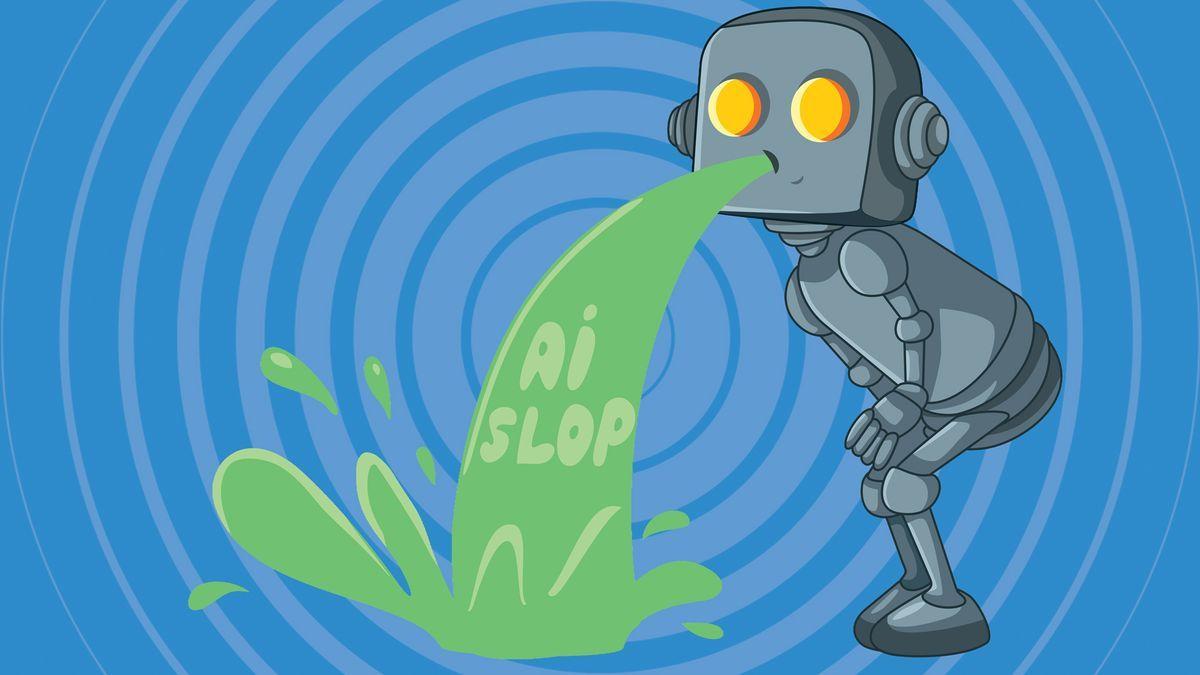
Source: TechRadar
AI Slop Economy Reshapes Digital Landscape
The cultural impact of AI has manifested in what critics call a "slop economy," where gluts of AI-generated content can be milked for advertising money
2
. One study in May claimed that nearly 75 percent of all new web content from the previous month had involved some kind of AI2
. This content deluge is polarizing digital communities, dividing them between those who can afford paywalled, higher-quality content and those who can only access low-quality digital content that often lacks informational value2
.Meta launched Vibes, a separate feed for AI-generated videos in September, while OpenAI released its Sora app shortly after
5
. Even Disney struck a deal to bring Sora-generated videos to its streaming platform while taking a billion-dollar equity stake in OpenAI4
. Meanwhile, platforms like YouTube, Wikipedia, Spotify, and Pinterest took steps to stave off the infestation of AI slop4
. Spotify removed over 75 million AI-generated, "spammy tracks" from its service and rolled out formal policies to protect artists from AI impersonation5
.From Mud to Mockery: The Evolution of Slop
The word slop originally entered English in the 1700s to mean soft mud. By the 1800s, it had evolved to describe food waste fed to pigs, and eventually came to mean rubbish or products of little value
1
. "Like slime, sludge, and muck, slop has the wet sound of something you don't want to touch," Merriam-Webster wrote2
4
.
Source: AP
Independent AI researcher Simon Willison helped document the term's rise in May 2024, comparing it to how spam had previously become the word for unwanted email
1
. "In 2025, amid all the talk about AI threats, slop set a tone that's less fearful, more mocking," Merriam-Webster wrote. "The word sends a little message to AI: when it comes to replacing human creativity, sometimes you don't seem too superintelligent"1
4
.Related Stories
Growing AI Anxiety and Content Moderation Challenges
The selection of slop as Word of the Year comes amid growing AI anxiety about how artificial intelligence is reshaping digital spaces. According to CNBC's All-America Economic Survey published December 15, just 48% of respondents said they had used AI platforms recently, down from 53% in August
5
. This decline suggests increasing wariness around AI tools like ChatGPT, Microsoft Copilot, and Google Gemini.Former Evernote CEO Phil Libin offered nuance to the debate, suggesting the distinction comes down to intention: "When AI is used to produce mediocre things with less effort than it would have taken without AI, it's slop. When it's used to make something better than it could have been made without AI, it's a positive augmentation"
1
. Willison echoed this view: "Not all promotional content is spam, and not all AI-generated content is slop. But if it's mindlessly generated and thrust upon someone who didn't ask for it, slop is the perfect term for it"1
.Other dictionaries also selected tech-related terms this year. Oxford University Press chose "rage bait," referring to content designed to provoke anger for engagement
1
3
. Macquarie Dictionary in Australia spotlighted "AI slop," while Cambridge Dictionary picked "parasocial," focusing on one-sided relationships with online personalities3
. These selections mirror a generation negotiating fatigue and frustration with the digital world3
.References
Summarized by

Navi
[4]
Related Stories
Macquarie Dictionary Names 'AI Slop' as 2025 Word of the Year
25 Nov 2025•Entertainment and Society

The Rise of AI Slop: How Mass-Produced Content Is Degrading Social Media and Marketing
25 Nov 2025•Entertainment and Society

AI Slop: The Rise of Low-Quality AI-Generated Content Flooding the Internet
03 Sept 2025•Technology

Recent Highlights
1
AI chatbots validate you too much, making you less kind to others, Stanford study reveals
Science and Research

2
Anthropic's Claude Code Source Leak Reveals Hidden AI Agent Plans and Extensive System Access
Technology

3
Judge blocks Pentagon from branding Anthropic a security risk over AI safety guardrails dispute
Policy and Regulation

Recent Highlights
Today's Top Stories



Your Daily Dose of Curated AI News
Don’t drown in AI news. We cut through the noise - filtering, ranking and summarizing the most important AI news, breakthroughs and research daily. Spend less time searching for the latest in AI and get straight to action.

