Meta acquires Manus for $2 billion, adding revenue-generating AI agents to its platforms


42 Sources
42 Sources
[1]
Meta just bought Manus, an AI startup everyone has been talking about | TechCrunch
Meta Platforms is acquiring Manus, a Singapore-based AI startup that's become the talk of Silicon Valley since it materialized this spring with a demo video so slick it went instantly viral. The clip showed an AI agent that could do things like screen job candidates, plan vacations, and analyze stock portfolios. Manus claimed at the time that it outperformed OpenAI's Deep Research. By April, just weeks after launch, the early-stage firm Benchmark led a $75 million funding round that assigned Manus a post-money valuation of $500 million. General partner Chetan Puttagunta joined the board. Some other big-name backers had already invested in Manus at that point, including Tencent, ZhenFund, and HSG (formerly known as Sequoia China). Though Bloomberg raised questions when Manus started charging $39 or $199 a month for access to its AI models (the outlet noted the pricing seemed "somewhat aggressive . . . for a membership service still in a testing phase,") the company recently announced it had since signed up millions of users and crossed $100 million in annual recurring revenue. That's when Meta started negotiating with Manus, according to the WSJ, which says Meta is paying $2 billion -- the same valuation Manus was seeking for its next funding round. For Zuckerberg, who has staked Meta's future on AI, Manus represents something new: an AI product that's actually making money (investors have grown increasingly twitchy about Meta's $60 billion infrastructure spending spree). Meta says it'll keep Manus running independently while weaving its agents into Facebook, Instagram, and WhatsApp, where Meta's own chatbot, Meta AI, is already available to users. There is one wrinkle, however, which is that Manus, which launched eight months ago, has Chinese founders who founded parent company Butterfly Effect in Beijing in 2022 before decamping to Singapore in the middle of this year. Whether that raises flags in Washington remains to be seen, but Senator John Cornyn already dragged Benchmark for its investment in the company, asking back in May on X who thought it was "a good idea for American investors to subsidize our biggest adversary in AI, only to have the CCP use that technology to challenge us economically and militarily? Not me." Cornyn, a Texas Republican and senior member of the Senate Intelligence Committee, has long been one of Congress's most vocal hawks on China and technology competition, but he's hardly alone. Being tough on China has become one of the genuinely bipartisan issues in Congress. Unsurprisingly, Meta has already told Nikkei Asia that after the acquisition, Manus won't have any ties to Chinese investors and will no longer operate in China. "There will be no continuing Chinese ownership interests in Manus AI following the transaction, and Manus AI will discontinue its services and operations in China," a Meta spokesperson told the outlet.
[2]
Everything Meta could do with its new $2 billion AI agent
Meta has acquired Singapore-based startup Manus.Manus went viral in March as the first general AI agent.The deal could help Meta to gain a competitive edge. Meta announced on Monday that it's acquiring Manus, the China-founded startup that went viral earlier this year with the release of what was promoted as the first truly useful AI agent. The deal, which The Wall Street Journal reported was valued at over $2 billion, marks Meta's latest effort to push to the forefront of the AI race. "Manus's exceptional talent will join Meta's team to deliver general-purpose agents across our consumer and business products, including in Meta AI," Meta wrote in its announcement. "We're excited to welcome the Manus team and help improve the lives of billions of people and millions of businesses with their technology." Also: What are AI agents? How to access a team of personalized assistants Despite its vast supply of capital and computing resources -- it's currently ranked as the sixth most valuable company in the world -- Meta was something of a late bloomer when it comes to consumer-facing AI. The acquisition of Manus, however, could help it to deploy more practically useful AI systems to its already expansive user base, and close the gap separating it from industry-leading AI labs like OpenAI, Anthropic, and Google DeepMind. Launched in March with financial backing from the Chinese firm Beijing Butterfly Effect Technology, Manus made waves across the tech world for its ability to handle complex tasks with less human oversight and prompting than are required by more traditional chatbots, such as ChatGPT. (Manus moved its headquarters from Beijing to Singapore in June to sidestep the US government's export controls of high-value GPUs to China.) Leading tech developers in the US soon followed suit by releasing their own agents, like OpenAI's Operator, which were broadly marketed as a form of AI that would be genuinely useful to individual users and businesses: able to not only respond to prompts but also browse the web, fill out forms, analyze financial data, generate reports, and handle other tasks. Also: Why AI agents failed to take over in 2025 - it's 'a story as old as time,' says Deloitte The acquisition of Manus could allow Meta to build and launch its own agents across Instagram, Facebook, Messenger, and WhatsApp. A Meta spokesperson did not immediately respond to a question about whether the company plans to give its Meta AI assistant an agentic upgrade following the acquisition. But Meta isn't just integrating Manus's technology into its products: The Singapore-based startup will also continue to operate and sell its own service, according to Monday's announcement, meaning that a separate revenue stream from millions of additional users will flow into Meta's coffers, further fueling its AI ambitions, including its goal of being the first to build "superintelligence." Meta changed its name from Facebook in October 2021 to signal its transition from a primarily social media-oriented brand to one focused on building the so-called "metaverse," a virtual world that, according to CEO Mark Zuckerberg, would be the future of commerce and socialization. However, that dream fizzled as virtual reality headset sales lagged and metaverse platforms, such as Meta's Horizon Worlds, became virtual ghost towns. Following the release of ChatGPT a little over three years ago and the ensuing fervor throughout the tech industry for all things generative AI, Zuckerberg did an about-face, declaring 2023 his company's "Year of Efficiency," and making AI research and development one of its top priorities. Also: As Meta fades in open-source AI, Nvidia senses its chance to lead Meta has invested heavily since then in its Llama family of open-sourced large language models, and also in embedding its Meta AI assistant across its family of apps. It has also been aggressively pushing to attract and acquire top talent. In June, Meta invested a reported sum of $14.3 billion in the data-labeling company Scale AI, and appointed the company's CEO, the 28-year-old Alexandr Wang, as its new chief AI officer. The company announced a partnership with Midjourney a couple of months later, with an eye toward integrating the latter company's generative AI tools across Meta's family of apps.
[3]
Zuck buys Chinese AI company Manus
Meta will acquire made-in-China AI outfit Manus and harness its "general agent" technology across its products. Manus debuted in March 2025 and immediately pitched itself as a leap beyond generative AI chatbots, which it characterizes as best suited to summarizing information and answering questions. The outfit promotes its own services as enabling "wide research and context-aware reasoning to produce actionable results in the format you need." To illustrate that promise, Manus offers a scenario in which users ask its tech to select the best candidate for an job by evaluating job applications stored in a .ZIP file. Manus can open that archive, read the files it contains, evaluate them according to user-defined criteria, then produce a document that ranks candidates by suitability for the role. The service does that in its own "computer" - a cloud-hosted VM - that Manus says "operates as a multi-agent system powered by several distinct models." Manus was created by a Chinese company called Butterfly Effect, which also operates an entity in Hong Kong an recently moved its headquarters to Singapore. The outfit recently claimed to have $100 million annual recurring revenue just eight months after launch. Meta's announcement of the deal states: "Manus is already serving the daily needs of millions of users and businesses worldwide" and reveals the made-in-China company's staff will join the social networking giant. The value of the deal was not disclosed. Manus hailed its acquisition as "validation of our pioneering work with General AI Agents." "Our solution is driving value for millions of users worldwide today. With time, we hope to expand this subscription to the millions of businesses and billions of people on Meta's platforms," Manus's post states, before adding a canned quote from CEO Xiao Hong who said joining the Zuckosphere represents a chance to "build on a stronger, more sustainable foundation without changing how Manus works or how decisions are made." "We're excited about what the future holds with Meta and Manus working together and we will continue to iterate the product and serve users that have defined Manus from the beginning." Meta boss-for-life Mark Zuckerberg wants to build a "superintelligence" service, which he defines as software "that knows us deeply, understands our goals, and can help us achieve them." In pursuit of that goal, Meta has committed to at least $70 billion of capital expenditure in 2025 and expects to spend more next year, much of it going towards building datacenters to host AI workloads. While the company credits AI with helping it to improve advertising revenue, Meta does not currently offer a paid AI service but is reportedly testing a subscription product called "Meta AI+". Manus seems a good fit for that offering, and perhaps also a step towards superintelligence. The deal is the fifth AI-related acquisition Meta has made in 2025, following its purchases of AI startups PlayAI and WaveForms, accelerator developer Rivos, and wearable device developer Limitless. The social networking giant has also dangled eight-figure compensation packages to lure top AI talent to the company. ®
[4]
Meta to acquire Chinese startup Manus to boost advanced AI features
Dec 29 (Reuters) - Meta (META.O), opens new tab said on Monday it would acquire Chinese artificial intelligence startup Manus, as the technology giant accelerates efforts to integrate advanced AI across its platforms. Tech giants such as Meta have been ramping up AI investments through strategic acquisitions and talent hires as they navigate fierce industry competition. Earlier this year, the Facebook-owner invested in Scale AI in a deal valuing the data-labeling startup at $29 billion and bringing in its 28-year-old CEO, Alexandr Wang. Financial terms of its deal with Manus were not released. Singapore-based Manus makes general-purpose AI agent, which can operate as a digital employee, executing tasks such as research and automation independently and with minimal prompts. Meta will operate and sell the Manus service, as well as integrate it into its consumer and business products, including in Meta AI, the company said. Earlier this year, Manus launched its AI agent, claiming that its performance surpasses that of OpenAI's AI agent, DeepResearch. The company, part of Beijing Butterfly Effect Technology Ltd Co, has marketed its product by completing dozens of tasks for users on X for free. Reporting by Harshita Mary Varghese in Bengaluru; Editing by Shilpi Majumdar Our Standards: The Thomson Reuters Trust Principles., opens new tab
[5]

Meta buys startup Manus in latest move to advance its artificial intelligence efforts
DETROIT (AP) -- Meta is buying artificial intelligence startup Manus, as the owner of Facebook and Instagram continues an aggressive push to amp-up AI offerings across its platforms. The California tech giant declined to disclose financial details of the acquisition. But The Wall Street Journal reported that Meta closed the deal at more than $2 billion. Manus, a Singapore-based platform with some Chinese roots, launched its first "general-purpose" AI agent earlier this year. The platform offers paid subscriptions for customers to use this technology for research, coding and other tasks. "Manus is already serving the daily needs of millions of users and businesses worldwide," Meta said in a Monday announcement, adding that it plans to scale this service -- as Manus will "deliver general-purpose agents across our consumer and business products, including in Meta AI." Xiao Hong, CEO of Manus, added that joining Meta will allow the platform to "build on a stronger, more sustainable foundation without changing how Manus works or how decisions are made." Manus confirmed that it would continue to sell and operate subscriptions through its own app and website. The platform has grown rapidly over the past year. Earlier this month, Manus announced that it had crossed the $100 million mark in annual recurring revenue, just eight months after launching. Some of Manus' initial financial backers reportedly included China's Tencent Holdings, ZhenFund and HSG. And the company that first launched the platform -- Butterfly Effect, which also operates under the Monica. Im name -- was founded in China before moving to Singapore. A Meta spokesperson confirmed on Tuesday that there would be "no continuing Chinese ownership interests in Manus AI" following its transaction, and that the platform would also discontinue its services and operations in China. Manus reiterated that it would continue to operate in Singapore, where most of its employees are based. Meta CEO Mark Zuckerberg has been pushing to revive its commercial AI efforts as the company faces tough competition from rivals such as Google and OpenAI, maker of ChatGPT. In June, the company made a $14.3 billion investment in AI data company Scale and recruited its CEO Alexandr Wang to help lead a team developing "superintelligence" at the tech giant.
[6]

Meta buys startup known for its AI task automation agents
Meta has acquired an AI startup called Manus -- known for its custom research and website-building agents -- in a deal valued at more than $2 billion, according toThe Wall Street Journal. It's reportedly one of the largest acquisitions yet involving a startup nurtured in China's AI ecosystem. Manus arrived in March 2025, shortly after another Chinese AI startup, DeepSeek appeared on the scene. The company (called Butterfly Effect at the time) originally described it as "the first general AI agent" to perform complex tasks autonomously, rather than just generating ideas. It draws from several third-party models, particularly Anthropic's Claude 3.5 Sonnet and versions of Alibaba's Qwen. Manus is designed to automate certain tasks, like market research, coding, sales data analysis and website cloning and creation. (However, one skeptic called it "a product devilishly optimized for influencers, which is why it exploded so much.") The company claims that Manu is "already serving the daily needs of millions of users and businesses" and has an annualized average revenue of more than $100 million only eight months after launch. Manus laid off most of its Beijing employees this summer before moving its headquarters to Singapore in an effort to expand globally.The company was reportedly seeking a funding round that would have valued it at $2 billion when it was approached by Meta. "Joining Meta allows us to build on a stronger, more sustainable foundation without changing how Manus works or how decisions are made," said Manus CEO Xiao Hong in a company news release.
[7]

Meta acquires intelligent agent firm Manus, capping year of aggressive AI moves
The logo of Meta is seen at the Viva Technology conference dedicated to innovation and startups at Porte de Versailles exhibition center in Paris, France, on June 11, 2025. Meta Platforms said Tuesday that it has acquired Manus, a Singapore-based developer of general-purpose AI agents, as the tech giant continues its massive investments into artificial intelligence. Manus, founded in China before relocating to Singapore, launched its first general AI agent earlier this year, which can execute complex tasks such as market research, coding, and data analysis. The company claimed it had achieved an annualized average revenue of more than $100 million just eight months after launch, while its revenue run rate exceeded $125 million. Meta said in a statement that its acquisition was aimed at accelerating AI innovation for businesses and integrating advanced automation into its consumer and enterprise products, including its Meta AI assistant. "Manus is already serving the daily needs of millions of users and businesses worldwide ... We plan to scale this service to many more businesses," Meta said. According to the firms, Manus will continue operating its subscription service without disruption. Further terms of the acquisition were not disclosed. Manus began as a product of Chinese start-up Butterfly Effect, also known as Monica.Im, before growing into a separate entity. It emerged as a notable AI player earlier this year after claiming its chatbot offered superior performance to OpenAI's DeepResearch. The company raised $75 million in a Series B funding round led by U.S. venture firm Benchmark in April, and is backed by Tencent and private equity firm HongShan Capital Group (HSG), formerly known as Sequoia, according to data from market research firm Tracxn. The start-up reportedly laid off most of its staff in Beijing in July before moving its headquarters to Singapore in June as it looked towards global expansion. "Joining Meta allows us to build on a stronger, more sustainable foundation without changing how Manus works or how decisions are made," Xiao Hong, CEO of Manus, said in a company release. The firm also announced a strategic partnership with Alibaba's Qwen AI team in March, highlighting its existing ties to Chinese tech companies.
[8]

Meta makes $2 billion bet on agentic AI with Manus acquisition
Serving tech enthusiasts for over 25 years. TechSpot means tech analysis and advice you can trust. What just happened? Meta Platforms has agreed to buy Singapore-based artificial intelligence startup Manus in a deal valued at more than $2 billion, according to people familiar with the matter. The acquisition marks one of the largest purchases by a US tech giant of an AI product from Asia. Manus gained international attention earlier this year when it unveiled an AI agent capable of generating detailed research reports and building customized websites. The system drew on models from both US and Chinese developers, including Anthropic and Alibaba, and was designed to handle multifaceted requests from paying users. The company's rapid ascent and hybrid technology base made it an attractive target for Meta as it sought to strengthen its AI tool portfolio. The deal would bring Manus's co-founder and CEO, Xiao Hong - known as Red - into Meta's executive structure, where she will report to Chief Operating Officer Javier Olivan, people familiar with the arrangement told The Wall Street Journal. In announcing the deal, Meta said it plans to "scale this service to many more businesses" while keeping the Manus platform operational and integrating it with Meta's broader social media ecosystem. For Meta, the acquisition signals a more aggressive play in the expanding market for AI agents. Microsoft's Copilot and similar assistants from OpenAI and Google have established early leads in the space, putting pressure on Meta to close the gap. Manus launched in March 2025 and drew millions of users within months, offering subscription plans for access to its research, coding, and analysis tools. In December, the company disclosed that its annual recurring revenue had surpassed $100 million - an extraordinary milestone just eight months after launch. Around the same time, Meta began talks about an acquisition, according to people familiar with the timeline. Earlier funding rounds had already set the company apart in Asia's competitive AI market. Manus raised $75 million in April in a round led by Benchmark, whose general partner, Chetan Puttagunta, later joined the company's board. That investment valued the startup at about $500 million and brought in additional backers, including HSG, ZhenFund, and Tencent. The parent company, Butterfly Effect, was founded in 2022, with offices in Beijing and Wuhan, and relocated its headquarters to Singapore after the Benchmark investment. Most of Manus's research and engineering talent remained in China, though the firm positioned itself globally to access American-developed AI models unavailable in the Chinese market. "Joining Meta allows us to build on a stronger, more sustainable foundation without changing how Manus works or how decisions are made," Xiao said in a statement announcing the deal. Meta's acquisition comes as the company channels billions into AI research and infrastructure to rival Microsoft, Google, and OpenAI. Chief Executive Mark Zuckerberg has spent much of the year recruiting top AI scientists and executives with multimillion-dollar contracts following delays in rolling out Meta's next-generation AI model. The company has also diversified its AI investments, taking a 49% stake in Scale AI at a $29 billion valuation, a move that brought Scale founder Alexandr Wang into Meta as its chief AI officer. Meta's AI systems already underpin much of its consumer-facing platforms, from Instagram recommendations to WhatsApp chat assistants. The company has also integrated machine learning deeply into its advertising business, bolstering profits even as it rolls out largely free, open-source AI models. Image credit: South China Morning Post
[9]

Meta buys Chinese-founded AI agent start-up Manus
Barton Crockett, analyst at Rosenblatt Securities, told Reuters it was a "natural fit" for Meta, which extended into boss Mark Zuckerberg's "vision of personal AI" using agents. Based in Singapore after relocating from China, Manus has sought to set itself apart from rival AI developers with what it claims can be a "truly autonomous" agent. Unlike many chatbots which need to be repeatedly asked for things before a user can get their desired response, Manus says its service can plan, execute and complete tasks independently in accordance with instructions. It forms part of the company's mission to "extend human reach" with general-purpose agents that can aid, rather than replace, human work. The company said its acquisition by Meta was "validation" of its efforts. "Joining Meta allows us to build on a stronger, more sustainable foundation without changing how Manus works or how decisions are made," said Xiao Hong, its chief executive and one of its Chinese founders, in a blog post. "We're excited about what the future holds with Meta and Manus working together and we will continue to iterate the product and serve users that have defined Manus from the beginning." Meta said as part of its deal it would continue to operate and sell Manus' AI service. It marks yet another high-profile move by the Silicon Valley tech giant to cement its presence in the sector through deals with rising start-ups. In June the company spent $14bn to buy 49% of Scale AI and secured its boss to take a lead role in Meta's development of the tech. This came amid a wider increase in spending by Zuckerberg on the company's AI strategy, as well as reportedly luring talent from rivals like OpenAI.
[10]

Meta Buys AI Agent Startup for $2 Billion, Says It Will Cut All Ties With China
Meta did it again. The social media giant just bought another AI startup. This time, it’s the Singapore-based AI agent company Manus. Meta is buying the AI company in a deal worth more than $2 billion, according to the Wall Street Journal. It’s the latest move in Meta’s increasingly aggressive push into AI. The company already has plans to invest billions into AI infrastructure. Additionally, Meta has snapped up or invested in AI startups like Scale AI and Limitless, a sign that its in-house efforts may not be moving fast enough. However, there’s one hitch with today’s deal. Manus’s roots in China could raise eyebrows in Washington, as the U.S. and China remain locked in an AI arms race. Manus made a splash when it debuted this spring as a general AI agent that could handle a wide range of tasks, including deep research, vacation planning, coding, and stock analysis. Earlier this month, Manus announced that it had reached $100 million in annual recurring revenue just eight months after launching. “Joining Meta allows us to build on a stronger, more sustainable foundation without changing how Manus works or how decisions are made,†Manus CEO Xiao Hong said in a statement. Meta said in its own announcement that it plans to continue operating Manus as its own service, while also integrating it into its own products. The startup was founded by its parent company, Butterfly Effect, which previously held offices in Beijing and Wuhan. Shortly after launching Manus, the company moved its headquarters to Singapore. Manus's Chinese ties have already drawn scrutiny. Earlier this year, Silicon Valley venture capital firm Benchmark faced backlash from U.S. lawmakers after investing in Manus. “Who thinks it is a good idea for American investors to subsidize our biggest adversary in AI, only to have the CCP use that technology to challenge us economically and militarily? Not me,†Sen. John Cornyn wrote in a post on X at the time. In what appears to be an effort to get ahead of similar accusations, Meta said that after the deal closes, Manus will be required to sever all remaining ties with China. “There will be no continuing Chinese ownership interests in Manus AI following the transaction, and Manus AI will discontinue its services and operations in China,†a Meta spokesperson told Nikkei Asia. Meta did not immediately respond to Gizmodo's request for comment. According to Nikkei, Manus has laid off most of its Chinese employees and now has 105 staffers based in Singapore, Tokyo, and San Francisco.
[11]

Meta is reportedly buying Manus -- here's what it could mean for how you use AI every day
2026 could be the year Meta AI proves it can keep up with OpenAI and Google IIt's already looking like 2026 could be the year Meta AI finally levels up. According to The Wall Street Journal, Meta is in the process of acquiring Manus, an AI startup best known for building autonomous, "agentic" systems. Manus is an AI in a league of its own because it can take action and delivers finished work with minimal back-and-forth chatting. On the surface, this acquisition looks like another big-ticket AI deal in an already crowded space. But for everyday users, it could quietly change how Meta AI works across Facebook, Instagram, WhatsApp and whatever comes next. There's a very good chance you may have not heard of Manus. It's not one of the more common chatbots like ChatGPT, Gemini or Claude. It surfaced about a year ago as competition to Deepseek and has been quietly building traction. But while most people are used to AI as a conversational tool, Manus stands out as an autonomous worker. Instead of responding step by step, agentic systems are designed to: Think less "help me write an outline" and more "research this topic, draft a summary, pull sources and format it for me." If Meta integrates that kind of capability into Meta AI, it moves the assistant from being reactive to proactive, which is a meaningfut shift towards the future of AI. If you use Meta AI today, you've probably noticed it's helpful but limited. It answers questions, generates images and assists with basic tasks, but it still feels like a chatbot. Agentic AI could change that in a few key ways: For consumers, this is the difference between talking to AI and delegating to it. Meta has been vocal about its AI ambitions, but it's also playing catch-up in some areas. With Google's Gemini 3.0 currently at the top of the leaderboards, the purchase of Manus could instantly accelerate Meta's push forward. Agentic AI is a space where companies like OpenAI and Google are already investing heavily. Instead of building everything in-house, Meta would be buying a team and a system already designed around autonomous execution. It's also a signal that Meta isn't just focused on flashy AI features -- it's aiming for utility. And utility is what actually keeps people using AI tools long-term. For users, the real story won't be the acquisition itself -- it'll be what ships. WIthin the upcoming months, I'll be watching how Meta integrates agentic features directly into Meta AI, or keeps them separate. I'll also be curious to see if this shows up first in productivity-style tools, or consumer apps like WhatsApp and Instagram. And perhaps most importantly, how much autonomy will users actually trust AI with? This deal reinforces a clear trend: AI is moving beyond conversation and toward action. For everyday users, that could mean fewer prompts, less micromanagement and AI that finally feels like a true assistant. Whether Meta can deliver on that promise is the question -- and one we'll be watching closely.
[12]

Meta buys Manus for $2 billion to power high-stakes AI agent race
The acquisition accelerates Meta's pivot from chatbot tools to task-completing AI across its platforms Meta has acquired AI startup Manus, known for its semi-autonomous AI agents, in a deal reportedly valued at more than $2 billion, according to The Wall Street Journal. It's one of the largest AI acquisitions to date. More importantly, it underscores Meta's plan to shift from creating foundational models like Llama to providing full-service AI agents capable of completing complex tasks for individuals and businesses. Meta said it plans to make the AI agent platform part of its Meta AI assistant and enterprise offerings. Manus agents can perform complex analytics and long-term research and planning, along with the more usual conversations and image generation. It can also go out to the web and carry out tasks for users, which is why it's named Manus, Latin for hand. "We will continue to operate and sell the Manus service, as well as integrate it into our products," Meta said in a statement. "Manus is already serving the daily needs of millions of users and businesses worldwide. It launched its first General AI Agent earlier this year and has already served more than 147T tokens and created more than 80M virtual computers. We plan to scale this service to many more businesses." The reported valuation aligns with where Manus had been headed before Meta intervened. The company had been raising new funds at a $2 billion valuation when Meta approached with an offer. With over $125 million in revenue run rate just eight months after launch, Manus had proven not only its technical capabilities but also its commercial appeal. But this isn't just a story of a high-value tech buyout. It marks a directional turn for Meta, one that deepens its commitment to building AI that does more than chat. In fact, Manus was not simply another chatbot; it was one of the first widely available agentic systems able to autonomously perform multi-step, goal-oriented tasks using a blend of reasoning, memory, and tool use. Users could, for instance, hand Manus a research objective or a programming task and watch it coordinate a solution end-to-end. That's a radically different product category than LLMs trained solely to predict the next word. Meta wants to build AI that acts. That's also the reason Meta invested $14.3 billion in Scale AI earlier this year. But a working autonomous AI platform is several steps beyond. The company's pricing model, a mix of free and premium subscriptions, helped it grow rapidly, especially among developers, analysts, and SMEs looking to automate workflows without hiring engineers. And while Meta has been pouring money into building out its own LLMs, developing effective agentic behavior remains a highly specific engineering and design challenge. Tools like planning, memory, tool-use, and recursive reasoning can't simply be bolted onto a large model, and Manus has already solved many of these problems. "Joining Meta allows us to build on a stronger, more sustainable foundation without changing how Manus works or how decisions are made," Manus CEO Xiao Hong said in a statement. "We're excited about what the future holds with Meta and Manus working together, and we will continue to iterate the product and serve users that have defined Manus from the beginning." Meta is racing to build up AI agents among fierce competition. Google's Gemini is actively developing agentic features, while OpenAI's ChatGPT has introduced tools to perform tasks online and provide more assistance that adapts to context. But Manus promises to make it easy to integrate its services into other platforms. That earned it interest from companies like Microsoft, which tested Manus integration in Windows 11. With Meta owning the whole thing, what happens next is just as much a question of strategy as it is technology. Manus's origins add a layer of complexity. Initially developed under the Chinese AI startup Butterfly Effect before spinning off, concerns over data security likely contributed to its relocation from Beijing to Singapore this year and the layoffs of most of its Chinese workforce. Meta's acquisition even comes with an explicit condition that "there will be no continuing Chinese ownership interests," according to the companies. Meta has had to walk a fine line in the global AI race as it skirts regulatory scrutiny. Manus lets it jump ahead in product development, but will probably come with at least some probing questions about who owns the data used to run Manus. In 2026, no major American tech company can afford to look like it has Chinese influence, just ask TikTok. Then there's the hardware angle. Meta's Reality Labs division doesn't bring in much cash, but Meta still sees a future of smart glasses and agentic AI assistants that interact with the physical world. Manus could provide the cognitive layer for those ambitions. The acquisition makes it clear that Meta sees 2026 as the time when AI chatbots will become AI agents. With Manus powering its AI platforms, Meta plans to be the tool of first resort when it comes to AI engaging with the real world.
[13]

Meta's deal with Manus AI could be worth $2.5 billion
Why it matters: AI has reset startup exit valuations, driven by unprecedented revenue growth. Catch up quick: Manus AI was valued at only $500 million when it raised $75 million in Series B funding this past May, led by Benchmark. * The deal was controversial given Manus AI's roots in China, although the company was headquartered in Singapore and its 100 or so China employees relocated shortly thereafter. What it does: Manus AI has developed a general AI agent that it claims can complete various real-world tasks, going well beyond chatbot or workflow functions. * Tasks include market research, coding, data analysis and resume screening. * The company claims it reached over $100 million in annual recurring revenue within months of launch. The intrigue: Manus is sold on a subscription basis to companies, marking Meta's first significant foray into AI for the enterprise. * The deal has the potential to put Meta on more equal footing in the agentic AI race with competitors Salesforce, Google, Microsoft and OpenAI. What we're watching: Meta has faced repeated scandals, fines, and criticism for data practices.
[14]

Meta acquires Manus: what it means for your enterprise AI agent strategy
Facebook and Instagram parent company Meta's agreement to acquire Manus for more than $2 billion -- announced last night by both companies and reported in The Wall Street Journal -- marks one of the clearest signals yet that large tech platforms are no longer just competing on model quality, but on who controls the execution layer of AI-powered work. Manus, a Singapore-based startup founded by Chinese entrepreneurs that debuted earlier this year, has built a general-purpose AI agent designed to autonomously carry out multi-step tasks such as research, analysis, coding, planning, and content generation. The company will continue operating from Singapore and selling its subscription product while its team and technology are integrated into Meta's broader AI organization. Manus co-founder and CEO Xiao Hong, who goes by "Red," is expected to report to Meta COO Javier Olivan. The deal arrives as Meta accelerates its AI investments to compete with Google, Microsoft, and OpenAI -- and as the industry's focus shifts from conversational demos to systems that can reliably produce artifacts, complete workflows, and operate with minimal supervision. Manus as an execution layer, not a chat interface Manus has consistently positioned itself less as an assistant and more as an execution engine. Rather than answering isolated prompts, its agent is designed to plan tasks, invoke tools, iterate on intermediate outputs, and deliver finished work. It gained 2 million users on its waitlist alone after unveiling itself in spring 2025. At that time, Manus outperformed OpenAI's Deep Research agent (powered then by the o3 model) and other state-of-the-art systems on the GAIA benchmark, which evaluates how well AI agents complete real-world, multi-step tasks, by more than 10% in some cases. And in the acquisition announcement last night, Manus said its system has processed more than 147 trillion tokens and created over 80 million virtual computers, metrics that suggest sustained, production-level usage rather than limited experimentation. Meta, meanwhile, said Manus can independently execute complex tasks such as market research, coding, and data analysis, and confirmed it will continue operating and selling the Manus service while integrating it into Meta AI and other products. For enterprises, this distinction matters. Many early "agent" systems fail not because the underlying models can't reason, but because execution breaks down: tools fail silently, intermediate steps drift, or long-running tasks can't be resumed or audited. Manus's core value proposition is that it manages those failure modes. What Manus users were actually doing with the agent Evidence of that execution-first positioning shows up clearly in Manus's own community. In the official Manus Discord server, a "Use Case Channel" post shared by a community member named Yesly on March 6, 2025 catalogued real examples of how users were already deploying the agent. Those use cases went far beyond casual prompting. They included: * Generating long-form research reports, such as a detailed analysis of climate change impacts on Earth and human society over the next century * Producing data-driven visual artifacts, including an NBA scoring efficiency four-quadrant chart based on player statistics * Conducting product and market research, such as comparing every MacBook model across Apple's history * Planning and synthesizing complex, multi-country travel itineraries, complete with budget estimates, accommodations, and a generated travel handbook * Tackling technical and academic tasks, including summarizing high-temperature superconductivity research, proposing PhD research directions, and outlining simulation-based approaches to room-temperature superconductors * Drafting structured proposals, such as designs for a solar-powered, self-sufficient home with defined geographic coordinates and engineering constraints Each example was shared as a replayable Manus session, reinforcing that the system wasn't just generating text, but orchestrating multi-step work to produce finished outputs. This pattern matters because it shows Manus operating in the messy middle ground where enterprise AI often stalls: tasks that are too complex for a single prompt, but too open-ended for rigid automation. Manus's recent updates The pace at which Manus shipped updates was also impressive, which likely added to its momentum with users and as a ripe acquisition target for Meta. In October, the company released Manus 1.5, an update aimed squarely at where early agent systems tended to break down: long, brittle tasks that lost context or stalled halfway through. Manus re-architected its core agent engine and saw immediate gains. The company said average task completion times dropped from roughly 15 minutes earlier in the year to under four minutes, nearly a fourfold speedup. The system dynamically allocated more reasoning time and compute to harder problems instead of treating every task the same. Manus also expanded the agent's context windows, enabling it to track longer conversations and more intricate workflows without dropping key details. Together, those changes reduced outright task failures and improved output quality for research-heavy, analytical, and multi-step jobs that previously required frequent human intervention. In December, Manus built on that foundation with version 1.6, extending those execution gains into more autonomous, creative, and platform-spanning work. The release introduced a higher-performance agent tuned to complete more tasks successfully in a single pass, along with new support for mobile application development, not just web-based projects. Users could describe a mobile app and have the agent handle the end-to-end build process, expanding Manus's reach beyond the browser. At the same time, the agent carried creative objectives across an entire production arc -- from research and ideation to drafting, visual creation, revision, and final delivery -- within one continuous session. That included generating and editing images through a visual interface, assembling presentations and reports, and building full-stack web applications the agent could launch, test, and fix on its own. Taken together, the updates reinforced Manus's positioning not as a prompt-driven assistant, but as an execution system designed to stay with a job, adapt when things broke, and reliably deliver finished work across analytical, creative, web, and mobile workflows. Application-layer traction over proprietary models Notably, Manus does not train its own frontier model. Reporting on the deal says it relies on third-party AI models from providers including Anthropic and Alibaba, focusing its differentiation on orchestration, reliability, and execution. That hasn't prevented commercial traction. Yuchen Jin, co-founder and chief technology officer (CTO) of AI cloud GPU-as-a-service provider Hyperbolic Labs, highlighted this dynamic in a public post discussing the acquisition. Jin noted that Manus by its own admission reached roughly $100 million in annual recurring revenue just eight months after launch, despite having no proprietary large language model (LLM) of its own, relying on the aforementioned providers. "People keep assuming a small update from OpenAI or Google will wipe out a lot of AI startups," Jin wrote. "But in reality, the AI application layer should be where most of the opportunity is." A similar interpretation came from Dev Shah, lead developer relations at Resemble AI, who argued that Meta didn't acquire a model company so much as an "environment company" and that "intelligence cannot exist in isolation." His point? Agentic capability emerges from how models are coupled with tools, memory, and execution environments -- a new concept he described as "Situated Agency." From that perspective, Manus's achievement was not training a proprietary foundation model, but engineering an execution layer that allows models like Claude to browse the web, write and run code, manipulate files, and complete multi-step workflows autonomously. Shah suggested this may align more closely with Meta's long-term strategy: rather than winning the race for state-of-the-art models, Meta could focus on owning the agentic infrastructure -- the orchestration, context engineering, and interfaces -- and swap in whichever model performs best over time. If that thesis holds, the Manus acquisition signals a shift toward treating foundation models as interchangeable inputs, while the execution environment becomes the primary source of durable value. These perspectives help explain Meta's move. Rather than buying another model team, it is acquiring a system that has already proven it can package existing models into a product users will pay for -- and keep using. What this means for your enterprise AI strategy For enterprise technical decision-makers, the Manus acquisition is less a vendor endorsement and more a strategic signal. First, it reinforces that orchestration layers -- systems that manage planning, tools, retries, memory, and monitoring -- are becoming as important as the models themselves. Enterprises building internal AI capabilities may want to invest more heavily in agent infrastructure that sits above models and can survive rapid shifts in the underlying model ecosystem. In that sense, building an internal agent layer is not speculative or redundant. It is exactly the class of software that large platforms now view as strategically valuable -- whether as acquisition targets or as internal accelerators. A video recorded ahead of this announcement by VentureBeat founder and CEO Matt Marshall and Red Dragon co-founder Witteveen delves deeper into this subject. Watch it free below or on YouTube. Second, the deal does not automatically mean enterprises should rush to standardize on Manus itself. Meta's history with enterprise products gives reason for caution. Tools like Workplace by Facebook gained early adoption but ultimately failed to become deeply embedded enterprise platforms, in part due to shifting internal priorities and inconsistent long-term investment. That history suggests a measured approach. Enterprises evaluating Manus today may want to treat it as a pilot or adjunct tool, not a foundational dependency, until Meta's integration strategy becomes clearer. Key questions include whether Manus remains product-led rather than ad- or data-driven, how governance and compliance evolve under Meta, and whether the roadmap continues to prioritize execution reliability over surface-level integration. Finally, the acquisition sharpens a broader choice facing enterprises: whether to wait for vendors to define the agent layer, or to build and control it themselves. Manus's trajectory suggests that the real leverage in AI increasingly lives not in who owns the smartest model, but in who owns the systems that turn reasoning into completed work. In that light, Meta's acquisition is less about Manus alone -- and more about where the next durable layer of the AI stack is taking shape. Why this deal matters beyond Meta From the perspective of some of us here at VentureBeat, the Manus acquisition is best read as confirmation of where value is consolidating in the AI stack (and Meta's enterprise AI agent ambitions, though the latter is far less assured.) The defining signal is not that Manus built novel models, but that it demonstrated how quickly well-designed agents can be turned into revenue-generating products by focusing on execution, speed, and concrete outcomes. That shift -- from debating what frontier models can do to measuring what agents actually deliver -- increasingly frames how AI progress is evaluated. The deal also sharpens an important distinction for enterprise readers: this is not primarily about adopting a Meta-backed product, but about recognizing that agent orchestration has become strategically material. Manus succeeded by targeting tractable, real-world tasks and shipping agents that worked end to end, even if those use cases skewed more consumer-oriented. The broader implication is that enterprises can apply the same approach in their own domains, building agent systems where they already possess data, expertise, and operational leverage. At the same time, we're cautious about reading this as a direct enterprise buying signal. Meta's history suggests that long-term enterprise trust is difficult to earn without sustained focus and specialized go-to-market muscle. Where the acquisition may make more immediate sense is on the consumer and small-business side of Meta's own ecosystem, particularly within products already designed to manage commerce, content, and customer interaction at scale. Manus's agentic capabilities map cleanly onto surfaces like Meta Business Suite, where small businesses already juggle content calendars, inboxes, ads, analytics, and monetization tools across Facebook and Instagram. An execution-oriented agent could plausibly automate or coordinate many of those tasks end to end, from drafting and scheduling posts to responding to messages, optimizing ads, or assembling performance reports. Manus's "Design View" feature, which launched publicly just a week prior to the Meta acquisition announcement and allows users to generate new imagery with editable discrete components using natural language, would seem to be tailor-made for a social network ad creation experience: Beyond creators and small businesses, those agents could plausibly extend to everyday users navigating Instagram or Facebook for shopping, discovery, or personal expression. An execution-oriented agent could assist regular users with tasks such as browsing and comparing products, managing purchases, assembling wish lists, or coordinating returns, while also helping them create and edit posts, reels, or stories for friends and family -- not as professional content, but as casual, social, and entertainment-driven output. That framing aligns closely with Meta's historical strengths. The company has been most successful when AI capabilities are tightly integrated into high-frequency consumer workflows rather than positioned as standalone enterprise software. A Manus-powered agent that helps users do things -- shop, create, plan, or manage interactions inside Meta's apps -- would fit naturally into Instagram and Facebook's evolution toward more agentic experiences. In that scenario, Manus functions less as an enterprise brand and more as an invisible execution layer, powering AI assistants that operate natively within Meta's consumer ecosystem, where scale, engagement, and commerce already converge. As a result, the acquisition's clearest relevance is not whether enterprises should standardize on Manus, but that investments in internal agent frameworks, orchestration layers, and governance now appear increasingly well-justified -- because that is precisely the layer large platforms are now willing to pay for.
[15]

Meta claims 'no continuing Chinese ownership interests in Manus AI' after reported $2 billion deal to shore up in AI agent race | Fortune
Meta is buying artificial intelligence startup Manus, as the owner of Facebook and Instagram continues an aggressive push to amp up AI offerings across its platforms. The California tech giant declined to disclose financial details of the acquisition. But The Wall Street Journal reported that Meta closed the deal at more than $2 billion. Manus, a Singapore-based platform with some Chinese roots, launched its first "general-purpose" AI agent earlier this year. The platform offers paid subscriptions for customers to use this technology for research, coding and other tasks. "Manus is already serving the daily needs of millions of users and businesses worldwide," Meta said in a Monday announcement, adding that it plans to scale this service -- as Manus will "deliver general-purpose agents across our consumer and business products, including in Meta AI." Xiao Hong, CEO of Manus, added that joining Meta will allow the platform to "build on a stronger, more sustainable foundation without changing how Manus works or how decisions are made." Manus confirmed that it would continue to sell and operate subscriptions through its own app and website. The platform has grown rapidly over the past year. Earlier this month, Manus announced that it had crossed the $100 million mark in annual recurring revenue, just eight months after launching. Some of Manus' initial financial backers reportedly included China's Tencent Holdings, ZhenFund and HSG. And the company that first launched the platform -- Butterfly Effect, which also operates under the name monica.im, which was founded in China before moving to Singapore. A Meta spokesperson confirmed on Tuesday that there would be "no continuing Chinese ownership interests in Manus AI" following its transaction, and that the platform would also discontinue its services and operations in China. Manus reiterated that it would continue to operate in Singapore, where most of its employees are based. Meta CEO Mark Zuckerberg has been pushing to revive its commercial AI efforts as the company faces tough competition from rivals such as Google and OpenAI, maker of ChatGPT. In June, the company made a $14.3 billion investment in AI data company Scale and recruited its CEO Alexandr Wang to help lead a team developing "superintelligence" at the tech giant.
[16]

Meta wants AI agents in your day-to-day, starting with Manus
The plan is to scale Manus inside consumer and business tools, including Meta AI. Meta has acquired Manus, a Singapore-based startup behind a general-purpose autonomous agent it plans to fold into its products. Meta Manus AI agents are being framed as the next step beyond chat, software that can carry work through to completion. Meta and Manus say the agent can independently handle tasks like market research, coding, and data analysis. The expectation is, you keep working where you already are, and the agent takes on more of the busywork that normally eats a day. Recommended Videos If you already use Manus, the companies are stressing continuity. The subscription service will keep running through the current app and website, and Manus will continue operating from Singapore. Manus is built to execute Manus is described as an execution layer that can take a goal, move through the steps, and deliver an output without constant back-and-forth. To back that up, Manus points to scale metrics. It says the agent has processed more than 147 trillion tokens and powered the creation of over 80 million virtual computers in a few months. Meta says it will keep operating the Manus service while it works on integrations across its consumer and business products, including Meta AI. Why Meta wants agents everywhere Meta is positioning the acquisition as an accelerator for business AI, and a way to bake automation into products people already use. That matters because it suggests agents will not stay locked inside a standalone tool, Meta says it wants them inside its broader ecosystem. The deal terms are still thin in public. CNBC reports the Wall Street Journal pegged the acquisition at more than $2 billion, and CNBC also reports Manus claimed an annualized average revenue above $100 million eight months after launch, with a run rate over $125 million. Those figures help explain why Meta would buy, not just partner. What businesses should watch next The near term looks like a two-track plan, keep the existing subscription steady while Meta starts weaving the agent into more surfaces. The practical questions for businesses are where it appears first and what data and tools it can access. If you run a team, start by listing the workflows you would actually trust an agent to execute end to end, like recurring research, first-pass analysis, or internal coding tasks. Then watch for updates around admin controls, pricing tiers, and data handling language as Meta scales Manus to more businesses.
[17]

Meta to acquire AI startup Manus in deal valued at over $2 billion
The acquisition comes as Mark Zuckerberg intensifies Meta's push to compete with rivals such as Google and OpenAI. Meta has agreed to buy artificial intelligence startup Manus, doubling down on its aggressive bid to supercharge AI across Facebook, Instagram and its wider product portfolio. The California tech giant declined to reveal the exact financial terms of the deal, but The Wall Street Journal reported that the acquisition is valued at more than $2 billion (€1.7 billion). Manus, a Singapore-based platform with some Chinese roots, launched its first "general-purpose" AI agent earlier this year, positioning itself as a versatile tool for everything from research to coding. The platform operates on a paid subscription model, offering users access to its AI-powered services. "Manus is already serving the daily needs of millions of users and businesses worldwide," Meta said in a Monday announcement, adding that it plans to scale the service - with Manus set to "deliver general-purpose agents across our consumer and business products, including in Meta AI." Xiao Hong, the CEO of Manus, said the move would allow the company to "build on a stronger, more sustainable foundation without changing how Manus works or how decisions are made." Manus confirmed it would continue selling and operating subscriptions through its own app and website. The startup's rise has been rapid. Earlier this month, Manus revealed it had surpassed $100 million in annual recurring revenue - just eight months after launch. Some of Manus' early backers reportedly included China's Tencent Holdings, ZhenFund and HSG. The platform was initially developed by Butterfly Effect - also known as monica.im - a company founded in China before relocating to Singapore. A Meta spokesperson confirmed on Tuesday that there would be "no continuing Chinese ownership interests in Manus AI" following the transaction, and that the company would wind down its services and operations in China. The deal is the latest in a series of high-profile moves by the Silicon Valley group to strengthen its foothold in the AI sector by snapping up fast-growing start-ups. In June, Meta spent $14 billion (€11.9 billion) to acquire a 49% stake in Scale AI.
[18]

Manus-Meta Deal May Come Under Scrutiny From Beijing: Report | AIM
Manus, now headquartered in Singapore, was founded in China. It raised $75 million in 2025 before moving its base. Meta's recent acquisition of Singapore-based AI startup Manus could attract scrutiny from Chinese regulators over potential violations of technology export controls, according to the South China Morning Post. The report cited Cui Fan, the deputy general secretary and director of research at the China Society for WTO Studies. Fan said regulators would focus on whether any technology restricted or prohibited under Chinese law was transferred overseas without approval. He pointed to China's Regulations on Technology Import and Export Administration, under which authorities may assess when, how, and what technologies were moved abroad by Manus' onshore entities, including both individuals and companies. The concern arises because Manus, now headquartered in Singapore, was founded in China in 2022. The company was established by a China-based team and raised $75 million in a Series B round in April 2025, led by US venture firm Benchmark, valuing it at about $500 million. The funding drew scrutiny from US regulators due to executive orders limiting American investment in Chinese AI companies, prompting a Treasury Department review. After the round, Manus shifted its headquarters to Singapore and scaled back its China operations. This included layoffs in mainland China, shutting down local operations, cancelling plans for a China-specific product, and ending technical collaboration discussions with Alibaba. However, despite attempts to distance itself from China, regulatory exposure may persist. Fan also noted that there has been no confirmation that Manus' core team members have renounced Chinese nationality or that they are no longer subject to Chinese jurisdiction. He added that Manus' mainland-registered parent company, Butterfly Effect, remains with the founding team, and that the firm's early research and development was conducted in China. Other experts quoted in the report said AI agents are likely to be classified as "important information technology products and services" under Chinese regulations, which could bring the Meta-Manus deal within the scope of China's national security review of foreign investment. The situation echoes the regulatory dynamics seen in the long-running TikTok saga. In that case, Beijing asserted jurisdiction over core technologies developed in China, particularly recommendation algorithms, even as parent company ByteDance sought to ring-fence or divest overseas operations.
[19]

Meta just bought one of the fastest-growing AI startups you've probably never heard of
In a year defined by companies pouring shocking sums of money into AI, one more deal squeaked in just before 2026. Meta just made a play on Manus, the buzzy Singapore-based company with Chinese roots that turned heads earlier this year when it showed its AI agents executing complex tasks, like hunting for real estate and sorting through resumes. The deal is sure to turn heads too. Manus and its parent company Butterfly Effect are now based in Singapore but were founded in China - a country with a fraught relationship to the U.S tech industry - and maintain operations there. Facebook's parent company will reportedly pay more than $2 billion to acquire the startup, which it hopes will bolster its own lagging AI capabilities. In a crowded field of soaring chipmakers, nimble startups laser focused on AI, and ancient tech giants like Microsoft making themselves freshly relevant with big AI bets, Meta is far from leading the pack - a fact the company seems well aware of.
[20]

Meta Platforms buys Manus to bolster its agentic AI skillset - SiliconANGLE
Meta Platforms buys Manus to bolster its agentic AI skillset Meta Platforms Inc. is pushing into autonomous artificial intelligence agents with the acquisition of Singapore-based Manus, which made headlines when it first emerged earlier this year for its ability to perform tasks using a web browser without human supervision. Manus shot to fame in March, just weeks after China's DeepSeek Ltd. shocked the world with its low-cost alternative to OpenAI Group PBC's ChatGPT. It was one of the first AI agents to be made widely available to everyday users through a subscription service, and it made a huge splash on social media for its ability to perform complicated tasks such as creating resumes, writing software applications and designing and building websites. It also demonstrated impressive research capabilities. In one video posted on X, a user asked Manus to find them a suitable two-bedroom apartment in their desired location and it immediately set about generating a comprehensive list of available real estate, complete with evaluations of local crime rates and commute times to different parts of the city. Manus was one of the first in a wave of AI agents that have taken the enterprise world by storm this year, and nowadays they're pretty common as everyone has jumped onto the bandwagon in an effort to fulfill the promise of AI work automation. For instance, coding agents like CodeGPT, GitHub Copilot, Replit and Jules have transformed software development, while companies such as Salesforce Inc. and ServiceNow Inc. have launched fleets of AI agents designed to automate work across industry verticals. Manus is much more of a general-purpose agent, and although the headlines have since died down, it has reportedly built on its initial success after raising $75 million in funding in April. In a brief blog post announcing today's acquisition, Meta said Manus has processed more than 147 trillion tokens this year and created over 80 million virtual computers while serving "millions of users and businesses" globally. The startup, which was initially based in China before moving to Singapore in the summer, says it reached $100 million in annually recurring revenue just eight months after its launch, making it the first startup anywhere to achieve this milestone in such a rapid timeframe. Most of its revenue stems from paid subscribers. In its announcement, Meta said it will continue to operate and sell the Manus agent as a separate offering for the time being, while also integrating its technology into its own ecosystem, including its Meta AI platform. That could expand the reach of Manus's technology to billions of users globally. "Joining Meta allows us to build on a stronger, more sustainable foundation without changing how Manus works or how decisions are made," said Manus Chief Executive Xiao Hong. The deal suggests Meta is getting more serious about the need to build a viable business around its massive, multibillion dollar investments in AI infrastructure. AI has become the top priority of Meta founder and CEO Mark Zuckerberg, surpassing his ambitions for the metaverse, but the social media giant has struggled recently, with its Llama family of large language models perceived to have fallen behind rivals such as OpenAI's GPT-5 and Google LLC's Gemini 3. Zuckerberg responded by forming a dedicated AI research division called Meta Superintelligence Labs that's focused on building more advanced models and AI agents. The unit is led by Alexandr Wang, the founder of data labelling startup Scale AI Inc. Meta paid $14 billion to acquire a 49% stake in Scale AI earlier this year in what was effectively an "acquihire" for Wang's services.
[21]
Mark Zuckerberg's Meta is dropping over $2 billion for an AI startup -- a rare example of a U.S. tech giant buying a platform founded in China | Fortune
Manus, in case you're unfamiliar, builds so‑called AI "agents" that can carry out complex digital tasks for consumers and businesses. The idea here is that Manus will essentially fold its technology into Meta's products, including the Meta AI assistant that runs across Facebook, Instagram, and WhatsApp. The deal marks one of the first major instances of a key player in U.S. tech buying a startup founded in China, making it somewhat of a litmus test for cross-border deals of this kind -- especially in the AI space. Manus launched just three years ago, in 2022. It started as a project from Butterfly Effect, a.k.a. Monica.im, a startup that was based in Beijing before it moved its headquarters to Singapore earlier this year as it looks to expand globally. Manus' AI agent, notably, can screen résumés, plan trips, analyze stock portfolios, and handle other multi‑step jobs with minimal human input, positioning it as a kind of virtual colleague rather than a simple chatbot. Manus has seen explosive growth in its brief life so far. Just a little over a week ago, Manus released a blog post claiming it had reached $100 million in annualized recurring revenue and achieved a $125 million run rate, thanks largely to subscriptions and power users. The company also says Microsoft tested Manus on Windows 11 PCs this year to help users build websites and other content from their local files. For Meta, the Manus deal is the latest in a series of multibillion‑dollar bets aimed at turning heavy infrastructure spending on AI chips and data centers into commercially viable products. Founder and CEO Mark Zuckerberg has called AI the company's top priority: Meta continues to invest heavily in its Llama family of open‑source language models, and made a large strategic investment in Scale AI earlier this year, even bringing on the startup's 28-year-old billionaire founder Alexandr Wang to lead Meta's broader AI efforts. The acquisition also untangles Manus's ownership ties to China. While the startup has received backing from Chinese investors from the likes of Tencent, ZhenFund, and HSG (formerly Sequoia China), a Meta spokesperson told Nikkei Asia "there will be no continuing Chinese ownership interests in Manus AI following the transaction, and Manus AI will discontinue its services and operations in China." A Meta spokesperson did not immediately respond to Fortune's request for comment. Of course, this move to disentangle Manus from China should help Meta avoid the eye and ire of U.S. politicians and regulators. John Cornyn, the 73-year-old Republican senator from Texas, slammed U.S. VC firm Benchmark Capital back in May for joining a $75 million funding round for Manus, asking and answering a hypothetical question on X, "Who thinks it is a good idea for American investors to subsidize our biggest adversary in AI, only to have the CCP use that technology to challenge us economically and militarily? Not me." Manus's founder and CEO, Xiao Hong, framed the sale as a way to scale the technology globally. "The era of AI that not only talks but also acts, creates, and delivers is just beginning," he said on social media, according to Al Jazeera. "Now, we have the opportunity to build it at a scale we could never have envisioned." Meta has said it will keep the Manus service running while integrating the team of roughly 100 employees into its broader AI organization.
[22]

Meta buys startup Manus in latest move to advance its artificial intelligence efforts
DETROIT (AP) -- Meta is buying artificial intelligence startup Manus, as the owner of Facebook and Instagram continues an aggressive push to amp up AI offerings across its platforms. The California tech giant declined to disclose financial details of the acquisition. But The Wall Street Journal reported that Meta closed the deal at more than $2 billion. Manus, a Singapore-based platform with some Chinese roots, launched its first "general-purpose" AI agent earlier this year. The platform offers paid subscriptions for customers to use this technology for research, coding and other tasks. "Manus is already serving the daily needs of millions of users and businesses worldwide," Meta said in a Monday announcement, adding that it plans to scale this service -- as Manus will "deliver general-purpose agents across our consumer and business products, including in Meta AI." Xiao Hong, CEO of Manus, added that joining Meta will allow the platform to "build on a stronger, more sustainable foundation without changing how Manus works or how decisions are made." Manus confirmed that it would continue to sell and operate subscriptions through its own app and website. The platform has grown rapidly over the past year. Earlier this month, Manus announced that it had crossed the $100 million mark in annual recurring revenue, just eight months after launching. Some of Manus' initial financial backers reportedly included China's Tencent Holdings, ZhenFund and HSG. And the company that first launched the platform -- Butterfly Effect, which also operates under the name monica.im, which was founded in China before moving to Singapore. A Meta spokesperson confirmed on Tuesday that there would be "no continuing Chinese ownership interests in Manus AI" following its transaction, and that the platform would also discontinue its services and operations in China. Manus reiterated that it would continue to operate in Singapore, where most of its employees are based. Meta CEO Mark Zuckerberg has been pushing to revive its commercial AI efforts as the company faces tough competition from rivals such as Google and OpenAI, maker of ChatGPT. In June, the company made a $14.3 billion investment in AI data company Scale and recruited its CEO Alexandr Wang to help lead a team developing "superintelligence" at the tech giant.
[23]

Meta buys startup Manus in latest move to advance its artificial intelligence efforts
DETROIT -- Meta is buying artificial intelligence startup Manus, as the owner of Facebook and Instagram continues an aggressive push to amp up AI offerings across its platforms. The California tech giant declined to disclose financial details of the acquisition. But The Wall Street Journal reported that Meta closed the deal at more than $2 billion. Manus, a Singapore-based platform with some Chinese roots, launched its first "general-purpose" AI agent earlier this year. The platform offers paid subscriptions for customers to use this technology for research, coding and other tasks. "Manus is already serving the daily needs of millions of users and businesses worldwide," Meta said in a Monday announcement, adding that it plans to scale this service -- as Manus will "deliver general-purpose agents across our consumer and business products, including in Meta AI." Xiao Hong, CEO of Manus, added that joining Meta will allow the platform to "build on a stronger, more sustainable foundation without changing how Manus works or how decisions are made." Manus confirmed that it would continue to sell and operate subscriptions through its own app and website. The platform has grown rapidly over the past year. Earlier this month, Manus announced that it had crossed the $100 million mark in annual recurring revenue, just eight months after launching. Some of Manus' initial financial backers reportedly included China's Tencent Holdings, ZhenFund and HSG. And the company that first launched the platform -- Butterfly Effect, which also operates under the name monica.im, which was founded in China before moving to Singapore. A Meta spokesperson confirmed on Tuesday that there would be "no continuing Chinese ownership interests in Manus AI" following its transaction, and that the platform would also discontinue its services and operations in China. Manus reiterated that it would continue to operate in Singapore, where most of its employees are based. Meta CEO Mark Zuckerberg has been pushing to revive its commercial AI efforts as the company faces tough competition from rivals such as Google and OpenAI, maker of ChatGPT. In June, the company made a $14.3 billion investment in AI data company Scale and recruited its CEO Alexandr Wang to help lead a team developing "superintelligence" at the tech giant.
[24]

Meta buys fast growing AI firm Manus in 2 billion dollar deal
Meta Platforms is acquiring Manus, a Singapore-based AI startup, for $2 billion. The Wall Street Journal reported the deal matches the valuation Manus sought for its next funding round after the startup's rapid user growth and revenue milestones. Manus emerged in spring with a demo video that gained viral attention. The video demonstrated an AI agent capable of screening job candidates, planning vacations, and analyzing stock portfolios. The startup positioned this technology as superior to OpenAI's Deep Research. Within weeks of its launch, by April, Benchmark led a $75 million funding round for the early-stage firm. This round established a post-money valuation of $500 million. Benchmark general partner Chetan Puttagunta joined the Manus board as part of the investment. Prior to this round, Manus had secured $10 million from investors including Tencent, ZhenFund, and HSG, formerly known as Sequoia China. Chinese media outlets reported these backers' involvement in the earlier financing. Manus introduced pricing at $39 or $199 per month for access to its AI models. Bloomberg described this as "somewhat aggressive ... for a membership service still in a testing phase." The company later reported signing up millions of users. It also achieved over $100 million in annual recurring revenue. These developments prompted Meta to enter negotiations with Manus. Meta plans to maintain Manus as an independent operation. At the same time, it will integrate Manus's AI agents into Facebook, Instagram, and WhatsApp. This complements Meta's existing Meta AI chatbot available to users on those platforms.
[25]

Meta buys startup Manus in latest move to advance its artificial intelligence efforts
DETROIT (AP) -- Meta is buying artificial intelligence startup Manus, as the owner of Facebook and Instagram continues an aggressive push to amp-up AI offerings across its platforms. The California tech giant declined to disclose financial details of the acquisition. But The Wall Street Journal reported that Meta closed the deal at more than $2 billion. Manus, a Singapore-based platform with some Chinese roots, launched its first "general-purpose" AI agent earlier this year. The platform offers paid subscriptions for customers to use this technology for research, coding and other tasks. "Manus is already serving the daily needs of millions of users and businesses worldwide," Meta said in a Monday announcement, adding that it plans to scale this service -- as Manus will "deliver general-purpose agents across our consumer and business products, including in Meta AI." Xiao Hong, CEO of Manus, added that joining Meta will allow the platform to "build on a stronger, more sustainable foundation without changing how Manus works or how decisions are made." Manus confirmed that it would continue to sell and operate subscriptions through its own app and website. The platform has grown rapidly over the past year. Earlier this month, Manus announced that it had crossed the $100 million mark in annual recurring revenue, just eight months after launching. Some of Manus' initial financial backers reportedly included China's Tencent Holdings, ZhenFund and HSG. And the company that first launched the platform -- Butterfly Effect, which also operates under the Monica. Im name -- was founded in China before moving to Singapore. A Meta spokesperson confirmed on Tuesday that there would be "no continuing Chinese ownership interests in Manus AI" following its transaction, and that the platform would also discontinue its services and operations in China. Manus reiterated that it would continue to operate in Singapore, where most of its employees are based. Meta CEO Mark Zuckerberg has been pushing to revive its commercial AI efforts as the company faces tough competition from rivals such as Google and OpenAI, maker of ChatGPT. In June, the company made a $14.3 billion investment in AI data company Scale and recruited its CEO Alexandr Wang to help lead a team developing "superintelligence" at the tech giant.
[26]
Manus Skips $2 Billion Funding to Join Meta: Report
Meta said that Manus's team will join the company to help develop general-purpose AI agents across Meta's products. Manus, an agentic AI platform developed by Singapore-based startup Butterfly Effect Technology, is now part of Meta. In a brief announcement, Meta said that Manus's team will join the company to help develop general-purpose AI agents across Meta's products. Neither Meta nor Manus (owned by Butterfly Effect Technologies) disclosed financial terms, and it remains unclear whether the deal is a 100% acquisition or an acquihire. However, several media reports stated that Meta has acquired the company. In its official blogpost, Manus said its products will continue operating without disruption. "Our top priority is ensuring that this change won't be disruptive for our customers," the company said in a statement. Liu Yuan, a partner at ZhenFund and an angel investor in Butterfly Effect, told the Chinese media outlet 36kr that the negotiation process was so "incredibly fast" that he doubted whether this was a fake offer. The report added that the 'acquisition negotiations' were completed in little over ten days. Manus was previously in the process of raising fresh funding at a $2 billion valuation, but the "vision offered by Meta founder and CEO Mark Zuckerberg quickly swayed" the team. Manus is positioned as a general-purpose AI agent designed to execute work rather than simply generate responses. It can independently research topics by pulling from multiple online sources, navigate websites to complete tasks end-to-end, and analyse structured data from Excel and CSV files. It also supports image generation, visual assets, and other structured outputs within larger workflows and integrates with tools, including Google Chrome, Drive, Gmail, Notion, and Google Calendar. On benchmarks such as Meta's Remote Labour Index, which measures automation of remote work, Manus ranked first, outperforming xAI's Grok 4, GPT-5, ChatGPT Agent, and Gemini 2.5 Pro, although the benchmark has not been updated to reflect newer model releases. Earlier this year, Manus announced it had crossed $100 million in annual recurring revenue just eight months after launch, placing it among the fastest-growing AI startups alongside Lovable, Replit, and Cursor. The company offers paid plans ranging from $20 to $200 per month. The deal follows a significant restructuring of Manus's corporate footprint. The company was founded in 2022 by a China-based team and raised $75 million in a Series B round just weeks after launch in a round led by US venture firm Benchmark, at an estimated $500 million valuation. The funding drew scrutiny from US regulators because of executive orders restricting American capital from flowing into Chinese AI companies, prompting a Treasury Department review. Following the round, Manus relocated its headquarters to Singapore and sharply reduced its presence in China. This included layoffs in mainland China, shutting down China operations, abandoning plans for a localised Chinese release, and cutting off technical collaboration frameworks previously discussed with Alibaba. Chris McGuire, a senior fellow for China and emerging technologies at the Council on Foreign Relations, wrote on X, "Neither the US government nor the Chinese government would have permitted Meta to acquire Manus if it had remained based in Beijing." "But once Manus fled China, likely as a result of US outbound investment restrictions, the Chinese government lost its influence over Manus and its say in the transaction," he added. The acquisition comes as Meta struggles to keep pace in the open-source model race. Llama 4 has underperformed expectations, while Chinese models such as Kimi, Qwen, and DeepSeek have advanced rapidly. Like Meta's earlier Scale AI deal and the formation of its new 'Superintelligence' team, the Manus acquisition appears aimed at building a new agentic layer within its offerings. One developer stated on X that this deal signals how Meta will now focus on the execution layer of AI workloads. Meta's hardware products, including Ray-Ban smart glasses and Quest headsets, could act as agent interfaces, while apps like WhatsApp and Instagram become task-delegation layers. WhatsApp already supports payments, business commerce, Meta AI content generation, and scheduling, positioning it as a natural surface for deploying AI agents at scale. Rishi Dean, VP of tech at Lyft, wrote on X: "So many US companies don't understand how much better ManusAI is at everything they're trying to build." "This is an acquisition like YouTube or WhatsApp," he added.
[27]

Meta Adds Manus to Its AI Portfolio in Its Fifth 2025 Acquisition
Manus AI is a Singapore-based startup with a Chinese parent company Meta completed the acquisition of Singapore-based startup, Manus AI, on Monday. The artificial intelligence (AI) company is known for its autonomous general-purpose AI agent, which can complete a range of tasks based on user prompts. The AI agent was released in March, and later the company introduced a subscription-based service to make it widely available. Even after the acquisition, the service and the core product will continue to be available to users, but they will be managed by the Menlo Park-based tech giant. Notably, this is the fifth AI acquisition of Meta in 2025. Meta's Latest AI Purchase Is Manus AI In separate announcement posts, both Meta and Manus AI confirmed the acquisition. Announcing the purchase, the Facebook parent said, "We are excited to announce that Manus is joining Meta to bring a leading agent to billions of people and unlock opportunities for businesses across our products." On the other hand, Manus called it a "validation of our pioneering work" with general-purpose AI agents. While the financial details of the acquisition were not made public by either party, The Wall Street Journal reported that Mark Zuckerberg's company spent upwards of $2 billion (roughly Rs. 17,990 crore) for the deal. Based on public data, the last time the tech giant spent such a massive amount was in 2014, when it purchased Oculus VR. Oculus' technology later became the foundation for Meta's Quest-branded virtual reality headsets. Manus AI is a Singapore-based startup; however, its parent company, Butterfly Effect, is based in China. However, with the transfer of ownership, Meta told Nikkei Asia that the Chinese ties no longer exist. Manus will reportedly discontinue its services and operations in the country as well. The AI startup gained mainstream popularity in March, after it released a general-purpose AI agent that could perform a wide range of tasks, such as sifting through resumes and CVs, writing code for a software, booking hotels and movie tickets online, and more. At the time of launch, the company claimed that its agent outperformed OpenAI's Deep Research. As per the startup, the AI agent has so far processed more than 147 trillion tokens and has "powered the creation of over 80 million virtual computers." Meta is not planning to continue the functioning of the startup as an independent entity either. "We will continue to operate and sell the Manus service, as well as integrate it into our products," the company said in the post.
[28]
Meta to acquire Manus in $2 billion bet on AI agents
Meta Platforms Inc. has agreed to buy Manus, a popular Singapore-based artificial intelligence agent with Chinese roots, in its effort to build a business around its massive AI investment. The deal values Manus at more than $2 billion, according to people familiar with the matter. It marks a rare U.S. acquisition of an Asian tech company and the latest multibillion-dollar AI bet from Meta Chief Executive Officer Mark Zuckerberg. The agreement was struck in about 10 days, the people said, asking not to be identified as the details are not public. Meta intends to continue operating and selling the Manus service while also integrating it into its products, it said in a statement. Backed by some of China's biggest names like Tencent Holdings Ltd., ZhenFund and HSG, Manus shot to prominence early this year not long after DeepSeek's debut. All of its existing investors have been bought out in Meta's takeover, one of the people said. "There will be no continuing Chinese ownership interests in Manus AI following the transaction, and Manus AI will discontinue its services and operations in China," a Meta spokesperson said. Manus' parent company, Butterfly Effect Pte, was founded in China before moving to Singapore. Zuckerberg has made AI his company's top priority, and is spending billions to hire researchers, build data centers and develop new models. Manus had an annual revenue run rate of $125 million earlier this year from selling its AI agent to businesses via subscriptions, which could give Meta a more immediate return on some of its AI spending The Manus AI agent can complete a handful of general tasks, such as screening resumes, creating trip itineraries and analyzing stocks in response to basic instructions. Butterfly Effect raised money earlier this year at close to a $500 million valuation in an investment round led by US venture capital firm Benchmark. AI agents are tools that don't need human supervision to perform specific digital tasks. Enterprise software companies such as Salesforce Inc. and ServiceNow Inc. have heavily promoted their versions of agents as the most effective way for businesses to use the emerging technology, rather than generative AI features such as chatbots, which require user prompts and interaction. Meta already has an AI chatbot, Meta AI, which is available through the company's social media and messaging platforms -- Facebook, Instagram and WhatsApp -- in addition to its AI glasses. The US company is acquiring the technology and leadership group from Manus, though its statement didn't detail where the new team will sit within the organization. The Wall Street Journal, which earlier reported the deal's value, said Manus co-founder and CEO Xiao Hong will report to Javier Olivan, chief operating officer of Meta, citing people familiar with the acquisition. Alexandr Wang, Meta's Chief AI Officer who joined this summer as part of a high-profile investment into his startup, welcomed the Manus team of about 100 staff with a post on X. In his own message on the platform, Manus' Xiao said that the deal would help his company expand the reach of its agents. "The era of AI that doesn't just talk, but acts, creates, and delivers, is only beginning," he wrote. "And now, we get to build it at a scale we never could have imagined." Meta's aggressive spending to compete in the AI race is matched by rivals like OpenAI, Alphabet Inc.'s Google and Microsoft Corp. Zuckerberg has pledged to spend $600 billion on US infrastructure projects over the next three years, many of them expected to be AI-related. The company has hired an expensive team of researchers to develop a new state-of-the-art AI model it plans to debut next spring, and has faced some skepticism from investors who worry that the heavy spending won't result in meaningful revenue anytime soon. VC firm Benchmark was criticized earlier this year by lawmakers and other venture investors for backing an AI company with ties to China. "Who thinks it is a good idea for American investors to subsidize our biggest adversary in AI, only to have the CCP use that technology to challenge us economically and militarily? Not me," U.S. Sen. John Cornyn, a Texas Republican, wrote in a post on X in May. Benchmark didn't immediately respond to a request for comment on the Meta deal Monday. When asked about the deal during a regular press briefing, a Chinese Foreign Ministry spokesperson on Tuesday referred reporters to relevant regulatory agencies without elaborating. -- With assistance from Vlad Savov and Philip Glamann.
[29]

Meta to acquire Chinese startup Manus to boost advanced AI features
Meta is acquiring Chinese artificial intelligence startup Manus. This move aims to speed up the integration of advanced AI across Meta's platforms. Manus develops a general-purpose AI agent capable of independent task execution. Meta plans to operate and sell the Manus service. It will also be integrated into Meta's consumer and business products. Meta said on Monday it would acquire Chinese artificial intelligence startup Manus, as the technology giant accelerates efforts to integrate advanced AI across its platforms. Tech giants such as Meta have been ramping up AI investments through strategic acquisitions and talent hires as they navigate fierce industry competition. Earlier this year, the Facebook-owner invested in Scale AI in a deal valuing the data-labeling startup at $29 billion and bringing in its 28-year-old CEO, Alexandr Wang. Financial terms of its deal with Manus were not released. Singapore-based Manus makes general-purpose AI agent, which can operate as a digital employee, executing tasks such as research and automation independently and with minimal prompts. Meta will operate and sell the Manus service, as well as integrate it into its consumer and business products, including in Meta AI, the company said. Earlier this year, Manus launched its AI agent, claiming that its performance surpasses that of OpenAI's AI agent, DeepResearch. The company, part of Beijing Butterfly Effect Technology Ltd Co, has marketed its product by completing dozens of tasks for users on X for free. Manus is among a flurry of Chinese firms that have domiciled in Singapore in recent years, betting a move to the trade-focused city-state would reduce risks their operations get disrupted by Sino-U.S. geopolitical tensions. (Reporting by Harshita Mary Varghese in Bengaluru; Editing by Shilpi Majumdar and Subhranshu Sahu)
[30]

Meta Acquires Manus, Betting Big On Action-Driven AI - Meta Platforms (NASDAQ:META)
Meta Platforms Inc. (NASDAQ:META) is accelerating its push to build practical, revenue-generating artificial intelligence tools as it looks to capitalize on years of heavy AI investment. The company has agreed to acquire Manus, a Singapore-based AI agent company with roots in China, as it seeks to leverage its substantial AI spending into a larger business. The Facebook and Instagram parent valued Manus at more than $2 billion and moved quickly to finalize the agreement. Also Read: Meta Faces New Reality: Pricier VR Gear, Dwindling Metaverse Dreams Meta plans to keep selling and operating the Manus service while weaving its agent technology into Meta products, Bloomberg reported on Tuesday, citing sources familiar with the matter. The company also bought out existing investors, which include backers such as Tencent Holding Ltd (OTC:TCEHY), ZhenFund, and HSG. It plans to end Manus' services and operations in China after the transaction. From Chatbots To "Do-The-Work" AI Meta targets Manus' agent capabilities software that can carry out tasks like screening resumes, building trip itineraries, and analyzing stocks with minimal supervision as it expands beyond chatbots into more "do-the-work" AI tools. Manus previously generated an annual revenue run rate of about $125 million from business subscriptions. The acquisition follows Manus' earlier funding round that valued the company near $500 million. Strong Earnings Support Meta's AI Push The acquisition comes on the heels of strong third-quarter results. Meta posted diluted EPS of $1.05, reflecting a one-time, non-cash income tax charge of $15.93 billion. On an adjusted basis, earnings came in at $7.25 per share. Revenue totaled $51.24 billion, topping the $49.38 billion consensus estimate and rising 26% from a year earlier. For the fourth quarter, Meta guided revenue to a range of $56 billion to $59 billion, compared with the Street estimate of $57.21 billion. Meta stock has gained 14% year-to-date, lagging S&P 500 index's over 17% returns. META Price Action: Meta Platforms shares were up 1.29% at $667.19 at the time of publication on Tuesday, according to Benzinga Pro data. Read Next: Meta AI Glasses Learn To Focus, Listen, And DJ Your Life Photo by Skorzewiak via Shutterstock METAMeta Platforms Inc$666.491.18%OverviewTCEHYTencent Holdings Ltd$77.130.23%Market News and Data brought to you by Benzinga APIs
[31]

Meta Pays $2 Billion for Singapore AI Startup Manus | PYMNTS.com
By completing this form, you agree to receive marketing communications from PYMNTS and to the sharing of your information with our sponsor, if applicable, in accordance with our Privacy Policy and Terms and Conditions. "Manus is already serving the daily needs of millions of users and businesses worldwide," Meta said in its announcement Monday (Dec. 29). "It launched its first general AI agent earlier this year and has already served more than 147 trillion tokens and created more than 80 million virtual computers. We plan to scale this service to many more businesses." While the companies did not put a price tag on the deal, a report by the Wall Street Journal (WSJ) cites sources who said Meta is paying more than $2 billion. The sources also said Manus had been seeking new funding with a valuation of $2 billion. The WSJ notes that the acquisition is one of the most high-profile cases of a U.S. tech giant purchasing an artificial intelligence (AI) product that came out of Asia's AI/startup space. Manus garnered a larger following, and the support of the Chinese government, in March after it showcased an AI agent that could produce detailed research reports and build custom websites, using AI models from companies such as Anthropic and China's Alibaba. The company has this year also rolled out a new subscription service and mobile app, as well as a text-to-video generative AI tool that transforms prompts into structured videos. As for Meta, the WSJ characterizes the deal as a new direction for the company as it spends heavily on AI to compete with the likes of OpenAI, Microsoft and Google. Meta earlier this month acquired Limitless, a maker of artificial intelligence-powered wearables, and invested $14.3 billion into Scale AI. The latter company's founder, Alexandr Wang, also joined Meta as its new chief AI officer. And while the company's investors have reportedly grown impatient with Meta's AI spending, CEO Mark Zuckerberg has this year engaged in an aggressive recruiting campaign, offering executives and researchers multi-million dollar compensation packages. The company would later halt its AI hiring blitz, and in October cut 600 roles in its AI unit. With this latest deal, in which Meta will operate and sell Manus' services and weave it into its social media platforms, the Facebook owner can better cement its position in the AI agent space, the WSJ report added. As covered here earlier this month, Meta is in the midst of a strategic pivot in its AI approach, shifting away from open-source AI model development toward commercial, revenue-oriented AI offerings. That transition is reportedly centered on internal focus and investment in proprietary models, including an AI project codenamed Avocado, slated for release next spring and aimed at to compete with offerings from firms like OpenAI and Google. "This change reflects Meta's broader recalibration of how it captures value from its AI investments," PYMNTS wrote. "Rather than emphasizing open-source research as a community good, Meta appears intent on building closed models that can be monetized directly, increasing revenue potential but also limiting external developer engagement."
[32]

Meta's $2B AI bet has everyone asking: What is Manus? (META:NASDAQ)
Singapore-based AI startup Manus has grabbed a lot of eyeballs, especially since Meta (META) on Monday said it will buy the firm for reportedly more than $2 billion. Meta has been pouring resources into AI as it races to sharpen Meta seeks to enhance its AI capabilities in recommendation systems, generative models, and immersive hardware through the Manus acquisition. Manus offers autonomous AI agents that plan and complete complex tasks with minimal input, unlike ChatGPT's step-by-step conversational help. Relocating to Singapore enabled Manus to circumvent US restrictions targeting Chinese AI companies, supporting its global expansion.
[33]
Meta Goes All-In On AI Agents With Manus Acquisition, Doubling Down After Scale AI Deal And Escalating Rivalry With OpenAI - Meta Platforms (NASDAQ:META), Tencent Holdings (OTC:TCEHY)
Mark Zuckerberg-led Meta Platforms Inc. (NASDAQ:META) has accelerated its artificial intelligence push with the acquisition of Manus AI, a fast-rising Chinese startup focused on autonomous agents. Meta Expands Beyond Chatbots Into Autonomous AI Agents Manus develops general-purpose AI agents designed to function like digital employees, capable of handling research, automation and multi-step tasks with minimal prompting. On Monday, Meta announced plans to operate and commercialize the Manus service, integrating the technology into Meta AI and other products. Financial terms of the deal were not disclosed. See Also: Meta Resets AI, Hardware Plans As 'Avocado' Delays, Leadership Turmoil, Cost Cuts Mount Deal Follows Meta's $29 Billion Scale AI Investment Alexandr Wang, chief AI officer at Meta and founder of Scale AI, in which the social media giant acquired a 49% stake, confirmed the deal on X. The Manus acquisition builds on Meta's aggressive AI strategy earlier this year, when the company invested in Scale AI in a deal valuing the data-labeling firm at $29 billion and brought Wang into Meta's leadership orbit. Manus Claims Edge Over OpenAI's DeepResearch Earlier this year, Manus launched its AI agent and stated performance advantages over OpenAI's DeepResearch tool. The startup, which is part of Beijing Butterfly Effect Technology Ltd., drew attention by completing dozens of real-world tasks for users on X at no cost. In May 2025, Manus AI also raised $75 million in new funding in a round led by Benchmark, with participation from Tencent Holdings (OTC:TCEHY), ZhenFund and HongShan Capital. Price Action: Meta shares were down 0.69% during the regular hours on Monday and slipped another 0.27% in after-hours trading, according to Benzinga Pro. Benzinga Edge Stock Rankings show Meta facing a bearish outlook over the medium and long term, despite maintaining a positive price trend in the short term. Click here to see how it stacks up against competitors. Read Next: Meta's Ray-Ban Smart Glasses Might Never Have Happened If Not For One Cold Email -- EssilorLuxottica's Rocco Basilico Reveals How It All Started Photo Courtesy: PJ McDonnell on Shutterstock.com Disclaimer: This content was partially produced with the help of AI tools and was reviewed and published by Benzinga editors. METAMeta Platforms Inc$656.90-0.27%OverviewTCEHYTencent Holdings Ltd$76.95-%Market News and Data brought to you by Benzinga APIs
[34]

Meta Expands AI Portfolio, Acquires Agentic AI Company Manus
"Manus is joining Meta," declared Manus, which is a Singapore-based AI agent company. Meanwhile, Meta's parallel announcement read that: "We will continue to operate and sell the Manus service, as well as integrate it into our products." This means that unlike a few AI companies that were shut down after Meta's acquisition, the global tech giant does not plan to wind down Manus. Meta intends to keep its services running as a standalone offering, and also embed its capabilities into Meta's own products. For context, Manus builds general purpose AI agents that can perform autonomous tasks based on user prompts, and the Meta acquisition comes shortly after Manus announced that it had crossed $100 million in Annual Recurring Revenue (ARR) since its launch in March 2025. Unlike conversation-driven OpenAI's ChatGPT and Google's Gemini, Manus LM executes tasks based on user prompts. China-based Butterfly Effect originally developed Manus and officially launched it in March 2025. Since its launch, Manus AI has supported browser-level operating capabilities. At launch in early March 2025, Manus operated through a cloud-based virtual browser: a sandboxed, isolated environment used for tasks such as web-based research, data analysis, and website creation. This setup kept execution of the user prompts limited only to interaction within the cloud-based virtual browser environment. However in November 2025, the company shifted to a local browser-level with the introduction of the Manus Browser Operator: which is an extension of Chromium-based browsers that allow the AI agent to work directly inside the user's existing local browser. The change meant Manus shifted from merely a remote execution model to an AI-driven agent embedded in the user's live browsing environment. Importantly, this can enable more context awareness and more direct interaction with more real-world workflows. In November, Manus also integrated payments from Stripe, an API-based payment services company. Elsewhere, they launched online learning courses that can enable users to learn how to use Manus across various use cases. AI-driven agents that are designed to give less agency to users will always have a higher degree of risk. For instance, several independent cybersecurity researchers at Brave Software have flagged security vulnerabilities of agentic AI browsers. After testing multiple AI-powered browsers, they said that indirect prompt injection is a systemic risk across agentic AI browsers rather than an isolated vulnerability. Researchers also demonstrated how attackers can embed malicious instructions in webpages, navigation flows, or even screenshots using near-invisible text, prompting AI assistants to perform harmful actions, especially if the user is logged in with credentials. Similarly, comparing the issue to scams and social engineering attacks that persist despite continuous security improvements, OpenAI has also acknowledged that prompt injections are unlikely to be fully eliminated. For some context, OpenAI has also launched a separate agentic AI browser called Atlas, furthering the new browser wars triggered by AI and agentic capabilities. However, addressing security and data privacy issues, Manus assured users that it doesn't have access to their passwords during local browser-level interactions, saying that: "Manus cannot access your passwords -- all authentication remains in your local browser." It also claims that the data stored in the sandboxed environment is automatically deleted within seven days for free users, and 14 days for paid users. Recently, in an attempt to control the flow of American money into the Chinese-owned tech sector, US President Donald Trump signed the National Defence Authorization Act that restricts US investment in Chinese tech companies. And while Manus is currently based out of Singapore, it was originally based out China. After receiving some traction and gaining popularity, the AI agent company moved its headquarters to Singapore and removed all the content from its Chinese social media platforms. Without addressing this recent development, a Meta spokesperson said that, "There will be no continuing Chinese ownership interests in Manus AI following the transaction, and Manus AI will discontinue its services and operations in China." Meanwhile earlier this year, a whistleblower by the name of Sarah Wynn-Williams, claimed that Facebook (now Meta) had operations in China from 2014 without the knowledge of the US government or the general public. Interestingly, she has written a book which details her experiences while she was an employee working at Facebook. Facebook, now rebranded as Meta, has acquired a plethora of companies since its inception. Among them, WhatsApp, Instagram, Giphy, Oculus VR (which became Meta Quest) are some popular acquisitions. As per Tracxn's list of Meta acquisitions since 2021, the Mark Zuckerberg-led company did not acquire any companies in 2023 and 2024. However, Meta resumed acquisitions in 2025 and bought all AI-related companies. In September 2025, Meta acquired Rivos, a US-based semiconductor company, which is still operating individually. However, Meta's recent acquired company Play AI is going to discontinue its services soon. For context, Play AI is an AI-voice based company that can build conversational voice models with abilities to clone voices and accents. At the time of writing, a disclaimer on the homepage reads, "We will be winding down all services on December 31, 2025." Similarly, another US-based AI audio-related company, namely WaveForms AI's URL remains inaccessible at the time of writing. Meta may have decided to discontinue the product after its acquisition. To explain, it is an audio large language model (LLM) research and product company aiming to solve the Speech Turing Test. Another such acquisition is Limitless AI, which is an AI-powered pendant that can record live conversations. The homepage of this company reads, "Limitless has been acquired by Meta" and says that they are discontinuing their services and joining Meta's "vision to bring personal superintelligence to everyone".
[35]

Meta snaps up AI startup Manus for $2B, drawing scrutiny over new...
Meta Platforms is plowing ahead in the AI arms race, snapping up fast-rising startup Manus for more than $2 billion in a lightning deal that delivers a revenue-generating AI agent business -- and draws fresh scrutiny over the new acquisition's Chinese roots. The sale, which was reported by The Wall Street Journal, caps a meteoric eight-month run for the Singapore-based startup. It was generating more than $125 million in annual revenue and was valued at $500 million in its last funding round before Meta swooped in with an all-cash buyout of existing investors. Manus was founded by Chinese entrepreneurs and originally operated out of Beijing under the startup Butterfly Effect before relocating. The company's origins set off alarm bells in Washington amid intensifying US-China tech tensions. Sen. John Cornyn (R-Texas), a senior member of the Senate Intelligence Committee, previously blasted American investors for backing the company, warning against funneling US capital into AI firms with Chinese roots during a period of strategic rivalry with Beijing. Meta has moved to neutralize those concerns, insisting the acquisition leaves no residual China exposure. The company told The Post all Chinese investors were fully bought out, Manus will shut down its China-facing products and operations, and employees based in China will be relocated or cut off from sensitive systems. The company has also said Manus staff joining Meta will not have access to customer data and that its AI models will remain geo-fenced -- steps aimed at heading off a potential national security review and keeping regulators at bay. "Meta's acquisition of Manus AI will enable us to provide the most advanced technology to our users with safeguards in place to eliminate areas of potential risk," a Meta spokesperson told The Post. "There will be no continuing Chinese ownership interests in Manus AI following the transaction, and Manus AI will discontinue its services and operations in China." The scrutiny comes as Meta has been pouring tens of billions of dollars into AI infrastructure and talent, making the Manus deal both a strategic bet on autonomous AI agents and a potential political test case for how far US tech giants can go when foreign roots collide with national security sensitivities. Meta has said Manus will continue operating its subscription service as a standalone product after the acquisition, even as its engineers are folded into Meta's broader AI teams to accelerate work on autonomous agents across Facebook, Instagram, WhatsApp and the company's Meta AI assistant. The deal was struck in roughly 10 days, people familiar with the matter told Bloomberg News, as Meta raced to lock up a fast-growing AI agent business that executives believe can immediately bolster both its product roadmap and revenue base. The Manus acquisition is just one piece of a far broader blitz in the AI space. The company is forecasting $70 billion to $72 billion in capital spending in 2025 alone, with internal expectations that outlays will top $100 billion in 2026. Zuckerberg has pledged more than $600 billion in US investment by 2028. In recent months, Meta has dangled compensation packages worth up to $300 million over four years -- and in some cases as much as $1.5 billion over six years -- to pry elite AI talent away from OpenAI, Google and Apple in an escalating Silicon Valley arms race.
[36]

Meta to buy Chinese founded startup Manus to boost advanced AI
Meta said on Monday it would acquire Chinese-founded artificial intelligence startup Manus, as the technology giant accelerates efforts to integrate advanced AI across its platforms. Financial terms of the transaction were not released, but a source with direct knowledge of the matter said the deal values the Singapore-based firm at between US$2 billion and $3 billion. Manus did not immediately reply to a request for comment. Manus went viral early this year on X after it released what it claimed was the world's first general AI agent, capable of making decisions and executing tasks autonomously, with much less prompting required than AI chatbots like ChatGPT and DeepSeek. That drove commentators to call it China's next DeepSeek, and it was cheered by Chinese state television. The company months later moved its headquarters from China to Singapore, joining a wave of other Chinese companies that have done so to curb risks from U.S.-China tensions. Manus, whose products are not available in China, claims its AI agent's performance surpasses that of OpenAI's DeepResearch. It also has a strategic partnership with Alibaba to collaborate on their AI models. Meta will operate and sell the Manus service and integrate it into its consumer and business products, including in Meta AI, the company said. "We see a natural fit into Meta's fast-growing, WhatsApp SMB (small, medium business) footprint, with extensions into CEO Mark Zuckerberg's agentic-rich vision of personal AI," said Barton Crockett, analyst at Rosenblatt Securities. Tech giants such as Meta have been ramping up AI investments through strategic acquisitions and talent hires as they navigate fierce industry competition. Earlier this year, the Facebook owner invested in Scale AI in a deal that valued the data-labeling startup at $29 billion and brought in its 28-year-old CEO, Alexandr Wang. Manus, backed by its parent Beijing Butterfly Effect Technology, raised $75 million this year at a valuation of around $500 million, the source said, confirming previous media reports. U.S. venture firm Benchmark led the funding round. Its investors also include HSG, formerly known as Sequoia Capital China, ZhenFund and internet giant Tencent Holdings, PitchBook data showed.
[37]

Meta Uses the Manus Deal to Anchor AI Spending to Near-Term Revenue | Investing.com UK
Meta Platforms, Inc. stock is trading at $665.93, up $7.24 (+1.10%) as of 9:41 AM EST on December 30, 2025. The surge follows the company's announcement that it will acquire Manus, a Singapore-based artificial intelligence startup with Chinese roots, in a deal valued at more than $2 billion. This acquisition marks Meta's latest strategic move to accelerate AI integration across its platforms and build a subscription-based business around its massive AI investments. The deal, which closed in approximately 10 days, represents a rare U.S. acquisition of a Chinese-origin tech company and underscores CEO Mark Zuckerberg's commitment to making AI the company's top priority. Meta announced it will acquire Manus, formerly hailed as "China's next DeepSeek," in a deal valued between $2 billion and $3 billion according to sources with direct knowledge. The Singapore-based startup gained prominence earlier this year after releasing what it claimed was the world's first general AI agent capable of making decisions and executing tasks autonomously with significantly less prompting than traditional AI chatbots. Manus had achieved an annual revenue run rate of $125 million from selling its AI agent to businesses via subscriptions, potentially providing Meta with more immediate returns on its AI spending. The acquisition brings approximately 100 Manus staff members to Meta, including co-founder and CEO Xiao Hong, who will report to Meta's Chief Operating Officer Javier Olivan. Meta intends to continue operating and selling the Manus service while integrating it into consumer and business products, including Meta AI. All existing Chinese investors, including Tencent Holdings, ZhenFund, and HSG (formerly Sequoia Capital China), have been bought out in the takeover. Meta emphasized that there will be no continuing Chinese ownership interests following the transaction, and Manus will discontinue all services and operations in China. Meta's stock has shown strong performance with a market capitalization of $1.68 trillion as of the market open. Over the past year, META has delivered returns of +13.17%, though it has slightly underperformed the S&P 500's +16.85% gain during the same period. The company's year-to-date return stands at +14.28%. With a forward P/E ratio of 21.98 and a profit margin of 30.89%, Meta demonstrates solid financial fundamentals. Analysts maintain a bullish outlook with an average price target of $837.15, suggesting significant upside potential from current levels. The Manus acquisition aligns with Zuckerberg's pledge to spend $600 billion on U.S. infrastructure projects over the next three years, many expected to be AI-related. The company has been aggressively hiring researchers to develop a new state-of-the-art AI model planned for debut in spring 2026. While some investors have expressed skepticism about whether heavy AI spending will result in meaningful revenue soon, the Manus deal provides a concrete path to monetization through its existing subscription business and enterprise customers. The deal faces potential regulatory scrutiny given Manus's Chinese origins, though the company relocated to Singapore to reduce risks from Sino-U.S. geopolitical tensions. *** Looking to start your trading day ahead of the curve?
[38]
Meta acquires Manus to expand AI agent capabilities By Investing.com
Investing.com -- Meta Platforms Inc (NASDAQ:META) has acquired Manus, a leading autonomous general-purpose AI agent company, in a move to integrate advanced agent technology across its products. Financial terms of the deal were not announced. Manus, which launched its first General AI Agent earlier this year, has already processed more than 147 trillion tokens and created over 80 million virtual computers. The company currently serves millions of users and businesses worldwide. "Joining Meta allows us to build on a stronger, more sustainable foundation without changing how Manus works or how decisions are made," said Xiao Hong, CEO of Manus. Meta plans to continue operating and selling the Manus service while also integrating it into Meta's product ecosystem, including Meta AI. The acquisition will bring Manus's technology to Meta's billions of users and millions of businesses. The Singapore-based Manus has experienced rapid growth, recently announcing it had reached $100 million in annual recurring revenue just eight months after launch, making it reportedly the fastest startup to achieve this milestone globally. The company's total revenue run rate exceeds $125 million, including usage-based and other revenue. This acquisition comes during what has been described as an intense year for Meta, involving an AI overhaul under CEO Mark Zuckerberg. The company has been restructuring to regain ground in the AI race while reportedly developing new AI models like Mango and Avocado for 2026. Earlier in 2025, Meta formed Meta Superintelligence Labs (MSL), a dedicated division headquartered in Menlo Park, California, focused on building advanced AI models that integrate deeply into Meta's ecosystem. The division is lead by Alexandr Wang, founder of Scale AI, a data-labelling startup Meta bought a 49% stake in for $14 billion, effectively acquiring Wang's services. Manus will continue to operate from Singapore following the acquisition. Meta has not yet responded to Investing.com's request for comment.
[39]

Meta to Acquire Agentic AI Startup Manus
Meta plans to acquire Manus, an artificial intelligence startup based in Singapore. Manus offers a general-purpose AI agent to businesses through a subscription service. The agent is designed to help with research, automation and complex tasks, including market research, coding, and data analysis. Meta said Monday that it will continue to operate and sell the Manus service as well as integrate it into its own consumer and business products, including in Meta AI. Manus said it will continue to operate from Singapore. The companies did not disclose the financial terms of the deal.
[40]
Meta to acquire Chinese startup Manus to boost advanced AI features
Dec 29 (Reuters) - Meta said on Monday it would acquire Chinese artificial intelligence startup Manus, as the technology giant accelerates efforts to integrate advanced AI across its platforms. Tech giants such as Meta have been ramping up AI investments through strategic acquisitions and talent hires as they navigate fierce industry competition. Earlier this year, the Facebook-owner invested in Scale AI in a deal valuing the data-labeling startup at $29 billion and bringing in its 28-year-old CEO, Alexandr Wang. Financial terms of its deal with Manus were not released. Singapore-based Manus makes general-purpose AI agent, which can operate as a digital employee, executing tasks such as research and automation independently and with minimal prompts. Meta will operate and sell the Manus service, as well as integrate it into its consumer and business products, including in Meta AI, the company said. Earlier this year, Manus launched its AI agent, claiming that its performance surpasses that of OpenAI's AI agent, DeepResearch. The company, part of Beijing Butterfly Effect Technology Ltd Co, has marketed its product by completing dozens of tasks for users on X for free. (Reporting by Harshita Mary Varghese in Bengaluru; Editing by Shilpi Majumdar)
[41]

Meta buying Manus AI: Mark Zuckerberg worried about losing AI race to Google, OpenAI?
HIGHLIGHTS Meta buys Manus to turn Llama into action-taking agents Deal signals urgency: AI ecosystems matter more than models Zuck isn't panicking, but he's racing to monetize On the last lap of 2025, Mark Zuckerberg did the most Zuckerberg thing possible: he bought time. Meta's reported $2B+ acquisition of Manus - a Singapore-based "general AI agent" platform - isn't a victory lap for Llama. It's a blunt admission that in the new AI race, models are the engine, but agents are the vehicle. And right now, Google and OpenAI have the shinier cars. Meta spent the year talking about intelligence - too much about super intelligence. It also spent the year paying for it, with ever-bigger AI infrastructure commitments. Zuckerberg's ambition may be grand, but bills still need to be paid in the AI race that's out there to be won. Manus, by contrast, already sells itself. After DeepSeek's disruption in January 2025, Manus AI made a lot of waves in early 2025, for those of you remember -- precisely for showing some promising AI agent concepts. Reporting around the deal says Manus hit roughly $100M+ in annual recurring revenue within months, via a subscription service used for research, coding and business workflows. That's not a lab demo, but an actual product with paying customers in the hundreds of millions. Also read: Meta's big AI play: What the Manus acquisition means for automation at scale Meta's public posture says it plans to use Manus to deliver "general-purpose agents" across consumer and business products, while keeping the Manus subscription service running. Translation: integrate it into Meta AI and the apps, but don't kill the cash register. If Llama is Meta's brain, Manus is the hands. Manus is built around orchestration: long-horizon task management, tool use, and the "virtual computer" idea - an agent operating inside a cloud machine so it can safely browse, run code, and complete multi-step jobs without you babysitting every click. Manus itself has bragged about spinning up massive volumes of these virtual sessions, and third-party writeups explain how it relies on sandboxed cloud environments for exactly this kind of controlled execution. That's the gap Meta has looked weakest on. It doesn't lack models, per se, as much as it lacks a battle-tested layer that turns a model into a reliable worker - the thing that remembers state, retries failures, compacts context, and finishes the job. Buying Manus is Meta buying that layer, already hardened by real users and real failure modes. Not "panic" worried. "Interface" worried for sure, from the looks of it, I'd say. The Llama story has been strong in open-weight credibility. But the last quarter's narrative has belonged to ecosystems: people don't just want a smart model; they want a place where tasks get done. That's why so much coverage frames Manus as Meta "shoring up" its position in the AI agent race - a catch-up move at the product layer, not an existential model crisis. Also read: Manus unveils Wide Research, lets AI agents handle over 100 tasks at once: Here's how it works There's also the speed argument. It's far quicker to acquire a shipped, commercially successful agent platform than to spend a year discovering all the painful details of "agents in production" the hard way. Near term, Meta says Manus will keep operating as Manus from Singapore, even as it winds down remaining operations tied to China - a reminder that geopolitics now sits inside the product roadmap. Longer term, the destination is everywhere Meta has intent-rich surfaces: WhatsApp for small businesses, Instagram for creators, Facebook for commerce, and Meta AI as the umbrella. Think agents that don't just suggest a campaign, but build it. They don't just draft replies, but chase invoices. They don't just recommend a trip, but book the boring parts. That's what Zuckerberg hopes will eventually be the key differentiator and defence against Google Gemini's and OpenAI ChatGPT's march toward AI greatness into 2026 and beyond.
[42]
Meta's big AI play: What the Manus acquisition means for automation at scale
Meta business platforms set for large scale AI driven workflow automation When Meta talks about artificial intelligence today, it is no longer just referring to smarter chatbots or better content recommendations. By bringing Manus into its ecosystem, Meta is signaling a shift toward something more ambitious: AI systems that can independently act, execute, and scale across real business workflows. Also read: Cursor CEO thinks vibe coding is the biggest threat to modern software Most business-facing AI tools today are reactive. They answer questions, generate text, or assist with narrow tasks. Manus operates in a different category altogether. Its core focus is autonomous AI agents that can plan multi-step actions, switch between tools, and complete complex objectives with limited human oversight. Instead of asking AI for help at every step, businesses can increasingly delegate entire processes. For Meta, this fills a critical gap. The company already has massive distribution across WhatsApp, Instagram, Facebook, and its ads platform. What it lacked was a deeply agentic layer that could automate work rather than simply support it. Manus provides that missing piece. Meta serves millions of small and medium businesses globally. Most of them do not have access to custom software, data teams, or enterprise automation tools. By integrating Manus-style agents, Meta can offer automation as a built-in capability rather than a premium add-on. This could mean AI agents that automatically manage ad campaigns, analyze performance data, adjust targeting, respond to customer queries, and even handle basic commerce operations. At scale, this turns Meta's platforms from marketing channels into operational backbones for businesses. Also read: Demis Hassabis says AI-led robot revolution is unfolding right now, here's why The acquisition also places Meta firmly in the race for agent-based AI, an area where competition is intensifying. While rivals are focused on enterprise productivity suites or developer tools, Meta's advantage lies in reach. If autonomous agents are embedded directly into platforms businesses already use daily, adoption friction drops dramatically. Manus gives Meta not just technology but also practical experience in deploying agents that operate in messy, real-world environments rather than controlled demos. That experience is crucial as AI moves from experimentation to execution. In the near term, most changes will be invisible. Tools will feel faster, smarter, and more proactive. Over time, the impact becomes structural. Businesses may rely less on external software stacks and more on AI-native workflows inside Meta's ecosystem. The long-term implication is clear. Meta is positioning itself as a platform where AI does work, not just offers advice. The Manus acquisition is less about headlines and more about infrastructure. It is a bet that the future of business automation will be agent-led, deeply integrated, and operating quietly at massive scale.
Share
Share
Copy Link
Meta has closed a $2 billion deal to acquire Manus, a Singapore-based Chinese AI startup that went viral for its general-purpose AI agent capabilities. The acquisition brings Meta a rare asset: an AI product already generating $100 million in annual recurring revenue. However, the deal faces scrutiny over Manus's Chinese origins and potential national security implications.
Meta Closes $2 Billion Acquisition of Chinese AI Startup Manus
Meta has acquired Manus, the Singapore-based Chinese AI startup that captured Silicon Valley's attention when it launched in March with a viral demo showcasing what it called the first truly useful general AI agent
1
. The $2 billion acquisition marks a strategic move by Mark Zuckerberg to accelerate Meta's artificial intelligence efforts and close the gap with competitors like OpenAI and Google DeepMind2
. Unlike traditional chatbots, Manus operates as a digital employee capable of handling AI agents for complex tasks such as screening job candidates, planning vacations, analyzing stock portfolios, and generating reports with minimal human oversight3
.
Source: Digit
A Revenue-Generating AI Product in Meta's Arsenal
For Meta, which has invested at least $70 billion in AI infrastructure spending in 2025, Manus represents something investors have been waiting for: a revenue-generating AI product
3
. Just eight months after launching, Manus announced it had crossed $100 million in annual recurring revenue by charging users $39 or $199 per month for access to its AI models1
. The company claims to serve millions of users worldwide, providing a subscription service that Meta will continue to operate independently while also working to integrate advanced AI features into Facebook, Instagram, WhatsApp, and Meta AI4
.
Source: Seattle Times
Chinese Origins Raise National Security Concerns
The deal comes with complications that could draw scrutiny from Washington. Manus was created by Beijing Butterfly Effect Technology, a company founded in China in 2022 before relocating to Singapore in June 2025 to sidestep US export controls on high-value GPUs to China
2
. Initial backers included Chinese firms Tencent, ZhenFund, and HSG (formerly Sequoia China), alongside Silicon Valley's Benchmark, which led a $75 million funding round in April that valued Manus at $500 million post-money1
. Senator John Cornyn, a senior member of the Senate Intelligence Committee, previously criticized Benchmark's investment, questioning whether American investors should subsidize China's AI capabilities1
.Related Stories
Meta Severs Chinese Ownership Ties
Anticipating potential regulatory hurdles, Meta has moved swiftly to address national security concerns. A Meta spokesperson confirmed that following the transaction, there would be no continuing Chinese ownership interests in Manus, and the platform would discontinue its services and operations in China
5
. The company will operate from Singapore, where most of its employees are based, and CEO Xiao Hong stated the acquisition allows Manus to build on a stronger foundation without changing how it operates or makes decisions3
.Pushing Toward a Superintelligence Service
This acquisition is Meta's fifth AI-related purchase in 2025, following deals for PlayAI, WaveForms, Rivos, and Limitless
3
. The company also invested $14.3 billion in Scale AI earlier this year, bringing in 28-year-old CEO Alexandr Wang as its chief AI officer2
. Zuckerberg has staked Meta's future on building a superintelligence service that deeply understands users and helps them achieve their goals3
. The Manus deal could accelerate that vision by enabling Meta to deploy practical AI systems across its platforms, potentially through an agentic upgrade to Meta AI or a rumored subscription product called Meta AI+2
. This marks a dramatic shift from the company's failed metaverse pivot, as Zuckerberg declared 2023 Meta's "Year of Efficiency" and made AI development a top priority following ChatGPT's release2
.
Source: ABC News
References
Summarized by

Navi
[3]
Related Stories
China launches probe into Meta's $2 billion Manus acquisition over technology export concerns
07 Jan 2026•Policy and Regulation

China deepens review of Meta's $2 billion Manus acquisition over tech export concerns
23 Jan 2026•Policy and Regulation

Manus launches personal AI agents on Telegram, with WhatsApp and Slack support coming soon
17 Feb 2026•Technology
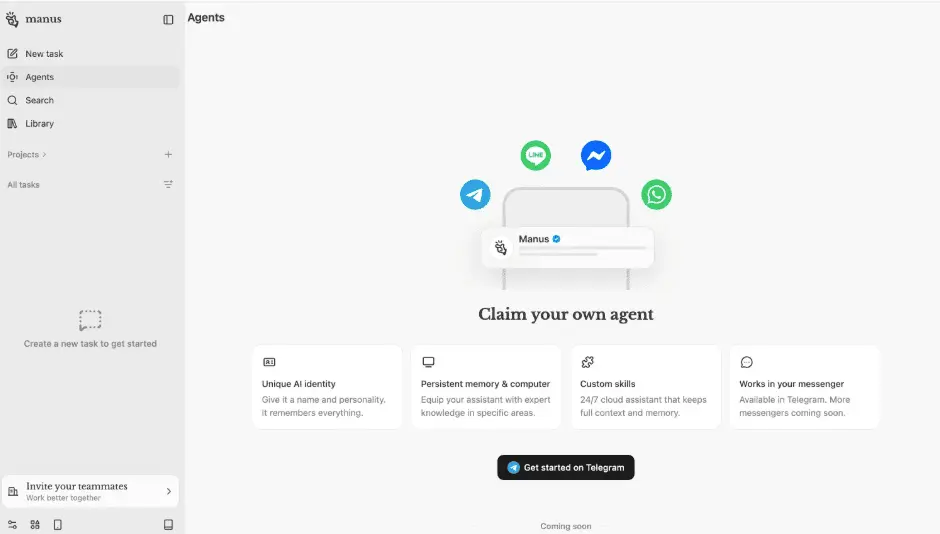
Recent Highlights
1
OpenAI Releases GPT-5.4, New AI Model Built for Agents and Professional Work
Technology
2
AI chatbots helped teens plan violent attacks in 8 of 10 cases, new investigation reveals
Technology

3
Pentagon shuts door on Anthropic talks as Microsoft and Big Tech rally behind AI firm's lawsuit
Policy and Regulation
Recent Highlights
Today's Top Stories






Your Daily Dose of Curated AI News
Don’t drown in AI news. We cut through the noise - filtering, ranking and summarizing the most important AI news, breakthroughs and research daily. Spend less time searching for the latest in AI and get straight to action.

