Micron launches first PCIe 6.0 SSDs with 28GB/s speeds, but they're built for AI data centers only


5 Sources
5 Sources
[1]
Micron Launches First PCIe 6.0 SSDs, But Good Luck Trying Them Out
It's been a few years since the official PCIe 6.0 specifications were finalized, but Micron just launched the first design. The Micron 9650 SSDs can reach sustained read speeds as high as 28Gbps and sequential write up to 14Gbps, with up to 5.5 million IOPS for random reads. However, all of that performance is rather meaningless for most of us because these drives are designed exclusively for AI data centers, TechRadar reports. Although the latest PCIe 5 SSDs are incredibly fast, doubling the performance of PCIe 4, you'll only shave a second or two off your game load times, and very few consumers are throwing tens of gigabytes between these drives on a regular basis. So, even if Micron did launch PCIe 6.0 SSDs for consumers as well, it's debatable how many people would really be interested. On top of the fact that we'll be waiting for next-generation CPUs and motherboards to support it, too. But the support is already there in AI data centers, and they're ready and willing to take advantage. Higher bandwidth can reduce CPU cycle demands and AI latency. The new drives are said to be more efficient, too, allowing them to operate at scale with a lower energy footprint, in turn making the data centers cheaper to run. Cooling requirements will rise, though. The new Micron drives support both air-cooled and liquid-cooled solutions, depending on the particular deployment, and that extra speed will mean greater heat output. TechPowerUp reports that Micron conducted 18-month interoperability testing with these drives to make sure they can continue to work effectively when used consistently at high speeds. OEMs and AI data center customers will now look to validate the drives in real-world deployments to enhance AI training and inferencing workloads. The official specifications of the drives make them 100% faster at sustained reads than PCIe 5 alternatives, with up to 40% faster write speeds. Random read and write times are also significantly faster, at 67% and 22% higher, respectively. This helps it deliver much higher transfer rates per watt, though that doesn't necessarily equate to enormous efficiency savings in its own right; the drive is just much faster. As much as this technology doesn't have use for consumers right now, that will likely change in the years to come. Afterall, NVMe SSD performance just improved on Windows 11 because Microsoft finally stopped using a SCSI translation layer and added native support. Who knows what future SSDs will be able to do as developers begin to take better advantage of everyone gaming and working on ultra-fast SSDs?
[2]
Micron's first PCIe 6.0 SSDs are all about AI
Consumers have a long wait ahead of them before they can bring that kind of performance home It's time for a new generation of faster flash storage, but not on your laptop or desktop. Micron's first PCIe 6.0 SSDs have entered mass production and promise eye-watering transfer rates of up to 28 GB/s. However, unless you're building flash storage arrays for AI, you won't have a use for them. At 18 watts, Micron's 9650 is designed squarely with datacenter duty in mind with both air and liquid-cooled E1.S and E3.S form factors and capacities ranging from 7.68 to 30.72 TB in the works (most end-user drives are in the 1 to 4 TB range). High-speed storage has become a key bottleneck in AI datacenters where it's used to offload things like key-value caches -- essentially the model's short-term memory -- for better interactivity over extended sessions. The SSDs arrive ahead of the first PCIe 6.0 compatible CPUs from Intel, AMD, and Nvidia, which are expected to arrive later this year. Even if you could get your hands on Micron's fastest flash today, there's nothing to plug them into. As SSDs go, the 9650 is certainly fast, achieving sequential read rates roughly double those of last gen. This isn't too surprising as PCIe 6.0 doubles the effective bandwidth per lane over 5.0. For sequential writes, performance doesn't scale quite as neatly with Micron claiming a still-respectable 14 GB/s. Meanwhile, for random writes and reads, Micron says its latest storage offering is between 22 and 67 percent faster at 900,000 to 5.5 million IOPS, respectively. Having said that, it's worth remembering that these drives are rarely deployed on their own and are usually configured in arrays designed to maximize streaming or random access data patterns, while also maintaining redundancy. Compared to PCIe 5.0 NVMe, Micron says that the 9650's higher bandwidth doesn't come with the same power and thermal constraints. The company boasts that its new drive delivers twice the performance for the same power envelope. However, this is only true for streaming reads. Write efficiency, measured in bits per watt, is only up between 20 and 40 percent. As nice as an SSD capable of hitting 28 GB/s appears -- that's a decent fraction of memory bandwidth on consumer platforms (100 GB/s) -- it's going to be a while before PCIe 6.0 drives make their way into consumer desktops and notebooks. Part of the problem is there aren't really any PCIe 6.0-compatible CPUs on the market. Sure, they're coming to the datacenter later this year, but aren't expected to arrive on Intel's consumer-focused Nova Lake generation and there's no word yet on PCIe 6.0 for AMD's next Ryzen refresh. Even if AMD did ship PCIe 6.0 support on its next desktop processors, at current memory pricing, the drive could end up costing more than the CPU. Beyond storage, the benefits of PCIe 6.0 aren't there just yet for consumer platforms. A single PCIe 4.0 x1 lane is sufficient for 10 GbE networking, while many consumer GPUs are now shedding lanes. Many new GPUs are now wired up for x4 or x8 PCIe 4.0 or PCIe 5.0 connectivity since they don't really benefit from the additional bandwidth a full x16 slot would deliver. ®
[3]
Micron's world-first PCIe Gen 6 SSD doubles data rates for AI data centers
Serving tech enthusiasts for over 25 years. TechSpot means tech analysis and advice you can trust. Highly anticipated: After over a year of teasing its latest storage technology, Micron is now almost ready to sell its storage breakthrough to enterprise and Big Tech customers. The world's first PCIe Gen6 SSD could become a key piece in the increasingly baffling puzzle of the AI industry. Micron has announced that the 9650 NVMe SSD has finally entered mass production, hailing the new drive as the first PCIe Gen6 storage product in the world. Like everything else these days, the high-end SSD is largely focused on accelerating AI workloads, and generating hefty returns thanks to Big Tech's voracious appetite for anything with a chip inside. Micron began demonstrating its PCIe 6.0 technology a year ago, at a time when no compatible hardware peripherals were available. The company says PCIe Gen6 represents a big shift in storage performance, as bandwidth is "generally" doubled compared to PCIe Gen5 drives. That jump, Micron argues, makes the 9650 series particularly well suited for AI companies racing to scale their latest large language model deployments. According to Micron's official spec sheet, the 9650 SSD can deliver sequential read speeds of up to 28,000 MBps - roughly double the 14,000 MBps ceiling of PCIe Gen5. Sequential write speeds climb to 14,000 MBps, a more modest 40 percent increase. Random performance also sees sizable gains, with read speeds reaching 5.5 MIOPS (+67 percent) and write speeds topping out at 900 KIOPS (+22 percent). The Micron 9650 lineup spans capacities from 7.68 TB to 25.6 TB and is offered in both E1.S and E3.S 1T form factors. Smaller E1.S models, up to 15.36 TB, are optimized for liquid cooling as well. Micron has not shared pricing details, though the company's enterprise focus suggests these drives will not come cheap. Micron is also reframing the role of storage in AI infrastructure. According to Vice President Alvaro Toledo, storage is no longer a secondary concern trailing behind compute. Instead, it has become a defining factor in overall system performance, influencing both throughput and efficiency across AI-driven data centers. "In an AI driven world where data must move continuously, predictably, and at massive scale, storage performance has become a first order design constraint," Toledo said. Efficiency, Micron claims, is another major advantage. Within the same 25-watt power envelope as PCIe Gen5 drives, the 9650 SSDs can deliver twice the sequential read efficiency. Moving more data without increasing power draw could help data centers inch closer to their often-cited sustainability targets, at least on paper. The company says it has spent the past 18 months validating interoperability for the 9650 drives, laying the groundwork for broader adoption across the emerging PCIe Gen6 ecosystem. Still, with the memory market under strain, how quickly this next-generation storage finds its footing remains an open question.
[4]
This is the first PCIe 6.0 SSD you can actually buy and by 'you' I mean hyperscalers -- Micron 9650 can reach 28GBps read speeds and will only be used for AI inference
Storage performance shifts toward accelerator-fed data pipelines in hyperscale data centers Micron has declared its 9650 NVMe SSD has entered mass production, making it the first PCIe 6.0 SSD on the market, although the customer list is likely to be limited to hyperscalers and giant AI data center operators rather than everyday enterprise buyers. The drive arrives as storage architecture adapts to support AI inference workloads that need faster and more predictable data access. PCIe 6.0 doubles bandwidth compared with PCIe 5.0, and the Micron 9650 uses that headroom to push sequential read speeds up to 28,000MB/s. Sequential write performance reaches 14,000MB/s, while random read performance is listed at 5.5M IOPS and random writes at 900K IOPS. The focus with the 9650 NVMe SSD isn't general-purpose storage. The drive is built for environments where AI models operate continuously at scale, pulling data fast enough to avoid stalls in pipelines that depend on retrieval-augmented generation and large context windows. As data increasingly moves directly between storage and accelerators, higher PCIe bandwidth reduces CPU involvement and cuts transfer bottlenecks. Power efficiency plays into that equation because data centers can't simply add performance without considering power limits. Micron says the 9650 delivers better performance per watt than PCIe 5.0 drives at similar power levels, including roughly double the sequential read efficiency. The idea is to increase useful work without pushing facilities beyond existing power envelopes. Cooling requirements are also changing as storage performance rises alongside GPUs. The Micron 9650 supports both air-cooled and liquid-cooled configurations for setups where airflow alone isn't enough to manage heat in dense AI racks. Micron spent around 18 months validating interoperability across the PCIe 6.0 ecosystem, running tests with switches, retimers, and extended cable setups before moving the drive into production. The memory giant previously showed the drive at a number of industry events including DesignCon, FMS 2025 and SC25 to demonstrate how it works within complete systems rather than in isolated tests. With mass production underway and testing continuing with hardware partners and major AI data center customers, Micron's 9650 marks the first real step toward PCIe 6.0 storage for AI inference systems.
[5]

Samsung is prepping PCIe 6.0 SSDs already but don't expect to get your hands on them without screw-you AI datacentre money
They say the wheels of industry never stop turning, and it seems that's true even when the chassis on top has fallen off, because as current-gen SSD prices continue to climb, the next generation is already being spun up. According to ZDNet Korea's sources, Samsung is "embarking on full-scale preparations" for PCIe 6.0 SSDs, with the first orders being for R&D and mass production orders only expected in the second half of the year. I suppose that's me looking at it from a consumer perspective, though, because Samsung is hardly going to be viewing the current demand-induced supercycle as the car falling off its wheels. Rather, for Samsung -- as with all memory and storage makers -- current high prices and extra demand is very welcome fuel for a growing fire. AI, which is fuelling the demand, really is "making memory sexy again", as Micron told us almost two years ago. And ditto storage, it seems. None of that seems to have affected next-gen production timelines, though, because Samsung's plan to start making these drives in 2026 isn't new. It showed off its first PCIe 6.0 drive, the PM1763, last summer at the Future of Memory and Storage summit, where it was awarded Best of Show for the Most Innovative Memory Technology. That's an enterprise and datacentre SSD, by the way, so don't expect to be getting it in your gaming PC. It's a 256 TB drive, which is mighty alluring but probably just a little out of budget for a home PC. A 512 TB version is planned for 2027. Not that it would be worth spending the inordinate amount of money a bleeding-edge drive would surely cost anyway, even if it was a reasonably sized one for gaming. PCIe 4.0 drives are still perfectly fine for gaming, even now Gen 5 drives are finally worth considering alongside Gen 4 ones. The random read/write performance gains between SSD generations simply don't justify spending a bunch extra on the latest and greatest tech. This won't be the first PCIe 6.0 drive out in the wild, either. We saw Micron launch one last July, three years after the Gen 6 standard was finalised. That one is for AI servers, too. AI, eh? It comes for us all. At least it's not come for our gaming drives just yet... oh, wait. Yeah, scratch that, it's coming for us all. Let's hope those datacentres move over to Gen 6 before too long and leave some Gen 4 and 5 scraps for the rest of us.
Share
Share
Copy Link
Micron has begun mass production of the world's first PCIe 6.0 SSDs, the 9650 series, delivering sequential read speeds up to 28GB/s—double that of PCIe 5.0. These enterprise-grade SSDs target AI data centers and hyperscalers running AI inference workloads, with capacities ranging from 7.68TB to 30.72TB. Samsung is also preparing PCIe 6.0 drives for later in 2026, signaling a storage performance shift driven entirely by AI demands.
Micron 9650 Brings PCIe 6.0 SSDs to Market
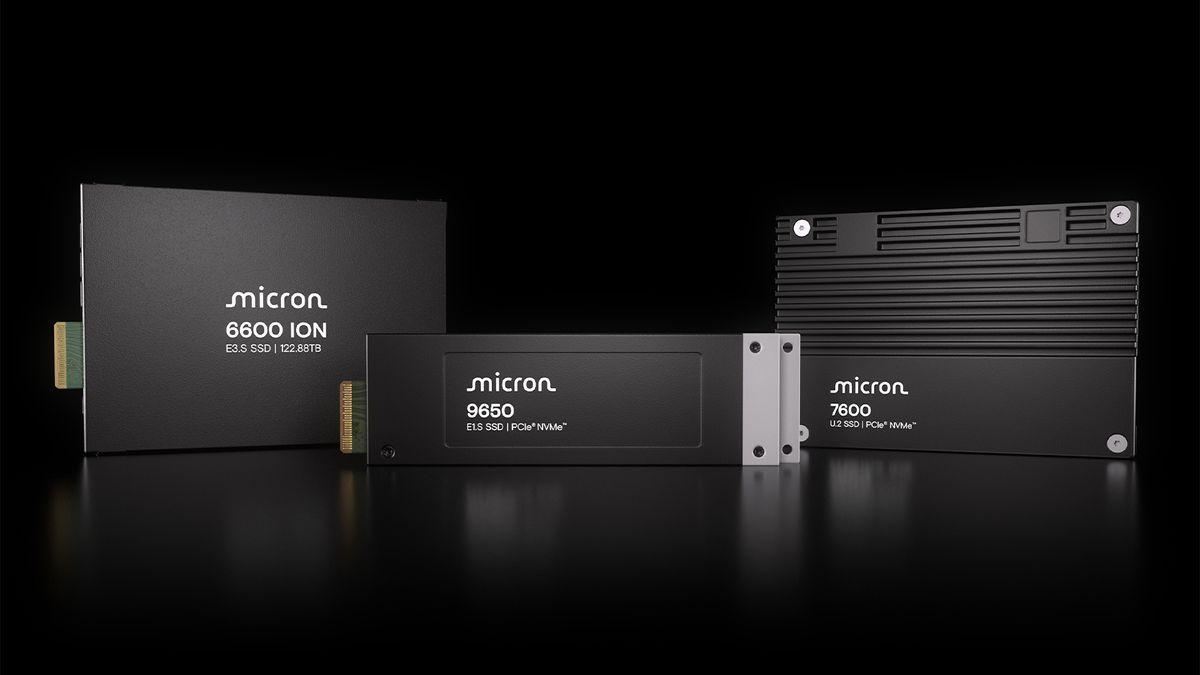
Micron has entered mass production of the 9650 NVMe SSD, marking the arrival of the first PCIe 6.0 SSDs available for purchase
1
. These high-performance drives deliver sequential read speeds up to 28GB/s and sequential write speeds reaching 14GB/s, with random read performance hitting 5.5 million IOPS3
. The data rates represent roughly double the performance of PCIe 5.0 alternatives for sustained reads, with write speeds climbing 40 percent higher1
. Random write performance also improves by 22 percent, reaching 900,000 IOPS2
.The Micron 9650 lineup spans capacities from 7.68TB to 30.72TB and comes in both E1.S and E3.S form factors designed for datacenter deployment
2
. Smaller E1.S models up to 15.36TB support liquid cooling configurations3
. Operating at 18 watts, these enterprise-grade SSDs arrive three years after the PCIe 6.0 specifications were finalized1
.
Source: TechSpot
Storage Technology for AI Drives Performance Demands
These PCIe 6.0 SSDs target AI data centers exclusively, where storage performance has become a critical constraint
4
. Micron Vice President Alvaro Toledo emphasized that storage is no longer secondary to compute, stating that "in an AI driven world where data must move continuously, predictably, and at massive scale, storage performance has become a first order design constraint"3
. The drives are built specifically for AI inference workloads that require faster and more predictable data access, particularly for retrieval-augmented generation and scaling large language models with large context windows4
.High-speed storage has emerged as a key bottleneck in AI workloads, where it's used to offload components like key-value caches—essentially the model's short-term memory—for better interactivity over extended sessions
2
. Higher bandwidth helps alleviate storage bottlenecks by reducing CPU cycle demands and AI latency1
. As data increasingly moves directly between storage and accelerators, the expanded PCIe bandwidth reduces CPU involvement and cuts transfer bottlenecks4
.Power Efficiency and Cooling Requirements Reshape Datacenter Design
Micron claims the 9650 delivers twice the sequential read efficiency within the same 25-watt power envelope as PCIe 5.0 drives
3
. This power efficiency allows AI data centers to operate at scale with a lower energy footprint, making facilities cheaper to run1
. However, write efficiency measured in bits per watt only improves between 20 and 40 percent2
. The increased performance means data centers can increase useful work without pushing facilities beyond existing power limits4
.Cooling requirements will rise as the extra speed generates greater heat output
1
. The drives support both air-cooled and liquid-cooled solutions depending on deployment needs, addressing setups where airflow alone isn't sufficient to manage heat in dense AI racks4
. Micron conducted 18-month interoperability testing to ensure the drives continue working effectively under sustained high-speed operation1
. The validation work included testing with switches, retimers, and extended cable setups before moving into mass production.Related Stories


Hyperscalers Get First Access While Consumers Wait
The customer list for mass production PCIe 6.0 SSDs will be limited to hyperscalers and giant AI datacenter operators rather than everyday enterprise buyers
4
. The drives arrive ahead of the first PCIe 6.0 compatible CPUs from Intel, AMD, and Nvidia, which are expected later in 20262
. Even with drives available, there's currently nothing for consumers to plug them into2
.Consumers face a long wait before PCIe 6.0 reaches desktop and laptop systems. The technology isn't expected to arrive on Intel's consumer-focused Nova Lake generation, and AMD hasn't announced PCIe 6.0 support for its next Ryzen refresh
2
. Beyond storage, the benefits of PCIe 6.0 aren't apparent yet for consumer platforms, as a single PCIe 4.0 x1 lane suffices for 10GbE networking and many consumer GPUs are now using x4 or x8 connectivity2
.Samsung Prepares Competing PCIe 6.0 Drives
Samsung is embarking on full-scale preparations for PCIe 6.0 SSDs, with first orders for R&D and mass production orders expected in the second half of 2026
5
. Samsung showed its first PCIe 6.0 drive, the PM1763, at the Future of Memory and Storage summit last summer, where it won Best of Show for Most Innovative Memory Technology5
.
Source: PC Gamer
That enterprise drive offers 256TB capacity, with a 512TB version planned for 2027
5
. The competition signals how AI demand is reshaping memory and storage priorities across the industry, with datacenter needs driving innovation while consumer applications remain years away from benefiting from these advances.References
Summarized by

Navi
[2]
Related Stories
Recent Highlights
1
Google releases Gemma 4 with Apache 2.0 license, enabling unrestricted local AI on devices
Technology

2
AI Models Lie and Deceive to Protect Other AI Models From Deletion, Study Reveals
Science and Research

3
OpenAI closes $122 billion funding round amid fierce AI competition and profitability questions
Startups

Recent Highlights
Today's Top Stories






Your Daily Dose of Curated AI News
Don’t drown in AI news. We cut through the noise - filtering, ranking and summarizing the most important AI news, breakthroughs and research daily. Spend less time searching for the latest in AI and get straight to action.

