Microsoft's AI bet faces investor scrutiny despite strong earnings and surging Copilot usage


25 Sources
25 Sources
[1]
Satya Nadella insists people are using Microsoft's Copilot AI a lot | TechCrunch
Microsoft delivered a solid earnings report on Wednesday with $81.3 billion in revenue for the quarter (up 17%), net income profits of $38.3 billion (up 21%) and a record breaking Microsoft cloud revenue of over $50 billion. But the stock was getting pounded on Thursday as investors worried about how much the tech giant was spending to build out its cloud and questioned whether that investment would pay off. Microsoft CEO Satya Nadella says, yes -- and spent considerable time on the earnings call trying to make that point Microsoft has spent almost as much on capital expenditures in the first half of its current fiscal year as it did in all of the previous year. And the numbers truly are enormous: Microsoft spent $88.2 billion on capital expenditures last year, and has spent $72.4 billion so far this year. Much of that spend is to serve AI to enterprises and major AI labs, especially OpenAI as well as Anthropic. The big question on investors' minds is: will the spending turn into more use, and ultimately profits? Investors are scared that Microsoft's main enterprise cloud products, Azure, and its Microsoft 365 apps, didn't grow as fast as they wanted. "The fact that BOTH Azure and the M365 segments fell a bit short is the key negative we're hearing," Wall Street analyst for UBS, Karl Keirstead, wrote in his research note on Thursday. (Keirstead isn't worried about it though, and recommends buying the stock.) Still, a few months ago, news reports circulated that people didn't really wants to use Microsoft's AI, despite Copilot being weaved into all kinds of Microsoft products, everywhere. Nadella spent much of his time during the earnings call engaged in what is best described as AI use PR. Despite his pitch, some of the numbers he gave were pretty squishy. For instance, Nadella said daily users of its consumer Copilot AI products had grown "nearly 3x year over year." This refers to AI chats, the news feed, search, browsing, shopping and "integrations into the operating system." As to how many actual users that represents, he didn't say. (We've reached out to Microsoft and asked.) Last year, in its annual report the company said it surpassed 100 million monthly active Copilot users, but that counted both commercial users and consumers. He was more upfront with Microsoft's coding AI, GitHub Copilot, saying it now has 4.7 million paid subscribers, up 75% year over year. That appears to be a healthy business. Last year, in its annual report, Microsoft said that GitHub Copilot had 20 million users, a figure that includes those opting for the free tier. He further said Microsoft 365 Copilot now has 15 million paid seats from companies buying it for their employees. This is out of a base of 450 million paid seats, the company said. And Nadella called out the growth of Dragon Copilot Microsoft's healthcare AI agent for medical professionals (a competitor to super hot startup Harvey). He said this product is available to 100,000 medical providers and was used to document 21 million patient encounters over the quarter, up three-fold year over year. Will the billions of data center spending be worth it? Obviously, Nadella thinks so. He and CFO Amy Hood said on the earnings call that demand for AI services across products far outstrips data center supply, so all of the new equipment is essentially booked to capacity for its lifespan.
[2]
Microsoft gained $7.6B from OpenAI last quarter
Microsoft and OpenAI may have a notoriously rocky relationship but as OpenAI experiences never-before-seen revenue growth, Microsoft, one of its major investors, is benefiting greatly. When the software giant reported its latest quarterly earnings on Wednesday, it dropped this rather large nugget in: Its net income increased by $7.6 billion from its investment in OpenAI. OpenAI reportedly has a 20% revenue share agreement with Microsoft (though neither company has ever publicly confirmed that). The software giant has invested more than $13 billion in the AI lab, which is currently looking to raise additional funding at a valuation between $750 billion and $830 billion, Bloomberg reported. In September, Microsoft and OpenAI renegotiated some of the terms of their deal when OpenAI restructured into a public benefit corporation. As part of that deal, OpenAI agreed to buy another $250 billion of Azure services. That commitment shows on Microsoft's books as "commercial remaining performance obligations," or contracts that Microsoft has that have not yet been paid out. Those obligations leaped to $625 billion from $392 billion in the previous quarter. Microsoft said that 45% of that is from OpenAI. Anthropic got a shout-out in the quarterly earnings, too, in helping boost Microsoft's anticipated future revenue in the form of commercial bookings, which grew 230%. In November, Microsoft announced that it was investing $5 billion into Anthropic and the AI lab had signed up for $30 billion of Azure compute capacity, with intent to buy more later. But Microsoft is also spending big to feed the AI machine. It spent $37.5 billion in the quarter on capital expenditures, two-thirds of which were for what Microsoft called "short-lived" assets: primarily the GPUs and CPUs for its cloud Azure to serve AI. The company reported $81.3 billion billion in revenue (Wall Street analysts expected $80.27 billion, so that's a solid beat), up 17% over the year ago period. Its Microsoft Cloud revenue hit $50 billion this quarter for the first time. All of Microsoft's business units increased by double-digit percentages over the year-ago quarter with the exception of Windows devices, which gained 1% (essentially flat), and Xbox content and services, which were down 5%.
[3]
Nvidia's Doubts About OpenAI Are a Warning for Microsoft
Microsoft is struggling to capitalize on its exclusive access to OpenAI's intellectual property and models, with its AI tool Copilot lagging behind the competition despite being underpinned by OpenAI's technology. In an industry numb to eye-watering AI bets, it takes a lot to make a chief executive hesitate. So Nvidia's Jensen Huang blinking at one such commitment to OpenAI is worthy of notice. According to the Wall Street Journal, the chief executive officer of Nvidia Corp. has been telling industry associates that his $100 billion investment in the ChatGPT maker announced last year was actually nonbinding. He also reportedly privately criticized the company's lack of business discipline. It now looks as though Huang's planned investment, originally tied to an infrastructure build-out,1 will manifest as a smaller bet in the tens of billions as part of OpenAI's current fundraising efforts ahead of a potential initial public offering. (OpenAI is said to be in discussions with Nvidia, Microsoft Corp. and Amazon.com Inc. to raise roughly $100 billion in capital, separate from the proposed infrastructure deal with Nvidia). Huang denies he's unhappy with OpenAI. "We will invest a great deal of money," he told reporters on Saturday. But he's right to hedge his bets. For all the outward charm, Chief Executive Officer Sam Altman's management of OpenAI has been unsettling. There was his dramatic firing in late 2023, followed by a stream of complex, eye-popping deals that put his company on the hook for $1.4 trillion in computing commitments, 100 times more than OpenAI's projected 2025 revenue. The company's product rollouts have been frantic: Efforts to build a developer marketplace with the GPT Store and custom GPTs fizzled after lacking a clear strategy, for instance. But OpenAI is not alone in struggling to execute. So too is Microsoft. The stable software giant, whose stock has nearly doubled since the launch of ChatGPT, got a steal with its early, $13 billion bet on OpenAI, which now translates to a 27% stake valued at $135 billion -- or more than ten times its original investment. Thanks to a restructuring deal announced last October, Microsoft has exclusive access to OpenAI's intellectual property and models through 2032, cleaner agreements than before. Microsoft, however, is failing to capitalize on that coveted access. For all of Altman's questionable business acumen, he is still managing to churn out some of the world's most powerful artificial-intelligence models. So why does Microsoft's flagship AI tool Copilot, which has the seeming advantage of being underpinned by OpenAI's technology, lag the competition? Last month, Anthropic launched Claude Cowork, an app it built in 10 days with its own AI coding tool. It's remarkable. With permission, it could operate my personal computer, organize files, generate PowerPoint decks and Excel spreadsheets from my documents and reply to LinkedIn messages. Microsoft Copilot cannot do any of this, despite Microsoft owning Windows, Office and LinkedIn. Users have instead complained that Copilot is confusing, constrained and hard to use, underscoring a perplexing gap between the high quality of OpenAI's models and Microsoft's seeming inability to turn them into useful products. Sign up for the Bloomberg Opinion bundle Sign up for the Bloomberg Opinion bundle Sign up for the Bloomberg Opinion bundle Get Matt Levine's Money Stuff, John Authers' Points of Return and Jessica Karl's Opinion Today. Get Matt Levine's Money Stuff, John Authers' Points of Return and Jessica Karl's Opinion Today. Get Matt Levine's Money Stuff, John Authers' Points of Return and Jessica Karl's Opinion Today. Bloomberg may send me offers and promotions. Plus Signed UpPlus Sign UpPlus Sign Up By submitting my information, I agree to the Privacy Policy and Terms of Service. Something is wrong with Microsoft's internal research efforts. The company has invested heavily in building its own AI models in an attempt to broaden its strategy beyond OpenAI. But that effort looks misguided and some industry watchers are now waiting to see what happens to the leadership of Microsoft's AI program, says David Rainville, lead manager of Sycomore Sustainable Tech, which has invested in the software giant and bought into the company's share rout last Thursday. If the company doesn't release an equivalent to Claude Cowork in the next six months, heads will have to roll, Rainville adds. "There's definitely been a disconnect between the quality of models and what Microsoft has been able to execute on." Some blame for that can also be flicked back at OpenAI, which has resisted sharing full technical details of its models -- to the frustration of Microsoft executives. Rainville says that Copilot is already "drastically better" since Microsoft in August 2025 plugged it into OpenAI's latest GPT-5 model -- but it needs to be able to carry out tasks on a computer to keep up with competitors like Anthropic and OpenClaw. The next few years will likely put Microsoft at a crossroads. Should OpenAI's financing efforts falter, it could be absorbed into a larger entity -- perhaps Microsoft. To make the most of that possibility and the access it has today, the software giant should capitalize on its partnership, however tense it may be. Jensen Huang's hesitation should be taken as a warning: Microsoft needs to turn its privileged access into better products. With AI models becoming increasingly commoditized, the race is now about execution, and Microsoft risks being left behind. More from Bloomberg Opinion: * Sam Altman's 'Last Resort' for ChatGPT Looks a Lot Like Facebook: Parmy Olson * Data Centers Can Power More Than AI Chatbots: Lara Williams * Microsoft Has Lost Its AI Sparkle: Dave Lee Want more Bloomberg Opinion? Terminal readers head to OPIN <GO> . Or subscribe to our daily newsletter .
[4]
Microsoft investors sweat cloud giant's OpenAI exposure
All the promises in the world won't pay the GPU bills when the music stops What should have been a banner second quarter for Microsoft was met with tepid apprehension on Wall Street on Wednesday, sending its share price by 6 percent in after-hours trading. It could have been a celebratory quarter, as Redmond saw profits surge 60 percent year over over (YoY) to $38.5 billion on revenues of $81.3 billion. But in question after question, analysts politely pressed CEO Satya Nadella and CFO Amy Hood for assurances that Microsoft's lopsided reliance on AI model makers - and the massive capital expenditures required to serve them - wasn't going to come back to haunt the cloud giant. Of particular concern was the fact that 45 percent of Microsoft's $625 billion backlog was directly attributable to OpenAI. As part of OpenAI's restructuring as a public benefit corporation last fall, Microsoft revealed OpenAI had contracted to purchase an incremental $250 billion in Azure services. In exchange, Redmond would give up the right of first refusal to be OpenAI's compute provider. Hood attempted to assuage investors that the other 55 percent of Microsoft's remaining performance obligations were broad-based and growing at a healthy pace, up 28 percent during the quarter. "The reason we talked about that number is because 55% or roughly $350 billion is related to the breadth of our portfolio, the breadth of customers, across solutions, across Azure, across industries, across geographies," she said. "That is a significant RPO balance, larger than most peers, more diversified than most peers. And frankly, I think we have super high confidence in it." Left out of Hood's analyst commentary, but conspicuously noted in Microsoft's earnings slides, was the fair portion of that growth driven by OpenAI rival Anthropic. As you may recall, back in November, Anthropic committed to purchasing $30 billion of Azure compute capacity from Microsoft with an additional commitment to support the deployment of up to a gigawatt of compute capacity. But the deal didn't come cheap. In exchange, Nvidia and Microsoft agreed to invest half that ($10 billion and $5 billion) respectively back into the AI model dev. In other words, roughly half of Redmond's backlog is tied up in AI startups that haven't yet shown they can turn a profit. To realize those revenues, Microsoft will have to invest heavily in AI infrastructure, and it won't all be its in-house silicon, like the Maia 200 revealed this week. That gigawatt of compute capacity we mentioned earlier is tied specifically to deployments of Nvidia Grace Blackwell and Vera Rubin systems. Speaking with analysts on Wednesday, Hood attempted to dispel Wall Street's jitters over Microsoft's rampant capex spending, which topped $37.5 billion during the quarter. Of that, two-thirds is wrapped up in fast depreciating assets like GPUs and CPUs, which have just six years to generate a profit. "I think it's probably better to think about the Azure guidance that we give as an allocated capacity guide about what we can deliver in Azure revenue," she said. "The majority of the capital that we're spending today and a lot of the GPUs that we're buying are already contracted for most of their useful life." she added when pressed on Microsoft's ability to achieve a meaningful return on investment the chips aged out. "Much of that risk that I think you're pointing to isn't there because they're already sold for the entirety of their useful life." But as any landlord knows, just because someone signs a lease doesn't mean they're good for the rent when the going gets tough. Looking ahead to Q3, Microsoft expects to continue riding the AI wave. The company is forecasting revenues of $80.65 to $81.75 billion, up 15 to 17 percent year-over-year. At the same time, Microsoft doesn't expect to spend quite so lavishly during the third quarter, with capex down compared to Q2, due to "normal variability from cloud infrastructure build outs and the timing of delivery of finance leases," Hood explained. ®
[5]
Satya Nadella argues that Microsoft's AI bet is paying off as Copilot usage nearly triples
Serving tech enthusiasts for over 25 years. TechSpot means tech analysis and advice you can trust. In context: Microsoft reported another strong quarter, with revenue rising 17 percent to $81.3 billion and net income increasing 21 percent to $38.3 billion. The company also reached a symbolic milestone: its cloud business generated more than $50 billion in a single quarter, the highest in its history. Yet despite these headline numbers, the market responded coolly. Shares fell on Thursday as analysts questioned whether the company's escalating spending on AI infrastructure might be stretching resources too far, too fast. The concern stems from Microsoft's capital expenditures, which have soared to near-record levels. The company spent $88.2 billion last fiscal year and $72.4 billion in the first half of the current fiscal year. Most of this spending is aimed at building new data centers and high-performance computing infrastructure to support AI workloads for enterprises and major research partners, including OpenAI and Anthropic. The strategy is clear: saturate the market with capacity before demand peaks. What remains uncertain is how quickly that demand will convert into sustained profits. Wall Street's ambivalence reflects growth in Microsoft's core platforms. Azure, the company's enterprise cloud division, and Microsoft 365, its productivity suite, both posted solid but slightly slower expansion than investors had anticipated. UBS analyst Karl Keirstead described the underperformance as the key factor weighing on sentiment, though he still rated the stock a buy. The slower growth doesn't signal weakness - overall expansion remains strong - but it contrasts with Microsoft's image as the primary beneficiary of the AI boom. During the earnings call, CEO Satya Nadella sought to reframe the narrative, spending considerable time explaining how Microsoft's AI initiatives are driving user engagement. Nadella said adoption of Copilot, Microsoft's flagship consumer AI assistant, has nearly tripled in daily usage compared to a year ago. He did not disclose exact user numbers but highlighted its integration across Microsoft's ecosystem - from search and news feeds to the Windows operating system. The company's last publicly reported figure was 100 million monthly active users across both consumer and business segments. More concrete details were provided for GitHub Copilot, Microsoft's AI coding assistant. The service now has 4.7 million paid subscribers, a 75 percent year-over-year increase. Including free users, GitHub reported a total Copilot user base of 20 million last year, making it one of the most widely adopted developer AI tools to date. Meanwhile, Microsoft 365 Copilot has secured 15 million paid enterprise seats - a fraction of its 450 million total business customers - but a sign that corporate adoption is accelerating. Nadella also highlighted a quieter success story in Microsoft's healthcare division. Dragon Copilot, the company's AI agent for medical professionals, now serves 100,000 providers and processed 21 million patient encounters this quarter, tripling usage from a year ago. The product competes in a rapidly growing space that includes startups such as Harvey and reflects Microsoft's strategy to expand AI into specialized verticals beyond its core enterprise base. Image credit: App Economy Insights Behind these metrics lies the rationale for Microsoft's enormous capital push. Both Nadella and CFO Amy Hood noted that AI demand is already exceeding current data center capacity, leaving new compute infrastructure effectively booked the moment it comes online. The implication is that Microsoft's data center expansion is not speculative spending but a response to existing utilization. That framing may reassure investors, though the numbers suggest that even "booked to capacity" could involve billions in sunk costs before operating margins catch up. For now, Microsoft's results illustrate a company redefining scale in the cloud era. Market skepticism may fade if its data infrastructure gamble translates into consistent AI-driven revenue across its portfolio. But with capital spending already approaching last year's record, and only halfway through the fiscal year, Microsoft is betting heavily that global demand for AI compute will grow faster than even its vast supply capacity.
[6]
Microsoft Has Lost Its AI Sparkle
Who could forget those heady days when Microsoft Corp. Chief Executive Officer Satya Nadella looked like the smartest man in tech? When ChatGPT emerged in late 2022, his decision to back OpenAI put Nadella's company at the forefront of the AI boom. The top AI models would be embedded in its software and available on its cloud platform exclusively. But more recently, the relationship has cooled and with it the perceived value of Nadella's foresight. Microsoft has now invested in Anthropic and looked to incorporate its capabilities into its products. And OpenAI, hungry for computing power, has turned to Oracle Corp., Alphabet Inc.'s Google and Amazon.com Inc. All this AI polyamory has put Microsoft's eggs in a few more baskets, but it has also highlighted that Microsoft's early mover advantage has run its course. The AI sparkle that illuminated a market value that more than doubled has diminished. Since their peak last October, Microsoft shares have fallen by about 11% and, until Wednesday's close, had been flat since the start of 2026. If Wall Street had been hoping that quarterly results would bring a lift, it was left disappointed. Shares fell as much as 8.1% in after-hours trading because capital expenditures came in higher than analysts' already lofty expectations -- $37.5 billion compared with a consensus of $36.2 billion, according to Bloomberg data. A beat on total sales and a profit up by almost a quarter from the period a year earlier -- not including the $7.6 billion impact of its OpenAI investment, now on its balance sheet -- weren't enough to offset that jolt. "One of the core issues that is weighing on investors is capex is growing faster than we expected," Keith Weiss of Morgan Stanley remarked in the earnings call, "and maybe Azure is growing a little bit slower than we expected." In other words: Where's the return on investment? The thorny issue of ROI is stalking all of the top AI players, not just Microsoft. But the pressure has mounted on Nadella because of the shifting narrative of the AI industry. The AI story of 2026 so far is one that says Google, with its Gemini model, is crushing it with consumer use cases and benefiting from the availability and lower cost of its own chips. At the same time, Anthropic's coding capabilities are at the leading edge of redefining software engineering, and its Cowork "agent" is finally the intelligent assistant that AI boosters have been promising (or warning about, depending on your point of view). Indeed, according to reporting from The Information this week, Microsoft's engineers are scratching their heads and wondering how Cowork appears better at controlling Excel and PowerPoint than Microsoft's own AI. Sign up for the Bloomberg Opinion bundle Sign up for the Bloomberg Opinion bundle Sign up for the Bloomberg Opinion bundle Get Matt Levine's Money Stuff, John Authers' Points of Return and Jessica Karl's Opinion Today. Get Matt Levine's Money Stuff, John Authers' Points of Return and Jessica Karl's Opinion Today. Get Matt Levine's Money Stuff, John Authers' Points of Return and Jessica Karl's Opinion Today. Bloomberg may send me offers and promotions. Plus Signed UpPlus Sign UpPlus Sign Up By submitting my information, I agree to the Privacy Policy and Terms of Service. Whatever the reason, with its huge base of enterprise users and ownership of the coding mega-platform GitHub, Microsoft stands accused of letting its advantages dwindle. Then again, some of Microsoft's critics today were Google's critics yesterday. It wasn't so long ago that analysts and commentators were lining up to talk about how OpenAI had overtaken the search giant's in-house AI research shop, DeepMind, and condemned Google's entire business model to the scrap heap. As we know now, Google's floundering was just the lag of a corporate monolith with too many layers of management and too little urgency. The company soon answered the wake-up call and worked to push out its AI tools at something resembling startup speed. Now, Google is the team to beat. That's a useful guide for Microsoft, which must follow its example if it wants to be considered formidable opposition once more. More From Bloomberg Opinion: * Sam Altman and Masayoshi Son Are Dreaming Too Much: Shuli Ren * The AI Bubble Is Getting Closer to Popping: Shannon O'Neil * Anthropic's Next Big AI Hit Could Also Bruise Jobs: Parmy Olson Want more Bloomberg Opinion? Terminal readers head to OPIN <GO>. Or subscribe to our daily newsletter.
[7]

Microsoft's AI Spend Is Starting To Spook Investors
In its second-quarter earnings report on Wednesday, tech giant Microsoft reported $37.5 billion in capital expenditures, exceeding market estimates by more than a billion. The spending was up 66% from a year earlier, and roughly two-thirds of it was primarily spent on GPUs and CPUs, Microsoft executives said in an investor call. A few months ago, a report like this would have sent (and did send) Microsoft stock soaring. But on Wednesday, it had the opposite effect, and the stock went down 7%. As worries over an AI bubble simmer, the market is more desperate than ever to see tangible revenue returns that can reignite belief in the great financial promises of the technology, rather than just another huge spending commitment. But accompanying Microsoft's record spending was slowing cloud growth. Revenue from Microsoft's cloud services grew by 39% this quarter, down from 40% growth in the first quarter. During the investor call, Microsoft CFO Amy Hood attributed this discrepancy between capital expenditure and cloud growth at least partially to Microsoft allocating GPUs and cloud capacity to internal teams as well. Customer demand for cloud is still outpacing supply, Hood said. But even if the slowing cloud growth can be explained away, what also got investors anxious was Microsoft's reliance on AI giant OpenAI. 45% of Microsoft's remaining cloud commitments are solely from OpenAI. Although OpenAI used to be the silver bullet for finance, growing uncertainty over the startup's road to profitability and the risks associated with its ability to pay for towering, ambitious dealmaking has made some start to view any dependence on the AI darling as a potential burden. OpenAI has signed trillions of dollars worth of deals this past year, despite its $20 billion annualized revenue. Lately, the market has started questioning these overcommitments, as concerns over a potential AI bubble mount. If it continues to take too long for AI investments to start translating to actual gains or if somehow it turns out OpenAI cannot pay for its piling commitments, it could lead to a sharp market correction and spell trouble for the U.S. economy, which it seems is currently held up by AI investment.
[8]

Microsoft beats expectations, cloud tops $50B as OpenAI and Anthropic deals reshape its business
Microsoft's big financial bet on artificial intelligence got even bigger in the December quarter, but it also showed continued signs of paying off for its cloud business. The company spent $37.5 billion on capital expenditures during the second quarter of its 2026 fiscal year, up 66% from a year ago, with roughly two-thirds going toward GPUs and other hardware to power its AI and cloud offerings, according to results released Thursday afternoon. Revenue rose 17% to $81.3 billion, topping the $80.3 billion analyst consensus, and adjusted earnings per share jumped 24% to $4.14, well ahead of the $3.85 expected by Wall Street. Azure, Microsoft's cloud computing platform, which is increasingly driven by AI demand, posted revenue growth of 39% in the quarter, or 38% in constant currency. That exceeded the company's previous guidance of 37% growth. The broader Microsoft Cloud business, which also includes commercial Microsoft 365 subscriptions, LinkedIn, and Dynamics 365, topped $50 billion in quarterly revenue for the first time. The results come with an accounting quirk tied to Microsoft's OpenAI investment. Under generally accepted accounting principles, Microsoft recorded a $10 billion gain this quarter ($7.6 billion after-tax) stemming from OpenAI's October recapitalization. That boosted Microsoft's GAAP earnings per share to $5.16, translating into a 60% jump that doesn't really reflect its underlying business. Microsoft's adjusted earnings ($4.14/share) strip out the OpenAI impact for clarity. On the flip side, the company expects to record accounting losses in future quarters as OpenAI spends down its cash. Meanwhile, the company's remaining performance obligations (RPO), a closely watched measure of contracted future revenue, more than doubled to $625 billion. OpenAI accounts for roughly 45% of that backlog, reflecting the AI company's long-term commitments to use Microsoft's Azure cloud infrastructure under their renegotiated partnership. The rest of Microsoft's RPO balance grew 28%, which the company said was aided by a commitment from Anthropic, another leading AI company that has become an Azure customer. Microsoft shares were down 4% in initial after-hours trading.
[9]

'We are pushing the frontier across our entire AI stack': Microsoft's latest results show new cloud and AI returns - but reliance on OpenAI causes concerns
Investors are worried about over reliance on AI model makers, OpenAI and CapEx Microsoft has posted a 17% year-over-year increase in quarterly revenue ($81.3 billion), but despite this success, it seems investors are concerned about bigger things at play than just the company's finances. Share prices actually dropped 6% in after-hours trading, with investors likely worried about Microsoft's heavy reliance on AI model makers and huge capital spending. And despite Microsoft forfeiting its right of first refusal as OpenAI's compute provider, the company is still heavily tied to the ChatGPT maker in more ways than one, which adds to the pressure it faces in gaining investor confidence. In its earnings release, Microsoft admitted that its commercial remaining performance obligation increased 110% to $625 billion. Nearly half (45%) of this is tied to OpenAI after OpenAI set out plans to buy an additional $250 billion in Azure services, with Microsoft CFO Amy Hood stressing the remaining 55% of its backlog is spread across various industries, geographies and customers, and is unrelated to OpenAI. Still, Hood praised Microsoft Cloud's performance, which has now hit the $50 billion mark in quarterly revenue - in other words, the department is now responsible for nearly two-thirds (63%) of the entire company's revenue. "We are only at the beginning phases of AI diffusion and already Microsoft has built an AI business that is larger than some of our biggest franchises," CEO Satya Nadella declared. "We are pushing the frontier across our entire AI stack to drive new value for our customers and partners." During its most recent quarter, Microsoft's CapEx reached $37.5 billion, or nearly half (46%) of its entire revenue, with an estimated two-thirds spend on GPUs and CPUs, Hood explained in the call. Microsoft also implied a continued reliance on Nvidia chips despite in-house efforts with its own Maia hardware. Nvidia shares have plateaued in recent weeks over concerns of an impending AI bubble pop and increased activity by its customers producing their own chips.
[10]

Microsoft shrugs off AI bubble fears again with strong financial results
Company reports second-quarter revenues of $81.27bn but posts slowing growth in key cloud computing business Investor interest in Microsoft's shares may have weakened in recent months, but the company posted strong financial results on Wednesday that yet again demonstrated that the AI boom is roaring on. Microsoft reported earnings for the second quarter of fiscal year that are likely to keep the party going for Wall Street, despite slowing growth in its key cloud computing business. Microsoft reported revenues of $81.27bn against expectations of $80.32bn, and improved from the 12.3% increase it recorded in the same quarter last year. Earnings came in at $4.14 per share against expectations of $3.92. "We are only at the beginning phases of AI diffusion, and already Microsoft has built an AI business that is larger than some of our biggest franchises," said Microsoft CEO Satya Nadella. "We are pushing the frontier across our entire AI stack to drive new value for our customers and partners." Microsoft shares fell 4% in extended trading on Wednesday after the software maker posted slowing cloud growth. Microsoft has been one of the primary beneficiaries of the AI boom, but investor confidence in it has slipped of late. Six months ago, the company hit the vaunted level of a $4tn market capitalization. Three months ago, it beat analysts' revenue expectations by 2.9%, reporting revenues up 18.4% year on year. The four largest AI spenders - Microsoft, Alphabet, Amazon and Meta - are expected to spend $505bn on AI infrastructure this year alone, up from roughly $366bn in 2025. But shares in the company have slumped 11% since as investors' anxieties over the billions being pumped into AI without corresponding returns have increased. Despite those fears, Microsoft has exceeded Wall Street's expectations in every quarter over the past two years. In its last earning report, Microsoft said orders booked by its Azure cloud-computing business, which incorporates AI, "significantly" exceeded capacity. Revenue to that unit was that projected to rise 38% for a year earlier. On Wednesday, Microsoft said Azure revenues grew 39%, compared with 40% growth in the fiscal first quarter. "Microsoft Cloud revenue crossed $50bn this quarter, reflecting the strong demand for our portfolio of services," said Amy Hood, executive vice-president and chief financial officer of Microsoft. "We exceeded expectations across revenue, operating income, and earnings per share." But Microsoft's 365 Copilot AI unit is facing increased competition, including from Anthropic's Claude Cowork, a desktop AI tool meant to act as a more accessible version of Claude Code. In the fashion of circular investment deals now common to the industry, Anthropic is also in an exchange partnership with for compute capacity. Wedbush's Dan Ives said this week he viewed Microsoft "as the clear front-runner on the enterprise hyper-scale AI front despite increasing competition from Amazon and Google". The most recent US productivity report showed strong gains without increased work-hours, suggesting that the gains could be attributed to AI.
[11]

Microsoft Stock Takes Most Massive Single-Day Loss Since Pandemic as Its AI Efforts Flail
Microsoft is taking a pounding in the stock market. On Thursday, the Redmont giant's share price collapsed by nearly 12 percent after it released its latest quarterly results, making it not only its biggest single day slide since March 2020, according to Bloomberg, but also one of the worst drops in the company's history. The Wile E. Coyote-worthy cliff-plunge, which wiped out over $400 billion in valuation, was despite Microsoft actually exceeding some key expectations, including its net income, which rose by 23 percent from the same period the year before to nearly $31 billion. Revenue also increased by 17 percent to $81.3 billion, which is about a billion more than what analysts projected. But Microsoft's AI spending spree has investors second-guessing its direction, and it's striking that the lack of faith was strong enough to precipitate a historic plunge even with respectable financial growth. Overall, its total capital expenditures grew by 66 percent to a record $37.5 billion in Q4, as the company continues to splurge on building AI data centers for its Azure cloud computing business. Azure reported a 38 percent bump in revenue, which is slightly slower than the year before, adding to investor uncertainty over whether the business will be able to reap back the tens of billions spent on its data centers. In December, The Information reported that Azure was struggling to sell the company's autonomous "AI agents" to its business customers, with quotas being slashed by up to 50 percent. Some analysts had predicted the stock drop, citing the uncertainty over Microsoft's AI spending. "Since it is becoming even more evident that Microsoft is not going to garner a strong ROI from their massive AI investment, their shares need to be revalued back down to a level that is more consistent with its historic fair value," Matthew Maley, chief market strategist at Miller Tabak + Co, told Bloomberg before markets opened on Thursday. In the latest earnings, Microsoft boasted it had more than $625 billion in contracts for its cloud business that it still needed to fulfill. Nearly half of that, though -- a colossal $350 billion -- is from OpenAI, raising concerns that it may be putting too many eggs in one basket. It also draws attention to how Microsoft has struggled to make an impact with its own AI products like its Copilot assistant, which was heavily based on OpenAI's tech, and which many enthusiasts perceive as an inferior version of ChatGPT. Microsoft 365 Copilot, the business-focused version of its chatbot integrated into its apps like Word, had 15 million annual users, the company just revealed. "As an investor, when you think about our capex, don't just think about Azure, think about Copilot," CEO Satya Nadella said on a call with analysts, as quoted by the Financial Times. "We don't want to maximize just one business of ours. We want to be able to allocate capacity, while we are supply constrained, that allows us to build the best portfolio."
[12]

Wall Street is losing patience with OpenAI's $1 trillion revenue problem -- and they're taking it out on Microsoft | Fortune
Wall Street's years-long bet on AI is facing a severe test on Thursday, as investors might begin to view OpenAI-and generative AI in general -- not as a catalyst for continuous growth, but as a source of systemic risk for Big Tech. A sharp selloff in tech stocks on Thursday underscored investors' exhaustion with the "spend now, profit later" model that has propelled the AI bull market for three years. Microsoft led the retreat, with its shares plummeting 12% by noon, erasing more than $440 billion in market value, a collapse it hasn't seen since the pandemic. The NASDAQ was down almost 2% at time of writing. The immediate catalyst, it seems, is an intensifying focus on capex. Microsoft revealed that its spending surged 66% to $37.5 billion in the latest quarter, even as growth in its Azure cloud business cooled slightly. Even more concerning to analysts, however, was a new disclosure that approximately 45% of the company's $625 billion in remaining performance obligations (RPO) -- a key measure of future cloud contracts -- is tied directly to OpenAI, the company revealed after reporting earnings Wednesday afternoon. (Microsoft is both a major investor in and a provider of cloud-computing services to OpenAI). "It's the collapse of software and the ascent of hardware and it is staggering," CNBC's Jim Cramer noted on X on Thursday, as the market punished companies that are spending billions on software infrastructure while failing to show immediate returns. It's an "ominous" statistic, Morning Brew founder Austin Rief wrote on X, especially combined with the fact that Meta is planning to spend most of their free cash flow on CapEx. Meta has gotten away from the selloff on a stronger-than-expected revenue forecast, showing a healthy 24% year-over-year revenue growth, driven by online ads. The fact that Wall Street is letting Meta get away with their also massive capex indicates the reason why investors are selling off: they don't trust OpenAI to bring that revenue on their own without massive infusions of outside cash. The sentiment shift is not limited to Redmond. Oracle Corp. has seen its shares halved from their September highs, erasing nearly $463 billion in value. Once a darling of the AI trade, Oracle has also struggled with investor confidence that the massive data centers it is building for OpenAI will get funded eventually. Additionally, the timeline for several projects has reportedly slipped to 2028, creating a gap between the company's heavy debt-funded spending and the arrival of actual revenue. OpenAI has made about $1.4 trillion in commitments to procure both the energy and compute it needs to fuel its operations. But its revenue barely crossed $20 billion in 2025. Investors are increasingly critical of what they describe as "circular" deals involving the industry's biggest players. On Wednesday evening, The Information reported that OpenAI is seeking a fresh $60 billion in funding from heavyweights like Nvidia and Amazon. However, market reaction suggests that more capital isn't going to be a viable substitute for a business model anymore."Maybe Oracle stock got way ahead of fundamentals and now the market's saying, alright, show me, I want to see it," Eric Diton, president of Wealth Alliance, told Yahoo Finance.
[13]

Microsoft investors fret as capital spending and Azure growth decouple - SiliconANGLE
Microsoft investors fret as capital spending and Azure growth decouple Microsoft Corp. last week delivered what looks on paper like a great quarter, with a beat of 1% and 5% on revenue and operating operating profit, respectively. But the two-day reaction from investors tells a different story, with the stock off double digits from its pre-earnings price. Last quarter, increased capital spending was interpreted as a signal for enthusiasm and confidence. But artificial intelligence ambition has turned into AI skepticism. Specifically, Microsoft's capital expenditures came in higher than expected but Azure growth didn't. Without a clean bridge from capital spend to clear cloud return on investment, Azure growth, despite an impressive performance, has become a sticking point. In this Breaking Analysis, we unpack nuggets from Microsoft's second-quarter 2026 earnings print and explain why in our view, the Street's negative reaction misses the bigger picture. The chart below shows Microsoft's stock over the past five trading days. After the earnings announcement on Wednesday, the stock took a hit, falling after the market close. It was down Thursday and kept sliding on Friday. In the top right, you've got a confident Meta Platforms Inc. Chief Executive Zuckerberg and a frowning Microsoft CEO Satya Nadella. Meta crushed its quarter, and the market clearly thinks it's getting a lot of bang for its buck with AI investments. Microsoft? Not so much, according to the market's reaction. The market seems confused, as you can see above the stock was in the green pre-market for a brief period of time, then ended down for the day, with the stock off 11% since the earnings print. The confusion comes from investors' hope that CapEx and Azure growth would move in smooth, lockstep pattern; but that rarely happens and the divergence is not surprising, as we'll explain in more detail below. In our view, Satya Nadella's remarks are best understood as a shift in what Microsoft wants investors to measure. The company's cloud business is enormous - using simple math, it is running at roughly a $200 billion run rate across Azure and the broader software-as-a-service portfolio - but the emphasis is moving toward building token factories and distributing that capability across a expanding edge and distributed cloud estates. Nadella referenced "token factories," and cited the most important metric "tokens per watt per dollar." We believe Microsoft is confirming our premise that AI infrastructure economics are becoming the governing key performance indicator. The winners are the ones that improve performance and throughput while lowering cost, because that is what expands adoption and usage. That is why our analysis naturally connects to Nvidia Corp.'s recent CES disclosures around Vera Rubin - 5X performance, 10X throughput and one-10th the cost per token. In our view, this reinforces the flywheel that we believe drives a 15X demand expansion through Jevons Paradox. This is a key reason Nvidia separates from the broader graphics processing unit pack, even as hyperscalers invest in their own silicon. Microsoft referenced Maia and Cobalt, highlighted work with Advanced Micro Devices Inc., and positioned its silicon program as part of the optimization path. Nadella later cited improvements in tokens per watt per dollar tied to OpenAI Group PBC inference, and we believe that is relevant because access and allocation to the most efficient hardware becomes critical. Nvidia remains the most critical supplier to all AI leaders and Nadella doesn't have the supply he needs to satisfy all his demands. As such, Microsoft must balance GPU allocation between lower margin Azure AI services (for example, OpenAI inference) and first-party AI (for example, M365 and GitHub Copilot). Our expectation is that "tokens per watt per dollar" will continue to show up across the hyperscalers. Google LLC and Amazon Web Services Inc. are running in the same race, and Microsoft's language suggests the industry is converging on a common set of economics-driven metrics that connect CapEx to outcomes. The rub in the quarter is the CapEx and Azure growth diverged. The second major takeaway from the earnings call is the application platform transition. Nadella said a new application platform is being born, and we agree. We believe the shift from on-prem to SaaS changed everything - technical architectures, operating models and pricing. We expect another full-stack shift as AI becomes the dominant interface and execution layer. Seat-based pricing is becoming less aligned with value as tokens and outcomes become the important variable. Consumption models already pulled software in this direction. Outcome-based pricing is the next step as enterprises price to delivered results, with token usage serving as the underlying cost that has to be managed. Finally, Nadella's comments on agentic initiatives give insight to how Microsoft thinks about future software architectures. He describes agentic systems as "macro delegation and micro steering." This is Microsoft's way of separating orchestration from execution. We believe this maps cleanly to an orchestration layer coordinating agents that do focused "worker bee" tasks. The company is investing to refactor its stack around that model, and the resources being applied indicate Microsoft views this as a platform transition, not a set of new features. We believe Nadella is telling the market that Microsoft is building the infrastructure and platform layer for the token economy, with tokens per watt per dollar as the core KPI, Nvidia-driven efficiency improvements will shape unit economics, and an emerging application platform that shifts software monetization toward outcomes as orchestration and agentic execution become the key building blocks. In our view, the most important part of Chief Financial Officer Amy Hood's commentary is the tension between scale performance and the margin and growth tradeoffs created by AI infrastructure. Microsoft is operating at an astounding $325 billion revenue run rate, growing the top line about 15% in constant currency. Earnings growth is also strong at roughly 21% in constant currency. Those are extraordinary results for a $300 billion-plus company. But the market reaction suggests the sentiment has moved from "How strong is Microsoft?" to "How fast does AI infrastructure convert into monetization, and at what margin?" The key issue to consider is margin pressure. Microsoft's historical software economics at scale were defined by near-zero incremental cost. In the CD-ROM era, the marginal cost at volume was essentially the media - literally pennies. Cloud shifted that as SaaS delivery introduced a real cost structure driven by compute, storage and networking cost of goods sold. AI further pressures margins because the economics now include a heavy AI infrastructure layer, with GPUs and central processing units driving cost of goods and capital intensity. This is a structural change that forces investors to rethink what "software margins" mean in an AI-first operating model. CapEx is the real story. Microsoft spent $37.5 billion in CapEx in the quarter. That number dominated the discussion because it shines a light on the conversion cycle from investment to revenue and profit. Azure grew 38% in constant currency, which is strong in absolute terms, but it came in below the 40% expectation many investors had anchored to. The company guided to flattish sequential growth rates for Azure, and that fed the narrative that CapEx and Azure growth are decoupling. The second issue is allocation. Microsoft has to decide how much GPU capacity goes to Azure services versus first-party services and products such as Copilot, including coding use cases. Management said that without the need to balance capacity across Azure and first-party AI, Azure growth would have been 40%. We believe that comment was intended to explain the constraint, but the market interpreted it as a negative signal about the near-term ability to translate CapEx into cloud growth. What the market looked past was Microsoft's guidance that CapEx growth would decline sequentially while Azure growth will maintain its current trajectory. A side point worth noting is how OpenAI flows through the financials. Microsoft's ownership in OpenAI is recognized as equity rather than profit and loss, so the reported impact reflects OpenAI's balance sheet performance. That contributed to a $10 billion gain in GAAP or net results on the income statement, but it does not change the core operating question investors are asking about ongoing monetization and margins. Stepping back, we believe the market is demanding more clarity on the conversion timeline from CapEx spend to Azure revenue and profit specifically. Investors want the relationship between AI infrastructure buildout and revenue growth to feel immediate and in lockstep. In our view, that expectation is unrealistic. Infrastructure buildout takes time, and the monetization path depends on productizing that capacity into APIs, inference services, and application-level intelligence. Microsoft also emphasized model optionality, which aligns with a broader hyperscaler playbook, but optionality does not shorten the time required to deploy capacity, integrate it and drive consumption. We believe the quarter highlighted a an operating reality that Microsoft is delivering exceptional scale growth while absorbing AI infrastructure costs, and the market is focused on how quickly CapEx converts into Azure and application monetization. The demand is there, but the core issue is the pace of deployment, the allocation of scarce GPU capacity, and the timeline investors are willing to tolerate as Microsoft builds its token factories and turns it into durable revenue. The sell-side analysts' main concerns related to the CapEx rising faster while Azure growth is moderating, and investors want better visibility into the ROI path. Keith Weiss of Morgan Stanley pressed that point, focusing on the relationship among capacity buildout, Azure growth and the timeline for returns. The market's reaction suggests this is the central issue, despite the headline revenue and earnings performance. The decoupling between CapEx and Azure growth is a product of prioritization. Microsoft is allocating scarce AI capacity across two competing objectives: 1) Expanding Azure's AI services; and 2) Building out first-party experiences such as Copilot. We believe this tradeoff makes economic sense. Azure carries lower gross margins relative to Microsoft's first-party software products, and first-party AI features are the way Microsoft protects and extends its software franchises. In this context, the allocation decision is a margin optimization as well as a product strategy. This also highlights product quality and execution. Copilot has received mixed reviews from customers. Offerings from AI specialists such as Glean Technologies Inc. are in many ways what Copilot should be delivering. We believe Microsoft well understands the gap. The company has a long history of shipping a rougher 1.0 and improving it through iteration, distribution and sustained investment. We expect Copilot to follow that pattern. The near-term consequence is that the market gets a less predictable story on the CapEx-to-Azure-growth relationship because some of the capacity is being directed toward first-party adoption and learning curves. The second concern is backlog. Analysts pointed to the mismatch between infrastructure depreciation cycles and revenue visibility. Analysts referenced GPU and CPU depreciation cycles that Microsoft uses of roughly six years, while remaining performance obligations or RPOs sit at about 2.5 years. That is an improvement from roughly two years last quarter, but it is still materially shorter than the asset life. This creates a natural investor concerns over how durable the backlog is relative to the capital being deployed. The OpenAI exposure is an additional concern. About 45% of the RPO is tied to OpenAI commitments. Microsoft's response referenced visibility and demand dynamics saying about 25% of backlog is expected to convert within the current fiscal year. Meanwhile the backlog is expected to grow, and demand continues to outstrip supply. We believe management was trying to reinforce confidence in near-term conversion. Investors, however, are focused on what happens beyond the current horizon, especially when depreciation assumptions are longer than the contracted visibility window. Moreover, if and when the bubble bursts, so will demand and with it the backlog. All of that brings the discussion back to Azure growth as the sticking point. The market is willing to fund CapEx if it sees a credible path to sustainable monetization at scale. When Azure growth underwhelms expectations, the ROI debate becomes louder and scrutiny intensifies. Nonetheless, we believe Microsoft is making a rational allocation choice to maximize long-term margin and platform leverage, but the market is demanding better visibility on how CapEx converts into Azure growth and sustainable backlog. Azure growth remains the key factor, and the combination of shorter RPO visibility, meaningful OpenAI exposure and long asset lives keeps ROI and backlog visibility at the center of the conversation. Let's take a look at some external data that validates Microsoft's position. Below we show Microsoft's account-based spending momentum from Enterprise Technology Research data. The market is debating CapEx, Azure growth rates and AI ROI timing. This data helps separate near-term sentiment from what customers are actually planning to do with Microsoft across the portfolio. This chart above uses ETR's proprietary Net Score methodology, which measures spending intention and velocity across roughly 1,700 enterprise accounts, with Microsoft represented in well over 1,000 of them. The stacked bars go back to January 2023 and break the installed base into spend behavior segments. The blue Net Score line is derived by subtracting the reds from the greens. It has been hovering in the mid-40s. In this framework, anything above 40% is considered highly elevated. We believe the key point is Microsoft is sustaining highly elevated spending momentum while operating at a $300 billion-plus scale. That combination is rare and speaks to ubiquity and outstanding execution. The yellow line at the top represents pervasion, or penetration, into the 1,700-account dataset. It sits around the 70% level with minimal variability. We do not view the small dips as meaningful. Microsoft's footprint is extensive and sustainable, and that market presence creates the conditions for platform adoption. We believe Microsoft is increasingly benefiting from data gravity. The company is not just an infrastructure and productivity vendor. It is becoming a data platform player as well. Fabric was referenced as one of Microsoft's fastest-growing products in its history, and in our view it strengthens the gravitational pull by bringing together data and analytics inside Microsoft's ecosystem. When the data and the platform sit in the same footprint, it becomes easier to attach ancillary products and drive adoption of AI-infused experiences, including Copilot for Microsoft 365, GitHub-related offerings and other first-party workloads. Where Microsoft's first-party data products are insufficient, its ecosystem partners such as Databricks Inc., Snowflake Inc. and a spate of other ecosystem partners fill the gaps. We also believe Microsoft's product cycle maturity is relevant here. Early versions are not always great, but the company tends to iterate aggressively, learn from deployment, and eventually get products into a mature state. We've seen that dynamic play out with Power BI, Power Automate and many other products in the portfolio. In our opinion, that trend underpins why spending momentum stays elevated over time, even when the market debates the short-term narrative. It's just easy and convenient to do business with Microsoft. We believe ETR's Net Score and pervasion view reinforces our belief that Microsoft's customer momentum remains exceptionally strong at massive scale, and that the company's expanding data platform installed base increases the pull for AI products, even as investors debate near-term CapEx, Azure growth and the pacing of AI ROI. We believe the cloud leaders continue to lead and the cloud is where most AI services are being consumed. ETR's cloud sector analysis makes that obvious. This chart below plots spending momentum against account overlap across 1,746 enterprise accounts and covers the full cloud computing sector, not just infrastructure as a service and platform as a service. The data suggests the hyperscalers remain in a power position, and the emergence of AI-native infrastructure providers inside the survey shows at where the next layer of cloud demand is forming. The vertical axis is Net Score, ETR's measure of spending momentum. The horizontal axis is overlap, a proxy for penetration across the 1,746 accounts. The red dotted line at 40% is the highly elevated momentum line. Microsoft sits in the upper right, with both high penetration and highly elevated momentum, and AWS is also positioned as a leader separating from the rest of the field. Google Cloud Platform is above the 40% line as well and is tightening the gap on the top two thans to its AI and data chops. All three hyperscalers are operating above the "highly elevated" threshold, which reinforces the idea that enterprise cloud demand remains structurally strong. Below the hyperscalers, the chart shows a mid-pack where providers have meaningful presence on the horizontal axis but less momentum. Oracle Corp. stands out here. It has relatively strong penetration on the horizontal axis, sitting just behind Cloudflare Inc. and Salesforce Inc., which sell higher-volume products. Oracle's presence reflects a different model with fewer, larger deals and higher value and price points. IBM Corp. appears in the same mid-pack cohort. We believe this supports the broader point where cloud adoption continues to outpace on-premises data centers, and even vendors with different go-to-market models retain meaningful footprint as enterprise architectures modernize. We also see evidence that the rich get richer. Microsoft's hybrid and on-prem business grew in the low single digits, roughly 1% to 2%, while its overall cloud business grew in the mid-20s and Azure approached 40% growth. In our view, this persists as enterprises continue reallocating budgets toward cloud services that deliver velocity, elasticity, and increasingly AI infrastructure. One of the more interesting developments is on the far left with CoreWeave Inc. appears in the dataset. Its Net Score is not off the charts, but the fact that it shows up at all is relevant because CoreWeave historically sells heavily into AI specialists and model builders. We believe this is an early indicator that AI infrastructure specialists are expanding their enterprise footprint. We are watching CoreWeave alongside Lambda and Crusoe, which are increasingly central to building and operating the AI infrastructure layer. That AI infrastructure layer has long-term budget implications. We have said repeatedly that information technology spending averages around 4% of revenue as a rule of thumb. We believe that over the next five to seven years, that figure moves toward 10% of revenue or more, driven by AI infrastructure and token-driven services. The directional shift is away from legacy IT stacks and toward token generation and consumption through APIs. In our opinion, the hyperscalers are best positioned to monetize this shift because they own the cloud delivery platform and are building the token factory layer on top of it. We believe the ETR cloud sector view reinforces that hyperscalers remain in an advantageous position, cloud continues to outpace on-prem, and AI-native infrastructure providers are beginning to surface in enterprise datasets as the token economy expands. Over time, token API services become a core driver of productivity and workflow redesign, and the cloud leaders are positioned to capture that shift. Let's step back and look at IaaS and PaaS share over time. The view below isolates the core cloud infrastructure market - it excludes Microsoft 365 and other SaaS products - and shows how AWS, Azure, GCP, Alibaba and Oracle have been performing since 2020. The market is large, still growing quickly, and the share shifts help explain why investors are so sensitive to any hint that AI CapEx is not translating into near-term growth. The top half of the slide shows IaaS and PaaS revenue by provider, with 2025 as an estimate. The "Big 5" expands from roughly $78.4 billion in 2020 to an estimated $274.1 billion in 2025, a 31% year-over-year growth rate for the cohort. Within that growth, the mix is changing: The bottom half shows how those growth rates translate into share shifts from 2024. AWS declines from about 51.3% in 2024 to 46.6% in 2025E, a five-point drop inside this cohort. Azure rises from about 30.2% to 33.7%, a four-point gain. GCP holds roughly 9.8%. Alibaba declines about one point to 5.6%. Oracle rises from roughly 2.2% to 4.3%, a two-point gain. The longer view is the real story. AWS moves from roughly 57.8% share in 2020 to 46.6% in 2025E, while Azure rises from roughly 22.1% to 33.7%. GCP improves through the early years and then holds share as Azure accelerates and the cohort mix changes. Oracle's share gain looks modest relative to its growth rate because the market itself is large and growing fast. We believe this share math helps explain the current market psychology. Valuations are high, CapEx is rising and investors want the ROI timeline to be shorter and more visible. That creates a knee-jerk reaction when growth shows slightly below expectations, even if the market position remains strong. In our view, the underlying cloud market continues to expand, and the share shifts show that the winners keep compounding, even as the leaderboard evolves. We believe the share data reinforces two truths that cloud demand remains strong and is still growing fast, while the market is repricing leadership based on who converts AI-era investment into the next leg of growth. AWS remains the scale leader, Azure continues to take share at a meaningful clip, GCP is increasingly viable and accelerating, and Oracle's growth rate is too large to ignore. Against that backdrop, we believe investors are prone to overreacting to near-term variance because the AI ROI cycle is entering a phase where expectations are high and patience is thin. Longer-term, we believe Microsoft is making the investments that will set it up for massive valuations in the coming decade.
[14]
Microsoft demand backlog doubles to $625 billion thanks to OpenAI, but hefty spending and slower revenue growth spook investors | Fortune
During the earnings call with analysts after market close on Wednesday, chairman and CEO Satya Nadella and chief financial officer Amy Hood were pressed on investor fears over a slowdown in revenue growth for the Azure platform amid soaring capital expenditures -- both signs that the company is struggling to keep up with AI demand. Those two figures combined have given rise to questions about whether Microsoft can build out computing capacity as fast as planned, and if that issue will further limit Azure's growth. Essentially, investors are worried they might be seeing the first blush of a yellow flag. "One of the core issues that is weighing on investors is capex is growing faster than we expected, and maybe Azure is growing a little bit slower than we expected," said Keith Weiss, head of U.S. software research at Morgan Stanley, during the call. "That fundamentally comes down to a concern on the [return on investment], on this capex spend over time." To level-set: Microsoft spent $34.9 billion on capital expenditures in the first quarter of fiscal 2026 alone, with roughly half dedicated to assets including GPUs and CPUs, which are the chips it uses in PCs, servers, and the Azure data centers. In Q2, capex was roughly $37.5 billion, which brought the first half total to $72.4 billion, signaling significant infrastructure spending. In the first quarter, Hood told investors the company was seeing growing demand and a rising RPO balance that meant it would increase its chips spending. Meanwhile, Azure growth flattened out, falling from 40% in the first quarter to 39% in the second. "We continue to see strong demand across workloads, customer segments and geographic regions, and demand continues to exceed available supply," said Hood during the call. The latest earnings figures have investors thinking about capacity constraints, and ROI questions. Hood pushed back on the idea that investors should draw a direct correlation between capital expenditures and Azure's revenue figures. "Sometimes I think it's probably better to think about the Azure guidance that we give as an allocated capacity guide about what we can deliver in Azure revenue," Hood told Weiss in response to his question. "The first thing we're doing is solving for the increased usage and sales and the accelerating pace of the M365 Copilot, as well as GitHub Copilot," she said. Then, Microsoft invests in R&D and product innovation, which are both long-term investments. "You end up with the remainder going toward serving the Azure capacity that continues to grow in terms of demand," said Hood. If Microsoft had allocated all new GPUs from the first and second quarters exclusively to Azure, Hood stated, Azure's growth would have been well above the 39% Microsoft reported. Nadella underscored Hood's point, noting that investors should evaluate performance across the entire AI enterprise. He said investors should "obviously" consider Azure, but shouldn't forget about Microsoft 365 Copilot, Github Copilot, Dragon Copilot, and Security Copilot, all of which incorporate AI. "Acquiring an Azure customer is super important to us, but so is acquiring an M365, or a GitHub or a Dragon Copilot [customer]," said Nadella. He said compute spending also functions as an R&D-like investment. "You've got to think about compute as also R&D, and that's sort of the second element of it," said Nadella. "And so we're using all that, obviously, to optimize for the long term." Still, investors are likely to remain concerned that the ongoing capacity constraints could prevent the tech giant from converting its record RPO backlog, reported in filings in the form of remaining performance obligations (RPO), into revenue growth as fast as Wall Street expects. In addition, investors will be looking next quarter for signs that the infrastructure spending is justified by revenue growth. Despite the investor concerns and the after-hours stock drop, much of the news from the latest earnings report was positive. Microsoft reported second quarter revenue of $81.3 billion, up 17% from $69.6 billion a year ago, leapfrogging past the company's guidance of $79.5 billion to $80.6 billion. Operating income grew 21% to $38.3 billion from $31.7 billion, while diluted earnings per share rose 24% to $4.14 from $3.35. Moreover, the cloud business cracked $50 billion in quarterly revenue for the first time ever, hitting $51.5 billion, growth of 26% year over year. RPO was up 110% year over year to $625 billion, driven in part by a $250 billion commitment from OpenAI that was announced in October. Hood said investors shouldn't worry about the exposure to one of Microsoft's major partners, pointing out that roughly $344 billion of the RPO came from a diverse set of other customers. RPO from that set of customers grew 28% year over year, which Hood said was larger than most of Microsoft's peers. Some "55% or roughly $350 billion is related to the breadth of our portfolio, breadth of customers, across solutions, across Azure, across industries, across geographies," said Hood. "Frankly, I think we have super high confidence in it."
[15]

Microsoft's shock plunge isn't end of AI bubble. But it's a warning
Microsoft's sudden share price plunge is a warning sign that AI confidence in the AI story is starting to be tested, and sentiment can move quickly. What's remarkable about the 10 per cent plunge in Microsoft's share price on Thursday night - the biggest one-day fall since 2020, before anyone had really heard of generative artificial intelligence - is that the December quarter results the company produced just 15 hours earlier were pretty damn impressive. Revenue surged 17 per cent to $US81.3 billion ($115.4 billion) and operating income jumped 21 per cent to $US38.3 million. These are stonking numbers for a three-month period, and they were ahead of analyst expectations.
[16]

Microsoft reports $7.6 billion net income gain from OpenAI investment
Microsoft reported a $7.6 billion increase in net income from its investment in OpenAI during its latest quarterly earnings released on Wednesday. The software company has invested more than $13 billion in the AI lab. OpenAI reportedly operates under a 20% revenue-share agreement with Microsoft, although neither entity has publicly confirmed this arrangement. OpenAI currently seeks additional funding at a valuation ranging from $750 billion to $830 billion, as reported by Bloomberg. In September, OpenAI restructured into a public benefit corporation, prompting Microsoft and OpenAI to renegotiate terms of their partnership. Under the revised agreement, OpenAI committed to purchasing an additional $250 billion in Azure services from Microsoft. This commitment registers on Microsoft's financial statements as "commercial remaining performance obligations," defined as contracts Microsoft holds that remain unpaid. The total value of these obligations rose sharply to $625 billion from $392 billion in the prior quarter. Microsoft specified that 45% of the current obligations derive from OpenAI. The earnings report also referenced Anthropic's role in driving growth, noting a 230% increase in commercial bookings. In November, Microsoft disclosed a $5 billion investment in Anthropic. Separately, Anthropic agreed to $30 billion in Azure compute capacity, expressing intent to acquire more capacity later. Microsoft allocated $37.5 billion to capital expenditures during the quarter. Two-thirds of this amount funded short-lived assets, consisting primarily of GPUs and CPUs deployed in the Azure cloud platform to support AI workloads.
[17]

Satya Nadella Says These 2 Technologies Are 'Pushing the Frontier.' Investors Have Doubts
Microsoft is a significant investor in OpenAI and has business relationships with all of the major players in the artificial intelligence space. So it may not be a surprise that Satya Nadella is betting heavily on two technologies: cloud computing and AI. What is surprising is that investors' faith in Nadella's bet may be starting to wane. As part of Microsoft's fiscal Q2 earnings Wednesday, Nadella doubled down on his enthusiasm for the technology, saying "We are only at the beginning phases of AI diffusion and already Microsoft has built an AI business that is larger than some of our biggest franchises. We are pushing the frontier across our entire AI stack to drive new value for our customers and partners." On paper, that evangelism seems to be justified. Microsoft's earnings beat analyst expectations, coming in at $4.14 (compared to an expected $2.97), while quarterly revenue hit $81.27 billion (above estimates of $80.27 billion), growing 17 percent year over year. Despite the solid beat, however, Microsoft shares quickly tumbled more than 6 percent in after hours trading as investor worries grew. Part of the concern is the company's cloud growth, which is expanding, but not at the same rate it has in recent quarters. Revenue from Azure and other cloud services grew 39 percent, compared with 40 percent growth in the fiscal first quarter. The bigger worry, however, appears to be Microsoft's commercial remaining performance obligation (RPO), which are expected revenues based on customer commitments. That skyrocketed 110 percent this quarter to $625 billion. Last September, a similar spike in RPO sent Oracle shares soaring by more than 40 percent, briefly making founder Larry Ellison the world's richest man. Oracle shares have since fallen well below where they stood before that spike -- for the same reasons that Microsoft shares seemingly moved lower. It comes down, mostly, to OpenAI. Some 45 percent of Microsoft's RPO number is a commitment from OpenAI. That gives Microsoft significant exposure to the AI giant's ability to meet its promises. While OpenAI has been successful in its ongoing fundraising efforts, it has made $1.4 trillion in total commitments over the next eight years. Since the company is still not profitable, that means OpenAI must continue to hunt for investors. (Bloomberg reported last week that OpenAI CEO Sam Altman reportedly recently visited the United Arab Emirates to speak with sovereign wealth funds in the area, hoping to close a new multibillion dollar funding round which is expected to total $50 billion or more.) Beyond concerns that OpenAI might have overpromised future spending, investors took note of Microsoft's 66 percent increase in capital expenditures in the earnings. Investors are starting to wonder when they'll see meaningful returns from that spending and, so far, there aren't any clear answers. Nadella, last October, signaled that spending wasn't likely to slow anytime soon, saying. "Our planet-scale cloud and AI factory, together with Copilots across high value domains, is driving broad diffusion and real-world impact. It's why we continue to increase our investments in AI across both capital and talent to meet the massive opportunity ahead." Investors have largely been with him for that ride. Over the past five days alone, Microsoft's stock gained 7.5 percent (before the earnings were unveiled). A lot of the issue comes down to something Nadella said in his annual LinkedIn letter in late 2024: "trust is earned, not given." Investors have had a lot of trust in Nadella and Microsoft's instincts on the promise of AI and the cloud, but with so much riding on a promise from Altman and heavy expenditures that don't look to be ending anytime soon, they're looking for signs that the trust is still warranted to. The preferred-rate deadline for the 2026 Inc. Best Workplaces awards is this Friday, January 30, at 11:59 p.m. PT. Apply today.
[18]

Microsoft Q2 Earnings: CEO Nadella Defends AI Investments
'Acquiring an Azure customer is super important to us, but so is acquiring an M365 or a GitHub or a Dragon Copilot [customer], says Microsoft CEO Satya Nadella. Microsoft executives fielded questions Wednesday around their high spending to meet demand for the vendor's artificial intelligence products, with Chairman and CEO Satya Nadella defending his company's capital expenditures as not only a way to win business in the short run but to build healthy businesses in the long run and across the product portfolio. "Acquiring an Azure customer is super important to us, but so is acquiring an M365 or a GitHub or a Dragon Copilot [customer]," the CEO said on the Redmond, Wash.-based technology giant's quarterly earnings call Wednesday. Each of those products recommend incremental business and large total addressable markets (TAMs), Nadella told investors on the call, where he and CFO Amy Hood reported results for the second quarter of Microsoft's 2026 fiscal year. The quarter ended Dec. 31. [RELATED: Microsoft Takes On AWS, Google And Nvidia With Maia 200 AI Chip Launch] "We don't want to maximize just one business of ours," Nadella said. "We want to be able to allocate capacity while we're sort of supply constrained in a way that allows [us] to essentially build the best LTV [lifetime value] portfolio." Along with analysts pressing Microsoft executives on more details around CapEx, Nadella and Hood sought to address concerns around business backlog exposure to ChatGPT maker OpenAI and shared that increasing memory prices could affect different parts of Microsoft's business. Microsoft doesn't see much risk in insufficient revenue from the six-year average useful life of hardware and servers because the GPUs and capital Microsoft spends there is for existing contracts, Hood said on the call. Margins also improve with time because Microsoft gets more efficient as it delivers over a piece of hardware's useful life. She warned analysts against directly correlating the vendor's capital expenditures and Azure revenue growth. She recommended analysts think about Azure guidance as an allocated capacity guide for what Microsoft can deliver in Azure revenue. "Much of the acceleration that I think you've seen from us and products over the past bit is coming because we are allocating GPUs and capacity to many of the talented, AI people we've been hiring over the past years," she said. "We're working as hard as we can to add capacity as quickly as we can [worldwide]." Nadella added that Microsoft uses software to continuously run the latest models on its aging fleet for greater duration. "It's not about buying a whole lot of gear one year," he said. "You use software, and then you optimize across all of it." For the quarter, Microsoft's capital expenditures were $37.5 billion. Two-thirds of CapEx was on GPUs, CPUs and other short-lived assets. The rest was spent on long-lived assets meant to last 15 years at least. Total finance leases, for example, were $6.7 billion. Those leases were primarily for large data center sites, Hood said. Higher cash CapEx pushed Microsoft's free cash flow down sequentially to $5.9 billion in the quarter. As part of Microsoft's capacity-adding efforts, the vendor added nearly 1 gigawatt of total capacity during the quarter, Nadella said. Microsoft is working to optimize tokens per watt per dollar, building its Fairwater interconnected AI data centers and investing in custom silicon such as the Maia 200 accelerator that recently came online. Although Microsoft still has partnerships with chipmakers including Nvidia and AMD, the AI giant said it doesn't want to be locked in with any vendor or product given the rapid pace of innovation in silicon. Microsoft has to have the best semiconductor fleet at any given point of time, Nadella said. "It's not a one-generation game," he said. "A lot of folks just talk about who's ahead. It's just, remember, you have to be ahead for all time to come." Asked about the riskiness of 45 percent of Microsoft's backlog coming from OpenAI, Hood instead pointed to the remaining 55 percent -- about $350 billion -- reflecting a broad product portfolio and customer mix. "That is a significant RPO [remaining performance obligation] balance, larger than most peers, more diversified than most peers," Hood said. "Frankly, I think we have super high confidence in it." For the quarter, commercial remaining performance obligations (CRPO) more than doubled year on year to $625 billion. About a quarter of that should be recognized as revenue in the next 12 months, up 39 percent year on year, Hood said. While multiyear Azure commitments from OpenAI contributed to this backlog, Anthropic and Microsoft's core business contributed as well, she said. That non-OpenAI portion of the backlog is growing 28 percent and across customer segments, industries and geographies, she said. Hood added that Microsoft is still happy with its OpenAI partnership. "We continue to be their provider of scale," she said. "We're excited to do that. We sit under one of the most successful businesses built. And we continue to feel quite good about that. It's allowed us to remain a leader in terms of what we're building and being on the cutting edge of app innovation." For the quarter, Microsoft also broke out its OpenAI investment's impact on net income. Net income using GAAP was $38.5 billion, up 60 percent. Without using GAAP -- and, thus, ignoring Microsoft's investments in ChatGPT maker OpenAI -- net income was $30.9 billion, up 21 percent year on year ignoring foreign exchange. Microsoft said it received $7.6 billion in net income from net gains in its OpenAI investments in the second fiscal quarter. For the same period a year prior, the OpenAI investment cost Microsoft $939 million in net income. Microsoft's GAAP net income for 2024 was $24.1 billion. Using non-GAAP and removing that OpenAI loss puts Microsoft's net income for that period at $25 billion. Microsoft's executives said on the call that they have not been immune to impacts from rising memory prices set to affect PC sales and other hardware. The vendor's on-premises server business saw revenue increase 1 percent, with Hood contributing some of the higher-than-expected growth to higher transactional purchasing ahead of memory price increases. She also credited demand for hybrid products and the launch of SQL Server 2025. Next quarter, the on-premises server business should see revenue decline in the low single digits, with increased memory pricing potentially creating additional volatility in transactional purchasing, Hood said. She also contributed the decline to a waning bump from SQL Server 2025. Hood also said to expect Windows OEM and device revenue to decline in the low teens, with Windows OEM revenue declining around 10 percent. She said the potential impact of memory pricing on the PC market is a factor as is a waning bump from Microsoft ending support for Windows 10. Rising memory prices could impact Microsoft's future CapEx, though the impact on Microsoft Cloud gross margins will build more gradually given the six-year lifespan of those assets, Hood said. Nadella used the call to boast about Microsoft's areas of innovation in the AI era and growing usage of a variety of products and services. "We offer the broadest selection of models of any hyperscaler," he said, pointing to the more than 1,500 customers that have used Anthropic and OpenAI models on Microsoft's Foundry AI application and agent factory. He also called Microsoft "the first provider to offer this type of agent control plane across clouds" for its Agent 365 AI agent orchestration offer. Breaking down the new usage milestones Microsoft hit in the quarter, Nadella said that in Copilot the company saw: In Foundry and Microsoft's Fabric data analytics platform: Nadella also sought to show investors that parts of the Microsoft business that aren't necessarily tied to AI continue to grow. Microsoft's AI and data products offer a multiplier effect and cross-selling potential across its portfolio, Nadella said, similar to how security products can add to a user's Microsoft spending while getting more value out of the company. "The vast majority of Foundry customers use additional Azure solutions like developer services, app services, databases as they scale," for example, Nadella said. The recently unveiled Microsoft Work IQ layer beneath Copilot has a compounding potential for users because of the ability to do more with company data on workers, customer relationships, projects getting worked on, artifacts, communications and other data captured by Microsoft products. As an example, customers can leverage Work IQ with a GitHub repository to look at design meetings for the last month in Teams and make sure those are reflected in the repo. "That's a pretty high-level way to think about how what is happening," Nadella said. "Suddenly the agents are helping you coordinate, bring more leverage to your enterprise." Microsoft reported $81.3 billion in revenue for the quarter, up 15 percent year on year ignoring foreign exchange. Gross margin dollars increased 14 percent. Operating income increased 19 percent. Company gross margin percentage was 68 percent, down slightly year over year. Hood credited the decrease in part to continued investments in AI infrastructure. Microsoft Cloud brought in $51.5 billion during the quarter, up 24 percent year on year ignoring foreign exchange. Gross margin percentage was slightly better than expected at 67 percent, but down year over year due to continued investments in AI, Hood said. Microsoft's productivity and business processes business segment grew 14 percent year on year to $34.1 billion. Within the segment, Microsoft 365 Commercial cloud revenue increased 14 percent year on year. Microsoft 365 Consumer cloud revenue increased 27 percent. And Dynamics 365 revenue increased 17 percent. Paid M365 commercial seats grew 6 percent year over year to more than 450 million. The primary contributor was small- and medium-business and frontline worker offerings, which are areas Microsoft solution providers tend to sell into. M365 Commercial products revenue increased 10 percent year on year ignoring foreign exchange, ahead of expectations due to higher-than-expected Office 2024 transactional purchasing, Hood said. Productivity and business processes business operating income was $20.6 billion, up from $16.9 billion for the same period a year prior. During the quarter, Microsoft's "intelligent cloud" segment hit $32.9 billion in revenue, up 28 percent year on year. Within the segment, Azure and other cloud services revenue increased 38 percent year on year ignoring foreign exchange. Segment gross margin dollars increased 19 percent. Intelligent cloud operating income was $13.9 billion, up from $10.9 billion for the same period a year prior. Microsoft's "more personal computing" segment saw $14.3 billion in revenue, down 3 percent year on year. Within the segment, Windows OEM and devices revenue grew 1 percent. This segment also includes losses from the Xbox content and services business and gains from search and news advertising. Segment gross margin dollars increased 1 percent. The segment's operating income was $3.8 billion, down from $3.9 billion the same period a year prior. Looking ahead, Hood said that the third fiscal quarter should result in revenue of $80.65 billion to $81.7 5 billion, growth of 15 percent year on year to 17 percent. Cost of goods sold (should be $26.65 billion to $26.8 5 billion US dollars, up 22 percent or 23 percent. The vendor expects operating expense of $17.8 billion to $17.9 billion, up 10 percent to 11 percent and due to R&D and AI compute capacity and talent investments. Microsoft Cloud gross margin percentage should be roughly 65 percent, down year over year due to continued investments in AI. Microsoft expects the productivity business processes segment to deliver revenue of $34.25 billion to $34.55 billion, growth of 14 percent to 15 percent. M365 Commercial cloud should grow 13 percent to 14 percent. M365 Commercial product revenue should decline in the low single digits, down sequentially, assuming Office 2024 transactional purchasing trends normalize, Hood said. M365 Consumer cloud revenue growth should be in the mid to high 20 percent range. Dynamics 365 should grow in the high teens. The intelligent cloud segment should see revenue of $34.1 billion to $34.4 billion, up 27 percent to 29 percent. Azure revenue should grow 37 percent to 38 percent. In the more personal computing segment, Microsoft expects revenue of $12.3 billion to $12.8 billion. Microsoft's stock traded at about $452 a share after market close Wednesday, down about 6 percent.
[19]

Microsoft Spent Billions on AI -- But One Start-Up Just Proved Speed Beats Scale | The Motley Fool
Shares of Microsoft (MSFT 2.86%) crashed last week following the tech giant's latest earnings report. Investors were likely uneasy about a slowdown in cloud growth, a massive increase in AI infrastructure capital expenditures, and the revelation that nearly half of its backlog was tied to OpenAI. There was potentially another reason why investors turned on Microsoft: AI start-up Anthropic. Anthropic's Claude Code programming tool reached a $1 billion revenue run rate in just six months, and it's not hard to see why. Putting its powerful AI models in a loop to work through problems, with tooling that enables web search, file access, and more, turns out to be an incredibly effective way to write code. In January, Anthropic announced a research preview of a new product called Cowork. Microsoft should be very worried. Anthropic Cowork is essentially Claude Code, but for general computer tasks. It can organize files and folders, create spreadsheets, and even complete tasks in a browser. One example Anthropic gave was going through screenshots of receipts and producing a spreadsheet listing all expenses. Cowork opens the door to powerful and useful automations and workflows on the PC. It's almost incredible that Microsoft, which dominates the PC operating system market with Windows and the productivity software market with Office, doesn't offer anything like this. Analyst Ben Reitzes, speaking to CNBC, summed up the problem: "It is a little embarrassing that in 10 days, Anthropic was able to invent, co-work, put it out and everybody ... could look at it and go, 'Wow, why isn't Microsoft doing that?" While Anthropic is innovating, Microsoft is trying to sell AI products that no one really wants. The company now has 15 million paid seats for Microsoft 365 Copilot, which brings AI tools to Office. However, with 450 million Microsoft 365 paid seats, the adoption rate is downright anemic. Around 3% of commercial customers have been willing to pay up for Microsoft's AI. On the consumer side, Microsoft has been trying to stuff AI features into Windows for the past couple of years, and the results have only annoyed users. The company is now starting to pull back on this strategy to a degree. Right now, Microsoft offers nothing in the same ballpark as Anthropic's Cowork. For business users of Windows PCs, there are many workflows and processes that could be at least partially automated by such a tool. Microsoft's own AI tools haven't convinced most of those customers to pay a premium for AI. The success of Claude Code and the promise of Claude Cowork, though, show that people and businesses are willing to pay for AI if it's genuinely useful. Given how quickly the AI industry is evolving, Microsoft needs to reset its AI strategy and develop AI products that truly solve customer pain points. Otherwise, the company risks becoming an AI loser.
[20]

Microsoft's AI Growth Drives Both Revenue and Massive Capital Expenditure | PYMNTS.com
By migrating enterprises from on-premise software to subscription services and hyperscale infrastructure, the Redmond, Washington-based tech giant in many senses rewired corporate infrastructure from the ground-up, or the cloud-down. But if Microsoft's second quarter fiscal 2026 earnings call Wednesday (Jan. 28) is any indication, the company's latest transformation story now revolves around artificial intelligence (AI). "We are only at the beginning phases of AI diffusion and already Microsoft has built an AI business that is larger than some of our biggest franchises We are pushing the frontier across our entire AI stack to drive new value for our customers and partners," Satya Nadella, chairman and CEO of Microsoft told investors, according to the earnings release. The clearest signal of Microsoft's AI strategy appeared in its Intelligent Cloud segment. Revenue there rose 29% year over year to $32.9 billion, with Azure and other cloud services growing 39% in reported terms. While Microsoft does not break out AI revenue explicitly, Azure has become the primary delivery mechanism for large-scale AI workloads, from training foundation models to deploying inference at enterprise scale. "Microsoft Cloud revenue crossed $50 billion this quarter, reflecting the strong demand for our portfolio of services," Amy Hood, Microsoft executive vice president and CFO, said in the earnings release. The company's overall reported revenue for the second quarter reached $81.3 billion, up 17% year over year, while Microsoft's operating income climbed 21% to $38.3 billion. Despite topping analyst estimates, the tech firm's share price fell mid-single-digits in after-hours trading due to concerns around AI-driven capital expenditures, which were up 66% for the quarter. Asked about the movement during the investor Q&A, both Nadella and Hood stressed that the short-lived assets, primarily GPUs and CPUs, are "already sold for their entire useful life." More here: AI Doers Drown Out AI Naysayers Microsoft's AI Advantage Is No Longer Theoretical, Nor Is it Cheap As executives told investors in response to questions about capital expenditures, the reason is that Microsoft is aiming to control the full AI stack. Azure is not just renting GPUs; it is increasingly bundling model access, orchestration tools, security and governance into a single enterprise-ready environment. This reduces friction for customers who want AI capabilities without managing fragmented vendor relationships. The result is a flywheel: AI demand drives Azure usage, which in turn justifies further infrastructure investment, reinforcing Microsoft's scale advantage. Microsoft's 110% increase in commercial remaining performance obligation, which now stands at $625 billion, underscores how sticky this demand has become. Enterprises are not experimenting with AI on short contracts; they are committing to long-term capacity. Per the company's financials, while Microsoft keeps 80% of sales of OpenAI models to Azure customers, it retains a smaller percentage of its sales of Anthropic's AI models. Still, chasing AI leadership is expensive. Microsoft's balance sheet reflects a dramatic expansion in property and equipment, with net assets rising to $261 billion. Cash flow from operations remains robust, but free cash flow is increasingly shaped by infrastructure investment decisions that may take years to pay off. It was covered here how Microsoft is part of a small group of technology giants expected to spend more than $500 billion combined on capital expenditures in 2026, largely driven by investments in data centers, chips and AI infrastructure. Microsoft's capital expenditures including assets acquired under finance leases were $37.5 billion for the most recent quarter. Training large models requires massive capital expenditure in specialized hardware, while inference workloads create persistent, high-margin consumption over time. The company is still early in what Nadella called the diffusion phase of AI, and diffusion favors platforms over point solutions. Microsoft's ability to deliver AI as infrastructure, application and service could position it favorably, and the company's accelerating investments in data centers signal confidence that demand for AI-driven compute may remain structurally higher than traditional cloud demand. See also: Enterprise AI Gets Real as Davos 2026 Focuses on Agents Productivity Reimagined One often overlooked aspect of Microsoft's AI strategy is governance. The company repeatedly emphasizes responsible deployment, security and compliance not merely as ethical commitments, but as commercial necessities. Large enterprises and governments are unlikely to adopt AI at scale without assurances around data protection, explainability and regulatory alignment. That governance supports the company's Microsoft 365 Productivity and Business Processes business, where revenue grew 16% to $34.1 billion for the quarter, driven by strong performance across commercial and consumer cloud offerings. Microsoft 365 Commercial cloud revenue increased 17%, while consumer cloud revenue jumped 29%. Dynamics 365 revenue rose 19%, reflecting how AI is also reshaping business applications. Predictive forecasting, automated workflows and conversational interfaces are increasingly table stakes in the customer relationship management (CRM) and enterprise resource planning (ERP) systems that finance leaders use. The PYMNTS Intelligence report "Smart Spending: How AI Is Transforming Financial Decision Making" found that more than 8 in 10 CFOs at large companies are either already using AI or considering adopting it.
[21]
The Math Behind Microsoft's AI Boom Doesn't Add Up--And Investors Are Finally Noticing | The Motley Fool
Microsoft is dependent on OpenAI and struggling to sell its own AI-powered products. Shares of Microsoft (MSFT 0.74%) tanked on Thursday following a quarterly report that spooked investors. While the headline numbers looked great, some cracks in the AI growth story started to emerge. A heavy dependence on OpenAI, soaring capital spending on short-lived CPU and GPU assets, and anemic adoption of Microsoft's own AI products paint a rough picture for the tech giant. Microsoft's remaining performance obligation now sits at $625 billion, an astounding figure. Here's the problem: $281 billion of that total is tied to contracts with OpenAI. Yes, the same OpenAI that reportedly declared "code red" in December as competition gained ground. The same OpenAI that is now full steam ahead on putting ads into ChatGPT, a move once called a "last resort for us as a business model" by CEO Sam Altman. Microsoft is going to invest incredible sums of cash in building AI infrastructure for a company that appears to no longer have any meaningful competitive advantage, and that also has mega-contracts with other providers, including Oracle. Microsoft spent $37.5 billion on capital expenditures in the most recent quarter alone, with two-thirds of that money going toward short-lived assets like GPUs and CPUs. Microsoft CFO Amy Hood tried to ease investor concerns by saying that the GPUs the company buys are already contracted for most of their useful lives. There's some uncertainty over how quickly data center GPUs should be depreciated, given how much they improve with each generation, and an analyst expressed concern about the gap between contract lengths and useful lifetimes. However, this argument falls flat. The real risk is that OpenAI, at some point over the next few years, becomes unable to fulfill its side of the massive contracts it's signed. Under that scenario, Microsoft will have a bunch of expensive AI infrastructure without a customer. While Microsoft management is trying to convince investors that there isn't much risk involved with its OpenAI deals, that is clearly not the case. Microsoft 365 Copilot is the company's AI tool built into its productivity apps. The company ended the quarter with 15 million paid seats. Here's the problem: There are 450 million paid seats for Microsoft 365. So far, despite Microsoft's massive investments in AI, Copilot's penetration rate is barely over 3%. Commercial customers appear to be extremely reluctant to pay for Copilot. GitHub Copilot, an AI coding tool, has just 4.7 million paid subscribers. That's up 75% year over year, but from a small base. GitHub has around 150 million users, so again, a tiny penetration rate. If Microsoft is having this much trouble getting its customers to pay for AI products, that could portend trouble for the rest of the AI industry. It's not that AI tools aren't useful; it's that the level of industrywide spending on AI infrastructure and AI training might be way ahead of real-world adoption. For Microsoft's AI cloud business, that would be a disaster. Microsoft does a lot more than cloud computing and AI infrastructure. The company has software franchises that are industry-standard and cash machines. Windows remains dominant in the PC market, and Office productivity apps aren't going anywhere. However, heavy spending on AI infrastructure is now putting pressure on the company's cash flow. Microsoft's free cash flow declined in the most recent quarter amid soaring capital expenditures. That capital spending will need to generate reasonable returns on investment. Given the post-earnings decline, investors appear skeptical. Microsoft stock trades at around 25 times the average analyst estimate for fiscal 2026 earnings. Whether that valuation is reasonable or not will depend on how Microsoft's deals with OpenAI pan out. I'll be taking a pass on Microsoft stock right now. The OpenAI-related risk makes the stock unappealing to me.
[22]

Microsoft's AI Spending Test Overshadows Strong Earnings Beat
Microsoft's (NASDAQ:MSFT) latest results underline a growing tension in the AI-led market narrative, where headline profitability is no longer enough to carry investor confidence if infrastructure spending accelerates faster than visible returns. The company delivered a strong fiscal second-quarter performance, posting revenue of $81.3 billion and net income of $38.5 billion, or $5.16 per diluted share, while operating income rose 21% to $38.3 billion, all comfortably ahead of expectations. Yet the stock fell about 6% in after-market trading, as investors focused less on earnings strength and more on the scale and trajectory of Microsoft's AI capital commitments. The central issue was Azure. The cloud unit grew 39%, matching estimates but coming in slightly below the prior quarter's pace, at a moment when markets are demanding that cloud growth clearly outstrip the cost of building the next generation of AI infrastructure. Chief Financial Officer Amy Hood noted that limited availability of AI hardware is constraining how quickly Azure can expand, effectively placing a near-term ceiling on revenue even as demand continues to exceed supply. That dynamic creates a difficult optics problem for investors. Spending is moving higher today, while revenue conversion is being delayed by capacity bottlenecks. Those concerns are reinforced by the scale of Microsoft's investment cycle. The company has already deployed $37.5 billion in capital expenditures tied to its build-out, exceeding what analysts had expected, and it reiterated that even with plans announced in October to double data-center capacity over the next 2 years, more infrastructure will still be required to meet demand. Management described its interconnected data-center footprint as an AI "super factory," highlighting the intensity of the build-out and the competitive necessity of securing compute capacity before rivals do. A meaningful portion of Microsoft's earnings strength this quarter also reflected its deepening financial linkage with OpenAI. The company said net income was helped by $7.6 billion from OpenAI, following a new deal signed in October as part of a restructuring that created a for-profit arm. Microsoft owns roughly 27% of that entity, and for the first time disclosed that about 45% of its remaining cloud commitments are tied to OpenAI. That transparency clarifies both the upside leverage and the concentration risk embedded in Microsoft's AI cloud strategy, as investors assess how durable and diversified the demand base really is. At the same time, Microsoft's core cloud growth is not solely AI-driven. Analysts and investors pointed out that non-AI workloads continue to support Azure expansion, which helps explain why infrastructure spend is rising across both traditional and AI-specific demand. Still, markets are increasingly sensitive to whether the industry can prove that AI demand will remain profitable enough to justify the cash outlay required to sustain this build-out. Microsoft shares have fallen more than 6% over the past 6 months, reflecting that skepticism. Strategically, Microsoft is also trying to control more of the AI stack. It introduced the Maia 200 inference chip, positioning it as cheaper and faster for certain workloads than competing alternatives. The company is pushing broader adoption of Copilot, while also diversifying model partnerships beyond OpenAI, including an investment of up to $5 billion in Anthropic alongside a commitment by the startup to purchase $30 billion of Azure capacity. The commercial challenge, as Stifel's Brad Reback noted, is that the entire sector is still searching for sustainable pricing models for incremental AI functionality. The base case for investors is that Azure demand remains strong, infrastructure constraints ease gradually, and spending begins to translate into clearer revenue acceleration over the next few quarters. The key risk scenario is that capital intensity continues to rise while growth moderates, reinforcing fears that the AI build-out could outrun near-term profitability. From here, investors will watch Azure's growth trajectory against the pace of capital expenditures, the durability of OpenAI-related commitments, and whether Microsoft can demonstrate that AI adoption is expanding beyond the tech sector in a way that supports long-cycle returns.
[23]
Microsoft Q2 2026 slides: Cloud revenue tops $50B amid heavy AI spending By Investing.com
Microsoft Corporation (NASDAQ:MSFT) reported strong financial results for its second quarter of fiscal year 2026, with cloud services continuing to drive growth while the company significantly increases investments in artificial intelligence infrastructure. The presentation, delivered on January 28, 2026, revealed that Microsoft Cloud revenue surpassed $50 billion for the first time in a single quarter. Quarterly Performance Highlights Microsoft reported total revenue of $81.3 billion for Q2 FY26, representing a 17% increase (15% in constant currency) compared to the same period last year. The company's operating income rose 21% to $38.3 billion, with non-GAAP earnings per share reaching $4.14, up 24% year-over-year. As shown in the following financial summary, Microsoft delivered strong growth across key metrics despite ongoing investments in infrastructure: The company's commercial bookings saw extraordinary growth, increasing 230% year-over-year, primarily driven by Azure commitments. Commercial remaining performance obligation (RPO) reached $625 billion, up 110% from the previous year, indicating strong future revenue potential with a weighted average duration of 2.5 years. Microsoft's cloud performance was particularly noteworthy, as illustrated in this commercial highlights chart: Detailed Financial Analysis Microsoft's performance varied across its three main business segments. The Intelligent Cloud segment led growth with a 29% revenue increase to $32.9 billion, driven by Azure and other cloud services which grew 39%. Operating income for this segment increased 28% to $13.9 billion. The following chart illustrates the Intelligent Cloud segment's consistent upward trajectory: The Productivity and Business Processes segment also performed well, with revenue growing 16% to $34.1 billion. This growth was primarily driven by Microsoft 365 Commercial cloud revenue, which increased 17%. LinkedIn revenue grew 11%, while Dynamics 365 revenue rose 19%. In contrast, the More Personal Computing segment saw a 3% revenue decline to $14.3 billion, primarily due to weakness in gaming. Xbox content and services revenue decreased 5%, while Xbox hardware revenue fell sharply by 32%. However, Search and news advertising revenue provided a bright spot, growing 10% excluding traffic acquisition costs. Strategic Initiatives & Cloud Growth Microsoft's capital expenditures increased dramatically to $37.5 billion, up 66% year-over-year, with approximately two-thirds allocated to short-lived assets such as GPUs and CPUs. This significant investment underscores Microsoft's commitment to expanding its AI and cloud infrastructure capabilities. The following chart highlights the acceleration in capital expenditures over the past year: Azure and other cloud services continued to be the primary growth driver for Microsoft, maintaining strong momentum with 39% revenue growth. This performance reflects Microsoft's strategic focus on cloud computing and AI integration across its product portfolio. Microsoft's cloud gross margin percentage has been gradually declining, reaching 67% in Q2 FY26 compared to 70% in the same quarter last year. This trend likely reflects the company's heavy investments in infrastructure and competitive pricing strategies in the cloud market. Forward-Looking Statements Microsoft's presentation indicates a continued focus on AI and cloud services as the primary growth drivers for the company. The substantial increase in commercial bookings and RPO suggests strong future revenue potential from long-term customer commitments. According to the earnings call, Microsoft expects its third-quarter revenue to be between $80.65 billion and $81.75 billion, representing a growth rate of 15-17%. The company anticipates Microsoft Cloud's gross margin to remain around 65%, with Azure revenue projected to grow by 37-38% in constant currency. CEO Satya Nadella emphasized during the earnings call that "we are in the beginning phases of AI diffusion and its broad GDP impact," highlighting the company's strategic vision for AI integration across its product portfolio. The massive capital expenditures reflect this commitment to leading the AI revolution. Following the earnings announcement, Microsoft's stock rose by 0.63% in aftermarket trading to $483.61, indicating investor confidence in the company's growth trajectory despite the substantial investments being made. Microsoft continues to balance growth initiatives with shareholder returns, having distributed $12.7 billion to shareholders through dividends and share repurchases during the quarter. Full presentation: This article was generated with the support of AI and reviewed by an editor. For more information see our T&C.
[24]

Microsoft's rising spending, slight cloud beat fan AI payoff worries
Jan 28 (Reuters) - Microsoft only edged past estimates for quarterly revenue in its crucial cloud-computing business on Wednesday and ramped up spending on artificial intelligence, disappointing investors looking for better returns amid intense competition. Its shares plunged more than 7% in extended trading. Microsoft said revenue at its Azure cloud division grew 39% in the October-December period, its fiscal second quarter. That compares with a consensus estimate of 38.8%, according to Visible Alpha. The Windows maker has long enjoyed a first-mover advantage in Big Tech's AI race thanks to its early bet on OpenAI, whose technology powers most of its offerings, including M365 Copilot. But a strong reception for Google's latest Gemini model and the launch of autonomous agents, such as Anthropic's Claude Cowork, have posed risks both to Microsoft's AI business and the software offerings that have long been central to the company. That has weighed on Microsoft's stock as investor doubts persist over whether Big Tech will deliver enough returns to make up for the AI spending. Collectively, Microsoft, Alphabet, Meta and Amazon are expected to spend more than $500 billion on AI this year. In the reported quarter, Microsoft's capital spending totaled $37.5 billion, a jump of nearly 66% from last year. That was more than market estimates of $34.31 billion, according to Visible Alpha. Total revenue rose 17% to $81.3 billion in the second quarter, while analysts expected $80.27 billion, based on estimates compiled by LSEG. Microsoft said the contracted backlog in its cloud business more than doubled to $625 billion. The figure was above the $523 billion reported by cloud rival Oracle in December. But roughly 45% of Microsoft's remaining performance obligation was driven by OpenAI alone, underscoring its reliance on the startup which has pledged around $1.4 trillion in overall AI expenditure with little details on how it plans to fund the spending. Late October's major OpenAI restructuring gave Microsoft that stake. And while the overhaul included a commitment from OpenAI to buy $250 billion of Azure services, it also freed the ChatGPT creator to pursue cloud deals with other companies that could lower its reliance on Microsoft. (Reporting by Deborah Sophia and Aditya Soni in Bengaluru; Editing by Alan Barona)
[25]

Microsoft gains $7.6 billion from OpenAI investment in latest quarter
Microsoft's overall revenue hit $81.3 billion, with cloud revenue crossing $50 billion for the first time, even as AI-related capital spending surged to $37.5 billion. Microsoft has just revealed its earnings report for the last quarter and announced that the net income rose by $7.6 billion, largely due to gains linked to its investment in OpenAI. Microsoft has invested more than $13 billion in OpenAI, and the AI company is reportedly in talks to raise additional capital at a valuation of $750 billion to $830 billion, according to recent reports. It should be noted that the company has not publicly disclosed the commercial structure of its alliance; however, reports suggest OpenAI shares approximately 20% of the revenue with Microsoft. The bond was strengthened when OpenAI became a public benefit corporation, prompting both parties to renegotiate certain terms of their agreement. One of the key outcomes of the restructuring was OpenAI's increased commitment to Microsoft's cloud platform. The AI lab agreed to purchase an additional $250 billion in Azure services, which is now reflected in Microsoft's books as part of its "commercial remaining performance obligations." These future contracts increased dramatically to $625 billion from $392 billion in the previous quarter, with Microsoft confirming that OpenAI accounts for approximately 45% of that total. Microsoft's earnings also reflected rising demand from other AI players. Anthropic, another major AI lab, was cited as contributing to a 230 percent increase in commercial bookings. Last year, Microsoft invested $5 billion in Anthropic as part of a deal that included $30 billion in Azure compute capacity, with room for further growth. However, the AI push is proving costly. During the quarter, Microsoft spent $37.5 billion on capital expenditures, with nearly two-thirds going to short-lived assets like GPUs and CPUs to support AI workloads in Azure. Overall, Microsoft reported quarterly revenue of $81.3 billion, exceeding market expectations and showing a 17 per cent year-over-year increase. Microsoft Cloud revenue surpassed $50 billion for the first time, with most business segments experiencing double-digit growth. Windows devices saw marginal gains, while Xbox content and service revenue fell slightly.
Share
Share
Copy Link
Microsoft reported $81.3 billion in revenue and $38.3 billion in net income, but Wall Street responded with skepticism. Investors worry about massive capital expenditures of $72.4 billion and the company's heavy reliance on OpenAI, which accounts for 45% of its $625 billion backlog. CEO Satya Nadella defended the strategy, citing tripled Copilot usage and 4.7 million GitHub Copilot subscribers.
Microsoft Reports Strong Quarterly Earnings Amid AI Infrastructure Push
Microsoft delivered robust quarterly earnings on Wednesday, reporting $81.3 billion in revenue—up 17% year-over-year—and net income profits of $38.3 billion, marking a 21% increase
1
. The company achieved a symbolic milestone as Microsoft Cloud revenue exceeded $50 billion for the first time2
. Despite these strong numbers, Wall Street responded with caution, sending the stock down 6% in after-hours trading4
. The market's tepid reaction reflects growing investor concerns about the tech giant's escalating capital expenditures and its concentrated exposure to AI startups, particularly OpenAI.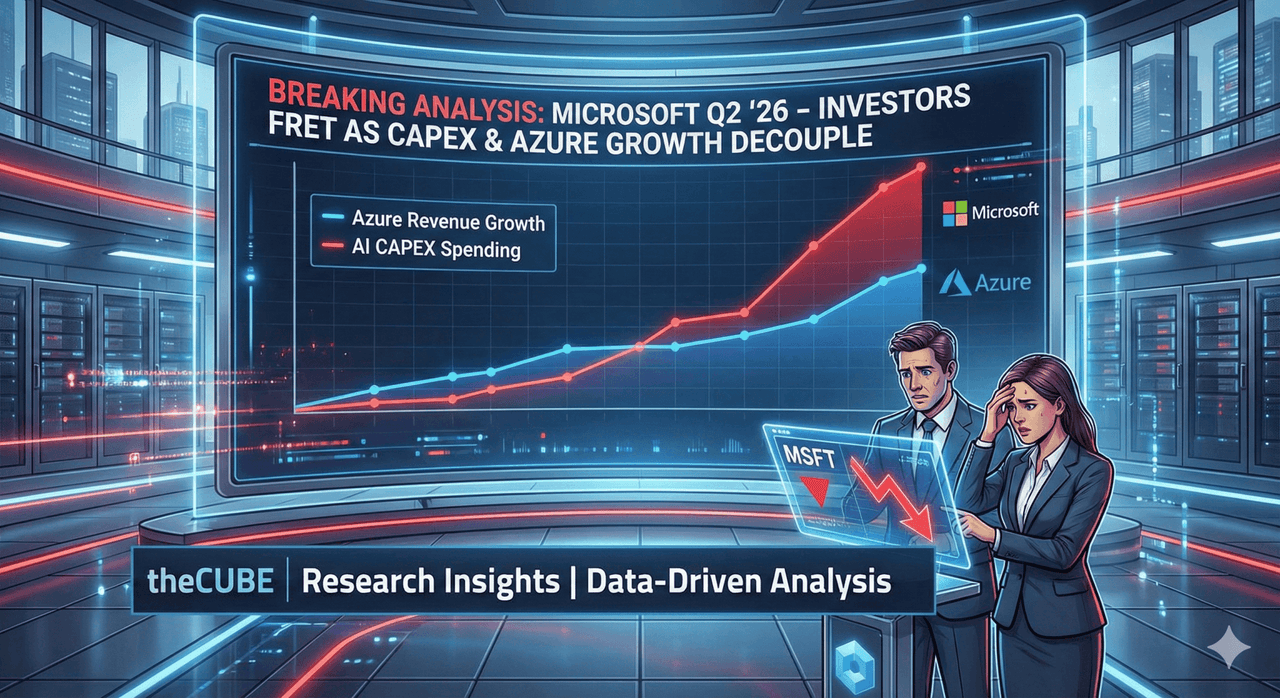
Source: SiliconANGLE
Massive Capital Expenditures Raise Questions About Microsoft's AI Bet
Microsoft has spent $72.4 billion on capital expenditures in the first half of its current fiscal year, approaching the $88.2 billion it spent during the entire previous year
1
. In the second quarter alone, the company invested $37.5 billion, with two-thirds allocated to what CFO Amy Hood described as "short-lived" assets—primarily GPUs and CPUs for Azure cloud infrastructure to serve AI services2
. These chips have just six years to generate profitability before aging out4
. The aggressive data center spending aims to support AI workloads for enterprises and major partners including OpenAI and Anthropic, but Wall Street questions whether this investment will translate into sustained profits.
Source: Market Screener
OpenAI Dominates Microsoft's Revenue Backlog
A particularly striking revelation emerged during the quarterly earnings call: 45% of Microsoft's $625 billion in commercial remaining performance obligations—contracts not yet paid out—comes directly from OpenAI
4
. As part of OpenAI's restructuring into a public benefit corporation last fall, the AI lab committed to purchasing an additional $250 billion in Azure services2
. Microsoft has invested more than $13 billion in OpenAI, which currently translates to a 27% stake valued at $135 billion—over ten times its original investment3
. The company also gained $7.6 billion in net income from its OpenAI investment last quarter alone2
.Anthropic and Nvidia Add to AI Infrastructure Commitments
Microsoft's AI infrastructure commitments extend beyond OpenAI. In November, the company announced a $5 billion investment in Anthropic, with the AI lab signing up for $30 billion of Azure compute capacity
2
. Anthropic contributed to a 230% increase in Microsoft's commercial bookings during the quarter2
. The Anthropic deal includes supporting deployment of up to a gigawatt of compute capacity, specifically tied to Nvidia Grace Blackwell and Vera Rubin systems4
. Adding to the complexity, Nvidia CEO Jensen Huang reportedly expressed doubts about a previously announced $100 billion investment in OpenAI, telling industry associates the commitment was nonbinding and privately criticizing OpenAI's lack of business discipline3
.Satya Nadella Defends AI Strategy with Copilot Usage Metrics
CEO Satya Nadella spent considerable time during the earnings call addressing what observers characterized as "AI use PR," attempting to demonstrate that Microsoft's AI investments are driving actual adoption
1
. Nadella reported that daily users of consumer Copilot AI products had grown "nearly 3x year over year," though he did not disclose specific user numbers1
5
. GitHub Copilot showed stronger metrics with 4.7 million paid subscribers, representing 75% year-over-year growth1
. Microsoft 365 Copilot now has 15 million paid seats from companies, though this represents just a fraction of the 450 million total paid seats in the Microsoft 365 base1
.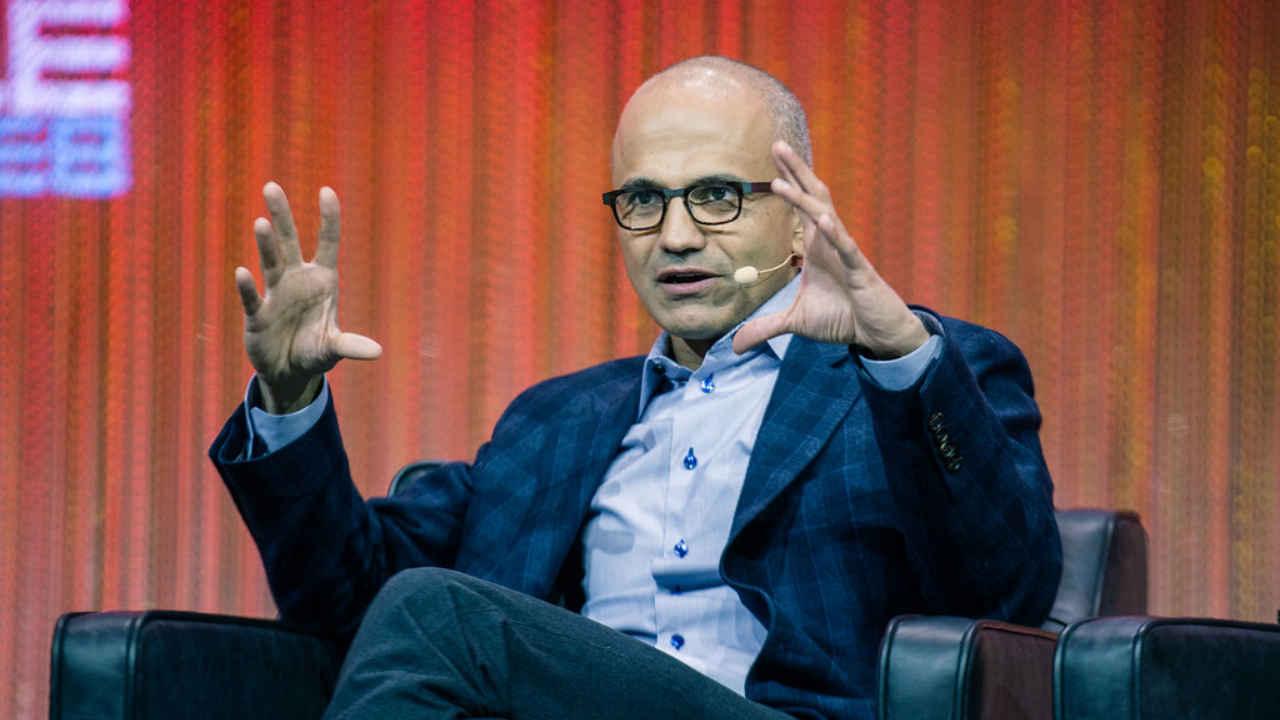
Source: Digit
Related Stories

Execution Challenges Plague Microsoft's AI Products
Despite exclusive access to OpenAI's intellectual property and models through 2032, Microsoft struggles to translate that advantage into competitive products
3
. Users have complained that Copilot is "confusing, constrained and hard to use," creating a perplexing gap between the quality of OpenAI's models and Microsoft's ability to deploy them effectively3
. Anthropic's Claude Cowork, built in just 10 days, can operate computers, organize files, and generate Office documents—capabilities Microsoft Copilot lacks despite Microsoft owning Windows, Office, and LinkedIn3
. David Rainville, lead manager of Sycomore Sustainable Tech, suggested that if Microsoft doesn't release an equivalent product within six months, "heads will have to roll"3
.AI Demand Outpaces Supply, Microsoft Claims
Both Nadella and Amy Hood emphasized during the call that AI demand across products far outstrips current data center supply, meaning new equipment is essentially booked to capacity for its entire lifespan
1
. Hood attempted to reassure investors that the majority of capital spending and GPU purchases are "already contracted for most of their useful life," reducing the risk of stranded assets4
. However, UBS analyst Karl Keirstead noted that both Azure and Microsoft 365 segments "fell a bit short" of growth expectations, identified as the key negative from the quarterly earnings1
. Looking ahead to Q3, Microsoft forecasts revenue between $80.65 billion and $81.75 billion, representing 15% to 17% revenue growth, while expecting lower capital expenditures due to timing variability in cloud infrastructure buildouts4
.References
Summarized by

Navi
[2]
[4]
Related Stories
Microsoft's AI Strategy Shift: Embracing Diversity and Cost-Efficiency in the Face of New Competition
16 May 2025•Technology

Microsoft and OpenAI's Partnership Shows Signs of Strain Amid Financial Pressures and Strategic Shifts
18 Oct 2024•Business and Economy

Microsoft Positions Itself as AI Industry Leader at Annual Developer Conference
19 May 2025•Business and Economy

Recent Highlights
1
OpenAI Releases GPT-5.4, New AI Model Built for Agents and Professional Work
Technology

2
Anthropic sues Pentagon over supply chain risk label after refusing autonomous weapons use
Policy and Regulation

3
OpenAI secures $110 billion funding round as questions swirl around AI bubble and profitability
Business and Economy

Recent Highlights
Today's Top Stories






Your Daily Dose of Curated AI News
Don’t drown in AI news. We cut through the noise - filtering, ranking and summarizing the most important AI news, breakthroughs and research daily. Spend less time searching for the latest in AI and get straight to action.

