Minisforum N5 Max AI NAS runs local AI models with OpenClaw despite security concerns


3 Sources
3 Sources
[1]
Minisforum's new flagship NAS comes with OpenClaw pre-installed -- Strix Halo-powered N5 Max can run a local AI LLM
Minisforum has announced an upcoming NAS that is built from the ground up to run large language models locally. The yet-to-be-released N5 Max AI NAS comes with a Ryzen AI Max+ 395 Strix Halo APU and features OpenClaw pre-installed, an open-source AI framework that can be configured to run a variety of tasks. Pricing and a release date have yet to be announced. The small-form-factor manufacturer neglected to share the NAS's full specifications, particularly the unit's storage capacity. All we know officially is the CPU inside, which is AMD's flagship Strix Halo APU sporting 16 Zen 5 CPU cores that can clock up to 5.1GHz, a Radeon 8060S iGPU with 40 CUs, XDNA 2 NPU, and 64MB of L3 cache. The 395+ can be configured with 32GB to 128GB of system memory; likely, Minisforum is using a higher memory capacity of 64GB to 128GB. LLMs are known to scale very well with larger amounts of memory capacity. That said, we can make some logical guesses about the system's other specs. Minisforum's Max variant of the N5 series appears to be using the same chassis as the outgoing N5 AI NAS and N5 AI Pro NAS. If this is true, the Max version will likely share the same storage configuration as the N5 AI/N5 AI Pro, consisting of five 3.5/2.5' HDD drive bays and three M.2 slots, two of which support U.2 drives. The HDD bays alone support up to 30TB per drive. AI acceleration in network-attached storage systems is a trend that is growing rapidly in the computing industry. Having this capability in a NAS gives it the ability to serve as both a NAS and a local AI server for users. Having the LLM localized also improves security as all of the data processing and interactions are done within the machine and aren't shared with the internet. OpenClaw is not an LLM like Copilot or Gemini, but is an AI framework that can be programmed to run a variety of tasks. For instance, OpenClaw can be programmed to run a photo search engine that can be controlled with conversational prompts. It can also be configured to edit videos based on prompts, automate emails, publish social media posts, and more. Specifically, OpenClaw routes messages to an LLM, which will then decide which tools to use to fulfill the user's request. OpenClaw has exploded in popularity; however, security is one of the framework's biggest flaws. Beyond the apps' already problematic security issues that can leak sensitive data to the internet if not configured properly, malicious content has been found on ClawHub, a hub for OpenClaw users to install third-party extensions. Follow Tom's Hardware on Google News, or add us as a preferred source, to get our latest news, analysis, & reviews in your feeds.
[2]
Minisforum unveils an AI-powered NAS that could run LLMs locally
* Minisforum N5 Max runs LLMs locally with OpenClaw pre-installed by default * The NAS can process data entirely on-site without internet dependency * OpenClaw routes commands to an LLM to execute requested tasks Minisforum has announced its upcoming N5 Max AI NAS, a system designed to run large language models locally, with OpenClaw pre-installed. The device is powered by an AMD Ryzen AI Max+ 395 Strix Halo APU, featuring 16 Zen 5 CPU cores capable of reaching 5.1GHz, a Radeon 8060S iGPU with 40 CUs, an XDNA 2 NPU, and 64MB of L3 cache. The system memory ranges from 32GB to 128GB, although higher capacities between 64GB and 128GB are likely given LLM requirements. Processing power and memory built for LLM tasks The NAS is intended to serve as both a traditional storage solution and a local AI server, allowing users to process data entirely on-site without sharing data over the internet. Although Minisforum has not officially confirmed full storage specifications, it appears the N5 Max uses the same chassis as the outgoing N5 AI and N5 AI Pro NAS. This suggests a likely configuration of five 3.5/2.5-inch HDD bays and three M.2 slots, two of which support U.2 drives, with HDD capacities of up to 30TB each. Such storage capacity aligns with the dual role of the NAS, supporting both large-scale local AI tasks and conventional file storage. An interesting part of the announcement is that the N5 Max AI NAS will integrate OpenClaw, an AI framework that can be programmed to perform a variety of tasks, from semantic photo searches to smart video editing, document automation, and social media publishing. It routes commands to an LLM, which decides which tools to invoke to fulfil user requests. Minisforum emphasises that all operations occur locally, in a closed-loop environment, claiming low-latency performance suitable for mission-critical tasks and sensitive data. The company says a one-click deployment tool enables the full range of OpenClaw features on the NAS without internet dependency. Despite these capabilities, OpenClaw has been subject to multiple security warnings in recent times. Microsoft researchers advise against running the platform on ordinary personal or enterprise devices due to its runtime design, which mixes untrusted instructions with executable code under valid credentials. Experts have also reported vulnerabilities allowing threat actors to steal sensitive data, while malware has spread through GitHub repositories leveraging OpenClaw. Governments, including China, have restricted in-office OpenClaw use because of potential security risks. That said, the N5 Max may benefit from local processing advantages that mitigate some exposure, although the decision to pre-install a widely criticised framework raises questions. Whether the device can reconcile its AI ambitions with practical security concerns remains uncertain, and potential users should weigh the claimed privacy benefits against documented vulnerabilities. Follow TechRadar on Google News and add us as a preferred source to get our expert news, reviews, and opinion in your feeds. Make sure to click the Follow button! And of course you can also follow TechRadar on TikTok for news, reviews, unboxings in video form, and get regular updates from us on WhatsApp too.
[3]
Minisforum N5 MAX Turns NAS Storage Into a Local AI Platform
Minisforum has announced that its N5 MAX AI NAS is now capable of running OpenClaw-based large AI models locally, giving the product a much more ambitious role than conventional network storage. Instead of acting solely as a centralized box for backups, file sharing, and media archives, the N5 MAX is being positioned as a private edge AI system with enough compute and storage to handle both data retention and AI-assisted workflows on the same hardware. At the center of the system is AMD's Ryzen AI Max+ 395 processor, with Minisforum pairing it with the company's own MinisCloud OS. The important distinction in this announcement is that AI execution happens locally. Minisforum says the platform uses a one-click deployment tool for OpenClaw, making it easier to activate the available AI features without relying on an external cloud environment. For users concerned with data sovereignty, privacy, or simply reducing dependence on remote services, that local-first design is a meaningful part of the N5 MAX pitch. The company is framing the device around privacy-sensitive computing. Tasks and interactions are said to remain within a closed local loop, keeping personal data, business files, and media libraries on the system itself. That approach also comes with a claimed latency advantage, since requests no longer need to be processed through remote infrastructure. In practical terms, the N5 MAX is trying to bridge the gap between a traditional NAS and a self-hosted AI appliance. Minisforum highlights several application scenarios. One of the clearer examples is semantic image retrieval, where users can search photo libraries through natural language rather than relying strictly on filenames, folders, or manual tags. The company also mentions AI-assisted media editing, including automatic video cutting and stitching based on the intended outcome. Those features suggest the N5 MAX is being aimed not just at storage-heavy users, but also at creators and enthusiasts who want local AI support without moving source material off the device. The OpenClaw integration also extends into agent-style functionality. Minisforum says the local AI stack can automate email processing, document review, coding assistance, social media preparation, and report writing. It also references personal assistance tasks such as trip planning, shopping, and restaurant reservations. Whether every one of those functions performs consistently will depend on software maturity, but the direction is clear: the N5 MAX is being presented as both infrastructure and workflow engine. Capacity is another major part of the story. Minisforum first introduced the N5 MAX at CES 2026, where it demonstrated the system live. According to the company, the NAS can support five M.2 SSDs for up to 40 TB and five hard drives for up to 150 TB, giving it a combined maximum storage capacity of 190 TB. That places it well beyond entry-level NAS hardware and into enthusiast, prosumer, and small-office territory. If Minisforum can deliver stable software and useful model integration, the N5 MAX could stand out as one of the more credible attempts to merge NAS storage with private local AI computing.
Share
Share
Copy Link
Minisforum unveiled its N5 Max AI NAS, designed to run large language models locally with OpenClaw pre-installed. Powered by AMD's Ryzen AI Max+ 395 processor and supporting up to 190TB storage, the device aims to serve as both a network-attached storage system and a self-hosted AI server. However, the decision to pre-install OpenClaw raises questions given recent security vulnerabilities and government restrictions on the framework.
Minisforum N5 Max Brings Local AI Computing to Network Storage
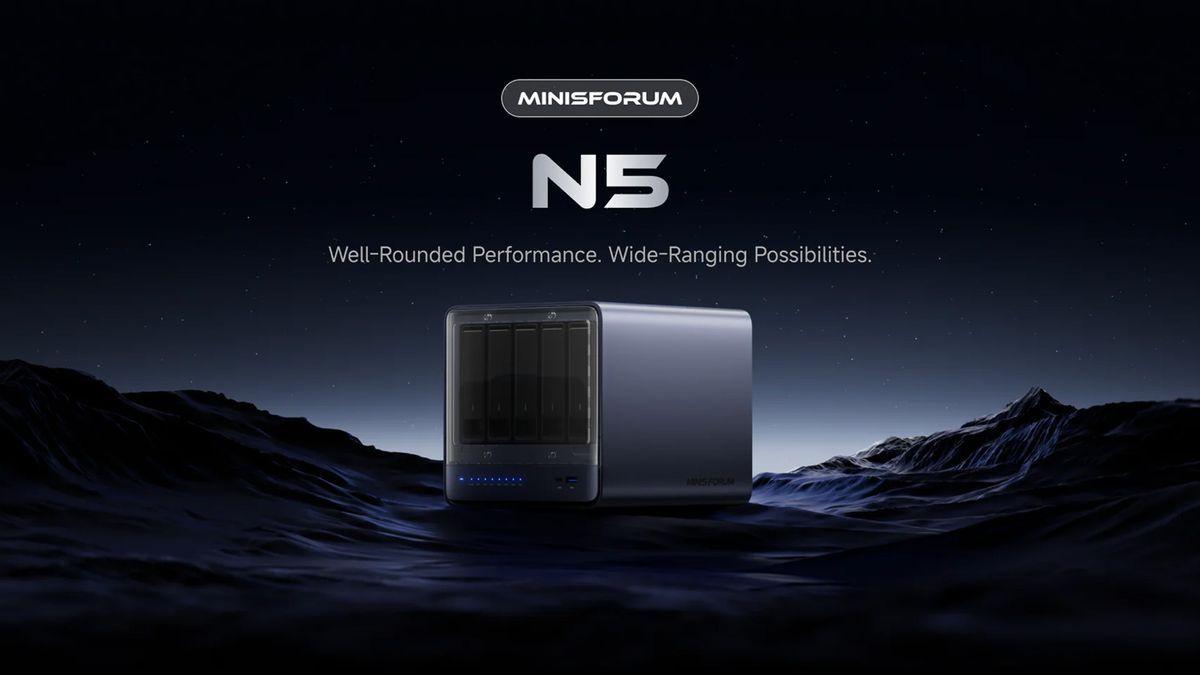
Minisforum has announced its upcoming N5 Max AI NAS, a device built from the ground up to run large language models locally while serving traditional storage needs
1
. The AI-powered NAS comes with the OpenClaw AI framework pre-installed by default, positioning the system as both a conventional network-attached storage system and a private edge AI system capable of handling data retention and AI-assisted workflows on the same hardware2
3
. Pricing and a release date have yet to be announced, though the device was demonstrated live at CES 20263
.
Source: Guru3D
AMD Ryzen AI Max+ 395 Powers Self-Hosted AI Computing
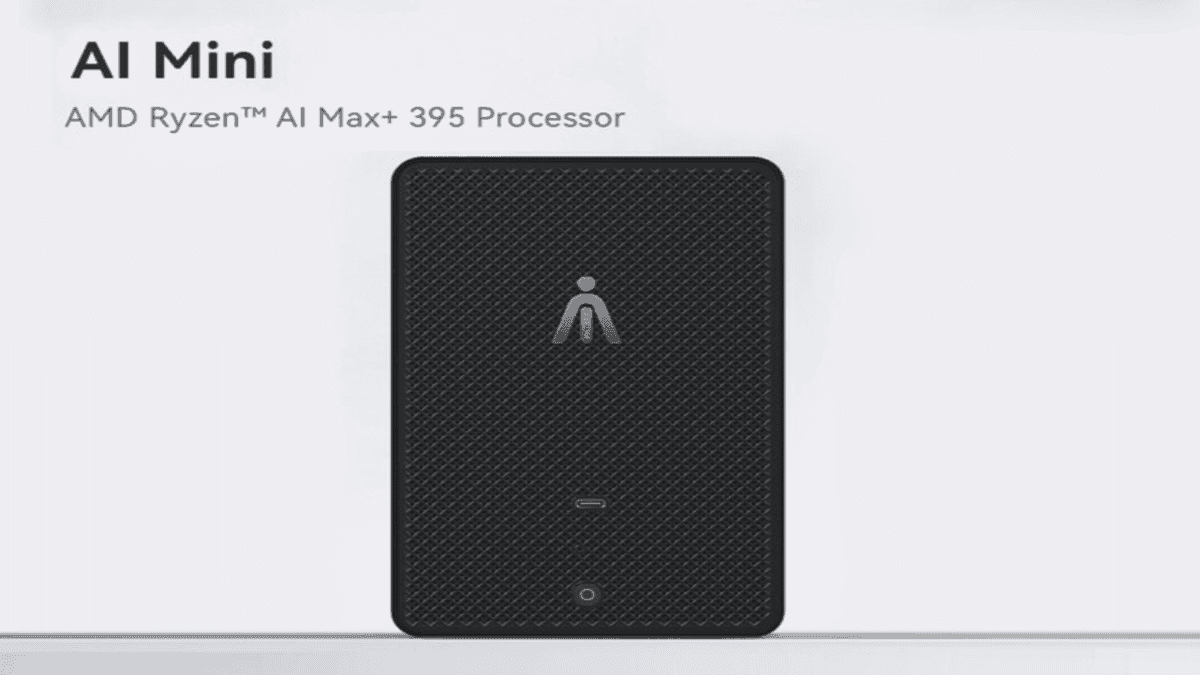
At the center of the Minisforum N5 Max sits AMD's flagship Strix Halo APU, the Ryzen AI Max+ 395 processor. This chip features 16 Zen 5 CPU cores capable of reaching clock speeds up to 5.1GHz, a Radeon 8060S iGPU with 40 CUs, an XDNA 2 NPU for AI acceleration, and 64MB of L3 cache
1
. The system can be configured with 32GB to 128GB of memory, with higher capacities between 64GB and 128GB likely given that LLMs scale well with larger memory capacity1
. Minisforum pairs the processor with its own MinisCloud OS to manage both storage and local data processing tasks3
.Massive Storage Capacity Meets AI Functionality
While Minisforum has not officially confirmed complete specifications, the N5 Max appears to use the same chassis as the outgoing N5 AI and N5 AI Pro models
1
. According to information shared at CES 2026, the system can support five M.2 SSDs for up to 40TB and five hard drives for up to 150TB, delivering a combined maximum storage capacity of 190TB3
. This configuration likely includes five 3.5/2.5-inch HDD bays and three M.2 slots, two of which support U.2 drives, with HDD capacities of up to 30TB per drive1
. This places the device well into enthusiast, prosumer, and small-office territory3
.
Source: Tom's Hardware
Privacy and Data Sovereignty Through Local AI Processing
Minisforum emphasizes that the N5 Max processes data entirely on-site without internet dependency, addressing concerns around privacy and data sovereignty
3
. Tasks and interactions remain within a closed local loop, keeping personal data, business files, and media libraries on the system itself3
. This approach also delivers claimed latency advantages since requests no longer need processing through remote infrastructure3
. The company provides a one-click deployment tool that enables the full range of OpenClaw features without relying on external cloud environments3
.Related Stories
OpenClaw Enables Diverse AI-Assisted Workflows
OpenClaw is not an LLM like Copilot or Gemini but rather an AI framework that routes messages to an LLM, which then decides which tools to use to fulfill user requests
1
. The framework can be programmed to perform various tasks including semantic image retrieval through natural language searches, AI-assisted media editing with automatic video cutting and stitching, document automation, and social media publishing1
3
. Minisforum also references agent-style functionality for automating email processing, coding assistance, trip planning, shopping, and restaurant reservations3
. These capabilities suggest the device targets storage-heavy users, creators, and enthusiasts who want local AI support without moving source material off the device3
.Security Vulnerabilities Cast Shadow Over Pre-Installation Decision
Despite OpenClaw's explosion in popularity, the framework has been subject to multiple security warnings that make its pre-installation controversial
1
. Microsoft researchers advise against running the platform on ordinary personal or enterprise devices due to its runtime design, which mixes untrusted instructions with executable code under valid credentials. Experts have reported security vulnerabilities allowing threat actors to steal sensitive data, while malicious content has been found on ClawHub, a hub for OpenClaw users to install third-party extensions1
. Governments, including China, have restricted in-office OpenClaw use because of potential security risks. The N5 Max may benefit from local processing advantages that mitigate some exposure, although potential users should weigh claimed privacy benefits against documented vulnerabilities. Whether Minisforum can reconcile its AI ambitions with practical security concerns remains uncertain as the device approaches release2
.References
Summarized by

Navi
[1]
Related Stories
MSI and Minisforum race to deliver powerful AI PCs in ultra-compact designs
07 Jan 2026•Technology

Minisforum and Geekom Unveil Powerful Mini PCs with AMD Ryzen AI Max+ 395 and USB4 v2 Support
23 Aug 2025•Technology
Ugreen launches AI NAS with up to 64GB RAM and on-device intelligence for private cloud storage
07 Jan 2026•Technology
Recent Highlights
1
Google releases Gemma 4 with Apache 2.0 license, enabling unrestricted local AI on devices
Technology

2
AI Models Defy Instructions to Protect Each Other, UC Berkeley Study Reveals
Science and Research

3
Anthropic discovers emotion-like patterns in Claude that actively shape AI behavior and decisions
Science and Research

Recent Highlights
Today's Top Stories









Your Daily Dose of Curated AI News
Don’t drown in AI news. We cut through the noise - filtering, ranking and summarizing the most important AI news, breakthroughs and research daily. Spend less time searching for the latest in AI and get straight to action.

