Model Context Protocol emerges as the missing layer connecting Agentic AI to real-world systems


3 Sources
3 Sources
[1]
Model Context Protocols: what they are and how you can use them: By Adam Lieberman
To use a hardware analogy, MCPs work much like USB ports on devices in so much as they allow us to connect a multitude of other devices and peripherals to our main device. In a similar fashion, MCPs allow us to plug different tools and pieces of software into AI-centric applications, like connecting ChatGPT to GitHub, for example, but through a bespoke UI. The business case for MCP servers The immediate potential of MCP servers lies in their ability to support a new way of working for today's digital natives. Those within this cohort, and those that will follow, will have begun their professional lives and grown up in the era of Gen AI, with the likes of ChatGPT, Claude, Perplexity, and Midjourney being as common as the traditional Microsoft Office suite of applications is to previous generations. AI is now everywhere and MCP servers are a technology that enables Gen AI tools to be embedded seamlessly into other applications, enabling a layer of abstraction from the core technology. Using a financial services example, MCP servers allow users to interface with financial products and services without having to log in or connect directly to a financial application. In the future, users will be able to simply ask a chatbot a question, via a personalized UI, about their personal finances or business account and receive the answer. Similarly, businesses will be able to use the same technology internally to help with their daily workflows. For example, a payment operator could use a chatbot to find out how many payments errors have occurred over a set period; a loan provider could inquire about the amount of loans they have approved over the year against rejected applications; and an HR professional could ask about the average salary for a role they are advertising, and so on. Ensuring trust in MCP servers Of course, the necessary permissions and security protocols will have to be in place when it comes to accessing different applications and systems for data extraction, and this also applies to organizations that provide access to their own systems and applications via MCP servers. Ensuring best practise when building MCP servers with regard to security, discoverability, and reliability, is essential to avoid vulnerabilities. As the use of agents becomes the norm, and we move closer to unlocking fully autonomous agentic AI systems, developers are going to bear the responsibility for controlling which MCP servers agents can access. Building your own MCP servers can provide greater certainty when it comes to security, but if you are going to give agents the power to access other MCP servers, we must be mindful of the risks and ensure due diligence. Risks and rewards New technologies are emerging all the time that extend what is possible with AI. In just the last year, we have seen an explosion of interest in agents and agentic AI systems, reasoning models, RAG systems, and now we are looking at what's possible with MCP servers and agent-to-agent (A2A) protocols. There are always risks when it comes to venturing into the unknown, but the core principles of ethics, security, reliability, governance, and scalability must be observed when building solutions and systems with new technologies, such as MCP servers. These principles must also evolve as architectural paradigms shift, particularly in line with increased automation. It's a great example of the self-perpetuating nature of technological innovation. Much like the move from the Ford Model T to the high-performance vehicles of today, which have evolved to incorporate several safety features, the evolution of software reveals new ways in which we can improve security. MCP servers, and increasingly A2A protocols, are the latest technology that allows us to extend the capabilities of AI and discover new avenues of innovation and we must continue to diligently assess the risk profile of every nascent technology and evolve accordingly.
[2]
How Does an MCP Work Under the Hood? MCP Workflow Explained
We've all faced that awkward limitation with AI: it can write code or explain complex topics in seconds, but the moment you ask it to check a local file or run a quick database query, it hits a wall. It's like having a genius assistant who is locked in an empty room -- smart, but completely cut off from your actual work. This is where the Model Context Protocol (MCP) changes the game. In this article, we'll explore MCP in depth. LLMs possess impressive knowledge and reasoning skills, which allow them to perform many complex tasks. But the problem is that their knowledge is limited to their initial training data. It means they can't access your calendar, run SQL queries, or send an email. It was clear that, to give the LLMs real-world knowledge, we have to provide some integrations that enable them to access real-time knowledge or perform some actions in the real world. This leads to the classic MxN problems, where developers have to build and maintain custom integrations for every combination of M models and N tools. The image below properly demonstrates the MxN Problem: Function calling (also known as tool calling) provides a powerful and flexible way for OpenAI models to interface with external systems and access data outside their training data. However, this feature is currently exclusive to OpenAI models, creating vendor lock-in. That's where MCP steps in. MCP is a write once, use anywhere approach to the problem. An app developer can write a single MCP server for any AI system to use and expose a set of tools and data. Similarly, an AI system can implement the protocol and connect to any MCP server that exists today or in the future. MCP is an open-source standard, developed by Anthropic, for connecting AI applications to external systems. By using an MCP, AI applications like Claude or ChatGPT can connect to data sources like local files and databases, tools like search engines and calculators, and workflows like specialized prompts -- enabling them to access key information and perform tasks. Think of an MCP like a USB-C port for AI applications. Just as USB-C provides a standardized way to connect electronic devices, an MCP provides a standardized way to connect AI applications to external systems. The image below will help you to better understand the MCP Server: The Model Context Protocol has a clear structure with components that work together to help LLMs and outside systems interact easily. An MCP follows a simple client-server architecture, which can be broken down into three simple key components: The host is the user-facing AI application, the environment where the AI model lives and interacts with the user. Hosts manage the discovery, permissions, and communication between clients and servers. This ca be a chat application like OpenAI's ChatGPT interface or Anthropic's Claude desktop app, or an AI-enhanced IDE like Cursor & Windsurf. The MCP client is a component within the host that handles the low-level communication with the MCP server. MCP clients are instantiated by host applications to communicate with particular MCP servers. Each client handles one direct communication with one server. Here, the difference is important: the host is the application users interact with, while clients are the components that enable server connections. The MCP server is the external program or service that exposes the capabilities (tools, data, and so on) to the application. An MCP server can be seen as a wrapper around some functionality, which exposes a set of tools or resources in a standardized way so that any MCP client can invoke them. Servers can run locally on the same machine as the host, or remotely on some cloud service, since an MCP is designed to support both scenarios seamlessly The image below will help you to better understand the concept: An MCP server can expose one or more capabilities to the client. Capabilities are essentially the features or functions that the server makes available. The MCP server provides the following capabilities: The transport layer uses JSON-RPC 2.0 messages to communicate between the client and server. For this, we have mainly two transport methods: An MCP gives an AI assistant the ability to securely use external tools, databases, and services. Imagine you ask Claude: "Find the latest sales report in our database and email it to my manager." When we launch any MCP client (Claude Desktop), it connects to your configured MCP servers and asks: "What can I do with available tools?" Before any external action happens, Claude Desktop prompts you: "Claude wants to query your sales database. Allow?" Nothing proceeds without your approval. This is core to the MCP's security model. Once you grant the permission, Claude sends a structured MCP tool call to the server. Next, the server will run a secure database lookup and return the latest sales report data. This doesn't give Claude direct access to the database. Once Claude has the data, Claude triggers a second permission prompt: "Claude wants to send an email on your behalf. Approve?" Once approved, MCP sends the information to the server, and Claude will format the email & deliver it to your manager Claude wraps everything up nicely and sends a response to you, "Done! I found the latest sales report and emailed it to your manager." The entire process typically happens in seconds. From your perspective, Claude simply "knows" how to access your database and send emails, but in reality, the MCP has orchestrated a secure, standardized exchange between multiple systems. The beauty of MCP is that it transforms AI assistants from isolated conversational tools into genuine productivity partners that can interact with your entire digital ecosystem, safely and with your explicit permission every step of the way. Fundamentally, MCP and RAG are built for serving different purposes. RAG is a technique that is used to supply the relevant knowledge that we have stored in a vector database. In RAG, the user's query is converted to a vector embedding, which searches through embeddings in the vector database and finds the relevant context based on similarity. This relevant context is then provided to the LLM. It is great for answering questions from large documents like company wikis, knowledge bases, or research papers. An MCP enables AI models to perform real-world actions with the help of tools. It lets the AI connect to tools and services like databases, APIs, Gmail, calendar, and so on. The Model Context Protocol (MCP) and the Agent-to-Agent (A2A) protocol are complementary open standards in AI architecture that serve different purposes in how AI agents connect with external systems. For more information on the MCP, you can refer to the official website: modelcontextprotocol.io. Some of the awesome MCP Servers which you can check: You can explore a list of available MCP servers here: https://github.com/punkpeye/awesome-mcp-servers If you're interested in learning how to build your own MCP server, check out this detailed course on Hugging Face: https://huggingface.co/mcp-course. MCP (Model Context Protocol) is an open-source standard for connecting AI applications to external systems. With MCP, AI models are not just chatbots, they are fully capable agents that can work with your local files, query your database, send emails with your permission and control. It has also solved the classic MxN problem -- developers only need to build the MCP server once, then all other AI systems can integrate the MCP server in their application. MCP is the revolution in how AI systems can interact with the real world. As the ecosystem of the MCP continues to grow, it will enable AI agents to become more powerful assistants that can operate across diverse environments with reliability and security.
[3]
Model Context Protocol: The Missing Layer in Agentic AI
Join the DZone community and get the full member experience. Join For Free AI agents are growing at a breakneck pace and are becoming highly efficient at automating routine tasks. However, amid all the exciting innovation across different use cases, even the most advanced models fall short due to a fundamental limitation: real-world applicability. They can think autonomously, yet they struggle to act reliably in real-world environments. For all their reasoning power, large language models (LLMs) often remain isolated. To unlock their full usability, they must be connected to the right tools, data sources, and systems. This is where the Model Context Protocol (MCP) is rewriting the rules of the AI landscape. One could say that MCP is the missing layer in the current Agentic AI stack. It is a unifying protocol that provides models with a predictable way to integrate with external environments. Its power lies in being cleanly designed, extensible, and capable of working across a broad array of platforms and runtimes. While MCP is still in its early stages, its rapidly growing use cases already allow developers and enterprises to build automation and agent workflows with far greater confidence. In this sense, MCP is doing for AI what HTTP did for the web: laying the foundational bricks for an ecosystem of intelligent, interoperable, and highly capable systems. MCP in Action: Use Cases MCP opens up new possibilities in orchestrating workflows, integrations, and multi-agent coordination. One of the striking benefits is streamlined workflow automation. As an example, consider a marketing analytics platform. It is based on a plethora of AI models - from a sentiment analysis model and a content recommendation engine to a predictive sales model. Without the organizing layer of MCP, every model operates in silos. This often necessitates manual interventions to integrate systems or share contextual data. With an MCP - exchange of information across audience segmentation, campaign metadata, or engagement history becomes a breeze. This can result in comprehensive insights. In the area of tools and API integrations, MCP bridges the gap between AI and 3rd party software systems. Consider a scenario wherein a research assistant needs information from multiple data repositories and APIs. These could scientific journals, patent databases, or regulatory records. MCP harmonizes the contextual information the AI receives and sends. This ensures that the assistant retrieves relevant data and updates all downstream systems in real time. Multi-agent coordination is another area where MCP excels at. Consider a logistics use case wherein multiple AI agents take upon the tasks of route optimization, inventory management, and customer notifications. MCP becomes a glue in combining stock levels, shipment delays, or traffic updates - all without requiring custom connectors for every interaction. This entire system works cohesively with the changing business conditions. Benefits of Adopting MCP MCP drives efficiency: a major factor in standardizing framework for context sharing. Further, this efficiency can be extended to time-sensitive environments inclusive of real-time analytics or autonomous systems, where delays in context exchange can have cascading effects. Interoperability is another significant benefit of MCP. It can work as a "universal" language for AI models and data. Even legacy systems can be integrated with modern AI systems in a jiffy - combining third-party APIs and linking specialized datasets without developing custom connectors for each workflow. This has the potential to significantly accelerate development timelines. Lastly, scalability is achieved by MCP. Based on the business needs, and as organizations expand their scope of AI use cases - adding new models or agents can be done easily without rewriting existing logic. A plug and play approach can be adopted wherein the required component can plug into the ecosystem while maintaining consistent context exchange. This reduces operational friction in the long run and helps in driving complex AI deployments seamlessly. Future of Agentic AI with MCP MCP is becoming a pivotal enabler for Agentic AI systems -- allowing them to operate autonomously, collaborate seamlessly, and adapt dynamically to complex environments. Minimal human intervention is required for agents to share context and coordinate actions. MCP also accelerates experimentation by enabling organizations to integrate cutting-edge models, tools, and datasets without custom coding. Researchers can simulate multi-agent environments, train models with dynamic contextual inputs, and deploy adaptive systems that evolve over time. Looking ahead, MCP is likely to underpin community-driven AI standards, promoting shared protocols that reduce fragmentation and improve reliability across industries. By adopting MCP, organizations position themselves at the forefront of agentic AI innovation, fostering ecosystems where autonomous agents collaborate safely, efficiently, and transparently. In essence, the future of agentic AI is one of connected, context-aware intelligence -- and MCP is the missing link that turns this vision into reality. As adoption grows, MCP will not only streamline AI operations but also redefine how humans and intelligent systems work together, opening the door to a new era of autonomous, coordinated, and highly adaptive AI solutions. This creates a truly collaborative intelligence, where the sum of the system is far greater than its individual parts.
Share
Share
Copy Link
Anthropic's open-source Model Context Protocol is solving a fundamental problem in AI: connecting large language models to external tools, databases, and systems. Like USB-C for AI applications, MCP provides a standardized interface that eliminates custom integrations, enabling seamless AI workflow automation and multi-agent coordination across platforms.
MCP Solves the Integration Problem Holding AI Back
Large Language Models possess impressive reasoning capabilities, yet they remain fundamentally limited by their inability to interact with real-world systems. While LLMs can explain complex topics or write code, they hit a wall when asked to check local files, run database queries, or send emails
2
. The Model Context Protocol addresses this critical gap by providing a standardized interface for AI that eliminates the classic MxN problem, where developers previously had to build and maintain custom integrations for every combination of M models and N tools2
.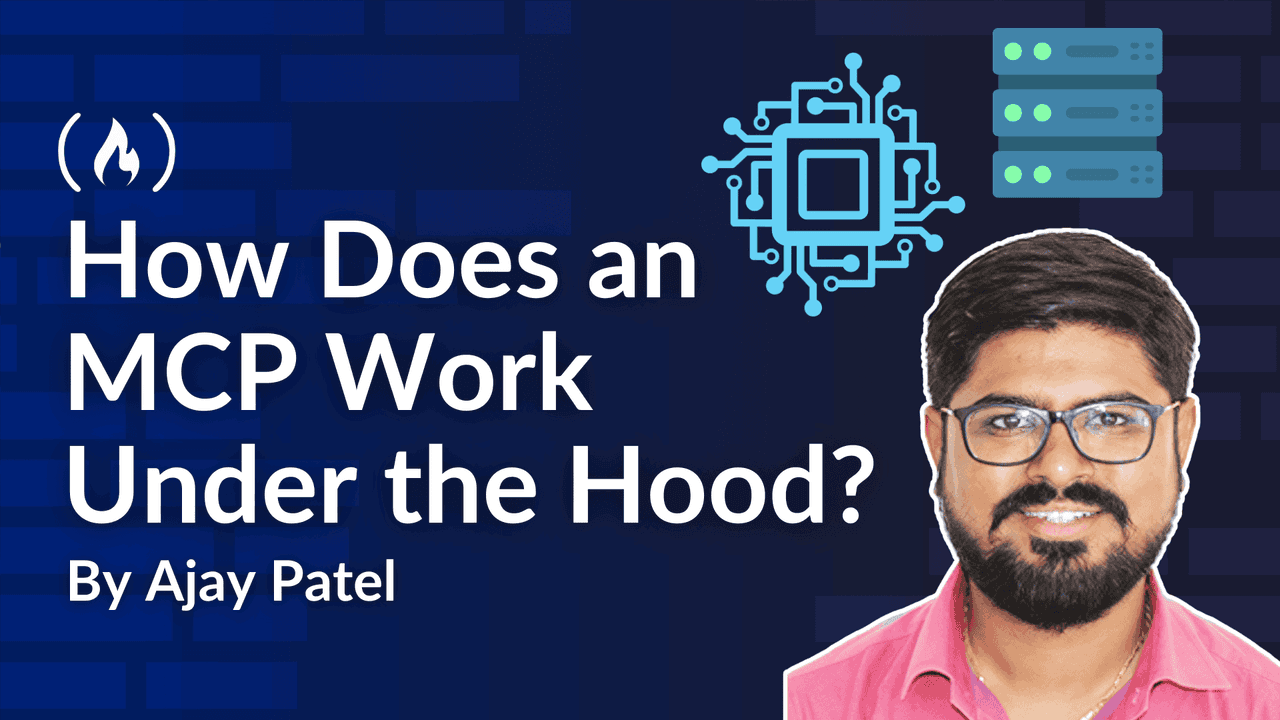
Source: freeCodeCamp
Developed by Anthropic as an open-source AI standard, the Model Context Protocol functions much like USB ports on devices, allowing multiple tools and software to plug into AI-centric applications through a unified framework
1
. This write-once, use-anywhere approach means an app developer can create a single MCP server for any AI system to use, while AI systems implementing the protocol can connect to any existing or future MCP server2
. The protocol eliminates vendor lock-in issues that plagued earlier solutions like function calling, which remained exclusive to OpenAI models2
.How MCP Client-Server Architecture Enables Secure AI Communication
The Model Context Protocol operates through a clear client-server architecture with three key components working together to facilitate AI interaction with external systems. The host serves as the user-facing AI application where the model lives, such as ChatGPT, Claude desktop app, or AI-enhanced IDEs like Cursor and Windsurf
2
. Within the host, MCP clients handle low-level communication with MCP servers, with each client managing one direct connection to one server2
.MCP servers function as external programs exposing capabilities like tools and data in a standardized way that any MCP client can invoke. These servers can run locally on the same machine as the host or remotely on cloud services, with the protocol designed to support both scenarios seamlessly
2
. The transport layer uses JSON-RPC 2.0 messages to communicate between client and server, ensuring structured and reliable data exchange2
.Security protocols remain central to MCP's design. Before any external action occurs, the system prompts users for explicit permission, such as "Claude wants to query your sales database. Allow?"
2
. Nothing proceeds without approval, ensuring that AI systems never gain direct access to sensitive systems but rather work through controlled, secure interfaces. Organizations providing access via MCP servers must ensure best practices regarding security, discoverability, and reliability to avoid vulnerabilities1
.AI Workflow Automation Transforms Business Operations
The business case for Model Context Protocol centers on enabling a new way of working for digital natives who have grown up with generative AI tools as common as Microsoft Office
1
. In financial services, MCP servers allow users to interface with products and services without logging directly into financial applications. Users can simply ask a chatbot about their personal finances or business account and receive answers through a personalized interface1
.Internal business workflows benefit significantly from LLM integration with tools. A payment operator could use a chatbot to determine payment errors over a set period, while a loan provider could inquire about approved versus rejected applications, and HR professionals could ask about average salaries for advertised roles
1
. Marketing analytics platforms demonstrate MCP's power by connecting sentiment analysis models, content recommendation engines, and predictive sales models that previously operated in silos3
. With MCP facilitating exchange of audience segmentation, campaign metadata, and engagement history, organizations gain comprehensive insights without manual integration3
.Related Stories

Multi-Agent Coordination Unlocks Complex Use Cases
Multi-agent coordination represents one of the most compelling applications for Agentic AI systems built on Model Context Protocol. In logistics scenarios, multiple AI agents handling route optimization, inventory management, and customer notifications can work cohesively through MCP's ability to combine stock levels, shipment delays, and traffic updates without requiring custom connectors for every interaction
3
. Research assistants needing information from scientific journals, patent databases, and regulatory records benefit from MCP harmonizing contextual information, ensuring relevant data retrieval while updating all downstream systems in real time3
.The protocol enables interoperability by working as a universal language for AI models and external data sources. Even legacy systems can integrate with modern AI systems quickly, combining third-party API integrations and linking specialized datasets without developing custom connectors for each workflow
3
. Scalability becomes achievable as organizations expand AI use cases, with new models or agents added through a plug-and-play approach that maintains consistent context exchange3
.Navigating Risks While Embracing Innovation
As Model Context Protocol gains adoption alongside other emerging technologies like A2A (agent-to-agent) protocols, RAG (Retrieval-Augmented Generation) systems, and reasoning models, developers bear responsibility for controlling which MCP servers agents can access
1
. Building proprietary MCP servers provides greater certainty around security, but granting agents power to access external servers requires due diligence and mindfulness of risks1
.Core principles of ethics, security, reliability, governance, and scalability must be observed when building solutions with new technologies. These ethical considerations must evolve as architectural paradigms shift, particularly with increased automation
1
. Looking ahead, MCP is likely to underpin community-driven AI standards, promoting shared protocols that reduce fragmentation and improve reliability across industries3
. Organizations adopting MCP position themselves at the forefront of agentic AI innovation, with minimal human intervention required for agents to share context and coordinate actions autonomously3
.References
Summarized by

Navi
[1]
[2]
Related Stories
MCP: The New "USB-C for AI" Unifying Rivals and Revolutionizing AI Tool Integration
28 Mar 2025•Technology

Model Context Protocol (MCP): Revolutionizing AI Integration and Tool Interaction
05 Jul 2025•Technology

Model Context Protocol: Bridging the Gap Between AI Models and Real-World Applications
02 Jun 2025•Technology

Recent Highlights
1
Google Maps unveils Ask Maps with Gemini AI and 3D Immersive Navigation in biggest update
Technology

2
Three Tennessee teens sue xAI over Grok AI creating child sexual abuse material from real photos
Policy and Regulation

3
Meta plans to cut 20% of workforce as AI spending reaches $600 billion, mirroring broader tech trend
Business and Economy
Recent Highlights
Today's Top Stories




Your Daily Dose of Curated AI News
Don’t drown in AI news. We cut through the noise - filtering, ranking and summarizing the most important AI news, breakthroughs and research daily. Spend less time searching for the latest in AI and get straight to action.

