Nvidia's DLSS 5 brings AI-powered neural rendering to games, sparking fierce debate


23 Sources
23 Sources
[1]
Nvidia Wants to Slop-ify Your PC Games With Its New AI Upscaler
You'll love DLSS 5 if you can't get enough of ugly, uncanny, and overly textured AI slop. Tired of DLSS 4.5? Nvidia said DLSS 5 is on the way, and it's bringing real-time slop-ification to PC gaming. The best I can say is if you love uncanny and overly manicured AI images of people, you’ll love what Nvidia hopes to do to your favorite game. Nvidia announced at GTC 2026 that DLSS 5 brings forth a new “real-time rendering model†that is supposed to make in-game lighting effects look even more realistic bouncing off characters’ skin. Actually, it does much more than that. Nvidia said that AI takes each game’s color and motion vector and “infuses†the scene with new materials. Like many generative AI video apps, the AI is supposed to be able to keep the images consistent from frame to frame. And just like an AI video, the characters in-game look like homunculi drafted from the bargain bin of internet supermodel stock images. Resident Evil Requiem running with DLSS 5 (left) and without DLSS 5 (right). © Nvidia A lifetime of being betrayed by CGI-rendered and otherwise touched-up game trailers has taught me to wait until I see a game’s graphics firsthand before having any knee-jerk reactions. However, since first witnessing the next update to Nvidia’s DLSS and its impact on games like Resident Evil Requiem, I can’t peel away the rictus grimace off my face. Nvidia's blog post showcasing DLSS 5’s effects on games is full of character models that appear like horrible AI-generated mockups of what we’ve seen in-game. While Resident Evil Requiem’s characters may bear a slight plastic, Barbie-doll appearance without the refined shadows, the DLSS 5 characters look like pure slop. A wizened old witch in Hogwarts Legacy appears with far more facial wrinkles than without DLSS 5. Bethesda’s bland-faced characters in Starfield suddenly appear with pronounced eyebrows and cheekbones that stretch perilously close to the uncanny valley. DLSS 5 will support resolutions up to 4K and should become available with existing titles like Assassin’s Creed Shadows and The Elder Scrolls IV: Oblivion Remastered, and many more besides. Nvidia quotes Bethesda studio head Todd Howard saying “it was amazing†how it brought Starfield “to life.†That sense of "realism" will inevitably impact some games with more stylized characters. Digital Foundry showcased video of DLSS 5 running on the Oblivion remake. Its odd-looking character models on the remaster were updated to resemble the Xbox 360-era title's alien-looking townsfolk. With DLSS 5, those same models appear more like a craggy skin texture adhered to a beaten pineapple. Grace Ashcroft, one of the game's dual protagonists, appears more like AI’s demented imagination of a supermodel stapled over the FBI analyst’s face. The game running with DLSS 5 displays how Resident Evil series' golden boy Leon Kennedy would look if you put the prompt “grizzled horror series protagonist with a boy band haircut†into ChatGPT. Nvidia’s next DLSS update won’t be around until fall when it's fine-tuned its model. Then again, the entire point of this update is to showcase what happens when you combine real-time graphics rendering with AI. Nvidia CEO Jensen Huang said in the announcement post that DLSS 5 blends “hand-crafted rendering with generative AI to deliver a dramatic leap in visual realism while preserving the control artists need for creative expression.â€Â The existing DLSS 4.5 squeezes out competition like AMD’s FSR Redstone and Intel’s XeSS as one of the best upscalers available right now. It manages to preserve details like individual tree leaves and grass better than the competition. In 2026, DLSS 4.5 is one of the main reasons to get a GPU like Nvidia’s RTX 5070 Ti or RTX 5080 compared to a cheaper and more widely available AMD Radeon RX 9070 XT. Good luck finding a 4K-ready Nvidia GPU for any price below $1,000. Nvidia has been refocusing its entire business to promote AI, and that seems to be infiltrating its gaming business more and more. The next big update to DLSS will offer more AI-generated frames with upgrades to 6x frame generation that can match a monitor’s refresh rate. PC gamers already have a hard time coming to terms with frame interpolation technology, designating them as “fake frames.†The gaming crowd won’t likely accept slop-ified characters anytime soon.
[2]
Calling Nvidia's DLSS 5 "AI slop" completely misses the point of modern rendering
Another day, another DLSS version sows discord among the gaming masses. It takes me right back to the release of the first public version of DLSS, and all the surrounding negativity. Yet, today, all but a vocal minority of gamers deny that DLSS has been the killer feature of the generation. DLSS uses machine learning algorithms to intelligently upscale a rendered image so that it appears to be a higher resolution. This solved a major issue that happened because of the shift from CRT monitors (which can display any arbitrary resolution without scaling artifacts) to flat panel displays, which have a physical pixel grid. If you can't render your image at that "native" resolution, you need to apply a scaling solution, and before DLSS they all looked rather terrible. As DLSS matured, it reached the point of providing superior image quality to "native" rendering combined with the popular Temporal Antialiasing (TAA) technique. With DLSS 4.5, NVIDIA polished the final rough edges of the technology. All but fixing issues with image stability and disocclusion artifacts. It was such a big leap that people wondered why it was just a point-five release, but it turns out the answer is way more radical than we could imagine. What is DLSS 5? Imagining a better (game) world DLSS 5 includes a new technology that uses AI to rework the lighting in a game so that it takes a major leap towards photorealism. It does not change the geometry or texture work, but "imagines" what the game would look like if rendered with extremely high-quality light. You can see the examples in action below in NVIDIA's official release video. The end result is simply beyond anything that current hardware can achieve using traditional rendering methods. It pushes these real-time games into the realm of pre-rendered CG. In this preliminary analysis video by Digital Foundry you can see that this is a real implementation in a real game. The results are consistent, and the game runs as normal, it just looks different. Just like real-time ray-tracing technology, this is using neural networks to make something possible that simply cannot be done by brute force at the moment. Now, it's worth noting that this demo is using not one, but two RTX 5090 cards. One to run the game, and one to apply the DLSS pass to the graphics, but obviously the intent is for this technology to run on a single card when it's released to the public. Alienware 16 Area-51 (2025) 9/10 Brand Dell / Alienware Operating System Windows 11 Home (Pro upgradable) $2000 at Dell $3100 at Best Buy Expand Collapse Why are gamers complaining? New thing is scary The reaction to DLSS 5 online has been interesting, to say the least. The most vocal reactions have been negative. The term "AI slop" was thrown around quite liberally as you might expect. However, the key theme here was about "artistic intent." The idea that DLSS 5 changes the art of the game so that it no longer looks the way the game developers intended it to look. I can't argue that it doesn't make the games look different, but the implication that NVIDA just put out a bunch of demos using games by major studios without their consent or approval is laughable. Indeed, not only did studios like Bethesda and Capcom give their blessing, they worked on the DLSS 5 implementation in their games themselves! NVIDIA was also quick to point out in a pinned comment under the announcement video that DLSS 5 wasn't a "filter" or some magic on/off switch: Important to note with this technology advance - game developers have full, detailed artistic control over DLSS 5's effects to ensure they maintain their game's unique aesthetic. The SDK includes things like intensity, color grading and masking off places where the effect shouldn't be applied. It's not a filter - DLSS 5 inputs the game's color and motion vectors for each frame into the model, anchoring the output in the source 3D content. It essentially builds on what we've seen with ray reconstruction and the original denoising process for RTX. It provides another option for the lighting in the game. Another complaint that I saw was the one leveled at generative AI products like Midjourney, where the idea is that the training was based on stolen work. Except that NVIDIA trains DLSS on extremely high-quality real-time rendering of game footage they generate themselves. It's NVIDIA's supercomputer resources that make DLSS what it is, not the GPU we buy that have simple tensor cores to run the resulting algorithms. The results matter more than the methods It's all fake, my dudes Setting all of this scrambling to prejudgment aside, my biggest frustration is with the strange purism that some people in the gaming world express when it comes to how AI is being used. The "fake frames" and "fake pixels" camps railed against DLSS in its initial form. They only want raw, native pixels like nature intended, apparently. Subscribe to the newsletter for DLSS 5 breakdowns Get clearer context - subscribe to the newsletter for in-depth, jargon-free analysis of DLSS 5 and AI-driven graphics, thoughtful takes on developer control and image-fidelity debates, and what it means for modern game visuals. Get Updates By subscribing, you agree to receive newsletter and marketing emails, and accept our Terms of Use and Privacy Policy. You can unsubscribe anytime. This entire framing misses the point that the "real" game rendering technologies they are defending consist of a mountain of kludges and shortcuts game developers have invented over the years to get as close to their intent as possible. What does it matter what sort of math, or what type of processor is responsible for the image on screen? NVIDIA's big DLSS Super Resolution upgrade has arrived A major upscaling update is rolling out to everyone. Posts By Jorge A. Aguilar A computer geek like me might be interested in the nuts and bolts, sure. But as a gamer, I care about the results above all. Does it look good? Does it play well? These are important questions. And I do care about whether I'm getting the intended experience. After all, I'm a guy who buys CRT monitors and TVs so that I can see what the games meant for those displays are supposed to look like. I think perhaps using existing games to showcase DLSS 5 could have been a mistake on NVIDIA's side. It may have been better to show off a game that has been designed from the ground up to have DLSS 5 as part of its rendering solution. Either way, this is a smart solution to achieve a multi-generational leap in visual fidelity. The only question is whether the AMD-powered gaming consoles most people play on will once again feel outdated at launch, just as they did when NVIDIA blindsided AMD with RTX and DLSS at the same time as the launch of the PlayStation 5 and Xbox Series consoles.
[3]
Deciphering DLSS 5: PC gaming breakthrough or Nvidia's AI slop era?
For the first time in a long while, Nvidia GTC 2026 gave us some huge PC gaming news. CEO Jensen Huang introduced DLSS 5: the "fusion of 3D graphics and artificial intelligence" in his own words, and the response has been...mixed to say the least. From outlets calling it the most impressive tech they've seen in a long time to people throwing out AI slop critiques and comparing it to those face filters you get with certain smartphone cameras, opinions are all over the place. And honestly, I didn't know how to feel at first -- like that damn dress meme in 2015, my mind changed every time I looked at the comparison videos! So I did what I always do. I followed my late Grandad's advice to "sleep on it, because you'll know how you feel in the morning." And in short, DLSS 5 is absolutely a breakthrough, but game developers have until the fall to find the sweet spot for it in their games. Let me explain. What is DLSS 5? Let's explain it with pizza It feels literally like yesterday that I was talking about DLSS 4.5, but we're already marching onto the next iteration -- and it's a big one we've known was coming for a while now. "DLSS 5 is the GPT moment for graphics -- blending hand-crafted rendering with generative AI to deliver a dramatic leap in visual realism while preserving the control artists need for creative expression," Huang commented. It's a fusion of the "predictive" model that's fueled DLSS for a while now with the "probabilistic" elements of generative AI to bring photorealism to games with cinematic lighting, enhanced material depth, real-time neural rendering and temporal consistency. And all of its capabilities are controllable by the game developers, as they can tune the intensity, color and masking to find an enhancement balance that is right for them. To break this down, I'm feeling hungry and you know what that means... Back to the pizzeria I go! Think about previous versions of DLSS as a magic magnifying glass. I love that 8-inch pizza, but I want more of it, so DLSS takes that pizza and stretches it to look like a 16-inch XL -- making it bigger without the crust getting too thin or the cheese burning more easily (this is resolution scaling). Then every now and again, the chef slides an extra few slices into the box between every real slice you actually order, so it feels like you're eating more at a faster pace (frame generation). Now, with the fifth generation, there's an AI master chef that doesn't just stretch the pizza, it re-imagines it. With settings turned up to max, the chef looks at that cheap pepperoni slice and says "I know what you were trying to do here, but I can do better," and swaps it with artisanal, hand-cured salami and fresh buffalo mozzarella -- even though you didn't order those things. Basically, DLSS 5 has stopped trying to "show you the game better," and is now resorting to "showing you a better version of the game." Bridging the uncanny valley We can't say any of us didn't see this coming. Jensen himself talked about it at CES 2026 in a behind-closed-doors Q&A session and shot his shot at a growing "fusion between rendering and generative AI." "In the future, it is very likely that we'll do more and more computation on fewer and fewer pixels. By doing so, the pixels that we compute are insanely beautiful, and then we use AI to infer what must be around it." Huang said. He talked about the "utterly shocking and incredible" results he saw in the labs that looked like "basically a photograph interacting with you at 500 frames per second." And now we have our first glimpse at it. In some of the game videos it's a significant improvement, but in others you can start to spot some creative challenges that will surely be worked out as we close in on an official launch. Let's start with the faces (yep, we've got to talk about Grace's face in Resident Evil: Requiem). There was a recent brain scan study that showed our brains process "hyper-realistic AI faces" differently than real faces. A sudden spike in activity around 600ms after seeing an image that triggers an internal uneasy mismatch feeling. That's what I believe is happening here, and a lot more of it comes down to the cinematic lighting than I initially thought. Based on my time pixel peeping videos and image comparisons, I'd say about 60% of Grace's face tweaks here can be explained by lighting and material depth. The remaining 40% is neural rendering -- there are definitely fuller lips and sharper jawlines (not that Leon Kennedy needs it, being the smokeshow he is). In some places, this photorealism really shines -- games like EA Sports FC and Starfield truly benefit from this upgrade. But I can appreciate the view around creative interpretation vs AI creating a jarring effect. There are some other things I noticed, too. Surfaces and textures have been given a serious upgrade, but with DLSS' reinterpretation of lighting, some of it feels less stylized or moody. Take this scene from Nvidia's Zorah Demo, for example. Before, there was a warmer hue and intentional shadowing to add depth, but that is re-interpreted with the cinematic lighting in a way that I feel loses the vibe a little. All-in-all, DLSS 5 is a diamond in the rough. I can see what the intention is, but this is all completely in the hands of devs to use however they wish. Maybe Capcom rolls back on the face tech, or Warner Bros. alters the cinematic lighting. It will take time to find the right balance. I've got some questions But of course, this is one PC gamer who's tested all the best GPUs and the tech that enables them -- pixel peeping videos and screenshots. I think it's something we all have to interact with to get a fuller understanding of DLSS 5. And if Nvidia's reading this (hi btw), before I (hopefully) get some hands (and eyes) on time with it, I do have some questions to get a better understanding of what's going on under the hood: * What is that real-time neural rendering and what has it been trained on? * How big is the DLSS 5 model now, and what is the goal for it by fall? Currently demos showed on 2 RTX 5090s -- so optimization/compression is key. * What are the controls for more stylized games? Titles that don't necessarily benefit from photorealism with cel-shaded or more artistic graphics. DLSS5 outlook The timing of these announcements always makes me chuckle. I know it may be unintentional, but it just feels like once another GPU company announces an update to its upscaling/frame generation tech, Nvidia just says "hold my beer" and takes another giant step ahead of the pack. Intel XeSS 3 with multi-frame generation? How about a little DLSS 4.5. AMD FSR Diamond? Well, here's DLSS 5. And honestly, it is a breakthrough -- but I can totally understand the mixed response. In some titles, it is a generational leap forward. In others, it can feel like an AI veneer. But ultimately, the tech is here and devs can turn it up or down however they want. Nvidia isn't adding slop to games, that team is marching forward to photorealism with another feather in the cap of developers to bring their visions to life. Follow Tom's Guide on Google News and add us as a preferred source to get our up-to-date news, analysis, and reviews in your feeds.
[4]
'I thought this video was an April Fool's joke, but it's still March': Nvidia reveals DLSS 5 to supercharge graphics with AI -- and the hate pours forth
The internet has a new game: invent your own new acronym for DLSS featuring the word 'slop' * Nvidia has announced DLSS 5 at GTC 2026 * This is a "real-time neural rendering model" (AI) to revamp lighting and improve graphics in PC games * The reaction has been broadly negative across social media, with plenty of concerns about the direction Nvidia is now heading in Nvidia has revealed DLSS 5 at GTC 2026, and is calling the next-gen tech the "most significant breakthrough" for computer graphics since real-time ray tracing. Nvidia announced in a press release that DLSS 5 brings in a "real-time neural rendering model that infuses pixels with photoreal lighting and materials", comparing the end result to Hollywood visual effects. So, this is essentially about taking a game's graphics and sprucing them up with AI to improve the lighting and overall look to be more realistic. This is not about frame rate boosting or upscaling (as with DLSS 4.5), but polishing up the visuals to be photorealistic -- the same game assets are used, we're told, just with very different AI-powered lighting. The best way to get a handle on what DLSS 5 actually does, of course, is to look at some of the early images Nvidia has shared showing the 'before and after' -- check out the above pic surfaced by our own Lance Ulanoff on X (from GTC), or the below example from Resident Evil Requiem shared by Nvidia (accompanying its DLSS 5 press release). Jensen Huang, CEO of Nvidia, commented that: "DLSS 5 is the GPT moment for graphics - blending handcrafted rendering with generative AI to deliver a dramatic leap in visual realism while preserving the control artists need for creative expression." DLSS 5 is set to launch later this year, in "the fall" -- so perhaps as early as September -- and it'll be for RTX 5000 graphics cards only as you might expect. To say there's been a groundswell of negative reaction to DLSS 5 would be an understatement -- on Reddit and Bluesky in particular -- so let's dive into why that's the case. Analysis: AI slop accusations Now, DLSS 5 does look like powerful tech, and Digital Foundry had a hands-on with the feature in a bunch of games over at GTC, coming away impressed. And indeed if you watch that YouTube video, some of the footage does look rather smart. I'd highlight Oblivion Remastered, where the lighting breathes fresh life into the stone walls and buildings -- though not everyone agrees on that. The problem comes with preserving artistic intent here. Huang specifically mentions that this might be AI overhauling a game's graphics, but that Nvidia intends to preserve the "control artists need for creative expression" -- and remember, the game assets aren't being altered here, just the lighting, Team Green assures us. Still, the Resident Evil Requiem screenshot in particular is causing a lot of controversy, most obviously because it's changing Grace's looks radically in terms of adding lipstick for example (and altering her hair color markedly). It ends up with a whole different -- and unwanted -- vibe for many. The overall look of game characters given a DLSS 5 makeover feels rather unreal, too, in an uncanny valley way. Yes, everything's a lot sharper and more like a photo, but that isn't always good if it looks overbearing in that respect, or it messes with the ambience and atmosphere of the original visuals. This holds true for background elements as well as foreground characters, and there's plenty of hate for both on Reddit. As one Redditor commented: "Surely this will result in a look that the artist/developer didn't intend? It's like putting an ugly AI filter over the artist's work. This seems dumb as hell to me." I also worry about the lighting looking too intense and overblown, and colors too saturated -- a bit like when you take a photo on your phone and stick a filter over it to jazz things up, and it's just too much. Clearly, this has stirred up a hornet's nest of reaction, with some of the most common refrains being that 'we don't want an AI slop filter'. Gamers are worried that this points in a dangerous direction for the future of games -- one where developers don't have as much control over the art direction of their products. There's another concern which hasn't been as widely picked up, too, namely that the tech demo for DLSS 5 is actually running on two RTX 5090 graphics cards, as per Nvidia's FAQ. Yes, a single RTX 5090 is not enough to cope with the overhauled lighting effects here -- Nvidia needed to use a pair of them, with one of the GPUs dedicated to running DLSS 5 (and the other actually rendering the game). That clearly suggests that whatever DLSS 5 is doing behind the scenes is seriously intensive work. Of course, this is still early days, and DLSS 5 is still in 'early preview' -- when it's finished, the tech will be optimized to run on a single GPU (so Team Green isn't ushering in a return to SLI setups). Similarly, there will be a lot of fine-tuning and other honing done to DLSS 5 in terms of the image produced, too, so we need to wait before passing a final judgment here. This is unlikely to dissuade AI skeptics, mind you, who have very much made up their minds already. Time will tell, but meanwhile, I expect heavily liked comments such as "your RAM died for this" (a comment from @canestrini808 on Digital Foundry's YouTube video) or "I thought this video was an April Fool's joke, but it's still March" (from @lukas0999) will continue to hold sway. We've reached out to Nvidia to see if the company had any comment on the negative reactions flying around, and will update this article if we hear back. Follow TechRadar on Google News and add us as a preferred source to get our expert news, reviews, and opinion in your feeds. Make sure to click the Follow button! And of course, you can also follow TechRadar on YouTube and TikTok for news, reviews, unboxings in video form, and get regular updates from us on WhatsApp too.
[5]

Nvidia and Bethesda clear the air on DLSS 5 making games look like "AI slop"
Early DLSS 5 demos sparked a backlash over the AI-altered visuals, but Nvidia and Bethesda say developers remain in full control and the effect is both adjustable and optional. Nvidia's newly announced DLSS 5 is already facing backlash, with some gamers calling its visuals "AI slop" that overrides a game's original art style. Now, Nvidia and Bethesda are stepping in to clarify how the tech actually works and who controls it. What exactly is DLSS 5, and why is it controversial? DLSS 5 is Nvidia's next-gen graphics tech that introduces neural rendering, which uses AI to enhance visuals in real time. Early demos show the technology dramatically altering the appearance of existing games, giving them a more photorealistic look that is a far cry from their original aesthetic. While the visuals may look appealing to some, others argue that the technology feels less like rendering and more like an AI filter being applied on top of games. Across Reddit and X, reactions have been sharp. Some users say the tech "paves over the original art direction" and makes games look homogenized, while others describe it as an "AI filter" that alters faces, lighting, and materials in a way that feels unnatural. There are also concerns about consistency, with users pointing out issues like facial features subtly changing or lighting appearing overly harsh or artificial. Some believe DLSS 5 could reduce the need for manual art direction, pushing games toward a generic, AI-generated look. The debate has also resulted in a string of memes on X, with side-by-side "DLSS on vs off" comparisons poking fun at how dramatically the tech alters a game's visuals. What do Nvidia and Bethesda have to say? In response, Nvidia has reassured that developers will retain "full, detailed artistic control over DLSS 5's effects to ensure they maintain their game's unique aesthetics. The SDK includes things like intensity, color grading and masking off places where the effect shouldn't be applied. It's not a filter - DLSS 5 inputs the game's color and motion vectors for each frame into the model, anchoring the output in the source 3D content." Bethesda echoed that stance, calling current demos an early look and confirming its art teams will continue refining the effect. The studio says the final implementation will be under artists' control and remain optional for players. Recommended Videos For now, DLSS 5 is off to a mixed start. While the tech promises better visuals, early reactions show players are wary of how much it changes a game's original look. How developers choose to use it will ultimately decide how it's received.
[6]

Bethesda promises Nvidia's controversial DLSS 5 AI filters will be "totally optional" for players
Bethesda will be "further adjusting the lighting and final effect" of Nvidia's DLSS 5 visuals on Starfield, following the controversial AI-tech's reveal. For those unaware, DLSS 5 is newly-announced AI-powered tech which Nvidia calls a "breakthrough in visual fidelity for games", and includes an optional upscaling filter which essentially 'beautifies' (I am using that term very loosely here) characters' faces and lighting. In the case of Resident Evil Requiem's Grace Ashcroft, the DLSS 5 filter appears to enlarge her lips and give her more makeup. Along with the most recent Resident Evil, another game used to showcase the tech was Starfield, with Bethesda's own Todd Howard calling the DLSS 5's effect on the game "amazing". That being said, Bethesda has heard the concern amongst its community since the reveal, and released another statement assuring fans that when DLSS 5 is being used in its games, it will be done so "under our artists' control", and be "totally optional" for players. "Appreciate your excitement and analysis of the new DLSS 5 lighting here," the Bethesda social media team wrote in response to a post highlighting the tech by Digital Foundry. "This is a very early look, and our art teams will be further adjusting the lighting and final effect to look the way we think works best for each game. "This will all be under our artists' control, and totally optional for players." Other responses to the post have been less diplomatic. "This is Nvidia taking a dump all over games as an art form," reads one such reply lambasting the use of AI to gloss over a creator's original work. "Games are art. This isn't". More broadly, AI remains an area of heated debate within the industry. While many developers have flirted with the technology, some have embraced it more than others, and last year, Epic Games boss Tim Sweeney said "AI will be involved in nearly all future production", so having Steam games disclose whether they were built with AI makes about as much sense as telling us what kind of shampoo the developers use. More recently, Arc Raiders developer Embark Studios revealed it had re-recorded some of its AI-generated voice lines, acknowledging "there is a quality difference" with lines recorded by human actors.
[7]

'Bad ending: now every game is slop': Game developers share mixed reactions to DLSS 5
After teasing it as "the future of real-time rendering", Nvidia has finally announced DLSS 5, an AI-led model for photorealistic visuals...that mostly looks like an AI filter slapped over Resident Evil Requiem. However, it's game developers, with their honed art direction and style, who will care the most about DLSS 5, and that reaction has been mostly mixed to put it lightly. Over on X, New Blood co-founder Dave Oshry shares a meme calling the tech "Pure Slopium", a reference to AI slop. 'Is this a 3D model?', an account dedicated to teaching X users about 3D models, similarly, labels DLSS 5 a "slop filter" and calls Nvidia "an absolute joke". The word slop is used a lot in regard to Nvidia's announcement. Indie developer Guselect says, "bad ending: now every game is AI slop." Over on BlueSky, Karla Ortiz, a Puerto Rican artist who worked for Ubisoft, Blizzard, Marvel and more, says: "This is so disrespectful to the intentional art direction of devs. If devs wanted to lean in to hyper realism they would," she says. "This also drastically changes key aspects of visuals like character features, focal points, lighting and so on. What a terrible invention. Nvidia should shelve this one." This is so disrespectful to the intentional art direction of devs. If devs wanted to lean in to hyper realism they would. This also drastically changes key aspects of visuals like character features, focal points, lighting and so on. What a terrible invention. Nvidia should shelve this one 😭 -- @kortizart.bsky.social ( @kortizart.bsky.social.bsky.social) 2026-03-17T13:46:17.934Z Some fears about the tech are more existential than simply perceiving something as looking bad. Jon Ingold, narrative director and co-founder of Inkle, shares a screenshot of its game Heaven's Vault, arguing that DLSS 5 would remove its main character. Heaven's Vault is a game largely about archaeology, history, and a desire to preserve culture, so this post implies DLSS 5's AI beauty filter style would actually erase the identity of characters that don't fit certain beauty norms. This same fear is expressed by illustrator Corey Brickley, who says: "What if we blended every famous woman into one woman and then that's every woman you see now." Chris Gardiner, narrative director at FailBetter Games, calls this AI beauty standard the "Scarlett Johansesonification of videogames." Catchy. Kansai-based game dev Alwei critiques what the model does to lighting, plus expressions, and art direction, stating: "The artwork created by artists has a solid intention behind it, and if that can't be controlled, it has no meaning." Sam Barlow, known for his work on Immortality, Her Story, and Telling Lies, argues that the choice of games intentionally ignores those which use face models, too. "Can you imagine the legality of and just the optics of your game starring Lea Seydoux and Elle Fanning changing their faces? Making Conan O' Brien look like a catalogue model Chris Hensworth?" Funny thing with the DLSS stuff - they only picked games that don't use actor likenesses. Can you imagine the legality of and just the optics of your game starring Lea Seydoux and Elle Fanning changing their faces? Making Conan O' Brien look like a catalogue model Chris Hensworth? -- @mrsambarlow.bsky.social ( @mrsambarlow.bsky.social.bsky.social) 2026-03-17T13:46:18.119Z Not all game developer reactions are negative towards DLSS 5. In the announcement for DLSS 5, Todd Howard shared, "When Nvidia showed us DLSS 5 and we got it running in Starfield, it was amazing how it brought it to life. We've played it. We can't wait for all of you to do so as well." For positive reactions outside of Nvidia's official press release, Kazuya Okada, ex-Epic Games software engineer, wishes "we could use super-high-quality images and videos -- created in advance in the game engine's editor, ignoring the load -- as training data, and then apply them to actual upscaling somehow..." 3D model creator tarava777 says, "It's ultimately an optional process handled by the GPU, essentially a kind of 'aftermarket mod.' You can't do it without a GPU, and it can be turned ON/OFF at will. "This is just a tech demo, not something that's going to be released as-is. We need to take those aspects in stride with a cool head, right? Personally, I think advancements like this are in a realm where 'whether you like it or hate it, there's no stopping them anymore'." The 'optional' element of that is certainly notable. Developers who don't want to use it, or gamers who don't want to see it, can choose not to do so. And there's some excitement in favour of using it too. CG artist and the writer of the CG art blog "3Dnchu" argues, "It's amazing that this can be done in real time...This feels like an evolution that's gonna stir up a lot of buzz in all sorts of ways, huh." Some like actor Rahul Kohli mainly met the reaction with dumbfoundment, "DLSS5 has to be a joke right? Right? Guys?" Bruno Diaz, who worked as a senior writer and lead narrative systems designer for Failbetter Games, argues that prohibitive hardware requirements could stop it from making a splash anyway. "If DLSS 5 actually ships, it'll probably be so performance costly that few people will be willing to use it." The demo for the tech used two RTX 5090s, which would cost the average gamer around $8,000 to get ahold of. It is worth noting that these games are running at 4K max settings, so cranking resolution down to 1440p or even 1080p will lower power requirements. Nvidia says it has got the tech working on a single GPU (presumably just one measly RTX 5090), but that is still a lot for your rig to be able to run it. One can assume the tech has been revealed because Nvidia assumes gamers will actually be able to run it once it launches in the Fall, but we'll need to go hands-on to understand its hardware limitations. Ultimately, this tech is very new and still relatively early in its development. Most have not had the chance to go hands-on with it, and how it will perform in real-time will be the most telling aspect of its release. Game developers online, or at least the most vocal of them in the West, seem rather sceptical, and Nvidia's Grace Ashcroft AI makeover perhaps isn't the best selling point for it. That's not helped by the fact that DLSS 5's presentation is just over one minute of a two-hour GTC keynote presentation, with little explanation on how the model works, how much it can be tweaked, among many other things. Nvidia says devs have "artistic control" with DLSS 5, but it could go so much further to specify how. Whether or not this will really be the future of real-time rendering will largely depend on mainstream adoption (both from gamers and developers) and on how easy it is to run, and that's not something easy to grasp from initial reactions. With DLSS 5 set to launch later this year, that will be the real testing ground for whether or not people actually want it, and if that's better or worse for the games, as a result.
[8]
Nvidia reveals DLSS's AI upscaled graphics filter, gets roundly mocked by pretty much everyone on the Internet
As concerns of a growing "AI bubble" continue to pile up while half the world is on fire, tech and gaming giants are trying their hardest to push AI-enabled "innovations". Nvidia is the latest company attempting to justify its massive investment in AI with DLSS 5, an "AI-Powered breakthrough in visual fidelity for games." Though most people learned about the new tech via Digital Foundry's in-depth hands-on preview, Nvidia also shared a look at the early footage (which you can watch below) that highlights how the new AI-powered DLSS version can add an optional filter which appears to "yassify" every living being it touches. If you were dreaming about the day when Bethesda NPCs could become photorealistic sleep paralysis demons, it seems that day has finally come. Also, Resident Evil Requiem co-lead Grace Ashcroft is victim of perhaps the worst implementation of this tech, as the DLSS 5 filter takes her face and seems to enlarge her lips, give her more make-up, and airbrush away what you can safely assume is the original vision of the developer. Somehow, the new filter even managed to make Leon S. Kennedy look bad too, which is quite the feat. "Twenty-five years after NVIDIA invented the programmable shader, we are reinventing computer graphics once again," said Jensen Huang. A big statement, to be sure. The biggest shock, post-reveal, comes in the form of glowing endorsements from big triple-A figures like Bethesda's Todd Howard, who (supposedly) "can't wait" for Starfield players to apply this weird, AI-flavoured sheen to their space adventures. Other notable reactions come from Capcom's Jun Takeuchi, executive producer and executive corporate officer, who reportedly said it's okay to overwrite the creative direction of developers to help players "become even more immersed in the world of Resident Evil." All of these statements feel completely detached from the public reaction to the tech, which has been unanimously critical. Tthe horrifying reveal instantly sparking a DLSS on/off meme format over on social media, which even some developers are embracing. "Make every game look like a bunch of artless idiots from Nexus Mods have had a go at it," former Eurogamer video legend Jim Trinca posted after taking a gander. The footage shared by Digital Foundry isn't free of visual oddities, of course, as DLSS 5 seems wildly inconsistent in how it applies its "enhancements." For example, here's some Oblivion NPC morphing its eyes mid-conversation. "What if shadows didn't exist," posted Restart writer Imran Khan while sharing a screenshot of the Assassin's Creed Shadows bit of the video that shows tree shadows getting almost completely removed in exchange for more unnatural ambient occlusion. The frustrating part of all this is that DLSS, in its basic form, has been proven to be a very useful technology to claw back performance while retaining visual fidelity through simple image upscaling. It's the tech which is allowing the Switch 2 to hit above its weight with ports like Resident Evil Requiem or Star Wars Outlaws. Moreover, recent frame generation extras can conjure up more fluidity out of thin air (as long as performance is already in a halfway-decent spot, at least). But if the next step for the tech is this nightmare-inducing, art style-bypassing mess, it seems DLSS tech has moved away from what initially made it great. At the time of writing, Nvidia is already running damage control in the comments section of the official reveal, claiming "game developers have full, detailed artistic control over DLSS 5's effects to ensure they maintain their game's unique aesthetic." But, for many, it seems the damage is already done: it's hard to imagine most gamers coming around on the very basic idea of this AI "upgrade."
[9]
The DLSS 5 memes are in full swing, so here are the ones that tickled me the most
During the Nvidia GTC keynote, company CEO Jensen Huang reiterated the company's commitment to gaming, stating that "This is the house that GeForce made." However, the company is still full steam ahead on AI, leveraging the tech to "revolutionise how graphics are made" in the form of DLSS 5. We got our first look at the tech last night, and the response has been mixed to say the least. Resident Evil Requiem was one game used to showcase the upscaling tech, and while I personally don't mind seeing Leon S. Kennedy with even more scruff, the tech makes Grace Ashcroft look like a totally different person, with distinctly higher cheekbones and fuller lips. Nvidia has said devs will retain 'artistic control' with this tech but, in the case of Grace, it's hard not to feel like DLSS 5 has daubed her with AI beauty standards. It's such a dramatic shift that plenty of PC gamers have been poking fun at DLSS 5, dismissing it as akin to a 'yassification filter'. Case in terrifying point, I stumbled across this Bluesky post that yassifies Requiem's stalker enemy, The Girl. Now that I've seen it, you can't unsee it either -- you're welcome. Elsewhere online, the memes have been similarly on point. In a similar vein to that downright haunting take on The Girl, developer Neal Agarwal reimagined The Password Game with a distinctly fleshy twist. After that, I think you've earned a palette cleanser. Among Us developer Innersloth was quick to playfully imagine what DLSS 5 could do with its game. Similarly, the official Cult of the Lamb X account also had fun reimagining the game's similarly cartoon-y art style. Meanwhile over on Reddit, r/PCMasterRace is perhaps predictably having a whale of a time dunking on DLSS 5. Besides a look-in from Handsome Squidward, an unfavourable comparison to Sonic the Hedgehog's original movie design, and even a throwback to Ecce Mono, the community turned their gaze to r/Nvidia. Alleging mods were deleting comments en masse, Redditors seized on yet another obvious DLSS 5 punchline. Thanks Nvidia from r/pcmasterrace Now, the case could be made that the tech's genuine improvement to environmental lighting is getting lost among all the memes. Furthermore, leveraging AI to get more out of older hardware, especially in the midst of a memory supply crisis that has made PC components even more expensive, is no small thing either. To be fair to the tech, DLSS 5 arguably had a better showing in EA Sports FC -- where the character models are even more closely based on real people in the form of recognisable sports persona. Unfortunately, the tech's implementation of photorealism in Starfield did not play well with that game's stiff conversation animations, creating a downright uncanny effect in my humble opinion. DLSS 4's multi-frame generation felt like a genuine game-changer. DLSS 5 is attempting to change the game again, but so far that's looking far more literal than many would like. Here's hoping the implementation will be refined over the coming months, and I'll recognise Grace Ashcroft next time she stumbles over her own feet.
[10]

New Nvidia DLSS Tech Gives Characters AI Slop Faces - Kotaku
Finally, all your video games can look terrible and artificial Today, GPU maker and tech giant Nvidia revealed DLSS 5, a new version of its existing upscaling technology that, based on the first images shared by the company, will slap a nice coat of AI slop onto in-game faces. On March 16, Nvidia announced the next evolution of DLSS, calling DLSS 5 the company's "most significant breakthrough in computer graphics since the debut of real-time ray tracing in 2018." Nvidia's CEO Jensen Huang, DLSS 5 called the new tech the "GPT moment" for video game graphics and said that it blends "hand-crafted rendering with generative AI to deliver a dramatic leap in visual realism while preserving the control artists need for creative expression." And uh, I have some doubts about that last point. Or really everything. In the blog post announcing DLSS 5, Nvidia showed off numerous examples, and all of the DLSS 5 enhanced screenshots of Grace in Resident Evil Requiem look like the kind of crap that gets made by angry fans online when they think a woman has too big a chin. According to Nvidia, here's how DLSS 5 works and also why it looks so bad. DLSS 5 takes a game’s color and motion vectors for each frame as input, and uses an AI model to infuse the scene with photoreal lighting and materials that are anchored to source 3D content and consistent from frame to frame. DLSS 5 runs in real time at up to 4K resolution for smooth, interactive gameplay. Basically, as described by Nvidia, each frame of the game is being covered in real-time with AI junk that is trying to mimic realism but ends up just creating a really off-putting image that also doesn't look at all like the original game. Previously, DLSS tech helped games run better by letting the PC render the game at a lower internal res and using AI to upscale it to something better looking. The results were often impressive. But this... this is something else and looks like someone ran Resident Evil through some cheap photo filter.
[11]

Nvidia Unveils DLSS 5 Graphics Upscaler, Faces Backlash Over 'AI Slop Filter'
The technology has received severe backlash online from gamers Nvidia unveiled DLSS 5, the latest iteration of its Deep Learning Super Sampling graphics upscaling technology, on Monday, showcasing AI-powered "photoreal" visuals in games like Resident Evil Requiem and Starfield. DLSS 5 utilises a real-time neural rendering model to give a graphical facelift to characters and environments. The company, however, is facing intense backlash from gamers, who are calling the new technology an "AI slop filter." While Nvidia is claiming that DLSS 5 is the company's "most significant breakthrough in computer graphics since the debut of real-time ray tracing in 2018," gamers have shared strong reactions criticising the upscaling technology of interfering with the developer's original artistic vision. DLSS 5 Receives Backlash For Changing Visuals In a video presentation debuting DLSS 5, Nvidia showed the graphics technology transforming faces of characters in games like Resident Evil Requeim, Starfield, Hogwarts Legacy, and EA Sports FC. However, the graphical updates shown in the video resemble an Instagram or Snapchat beauty filter that changes the original look of the character. The most egregious use of DLSS 5 can be seen on Resident Evil Requiem's protagonist, Grace Ashcroft. The upscaling technology seems to be adding make-up, eye shadow, and fuller lips covered in lipstick, completely changing the character's look. DLSS 5 changes Grace Ashcroft's face with an effect that resembles a beauty filter Photo Credit: Nvidia In a separate domonstration, DLSS 5 is seen completely transforming characters' faces in Bethesda's sci-fi RPG, Starfield. In the video, with DLSS 5 on, the "upscaled" faces look radically different from their original versions. The effect is a disturbing departure from the original art style of the game, completely changing the look of Starfield's Creation Engine 2 graphics and superimposing a new style that can only be described as an AI filter that bumps up brightness, contrast, and saturation on characters' faces while adding an uncanny valley "realism" to them. The demonstration videos have sparked backlash from fans, who are now flooding social media with DLSS 5 "AI slop filter" memes. DLSS 5 is being labelled "deep learning super slop 5," "slop tracing," and "AI slop filter" by users on X. Nvidia, whose highly sought after AI chips have made it the most valuable company in the world, on its part, said that DLSS 5 was a breakthrough that would "reinvent" computer graphics. "DLSS 5 is the GPT moment for graphics -- blending hand-crafted rendering with generative AI to deliver a dramatic leap in visual realism while preserving the control artists need for creative expression," Nvidia CEO Jensen Huang said during the announcement. Nvidia, Bethesda Issue Clarification After Backlash The intense backlash, however, has forced Nvidia and Bethesda, one of the studios' whose games were featured in the DLSS 5 presentation, to issue statements. Nvidia said that DLSS 5 was "not a filter" and that developers would retain artistic control over DLSS 5 output. "Important to note with this technology advance (sic) - game developers have full, detailed artistic control over DLSS 5's effects to ensure they maintain their game's unique aesthetic. The SDK includes things like intensity, color grading and masking off places where the effect shouldn't be applied. It's not a filter - DLSS 5 inputs the game's color and motion vectors for each frame into the model, anchoring the output in the source 3D content," the company said in a pinned comment on its demonstration video. Bethesda director Todd Howard endorsed DLSS 5 and called the technology's effect on Starfield's graphics "amazing." However, Bethesda appeared to backpedal a bit following online backlash. "This is a very early look, and our art teams will be further adjusting the lighting and final effect to look the way we think works best for each game. This will all be under our artists' control, and totally optional for players," the company clarified on X. In addition to Bethesda, studios like Capcom, Hotta Studio, NetEase, NCSoft, S-Game, Tencent, Ubisoft, and Warner Bros. Games are confirmed to support DLSS 5 for their games. Nvidia DLSS 5 will debut in fall 2026.
[12]

There's upscaling, and then there's straight-up changing a game's art direction, and your gaming hardware should only do one of those things
"Game developers have full, detailed artistic control over DLSS 5's effects" One of my favorite games of all time is Dishonored. Ignoring its amazing sandbox gameplay, exceptional level design, and barrels of charm that make it a joy to play more than 10 years after its release, its art style is one of the things that make it feel truly unique. With the announcement from GTC that DLSS 5 is going to be coming to some of the best graphics cards this fall, I'm very afraid of what it means for games like Dishonored. DLSS 5 is being met with criticism at every turn so far. It looks like it's going five steps beyond the upscaling we've seen from gaming PC hardware until now, and not in a good way. In fact, it looks like an undeniable generative AI do-over that fundamentally changes the way in-game characters look. Until now, AI upscaling has been about providing gamers with higher frame rates, but while making games smoother is one thing, trying to make them look "better" is something new entirely. If anything, toggling DLSS on makes your games look worse, but that's the price we've all accepted to unlock better frame rates in an era where game optimization isn't exactly at its peak. Nvidia's been quick to try and get out ahead of my biggest concern with DLSS 5 - the destruction of art direction: "Important to note with this technology advance - game developers have full, detailed artistic control over DLSS 5's effects to ensure they maintain their game's unique aesthetic," Nvidia commented on its own YouTube reveal trailer. "The SDK includes things like intensity, color grading and masking off places where the effect shouldn't be applied. It's not a filter - DLSS 5 inputs the game's color and motion vectors for each frame into the model, anchoring the output in the source 3D content." But to be honest, I'm left asking why they'd want to implement any of the changes shown in this trailer. I don't know about you, but there hasn't been a moment in the last decade of gaming when I've thought, "Man, I wish all my video games looked more photorealistic." Art direction is, in my opinion, the way the soul of a game comes across. Like its sound design and distinct-feeling gameplay, it's what really makes a game feel unique. I love observing the subtleties between the character models in The Last of Us compared to Marvel's Spider-Man. Both have completely different approaches to character animation, but both are capable of telling an excellent story with their chosen direction. You can look at franchises that have been around for ages. Resident Evil, Mario, Zelda, and even Grand Theft Auto - they've all found ways of modernizing their art styles without losing the soul of how their games looked back in the day. With the explosion of the indie game scene, I've loved that we celebrate any and all art styles today. "Game of the Year" isn't automatically the one with the most "realistic" graphics; that award can go to anything because it's about more than just crafting a lifelike look. And I think trying to apply a blanket statement to all of these art styles by saying DLSS can now make them look "better" doesn't work. All of those unique bits of visual identity, the way faces look, the way lighting is directed at certain points of the environment, and the way the aesthetics come together have all been put there for a reason. They are, for want of a less blatant term, artistic choices. Even if game developers have control over how it's implemented, DLSS 5 seems to disrupt a lot of that direction. DLSS 5 seems to be pushing for all games to look photorealistic. Starfield, Resident Evil Requiem, EA Sports UFC, all the games shown in the trailer end up looking exactly the same, their subtle artstyle differences removed in the name of... something? Ignoring completely that it looks like AI-generated slop, all of the hard work of character and environment artists, all the technical feats of animating facial meshes, all of the detail brought over from motion capture - with DLSS 5, it all fades into the background as Nvidia's new form of upscaling takes over. There's been so much controversy around any and all use of generative AI in game development lately, but with DLSS support being such a widespread tool in so many games today, I do worry about how this is all going to be implemented. Nvidia says that game devs will have full, detailed artistic control over it, but to what extent? Is DLSS 5 a special opt-in, or will allowing support for DLSS 4.5 for performance boost reasons also mean they have to submit to DLSS 5's visual substitutes? For the record, this sort of question mark is why I've been wishing that there was less of an emphasis on AI upscaling within modern graphics cards. In my eyes, hardware shouldn't be so reliant on software to make it work to its full capabilities. DLSS isn't something you own and therefore control when you purchase a bit of hardware, so how much do you really own and control your graphics card if it's reliant on upscaling that can change after the purchase has been made? If DLSS 5 causes enough controversy, will game devs stop using it? Will support for it within games then become less widespread? If so, your RTX 50 Series GPU might not be the future-proofed purchase we thought it was. I'm getting a bit carried away with a potential future, but it's because I'm not sure I like the direction Nvidia is going in right now. It was only a few weeks ago that the brand's CEO said his company "created the modern video game industry". With DLSS 5, I hate to contradict Nvidia's comment on its own video, but it looks like it now wants to recreate it in its own image. Take a look at the best CPUs for gaming, the best gaming PCs in the UK, and the best RAM for gaming.
[13]

Gamers recoil as Nvidia touts new graphics boost
A new graphics-boosting AI technology touted by chip giant Nvidia Monday as a "GPT moment" for gaming has been blasted by players denouncing the "slopification" of favourite titles. Nvidia has surged in recent years from a creator of graphics chips for gaming to the world's most valuable company, as its technology has proved crucial for powering generative artificial intelligence. A new graphics-boosting AI technology touted by chip giant Nvidia Monday as a "GPT moment" for gaming has been blasted by players denouncing the "slopification" of favourite titles. Nvidia has surged in recent years from a creator of graphics chips for gaming to the world's most valuable company, as its technology has proved crucial for powering generative artificial intelligence. That technology is set to be recycled into games in the upcoming generation of Nvidia's Deep Learning Super Sampling (DLSS) technology, which uses AI to improve graphics in real time, the company said at its annual developer conference in California's San Jose. Originally used to upscale images to higher resolutions, current versions pump up the quality and realism of visual elements like reflections, shadows and highlights. "DLSS 5 empowers game developers to deliver a new level of photoreal computer graphics previously only achieved in Hollywood visual effects," Nvidia said in a statement. It called the update set to arrive in autumn its "most significant breakthrough in computer graphics" since DLSS' creation in 2018. "DLSS 5 is the GPT moment for graphics -- blending hand-crafted rendering with generative AI to deliver a dramatic leap in visual realism," chief executive Jensen Huang said. The resource-intensive tech will only work with Nvidia's most powerful and expensive graphics cards. A minute-long video published by Nvidia showed before and after shots of several popular games that could benefit from the technology, including "Resident Evil Requiem", "Starfield" and Harry Potter tie-in "Hogwarts Legacy". The images showed characters modified with more dramatic lighting and intense colour to produce a near-photorealistic look, but also with details changed such as fuller lips and larger eyes on female faces. Many online commenters quickly recoiled, lumping the supposed graphics upgrade in with low-effort "AI slop" images that infest social networks. "Now your game can look like an AI-generated image, wow!," one viewer posted on Nvidia's Youtube video, which accumuluated almost 11,000 mostly negative comments in 14 hours. "Great, they turned DLSS into a TikTok filter," another wrote. Posters on X and Bluesky were deeply divided, with many warning that adding more AI into graphics would keep players from experiencing the visual art of games as developers intended. "Artists are rightly going to be pissed about this," gaming podcaster Will Smith wrote on Bluesky. "Yassifying (Resident Evil protagonist) Grace changes the tone and themes of this game," he added, referring to modifying women's images to make them stereotypically feminine or sexualised. In a response on Youtube, Nvidia said that "game developers have full, detailed artistic control over DLSS5's effects to ensure they maintain their game's unique aesthetic". "This is a very early look" at a technology that will be "under our artists' control" and "totally optional" for players, "Starfield" developer Bethesda posted on X.
[14]

"If DLSS 5 Was Shown as a Next-Gen Hardware Reveal and not AI, You Guys Would Be Going Nuts" - Game Dev Hits Back at Anti-AI Crowd
Predictably, despite the lavish praise from Digital Foundry experts and NVIDIA's reassurance that DLSS 5 would be tunable by game developers to respect their artistic intent, the explosive announcement of the new technology during CEO Jensen Huang's GTC 2026 keynote has already attracted a vocal anti-AI crowd that has since bashed DLSS 5 heavily on social media for being "an AI filter", "slop", and for going against the work of human artists. However, the tech also has plenty of supporters. One of them is JP (Jean Pierre) Kellams, a veteran developer who started his career working on localization and game writing at CAPCOM on titles like Devil May Cry 4, GODHAND, and Bionic Commando. He then joined PlatinumGames at its founding and worked as a writer and music coordinator on titles such as Bayonetta, MadWorld, Vanquish, Anarchy Reigns, Metal Gear Rising: Revengeance, The Wonderful 101, and Bayonetta 2 before being promoted to lead producer on the ill-fated Scalebound. Following Scalebound's cancellation, he returned to the US to work on EA's Madden team in Orlando from 2017 to 2021, serving as development director and producer. For the last five years, he's been a lead producer on the Harmonix team (which was acquired by Epic Games in late 2021) to help "develop musical journeys and gameplay for Fortnite, starting with Fortnite Festival." Kellams didn't mince words in his tweeted response to the anti-DLSS 5 folks: All you guys roasting DLSS 5 like it doesn't look better/is detracting from art direction are absolutely insane. The lighting and shading improvements are bonkers. If that was shown as a next-gen hardware reveal and not "AI" you guys would be going nuts like the Watch Dogs demo. I get that some very vocal people don't like AI. But guess what. Technology doesn't care if you like it. It is a tool. AI isn't coming. It is here. Just this morning, my oncologist was telling me all the ways it is helping cancer treatment and research. Kellams then highlighted that AI-based technologies could enable marginalized creators to make their dreams a reality. He admitted that the transition is likely to be painful for some people, but likened it to similar technological transitions in the past, like going from candles to electricity, from landlines to cellphones, or from mail to e-mail. Kellams is not the only one. There's another renowned voice in the tech industry who has spoken in favor of DLSS 5 on X with a nuanced take: tech journalist Ryan Shrout, formerly the founder and president of PC Perspective, then the senior director of gaming at Intel, and, more recently, the president of Signal65, a technical marketing and competitive analysis company affiliated with Six Five Media and the Futurum Group. Shrout, like Digital Foundry, watched the DLSS 5 demo in-person and pointed out that while some people's first reaction to the "new" faces may be understandable due to a psychological effect, the improvements are much broader than that. The visual improvements are significant. Not incremental. Significant. But if you've been scrolling social media, you'd think NVIDIA just shipped an Instagram beauty filter for video games. And I get why that's the first reaction. But it misses the true picture by a wide margin. [...] I've probably seen ten different "floating head" tech demos over the course of my career. That's not an exaggeration. They're always a single head with no hair, no body, no environment, because rendering a photorealistic face at that level of quality is so expensive that it can only be done in isolation. You never see it inside an actual game, because the performance budget won't allow it. DLSS 5 closes that gap in a pretty dramatic way. And because that's the area where the delta between "before" and "after" is most visible, that's what everyone is reacting to. The NVIDIA team put it well during my demo. It's a psychological effect. You've seen environments rendered really well before. When you suddenly see a character rendered at that same photorealistic level, your brain flags it immediately. It stands out. Fair enough. But focusing only on the faces is wrong. In Starfield, there's a countertop scene with a coffee machine, some paper towels, a cup, napkin holders. Standard environmental clutter. With DLSS 5 off, everything looks flat. The coffee maker fades into the background. Toggle it on, and suddenly the objects have shape. The lighting wraps around them naturally. The same thing played out across every title. In Oblivion Remastered, the water went from good video game water to something that could pass for real, with the kind of light interaction and shimmer you'd expect from an offline render. In Assassin's Creed Shadows, the trees and distant foliage gained dramatically better depth and separation in how light moved from the canopy down through the branches. Shrout stressed that it's not a filter but a much more complex unified model capable of scanning a frame, recognizing the game's assets, and processing them based on how light should behave when interacting with them. He also noted the granular level of control developers will be able to exercise to ensure the game looks like what they want it to look, thanks to spatial masking, color grading controls, etc. Ultimately, he closed his article with this statement: The early social media reaction is predictable. New technology that changes how games look will always generate strong opinions, especially when AI is involved. But the knee-jerk "it's just a face filter" take doesn't hold up once you've actually seen the full scope of what DLSS 5 is doing across an entire scene, across multiple games, in real time. Go look at a coffee maker. Go look at stone textures. Go look at the way light passes through a leaf. That's where the real story is. No doubt, there will be many more reactions from both sides of the argument to the reveal of this groundbreaking technology. Stay tuned on Wccftech for more as we report it, and share your own opinions in the comments below.
[15]

NVIDIA DLSS 5 Reveal Backfires as Gamers Mock "AI Slop"
Gamers are mocking it as "AI slop" upon looking at the generated frames using DLSS 5. NVIDIA is at the front and center of the gaming news once again - not because it's finally lowering the GPU prices (keep dreaming like we are). Nope. Rather, this time around, they find themselves in rather hot water with gamers after introducing their new "breakthrough" generative AI model DLSS 5, coming this fall. As gamers may know what DLSS is, to those who don't, it is an AI-powered model that creates entirely new frames to insert between rendered ones, smoothing gameplay, enhancing performance, and reducing VRAM usage for low-end GPUs. Imagine an RTX 2060 generating the quality of graphics you'd expect from a 3070Ti. Pretty neat, right? Gamers love it for better image quality, smoother framerates, and how it takes the heat off your GPU's back and lets it breathe for a bit. The ongoing DLSS 4.5 was launched earlier this year, and ever since I've been using it, it's helped me reduce ghosting and produce sharper, more detailed edges for my games. However, just as GDC 2026 wrapped, and NVIDIA announced its plans for GeForce NOW, they also dropped a surprise DLSS 5 unveiling with actual footage on how its new frame gen model looks, and it seems gamers have something to mock, yet again. Earlier today, NVIDIA unveiled a first look at its new gen AI model for DLSS 5, which will be released later this fall, and according to the company, it bridges the "divide between rendering and reality." As their blog continued, "DLSS 5 empowers game developers to deliver a new level of photoreal computer graphics previously only achieved in Hollywood visual effects." NVIDIA boss Jensen Huang went as far as to call DLSS 5 "the GPT moment for graphics." He continued, "Twenty-five years after NVIDIA invented the programmable shader, we are reinventing computer graphics once again. (DLSS 5 is) blending hand-crafted rendering with generative AI to deliver a dramatic leap in visual realism while preserving the control artists need for creative expression." NVIDIA explained that DLSS 5 works by analyzing a single frame to understand scene details - characters, lighting, materials - and then uses that understanding to generate images that accurately render tricky visual elements like skin, fabric, and hair while staying true to the original scene. The company also claimed that DLSS 5 is supported by publishers across the globe with the likes of Bethesda, CAPCOM, Hotta Studio, NetEase, NCSOFT, S-GAME, Tencent, Ubisoft, and Warner Bros. Games. When it comes to the actual DLSS 4.5 vs DLSS 5 footage, fans noticed a drastic difference between the actual faces of the characters as intended by the game studios, vs what DLSS 5 generated. To summarize its performance and result, gamers spent no time labeling the update as "AI Slop." Imagine you're playing as Kratos with DLSS 5 on, and next thing you know, the model waxed his beard and groomed him up into a well-dressed "Chris Hemsworth-style warrior", which he's rather not. Coming back to the gamers, one wrote, "Wow! This looks absolutely f*****g awful! Thank you, Nvidia!" Another chimed in, "I don't think people build a 3000 dollar pc to have the ability to have an AI Slop filter." NVIDIA DLSS 5 drops this fall and is going to be a free update for all users who use an NVIDIA RTX GPU and the NVIDIA app on their desktops. Will you be using DLSS 5 when it drops to make your game photorealistic? Let us know in the comments below!
[16]

Nvidia call DLSS 5 a "GPT moment" but internet calls it a joke
On Monday evening, Nvidia unveiled its new DLSS 5 technology, with the inclusion of AI to enhance visuals, particularly facial details, drawing the most attention - a development the company believes is the next major leap forward in the gaming world. To illustrate this, a short video was also released showing how games can be enhanced with the technology, which you can watch below. Nvidia founder and CEO Jensen Huang comments on what he believes is a giant leap forward: "Twenty-five years after NVIDIA invented the programmable shader, we are reinventing computer graphics once again. DLSS 5 is the GPT moment for graphics -- blending handcrafted rendering with generative AI to deliver a dramatic leap in visual realism while preserving the control artists need for creative expression. Computer graphics comes to life, now what did we do? We fused controllable 3D graphics, the ground truth of virtual worlds, the structured data of virtual worlds, and the generated worlds. We combined 3D graphics with generative AI and probabilistic computing. One of them is completely predictive, the other one, probabilistic yet highly realistic. The content is beautiful as well as controllable. This concept of fusing structured information and generative AI will repeat itself in one industry after another. Structured data is the foundation of trustworthy AI." While the technology is undoubtedly impressive, it would be a stretch to say the internet was impressed. On the contrary, the criticism has been massive. Nvidia's "enhanced" faces rarely resemble what the game developer originally envisioned, and unfortunately bear a striking resemblance to the typically lackluster and unimaginative AI you get when you ask Grok or ChatGPT to enhance a photo or render a beautiful person. We've scrolled through countless posts in comment sections and on social media and can attest that virtually everyone who took the time to comment is thoroughly negative about what they consider to be automated AI-slop.
[17]

NVIDIA DLSS 5 Adds Real-Time Neural Lighting to Games Raising New Questions
Nvidia's DLSS 5 represents a significant advancement in gaming graphics, combining real-time neural rendering with artificial intelligence to enhance visual quality. According to Daniel Owen, the system processes motion vectors and color data to generate realistic textures, dynamic lighting and lifelike materials. However, these improvements come with challenges, such as high hardware requirements and concerns over AI-driven enhancements potentially overshadowing artistic intent. Owen notes that developers can address some of these issues through features like adjustable intensity settings and masking options, though these solutions may disproportionately benefit larger studios with more resources. Explore how DLSS 5 balances realism with artistic stylization, including its implications for creative control in game design. Gain insight into the widening divide between AAA and indie developers as a result of resource-intensive technologies. Additionally, understand the technical challenges posed by latency and hardware demands and how these factors influence both development workflows and player experiences. DLSS 5 builds on the foundation of its predecessors, shifting its focus from performance optimization to a comprehensive enhancement of visual quality. At its core, the technology uses AI to process motion vectors and color data from a game, allowing the creation of highly realistic textures, lighting and materials in real time. This neural rendering approach allows the AI to interpret and recreate intricate scene elements, such as: The result is a gaming experience that blurs the line between pre-rendered cinematics and real-time gameplay. Nvidia's AI model is trained to adapt to complex scene dynamics, making sure that visual elements respond seamlessly to player actions and environmental changes. This level of detail mirrors the quality of visual effects seen in Hollywood productions, setting a new benchmark for gaming graphics. One of the most debated aspects of DLSS 5 is its potential influence on artistic intent. Critics have expressed concerns that the technology might homogenize game visuals, applying a universal "filter" that could override a developer's creative vision. Nvidia has addressed these concerns by offering developers tools to customize the AI-generated output, including: These tools provide flexibility, allowing developers to retain control over their artistic direction. However, they also present challenges, particularly for smaller studios with limited resources. Fine-tuning these settings requires time and expertise, which may not be feasible for all developers. This raises questions about whether DLSS 5 will primarily benefit larger studios with greater technical capabilities, potentially widening the gap between AAA developers and indie creators. Explore further guides and articles from our vast library that you may find relevant to your interests in NVIDIA. The advanced capabilities of DLSS 5 come with significant hardware requirements, which could limit its accessibility to a broader audience. Early demonstrations have showcased the technology running on high-end setups, such as dual RTX 5090 GPUs, far exceeding the capabilities of most consumer gaming systems. This has sparked concerns about whether DLSS 5 will remain a luxury feature for those with top-tier gaming rigs. Nvidia has acknowledged these concerns and stated that future updates aim to optimize the technology for lower-end hardware. However, the timeline for these optimizations remains uncertain. Until then, the steep hardware demands may restrict DLSS 5 to a niche audience, potentially slowing its adoption across the gaming industry. Despite its impressive advancements, DLSS 5 is not without its challenges. The additional AI processing required for neural rendering introduces latency, which could impact gameplay responsiveness. This is a critical concern, particularly for competitive gaming, where even minor delays can affect performance. Nvidia is reportedly working on latency reduction techniques, but achieving seamless performance remains a significant hurdle. Another challenge lies in the "uncanny valley" effect, especially in character rendering. While hyper-realistic visuals are visually stunning, they can sometimes feel unnatural, creating a sense of disconnection for players. Striking the right balance between realism and artistic stylization will be essential to maintaining player immersion and making sure that the visuals enhance, rather than detract from, the gaming experience. Several high-profile games, including Starfield, Hogwarts Legacy, and Assassin's Creed Shadows, have already announced support for DLSS 5. These early integrations demonstrate the growing interest in AI-enhanced graphics across the gaming industry. However, the extent to which developers embrace DLSS 5 will depend on several factors, including the costs associated with implementation and the availability of resources to optimize its use. Beyond individual games, DLSS 5 represents a broader shift toward neural rendering in gaming. Competitors such as Sony and Microsoft are likely to explore similar technologies, further driving innovation in the field. However, this shift also invites skepticism. Some industry observers question whether the long-term benefits of AI-driven graphics outweigh the challenges they introduce, particularly in terms of accessibility and artistic integrity. DLSS 5 is undeniably a bold step forward in gaming graphics, showcasing the potential of real-time neural rendering to deliver photorealistic visuals. Its ability to transform lighting, textures and materials in real time underscores Nvidia's advancements in AI and graphics processing. However, the technology also presents significant challenges, from steep hardware requirements to concerns about artistic integrity and latency. As the gaming industry continues to evolve, the adoption and reception of DLSS 5 will depend on how effectively these challenges are addressed. For developers and players alike, the promise of Hollywood-level visuals in real-time gaming is both exciting and complex, marking a pivotal moment in the future of interactive entertainment. Disclosure: Some of our articles include affiliate links. If you buy something through one of these links, Geeky Gadgets may earn an affiliate commission. Learn about our Disclosure Policy.
[18]
"We need to push back harder": Nvidia's DLSS 5 "AI slop" filter is being torn apart by industry veterans from Baldur's Gate 3, Palworld, and many more
DLSS 5 from Nvidia was revealed yesterday, in a video demonstrating several recent releases getting upscaled by the "real-time neural rendering model," including Resident Evil: Requiem and Starfield. It's essentially an AI upscaler, with the results being rife with that weird, uncanny feel generative content has, and some developers are voicing their concerns. "This DLSS 5 AI dogshit is actually depressing man," Dave Oshry, co-founder and CEO of New Blood Interactive, posted on Twitter. "Even worse is that a whole generation is growing up who won't even know this looks 'bad' or 'wrong' because to them it'll be normal." Besides making his opinion clear, he adds a rallying call: "We need to push back harder against it." Amid the onslaught of memes clowning on the software's 'realism', other members of the industry are in agreement. "Watching my daughter grow up where AI slop is the norm and her not knowing quality of quantity really bums me out," Arman Nouri, senior environment artist at Epic Games, tells Oshry in his replies. John Buckley, the head of publishing and communications at Pocketpair, posted, "One step closer to DLSS 6," with a popular - and crass - clip from Star Trek spoof Star Trash, involving a particular use of ultra-realistic holograms. We create the future. Meanwhile, Michael Douse, director of publishing at Larian Studios, now believes the latest Resi has been ruined by the anticipation of this upgrade. "Playing some Resident Evil Requiem this morning," he jokes on Twitter. "The game is great but I just wish it infused pixels with photoreal lighting and materials, bridging the gap between rendering and reality alas unplayable for now." Please pour one out for his current playing experience. In all seriousness, Requiem's already a game that looks incredibly impressive on contemporary hardware, and there's a strong argument for the idea DLSS 5 is just detracting from the art direction in favor of whatever it's trying to accomplish. Given the pushback and division, we'll see if Nvidia decides to pivot any. I wouldn't hold my breath.
[19]
"I Don't Think I've Seen a Demo Quite as Astonishing as DLSS 5 for Quite Some Time" Says Digital Foundry Founder
NVIDIA dropped a massive bomb at GTC 2026: the announcement of DLSS 5, which left almost everyone surprised, except for the folks at Digital Foundry, who were already able to check out this new technology. Richard Leadbetter and Oliver McKenzie discussed it in a first-look hands-on preview and, by and large, waxed praise upon it. I've selected some of the strongest quotes from their DLSS 5 impressions video: Yet even their highly positive video is already filled with commenters suggesting that DLSS 5 is "just an AI filter" and that it is "disrupting the original art style". Now, as Richard points out in the video, the only major aesthetic difference is in one shot of Grace Ashcroft from Resident Evil Requiem, where her face looks, admittedly, quite different from the original game. In all other cases shown so far, from Starfield to EA Sports FC and even another shot of Grace from CAPCOM's game (as seen in the comparison picture below), the art style appears to be largely preserved, except that it's received a massive, generational boost in detail. Indeed, Digital Foundry confirms that DLSS 5 retains the game's original geometry in its entirety and simply passes it through its fine-tuned AI model. That said, with several months still left before the technology's planned Fall 2026 debut, there's room for improvement, as NVIDIA itself admitted, calling this demo a "snapshot of current development for the model" with plenty of tuning left to do. Furthermore, DLSS 5 is directly integrated into the NVIDIA Streamline SDK, allowing developers to use the detailed controls for intensity, colour grading, and masking to determine where and how enhancements are applied, helping them to maintain each game's unique aesthetic. Indeed, many developers are already on board with it, including the following who have already provided official statements: Todd Howard, studio head and executive producer at Bethesda Game Studios: Bethesda has such a rich history pushing graphics with NVIDIA, going all the way back to Morrowind, with that incredible water. When NVIDIA showed us DLSS 5 and we got it running in Starfield, it was amazing how it brought it to life. We've played it. We can't wait for all of you to do so as well. Jun Takeuchi, executive producer and executive corporate officer at CAPCOM: At CAPCOM, we strive to create experiences that feel cinematic, compelling and deeply believable -- where every shadow, texture and ray of light is crafted with intention to enhance atmosphere and emotional impact. DLSS 5 represents another important step in pushing visual fidelity forward, helping players become even more immersed in the world of Resident Evil." Charlie Guillemot, co-CEO of Vantage Studios: Immersion is about making the world feel real. DLSS 5 is a real step towards that goal. The way it renders lighting, materials and characters changes what we can promise to players. On Assassin's Creed Shadows, it's letting us build the kind of worlds we've always wanted to. We'll definitely cover a lot more about the new DLSS as we get closer to its launch. Stay tuned!
[20]

DLSS 5 is Nvidia's boldest graphics leap yet, and its most controversial
Nvidia has taken the wraps off its next leap in graphics tech, and while the promise is sharper, richer game worlds, helping those who don't have monster gaming rigs to experience the high-end visual fidelity, not everyone is thrilled about what that might mean for how games actually look. Why? Because it uses generative AI to override existing art direction in favour of filtered, commonplace AI art. The debate erupted after Nvidia revealed DLSS 5, a new version of its Deep Learning Super Sampling technology that takes AI-assisted rendering further. In simple terms, it's designed to enhance frames in real time using neural networks, adding extra lighting detail, materials, and subtle visual touches on top of what the game engine already produces. For Nvidia, it's a natural evolution of a technology that has steadily grown from a performance booster. When DLSS first appeared, the idea was fairly straightforward: render the game at a lower resolution, then use AI to reconstruct a sharper final image. It helped push frame rates higher without forcing players to sacrifice visual quality. Since then, the feature set has expanded to include frame generation and smarter reconstruction models. With DLSS 5, the focus shifts again, this time toward AI-assisted scene enhancement, where the system analyses each frame and enriches the lighting and material details before they reach the screen. Real-time graphics have long pursued the holy grail of film-quality realism, and neural rendering could be a magic bullet that brings it to everyone, including developers, affordably. If it works as advertised, it may enable developers to achieve more complex lighting and surface detail without crushing performance or raising costs. But the reveal has already sparked a wave of scepticism among parts of the gaming community. Shortly after the announcement, clips circulating on social media drew criticism from players who felt the effect looked less like improved rendering and more like an AI overlay applied to the original game geometry. Some gamers went so far as to call it 'AI slop', arguing that it risks smoothing over the deliberate look crafted by game artists. The Nvidia demo didn't help, as it showed how DLSS 5 could 'improve' games' visuals with a mix of partner developer examples, including Capcom's Resident Evil Requiem and Bethesda's Starfield. In RE Requiem, we see improvements to the Grace character, with added 'realism', but it's the kind of uncanny valley AI is renowned for - her hair is softer, lips redder and fuller, skin smoother. Sure, it looks 'better', but it hardly represents an FBI character who is fighting for her life against the undead. The grit, hustle, and stress of her character design are removed in favour of generic glamour. Game artist Karlo Ortiz wrote on X: "Please take it from an artist, all of it being so detailed kills the balance of the image, making cinematic games lit terribly, bringing too much noise that kills focal points of the image, and turns interesting characters into yassified same ol." Another artist, Dave Rapoza, chipped in, tongue in cheek, writing: "I don't think you understand, the public doesn't want art direction, they want to play "high res photos - the game" starring their AI girlfriends as protagonists - not carefully curated ideas that create a fingerprint for an IP - all IP will look the same, I can't wait for meta glasses to use this tech so everyone on earth is my AI girlfriend." Game visuals are rarely accidental, and colour palettes, lighting styles and surface detail are usually carefully tuned to support a particular mood or art direction, sometimes due to tech constraints, sometimes for artistic meaning - Marathon could load up on detail be chooses a graphic design look, Romeo is a Dead could be photorealistic but opts for a mix of artistic styles to tell its story. If an AI model starts modifying those elements automatically, some players worry the final result could drift away from the developer's intended look. In a statement, Jun Takeuchi, executive producer and executive corporate officer at Capcom, said: "At Capcom, we strive to create experiences that feel cinematic, compelling and deeply believable - where every shadow, texture and ray of light is crafted with intention to enhance atmosphere and emotional impact. DLSS 5 represents another important step in pushing visual fidelity forward, helping players become even more immersed in the world of Resident Evil." For me, good art direction stands the test of time. Long after technology has moved on, great design and innovative creative choices make some games stand out and last. Think of Persona 5, Nier: Automata, Okami, and even the original PS2-era GTAs with their pop art aesthetic, which is a style Rockstar has evolved, not made photoreal; all the games had a style designed for a reason and with purpose. That debate taps into a wider anxiety around generative AI creeping into creative pipelines. For critics, DLSS 5 represents another step toward algorithms reinterpreting art originally designed by humans. Of course, DLSS itself remains hugely popular. Many PC players rely on it to squeeze higher performance from demanding games, and recent versions have earned praise for how clean their reconstructed images look compared to older upscaling methods. So the reaction to DLSS 5 is likely to remain mixed. Some players will welcome anything that pushes graphics closer to photorealism, while others will watch carefully to see whether the technology enhances a game's visual style or quietly rewrites it. What do you think? Is this a good thing for everyone? After all, is it optional to enable DLSS 5 and use the 'AI filter', or should developers' and artists' creative decisions be respected? Take our poll and have your say.
[21]
Bethesda says Nvidia's controversial new DLSS 5 AI filter "will all be under our artists' control, and totally optional for players"
"This is a very early look, and our art teams will be further adjusting the lighting and final effect" Bethesda Game Studios has posted official comment on Nvidia's controversial announcement of DLSS 5, a new lighting filter that seems to apply a blatantly AI-generated filter over games. Seemingly in attempt to cool down the temperature following DLSS 5's reveal, Bethesda issued a response to Digital Foundry's analysis, which was published the day of the announcement and largely praises the new tech. "Appreciate your excitement and analysis of the new DLSS 5 lighting here," reads a reply from the official Bethesda Game Studios Twitter (X) account. While Digital Foundry seems by and large impressed by DLSS 5, Bethesda appears to be aware that the vast majority of comments on the media company's video are not positive. "This is a very early look, and our art teams will be further adjusting the lighting and final effect to look the way we think works best for each game," reads Bethesda's reply. "This will all be under our artists' control, and totally optional for players." Make no mistake, Bethesda is doing damage control here. Studio head Todd Howard was among several high-profile gaming executives gassing up the tech this morning, but it seems that no matter how many industry leaders tell the gaming community that AI-generated filters are a good thing, people still like games to stay faithful to artistic intent. It seems Bethesda's official comment is aimed squarely at that sticking point, although the exact involvement of studio artists, character designers, and other developers in DLSS 5 remains unclear. The controversy here stems particularly from the use of these gen-AI filters over characters' faces. The announcement video showcases the effects of DLSS 5's "real-time neural rendering model" on games including Resident Evil Requiem, Starfield, and Hogwarts Legacy, with the very first shot revealing a distinctly AI-looking Grace Ashcroft. While other character models, coincidentally including Grace's Resident Evil Requiem co-lead Leon Kennedy, aren't as conspicuous, I suspect DLSS 5 will continue to divide players so long as it threatens to change the look of characters so dramatically.
[22]

Nvidia's DLSS 5 is a Slap in the Face to the Art of Video Game Design - IGN
So, Nvidia just revealed DLSS 5, its new AI graphics tech that uses generative systems to "enhance" video games with more photo-realistic effects, and I'm not going to worry about mincing my words here: I think it looks shit. Yes, we've barely seen a minute of it in action, but if what's teased is where technology giants think the future of graphics tech in games is going, then I'm afraid I'm out. The first shot of Nvidia's DLSS 5 announcement trailer gives us a good look at the impact the technology has on Capcom's latest, Resident Evil Requiem. It's already a stunning-looking video game, so I can't say I ever felt it was in need of enhancements, but lo and behold, as that green bar sweeps across the screen, a yassified Grace Ashcroft is left staring back at us, devoid of any discernible character, as if the light behind her eyes has been switched off by the technology. It's the sort of smoothed-over face and unrealistic lighting that we've become accustomed to seeing in the corners of the app store, or on the advertising banners of websites you'd only look at in incognito mode. It takes a character so carefully crafted by the art team at Capcom, and says "no, we can do that better," adding a layer of sheen that makes Grace stand out in Requiem's world, rather than feel a part of it. Not once on my playthrough of Resident Evil Requiem did I think that it didn't look photo-realistic enough or that either of its two protagonists was in need of a glow-up, and I have definitely never played a match of EA FC 26 where I wished that Virgil Van Dijk looked less like his real-life counterpart. I play games to experience a crafted piece of artistry, whether the developers are aiming to take me to far-flung fantasy worlds, or recreate real-life with as much fidelity as possible. But DLSS 5 offers none of this to me, instead replacing the paintbrush held in a human hand with an AI slopping a big vat of oil over the canvas. What are we doing here? AI has no artistic or authorial intent. What it does is read an image as if it were purely zeros and ones and overwrites it according to its training data, theoretically in an attempt to make it look "better". On Nvidia's accompanying blog post, the company explains that the model is trained to "end-to-end understand complex scene semantics such as characters, hair, fabric and translucent skin, along with environmental lighting conditions like front-lit, back-lit or overcast - all by analyzing a single frame." The idea, in theory, is to improve the look of characters while also keeping them grounded in the scene they already stand in. The results are just off-putting to my eye, though. Each one of the Hogwarts Legacy characters in the trailer looks like they're now spotlit from behind the camera in an off-putting way that by no means looks natural. Yes, we now live in a world where game environments are largely dynamically lit, but the developers and technical artists behind those systems still have ultimate control over how they look. They can decide the mood they're trying to set and will spend much of their time making sure it fits the game's vision, but Nvidia and the tech behind this AI filter obviously think it knows better. Art direction is such a huge part of video game design. The worlds and characters that these developers spend years handcrafting are what root us in the experience. I very recently started a replay of Uncharted 4, and it still strikes me in this nearly decade-old game how incredibly nuanced Nathan Drake's face is during its cutscenes. There are little wrinkles, bashes, and bruises that come and go throughout its story that reflect his place in the world and the struggles he's going through. I couldn't imagine ever wanting an AI filter layered on top, that would no doubt smooth over his wrinkles and remove his blemishes, recalibrating Naughty Dog's flawed hero to better reflect the "perfect" men that are promoted by society and thus flood its training data. But cuts, scuffs, and genetic "imperfections" are the small details that make us connect to characters, and are the intent of the artist who made them. The technology behind DLSS 5 threatens not only to make games visibly distracting but also completely alter the emotions of a story if it is embraced by the corporations that employ these artists. I can only imagine the collective sigh let out by the majority of video game developers when this trailer was released, but fear that the people in charge of the money may have let out a little smile instead. This feels like the dawn of a new era, and a saga that will stretch on far beyond Nvidia's announcement this week. Already we're seeing pushback from fans slamming DLSS 5 as "AI-generated slop," and Bethesda has quickly committed to "further adjusting the lighting and final effect" of Starfield's implementation of the tech after it showed multiple characters suffering from the same smooth-faced fate in its space RPG. "This will all be under our artists' control, and totally optional for players", Bethesda Game Studios added on social media. It may well be completely optional for now on existing games, but I fear for what happens when studios start having to use this tech more in step with the development process. If we allow this sort of technology to thrive, are we giving the go-ahead for companies to place less importance on curated art direction and instead do the bare minimum and let AI fill in the gaps? I don't know about you, but I like my art to be made by humans. I want to know if someone decided to light a scene in a certain way or if the small details on a character's face were sculpted with intention. So I'll continue to say that visual "upgrades" like this look like shit -- it's not like the tech behind it has any feelings to hurt anyway.
[23]
'This Will All Be Under Our Artists' Control': Bethesda Commits to 'Further Adjusting' DLSS 5 Use in Starfield Following 'AI Slop' Backlash - IGN
Bethesda has committed to "further adjusting the lighting and final effect" of Nvidia's controversial DLSS 5 visuals on Starfield, after fans strongly criticized the game's AI-like faces when the controversial new technology was applied. Nvidia announced DLSS 5 yesterday, and dubbed "the GPT moment for graphics." (For more about DLSS and why it matters to gaming, check out IGN's handy guide). As part of the announcement, Nvidia acknowledged the challenges that AI video models have faced in the past, but claimed its solution was to tie the model to the color and motion vector data taken from the game engine - just like with Frame Generation - to keep the output grounded in the original scene. The model is then trained to "end-to-end understand complex scene semantics such as characters, hair, fabric and translucent skin, along with environmental lighting conditions like front-lit, back-lit or overcast - all by analyzing a single frame," then use that information to generate images. However, despite comments from Bethesda boss Todd Howard hailing DLSS 5's impact as "amazing," the results have failed to impress some fans, who have hit back at the photorealistic lighting and facial details, forcing Bethesda to seemingly walk back some of that excitement soon afterwards. "Appreciate your excitement and analysis of the new DLSS 5 lighting here. This is a very early look, and our art teams will be further adjusting the lighting and final effect to look the way we think works best for each game," the company said. It also stressed that "this will all be under our artists' control, and totally optional for players." The latter comment stems from complaints from players that DLSS 5 essentially overlays AI-generated graphics over the original, with some calling it "an insult to your own artists" and pleading, "please don't subject your art teams to this." DLSS debuted back in 2018 with the RTX 2080, and it was initially just the Deep Learning Super Sampling that it's named after. The idea was to take a game, render it at a lower resolution, and then upscale it using AI back to your native resolution. DLSS has evolved a lot in the years since, adding features like Frame Generation, Reflex, and now its AI model that injects new lighting and materials to make the scene more "photorealistic." Opinion on the use of AI in games continues to divide studios and their fans, with some vehemently against its use, while others claim it's an inevitable part of the future. Rockstar co-founder and former Grand Theft Auto writer Dan Houser recently likened AI to mad cow disease, but the CEO of Genvid -- the company behind choose-your-own-adventure interactive series like Silent Hill Ascension -- has claimed "consumers generally do not care" about generative AI in games, and stated that: "Gen Z loves AI slop."
Share
Share
Copy Link
Nvidia unveiled DLSS 5 at GTC 2026, introducing neural rendering that uses AI to dramatically enhance game visuals with photorealistic lighting. But the announcement has divided the gaming community. Critics call it 'AI slop' that overrides artistic intent, while supporters see a breakthrough in real-time graphics. Nvidia and Bethesda insist developers maintain full control over the effect.
Nvidia Introduces DLSS 5 With Neural Rendering at GTC 2026
Nvidia CEO Jensen Huang announced DLSS 5 at GTC 2026, calling it the "most significant breakthrough" for computer graphics since real-time ray tracing
4
. The technology introduces a real-time neural rendering model that uses AI to transform game visuals by enhancing lighting effects and materials1
. Unlike previous DLSS versions focused on AI upscaling and frame generation, DLSS 5 takes color and motion vectors from each game frame and "infuses" scenes with new materials to achieve photorealistic visuals1
.
Source: How-To Geek
Huang described DLSS 5 as "the GPT moment for graphics—blending hand-crafted rendering with generative AI to deliver a dramatic leap in visual realism while preserving the control artists need for creative expression"
4
. The technology will support resolutions up to 4K and launch in fall 2026 exclusively for RTX 5000 series graphics cards1
4
. Early demos showcased the technology running on titles including Resident Evil Requiem, Starfield, Hogwarts Legacy, and The Elder Scrolls IV: Oblivion Remastered1
.AI Slop Accusations Dominate Early Reactions
The announcement triggered immediate backlash across social media platforms, with gamers labeling the enhanced visuals as "AI slop"
5
. Comparison images from Resident Evil Requiem became particularly controversial, showing character Grace Ashcroft with altered facial features, different hair color, and added lipstick4
. Critics described the results as venturing into uncanny valley territory, with characters appearing overly manicured and artificial1
.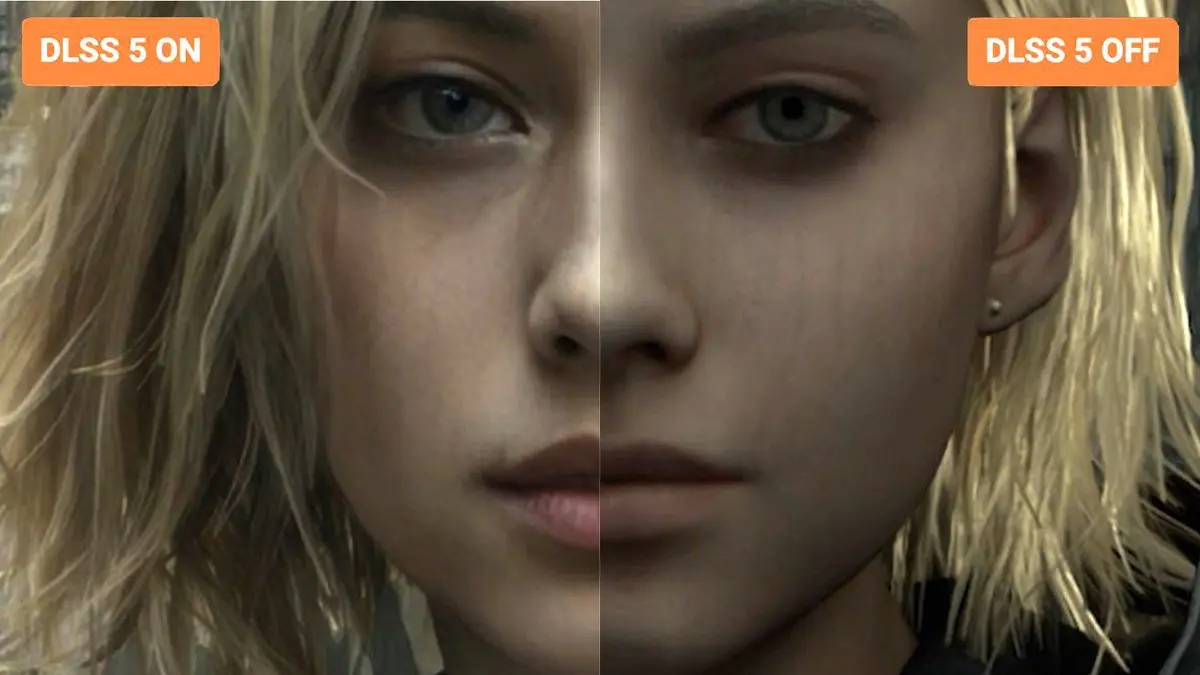
Source: Creative Bloq
One Reddit user captured the sentiment: "Surely this will result in a look that the artist/developer didn't intend? It's like putting an ugly AI filter over the artist's work"
4
. The technology's impact on Starfield characters showed pronounced eyebrows and cheekbones, while Hogwarts Legacy's witch character displayed far more facial wrinkles than the original rendering1
. A brain scan study referenced in coverage showed that human brains process hyper-realistic AI faces differently than real faces, triggering an uneasy mismatch feeling around 600ms after viewing3
.Nvidia and Bethesda Defend Artistic Control
In response to the controversy, Nvidia clarified that DLSS 5 provides developers with "full, detailed artistic control" over the technology's effects
5
. The SDK includes controls for intensity, color grading, and masking to prevent the effect from being applied in specific areas2
. Nvidia emphasized in a pinned comment that "it's not a filter—DLSS 5 inputs the game's color and motion vectors for each frame into the model, anchoring the output in the source 3D content"2
.Bethesda confirmed that its art teams will continue refining the effect and that the final implementation remains optional for players
5
. Bethesda studio head Todd Howard praised the technology, stating it was "amazing" how it brought Starfield "to life"1
. Major studios including Capcom worked directly on DLSS 5 implementation in their games, suggesting industry buy-in despite player concerns2
.Related Stories

Technical Requirements Raise Performance Questions
A notable detail emerged regarding DLSS 5's computational demands: early demos at GTC 2026 required two RTX 5090 graphics cards running simultaneously—one to render the game and another dedicated solely to applying the DLSS 5 pass
4
. Nvidia clarified this represents early preview technology that will be optimized to run on a single GPU by the fall launch4
.
Source: TechRadar
DLSS 4.5 currently leads the AI upscaling market, outperforming AMD's FSR Redstone and Intel's XeSS in preserving details like individual tree leaves and grass
1
. The technology remains a primary reason to choose Nvidia's RTX 5070 Ti or RTX 5080 over AMD Radeon RX 9070 XT, though 4K-ready Nvidia GPUs rarely sell below $1,0001
. DLSS 5 will also introduce 6x frame generation capabilities to match monitor refresh rates1
.Divided Community Reflects Broader AI Tensions in PC Gaming
The polarized response to DLSS 5 mirrors longstanding debates about AI in PC gaming. Digital Foundry's hands-on preview praised the technology, particularly highlighting how enhanced lighting breathed fresh life into Oblivion Remastered's stone walls and buildings
4
. Supporters argue the technology represents a necessary evolution, noting that DLSS initially faced similar negativity before becoming widely accepted2
.Critics worry about homogenization of visual styles and loss of artistic intent, with some noting that lighting can appear too intense with oversaturated colors
4
. The technology's impact varies significantly by game—EA Sports FC and Starfield reportedly benefit substantially, while stylized titles face greater challenges3
. As Nvidia trains DLSS on high-quality rendering generated by its own supercomputers rather than external sources, concerns about training data differ from those surrounding generative AI tools like Midjourney2
. How developers implement artistic control features between now and fall will likely determine whether DLSS 5 achieves acceptance or remains controversial.References
Summarized by

Navi
Related Stories
DLSS 4: Nvidia's Game-Changing AI Upscaling Technology Revolutionizes Gaming Performance
31 Jan 2025•Technology

Nvidia unveils DLSS 4.5 with 6x Frame Generation and improved AI upscaling at CES 2026
06 Jan 2026•Technology
NVIDIA's DLSS Adoption Soars: Over 80% of GeForce RTX Users Embrace AI Upscaling
16 Jan 2025•Technology

Recent Highlights
1
Google Maps unveils Ask Maps with Gemini AI and 3D Immersive Navigation in biggest update
Technology

2
AI chatbots help plan violent attacks as safety guardrails fail, new investigation reveals
Technology

3
OpenAI secures $110 billion funding round as questions swirl around AI bubble and profitability
Business and Economy

Recent Highlights
Today's Top Stories





Your Daily Dose of Curated AI News
Don’t drown in AI news. We cut through the noise - filtering, ranking and summarizing the most important AI news, breakthroughs and research daily. Spend less time searching for the latest in AI and get straight to action.

