Nvidia unveils Vera Rubin Space Module for orbital AI data centers as space computing race heats up


18 Sources
[1]
Nvidia Is Building a Computer for AI Data Centers in Space
Expertise Artificial intelligence, home energy, heating and cooling, home technology. Space may be the next frontier for the AI infrastructure boom, but it will take some work to make that happen, Nvidia CEO Jensen Huang said during his keynote address Monday at the company's GTC conference in San
[2]
Nvidia is the latest to promise AI data centers in space.
The NVIDIA Space-1 Vera Rubin Module is the ticket. CEO Jensen Huang: We're working with our partners on a new computer called Vera Ruben Space 1, and it's going to go out to space and start data centers out in space. Now, of course in space there's no conduction, there's no convection, there's
[3]
Musk Offers Sneak Peek at Orbiting Data Centers. They're Bigger Than the ISS
Elon Musk offered a first look at his plans for orbiting data centers this weekend, and they will be longer than the International Space Station (ISS). The satellites stand out for their exceptionally large solar arrays. The SpaceX CEO's presentation didn't give an exact length, but each one is
[4]
Nvidia announces Vera Rubin Space Module -- up to 25x the AI compute of H100 for orbital data centers
Nvidia CEO Jensen Heung has announced the Vera Rubin Space Module at the company's ongoing GTC 2026 event, claiming up to 25 times more AI compute than the H100 for orbital inference workloads. Six commercial space companies are understood to have already deployed the platform. According to the
[5]
Nvidia Debuts an AI Chip For Space-Based Data Centers
When he's not battling bugs and robots in Helldivers 2, Michael is reporting on AI, satellites, cybersecurity, PCs, and tech policy. Orbiting data centers may be a moonshot, but Nvidia isn't waiting for the concept to potentially take off. The company announced it's working on a chip designed to
[6]

Nvidia announces Vera Rubin Space-1 chip system for orbital AI data centers
"Space computing, the final frontier, has arrived," said CEO Jensen Huang. "As we deploy satellite constellations and explore deeper into space, intelligence must live wherever data is generated." In a press release, the company said that its Vera Rubin Space-1 Module, which includes the IGX Thor
[7]

'Space computing, the final frontier, has arrived': Nvidia wants to power the next generation of data centers in space
* Nvidia reveals hardware for use in orbital data centers * Space-1 Vera Rubin Module will offer huge increases in power and efficiency, with RTX PRO 6000 Blackwell Server Edition GPU back on Erath to process the data * Six space companies have alreadt signed up to work with Nvidia Nvidia has
[8]

Nvidia making AI module for outer space
San José (United States) (AFP) - Nvidia chief Jensen Huang on Monday said the leading artificial intelligence chip maker is heading for space with a goal of powering orbiting data centers. An Nvidia graphics processing unit (GPU) was launched into space late last year by startup Starcloud in what
[9]

Nvidia previews Vera Rubin Space-1 Module for orbital data centers - SiliconANGLE
Nvidia previews Vera Rubin Space-1 Module for orbital data centers Nvidia Corp. has previewed a computing device called the Vera Rubin Space-1 Module that is designed to power satellites and orbital data centers. Chief Executive Jensen Huang announced the product today in his GTC keynote. Nvidia
[10]

Nvidia unveils Vera Rubin Space-1 for orbital data centers
Nvidia has launched computing platforms for orbital data centers, unveiling the Vera Rubin Space-1 Module at its GTC 2026 conference on Monday. The move positions the chipmaker at the center of a growing push to move AI infrastructure beyond Earth, as terrestrial data centers strain power grids
[11]

Nvidia making AI module for outer space
Nvidia chief Jensen Huang on Monday said the leading artificial intelligence chip maker is heading for space with a goal of powering orbiting data centers. Tech firms are floating the idea of building data centers in space and tapping into the sun's energy to meet out-of-this-world power demands in
[12]

Exclusive: Expert Weighs In On Why Orbital Datacenters Could Likely Work In Tandem With Ground-Based AI Infrastructure
Space-based AI compute has been positioned by the tech industry as a solution to several challenges facing current Earth-based datacenter infrastructure, including energy supply, cooling, and water. However, is the technology as feasible and attainable as it's touted to be? We spoke to Sean
[13]

Nvidia unveils new hardware in push for data centers in space
Nvidia's approach emphasizes that satellites can filter and process imagery, track weather systems, monitor infrastructure, and detect anomalies without waiting for instructions from Earth. Nvidia unveiled a hardware platform for space-based computing. The Vera Rubin Space-1 Module will support
[14]
Nvidia CEO Jensen Huang Explains Why AI Data Centers In Space Are Harder Than They Sound: 'It'll Take Years. It's OK. I Got Plenty Of Time' - Alphabet (NASDAQ:GOOG), Alphabet (NASDAQ:GOOGL)
AI Data Centers In Space: Big Vision, Bigger Challenges "We should definitely work on the ground first because we're already here," Huang said, while noting that preparing for space-based infrastructure is still important. The idea has gained traction as AI workloads surge, pushing tech companies
[15]
Musk Vs Huang: The Race For AI In Space - NVIDIA (NASDAQ:NVDA)
Musk's Starlink Vs. Huang's Vera Rubin: Billionaires Battle For Orbital AI Dominance The next AI arms race may not happen on Earth. With its ambitious "Vera Rubin Space-1" project, Nvidia Corp (NASDAQ:NVDA) aims to bring high-performance AI computing to space, moving data centers beyond the
[16]
Nvidia Announces New Chip For Space-Based AI Compute In Boost For Orbital Datacenters - NVIDIA (NASDAQ:NVDA)
Space-Based Datacenters At the event, Huang revealed that Nvidia was working on its orbital datacenters goal. "We're going to space," Huang said, adding that the company's THOR chip was "radiation approved" and that Nvidia was already using satellites for image processing. "In the future, we'll
[17]

Nvidia unveils spatial computing platform for AI in orbit
Nvidia has announced the launch of the Vera Rubin Space-1 Module platform, designed to enable the deployment of advanced computing capabilities in space. Presented by CEO Jensen Huang during the GTC conference, this technology aims to support the rise of satellite constellations and space
[18]

Space-1 Vera Rubin: NVIDIA's space chip for 25x AI performance
Houston, AI has landed. And this time, it's not coming back down. At GTC this week, NVIDIA announced the Space-1 Vera Rubin Module - a purpose-built AI chip designed to carry data-centre-class intelligence off the ground and into orbit. Compared to the H100 GPU, the Rubin GPU delivers up to 25
Share
Copy Link
Nvidia announced the Vera Rubin Space Module at GTC 2026, claiming up to 25 times more AI compute than the H100 for orbital inference workloads. Six commercial space companies have already deployed the platform, while CEO Jensen Huang acknowledged the significant challenge of cooling computer chips in space where there's no air convection.
Nvidia Enters the Space Computing Race with Vera Rubin Module
Nvidia has officially entered the orbital data centers competition with the Vera Rubin Space Module, a specialized AI compute platform designed to run large language models and advanced foundation models directly in space
4
. CEO Jensen Huang unveiled the technology at the company's GTC conference in San Jose, California, claiming the module delivers up to 25 times more AI compute performance than the H100 GPU for orbital inference workloads4
. Six commercial space companies—Aetherflux, Axiom Space, Kepler Communications, Planet Labs PBC, Sophia Space, and StarCloud—are already deploying the platform across orbital and ground environments4
.
Source: Benzinga
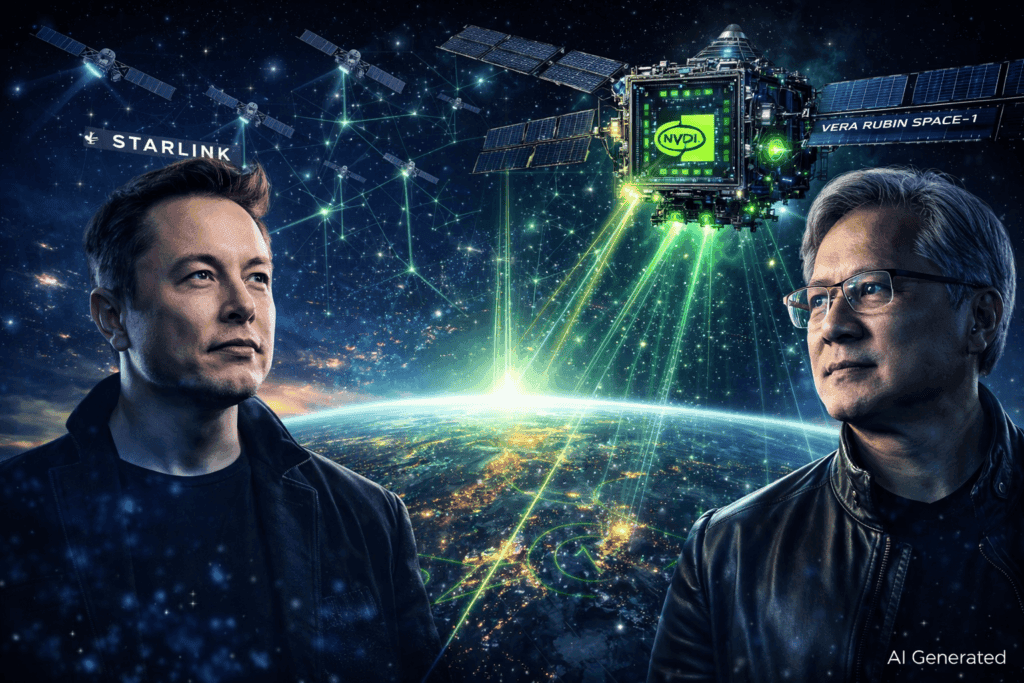
The announcement positions Nvidia alongside Elon Musk's SpaceX in the emerging race to establish AI data centers in space. While Musk has filed regulatory requests to operate up to 1 million satellites for orbiting data centers, Nvidia appears focused on a more measured approach, targeting specialized workloads rather than general-purpose computing
5
.
Source: Benzinga
Cooling Computer Chips in Space Remains Critical Challenge
The most significant technical hurdle for AI data centers in space involves thermal management. "In space, there's no conduction, there's no convection, it's just radiation," Huang explained during his keynote address
1
. Traditional cooling systems that rely on air circulation simply won't work in the vacuum of space, forcing engineers to develop entirely new approaches to dissipate heat from high-density AI processing chips1
.The Vera Rubin Space Module features a tightly integrated CPU-GPU architecture with high-bandwidth interconnect built to handle large data streams from space-based instruments in real time
4
. This design enables on-orbit analytics, autonomous scientific discovery, and rapid insight generation without relying on ground-based servers5
. Musk pushed back on cooling concerns, noting that SpaceX already manages heat rejection across 10,000 Starlink satellites in orbit3
.SpaceX Plans Massive Satellite Constellation Despite Growing Concerns
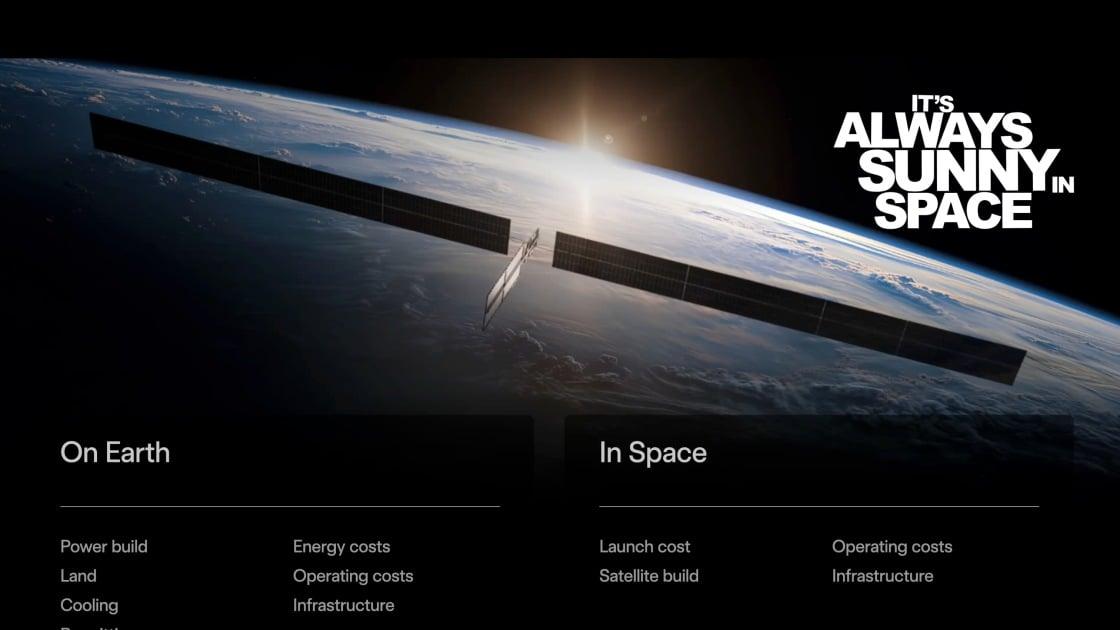
Elon Musk revealed renderings of SpaceX's proposed orbiting data centers over the weekend, showing satellites longer than the International Space Station, which spans 109 meters
3
. The satellites feature exceptionally large solar arrays to capture solar power for AI processing, with current designs promising 100 kilowatts of AI computing and future versions reaching megawatt-range capacity3
.
Source: PC Magazine
Space debris expert Hugh Lewis estimates the constellation would require 40,000 to 100,000 collision avoidance maneuvers per day, translating to 14.5 to 36.5 million maneuvers annually
3
. "I would expect quite a few collisions amongst the active satellites in the constellation, despite all those efforts to avoid them," Lewis told PCMag3
. Astronomers also warn about light pollution from the proposed space-based data centers, with the International Astronomical Union concerned that heat radiation could interfere with radio astronomy observations3
.Related Stories

Commercial Deployment Already Underway
Despite technical and regulatory challenges, commercial deployment of AI models in space is already happening. StarCloud launched an Nvidia H100 GPU into space last November using a test satellite, successfully connecting to train and run AI models over the GPU
5
. The company has since filed a request to launch up to 88,000 satellites5
. Kepler Communications is deploying Nvidia Jetson Orin across its satellite constellation for AI-driven data management, with CEO Mina Mitry stating the technology "allows us to intelligently manage and route data across our constellation"4
.Jensen Huang acknowledged that while "the economics are poor today," they will improve over time
5
. He pointed to specific use cases like high-resolution satellite imaging where AI chips in space could process imagery at much faster rates than relying on Earth-based servers5
. Space offers distinct advantages for AI data centers, including unlimited solar power, no zoning restrictions, and abundant room for expansion1
. Jeff Bezos predicted gigawatt-scale data centers in orbit are 10 to 20 years away, citing continuous solar power and simplified cooling environments as primary advantages4
. Nvidia is actively recruiting for an "Orbital Datacenter System Architect" position, signaling long-term commitment to space computing5
.References
Summarized by

Navi
[4]
[5]
Related Stories
SpaceX pushes AI data centers into orbit as Musk predicts space will beat Earth in 36 months
06 Feb 2026•Technology
NVIDIA and Elon Musk race to put AI data centers in space as Earth-based limits bite
12 May 2026•Technology

AI Trained in Space as Tech Giants Race to Build Orbiting Data Centers Powered by Solar Energy
11 Dec 2025•Technology
Recent Highlights
1
Meta Unveils Muse Wonder Frontier AI Models, Claims Performance Matching OpenAI and Anthropic
Technology

2
IMF Report Warns AI Market Correction Could Spark Global Financial Crisis With $1.4T at Risk
Business and Economy

3
OpenAI Releases 722 AI-Generated Math Solutions, Triggering Existential Crisis in Mathematics
Technology

Recent Highlights
Today's Top Stories









Don’t drown in AI news. We cut through the noise - filtering, ranking and summarizing the most important AI news, breakthroughs and research daily. Follow topics that matter to you and stay ahead.


