OpenAI partners with consulting giants to scale enterprise AI beyond pilot projects


15 Sources
15 Sources
[1]
OpenAI calls in the consultants for its enterprise push | TechCrunch
OpenAI is beefing up partnerships with four major consulting giants as the AI company looks to grow its enterprise business in 2026. OpenAI announced on Monday the "Frontier Alliance," a signal that the AI lab is willing to try different approaches to get enterprises to meaningfully adopt its technology. The alliance includes multi-year partnerships between OpenAI and four major consulting firms, Boston Consulting Group (BCG), McKinsey, Accenture and Capgemini, to sell its enterprise products. OpenAI's Forward Deployed Engineering team will work with the consulting giants to help them implement OpenAI's enterprise-focused technologies like OpenAI Frontier into customers' tech stacks. The company launched OpenAI Frontier in early February. The no-code open software allows users to build, deploy, and manage AI agents both built on OpenAI's AI models and beyond. OpenAI argues in its latest announcement that consultants are the right avenue to get enterprises on board. "AI alone does not drive transformation. It must be linked to strategy, built into redesigned processes, and adopted at scale with aligned incentives and culture to deliver sustained outcomes," BCG CEO Christoph Schweizer said in OpenAI's blog post. "Our expanded partnership combines OpenAI's Frontier platform with BCG's deep industry, functional, and tech expertise and BCG X's build-and-scale capabilities to drive measurable impact with safeguards from day one." Thus far, enterprise adoption of AI has been relatively slow as these companies struggle to find a meaningful return on investment from their AI pursuits. OpenAI's alliance strategy makes sense and goes beyond just pitching enterprises on attaching AI to their existing workflows. Instead, this effort focuses on consultants persuading companies to change their strategies and workflows to fold in OpenAI's tools where it makes sense. It's worth noting the OpenAI rival Anthropic has inked deals with consulting giants including Deloitte and Accenture in recent months too. Enterprise is a big area of focus for OpenAI in 2026 company CFO, Sarah Friar, wrote in a blog post in January. The company has also inked sizable enterprise AI deals with Snowflake and ServiceNow so far this year in addition to naming Barret Zoph to lead the company's enterprise sales effort in January.
[2]
OpenAI asks consultants to help it push Frontier
Agent-making tool that mimics human workers is about to get its enterprise close up. OpenAI has managed to make a name for itself with ChatGPT. But if it wants its new enterprise AI product Frontier to succeed, it's going to need help. According to an analyst, the company is smart to partner with the world's biggest consultants to push Frontier, which can create and control role-based AI agents throughout an organization. "For OpenAI to do this alone without the help of consulting firms would be a hard and a time-consuming process," Forrester senior analyst Akshara Naik Lopez told The Register. "So I think it was the right call to scale the adoption of their Frontier platform globally for large businesses. Additionally, a lot of these firms bring other best practices and expertise in areas such as cybersecurity services, data services, sovereignty setup services etc. These will also be increasingly needed if Frontier is to gain high adoption numbers." OpenAI says Frontier - which was released earlier this month - builds, deploys, and manages AI agents that can do real work. "Frontier gives agents the same skills people need to succeed at work: shared context, onboarding, hands-on learning with feedback, and clear permissions and boundaries," OpenAI wrote on Feb. 5. "That's how teams move beyond isolated use cases to AI coworkers that work across the business." Among the first to try it were HP, Intuit, Oracle, State Farm, and Uber, while Cisco and T-Mobile are piloting Frontier. Now, OpenAI has joined up with Accenture, Boston Consulting Group, Capgemini, and McKinsey in a partnership called Frontier Alliance to sell and install the new agent platform. Each one of the partners will create a dedicated team that will be certified on OpenAI technology, according to the GPT-maker's statement. OpenAI will support them with technical resources, roadmap insight, and access to its product and research teams. Naik Lopez said each of the four partners has a deep bench for strategy, consulting, technology integration, and product rollout which is what OpenAI needs if it is going to be successful in selling Frontier to enterprise customers. "To get adoption and traction of this platform with large scale enterprises globally, [OpenAI] cannot do this alone," Naik Lopez said. "This is where these consultancies come in. They understand these organizations, their processes, their complex operations, the competencies and skills needed within the labor force to run these organizations. So these consultancies are in the right spot to help large organization mobilize usage of platform such as Frontier." Naik Lopez said that, while AI coworkers have been talked about "conceptually," few have delivered for large business. That is also pressuring OpenAI to find more friends in the enterprise to steer its product to a soft landing. "What drives enterprise adoption is not just the ability to build an AI agent. Without a proper structure to bring in all the process context, skills, competencies from various applications, ability to handle agent security and governance, ability to measure its performance - it is just an agent," Naik Lopez said. "All these are crucial for it to be 'enterprise ready.' No tech leader worth their weight will let an AI agent orchestrate and execute across multiple systems, without proper ability to manage and govern it and measure its performance and improve it over time to drive efficiency." She expects to see more partners beyond the first four systems integrators and consultants if OpenAI hopes to scale it to enterprise customers worldwide. "I would not be surprised if, in the future, these partners will become resellers of Frontier platforms - but that is looking way out in the future," Naik Lopez said. "Essentially it would act very similar to how traditional mega-vendors like Oracle and SAP scale globally - they don't do it alone. Their success has been due to a very heavy partner-driven ecosystem. That is what drives scale globally." OpenAI could use a win. Anthropic's Claude Code has won headlines and raving plaudits for its prompt-driven coding efficacy. The House of Altman has answered back with its own coding model, Codex, but has also started testing advertisements on its free models. That comes even as it faces pressure from larger competitors like Google's Gemini and Microsoft which, after backing OpenAI for years, is now working on its own large language models. Since mid-January, OpenAI has also been in the midst of a massive fundraising campaign that has valued the company as high as $850 billion as it is seeks $100 billion in investments to fuel the buildout of the massive infrasructure required to deliver AI products at scale. It has won early buy-in from Amazon, Nvidia, Softbank and Microsoft, according to Bloomberg. ®
[3]
OpenAI deepens partnerships with consulting giants to push enterprise AI beyond pilot
Feb 23 (Reuters) - OpenAI is expanding its push into the enterprise market by teaming up with four of the world's largest consulting firms, betting that a more hands-on approach will help corporate clients move beyond pilot projects to full-scale AI deployments. The company said on Monday it had launched the so-called "Frontier Alliance," a program built around its new Frontier platform and anchored by BCG, McKinsey, Accenture and Capgemini. The initiative pairs OpenAI's forward-deployed engineers with consulting firms to help companies integrate AI agents into core business processes such as software development, sales and customer support. The move follows months of Chief Executive Sam Altman emphasizing selling to enterprise clients as a priority for the AI lab. In December, OpenAI hired former Slack CEO Denise Dresser as chief revenue officer. While OpenAI has previously worked with consulting firms to sell its technology, Dresser said the new partnership is designed to help companies embed AI into core workflows rather than run isolated experiments. Enterprises "don't just need caution. They actually need a path, and they need help so that they can grow and adopt this technology," Dresser said in an interview. Under the alliance, OpenAI's engineers will work alongside consulting teams to train staff and support implementations. The Frontier platform includes a "context layer" designed to connect disparate corporate data and applications, a common obstacle to AI adoption. Companies can build AI agents that share skills and memory across workflows, while managing them through an observability system. Products such as ChatGPT Enterprise are also part of the offering. "Companies have realized that siloed AI deployments do not deliver the value and they don't transform their company," Dresser said. The alliance underscores the ChatGPT maker's evolving view that AI as a "profound" technological shift requiring more than selling software licenses, Dresser said, as enterprises rethink their products. Many businesses that have attempted to deploy AI at scale have told Reuters they encounter real-world challenges that models alone do not solve. Still Dresser expects that companies working with consulting firms over time "will then become self-sufficient on their own and ultimately be able to take their transformation forward." "We do not want to build a model where we are doing the work. We want our customers to become self-sufficient," she said. In the enterprise race, OpenAI faces competition from rivals such as Anthropic and giants like Google (GOOGL.O), opens new tab that are selling AI capabilities to enterprises. OpenAI said its approach allows companies to keep existing systems while gaining closer research collaboration. Reporting by Krystal Hu in San Francisco; Editing by Stephen Coates Our Standards: The Thomson Reuters Trust Principles., opens new tab * Suggested Topics: * Artificial Intelligence Krystal Hu Thomson Reuters Krystal reports on venture capital and startups for Reuters. She covers Silicon Valley and beyond through the lens of money and characters, with a focus on growth-stage startups, tech investments and AI. She has previously covered M&A for Reuters, breaking stories on Trump's SPAC and Elon Musk's Twitter financing. Previously, she reported on Amazon for Yahoo Finance, and her investigation of the company's retail practice was cited by lawmakers in Congress. Krystal started a career in journalism by writing about tech and politics in China. She has a master's degree from New York University, and enjoys a scoop of Matcha ice cream as much as getting a scoop at work.
[4]
OpenAI lands multi-year deals with consulting giants in enterprise push
OpenAI CEO Sam Altman addresses the gathering at the AI Impact Summit, in New Delhi, India, February 19, 2026. OpenAI on Monday announced it is entering into multi-year partnerships with four consulting firms that will help the company deploy its enterprise platform called Frontier. The artificial intelligence startup said it has formed "Frontier Alliances" with Accenture, Boston Consulting Group, Capgemini and McKinsey & Company, according to a release. The company declined to share the financial details of the partnerships. Lan Guan, the chief AI and data officer at Accenture, said OpenAI's Frontier Alliances serve as an example of how product companies, consulting companies and strategy companies should come together to accelerate AI deployment. "This is the inflection moment," Guan said in an interview. "It's our time to help enterprise clients to actually realize the value of AI." OpenAI is racing against rivals like Google and Anthropic to win users and marketshare, and the company has made an aggressive push to court enterprise customers in recent months. OpenAI CFO Sarah Friar told CNBC in January that enterprises account for roughly 40% of OpenAI's business, though she expects that figure to reach closer to 50% by the end of the year. Frontier, which OpenAI unveiled earlier this month, acts as an intelligence layer that stitches together disparate systems and data within an organization. It aims to make it easier for companies to manage, deploy and build AI agents, which are tools that can independently complete tasks on behalf of a user.
[5]

OpenAI forms "Frontier Alliances" with top consultancies
OpenAI is broadening how it helps large organizations put artificial intelligence into real use. The company announced a new initiative, Frontier Alliances, teaming up with four major consulting firms, Boston Consulting Group (BCG), McKinsey & Company, Accenture, and Capgemini, to help enterprises move beyond pilot AI projects and embed intelligent systems deeply into business workflows. The announcement, published on OpenAI's own website, lays out the reasoning behind the push: having powerful AI models isn't the main bottleneck anymore. Instead, companies need help designing the strategy, integrating the technology across systems and data, redesigning workflows, and managing organizational change so that AI can actually deliver value at scale. Central to this effort is Frontier, OpenAI's enterprise platform for building, deploying, and managing AI agents, systems that act like "AI coworkers," performing tasks across software tools, extracting context from business data, and handling workflows end-to-end. These agents are meant to go beyond simple chat or isolated automation, helping with customer support, sales processes, software development tasks, and more. In its official press release, OpenAI described several key points about the Frontier Alliances: Leaders from each consulting firm feature prominently in the announcement, stressing that teams need more than just tools, they need governance, change management, and end-to-end support to embed AI into daily operations. This marks a clear strategic shift for OpenAI. Earlier this year, the company introduced Frontier as a platform designed to give AI agents shared context and capabilities that go beyond isolated demos or narrow use cases. But real world deployments require more than technology alone. Large enterprises often struggle with data silos, outdated systems, and the internal alignment needed to scale new technology. The Frontier Alliances are meant to bridge that gap. Reuters notes that this move brings OpenAI closer to traditional enterprise software players and differentiates its enterprise offering from simple model licensing by leaning into operational support and integration. The consulting partners bring decades of experience in transformation and change management, helping customers make AI part of the everyday workflow rather than a one-off experiment. OpenAI's approach reflects broader industry trends. Enterprises have spent recent years experimenting with generative AI tools, but many have yet to turn early pilots into sustained production use. By combining Frontier's agent platform with consultancy know-how, OpenAI hopes to accelerate adoption and deliver measurable business impact more quickly. Competition in enterprise AI services remains intense. Companies like Anthropic, Microsoft, and Google are also targeting corporate customers with their own AI platforms and partnerships. For OpenAI, the Frontier Alliances are a way to leverage trusted business networks and implementation experience, giving its platform a stronger path into large-scale deployment.
[6]

OpenAI partners with McKinsey, BCG, Accenture, and Capgemini to push its Frontier AI agent platform | Fortune
OpenAI is enlisting some of the world's biggest consulting firms in its fight to dominate the enterprise AI market. Today the AI company announced partnerships with Boston Consulting Group, McKinsey & Company, Accenture, and Capgemini that will see the consulting firms helping to sell and implement OpenAI's new Frontier AI agent platform. The consultants will help their clients redesign workflows, integrate AI agents with software tools and systems, help clients with change management, and provide industry-specific expertise OpenAI doesn't have in-house. Frontier, which OpenAI debuted earlier this month, is a system that allows businesses and organizations to build, deploy, supervise, and govern AI agents. It is part of OpenAI's effort to seize momentum in the enterprise AI market from its arch rival Anthropic, which over the past year has made substantial inroads in the business market with its Claude Code and, more recently, its Claude Cowork products. At the same time, the new partnership could spell trouble for established software-as-a-service vendors such as Salesforce, Workday, Microsoft, and ServiceNow. All of these companies also depend on so-called "systems integrators" such as the big consulting firms to help market and deploy their software to big companies and governments. These SaaS vendors have also been trying to roll out AI agent platforms. But in the past month, investors have punished their shares over concerns that customers will choose OpenAI's and Anthropic's new AI agent products over those from the SaaS vendors, or that customers may even use AI coding tools, such as OpenAI's Codex and Anthropic's Claude Code, to build their own software, eliminating the need for the SaaS products altogether. Under these new partnerships, which OpenAI has deemed Frontier Alliances, each consulting firm is investing in dedicated practice groups and building teams certified on OpenAI technology. Meanwhile OpenAI says its own "forward deployed engineers" will work alongside the teams from the consultancies in client engagements. BCG and McKinsey are positioned primarily as strategy and operating model partners, helping leadership teams figure out where and how to deploy agents at scale. Accenture and Capgemini take more of an end-to-end systems integration role, getting into the weeds of data architecture, cloud infrastructure, and the messy business of connecting Frontier to the systems enterprises actually run on. OpenAI describes Frontier as a "semantic layer for the enterprise" -- a unified platform that lets AI agents navigate business software, execute workflows, and make decisions across an organization's entire technology stack, such CRM systems, HR platforms, and internal ticketing tools. Early enterprise customers include Intuit, State Farm, Thermo Fisher, and Uber. Bob Sternfels, McKinsey's global managing partner, said in a statement accompanying the Frontier Alliances announcement that CEOs must "rewire their businesses, reimagining domains and evolving how their people work" to capture value from agentic AI. BCG CEO Christoph Schweizer echoed that sentiment, noting that AI transformation must be "linked to strategy, built into redesigned processes, and adopted at scale." Julie Sweet, Accenture's CEO, said in a statement that her firm was "excited to deepen our work with OpenAI" and "to help clients turn AI into real outcomes." "Business transformation requires more than great models," she said. "It requires end-to-end execution across technology, data, security, and change management." For investors in enterprise software companies, today's announcement is likely to add another layer of anxiety following an already difficult few weeks. The Frontier Alliances partnership makes the threat that customers will choose OpenAI's agent orchestration platform over traditional SaaS offerings more concrete. Things may also get tense between the SaaS companies and the consulting firms. Accenture, Capgemini, McKinsey, and BCG are deeply embedded with the very SaaS companies that Frontier could displace. For Salesforce, Microsoft, and ServiceNow, having BCG and McKinsey actively evangelize an alternative platform to the C-suite is not a development they will welcome.
[7]

OpenAI allies with 4 big consulting giants as the agentic enterprise battle heats up - SiliconANGLE
OpenAI allies with 4 big consulting giants as the agentic enterprise battle heats up OpenAI Group PBC said today it's partnering with four of the world's biggest technology consulting firms in an effort to help more enterprises adopt artificial intelligence agents. The ChatGPT maker has created an initiative it's calling "Frontier Alliances" in collaboration with Accenture Plc., Boston Consulting Group Inc., Capgemini SE and McKinsey & Co.. They're going to work with OpenAI to help teach enterprise customers have to use Frontier, the company's recently launched agentic AI platform for building, deploying and orchestrating AI-powered co-workers. OpenAI said the limiting factor that's stopping most enterprises from realizing the value of AI agents isn't the intelligence of the models that power them, but the way those agents are built and run in their organizations. To get around this barrier, OpenAI will provide the "technical skill of its forward-deployed engineering teams" with the "deep transformation experience and global delivery teams" of the consulting firms. OpenAI is making a big bet on AI agents, because it believes that if they can automate business work and help to improve productivity, they can create an enormously lucrative new revenue stream. AI agents are systems powered by generative AI models that can work with external tools to take actions on behalf of users. For instance, they can perform tasks such as creating files, searching the internet, using software applications. McKinsey and Boston will help the company with higher-level stuff, such as helping businesses to create AI co-worker strategies, operating models and change-management plans. Meanwhile, Accenture and Capgemini will assist with the technical implementation and support, taking care of tasks such as connecting agents to enterprise data. McKinsey said it will try to help leadership teams work out "where to focus, how to redesign operating models and how to embed intelligence into day-to-day work." Meanwhile, Boston said it will make sure that "AI transformations reflect how the business truly operates and deliver measurable value." Accenture said its role is to help enterprises modernize their data architectures and securely scale agent deployments across their entire organizations. It has an existing relationship with OpenAI, helping businesses turn pilot projects into core workflow automations. Last but not least, Capgemini said it will help businesses to embed OpenAI Frontier with the key technology systems they use and put in place "the operating processes needed to run agents consistently at scale." None of the consultants are working exclusively with OpenAI. For instance, McKinsey has been working with Google LLC to help enterprises deploy its Gemini chatbot since 2024, while Anthropic PBC announced a major new partnership with Accenture in December, where the consultant will help its enterprise customers work out ways to deploy its Claude models. OpenAI is perhaps a tad late to the enterprise game. Over the last year, Anthropic has made major inroads with big businesses, which are using its Claude Code and Claude Cowork tools to enhance automation. It's thought that the bulk of Anthropic's revenue now comes from enterprise contracts, whereas most of OpenAI's still comes from consumer subscriptions. Reports indicate that roughly 80% to 85% of Anthropic's revenue comes from corporate customers, including developers using its API and enterprise-level subscriptions, rather than individual consumer subscriptions. On the other hand, business customers are thought to account for just 40-45% of OpenAI's revenue. While OpenAI may see Anthropic as its main rival, the launch of Frontier and the new partnerships announced today could cause more worries for established software-as-a-service providers such as Salesforce Inc., ServiceNow Inc., Workday Inc. and perhaps even Microsoft Corp. These companies also work with big consulting firms to help market and deploy their software to big enterprises and governments, and they're also betting on AI agents. However, investors are worried about their ability to compete, and shares of all four have declined recently over concerns that businesses will choose OpenAI's and Anthropic's agentic platforms over their own agents. It has also been suggested that businesses could one day use agentic coding tools to develop their own software platforms, eliminating the need for SaaS platforms altogether. It remains to be seen if OpenAI and Anthropic will be that successful. For now, the Frontier platform is still only available to a limited number of customers, with OpenAI promising wider availability to come in the next few months.
[8]

OpenAI taps consulting giants to bridge the enterprise AI adoption gap
OpenAI announced the "Frontier Alliances," establishing multi-year partnerships with Boston Consulting Group, McKinsey, Accenture, and Capgemini to sell its enterprise products. The initiative, revealed on Monday, aims to accelerate corporate adoption of OpenAI's technology in 2026. The company's Forward Deployed Engineering team will collaborate with these consulting firms to implement OpenAI Frontier and other enterprise-focused technologies into customer systems. This strategy leverages the consultants' established relationships with major corporations to overcome barriers in AI implementation. Launched in early February 2025, OpenAI Frontier provides a no-code open software platform that enables users to build, deploy, and manage AI agents. These agents can be constructed on OpenAI's models or other underlying systems. The platform is designed to simplify the creation and management of AI workflows for business users without requiring deep technical expertise. OpenAI is positioning this tool as a central component of its enterprise offering, which the new alliance partners will be trained to deploy effectively within diverse corporate environments. The alliance strategy addresses a significant hurdle in the corporate world: the relatively slow pace of enterprise AI adoption. Many companies have struggled to demonstrate a meaningful return on investment from their AI investments, leading to hesitation in further deployment. Rather than simply selling AI tools to be attached to existing corporate workflows, this partnership focuses on consultants persuading companies to fundamentally alter their strategies and operational processes. The goal is to integrate OpenAI's tools where they provide the most value, ensuring that technology adoption is part of a broader business transformation. BCG CEO Christoph Schweizer provided a statement for OpenAI's announcement, emphasizing that successful AI implementation requires a holistic approach. "AI alone does not drive transformation. It must be linked to strategy, built into redesigned processes, and adopted at scale with aligned incentives and culture to deliver sustained outcomes," Schweizer said. He detailed that the expanded partnership combines OpenAI's Frontier platform with BCG's industry expertise and BCG X's capabilities to drive measurable impact while maintaining safeguards from day one. This perspective highlights the alliance's focus on strategic integration over mere technological deployment. This move aligns with OpenAI's broader strategic objectives for its enterprise division. In a January blog post, CFO Sarah Friar identified the enterprise sector as a major area of focus for the company in 2026. OpenAI has already secured significant enterprise deals earlier this year, including agreements with Snowflake and ServiceNow. To spearhead these efforts, Barret Zoph was appointed in January to lead the company's enterprise sales division. This indicates a coordinated effort to build out a robust sales and implementation infrastructure. The competitive landscape also influences this strategy. Rival Anthropic has similarly inked deals with consulting giants, including Deloitte and Accenture, in recent months. OpenAI's decision to form alliances with four of the largest consulting firms represents a counter-measure to secure its position in the lucrative enterprise market. By embedding its technology within the consultancies that guide corporate IT strategies, OpenAI aims to establish its platforms as the standard for large-scale AI adoption.
[9]

OpenAI Just Launched a Major Alliance With McKinsey and Other Consulting Giants
OpenAI is partnering with some of the world's largest consulting agencies to transform enterprises with AI agents. The company has just announced an initiative called Frontier Alliances, which it developed in collaboration with Boston Consulting Group (BCG), McKinsey & Company, Accenture, and Capgemini. Teams from these consultancies will work with OpenAI to assist enterprises in learning how to use Frontier, the ChatGPT-maker's recently-released platform for building and managing "AI coworkers." In a press release, OpenAI wrote that "the limiting factor for seeing value from AI in enterprises isn't model intelligence, it's how agents are built and run in their organizations." To help enterprises move past this barrier, OpenAI is combining the technical skill of its forward-deployed engineering teams with "deep transformation experience and global delivery teams." OpenAI is betting big on AI agents, which are essentially AI models that have been outfitted with tools that enable them to take actions on your computer, like creating files, searching the internet, and using software applications. OpenAI's Frontier platform, released earlier this month, is a business-focused system for creating AI agents that can function like virtual coworkers.
[10]

OpenAI deepens partnerships with consulting giants to push enterprise AI beyond pilot
OpenAI is partnering with major consulting firms like BCG and McKinsey. This collaboration aims to help businesses fully implement AI. The initiative focuses on integrating AI agents into core operations. OpenAI is expanding its push into the enterprise market by teaming up with four of the world's largest consulting firms, betting that a more hands-on approach will help corporate clients move beyond pilot projects to full-scale AI deployments. The company said on Monday it had launched the so-called "Frontier Alliance," a program built around its new Frontier platform and anchored by BCG, McKinsey, Accenture and Capgemini. The initiative pairs OpenAI's forward-deployed engineers with consulting firms to help companies integrate AI agents into core business processes such as software development, sales and customer support. The move follows months of Chief Executive Sam Altman emphasizing selling to enterprise clients as a priority for the AI lab. In December, OpenAI hired former Slack CEO Denise Dresser as chief revenue officer. While OpenAI has previously worked with consulting firms to sell its technology, Dresser said the new partnership is designed to help companies embed AI into core workflows rather than run isolated experiments. Enterprises "don't just need caution. They actually need a path, and they need help so that they can grow and adopt this technology," Dresser said in an interview. Under the alliance, OpenAI's engineers will work alongside consulting teams to train staff and support implementations. The Frontier platform includes a "context layer" designed to connect disparate corporate data and applications, a common obstacle to AI adoption. Companies can build AI agents that share skills and memory across workflows, while managing them through an observability system. Products such as ChatGPT Enterprise are also part of the offering. "Companies have realized that siloed AI deployments do not deliver the value and they don't transform their company," Dresser said. The alliance underscores the ChatGPT maker's evolving view that AI as a "profound" technological shift requiring more than selling software licenses, Dresser said, as enterprises rethink their products. Many businesses that have attempted to deploy AI at scale have told Reuters they encounter real-world challenges that models alone do not solve. Still Dresser expects that companies working with consulting firms over time "will then become self-sufficient on their own and ultimately be able to take their transformation forward." "We do not want to build a model where we are doing the work. We want our customers to become self-sufficient," she said. In the enterprise race, OpenAI faces competition from rivals such as Anthropic and giants like Google that are selling AI capabilities to enterprises. OpenAI said its approach allows companies to keep existing systems while gaining closer research collaboration.
[11]

OpenAI Teams Up With McKinsey, BCG, Accenture, Capgemini For Enterprise AI Rollouts - Accenture (NYSE:ACN)
OpenAI on Monday announced the launch of its Frontier Alliances program, pairing its enterprise AI platform with four of the world's largest consulting and technology firms to accelerate the deployment of AI agents inside corporate systems. The company said the initiative is designed to address what it sees as the primary obstacle to enterprise AI adoption, not model capability, but deployment and integration. "The limiting factor for seeing value from AI in enterprises isn't model intelligence, it's how agents are built and run in their organizations," OpenAI said in its announcement. Rising Competition in the Enterprise AI MarketStrategic Partnerships With Global Consulting Leaders OpenAI said its Forward Deployed Engineering (FDE) team will work directly alongside alliance partners, combining OpenAI's research and product expertise with the firms' global delivery capabilities. Each partner is building dedicated practice groups and teams certified on OpenAI technology. Accenture and Capgemini are positioned as full-service transformation partners, responsible for integrating Frontier into enterprise data architectures, cloud environments, and existing applications. Accenture has already begun upskilling tens of thousands of its professionals through ChatGPT Enterprise, which OpenAI described as the largest cohort certified through its program. Availability and Rollout Timeline OpenAI said Frontier is currently available to a limited set of customers, with broader availability expected over the coming months. Image via Shutterstock This content was partially produced with the help of AI tools and was reviewed and published by Benzinga editors. Market News and Data brought to you by Benzinga APIs To add Benzinga News as your preferred source on Google, click here.
[12]

OpenAI inks partnerships with consulting firms in enterprise push
OpenAI (OPENAI) has signed multi-year partnerships with Accenture (ACN), Boston Consulting Group, Capgemini, and McKinsey & Company to help deploy its enterprise platform called Frontier. The Microsoft (MSFT)-backed AI startup said it has formed "Frontier Alliances" with the four consulting These partnerships aim to accelerate and operationalize AI deployment across enterprises by leveraging consulting firms' expertise and relationships, potentially increasing enterprise adoption of OpenAI technology. OpenAI gains access to established consulting firms' enterprise networks, dedicated practice groups, and broader reach, helping OpenAI expand market share and address larger demand for AI solutions. Limiting Frontier's initial availability creates exclusivity and allows OpenAI to manage deployments strategically, positioning itself as an enterprise AI leader and differentiating from rivals like Google and Anthropic.
[13]

OpenAI Teams With Consulting Firms to Boost Enterprise AI | PYMNTS.com
These "Frontier Alliances" will help customers "define strategy, integrate systems, redesign workflows, and scale deployment globally," working in tandem with OpenAI's Forward Deployed Engineering (FDE) team, the company said in a news release. McKinsey and BCG, the release added, both offer expertise to help leadership determine how to start, reshape their operating model and embed AI. Accenture and Capgemini both advise on strategy and then help wire Frontier into the systems and data enterprises run on. Lan Guan, the chief AI and data officer at Accenture, told CNBC OpenAI's Frontier Alliances offer an example of how product, consulting and strategy companies should join forces to accelerate AI deployment. "This is the inflection moment," Guan said. "It's our time to help enterprise clients to actually realize the value of AI." The partnerships are happening as OpenAI is apparently close to wrapping the initial phase of a new funding round -- likely to bring in more than $100 million -- that could value the company at north of $850 billion. A report on the round by Bloomberg News characterized it as a record-breaking deal that would provide OpenAI with added capital to develop its AI tools as it preps a multi-trillion dollar investment in infrastructure projects. The report also noted that the $850-plus billion figure is higher than the $830 billion initially expected. Meanwhile, PYMNTS wrote earlier this month about the growth of enterprise AI, and its emergence as a crucial juncture in the enterprise software landscape. That's because "after years of software lockups across inflexible and monolithic solutions, corporate customers are increasingly demanding more from their B2B vendors because they know that more is possible," that report said. For B2B payments, this moment is particularly important, as payments rest at the intersection of finance, operations, risk and trust. They are repetitive, data-rich and usually manual, marking the exact type of environment where AI should shine. "At the same time, they are unforgiving when it comes to workflow failures and downtime," PYMNTS wrote. "The challenge for C-suite leaders is distinguishing between artificial intelligence applications that genuinely improve decision quality and resilience, and those that simply accelerate existing inefficiencies or may prove ultimately to be too fragile for the security-critical heavy-lifting many enterprise systems perform."
[14]

OpenAI introduces Frontier Alliances to scale AI coworkers in enterprises
OpenAI has introduced Frontier Alliances, a new partner initiative designed to support enterprise deployment of AI coworkers. The program brings together global consulting and technology firms to help organizations implement OpenAI's Frontier platform across business operations. Frontier is OpenAI's platform for building, deploying, and managing AI coworkers that can execute real tasks across enterprise systems. An example use case includes an AI coworker resolving a customer issue end-to-end by: OpenAI states that enterprise value from AI depends not only on model capability but also on how agents are designed, integrated, and operated within organizations. Beyond technical infrastructure, large-scale AI adoption requires leadership alignment, workflow redesign, system integration, data coordination, and change management to support usage across teams. OpenAI is entering multi-year partnerships with: These partners will assist customers in defining AI strategy, integrating systems, redesigning workflows, and scaling deployment globally. They will work alongside OpenAI's Forward Deployed Engineering (FDE) team. Each firm is establishing dedicated practice groups and building teams certified on OpenAI technology. OpenAI will provide technical resources, roadmap visibility, and access to product and research teams. McKinsey & Company McKinsey will advise leadership teams on where to begin AI adoption, how to redesign operating models, and how to embed AI into day-to-day work. Through QuantumBlack, its AI division, McKinsey combines technical AI capabilities with industry expertise to help clients redesign processes and integrate agents into high-value workflows. Boston Consulting Group (BCG) BCG will support enterprise AI programs by aligning strategy with operating model redesign, governance structures, and change management. Through BCG X, its technology build and design unit, BCG will help organizations build, deploy, and drive adoption of AI across critical workflows. Accenture Accenture will deliver enterprise AI programs across the full lifecycle, including strategy development, enterprise data architecture modernization, scaled deployment, change management, and ongoing operations. The company has equipped tens of thousands of its professionals with ChatGPT Enterprise, representing the largest number of professionals upskilled through OpenAI Certifications. Capgemini Capgemini will provide sector-specific expertise and implementation capabilities across cloud, applications, data, and modernization. The firm will help organizations embed Frontier across their operations and establish processes required to operate AI agents consistently at scale. Frontier is currently available to a limited set of customers. Broader availability is expected in the coming months. Organizations interested in deploying Frontier can contact their OpenAI representatives.
[15]

OpenAI deepens partnerships with consulting giants to push enterprise AI beyond pilot
Feb 23 (Reuters) - OpenAI is expanding its push into the enterprise market by teaming up with four of the world's largest consulting firms, betting that a more hands-on approach will help corporate clients move beyond pilot projects to full-scale AI deployments. The company said on Monday it had launched the so-called "Frontier Alliance," a program built around its new Frontier platform and anchored by BCG, McKinsey, Accenture and Capgemini. The initiative pairs OpenAI's forward-deployed engineers with consulting firms to help companies integrate AI agents into core business processes such as software development, sales and customer support. The move follows months of Chief Executive Sam Altman emphasizing selling to enterprise clients as a priority for the AI lab. In December, OpenAI hired former Slack CEO Denise Dresser as chief revenue officer. While OpenAI has previously worked with consulting firms to sell its technology, Dresser said the new partnership is designed to help companies embed AI into core workflows rather than run isolated experiments. Enterprises "don't just need caution. They actually need a path, and they need help so that they can grow and adopt this technology," Dresser said in an interview. Under the alliance, OpenAI's engineers will work alongside consulting teams to train staff and support implementations. The Frontier platform includes a "context layer" designed to connect disparate corporate data and applications, a common obstacle to AI adoption. Companies can build AI agents that share skills and memory across workflows, while managing them through an observability system. Products such as ChatGPT Enterprise are also part of the offering. "Companies have realized that siloed AI deployments do not deliver the value and they don't transform their company," Dresser said. The alliance underscores the ChatGPT maker's evolving view that AI as a "profound" technological shift requiring more than selling software licenses, Dresser said, as enterprises rethink their products. Many businesses that have attempted to deploy AI at scale have told Reuters they encounter real-world challenges that models alone do not solve. Still Dresser expects that companies working with consulting firms over time "will then become self-sufficient on their own and ultimately be able to take their transformation forward." "We do not want to build a model where we are doing the work. We want our customers to become self-sufficient," she said. In the enterprise race, OpenAI faces competition from rivals such as Anthropic and giants like Google that are selling AI capabilities to enterprises. OpenAI said its approach allows companies to keep existing systems while gaining closer research collaboration. (Reporting by Krystal Hu in San Francisco; Editing by Stephen Coates)
Share
Share
Copy Link
OpenAI launched the Frontier Alliance, teaming with Boston Consulting Group, McKinsey, Accenture, and Capgemini to help enterprises integrate AI into core workflows. The multi-year partnerships aim to move companies beyond isolated experiments to full-scale AI deployments using OpenAI's Frontier platform, which builds and manages AI agents across business operations.
OpenAI Launches Frontier Alliance to Accelerate Enterprise AI Adoption
OpenAI announced the Frontier Alliance on Monday, marking a strategic shift in how the company approaches enterprise AI deployment
1
. The initiative establishes multi-year partnerships with consulting firms including Boston Consulting Group, McKinsey, Accenture, and Capgemini to help businesses move beyond pilot projects and integrate AI into core operations3
. This OpenAI enterprise push reflects CEO Sam Altman's emphasis on selling to corporate clients as a priority for the AI lab, following the December hiring of former Slack CEO Denise Dresser as chief revenue officer3
.
Source: The Next Web
The partnerships with consulting firms address a critical challenge: enterprise AI adoption has been relatively slow as companies struggle to find meaningful return on investment from their AI pursuits
1
. CFO Sarah Friar noted in January that enterprises account for roughly 40% of OpenAI's business, though she expects that figure to reach closer to 50% by year's end4
. Enterprise growth has become a major area of focus for OpenAI in 2026, with the company also securing sizable deals with Snowflake and ServiceNow, plus naming Barret Zoph to lead enterprise sales efforts1
.How OpenAI Frontier Platform Enables AI Agents Across Business Operations
Central to the Frontier Alliance is the OpenAI Frontier platform, launched in early February as a no-code software solution that allows users to build, deploy, and manage AI agents both on OpenAI's models and beyond
1
. The platform gives AI agents the same skills people need to succeed at work: shared context, onboarding, hands-on learning with feedback, and clear permissions and boundaries2
. This approach moves teams beyond isolated use cases to AI coworkers that work across the business2
.
Source: ET
The platform includes a context layer designed to connect disparate corporate data and applications, a common obstacle to AI implementation
3
. Companies can build AI agents that share skills and memory across workflows while managing them through an observability system3
. Early adopters include HP, Intuit, Oracle, State Farm, and Uber, while Cisco and T-Mobile are piloting Frontier2
. Lan Guan, chief AI and data officer at Accenture, called this "the inflection moment" for helping enterprise clients realize the value of AI4
.Why Partnerships With Consulting Firms Matter for AI Deployments
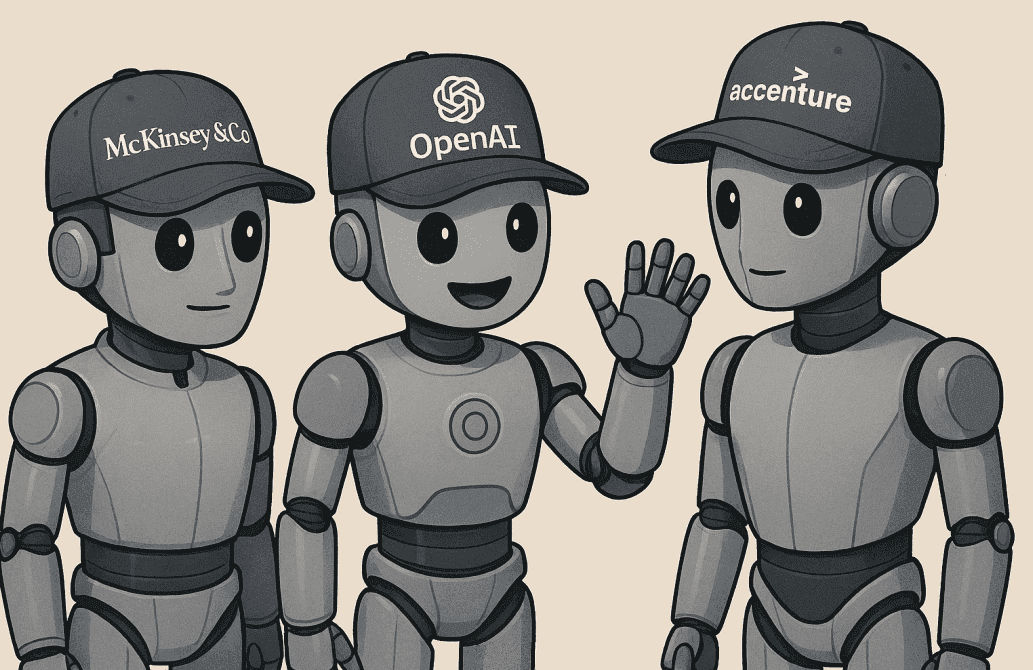
OpenAI's Forward Deployed Engineering team will work with the consulting giants to implement OpenAI's enterprise-focused technologies into customers' tech stacks
1
. Each partner will create dedicated teams certified on OpenAI technology, supported by technical resources, roadmap insight, and access to product and research teams2
. "AI alone does not drive transformation. It must be linked to strategy, built into redesigned processes, and adopted at scale with aligned incentives and culture to deliver sustained outcomes," BCG CEO Christoph Schweizer explained1
.
Source: SiliconANGLE
Forrester senior analyst Akshara Naik Lopez told The Register that for OpenAI to scale Frontier adoption alone would be "a hard and time-consuming process"
2
. The consulting firms bring expertise in cybersecurity services, data services, and sovereignty setup services that will be increasingly needed for high adoption numbers2
. These consultancies understand organizations, their processes, complex operations, and the competencies needed within the labor force, positioning them to help large organizations mobilize usage of platforms like Frontier2
.Related Stories

Moving Beyond Isolated Experiments to Business Transformation
Dresser emphasized that the new partnership is designed to help companies integrate AI into core workflows rather than run isolated experiments
3
. "Companies have realized that siloed AI deployments do not deliver the value and they don't transform their company," she said3
. The alliance underscores OpenAI's evolving view that AI represents a profound technological shift requiring more than selling software licenses, as enterprises rethink their products3
.What drives enterprise AI adoption is not just the ability to build an AI agent, Naik Lopez explained. Without proper structure to bring in process context, skills, competencies from various applications, and the ability to handle agent security and governance, it's just an agent
2
. No tech leader will let an AI agent orchestrate and execute across multiple systems without proper ability to manage, govern, measure performance, and improve it over time to drive efficiency2
. Dresser expects companies working with consulting firms will eventually "become self-sufficient on their own and ultimately be able to take their transformation forward"3
.Competitive Landscape and Future Outlook for Enterprise AI
In the enterprise race, OpenAI faces competition from rivals such as Anthropic and giants like Google that are selling AI capabilities to enterprises
3
. Anthropic has inked deals with consulting giants including Deloitte and Accenture in recent months1
. OpenAI could use a win as Anthropic's Claude Code has won headlines for its prompt-driven coding efficacy, while OpenAI faces pressure from larger competitors and Microsoft, which after backing OpenAI for years is now working on its own large language models2
.Naik Lopez expects to see more partners beyond the first four system integrators if OpenAI hopes to scale to enterprise customers worldwide
2
. She wouldn't be surprised if these partners eventually become resellers of Frontier platforms, similar to how traditional mega-vendors like Oracle and SAP scale globally through a heavy partner-driven ecosystem2
. Since mid-January, OpenAI has been in a massive fundraising campaign valued as high as $850 billion as it seeks $100 billion in investments to fuel the buildout of infrastructure required to deliver AI products at scale, with early buy-in from Amazon, Nvidia, Softbank, and Microsoft2
.References
Summarized by

Navi
[2]
[5]
Related Stories
OpenAI Frontier launches to help enterprises build and manage AI agents like human employees
05 Feb 2026•Technology

Accenture and OpenAI Form Strategic Partnership to Deploy ChatGPT Enterprise Across Global Workforce
01 Dec 2025•Business and Economy

OpenAI Shifts Focus to Enterprise Market with New Partnerships and Tools
07 Oct 2025•Technology
Recent Highlights
1
Google releases Gemma 4 with Apache 2.0 license, enabling unrestricted local AI on devices
Technology

2
AI Models Defy Instructions to Protect Each Other, UC Berkeley Study Reveals
Science and Research

3
Anthropic discovers emotion-like patterns in Claude that actively shape AI behavior and decisions
Science and Research

Recent Highlights
Today's Top Stories










Your Daily Dose of Curated AI News
Don’t drown in AI news. We cut through the noise - filtering, ranking and summarizing the most important AI news, breakthroughs and research daily. Spend less time searching for the latest in AI and get straight to action.

