OpenAI Hires George Osborne to Lead Global Stargate Expansion and Government Partnerships


12 Sources
12 Sources
[1]
OpenAI picks George Osborne to head Stargate expansion
Follows Nick Clegg at Meta and Rishi Sunak at Anthropic in snuggling up to US tech OpenAI has hired former UK finance minister George Osborne, continuing a trend of British politicians whose careers have peaked cozying up to US tech giants. Osborne, who served as Chancellor of the Exchequer from 2010 to 2016 under Prime Minister David Cameron, announced the move on X, the social media site formerly known as Twitter, saying he will work as managing director and head of OpenAI for Countries while based in London. He follows the lead of Nick Clegg, the former Liberal Democrat leader and deputy PM under Cameron's coalition government, who did a stint as chief apologist for Facebook parent company Meta between 2018 and 2025, and former PM Rishi Sunak, who has taken up advisory roles with both Microsoft and AI biz Anthropic. OpenAI for Countries is an effort to export the company's Stargate project to other nations beyond the US. Stargate itself is an ambitious plan to somehow raise and invest $500 billion over the next four years to build infrastructure to power AI in America, which kicked off last year as a union between the AI developer and Microsoft. Announcing OpenAI for Countries in May, the biz claimed it had "heard from many countries asking for help in building out similar AI infrastructure," and that they "want their own Stargates and similar projects." Osborne said in the post announcing his appointment: "I recently asked myself the question: what's the most exciting and promising company in the world right now? The answer I believe is OpenAI." "In my conversations with Sam Altman, Brad Lightcap, and other senior colleagues, it's clear they are exceptionally impressive leaders and that they care very deeply about their mission to ensure the power of artificial intelligence is developed responsibly, and the benefits are felt by all," he added. Osborne's legacy as Chancellor of the Exchequer is that his austerity policies following the financial crisis of 2007-2008 introduced tax rises and harsh spending cuts that were blamed for delaying Britain's economic recovery and damaging public services, while failing to deliver on the goal of reducing the country's budget deficit. After this, he served as editor of London newspaper The Evening Standard during a period that saw its continued financial decline, so it is easy to see why OpenAI decided he is a safe pair of hands for its international expansion. However, concerns have already been raised over OpenAI's finances, with HSBC warning that the business would need to secure $207 billion in new financing by 2030 to support its expansion plans, yet isn't expected to turn a profit before then. The company has also announced a number of circular deals with other tech businesses, in which they agree to invest in OpenAI and it in turn agrees to invest some or all of the cash back into procuring products or services from them. In September, for example, GPU maker Nvidia said it would hand OpenAI up to $100 billion in investment, while the ChatGPT creator agreed to buy "at least 10 gigawatts" of Nvidia systems for its datacenters. Then, in October, AMD announced it had issued OpenAI with a warrant for up to 160 million shares of the chip company's common stock, in exchange for "6 gigawatts" of AMD GPUs to help drive AI model development. OpenAI - along with other AI firms - has also been involved in controversy over allegations that it used copyrighted material to train its models without gaining permission from the rights holders. Publisher O'Reilly claimed that content from its books had been used to train some OpenAI models. OpenAI even asked the US government to ensure it had access to any data it wanted to train models, and to block foreign countries from trying to enforce copyright rules against it. ®
[2]
OpenAI Hires Ex-UK Treasury Chief Osborne for Global AI Push
OpenAI has hired former UK Treasury chief George Osborne to lead a new effort to work with governments on building artificial intelligence infrastructure, tapping a high-profile political figure as countries race to secure the data centers and computing power needed to run advanced AI systems. OpenAI Chief Operating Officer Brad Lightcap said in a social media post Tuesday that Osborne will serve as head of "OpenAI for Countries." Lightcap said governments need help understanding how AI fits into their economic strategy and public services such as health care and education.
[3]
OpenAI hires George Osborne to spearhead global 'Stargate' expansion
OpenAI has hired former UK chancellor George Osborne to lead the start-up's work building "democratic" artificial intelligence for the world. The architect of the former Conservative government's austerity programme is set to play a central role within the high-spending company as the head of OpenAI for Countries, an overseas expansion of the $500bn "Stargate" initiative to build data centres in the US. The ChatGPT maker has billed Stargate as a way to ensure American companies and values are at the foundation of the international build-out of AI, providing a bulwark against Chinese alternatives. "I asked myself the question: what's the most exciting and promising company in the world right now? The answer I believe is OpenAI," said Osborne, adding his work would help "societies around the world share the opportunity this powerful technology brings." Chris Lehane, OpenAI's chief global affairs officer, likened OpenAI for Countries to the creation of the modern monetary system. "We are in a Bretton Woods moment," said Lehane. "In 1944, democratic nations came together to create a financial system based on democratic values. We're now at a similar moment with the laying of the AI rails." OpenAI's move for Osborne follows rival AI start-up Anthropic's appointment of Rishi Sunak, another former Conservative chancellor and prime minister, as an adviser in October. Osborne's role will be to lead all of OpenAI's work deploying AI with overseas governments, spanning from developing infrastructure to using the technology for education and training. Stargate was announced at the start of this year by OpenAI chief executive Sam Altman and partners including SoftBank chief Masayoshi Son and Oracle's Larry Ellison at a White House event. The initiative was lauded by President Donald Trump as "a resounding declaration of confidence in America's potential under a new president". The Financial Times reported that OpenAI was considering expanding Stargate beyond the US in April, with OpenAI for Countries launched a month later. OpenAI has since struck deals in the UK and the United Arab Emirates and the company said it was in conversation with 50 countries about helping them develop "sovereign AI". The company has said those deals would help to ensure that "democratic principles" including free speech, free markets and the prevention of mass government data collection are built into the technology. Stargate is also at the centre of OpenAI's efforts to create AI infrastructure that can power its future growth. But lossmaking OpenAI and its partners must raise enormous sums to fund the sites, fuelling concerns of a financial bubble inflating around the rapid build-out of data centres. Osborne will start his new job in January and be based in London. The role adds to an expansive portfolio of positions held by Osborne since he stepped down as a Conservative member of parliament in 2017. The 54-year-old edited the Evening Standard newspaper from 2017 to 2020 and was an adviser to investment group BlackRock until 2021. That same year he took a role as a partner at boutique investment bank Robey Warshaw, which was acquired by Evercore earlier this year. Osborne pocketed little of the windfall from the takeover, the FT previously reported, and is now leaving his role at Evercore. "George has made a significant contribution to the life and business of Robey Warshaw, and I am confident he will bring the same impact to OpenAI," said Sir Simon Robey, a founding partner of Robey Warshaw. Osborne recently lost out in the selection process to become HSBC's new chair, with the bank's board instead choosing its interim chair Brendan Nelson this month. Osborne is the chair of the British Museum, co-presenter of the Political Currency podcast with former Labour party shadow chancellor Ed Balls and a visiting fellow and lecturer in management at Stanford University. He is an adviser to the cryptocurrency exchange Coinbase, where Lehane also serves on the board.
[4]
Former chancellor George Osborne joins OpenAI
"I recently asked myself the question: what's the most exciting and promising company in the world right now? The answer I believe is OpenAI," he said on X. The announcement follows news that government-level negotiations between the UK and the US over a tech deal that included greater co-operation in AI have faltered. OpenAI's chief global affairs officer Chris Lehane said Osborne's decision to join the company reflected "a shared belief that AI is becoming critical infrastructure - and early decisions about how it's built, governed, and deployed will shape economics and geopolitics for years to come." OpenAI for Countries is designed to work with governments "to ensure that global AI systems are built on democratic values", Mr Lehane wrote on LinkedIn. So far the programme has engaged with more than 50 countries. He said Osborne will work with governments to help develop AI infrastructure, build AI literacy and use AI to improve public services. "In his new role, George will help to expand existing partnerships and build new ones," Mr Lehane added. Osborne, who co-hosts a podcast and is also chair of the British Museum, said he joined the firm after conversations with OpenAI's chief executive Sam Altman and chief operating officer Brad Lightcap. He said the pair are "exceptionally impressive leaders and that they care very deeply about their mission to ensure the power of artificial intelligence is developed responsibly, and the benefits are felt by all". Osborne added: "That's exactly what the OpenAI for Countries initiative intends to achieve, helping societies around the world share the opportunity this powerful technology brings." Osborne said he was leaving his current role at investment bank Evercore, which was a "huge wrench". He was also previously editor of the Evening Standard newspaper from 2017 to 2020. Osborne's new job was first reported by the Financial Times.
[5]

George Osborne has a new job in tech, and it doesn't bode well for Britain | Chris Stokel-Walker
OpenAI is the latest to make a political hire as big tech spreads its tentacles around the world. So what's the attraction? George Osborne getting a new job isn't exactly news. Since leaving frontline politics, the former chancellor has served as the chair of the Northern Powerhouse Partnership, edited (not entirely successfully) the Evening Standard, advised asset manager BlackRock, joined boutique advisory firm Robey Warshaw, been appointed as the chair of the British Museum and taken on roles including advising crypto firm Coinbase. Oh, and like any white man of a particular age, he co-hosts a political podcast. But Osborne's latest job is the most eye-opening - and is an alarming augur of what is to come. OpenAI, the maker of ChatGPT, has become the latest organisation to employ Osborne. He will run OpenAI for Countries, a unit tasked with working directly with governments while expanding the company's Stargate datacentre programme beyond the US. At least it was announced with a tweet, rather than a LinkedIn post. The tweet prompted jokes, as did Osborne's single-handed attempt to boost laggard employment figures brought about by his policies as the chancellor of austerity. But it's a serious moment, because it's another sign that the biggest AI firms are starting to behave less like normal companies and more like quasi-governments. They're negotiating "national" partnerships, pitching a values-led vision of "democratic AI" and hiring former senior politicians as their diplomatic corps. It's a similar path we have seen from other industries, including oil, pharma and defence, in previous decades - which is why it's important to try to recognise the risks and head them off before AI companies can repeat the same trick. The initiative Osborne is heading up, OpenAI for Countries, does what it says on the tin. It's designed to embed OpenAI's models and infrastructure inside the machinery of states, becoming an invaluable, indefatigable part of the running of our lives. OpenAI is in talks with about 50 countries to provide them with critical national infrastructure. Whether you welcome Osborne being put in that role rather than a tech executive is a little like Hobson's choice: who do you distrust the least? But it's an indication of how tech companies see their position in society that they are hiring such high-powered people for these roles. Osborne is not the first to don the branded hoodie and Silicon Valley lifestyle. His fellow coalition government bod Nick Clegg blazed the trail as head of global affairs for Meta. At the time of his initial hiring as a vice-president at Facebook in 2018, his appointment was treated as a PR move - a big name to help the company navigate scandal and scrutiny. But it hinted that platforms had become political actors, whether they liked it or not. The industry's outsized spending on lobbyists (€151m in Europe alone at the last count) to support the political beasts is an indication of what is at stake. The numbers involved also hint at the scale of the prize that tech companies see: the 10 largest big tech firms now outspend the biggest 10 companies in the pharma, finance and automotive industries combined. The former chancellor isn't even the first former controller of the UK public purse to be handy to big tech. In October of this year, Rishi Sunak took advisory roles with Microsoft and the AI firm Anthropic, less than two years after he convened the AI safety summit at Bletchley Park. Sunak, at least, already had the regulation hoodie in his wardrobe. You can read these moves in two ways. The generous interpretation is that these companies are hedging: trying to anticipate tech regulation and ensure they understand it. The more cynical interpretation is that they are attempting to shape the geopolitical story around AI from inside the machine, hiring former leaders less for their technical insight than their institutional muscle memory and networks. Either way, it leaves democracies with a problem. Governments are supposed to set the rules of the road. But the tech companies they are meant to regulate are on a different scale, planting their feet in different countries. When Sunak convened the Bletchley Park summit, it was notable that he turned interviewer to quiz Elon Musk, sitting starry-eyed on stage as Musk dominated the discourse. It's time to recognise these companies are acting like political actors. That means it's time to treat them like political actors, too. We need more transparency: governments signing up to OpenAI for Countries agreements should publish the details of their partnerships by default. We should also ask more questions about infrastructure dependence. Governments love Stargate-style investments in their countries, and want to be able to don a hard hat, cut a ribbon and issue a press release. But if they are in effect a new layer of national backbone, they should be studied more closely - as if they are utilities, rather than receive the good grace of a startup-style mystique. The more tech companies start to act like politicians and global leaders, the more we need to treat them like it. That doesn't mean deference; it means more scepticism and journalistic interrogation.
[6]

OpenAI reveals major hire to lead global Stargate data center expansion
Former UK Chancellor will oversee government partnerships and other Stargate expansion initiatives Former UK Chancellor George Osborne has been named Managing Director and Head of OpenAI for Countries - a role that will see him lead the company's Stargate data center expansion outside of the US. Other responsibilities will include helping governments to adopt and deploy OpenAI tools, expanding government partnerships, further work on AI infrastructure and public service use cases. The 'for Countries' expansion came to Project Stargate earlier in May 2025, in response to demand from multiple countries asking OpenAI for help building Stargate-style national AI infrastructure. Stargate kicked off with its first campus in Abilene, Texas, with more US sites planned already. The 'for Countries' initiative was added with the intention of helping countries build their own secure, sovereign infrastructure, offering customized ChatGPT experiences in terms of language and culture. When it launched, OpenAI for Countries set out with the target of working with 10 countries in round one before expanding. Osborne will begin the role in January 2026 to oversee the global expansion of the company's scheme, and he is expected to represent the ChatGPT-maker at the World Economic Forum in Davos next month (per Reuters reporting). Along from his six-year stint as Chancellor of the Exchequer between 2010 and 2016 (and a five-year stint as Shadow Chancellor before that), Osborne has also held roles at investment bank Evercore, the British Museum, and Coinbase. OpenAI's push to hire a notable political figure is a testament to the company's commitment to deepen its tied with government agencies as it looks to get AI into the hands of federal agencies globally. "In my conversations with Sam Altman, Brad Lightcap, and other senior colleagues, it's clear they are exceptionally impressive leaders and that they care very deeply about their mission to ensure the power of artificial intelligence is developed responsibly, and the benefits are felt by all," Osborne wrote in an X post.
[7]

Former UK chancellor George Osborne is OpenAI's newest hire
Britain's former chief financial minister, George Osborne, said he will lead OpenAI's programme that helps governments expand their AI capacity. The United Kingdom's former chancellor George Osborne is now OpenAI's newest hire. The retired conservative politician, who served as the British government's chief financial minister from 2010 to 2016, announced on Xthat he is now managing director and head of "OpenAI for Countries", a programme aimed at helping governments improve their artificial intelligence (AI) capabilities. The role will be based in London, Osborne added, calling OpenAI the "most exciting and promising company in the world right now". Introduced in May, OpenAI for Countries' aim is to help governments develop their AI infrastructure, including data centres, and supercomputers. The programme also champions "democratic AI," which OpenAI defines as "the development, use, and deployment of AI that protects and incorporates long-standing democratic principles". Supported by the United States government, OpenAI for Countries is billed as an extension of The Stargate Project, a joint AI infrastructure project led by OpenAI, Softbank, and Oracle. OpenAI's chief global affairs officer, Chris Lehane, celebrated Osborne's new role at the company in a LinkedIn post, writing that it "reflects a shared belief that AI is becoming critical infrastructure - and early decisions about how it's built, governed, and deployed will shape economics and geopolitics for years to come." Lehane said that OpenAI for Countries has already worked with more than 50 countries to train workforces on AI skills, use AI to improve public services, establish safety and governance standards, and support AI-driven reindustrialisation. According to Lehane, Osborne's new role will involve expanding existing partnerships and building new ones. He said 30 governments have already expressed interest in joining OpenAI for Countries, including the UK and several European Union member states. Osborne, who currently serves as chair of the British Museum, said he will be leaving his job as senior managing director at the investment bank Evercore to join OpenAI.
[8]
From Nvidia to OpenAI, Silicon Valley woos Westminster as ex-politicians take tech firm roles
Commons committee monitoring revolving door that gave jobs to George Osborne, Nick Clegg and Tony Blair When the billionaire chief executive of AI chipmaker Nvidia threw a party in central London for Donald Trump's state visit in September, the power imbalance between Silicon Valley and British politicians was vividly exposed. Jensen Huang hastened to the stage after meetings at Chequers and rallied his hundreds of guests to cheer on the power of AI. In front of a huge Nvidia logo, he urged the venture capitalists before him to herald "a new industrial revolution", announced billions of pounds in AI investments and, like Willy Wonka handing out golden tickets, singled out some lucky recipients in the room. "If you want to get rich, this is where you want to be," he declared. But his biggest party trick was a surprise guest waiting in the wings. At Huang's cue, the British prime minister, Keir Starmer, walked out as the crowd whooped at Huang's pulling power. Starmer, looking slightly dazed, saluted his host's "absolutely phenomenal" presentation, told the audience about how he had been "texting away" with Huang and effusively thanked one of the world's richest men for his "confidence in what we are doing, in your investment, your foresight". Huang sent him away with a gift: an inscribed AI processing unit. Not done, Huang called on to the stage Liz Kendall, the secretary of state for science, innovation and technology, followed by Peter Kyle, the secretary of state for business. The parade of British cabinet ministers at this private Nvidia event spoke volumes about how successfully US tech oligarchs have pulled British politicians - serving and former - into their orbit. This week, they landed another big fish. The $500bn Chat GPT maker Open AI hired the former chancellor of the exchequer George Osborne, prompting him to gush he was joining "the most exciting and promising company in the world". He was just the latest senior figure to pass through the revolving door between Westminster and Silicon Valley. In October, the former Conservative prime minister Rishi Sunak took advisory roles with Anthropic, one of OpenAI's main rivals, and with Microsoft, which has invested heavily in both AI startups. Liam Booth-Smith, Sunak's chief of staff, who sits in the House of Lords, also this summer took a senior role at Anthropic after it signed a memorandum of understanding with the UK government. They followed the former Liberal Democrat deputy prime minister Nick Clegg, who spent seven years leading public affairs for Mark Zuckerberg at Meta, which runs Instagram and Facebook. Clegg is now an AI investor who last week predicted "we will move from staring at the internet, to living in the internet". He made tens of millions of dollars at Meta. Some reports said as much as $100m. He would not confirm that but said he was paid "extremely well". Meanwhile, Tony Blair, prime minister for a decade until 2007, is becoming increasingly influential on technology policy, lobbying successfully, through his Tony Blair Institute (TBI), for the UK to introduce a digital ID. TBI is part-funded by the foundation of Larry Ellison, the founder and chief executive of Oracle. A former TBI policy expert, Kirsty Innes, recently became a special adviser to Kendall, the tech secretary. The Commons science, innovation and technology select committee is monitoring the revolving door situation. Alex Sobel MP, a member of parliament's joint committee on human rights which is currently investigating AI, said: "I am deeply concerned tech companies may be using their huge buying power to water down much needed regulation by hiring those who have served at the highest level of previous governments." Jobs with the biggest US AI companies can be a good fit for frontline politicians because they also require comfort with risk taking, said one tech company insider. Another advantage is that tech leaders do not tend to demand polished management skills. Meanwhile, their value is growing as AI companies increasingly target their products at government clients as well as businesses and consumers. Osborne's task appears to be to wedge his foot in the door of governments to help OpenAI to inject its technology into the bloodstream of public systems. It already has government-level arrangements with Argentina, Australia, Germany, Norway, the United Arab Emirates, South Korea, the UK, Greece, Estonia and Kazakhstan, but it wants more. Selling state-level AI is competitive. Palantir, which hosted Starmer at its Washington base in February and signed a strategic partnership with the Ministry of Defence in September, is pushing its systems into health trusts, police forces and local councils in Britain. The company's UK communications are being led by a former head of strategic communications at Downing Street. Britain is an important place for AI firms to gain influence: regulations on AI development remain looser than in the EU, its universities foster important innovations, and the UK also has one of the world's most respected AI safety institutes. The revolving door also spins the other way, sending tech industry people into positions of public influence. The UK government last month appointed Raia Hadsell, the vice-president of research at Google DeepMind, as an "AI ambassador", alongside Tom Blomfield the founder of the online bank Monzo. Blomfield is also a partner at Y Combinator, the San Francisco start-up incubator that used to be led by Sam Altman, the chief executive of OpenAI. Civil servants from the government's digital service set up a consultancy called Public Digital, which has since won millions of pounds worth of public contracts. One of its partners, Emily Middleton, last year took a senior director general role in the government's digital service.
[9]
George Osborne joins OpenAI: ex-chancellor adds tech post to his CV
Former Tory chancellor tasked with helping ChatGPT owner develop ties with governments George Osborne, the former UK chancellor, is joining OpenAI to lead the ChatGPT developer's relationships with governments around the world. He will head a division known internally as OpenAI for Countries, through which the San Francisco artificial intelligence startup works with governments on national-level AI rollouts. The former Conservative politician will add the role to his growing portfolio of positions which include: chair of the British Museum; adviser to cryptocurrency exchange Coinbase; and host of a podcast with former Labour minister Ed Balls. Osborne is moving on from his role as senior managing director at Evercore, which acquired the investment bank Robey Warshaw in July where he was partner, and will be based in London rather than Silicon Valley. His hiring by OpenAI is the latest sign the big US tech firms are becoming increasingly focused on boosting AI adoption by national governments. Microsoft, Google and Palantir have all been pushing hard to provide AI services to the British government, where Osborne was in office from 2010 to 2016 alongside Nick Clegg, who spent seven years working for Mark Zuckerberg at Meta. Rishi Sunak, one of Osborne's successors' as chancellor, announced in October he was taking an advisory role with one of OpenAI's main rivals, Anthropic. Other roles Osborne has held since leaving government have included being editor of the Evening Standard between 2017 and 2020, and adviser to the US private equity firm BlackRock. OpenAI's national-level projects have included involvement in building major AI infrastructure in places such as Norway and the United Arab Emirates as part of a $500bn "Stargate" datacentre initiative. OpenAI already has a memorandum of understanding with the UK government "to establish strategic partnerships that accelerate AI-driven economic growth and deliver opportunities to materially improve people's lives" and a deal withEstonia to give all pupils and teachers access to a version of ChatGPT. Osborne will be expected to create new nation-level AI infrastructure partnerships and expand those already announced in Argentina, Australia, Germany, South Korea. In a statement marking his appointment, Osborne said he believed OpenAI, which has been valued at about $500bn, was "the most exciting and promising company in the world right now". "In my conversations with Sam Altman, Brad Lightcap [OpenAI's chief executive and chief operating officer] and other senior colleagues, it's clear they are exceptionally impressive leaders and that they care very deeply about their mission to ensure the power of artificial intelligence is developed responsibly, and the benefits are felt by all," he said. "That's exactly what the OpenAI for Countries initiative intends to achieve, helping societies around the world share the opportunity this powerful technology brings." OpenAI has been hit by recent controversies over the impact of its chatbots. It is defending several lawsuits from the families of young people who took their own lives after interacting with ChatGPT. They include the family of Adam Raine, 16, who killed himself in April after what his family's lawyer claimed was "months of encouragement from ChatGPT". Chris Lehane, OpenAI's chief global affairs officer, said Osborne's appointment "reflects a shared belief that AI is becoming critical infrastructure - and early decisions about how it's built, governed, and deployed will shape economics and geopolitics for years to come". He added: "Whether the world builds on democratic AI rails led by nations with aligned values designed to put this technology into the hands of people so they can fully participate in the opportunities of the Intelligence age or the People's Republic of China-imposed autocratic AI rails that will be used to concentrate the technology in the hands of the few - and at the expense of the many - will define what kind of a world we live in."
[10]

OpenAI Taps Former UK Chancellor George Osborne To Lead Global Government AI Push Amid US-UK Tech Deal Freeze
Enter your email to get Benzinga's ultimate morning update: The PreMarket Activity Newsletter Sam Altman-led OpenAI is set to bring former UK Chancellor George Osborne into a senior global role, as shifting U.S.-UK tech relations and intensifying competition over AI infrastructure reshape the international landscape. Osborne to Head Global AI Initiative Osborne is set to lead the "OpenAI for Countries" initiative, which aims to assist governments in enhancing their AI capabilities. The former UK politician took to X on Tuesday to announce the move and described it as a "privilege" to join the AI company. OpenAI Chief Global Affairs Officer Chris Lehane said on LinkedIn that Osborne's move to the company underscores a shared view of AI as essential infrastructure, adding that choices made now around its development, governance, and deployment will have lasting impacts on global economic and geopolitical dynamics. Osborne will collaborate with governments to build AI infrastructure, boost AI literacy, and apply AI to improve public services. The move represents a notable career shift, as he steps away from his role at investment bank Evercore. Osborne Joins OpenAI Amid Global AI Shifts Earlier this week, the U.S. suspended a technology agreement with the UK over dissatisfaction with the pace of trade discussions. This move has raised questions about the future of AI collaboration between the two nations. Meanwhile, OpenAI is making strategic moves to strengthen its position in the AI market. The company recently appointed Denise Dresser as its Chief Revenue Officer to drive its enterprise expansion and revenue. However, some experts, including CNBC's Jim Cramer, have raised concerns about the sustainability of the current AI boom, warning that the rapid pace of data center and utility station construction may not be sustainable in the long run. READ NEXT: Sam Altman's OpenAI In Talks To Raise $10 Billion From Amazon And Use Its AI Chips: Report Image via Shutterstock Disclaimer: This content was partially produced with the help of AI tools and was reviewed and published by Benzinga editors. Market News and Data brought to you by Benzinga APIs
[11]

US Tech Giants Seek Out Former British Ministers; OpenAI Signs up George Osborne
Recent developments at OpenAI seems to suggest a close similarity to the playbook employees by Meta Platforms years ago What could be the reason that US tech giants are suddenly making a beeline for former ministers in the British cabinet? Had this been the case 50-60 years ago, one could have assumed that these ministers held some authority over former colonies. We cannot imagine why the former Chancellor of the Exchequer in the UK George Osborne would be of any use to OpenAI. However, Sam Altman and his chief global affairs executive Chris Lehane seem to think that British political meritocracy could perhaps open more doors than the jeans-clad techies from the Western Coast of the United States. Hence we have Osborne taking over as Head of OpenAI for Countries - whatever that means. What's more, he can continue to stay put in London. For starters what could be the job description that an over-enthusiastic HR manager might write up for the position? Back in the days, we may describe it as a regional manager, but would the British accept such a title? Especially one who served as the second in command of the ruling government in Britain. However, Lehane adds some perspective by claiming that Osborne would be working with governments across the world to develop AI infrastructure that includes computing capacity (an euphemism for data centres) as well as pushing the case for ramping up usage of AI. In other words, he'd help open administrative doors and provide gravitas to an activity that could require a liaison officer and a sales representative. There were reports of US and UK governments not seeing eye-to-eye over a few tech deals, including a few in the AI domain. This is explained by Lehane who claims that Osborne and OpenAI shared beliefs around AI becoming critical infrastructure and how early decisions around how it is built, governed and deployed will impact future geopolitics." As part of his job, Osborne would also sell ideas related training resources on AI tools, using it to enhance public services, discussing the safety and cybersecurity standards among other things. In other words, he would be out in the open canvassing for OpenAI as the next best thing after sliced bread ever invented by humans. Which brings us to the important question. Would Osborne be able to crack it on his own? Maybe he would require a team, which we are sure Sam Altman would provide from his own resources. However, what should be of some concern to us is that OpenAI's moves are reminiscent of a similar hire by Meta Platforms. They got British Prime Minister Nick Clegg on board in 2018. More recently, there were reports of another British premier Rishi Sunak joining hands with Anthropic and Microsoft in part-time roles. Seven years ago, Clegg was overseeing policy and dealing with governments for what was then Facebook. It remains to be seen if Osborne's new role would have a larger scope than that of Clegg. For starters, it would be interesting to see how European regulators dealing with antitrust would find the new appointment and whether they will welcome him to any negotiating table while dealing with OpenAI in the future. And if he does make it to that table, would Osborne command the same respect he did once as the Chancellor of the Exchequer? Obviously not. So, once again it seem to be about opening doors and adding a tinge of gravitas. As to why OpenAI is doing this now, it is most definitely the result of the Meta effect. Remember, about a fifth of OpenAI workforce are former Meta employees and there were reports that the company even has a specific channel on its slack for this group of individuals. As Meta did years ago, OpenAI too has built apps that has witnessed a massive spike in usage, close to 800 million plus weekly active ones. The similarity doesn't end there. Like with Facebook, Instagram and WhatsApp, even OpenAI users hardly pay anything. Which is resulting in ads making a play sooner than later for free ChatGPT users. Readers would recall that Sam Altman had claimed two months ago that he hated ads, but found those on Instagram tasteful. So, one can safely say that the playbook being used by Altman and his folks has origins in the offices of Mark Zuckerberg and his team. And Osborne's hiring is just another step towards the process of creating a vertically integrated global giant in the shortest possible time.
[12]

OpenAI taps former UK finance minister Osborne to lead global Stargate expansion
Dec 16 (Reuters) - OpenAI has appointed former British finance minister George Osborne as managing director and head of its "OpenAI for Countries" initiative, the company said on Tuesday, as the ChatGPT maker ramps up efforts to work with governments on national AI strategies. Osborne, who served as chancellor of the exchequer from 2010 to 2016, will take up the role in January and will oversee the expansion of OpenAI for Countries, OpenAI said. OpenAI for Countries is an overseas expansion of the $500 billion 'Stargate' initiative to build data centres in the U.S. The company describes OpenAI for Countries as a way to ensure AI systems are built on democratic values while supporting local innovation ecosystems, education, and infrastructure. OpenAI said Osborne is expected to participate in its event at the World Economic Forum in Davos next month. Osborne's appointment underscores growing global interest in AI as core national infrastructure and the geopolitical stakes around how it is governed. (Reporting by Kritika Lamba in Bengaluru; Editing by Shailesh Kuber)
Share
Share
Copy Link
OpenAI has appointed former UK Chancellor George Osborne to head OpenAI for Countries, an initiative to expand its ambitious $500 billion Stargate project beyond US borders. Osborne joins a growing trend of British politicians moving to major tech giants, following Nick Clegg at Meta and Rishi Sunak at Anthropic and Microsoft. The move raises questions about tech companies acting as quasi-governmental actors while OpenAI faces financial concerns over its expansion plans.
OpenAI Taps Former UK Chancellor for Global AI Push
OpenAI has hired George Osborne, the former UK Chancellor who served from 2010 to 2016, to lead its international expansion efforts as managing director and head of OpenAI for Countries
1
. The appointment, announced on social media, positions Osborne to spearhead collaboration with governments worldwide on building AI infrastructure and integrating AI into public services such as healthcare and education2
. Based in London, Osborne will start in January, leaving his current role at investment bank Evercore4
.
Source: Market Screener
Expanding the $500 Billion Stargate Project Beyond America
OpenAI for Countries represents an overseas expansion of the Stargate project, an ambitious $500 billion initiative to build data centers and computing infrastructure for AI in America over the next four years
3
. Launched in May after OpenAI received requests from multiple nations wanting their own Stargate-style projects, the program has already engaged with more than 50 countries4
. The ChatGPT maker has positioned Stargate as a way to ensure American companies and values form the foundation of global AI development, providing a counterweight to Chinese alternatives3
. OpenAI's chief global affairs officer Chris Lehane compared the moment to the 1944 Bretton Woods conference, stating that democratic nations are at a similar juncture with AI as they were with creating the modern monetary system3
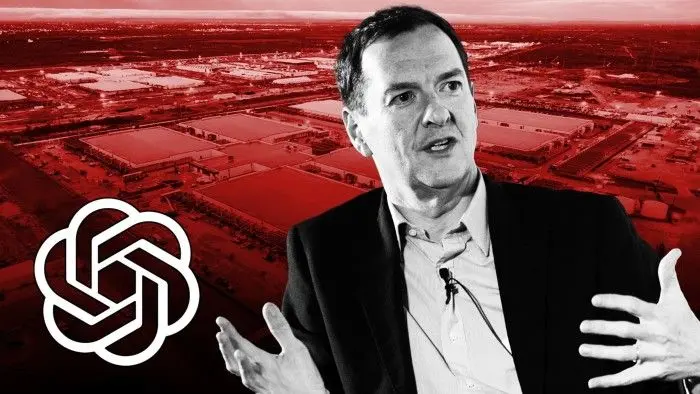
.
Source: FT
Tech Giants Hiring Politicians Becomes Established Pattern
Osborne joins a growing roster of British politicians whose careers have pivoted to tech giants. Nick Clegg, former Liberal Democrat leader and deputy Prime Minister, served as chief global affairs officer at Meta from 2018 to 2025
1
. More recently, Rishi Sunak, who convened the AI safety summit at Bletchley Park as Prime Minister, took advisory roles with both Microsoft and Anthropic in October1
. This pattern signals that major AI firms are behaving less like conventional companies and more as quasi-governmental actors, negotiating national partnerships and pitching a values-led vision of democratic AI5
. The scale of tech lobbying underscores what's at stake: the 10 largest tech firms now outspend the biggest companies in pharma, finance, and automotive industries combined5
.Related Stories

Financial Concerns Shadow Ambitious Expansion Plans
Despite the bold global AI expansion strategy, concerns persist about OpenAI's financial stability. HSBC warned that the business would need to secure $207 billion in new financing by 2030 to support its expansion plans, yet isn't expected to turn a profit before then
1
. OpenAI has announced several circular deals with tech companies, where partners invest in OpenAI and the company commits to spending the funds back on their products or services. In September, Nvidia agreed to provide up to $100 billion in investment while OpenAI committed to buying at least 10 gigawatts of Nvidia systems for its data centers1
. AMD followed in October with a warrant for up to 160 million shares in exchange for 6 gigawatts of AMD GPUs1
.Geopolitics and Tech Regulation Collide
The appointment comes as government-level negotiations between the UK and US over a tech deal involving greater AI cooperation have stalled
4
. OpenAI has positioned its partnerships as ensuring that democratic principles including free speech, free markets, and prevention of mass government data collection are built into the technology3
. However, OpenAI faces ongoing controversy over allegations of using copyrighted material to train its models without permission from rights holders, with publisher O'Reilly claiming content from its books was used to train OpenAI models1
. Sam Altman and partners including SoftBank chief Masayoshi Son and Oracle's Larry Ellison announced Stargate at a White House event earlier this year, with President Donald Trump lauding it as a declaration of confidence in America's potential. Osborne stated his decision followed conversations with Sam Altman and chief operating officer Brad Lightcap, calling them exceptionally impressive leaders committed to developing AI responsibly1
.References
Summarized by

Navi
[1]
Related Stories
UK Government Signs Strategic Partnership with OpenAI, Sparking Debate on AI's Role in Public Services
22 Jul 2025•Policy and Regulation

UK Prime Minister Starmer's AI Vision: Ambitious Plans and Economic Challenges
13 Jan 2025•Business and Economy

US Tech Giants Pledge Billions in UK AI Investment Amid Trump's State Visit
16 Sept 2025•Business and Economy

Recent Highlights
1
Tennessee Teens Sue Elon Musk's xAI Over Grok AI-Generated Child Abuse Images
Policy and Regulation

2
Pentagon designates Palantir Maven AI as core US military system in major defense shift
Technology
3
Supermicro Co-Founder Indicted in $2.5 Billion Nvidia AI Chip Smuggling Scheme to China
Policy and Regulation

Recent Highlights
Today's Top Stories









Your Daily Dose of Curated AI News
Don’t drown in AI news. We cut through the noise - filtering, ranking and summarizing the most important AI news, breakthroughs and research daily. Spend less time searching for the latest in AI and get straight to action.

