Razer invests $600 million in AI hardware, targeting developers and gamers with new workstation


5 Sources
5 Sources
[1]
Razer is making computers for AI developers now
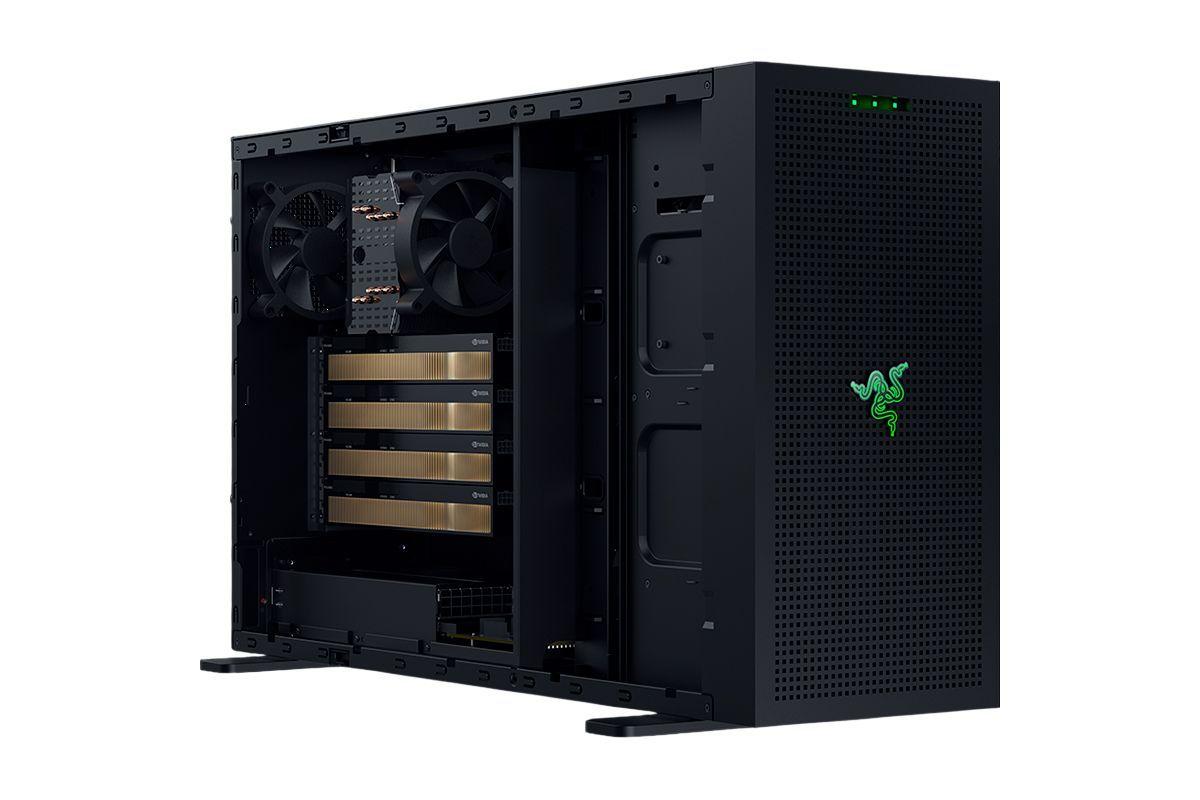
Razer is the latest PC gaming company to pivot to chase that sweet, sweet AI money, but it isn't just slapping an AI label onto its existing products. Well, it is doing that a little bit -- Razer is now categorizing its powerful Blade 18 laptop and Core X V2 eGPU enclosure as "AI dev hardware" -- but it's also launching a new workstation that's specifically designed to handle AI training, inference, and simulation workloads. The Razer Forge AI dev workstation features a rack-ready design that makes it easier to configure a single tower into dense cluster configurations. It supports up to four AMD or Nvidia graphics cards, has eight DDR5 slots, and is powered by AMD's Ryzen Threadripper Pro processor. The Razer Forge supports up to 2,000W power supply and includes dual 10GB Ethernet ports for speedy data transfers. Razer hasn't shared pricing or availability, as this will be a bespoke product that requires users to contact Razer's sales team. This latest launch from Razer follows Nvidia's announcement of its own Digits personal AI supercomputer at CES last year, and more companies will likely follow suit.
[2]
Razer Dives Into AI for Consumers, Professionals and Gamers
The company's CEO said AI represents a multibillion-dollar opportunity for Razer and that the market for AI in gaming "is completely untapped" with about 150 million users already on Razer's software platform. Razer Inc., the gaming peripherals company that went private in 2022, unveiled a series of new products powered by artificial intelligence as it aims for a far-reaching revamp around AI. The new lineup runs the gamut from a pair of over-ear headphones that would compete with smart glasses to a high-powered workstation PC meant for handling demanding AI workloads. While some of these items are meant for consumers, other things, such as an open source AI developer kit, are aimed at coders and other business customers. AI represents a multibillion-dollar opportunity for Razer, said Chief Executive Officer Min-Liang Tan, who co-founded the company in 2005. Razer will invest more than $600 million into artificial intelligence over "the next couple of years" and is hiring about 150 AI scientists, he said in an interview before CES. Razer, with operations in Tan's native Singapore and Irvine, California, joins tech peers in trumpeting the technology that is dominating the CES trade show and the industry more broadly. Consumer-facing companies such as Samsung Electronics Co., LG Electronics Inc. and Lenovo Group Ltd. are all trying to articulate their strategy around artificial intelligence -- and attempt to sell ordinary shoppers on the practical benefits. But Razer will be one of relatively few companies at the conference attempting to pitch gamers on the convenience of AI. While the brand has a history of unveiling new concepts at CES, it's best known for its gaming hardware, including laptops, headsets and even vibrating chairs. The market for AI in gaming "is completely untapped so we see it as a massive opportunity for us," 48-year-old Tan said, pointing to about 150 million users already on Razer's software platform. The broader population of gamers is effectively uncountable, in part because the pastime now includes everyone from professional e-sports players to Wordle enthusiasts. Tan said the growing popularity of video games, particularly among young people, means Razer can offer its new products to a large swath of potential customers without having to broaden its sights beyond that audience. "Instead of us going mainstream, we believe that mainstream will come to us," the CEO said. Razer's concept headset, codenamed Project Motoko, uses built-in cameras and microphones to offer some of the same features as smart glasses. One could, for instance, use the headset to translate text, program a custom workout or suggest a recipe using available ingredients. Naturally, there's also a gaming angle: AI can help people get through tricky game levels. Motoko is compatible with most popular AI assistants, such as those from OpenAI, xAI, Anthropic and Microsoft Corp. Although Motoko's obvious competitors are the sort of smart glasses popularized by Meta Platforms Inc., Razer is betting that consumers will prefer the headphone style, as most people own audio gear but not everyone wears glasses regularly. The battery life will be longer too, Tan said. While the company has not committed to specific numbers, the wireless headset has gone as long as 36 hours on a charge in testing, said Paige Sander, a product marketing manager at Razer. For comparison, Meta's second-generation Ray-Ban AI glasses are rated for eight hours. Inside, Motoko runs on a Snapdragon chip from Qualcomm Inc., which collaborated with Razer on the device. Razer isn't sharing pricing yet for the headset, which Sander said would be available this year. Tan indicated it would command a "slight premium" over other high-end headphones. "We're really looking at this from a headphone pricing perspective," he said. "We're not talking about thousands of dollars." (For reference, the most expensive headset in Razer's current lineup costs $400.) In the meantime, Razer has some kinks to iron out. In a product demonstration controlled by company representatives, the headset's dual cameras failed occasionally to recognize objects in front of it, even in a moderately lit room. Another new initiative, dubbed Project Ava, is essentially a see-through canister that sits on a desktop and allows users to make eye contact with a small holographic avatar -- the face of whatever AI assistant they're using. It will be available in the second half of this year, the company said. The price hasn't been announced, but consumers can put down $20 now to reserve one. The target audience are tech enthusiasts who already relish customizing their desk setups, said David Ng, a director of product marketing. "Our fans spend a lot of time on their computers," he said. The product is not, he added, leaning into the stereotype that gamers can be a lonely bunch. (Plenty of non-gamers, too, have been known to become emotionally attached to AI chatbots.) "We're not trying to foster a relationship, but we do acknowledge that people are using their AIs in a more personal way," he said. Get the Tech Newsletter bundle. Get the Tech Newsletter bundle. Get the Tech Newsletter bundle. Bloomberg's subscriber-only tech newsletters, and full access to all the articles they feature. Bloomberg's subscriber-only tech newsletters, and full access to all the articles they feature. Bloomberg's subscriber-only tech newsletters, and full access to all the articles they feature. Bloomberg may send me offers and promotions. Plus Signed UpPlus Sign UpPlus Sign Up By submitting my information, I agree to the Privacy Policy and Terms of Service. While Razer's two AI-based hardware concepts have yet to go on sale, the company has already begun offering artificial intelligence software. In November, it launched a developer tool called Razer QA Companion, which uses AI to speed up the quality-assurance, or QA, stage of video-game development. Tan said the technology allows programmers to catch 25% more bugs "at any point of time," reducing the total time for such jobs by 50%. Razer has so far onboarded about 50 big-budget and indie studios, and is partnering with Side America Inc., a major provider of gaming-related services, including QA. "As our AI services scale, we expect services revenue, including AI, to grow significantly alongside our hardware business," Tan said, adding that he expects Razer to move toward a roughly even split between hardware and services over the next three to five years. The high-margin nature of these kinds of software and services will help accelerate growth, he said. The open source code, meanwhile, called Razer AIKit, is meant to help developers and researchers find more efficient ways to run large language models on local machines, as opposed to the cloud, to reduce response time. Razer declined to comment on its plans to monetize the software. Not being beholden to public shareholders has given Razer some room to make more ambitious bets, Tan said. "One of the big reasons why we've taken the company private was really to double down and focus on AI."
[3]
Razer joins AI bandwagon with external AI accelerator backed by iconic AMD chip architect
AI device supports daisy chained units for local multi accelerator workloads Razer has revealed an expansion beyond gaming hardware with an external AI accelerator and a new workstation platform aimed at developers working locally on advanced models. Launched at CES 2026, the Razer Forge AI Dev Workstation is a high performance system designed for training, inference, and simulation workloads without relying on cloud services. The on premises solution is for developers who want direct control over datasets, models, and experiments while avoiding subscription fees. The Razer Forge AI Dev Workstation supports up to four professional graphics cards from Nvidia or AMD, allowing large pooled VRAM configurations for multi GPU workloads. Processor options include AMD Ryzen Threadripper PRO and Intel Xeon W chips, paired with support for eight DDR5 RDIMM slots for large memory capacity. Networking is handled through dual 10Gb Ethernet ports, while storage includes up to four PCIe Gen5 M.2 NVMe drives and eight SATA bays. Cooling is designed for sustained loads, with multiple high pressure fans intended to maintain airflow across dense internal components. The workstation can operate as a standalone tower or transition into rack environments, allowing it to scale from individual desks to clustered deployments. Alongside the workstation, Razer has been working with Tenstorrent on a compact external AI accelerator aimed at portable development workflows. Tenstorrent is led by Jim Keller, best known for his work on AMD's Zen CPU architecture and early self driving silicon at Tesla. The accelerator connects over Thunderbolt 4 or Thunderbolt 5 and is designed to add local AI compute to laptops and other compatible systems. It is based on Tenstorrent's Wormhole architecture and supports the company's open source software stack for running LLMs, image generation models, and other AI workloads. Multiple units can be connected together, with up to four devices forming a small local cluster for larger models. "A device anyone can plug into their laptop unlocks the next generation of developers building on our open platform," said Christine Blizzard, chief experience officer at Tenstorrent. "Our goal is to make AI more accessible and we trust Razer to deliver products that developers love." "AI developers on the edge demand power, flexibility, and mobility - and this collaboration delivers all three," said Travis Furst, head of notebook and accessories division at Razer. "Our partnership with Tenstorrent combines their cutting-edge AI acceleration technology with Razer's expertise in high-performance engineering and external enclosure design. Together, we're advancing edge AI development as part of Razer's broader vision for AI - bringing portable, uncompromising compute to developers." Pricing and availability for the external AI accelerator have yet to be announced.
[4]
Razer Unveils Forge AI Dev Workstation, Its Vision for Purpose-Built AI Hardware
Razer has announced the Forge AI Dev Workstation, a new high-performance system aimed squarely at AI developers, researchers, and enterprise users who require powerful local compute without reliance on cloud subscriptions. With this platform, Razer outlines its vision for purpose-built AI hardware that delivers end-to-end performance, secure on-device processing, and predictable responsiveness for training, inference, and simulation workloads. The Forge AI Dev Workstation is positioned as a local alternative to cloud-based AI infrastructure. Razer emphasizes zero subscription costs, full control over data, and consistent performance as key advantages, particularly for organizations working with sensitive datasets or latency-critical workloads. Drawing on more than two decades of experience in high-performance system design, the company has focused on scalability, airflow efficiency, and component flexibility. At the heart of the Forge AI Dev Workstation is support for multiple professional-grade GPUs and AI accelerators, including the latest NVIDIA RTX PRO 6000 Blackwell series. These GPUs are designed for demanding professional workflows, combining large onboard memory with advanced AI and neural rendering capabilities. Razer positions this GPU support as central to accelerating tasks in areas such as model training, large-scale inference, engineering simulation, and scientific computing. On the CPU side, the system supports both AMD Ryzen Threadripper PRO and Intel Xeon W platforms. These processors are optimized for heavy parallel workloads, enabling simultaneous data preprocessing, model compilation, and orchestration tasks. According to Razer, this flexibility allows customers to tailor the system to their preferred ecosystem or specific performance requirements. Memory bandwidth is another core design focus. The Forge AI Dev Workstation supports up to eight DDR5 RDIMM modules, providing the capacity and throughput needed to handle large datasets and keep high-end GPUs consistently fed with data. This configuration is intended to reduce I/O bottlenecks and improve efficiency during large model training runs. For data movement and cluster integration, the system includes dual 10-Gigabit Ethernet ports, enabling high-speed transfer of training data and models at up to 10 Gbps. This makes the workstation suitable not only as a standalone development system but also as part of a larger on-premises AI cluster. Physically, the Forge AI Dev Workstation is designed with scalability in mind. It supports both tower and rack-mounted deployments, with front-to-back airflow, structured cable management, and compatibility with dense rack environments. This allows organizations to scale from a single-node setup to multi-node clusters without redesigning their infrastructure. Razer also highlights tight integration with its AIKit software stack, which is designed to simplify deployment and management. AIKit enables developers to run large language models locally on a single GPU or scale across multiple GPUs, offering a more accessible path to cloud-grade performance within a local environment.
[5]

Razer Spends $600 Million to Sharpen Focus on AI Gaming | PYMNTS.com
By completing this form, you agree to receive marketing communications from PYMNTS and to the sharing of your information with our sponsor, if applicable, in accordance with our Privacy Policy and Terms and Conditions. As part of the realignment, the company is rolling out new products for consumers and businesses, Bloomberg reported Tuesday (Jan. 6). These include headphones that would compete with smart glasses, a PC designed to handle heavy AI workloads and an open source AI developer kit. CEO and co-founder Min-Liang Tan said AI represents a multibillion-dollar opportunity for Razer, per the report. Interviewed before the CES conference in Las Vegas, he said Razer will invest more than $600 million into the technology over "the next couple of years" and is hiring roughly 150 AI scientists. While many companies at CES are promoting AI-powered products, Razer is among the few trying to convince gamers of the convenience of AI, the report said. The market for AI in gaming "is completely untapped, so we see it as a massive opportunity for us," Tan said, per the report, pointing to about 150 million people already using Razer's software platform. He added that the increasing popularity of video games, especially among young people, means Razer can offer its new products to large numbers of potential customers without having to expand its sights beyond that audience, according to the report. "Instead of us going mainstream, we believe that mainstream will come to us," Tan said, per the report. "Early household robots may assist with narrow tasks in controlled settings, complementing existing appliances rather than replacing human labor," PYMNTS wrote Monday (Jan. 5). "Integration with smart home platforms may make these systems more useful, even if their physical abilities remain limited." For companies like LG and Samsung, the strategic value may stem as much from ecosystem positioning as from immediate functionality. Robots connect AI platforms to physical spaces and bolster the idea that these companies can handle daily routines, not just digital interactions.
Share
Share
Copy Link
Gaming hardware giant Razer is making a significant pivot into artificial intelligence with a $600 million investment over the next couple of years. The company unveiled the Forge AI Dev Workstation at CES 2026, designed specifically for AI training, inference, and simulation workloads. Razer is also hiring 150 AI scientists as it targets what CEO Min-Liang Tan calls a multibillion-dollar opportunity in the untapped AI gaming market.
Razer Commits $600 Million to AI Hardware Development
Gaming peripherals company Razer is executing a far-reaching strategic shift into artificial intelligence, announcing at CES 2026 that it will invest more than $600 million into AI over the next couple of years
2
. CEO and co-founder Min-Liang Tan described AI as a multibillion-dollar opportunity for the company, which went private in 20222
. The company is hiring approximately 150 AI scientists to support this expansion5
. Razer's pivot represents one of the most aggressive moves by a gaming hardware manufacturer into the AI space, targeting both professional developers and its existing base of 150 million users on its software platform2
.
Source: PYMNTS
Forge AI Dev Workstation Targets Professional AI Developers
The centerpiece of Razer's AI hardware strategy is the Forge AI Dev Workstation, a high-performance system designed specifically for AI training, inference, and simulation workloads without relying on cloud services
3
. The workstation supports up to four professional graphics cards from Nvidia or AMD, including the latest Nvidia RTX PRO 6000 Blackwell series, allowing large pooled VRAM configurations for multi-GPU AI workloads4
. Powered by AMD Ryzen Threadripper Pro or Intel Xeon W processors, the system features eight DDR5 RDIMM slots for substantial memory capacity and supports up to a 2,000W power supply1
. The rack-ready design enables configurations from standalone towers to dense cluster deployments, making it suitable for both individual developers and enterprise environments3
.
Source: TechRadar
External AI Accelerator Brings Portable Computing Power
Razer has partnered with Tenstorrent, led by renowned chip architect Jim Keller, to develop a compact external AI accelerator aimed at portable development workflows
3
. The device connects via Thunderbolt 4 or Thunderbolt 5 and is designed to add local AI compute to laptops and other compatible systems, enabling on-premises edge AI development3
. Based on Tenstorrent's Wormhole architecture, the accelerator supports the company's open-source AI developer kit for running large language models, image generation models, and other AI workloads3
. Multiple units can be daisy-chained together, with up to four devices forming a small local cluster for handling larger models3
. Travis Furst, head of Razer's notebook and accessories division, emphasized that the collaboration delivers the power, flexibility, and mobility that AI developers on the edge demand3
.Related Stories

AI Gaming Market Represents Untapped Opportunity
While many companies at CES are promoting AI-powered products, Razer is among the few specifically targeting gamers with AI convenience features
5
. Min-Liang Tan stated that the market for AI gaming "is completely untapped so we see it as a massive opportunity for us," pointing to the company's existing user base of approximately 150 million people on Razer's software platform2
. The company unveiled Project Motoko, a concept headset with built-in cameras and microphones that offers features similar to smart glasses, including text translation, custom workout programming, and assistance with tricky game levels2
. Compatible with popular AI assistants from OpenAI, xAI, Anthropic, and Microsoft, the wireless headset has achieved up to 36 hours of battery life in testing, far exceeding Meta's Ray-Ban AI glasses' eight-hour rating2
. Another initiative, Project Ava, features a see-through desktop canister that displays a small holographic avatar representing the user's AI assistant2
.
Source: Bloomberg
Strategic Positioning Against Cloud Services
Razer positions its AI hardware as a local alternative to cloud-based AI infrastructure, emphasizing zero subscription costs, full control over data, and consistent performance as key advantages
4
. This approach particularly benefits organizations working with sensitive datasets or latency-critical workloads4
. The Forge AI Dev Workstation includes dual 10-Gigabit Ethernet ports for high-speed data transfer at up to 10 Gbps, making it suitable for both standalone development and integration into larger on-premises AI clusters4
. Razer has integrated its AIKit software stack to simplify deployment and management, enabling developers to run large language models locally on a single GPU or scale across multiple GPUs4
. The company's strategy follows Nvidia's announcement of its Digits personal AI supercomputer at a previous CES, suggesting a broader industry trend toward localized AI computing solutions1
. Tan expressed confidence that rather than Razer needing to go mainstream, "mainstream will come to us" as gaming continues to grow in popularity, particularly among young people2
.References
Summarized by

Navi
[1]
[3]
Related Stories
Razer unveils fully agentic AI companion AVA at GDC 2026, promising task automation beyond chat
09 Mar 2026•Technology

Razer Unveils AI-Powered Game Development and Assistance Tools
20 Mar 2025•Technology
Razer Unveils Ultra-Thin Blade 16 Gaming Laptop with AMD Ryzen AI and NVIDIA RTX 5090
07 Jan 2025•Technology

Recent Highlights
1
OpenAI shuts down Sora video app after six months, ending Disney's $1 billion investment deal
Technology

2
AI-Generated Val Kilmer to Posthumously Appear in As Deep as the Grave After His Death
Entertainment and Society

3
Supermicro Co-Founder Indicted in $2.5 Billion Nvidia AI Chip Smuggling Scheme to China
Policy and Regulation
Recent Highlights
Today's Top Stories






Your Daily Dose of Curated AI News
Don’t drown in AI news. We cut through the noise - filtering, ranking and summarizing the most important AI news, breakthroughs and research daily. Spend less time searching for the latest in AI and get straight to action.

