Razer's Project Motoko brings AI headphones with cameras to challenge smart glasses market


14 Sources
14 Sources
[1]
I Wore Razer's Project Motoko: Like Smart Glasses, but in Headphone Form
Nearly 20 years writing about tech, and over a decade reviewing wearable tech, VR, and AR products and apps I've been down this road before: look at something in front of me, snap a photo, and ask AI services for advice about what I'm looking at. I've done with Meta's Ray-Ban glasses and countless others, but this time I was wearing a pair of over-ear headphones with a camera in each cup at Razer's CES demo suite. Project Motoko is Razer's latest wild stab at new gaming tech at this year's CES, but the funny thing is it's not as wild as I thought...in a good way? Motoko is meant to be worn while gaming, or doing anything else, but the pitch of "why these over smart glasses" is you don't have to deal with wearing glasses at all with this, and the promised battery life with AI-connected services on is 36 hours...which is way beyond what any pair of smart glasses I've worn can do. The headphones use a Qualcomm Snapdragon chip inside, although I wasn't told which one...and it's something that will likely change whenever this idea becomes an actual product. Which reps at Razer I spoke to say is definitely happening, at some point, at a price that would be competitive with smart glasses. Right now, Meta's Ray-Ban glasses start at around $300. There are dual Sony 4K 12MP cameras on Project Motoko, good enough for photos or video (although how good they'd look, I don't know). And I also don't know how good Motoko sounds as headphones, since my demo was entirely focused on using the microphones to ask AI questions while a nearby speaker broadcast the answers. Motoko could connect to a PC or a future mobile app, and the plan is to make the headphones AI-agnostic, plugging into whatever platform you want. That's another advantage over current smart glasses, which generally funnel you to one AI service. I'm glad I checked these out, because I don't think this will be the last time I wear headphones with cameras in them. Qualcomm is often a harbinger of new tech products to come, and a lot more people wear headphones than glasses. It's likely a sign of where an ongoing wave of camera-enabled AI wearables are heading. Now I'm wondering when earbuds are next.
[2]
Razer thinks you'd rather have AI headphones instead of glasses
"This is the future of AI wearables!" That's what I'm told as a Razer representative slips a pair of otherwise nondescript headphones over their ears. Except this isn't a regular pair of gaming headphones. This is Razer's Project Motoko, a concept pair of headphones that has two 4K cameras, near and far field microphones, and built-in AI. The device is powered by a Qualcomm Snapdragon chip, though Razer is tightlipped about exactly which. That's because by the time the device hits shelves, it might be a slightly different one than the one its showing off at CES 2026. Headphones, the Razer rep tells me, are a much better choice for on-the-go AI than smart glasses before rattling off some reasons. For starters, headphones have longer battery life. While Razer declines to give us an official battery spec, I'm told that they've achieved up to 36 hours in testing. If that holds up, that's a significant advantage. By comparison, the Ray-Ban Meta glasses get about six hours on a single charge. Some smart glasses achieve longer battery life, but I've yet to see a pair of smart glasses truly last all day. Theoretically, you could also use these headphones while charging -- that's something you can't do with smart glasses either. Supposedly, placing cameras in the cans also offers more natural point-of-view footage. I'm skeptical about that as it depends on the smart glasses. That may be true of glasses that place cameras in a singular hinge, but it's a dubious claim for those that house cameras in the nose bridge. Lastly, because these are actual over-the-ear cans, no one else can hear the answers to your conversations. A rep tells me that's much more private than open-ear audio you get in glasses. Otherwise, it works similarly to how AI glasses work. You can take photos with a press of a button, and from there, talk or ask questions to whichever AI assistant you choose. The demo model I see has ChatGPT preloaded. Like many CES demos, this one is a bit on rails. I get to see Project Motoko translate a cafe menu written in Japanese. It identifies correctly a tablet as a miniature version of the Rosetta Stone. At one point, it translates how to say "One matcha latte, please" in Japanese and repeats it slower with the phonetics enunciated. (Said translation is accurate.) I'm told you'll also be able to use it to ask for recipe suggestions or to generate workout recommendations. Some basic AI queries can be done locally on the headphones, while more complex queries will require your phone or PC's internet connection. In any case, I'm told Project Motoko will require minimal connectivity. Big, if true. When I ask about privacy, Razer refers me to a teeny tiny recording indicator light. I hadn't noticed it going off at all during the demo, and I'm skeptical of whether it'll be fully visible in bright surroundings or if you happen to have a voluminous head of hair. Speaking of luscious locks, I'm curious to see how that might impede camera views. On smart glasses, my bangs are a constant, unwelcome intrusion in video and photo footage. I sort of blame Sam Altman and Jony Ive for this. Last year, the duo announced Open AI was working on a mysterious AI hardware product that wouldn't be glasses. So far, all we know is it'll be screen-free and about the size of a phone but early on, many (including myself) speculated that headphones might be in the mix. Now it seems Razer's taken that idea and is running with it. Razer has already experimented with smart glasses, to a lackluster response, so perhaps that's another reason why the company is keen to branch out. For a concept product, Razer seems pretty confident that this will actually reach consumers. While Razer declined to name an estimated price, the company says to expect Project Motoko to arrive sometime later this year.
[3]
Razer's Project Motoko is a concept gaming headset that doubles as an AI wearable
We see plenty of far-out ideas on the CES show floor, and this year Razer brought in a concept piece called Project Motoko. The device is Razer's take on blurring the line between a gaming headset and an AI-powered wearable for daily life. Or it's a way for Ghost in the Shell fans to feel affronted by Razer taking The Major's name in vain, take your pick. Project Motoko is powered by Qualcomm's Snapdragon platforms. The headset has a pair of first-person view cameras positioned at eye level that can support real-time object and text recognition. It also has a wide field of attention that can capture things happening beyond the normal human eye's peripheral vision, and its microphone array is designed to capture both near and distant audio. "Project Motoko is more than a concept, it's a vision for the future of AI and wearable computing," Nick Bourne, Razer's global head of mobile console division, said in the press release about the device. "By partnering with Qualcomm Technologies, we're building a platform that enhances gameplay while transforming how technology integrates into everyday life. This is the next frontier for immersive experiences." In addition to taking in environmental details, Project Motoko can also operate as a wearable AI assistant, and the model is compatible with several different chatbots. The company's press release noted that it can integrate with Grok, OpenAI and Gemini. Since Project Motoko is a concept device, Razer has no plans for a commercial release of this headset, but one of the highlights of CES is seeing these more experimental designs. Razer is also well-established as a brand for serious gamers, so seeing the company explore making an AI wearable that could appeal to a broader audience, if still a geeky one, is an intriguing move.
[4]
Razer Thinks AI Headphones With Cameras Can Take On Meta's Ray-Bans
If there's one thing that 2025 gave us a lot of last year in the tech world, it was smart glasses, and if I had to guess, 2026 won't be any different. But just because gadget makers seem to have their eyes fixed in one direction doesn't mean smart glasses are a sure thing. What if there's another form factor that could offer the same feature set without needing to sit on your nose all day? For Razer, that form factor is (drum roll) headphones. At CES 2026, Razer took the wraps off a concept called Project Motoko, which is a pair of wireless headphones equipped with cameras. The idea here is similar to that of Ray-Ban Meta AI glasses (in fact, Razer mentioned Meta by name in its briefing to the press). Cameras, according to Razer, are meant to be used for computer vision, meaning they can watch what you're doing and then use AI to chime in on what the cameras see. Just like the Ray-Ban Meta AI glasses and the Meta Ray-Ban Display, computer vision is intended to be used for several purposes, including answering questions about your surroundings, translating text, and providing instructions on what to cook, to name a few. Naturally, since this is Razer we're talking about, Razer also sees applications in gaming, allowing you to point Motoko at the screen you're looking at and ask questions about gameplay or strategy. I got a chance to try Project Motoko a little bit, and the experience was... okay. Just like Meta AI, which is built into Meta's AI glasses, the outcome of your question is highly variableâ€"sometimes AI understands the assignment, but sometimes it doesn't. For example, I asked the headphones how to help me choose attachments on a weapon in Battlefield while looking at a Battlefield game menu, and the AI instead went on a tangent about different guns in the game. I had to ask again with greater specificity to get an answer that helped, which isn't what I would call totally smooth. Hardware-wise, Project Motoko uses two 12-megapixel sensors on either earcup, which is similar to what Meta uses in its AI glasses. Razer tells Gizmodo that users can also take pictures with those cameras if they so choose. Obviously, Project Motoko isn't using Meta AI, though, and instead can be customized with different models, including Gemini, ChatGPT, and Grok. Internally, Project Motoko is powered by a Snapdragon chip, though Razer didn't say which. So, why take a left turn away from glasses? As Razer suggests, some people just don't want to wear smart glasses all the time, and headphones could fill in the gaps for those people. There's also the added privacy of having audio directed straight into your ears instead of the more open form factor of glasses that can sometimes blast audio out loud to others unintentionally. I suppose if you're the type of person who tends to walk around with headphones on their ears all the time, Project Motoko could make sense, but if I'm being honest, the whole thing feels like a tough sell. Headphones might be the right form factor sometimes, but they can feel isolating. The second you block your ears with earcups, you're separating yourself from your environment, which can be nice when you want a timeout, but it isn't conducive to all-day wear. The whole thing is still a concept, though, so Razer may never have to grapple with that sticking point in a real sense. If there's one thing that Project Motoko proves for now, it's that AI wearables likely aren't going anywhere soon, so buckle up and expect a lot more computer vision in the year ahead.
[5]

Razer's new concept headphones have built-in cameras and all the AI you need
You can also set us as a preferred source in Google Search by clicking the button below. Although many companies have been pushing the idea of glasses using AI, AR, and other cutting-edge technologies, Razer feels that headphones are a better choice for AI wearables. While you won't have a display to augment the world around you, Project Motoko is still very much aware of its environment, thanks to its Dual FOV cameras with 3K/60 spatial video capabilities. You'll be able to ask Motoko a variety of things by saying "Hey, Motoko", including weather requests, direction information, general questions, and more.
[6]

I tried Razer's Project Motoko and this gaming headset with dual first-person cameras could be the future of AI
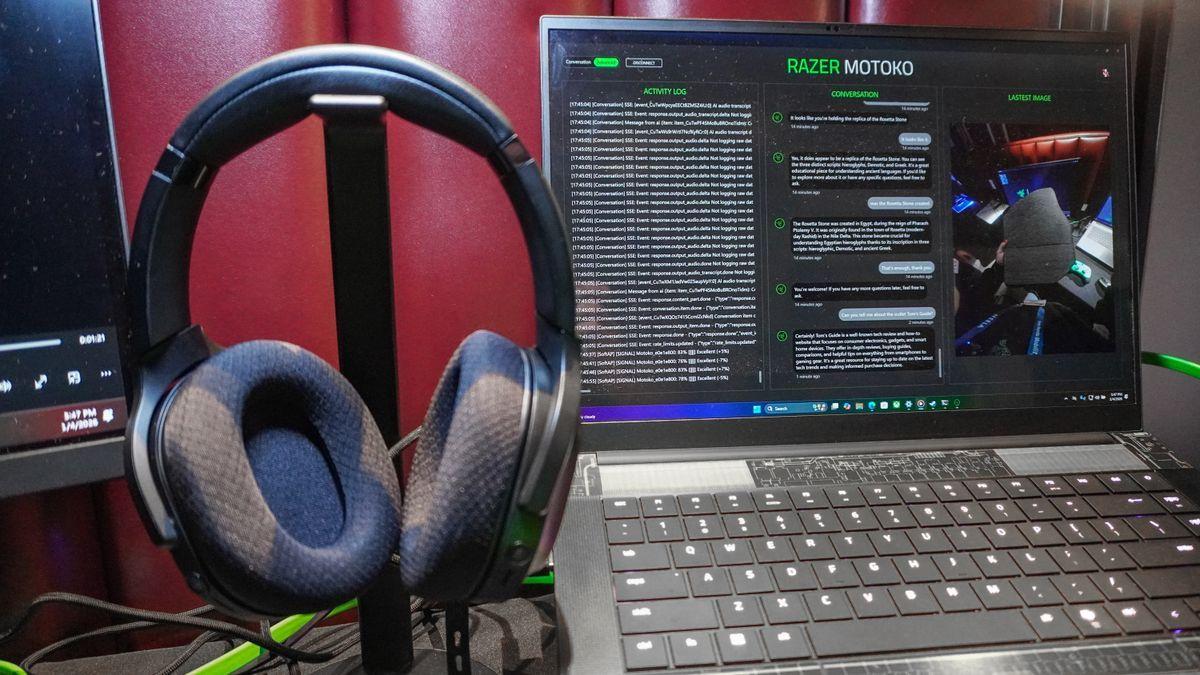
Proving the best AI wearable is the one you're already wearing From Plaud's NotePin to Meta's Ray-Ban smart glasses, AI wearables are all the rage these days, and that's especially true at CES 2026. However, when I walked into Razer's suite, I wasn't expecting to find an AI-powered gaming headset. Getting people to don a new device just to use AI hasn't been as seamless as you'd expect. Sure, the Humane AI Pin caught everyone's attention (including ours) at CES a few years ago, but it effectively became a paperweight after its servers were shut down in February 2025. Plaud's NotePin has fared better by carving out a niche for professionals, but it's still a device most people only see at tech events. Razer has been slowly integrating AI into its ecosystem -- from AI-powered game assistants to intelligent webcams -- but this year, the company is taking things to a new level. Project Motoko is a bold concept that blends an AI-native computer into a high-end gaming headset. Powered by Snapdragon platforms and equipped with dual eye-level cameras, it offers a level of contextual awareness and processing power that smaller wearables simply can't match. Here's everything you need to know about Razer's Project Motoko and why it might finally succeed where other AI wearables have failed. So much more than a headset At first glance, I thought I was looking at a potential new contender for one of the best gaming headsets when I first laid eyes on Razer's Project Motoko. However, upon closer inspection, the dual eye-level cameras let me know that this was a different beast entirely. Since this is a concept after all, Razer couldn't tell me exactly which AI chip was powering this headset in the demo I saw, but it did confirm the platform is built on Snapdragon. Unlike a pair of smart glasses or another pin-like wearable, Project Motoko actually looked comfy and something I wouldn't mind wearing at all. I didn't get to try on the headset immediately. Instead, I watched a Razer employee use its dual eye-level cameras to capture pictures and then proceed to ask its built-in AI assistant about them. This isn't the only way you can use Project Motoko, though, as you can also have its cameras continuously capture what you see for real-time interaction. This provides what Razer calls "stereoscopic precision," allowing the AI to perceive depth and details that might even be beyond your own peripheral vision. The big difference between a pair of the best smart glasses and Project Motoko is battery life. With all that extra room inside the headset's earcups, you can house a larger battery which is perfect for continuous capture since it's such a drain on a device's battery life. Likewise, this also means you can use bigger, more powerful chips for improved on-device processing. In addition to the cameras on both earcups, there are also dual far and near-field microphones. These work together to capture your voice commands while sensing environmental audio, which made it easier for the headset to pick up on the questions I asked once I finally had a chance to try it out for myself -- even in the crowded suite where I got to see Project Motoko in action. While still an early concept, I saw it perform real-time object and text recognition by taking a picture of a Japanese menu and then translating and explaining it on the fly. There was also a replica of the Rosetta Stone on the desk next to the headset, and after a quick pic, Project Motoko explained to us that there were three languages written on the stone tablet and exactly where each one appeared. One of the most interesting parts is that you aren't locked into one ecosystem; the headset is designed for universal compatibility with leading AI platforms like Grok, ChatGPT, and Gemini. With my demo done, it was time to don Project Motoko myself and see if an AI-powered headset was as useful as it looked. An AI wearable you'll actually wear Remembering to attach a pin to your clothes before you head out or wearing a pair of smart glasses when you don't actually need glasses can be difficult. With Project Motoko, I picked it up and put it on the same way I would with any gaming headset. I didn't feel its extra weight at all and if I hadn't seen the cameras on the sides of its earcups beforehand, I might not have even noticed this wasn't your typical gaming headset. Granted, things could change if and when Project Motoko becomes an actual product you can buy. Still, I had the power of AI at eye level without any of the awkwardness that comes from a brand-new category of device. Since there was a Razer gaming laptop plugged into a monitor in front of me and partially due to its color, I took a picture and then asked Project Motoko about the HDMI cable connecting them. It quickly explained that the HDMI cable in question was Razer green without any issues. While this was a simple test, the vision system is designed to understand much more complex contexts instantly, from tracking gym reps to summarizing documents on the fly. For the sake of the demo, Project Motoko's responses came through on a Razer Leviathan soundbar underneath the monitor. In practice (and if this becomes a real product), all of its on-the-fly audio feedback will come directly through the headset's earcups. That way, you and you alone will be able to hear how the AI assistant adapts to your schedule and habits. One of the most surprising aspects of this "wearability" isn't just for the user, but for the future of technology itself. Razer is positioning Motoko as a tool for machine learning, using the authentic human POV data it captures -- like depth and focus patterns -- to provide the high-value datasets needed to train humanoid robots for natural perception. During my short time with Project Motoko, I was quite impressed. However, it's the kind of device I'd have to try out for myself -- from both the comfort of my own home and out in public -- before deciding whether or not I'd ditch my current headset for this turbo-charged one. Not just for gamers Razer may be a gaming company, but Project Motoko appears to have even larger ambitions. During a video explaining the concept, the headset was just as useful when sitting in front of one of the best gaming PCs as it was in the rest of your home. For instance, in the video, the person wearing it used it while fixing things in their living room and while cooking in the kitchen. Like you would with your favorite AI chatbot, you can look in your fridge or even at a table full of raw ingredients and simply ask, "What can I make with what I have here?". This is possible because Motoko acts as a full-time AI assistant that adapts to your habits, providing on-the-fly audio feedback for everything from translating street signs to tracking gym reps. Getting people excited about AI wearables and convincing them to actually buy one are two completely different things. However, if your AI wearable sits in a drawer gathering dust, no one's actually using it anyway. With a device like Razer's Project Motoko, I think that last barrier to entry is completely removed. People -- and especially gamers -- are used to wearing over-ear headphones, and that's half the battle right there. Beyond personal use, Razer is even looking at how this device can help build the future of robotics. By capturing authentic human POV vision data -- including depth, focus, and attention patterns -- Motoko provides the high-value datasets needed to train the humanoid robots of tomorrow for natural perception and decision-making. Now, will Project Motoko ever materialize as a real product? For now, it remains a concept debut for CES 2026. Well, only time will tell. For me, though, I could see myself using a headset like this if it delivers the same audio experience Razer is known for but with some extra help along the way from my favorite AI chatbot. Follow Tom's Guide on Google News and add us as a preferred source to get our up-to-date news, analysis, and reviews in your feeds.
[7]

CES 2026: Move over, AI smart glasses! Razer has a new AI wearable: Headphones.
Hands-on with Razer's new Project Motoko at CES 2026. Credit: Mashable If you don't regularly wear glasses, why would you ever wear AI-powered smart glasses? That's the question posed to us by Razer at CES 2026 this year - and it's a good point! This is why Razer has been working on a new wearable that the company unveiled at CES this week called Project Motoko, an AI-powered headset. Project Motoko is very much in the prototype stage, without any scheduled release date or price point currently in mind. Razer gave Mashable an up-close look at the Project Motoko during a private demo at CES, and some of you might hope that Razer hurries along with that release after hearing about our experience. With Project Motoko, Razer has essentially inserted a full-fledged AI assistant into a pair of headphones. The headset is powered by Snapdragon and features two dual eye-level cameras outfitted in the device for contextual awareness. To showcase what these capabilities for Project Motoko mean, Razer provided a fictional scenario where we were traveling in Japan and pulled out a restaurant menu that was written in Japanese. The Project Motoko headset was able to read the menu thanks to its cameras, and translate the menu to us via audio within the headphone set. We were then able to ask Project Motoko questions about the menu such as which flavors were available or if we could afford a certain menu item based on the amount of money we had available to us. Project Motoko answered our questions and even suggested an alternative menu item when informing us that our item of choice was out of our budget. In another example during the demo, Project Motoko was able to recognize a physical replica of the Rosetta Stone and provide corresponding information about that. As explained by Razer, Project Motoko is not tied to any specific AI model and can be used with the user's large language model (LLM) of choice. Razer thinks there are quite a number of bonuses to having an AI assistant in your headphones rather than your smart glasses. The demo showed off another one: The AI assistant is talking to the user within the headphone set. With smart glasses, it's much easier for people to eavesdrop on what your AI assistant is telling you. However, as a headset, Project Motoko is missing one central feature that smart glasses can provide: A display. Yes, that seems obvious but it's also important to point out. But, when you consider that not all smart glasses even provide an in-lens display feature, it might not be a dealbreaker. Razer's inspiration here is clearly that the company believes that more potential customers wear headphones throughout their day than a pair of glasses or even a watch. Plus, users who want AI wearables want ones that feel like products they already utilize. And, in our hands-on with Project Motoko, it just felt like a regular pair of headphones. It seems like Razer is on to something here.
[8]

Wearable AI is coming -- and Razer's Project Motoko is leading the charge with smart headphones
The headset pairs cameras, microphones, and AI platforms like ChatGPT and Gemini to offer hands-free assistance Razer offered a glimpse of a world where your headset sees, hears, and thinks while it pipes your music to your ears at CES this year. The company's new Project Motoko AI-native headset is still in the concept stage, but it joined its new remote and gaming chair in Las Vegas. Motoko is a way of seeing how Razer's approach to AI wearable tech might easily catch on. Razer's pitch for wearable AI is basically a headset that sees and hears whatever you do and provides proactive help based on context. Project Motoko melds Razer's design sensibilities with AI chips and extended reality tools. The wireless headset is laden with cameras and microphones that share information with AI models able to recognize and interact with whatever you're looking at, while keeping a digital eye on the world beyond your peripheral vision. Razer claims the headset will respond to visual cues, translate signs, summarize documents, track workouts, and generally act like a low-key, always-on assistant. The dual forward-facing cameras mounted at eye level give the headset a natural first-person perspective, allowing it to recognize traffic lights, recipes, or anything else in front of you and offer whatever help seems most needed. The multiple microphones let it parse both your voice commands and whatever else it hears around you. They combine to provide what Razer calls "augmented AI awareness." Project Motoko is agnostic about which AI tool is helping you out, so you can have a conversation with Gemini, ChatGPT, or even Grok. The headset can process and respond based on whatever system you already use. Razer hastened to make clear that Motoko is not just for gaming, even if it debuted under Razer's gaming-forward brand. The company wants people to use the headset every day for more mundane tasks. That might mean organizing your calendar, handling chores, browsing the web, or walking through a foreign city while it quietly translates the signage and helps you avoid construction zones. The look of the headset compared to smartglasses might be part of the draw. Smart glasses, which have struggled with adoption due to awkward designs and social discomfort, while over-ear headphones are already widely accepted. Of course, since Motoko isn't shipping yet, a lot of its capabilities are left to demos and speculation. Razer is likely particularly keen to avoid the pitfalls that plagued Humane's AI Pin into extinction and led to so many complaints for the Rabbit's R1 assistant. Motoko doesn't claim to be the first or the only solution. But it does reflect a growing trend for context-aware devices that live in everyday accessories. Razer even sees potential in robotics and machine learning research. The idea is that people could use Motoko's human-like field of view and depth data to train other AI models to see and understand the world. One way or another, headsets might become a common AI interface sooner than we think. "Project Motoko is more than a concept, it's a vision for the future of AI and wearable computing," said Nick Bourne, Global Head of Mobile Console Division, Razer. "This is the next frontier for immersive experiences."
[9]

Your headphones just got two cameras, meet Project Motoko
Razer's concept headset puts dual eye-line FPV cameras on a Snapdragon platform, pitched for hands-free POV capture and computer vision tasks CES 2026 Read and watch our complete CES coverage here Updated less than 5 minutes ago Razer Project Motoko is a wireless AI headset concept that adds dual first person cameras at eye level to something you already wear for games, calls, and streams. Razer showed it at CES 2026, and the bet is that your headset can do more than audio when so much of life is now recorded. Motoko pairs those cameras with near and far field microphones, so it can capture what you see and what's happening around you. Razer also describes it as a front end for multiple AI services, with the idea that you can switch assistants based on the task. Recommended Videos It's still a concept, but there's a near-term milestone. Razer is taking sign-ups for a Developer Kit it expects in Q2 2026, which is the first real hint at how serious this is beyond the show floor. Two cameras, one viewpoint The defining choice is placement. The cameras sit where your eyes are, not on your monitor or on your desk, so the footage matches your natural perspective. Cameras are also no strangers in Razer's product offering, as the Leviathan V2 Pro has infrared cameras that track your head and ears. Razer links the stereo setup to depth cues and scene understanding, which is a different goal than a basic webcam. With the microphones in the mix, Motoko is meant to capture both the visual context and the audio context in front of you. If it works well, it could make hands-free POV capture feel less like a compromise and more like a default. If it doesn't, it becomes another gadget that only looks good in controlled demos. Why streamers and robot builders care Creators will notice the obvious upside. Eye-level video can look more natural than chest mounts, and it can move with you from desk to couch to IRL without rebuilding your setup every time. Developers get a different hook. Razer explicitly points to computer vision workflows and robotics, and it talks about collecting point of view data that includes depth and attention patterns. That positioning puts Motoko closer to a wearable sensor platform than a creator accessory. The multi-assistant angle matters most here. If Motoko can reliably hand off tasks to different AI back ends, it may fit a wider range of experiments than a single locked-in assistant. What to watch next The Developer Kit will either validate the idea or expose its limits fast. If it arrives in Q2 2026 and developers ship prototypes, you'll see whether stereo POV is genuinely useful or mostly novelty. After that, the missing specs become the story. Camera resolution, field of view, onboard processing, battery life, and where video is stored or sent will shape the privacy and practicality questions. Those details decide whether Project Motoko turns into a real tool or stays a CES concept.
[10]

Razer announces Project Motoko: kind of like AI glasses but a gaming headset
Ah, CES. Half AI, a quarter prototypes that seem finetuned for a headline, and a quarter genuinely useful tech. With Project Motoko, Razer seems intent on hitting at least three quarters of that market. Announced today, Project Motoko is a gaming headset with a Snapdragon chip that reportedly has AI computer vision and universal AI platform compatibility. With dual 3K 60 fps cameras, Razer says it could theoretically look at what's in front of you and use an AI model to take in data. It could then give gaming advice, tell you what's in front of you, or anything else you would traditionally use a chatbot for. The first-person view means you can also stream or record video, much like the Ray-Ban Meta smartglasses. Razer tells us it comes with optical image stabilization, which should help with the whole 'two cameras strapped to the side of your head' thing. However, there's a less traditional use case here that is oh so Razer. In the pre-presentation briefing I attended, I was informed that Project Motoko can be used to give advice for the game you are playing. How it manages to accurately identify the game, then use that data to give you context-specific advice, is anyone's guess, but it was part of the presentation nonetheless. In fairness to this idea, Razer's headsets have been mighty comfortable as of late. In Dave's review of the Razer BlackShark V3, he said, "You're getting a gaming headset which feels comfortable even for the long haul." Still, I'd imagine many would pick a standard BlackShark and use their everyday phone, rather than commit to the full AI gaming headset. With its ability to work with ChatGPT, Gemini, Perplexity, Grok, and other major AI bots, Razer told us it could be used to "train the next generation of terminators". This line was, naturally, delivered with a cheeky smile, before moving on to the next thing. There's also no word yet on battery life, and that's likely because this is simply a prototype, rather than a ready-to-market product. CES tends to be full of prototypes from companies that may never see the light of day. They work as neat marketing for the brand (which my words naturally play into), though it's not impossible to think enough interest could bring such a project to life. Last year, Razer unveiled a chair that could swap between being heated and being cooled, and though that idea is certainly interesting, we haven't heard a peep (or awkward creak that sounds suspiciously like a fart) since. Razer also said it plans on releasing a wearable of some kind in 2026 (which would presumably rival what Meta is working on, too). Still, I can't quite decide if a smart gaming headset or smart glasses would be more awkward to let loose in the wild. One thing is true: Razer's future terminator will certainly look a bit dorky, if you ask me.
[11]
CES 2026 news: Razer AI-powered gaming headset revealed
CES is all about wacky concepts, and Razer brought one of its own to the 2026 showcase. The gaming accessory giant unveiled a concept gaming headset called Project Motoko that does more than just deliver audio and accommodate voice chat with friends. Much more, in fact. Motoko is actually a wireless AI wearable that's compatible with all the big AI systems like Gemini and OpenAI and does a lot of the same things that a pair of smart glasses could do. Just, you know, in the form of a headset instead of glasses. By that, I mean it can use first-person cameras positioned on the front of the device to recognize objects and text in real-time, with language translation and document scanning provided as examples by Razer. It's also got multiple on-board microphones for recognizing voice commands for whichever AI assistant you feel like using. It really does seem, feature-wise, like it's got parity with any number of AI-powered smart glasses that are on the market today, but just in a different form factor. Of course, the difference is that those glasses are actually on the market and Project Motoko is not. This is just a concept, with no release date or price at the moment.
[12]

Razer's Project Motoko turns AI smart glasses into a wireless headset
TL;DR: Razer's Project Motoko, unveiled at CES 2026, is a wireless gaming headset featuring dual first-person cameras and AI-powered real-time object recognition. It offers private, fast AI interactions via speech, supports multiple AI platforms, and is designed for on-the-go use, with a planned 2026 release. Announced at CES 2026, Razer's Project Motoko offers an interesting take on the AI smart glasses phenomenon, as it's a wireless gaming headset with built-in cameras. Powered by an undisclosed Snapdragon processor, the dual first-person cameras allow for real-time object and test recognition, which then interacts with the on-board AI. During our demonstration of Project Motoko, we had the AI translate a restaurant menu from Japanese to English and scan a table with a handful of ingredients to provide a quick, easy recipe for a meal. As a headset with a microphone, this is handled via speech and natural language, with AI responses fed directly through the headset. Similar functionality to Meta Glasses; however, as Project Motoko is a headset, the AI responses are kept private, so those nearby won't be able to listen in. And to capture audio from multiple sources, there are dual far and near-field microphones to capture voice commands and all other sounds within view, including dialogue. One of the impressive aspects of Project Motoko is that the AI responses are impressively quick, with no apparent long delay between commands and responses. The version we saw at CES 2026 featured a physical design similar to the Razer Barracuda, the company's gaming headset with the most lifestyle-like design. This makes sense because it is a piece of wearable technology designed to be taken with you on the go. And the good news is that even though this isn't the final version, Razer told us that Project Motoko is currently on track for a 2026 release. Also, it will be versatile and compatible with AI platforms such as Grok, OpenAI, and Gemini.
[13]

Razer's Project Motoko Combines AI Smarts into a Gaming Headset - Phandroid
The annual Consumer Electronics Showcase in Las Vegas is probably one of the best places to see a lot of cool tech, and while some of them don't necessarily make it to market status, they nevertheless show what we can expect from current technology. That said, Razer recently unveiled Project Motoko, a conceptual AI-powered wireless headset. Razer says that Motoko was developed in collaboration with Qualcomm, and as such is built on Snapdragon platforms, designed to function as a wearable computing interface. The concept focuses on combining computer vision, environmental awareness, and multi-platform AI compatibility into a relatively-portable form factor. Like a lot of products at CES this year, Motoko is built to work with a number of AI models such as OpenAI, and Gemini. The headset features dual eye-level cameras that provide a first-person viewpoint for real-time object and text recognition, allowing the system to perform tasks such as translating signage, tracking physical activities, or summarizing printed documents. Razer says that the system is designed to provide stereoscopic precision and a wide field of attention. For audio, Project Motoko uses a dual-microphone setup that can capture near-field voice commands and far-field environmental sounds. Razer says that this setup allows the integrated AI assistant to interpret contextual audio and provide immediate feedback. Additionally, the device is designed for hands-free operation as well.
[14]

Razer's New Headphones Have Cameras to Act as a Real-Time AI assistant
Project Motoko is still a concept for now, but you can sign up to get the first Developer Kit in Q2 2026. At CES 2026, Razer unveiled a new type of wearable AI device called Project Motoko. It's a wireless headset that turns a pair of headphones into an "always-on" AI assistant. Razer's Project Motoko features cameras and microphones to see the world around you and interact with you in real-time. It basically integrates AI vision and audio to help with tasks including productivity, content capture, and gaming. Razer has added dual FPV cameras mounted at eye level to match your natural viewpoint. The cameras also have stereoscopic precision which allow it to read depth and locate objects with sub-millimeter accuracy. At the same time, it maintains a wide field of vision, going beyond human peripheral vision. It can easily read symbols, text, and other details that you might miss. The camera is paired with dual microphones including a far and near-field microphone. It can seamlessly capture your voice, pick up conversation from other people within the cameras' view and also environmental audio. The best part is that Project Motoko lets you connect with AI models from OpenAI, Gemini, and Grok. In case you are wondering, where can you use Project Motoko, well, it's a device like AI glasses with cameras and microphones so there are many use cases. You can use it while cooking for guidance, get real-time translations while traveling, managing tasks hands-free, and best of all, get an immersive AI-driven guidance while gaming. Basically, Project Motoko is an always-on device that can see and hear the world around you and you can use it as your AI companion in daily life. Note that it's still a concept device and it's not clear when Razer will release this AI device. However, the company says the data from Project Motoko can be used for humanoid training and perception research. You can sign up here to access the first Developer Kit in the second quarter of 2026.
Share
Share
Copy Link
Razer introduced Project Motoko at CES 2026, a concept pair of AI-powered headphones equipped with dual 4K cameras and voice-activated AI capabilities. The device promises 36-hour battery life and compatibility with multiple AI platforms including ChatGPT, Gemini, and Grok. Razer positions these headphones with cameras as a practical alternative to smart glasses, targeting gamers and everyday users who want AI assistance without wearing glasses.
Razer Unveils Project Motoko AI Headphones at CES
Razer showcased Project Motoko at CES 2026, positioning these AI headphones as a compelling alternative to smart glasses in the expanding wearable AI assistant market. The concept gaming headset features dual Sony 4K 12MP cameras mounted on each earcup, designed to capture point-of-view footage and enable computer vision capabilities
1
. Powered by a Qualcomm Snapdragon chip, the device integrates AI-enabled wearable technology into an over-ear form factor that many users already wear daily2
.
Source: Engadget
The headphones with cameras can perform real-time object and text recognition, translate foreign language menus, provide recipe suggestions, and answer gaming strategy questions
3
. Users activate the wearable AI assistant by saying "Hey, Motoko" or pressing a button to capture photos and initiate AI queries5
.
Source: Tom's Guide
Why Razer Chose Headphones Over Smart Glasses
Razer makes a direct case for AI-powered headphones as superior to Meta Ray-Ban and other smart glasses options. The most significant advantage is battery life—Project Motoko achieved up to 36 hours in testing, compared to approximately six hours for Ray-Ban Meta glasses
2
.
Source: CNET
The on-the-go AI functionalities also benefit from enhanced privacy, according to Razer representatives. Over-ear cans direct audio straight into users' ears rather than broadcasting responses through open-ear speakers found in most smart glasses
4
. Additionally, users can charge and use these headphones simultaneously, something impossible with smart glasses2
.Multi-Platform AI Integration and Technical Specifications
Unlike smart glasses that typically funnel users to one AI service, Project Motoko takes an AI-agnostic approach. The concept device integrates with ChatGPT, OpenAI, Gemini, and Grok, allowing users to choose their preferred platform
3
. Basic AI queries process locally on the headphones, while more complex requests require internet connectivity through a paired phone or PC2
.The 4K cameras positioned at eye level provide what Razer claims is more natural point-of-view footage than many smart glasses designs
2
. The device includes near and far field microphones to capture audio at various distances, enhancing its computer vision and voice commands capabilities3
.Related Stories

Real-World Performance and Privacy Concerns
Demonstrations at CES showed Project Motoko successfully translating Japanese cafe menus, identifying objects like a miniature Rosetta Stone tablet, and providing real-time translation with phonetic pronunciation
2
. However, hands-on testing revealed variable performance typical of AI wearables. When asked about weapon attachments in Battlefield, the system initially provided tangential information about different guns before delivering a useful answer upon rephrasing4
.Privacy remains a consideration with any camera-equipped wearable. Project Motoko includes a small recording indicator light, though observers questioned its visibility in bright environments or for users with voluminous hair
2
. The form factor itself presents trade-offs—while offering privacy benefits, over-ear headphones can feel isolating and may not suit all-day wear for users who need environmental awareness4
.Market Positioning and Release Timeline
Razer appears confident about bringing this concept device to market, with company representatives stating a commercial release will happen at a price competitive with smart glasses, which currently start around $300 for Meta Ray-Ban models
1
. The company expects Project Motoko to arrive sometime later in 20262
.Nick Bourne, Razer's global head of mobile console division, described the device as "more than a concept" and "a vision for the future of AI and wearable computing"
3
. The involvement of Qualcomm, known for driving new tech product categories, suggests headphones with cameras may represent an emerging trend in AI wearables1
. With more people wearing headphones than glasses daily, this alternative form factor could expand the addressable market for AI-enabled wearable technology beyond early adopters of smart glasses.References
Summarized by

Navi
[5]
Related Stories
Razer unveils Project Ava AI hologram desk companion powered by Grok at CES 2026
06 Jan 2026•Technology

Razer opens reservations for Project Ava AI waifu but can't explain what you're buying
20 Jan 2026•Technology
Rokid's $299 AI glasses take aim at Meta with screenless design and neural wristband partnership
08 Jan 2026•Technology
Recent Highlights



Recent Highlights
Today's Top Stories





Your Daily Dose of Curated AI News
Don’t drown in AI news. We cut through the noise - filtering, ranking and summarizing the most important AI news, breakthroughs and research daily. Spend less time searching for the latest in AI and get straight to action.

