Ring's Search Party Super Bowl ad triggers mass surveillance fears and widespread backlash


8 Sources
8 Sources
[1]
Amazon Ring's Super Bowl ad sparks backlash amid fears of mass surveillance
Ring's new Search Party feature has once again drawn backlash for the company. A 30-second ad that aired during Sunday's Super Bowl showed Ring cameras "surveilling" neighborhoods to locate a lost dog. In the current political climate, a prime-time ad celebrating neighborhood surveillance struck a nerve People voiced concerns across social media that the AI-powered technology Ring uses to identify dogs could soon be used to search for humans. Combined with Ring's rollout of its new facial recognition capability, it feels like a short leap for a pet-finding feature to be turned into a tool for state surveillance. Privacy expert Chris Gilliard told 404 Media that the ad was "a clumsy attempt by Ring to put a cuddly face on a rather dystopian reality: widespread networked surveillance by a company that has cozy relationships with law enforcement and other equally invasive surveillance companies." The fears center on the Amazon-owned Ring's partnership with Flock Safety, a surveillance technology company that has contracts with law enforcement to use its automated license plate readers and video surveillance systems. The partnership connects Ring's massive residential camera network with an organization that has reportedly allowed ICE to access data from its own nationwide camera network. "This definitely isn't about dogs -- it's about mass surveillance," Sen. Ed Markey (D-MA) posted on X. A vocal critic of Ring's ties to law enforcement, Markey has pressed for greater transparency into Ring's connections with law enforcement, along with stronger privacy protections for consumers. Comments on the YouTube video of the ad ranged from "This is a huge problem disguised as a solution," to "Smart way to gaslight people in mass surveillance." Video: Ring Ring spokesperson Emma Daniels told The Verge that Search Party is designed to match images of dogs and is "not capable of processing human biometrics." Additionally, she maintains that the Familiar Faces facial recognition feature is separate from Search Party. It operates on the individual account level, she said, and there's no communal sharing as there is with Search Party. While Familiar Faces is opt-in for each user, Search Party is enabled by default on any outdoor camera enrolled in Ring's subscription plan. It works by using AI to scan footage in the cloud for the missing dog once the owner uploads a picture to Ring's Neighbors app. If a match is found, Ring alerts the camera's owner, who can then choose to share the video or notify the owner through the app. "These are not tools for mass surveillance," Daniels said."We build the right guardrails, and we're super transparent about them." While that may be the case today, I asked whether Ring cameras could one day be used to specifically search for people. "The way these features are built, they are not capable of that today," she said. "We don't comment on feature road maps, but I have no knowledge or indication that we're building features like that at this point." Ring users can currently share footage from their cameras with local law enforcement during an active investigation through a feature called Community Requests. Unlike previous Ring police partnerships, Community Request goes through third-party companies -- the Taser company Axon and, soon, Flock. "The reason we did that is these third-party evidence management systems offer a much more secure chain of custody," says Daniels, adding that if a user declines a request, no one will be notified. The company maintains that neither the government nor law enforcement can access its network, and that footage is shared only by users or in response to a legal request. Daniels reiterated what the company had previously told The Verge, that it has no partnerships with ICE or any other federal agency, and said you can see every request agencies have made on its Neighbors app profile. Additionally, the Flock integration is not currently live, although Daniels had no update on the company's plans for the partnership following the backlash. She referred me to the company's earlier response. "As we explore the integration, we will ensure the feature is built for the use of local public safety agencies only -- which is what the program is designed for." The problem is that there's nothing preventing local agencies from sharing footage with federal ones. And while the Super Bowl ad played up heartwarming images of a girl reunited with her puppy, the leap to this technology that can track people in your neighborhood is still very small. Combined with government overreach, it's not hard to imagine how a powerful network of AI-enabled cameras goes from finding lost dogs to hunting people. And Ring has a history of partnering with the police. While it has rolled back some of that in recent years, since founder Jamie Siminoff returned, the company has renewed its focus on using its products to prevent crime. Siminoff said he came back because of the possibilities AI brings. With this technology, he believes neighborhood cameras could be used to virtually "zero out crime" within a year. Given these stated goals and the new capabilities AI can bring, why wouldn't Ring be planning to add some form of Search Party for People to its cameras? Eliminating crime is an admirable goal, but history has shown that tools capable of large-scale surveillance are rarely limited to their original purpose. Ring has a responsibility here to protect its users, which it says it is doing. But ultimately, it comes down to how much you can trust a company - and the company it keeps - to never overstep. If Ring is cloaking its ambitions behind our instinct to protect our furry friends, that trust will be hard to find.
[2]
What Ring's 'Search Party' actually does, and why its Super Bowl ad gave people the creeps
Reuniting families with their lost pooches, what's not to like? Well, coordinated neighborhood surveillance, for one. That sums up the reaction to the Super Bowl ad for Search Party, the AI-powered feature from Amazon's Ring that mobilizes outdoor cameras across a neighborhood to help find lost dogs. Search Party raised privacy concerns when it launched last year, focusing in part on the fact that the feature is turned on by default in eligible cameras, requiring users to opt out. But as with most things, the spotlight during the biggest game of the year took it to a whole new level. Here's how it works: When someone reports a lost dog in the Ring app, nearby outdoor Ring cameras with the feature enabled use AI to scan their saved footage for a potential match. If a camera spots something, the camera's owner (not the owner of the lost dog) gets a notification. They then decide whether to share the clip with the dog's owner. Nothing is shared automatically. The search is temporary, expiring after a few hours unless renewed. That kind of subtlety doesn't exactly translate to a 30-second Super Bowl spot. But even with a fuller understanding of how it works, critics aren't buying it. The ad is being tagged as "creepy" and "dystopian," with critics pointing out the obvious: if Ring's AI can scan a neighborhood's cameras for a specific dog, what's to stop it from doing the same for a specific person? For the record, Ring says Search Party is not designed to process human biometrics, and that Search Party footage is not included in the company's Community Requests service, which allows law enforcement to request video for voluntary sharing by Ring users. In an interview with GeekWire last year, Amazon VP and Ring founder Jamie Siminoff described the Search Party feature as a breakthrough made possible by advances in AI, saying it couldn't have been built at reasonable cost even two years ago. Asked how the company was balancing these kinds of benefits against privacy concerns, he said Ring's approach is to give customers full control. "You don't balance it," he said. "You give 100% control to your customers. It's their data. They control it." But for critics, the issue isn't really about what Search Party does now. It's about what the underlying technology could be used for down the road. That concern is amplified by Ring's own recent moves. The company has also rolled out Familiar Faces, which lets users register images of family and friends so their cameras can identify specific people, but limited to those the camera owner knows. Ring's partnership with Flock Safety, the license-plate-recognition company used by thousands of police departments, is another lightning rod, even though Ring says the integration isn't live yet. The partnership is part of Ring's Community Requests tool, which lets local law enforcement request footage from nearby Ring users during active investigations. Users can choose to ignore those requests. The company says it has no partnership with U.S. Immigration and Customs Enforcement and does not share video with the agency. But civil liberties groups, including the ACLU, have raised concerns that once footage reaches local police, there's no guarantee it stays there, particularly given reports that some Flock-connected departments have performed lookups for ICE. Siminoff, who returned to lead Ring last year after a hiatus, has been open about re-embracing the company's original mission of making neighborhoods safer, including reinstating partnerships with law enforcement that had been scaled back during his absence. In the GeekWire interview, he acknowledged that not everyone inside the company was on board with the shift, but said he's "very convicted on the impact that we can have with Ring," and on a much faster timeline than he might have thought in the past, due to AI. Amazon says Search Party has reunited more than one lost dog a day with their families since launch. It's committing $1 million to equip animal shelters with Ring cameras. But the bigger question fueling the backlash is whether finding lost puppies today is building the infrastructure for something less cute and cuddly in the future.
[3]
With Ring, American Consumers Built a Surveillance Dragnet
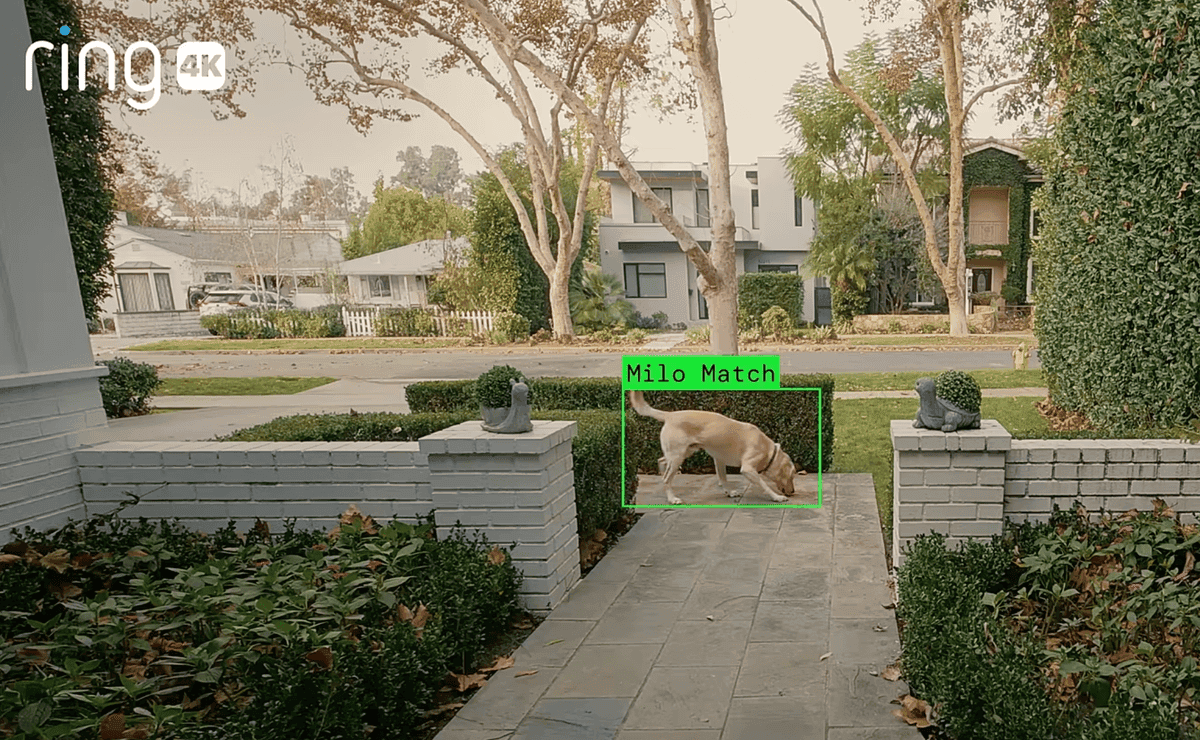
Ring's 'Search Party' is dystopian surveillance accelerationism. America, it's time to refamiliarize yourself with Ring. At Sunday's Super Bowl, Ring advertised "Search Party," a cute, horrifyingly dystopian feature nominally designed to turn all of the Ring cameras in a neighborhood into a dragnet that uses AI to look for a lost dog: "One post of a dog's photo in the Ring app starts outdoor cameras looking for a match," Ring founder Jamie Siminoff said in the Super Bowl commercial. "Search Party from Ring uses AI to help families find lost dogs." Onscreen, an AI-powered box forms around a missing dog: "Milo Match," it says. "Since launch, more than a dog a day has been reunited with their family. Be a hero in your neighborhood with Search Party. Available to everyone for free right now." It does not take an imagination of any sort to envision this being tweaked to work against suspected criminals, undocumented immigrants, or others deemed 'suspicious' by people in the neighborhood. Many of these use cases are how Ring has been used by people on its dystopian "Neighbors" app for years. Ring rose to prominence as a piece of package theft prevention tech owned by Amazon and by forming partnerships with local police around the country, asking them to shill their doorbell cameras to people in their neighborhoods in return for a system that allowed police to request footage from individual users without a warrant. Chris Gilliard, a privacy expert and author of the upcoming book Luxury Surveillance, told 404 Media these features and its Super Bowl ad are "a clumsy attempt by Ring to put a cuddly face on a rather dystopian reality: widespread networked surveillance by a company that has cozy relationships with law enforcement and other equally invasive surveillance companies." Unlike, say, data analytics giant Palantir or some other high-profile surveillance companies, Ring is a surveillance network that homeowners have by and large deployed themselves, powered by fear mongering against our neighbors and unfettered consumerism. After a lot of criticism in the late 2010s over its police contracts and its terrible security settings that resulted in hackers breaking into a series of indoor Ring cameras to terrorize children and families, Ring somehow found a way to more or less fly under the radar the last few years as a critical part of our ever-expanding surveillance state. It did this by scaling back police partnerships that were so critical to its growth but that received lots of scrutiny from journalists and privacy advocates. Siminoff left Ring in 2023, but returned last year; in his absence, Ring explicitly sought to take on a softer tone by branding itself as more or less as a device that could be used to film viral moments on people's porches. It turned its owners into mini cops who would complain about delivery people who didn't drop a package in the correct spot; who became hyperaware of the comings and goings of their friends, spouses, and children, or who might catch a potentially sharable moment when someone slipped on an icy porch or whatever. Part of this strategy included creating a short-lived reality TV show called Ring Nation, which consisted of precious little moments filmed through Ring cameras.
[4]
'Dystopian' Ring Search Party feature sparks public backlash [Video] - 9to5Mac
Amazon apparently thought the world would respond with a collective "awww" when it announced an expansion of its Ring Search Party feature to help find lost dogs, promoted via a 30-second Super Bowl ad (below). Instead, it's being widely panned as a dystopian move in the current climate. Since the company has recently rolled out a facial recognition capability for the Ring video doorbell, people drew the obvious and exceedingly short line between surveilling for dogs to surveilling for people ... The Search Party for Dogs feature works by allowing owners of lost dogs to send a photo and description to other nearby Ring doorbell users. When the camera thinks it has spotted a dog matching the description, it alerts the homeowner. If they confirm that it looks like the right dog, it puts them in touch with the owner of the pet. The company has now rolled out the feature to non-ring camera owners via the Ring app, going all in on promoting it - including the Super Bowl ad seen below. Since launch, Search Party has helped bring home more than a dog a day -- and now, the feature is available to non-Ring camera owners via the Ring app for the first time. "Before Search Party, the best you could do was drive up and down the neighborhood, shouting your dog's name in hopes of finding them," said Jamie Siminoff, Ring's chief inventor. "Now, pet owners can mobilize the whole community -- and communities are empowered to help -- to find lost pets more effectively than ever before. That's why we believe it's so important to make this feature available to anyone who shares a lost dog post in Neighbors." With nationwide protests against ICE operations, it's no surprise that the company did not get the positive response it expected. 404 Media didn't pull any punches. At Sunday's Super Bowl, Ring advertised "Search Party," a cute, horrifyingly dystopian feature nominally designed to turn all of the Ring cameras in a neighborhood into a dragnet that uses AI to look for a lost dog [...] It does not take an imagination of any sort to envision this being tweaked to work against suspected criminals, undocumented immigrants, or others deemed 'suspicious' by people in the neighborhood. Many of these use cases are how Ring has been used by people on its dystopian "Neighbors" app for years. The Neighbours app quickly got a reputation for racists sharing reports of supposedly suspicious-looking people whose skin colour was the only thing they had in common. You can watch a higher quality version of the 30-second ad below.
[5]

Why so many people hate Ring's 'Search Party' Super Bowl ad
Why is everyone so mad about the Ring Super Bowl ad? The short TV spot "Search Party" should pull at the heartstrings -- it's got a puppy, lost dogs, a father and daughter, and a happy ending. It even promises viewers they can "Be a hero in your neighborhood." Many viewers on both the right and left were disturbed by the privacy implications of the advertised "Search Party" feature. This AI tool is designed to reunite lost dogs with their owners, and the Super Bowl ad claims that one lost pet is found every day thanks to the technology. Here's how Search Party works: When a dog is lost, pet owners can upload a picture of their pet, at which point their neighbors' Ring video doorbells and security cameras will start looking for the lost pup. Of course, as viewers quickly realized, if Ring can do this for lost dogs, there's no reason it couldn't identify a human face just as easily. I was at the November 2025 Amazon event where Search Party was first announced, and the AI detection feature seemed problematic from the jump. As I reported at the time, privacy advocates warned that some of Amazon's new AI features could even violate state privacy laws. Of course, those privacy laws don't apply to dogs, which is why critics are calling Search Party a Trojan horse for mass surveillance technology. This Tweet is currently unavailable. It might be loading or has been removed. This Tweet is currently unavailable. It might be loading or has been removed. This Tweet is currently unavailable. It might be loading or has been removed. This Tweet is currently unavailable. It might be loading or has been removed. For progressive Americans on alert because of increased ICE activity, the ad seemed especially poorly timed. Ring's history is also working against it. In the past, progressives have criticized Ring for sharing footage with law enforcement, which the company has said it only does in rare emergencies, with customers' permission, or when required to do so by a subpoena or warrant. On top of that, back in 2023, the Federal Trade Commission accused Ring employees and contractors of accessing customers' private videos. Despite these controversies, Ring remains very popular, including among Mashable readers. Remember: for many customers, cooperating with law enforcement is a feature, not a bug, in a home security company. Regardless, it's clear that the Search Party Super Bowl ad struck a nerve. Strangely, it wasn't the only vaguely dystopian advertisement from Amazon this year. A Super Bowl LX commercial for Alexa+ showed actor Chris Hemsworth being repeatedly killed by the newly AI-powered smart home assistant.
[6]

You don't need Ring Search Party to find your lost dog. Privacy advocates and pet lovers say try this instead
There are few things everyone can rally behind as much as finding a lost dog. But what if that mission is actually a workaround for mass surveillance? That's the question many people are asking following a Super Bowl commercial from Ring, Amazon's doorbell camera and home security brand. The 30-second video shows a series of missing dog posters and claims that 10 million pets go missing every year. It pitches Ring's Search Party feature as the solution. Launched in November, Search Party takes a photo of the pet and taps into Ring cameras across the area. They can then use AI to identify the missing pet and send an alert. The ad claims that at least one dog a day has been found since the feature launched.
[7]

Ring Is Facing Intense Backlash After Using Lost Puppies as an Excuse for AI Surveillance
There are few things more sympathetic than finding lost puppies. That's why Ring's Super Bowl commercial should have been a sure win. The ad, which ran during the third quarter of Seattle's win over New England, highlighted the company's "Search Party" feature, which Ring says has been responsible for saving an average of one pet per day since it rolled out this fall. It's everything right with technology. Who isn't on the side of bringing a neighbor's pet back home? Except, when you start to think about what's actually happening, the ad starts to look a lot like the normalization of AI-powered neighborhood surveillance, just packaged in the least controversial way possible. The response to the commercial was harsh, but the only surprising part is that Ring didn't see it coming. Look, at a surface level, "Search Party" sounds reasonable. A pet goes missing. The owner uploads a photo. Ring's system scans recent footage from participating cameras in the area for visual matches. If a possible sighting appears, the camera owner is notified and can choose whether to share the clip.
[8]

Amazon device debuts new feature that's dividing people
Amazon is not just one of the most recognizable e-commerce brands in the world, but also one of the most popular ones. According to YouGov's tracker, the company gets a 69% rating on popularity, while 17% are neutral, and 14% dislike the company. However, a new feature Amazon debuted is getting decidedly more mixed reviews. Introduced as a great advancement, it aims to solve a major problem. Despite this, many customers have serious concerns. Here's the feature that Amazon introduced, along with details on why some customers support the change, while others are wary of the whole idea. This is Amazon's controversial new feature for Ring cameras The service works by harnessing the power of Ring camera systems, which are on millions of homes throughout the United States. Amazon announced the new feature on Feb. 2, 2026, posting about it on Amazon News. "Ring has expanded Search Party for Dogs, an AI-powered community feature that enables your outdoor Ring cameras to help reunite lost dogs with their families, to anyone in the U.S. who needs help finding their lost pup," according to the announcement. How does Amazon's new Search Party for Dogs work? Amazon's Search Party solutions works simply. * A neighbor reports a lost dog on the Ring app. * Ring cameras in the area automatically start looking for possible matches. * AI-powered computer vision is used to scan for dogs that look similar to missing pets. * If AI spots a dog in the Ring footage that potentially matches the missing one, the camera owner is alerted. * The camera owner can compare the Ring footage of the dog to a picture that is sent to them. * If a match is confirmed, the camera owner can choose to tag the pet's owner, and can decide if they want to share the video as well. Amazon News boasted the success of the program, explaining that Search Party made it possible to find a Wichita, Kansas, dog in as little as 15 minutes. Since the pilot program launched before expansion, Amazon also said that Search Party had found at least a dog a day. Amazon's Search Party for Dogs raises concerns of privacy, "surveillance state" Finding lost pets is obviously a great cause, and it's one with which pretty much everyone can get on board. As a pet owner myself, I know that the two times (over 20 years) that I've had a dog get out of my yard, I've been frantic until I was able to find them. Some customers, including those who were featured in Amazon's news release, were also understandably thrilled about the fact that the service had helped reunite them with their missing furry family member. "I don't think we would have been able to find him if it weren't for the Ring app," said Kylee, a Ring customer whose dog was located quickly after a neighbor shared a video of her missing pup. More Restaurants However, others have concerns that Amazon may be ushering in a surveillance state, using our love of dogs as the Trojan Horse to get people to happily sign on. "While the company credits the feature with helping find roughly one dog per day, a laudable achievement, no doubt celebrated by pet owners across the country, it comes at a time when every American is trying to weigh the pros and cons of blanketing the globe with cameras watching our every move," Matt Novak recently wrote for tech news blog Gizmodo in an analysis piece titled "Amazon's Ring wants to wash away your surveillance concerns with lost puppies." Novak expressed concern that this feature is a "PR move that pulls attention from the threat of omnipresent surveillance in an ostensibly free society: the fact that every American's device can be turned against them in an instant. If you don't like it, well, I guess you like lost dogs." Some comments under the Gizmodo post echoed Novak's concerns. "A means for State surveillance abuse," said commenter Eye B Me. "Info in cloud storage can be used by law enforcement to access surveillance to solve a crime, a good thing. Or to surveil who comes to your house, who enters who leaves and when. Not their business." Commenter Tsuyoikuma also weighed in with an alternate take. "Do you think people who get Ring cameras will care about this? Some of us are adult enough to recognize that privacy in public places hasn't existed since we started living around other people and learned to grunt about what we saw others in our community doing." It seems that those who own Ring cameras will need to weigh very real privacy concerns with their desire to help their neighbors find pets as they decide if they want Search Party activated on their devices. TheStreet This story was originally published February 9, 2026 at 7:33 PM.
Share
Share
Copy Link
Amazon's Ring aired a 30-second Super Bowl ad promoting its AI-powered Search Party feature designed to help find lost dogs using neighborhood cameras. But the heartwarming pitch backfired spectacularly, drawing fierce criticism from privacy advocates, lawmakers, and viewers who see it as a dystopian step toward mass surveillance. Combined with Ring's facial recognition rollout and Flock Safety partnership, the feature raises urgent questions about how quickly pet-finding technology could morph into tools for tracking humans.
Ring's Super Bowl Ad Turns Heartwarming Story Into Privacy Nightmare
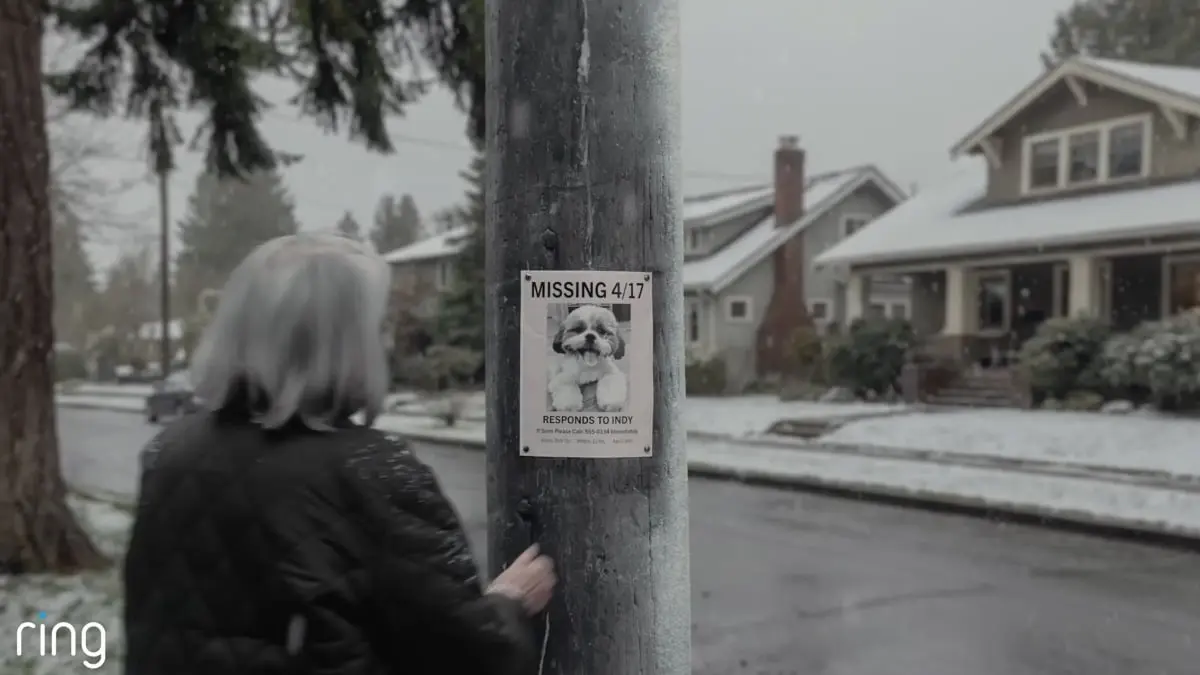
Amazon's Ring thought it had a winner with its Super Bowl ad. The 30-second spot featured a lost puppy, a worried girl, and a happy reunion made possible by the company's AI-powered feature called Search Party
1
.
Source: Mashable
Instead of applause, Ring faced immediate public backlash across social media platforms, with critics calling the advertisement a tone-deaf celebration of neighborhood surveillance in an increasingly tense political climate
2
.
Source: Inc.
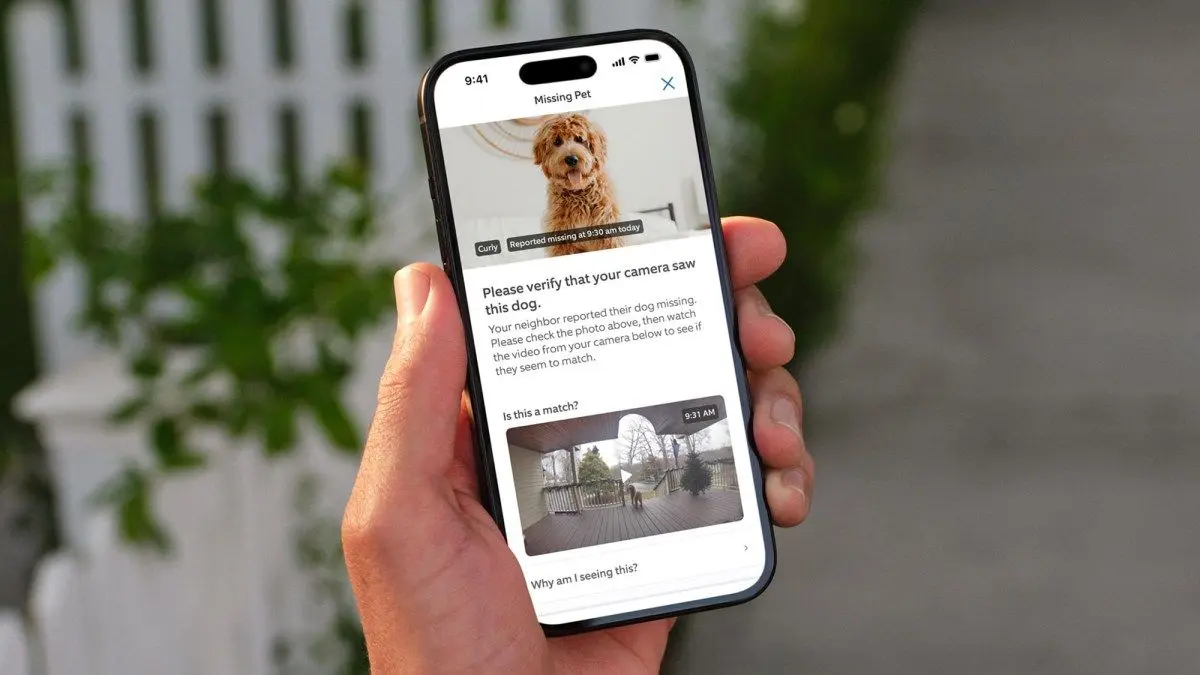
The Search Party feature works by mobilizing outdoor Ring cameras across a neighborhood to scan for lost dogs. When someone reports a missing pet in the Neighbors app, nearby outdoor cameras with the feature enabled use AI to scan their saved footage for a potential match
2
. If a camera spots something, the camera's owner gets a notification and can decide whether to share the clip with the dog's owner. The search is temporary, expiring after a few hours unless renewed. Ring founder Jamie Siminoff appeared in the commercial claiming that "since launch, more than a dog a day has been reunited with their family"3
.
Source: 404 Media
Privacy Concerns Overshadow Feel-Good Marketing
The dystopian surveillance implications became immediately apparent to viewers. Privacy expert Chris Gilliard told 404 Media that the ad was "a clumsy attempt by Ring to put a cuddly face on a rather dystopian reality: widespread networked surveillance by a company that has cozy relationships with law enforcement and other equally invasive surveillance companies"
1
. Comments on the YouTube video ranged from "This is a huge problem disguised as a solution" to "Smart way to gaslight people in mass surveillance"1
.The core issue isn't just what Search Party does now, but what the underlying technology could be used for down the road
2
. If Ring's AI can scan a neighborhood's cameras for a specific dog, critics ask, what's to stop it from doing the same for a specific person? This concern intensified because Amazon recently rolled out Familiar Faces, a facial recognition capability that lets users register images of family and friends so their cameras can identify specific people1
4
.Law Enforcement Partnerships and Government Overreach Fears
The timing proved particularly problematic amid nationwide protests against ICE operations
4
. Ring's partnership with Flock Safety, a surveillance technology company with contracts allowing law enforcement to use its automated license plate readers and video surveillance systems, amplified these privacy concerns1
. The partnership connects Ring's massive residential camera network with an organization that has reportedly allowed ICE to access data from its own nationwide camera network1
.Sen. Ed Markey (D-MA), a vocal critic of Ring's ties to law enforcement, posted on X: "This definitely isn't about dogs -- it's about mass surveillance"
1
. The senator has pressed for greater transparency into Ring's connections with law enforcement and stronger privacy protections for consumers. Ring users can currently share footage from their cameras with local law enforcement during an active investigation through Community Requests, which goes through third-party companies including Axon and, soon, Flock1
. The problem is that there's nothing preventing local agencies from sharing footage with federal ones, creating what many see as a Trojan horse for expanded government surveillance1
5
.Ring's Defense and the Human Biometrics Question
Ring spokesperson Emma Daniels told The Verge that Search Party is designed to match images of lost dogs and is "not capable of processing human biometrics"
1
. She maintains that the Familiar Faces facial recognition feature is separate from Search Party and operates on the individual account level with no communal sharing1
. While Search Party is enabled by default on any outdoor camera enrolled in Ring's subscription plan, Familiar Faces is opt-in for each user1
.When asked whether Ring cameras could one day be used to specifically search for people, Daniels said: "The way these features are built, they are not capable of that today. We don't comment on feature road maps, but I have no knowledge or indication that we're building features like that at this point"
1
. The company maintains that neither the government nor law enforcement can access its network, and that footage is shared only by users or in response to a legal request1
. Ring also states it has no partnerships with ICE or any other federal agency1
.Related Stories

Jamie Siminoff's Return and Ring's Renewed Crime Prevention Focus
Jamie Siminoff returned to lead Ring last year after a hiatus, during which the company had explicitly sought to take on a softer tone by branding itself more as a device for filming viral moments on people's porches
3
. Since his return, Ring has renewed its focus on using its products to prevent crime and reinstated law enforcement partnerships that had been scaled back during his absence1
2
.In an interview with GeekWire last year, Siminoff described the Search Party feature as a breakthrough made possible by advances in AI, saying it couldn't have been built at reasonable cost even two years ago
2
. Asked how the company was balancing these benefits against privacy concerns, he said Ring's approach is to give customers full control: "You don't balance it. You give 100% control to your customers. It's their data. They control it"2
.What This Means for Data Sharing and Surveillance Infrastructure
Unlike data analytics giant Palantir or other high-profile surveillance companies, Ring represents a surveillance network that homeowners have largely deployed themselves
3
. The company rose to prominence by forming partnerships with local police around the country, asking them to promote their doorbell cameras to people in their neighborhoods in return for a system that allowed police to request footage from individual users without a warrant3
.Ring has a history of controversy around data sharing. In 2023, the Federal Trade Commission accused Ring employees and contractors of accessing customers' private videos
5
. The company also faced criticism in the late 2010s over its police contracts and terrible security settings that resulted in hackers breaking into indoor Ring cameras to terrorize children and families3
. The Neighbors app quickly gained a reputation for racists sharing reports of supposedly suspicious-looking people whose skin color was the only thing they had in common4
.Amazon says it's committing $1 million to equip animal shelters with Ring cameras
2
. But the bigger question fueling the backlash is whether finding lost dogs today is building the infrastructure for something far less benign tomorrow. For progressive Americans on alert because of increased ICE activity, the ad seemed especially poorly timed5
. Viewers on both the right and left were disturbed by the privacy implications of the advertised AI-powered feature , showing that concerns about mass surveillance cut across political divides.References
Summarized by

Navi
[2]
Related Stories
Ring abandons Flock deal after Super Bowl ad sparks mass surveillance fears
13 Feb 2026•Policy and Regulation

Ring opens Search Party feature to everyone, pledges $1 million to animal shelters nationwide
02 Feb 2026•Technology
Ring Search Party AI feature sparks privacy concerns after Super Bowl ad reveals surveillance scope
09 Feb 2026•Technology

Recent Highlights
1
Anthropic's Claude AI can now control your computer to complete tasks autonomously
Technology

2
Nvidia's Jensen Huang calls OpenClaw the next ChatGPT, sending Chinese AI stocks soaring
Technology

3
Elon Musk unveils $20 billion Terafab chip manufacturing project to produce terawatt of computing
Technology

Recent Highlights
Today's Top Stories




Your Daily Dose of Curated AI News
Don’t drown in AI news. We cut through the noise - filtering, ranking and summarizing the most important AI news, breakthroughs and research daily. Spend less time searching for the latest in AI and get straight to action.

