Rivian unveils custom AI chip and autonomous driving tech with lidar, hinting at robotaxi future


33 Sources
33 Sources
[1]
Rivian goes big on autonomy, with custom silicon, lidar, and a hint at robotaxis | TechCrunch
Rivian detailed Thursday how it plans to make its electric vehicles increasingly autonomous -- an ambitious effort that includes new hardware, including lidar and custom silicon, and eventually, a potential entry into the self-driving ride-hail market, according to CEO RJ Scaringe. The announcements at the company's first "Autonomy & AI Day" event in Palo Alto, California shed fresh light on Rivian's technology development, much of which has been kept undercover as it pushes to begin production of its more affordable R2 SUV in the first half of 2026. Rivian's event is also a very public signal to shareholders that it's keeping pace, or even exceeding, the automated-driving capabilities of industry rivals like Tesla, Ford, General Motors, as well as automakers from Europe and China. Rivian said it will expand the hands-free version of its driver-assistance software to "over 3.5 million miles of roads across the USA and Canada" and will eventually expand beyond highways to surface streets. This expanded access will be available on the company's second-generation R1 trucks and SUVs. It's calling the expanded capabilities "Universal Hands-Free," and will launch in early 2026. Rivian says it will charge a one-time free of $2,500 or $49.99 per month. "What that means is you can get into the vehicle at your house, plug in the address to where you're going, and the vehicle will completely drive you there," Scaringe said Thursday describing a point-to-point navigation feature. After that, Rivian plans to allow drivers to take their eyes off the road. "This gives you your time back. You can be on your phone, or reading a book, no longer needing to be actively involved in the operation of vehicle." Rivian's driver assistance software won't stop there; the EV maker laid out plans on Thursday to enhance its capabilities all the way up to what it's calling "personal L4," a nod to the level set by the Society of Automotive Engineers that means a car can operate in a particular area with no human intervention. After that, Scaringe hinted that Rivian will be looking at competing with the likes of Waymo. "While our initial focus will be on personally owned vehicles, which today represent a vast majority of the miles driven the United States, this also enables us to pursue opportunities in the rideshare space," he said. To help accomplish these lofty goals, Rivian has been building a "large driving model" (think: an LLM but for real-world driving), part of a move away from a rules-based framework for developing autonomous vehicles that has been led by Tesla. The company also showed off its own custom 5nm processor which it says will be built in collaboration with both Arm and TSMC. That custom chip powers what Rivian is referring to as its third-generation "autonomy computer," or ACM3. The new computer can process 5 billion pixels per second, and will start showing up on Rivian's upcoming mass-market R2 SUV in late 2026. Rivian will couple the ACM3 with a lidar sensor at the top of the windshield (from an undisclosed supplier) to provide "three-dimensional spatial data and redundant sensing," which it says will help with "real-time detection for the edge cases of driving." The R2 is set to start shipping in the first half of 2026, meaning the launch versions of the SUV will not have ACM3 or the lidar sensor. But the company said in a press release that it aims to "continuously improve the autonomy capabilities" of its "Gen 2 R1 and future R2 vehicles, with a clear trajectory including point-to-point, eyes off and personal L4." The company believes it can reach an advanced state of autonomy in many of its current vehicles without the new hardware -- but Scaringe said Thursday that the new hardware suite will "enable a much higher ceiling than we have in our vehicles today."
[2]
Rivian is building its own AI assistant | TechCrunch
Rivian has spent nearly two years building its own AI assistant, an effort that remains separate from its multi-billion dollar technology joint venture with Volkswagen, TechCrunch has learned. Rivian hasn't revealed when it will put the AI assistant in consumers hands. However, in an interview earlier this year, Rivian's software chief Wassym Bensaid told TechCrunch it was targeting the end of the year. The company will likely share more during its upcoming AI and Autonomy day, which will be live streamed starting at 9 am PT December 11. Rivian's plans are reflective of the moment as the pace of development from foundational AI companies- the tech giants and startups like Anthropic, Google, Microsoft, Meta, OpenAI that are building the core models and infrastructure -- accelerates and industries scramble to keep up. But as Bensaid noted to TechCrunch earlier this year, this isn't some slapdash effort to stay on trend. Nor is it simply a chatbot thrown into the infotainment system. The company has put considerable thought, resources, and time into the product, Bensaid said, noting that its designed to be integrated with all vehicle controls. The company started with an underlying philosophy to build an overall architecture that is model and platform agnostic, according to Bensaid. The Rivian AI assistant team, which is based out the company's Palo Alto office, soon realized effort and attention should also be directed towards developing the software layers that help coordinate various workflows as well as the control logic that resolves conflicts. "And that's the in-vehicle platform we have built," Bensaid said. "We use what the industry loves to now call an agentic framework; but we thought about that architecture since very early so that we can interface with different models." The in-house AI assistant program is consistent with Rivian's push to become more vertically integrated. In 2024, Rivian overhauled its flagship R1T truck and R1S SUV, changing everything from the battery pack and suspension system to the electrical architecture, sensor stack, and software user interface. The company has also put considerable resources towards developing and improving its own software stack, which includes everything related to real-time operating systems (RTOS) that manage the car, such as thermal dynamics, ADAS and safety systems, as well as another layer related to the infotainment system. Bensaid didn't provide detailed information about the AI assistant, but he did say it includes a mix of models that handle specific tasks. The result is a hybrid software stack that combines edge AI, where tasks are handled on the device, and cloud AI, in which large models that require more compute are handled by remote servers. This should mean a flexible, customized AI assistant that splits the workload between the edge and cloud. Rivian developed much of the AI software stack in house, including its own custom models and the "orchestration layer," the conductor or traffic cop of sorts that makes sure the various AI models work together. Rivian tapped other companies for specific agentic AI functions. The mission is to develop an AI assistant that increases customer trust and engagement, Bensaid said. For now, the AI assistant is staying within Rivian. The company's joint venture with Volkswagen is focused on software, but not an AI assistant or anything to do with automated driving. The technology joint venture with Volkswagen, which was announced in 2024 and is worth up to $5.8 billion, is centered on the underlying electrical architecture and zonal compute, and infotainment. The joint venture officially kicked off in November 2024 and is expected to supply the electrical architecture and software for Volkswagen Group as early as 2027. Autonomy and AI are separate for now, but "It doesn't mean that it may not be in the future," Bensaid said.
[3]
Rivian Reveals New AI Chip, Rooftop Lidar Coming to R2 EVs in 2026
Rivian Assistant: A new AI voice interface with real capability Electric truck and SUV maker Rivian opened the doors of its Palo Alto, California, headquarters this week for its Autonomy & AI event, giving us a front-row look at the company's next-generation driver assistance tech. It also detailed how it's using new AI tech to power future autonomous driving features and the new Rivian Assistant voice interface launching on its R1 and R2 EVs next year. I was seated up front as Rivian's engineering leaders walked us through a major evolution in the brand's hardware and software stack -- technology that will shape the upcoming R2 SUV and upgrade today's R1 trucks and SUVs. The powerhouse of Rivian's next-gen tech strategy is its first in-house AI chip: the Rivian Autonomy Processor. This multi-chip module combines processor and memory into a single package, designed from the ground up for crunching data for artificial intelligence and autonomous driving tasks. The upcoming R2 electric SUV will use two RAP1 modules inside what Rivian calls its Gen 3 Autonomy Computer. The company says the ACM3 is 2.5 times more energy-efficient than its current system, which probably won't have a huge impact on range, but for an EV, every watt saved matters. More importantly, the new silicon is said to deliver four times the performance of the current Gen 2 system, which is a major improvement. Rivian says ACM3 will be able to process around 5 billion pixels of sensor data per second, which is important because the R2 is getting a substantial sensor upgrade. The big news here is that Rivian's R2 generation of EV will see a lidar array join the party, subtly integrated into the roofline just above the windshield. Rivian made a point of noting how its designers were able to avoid the "taxi-cab turret" design seen on vehicles like the Volvo EX90, maintaining a clean silhouette when viewed in profile. The R2 platform's 11 cameras will also see resolution improvements, now totaling a combined 65 megapixels and giving Rivian's perception stack much sharper and more detailed visual awareness. Five redesigned radar units round out the package. The short-range capability is reportedly so good that Rivian has eliminated ultrasonic parking sensors entirely, a bold move and a sign of confidence in the new radar technology. Beyond the hardware, Rivian laid out an ambitious autonomy roadmap powered by what it calls its Large Driving Model, a high-capacity AI model trained to handle complex, real-world driving scenarios. The name hearkens to its being based on many of the same technologies, neural networks and training patterns as the large language models now familiar to AI chatbots, which feels like a novel approach to autonomous driving development. But Rivian assures us that it has placed safety first when building the technology. The Large Driving Model will soon power Rivian's Autonomy Plus driver assistance suite. Launching in early 2026 for current R1 owners, Autonomy Plus will expand Rivian's hands-free driving coverage to 3.5 million miles of US and Canadian roadways. It will also allow hands-free operation on non-highway roads, as long as lane markings are clear. Pricing is set at a $2,500 one-time upgrade or $50 per month for drivers who want to test the waters first. With more AI processing hardware and the extra peace of mind provided by lidar, Rivian says its autonomy roadmap leads to full point-to-point hands-free driving for the upcoming R2 EVs, eventually evolving to eyes-off driving and ultimately to full Level 4 autonomy, where the vehicle can operate independently under defined conditions. The event wasn't just about autonomy. Rivian also showcased how its new AI hardware will boost convenience and dashboard tech inside of its EVs. Rivian Assistant is the automaker's new online and offline AI voice assistant designed to understand natural speech and tie directly into the vehicle's apps and services. In a live demo, Rivian used Assistant to access a user's Google Calendar and find the day's appointments and then reschedule one of the meetings in real time. With another series of conversationally spoken commands, the Rivian then pulled a destination from the appointment, searched for restaurants nearby and then sent the top three dining options to the meeting attendee, complete with an updated ETA. All of it worked with simple, conversational commands, and if Rivian can maintain this level of integration across more services, it could become one of the most useful in-car assistants available. Rivian Assistant launches early next year on current first- and second-generation R1T and R1S vehicles and will debut natively on the R2 near the end of 2026.
[4]
Rivian Refuses to Support Apple CarPlay, But Its New Workaround Looks Promising
Rivian shows off its new purple Borealis trim on stage at Autonomy Day (Credit: Rivian) Rivian debuted a new AI assistant this week, and it brings welcome relief to Apple CarPlay and Android Auto lovers who went cold turkey on their favorite dash tech since switching to one of the company's swanky electric cars. Rivian is one of several automakers that chose to build its own car tech from the ground up. Tesla has also avoided third-party interfaces (for now), as has General Motors. But for many people, life without CarPlay or Android Auto is a dealbreaker. Turns out, there is a middle ground. The new Rivian Assistant can do things like read and respond to texts, from both iOS and Android devices. This was a highly requested feature from the Rivian community, according to Wassym Bensaid, Rivian's chief product officer, who spoke on stage at the company's first annual Autonomy and AI day in Palo Alto, California, on Thursday. The Rivian Assistant will begin rolling out in early 2026. It's built on multiple large language models and is part of the larger Rivian Unified Intelligence system, the company says. Happily, it will work on all Rivian vehicles no matter when you bought it, including first- and second-generation operating systems, as well as the more affordable R2 when it debuts later in 2026. While I'm typically a little suspicious of in-car voice assistants, this one was impressive in the live demo. A Rivian product manager noted you can activate the system by pressing a button on the steering wheel, or saying, "Hey, Rivian." He asked it to read his recent messages. The screen pulled one up so he could read it, speak a response out loud, and send it. As an example of a more advanced feature, he asked for a nearby restaurant, which the AI located and showed on the dash screen maps. "Send my friend the restaurant and my ETA," the product manager said. The vehicle did it, demonstrating integration with the driver's phone and vehicle routing system. "The assistant has memory, context, and the full story, and it puts everything into a perfect message," Bensaid added. (I'm unlikely to go blindly drive to a restaurant without looking at the menu, but that's not the point.) The Rivian Assistant also integrates with your Google Calendar, something the two companies worked together to enable, Bensaid says. In the demo, the driver asked, "What's on my calendar today?" It took two tries to go through -- a common problem that has turned me against in-car voice assistants in the past -- but when it worked, it seemed helpful. The dash screen showed two meetings that day. "Can you move my call with Tim to 5pm?" the driver said. It appeared to go through, offering a truly hands-free way to manage your calendar on-the-go. The driver then asked it to drive to their next meeting. It read the location from the meeting invite, and routed the car there. "Google Calendar is just the beginning. The platform will expand to many more applications and many more third party agents as they become available," Bensaid says. "How much battery will I have when I get to my destination?" was the next question, intended to show how the voice assistant not only knows what's on your phone or in maps, but also how the car is doing. The car indicated that the battery was a bit low, so the driver asked to switch to a more efficient drive mode, and the AI flipped the car from "All-Purpose" driving to "Conserve" mode. This goes beyond what Apple CarPlay or Android Auto can do. In another example, the driver asked to turn on all the seat warmers besides the one in the driver's seat. The dash screen then showed all of them were activated, except his. "The assistant takes the vehicle experience to the next level," Bensaid says. "Instead of having multiple UI commands, multiple tabs on the touch screen, you can perform the whole task with just one natural language command." The assistant will also power "predictive maintenance" for the vehicle "by embedding AI into diagnostics," Rivian says. "It's an expert assistant for technicians, scanning telemetry and history to pinpointing complex issues." Also at the event, Rivian debuted a custom-built silicon chip for its autonomous driving platform, called its first-generation Rivian Autonomy Processor (RAP1). It also announced it would be adding LiDAR to its self-driving systems, noting that cameras alone are not enough in poor lighting conditions -- a subtle dig toward Tesla's cameras-only strategy. You can watch the full presentation here.
[5]
Rivian unveils its own in-house RAP1 AI chip and ACM3 self-driving platform -- automaker one-ups Tesla with LiDAR support
Most folks would think of Rivian as a runner-up to Tesla thanks to its aluminum unibody R1 vehicles, but the automaker has actually been making a tidy sum in software and services. True to that statement, Rivian today announced its Rivian Autonomy Processor chip and Autonomy Compute Module 3 platform, ready for integration in its own vehicles, and likely those of other automakers. The Rivian Autonomy Processor (RAP1) is a bespoke in-house effort. The chip itself is an Armv9 design, with 14 Cortex-A720AE cores. and is manufactured on a 5 nm process. It has support for the company's own RivLink (no relation or comparison with Nvidia's NVLink), an interconnect that Rivian says provides extensibility to computing power by adding other chips, presumably similar, but there aren't many details. The RAP1 is the cornerstone of the Autonomy Compute Module 3 (ACM3), a vehicle computer system focused on self-driving capabilities. Its claimed abilities include 1,800 TOPS of INT8 inference, enough grunt to process 5 billion pixels per second of camera feeds. Interestingly, Rivian says that ACM3 will support the addition of LiDAR input, something that Tesla decided against and Elon Musk himself derided. Rivian says the ACM3 and LiDAR are undergoing validation and will be used in versions of its upcoming R2 vehicle come late 2026. Existing second-generation R1 vehicles will get Universal Hands Free (UHF), a limited driving assistant akin to Tesla's Autopilot. Rivian says it'll be able to function for extended periods of time and covers 3.5 million miles of roads in the U.S. and Canada. UHF isn't limited to highways, either, as it's meant to work on roads that have clearly painted lines. For those wishing for additional capabilities, Rivian will launch its Autonomy+ service, priced as a $2,500 one-time fee or as a $49.99/mo subscription. Probably wisely, the company chose its words carefully and didn't imply the vehicle would have complete self-driving ability, opting instead to tout Autonomy+ as a safety improvement, though it states it's on the race for Level 4 autonomous driving. The company also talked up the Large Driving Model, its driving-oriented AI model (analogous to chatbots' Large Language Model) that Rivian claims is superior thanks to its use of Group Relative Policy Optimization, similar to how DeepSeek operates. Comparisons to Tesla vehicles' HW-series platforms are inevitable, especially given that recently, Elon Musk touted his auto business's acumen in the chip department. Given that Rivian is looking into a 2026 timeframe for RAP1, we can only compare via rumors of Tesla's upcoming HW5. Even still, with the appropriate amount of salt, Tesla is reportedly gunning for 2,000 to 2,500 TOPS for HW5, though naturally, there's no support for LiDAR. Rivian's latest move might seem odd given it's primarily an automotive outfit, and there's no shortage of discussions about its upcoming $45,000 Rivian R2 SUV. However, the company signed a $5.8 billion joint venture with the VW Group in 2024 for EV software and electrical architecture. That branch of the business is seeing enormous growth and, unlike the automotive section, is actually turning a profit. It's perfectly possible that Rivian might sell its newfangled self-driving and assistant tech to other automakers as well.
[6]

Rivian announces AI chip in move towards self-driving future
Rivian founder and CEO RJ Scaringe hosted the EV manufacturer's first Autonomy and AI Day this week, announcing a slew of big advancements from his no-longer-fledgling company. Appropriately, from Rivian's headquarters in Silicon Valley, the automaker revealed a project it has been keeping under wraps: a silicon chip of its own design. The chip is a processor that powers the next version of Rivian's on-board computer. Dubbed Autonomy Compute Module 3, it's capable of 1600 sparse INT8 (8-bit integer) TOPS (trillion operations per second) and 5 billion pixels per second of processing power. Without getting too deep into the bits and bytes, these numbers are indicative of bar-setting performance. Rivian is talking about data with numbers that boggle the mind. For scale, Rivian says this new setup will quadruple the capabilities of the Nvidia-chip-centered system it's currently using. Semiconductors are the brains that run just about everything digital in our lives now, from smartphones to cars. Chip manufacturing generally requires a multi-billion dollar facility with cleanrooms and an incredibly complex process that results in tiny silicon-based wafers. That's not what Rivian is doing; the automaker sources the chip itself, but the design and housing are all done in-house by Rivian. Designing an in-house chip was just a dream a couple of years ago, but it's a massive advantage. "We're cognizant of the fact that we are a car company, not a full time chip company," says Vidya Rajagopalan, Rivian's senior vice president of electrical hardware. Rajagopalan worked on the Model 3 at Tesla and for several silicon and systems companies before joining Rivian in 2020, and she knows what she's talking about. Rivian works with ARM and uses the company's microprocessor while Rivian designed the core, which is the neural engine. That's the most important part of the chip, Rajagopalan says, and that's where Rivian adds the most value. "Building a chip is time consuming and requires a world class team," Rajagopalan says. "But the benefits are velocity, performance, and cost. This means we're able to get to market sooner with a cutting-edge AI product and we can optimize our silicon for our use cases with room for models of the future. We don't carry the overhead with a design that was designated for another purpose." In other words, designing the chip allows Rivian to customize the system along the way instead of receiving a universal chip and figure out how to make it fit. Customizing its use of AI is a major tenet of the company's game plan, underpinning its software, autonomy research and mapping, and Rivian Assistant, its new voice command setup. Wake it up with "Hey Rivian" and the system can handle complicated, multi-part requests, interruptions, and a texting interface that circumvents the need for Apple CarPlay and Android Auto. Another aspect of the equation is Rivian's new middleware stack, also developed in-house. Middleware is the glue that ties the pieces together, acting as a bridge to connect different applications, databases, and services. It maximizes flexibility and speeds up testing and development, scaling across various platforms and computing hardware. Rivian also unveiled its next-generation autonomy platform, which will be run by its new chips. The proprietary, purpose-built silicon was designed to "achieve dramatic progress in self-driving," Scaringe says, as part of his road map to reshape the future of the industry with artificial intelligence. "AI is enabling us to create technology and customer experiences at a rate that is completely different from what we've seen in the past," Scaringe says. "If we look three or four years into the future, the rate of change is an order of magnitude greater than all the experience from the last three or four years." As the market debates a potential "AI bubble" that could crash like the dot-com bubble of the late 1990s, technologists, politicians, and ecological specialists have expressed their concerns. AI, for all of its potential, also represents threats to the environment due to its vast energy requirements and job loss. "The integration and adoption of AI in real-world settings can be complex and create unwanted outcomes as we pave our way forward," says Ali Shojaei, a professor at Virginia Tech. "For example, the environmental impact and energy consumption of AI cannot be overlooked. Data privacy and security are also valid concerns with the increased use of AI and automation of sensitive information." Scaringe insists we're in the middle of a technology inflection point. "The way that we approach AI in the physical world has shifted dramatically, and the idea of not having fully capable artificial intelligence across every domain of our lives will be almost impossible to even imagine," the CEO predicted in a video released this week. Up until about five years ago, Scaringe says approach was centered on a rules-based environment with a set of perception sensors to identify and classify objects. A few years ago, it became clear that the approach needed to shift to a neural net-like understanding of how to drive. All this will come to fruition on the upcoming R2 model with Rivian Autonomy Processor 1 chips and a new LiDAR sensor, combined with cameras and radar technology. Waymo's driverless rideshare vehicles, for example, use LiDAR sensors all around the vehicle, sending laser pulses in all directions to detect objects. Rivian's main lidar sensor is built into the car above the windshield instead of the Waymo-style dome that screams "taxi." Scaringe's updated vision for self-driving Rivians kicks off in 2026, when the automaker will roll out point-to-point navigation in the R2 and via over-the-air updates for its second generation vehicles. Rivian is clearly aiming for self driving that doesn't require the driver to keep their eyes on the road without the need to be engaged in the operation of the vehicle. And after that, the CEO says, is level 4 autonomy, which means the car could drop the kids off at swim practice for you. Rivian engineers admit its autonomy is a work in progress, and every R2 vehicle will be eligible to provide crowd-sourcing training for the system via AI. When asked about the multiple instances of Waymo vehicles illegally passing school buses, director of product and programs of autonomy Nick Nguyen pointed out that the driver is still responsible in level 2 autonomy situations. This is not yet at level 4. "We will not be able to handle every single situation the car can encounter, but if the person is looking at the road [which is required at this level], in that situation the driver should take over," Nguyen emphasizes. The company will start charging for its Autonomy+ software platform next year; customers can either pay $2,500 up front or a $49.99 monthly subscription. That's less than Tesla's FSD system, which requires either $8,000 in a lump sum or $99 per month.
[7]

Rivian Unveils AI Chip for Automated Driving, Ditches Nvidia
Rivian Automotive Inc. shares fell after the company unveiled its own artificial intelligence chip designed to replace Nvidia Corp. technology as part of a broader push to enhance automated-driving features in future vehicles. The automaker will equip its upcoming R2 sport utility vehicles with Rivian Autonomy Processor 1 chips and a new lidar sensor. Taiwan Semiconductor Manufacturing Co. will produce the chips that, combined with the new sensor and AI model developments, will bolster Rivian's efforts to eventually offer autonomous driving capability.
[8]

Rivian's AI, autonomy impress Wall Street, but EV and capital concerns remain
Rivian CEO RJ Scaringe at the company's first "Autonomy and AI Day" on Dec. 11, 2025, in Palo Alto, California. Rivian Automotive impressed Wall Street on Thursday with its plans for artificial intelligence, automation and an internally developed silicon chip, but significant challenges involving demand and capital remain for the electric vehicle maker. Despite Wall Street analysts expressing some optimism following Rivian's first "Autonomy and AI Day," the company's stock fell 6.1% to close Thursday at $16.43 per share. But shares recovered during intraday trading Friday and were up more than 15%. While the event didn't cause many analysts to change ratings or price targets, Needham raised its price target on Rivian by 64% to $23 per share. The firm did so on the tech announcements and potential for future licensing deals, as well as higher-than-consensus expectations on deliveries next year of the company's new midsize R2 SUV.
[9]

Rivian expands hands-free driving system, builds proprietary AI chip
Serving tech enthusiasts for over 25 years. TechSpot means tech analysis and advice you can trust. What we know so far: Rivian is betting its future on artificial intelligence as the cornerstone of fully autonomous vehicles, even as financial losses and a tougher electric-vehicle market challenge the young automaker. At its "Autonomy and AI Day" event in Silicon Valley, the company unveiled new details of its autonomy roadmap, highlighting plans to expand hands-free driving capabilities and accelerate the development of in-house AI-focused hardware and software. Later this month, Rivian will expand its hands-free driving system to cover 3.5 million miles of roads across North America - more than 20 times its current coverage. The system, available on second-generation R1 trucks and SUVs, will no longer be limited to divided highways. Vehicles equipped with the updated autonomy suite will be able to maintain lane position, manage speed, and navigate most well-marked roads. The technical backbone of this expansion is Rivian's new proprietary computer chip, designed to process the massive influx of sensor and camera data required for advanced driver assistance and autonomous navigation. Similar to Tesla's custom silicon, Rivian's chip is central to what CEO RJ Scaringe calls a "data flywheel." As more Rivian vehicles travel public roads, the onboard systems collect real-world driving data, which is then used to train and refine the company's AI models. At the event, Scaringe described this as a self-reinforcing loop: better data produces better driving performance, which attracts more drivers and generates even more data. This AI-first pivot represents a clear departure from Rivian's earlier strategy. In 2022, the company abandoned its rules-based self-driving program in favor of building its autonomy stack from scratch. Rivian plans to introduce point-to-point navigation next year, allowing vehicles to operate hands-free for entire trips. Scaringe also outlined a longer-term vision in which Rivian models could handle all aspects of driving - eventually enabling passengers to read, work, or even send the car on errands independently. A timeline for "eyes-off" capability or full autonomy has not been set. Rivian intends to monetize these features starting in March 2026. The hands-free system will cost $50 per month or a one-time fee of $2,500, undercutting Tesla's current pricing of $99 per month or $8,000 one-time for its comparable driver-assistance product. Scaringe noted that the pricing model could evolve as performance improves. Rivian joins several automakers pursuing advanced autonomy as a competitive differentiator. General Motors plans to introduce "eyes-off" functionality on its Super Cruise system by 2028, beginning with high-end Cadillac EVs, while Lucid Motors continues to invest heavily in its own autonomous platform.
[10]

Rivian Reveals New AI Assistant, Lidar, and Autonomous Driving Coming in 2026
Attempting to leapfrog competitors ahead of a crucial vehicle launch and a race to integrate AI and advanced driver assistance systems, Rivian revealed its latest hands-free driving system with better highway mapping, a custom processor, lidar, and a voice assistant as it prepares for the launch of its more mainstream R2 midsize electric SUV with an estimated $45,000 starting price. At a Palo Alto event on Thursday, Rivian detailed the advances its in-house system has made over the second-generation system, released a year ago, on its large R1S SUV and R1T pickup truck. And in introducing new features and software, it’s also keeping existing customers in the fold by making updates available to its older models. Rivian has been working on its own AI technology for a few years now, its founder and CEO RJ Scaringe said. While learning from earlier reliance on outside suppliers and being tied to the same cost fluctuations as its rivals, Rivian’s focus now is on bringing its costs down and keeping its technology under its own control so it can adapt to what its customers want based on their driving habits. With that, the new Large Driving Model will have a hands-free driving assistant on an estimated 3.5 million miles of U.S. roads with point-to-point destination service, rather than the roughly 150,000 miles on the existing system. That’s also more than what current systems like General Motors’ SuperCruise and Ford’s BlueCruise offer. Rivian’s Autonomy+ will launch next year, priced at a $2,500 one-time fee or $49.99 per month. Eventually, an eyes-off version of the new system will be introduced on the R1 and R2 vehicles. “This gives you your time back,†Scaringe said at the event. You can be on your phone or reading a book, no longer needing to be actively involved in the operation of the vehicle.†A Level 4 autonomous function would also allow Rivian to compete in the quickly growing autonomous “robotaxi†space from Waymo, Zoox, and Uber, which use vehicles from various automakers, although Scaringe stopped short of committing to any future plans. “While initial focus will be on personal vehicles, the majority of the vehicles on the road, it allows us to pursue opportunities in the rideshare space,†he said. The system is made possible by the company’s extensive development of the third-generation Rivian Autonomy Processor using a self-developed Autonomy Computing module. On the R2, it will incorporate 11 cameras with 65 megapixels, 5 radar sensors, and a new lidar sensor. The whole system, however, isn’t due until late 2026, so it won’t be on the first R2s that roll off the Illinois production line. The California-based electric SUV and pickup truck company made these announcements at a critical time as it hinges on new products and a lucrative tie-up with Volkswagen Group to stay afloat amid increased consumer interest in hybrid and range-extended electrics and deep concerns over vehicle affordability. For now, though, Rivian's AI and autonomous strategy will stay focused on its vehicles. Bringing its own chips and a lower-cost lidar to its mid-priced R2 vehicle is crucial for Rivian’s step out of the high-end and niche EV market, and a potential blow to larger chip makers like Nvidia. The company also took two digs at other automakers, especially Volvo, with lidar missteps that resulted in noticeable cost and design compromises. Volvo subsequently removed the lidar sensor and resultant roof-mounted “taxi cab†bump on the 2026 EX90 and ES90 SUVs after the added hands-free capability failed to materialize. Also, as expected, Rivian revealed its own AI Assistant. Rivian Assistant, debuting early next year. As with most systems of this type, it will integrate third-party apps like Google Calendar, but it also incorporates a talk-to-text system rather than the canned responses that some companies still use. Similar to systems like Google Gemini (which Rivian leans on here) being implemented by some automakers, Rivian Assistant also tries to create more natural ways to do things like give destination or restaurant recommendations, estimate time of arrival, and even run vehicle diagnostics. The latter provides more vehicle integration than simply adding on another company’s system and presents an opportunity for greater use on future generations, the company said. Notably, Rivian Assistant won’t just be available on new models but on existing Gen1 and Gen2 R1S and R1Ts. Rivian has faced similar problems as other startup EV makers when it comes to getting quality and production issues settled, while simultaneously suffering from cash flow issues. The Trump administration has added additional headaches with tariffs and the elimination of subsidies for electric cars. The BMW X3-sized R2 has long been considered its best shot at a mainstream product ahead of a possibly lower-cost R3 hatchback, as the current R1 models can cost more than $100,000 and are generally considered too large for big export success. Scaringe, in his closing remarks, framed Thursday’s announcements as the big step the company has been working on so far this decade to “build the house†of its physical products and the pieces needed to advance its software and hardware for future efforts. And customers will be able to see all of those pieces taking shape with the upcoming technology. “You’re seeing the house start to form in front of you,†he said.
[11]
Rivian announces new AI tech, in-house chip and robotaxi ambitions
Rivian debuted new tech at its first "Autonomy and AI Day" on Thursday in Palo Alto, California. Electric vehicle maker Rivian Automotive has developed a custom chip, car computer and new artificial intelligence models that will enable it to bring self-driving features to its forthcoming vehicles, the company revealed at its first "Autonomy and AI Day" on Thursday in Palo Alto, California. Rivian also said it plans to roll out an Autonomy+ subscription with "continuously expanding capabilities" to customers in early 2026, to be powered by its Rivian Autonomy Processors and autonomy computers. The Autonomy+ offering will be priced at $2,500 as a one-time upfront purchase or is available for $49.99 per month to start. By comparison, competitor Tesla offers its premium FSD (Supervised) option for $8,000 upfront or a $99 per month fee. The company said in a statement that a near-future software update will include a "Universal Hands-Free," capability, allowing Rivian customers "hands-free driving" on "over 3.5 million miles of roads in North America, covering the vast majority of marked roads in the US." Unlike its primary competitor, Tesla, Rivian said it intends to use lidar, or light detection and ranging, systems and radar sensors in its forthcoming cars to enable "level 4," or fully automated driving, as defined by SAE Levels of Driving Automation. A passenger can sleep in the back seat in a level 4 self-driving car while it carries them to their destination in normal traffic and weather conditions. Waymo, the Alphabet-owned robotaxi leader in the U.S., considers its vehicles level 4. Rivian CEO RJ Scaringe said Thursday the company's forthcoming self-driving vehicles enable the company "to pursue opportunities in the rideshare space," also known as robotaxis. Rivian is not alone in aiming to deliver autonomous systems that meet level 4 expectations, while rolling out partially automated features along the way to drivers who generally want these to reduce fatigue on long drives or make them safer behind the wheel overall.
[12]

Rivian expected to talk autonomous driving EV features Dec. 11
Tesla this. Tesla that. Are you interested in EVs and autonomous vehicles, but tired of hearing about Elon Musk and company? Then you'll probably want to tune into Rivian's upcoming "Autonomy and AI Day" on December 11 at 12pm ET. Rivian, the California-based electric vehicle manufacturer founded by its CEO RJ Scaringe, hasn't shared too much information aside from the not-so-subtle name of the event. Although "Autonomy and AI" could be somewhat broad, the outlet RivianTrackr has some predictions concerning what the company seems likely to unveil during the event. One announcement that is almost guaranteed at the event is the Universal Hands Free feature. Scaringe previously shared last month that he has spent hours in a Gen 2 Rivian R1 driving through Palo Alto, California with the car handling the road. RivianTrackr believes that this will be a practical feature, likely one promoted as handling highway driving, and not one marketed as a Tesla-like robotaxi service. RivianTrackr predicts that the company will spend some time discussing its sensor technology. As the outlet points out, Rivian doesn't solely depend on cameras and will likely walk through its combination of technologies such as radar and ultrasonics alongside camera improvements. RivianTrackr also says the company could discuss LiDAR technology for future vehicles, even if the company is not prepared to unveil one equipped with it just yet. A release rollout, such as a phased roadmap, alongside pricing discussions are also potential topics during the event. RivianTrackr says that Rivian hasn't provided much on either end yet and could provide some clarity to Rivian owners. RivianTrackr believes the autonomous features will be priced at a premium and not really attempt to compete with Tesla's pricing. They could be offered at either a one-time purchase or subscription model. As Engadget points out, Rivian previously said that 2026 would see "a hands-off/eyes-off feature" that is "for controlled conditions with our current Gen 2 vehicles" so we could hear more about that as we're about to head into the new year. Lastly, RivianTrackr expects for Rivian to share more about AI with its vehicles in terms of "data collection, fleet learning, continuous improvement through over-the-air updates, and how Rivian's vehicles will get better over time." All seem like strong possibilities for Rivian to discuss on Dec. 11, especially the Universal Hands Free feature. Most importantly though, as RivianTrackr says, is the company's ability to show that it has credibility in the EV and self-driving space. We'll see in just a few short days.
[13]

Rivian CEO says the EV maker's new large driving model will one day allow for fully autonomous driving -- and maybe a spot in the robotaxi race | Fortune
Rivian has developed its own artificial intelligence chip, replacing Nvidia Corp. technology as part of a broader push to add automated-driving features to future vehicles.Getty Images -- Jason Henry/Bloomberg Announcements around these topics headlined Rivian's first "Autonomy and AI Day" in Palo Alto on Thursday, where executives highlighted a slew of tech advancements the EV startup is slated to roll out in the near future. Let the chips fall: Rivian execs announced the development of custom silicon that will underpin its next-generation autonomy platform and that they said would deliver cost, performance, and speed benefits. "Our updated hardware platform, which includes our in-house 1600 sparse TOPS inference chip, will enable us to achieve dramatic progress in self-driving to ultimately deliver on our goal of delivering L4," Rivian founder and CEO RJ Scaringe said in a statement. Execs unveiled what they're calling the Rivian Autonomy Processor, or RAP1, described in a news release as "a custom 5nm processor that integrates processing and memory onto a single multi-chip module." The RAP1 will support Rivian's third-gen autonomy computer, dubbed ACM3, which the company said will have the power to process 5 billion pixels per second. The company plans to roll out the new third-gen autonomy hardware in R2 models beginning in late 2026. "With our in-house silicon development, we're able to start our software development almost a year ahead of what we can do with supplier silicon," Vidya Rajagopalan, Rivian's SVP of electrical hardware, said during a livestream of the event. Additionally, executives announced that future models of its second-gen vehicle lineup, R2, will have lidar sensors integrated into the sensor suite, supplementing cameras and radar. Rajagopalan said the decision to introduce lidar came down to improvements in the sensors' cost, performance, and design in recent years. "Camera is the main workhorse of our sensor suite, generating the bulk of the data fed to the models," she said, "but the radar and lidar are critical to addressing the edge cases which would otherwise create the long tail of problem cases." Hands off: Rivian unveiled the company's Large Driving Model, or LDM, "a foundational autonomous model trained like a large language model." "With the deployment of our Gen 2 R1s, we began the process of building our data flywheel to grow and build our large driving model," Scaringe said. "Our approach to building self-driving is really designed around this data flywheel, where a deployed fleet has a carefully designed data policy that allows us to identify important and interesting events that we can use to train our large model offline before distilling the model back down into the vehicle," he added. To that end, Rivian plans to roll out software updates to second-gen R1 vehicles, soon to expand hands-free assisted driving across 3.5 million miles of roads in the US and Canada. Next year, the company will launch a subscription package for autonomy features priced at a one-time cost of $2,500, or $49.99 per month. Scaringe said the Gen 3 autonomy platform also will be able to do point-to-point journeys, and sketched out a vision in which Rivian's autonomy capabilities incrementally improve over time, eventually enabling eyes-off driving and fully autonomous driving -- and maybe even give Rivian an opportunity to hop into the robotaxi race. "While our initial focus will be on personally owned vehicles, which today represent a vast majority of the miles driven in the United States, this also enables us to pursue opportunities in the rideshare space," Scaringe said. Let's chat: In early 2026, Rivian plans to debut a new AI voice tool called Rivian Assistant on Gen 1 and Gen 2 R1 vehicles. While the assistant will be able to connect to third-party apps like Google Calendar, it will be underpinned by Rivian Unified Intelligence, a "shared, multi-modal, and multi-LLM foundation." "Directly controlling our network architecture and our software platforms in our vehicles has of course created an opportunity for us to deliver amazingly rich software," Scaringe said, "but perhaps even more importantly, this is the foundation of enabling AI across our vehicles and our business."
[14]
Rivian turns to AI, autonomy to woo investors as EV sales stall
DETROIT -- Rivian Automotive will let artificial intelligence take the wheel to try to convince investors that its future can be more lucrative than its past. The all-electric vehicle maker is set to host its first "Autonomy and AI Day" Thursday as its core business of producing and selling EVs hasn't been as fruitful as expected since its initial public offering in 2021. Shares of the automaker are off more than 80% since then as internal and external challenges have caused sales and production to be slower than planned. The company also continues to lose billions of dollars annually, despite significant cost reductions and gains in software revenue thanks to a multiyear $5.8 billion joint venture deal with German automaker Volkswagen. CEO RJ Scaringe has always sold the company as a technology play in varying forms - from initially touting its cloud-based tech and "vertically integrated ecosystem" to more recently highlighting new "zonal" software architecture and AI aspirations. But the pressure is on for Rivian to deliver. It has tactically brought its software and automation efforts in house to unlock future growth potential for investors and to try to expand its customer base amid slowing sales of EVs and regulatory changes. "Over the longer term, we believe what will differentiate Rivian's autonomous capabilities will be our end-to-end AI-centric approach," Scaringe said last month during the automaker's most recent quarterly investor call.
[15]

Rivian Launches 'Universal Hands-Free' Driving -- And An AI Assistant
These updates are coming to the second-generation Rivian R1 vehicles and the forthcoming R2 crossover. Arguably, the biggest news out of Rivian's inaugural Autonomy and AI Day event is that the Rivian R2 will be the most affordable new U.S. market car to deploy lidar for more advanced autonomous driving assistance features. But Rivian is about to show that you don't need lidar to have a good time. The California-based electric vehicle startup today announced the advent of the Rivian Autonomy Platform: an end-to-end AI-powered data loop used for training cars to operate better and better with less human supervision, and ultimately Level 4 autonomous driving for consumer-owned cars. The SAE defines L4 as a car that can drive without any human supervision under certain conditions, like a Waymo taxi. Right now, that level of autonomy isn't available on any car you can actually buy and drive. It won't be available on any of Rivian's EVs anytime soon, either. But that's the goal: the company has "a clear trajectory including point-to-point, eyes off and personal L4," Rivian said in a news release. For now, the Rivian Autonomy Platform will include the R2 as well as the second-generation R1S and R1T models, which were launched last year. (The first-generation Rivian models lack the hardware capability for this, company officials said.) What that translates to is Universal Hands-Free (UHF): a hands-off assisted driving system that takes Rivian's hands-free highway tech off the highways and onto any roads with clearly painted lines. That's about 3.5 million miles of roads in the U.S. and Canada, Rivian said. On those roads, it'll follow lane markings and control its distance to cars in front, but don't expect it to stop for traffic lights or navigate right-angle turns on its own. "The initial fruit of [this investment] was Enhanced Highway Assist," said James Philbin, Rivian's Vice President of autonomy and AI, on an episode of the InsideEVs Plugged-In Podcast airing Friday. "That was still using these mapped roads. Although it was hands-free, it was only on 150,000 miles of mapped roads. With the big new feature, Universal Hands Free, we're actually removing that map restriction." That will launch on a subscription feature called Autonomy+, which launches early next year and costs $2,500 as a one-time subscription or a $49.99 per month subscription. While many car shoppers may wince at the thought of yet another subscription feature, the data shows that hands-free driving (specifically on the highway) is something people want and will pay for: General Motors' highway Super Cruise and Ford's BlueCruise both have high subscription renewal rates when their trial periods end. And a recent AutoPacific study indicated that hands-free is now the most-requested feature among new-car shoppers. Philbin also said that hands-free driving is the most-demanded feature for Rivian owners, too, and it's meant to be a benefit to road trips and long days in the car. "When you do these long drives, you arrive, you're tired, you're worn out," Philbin said. "Mentally, it takes a lot out of you to do these super-long commutes or super-long drives. I think if you can do this hands-free, even though you're monitoring, it's just a totally different experience." Philbin and other company officials said the Rivian Autonomy Platform is trained on an AI model that's patterned after a Large Language Model (LLM), like OpenAI's GPT-4/4o or Google's Gemini. That means it intakes data from Rivian drivers everywhere -- key events that require higher levels of skill training, Philbin said, like near-collisions or difficult intersections where a car gets confused -- and then that's beamed back to Rivian via LTE or a WiFi connection and used to make the model better. It's not unlike the end-to-end AI training model Tesla is purportedly using to develop Full Self-Driving (FSD) and Autopilot. Yet while Rivian's EVs use sensors that Tesla does not, including radar, it's not quite as sophisticated at the moment. A driver will still need to use their brake pedal at a stoplight, for example. But it is expected to get better over time with more training. That's not the only AI-centric news Rivian's offering today. The company is joining the crop of automakers to offer a conversational, natural-sounding AI assistant. Dubbed Rivian Assistant, this will launch early next year on both Gen 1 and Gen 2 R1 vehicles. Rivian said this AI draws upon the digital expertise of multiple LLMs to answer questions and control various vehicle functions, like turning on your heated seats or opening the frunk. It can even integrate with outside apps. Google Calendar is apparently the first, so in theory, you could tell your car to schedule an event for you or even cancel a meeting. Or say, "navigate to my next appointment," and the car will do this if you've given it an address. Even the most AI-skeptical among us might admit that sounds rather useful. Again, Rivian is not the first to try these features. Mercedes-Benz has an advanced voice AI coming the new CLA-Class and future models next year, and Tesla incorporates Grok, the system from the Elon Musk-owned concern xAI. And while AI features may be a bit more nascent for now than the obvious use cases for hands-free driving, if they're done right, they could be an immensely popular feature over time. For now, and like any other automaker branching into urban automated driving, Rivian has to prove that the system can be safe -- and worth actually using day-to-day, instead of babysitting. But while everybody knows that Rivian has a make-or-break year ahead with the R2, these features could help keep the R1 models relevant and fresh for a long time.
[16]

Rivian CEO RJ Scaringe charts a new course for autonomous vehicles
When I caught up with Rivian founder and CEO RJ Scaringe after the company's "AI & Autonomy Day" keynote on December 11 at its Palo Alto headquarters, he marveled that the company had managed to keep the event's news under wraps until it was ready for its big reveal. It did -- and there was a lot to discuss. At the keynote, Rivian unveiled its Gen 3 platform, which will turn the maker of EV trucks, SUVs, and vans into an autonomy company, a focus he says will subsume "the whole business" of transportation. Debuting late next year in a version of the upcoming R2 SUV, the Rivian Autonomy Computer platform is powered by a chip the company designed itself, the RAP1 (Rivian Autonomy Processor). The R2's self-driving features will also draw on data from a lidar unit that sits inconspicuously at the top of the windshield -- a far cry from the spinning lidar towers atop vehicles such as Waymos. (Controversially, Tesla's cars don't use lidar sensors.)
[17]

Rivian AI & Autonomy Day: In-house silicon chip, next-gen AI platform, LiDAR for Level 4 self-driving [Video]
As promised, we are here in Palo Alto, California, live at Rivian's inaugural AI and Autonomy day, which the American automaker has been teasing for a month now. The event was filled with numerous exciting updates, including new in-house technology, a new AI assistant, the addition of LiDAR, and a uniquely wrapped Rivian R2. Today's AI and Autonomy event has been on our radar since Rivian released its Q3 2025 financial report, back in early November. At the time, the American automaker shared it had recently founded a new AI-focused company called Mind Robotics, joining its recently launched e-bike brand, ALSO. When Rivian's comms team shared the news about Mind Robotics, it said not to bother asking any additional questions, as the company wasn't sharing any other details at the time. Instead, more would be revealed at an upcoming event called Rivian's AI and Autonomy Day, slotted for December 11, 2026. Here we are, and if you're reading this, Rivian's livestream of the inaugural event is either happening or has recently taken place. In addition to AI news, Rivian shared a slew of exciting updates, including some new component integrations as the automaker joins the race to achieve full-fledged Level 4 autonomy someday. There's a lot to unpack here, so let's dig in. Since today's event was partially an AI Day, let's start there. To begin, it revealed a new Rivian Autonomy Processor (RAP1) and Gen 3 Autonomy Computer, powered by a new in-house silicon chip designed for vision-centric AI. According to Rivian, RAP1 will power its Gen 3 Autonomy computer, called the Autonomy Compute Module 3, or "ACM3." Here are some key specs: Additionally, AI plays a key role in Rivian's business infrastructure and user experience through a shared, multi-modal, and multi-LLM data foundation it calls "Rivian Unified Intelligence" (RUI). Rivian says RUI will integrate AI into diagnostics to assist techs and quickly identify "complex issues."Rivian states that the AI platform will also aid in the development of powerful new features, enhance service infrastructure, and facilitate predictive maintenance. A notable addition that stood out to me in this new architecture is the Rivian Assistant (pictured above), which we've learned will launch in early 2026 on Gen 1 and Gen 2 R1 vehicles. Here are some highlights, per Rivian: Now for the second part of Rivian's special event - autonomy. This morning, Rivian shared details of its new Autonomy Platform as well as an end-to-end data loop used to train it. This Large Driving Model (LDM) is trained similarly to a Large Language Model (LLM), but programmed to achieve foundational autonomy, with the ultimate aim of reaching Level 4 self-driving capabilities. The new LDM will gather ideal driving strategies from massive datasets using Group-Relative Policy Optimization (GRPO) and will then incorporate those techniques into a compatible Rivian vehicle. According to Rivian, those autonomy software enhancements will be rolled out to Gen 2 R1 models in the near future, unlocking Universal Hands-Free (UHF) driving capabilities for over 3.5 million miles of roads across the US and Canada. Check it out: To access this feature, Rivian has introduced an autonomy subscription called Autonomy+, launching in early 2026 for a one-time fee of $2,500 or a monthly payment of $49.99 to access the feature and its ongoing improvements. Rivian hinted at some of those autonomy-centric improvements in the works for the Gen 2 R1 and R2 EVs, which include point-to-point, eyes-off, and personal Level 4 driving capabilities. Rivian founder and CEO, RJ Scaringe, spoke to the new tech debuting at AI and Autonomy Day: I couldn't be more excited for the work our teams are driving in autonomy and AI. Our updated hardware platform, which includes our in-house 1600 sparse TOPS inference chip, will enable us to achieve dramatic progress in self-driving to ultimately deliver on our goal of delivering L4. This represents an inflection point for the ownership experience - ultimately being able to give customers their time back when in the car. Last but not least, the upcoming R2 made an appearance, cleverly "dressed" as R2D2 from Star Wars. What was more interesting, however, was that the R2 was equipped with a new piece of autonomy tech new to Rivian EVs - LiDAR. That's right; today, Rivian confirmed that it plans to integrate LiDAR into future R2 models, alongside the previously mentioned ACM3. Per Rivian: LiDAR will augment the company's multi-modal sensor strategy, providing detailed, three-dimensional spatial data and redundant sensing, and improving real-time detection for the edge cases of driving. Here's a peek at how it works: How are we feeling? I know I just threw a lot of technical jargon at you, but here's the gist - Rivian is continuing to develop, introduce, and integrate its own in-house technologies. Today's was a purpose-built silicon chip and software-centric autonomy platform bolstered by AI. LiDAR is likely to be introduced in R2 next year, and future models beyond that, and new autonomy capabilities are on the way (for a fee). That will include more hands-free-friendly routes around the US and Canada. Exciting stuff all around from Palo Alto. While we will still need to see Rivian actually roll out these AI and autonomy technologies to owners for real-world use (and critique), it is exciting to see the American automaker not only deploying technologies like software-first autonomy platforms and silicon chips, but also developing them in-house. Rivian is by no means the first to do so (Tesla introduced its FSD silicon chip years ago, and several Chinese automakers have followed suit). However, it's still quite encouraging to see Rivian put a pony in the race to true, Level 4 self-driving. I also find it interesting (while not surprising) that Rivian has chosen to integrate LiDAR into the R2 to support autonomy as part of its multi-modal approach discussed above. LiDAR remains a hot topic as Tesla still swears by vision cameras and has been joined by other recent converts, such as XPeng Motors. Meanwhile, most other OEMs still see LiDAR as the long-term best option, especially when paired with other sensors. Rivian has opted for that same route to autonomy, and I can't disagree with the decision. From a business standpoint, owning IP is a significant advantage, and it's exciting to see Rivian continuing to develop such technological advancements internally, similar to other American EV brands like Tesla and Lucid. Their focus on EVs not only promotes a sustainable future but also gives these companies more freedom to invest more heavily in one form of technology (BEVs) compared to legacy automakers, who must spread their R&D budgets across combustion, hybrid, PHEV, and BEV models. Automakers like Rivian, Lucid, and Tesla have a few proprietary aces up their sleeves that they could one day wield toward other OEMs, whether that's building and selling that hardware or software to them, or even licensing it. Take, for example, Rivian's agreement with the Volkswagen Group, which includes EVs from Scout Motors. Right now, I'm sure those brands are utilizing most of their technology in their own models, but developing their own motors, inverters, chips, and software platforms does have its advantages, whether that's in Rivian EVs or other makes and models. I'm personally excited to see Autonomy+ roll out to my Gen 2 R1S and will be sure to test the expanded Hands Free routes when I can. That's all for now; thank you for reading.
[18]
The Rivian R2 Is Getting Lidar. Here's Why It's An Even Bigger Deal Now
Rivian says the crossovers will also gather valuable data for training its driving models. Rivian's first shot at the mainstream car market, the $45,000 R2 crossover, is one of the most anticipated electric vehicles of 2026. Come next year, it will also be equipped to take Rivian's autonomous driving tech to the next level. The R2 will get a lidar unit and Rivian's first in-house computer chip for self-driving, the EV startup announced at its Autonomy and AI Day on Thursday. The fancy sensor, which most experts believe is crucial to safe autonomous vehicle technology, will begin shipping in R2s at the end of 2026, several months after the planned start of production. The news comes during a renewed era of excitement around autonomous vehicles. Rivian says lidar, which uses lasers to generate a real-time 3D map of the world, will be key to deploying increasingly capable driver-assistance technology across its vehicles -- and eventually full-blown self-driving capability in the R2. "Lidar is an incredible sensor. I mean, there's a reason you see it on all of the L4 players that are going for high levels of autonomy," Rivian's vice president of autonomy and AI, James Philbin, told InsideEVs in an interview on the Plugged-In Podcast airing Friday. L4 -- or Level 4 automation, according to SAE -- is industry speak for a car that can drive without any human supervision under certain conditions, like a Waymo. Rivian's technology roadmap, outlined on Thursday, includes "Universal Hands-Free," rolling out this month. That's hands-off adaptive cruise control and lane keeping on most roads, even outside of highways. On Thursday, Rivian also said it plans to "continuously improve the autonomy capabilities of its Gen 2 R1 and future R2 vehicles, with a clear trajectory including point-to-point, eyes off and personal L4." While Rivian's latest Gen 2 R1T and R1S models (which don't have lidar) will get point-to-point navigation, it will be the lidar-equipped R2s that Rivian expects to reach Level 4 autonomy over time, a spokesperson said. Rivian didn't share an explicit timeline, but its CEO expects things to move quickly. RJ Scaringe told Automotive News this week that Rivian vehicles will be driverless "well before the end of the decade." In the near term, Rivian says lidar-equipped R2s will help it gather rich driving data that will be used to beef up the model that underpins all of its driver-assistance tech. And at launch, those R2s will benefit from "a new augmented reality visualization in the driver display, plus improved detections of objects around the vehicle -- particularly further away and with challenging conditions," a spokesperson said in an email. It wasn't immediately clear whether lidar would be an option starting in late 2026, or standard equipment from then on. A spokesperson said Rivian will share R2 details closer to its launch date. Famously, Tesla CEO Elon Musk thinks his company can create self-driving cars using only cameras -- no lidar or radar. It may even be close. After years of promises, Tesla now runs a robotaxi service in Austin, albeit with a safety monitor in the front passenger's seat. Rivian, like most other companies developing autonomous tech, sees a benefit in extra sensing capability and better data collection. Plus, lidar units are a lot cheaper than they used to be. They used to cost tens of thousands of dollars, an unthinkable sum for a regular vehicle. Now you can find lidars in a few vehicles in the U.S., mainly luxury cars like the Lucid Air and Volvo EX90. The R2 may be the cheapest. "Lidar is following one of these classic cost curves, whereas it's been scaled, the prices come down and down and down," Philbin said. "And it's now really comparable to a front-facing radar in price and very much in the ballpark for a consumer vehicle." Rivian's autonomy plans also hinge on its first in-house computer chip for autonomous driving. The Rivian Autonomy Processor, like lidar, is going through validation and will debut in the R2 late next year. Why design its own silicon? Philbin claims Rivian's chip performs better than what's on the market. And he said there are real benefits to developing both software and the chips that it will run on. The company has a lot to prove before it can be considered a leader in autonomous technology. It only recently added hands-free highway driving to its arsenal, something the likes of General Motors and Ford have been doing for years. It's behind Tesla's Full Self-Driving (Supervised) on point-to-point navigation. Waymo is the only company that's deployed driverless cars at scale in the U.S., and no car company has managed to sell a truly self-driving car to consumers. All cars with automated driving assistance systems (ADAS) require close driver supervision. But Rivian is now joining a growing list of automakers aiming to up the ante. Lucid, for example, says its upcoming midsize crossover will also have the equipment needed to drive itself in the near future. Nissan this week announced plans for point-to-point urban autonomy with AI partner Wayve in Japan in 2027, then in North America. And the new Mercedes-Benz CLA will debut a system called MB Drive Assist Pro, which does hands-on automated navigation of city streets. The R2 was already make-or-break for Rivian's future as a mass-market car company. Now it's very tied up in the company's ambitions to be much more than that. As Scaringe told us earlier this year: "It must go well."
[19]

Rivian announces home-grown AI assistant coming to all R1 vehicles in 2026
Rivian announced its home-grown AI assistant at the AI & Autonomy event in Palo Alto, confirming a launch in early 2026 for every existing R1T and R1S vehicle to enable natural conversation for controlling A/C, music, and vehicle stats. Rivian has developed the AI assistant internally over two years. The company unveiled the technology during the recent event, shifting from traditional keyword-based voice commands to a more intuitive interaction model. Drivers and passengers can adjust settings through everyday speech, eliminating the need for rigid phrasing. The rollout extends to all current R1T and R1S models already in owners' driveways, ensuring broad accessibility without limiting features to newly produced vehicles. This approach delivers the update via software, integrating seamlessly into existing hardware configurations. The assistant operates on an "agentic" framework, allowing it to execute actions by linking with external applications. This design enables proactive handling of requests beyond simple responses, facilitating practical tasks during drives. Rivian targets year-end release for in-house AI assistant Upon launch, integration with Google Calendar permits schedule management directly from the vehicle. Users can add appointments, review upcoming events, or modify plans through voice commands, streamlining daily organization while on the road. The system combines Rivian's proprietary internal models with Google's Gemini and Vertex AI to process context and perform reasoning tasks. These components work together to interpret nuanced instructions accurately, enhancing reliability in varied conversational scenarios. All functions run on Rivian Unified Intelligence (RUI), a central platform that coordinates multiple AI tools. RUI orchestrates external technologies while maintaining Rivian's oversight, ensuring customized performance tailored to vehicle operations. Rivian collaborates with Arm and TSMC on a custom 5 nm chip designed to support future self-driving capabilities. This hardware development complements the software ecosystem, providing efficient processing power for advanced features. The company employs software updates to enhance owned vehicles, countering industry practices of planned obsolescence. Existing cars receive upgrades that extend usability and functionality over time through over-the-air deliveries. Current owners benefit from a free "brain transplant," upgrading the system to improve cabin interactions and minimize driver distractions. The enhancement refines control interfaces, making operations more fluid and attentive to user needs. RUI extends utility to maintenance by enabling mechanics to diagnose issues through intelligent analysis of vehicle maintenance history. It processes historical data to identify patterns in rattles, software glitches, or other anomalies, aiding precise repairs. The AI assistant represents the initial phase of RUI's deployment. The platform supports expansion into autonomous driving systems, internal diagnostics, and incorporation of additional third-party agents, progressively increasing hands-free operations.
[20]

Rivian Is Coming for Uber and Waymo With Its 'AI-Defined Vehicle'
Rivian is putting AI in the driver's seat. At an event on Thursday, the Palo Alto-based electric vehicle company unveiled a new AI assistant feature and teased details about the expanded self-driving tech it's developing. Rivian's AI-powered Rivian Assistant, which responds to the phrase "Hey Rivian" or can be activated via a button on the steering wheel, will be integrated with Google Calendar so it can show drivers their schedule, change a meeting time, and relay information to others. "The assistant has memory, has context, it remembers the full story," Wassym Bensaid, the company's chief software officer, said during the event, after a live demonstration. "Who you are talking to, where you are going, and what you just searched for, and then it puts everything into a perfect message." With these features, he added, Rivian will deliver an "AI-defined vehicle." The company also announced its forthcoming autonomous driving capabilities, which involve scenarios in which the driver can have their hands off the wheel but need to watch the road ahead, and eventually situations in which the driver can have their hands off the wheel and their eyes off the road. Coming down the pike next year is point-to-point travel, "in which the vehicle can drive address-to-address," said Rivian founder and CEO, RJ Scaringe. "What that means is that you can get into the vehicle at your house, plug in the address to where you're going, and the vehicle will completely drive you there." When that happens, your hands can be off the wheel but you still need to be watching the road. After that, he said, comes "eyes-off [driving], meaning you can navigate point-to-point with your hands off the wheel, but importantly, your eyes off the road. This gives you your time back. You can be on your phone, or reading a book -- no longer needing to be actively involved in the operation of the vehicle."
[21]

Rivian's Stock Pops Friday. The EV Maker Is Leaning Into Autonomy and AI
The move higher came even as worries about an AI bubble weighed on other stocks exposed to the technology. Are investors ready to buy into Rivian's vision for its autonomous vehicles and AI? Shares of the electric vehicle maker surged 12% Friday, erasing yesterday's losses after an "Autonomy & AI Day" event where Rivian (RIVN) announced a custom AI chip and plans to roll out enhanced self-driving software. The move higher came during a down day for broader markets as worries about an AI bubble continued to pressure shares of big AI names such as Broadcom (AVGO) and Micron Technology (MU). Rivian said Thursday it will soon issue an update to its second-generation R1 vehicles that will expand the ability for hands-off driving to more than 3.5 million miles of roads in the U.S. and Canada, compared to under 150,000 miles previously. That would bring Rivian closer to Tesla's (TSLA) base Autopilot system in covering most roads in the U.S., Barclays analysts said in a note following the event. The analysts said the development, along with other updates, showcased Rivian's shift in strategy to focus more on autonomous and AI features as a way to differentiate its offerings in the face of a challenging EV market, and open up new high-margin revenue streams through subscriptions and licensing. Rivian said it plans to launch a subscription platform called Autonomy+ early next year that will deliver more advanced driving assistance features and be continuously updated as Rivian develops the software, much like Tesla's Full Self Driving (Supervised) service. Rivian expects to offer its subscription at $49.99 per month, or a one-time $2,500 purchase. Tesla's more advanced system costs $99 per month. Rivian also unveiled its own AI chip designed to replace the chips it currently buys from Nvidia (NVDA) to power its self-driving software. The Rivian chip and a LiDAR, or Light Detection and Ranging, sensor system are each expected to be approved and added to Rivian's new R2 vehicles by late next year. The company is looking to add an AI voice assistant to first and second-generation R1 vehicles early next year. Barclays analysts told clients that while there are a number technical hurdles for Rivian to clear as it looks to catch up with Tesla and other self-driving competitors, they "appreciate this strategy, reflecting the strength of RIVN's efforts in vertical integration, and reminding us that aside from Tesla, they are taking clear efforts to lead on software-defined vehicles in the west." While Rivian did not explicitly include plans for a fleet of robotaxis in Thursday's presentation, CEO RJ Scaringe hinted that the company's efforts in self-driving could also enable Rivian to pursue rideshare opportunities in the future. Offering a robotaxi service or providing its vehicles to ridesharing services once they are capable of self-driving would put Rivian in closer competition with Tesla, which launched a test pilot of its robotaxi service in Austin, Texas earlier this year. While still well off their highs in 2021, Rivian shares have climbed close to 40% in 2025, outpacing the S&P 500's 16% gain.
[22]
How To Watch Rivian's Autonomy And AI Day Event
The event livestream starts at noon today, and you can watch it here on InsideEVs. The heat is on Rivian. With the $7,500 federal tax credit out of the picture and the upcoming R2 SUV yet to be on sale, the American EV startup is looking for ways to diversify its revenue streams. It already scored a big win with Volkswagen, but that's not enough, so it's looking to autonomy as the next big thing that could keep it afloat for many years to come. Today, Rivian will hold its first-ever Autonomy and AI day, where the company is expected to reveal its plans for what's next in terms of advanced driver assistance systems, artificial intelligence assistants and the hardware that will enable it all. It's similar to what Tesla has been doing for a few years now, and it's meant to spur interest among fans, potential customers and -- probably more importantly-investors. If Rivian's plan is solid, investment firms will be more than happy to pour money into the startup, but if it all hinges on hopes and dreams, the California company might face one of the biggest struggles since its inception. Rivian posted a short teaser about the event (embedded below), where founder and CEO RJ Scaringe said that, "In the relatively near future, the expectation from the customers is that your vehicle can drive you places, take you anywhere you'd like to go, and you don't have to play an active role in the operation of the vehicle." This sounds a lot like Rivian is prepping a semi-autonomous system that would allow drivers to take their hands off the steering wheel and enjoy a more relaxing long-distance ride. Scaringe said last week that the next steps for Rivian's autonomy efforts are a "hands-off everywhere" feature, followed by a "point-to-point navigation" feature. So far, the R1S and R1T's advanced driver assistance systems have been a little lackluster, probably because they're based on cameras and conventional proximity sensors. The key to unlocking more advanced hands-off driving features might lie in the addition of a Lidar sensor. Although Tesla CEO Elon Musk described the technology as a "crutch," we expect Rivian to offer a Lidar sensor in the upcoming R2 SUV. A cutout of where the sensor would be installed can be seen in an official video showing an R2 prototype being assembled, and RJ Scaringe said that he "wouldn't rule out" the technology. Another piece of news that might pop up during Rivian's Autonomy and AI Day is regarding an artificial intelligence in-car assistant, which could control some fo the vehicle's functions through natural voice commands. In an interview with TechCrunch, Wassym Bensaid, Rivian's software chief, said that the company has spent nearly two years developing the AI assistant and that it's planning on releasing it by the end of the year. We'll attend Rivian's Autonomy and AI Day event in person, and we'll publish important breakouts from the show floor, but anybody can join the online livestream below. The event starts today at 12 p.m. ET.
[23]
Rivian targets year-end release for in-house AI assistant
Rivian has developed its own AI assistant over nearly two years, separate from its joint venture with Volkswagen, TechCrunch reports. The project targets a release by year-end, as stated by software chief Wassym Bensaid, with further details to emerge at the company's AI and Autonomy Day event on December 11 at 9 a.m. PT. The AI assistant initiative represents a dedicated internal effort at Rivian, distinct from the multibillion-dollar technology partnership with Volkswagen. Rivian has not specified an exact date for consumer availability, but Bensaid indicated in an earlier interview that the company aims to deploy it by the end of the year. This timeline aligns with broader industry movements where foundational AI developers, including tech giants and startups such as Anthropic, Google, Microsoft, Meta, and OpenAI, advance core models and infrastructure, prompting automotive firms to integrate similar technologies. Rivian plans to disclose additional aspects of the AI assistant during its AI and Autonomy Day, scheduled for livestreaming on December 11 starting at 9 a.m. PT. This event will provide insights into the assistant's capabilities and integration strategies, building on the preliminary information shared by company executives. The development of the AI assistant stems from a deliberate approach, avoiding superficial implementations like basic chatbots in infotainment systems. Rivian allocated significant resources and time to create a product deeply integrated with all vehicle controls. Bensaid emphasized that the foundational architecture is model- and platform-agnostic, enabling compatibility across various AI models and hardware setups. The team, located in Rivian's Palo Alto office, focused on software layers that manage workflows and resolve control conflicts, ensuring seamless operation within the vehicle environment. Bensaid described the resulting in-vehicle platform as utilizing an agentic framework, a concept the company considered from the project's early stages to facilitate interactions with diverse AI models. This framework allows the assistant to handle complex tasks by coordinating multiple components, preventing overlaps or errors in vehicle operations such as driving assistance or system adjustments. This AI assistant program aligns with Rivian's broader strategy of vertical integration, evident in its 2024 updates to the flagship R1T truck and R1S SUV. The overhaul included modifications to the battery pack for improved efficiency and range, enhancements to the suspension system for better handling and ride quality, revisions to the electrical architecture to support advanced features, additions to the sensor stack for enhanced perception, and updates to the software user interface for more intuitive interactions. Rivian has invested substantially in its proprietary software stack, encompassing real-time operating systems that oversee critical vehicle functions. These systems manage thermal dynamics to regulate temperature in components like batteries and motors, advanced driver-assistance systems for features such as lane-keeping and adaptive cruise control, and safety systems including collision avoidance and emergency braking. A separate layer addresses infotainment, handling entertainment, navigation, and connectivity options. The AI assistant incorporates a hybrid software stack that blends edge AI, where computations occur directly on the vehicle's hardware for low-latency tasks, with cloud AI, which offloads intensive modeling to remote servers. This combination enables flexible distribution of workloads, allowing the assistant to process simple queries locally while accessing powerful models for complex analyses, such as route optimization or predictive maintenance. Rivian engineered much of the AI software internally, including custom models tailored to automotive needs and an orchestration layer that synchronizes operations among different AI components, functioning as a central coordinator to maintain harmony and efficiency. To augment specific agentic AI functions, Rivian collaborated with external companies, integrating specialized capabilities that enhance the assistant's responsiveness and accuracy. The primary objective of the AI assistant is to foster greater customer trust and engagement by delivering reliable, context-aware interactions within the vehicle. Bensaid highlighted this goal, underscoring how the assistant's design promotes confidence in its operations and encourages deeper user involvement with the vehicle's features. Currently, the AI assistant remains an exclusive Rivian project, uninvolved in the Volkswagen joint venture. That partnership, announced in 2024 and valued at up to $5.8 billion, concentrates on foundational technologies including electrical architecture for power distribution, zonal compute for localized processing, and infotainment systems. The joint venture commenced operations in November 2024 and anticipates delivering these technologies to Volkswagen Group vehicles by 2027. Autonomy and AI initiatives operate independently at present, with the Volkswagen collaboration excluding any elements related to automated driving or AI assistants. Bensaid noted that while they are separate now, future integration remains possible.
[24]

Rivian CEO RJ Scaringe Hasn't Ruled Out Robotaxis, Says RIVN Is Focused On Level 4 Autonomy - Rivian Automotive (NASDAQ:RIVN)
Rivian Automotive Inc. (NASDAQ:RIVN) CEO RJ Scaringe hasn't ruled out the automaker entering the Robotaxi race in the future. Rivian Robotaxis In The Pipeline? Speaking to Fast Company in an interview released on Monday, Scaringe outlined that the company's focus on "personally owned" vehicles does not mean that Rivian can't do "robotaxis or rideshare," the CEO said. He added that he was surprised the automaker was able to keep its autonomous driving pursuits under wraps. "Somehow, it didn't leak," Scaringe said. "Rideshare today is such a small percentage of miles," Scaringe said, before conceding that his stance on rideshare has changed. The CEO said that he thought rideshare would account for 50% of the total miles driven. "Maybe that happens, but I think it's probably more likely to go from 99% to 90%," Scaringe shared. He also said that customers' preferences were different around the world, with most people in the U.S. preferring to own cars. However, if the industry were to trend toward rideshare, Scaringe shared that Rivian was "equally ready for that." Seemingly echoing Tesla Inc. (NASDAQ:TSLA) CEO Elon Musk's views about Tesla owners being able to add their vehicles to the company's Robotaxi/autonomous fleet, Scaringe shared the possibility of one vehicle being shared by multiple people. "Maybe the vehicle's mine during the week and another family's during the weekend," he said. Scaringe also reiterated the need for Level 4 autonomy. "You need level four. So that's what we're focused on," he said, adding that "Robotaxis don't work with level 3 [autonomy]." Rivian's Autonomous Driving Tech The news comes as Rivian unveiled its own autonomous driving technology, which would use a combination of cameras and LiDAR sensors, which the company's Autonomy chief hailed as a "no-brainer" for self-driving cars, in contrast to Tesla's vision-only approach. Rivian's Autonomy+ subscription, which the company unveiled recently, will be available to customers for a one-time payment of $2,500 or a monthly subscription fee of $49.99. The company said it's targeting a 2026 launch for the package. RJ Scaringe Decries Lack Of Choice Scaringe had recently also decried the lack of choice in the EV sector in the U.S. domestic market, sharing that there weren't many "highly compelling" EV choices in the price range of under $50,000 other than a Tesla vehicle. Rivian, on the other hand, is targeting the sub $50,000 segment of cars with the upcoming R2 Crossover SUV, with deliveries scheduled to commence sometime next year. It's worth noting that the R2 would sport LiDAR sensors, as revealed by the automaker during the "AI and Autonomy Day" event. Rivian scores well on Momentum, while offering satisfactory Growth. It also has a favorable price trend in the Short, Medium and Long term. For more such insights, sign up for Benzinga Edge Stock Rankings today! Price Action: RIVN slid 1.02% to $18.51 during the After-hours trading session, according to Benzinga Pro data. Check out more of Benzinga's Future Of Mobility coverage by following this link. Read Next: Tesla On Top? Kobeissi Letter Says EV Giant On Track For $1.5 Trillion Valuation Amid SpaceX IPO: 'Elon Musk Has Done It Again' Photo courtesy: Michael Berlfein via Shutterstock RIVNRivian Automotive Inc$18.55-0.80%OverviewTSLATesla Inc$471.13-0.88%Market News and Data brought to you by Benzinga APIs
[25]
Rivian's Stock Pops 15% Friday. The EV Maker Is Leaning Into Autonomy and AI
The move higher came even as worries about an AI bubble weighed on other stocks exposed to the technology. Are investors ready to buy into Rivian's vision for its autonomous vehicles and AI? Shares of the electric vehicle maker were up about 15% in recent trading, erasing yesterday's losses after an "Autonomy & AI Day" event where Rivian (RIVN) announced a custom AI chip and plans to roll out enhanced self-driving software. The move higher Friday came during a down day for broader markets as worries about an AI bubble continued to pressure shares of big AI names such as Broadcom (AVGO) and Micron Technology (MU). Rivian said Thursday it will soon issue an update to its second-generation R1 vehicles that will expand the ability for hands-off driving to more than 3.5 million miles of roads in the U.S. and Canada, compared to under 150,000 miles previously. That would bring Rivian closer to Tesla's (TSLA) base Autopilot system in covering most roads in the U.S., Barclays analysts said in a note following Thursday's event. The analysts said the development, along with other updates, showcased Rivian's shift in strategy to focus more on autonomous and AI features as a way to differentiate its offerings in the face of a challenging EV market, and open up new high-margin revenue streams through subscriptions and licensing. Rivian said it plans to launch a subscription platform called Autonomy+ early next year that will deliver more advanced driving assistance features and be continuously updated as Rivian develops the software, much like Tesla's Full Self Driving (Supervised) service. Rivian expects to offer its subscription at $49.99 per month, or a one-time $2,500 purchase. Tesla's more advanced system costs $99 per month. Rivian also unveiled its own AI chip designed to replace the chips it currently buys from Nvidia (NVDA) to power its self-driving software. The Rivian chip and a LiDAR, or Light Detection and Ranging, sensor system are each expected to be approved and added to Rivian's new R2 vehicles by late next year. The company is looking to add an AI voice assistant to first and second-generation R1 vehicles early next year. Barclays analysts told clients that while there are a number technical hurdles for Rivian to clear as it looks to catch up with Tesla and other self-driving competitors, they "appreciate this strategy, reflecting the strength of RIVN's efforts in vertical integration, and reminding us that aside from Tesla, they are taking clear efforts to lead on software-defined vehicles in the west." While Rivian did not explicitly include plans for a fleet of robotaxis in Thursday's presentation, CEO RJ Scaringe hinted that the company's efforts in self-driving could also enable Rivian to pursue rideshare opportunities in the future. Offering a robotaxi service or providing its vehicles to ridesharing services once they are capable of self-driving would put Rivian in closer competition with Tesla, which launched a test pilot of its robotaxi service in Austin, Texas earlier this year. While still well off their highs in 2021, Rivian shares have climbed close to 40% in 2025, outpacing the S&P 500's 16% gain.
[26]

Why Rivian Stock Sank After Its AI Event Today | The Motley Fool
Rivian will add an "autonomy computer" to its EVs, designed to enable advanced self-driving capabilities. Rivian Automotive (RIVN 6.14%) held its first "Autonomy and AI Day" today in Palo Alto, CA, and so far, it appears that analysts and investors have been underwhelmed. CEO R.J. Scaringe impressed the audience by announcing the company's first in-house Rivian autonomy processor, but shares still dove as much as 10% today anyway. As of 3:22 p.m. ET, with more investors likely watching the presentation's webcast replay, the stock rebounded somewhat but remained lower by 4.5%. The core of Rivian's autonomy platform will be the EV maker's artificial intelligence (AI) processors developed in-house. The company's advanced driver-assistance system will continuously improve using data from the EV maker's deployed fleet of vehicles. Starting in late 2026, Rivian's third-generation platform on R2 vehicles will include cameras, a powerful radar array, and a front-facing long-range lidar. In the next few weeks, however, the company will send an over-the-air update to its existing R1 customers with the latest computer platform, which will significantly expand their existing hands-free driving capacity. Scaringe said that the update will open up existing hands-free capabilities for its customers on more than 3.5 million miles of roads in North America. Investors may have wanted to hear more about imminent capabilities, however. Rivian won't be offering fully autonomous vehicles yet. Its next step in 2026 will allow the vehicles to drive point-to-point. But investors may have wanted to hear more concrete dates for hands-free, eyes-off-the-road driving. Scaringe said that it will come as part of a series of steps. Rivian investors should look at the long term, though. Today's presentation was another step for the company. It plans to add a new revenue source with an Autonomy+ subscription that will continuously improve with updates. Some investors may have just decided to sell the news today.
[27]

Rivian Unveils Custom AI Chip, Reduces Dependence on Nvidia | PYMNTS.com
By completing this form, you agree to receive marketing communications from PYMNTS and to the sharing of your information with our sponsor, if applicable, in accordance with our Privacy Policy and Terms and Conditions. The announcement, made at the company's first "Autonomy & AI Day" in Palo Alto, California, marks a departure from reliance on third-party computing solutions such as Nvidia's processors. Rivian said its new silicon and software architecture will power next-generation driver assistance and automated capabilities, starting with its upcoming R2 vehicle line and future vehicles beyond. Rivian's announcement highlights a broader shift in the EV industry toward vertical integration of hardware and software. The company described the custom chip as engineered specifically to meet the demands of autonomous driving systems, where coordination between sensors, neural networks and compute is critical. That approach contrasts with using general purpose chips from Nvidia, designed to serve many customers and use cases, which can limit long-term customization and result in slow feature development. At the center of Rivian's initiative is the Rivian Autonomy Processor (RAP1), a custom, purpose-built chip fabricated by Taiwan Semiconductor Manufacturing Co. (TSMC) that Rivian said is optimized for vision-centric AI tasks. The company said RAP1 powers its new third-generation compute architecture, the Autonomy Compute Module 3 (ACM3), which it expects to ship on production vehicles starting with the R2 in late 2026. Rivian also said it plans to include lidar sensors alongside cameras and radar in future vehicles as part of a multimodal sensor strategy to enhance object detection and redundancy. The company also introduced new autonomy software built on a foundational "Large Driving Model," a neural network architecture trained on real and simulated driving data, which Rivian says will be integrated across future vehicles to support improved perception and planning. According to Bloomberg, Rivian plans to replace Nvidia processors used in earlier generations of its autonomy systems with its own in-house silicon in future vehicles. CNBC reported that Rivian's leadership framed autonomy as an end-to-end effort, emphasizing that compute, sensors, models and software must be developed together rather than added on to existing platforms. The strategy reflects a growing view among automakers that tighter integration across the autonomy stack can improve development speed and long-term flexibility, even as companies remain cautious about timelines for more advanced self-driving capabilities. Rivian also released a subscription offering, Autonomy+, which will deliver enhanced driver-assistance features. The service is priced at $2,500 upfront or $49.99 per month, significantly below comparable offerings from some competitors. Universal hands-free driver assistance is projected to work on more than 3.5 million miles of mapped roads in the U.S. and Canada, expanding Rivian's assisted driving coverage substantially. Rivian's decision to build its own silicon places it alongside companies that have pursued vertical integration as a competitive strategy. Tesla has long developed its own full self-driving processors, working with Samsung and TSMC for manufacturing, to tailor compute performance to its software stack. Chinese automakers such as BYD, XPeng and Nio have also introduced proprietary chips and autonomy platforms, in some cases exploring whether to license that technology to other manufacturers. These moves reflect a broader industry trend toward control over core compute components as autonomy becomes more central to product differentiation. Outside automotive, Apple's shift to custom silicon in its consumer devices despite the availability of capable processors from Intel and Qualcomm provides a parallel. By designing chips tailored to the company's software and product goals, Apple gained advantages in performance, power efficiency and product integration. Rivian's strategy appears to apply the same principle to autonomous driving, treating the compute layer as strategic intellectual property rather than a commodity. Rivian said it expects vehicles equipped with its custom autonomy hardware and software to begin production in late 2026, with ongoing updates to both hands-free and higher-level autonomous features in years that follow.
[28]

What analysts are saying about Rivian after its AI & Autonomy Day event (RIVN:NASDAQ)
Rivian Automotive (RIVN) is being sized up by analysts after its AI & Autonomy Day showcased a new in-house autonomy chip and Gen 3 computer, a "Large Driving Model" AI stack, and the Rivian Assistant in-car AI. The company detailed Universal Hands-Free driving on over 3.5 million Rivian's in-house autonomy chip, AI stack, and vertical integration allow for faster development, differentiation from legacy automakers, and a durable competitive edge. Key risks include uncertain demand, limited data capture needed for higher autonomy levels, and challenges in achieving profitability. Analysts warn Rivian's limited history and low margin for error mean it must prove it can grow its customer base without high advertising costs.
[29]
Rivian Builds AI Assistant To Run The Vehicle, Not Just Talk - Rivian Automotive (NASDAQ:RIVN)
Rivian Automotive, Inc. (NASDAQ:RIVN) has spent nearly two years developing its own artificial intelligence assistant, a project separate from its $5.8 billion technology joint venture with Volkswagen AG (OTC:VWAGY). Rivian designed the assistant to integrate fully with vehicle controls rather than functioning as a simple infotainment chatbot. The team in Palo Alto built a flexible, model-agnostic architecture and focused on software layers that coordinate workflows and manage control logic across systems, TechCrunch reported on Tuesday. Also Read: Rivian To Recall 34,824 Vehicles After Seatbelt Failure Warning Benzinga requested comment from Rivian's investor relations team and is awaiting a response. Rivian's software chief, Wassym Bensaid, told TechCrunch earlier this year that it aims to launch by year-end and plans to share more during its AI & Autonomy Day livestream on December 11. The assistant relies on a hybrid software stack combining edge AI, which handles tasks on the vehicle, and cloud AI for heavier computing. Rivian developed most of the stack in-house, including custom models and an orchestration layer that ensures all AI components work together. Industry Context As Rivian pushes deeper into AI, CEO RJ Scaringe underscored lingering challenges in the U.S. electric-vehicle landscape. Speaking at Fortune's Brainstorm AI event, Scaringe told Business Insider that compared to Europe and China, the U.S. offers a "shocking lack of choice" for EVs priced below $50,000. He argued that limited supply, not weak demand, is restraining growth, noting that Tesla Inc. (NASDAQ:TSLA) remains the only broadly accessible option in that price bracket. Analyst Concerns Rivian shares fell Monday after Morgan Stanley downgraded the EV maker from Equal Weight to Underweight, setting a new $12 price forecast. Analyst Andrew Percoco cited "outsized risk" heading into 2026, warning that the launch of Rivian's lower-priced R2 faces a tough EV market with slowing adoption, the loss of the $7,500 federal tax credit, and ongoing concerns about range and charging infrastructure. Morgan Stanley also flagged potential financial pressure, projecting $4.2 billion in free cash flow burn next year and the risk that R2 sales could cannibalize demand for the R1 lineup. Investors are now looking to Rivian's AI Day on December 11 for updates on autonomous driving and its capital partnership with Volkswagen. Rivian shares have gained over 33% year-to-date. RIVN Price Action: Rivian Automotive shares were down 0.17% at $17.68 during premarket trading on Wednesday, according to Benzinga Pro data. Photo by Michael Berlfein via Shutterstock RIVNRivian Automotive Inc$17.68-0.17%OverviewTSLATesla Inc$447.790.59%VWAGYVolkswagen AG$12.480.08%Market News and Data brought to you by Benzinga APIs
[30]

Rivian stock soars after Needham raises price target on AI advancements By Investing.com
Investing.com -- Rivian Automotive Inc (NASDAQ:RIVN) stock surged 14% Friday, climbing to $18.70 after Needham analyst Chris Pierce raised his price target on the electric vehicle maker to $23 from $14 while maintaining a Buy rating. The price target increase follows Rivian's inaugural Autonomy & AI Day, where the company unveiled its proprietary silicon chips, next-generation autonomy platform, and comprehensive AI integration strategy. Pierce cited increased confidence in Rivian's positioning in the software-defined vehicle market as a key factor behind the upgraded outlook. "We reiterate our Buy rating and raise our price target to $23 following RIVN's AI & Autonomy Day. The event increased our confidence in RIVN's positioning as software (and now AI) defined vehicles increasingly become industry table stakes, with RIVN's vertical integration allowing for fuller control driving faster learning and feature iterations across driver interface and autonomy technology, underpinning a durable competitive advantage," Pierce noted. At the event, Rivian revealed its custom-designed Rivian Autonomy Processor (RAP1) and third-generation Autonomy Compute Module (ACM3), which delivers 1600 sparse INT8 TOPS (Trillion Operations Per Second). The company plans to integrate this technology along with LiDAR into its upcoming R2 models starting in late 2026. Rivian also announced plans to launch an autonomy subscription service called Autonomy+ in early 2026, priced at either $2,500 as a one-time fee or $49.99 monthly. Additionally, the company introduced its Rivian Assistant, a next-generation voice interface powered by AI that will be available on both first and second-generation R1 vehicles. Pierce's updated price target represents a multiple of 20x EV/FY28 estimated adjusted EBITDA, up from 15x previously, reflecting growing enthusiasm for the company's R2 vehicle ahead of its planned first-half 2026 launch. This article was generated with the support of AI and reviewed by an editor. For more information see our T&C.
[31]

Rivian shares surge as analysts cheer shift to custom self-driving chip, AI strategy
Dec 12 (Reuters) - Shares of Rivian Automotive surged 18% on Friday as analysts issued bullish commentary on the electric pickup truck and SUV maker's efforts to develop a custom chip for self-driving features and its integration of artificial intelligence. The stock had closed about 6% lower on Thursday after the company's announcements at its first Autonomy and AI Day, where it said it would shift away from Nvidia's processors that power autonomous driving and had launched a paid package for self-driving features. Rivian's shares rose 17.9% to $19.37, its highest in nearly two years. The stock had risen about 24% this year, as of Thursday's close. The company's new R2 model cars, which are expected to roll out first half of 2026, will carry the new chips. The self-driving and driver-assistance systems still require human oversight. The company expects to launch "eyes-off" functionality in 2026. "The event exceeded our expectations and cements our view for Rivian to become the number 2 North America EV player, even leapfrogging Tesla right now in certain AI-integration areas," James Picariello, senior analyst at BNP Paribas said. Brokerage Needham and Co raised its price target by 64% to $23 per share, citing increased confidence "in Rivian's positioning as software-defined vehicles increasingly become industry table stakes." Rivian's custom self-driving and AI chip, dubbed the Rivian Autonomy Processor, will be produced by Taiwan Semiconductor Manufacturing Co. The company also unveiled a new paid driver-assistance package called Autonomy+, priced at $2,500 in a one-time payment or $49.99 per month, significantly undercutting Tesla's $8,000 price to buy its Full Self-Driving system outright or $99 per month as a subscription. (Reporting by Akash Sriram in Bengaluru; Editing by Tasim Zahid)
[32]
Rivian debuts custom self-driving chip, $2,500 driver-assistance package
PALO ALTO, Dec 11 (Reuters) - Rivian Automotive on Thursday unveiled its first custom computer chip for self-driving and a new paid driver-assistance package called Autonomy+, as the electric-vehicle maker leans on artificial intelligence to boost revenue. The announcements, made at Rivian's first Autonomy and AI Day, come as carmakers worldwide pour billions into AI systems that power long-awaited self-driving technologies that have faced several technical challenges. Rivian said its longer-term goal is Level 4 autonomy, in which a vehicle can operate without human input in certain conditions, and that its new foundational AI model trained on vast amounts of real and simulated driving data, called the Large Driving Model, will underpin those efforts. The new in-house chip, called the Rivian Autonomy Processor, will boost the vehicles' capacity to process data from cameras, LIDAR and other sensors, key to achieving its target of higher levels of autonomous driving. Rivian had previously relied on Nvidia processors. Tesla, too, develops its own AI chips, produced by Samsung and Taiwan Semiconductor Manufacturing Co. Driver-assistance package Autonomy+, priced at $2,500 one-time payment or $49.99 per month, will include a Universal Hands-Free feature that works on more than 3.5 million miles of roads across the U.S. and Canada. The price is significantly lower than Tesla's $8,000 to buy its Full Self-Driving system outright, or $99 per month as a subscription. Rivian also said it will add LIDAR sensors for three-dimensional mapping to its next-generation R2 models, improving their ability to identify obstacles and road conditions. The approach mirrors that of Alphabet's Waymo. The first deliveries of the R2 are expected in the first half of next year. Rivian's current second-generation R1 vehicles will receive software updates, including expanded hands-free functions. It had rolled out hands-free driving earlier this year, and expects to launch "eyes-off" functionality in 2026. The company also introduced an AI Assistant that it says can manage some vehicle functions, sync with apps and flag potential repair issues. COOLING EV DEMAND The announcements arrive as demand has cooled for electric vehicles in the U.S. after a $7,500 federal tax credit expired. Rivian has narrowed its losses so far this year, but has trimmed its full-year delivery outlook to between 41,500 and 43,500 vehicles. Analysts expect the demand to remain uneven without the $7,500 incentive. Rivian's lower-cost R2 SUV, expected to rival Tesla's best-selling Model Y crossover, is viewed as essential for reaching more price-sensitive buyers. (Reporting by Akash Sriram in Bengaluru; Editing by Sahal Muhammed)
[33]
Rivian Unveils Custom Silicon, Next-Gen Autonomy Platform, and Deep AI Integration at Inaugural Autonomy & AI Day
American automotive technology company showcases roadmap toward global leadership in AI-defined vehicles and ownership experience Rivian (NASDAQ: RIVN) today announced significant breakthroughs in vertically integrated automotive technology at its first Autonomy & AI Day. During the event at its Palo Alto offices, the company unveiled its proprietary, purpose-built silicon, outlined its roadmap for next-generation vehicle autonomy, and introduced an evolved software architecture underpinned by artificial intelligence (AI). "I couldn't be more excited for the work our teams are driving in autonomy and AI. Our updated hardware platform, which includes our in-house 1600 sparse TOPS inference chip, will enable us to achieve dramatic progress in self-driving to ultimately deliver on our goal of delivering L4. This represents an inflection point for the ownership experience - ultimately being able to give customers their time back when in the car," said Rivian Founder and CEO RJ Scaringe. Rivian Autonomy Processor and Gen 3 Autonomy Computer At the core of Rivian's technology roadmap is the transition to in-house silicon, designed specifically for the vision-centric physical AI. The first generation Rivian Autonomy Processor (RAP1) is a custom 5nm processor that integrates processing and memory onto a single multi-chip module. This architecture delivers advanced levels of efficiency, performance, and Automotive Safety Integrity Level compliance. RAP1 powers the company's third-generation Autonomy computer, the Autonomy Compute Module 3 (ACM3). Key specifications of the ACM3 include: * 1600 sparse INT8 TOPS (Trillion Operations Per Second). * The processing power of 5 billion pixels per second. * RAP1 features RivLink, a low latency interconnect technology allowing chips to be connected to multiply processing power, making it inherently extensible. * RAP1 is enabled by an in-house developed AI compiler and platform software. In addition to ACM3, Rivian plans to integrate LiDAR into future R2 models. LiDAR will augment the company's multi-modal sensor strategy, providing detailed, three-dimensional spatial data and redundant sensing, and improving real-time detection for the edge cases of driving. Our Gen 3 Autonomy hardware including ACM3 and LiDAR is currently undergoing validation and we expect it to ship on R2 models starting at the end of 2026. Rivian Autonomy Platform Rivian also detailed its software-first approach to autonomy, powered by the Rivian Autonomy Platform and an end-to-end data loop used for training. The company introduced its Large Driving Model (LDM), a foundational autonomous model trained like a Large Language Model (LLM). Utilizing Group-Relative Policy Optimization (GRPO), the LDM will distill superior driving strategies from massive datasets into the vehicle. Software advancements are coming to the company's second generation R1 vehicles in the near term with the addition of Universal Hands-Free (UHF), bringing hands-free assisted driving for extended periods to significantly more places. * Available on over 3.5 million miles of roads across the USA and Canada. * Capable of operating off-highway on roads with clearly painted lines. Rivian announced its autonomy subscription, Autonomy+, with continuously expanding capabilities, launching in early 2026 and priced at $2,500 (one-time) or $49.99 (per month). These features have the potential to make the roads safer, address customer demand and become veritable drivers for the business. Rivian also detailed plans to continuously improve the autonomy capabilities of its Gen 2 R1 and future R2 vehicles, with a clear trajectory including point-to-point, eyes off and personal L4. Rivian Unified Intelligence and Rivian Assistant Beyond vehicle autonomy, Rivian is harnessing AI across the business with the Rivian Unified Intelligence (RUI). The shared, multi-modal and multi-LLM data foundation is helping the company develop powerful new features, improve service infrastructure, and even power predictive maintenance. The highlight of this new architecture is the Rivian Assistant, a next-generation voice interface launching in early 2026 on Gen 1 and Gen 2 R1 vehicles. * Built on Rivian's edge models to understand your vehicle, your digital life and the world around you. * Connects vehicle systems with third-party apps using an in-house agentic framework, with Google Calendar named as the first integration. * Augmented by frontier large language models for grounded data, natural conversation and powerful reasoning. RUI will fundamentally change service by embedding AI into diagnostics. It's an expert assistant for technicians, scanning telemetry and history to pinpointing complex issues. This same advanced intelligence will soon power Rivian's mobile app, improving self-service diagnostics. Rivian's unique, vertically integrated strategy allows the company to rapidly evolve the entire vehicle experience -- from user-facing features to foundational technology. In the company's next stage of growth, integration meets acceleration as this next-generation hardware and software come to market. About Rivian: Rivian (NASDAQ: RIVN) is an American automotive technology company that develops and builds category-defining electric vehicles as well as vertically integrated technologies and services. Through innovation across its electrical architecture, end-to-end software, autonomous driving platform, artificial intelligence and propulsion, the company creates vehicles that excel at work and play while accelerating the global transition to zero-emission transportation and energy. Rivian vehicles are manufactured in the United States and are sold directly to consumer and commercial customers. Whether taking families on new adventures or electrifying fleets at scale, Rivian vehicles all share a common goal -- preserving the natural world for generations to come. Forward-Looking Statements: This press release contains forward-looking statements within the meaning of the Private Securities Litigation Reform Act of 1995. We intend such forward-looking statements to be covered by the safe harbor provisions for forward-looking statements contained in Section 27A of the Securities Act of 1933, as amended, and Section 21E of the Securities Exchange Act of 1934, as amended. All statements contained in this press release that do not relate to matters of historical fact should be considered forward-looking statements, including without limitation statements regarding our roadmap and timeline for the release of our next-generation vehicle autonomy systems, hardware, including ACM3 and LiDAR, and software architecture underpinned by artificial intelligence, including LDM, Rivian Assistant, Universal Hands-Free, and RUI. In some cases, you can identify forward-looking statements by terms such as "may," "will," "should," "expects," "plans," "anticipates," "could," "intends," "targets," "projects," "contemplates," "believes," "estimates," "forecasts," "predicts," "potential" or "continue" or the negative of these terms or other similar expressions, although not all forward-looking statements use these words or expressions. We have based these forward-looking statements largely on our current expectations and projections about future events and financial trends that we believe may affect our business, financial condition, and results of operations. Forward-looking statements involve known and unknown risks, uncertainties and other important factors that may cause our actual results, performance, or achievements to be materially different from any future results, performance, or achievements expressed or implied by the forward-looking statements, including, but not limited to, the important factors discussed in Part II, Item 1A, "Risk Factors" in our Quarterly Report on Form 10-Q for the quarter ended September 30, 2025, and our other filings with the Securities and Exchange Commission. The forward-looking statements in this press release are based upon information available to us as of the date of this press release, and while we believe such information forms a reasonable basis for such statements, such information may be limited or incomplete, and our statements should not be read to indicate that we have conducted an exhaustive inquiry into, or review of, all potentially available relevant information. These statements are inherently uncertain, and investors are cautioned not to unduly rely upon these statements. While we may elect to update such forward-looking statements at some point in the future, we disclaim any obligation to do so, even if subsequent events cause our views to change. View source version on businesswire.com: https://www.businesswire.com/news/home/20251211701014/en/
Share
Share
Copy Link
Rivian showcased its ambitious autonomous driving roadmap at its first Autonomy & AI Day, revealing a custom-built RAP1 processor, lidar integration, and a sophisticated AI assistant. The EV maker plans to expand hands-free driving to 3.5 million miles of roads and aims for Level 4 autonomy, with CEO RJ Scaringe hinting at potential entry into the ride-hail market to compete with Waymo.
Rivian Unveils Custom Silicon and Self-Driving Platform
Rivian detailed its autonomous driving ambitions at its inaugural Autonomy & AI Day event in Palo Alto, California, revealing hardware and software advancements that position the EV maker as a serious competitor to Tesla and other automakers. The centerpiece of this announcement is the Rivian Autonomy Processor (RAP1), an in-house AI chip built on a 5nm process using Armv9 architecture with 14 Cortex-A720AE cores
1
5
. This custom silicon powers the third-generation autonomy computer, ACM3, which delivers 1,800 TOPS of INT8 inference and can process 5 billion pixels per second—representing 2.5 times better energy efficiency and four times the performance of the current Gen 2 system3
5
.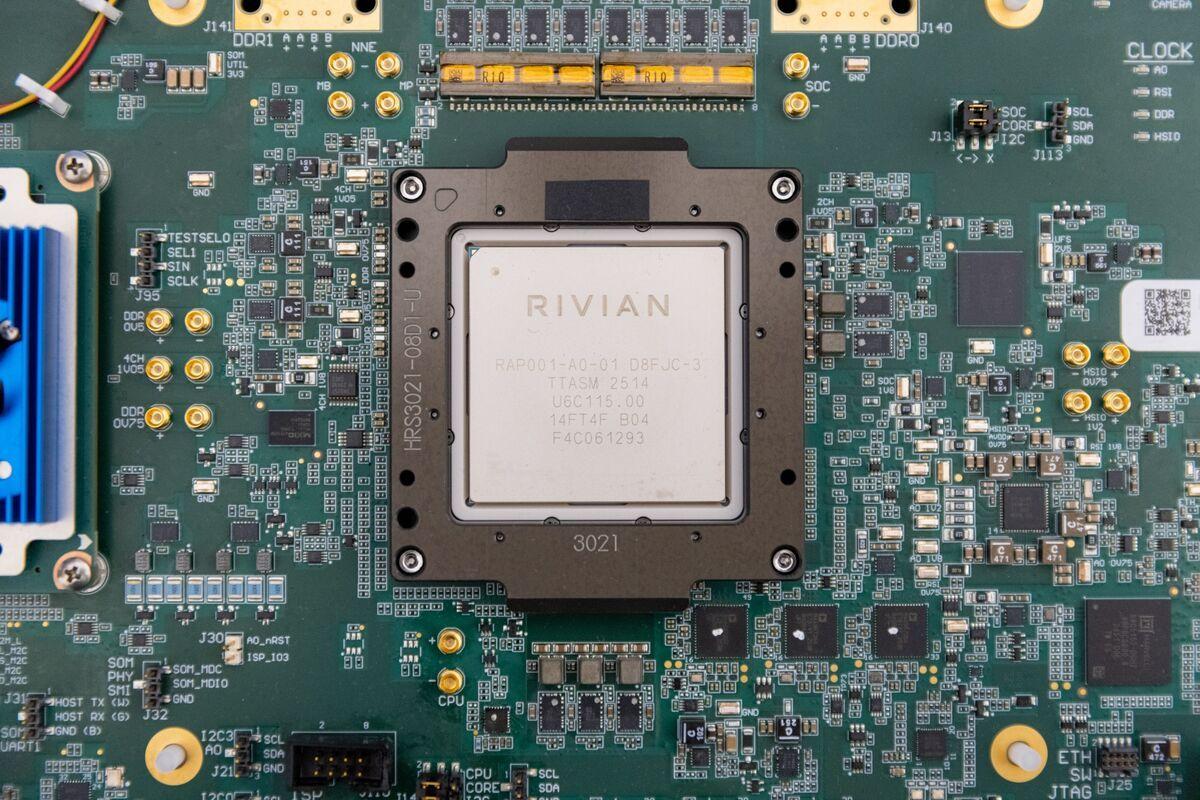
Source: Bloomberg
The ACM3 will debut in late 2026 versions of the upcoming R2 EVs, paired with lidar sensors integrated into the roofline above the windshield. This marks a strategic departure from Tesla's camera-only approach, with Rivian emphasizing that lidar provides "three-dimensional spatial data and redundant sensing" for real-time detection of edge cases
1
. The R2 platform will feature 11 cameras totaling 65 megapixels and five redesigned radar units, with improved short-range capability allowing Rivian to eliminate ultrasonic parking sensors entirely3
.
Source: Electrek
Large Driving Model Powers Autonomous Capabilities
Rivian is building what it calls a Large Driving Model, an AI system trained on real-world driving scenarios that represents a shift away from rules-based frameworks for developing autonomous vehicles
1
. The company claims this approach uses Group Relative Policy Optimization, similar to techniques employed by DeepSeek, and applies the same neural network and training patterns familiar from large language models used in AI chatbots5
3
.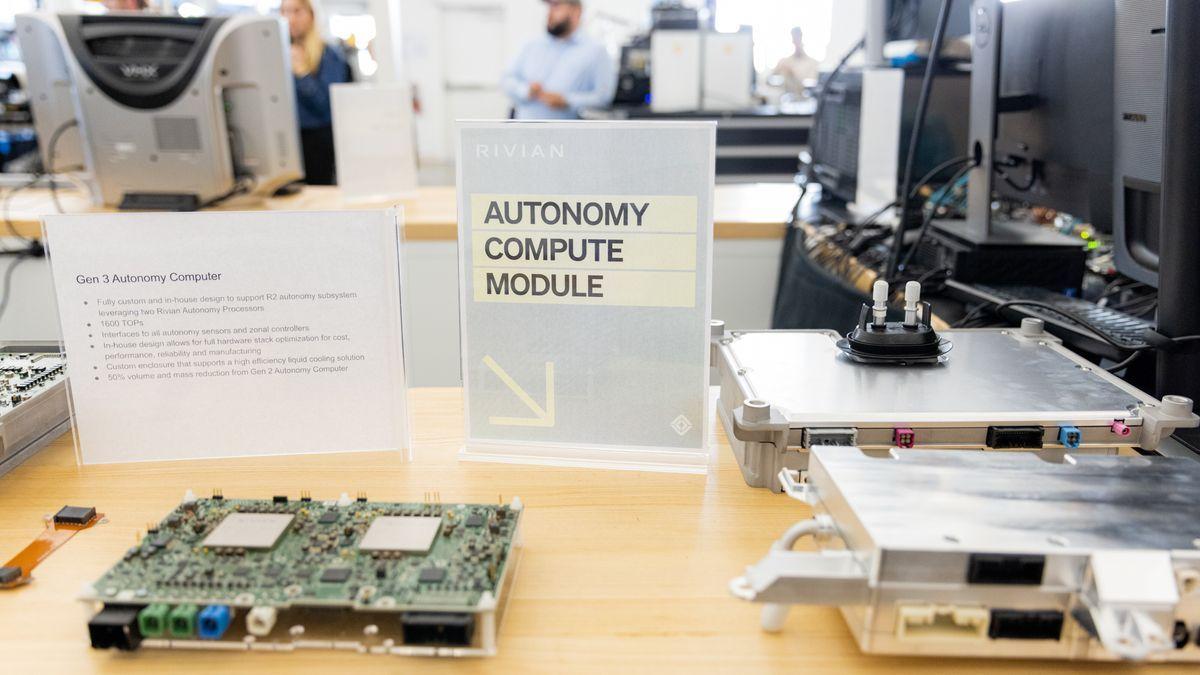
Source: Tom's Hardware
This technology will enable Universal Hands-Free driving, launching in early 2026 for second-generation R1 trucks and SUVs. The feature will cover 3.5 million miles of roads across the USA and Canada, extending beyond highways to surface streets with clear lane markings
1
5
. Rivian will charge a one-time fee of $2,500 or $49.99 per month for this Autonomy+ service1
3
.Path to Level 4 Autonomy and Robotaxi Ambitions
CEO RJ Scaringe outlined an ambitious roadmap that progresses from point-to-point navigation to eyes-off driving, ultimately reaching what Rivian calls "personal L4"—referring to Level 4 autonomy where vehicles can operate independently under defined conditions
1
. "What that means is you can get into the vehicle at your house, plug in the address to where you're going, and the vehicle will completely drive you there," Scaringe explained, describing future capabilities where drivers can reclaim their time by reading or using their phones1
.Scaringe also hinted at potential competition with Waymo in the ride-hail market. "While our initial focus will be on personally owned vehicles, which today represent a vast majority of the miles driven the United States, this also enables us to pursue opportunities in the rideshare space," he stated
1
. This signals Rivian's interest in the robotaxi market, though the company emphasizes that personally owned vehicles remain the priority.Related Stories

Rivian AI Assistant Offers CarPlay Alternative
Rivian has spent nearly two years developing its Rivian AI assistant, a sophisticated voice interface that integrates deeply with vehicle controls and third-party services
2
. The assistant launches in early 2026 on all Rivian vehicles, including first- and second-generation R1T and R1S models, with native integration on the R2 by late 20263
4
.The voice assistant addresses a major pain point for customers who miss Apple CarPlay and Android Auto functionality. During a live demonstration, the system read and responded to text messages, accessed Google Calendar to reschedule meetings, found nearby restaurants, and sent updated ETAs to contacts—all through natural, conversational commands
4
. The assistant can also control vehicle functions like switching drive modes or activating seat warmers, going beyond what CarPlay or Android Auto can accomplish4
.Wassym Bensaid, Rivian's chief software officer, explained that the company built an architecture that is model and platform agnostic, using what the industry calls an "agentic framework" to interface with different AI models
2
. The system combines edge AI for on-device tasks with cloud AI for more compute-intensive operations, creating a flexible hybrid software stack2
. Rivian also plans to use the assistant for predictive maintenance by embedding AI into diagnostics to help technicians pinpoint complex issues4
.Strategic Implications and Industry Competition
These announcements represent a public signal to shareholders that Rivian is keeping pace with or exceeding the automated-driving capabilities of rivals like Tesla, Ford, General Motors, and automakers from Europe and China
1
. The timing is significant as Rivian pushes to begin production of its more affordable R2 SUV in the first half of 2026, with initial models shipping without the ACM3 or lidar sensor before the upgraded versions arrive later that year1
.The AI assistant and autonomous driving development remain separate from Rivian's $5.8 billion joint venture with Volkswagen, which focuses on electrical architecture, zonal compute, and infotainment systems
2
5
. However, Bensaid noted that this separation "doesn't mean that it may not be in the future," suggesting potential expansion of the partnership2
. With Rivian's software and services business already turning a profit unlike its automotive division, the company may look to sell its autonomous driving and assistant technology to other automakers5
.References
Summarized by

Navi
[1]
[2]
Related Stories
Rivian Spins Off Mind Robotics with $115M to Bring Industrial AI to Manufacturing
04 Nov 2025•Business and Economy

Rivian Appoints AI Expert Aidan Gomez to Board, Signaling Ambitious AI Plans in EV Industry
23 Apr 2025•Technology

Rivian rolls out Universal Hands-Free driving across 3.5 million miles of US and Canadian roads
18 Dec 2025•Technology

Recent Highlights
1
OpenAI Releases GPT-5.4, New AI Model Built for Agents and Professional Work
Technology

2
Anthropic sues Pentagon over supply chain risk label after refusing autonomous weapons use
Policy and Regulation

3
OpenAI secures $110 billion funding round as questions swirl around AI bubble and profitability
Business and Economy

Recent Highlights
Today's Top Stories







Your Daily Dose of Curated AI News
Don’t drown in AI news. We cut through the noise - filtering, ranking and summarizing the most important AI news, breakthroughs and research daily. Spend less time searching for the latest in AI and get straight to action.

