Satya Nadella wants us to stop calling AI slop and start seeing it as bicycles for the mind


13 Sources
13 Sources
[1]
Microsoft's Nadella wants us to stop thinking of AI as 'slop' | TechCrunch
A couple of weeks after Merriam-Webster named "slop" as its word of the year, Microsoft CEO Satya Nadella weighed in on what to expect from AI in 2026. In his classic, intellectual style, Nadella wrote on his personal blog that he wants us to stop thinking of AI as "slop" and start thinking of it as "bicycles for the mind." He wrote, "A new concept that evolves 'bicycles for the mind' such that we always think of AI as a scaffolding for human potential vs a substitute." He continued: "We need to get beyond the arguments of slop vs sophistication and develop a new equilibrium in terms of our 'theory of the mind' that accounts for humans being equipped with these new cognitive amplifier tools as we relate to each other." If you parse through those syllables, you may see that he's not only urging everyone to stop thinking of AI-generated content as slop, but also wants the tech industry to stop talking about AI as a replacement for humans. He hopes the industry will start talking about it as a human-helper productivity tool instead. Here's the problem with that framing, though: Much of AI agent marketing uses the idea of replacing human labor as a way to price it, and justify its expense. Meanwhile, some of the biggest names in AI have been sounding the alarm that that the tech will soon cause very high levels of human unemployment. For instance, in May Anthropic CEO Dario Amodei warned that AI could take away half of all entry-level white-collar jobs, raising unemployment to 10-20% over the next five years, and he doubled down on that last month in an interview on 60 Minutes. Yet we currently don't know how true such doomsday stats are. As Nadella implies, most AI tools today don't replace workers, they are used by them (as long as the human doesn't mind checking the AI's work for accuracy). One oft-cited research study is MIT's ongoing Project Iceberg, which seeks to measure the economic impact on jobs as AI enters the workforce. Project Iceberg estimates that AI is currently capable of performing about 11.7% of human paid labor. While this has been widely reported as AI being capable of replacing nearly 12% of jobs, the Project says what it's actually estimating is how much of a job can be offloaded to AI. It then calculates wages attached to that offloaded work. Interestingly, the tasks it cites as examples include automated paperwork for nurses and AI-written computer code. That's not to say there are no jobs being heavily impacted by AI. Corporate graphic artists and marketing bloggers are two examples, according to a Substack called Blood in the Machine. Then there are the high unemployment rates among new grad junior coders. But it's also true that highly skilled artists, writers and programmers produce better work with AI tools than those without the skills. AI can't replace human creativity, yet. So it's perhaps no surprise that as we slide into 2026, some data is emerging that shows the jobs where AI has made the most progress are actually flourishing. Vanguard's 2026 economic forecast report found that "the approximately 100 occupations most exposed to AI automation are actually outperforming the rest of the labor market in terms of job growth and real wage increases." The Vanguard report concludes that those who are masterfully using AI are making themselves more valuable, not replaceable. The irony is that Microsoft's own actions last year helped give rise to the AI-is-coming-for-our-jobs narrative. The company laid off over 15,000 people in 2025, even as it recorded record revenues and profits for its last fiscal year, which closed in June -- citing success with AI as a reason. Nadella even wrote a public memo about the layoffs after these results. Notably, he didn't say that internal AI efficiency led to cuts. But he did say that Microsoft had to "reimagine our mission for a new era" and named "AI transformation" as one of the company's three business objectives in this era (the other two being security and quality). The truth about job loss attributed to AI during 2025 AI is more nuanced. As the Vanguard report points out, this had less to do with internal AI efficiency and more to do with ordinary business practices that are less exciting to investors, like ending investment in slowing areas to pile in to growing ones. To be fair, Microsoft wasn't alone in laying off workers while pursuing AI. The technology was said to be responsible for almost 55,000 layoffs in the U.S. in 2025, according to research from firm Challenger, Gray & Christmas, CNBC reported. That report cited the large cuts last year at Amazon, Salesforce, Microsoft and other tech companies chasing AI. And to be fair to slop, those of us who spend more time than we should on social media laughing at memes and AI-generated short-form videos might argue that slop is one of AI's most entertaining (if not best) uses, too.
[2]
Microsoft CEO Satya Nadella is now blogging about AI slop
Now that Microsoft CEO Satya Nadella has appointed a new CEO to run Microsoft's biggest businesses, he has a little more time on his hands for other adventures. Beyond focusing on Microsoft's technical work, Nadella is now turning to the ancient art of blogging to discuss Microsoft's year ahead and why he thinks everyone needs to move "beyond the arguments of [AI] slop vs sophistication." Nadella's first blog entry in "sn scratchpad" is all about Microsoft and other AI companies still needing to get a bunch of stuff right with AI. Chief among them is creating a new concept for AI that evolves the "bicycles for the mind" concept that Steve Jobs used to describe computers as tools in the '90s. "We need to get beyond the arguments of slop vs sophistication and develop a new equilibrium in terms of our 'theory of the mind' that accounts for humans being equipped with these new cognitive amplifier tools as we relate to each other," says Nadella. Nadella wants to move beyond the usual AI slop arguments, because Microsoft is betting on getting everyone hooked on AI agents instead of the Office and Windows software that has powered so many industries for decades. This speaks to the tension with AI models right now, and the fear from creatives about being edged out by AI models that are capable of copying the style of artists, designers, filmmakers, and more. We've been using PCs as tools for decades to create art, write code, and beyond, but Microsoft and others now want us to rely on AI agents as the new tools for creation instead -- even if a lot of what is generated is slop. Microsoft has a vision of everyone using Copilot with our voice to create content, search for information, and discover how to use things. The problem is that the vision doesn't match reality right now, and barely any of what Copilot promises to do actually works. Microsoft is betting on improved AI models to help Copilot and its own AI offerings, just as Meta warns that you can't trust your eyes to tell you what's real anymore. While Nadella has been part of the OpenAI, Google, and Anthropic AI model battle of 2025, he now argues that it's how people choose to apply AI instead of individual model power that ultimately matters. "We will evolve from models to systems when it comes to deploying AI for real world impact," says Nadella. These systems will have to take into consideration the societal impact they have on people and the planet, he says. "The choices we make about where we apply our scarce energy, compute, and talent resources will matter. This is the socio-technical issue we need to build consensus around." Nadella's first sn scratchpad blog entry is brief, but it's all about 2026 being a "pivotal year for AI." The same could be said for 2025, but Nadella thinks the industry now has a "clearer sense of where the tech is headed" and how it will shape its impact on the world. We'll have to revisit whether the tech industry gets AI right this year once 2027 rolls around, but Nadella is now promising to deliver more of his personal "notes on advances in technology and real-world impact" in future blog posts throughout 2026.
[3]
Microsoft CEO Satya Nadella calls for consensus about AI
Exec argues we need a new metaphor focused on AI as a lever rather than a job killer Microsoft CEO and head AI peddler Satya Nadella wants you to know that it's time for the next phase of AI acceptance, where we focus on how humans are empowered by tools and agents and how we deploy resources to support this growth. Amid doubts that revenue from Microsoft Copilot subscriptions and cloud AI services will compensate for data center capital expenditures any time soon, Satya has some incentive to convince customers and investors that AI is a financially intelligent long-term bet. Thus he has taken up the pen in an act of "thought leadership," to use the marketing jargon of his company's LinkedIn where he announced his post on a new blog entitled "sn scratchpad." Early in his post Nadella writes, "We have moved past the initial phase of discovery and are entering a phase of widespread diffusion." That's fair enough, given that widespread can mean anything. According to Pew Research, 62 percent of US adults say they interact with AI at least several times a week. The more relevant stat for Microsoft, however, is the percentage of customers who pay for Copilot and other AI services. That remains a work in progress. He also offers a new variant on the filler phrase "it's early days," so often heard from tech execs deflecting inquiries about lack of results. "We are still in the opening miles of a marathon," he opined. "Much remains unpredictable." Getting down to business, the Microsoft CEO says that there are three things the tech industry and society need to "get right" in 2026 to make AI return real value for everyone. First, we must develop a "theory of mind" that treats AI as a tool that amplifies humans and products should be designed around this belief. He uses Steve Jobs' famous quote that computers are "bicycles for the mind" as a jumping off point. When Microsoft is having to reassure people that its own research on the labor impact of AI shouldn't be interpreted to mean that jobs will be eliminated, you can see why Nadella might be keen to avoid the impression that AI is intended as a substitute for human labor. "What matters is not the power of any given model, but how people choose to apply it to achieve their goals," Nadella wrote. Second, Nadella posits that we move from "models" to "systems" for AI such that multiple models and agents working together can provide value. "We are now entering a phase where we build rich scaffolds that orchestrate multiple models and agents; account for memory and entitlements; enable rich and safe 'tools use,'" said Nadella. So perhaps we can look forward to agents failing less than 70 percent of the time. Finally, he argues, that society needs to make tough decisions about how and where to deploy AI so that it has "real world impact." "The choices we make about where we apply our scarce energy, compute, and talent resources will matter," he wrote. "This is the socio-technical issue we need to build consensus around."
[4]
Satya Nadella starts blogging about AI, wants to move the conversation beyond "slop"
Serving tech enthusiasts for over 25 years. TechSpot means tech analysis and advice you can trust. Forward-looking: Satya Nadella has a new platform for sharing his thoughts on the future of artificial intelligence, and it isn't a stage at a developer conference. The Microsoft CEO has begun publishing personal essays on a site called SN Scratchpad, where he outlined his vision for 2026 and described what he calls the next phase of AI evolution. Nadella's first post is not about new software releases or quarterly performance. Instead, it addresses the cultural and technical limits of how AI is understood and applied. He argues that the debate over "AI slop vs. sophistication" misses the larger point. "We need to get beyond the arguments of slop vs sophistication and develop a new equilibrium in terms of our 'theory of the mind' that accounts for humans being equipped with these new cognitive amplifier tools as we relate to each other," Nadella wrote. The post comes as Microsoft continues to expand its Copilot platform across Windows and Office, betting that users will one day rely on AI agents as thoroughly as they once relied on word processors and spreadsheets. But progress has been uneven. Features promised in Microsoft's Copilot vision, such as seamless voice assistance and multimodal integration across devices, remain largely aspirational. Many functions still fail to perform as advertised, fueling skepticism about the company's ability to align its ambitions with reality. In his essay, Nadella frames 2026 as a pivotal year for AI, describing a shift from discovery to diffusion. "We are beginning to distinguish between 'spectacle' and 'substance,'" he wrote. "We now have a clearer sense of where the tech is headed, but also the harder and more important question of how to shape its impact on the world." The statement signals that Microsoft sees the next phase of AI development not as a competition between OpenAI, Google, or Anthropic, but as a system-level challenge involving orchestration, safety, and social legitimacy. That perspective emerges in Nadella's call for AI systems that go beyond standalone models. "We will evolve from models to systems when it comes to deploying AI for real-world impact," he wrote. He adds that future systems will "build rich scaffolds that orchestrate multiple models and agents; account for memory and entitlements; enable rich and safe 'tools use.'" For Nadella, these technical and architectural layers are where AI's true engineering sophistication will emerge. He also invokes Steve Jobs' "bicycles for the mind" metaphor - a 90s-era concept describing computers as extensions of human cognition - as a template for the next generation of human-machine collaboration. Nadella argues that AI should function as a "cognitive amplifier" rather than a replacement for creative or analytical thought, even as he acknowledges that the current generation of tools is uneven in quality. "What matters is not the power of any given model, but how people choose to apply it to achieve their goals," he wrote. The challenge now extends beyond technical considerations to ethical ones. Nadella cautioned that the societal impact of AI depends on how limited energy, compute, and human talent are distributed. "The choices we make about where we apply our scarce energy, compute, and talent resources will matter," he wrote. "This is the socio-technical issue we need to build consensus around." His post arrives amid growing scrutiny of AI companies over performance, environmental costs, and the flood of generative "slop" that defined 2025. Merriam-Webster even named "slop" its word of the year, defining it as "digital content of low quality that is produced usually in quantity by means of artificial intelligence." Despite this pejorative framing, Nadella insists that the focus should shift from dismissing AI's failures to designing systems capable of making a durable societal contribution. Microsoft has invested tens of billions of dollars in AI partnerships and infrastructure, positioning itself at the core of the industry's hardware and software stack. Yet Nadella's tone suggests an understanding that technological dominance alone is insufficient. "Computing throughout its history has been about empowering people and organizations to achieve more, and AI must follow the same path," he wrote. "If we do that, it can become one of the most profound waves of computing yet." For now, his scratchpad remains sparse. But Nadella hints that 2026 will bring more personal updates as Microsoft and the wider industry attempt to turn sprawling AI ambitions into something more coherent - and perhaps, as he suggests, something less sloppy.
[5]

Satya Nadella wants us to stop calling AI "slop" - good luck with that
Microsoft CEO Satya Nadella's recent blog post has sparked backlash online, ultimately amplifying the very debate he wanted to move past. In his post reflecting on AI in 2025 and setting out expectations for 2026, Nadella argued that society should move beyond discussions of 'AI slop' and novelty, and actually focus on where AI can have real-world impact. He described 2026 as a pivotal year for AI, though he did acknowledge that we're still in the early stages of AI despite rapid progress. Redmond has already been criticized for its pretty aggressive approach to rolling out AI - many users feel that the tech has been forced upon them, whether they like it or not. However, use cases aren't just limited to workplace applications. Much of AI's mainstream usage today has been associated with misinformation, low-quality content, memes and even abuse. On the flip side, AI is yet to deliver promised breakthroughs like curing diseases or drastically transforming productivity, despite disrupting many entry-level jobs and straining memory supply (making computers more expensive for consumers). Nadella called for AI deployment to evolve from standalone models to comprehensive systems that combine models, agents, memory and more. "It will be a messy process of discovery, like all technology and product development always is," he admitted. Nevertheless, the term 'Microslop' has been trending on social media as a satirical response to the CEO's comments and to Microsoft's AI strategy on the whole - forced AI adoption and poor quality results tie in with the idea of AI slop. One comment on Nadella's LinkedIn post criticizes the short blog post for being "polished, but... empty." All in all, as with any technology or new invention, AI will continue to have mixed use cases that are both transformative and destructive, so it's on companies, regulators and society to manage this and work out exactly where AI belongs.
[6]

Microsoft CEO Begs Users to Stop Calling It "Slop"
"We need to get beyond the arguments of slop vs sophistication." In mid-December 2025, the editors of Merriam-Webster's dictionary chose "slop" as their word of the year. Their definition: "digital content of low quality that is produced usually in quantity by means of artificial intelligence." It's no mystery why they felt the term best described 2025. It was a year beset by uncanny AI-generated ads, search engine decay, and a tidal wave of AI music spamming streaming apps. Though the choice clearly struck a popular nerve, not everybody appreciated the dictionary's cheeky dig at AI companies and the cottage industry of slop they've engineered. In a year-end roundup shared via LinkedIn, for instance, Microsoft CEO Satya Nadella made it clear that he'd prefer we all left the term in 2025. "We need to get beyond the arguments of slop vs sophistication," Nadella wrote in a rambling post flagged by Windows Central, arguing that humanity needs to learn to accept AI as the "new equilibrium" of human nature. (As WC points out, there's actually growing evidence that AI harms human cognitive ability.) Going on, Nadella said that we now know enough about "riding the exponentials of model capabilities" as well as managing AI's "'jagged' edges" to allow us to "get value of AI in the real world." "Ultimately, the most meaningful measure of progress is the outcomes for each of us," the CEO concludes, in an impressive deluge of corporate-speak that may or may not itself by AI-generated. "It will be a messy process of discovery, like all technology and product development always is." Nadella's comments come as Microsoft users have revolted en masse against the company's AI products, which have largely been forced on them without consent. Earlier in December, it was reported that a staggering one billion PCs were still running Windows 10, even though a full half were eligible to upgrade to the AI-satured Windows 11. That being the case, it's obvious the CEO has a specific axe to grind with the people who refuse to go gentle into the sloppified night. Tech CEOs like Nadella might talk a big game about altruism and human achievement, but at the end of the day, AI is a product -- and like any product, it lives or dies by consumer demand.
[7]

Microsoft CEO Satya Nadella says it's time to stop talking about AI 'slop' and start talking about a 'theory of the mind that accounts for humans being equipped with these new cognitive amplifier tools'
Merriam-Webster's word of the year for 2025 was "slop," the catch-all term for machine-generated crapola -- or, as Merriam-Webster more prosaically (and politely) defines it, "digital content of low quality that is produced usually in quantity by means of artificial intelligence." Hard to argue with the pick: As PC Gamer's Lincoln Carpenter said, it was "a year full of AI humiliation" that started with a stupid AI-generated Star Wars video and didn't stop until the calendar ran out. But while "slop" is without doubt an appropriately defining word for 2025, Microsoft CEO Satya Nadella says it's time to stop talking about it, because we need to move on to bigger and more important things -- like how they're going to make this obscenely expensive and resource-sucking mistake generator that nobody wants actually work. "We have moved past the initial phase of discovery and are entering a phase of widespread diffusion," Nadella wrote on his sn scratchpad blog (via The Verge). "We are beginning to distinguish between 'spectacle' and 'substance'. We now have a clearer sense of where the tech is headed, but also the harder and more important question of how to shape its impact on the world." Nadella listed three key points the AI industry needs to focus on going forward, the first of which is developing a "new concept" of AI that builds upon the "bicycles for the mind" theory put forth by Steve Jobs in the early days of personal computing. "What matters is not the power of any given model, but how people choose to apply it to achieve their goals," Nadella wrote. "We need to get beyond the arguments of slop vs. sophistication and develop a new equilibrium in terms of our 'theory of the mind' that accounts for humans being equipped with these new cognitive amplifier tools as we relate to each other. This is the product design question we need to debate and answer." The inherent assumption that AI collectively represents "cognitive amplifier tools" is immediately suspect: There's a reason we call AI output "slop," after all, and beyond it merely not being very good (and certainly not original or "creative" in any way), there's a growing body of research -- including one paper co-authored by Microsoft -- indicating that the rise of AI is actually making its users, well, dumber. Beyond trying to convince everyone to stop saying "slop," AI companies will also "evolve from models to systems when it comes to deploying AI for real world impact," Nadella predicted: "We are now entering a phase where we build rich scaffolds that orchestrate multiple models and agents; account for memory and entitlements; enable rich and safe 'tools use'. This is the engineering sophistication we must continue to build to get value out of AI in the real world." And, finally, "we need to make deliberate choices on how we diffuse this technology in the world as a solution to the challenges of people and planet. For AI to have societal permission it must have real world eval impact. The choices we make about where we apply our scarce energy, compute, and talent resources will matter." There's a lot of jargon and bafflegab in Nadella's post, as you might expect from a CEO who really needs to sell this stuff to someone, but what I find more interesting is the sense that he's hedging a bit. Microsoft has sunk tens of billions of dollars into its pursuit of an AI panacea and expressed outright bafflement that people don't get how awesome it all is (even though, y'know, it's pretty obvious), and the chief result of that effort is hot garbage and angry Windows users. Against that less-than-happy backdrop, and with Microsoft and other AI companies still gobbling up untold mountains of money with no endgame in sight (short of the biggest financial bubble-pop in recorded history, I suppose), Nadella concluded his missive by saying the continued development of AI "will be a messy process of discovery," and deploying a very heavily freighted use of the word "if." "Computing throughout its history has been about empowering people and organizations to achieve more, and AI must follow the same path," he wrote. "If we do that, it can become one of the most profound waves of computing yet. This is what I hope we will collectively push for in '26 and beyond."
[8]

Satya Nadella wants the internet to keep an open mind about AI. The internet isn't having it
A new insult for artificial intelligence just dropped thanks to Microsoft's CEO. If you use Microsoft products, it's near impossible to avoid AI now. The company is pushing AI agents deep into Windows, with every app, service, and product Microsoft has on the market now including some kind of AI integration, without the option to opt out. Microsoft CEO Satya Nadella recently shared a blog post to LinkedIn titled "Looking Ahead to 2026" offering an insight into the company's focus for the new year. Spoiler alert: it's AI. Nadella wrote that he wants users to stop thinking of AI as "slop" and start thinking of it as "bicycles for the mind." Many took the post as a pushback against the popular insult "slop" often leveled at anything AI-generated, recently crowned Merriam-Webster's word of the year for 2025.
[9]

Microsoft CEO Says People Need To 'Get Beyond' Calling It AI Slop
CEO Satya Nadella says people 'need to get beyond' the gen AI slop debate Gen AI isn't going anywhere. In fact, it's just getting started. That's what Microsoft CEO Satya Nadella believes. He'd also like you to stop calling everything generated by LLM AI "slop." People need to "get beyond" that in 2026, the executive who earned $79 million in compensation recently announced. These and other musings were shared on his personal "sn scratchpad" blog in a December 29 post titled "Looking ahead to 2026." It acknowledges the challenges of people figuring out how to actually use gen AI to do things that are useful, but remains bullish on the underlying technology itself to continue improving at a rate worth investing $100 billion in. Here's the part that caught everyone's' attention, though: We need to get beyond the arguments of slop vs sophistication and develop a new equilibrium in terms of our 'theory of the mind' that accounts for humans being equipped with these new cognitive amplifier tools as we relate to each other. This is the product design question we need to debate and answer. I'm not sure what exactly Nadella means by "a new equilibrium in terms of our 'theory of the mind,'" and perhaps he doesn't either. Given the executive's penchant for folding AI use into every facet of his work life, it's not only possible but actually very likely that some version of Copilot, perhaps even a "rich" multi-agent "scaffold," was the "bicycle for the mind" that helped him conjure this blog post in the first place. If true, that would be as good a reason as any not to move so quickly beyond the "slop vs. sophistication" distinction. But there's no doubt a deeper philosophical schism that separates people who deploy the term "slop" against AI from those whose future is inextricably bound up in gen AI services becoming widely and eagerly adopted. For Nadella, the difference is one of apparent quality. Like the Turing test which ascribes human-like intelligence to anything that can convincingly manipulate language well enough to trick humans, some think it's only slop if the slop can't convince them otherwise. For others, it's slop, no matter how sophisticated it may be, the second human creativity is interrupted, or even supplemented, by a plagiarism machine. In the world of cloud computing and stock prices, where everything is interchangeable and fungible, such distinctions are meaningless, or at the very least, don't drive quarterly profit growth. But in the world of people, slop in is slop out. Being content to eat from the trough does not transform it into a Michelin Star meal.
[10]

Satya Nadella Says AI Models Alone Won't Cut It, Systems Are the Future
He said that AI's product design is the biggest question for us Microsoft Chairman and CEO Satya Nadella has outlined his vision for the artificial Intelligence (AI) landscape in 2026, highlighting a transition beyond standalone models and toward AI systems designed for real-world use and impact. In a year-end post titled "Looking Ahead to 2026," Nadella wrote that the industry is moving past early discovery phases and into "widespread diffusion" of AI technologies. He said companies must shift focus from raw capability to meaningful outcomes and build systems that work safely and usefully outside research environments. Satya Nadella Bets on AI Systems In his first personal blog post on sn scratchpad, Nadella argued that the AI industry is currently going through a vibe shift. He claimed that while the narrative of 2025 was shared around the debates of "spectacle VS substance," distinguishing between the two is becoming easier. Instead, he suggested that the industry should focus on how AI can be purposefully integrated into everyday workflows and societal services. According to the Microsoft CEO, the debate over sheer model power must give way to engineering "rich scaffolds" that orchestrate multiple AI components into cohesive and practical systems. In his reflections, Nadella called for a new conceptual framework that treats AI as "scaffolding for human potential," instead of a substitute for humans. He also gave a callback to Steve Jobs' famous "bicycles for the mind" quote, highlighting that AI should play the same, but an evolved role. A central theme of Nadella's blog is the notion that AI models alone are no longer sufficient for broad, real-world impact. He said future progress requires systems that combine multiple models, support memory and entitlements, and incorporate safe ways to use tools at scale. "We will evolve from models to systems when it comes to deploying AI for real-world impact," he wrote, noting that engineers will need to handle the "jagged edges" of current technology as they build these systems. This shift, as Nadella described it, involves not just technical integration but a broader evaluation of where and how AI is deployed. He argued that factors such as the allocation of scarce compute, energy and talent resources should inform decisions about AI deployment if the technology is to earn what he called "societal permission". The Microsoft CEO also stated that achieving real-world impact from AI will depend on consensus around these socio-technical challenges.
[11]

Microsoft CEO Satya Nadella calls for a big AI reset in 2026, says we need to move beyond...
Microsoft CEO Satya Nadella has urged everyone to move beyond the novelty phase and focus on real-world impact, shifting from "slop vs. sophistication" arguments. In a blog titled 'Looking Ahead to 2026', he emphasizes AI as a tool to amplify human potential, not a substitute, and highlights the importance of product design and societal considerations in developing AI systems for widespread diffusion. Merriam-Webster's word of the year for 2025 was 'slop' and it was undoubtedly an appropriately defining word for 2025 but Microsoft CEO Satya Nadella says it's time to stop talking about it. In a blog published towards the end of the last year, Satya Nadella argued that the AI industry has moved past its novelty phase and now faces a more difficult challenge: proving that any of this actually works in the real world. Satya Nadella turned to blogging to discuss the coming years of Microsoft why he thinks everyone needs to move "beyond the arguments of [AI] slop vs sophistication." Nadella's first blog entry in "sn scratchpad" is all about Microsoft and other AI companies still needing to get a bunch of stuff right with AI. Nadella has titled the blog: Looking Ahead to 2026; and describes it as -- Notes on advances in technology and real-world impact and the blog offers insights on Microsoft's focus for the new year. "As I reflect on the past year and look toward the one ahead, there's no question 2026 will be a pivotal year for AI. Yes, another one," Nadella opines. "But this moment feels different in a few notable ways." He added, "We have moved past the initial phase of discovery and are entering a phase of widespread diffusion. We are beginning to distinguish between "spectacle" and "substance". We now have a clearer sense of where the tech is headed, but also the harder and more important question of how to shape its impact on the world." Microsoft CEO wants everyone to move beyond the usual AI slop arguments. This is because Microsoft is betting on getting everyone hooked on AI agents instead of the Office and Windows software that has powered so many industries for decades. ALSO READ: Flight rule change: Use of power banks for in-flight charging barred by DGCA amid lithium battery fire fears At the heart of his argument is a return to Steve Jobs' idea of computers as "bicycles for the mind". Nadella said AI should not be seen as an independent intelligence, but as a tool that boosts human thinking and helps people achieve their goals. From this perspective, the focus is less on raw model power and more on good product design and how people use AI in their everyday lives. "A new concept that evolves "bicycles for the mind" such that we always think of AI as a scaffolding for human potential vs a substitute. What matters is not the power of any given model, but how people choose to apply it to achieve their goals. We need to get beyond the arguments of slop vs sophistication and develop a new equilibrium in terms of our "theory of the mind" that accounts for humans being equipped with these new cognitive amplifier tools as we relate to each other. This is the product design question we need to debate and answer," said Nadella. Microsoft is betting on more advanced AI models to strengthen Copilot and its wider AI products. Nadella says the real impact of AI depends less on how powerful a model is and more on how people choose to use it. "We will evolve from models to systems when it comes to deploying AI for real world impact," says Nadella. These systems will have to take into consideration the societal impact they have on people and the planet, he says. "The choices we make about where we apply our scarce energy, compute, and talent resources will matter. This is the socio-technical issue we need to build consensus around." ALSO READ: Quote of the Day by Brad Pitt: 'You don't really get to choose who you fall in love with. Love chooses you' You may have seen images on social media that look like a mix of real photographs and computer-generated graphics. While some are clearly unreal, such as the viral "Shrimp Jesus", while others seem believable at first glance, like the image of a little girl holding a puppy in a boat during a flood. These are examples of what is known as "AI slop" -- low- to medium-quality content created using AI tools. It can include videos, images, audio, text, or a combination of these, and is often made with little concern for accuracy. This kind of content is quick, easy, and cheap to produce. Those who create AI slop usually share it on social media to take advantage of the internet's attention-driven economy, pushing out higher-quality content that could be more informative or useful.
[12]

Microsoft CEO Satya Nadella Says AI is Not "Slop," Urges a Shift in Perspective Toward AI
As 55,000 Tech Jobs Vanish, Nadella Encourages Professionals to View AI as a Human Support Tool and Not a Cause for Job Loss Microsoft CEO Satya Nadella shared his views on artificial intelligence in a recent blog post, encouraging people to change their perspective on the technology. His comments came soon after Merriam-Webster named "slop" as its word of the year. Many people use it to describe poor-quality AI content online. However, Nadella believes artificial intelligence should never be dismissed as 'slop' and instead should be seen as a helpful tool supporting human workflows. He compared AI to "bicycles for the mind," signaling a tool that supports people in thinking faster and working smarter.
[13]

Satya Nadella on AI in 2026: We will evolve from models to systems
He frames AI as amplification of human potential, not replacement In case you didn't know this before, yes, Satya Nadella has an online blog (a scratchpad of sorts), where he likes to give his unfiltered two cents on all things tech from time to time. Not just any random Happy New Year greeting, in his latest post Satya Nadella fires a warning shot related to AI. The Microsoft CEO says 2026 is "pivotal" for all things AI, because AI has moved from discovery to "widespread diffusion," and we're finally separating "spectacle" from "substance." The catch, according to Nadella, is that we're in a "model overhang," where capability is outrunning real-world impact - so the next leap is product discipline, not just bigger models. In his blog post, Nadella describes what he wants as an updated "bicycles for the mind," with AI as "scaffolding for human potential." Not just that, Satya Nadella urges everyone to adopt a new "theory of the mind" which assumes the fact that we will all live with AI as amplifiers to our own intelligence, not as outright replacements. If we interpret Satya Nadella's thoughts in Microsoft terms, it would mean that Copilot becomes less of a chat box and more of a deeply embedded operating layer. In fact, Ignite 2025's "Work IQ" suggests something similar, where Copilot starts to become an intelligence layer that blends your work data, memory, and inference to recommend actions in your workflow through Word, Outlook, and Teams - and obviously it constantly learns over time. Also read: Google predicts a 2026 robotics boom, Elon Musk and Altman agree If Nadella's vision lands, 2026 is the year Copilot stops feeling like a separate app and starts feeling like the default way Microsoft software behaves, which is more contextual and personalized. Nadella's second major thought related to AI in his blog is related to a decisive shift. According to Nadella, AI must evolve from "models to systems." There are already lots of AI models with lots of capabilities out there for users to pick and choose from, but it's time to develop systems and platforms, argues Nadella, with rich scaffolds orchestrating multiple models and agents, handling "memory and entitlements," and enabling safe "tools use." That maps neatly onto Microsoft's two factories. For businesses, Copilot Studio is pitched as the low-code place to build "agents and agent flows." For developers, Microsoft Foundry markets itself as an "AI app and agent factory" with model choice, knowledge/tools integration, and "observability and trust. Meanwhile, Microsoft Windows is also being positioned as an agent launcher, where Copilot PC users start and monitor agents from the taskbar, where agents reach into File Explorer or Settings - explicitly "with user consent - with the help of connectors. Nadella's final warning is the most pragmatic one, I think, out of everything he has mentioned in his short and brief ode to AI in 2026. Here Satya Nadella stresses about the social contract all of us as users need to make about AI in the long term. He says that AI only earns "societal permission" through "real world impact," and the choices we make with scarce "energy, compute, and talent" while deploying AI matter - because they impact all of us. From this bit alone, one can expect Microsoft's 2026 AI story to lean harder on measurement and governance. Where productivity gains are quantifiable, and safety processes are front and centre. The takeaway from Nadella's AI evolution through 2026 couldn't be more clear - the winners won't be the labs with the loudest models, but the platforms that turn messy capability into dependable systems.
Share
Share
Copy Link
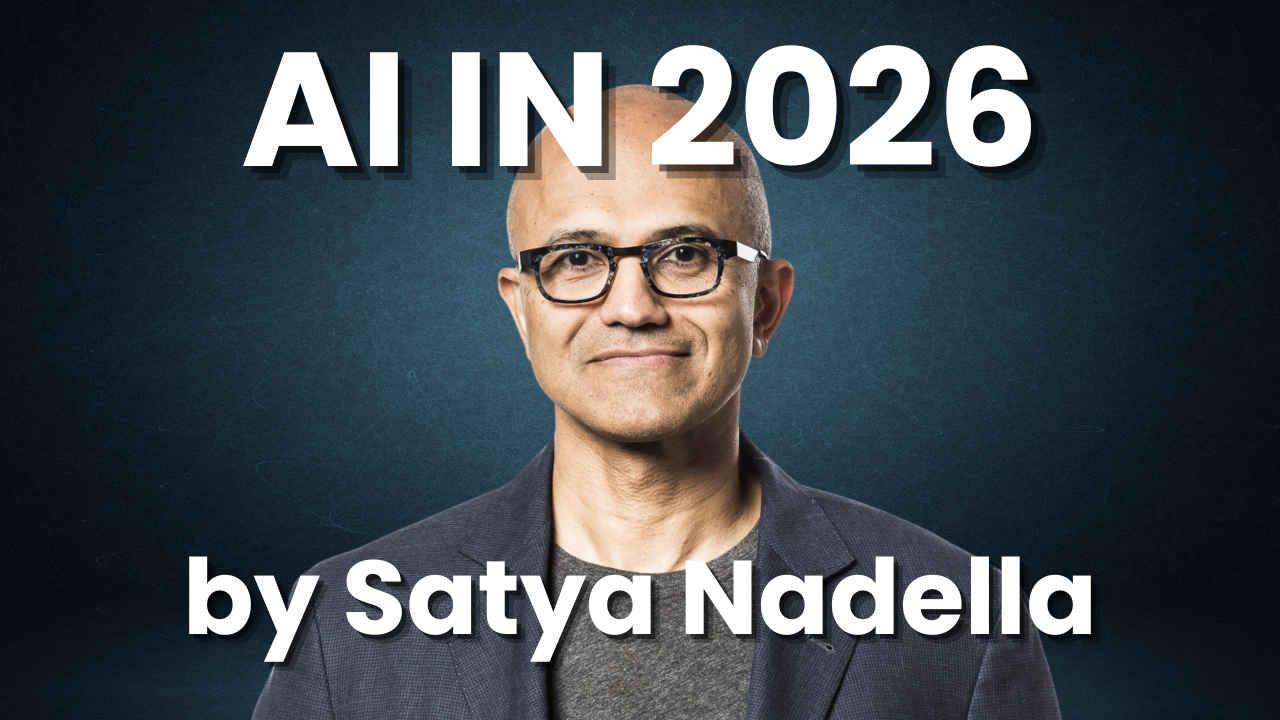
Microsoft CEO Satya Nadella launched his personal blog to reshape how we think about AI in 2026. He's calling for the industry to move beyond debates about AI slop and start treating artificial intelligence as cognitive amplifiers that enhance human potential rather than replace it. But his message faces skepticism given Microsoft's own layoffs and the reality of how AI agents are marketed.
Microsoft CEO Launches Personal Blog to Reframe AI Conversation
Satya Nadella has entered the blogging arena with a clear mission: to change how we talk about AI in 2026
1
2
. The Microsoft CEO launched his personal blog, SN Scratchpad, just weeks after Merriam-Webster named "slop" its word of the year, defining it as low-quality content produced in quantity through artificial intelligence4
. In his inaugural post, Nadella argues that the tech industry needs to "get beyond the arguments of AI slop vs sophistication" and develop a new understanding of how humans interact with these tools1
.
Source: Digit
Bicycles for the Mind: A New Theory for AI
Nadella invokes Steve Jobs' famous 1990s concept of computers as "bicycles for the mind" to frame his vision for AI
3
. He wants to evolve this metaphor so that "we always think of AI as a scaffolding for human potential vs a substitute."1
The Microsoft CEO describes AI as cognitive amplifiers that should enhance human creativity rather than replace it, calling for a new "theory of the mind" that accounts for humans equipped with these tools2
. "What matters is not the power of any given model, but how people choose to apply it to achieve their goals," Nadella wrote3
.The Tension Between Vision and Reality
Yet Nadella's call for human augmentation through AI faces considerable skepticism. Microsoft itself laid off over 15,000 people in 2025 while recording record revenues and citing AI transformation as a business objective
1
. The technology was reportedly responsible for almost 55,000 layoffs across U.S. tech companies in 2025, according to research from Challenger, Gray & Christmas1
. AI agents are frequently marketed using the idea of replacing human labor as justification for their expense1
. Anthropic CEO Dario Amodei warned that AI could eliminate half of all entry-level white-collar jobs, potentially raising unemployment to 10-20% over the next five years1
.From Models to Systems: Nadella's Three Priorities
The Microsoft CEO outlined three areas the industry must "get right" in 2026
3
. First, developing products designed around AI as human augmentation tools rather than substitutes. Second, evolving from standalone AI models to comprehensive AI systems that orchestrate multiple models and agents, accounting for memory, entitlements, and safe tool use4
. "We will evolve from models to systems when it comes to deploying AI for real world impact," Nadella stated. Third, making strategic decisions about deploying scarce energy, compute, and talent resources for the real-world impact of AI3
. This call for consensus about AI deployment addresses the societal impact on people and the planet.
Source: ET
Related Stories
Mixed Evidence on Job Impact and Performance
The actual data on job loss presents a more nuanced picture than doomsday predictions suggest. MIT's Project Iceberg estimates that AI is currently capable of performing about 11.7% of human paid labor, though this measures tasks that can be offloaded rather than entire jobs replaced
1
. Interestingly, Vanguard's 2026 economic forecast found that approximately 100 occupations most exposed to AI automation are actually outperforming the rest of the labor market in job growth and real wage increases, suggesting that workers who masterfully use AI are making themselves more valuable1
. Meanwhile, Microsoft's Copilot platform, which the company is betting on heavily, faces criticism for features that remain largely aspirational and often fail to perform as advertised4
.Backlash and the "Microslop" Response
Nadella's attempt to move past the AI slop debate has ironically amplified it. The term "Microslop" trended on social media as a satirical response to his comments, with critics pointing to Microsoft's aggressive approach to rolling out AI and users feeling the technology has been forced upon them
5
. One commenter on Nadella's LinkedIn post described the blog entry as "polished, but... empty"5
. Much of AI's mainstream usage remains associated with misinformation, low-quality content, and memes, while promised breakthroughs like curing diseases remain elusive5
. As Microsoft competes with OpenAI, Google, and Anthropic in the AI model battle, Nadella describes 2026 as a "pivotal year for AI" where the industry has "a clearer sense of where the tech is headed". Whether human-machine collaboration can deliver on its promises while addressing concerns about human creativity, job loss, and societal impact remains the central question as we move deeper into this AI era.
Source: TechCrunch
References
Summarized by

Navi
[3]
Related Stories
Microsoft CEO Satya Nadella Calls for Realistic AI Expectations, Emphasizing Economic Impact Over Hype
21 Feb 2025•Business and Economy

Satya Nadella warns AI risks losing social permission without tangible societal benefits
20 Jan 2026•Business and Economy
Microsoft AI Chief Defends Technology Amid Growing User Backlash Over Agentic Windows
20 Nov 2025•Entertainment and Society

Recent Highlights
1
Apple Plans Major Siri AI Overhaul in iOS 27 With Third-Party Chatbot Integration
Technology

2
OpenAI shuts down Sora after six months, ending Disney's $1 billion licensing partnership
Technology

3
AI chatbots validate you too much, making you less kind to others, Stanford study reveals
Science and Research
Recent Highlights
Today's Top Stories






Your Daily Dose of Curated AI News
Don’t drown in AI news. We cut through the noise - filtering, ranking and summarizing the most important AI news, breakthroughs and research daily. Spend less time searching for the latest in AI and get straight to action.

