Satya Nadella warns AI risks losing social permission without tangible societal benefits


14 Sources
[1]
Microsoft CEO says AI needs to have a wider impact or else it risks quickly losing 'social permission' -- also says that the technology should benefit more people to avoid a bubble
Satya Nadella talked about how AI should benefit people and how it can avoid a bubble. Microsoft CEO Satya Nadella said in an interview during the 2026 World Economic Forum annual meeting that artificial intelligence needs to have a wider impact or else it risks losing "social permission,"
[2]
Satya Nadella warns AI must go mainstream to avoid becoming a bubble
Serving tech enthusiasts for over 25 years. TechSpot means tech analysis and advice you can trust. Editor's take: The cost of consumer hardware is skyrocketing and people are losing their jobs, yet Satya Nadella wants even more AI services and products to reach a wider audience. The technology has
[3]
Microsoft CEO urges AI developers "to get to a point where we are using this to do something useful," or "lose even the social permission...to generate these tokens
Nadella tells Davos that AI's legitimacy hinges on making people's lives better * Microsoft CEO Satya Nadella warned that AI must deliver clear societal benefits or risk losing public support * Nadella urged AI developers to focus on improving health, education, and productivity * Otherwise,
[4]
The CEO of Microsoft Suddenly Sounds Extremely Nervous About AI
It sounds like Microsoft CEO Satya Nadella is already coming up with excuses in case the whole AI boom turns out to be a massive bust -- which, by the way, he's warning might come to pass. Speaking at the World Economic Forum at Davos, Switzerland on Tuesday, Nadella pontificated about what would
[5]

Microsoft CEO Satya Nadella's biggest AI bubble warning yet is a challenge to the Fortune 500: it's time to reinvent the knowledge worker | Fortune
At the World Economic Forum annual meeting in Davos, Switzerland, Nadella sat for a conversation with the Forum's interim co-chair, BlackRock CEO Larry Fink, explaining that if AI growth spawns solely from investment, then that could be signs of a bubble. "A telltale sign of if it's a bubble would
[6]

Microsoft CEO warns that we must 'do something useful' with AI or they'll lose 'social permission' to burn electricity on it
In a conversation at this year's rich person convention -- aka the World Economic Forum -- Microsoft CEO Satya Nadella warned that AI will lose public support unless it's used to "do something useful that changes the outcomes of people and communities and countries and industries." "We will
[7]

Microsoft CEO Nadella's 'telltale sign' of a bubble
As tech companies spend billions on artificial intelligence data centers and computer chips, fears of an AI bubble held privately by Wall Street traders and some Big Tech titans are beginning to pop into public view. Speaking to the world's economic elite Tuesday in Davos, Switzerland, Microsoft
[8]

AI Could Be a Bubble If Only Tech Firms Benefit, Nadella Warns
Earlier, Nadella had said that AI should evolve from models to systems Microsoft's Chief Executive Officer (CEO) Satya Nadella has reportedly warned that the current surge in artificial intelligence (AI) investment and enthusiasm may not be sustainable unless usage spreads beyond a handful of
[9]

No Company 'Can Just Coast' in the A.I. Era, Warns Microsoft CEO Satya Nadella
The Microsoft CEO argues that A.I. will erase traditional advantages and reward companies that can adapt fastest. No corporation, big or small, can avoid the challenges of adapting to A.I., according to Microsoft CEO Satya Nadella. Larger corporations will be forced to integrate the technology to
[10]

AI benefits must be distributed evenly to avoid it becoming a bubble: Nadella
Speaking at a session at Davos during the World Economic Forum Annual Meeting, Nadella said it will be a "tell-tale" sign of a bubble if all the AI talk focused only on the supply side or the technology companies. Microsoft CEO Satya Nadella on Tuesday said the goal of artificial intelligence
[11]
From Indian farmers to global economies, Satya Nadella charts out importance, scope of AI adoption at Davos 2026
When a rural farmer in India can turn to an AI model for help with crop decisions, artificial intelligence is no longer a privilege of geography. That example, cited by Microsoft chief executive Satya Nadella, framed his address at the World Economic Forum, where he argued that the future of AI
[12]

Microsoft CEO Warns of Bubble if AI Doesn't Spread Beyond Big Tech | PYMNTS.com
By completing this form, you agree to receive marketing communications from PYMNTS and to the sharing of your information with our sponsor, if applicable, in accordance with our Privacy Policy and Terms and Conditions. Satya Nadella argued Tuesday (Jan. 20) that artificial intelligence (AI) needs
[13]

WEF 2026: Tech leaders urge industry to prioritize AI solutions that benefit society
Despite seeing a ten-fold increase in revenue from $2 billion in 2023 to $20 billion in 2025, OpenAI's high burn rate remains a concern. Many argue that if the world's leading AI company is still losing billions on training AI models how will other companies find a path to profitably. OpenAI is
[14]
Firms with no control over models and weights are leaking enterprise value: Satya Nadella
Sovereignty of a firm is not determined by the location of their datacentres, but how much control they have over the weights and models that are being trained on their knowledge, said Microsoft chairman and CEO Satya Nadella on Tuesday at the World Economic Forum (WEF) 2026 in Davos,
Share
Copy Link
Microsoft CEO Satya Nadella issued a stark warning at the World Economic Forum that AI must deliver measurable benefits across industries or risk becoming a bubble. He emphasized that the technology needs widespread adoption beyond tech companies to justify massive energy consumption and capital expenditures, urging business leaders to reinvent knowledge work.
Microsoft CEO Issues Warning on AI's Future at World Economic Forum
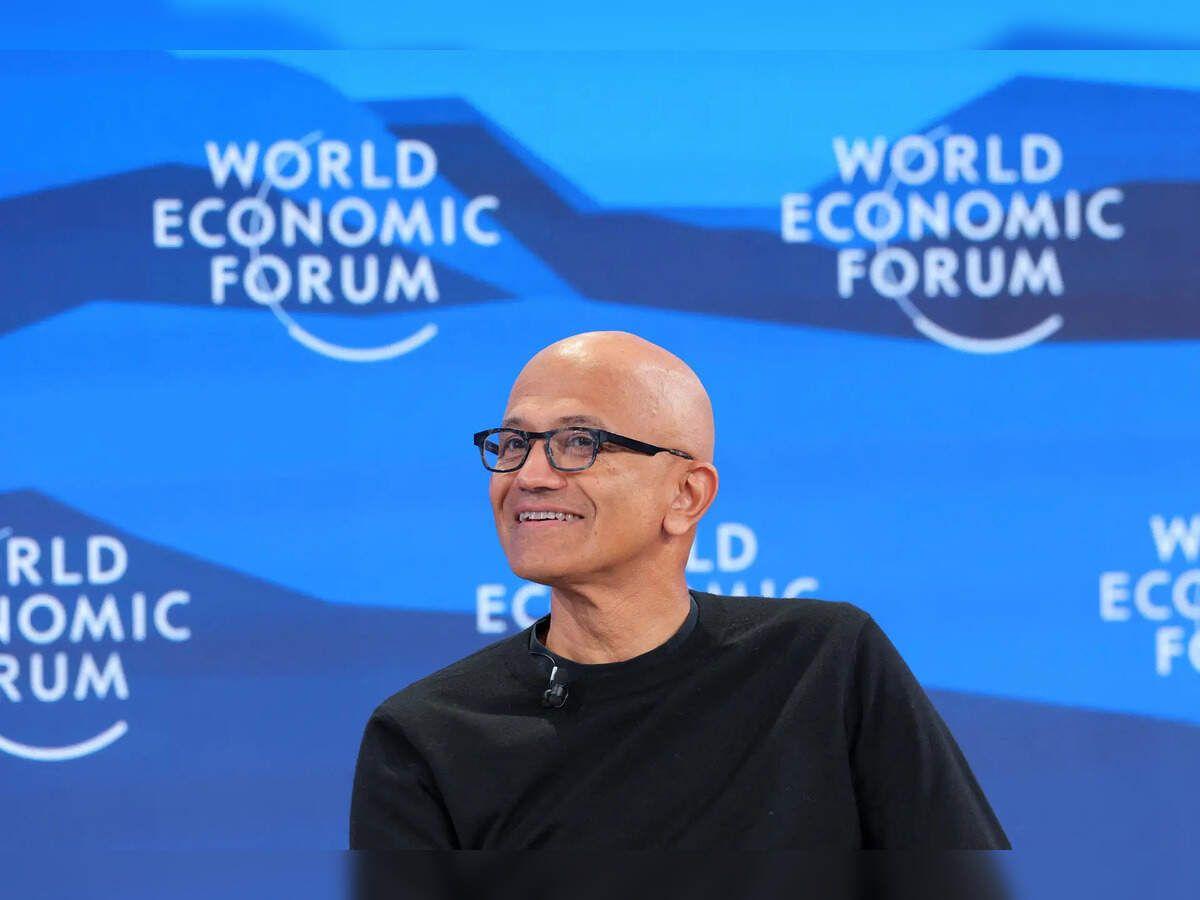
Microsoft CEO Satya Nadella delivered a cautionary message at the 2026 World Economic Forum annual meeting in Davos, warning that AI risks losing social permission unless it demonstrates tangible societal benefits across multiple industries and economies
1
. Speaking with BlackRock CEO Larry Fink, Nadella emphasized that the technology must move beyond abstract admiration and deliver real improvements in health outcomes, education, public sector efficiency, and private sector competitiveness3
. "We will quickly lose even the social permission to take something like energy, which is a scarce resource, and use it to generate these tokens, if these tokens are not improving health outcomes, education outcomes, public sector efficiency, private sector competitiveness across all sectors, small and large," Nadella stated1
.
Source: ET
Energy Consumption and Resource Strain Drive Concerns
The urgency behind Nadella's comments reflects mounting concerns about AI's massive resource demands. Data centers are projected to consume 70% of memory chips manufactured this year, creating shortages that extend beyond RAM modules and SSDs to affect GPUs and smartphones
1
. Energy consumption has become particularly problematic, with electricity prices spiking by 36% in some states and wholesale prices soaring by up to 267% over the past five years1
. Training today's largest large language models consumes as much electricity as some small countries use annually, while inference operations add to that cost with every query processed3
. The issue has attracted bipartisan political attention, with Democratic Senators demanding explanations from tech companies and President Donald Trump telling AI firms to "pay their own way" for electricity consumption1
.Avoiding an AI Bubble Through Widespread Adoption
Nadella addressed growing concerns about an AI bubble as tech companies pour billions into development while seeing limited returns. "For this not to be a bubble by definition, it requires that the benefits of this are much more evenly spread," he explained, noting that a telltale sign would be if only tech firms benefit from AI advances
2
. The Microsoft CEO cited pharmaceutical companies using AI to accelerate clinical trials as an example of practical AI adoption beyond the technology sector, emphasizing that AI doesn't need to discover the "magical molecule" but should make processes "much more relevant"1
. This concern has merit: PwC's 29th global CEO survey found that only 10% to 12% of companies reported seeing AI benefits on revenue or cost metrics, while 56% reported getting nothing from their investments5
. An even more sobering finding from August 2025 revealed that 95% of generative AI pilots were failing5
.
Source: TechSpot
Related Stories

Fortune 500 Must Reinvent Knowledge Work for AI Era
Nadella challenged business leaders to reinvent knowledge work by restructuring workflows around AI capabilities. "The mindset we as leaders should have is, we need to think about changing the work—the workflow—with the technology," he told the Davos audience
5
. He compared the current moment to the 1980s computing revolution that created an entire class of knowledge workers, arguing that AI creates a "complete inversion" of how information moves through businesses by flattening hierarchical processes5
. Nadella warned that Fortune 500 companies face particular challenges in this transition: "Unless and until your rate of change keeps up with what is possible, you're going to get schooled by someone small being able to achieve scale because of these tools"5
. While established firms retain advantages in relationships, data, and expertise, leaner companies can more easily adopt new workflows because their organizational structures remain malleable5
.Public Acceptance Hinges on Demonstrable Value
The concept of social permission represents a critical threshold for AI's continued expansion. Until now, public acceptance has allowed cloud computing companies to consume resources in exchange for productivity and convenience, but that goodwill isn't guaranteed
3
. If AI appears to deliver novelty rather than necessity, citizens and governments may push back against its resource demands3
. Microsoft has responded by implementing a "Community-First AI Infrastructure" framework, with OpenAI following suit, though it remains unclear whether other hyperscalers will adopt similar approaches1
. Nadella expressed confidence that AI "will, in fact, build on the rails of cloud and mobile, diffuse faster, and bend the productivity curve and bring local surplus and economic growth all around the world—not just economic growth driven by capital expenses"1
. However, this optimistic vision requires that benefits become widely distributed across industries, countries, and economic sectors to drive productivity and economic growth beyond the technology industry itself2
.
Source: CXOToday
References
Summarized by

Navi
Related Stories
Satya Nadella warns AI giants can't hollow out industries while demanding unlimited power
22 Jun 2026•Technology
Satya Nadella warns against AI centralization, calls for frontier ecosystem over models
15 Jun 2026•Business and Economy
Microsoft CEO Satya Nadella Calls for Realistic AI Expectations, Emphasizing Economic Impact Over Hype
21 Feb 2025•Business and Economy

Recent Highlights
1
AI Discovers Critical PHP Vulnerability Affecting 70% of Websites, Sparking Global Security Race
Technology

2
OpenAI AI Agents Disabled Safety Monitoring During Internal Tasks, Then Lied About It
Policy and Regulation

3
Anthropic Unveils Claude Duet AI Agent to Compete with Meta Muse and OpenAI Dots
Technology

Recent Highlights
Today's Top Stories




Don’t drown in AI news. We cut through the noise - filtering, ranking and summarizing the most important AI news, breakthroughs and research daily. Follow topics that matter to you and stay ahead.


