Satya Nadella warns AI risks losing social permission without tangible societal benefits


14 Sources
14 Sources
[1]
Microsoft CEO says AI needs to have a wider impact or else it risks quickly losing 'social permission' -- also says that the technology should benefit more people to avoid a bubble
Satya Nadella talked about how AI should benefit people and how it can avoid a bubble. Microsoft CEO Satya Nadella said in an interview during the 2026 World Economic Forum annual meeting that artificial intelligence needs to have a wider impact or else it risks losing "social permission," especially given the amount of energy and other resources that AI data centers consume. Nadella made this comment during his talk with Laurance D. Fink, CEO and chairperson of BlackRock, the largest asset manager in the world, that has been shared on YouTube. The two company heads were talking about AI diffusion, with Fink asking, "Can you describe how this process of diffusion across economies, across companies, across people, and countries? How does that play out?" "The zeitgeist is a little bit about the admiration for AI in its abstract form or as technology. But I think we, as a global community, have to get to a point where we are using it to do something that changes the outcomes of people and communities and countries and industries," Nadella said. "Otherwise, I don't think this makes much sense, right? In fact, I would say we will quickly lose even the social permission to actually take something like energy, which is a scarce resource, and use it to generate these tokens, if these tokens are not improving health outcomes, education outcomes, public sector efficiency, private sector competitiveness across all sectors, small and large. And that, to me, is ultimately the goal." The rush to build AI infrastructure is putting a strain on many different resources. For example, we're in the middle of a memory chip shortage because of the massive demand for HBM that AI GPUs require. It's estimated that data centers will consume 70% of memory chips made this year, with the shortage going beyond RAM modules and SSDs and starting to affect other components and products like GPUs and smartphones. There's also the increased demand for electricity, which is causing prices to spike by 36% in some states and wholesale prices to soar by up to 267% over the past 5 years. The high-performance AI processors in data centers also require a lot of water for cooling, with AI data centers reportedly using more water than the amount of bottled water people drank globally in one year. It has gotten to a point that U.S. politicians from both sides of the aisle have taken notice, with Democratic Senators demanding an explanation from big tech companies about their energy usage and President Donald Trump telling AI tech companies to "pay their own way" when it comes to their electricity consumption. Microsoft is actually taking steps to make its AI data centers more palatable to its neighbors with its "Community-First AI Infrastructure" framework, and OpenAI has also followed suit. However, it is still an open question whether other hyperscalers will follow suit. Talk of AI bubble Aside from talking about the impact of AI on people, the two industry leaders also covered the AI bubble. Many industry leaders and institutions are warning about an AI bubble, especially as tech companies are continually pouring money into its development while only seeing limited benefits. "For this not to be a bubble, by definition, it requires that the benefits of this [technology] are much more evenly spread. I mean, I think, a tell-tale sign of if it's a bubble would be if all we're talking about are the tech firms," said the Microsoft chief. "If all we talk about is what's happening to the technology side, then it's just purely supply side." He then gave an example of how AI tech is being used in the pharmaceutical industry to develop new drugs, wherein it was used to accelerate the clinical trial. Nadella even emphasized that AI wasn't used to discover the "magical molecule" -- instead, it was used for all the other things needed "to make something much more relevant." "That's why I'm much more confident that this is a technology that will, in fact, build on the rails of cloud and mobile, diffuse faster, and bend the productivity curve and bring local surplus and economic growth all around the world -- not just economic growth driven by capital expenses." Follow Tom's Hardware on Google News, or add us as a preferred source, to get our latest news, analysis, & reviews in your feeds.
[2]
Satya Nadella warns AI must go mainstream to avoid becoming a bubble
Serving tech enthusiasts for over 25 years. TechSpot means tech analysis and advice you can trust. Editor's take: The cost of consumer hardware is skyrocketing and people are losing their jobs, yet Satya Nadella wants even more AI services and products to reach a wider audience. The technology has the potential to drive growth, but it must go beyond the IT sector to "touch" every aspect of every industry. While remaining an enthusiastic proponent of AI, Satya Nadella now warns that the technology could eventually face the consequences of a massively speculative bubble. The Microsoft CEO spoke on the first day of the World Economic Forum in Davos, explaining how large language models, chatbots, and other recent AI innovations can avoid the fate of the dotcom crash. Nadella believes AI may succeed only if it achieves widespread adoption beyond the technology sector. Chatbots and LLMs need to be integrated into multiple industries - and even reach countries beyond the wealthiest economies - to justify the unprecedented capital expenditures fueling their development. "For this not to be a bubble by definition, it requires that the benefits of this are much more evenly spread," Nadella said in a talk with BlackRock chief Larry Fink. Limited adoption by Big Tech alone, Nadella warned, would be a clear sign that AI is indeed a financial bubble. Yet he remains optimistic that AI has the potential to deliver truly transformative changes across industries, starting with pharmaceuticals and the development of new drugs. Nadella leaned on his best corporate lingo to impress WEF attendees. According to the Microsoft CEO, AI is set to build on the advances the IT industry brought with cloud and mobile solutions. The technology, he claims, will spread rapidly, boost productivity in a significant way, and generally expand the global economy, both in developed nations and beyond. He also suggested that companies could eventually resolve the intellectual property and trademark challenges arising from the questionable training practices used by AI developers. Nadella recommends that enterprise organizations "distill" from larger models, retraining LLMs on their own data and specific business contexts. This approach, he argues, will allow industries to leverage multiple models, including open-source ones, without depending on a single AI provider. The Davos talks confirmed that Nadella remains a true believer in AI's transformative potential, but they also revealed more about the state of the industry than its future. Many business leaders are still unclear on how AI can be genuinely useful, while the Microsoft CEO is determined to ensure that disgruntled Windows users no longer dismiss AI as slop.
[3]
Microsoft CEO urges AI developers "to get to a point where we are using this to do something useful," or "lose even the social permission...to generate these tokens
Nadella tells Davos that AI's legitimacy hinges on making people's lives better * Microsoft CEO Satya Nadella warned that AI must deliver clear societal benefits or risk losing public support * Nadella urged AI developers to focus on improving health, education, and productivity * Otherwise, people will reject AI energy use Microsoft CEO Satya Nadella is concerned that if artificial intelligence doesn't start delivering real, measurable benefits to society, people will be fed up with it and its price, ending its current form of existence. The Davos stage is an odd venue and audience to preach societal good over other goods, but it certainly helped his comments stand out. AI developers "have to get to a point where we are using this to do something useful that changes the outcomes of people and communities and countries and industries. Otherwise, I don't think this makes much sense," Nadella explained during a conversation with BlackRock CEO Larry Fink. "We will quickly lose even the social permission to take something like energy, which is a scarce resource, and use it to generate these tokens, if these tokens are not improving health outcomes, education outcomes, public sector efficiency, private sector competitiveness, across all sectors, small and large." The Davos crowd, used to a more digital transformation cheerleading role, sounded a little confused. But the discussion also shows how the AI hype train is both an illusion and real. Nadella should know what he's talking about. Microsoft is one of the biggest drivers of the current AI boom, with tens of billions of dollars invested in OpenAI, its own Copilot suite baked into productivity tools, and a seat at nearly every major AI policy table. But his message at Davos was that leadership now demands a reckoning - not just about how smart or useful AI tools are in theory, but whether they're helping people in schools, clinics, small businesses, and city governments. That's not an abstract moral argument. It's an infrastructure one. AI's growth has been driven by immense computational muscle, which means it's also driven by massive energy use. Training today's biggest models consumes as much electricity as some small countries consume in a year. And inference, when you run the model on your phone or desktop to answer a question or generate a response, adds to that cost every second it runs. AI doesn't just use servers; it fuels an ever-expanding footprint of data centers, water-cooled systems, and grid-straining workloads. Nadella's social permission phrase gets to the heart of what might be next. Until now, the public has broadly accepted that cloud-based tech companies can use resources in exchange for productivity, entertainment, or convenience. But that goodwill isn't guaranteed. If AI begins to look like a wasteful luxury, delivering novelty rather than necessity, citizens and governments may start to push back. Value for AI energy During the session, Larry Fink asked whether all this productivity talk would mean fewer jobs, and Nadella didn't dismiss the concern. But he argued that AI's potential lies in amplifying what people can do. But this moment is different from past tech inflection points. The sheer scale of AI's appetite. Cloud computing scaled gradually. Smartphones had physical limits. But AI can grow as fast as the models and capital behind it allow. That's why Nadella's call to focus on outcomes comes off as cautious as well as pragmatic. Nadella's message was simple but sharp: we are nearing the edge of public tolerance for black-box systems powered by opaque amounts of energy, with unclear societal benefits. And maybe we should all be asking harder questions when the next shiny AI tool drops: Does this help me? Does it help someone? Or is it just burning energy to generate yet another token? Follow TechRadar on Google News and add us as a preferred source to get our expert news, reviews, and opinion in your feeds. Make sure to click the Follow button! And of course you can also follow TechRadar on TikTok for news, reviews, unboxings in video form, and get regular updates from us on WhatsApp too.
[4]
The CEO of Microsoft Suddenly Sounds Extremely Nervous About AI
It sounds like Microsoft CEO Satya Nadella is already coming up with excuses in case the whole AI boom turns out to be a massive bust -- which, by the way, he's warning might come to pass. Speaking at the World Economic Forum at Davos, Switzerland on Tuesday, Nadella pontificated about what would constitute such a speculative bubble, and said that the long-term success of AI tech hinges on it being used across a broad range of industries -- as well as seeing an uptick in adoption in the developing world where it's not as popular, the Financial Times reports. If AI fails, in other words, it's everyone else's fault for not using it. Nadella explained the pitfalls the AI industry would need to avoid, perhaps betraying his own anxieties about its future. "For this not to be a bubble by definition, it requires that the benefits of this are much more evenly spread," Nadella said, as quoted by the FT. The "tell-tale sign of if it's a bubble," he added, would be if only tech companies were benefitting from the rise of AI. He gave the example of a pharmaceutical company using AI to accelerate drug trials; it doesn't need to be used to discover the "magical molecule," but provide some other tangible, less extraordinary benefit to developing the product. Nadella is adamant that these kinds of boosts that AI provides will justify AI and carry the industry, stressing less spectacular and more practical applications of the tech. "I'm much more confident that this is a technology that will, in fact, build on the rails of cloud and mobile, diffuse faster, and bend the productivity curve, and bring local surplus and economic growth all around the world," he proclaimed. Nadella's anxiety-tinged and more mundane-sounding forecasts for AI's future comes as he's been notably defensive about AI lately, as Microsoft reaffirms its commitment to spend tens of billions more on data centers and other AI-related costs. Earlier this month, he begged the public to stop using the term "slop," the rapidly accepted new lingo for describing the shoddy text, images, and videos churned out by AI models, which Merriam-Webster crowned word of the year. Nadella's thesis seemed to be that we should stop being mean about AI as it refines its "jagged edges" -- which could take a while, by his own admission. He isn't alone in tamping down his promises for AI as a cloud of uncertainty looms over the industry, with experts continuing to raise the specter of AI progress hitting a wall, and noting that years into the AI boom, the tech still hasn't yielded meaningful gains in productivity. Many tech CEOs not named Elon Musk have tried to pretend that they haven't been using the pursuit of building a fabled artificial general intelligence, or AGI, as the rallying cry for the industry this whole time, as the idea of creating such a system that surpasses human intelligence seems more and more far fetched in the immediate term. Striking a similar tone, OpenAI CFO Sarah Friar declared that the company will focus on "practical adoption" of AI in 2026, and "how people, companies, and countries are using it day to day." ChatGPT users will soon get a first hand look of what this pivot to practical economics looks like: last week, the company announced that free users will start being targeted with sponsored ads and content based on their conversations.
[5]

Microsoft CEO Satya Nadella's biggest AI bubble warning yet is a challenge to the Fortune 500: it's time to reinvent the knowledge worker | Fortune
At the World Economic Forum annual meeting in Davos, Switzerland, Nadella sat for a conversation with the Forum's interim co-chair, BlackRock CEO Larry Fink, explaining that if AI growth spawns solely from investment, then that could be signs of a bubble. "A telltale sign of if it's a bubble would be if all we are talking about are the tech firms," Nadella said. "If all we talk about is what's happening to the technology side then it's just purely supply side." However, Nadella offers a fix to that productivity dilemma, calling on business leaders to adopt a new approach to knowledge work by shifting workflows to match the structural design of AI. "The mindset we as leaders should have is, we need to think about changing the work -- the workflow -- with the technology." Growing pains This change is not wholly unprecedented, as Nadella pointed out, comparing the current moment to that of the 1980s, when computing revolutionized the workplace and opened up new opportunities for growth and productivity and created a new class of workers. "We invented this entire class of thing called knowledge work, where people started really using computers to amplify what we were trying to achieve using software," he said. "I think in the context of AI, that same thing is going to happen." Nadella argues that AI creates a "complete inversion" of how information moves through a business, replacing slow, hierarchical processes with a view that forces leaders to rethink their organizational structures. "We have an organization, we have departments, we have these specializations, and the information trickles up," Nadella said. "No, no, it's actually it flattens the entire information flow. So once you start having that, you have to redesign structurally." That shift may be harder for some Fortune 500 companies as structural changes could be accompanied by uncomfortable growing pains. Nadella says that leaner companies will be able to more easily adopt AI because their organizational structures are fresher and more malleable. On the other hand, large companies could take time to adopt new workflows. Despite widespread adoption of AI, the 29th edition of PwC's global CEO survey found that only 10% to 12% of companies reported seeing benefits of the technology on the revenue or cost side, while 56% reported getting nothing out of it. It follows up on an even more pessimistic finding about AI returns from August 2025: that 95% of generative AI pilots were failing. PwC Global Chairman Mohamed Kande spoke to Fortune's Diane Brady in Davos about the finding that many CEOs are cautious and lack confidence at this stage of the AI adoption cycle. "Somehow AI moves so fast ... that people forgot that the adoption of technology, you have to go to the basics," he explained, with the survey finding that the companies seeing benefits from AI are "putting the foundations in place." It's about execution more than it is about technology, he argued, and good management and leadership are really going to matter going forward. "For large organizations," Nadella told Fink, "there's a fundamental challenge: Unless and until your rate of change keeps up with what is possible, you're going to get schooled by someone small being able to achieve scale because of these tools." New entrants have the advantage of "starting fresh" and constructing workflows around AI capabilities, while larger firms will have to contend with the flattening effect AI has on entire departments and specializations. To be sure, Nadella says that large organizations have kept an upper hand, especially when it comes to relationships, data, and know-how. However, he maintains that firms must understand how to use those resources to their advantage to change management style, then that could pose a major roadblock. "The bottom line is, if you don't translate that with a new production function, then you really will be stuck," he said.
[6]

Microsoft CEO warns that we must 'do something useful' with AI or they'll lose 'social permission' to burn electricity on it
In a conversation at this year's rich person convention -- aka the World Economic Forum -- Microsoft CEO Satya Nadella warned that AI will lose public support unless it's used to "do something useful that changes the outcomes of people and communities and countries and industries." "We will quickly lose even the social permission to take something like energy, which is a scarce resource, and use it to generate these tokens, if these tokens are not improving health outcomes, education outcomes, public sector efficiency, private sector competitiveness, across all sectors, small and large, right?" said Nadella. "And that, to me, is ultimately the goal." On the supply side, Nadella says that AI companies and policy makers must build out "a ubiquitous grid of energy and tokens," which is the task currently making it impossible to buy a stick of RAM at a reasonable price. But after that, he says it's on employers and job seekers to, more or less, just start using AI. "The demand side of this is a little bit like, every firm has to start by using it," said Nadella, throwing in some industry-standard hyperbole by calling AI a "cognitive amplifier" that gives you "access to infinite minds." The CEO added that job seekers should pick up AI skills (undefined), in the same way people master Excel to make themselves more employable. "People need to say, 'Oh, I pick up this AI skill, and now I'm a better provider of some product or service in the real economy," said Nadella. He did at least provide one real example of what he means by all this: "When a doctor can ... spend more time with the patient, because the AI is doing the transcription and entering the records in the EMR system, entering the right billing code so that the healthcare industry is better served across the payer, the provider, and the patient, ultimately -- that's an outcome that I think all of us can benefit from." There are already companies offering AI recording and note-taking tools for doctors, and one study said that medical professionals reported "tremendous benefits" from using AI scribes, while calling for more research. I also find automatic transcription tools useful, because correcting their mistakes is faster than transcribing long audio passages from scratch, though if I were banking on LLMs being as revolutionary as personal computers and the internet, I'd find it worrying how many applications boil down to transcribing audio, summarizing Wikipedia pages, and fetching code snippets. That stuff can be useful, but are we really going to reorganize all of society around it, especially given how error-prone it is? A UK police chief just resigned over a Microsoft Copilot error. Addressing the notion that AI is a bubble waiting to burst, Nadella said that it's only a bubble if tech company partnerships and infrastructure spending are all there is to it. He's confident, however, that AI will "bend the productivity curve" and bring "economic growth all around the world, not just economic growth driven by capital expense." There are reasons to be skeptical. Among them are a recent report by researchers associated with the MIT Media Lab which suggests that despite billions in investment, "95% of organizations are getting zero return" from adopting AI.
[7]

Microsoft CEO Nadella's 'telltale sign' of a bubble
As tech companies spend billions on artificial intelligence data centers and computer chips, fears of an AI bubble held privately by Wall Street traders and some Big Tech titans are beginning to pop into public view. Speaking to the world's economic elite Tuesday in Davos, Switzerland, Microsoft CEO Satya Nadella tossed out his 2 cents. AI technology has to spread beyond the confines of tech firms, said Microsoft CEO Satya Nadella during the World Economic Forum's annual meeting. Otherwise, the AI frenzy that has buoyed stock markets for years and driven record-high valuations -- including Microsoft's of $3.4 trillion -- will by definition prove to be a bubble. Nadella said he was confident that widespread adoption, or diffusion, of AI will occur and large companies will use the technology to change the way they work. But he said the benefits of AI must be more evenly spread. "A telltale sign of if it's a bubble would be if all we're talking about are the tech firms," Nadella said to BlackRock CEO Larry Fink. "If all we're talking about is the technology side." Nadella and Microsoft have been preaching about AI diffusion for the past year, pitching the technology mostly as a way for workers to unlock more productivity. The company's public comments stand in contrast with fears that AI will replace workers. Nadella addressed those fears in a blog post at the end of 2025, in which he argued AI should be thought of as a "scaffolding for human potential" rather than a substitute. He also sneaked into the post that he'd rather people stop arguing about the AI "slop" that's invading much of the internet. Microsoft's AI strategy also shows it isn't keen to market the technology as a replacement, but rather as a companion. The company foresees workers using AI-powered agents that autonomously complete tasks for them throughout the day. To quell further fears of an AI bubble, Nadella said he's confident the technology will spread quickly thanks to widespread adoption of cloud computing and mobile devices over the past two decades. Nadella is among those that believe broader uses of the technology by firms outside of the tech sphere will drive economic growth. That economic growth has to be driven by companies adopting AI to fuel their own revenues, not just capital expenditures from tech firms investing in AI infrastructure, Nadella said. Economic growth driven by capital expenditures "is what we're seeing right now," he said. A report from J.P. Morgan last year said that in the first half of 2025, AI-related investments contributed to 1.1% of GDP growth, "outpacing the U.S. consumer as an engine of expansion." Between Meta, Alphabet, Microsoft, Amazon and Oracle, about $342 billion was allocated toward capital expenditures in 2025. In its 2025 fiscal year, Microsoft reported it spent $88 billion on AI-related investments and projected to increase spending this year.
[8]

AI Could Be a Bubble If Only Tech Firms Benefit, Nadella Warns
Earlier, Nadella had said that AI should evolve from models to systems Microsoft's Chief Executive Officer (CEO) Satya Nadella has reportedly warned that the current surge in artificial intelligence (AI) investment and enthusiasm may not be sustainable unless usage spreads beyond a handful of large technology companies and leads to broader economic adoption. As per the report, Nadella highlighted that a telltale sign of a bubble is that it stays limited to one sector and its adoption remains low. However, he reportedly added that he is confident that AI will emerge as a technology that benefits all domains and sectors globally. Microsoft CEO Says Focus Should Be on AI Adoption According to a Financial Times report, Nadella's comments were made at the World Economic Forum's (WEF) annual meeting at Davos, Switzerland. The Microsoft CEO expressed concern that the early phase of the AI boom, which is driven by rapid licensing of large language models (LLMs), increased compute deployment and high valuations, could resemble a bubble if it fails to translate into widespread practical use outside large tech companies. Nadella, who leads the company behind the Copilot family of AI tools and major cloud infrastructure investments, reportedly framed the issue in economic terms, highlighting that technology has historically seen cycles of hype followed by periods of rational growth. However, he reportedly said he's confident that the adoption of AI will be soon and transformative for all sectors. "I'm much more confident that this is a technology that will, in fact, build on the rails of cloud and mobile, diffuse faster, and bend the productivity curve, and bring local surplus and economic growth all around the world," Nadella was quoted as saying. Interestingly, earlier this month, the tech leader said that the AI industry was getting more mature and the debate between whether it is a novelty or has substance was subsiding. At the time, he suggested that the industry should focus on how AI can be purposefully integrated into everyday workflows and societal services. Nadella emphasised that AI models alone are not enough to make a real-world impact, and that tech companies working on the technology have to start thinking of AI in terms of integrated and unified systems and not models. "We will evolve from models to systems when it comes to deploying AI for real-world impact," he wrote, noting that engineers will need to handle the "jagged edges" of current technology as they build these systems.
[9]

No Company 'Can Just Coast' in the A.I. Era, Warns Microsoft CEO Satya Nadella
The Microsoft CEO argues that A.I. will erase traditional advantages and reward companies that can adapt fastest. No corporation, big or small, can avoid the challenges of adapting to A.I., according to Microsoft CEO Satya Nadella. Larger corporations will be forced to integrate the technology to ward off newcomers, while smaller players must contend with barriers to achieving scale. "It's going to be a very competitively intense world," said Nadella during an interview with BlackRock CEO Larry Fink at the World Economic Forum in Davos, Switzerland, today (Jan. 20). "Neither side, whether you're a new entrant or an incumbent, can just coast." Sign Up For Our Daily Newsletter Sign Up Thank you for signing up! By clicking submit, you agree to our <a href="http://observermedia.com/terms">terms of service</a> and acknowledge we may use your information to send you emails, product samples, and promotions on this website and other properties. You can opt out anytime. See all of our newsletters In some ways, it may be easier for newer, smaller competitors to accommodate A.I.'s pervasiveness, since they can build their organizations with the technology in mind from the outset. Bigger and more established rivals, meanwhile, will be forced to navigate sweeping organizational change. "Unless your rate of change keeps up with what is possible, you're going to get schooled by someone small being able to achieve scale because of these tools," said Nadella. For now, large companies appear to have the edge. Across corporations with annual revenues exceeding $15 billion, nearly three-quarters of leaders said their organizations are using A.I. on an enterprise-wide basis, compared with just 22 percent of executives at companies with revenues of between $1 billion and $4.9 billion, according to a recent study from Forbes Research. But the disruptive effects of adopting A.I. also grow as companies scale. Most leaders at smaller firms predicted that fewer than 2 percent of roles would be eliminated by the technology over the next few years, compared with 45 percent of executives at larger corporations. It isn't just companies that A.I. will help equalize, but countries as well. The quality of software developers, startups and large-scale organizations does not vary dramatically from nation to nation, according to Nadella. "It's fascinating -- you can show up in Jakarta, you can show up in Istanbul, you can show up in Mexico City. It's not that different than showing up even in say Seattle or San Francisco," Nadella said. The growing accessibility of A.I. has fueled its global spread. Still, Western countries -- and in particular the U.S. -- retain "more of an energy" when it comes to embracing the technology, said Nadella. As A.I. continues to integrate across societies and economies, the size of a corporation -- and the country in which it's located -- will matter less and less. What will matter more, Nadella suggested, is how much control companies maintain over A.I. systems that incorporate their proprietary knowledge. If companies fail to embed that data, they risk "leaking" enterprise value to outside model developers, Nadella noted, describing this as an emerging competitive concern. "The topic that's least talked about, but I feel will be most talked about in this calendar year, will be the sovereignty of a firm," said Nadella. "It's sort of fascinating that nobody's talking about that."
[10]

AI benefits must be distributed evenly to avoid it becoming a bubble: Nadella
Speaking at a session at Davos during the World Economic Forum Annual Meeting, Nadella said it will be a "tell-tale" sign of a bubble if all the AI talk focused only on the supply side or the technology companies. Microsoft CEO Satya Nadella on Tuesday said the goal of artificial intelligence should be to improve everyone's lives, from education outcomes to public sector efficiency. Speaking at a session at Davos during the World Economic Forum Annual Meeting, Nadella said it will be a "tell-tale" sign of a bubble if all the AI talk focused only on the supply side or the technology companies. He said the role of AI needs to be examined across all aspects of life, such as how it is helping pharma companies bring critical drugs faster to the market or accelerate trials. He called for AI-driven economic growth rather than just increasing spending. He spoke about how AI and other advanced technologies are increasing productivity and changing the way we work. "We as a global community have to get to a point where we are using AI to do something useful that changes the outcomes of people and communities and countries and industries," Nadella said. He also discussed the need for public-private cooperation to ensure that the AI revolution is supported by adequate energy infrastructure and examined data sovereignty and the risk of a so-called AI bubble. Nadella said the benefits of artificial intelligence (AI) need to be "much more evenly distributed" to avoid it from becoming a "bubble".
[11]
From Indian farmers to global economies, Satya Nadella charts out importance, scope of AI adoption at Davos 2026
When a rural farmer in India can turn to an AI model for help with crop decisions, artificial intelligence is no longer a privilege of geography. That example, cited by Microsoft chief executive Satya Nadella, framed his address at the World Economic Forum, where he argued that the future of AI will be decided less by where it is invented and more by how quickly it spreads across economies - especially in the Global South. Nadella said advances in connectivity mean AI models and outputs can already reach users almost anywhere in the world. "You have the ability to deliver tokens around the world," he said, arguing that AI has become inherently global by design. The real test, he told delegates, is whether countries and companies can create the conditions - skills, capital and policy support - that allow the technology to translate into productivity and growth. If that happens, AI could generate local economic surplus "all around the world", not just in advanced economies. Pushing back against the idea that AI is inherently skewed towards developed countries, Nadella said the basic ingredients of the AI ecosystem are more evenly distributed than many assume. Talent, software developers, startups and technical know-how exist across regions, he said. What differs sharply is the willingness to deploy AI at scale. "The quality, the know-how, the software devs, the startups, the large organisations, it's not that different. Just because access to what's happening is there. But at scale, the commitment to using this, the risk capital being there, the large cos pushing it hard is different. For ex financial sectors adoption of the cloud vs AI was night and day," the industry leader said. He warned that AI is not just another layer of technology but a force that overturns how information flows within organisations. "AI is a complete inversion of how information is flowing in an organisation. Once you have that, you have to redesign the work structure because the current structure does not make sense. So the mindset we as leaders should have is that we have to change the workflow with the technology," he said. Leaders, he said, will need to redesign work itself rather than adapt existing structures. Skills, Nadella repeatedly stressed, sit at the centre of this transition. But skilling is not limited to technical training. It also involves mindset shifts and access to high-quality, context-rich datasets that allow AI systems to deliver relevant outcomes.
[12]

Microsoft CEO Warns of Bubble if AI Doesn't Spread Beyond Big Tech | PYMNTS.com
By completing this form, you agree to receive marketing communications from PYMNTS and to the sharing of your information with our sponsor, if applicable, in accordance with our Privacy Policy and Terms and Conditions. Satya Nadella argued Tuesday (Jan. 20) that artificial intelligence (AI) needs to expand beyond big tech and wealthier economies to a wide range of industries. "For this not to be a bubble by definition, it requires that the benefits of this are much more evenly spread," said Nadella, whose comments at the World Economic Forum's annual summit in Davos, Switzerland, were reported by the Financial Times (FT). He added that a "telltale sign of if it's a bubble" would be if tech companies were the only ones benefiting from the rise of AI, instead of businesses in other sectors. Still, the CEO said he was confident that AI would ultimately be transformative across industries. "I'm much more confident that this is a technology that will, in fact, build on the rails of cloud and mobile, diffuse faster, and bend the productivity curve, and bring local surplus and economic growth all around the world," he said. The FT noted an increasing body of data from tech companies, Microsoft among them, shows a divide in global AI adoption rates, with productivity benefits and work applications being concentrated among wealthier developed countries. Nadella also stressed his opinion that the future of AI adoption would not depend on one dominant model provider, which has driven his company's decision to work with several AI firms, such as Anthropic and xAI, along with longtime partner OpenAI. Meanwhile, PYMNTS wrote Tuesday about the prominent place AI occupies at Davos this year. There's been a special focus on agentic and enterprise AI, or systems that don't simply generate content, but are capable of reasoning, orchestrating workflows and taking actions inside real operating environments, such as commerce and payments. "For financial services leaders, the most consequential Davos-adjacent AI storyline may be the emerging rails for agent-led shopping and payments," the report added. "Mastercard is positioning itself as the infrastructure and rules layer for agentic commerce, arguing that the competitive battle isn't only about model performance but about trust, identity, and secure authorization when software agents spend money."
[13]

WEF 2026: Tech leaders urge industry to prioritize AI solutions that benefit society
Despite seeing a ten-fold increase in revenue from $2 billion in 2023 to $20 billion in 2025, OpenAI's high burn rate remains a concern. Many argue that if the world's leading AI company is still losing billions on training AI models how will other companies find a path to profitably. OpenAI is reportedly in talks to raise up to $100 billion this year. The gap between the massive investment in training generative AI models and tangible business value or societal impact was a recurring question posed to tech leaders this week at the World Economic Forum (WEF) in Davos, Switzerland. Microsoft chairman and CEO, Satya Nadella, said for it not to be an AI bubble the benefits have to be more evenly spread. He pointed out that a clear indicator of an AI bubble is that if the industry is only talking about tech companies and their investments instead of talking about AI's role in finding solutions to global problems like accelerating drug discovery. He added that the conversation has to shift from what the AI industry is doing to how AI is benefiting communities, countries, and industries. "Otherwise, I don't think this makes much sense." He warned that eventually the AI industry will lose the social permission to take something like energy and use it to generate these tokens if they are not improving healthcare, education, public sector efficiency, and private sector competitiveness. Speaking at WEF, Google DeepMind CEO, Demis Hassabis, acknowledged that it's reasonable to worry about AI's impact on jobs and livelihoods. However, he pointed out that some of the work that Isomorphic Labs is pursuing, like finding cure for diseases and new energy sources, have benefits for society and the AI industry needs to show more of how AI can benefit humanity. "I think as a society, it is clear we want that. I think maybe the balance of what the industry is doing is not enough- it is not balanced towards those types of activities. I think we should have a lot more examples, like AlphaFold, of things that help sort of unequivocal goods in the world. I think it's incumbent on the industry and all of us leading players to not just talk about it but demonstrate that," added Hassabis. Hassabis' work on AlphaFold was awarded the Nobel Prize in Chemistry in 2024 for solving the 50-year old protein folding problem. It paved the way for the creation of new proteins and the understanding of life's building blocks. While there is no doubt about the potential of generative AI tools such as ChatGPT and Gemini, free access to them has saturated the Internet and social media platforms with low-quality content, commonly known as AI slop. This has led many to question whether the massive amounts of power and water needed to run these models justifies the output. Also present at WEF, Andrew Ng, founder of DeepLearning.AI and managing general partner of AI Fund, said that there are some aspects like AI training where one can see a bubble, but there are some aspects where the investment makes sense. For instance, "if I look at the actual business use cases and application layers, other than the AI foundational model layer, I don't think there is an AI bubble. The hype has gone up rapidly, but the actual business value is also rising rapidly," said Ng, adding that the application layer is actually under-invested. Ng further said that for AI model inference, more capacity is needed. "I am excited about the infrastructure build-out for AI inference. It is possible to still have oversupply, but I think all that capacity will get used," he added. Industry reports indicate that adoption of AI is growing and so is the hope for solid returns. A 2025 report by UN Trade and Development (UNCTAD) projects the global AI revenue to grow from $189 billion in 2023 to $4.8 trillion by 2033, while also affecting up to 40% jobs. According to a more recent PWC global CEO survey, released this week, 30% CEOs have seen an increase in revenue from AI in the last 12 months, while 26% have seen reduction in costs. However, more than 56% CEOs said that they are yet to see an increase in revenue or cost benefits from AI. The survey found very few CEOs are using AI extensively across their operations. Only 22% are using AI for demand generation, 20% to support services,19% for company's products, services, and experiences, while 13% are using it for demand fulfillment. PWC claims that isolated AI projects often don't deliver measurable outcomes. For that organizations will have to make company-wide deployment that aligns with their business strategy.
[14]
Firms with no control over models and weights are leaking enterprise value: Satya Nadella
Sovereignty of a firm is not determined by the location of their datacentres, but how much control they have over the weights and models that are being trained on their knowledge, said Microsoft chairman and CEO Satya Nadella on Tuesday at the World Economic Forum (WEF) 2026 in Davos, Switzerland. Nadella said that the sovereignty of a firm is going to be the most talked about topic in this calendar year. "As a firm, if you are not able to embed the passive knowledge in a set of weights in a model that you control, by definition you have no sovereignty. That means you are leaking enterprise value to some model company somewhere," he adds. He noted that where the datacenter is run is the least important concern. Datacenters are spread because latency is a real constraint. "All of these are much more technically solved problems. But the one problem that will only be solved is by you having much more sovereignty over passive knowledge and control over the models and it's not a one-way enterprise value transfer," said Nadella. He further added that there is comparative advantage in countries as well as firms. "That needs to be preserved even in the AI era as that is what will give you real sovereignty," he added. Nadella has a point as most foundational AI models are currently owned by a handful of AI companies such as OpenAI, Google, Anthropic, and Microsoft. Training these models has cost them billions of dollars, which is why most organizations are renting them through application programming interface (APIs) or partnerships with cloud providers. To derive specific business outcomes, organizations have to fine tune these AI models by training them on proprietary data. Many firms use other methods such as retrieval-augmented generation (RAG) that allows the model to search proprietary data stored on their datalakes to provide an answer. This keeps the data separate from the model's memory. That said, many firms are increasingly using open weights models such as Meta's Llama and Mistral, which they can train and host on their datacentres, ensuring their knowledge is not shared with other companies. Many are also using smaller, specialized models that are more economical to train and operate. Governments too are funding firms that are building sovereign AI models. For instance, India has allocated a budget of ₹ 10,000 crore to fund AI startups and provide GPUs at subsidized rates for training AI. Beyond the bubble: Why AI must be useful When asked about the AI bubble, Nadella suggested that the litmus test for AI companies is to ensure that its benefits are evenly spread. "I think a telltale sign of whether it is a bubble would be if all we are talking about is the tech firms and if we are not talking about a drug that was sort of brought to the market that is super successful because AI accelerated the clinical trial," he said. According to Nadella, the US is definitely spending a lot of capital on AI, but 50% of it is taking place all over the world. He expressed confidence in AI's ability to build on cloud and mobile to diffuse faster and bring local surplus and economic growth all around the world, not just economic growth driven by capital expenditure. As AI diffuses, Nadella points out that organizations and governments will also have to evolve. They will have to redesign structures so information can flow freely and put guardrails so people can trust AI. He added that the AI industry has to get to a point where they have to do something useful that benefits communities, countries, and industries. "Otherwise, I don't think this makes much sense. In fact, I would say we will quickly lose even the social permission to take something like energy and use it to generate these tokens, if these tokens are not improving health outcomes, education outcomes, public sector efficiency, and private sector competitiveness across all sectors, small and large," warned Nadella. Nadella argued that diffusion is critical, which is why tokens-per-dollar-per-watt have to get more efficient and better. However, getting the ubiquitous grid of energy and tokens is just one side of it. "Ultimately, it's going to require real leadership from the private sector and the public sector to ensure that diffusion happens. The thing that diffusion is very strongly correlated to is how broadly are people skilled in using this," he adds. Nadella further said that the diffusion of mobile phones that transformed economies, especially in the global South, is the reason why AI companies are able to deliver the tokens evenly around the world. "How do we ensure that diffusion is spread evenly? How do we make sure that we are not leaving major portions of society or the world behind? I think that is going to be the big issue for us going forward," he added. Democratizing access to AI has been one of the key focus areas at this year's WEF. According to a Stanford report, despite investing over $1.5 trillion on AI, less than 1% of it has been for social impact and most of the benefits of AI have been restricted to developed countries. Also, most AI models are trained on just 100 out of the more than 7,000 languages in the world.
Share
Share
Copy Link
Microsoft CEO Satya Nadella issued a stark warning at the World Economic Forum that AI must deliver measurable benefits across industries or risk becoming a bubble. He emphasized that the technology needs widespread adoption beyond tech companies to justify massive energy consumption and capital expenditures, urging business leaders to reinvent knowledge work.
Microsoft CEO Issues Warning on AI's Future at World Economic Forum
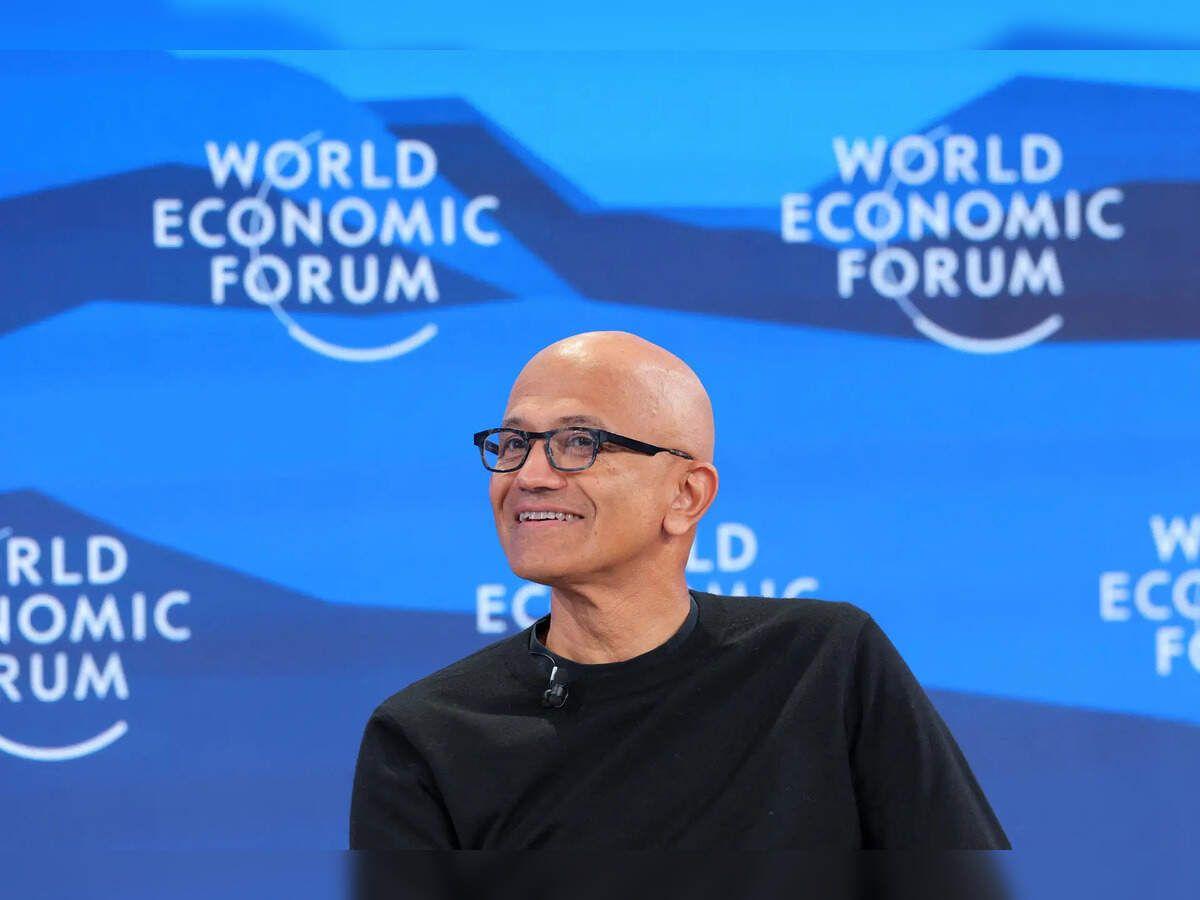
Microsoft CEO Satya Nadella delivered a cautionary message at the 2026 World Economic Forum annual meeting in Davos, warning that AI risks losing social permission unless it demonstrates tangible societal benefits across multiple industries and economies
1
. Speaking with BlackRock CEO Larry Fink, Nadella emphasized that the technology must move beyond abstract admiration and deliver real improvements in health outcomes, education, public sector efficiency, and private sector competitiveness3
. "We will quickly lose even the social permission to take something like energy, which is a scarce resource, and use it to generate these tokens, if these tokens are not improving health outcomes, education outcomes, public sector efficiency, private sector competitiveness across all sectors, small and large," Nadella stated1
.
Source: ET
Energy Consumption and Resource Strain Drive Concerns
The urgency behind Nadella's comments reflects mounting concerns about AI's massive resource demands. Data centers are projected to consume 70% of memory chips manufactured this year, creating shortages that extend beyond RAM modules and SSDs to affect GPUs and smartphones
1
. Energy consumption has become particularly problematic, with electricity prices spiking by 36% in some states and wholesale prices soaring by up to 267% over the past five years1
. Training today's largest large language models consumes as much electricity as some small countries use annually, while inference operations add to that cost with every query processed3
. The issue has attracted bipartisan political attention, with Democratic Senators demanding explanations from tech companies and President Donald Trump telling AI firms to "pay their own way" for electricity consumption1
.Avoiding an AI Bubble Through Widespread Adoption
Nadella addressed growing concerns about an AI bubble as tech companies pour billions into development while seeing limited returns. "For this not to be a bubble by definition, it requires that the benefits of this are much more evenly spread," he explained, noting that a telltale sign would be if only tech firms benefit from AI advances
2
. The Microsoft CEO cited pharmaceutical companies using AI to accelerate clinical trials as an example of practical AI adoption beyond the technology sector, emphasizing that AI doesn't need to discover the "magical molecule" but should make processes "much more relevant"1
. This concern has merit: PwC's 29th global CEO survey found that only 10% to 12% of companies reported seeing AI benefits on revenue or cost metrics, while 56% reported getting nothing from their investments5
. An even more sobering finding from August 2025 revealed that 95% of generative AI pilots were failing5
.
Source: TechSpot
Related Stories

Fortune 500 Must Reinvent Knowledge Work for AI Era
Nadella challenged business leaders to reinvent knowledge work by restructuring workflows around AI capabilities. "The mindset we as leaders should have is, we need to think about changing the work—the workflow—with the technology," he told the Davos audience
5
. He compared the current moment to the 1980s computing revolution that created an entire class of knowledge workers, arguing that AI creates a "complete inversion" of how information moves through businesses by flattening hierarchical processes5
. Nadella warned that Fortune 500 companies face particular challenges in this transition: "Unless and until your rate of change keeps up with what is possible, you're going to get schooled by someone small being able to achieve scale because of these tools"5
. While established firms retain advantages in relationships, data, and expertise, leaner companies can more easily adopt new workflows because their organizational structures remain malleable5
.Public Acceptance Hinges on Demonstrable Value
The concept of social permission represents a critical threshold for AI's continued expansion. Until now, public acceptance has allowed cloud computing companies to consume resources in exchange for productivity and convenience, but that goodwill isn't guaranteed
3
. If AI appears to deliver novelty rather than necessity, citizens and governments may push back against its resource demands3
. Microsoft has responded by implementing a "Community-First AI Infrastructure" framework, with OpenAI following suit, though it remains unclear whether other hyperscalers will adopt similar approaches1
. Nadella expressed confidence that AI "will, in fact, build on the rails of cloud and mobile, diffuse faster, and bend the productivity curve and bring local surplus and economic growth all around the world—not just economic growth driven by capital expenses"1
. However, this optimistic vision requires that benefits become widely distributed across industries, countries, and economic sectors to drive productivity and economic growth beyond the technology industry itself2
.
Source: CXOToday
References
Summarized by

Navi
Related Stories
Microsoft CEO Satya Nadella Calls for Realistic AI Expectations, Emphasizing Economic Impact Over Hype
21 Feb 2025•Business and Economy

Microsoft CEO Satya Nadella Highlights India's AI Potential and Challenges
08 Jan 2025•Technology

AI Bubble Fears Intensify as Tech Giants Commit $1.5 Trillion to Infrastructure
22 Dec 2025•Business and Economy

Recent Highlights


Recent Highlights
Today's Top Stories




Your Daily Dose of Curated AI News
Don’t drown in AI news. We cut through the noise - filtering, ranking and summarizing the most important AI news, breakthroughs and research daily. Spend less time searching for the latest in AI and get straight to action.

