SK Hynix overtakes Samsung in annual profit as HBM dominance reshapes AI chip rivalry


2 Sources
2 Sources
[1]
SK Hynix overtakes Samsung in annual profit for the first time as AI reshapes rivalry
SK Hynix beat rival Samsung Electronics in operating profit for the first time in 2025, as it retained its lead in high-bandwidth memory used in artificial intelligence chips. The two South Korean memory makers went head-to-head this week, with SK Hynix reporting earnings on Wednesday and Samsung on Thursday morning local time. SK Hynix posted a record operating profit of 47.2 trillion won for the full year, surpassing Samsung's 43.6 trillion won. The comparison underscores SK Hynix's ascension in South Korea's tech space since it was acquired by SK Telecom for about $3 billion in 2012. SK Hynix focuses almost entirely on memory chips, while Samsung operates across multiple businesses, including consumer electronics and contract chip manufacturing. Samsung's memory segment generated operating profits of about 24.9 trillion won in 2025. SK Hynix's success is in large part thanks to its entrenched position as the global leader in high-bandwidth memory, or HBM, a specialized chip used in AI processors and servers such as those produced by Nvidia. "SK Hynix is clearly an outstanding 'AI Winner' in Asia," said MS Hwang, research director at Counterpoint Research, adding that its lead in quality and supply of HBMs and other chips used in AI servers has been crucial in the current phase of the AI infrastructure boom. SK Hynix has maintained its market lead in both areas, even as Samsung regained the top spot in memory revenue rankings in the fourth quarter of 2025, said Hwang. However, competition is ramping up. While SK Hynix managed to gain an early lead in HBM and secured the lion's share of Nvidia memory contracts last year, competitors like Samsung and Micron have been making some breakthroughs. Samsung has expanded its HBM sales and said it remains on track to begin delivering HBM4 products -- the latest, sixth-generation HBM technology -- this year. "[W]e expect Samsung to show a significant turnaround with HBM4 for Nvidia's new products, moving past last year's quality issues," said Ray Wang, an analyst at SemiAnalysis focused on memory and the AI supply chain. Still, analysts expect SK Hynix to retain high market share in HBM4 and maintain its dominant position. "The HBM4 race is really between SK Hynix and Samsung as we think [the] two companies are more competitive than Micron," said Wang. "We expect SK Hynix to maintain its lead in HBM4, while Samsung to make material progress and become more competitive in HBM4 than [previous generations]," he added.
[2]
SK hynix expresses confidence in HBM4 leadership amid competition with Samsung - The Korea Times
SK hynix said Thursday it will seek to secure overwhelming leadership in sixth-generation high bandwidth memory (HBM), or HBM4, as it did in previous generations, amid expected competition with Samsung Electronics. "(The company) aims to take an overwhelming market share in the HBM4 sector, as we did for the HBM3 and HBM3E products," the company said in a conference call held a day after reporting record-breaking earnings for 2025. On Wednesday, SK hynix said it posted an annual record operating profit of 47.2 trillion won ($33 billion) in 2025 amid the artificial intelligence (AI) boom, beating its rival Samsung Electronics' total performance for the first time. "Despite efforts to maximize production capacity, it is hard to meet clients' demand 100 percent, and we expect some rivals to enter the competition," the company said, citing "explosive" global demand driven by AI infrastructure investment. SK hynix is currently in the final stages of preparing for full-scale production of HBM4, with samples already supplied to Nvidia. Samsung Electronics is also expected to start full-fledged production of HBM4 this year. "We will maintain our leadership and position as the leading supplier based on performance, mass production capacity and quality," it added. Industry tracker Counterpoint Research recently estimated SK hynix will account for 54 percent of the global HBM4 market in 2026, followed by Samsung Electronics with 28 percent and Micron Technology Inc. at 18 percent.
Share
Share
Copy Link
SK Hynix achieved a historic milestone by surpassing Samsung Electronics in annual operating profit for the first time in 2025, posting 47.2 trillion won compared to Samsung's 43.6 trillion won. The shift reflects SK Hynix's commanding lead in high-bandwidth memory (HBM) chips critical for AI applications, though intensifying competition from Samsung and Micron in the HBM4 market could reshape the landscape.
SK Hynix Achieves Historic Profit Milestone
SK Hynix has overtaken Samsung Electronics in annual operating profit for the first time, marking a pivotal shift in South Korea's technology landscape. The memory chip specialist posted a record operating profit of 47.2 trillion won ($33 billion) for 2025, exceeding Samsung's 43.6 trillion won
1
. This achievement underscores SK Hynix's remarkable ascension since SK Telecom acquired the company for approximately $3 billion in 20121
. While Samsung operates across multiple businesses including consumer electronics and contract chip manufacturing, SK Hynix focuses almost entirely on memory chips, with its success driven by the AI infrastructure boom1
.HBM Dominance Powers Revenue Growth
The company's financial performance stems largely from its entrenched position as the global leader in high-bandwidth memory (HBM), a specialized chip used in artificial intelligence chips and AI processors such as those produced by Nvidia
1
. MS Hwang, research director at Counterpoint Research, described SK Hynix as "clearly an outstanding 'AI Winner' in Asia," noting that its lead in quality and supply of HBMs and other chips used in AI servers has been crucial during the current phase of the AI infrastructure expansion1
. The company secured the lion's share of Nvidia memory contracts last year, even as Samsung regained the top spot in overall memory revenue rankings in the fourth quarter of 20251
. SK Hynix cited "explosive" global demand driven by AI infrastructure investment, noting that despite efforts to maximize production capacity, meeting 100 percent of clients' demand remains challenging2
.HBM4 Leadership Battle Intensifies
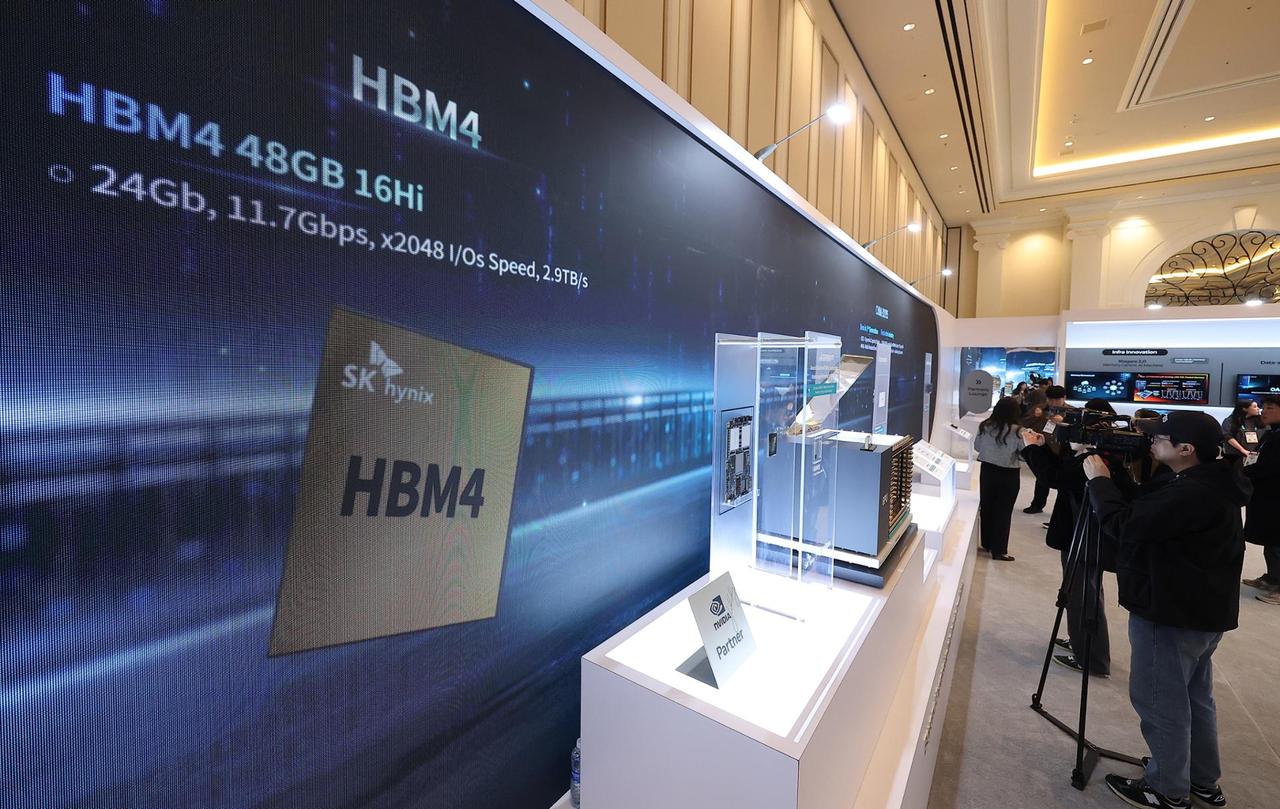
Competition with Samsung is ramping up as both South Korean giants race to dominate the sixth-generation HBM4 market. SK Hynix expressed confidence it will maintain HBM4 leadership during a conference call, stating the company "aims to take an overwhelming market share in the HBM4 sector, as we did for the HBM3 and HBM3E products"
2
. The company is currently in final stages of preparing for full-scale production of HBM4, with samples already supplied to Nvidia2
. Samsung Electronics has expanded its HBM sales and remains on track to begin delivering HBM4 products this year1
. Ray Wang, an analyst at SemiAnalysis focused on memory and the supply chain, expects Samsung to "show a significant turnaround with HBM4 for Nvidia's new products, moving past last year's quality issues"1
.
Source: Korea Times
Related Stories


Market Share Projections and Competitive Outlook
Industry projections suggest SK Hynix will maintain its dominant market share despite intensifying competition. Counterpoint Research estimates SK Hynix will account for 54 percent of the global HBM4 market in 2026, followed by Samsung Electronics with 28 percent and Micron Technology Inc. at 18 percent
2
. Wang noted that "the HBM4 race is really between SK Hynix and Samsung as we think the two companies are more competitive than Micron," adding that SK Hynix is expected to maintain its lead while Samsung makes material progress and becomes more competitive in HBM4 than previous generations1
. SK Hynix pledged to "maintain our leadership and position as the leading supplier based on performance, mass production capacity and quality"2
. For context, Samsung's memory segment generated annual operating profit of about 24.9 trillion won in 20251
, highlighting the profitability gap driven by AI-focused chip manufacturing strategies.References
Summarized by

Navi
Related Stories
Recent Highlights
1
Google Maps unveils Ask Maps with Gemini AI and 3D Immersive Navigation in biggest update
Technology

2
AI chatbots help plan violent attacks as safety guardrails fail, new investigation reveals
Technology

3
OpenAI secures $110 billion funding round as questions swirl around AI bubble and profitability
Business and Economy

Recent Highlights
Today's Top Stories




Your Daily Dose of Curated AI News
Don’t drown in AI news. We cut through the noise - filtering, ranking and summarizing the most important AI news, breakthroughs and research daily. Spend less time searching for the latest in AI and get straight to action.

