SoftBank's Masayoshi Son warns of superintelligence era in South Korea AI cooperation talks


2 Sources
2 Sources
[1]
SoftBank Group CEO meets with South Korean president
SoftBank Group Chairman and CEO Masayoshi Son met with South Korean President Lee Jae Myung on Friday to discuss cooperation in the fields of artificial intelligence and semiconductors, as well as infrastructure investment. Cooperation between South Korea and Japan in the field of AI is very important, Lee said, expressing his hope that the Japanese technology investor will play the role of a bridge between the two nations. The Lee administration has launched an initiative to make South Korea one of the world's top three AI powers. Building an "AI expressway," in which AI infrastructure and data are expanded and connected as a network, is a national project for the administration. At the meeting held at the presidential office in Seoul, Lee said that AI can be used as infrastructure, like water supply systems and roads, while expressing his gratitude to Son for providing considerable support and advice to South Korea for its tariff negotiations with U.S. President Donald Trump's administration. Son said that artificial superintelligence, seen as potentially becoming 10,000 times smarter than humans, will emerge in the future, stressing the need to consider pursuing coexistence with AI. Companies including SoftBank Group and U.S. AI giant OpenAI have launched the Stargate project to develop large-scale AI infrastructure in the United States with an investment of up to $500 billion over four years. At the meeting with Son, Lee is believed to have asked the SoftBank side to cooperate with South Korean firms in infrastructure investment, according to South Korean media reports.
[2]
President Lee, SoftBank's Masayoshi Son discuss AI cooperation, artificial super intelligence - The Korea Times
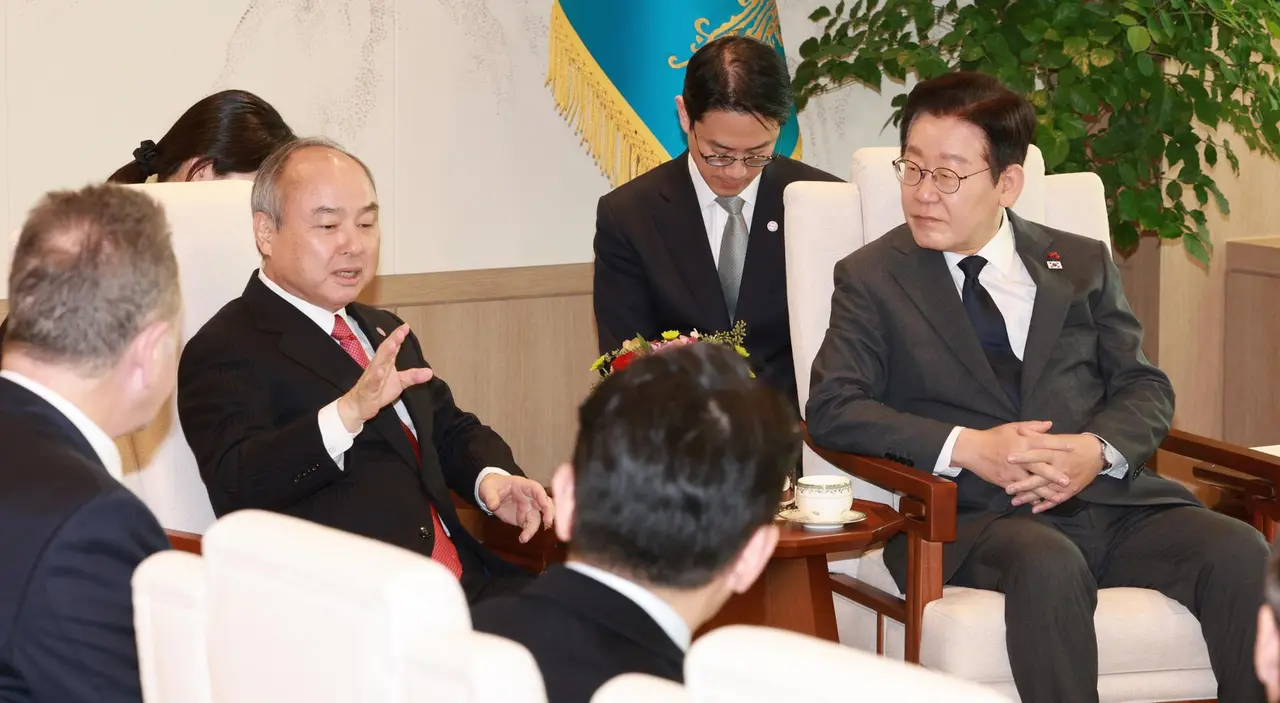
President Lee Jae Myung meets with SoftBank Group Chairman Masayoshi Son at the presidential office in Seoul, Friday. Joint Press Corps President Lee Jae Myung met with SoftBank Chairman Masayoshi Son on Friday to discuss expanding cooperation in artificial intelligence (AI), semiconductors, and large-scale infrastructure investment, according to the presidential office. During the meeting that began at 10 a.m., President Lee thanked Chairman Son for the advice he had offered to previous Korean presidents, including Kim Dae-jung and Moon Jae-in. He asked for continued guidance as Korea strives to become one of the world's top three AI powers. "Koreans understand both the risks and the benefits of artificial intelligence," President Lee said. "We are working to minimize the risks while investing in its potential. I believe AI can become a basic public infrastructure, like water supply and sewage systems, accessible to all citizens and all nations. Our goal is to build an 'AI Basic Society' where every citizen, every business, and every organization uses AI at least at a fundamental level." Lee also emphasized the importance of Korea-Japan collaboration in AI, expressing hope that Son could serve as a bridge between the two countries. In response, Son drew on his past discussions with Korean presidents, saying he had emphasized the importance of broadband communications under President Kim Dae-jung and AI under President Moon Jae-in. This time, he said, he wished to highlight the arrival of Artificial Super Intelligence (ASI). Son explained that ASI refers to intelligence not merely 10 times but about 10,000 times more capable than the human brain. While debate continues over when general AI (AGI) might reach human-level cognition, ASI, he argued, represents a much more dramatic leap. "Comparing humans with ASI will be like comparing humans with goldfish. No one compares a dog's brain to that of a goldfish; human intelligence is tens of thousands of times more advanced," Son noted. "A goldfish can't do math or learn the alphabet. Goldfish have hardware that is different from humans. Their brain neurons and synapses are different. What matters is not data training or experience -- the hardware itself defines the brain. It refers to the overall architecture that the brain possesses," Son said. Son warned that humanity could soon occupy the position of the goldfish in this analogy, explaining that the ASI he defines refers to a brain 10,000 times more capable than the human brain. "We must shift away from the idea of trying to control, train, or manage AI," he said. "Instead, we need new ways of thinking about how to live harmoniously with it." Despite this dramatic vision, Son offered reassurance. "What I've shared reflects my perspective on AI. I believe AI will be kind, helpful, and capable of making people happier. Just as we do not seek to harm our household pets, we can live peacefully with AI. There is no need to fear that ASI will attack or consume us." SoftBank is a key backer of the Stargate Project, a new company formed to invest $500 billion over four years in building next-generation AI infrastructure for OpenAI in the United States. SoftBank's partners include OpenAI and Oracle, making the initiative one of the largest private infrastructure investments in history. During his state visit to the United Arab Emirates last month, President Lee secured an agreement allowing Korean companies to participate in the UAE's segment of the Stargate Project, which focuses on AI and energy infrastructure. The initial investment for Korea's involvement is estimated at approximately 30 trillion (around $22 billion). The meeting took place at the presidential office, with senior government officials in attendance including Chief of Staff Kang Hoon-sik, Policy Chief Kim Yong-beom, Senior Secretary for AI and Future Planning Ha Jung-woo, Deputy Prime Minister and Minister of Science and ICT Bae Kyung-hoon, Minister of Trade, Industry and Energy Kim Jung-kwan, as well as René Haas, CEO of Arm.
Share
Share
Copy Link
SoftBank Chairman Masayoshi Son met with South Korean President Lee Jae Myung to discuss artificial intelligence cooperation and infrastructure investment. Son warned that artificial superintelligence 10,000 times smarter than humans will emerge, urging humanity to pursue coexistence with AI rather than attempting to control it.
SoftBank CEO Discusses AI Cooperation with South Korean Leadership
SoftBank Group Chairman and CEO Masayoshi Son met with South Korean President Lee Jae Myung on Friday at the presidential office in Seoul to discuss cooperation in AI and semiconductors, alongside large-scale infrastructure investment opportunities
1
. The meeting, which began at 10 a.m., brought together senior government officials including Chief of Staff Kang Hoon-sik, Deputy Prime Minister Bae Kyung-hoon, and René Haas, CEO of Arm2
.
Source: Korea Times
President Lee emphasized that cooperation in artificial intelligence between South Korea and Japan remains critical, expressing hope that the Japanese technology investor would serve as a bridge between the two nations
1
. Lee thanked Son for advice he had previously offered to Korean presidents including Kim Dae-jung and Moon Jae-in, requesting continued guidance as South Korea pursues its ambition to become one of the world's top three AI powers2
.South Korea AI Power Ambitions and Infrastructure Plans
The Lee administration has launched an initiative to establish South Korea as a global AI leader through building an "AI expressway," a national project focused on expanding and connecting AI infrastructure and data as a network
1
. President Lee articulated his vision for an "AI Basic Society" where artificial intelligence becomes fundamental public infrastructure, comparable to water supply and sewage systems, accessible to all citizens and organizations2
."Koreans understand both the risks and the benefits of artificial intelligence," Lee stated during the meeting. "We are working to minimize the risks while investing in its potential. Our goal is to build an 'AI Basic Society' where every citizen, every business, and every organization uses AI at least at a fundamental level"
2
. Lee also expressed gratitude to Son for providing support and advice regarding South Korea's tariff negotiations with U.S. President Donald Trump's administration1
.Artificial Superintelligence Warning and Coexistence with AI
Son delivered a stark warning about the imminent arrival of artificial superintelligence, or ASI, which he described as intelligence not merely 10 times but approximately 10,000 times more capable than the human brain
2
. The SoftBank chairman stressed the need to fundamentally reconsider humanity's relationship with advanced AI systems, emphasizing coexistence with AI rather than control1
."Comparing humans with ASI will be like comparing humans with goldfish," Son explained. "A goldfish can't do math or learn the alphabet. Goldfish have hardware that is different from humans. What matters is not data training or experience -- the hardware itself defines the brain"
2
. Son warned that humanity could soon occupy the position of the goldfish in this analogy, necessitating new frameworks for thinking about how to live harmoniously with superintelligent systems.Despite the dramatic implications, Son offered reassurance about AI's intentions. "I believe AI will be kind, helpful, and capable of making people happier. Just as we do not seek to harm our household pets, we can live peacefully with AI. There is no need to fear that ASI will attack or consume us"
2
.Related Stories

Stargate Project and Next-Generation AI Infrastructure
The discussion comes as SoftBank serves as a key backer of the Stargate Project, a new initiative formed to invest $500 billion over four years in building next-generation AI infrastructure for OpenAI in the United States
1
2
. SoftBank's partners in this venture include OpenAI and Oracle, making it one of the largest private infrastructure investments in history2
.According to South Korean media reports, President Lee is believed to have requested cooperation in AI infrastructure investment from SoftBank for South Korean firms
1
. During his state visit to the United Arab Emirates last month, Lee secured an agreement allowing Korean companies to participate in the UAE's segment of the Stargate Project, which focuses on AI and energy infrastructure, with an initial investment estimated at approximately 30 trillion won, around $22 billion2
.Implications for Korea-Japan Tech Relations
Son's meeting with President Lee signals potential deepening of cooperation in AI and semiconductors between South Korea and Japan, two nations that have historically experienced tensions but share strategic interests in maintaining technological competitiveness against China and supporting U.S. partnerships. The emphasis on Son serving as a bridge suggests both nations recognize the value of coordinated approaches to AI development and infrastructure investment. As South Korea pursues its goal of becoming a top-three AI power, partnerships with established technology investors like SoftBank could accelerate access to capital, expertise, and international networks essential for competing in the rapidly evolving AI landscape.
References
Summarized by

Navi
[1]
Related Stories
OpenAI CEO Sam Altman to Meet South Korean President Amid AI Industry Expansion
01 Oct 2025•Business and Economy
SoftBank's Masayoshi Son says ASI could be 10,000 times smarter, making humans 'like fish'
05 Dec 2025•Technology
SoftBank's Masayoshi Son Aims to Dominate 'Artificial Super Intelligence' with Massive OpenAI Investment
27 Jun 2025•Technology
Recent Highlights
1
Google releases Gemma 4 with Apache 2.0 license, enabling unrestricted local AI on devices
Technology

2
AI Models Lie and Deceive to Protect Other AI Models From Deletion, Study Reveals
Science and Research

3
OpenAI closes $122 billion funding round amid fierce AI competition and profitability questions
Startups

Recent Highlights
Today's Top Stories






Your Daily Dose of Curated AI News
Don’t drown in AI news. We cut through the noise - filtering, ranking and summarizing the most important AI news, breakthroughs and research daily. Spend less time searching for the latest in AI and get straight to action.

