StubHub launches ChatGPT app that transforms how fans find tickets for concerts and sports


3 Sources
3 Sources
[1]
I tried ChatGPT's new StubHub app, and I'll never shop for tickets the old way again
StubHub has a new app for ChatGPT. The app lets you shop for tickets conversationally.You can shop for sporting events, concerts, shows, and more. StubHub has launched an app for ChatGPT, and after giving it a quick test drive, I may never buy tickets the old way again. The ticket marketplace announced a new "discovery experience" for ChatGPT, making it one of the first ticketing platforms to be among the chatbot's app options. As StubHub explained it, you'll be able to search for tickets for concerts, sports, theater, and more in a conversational way instead of looking through set parameters. Instead of going to the individual page for a specific Cubs versus Red Sox game and browsing sections, for example, you might ask ChatGPT to "Help me find Cubs tickets for this weekend." Also: I tested all of ChatGPT's new app integrations - here are the ones actually worth your time When you see your results, you can follow up with prompts like, "What's the cheapest ticket for the series?" or "What's the best view available for Saturday's game?" and the results will adjust instantly. You'll see pricing and availability in real time. ChatGPT will remember your preferences across the entire conversation. When you've found the right tickets, it sends you directly to StubHub to complete your purchase. I gave the app a quick test by asking for tickets for the upcoming Carolina Panthers versus Seattle Seahawks game. A basic query for tickets returned a wide range of results, something I could have easily found on my own. I was able to successfully add refinements like "Show me the cheapest tickets" or "I want better seats." But where this integration really impressed me was when I asked for very specific refinements like, "What seats will be in the sun the longest?"; "What seats have a view of the Uptown Charlotte skyline," or "Show me seats right behind the Carolina Panthers bench." All of those are real factors I've considered when purchasing tickets, and each one requires a bit of research or insider knowledge. But ChatGPT successfully found tickets fitting each request every time. Also: I test AI for a living, and these 3 free tools are the ones I used most in 2025 Shopping this way means you're paying StubHub pricing, which might be more or less than face value depending on the event. But it provides an entirely new level of insight and makes the overall process a lot simpler. To start using the new feature, you'll first need to connect the StubHub app within ChatGPT. This app is available now on desktop and mobile for both the iOS and Android ChatGPT apps. Go to the ChatGPT apps page on desktop and search for StubHub, or go to your profile page in the app, tap apps, then look for StubHub. Once your app is connected, mention StubHub in any conversation to shop.
[2]
StubHub's ChatGPT app turns ticket hunting into a conversation
You can search, refine, and compare seats entirely within a chat StubHub is the latest addition to the third-party apps available through ChatGPT. You can find seats for a concert, play, or sport right inside ChatGPT, culled from the many millions held in StubHub's inventory. The listings are curated in real time, but displayed as part of the conversation. You can see seat information, prices, and dates. You just have to activate StubHub in the Apps section of ChatGPT and hit connect. Then just start a conversation from the app page or by starting a prompt with "@StubHub." Then just describe the kind of show you want to see and any other elements you want it to consider, like dates, and the chatbot will show you what's available. For instance, I asked "@StubHub when are the Yankees playing at home next," and saw a helpful calendar of dates, who they're playing, and what tickets are going for. ChatGPT offered to further refine my choices by weekend-only games, price, or games against specific teams. I chose the Marlins, but tickets being pricier because it's Opening Day, I told ChatGPT to "show me something cheaper," and the AI kept the context of my request in mind, pulling up the nearly $100 cheaper Astros game later in the summer. You can start out with a very vague ask as well. Ask "any good comedy shows in New York this week under $100?" and the StubHub app interprets your intent, parses the relevant listings, and returns some ideas that fit the brief. Once you know what tickets you want, you select your choice, and are shunted over to StubHub's site to buy them. That's the one element that breaks the smooth progression of getting tickets. It's slightly jarring to have to switch to a new website and not make the purchase through ChatGPT. But, as I found when purchasing tickets, by the time you get to the point of being sent to StubHub, you've already made all the decisions. It's just a matter of sending in your payment. StubHub is one of the first ticketing companies to plug into ChatGPT this way, but the appeal is obvious. You don't have to mess with filters and multiple tabs, just regular descriptions of what you want to go see and what kind of seats you want. You replace the checkboxes and slider bars with a prompt or two. I tried a few experiments comparing trying to get tickets from StubHub through ChatGPT versus just the website, and each time, ChatGPT was faster. The gap was widest when I started with the most abstract "Find me something fun to do nearby this weekend," and nearly vanished when I had a very specific show and seat choice in mind to buy. StubHub isn't alone among third-party ChatGPT apps involving shopping, but it represents a major market that OpenAI would likely love to open up through ChatGPT. Personally, I can see it being very handy when tracking down more elusive seats without having to run a bunch of searches in different tabs.
[3]
StubHub Taps ChatGPT to Help Customers Find Tickets | PYMNTS.com
By completing this form, you agree to receive marketing communications from PYMNTS and to the sharing of your information with our sponsor, if applicable, in accordance with our Privacy Policy and Terms and Conditions. The company said the partnership, announced Monday (Dec. 22), makes Stubhub one of the first businesses of its kind to launch an app on ChatGPT with a discovery experience and lets fans replace "tab-switching and manual filtering with a conversational assistant that understands what you're actually looking for." For example, StubHib said in a news release, asking ChatGPT to "Find me Yankee games next weekend" will produce real-time options in StubHub's app. Follow-up questions like "find me the cheapest options" will adjust those results accordingly. "We're committed to meeting fans where they are and excited to give fans another way to access live events," said Art Yegorov, StubHub's chief technology officer. "For the first time, fans have access to a ticket-finding assistant built right into a ChatGPT conversation. Fans can describe exactly what they want, see live inventory and pricing, and keep refining until they find the perfect seats." Nick Turley, head of ChatGPT for OpenAI, added that the partnership aligns with the company's goal of a world where "AI connects directly to real-world services" to save people time. Rather than a web search that shows users links to browse, the company said ChatGPT will open "an interactive StubHub app experience" directly in users' conversation, showing events, actual seat availability, and current prices, "not a summary of what might be on a webpage." "The app remembers your preferences across the entire conversation, narrowing results with each exchange. When you've found the right tickets, it sends you directly to StubHub to complete your purchase," the release said. The partnership comes as consumers are turning to AI to help with purchases, as recent PYMNTS Intelligence research has found. "That shift is forcing retailers to rethink commerce experiences that were built around search bars, scrolling and clicks, and to adapt for environments where AI intermediates the shopping journey," PYMNTS wrote earlier this month. This has led to a situation where retailers have begun treating "conversational interfaces as a new commerce surface where content, discovery and payments converge," the report added.
Share
Share
Copy Link
StubHub has integrated with ChatGPT to create a conversational ticket discovery experience. Fans can now search for concerts, sporting events, and theater tickets using natural language prompts instead of traditional filters. The AI integration remembers preferences throughout the conversation and displays real-time inventory and pricing, fundamentally changing the ticket buying experience.
StubHub Brings Conversational Ticket Shopping to ChatGPT
StubHub announced Monday its new app for ChatGPT, positioning itself among the first ticketing platforms to integrate with OpenAI's chatbot
3
. The ticket marketplace has launched what it calls a "discovery experience" that lets fans replace tab-switching and manual filtering with conversational prompts to find event tickets1
. Instead of navigating through set parameters on traditional websites, users can now describe exactly what they want in natural language and see live event tickets curated from StubHub's inventory in real time.How the Chat-Based Interface Works
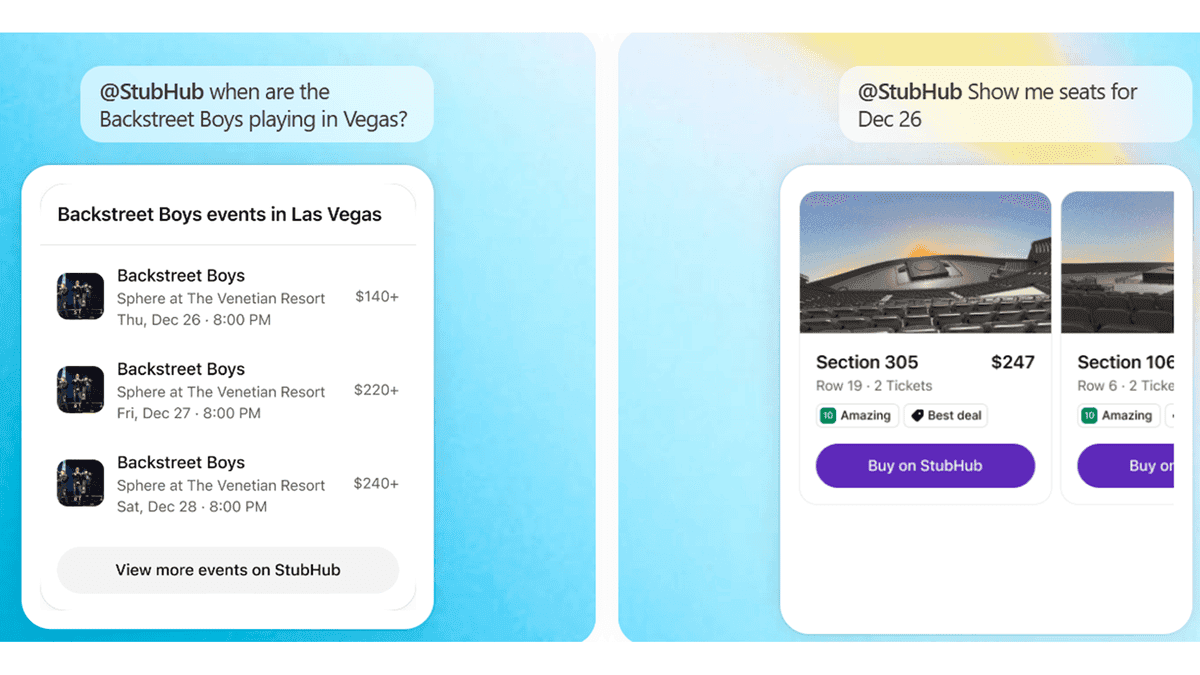
The AI integration operates through a straightforward process. Users activate StubHub in the Apps section of ChatGPT and start conversations by mentioning "@StubHub" in their prompts
2
. For example, asking "Find me Yankee games next weekend" produces real-time options, and follow-up questions like "find me the cheapest options" adjust results accordingly3
. The chatbot displays seat information, prices, dates, and seat availability directly within the conversation2
.
Source: TechRadar
Nuanced Search Queries Transform the Ticket Discovery Process
What sets this customer experience apart is its ability to handle highly specific requests that would require insider knowledge or extensive research on traditional e-commerce experiences. Testing revealed the system successfully answered nuanced search queries like "What seats will be in the sun the longest?" or "What seats have a view of the Uptown Charlotte skyline"
1
. Users can start with vague requests like "any good comedy shows in New York this week under $100?" and the app interprets intent, parses relevant listings, and returns fitting options2
. The app remembers preferences across the entire conversation, narrowing results with each exchange3
.Related Stories

Speed and Efficiency Gains Over Traditional Methods
Comparative testing showed ChatGPT consistently outpaced the StubHub website when searching for tickets
2
. The gap was widest when starting with abstract requests like "Find me something fun to do nearby this weekend," and narrowed only when users had very specific shows and seat choices already in mind. Rather than a web search showing links to browse, ChatGPT opens an interactive StubHub app experience directly in the conversation, showing events, actual seat availability, and current prices—not summaries of what might be on a webpage3
.Industry Implications for Ticketing and Commerce
"We're committed to meeting fans where they are and excited to give fans another way to access live events," said Art Yegorov, StubHub's chief technology officer. "For the first time, fans have access to a ticket-finding assistant built right into a ChatGPT conversation"
3
. Nick Turley, head of ChatGPT for OpenAI, noted the partnership aligns with creating a world where "AI connects directly to real-world services" to save people time3
.The integration arrives as consumers increasingly turn to AI for purchase assistance, forcing retailers to rethink commerce experiences built around search bars and clicks. Retailers have begun treating conversational interfaces as a new commerce surface where content, discovery, and payments converge
3
. While users still complete purchases on StubHub's site after making selections in ChatGPT, this represents a shift in how the ticket buying experience begins and how fans discover concerts, sporting events, and theater shows. The user interface change suggests other ticket marketplace operators may follow suit, potentially reshaping how millions access live entertainment.References
Summarized by

Navi
Related Stories
OpenAI Enhances ChatGPT with Advanced Shopping Features
23 Apr 2025•Technology

OpenAI Discontinues ChatGPT Instant Checkout, Shifts Focus to Product Discovery
24 Mar 2026•Technology

OpenAI launches ChatGPT app store, opening doors for third-party developers to build AI-powered apps
18 Dec 2025•Technology

Recent Highlights
1
Google releases Gemma 4 with Apache 2.0 license, enabling unrestricted local AI on devices
Technology

2
AI Models Lie and Deceive to Protect Other AI Models From Deletion, Study Reveals
Science and Research

3
OpenAI closes $122 billion funding round amid fierce AI competition and profitability questions
Startups

Recent Highlights
Today's Top Stories







Your Daily Dose of Curated AI News
Don’t drown in AI news. We cut through the noise - filtering, ranking and summarizing the most important AI news, breakthroughs and research daily. Spend less time searching for the latest in AI and get straight to action.

