Tesla's Full Self-Driving tries to drive owner into lake, raising fresh safety concerns


3 Sources
3 Sources
[1]
FSD Tries to Drive Straight Into Lake
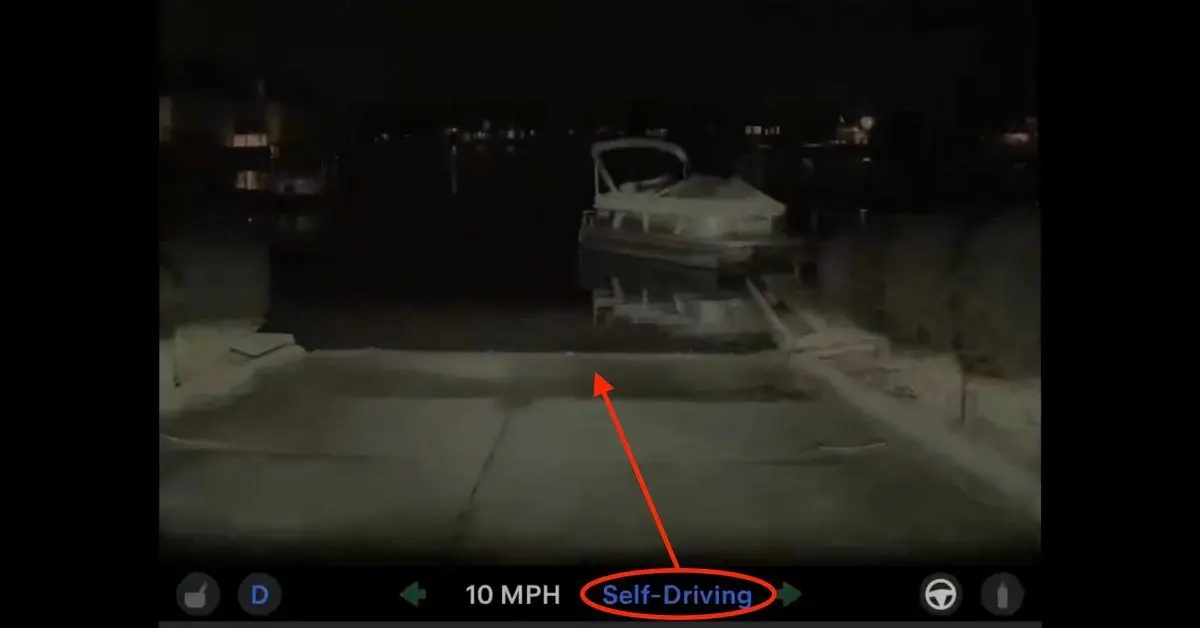
Tesla CEO Elon Musk once boasted that the Cybertruck could double as a boat. Perhaps the AI behind his cars' Full Self-Driving software took Musk at his word and hallucinated that this applied to all Teslas, because one of them just attempted to steer a guy's ride straight into a lake. Footage of this lacustrine impulse was shared Sunday by Daniel Milligan, a Tesla owner and former SpaceX engineer. It begins innocently enough: at night, on a quiet road. The car then gently turns right onto what turns out to be a boat ramp, and instead of slowing down, accelerates towards what would've been its watery grave, had the driver not hit the brakes. "I had to intervene," Milligan wrote. "I'd like to see what it would've done, but at the speed it was going, it definitely felt like it was going to go for a swim." Milligan explained his intended destination was a driveway about fifty feet away. He suspected the error had to do with the lighting conditions. "Just tried it again during the day (same direction and destination) and it completely skipped the boat ramp," Milligan later reported. "My guess is that it could actually see the driveway up ahead in the daytime or could more clearly see the lake." The footage is merely the latest among countless examples of self-driving cars struggling to safely, or evenly convincingly, navigate public roads. Tesla's FSD in particular has generated loads of controversies, which is no doubt a consequence of Musk's incredible decision to make it available to millions of Tesla owners, despite the software being both unfinished and not actually fully self-driving. While its name suggests otherwise, it is classified as a driving assistance feature, requiring drivers be prepared to intervene at any moment. Its track record, therefore, is worrisome. On top of a documented habit of driving straight into the path of oncoming trains, FSD and its predecessor Autopilot have also been involved in numerous deadly accidents, including the latter being found partially responsible for the death of a 22-year-old woman who was struck by one of the cars. These concerns rarely deter Tesla owners. Milligan, for example, still thinks FSD is a "game changer," but admits it "needs more work before it's fully autonomous." Of course, maybe we should consider that FSD has a daring sense of humor: it nearly re-enacted a famous scene from "The Office," in which Michael Scott submerges his car after taking his GPS's guidance too literally. "The machine knows where it's going. The machines knows!" he screams.
[2]
Tesla 'Full Self-Driving' tried to drive owner into a lake, viral video shows
A Tesla owner says his car tried to drive him into a lake while using the automaker's latest "Full Self-Driving" software. The incident, captured on video and posted to social media, has gone viral with over 1 million views, adding to a growing list of dangerous FSD edge cases that raise serious questions about the system's readiness. Daniel Milligan posted the video to X on Saturday, tagging both Tesla and Ashok Elluswamy, Tesla's head of Autopilot AI, writing: "My Tesla tried to drive me into a lake today!" The vehicle was running FSD version 14.2.2.4 (build 2025.45.9.1), one of the latest updates Tesla has pushed to its fleet. The post racked up over 1.2 million views, 9,000 likes, and hundreds of reposts within hours: The lake incident is the latest in a pattern of alarming "Full Self-Driving" failures that Electrek has been tracking for years. In May 2025, a Tesla on FSD suddenly veered off road and flipped a car upside down in a crash the driver said he could not prevent. In December, a Tesla driver in China crashed head-on into another vehicle during a livestream demonstrating FSD features, the system initiated a lane change into oncoming traffic. Two Tesla influencers attempting Elon Musk's much-hyped coast-to-coast FSD drive didn't even make it out of California before crashing into road debris. The FSD v14.2.2.4 build involved in the lake incident rolled out in late January 2026. Tesla did not publish new release notes for this version compared to the prior v14.2.2.3, characterizing it as a polished and fine-tuned build. The v14.2 series did upgrade Tesla's neural network vision encoder for higher resolution features and added handling for emergency vehicles, but dangerous edge cases clearly persist. The incident arrives as Tesla's FSD system faces mounting regulatory pressure. In October 2025, NHTSA launched a broad investigation into 2.88 million Tesla vehicles after connecting 58 incidents to FSD, including 14 crashes and 23 injuries. The investigation specifically focuses on FSD running red lights and driving into opposing lanes of traffic, the kind of fundamental failures that should not be happening in a system Tesla charges $99 per month for. NHTSA also opened a separate probe into Tesla's failure to properly report Autopilot and FSD crashes to regulators in a timely manner. There have been over 50 deaths related to crashes involving Tesla's driver-assistance systems (Autopilot and FSD). Meanwhile, Tesla's "unsupervised" Robotaxi program in Austin has proven to be anything but unsupervised. Today, we released a status update on the Robotaxi program 8 months after the launch. We keep saying it and incidents like this keep proving it: Tesla's "Full Self-Driving" should not be marketed as such. A system that tries to drive you into a lake is not "full self-driving" by any reasonable definition of those words. The problem is not just that FSD makes mistakes, all driver-assistance systems have limitations. The problem is the gap between what Tesla sells and what FSD actually delivers. Tesla moved FSD to a subscription-only model in February, effectively admitting the system is a service rather than the asset it was sold as for years. Musk has been promising "unsupervised" FSD since 2016, and yet here we are in 2026 watching videos of Teslas attempting to swim. As we noted in our FSD v14 review, the system is the most impressive Level 2 system on the market, but it remains far from what Tesla has been selling customers for nearly a decade. With NHTSA investigations piling up and incidents continuing to go viral, regulators will eventually need to decide whether Tesla can keep calling this "Full Self-Driving" while people's cars try to take them for an unexpected swim. I think we are approaching the end of this era, and Tesla switching to a subscription-only service heralds it. If it only offers a monthly subscription rather than a package with future capabilities, it doesn't have to promise it will become unsupervised.
[3]
Tesla Owner Says FSD Tried To Drive Into Lake -- Calls Issue 'Repeatable' - Tesla (NASDAQ:TSLA)
A Tesla Inc. (NASDAQ:TSLA) owner has claimed that the company's Full Self-Driving (FSD) system drove onto a boat ramp on a lake before he intervened and stopped. FSD Trouble? On Sunday, Daniel Milligan shared a video on the social media platform X, tagging Elon Musk as well as Tesla's VP of AI, Ashok Elluswamy, sharing that his Tesla vehicle "tried to drive" Milligan into a lake. Milligan then said that the car was running FSD's version 14.2.2.4. Milligan then quoted his video with an update, sharing that the same problem occurred once again. Milligan showcased in the video that he set a destination on the map and then kicked off the FSD. The video then shows the Tesla driving onto the boat ramp once again before Milligan braked. "Here is a video I took inside the car to prove I didn't fake it. It's repeatable at night," he said in the post. Tesla didn't immediately respond to Benzinga's request for comment. Ross Gerber Slams FSD, Elon Musk Touts Largest AV Fleet Meanwhile, investor Gary Black of the Future Fund LLC says that Tesla stock could rally once the company announces operating "hundreds" of unsupervised Robotaxis in Austin, as well as other cities. Benzinga Edge Rankings show that Tesla scores well on the Momentum metric and offers a favorable price trend in the Long Term. Price Action: TSLA gained 0.09% to $417.44 at Market close on February 13. Check out more of Benzinga's Future Of Mobility coverage by following this link. Photo courtesy: Shutterstock Market News and Data brought to you by Benzinga APIs To add Benzinga News as your preferred source on Google, click here.
Share
Share
Copy Link
A Tesla owner captured his vehicle attempting to drive straight into a lake while using Full Self-Driving version 14.2.2.4. Daniel Milligan's viral video, which garnered over 1.2 million views, shows the car accelerating down a boat ramp at night before he intervened. The repeatable incident adds to mounting regulatory pressure as NHTSA investigates 2.88 million Tesla vehicles.
Tesla Owner Captures FSD Driving Toward Lake
A Tesla owner's nighttime drive nearly ended in an unexpected swim when his vehicle, operating on Full Self-Driving version 14.2.2.4, mistook a boat ramp for a road and accelerated toward a lake. Daniel Milligan, a former SpaceX engineer, shared the footage on Sunday, tagging both Tesla and Ashok Elluswamy, the company's head of Autopilot AI
1
2
. The viral video shows the car gently turning right onto what appears to be a boat ramp, then accelerating toward the water before Milligan hit the brakes. "My Tesla tried to drive me into a lake today!" he wrote in a post that quickly accumulated over 1.2 million views, 9,000 likes, and hundreds of reposts2
.
Source: Electrek
Repeatable FSD Failures Under Different Conditions
Milligan explained his intended destination was a driveway approximately fifty feet away from where the Tesla FSD incident occurred. Testing the same route during daylight hours revealed the issue was repeatable at night but not during the day. "Just tried it again during the day (same direction and destination) and it completely skipped the boat ramp," Milligan reported, suggesting the error stemmed from lighting conditions affecting the AI's ability to distinguish the lake from the road
1
. In a follow-up video posted to X, Milligan demonstrated the problem occurring again, writing: "Here is a video I took inside the car to prove I didn't fake it. It's repeatable at night"3
. This lake incident represents a particularly dangerous edge case where the driver assistance feature failed to recognize a fundamental hazard.
Source: Futurism
Growing Pattern of Dangerous FSD Failures
The lake incident joins a troubling catalog of FSD failures that raise questions about the system's readiness for widespread deployment. In May 2025, a Tesla on FSD suddenly veered off road and flipped a car upside down in a crash the driver said he could not prevent. In December, a Tesla driver in China crashed head-on into another vehicle during a livestream demonstrating FSD features when the system initiated a lane change into oncoming traffic
2
. Tesla's Full Self-Driving has a documented habit of driving straight into the path of oncoming trains, and both FSD and its predecessor Autopilot have been involved in numerous deadly crashes, including over 50 deaths related to incidents involving Tesla's driver-assistance systems1
2
. The system is classified as a driver assistance feature requiring active driver supervision, despite its name suggesting otherwise.Related Stories

NHTSA Investigation and Regulatory Pressure Intensifies
The incident arrives as Tesla faces mounting regulatory pressure over its self-driving cars. In October 2025, NHTSA launched a broad investigation into 2.88 million Tesla vehicles after connecting 58 incidents to FSD, including 14 crashes and 23 injuries
2
. The NHTSA investigation specifically focuses on FSD running red lights and driving into opposing lanes of traffic—fundamental failures that shouldn't occur in a system Tesla charges $99 per month for. NHTSA also opened a separate probe into Tesla's failure to properly report Autopilot and FSD crashes to regulators in a timely manner2
. The FSD version 14.2.2.4 build involved in the lake incident rolled out in late January 2026, with Tesla characterizing it as a polished and fine-tuned software update that upgraded the neural network vision encoder for higher resolution features.Marketing Claims Versus Reality for Tesla
Despite these incidents, Tesla owner enthusiasm often persists. Milligan still considers FSD a "game changer," though he admits it "needs more work before it's fully autonomous"
1
. The gap between what Tesla sells and what FSD actually delivers remains substantial. Elon Musk has been promising "unsupervised" FSD since 2016, yet the company's Robotaxi program in Austin has proven to be anything but unsupervised2
. Tesla moved FSD to a subscription-only model in February, effectively admitting the system is a service rather than the asset it was sold as for years. This shift may signal Tesla no longer needs to promise the system will become unsupervised, potentially marking the end of an era of ambitious autonomy claims that haven't materialized. With viral video shows of dangerous FSD failures continuing to surface and regulatory scrutiny intensifying, the question facing NHTSA is whether Tesla can continue marketing this technology as "Full Self-Driving" while vehicles attempt to navigate drivers into lakes.References
Summarized by

Navi
[1]
Related Stories
Tesla Cybertruck Crash Raises Concerns Over Self-Driving Technology
14 Feb 2025•Technology

Tesla Cybertruck Receives Full Self-Driving Update, Marking a Milestone in Autonomous Vehicle Technology
30 Sept 2024

Tesla's Full Self-Driving Technology Faces Growing Safety Concerns and Launch Doubts
29 Aug 2024

Recent Highlights
1
Google releases Gemma 4 with Apache 2.0 license, enabling unrestricted local AI on devices
Technology

2
AI Models Lie and Deceive to Protect Other AI Models From Deletion, Study Reveals
Science and Research

3
OpenAI closes $122 billion funding round amid fierce AI competition and profitability questions
Startups

Recent Highlights
Today's Top Stories





Your Daily Dose of Curated AI News
Don’t drown in AI news. We cut through the noise - filtering, ranking and summarizing the most important AI news, breakthroughs and research daily. Spend less time searching for the latest in AI and get straight to action.

