US China competition reveals two divergent paths in the global AI race


3 Sources
3 Sources
[1]
The U.S. and China Are Pursuing Different AI Futures
More money has been invested in AI than it took to land on the moon. Spending on the technology this year is projected to reach up to $700 billion, almost double last year's spending. Part of the impetus for this frantic outlay is a conviction among investors and policymakers in the United States that it needs to "beat China." Indeed, headlines have long cast AI development as a zero-sum rivalry between the U.S. and China, framing the technology's advance as an arms race with a defined finish line. The narrative implies speed, symmetry, and a common objective. But a closer look at AI development in the two countries shows they're not only not racing toward the same finish line: "The U.S. and China are running in very different lanes," says Selina Xu, who leads China and AI policy research for Eric Schmidt, the tech investor, philanthropist and former Google chief, in New York City. "The U.S. is doubling down on scaling," in pursuit of artificial general intelligence (AGI) Xu says, "while for China it's more about boosting economic productivity and real-world impact." Lumping the U.S. and China onto a single AI scoreboard isn't just inaccurate, it can impact policy and business decisions in a harmful way. "An arms race can become a self-fulfilling prophecy," Xu says. "If companies and governments all embrace a 'race to the bottom' mentality, they will eschew necessary security and safety guardrails for the sake of being ahead. That increases the odds of AI-related crises." As machine learning advanced in the 2010s, prominent public figures such as Stephen Hawking and Elon Musk warned that it would be impossible to separate AI's general-purpose potential from its military and economic implications, echoing Cold War-era frameworks for strategic competition. "An arms race is an easy way to think about this situation even if it's not exactly right," says Karson Elmgren, a China researcher at the Institute for AI Policy and Strategy, a think tank in San Francisco. Frontier labs, investors, and media benefit from simple, comparable progress metrics, like larger models, better benchmarks, and more computing power, so they favor and compound the arms race framing. Artificial general intelligence is the implied "finish line" if AI is an arms race. But one of the many problems with an AGI finish line is that by its very nature, a machine superintelligence would be smarter than humans and therefore impossible to control. "If superintelligence were to emerge in a particular country, there's no guarantee that that country's interests are going to win," says Graham Webster, a China researcher at Stanford University, in Palo Alto, California. An AGI finish line also assumes the U.S. and China are both optimizing for this goal and putting the majority of their resources towards it. This isn't the case, as the two countries have starkly different economic landscapes. After decades of rapid growth, China is now facing a grimmer reality. "China has been suffering through an economic slowdown for a mixture of reasons, from real estate to credit to consumption and youth unemployment," says Xu, adding that the country's leaders have been "trying to figure out what is the next economic driver that can get China to sustain its growth." Enter AI. Rather than pouring resources into speculative frontier models, Beijing has a pressing incentive to use the technology as a more immediate productivity engine. "In China we define AI as an enabler to improve existing industry, like healthcare, energy, or agriculture," says AI policy researcher Liang Zheng, of Tsinghua University in Beijing, China. "The first priority is to use it to benefit ordinary people." To that end, AI investment in China is focused on embedding the technology into manufacturing, logistics, energy, finance, and public services. "It's a long-term structural change, and companies must invest more in machines, software, and digitalization," Liang says. "Even very small and medium enterprises are exploring use of AI to improve their productivity." China's AI Plus initiative encourages using AI to boost efficiency. "Having a frontier technology doesn't really move China towards an innovation-led developed economy," says Kristy Loke, a fellow at MATS Research who focuses on China's AI innovation and governance strategies. Instead, she says, "It's really important to make sure that [these tools] are able to meet the demands of the Chinese economy, which are to industrialize faster, to do more smart manufacturing, to make sure they're producing things in competitive processes." Automakers have embraced intelligent robots in "dark factories" with minimal human intervention; as of 2024, China had around five times more factory robots in use than the U.S. "We used to use human eyes for quality control and it was very inefficient," says Liang. Now, computer vision systems detect errors and software predicts equipment failures, pausing production and scheduling just-in-time maintenance. Agricultural models advise farmers on crop selection, planting schedules, and pest control. In healthcare, AI tools triage patients, interpret medical images, and assist diagnoses; Tsinghua is even piloting an AI "Agent Hospital" where physicians work alongside virtual clinical assistants. "In hospitals you used to have to wait a long time, but now you can use your agent to make a precise appointment," Liang says. Many such applications use simpler "narrow AI" designed for specific tasks. AI is also increasingly embedded across industries in the U.S., but the focus tends toward service-oriented and data-driven applications, leveraging large language models (LLMs) to handle unstructured data and automate communication. For example, banks use LLM-based assistants to help users manage accounts, find transactions, and handle routine requests; LLMs help healthcare professionals extract information from medical notes and clinical documentation. "LLMs as a technology naturally fit the U.S. service-sector-based economy more so than the Chinese manufacturing economy," Elmgren says. The U.S. and China do compete more or less head-to-head in some AI-related areas, such as the underlying chips. The two have grappled to gain enough control over their supply chains to ensure national security, as recent tariff and export control fights have shown. "I think the main competitive element from a top level [for China] is to wriggle their way out of U.S. coercion over semiconductors. They want to have an independent capability to design, build, and package advanced semiconductors," Webster says. Military applications of AI are also a significant arena of U.S.-China competition, with both governments aiming to speed decision-making, improve intelligence, and increase autonomy in weapons systems. The U.S. Department of Defense launched its AI Acceleration Strategy last month, and China has explicitly integrated AI into its military modernization strategy under its policy of military-civil fusion. "From the perspective of specific military systems, there are incremental advantages that one side or the other can gain," Webster says. Despite China's commitment to military and industrial applications, it has not yet picked an AI national champion. "After Deepseek in early 2025 the government could have easily said, 'You guys are the winners, I'll give you all the money, please build AGI,' but they didn't. They see being 'close enough' to the technological frontier as important, but putting all eggs in the AGI basket as a gamble," Loke says.
[2]
How China is betting cheap AI will get the world hooked on its tech
Artificial intelligence (AI) is at a very Chinese time in its life. Recent moves from Chinese AI labs are throwing the dominance of American "frontier labs" such as Google and OpenAI into question. Last week ByteDance, the company behind TikTok, released an AI video-generating tool called Seedance 2.0 which produces high-quality film-like clips from text prompts, with a casual disregard for copyright concerns. This week Anthropic, the US company behind the chatbot Claude, said three Chinese AI labs created thousands of fake accounts to harvest Claude's answers in a practice called "distillation" which can be used to improve AI models. These events have led to suggestions that China may be gaining the upper hand in the battle to dominate AI. So, is China winning the "AI race"? Cheap, widely used tools While most advanced frontier models are still made by American companies, China is pushing hard to develop cheap, widely used AI tools, which could create global dependence on Chinese platforms. Reuters reports the industry is bracing for a "flurry" of low-cost Chinese AI models, with Chinese systems repeatedly driving usage costs down. What's the plan? China's official AI policy documents suggest China sees AI as "a new engine for building China into both a manufacturing and cyber superpower", and "a new engine of economic development". Since 2017, China has recognised that the technology is at the centre of "international competition". "By 2030," one key policy document says, China's AI "technology and application should achieve world-leading levels, making China the world's primary AI innovation center". This focus on becoming the dominant player in AI helps explain why Chinese firms are pushing hard on price. If you can make your AI cheap enough, you might just make it globally ubiquitous. Cost helps determine who adopts AI first, and which models are first implemented in software and services. Even if the United States remains ahead on most elite benchmarks, Chinese products could still become globally influential if they are widely used and widely depended upon. High-tech soft power But China does not present its AI technology to the world as only benefiting itself. Instead, it's pitched as a contribution to humanity. A 2019 statement of "governance principles" from a national AI governance expert committee argues that AI development should enhance "the common well-being of humanity" and "serve the progress of human civilization". These phrases portray AI as a technology that advances the human story itself, rather than only serving Chinese interests. It suggests Chinese AI leadership is good for everyone. This is an example of Chinese soft power. Tools such as Seedance may threaten Hollywood's business model, but they do something else too. High-quality, low-cost generative media can spread quickly. EMBED VIDEO HERE? If Chinese systems become widespread, they can influence creators, developer habits, and platform dependencies, especially in non-Western markets that need affordable tools and may dislike American tech dominance. The spread of the 'Chinese model' For liberal democracies such as the United Kingdom, Australia and Canada, the growth of Chinese AI tools creates a strategic headache. It will not be easy to manage security concerns about Chinese technology while avoiding technological isolation if Chinese AI tools become widely adopted. There is a darker side to China's AI tools. US think-tank Freedom House describes China as having the world's "worst conditions for internet freedom", and suggests other nations are now "embracing the 'Chinese model' of extensive censorship and automated surveillance". In 2022, the Cyberspace Administration of China issued rules for the algorithms that curate news feeds and short video platforms. Providers are required to "uphold mainstream value orientations" and "vigorously disseminate positive energy". These algorithms are important because they shape what people see and what is suppressed. As a result, these rules suggest the Chinese government is deeply concerned with controlling information across its social media platforms and AI tools. A dilemma for third parties Not every Chinese AI tool is a propaganda weapon. Rather, China is building world-class AI technology within an authoritarian system that prioritises the control of information. This means China's ability to make generative AI commercially powerful will likely also, despite its claims about serving "human civilisation", make censorship and narrative management cheaper and easier. China's business and soft-power model is a much bigger story than just Seedance's cavalier attitude towards copyright or Anthropic's concerns about intellectual property. China's goal is to build AI tools that rival those created by America's tech giants, and to make them inexpensive and adopted globally. For other countries, this may create a dilemma. Once a technology becomes a standard, it can be difficult to justify using a different product. The question that remains is whether liberal democracies can adopt China's low-cost products without drifting into dependence on systems shaped by an authoritarian political model.
[3]
The Tech Download: Will China win the AI race?
But the country's AI companies do have some advantages over U.S. counterparts. The clearest area where China is outcompeting the U.S. is efficiency-driven model development -- achieving strong performance at lower compute cost, said Patience. "Whether driven by necessity (chip constraints) or strategy, Chinese labs have made notable advances in inference efficiency and quantization techniques that the broader industry must take seriously," he said. There's also power. China is undergoing an energy boom and has added more power capacity in the past four years than the U.S. has in total, Bloomberg reported last month. "This will help with the diffusion of AI in China, because energy will be more available to run data centers and other AI related infrastructure," said Triolo. By releasing competitive open-source or open-weight models, Chinese labs are "eroding the commercial moat that U.S. closed model vendors have relied on," said Patience. "If an enterprise can deploy a capable open-weight Chinese model on its own infrastructure at low cost, the business case for paying premium prices to U.S. providers weakens considerably," he told CNBC. With AI competition shifting from "model performance to value realization" -- as Julian Sun, VP at research firm Gartner, told CNBC -- that could be a significant boon for Chinese AI companies. Green's Chinese tech stack prediction is "plausible as a long-run scenario" for parts of the Global South where cost is the dominant consideration and geopolitical alignment with the U.S. is weaker, according to Patience, though he cautioned it's a "speculative 5-10 year call." The U.S. still has some big advantages. American companies continue to lead in areas such as advanced semiconductors, frontier-model research and hyperscaler infrastructure. They also continue to court huge sums from investors and companies, and governments have deployed their tools across the globe. Sun says he sees the global AI landscape becoming "multi-polar" across different layers of the tech stack rather than being dominated by a single ecosystem. Time will tell how this plays out geographically as AI systems become omnipresent in societies.
Share
Share
Copy Link
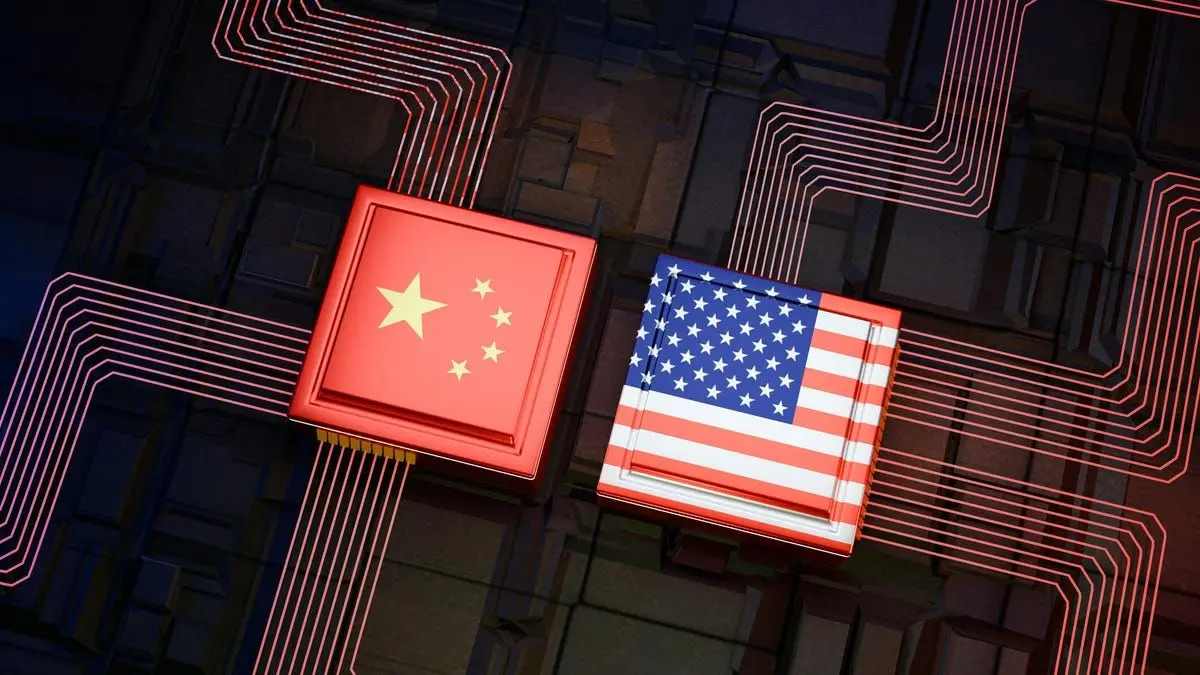
The AI race between the US and China isn't what it seems. While spending on AI is projected to reach $700 billion this year, the two nations are pursuing fundamentally different strategies. The US doubles down on scaling toward Artificial General Intelligence (AGI), while China focuses on low-cost AI tools to boost economic productivity and global adoption.
The AI Race Narrative Masks Fundamental Differences
More money has been invested in AI than it took to land on the moon, with spending projected to reach up to $700 billion this year—almost double last year's figures
1
. Headlines have long framed US China competition in AI as a zero-sum rivalry, suggesting a race with a defined finish line. But this narrative of symmetry and common objectives obscures a more complex reality. "The U.S. and China are running in very different lanes," says Selina Xu, who leads China and AI policy research for Eric Schmidt in New York City1
. The US is doubling down on scaling in pursuit of Artificial General Intelligence (AGI), while China AI strategy centers on boosting economic productivity and real-world impact.
Source: IEEE
Lumping both nations onto a single AI scoreboard isn't just inaccurate—it can shape policy and business decisions in harmful ways. "An arms race can become a self-fulfilling prophecy," Xu warns, noting that a "race to the bottom" mentality encourages companies and governments to eschew necessary security and safety guardrails
1
. This increases the odds of AI-related crises as organizations prioritize speed over responsible development.China's Pragmatic Approach to AI Development Paths
After decades of rapid growth, China now faces economic headwinds including real estate troubles, credit issues, and youth unemployment
1
. The country's leaders have identified AI as the next economic driver to sustain growth. Rather than pouring resources into speculative frontier models, Beijing has a pressing incentive to use the technology as an immediate productivity engine. "In China we define AI as an enabler to improve existing industry, like healthcare, energy, or agriculture," says AI policy researcher Liang Zheng of Tsinghua University1
. "The first priority is to use it to benefit ordinary people."This focus manifests through the AI Plus initiative, which encourages embedding AI into manufacturing, logistics, energy, finance, and public services
1
. Even small and medium enterprises are exploring AI to improve productivity through long-term structural changes involving machines, software, and digitalization. Automakers have embraced intelligent robots in "dark factories" with minimal human intervention, and as of 2024, China had around five times more factory robots in use than the US1
. Computer vision systems now handle quality control tasks that previously required human eyes, while software predicts equipment failures to optimize production.Low-Cost AI Tools Drive Global Adoption Strategy
China is pushing hard to develop low-cost AI tools that could create technological dependence worldwide
2
. The industry is bracing for a "flurry" of inexpensive Chinese AI models, with Chinese systems repeatedly driving usage costs down. Recent moves illustrate this strategy: ByteDance released Seedance 2.0, an AI video-generating tool producing high-quality film-like clips from text prompts, while reports emerged of Chinese AI labs creating thousands of fake accounts for data harvesting from Anthropic's Claude chatbot in a practice called "distillation"2
.This pricing strategy has strategic implications. Cost determines who adopts AI first and which models get implemented in software and services. Even if the United States maintains AI leadership on elite benchmarks, Chinese products could become globally influential through widespread adoption. "If an enterprise can deploy a capable open-weight Chinese model on its own infrastructure at low cost, the business case for paying premium prices to U.S. providers weakens considerably," according to industry analysis
3
. By releasing competitive open-source models, Chinese labs are eroding the commercial moat that US closed model vendors have relied upon.Efficiency-Driven Model Development Shows Chinese Strengths
The clearest area where China is outcompeting the US is efficiency-driven model development—achieving strong performance at lower compute cost
3
. Whether driven by necessity from chip constraints or strategic choice, Chinese labs have made notable advances in inference efficiency and quantization techniques that the broader industry must take seriously. China also benefits from an energy boom, having added more power capacity in the past four years than the US has in total3
. This energy availability will help with AI diffusion by supporting data centers and other AI-related hyperscaler infrastructure.As AI competition shifts from model performance to value realization, these advantages could prove significant for Chinese AI companies
3
. The prediction of a Chinese tech stack becoming dominant is "plausible as a long-run scenario" for parts of the Global South where cost is the primary consideration and geopolitical alignment with the US is weaker, though experts caution this remains a speculative 5-10 year outlook.Related Stories

Soft Power and AI Governance Concerns
China doesn't present its AI technology as only benefiting itself. Official AI policy documents since 2017 recognize the technology as central to "international competition," with goals stating that by 2030, China's AI "technology and application should achieve world-leading levels, making China the world's primary AI innovation center"
2
. Yet China frames this pursuit as serving "the common well-being of humanity" and "the progress of human civilization," positioning Chinese AI leadership as beneficial for everyone—a clear example of soft power2
.However, China's AI development occurs within an authoritarian system prioritizing information control. The Cyberspace Administration of China issued rules in 2022 requiring algorithm providers to "uphold mainstream value orientations" and "vigorously disseminate positive energy"
2
. These algorithms shape what people see and what gets suppressed across social media platforms and AI tools. Freedom House describes China as having the world's "worst conditions for internet freedom," noting other nations are "embracing the 'Chinese model' of extensive censorship and automated surveillance"2
. China's ability to make generative AI commercially powerful will likely make censorship and narrative management cheaper and easier globally.
Source: The Conversation
The AGI Question and Strategic Implications
Artificial General Intelligence (AGI) serves as the implied finish line in AI race framing, but this creates multiple problems. By its very nature, machine superintelligence would be smarter than humans and therefore impossible to control. "If superintelligence were to emerge in a particular country, there's no guarantee that that country's interests are going to win," says Graham Webster, a China researcher at Stanford University
1
. An AGI finish line also assumes both countries are optimizing for this goal and directing the majority of resources toward it—an assumption contradicted by their starkly different economic landscapes and priorities.For liberal democracies, the growth of Chinese AI tools creates strategic challenges. Managing security concerns about Chinese technology while avoiding technological isolation will prove difficult if Chinese AI tools achieve widespread adoption. American companies continue to lead in areas such as advanced semiconductors, frontier-model research, and hyperscaler infrastructure, while courting huge investment sums
3
. Experts predict the global AI landscape will become "multi-polar" across different layers of the tech stack rather than dominated by a single ecosystem3
. How this plays out geographically as AI systems become omnipresent in societies remains an open question with profound implications for economic productivity, technological dependence, and geopolitical power dynamics.References
Summarized by

Navi
[2]
Related Stories
Mistral CEO calls China's AI lag a 'fairy tale' as debate intensifies over US-China AI race
23 Jan 2026•Policy and Regulation

China's AI Surge: Implications for Global Tech Landscape
16 Jul 2024

Chinese AI Models Close Gap With US Systems as Open-Source Strategy Reshapes Global Tech Order
22 Dec 2025•Policy and Regulation
Recent Highlights
1
AI chatbots validate you too much, making you less kind to others, Stanford study reveals
Science and Research

2
Anthropic's Claude Code Source Leak Reveals Hidden AI Agent Plans and Extensive System Access
Technology

3
Judge blocks Pentagon from branding Anthropic a security risk over AI safety guardrails dispute
Policy and Regulation

Recent Highlights
Today's Top Stories










Your Daily Dose of Curated AI News
Don’t drown in AI news. We cut through the noise - filtering, ranking and summarizing the most important AI news, breakthroughs and research daily. Spend less time searching for the latest in AI and get straight to action.

