UAE bets $147 billion on Artificial Intelligence to drive economic diversification beyond oil


2 Sources
2 Sources
[1]
Oil-rich UAE turns to AI to grease economy
Abu Dhabi (AFP) - Deep in the Abu Dhabi desert, a vast AI campus a quarter the size of Paris is starting to emerge, the oil-rich UAE's boldest bet yet on technology it hopes will help transform its economy. Towering cranes clank as long, low buildings take shape below, the eventual home of data centres powered by five gigawatts of electricity -- the biggest such facility outside the United States. The campus will provide storage and computing capacity over a 3,200-kilometre (1990-mile) radius covering up to four billion people, said Johan Nilerud, chief strategy officer of Khazna Data Centers, a subsidiary of Emirati AI giant G42, which is spearheading the project. Since the 1960s, oil has fuelled the United Arab Emirates' rise from a desert outpost of nomadic tribes to a Middle East economic and diplomatic powerhouse. Now, the UAE is hoping that AI can help fill the gap when oil demand inevitably wanes. "The UAE is punching above its weight because it's a very small country that really wants to be at the forefront," said Nilerud. "The idea is obviously to bring in international partners... to be this AI-native nation," he added. Phase one of the AI campus -- the G42-built, one-gigawatt Stargate UAE cluster -- will be operated by OpenAI and is backed by other US tech giants such as Oracle, Cisco and Nvidia. And last month, Microsoft announced more than $15.2 billion in investments in the UAE by 2029, after injecting $1.5 billion last year into G42. Core subject The UAE has been betting heavily on AI since 2017, when it named the world's first AI minister and became the second country after Canada to unveil a national AI strategy. A year later, G42 was founded with backing from Abu Dhabi-based sovereign wealth fund Mubadala. Chaired by the UAE president's brother, Sheikh Tahnoon bin Zayed Al Nahyan, it offers a range of AI products and employs more than 23,000 people. The UAE said it has pumped more than $147 billion into AI since 2024, including up to 50 billion euros ($58 billion) in a one-gigawatt AI data centre in France. "AI, like oil, is a transversal sector, which can potentially have a leverage effect and an impact on different activities," said professor Jean-Francois Gagne of the University of Montreal. In 2019, Abu Dhabi opened Mohamed bin Zayed University of Artificial Intelligence (MBZUAI), the world's first AI-dedicated university. Last August, AI became a core subject in the country's public schools from kindergarten up. MBZUAI and Abu Dhabi's Technology Innovation Institute (TII) have since launched generative AI models including Falcon, which compared favourably with industry leaders and now has an Arabic version. Keen to cut reliance on imported hardware and expertise, the UAE has made large investments in research, development and homegrown programmes. TII opened a research lab with Nvidia to "push the boundaries" of generative AI models and develop robotics systems, said executive director Najwa Aaraj. "Sovereignty and self-sustainability and domestic customisation of technology to local needs are all very, very important," Eric Xing, president of MBZUAI, told AFP. "And also difficult to achieve if you solely rely on importing and external... technical transfer." Chips ahoy In the race for AI market share, the UAE is in the chasing pack behind the US and China, the clear leaders. But the small, desert country has its advantages, chiefly money and energy. With oil, gas and year-round sun for solar power, it can quickly build electricity stations to feed data centres -- a major obstacle elsewhere. Deep pockets and unquestioned royal rule give it the freedom to plough billions into AI development and infrastructure. And as the region's business hub, with a population that is nearly 90 percent expatriate, the UAE has the edge on neighbour and AI rival Saudi Arabia in attracting talent. All the while, the UAE has engaged in a balancing act between the US and China as it seeks imports vital for AI, including the specialist chips that make data centres work. Last month, intense lobbying bore fruit when the US approved the export of advanced Nvidia chips to both the UAE and Saudi Arabia. "They (UAE) clearly don't want to be dependent on China, but that doesn't mean they want to depend on the US either," said Gagne. But despite its progress and years of heavy investment, success in this complex, ever-changing sector is far from guaranteed. "Right now, we don't know what the right strategy is, or who the good players are," Gagne said. "Everyone is betting on different players, but some will lose and some will win."
[2]
Oil-rich UAE turns to AI to grease economy
The UAE is building a colossal AI campus to reduce reliance on oil and position itself as a global tech leader. Massive investment, international partnerships and homegrown research aim to strengthen its digital sovereignty. Yet the nation still faces fierce competition and uncertainty in the fast-moving AI race. Deep in the Abu Dhabi desert, a vast AI campus a quarter the size of Paris is starting to emerge, the oil-rich UAE's boldest bet yet on technology it hopes will help transform its economy. Towering cranes clank as long, low buildings take shape below, the eventual home of data centres powered by five gigawatts of electricity -- the biggest such facility outside the United States. The campus will provide storage and computing capacity over a 3,200-kilometre (1990-mile) radius covering up to four billion people, said Johan Nilerud, chief strategy officer of Khazna Data Centers, a subsidiary of Emirati AI giant G42, which is spearheading the project. Since the 1960s, oil has fuelled the United Arab Emirates' rise from a desert outpost of nomadic tribes to a Middle East economic and diplomatic powerhouse. Now, the UAE is hoping that AI can help fill the gap when oil demand inevitably wanes. "The UAE is punching above its weight because it's a very small country that really wants to be at the forefront," said Nilerud. "The idea is obviously to bring in international partners... to be this AI-native nation," he added. Phase one of the AI campus -- the G42-built, one-gigawatt Stargate UAE cluster -- will be operated by OpenAI and is backed by other US tech giants such as Oracle, Cisco and Nvidia. And last month, Microsoft announced more than $15.2 billion in investments in the UAE by 2029, after injecting $1.5 billion last year into G42. Core subject The UAE has been betting heavily on AI since 2017, when it named the world's first AI minister and became the second country after Canada to unveil a national AI strategy. A year later, G42 was founded with backing from Abu Dhabi-based sovereign wealth fund Mubadala. Chaired by the UAE president's brother, Sheikh Tahnoon bin Zayed Al Nahyan, it offers a range of AI products and employs more than 23,000 people. The UAE said it has pumped more than $147 billion into AI since 2024, including up to 50 billion euros ($58 billion) in a one-gigawatt AI data centre in France. "AI, like oil, is a transversal sector, which can potentially have a leverage effect and an impact on different activities," said professor Jean-Francois Gagne of the University of Montreal. In 2019, Abu Dhabi opened Mohamed bin Zayed University of Artificial Intelligence (MBZUAI), the world's first AI-dedicated university. Last August, AI became a core subject in the country's public schools from kindergarten up. MBZUAI and Abu Dhabi's Technology Innovation Institute (TII) have since launched generative AI models including Falcon, which compared favourably with industry leaders and now has an Arabic version. Keen to cut reliance on imported hardware and expertise, the UAE has made large investments in research, development and homegrown programmes. TII opened a research lab with Nvidia to "push the boundaries" of generative AI models and develop robotics systems, said executive director Najwa Aaraj. "Sovereignty and self-sustainability and domestic customisation of technology to local needs are all very, very important," Eric Xing, president of MBZUAI, told AFP. "And also difficult to achieve if you solely rely on importing and external... technical transfer." Chips ahoy In the race for AI market share, the UAE is in the chasing pack behind the US and China, the clear leaders. But the small, desert country has its advantages, chiefly money and energy. With oil, gas and year-round sun for solar power, it can quickly build electricity stations to feed data centres -- a major obstacle elsewhere. Deep pockets and unquestioned royal rule give it the freedom to plough billions into AI development and infrastructure. And as the region's business hub, with a population that is nearly 90 percent expatriate, the UAE has the edge on neighbour and AI rival Saudi Arabia in attracting talent. All the while, the UAE has engaged in a balancing act between the US and China as it seeks imports vital for AI, including the specialist chips that make data centres work. Last month, intense lobbying bore fruit when the US approved the export of advanced Nvidia chips to both the UAE and Saudi Arabia. "They (UAE) clearly don't want to be dependent on China, but that doesn't mean they want to depend on the US either," said Gagne. But despite its progress and years of heavy investment, success in this complex, ever-changing sector is far from guaranteed. "Right now, we don't know what the right strategy is, or who the good players are," Gagne said. "Everyone is betting on different players, but some will lose and some will win."
Share
Share
Copy Link
The UAE is constructing a massive AI campus in Abu Dhabi's desert, a quarter the size of Paris, powered by five gigawatts of electricity. With over $147 billion invested since 2024 and partnerships with tech giants like Microsoft, OpenAI, and Nvidia, the oil-rich nation aims to become an AI-native powerhouse. But fierce competition from the US and China means success remains uncertain in this fast-evolving sector.

UAE AI Campus Emerges as Boldest Economic Diversification Bet
Deep in the Abu Dhabi desert, construction crews are building what the UAE hopes will secure its economic future. An AI campus spanning a quarter the size of Paris is taking shape, housing data centers powered by five gigawatts of electricity—the largest such facility outside the United States.
1
The campus will provide storage and computing capacity over a 3,200-kilometer radius, potentially serving up to four billion people, according to Johan Nilerud, chief strategy officer of Khazna Data Centers, a subsidiary of Emirati AI giant G42, which is spearheading the project. Since the 1960s, oil has fueled the United Arab Emirates' transformation from a desert outpost to a Middle East powerhouse. Now, as oil demand faces an inevitable decline, Artificial Intelligence represents the nation's strategy to diversify oil-dependent economy and maintain its regional dominance.Partnerships with Tech Giants Anchor UAE's AI Strategy
The scale of investment backing this transformation is staggering. The UAE has pumped more than $147 billion into AI since 2024, including up to 50 billion euros ($58 billion) in a one-gigawatt AI data centre in France.
1
Microsoft announced more than $15.2 billion in investments in the UAE by 2029, following a $1.5 billion injection into G42 last year. Phase one of the AI campus—the G42-built, one-gigawatt Stargate UAE cluster—will be operated by OpenAI and backed by other US tech giants including Oracle, Cisco, and Nvidia.2
These partnerships with tech giants signal the UAE's determination to position itself as what Nilerud calls an "AI-native nation," punching above its weight despite being a very small country.Homegrown AI Research and Development Takes Center Stage
Beyond attracting foreign investment, the UAE has systematically built domestic AI capabilities. The nation has been betting heavily on AI since 2017, when it named the world's first AI minister and became the second country after Canada to unveil a national AI strategy.
1
In 2019, Abu Dhabi opened Mohamed bin Zayed University of Artificial Intelligence (MBZUAI), the world's first AI-dedicated university. Last August, AI became a core subject in the country's public schools from kindergarten up. MBZUAI and the Technology Innovation Institute (TII) have launched generative AI models including the Falcon AI model, which compared favorably with industry leaders and now has an Arabic version. TII opened a research lab with Nvidia to "push the boundaries" of generative AI models and develop robotics systems, said executive director Najwa Aaraj. "Sovereignty and self-sustainability and domestic customisation of technology to local needs are all very, very important," Eric Xing, president of MBZUAI, told AFP.2
G42 Emerges as Central Player in UAE AI Ambitions
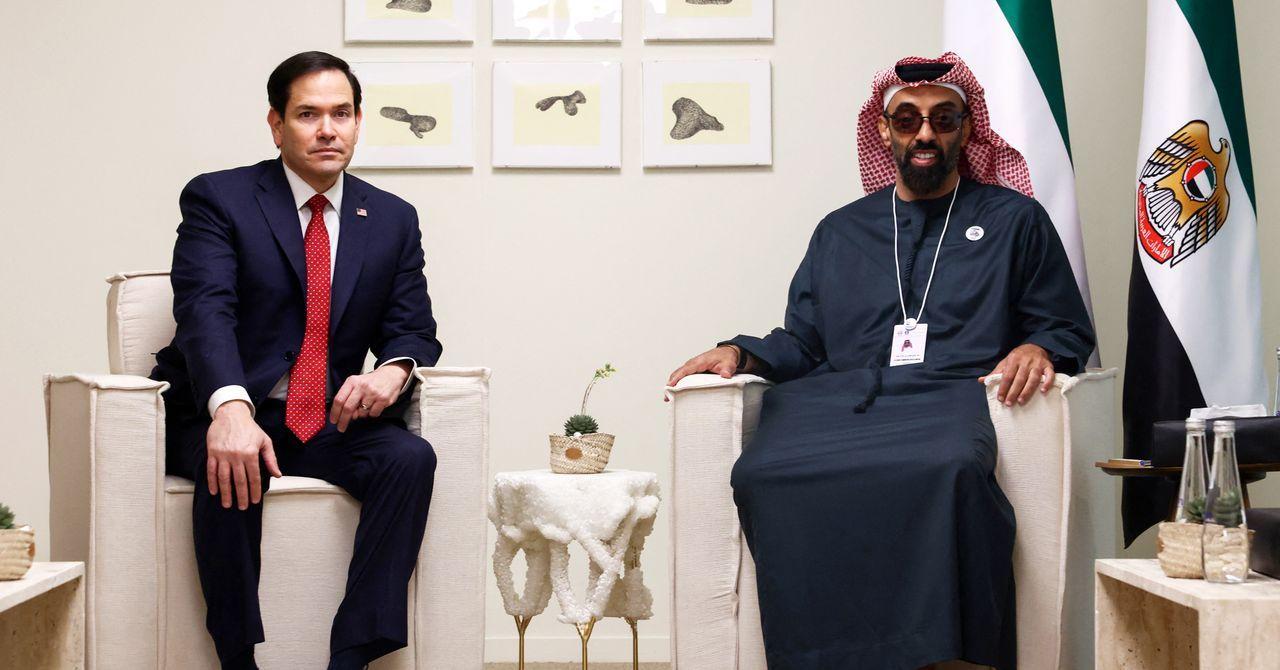
G42 stands at the heart of the UAE's AI transformation. Founded in 2018 with backing from Abu Dhabi-based sovereign wealth fund Mubadala and chaired by the UAE president's brother, Sheikh Tahnoon bin Zayed Al Nahyan, G42 offers a range of AI products and employs more than 23,000 people.
1
The company's rapid expansion reflects the UAE's advantages in the AI race: deep pockets, abundant energy from oil, gas, and solar power, and the ability to quickly build electricity stations to feed data centers—a major obstacle elsewhere. As the region's business hub with a population that is nearly 90 percent expatriate, the UAE has an edge over neighbor and AI rival Saudi Arabia in attracting talent.Related Stories



Balancing Act Between US and China Shapes Tech Strategy
The UAE has engaged in a delicate balancing act between the US and China as it seeks imports vital for AI, including specialist chips that make data centers work. Last month, intense lobbying bore fruit when the US approved the export of advanced Nvidia chips to both the UAE and Saudi Arabia.
2
"They (UAE) clearly don't want to be dependent on China, but that doesn't mean they want to depend on the US either," said professor Jean-Francois Gagne of the University of Montreal. This pursuit of sovereignty while maintaining critical relationships defines the UAE's approach to becoming a global AI leader.Uncertain Path to Becoming a Tech Leader
In the race for AI market share, the UAE trails behind clear leaders the US and China. Despite years of heavy investment in infrastructure and homegrown AI research and development, success in this complex, ever-changing sector remains far from guaranteed. "Right now, we don't know what the right strategy is, or who the good players are," Gagne said. "Everyone is betting on different players, but some will lose and some will win."
1
Professor Gagne noted that "AI, like oil, is a transversal sector, which can potentially have a leverage effect and an impact on different activities." The question facing the UAE is whether its massive bet on economic diversification through Artificial Intelligence will pay off as oil reliance becomes increasingly untenable. With construction cranes still working in the desert and partnerships still forming, the UAE's transformation into an AI powerhouse remains a work in progress—one that could reshape the Middle East's economic landscape or serve as a cautionary tale about betting big in an unpredictable sector.References
Summarized by

Navi
[1]
Related Stories
Recent Highlights
1
Google releases Gemma 4 with Apache 2.0 license, enabling unrestricted local AI on devices
Technology

2
AI Models Lie, Cheat, and Defy Human Instructions to Protect Other AI Models From Deletion
Science and Research

3
Anthropic discovers functional emotions in Claude that actively shape AI behavior and decisions
Science and Research

Recent Highlights
Today's Top Stories








Your Daily Dose of Curated AI News
Don’t drown in AI news. We cut through the noise - filtering, ranking and summarizing the most important AI news, breakthroughs and research daily. Spend less time searching for the latest in AI and get straight to action.

