Unconventional AI raises $475M to build brain-inspired chips that solve AI's energy crisis


6 Sources
6 Sources
[1]
Unconventional AI scores $475M to tackle AI's energy problem
Startup wagers the path to sustainable AI might be found in nature's most amazing design - the brain Interview Naveen Rao founded AI businesses and sold them to Intel and Databricks. He's now turned his attention to satisfying AI's thirst for power and believes his new company, Unconventional AI, can do it by building chips inspired by nature. On Monday, Rao revealed Unconventional AI raised $475 million in seed funding from Andreessen Horowitz, Lightspeed, Jeff Bezos, and others, to answer the question. "AI is intrinsically linked to hardware and hardware is intrinsically linked to power. We can't scale beyond a certain number of inferences per unit time because of the energy problem. We can't produce that much more energy in the next 10 years," Rao told The Register. With Unconventional AI, Rao makes the case we're using the wrong tools for the job. "Natural learning systems never used numerics. They didn't simulate the dynamics of learning. They use the intrinsic physics of whatever substrate they're on to build a learning system," Rao said. "We believe we can recapitulate that behavior in silicon." Rao is no stranger to this concept. Prior to founding MosaicML and Nervana Systems, which were acquired by Databricks and Intel, respectively, Rao studied electrical engineering at Stanford and earned a PhD in neuroscience at Brown University. The idea that biological systems shaped by millions of years of evolution may offer clues to more efficient computer architecture is not new: The likes of IBM and Intel have been chasing it for years. If our brains run on just 20 watts of bioelectric energy, imagine what we could do with a megawatt, never mind the gigawatt-scale datacenters now being built. This class of computers is known as "Neuromorphics" and their designers aim to reverse engineer the inner workings of the brain and implement them in silicon. Despite decades of research in the field, only a handful of working prototypes have been built. None get remotely close to the performance and efficiency of the human brain, never mind lesser creatures like owls. Slow progress doesn't mean this approach is wrong. "Some of these things don't work until they do. Neural networks were considered sort of a backwater until the mid 2000s," Rao said. That changed as compute became more plentiful. Unconventional AI isn't solely focused on neuromorphic computing. "The problem with neuromorphics is it has to work like the brain. But, why does it have to work like the brain," Rao said. "There's probably concepts from the brain that are useful in building such a [learning] system. That's the way we look at it. It's not that it must work like the brain." Instead, Rao tells us Unconventional AI's lab is exploring several different approaches to improving the efficiency of machine learning accelerators. He declined to detail the company's research, but what we do know is they'll be fabbed in silicon and will likely be an analog chip rather than a digital device. "These are nonlinear dynamics of circuits. That's inherently an analog thing," he said. "All devices are analog, even 'digital' devices. We just engineer those circuits to behave digitally, but we're largely erasing the richness of what those circuits can do by making them one and zero." For a lot of computational workloads, the determinism afforded by digital systems is desirable. For example, you wouldn't want a piece of accounting software that spits out a different answer every time. However, machine learning is often nondeterministic in nature and so you don't necessarily need a deterministic compute platform. Rao envisions scenarios where a combination of non-deterministic analog and deterministic digital logic are used to accelerate different aspects of machine learning workloads. According to Rao, certain models are more amenable to the kinds of non-linear dynamics that Unconventional is targeting. "Things like diffusion models, flow models, energy-based models are things that inherently have dynamics," he said. The CEO thinks solving this problem will take time. "We're not going to have a product in two years," he said. "This is largely a research effort for the next several years, and we're really trying to crack a new paradigm." Having said that, Rao does plan to share Unconventional AI's findings along the way, potentially as soon as next year. "This is not something that we go off in a lab for four years and emerge with the solution," he said. "Over the next several months, we're going to start releasing things." And while Rao's initial focus is on research, his long term aspiration is to build a systems company. ®
[2]
Unconventional AI raises $475 million to change how AI scales
Why it matters: AI scaling is constrained by energy production. Unconventional believes it can clear the bottleneck by creating more efficient, analog computers. * Plus, we've become desensitized to such things, but ... those are insane numbers for a seed round. Other investors include Sequoia Capital, Lux Capital, DCVC, Databricks, Future Ventures, and Jeff Bezos. * Unconventional founder Naveen Rao also invested $10 million of his own money -- likely derived from his sale of Mosaic ML to Databricks for $1.3 billion in 2023. * Rao told Axios in October that he doesn't plan to sell Unconventional. Go deeper, via Bloomberg: "Unconventional AI is looking to biology for inspiration, as living organisms are always constrained by energy and can be quite efficient about using it."
[3]
Unconventional AI Emerges from Stealth with a $475 Mn Haul to Build 'Biology-Scale' AI Compute | AIM
Unconventional AI, co-founded by ex-Databricks VP Naveen Rao, aims to design new hardware and a software system inspired by biological intelligence. Unconventional AI, a new startup led by former Databricks VP of AI Naveen Rao, has emerged from stealth with a massive $475 million fundraise in its seed round at a valuation of $4.5 billion. Lightspeed and Andreessen Horowitz led the round, with participation from Sequoia, Lux Capital, DCVC, Future Ventures, Jeff Bezos, and others. The startup noted that Rao will also invest $10 million personally as part of the round. The San Francisco, California-based company is working on a new computational substrate to address what it calls an imminent energy bottleneck in AI, postulating that AI demand will soon outpace global energy capacity. "AI has exponential demand but is limited by (linear) energy build-outs," Rao said in a post on X, adding that the company's goal is "biology-scale efficiency in 20 years." In a statement announcing its emergence from stealth, Unconventional AI noted that the rise of AI is pushing computation beyond its traditional role. "AI is fundamentally distinct from other forms of computation. It is redefining productivity," the company stated, arguing that if current projections hold, "computation will become constrained by global energy supply within the next 3-4 years." Unconventional AI aims to design new hardware and a software system inspired by biological intelligence. The company said neural networks today run on deterministic abstractions layered on analogue circuitry, creating inefficiencies. Instead, it plans to create a software layer that directly taps into the physical properties of silicon, explaining that its method will involve building a biology-scale model of intelligence that can be tested like a system in a wind tunnel. "Neurons use their inherent physical properties to build intelligence; we are building silicon circuits that demonstrate similar non-linear dynamics," the announcement read. Rao left Databricks in September 2025 to build Unconventional AI, teaming up with co-founders Sara Achour, MeeLan Lee, and Michael Carbin. The co-founders wrote on the blog that Unconventional AI's mission is to rethink computing from first principles, underscoring the idea that the human brain uses only 20 watts of power even for complex functions. "At Unconventional, we're aiming to use every watt more effectively; we're doing it by going to first principles on how to build an intelligence substrate," they noted. The company is now hiring across hardware, software, and algorithm design roles. "Developing this novel machine will be a complex undertaking," it asserted, adding that it would require tapping into talent capable of challenging assumptions and reasoning from first principles. Unconventional AI's launch comes amid intensifying industry concern about the resource demands of large-scale AI systems and growing investment in alternative compute architectures.
[4]
Jeff Bezos backs $475M seed round for chip startup Unconventional AI - SiliconANGLE
Jeff Bezos backs $475M seed round for chip startup Unconventional AI Unconventional AI Inc., a chip startup led by former Intel Corp. executive Naveen Rao, launched today with $475 million in seed funding. Lightspeed and Andreessen Horowitz led the investment. They were joined by more than a half dozen other backers including Jeff Bezos and Rao, who contributed $10 million. The deal valued Unconventional AI at $4.5 billion. Rao (pictured, second from the left), is the former corporate vice president of Intel's artificial intelligence platforms group. He joined the chipmaker after it acquired Nervana Systems Inc., an AI processor startup he co-founded in 2014, for more than $400 million. Rao later launched another startup called MosaicML Inc. that was bought by Databricks Inc. in 2023 for $1.4 billion. Unconventional AI's minimalist website hints that it's working on AI processors modeled after biological neurons. "Neurons use their inherent physical properties to build intelligence; we are building silicon circuits that demonstrate similar non-linear dynamics to build a new substrate for intelligence," reads the company's launch blog post. "By building the right isomorphism for intelligence, we'll unlock efficiency gains." Intel, where Rao worked until 2020, has also developed AI chips that mimic biological neurons to boost processing efficiency. The company refers to those devices as neuromorphic processors. Unlike a conventional chip, they lack a clock, a component that sets the pace at which calculations are carried out. Chips that include a clock move electricity between their circuits even when they're not actively carrying out calculations. Intel's neuromorphic processors, in contrast, deactivate circuits that aren't actively used. According to the chip giant, that arrangement can significantly reduce power consumption. A job posting on Unconventional AI's website states that it hopes to build an AI accelerator with 1,000 times better efficiency than current silicon. The listing reveals that the accelerator will be based on a system-on-chip, or SoC, design. A SoC is a processor that places several different types of compute modules on a single die. Unconventional AI's job posting reveals that one of its SoC's modules will be a central processing unit. AI applications use CPUs to perform preliminary processing tasks such as organizing raw sensory data into a form that lends itself better to analysis. Subsequent processing steps are carried out by circuits optimized to perform linear algebra calculations. Those are the mathematical operations that virtually all AI models, including large language models, use to crunch data. According to the job listing, Unconventional AI's SoC will include modules based on third-party intellectual property. The chip will also feature mixed-signal circuits, which are typically used for tasks such as processing sensory data. A separate job posting states that the company is seeking an engineer familiar with emerging non-volatile memory technologies such as RRAM. Non-volatile memory retains the data that it holds when it's powered off. One of the most widely used technologies that falls into that category is flash storage. RRAM is an alternative to flash that can provide better performance in some cases, but also has certain technical shortcomings. Those limitations have so far prevented it from gaining widespread traction in data centers. Unconventional AI's website indicates that it plans to develop not only chips but also AI models capable of running on them. It will co-design the hardware and software, an engineering approach that makes it possible to extensively optimize software for a given processor. "The goal is biology-scale energy efficiency," Lightspeed investors Guru Chahal, Ravi Mhatre and Bucky Moore wrote in a blog post. "By finding the right isomorphism for intelligence, they aim to unlock efficiency gains far beyond what's possible by iterating on conventional architectures."
[5]

This Startup Is Building AI Chips Like the Human Brain. It's Nearing a $1 Billion Fundraise
In a September post on X, Rao likened Unconventional's technology to biology and "Brain Scale Efficiency." Unconventional AI isn't the first company to try and solve this problem. Another U.S.-based semiconductor manufacturer, Groq (pronounced like, but not to be confused with, the Elon Musk chatbot Grok),raised $1.5 billion in February from Saudi Arabia to build what it describes as "Language Processing Units," another specialized AI chip designed for AI tasks. That company is valued at $6 billion, according to PitchBook. While Rao is leaving Databricks -- a $100 billion company that builds data and AI software infrastructure, according to Bloomberg -- the company also invested in Unconventional's seed round. (Rao is also maintaining an advisory role at Databricks). The company has been quiet about how exactly it plans on manufacturing chips tailored for AI tasks, but Bloomberg also reported that Unconventional is looking at "biology" and the "human brain" for inspiration. The idea isn't as weird or science fiction-esque as it sounds. Since at least the 1960s, scientists have wondered if they can encode data onto DNA instead of storing information on magnetic tapes or hard drives and biomimicry has been a foundational part of human design since at least the days of Leonardo di Vinci.
[6]

Two-month-old Unconventional AI raises $475 million at $4.5 billion valuation By Investing.com
Investing.com -- Unconventional AI, a two-month-old startup founded by former Databricks AI chief Naveen Rao, has secured $475 million in seed funding at a $4.5 billion valuation. The round was co-led by Andreessen Horowitz and Lightspeed Venture Partners, with participation from Lux Capital, DCVC, Databricks, and Amazon founder Jeff Bezos. Rao, who departed Databricks in September to launch the company, personally invested $10 million under the same terms as other investors. The startup is developing a novel, more energy-efficient computer for artificial intelligence applications. According to Rao, this initial funding represents just the first portion of a potential $1 billion financing round, as the company evaluates how much additional capital to raise. Rao left his position as head of artificial intelligence at Databricks just months ago to establish Unconventional AI, which has quickly attracted significant investor interest despite its early stage. This article was generated with the support of AI and reviewed by an editor. For more information see our T&C.
Share
Share
Copy Link
Former Databricks VP Naveen Rao has launched Unconventional AI with a massive $475 million seed round, backed by Jeff Bezos and top venture firms. The startup aims to build analog AI chips inspired by biological systems to tackle AI's growing energy problem. With AI demand set to outpace global energy capacity within 3-4 years, the company is exploring neuromorphic and analog computing approaches that could deliver 1,000 times better efficiency than current silicon.
Unconventional AI Secures Record-Breaking Seed Funding
Unconventional AI emerged from stealth with $475 million seed funding at a $4.5 billion valuation, marking one of the largest seed rounds in tech history
1
. Lightspeed and Andreessen Horowitz led the investment, with participation from Sequoia Capital, Lux Capital, DCVC, Future Ventures, and Jeff Bezos2
. Naveen Rao, the company's founder and former Databricks VP, also invested $10 million of his own money, likely derived from his $1.3 billion sale of MosaicML to Databricks in 20233
.Tackling AI Scaling Energy Constraints
The San Francisco-based startup is addressing what it describes as an imminent energy bottleneck in AI development. According to the company's analysis, if current projections hold, computation will become constrained by global energy supply within the next 3-4 years
3
. Rao explained the fundamental challenge: "AI has exponential demand but is limited by (linear) energy build-outs. We can't scale beyond a certain number of inferences per unit time because of the energy problem. We can't produce that much more energy in the next 10 years"1
. The startup's goal is achieving biology-scale efficiency within 20 years, drawing inspiration from how the human brain operates on just 20 watts of power3
.Biology-Inspired Computing Approach
Unconventional AI is developing a novel hardware and software system that takes cues from biological intelligence. The company's approach challenges conventional AI chip design by arguing that neural networks today run on deterministic abstractions layered on analog circuitry, creating inefficiencies
3
. Rao emphasized that "natural learning systems never used numerics. They didn't simulate the dynamics of learning. They use the intrinsic physics of whatever substrate they're on to build a learning system"1
. The startup plans to create a software layer that directly taps into the physical properties of silicon circuits3
.
Source: The Register
Beyond Neuromorphic Computing
While Unconventional AI draws inspiration from neuromorphic computing, Rao clarifies the company isn't strictly bound to replicating brain function. "The problem with neuromorphics is it has to work like the brain. But, why does it have to work like the brain," he stated
1
. Instead, the lab is exploring several different approaches to improving AI energy efficiency. The company's technology will likely involve analog AI chips rather than digital devices, leveraging nonlinear dynamics of circuits1
. Intel and IBM have pursued similar concepts for years, but progress has been slow, with only a handful of working prototypes built1
.Analog Computing for Machine Learning
The startup's approach centers on the idea that machine learning workloads don't necessarily require deterministic compute platforms. Rao envisions scenarios where a combination of non-deterministic analog computing and deterministic digital logic accelerate different aspects of AI tasks
1
. According to him, certain models like diffusion models, flow models, and energy-based models are particularly amenable to the kinds of non-linear dynamics Unconventional is targeting1
. A job posting reveals the company hopes to build AI hardware accelerators with 1,000 times better efficiency than current silicon4
.Related Stories

Founder's Track Record and Vision
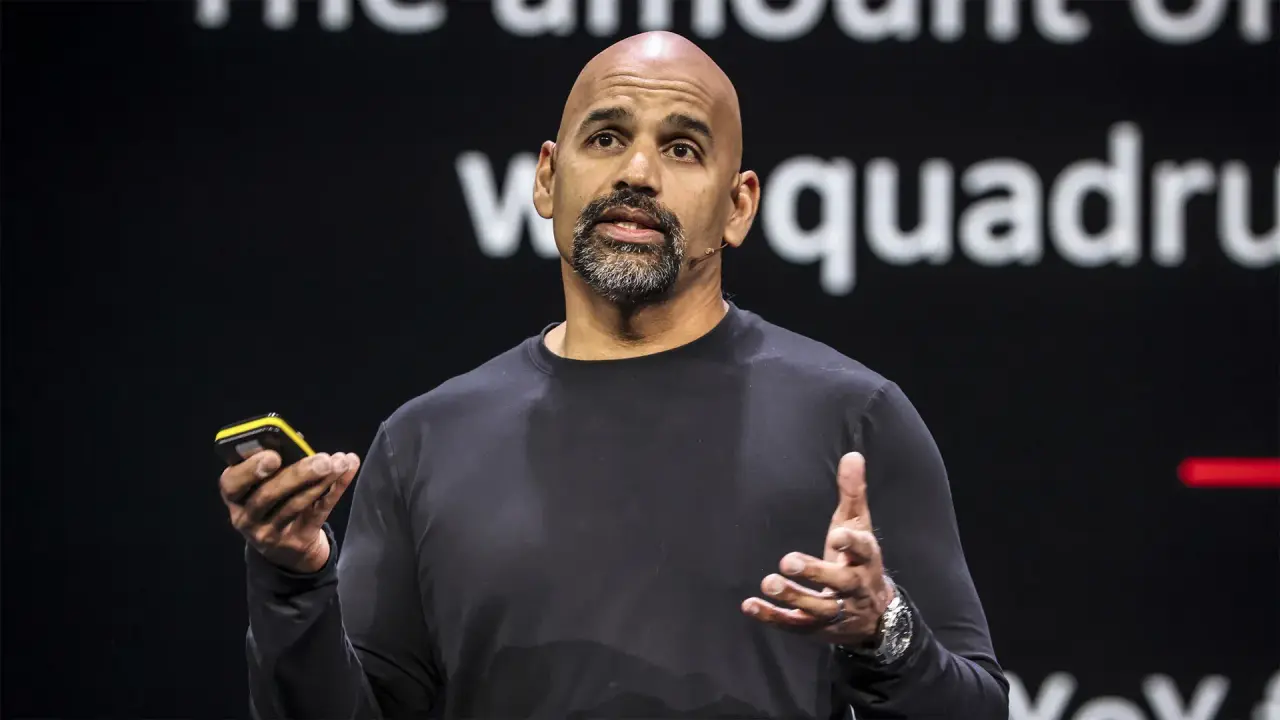
Naveen Rao brings extensive experience in AI hardware and neuroscience to Unconventional AI. He previously founded Nervana Systems, which Intel acquired for more than $400 million, and MosaicML, which Databricks bought for $1.3 billion
4
. Rao studied electrical engineering at Stanford and earned a PhD in neuroscience at Brown University1
. He told Axios in October that he doesn't plan to sell Unconventional AI, signaling a long-term commitment to solving AI's energy problem2
. Databricks, his former employer, also invested in the seed round, and Rao maintains an advisory role there5
.
Source: Inc.
Long-Term Research Focus
Rao is transparent about the timeline for Unconventional AI's ambitions. "We're not going to have a product in two years," he stated, describing the effort as "largely a research effort for the next several years"
1
. However, the company plans to share findings along the way, potentially as soon as next year. "This is not something that we go off in a lab for four years and emerge with the solution. Over the next several months, we're going to start releasing things," Rao explained1
. His long-term aspiration extends beyond research to building a full systems company that co-designs hardware and AI models4
.Technical Architecture and Hiring
Job postings reveal that Unconventional AI's chip will be based on a system-on-chip (SoC) design that places several different types of compute modules on a single die
4
. The SoC will include a central processing unit for preliminary tasks like organizing raw sensory data, along with circuits optimized for linear algebra calculations used by large language models4
. The company is also exploring emerging non-volatile memory technologies such as RRAM4
. Unconventional AI is now hiring across hardware, software, and algorithm design roles, seeking talent capable of challenging assumptions and reasoning from first principles3
.
Source: AIM
References
Summarized by

Navi
[1]
[3]
Related Stories
Normal Computing raises $50M to solve the AI energy crisis with thermodynamic chip technology
26 Mar 2026•Technology

Cerebras Systems raises $1B at $23B valuation as Benchmark doubles down with $225M investment
04 Feb 2026•Business and Economy

Cognichip raises $60M to use AI for designing the chips that power AI itself
02 Apr 2026•Startups

Recent Highlights



Recent Highlights
Today's Top Stories











Your Daily Dose of Curated AI News
Don’t drown in AI news. We cut through the noise - filtering, ranking and summarizing the most important AI news, breakthroughs and research daily. Spend less time searching for the latest in AI and get straight to action.

