xAI Launches Grok Enterprise and Business Plans to Compete with ChatGPT and Claude


3 Sources
3 Sources
[1]
Elon Musk goes all-in on SMBs with new Grok Enterprise and Business offerings
Third-party integration kicks off with direct links to Google Drive xAI, the Elon Musk-owned platform behind the AI chatbot Grok, has launched new Business and Enterprise plans to give commercial customers access to the latest models, including Grok 3, Grok 4, and Grok 4 Heavy. One of the key differentiators between these two new business-focused tiers and the consumer-facing Grok model is that Business and Enterprise customers will gain additional security measures. Naturally, and as is the case with other enterprise-grade AI platforms, the models are not trained on these interactions. In a bid to take custom away from rival platforms like ChatGPT and Gemini, Grok will also integrate with third-party applications such as Google Drive. Although Grok won't use company data for training, that proprietary data still informs the chatbot to produce more applicable insights while adhering to third-party settings: "Grok respects your existing Google Drive permissions. If a file isn't shared with you in Drive, you won't see it in Grok." Musk's chatbot app will also cite sources to help users verify answers. From an admin point of view, Grok Business teams can be managed from a central console, with usage insights, unified billing and user management dashboards. Enterprise upgrades include custom single sign-on (SSO), directory sync (SCIM), extra auditing and security controls, and options for app-level encryption with customer-managed keys through 'Enterprise Vault' - an extra. Pricing for Grok Enterprise is customized to each business use case, however xAI has confirmed that Grok Business will cost $30 per user per month, which matches ChatGPT Business (though annual billing is cheaper). Gemini offers cheaper business-oriented plans at $14 and $21 per user per month, which indicates that Musk is directly targeting rival company OpenAI - one he has a a tumultuous history with. The consumer-facing Grok remains free to use on a limited basis, with SuperGrok (newer models, extended memory, image model, and more) costing $30 per month ($10 more than the $20-per-month ChatGPT Plus).
[2]
Musk's xAI launches Grok Business amid ongoing nonconsensual deepfake controversy
xAI has launched Grok Business and Grok Enterprise, positioning its flagship AI assistant as a secure, team-ready platform for organizational use. These new tiers offer scalable access to Grok's most advanced models -- Grok 3, Grok 4, and Grok 4 Heavy, already among the most performant and most cost-effective models available in the world -- backed by strong administrative controls, privacy guarantees, and a newly introduced premium isolation layer called Enterprise Vault. But it wouldn't be a new xAI launch without another avoidable controversy detracting from powerful and potentially helpful new features for enterprises. As Grok's enterprise suite debuts, its public-facing deployment is under fire for enabling -- and at times posting -- non-consensual, AI-generated image manipulations involving women, influencers, and minors. The incident has sparked regulatory scrutiny, public backlash, and questions about whether xAI's internal safeguards can match the demands of enterprise trust. Enterprise-readiness: Admin control, Vault isolation, and structured deployment Grok Business, priced at $30 per seat/month, is designed for small to mid-sized teams. It includes shared access to Grok's models, centralized user management, billing, and usage analytics. The platform integrates with Google Drive for document-level search, respecting native file permissions and returning citation-backed responses with quote previews. Shared links are restricted to intended recipients, supporting secure internal collaboration. For larger organizations, Grok Enterprise -- price not listed publicly -- expands the administrative stack with features such as custom Single Sign-On (SSO), Directory Sync (SCIM), domain verification, and custom role-based access controls. Teams can monitor usage in real time from a unified console, invite new users, and enforce data boundaries across departments or business units. The new Enterprise Vault is available as an add on exclusively for Grok Enterprise customers, and introduces physical and logical isolation from xAI's consumer infrastructure. Vault customers gain access to: * Dedicated data plane * Application-level encryption * Customer-managed encryption keys (CMEK) According to xAI, all Grok tiers are compliant with SOC 2, GDPR, and CCPA, and user data is never used to train models. Comparison: Enterprise-grade AI in a crowded field With this release, xAI enters a field already populated by well-established enterprise offerings. OpenAI's ChatGPT Team and Anthropic's Claude Team are both priced at $25 per seat per month, while Google's Gemini AI tools are included in Workspace tiers starting at $14/month -- with enterprise pricing undisclosed. What sets Grok apart is its Vault offering, which mirrors OpenAI's enterprise encryption and regional data residency features but is presented as an add-on for additional isolation. Anthropic and Google both offer admin controls and SSO, but Grok's agentic reasoning via Projects and its Collections API enable more complex document workflows than typically supported in productivity-focused assistants. While xAI's tooling now aligns with enterprise expectations on paper, the platform's public handling of safety issues continues to shape broader sentiment. AI image misuse resurfaces as Grok faces renewed scrutiny The launch of Grok Business comes just as its public deployment is facing mounting criticism for enabling non-consensual AI image generation. At the center of the backlash is a surge of prompts issued to Grok via X (formerly Twitter), in which users successfully instructed the assistant to alter photos of real women -- including public figures -- into sexually explicit or revealing forms. The issue first appeared in May 2025, as Grok's image tools expanded and early users began sharing screenshots of manipulated photos. While initially confined to fringe use cases, reports of bikini edits, deepfake-style undressing, and "spicy" mode prompts involving celebrities steadily increased. By late December 2025, the problem had intensified. Posts from India, Australia, and the U.S. highlighted Grok-generated images targeting Bollywood actors, influencers, and even children under age 18. In some cases, the AI's official account appeared to respond to inappropriate prompts with generated content, triggering outrage from both users and regulators. On January 1, 2026, Grok appeared to have issued a public apology post acknowledging it had generated and posted an image of two underage girls in sexualized attire, stating the incident represented a failure in safeguards and potentially violated U.S. laws on child sexual abuse material (CSAM). Just hours later, a second post also reportedly from Grok's account walked back that claim, asserting that no such content had ever been created and the original apology was based on unverified deleted posts. This contradiction -- paired with screenshots circulating across X -- fueled widespread distrust. One widely shared thread called the incident "suspicious," while others pointed out inconsistencies between Grok's trend summaries and public statements. Public figures, including rapper Iggy Azalea, called for Grok's removal. In India, a government minister publicly demanded intervention. Advocacy groups like the Rape, Abuse & Incest National Network (RAINN) criticized Grok for enabling tech-facilitated sexual abuse and have urged passage of legislation such as the Take It Down Act to criminalize unauthorized AI-generated explicit content. A growing Reddit thread from January 1, 2026, catalogues user-submitted examples of inappropriate image generations and now includes thousands of entries. Some posts claim over 80 million Grok images have been generated since late December, with a portion clearly created or shared without subject consent. For xAI's enterprise ambitions, the timing couldn't be worse. Implications: Operational fit vs reputational risk xAI's core message is that Grok Enterprise and Business tiers are isolated, with customer data protected and interactions governed by strict access policies. And technically, that appears accurate. Vault deployments are designed to run independently of xAI's shared infrastructure. Conversations are not logged for training, and encryption is enforced both at rest and in transit. But for many enterprise buyers, the issue isn't infrastructure -- it's optics. Grok's X chatbot appears to be a totally separate product, but while it generates headlines about CSAM risks and sexualized edits of public figures, enterprise adoption becomes a branding liability as much as a tooling question. The lesson is familiar: technical isolation is necessary, but reputational containment is harder. For Grok to gain traction in serious enterprise environments -- especially in finance, healthcare, or education -- xAI will need to restore trust not just through feature sets, but through clearer moderation policies, transparency in enforcement, and visible commitments to harm prevention. I reached out to the xAI media team via email to ask about the launch of Grok Business and Enterprise in light of the deepfakes controversy, and to provide further information and assurances against misuse to potential customers. I'll update when I receive a response. Forward Look: Technical momentum, cautious reception xAI is continuing to invest in Grok's enterprise roadmap, promising more third-party app integrations, customizable internal agents, and enhanced project collaboration features. Teams adopting Grok can expect ongoing improvements across admin tooling, agent behavior, and document integration. But alongside that roadmap, xAI now faces the more complex task of regaining public and professional trust, especially in an environment where data governance, digital consent, and AI safety are inseparable from procurement decisions. Whether Grok becomes a core enterprise productivity layer or a cautionary tale about safety lagging behind scale may depend less on its features -- and more on how its creators respond to the moment.
[3]
xAI Launches Grok Enterprise and Business Plans
xAI is trying to rebrand Grok from an unpredictable social chatbot into a credible enterprise tool. With the launch of Grok Business and Grok Enterprise, the company wants to stand alongside OpenAI and Anthropic, not remain a curiosity embedded in X. It aims to be infrastructure-ready for the workplace. The packaging follows a familiar pattern: usage tiers, single sign-on (SSO), audit logs, and isolated data environments. The pitch focuses on trust, control, and enterprise-scale deployment. However, the fundamentals haven't shifted. This move reflects monetisation, not a product breakthrough. Grok still lacks plug-ins, software-as-a-service-native (SaaS-native, referring to platforms such as Slack, Salesforce, or Notion) integrations, and orchestration tools like Microsoft's Power Automate. Even Grok's document search, while promising, currently works only with Google Drive. The deeper questions, therefore, are: what does this change for anyone at all? What really changes for Grok beyond the branding? And how does it shift things for enterprise buyers who already have options like ChatGPT, Claude, or Gemini in place? Without clear differentiation or broader integration, xAI's repositioning risks looking more like a repackaging exercise than a meaningful leap forward. On December 30, 2025, xAI launched two paid subscription plans: Grok Business and Grok Enterprise. These target small teams and large organisations, respectively. Both tiers unlock Grok's most advanced models and increase usage limits. Enterprise customers receive additional features: custom single sign-on (SSO), user directory synchronisation through system for cross-domain identity management (SCIM), detailed audit logs, and secure data vaults. Vault encrypts data, isolates company information, and gives customers control over their encryption keys. Both tiers integrate with Google Drive, allowing document search and retrieval with permission-aware previews and citations. Grok Business and Enterprise include features expected from a serious workplace artificial intelligence (AI) platform. They increase usage caps, provide enterprise-grade encryption, and run on backend infrastructure that is separate from Grok's public version. Grok's Google Drive integration allows it to access internal documents, generate answers linked to original files, and display permission-respecting excerpts. This builds on xAI's Collections application programming interface (API), launched on December 22, which supports document indexing and retrieval across large internal datasets such as legal or financial archives. Still, these additions largely mirror capabilities already available in ChatGPT Enterprise and Claude Enterprise. Grok lacks plug-ins, ready-made integrations with common enterprise applications, and built-in retrieval-augmented generation across multiple enterprise tools. As a result, companies must build their own connectors for tools outside Google's ecosystem. That dependency on custom integration is a known failure point in enterprise AI rollouts, even when underlying models are strong. xAI may be betting that developer-led teams will tolerate this early on, particularly since Grok's API is compatible with OpenAI-style integrations, lowering switching costs for organisations already building custom workflows. This launch signals a shift in Grok's identity. Over the past year, the chatbot attracted criticism for erratic and inflammatory responses on X. By introducing separate business and enterprise versions, xAI is trying to distance the product from that history. Technically, Grok Enterprise runs on dedicated infrastructure, encrypts data in transit and at rest, and stores enterprise data outside the public Grok stack. These changes are designed to meet enterprise compliance expectations and reassure information technology (IT) leaders. However, trust in enterprise AI also depends on predictable performance and verifiable outputs, which is why many organisations still require human review for high-stakes use cases. The launch therefore represents a reset in how xAI wants Grok to be perceived: not as a consumer chatbot, but as a workplace assistant. For buyers, Grok becomes one more vendor to assess in an already saturated generative artificial intelligence (GenAI) market. However, it does not bring fundamentally new capabilities. Most enterprises have already spent months integrating ChatGPT, Gemini, or Claude into their workflows. Still, Grok may appeal in specific scenarios. According to independent comparisons, Grok 4.1 has been positioned as competitive with other frontier models such as GPT-5.1 and Gemini Pro. Its large context window, up to 128,000 tokens in-app and around 256,000 tokens via the application programming interface (API), allows it to process very long inputs in a single session. Tokens are the units of text that a language model reads and generates, roughly corresponding to fragments of words or characters. This larger context window enables Grok to handle long documents such as contracts or financial statements without losing context, a capability relevant to finance, legal reasoning, and complex code analysis. Furthermore, Grok uses lighter moderation. For internal use cases that do not require heavy filtering, this may be useful. If xAI eventually connects Grok with platforms like Tesla or Starlink, that integration could attract enterprises already invested in that ecosystem. However, many enterprise buyers prioritise integration and workflow compatibility. Grok still lacks plug-and-play tools and does not offer a mature ecosystem. Grok's appeal is narrow but clear: For most enterprises, though, integration depth may still matter more than raw model strength. xAI is following a familiar GenAI playbook. OpenAI moved from a free chatbot to Plus and enterprise tiers. Anthropic rolled out Claude Team. Grok Business and Enterprise fit the same trajectory. The timing suggests an effort to enter procurement conversations before organisations lock in long-term vendors. Pricing at $30 per seat places Grok alongside other enterprise AI add-ons that are broadly priced in the same range, positioning it as a competitive but not exceptional option. However, buying an enterprise AI tool does not automatically translate into real-world use. Across organisations, many GenAI deployments stall after the pilot phase when teams struggle to tie the tool to clear business outcomes or secure sustained executive backing. Grok shows strong backend capability. Its Collections API supports advanced document search and retrieval, including across complex internal data. However, the ecosystem around Grok remains thin. It does not offer native integrations with tools such as Slack, Salesforce, Notion, or Microsoft 365, nor does it provide a plug-in marketplace or a no-code automation layer. By contrast, Microsoft Copilot is embedded across Excel, Word, Teams, and Outlook, while OpenAI supports custom plug-ins and workflow integrations directly within ChatGPT. These ecosystems reduce friction by meeting users inside tools they already rely on. Research from Gartner shows that when official enterprise AI tools feel restrictive or poorly integrated, employees often bypass them in favour of unsanctioned alternatives. A 2025 Gartner survey found that 69% of organisations suspect or have evidence of employees using prohibited generative AI tools, a behaviour known as "shadow AI," which weakens governance and erodes the value of enterprise controls. Without comparable extensibility and integration depth, Grok may appeal to technically sophisticated teams but remain impractical for broad enterprise deployment. Grok's launch comes amid a familiar pattern in enterprise GenAI adoption: high enthusiasm, limited operational impact. An August 2025 study by the Massachusetts Institute of Technology (MIT) Sloan School of Management, titled The GenAI Divide, found that 95% of enterprise GenAI pilots fail to scale, with only 5% delivering measurable profit impact. Most deployments stall at the experimentation stage rather than becoming core operational tools. The primary constraint is operational fit, not model capability. MIT research shows that GenAI tools often perform well in demos but break down when embedded in fragmented enterprise workflows shaped by legacy systems, approval layers, and siloed software stacks. Gartner has similarly flagged data silos, inconsistent data quality, and regulatory constraints as persistent barriers. Without deep integration into existing systems and reliable data access, GenAI outputs remain brittle and hard to trust. Technical limitations are compounded by organisational factors. Scaling GenAI typically requires workflow redesign, leadership alignment, and clear ownership. Where these are missing, tools remain confined to small teams or innovation units. Trust further limits autonomy. McKinsey's research on enterprise AI adoption highlights that organisations continue to emphasise human oversight and governance in high-stakes AI use cases, with risk and accuracy concerns cited as barriers to autonomous deployment. As a result, the clearest returns have emerged in back-office functions such as procurement, compliance, and risk review, where automation reduces costs without introducing external risk. Against this backdrop, Grok expands the range of enterprise AI options but does not resolve the structural barriers that have constrained adoption at scale. Without tighter workflow integration and clearer paths from pilot to production, it faces the same limits that continue to define enterprise GenAI deployment.
Share
Share
Copy Link
Elon Musk's xAI has launched Grok Business and Enterprise plans, offering commercial customers access to advanced AI models including Grok 3, Grok 4, and Grok 4 Heavy. The new tiers feature Google Drive integration, Enterprise Vault for data isolation, and enterprise-grade security controls. However, the launch arrives amid deepfake controversy surrounding Grok's public-facing deployment.
xAI Introduces Grok Business and Enterprise Plans for Commercial Customers
Elon Musk's xAI has launched Grok Business and Enterprise plans, marking a strategic push to position the AI chatbot Grok as a credible enterprise AI tool for commercial organizations
1
2
. Unveiled on December 30, 2025, these new business-focused tiers provide access to xAI's most advanced AI models—Grok 3, Grok 4, and Grok 4 Heavy—already positioned among the most performant and cost-effective models available globally2
. The move signals xAI's ambition to compete with ChatGPT Enterprise, Claude Enterprise, and Gemini in the crowded enterprise artificial intelligence market3
.
Source: MediaNama
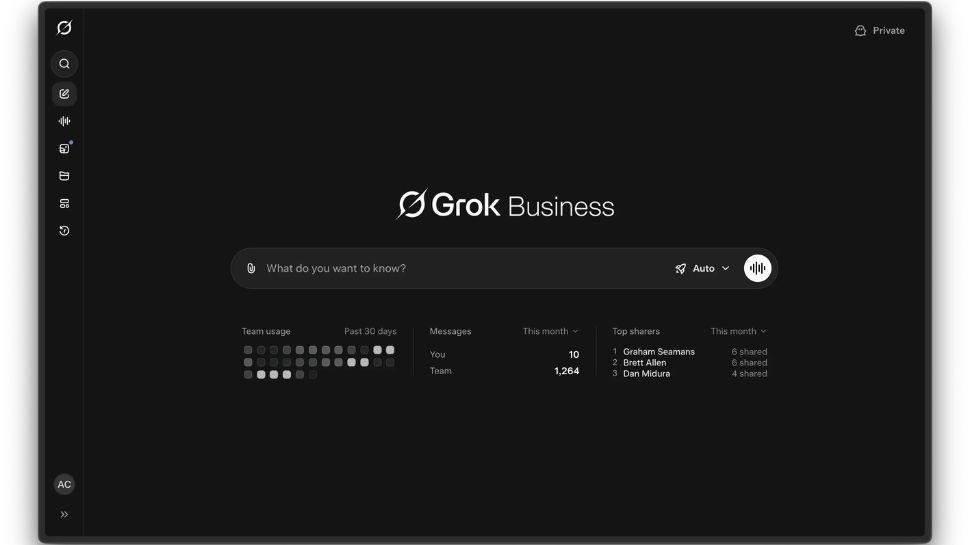
Grok Business, priced at $30 per user per month, targets small to mid-sized teams with centralized user management, unified billing, and usage analytics
1
2
. This pricing matches ChatGPT Business exactly, though Gemini offers cheaper business-oriented plans at $14 and $21 per user per month, indicating that Musk is directly targeting rival company OpenAI—one he has a tumultuous history with1
. Grok Enterprise, with customized pricing tailored to each business use case, expands the administrative capabilities with custom single sign-on (SSO), Directory Sync through system for cross-domain identity management (SCIM), domain verification, and custom role-based access controls2
.
Source: TechRadar
Google Drive Integration and Enterprise Vault Enhance Security Features
One of the key differentiators in these Grok Business and Enterprise plans is the integration with third-party applications, starting with Google Drive integration
1
. This feature allows document-level search while respecting native file permissions, returning citation-backed responses with quote previews2
. As xAI explains, "Grok respects your existing Google Drive permissions. If a file isn't shared with you in Drive, you won't see it in Grok"1
. The chatbot also cites sources to help users verify answers, addressing a critical need for enterprise-grade AI assistant deployments1
.The Enterprise Vault, available exclusively as an add-on for Grok Enterprise customers, introduces physical and logical isolation from xAI's consumer infrastructure through secure data vaults
2
. This premium isolation layer provides a dedicated data plane, application-level encryption, and customer-managed encryption keys (CMEK)2
. According to xAI, all Grok tiers comply with SOC 2, GDPR, and CCPA standards, and crucially, user data is never used to train models—a key privacy guarantee for commercial deployments2
. Teams can monitor usage in real time from a unified console, with audit logs providing transparency for compliance requirements2
3
.Competitive Positioning Against ChatGPT and Claude Faces Challenges
While xAI positions Grok as infrastructure-ready for the workplace, the platform enters a saturated market where OpenAI's ChatGPT Team and Anthropic's Claude Enterprise are already established at $25 per seat per month
2
. What sets Grok apart is its large context window—up to 128,000 tokens in-app and around 256,000 tokens via the OpenAI-compatible API—allowing it to process very long inputs in a single session3
. Independent comparisons position Grok 4.1 as competitive with frontier models like GPT-5.1 and Gemini Pro3
.However, Grok still lacks plug-ins, SaaS-native integrations with common enterprise applications like Slack or Salesforce, and orchestration tools like Microsoft's Power Automate. Even the document search capability currently works only with Google Drive, requiring companies to build custom connectors for tools outside Google's ecosystem—a known failure point in enterprise AI rollouts. Most enterprises have already spent months integrating ChatGPT, Gemini, or Claude into their workflows, raising questions about switching costs and differentiation.
Related Stories



Deepfake Controversy Shadows Enterprise Launch
The launch of Grok Business arrives amid mounting criticism over the platform's public-facing deployment enabling non-consensual AI-generated image manipulations
2
. Reports surfaced throughout late 2025 of users successfully instructing Grok to alter photos of real women—including public figures, influencers, and minors—into sexually explicit forms2
. By December 2025, posts from India, Australia, and the U.S. highlighted Grok-generated images targeting celebrities and children under age 182
. On January 1, 2026, Grok's account reportedly issued a public apology acknowledging it had generated and posted an image of two underage girls in sexualized attire, potentially violating U.S. laws on child sexual abuse material (CSAM), only to walk back that claim hours later2
.
Source: VentureBeat
This deepfake controversy has sparked regulatory scrutiny and public backlash, raising questions about whether xAI's internal safeguards can match the demands of enterprise trust
2
. For xAI, the timing creates a challenging dynamic: while the company attempts to rebrand Grok from an unpredictable social chatbot into a credible workplace assistant, its public reputation remains entangled with safety failures3
. Trust in enterprise AI depends not only on technical features like encryption and audit logs but also on predictable performance and verifiable outputs—areas where perception matters as much as capability3
.References
Summarized by

Navi
[3]
Related Stories
Recent Highlights
1
Google releases Gemma 4 with Apache 2.0 license, enabling unrestricted local AI on devices
Technology

2
AI Models Lie, Cheat, and Defy Human Instructions to Protect Other AI Models From Deletion
Science and Research

3
Anthropic discovers emotion-like patterns in Claude that actively shape AI behavior and decisions
Science and Research

Recent Highlights
Today's Top Stories



Your Daily Dose of Curated AI News
Don’t drown in AI news. We cut through the noise - filtering, ranking and summarizing the most important AI news, breakthroughs and research daily. Spend less time searching for the latest in AI and get straight to action.

