Yahoo Scout launches as AI search engine with visible links to challenge Google and Perplexity


7 Sources
7 Sources
[1]
Yahoo Scout looks like a more web-friendly take on AI search
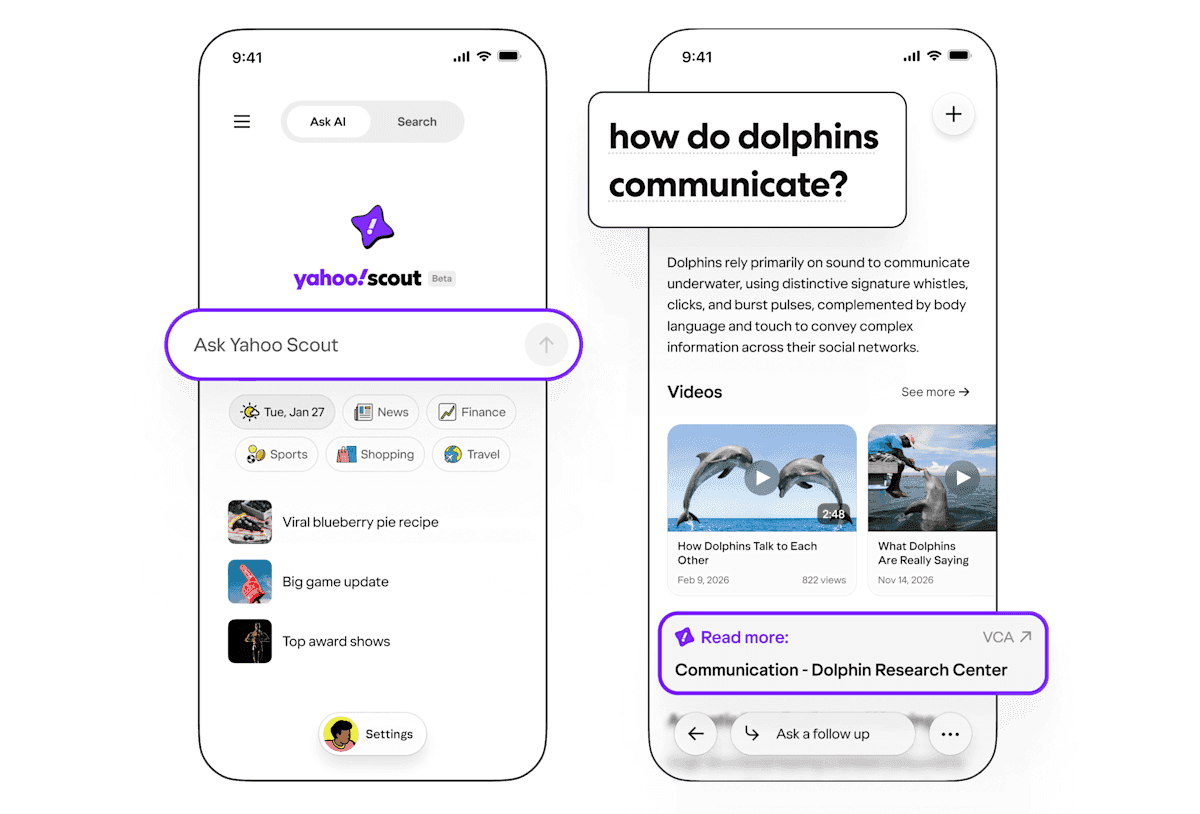
Yahoo's big AI play is, in many ways, actually a return to the company's roots. Three decades ago, Yahoo was known as "Jerry's guide to the world wide web," and was designed as a sort of all-encompassing portal to help people find good stuff on an increasingly large, hard-to-parse internet. In the early aughts, the rise of web search more or less obviated that whole idea. But now, Yahoo thinks, we've come back around. With a new product called Scout, Yahoo is trying to return to being that kind of guide to the web -- only this time, with a whole bunch of AI in the mix. Scout, in its early form, is a search portal that will immediately be familiar if you've ever used Perplexity or clicked over to Google's AI Mode. It shows a text box and some suggested queries. You type a question; it delivers an answer. Right now Scout is a tab in Yahoo's search engine (which, CEO Jim Lanzone likes to remind me every time we talk, is somehow still the third-most-popular search engine in the US), a standalone web app, and a central feature in the new Yahoo Search mobile app. Yahoo calls it an "answer engine," but it's AI web search. You get it. And so far, it's the most search-y of any similar product I've tried. I like it a lot. Scout has two jobs, really. The first is just to be a guide, to find stuff on the web. "It's moved from 'how do I find things on the internet' to weeding through clickbait and now AI slop," says Eric Feng, who runs Yahoo's research group and has been leading the Scout project. But Scout's job is also to bring AI summaries and smarts to all of Yahoo's other products, and to help Yahoo users pull all that disparate data into one place. In a funny twist, Yahoo may be perfectly positioned to do this well. Because Yahoo runs huge content verticals like Sports and Finance, with a big newsroom of its own and partnerships with many other publishers, it has a huge amount of high-quality reference material for Scout. It also has Yahoo Weather and Yahoo Mail and Yahoo Horoscopes and Yahoo Shopping and Yahoo So Many Other Things Besides. Yahoo is a full-fledged content machine, and it can just point an LLM at all that content. "We're the only ones who can take our user data, our usage data, our content, our relationships and information, and combine that with everything we know about search into an AI answer engine," Lanzone says. Google would probably take issue with that statement. It has many of Yahoo's same advantages, and a bunch of other ones, and a lot more users. But Yahoo has one key win over Google: It doesn't have a massive, indomitable search-ads business to protect. Because of the sheer scale of both its user base and its revenue, Google has to slow-play its way into making AI Mode the face of Google Search, even though that's obviously the plan. Yahoo has no such qualms: Lanzone says Scout won't replace standard Yahoo Search from day one, but makes it pretty clear that that's the plan before long. There is still a business plan here, though. Scout is launching with affiliate links for shopping results and an ad unit at the bottom of some searches. All the AI search products seem to be deciding that ads are the way to monetize AI, and Yahoo is set up to get there quickly. The goal, Lanzone says, is to use ads to keep Scout free for everyone. "Maybe one day we'll also have a paid tier," he adds, "but free search is extremely important." One thing Yahoo isn't doing? Building its own foundation model. For one thing, Lanzone says, doing that is very expensive. "We think we can best serve our users not so much with the model," he says, "but with the grounding data and the personalization data that we can add on top of other people's models." Scout is based on Anthropic's Claude model, and what Feng describes as "Yahoo content, Yahoo data, Yahoo personality." Much of the web-search data comes from a partnership with Microsoft and Bing, as it has for many years. Everybody doing AI search swears they care deeply about the future of the open web, but in my testing so far, Scout is the most web-forward AI search product yet. When I asked Scout, "What's the latest on this winter storm?" it responded with a one-paragraph summary that included three links prominently highlighted in blue. After that, I got three sections of more details about what's happening in my Virginia town, the forecast to come, and then a "Latest News" section with links to Yahoo stories, Yahoo partner stories, and other links around the web. In total, the page had nine links, plus a way to see all the page's sources at once. When I did the same search on ChatGPT, Perplexity, and Google AI Mode, I got similar summaries, structured in similar ways. ChatGPT was the only one to link more prominently: It stuck a carousel of news links right at the top of the page. Other than that, all three platforms seem to hide links behind icons or light-colored buttons -- only Scout seems to actually want you to click the links. Making sure people actually do click them will be crucial to the rest of Yahoo's business, and to keeping its newsroom and publisher partners on board with Scout's existence. In my early tests of Scout, it feels much more like a search engine than an AI companion. Its tone is very straightforward, and it doesn't present like a friend to talk to. It's just a way to find information on the internet, organized conversationally rather than as a bunch of links. That doesn't sound particularly novel, but in a sea of AI tools that would love to pretend the internet doesn't exist at all, it's a refreshingly useful take on the genre. I don't think I've used Yahoo Search on purpose in a decade, but when I wanted to know when the Winter Olympics started, Scout gave me a better answer than any other search engine I tested. That's not enough to take on Google, but it's a decent start.
[2]
Yahoo is adding generative AI to its search engine
Yahoo has a new AI-powered "answer engine", dubbed Yahoo Scout. The new tool is available now in beta and is powered by Anthropic's . The company says Scout "synthesizes" info from the web, as well as Yahoo's own data and content when constructing responses to user's natural-language search queries. Yahoo says the interface will include interactive digital media, structured lists and tables and visible source links aimed at making answers easier to verify. (Disclosure: Yahoo is the parent company of Engadget.) Alongside Scout, Yahoo is announcing an "intelligence platform" across its varied products. This will include features like AI summaries in Yahoo Mail, "key takeaways" in Yahoo News and game breakdowns in Yahoo Sports. Scout will also integrate into Yahoo Shopping to offer insights and shoppable links, and Yahoo Finance, where it can populate company financials, analyst ratings and explain stock moves as they occur. Yahoo says the answer engine behind Scout will become more personalized and focus on "deeper experiences" as time goes on. Google offered a glimpse of generative AI in search , and the company's for search was made widely available in the US last year. The company has been similarly at work integrating its AI model across its product portfolio, including and .
[3]
Yahoo launches AI answer engine
Why it matters: As search moves from a list of links to conversations and answers, Yahoo is betting its three decades of data can help it compete with newer rivals. * "Yahoo Scout really can help supercharge the original Yahoo mission of being the trusted guide to the internet," CEO Jim Lanzone tells Axios. "It's an opportunity that I don't think we thought would come around again ... but AI has given us that opportunity, and we're running with it." Driving the news: On Tuesday, Yahoo Scout debuted in beta on desktop and mobile -- within the existing Yahoo Search app on iOS and Android -- in the U.S. * The Scout experience looks more vibrant than other AI answer engines, featuring colorful emoji in the sidebar, easy-to-scan answers with tables and images and inline citations that make results transparent, Axios viewed in a product demo. * Yahoo is also introducing the Scout Intelligence Platform, bringing generative AI capabilities to Yahoo Mail, News, Finance and Sports with features like email summaries, game breakdowns and stock analysis. * Scout's primary foundational AI model is Anthropic's Claude. Scout runs on Yahoo's proprietary data, content and insights alongside Claude and Microsoft Bing's grounding API, which surfaces sources from the open web for answers. The big picture: Yahoo aims to make AI search friendly to users and publishers, delivering answers instantly while still driving traffic back to the open web. * Every response includes inline citations and links to sources, a deliberate move to "reestablish the social contract" and have search engines send traffic to publishers, Lanzone says. Yahoo also is joining Microsoft's Publisher Content Marketplace pilot, which has a similar goal of providing sustainable revenue for publishers. * Yahoo's advantage is in its unique "treasure trove of data" and "deep understanding of query intent," says Eric Feng, senior vice president and general manager of Yahoo Research Group. * Yahoo has 250 million monthly users in the U.S., 500 million user profiles and 18 trillion annual signals (i.e., searching for a stock or a game score or clicking on a news article) across its ecosystem. Follow the money: Yahoo is testing ads at launch with a small percentage of queries. * That strategy differs from competitor OpenAI, which has relied on paid subscriptions for ChatGPT and only just recently announced testing ads. * "Our goal is to make it free for everyone," Feng says. "We want it to be always free and that really fits into our mission of making this very accessible." Reality check: Google and OpenAI already dominate the AI search market. Even with Yahoo's decades of data and existing user base, winning attention won't be easy. What's next: Yahoo plans to add more personalization features, new capabilities for different verticals and more opportunities for advertisers.
[4]
Yahoo Scout is an AI 'answer engine' that wants to challenge Perplexity and Google's AI mode
Yahoo is officially back in the search conversation, with Yahoo Scout, a new AI-powered answer engine that wants to take on Google's AI mode and Perplexity by doing something surprisingly old-school. Instead of hiding links behind buttons or footnotes, Scout puts them front and center and makes clicking links part of the experience. Yahoo Scout enters the AI search race with a different playbook Scout is being pitched as an "answer engine," not an AI chatbot. Ask it a question, and you get a clear, conversational response, but one that is loaded with visible blue links. Up to nine sources can appear for a single query, along with a full list of where the information came from. Yahoo says this is deliberate. While rivals focus on smooth summaries, Scout is designed to keep the web visible rather than replacing it, a move that directly addresses publisher concerns around Google's AI search quietly siphoning traffic. Recommended Videos Yahoo Scout is rolling out in beta starting today for U.S. users, available on scout.yahoo.com as well as inside the Yahoo Search app on iOS and Android. Yahoo Scout is betting links still matter in AI search Under the hood, Scout runs on Anthropic's Claude model, combined with Yahoo's own data, tone, and massive content library. That includes Yahoo News, Finance, Sports, and other verticals, along with web results powered by Microsoft Bing. The result feels familiar if you have used Perplexity or Google's AI mode, but the presentation is very different. Links are treated as the point, not an afterthought, and the interface feels more like a curated guide than a chatty assistant. There is also a business reason for this approach. Yahoo does not have a giant search ads empire to protect, which gives it more freedom than Google to lean into AI answers without worrying about cannibalizing its core revenue. CEO Jim Lanzone told The Verge that Scout is on track to eventually replace traditional Yahoo Search, and the company is already monetizing it through affiliate links and ads placed at the bottom of results. Compared to Perplexity and Google's AI mode, Scout is less about being your AI companion and more about being a fast, utilitarian way to find reliable information. It is not trying to be clever or personal. Yahoo is betting that in a world full of AI summaries and synthetic answers, simply pointing people clearly to the source might be the most radical move of all.
[5]

Yahoo claps back on AI search engines with Yahoo Scout
Yahoo may not be the most headlined company in tech anymore, but its reach can't be denied. With nearly 250 million monthly users across the country and 700 million globally, it's still the second most popular email client in the world, and the third most popular search engine in the U.S. (even though that search engine has technically been powered by either Bing or Google since 2009). As a privately owned company since 2021 (once worth $125 billion, but purchased for a mere $5 billion at the time), its CEO Jim Lanzone says that the last few years have been about "getting the house in order." But now, he promises, "this is one of the biggest turnarounds people have tried in internet history." Lanzone says that turnaround begins with Yahoo Scout, which launches today in beta. In short, Yahoo Scout is a new, free AI search engine (it's also an omnipresent button across Yahoo verticals like Finance, Sports, and Mail) that's there to summarize the performance of a business or break down the key moments of a game. In one mode, it's essentially Yahoo's version of Claude or ChatGPT. (Yahoo Answers for the AI era!) In the other, it's an AI-translate button accompanying Yahoo's editorial content, boiling down articles into takeaways. It will even summarize the sentiment of the comments on stories you read across Yahoo.
[6]

Yahoo launches Scout beta to bring conversational AI to its 250 million users
Yahao announced Yahoo Scout, an AI-powered answer engine for its search, now available in beta and powered by Anthropic's Claude model. It synthesizes information from the web, Yahoo's own data, and content to respond to natural-language search queries. The Scout interface incorporates interactive digital media, structured lists and tables, and visible source links to facilitate verification of answers. Yahoo positions this design to make responses more accessible and reliable for users seeking precise information. (Disclosure: Yahoo is the parent company of Engadget.) In parallel, Yahoo introduced an intelligence platform extending across its product suite. This platform delivers AI summaries within Yahoo Mail to condense email content efficiently. In Yahoo News, it generates key takeaways to highlight core elements of articles. Yahoo Sports receives game breakdowns that analyze match details and outcomes. Scout integrates directly into Yahoo Shopping, where it supplies insights alongside shoppable links to guide purchasing decisions. Within Yahoo Finance, Scout populates company financials, compiles analyst ratings, and provides real-time explanations of stock movements based on current data. Yahoo states the answer engine powering Scout will evolve to deliver more personalized responses tailored to individual users. It will also emphasize deeper experiences, expanding beyond surface-level answers to offer richer interactions over time. Google first demonstrated generative AI in search during 2023. Its AI Mode for search achieved wide availability in the United States in 2024. Google continues integrating its AI model throughout its offerings, including Gmail for enhanced email handling and shopping features for improved recommendations.
[7]

Yahoo's AI gamble: Can Scout reclaim a lost internet giant?
Yahoo seeks to reclaim relevance in an arena long dominated by Google with the launch of Yahoo Scout, an AI-powered answer engine built on Anthropic's Claude model and integrated with Microsoft Bing's web grounding API to provide accurate, and contextually appropriate responses. While it certainly marks the company's most aggressive push into next-generation search in years, history shows us a very different picture. Yahoo was founded four years before Google, and its search engine helped it compete and dominate the space occupied by the likes of Excite, Lycos and AOL. Positioned as "web portals", all of them shone till they succumbed to the dotcom bust. Ironically, Google in its early days was turned down both by Yahoo (twice) and Excite. Moreover, Yahoo Search was powered by Google for four years, following which it began using Inktomi. Today, Yahoo is 90% owned by Apollo Global Management and 10% by Verizon Communications, which also acquired AOL in 2015 and merged it with Yahoo. In India, when Yahoo opened its Mumbai office in 2003, co-founder Jerry Yang invited Shammi Kapoor -- who had famously popularised the word "Yahoo" in Junglee -- to inaugurate it. Yahoo currently claims nearly 250 million regular U.S. users for Scout's beta launch. The company emphasises its rich historical data that spans decades of user behaviour, vertically specialised content in finance, sports, news, mail, and an extensive knowledge graph, as a differentiator. There is a clear intention to weave Scout's capabilities into the broader Yahoo ecosystem, offering AI summaries in mail, insights in news, analytical breakdowns in sports, and shoppable answers in commerce. That said, market realities are sobering for Yahoo. In the traditional search landscape, Google continues to command roughly 89- 90 % of global search engine market share, with competitors including Bing, Yandex, and Yahoo collectively holding only the remaining fraction, and Yahoo itself accounting for around 1-1.4 % globally. Even in the U.S., where Yahoo's share is numerically higher, it still trails far behind Google and Microsoft's Bing. To be sure, AI-powered browsers are quietly upending the traditional search engine model, challenging the dominance of platforms like Google. Instead of serving up a page of blue links, these browsers deliver direct answers, often with citations, pulled from across the web. This shift threatens one of the internet's most lucrative business models: search advertising. Consequently, traditional keyword-centric search is giving way to AI-augmented discovery, where natural language queries and summarised insights are increasingly expected. Yahoo's design reflects this trend, leaning on visible source citations and structured outputs to balance immediacy with reliability. That approach may resonate with users who are frustrated by generic AI responses lacking transparency or depth. Yet it also pits Scout directly against not only Google's AI Mode but a host of Chromium-based AI browsers like Perplexity's Comet, the Dia browser, Brave Leo, and ChatGPT Atlas, all of which are built on Google's open-source engine, which also powers Chrome. Layered on AI capabilities, these agentic AI browsers can summarize pages, answer questions, automate searches, and even take action on behalf of users. Likewise, Scout is being positioned as a means to synthesise information from the web and Yahoo's own content and data, and features agentic capabilities too. Whether Scout can materially shift Yahoo's competitive position depends on adoption and monetisation trajectories that are still unfolding. At launch, Yahoo is experimenting with limited advertising on certain query types, a departure from subscription-focused AI product monetisation seen elsewhere. Integrating AI features across verticals could increase engagement across Yahoo's portfolio, a necessary condition for any revival. Without a clear alternative ad revenue strategy that scales with Scout's conversational format, the financial impact may lag even if user metrics improve. Moreover, Google's extensive integration of AI across its apps, from search to Gmail and beyond, continues to reinforce user habits. Google's sheer scale and multiple touchpoints mean that incremental improvements in AI features can have outsized effects on user retention. In this context, Yahoo's task is not simply to innovate but to re-educate a market accustomed to defaulting to Google for quick answers. The global AI search engine market size, pegged at $16.28 billion in 2024, is forecast to touch $50.90 billion by 2033, as per Grand View Research. That said, Yahoo Scout may succeed in slowing ceding ground and bolstering engagement within Yahoo's own ecosystem, drawing on decades of data and a recognisable brand to offer an alternative search experience. However, dislodging the entrenched dominance of Google, particularly in core search share, is easier said than done.
Share
Share
Copy Link
Yahoo has launched Scout, an AI-powered answer engine built on Anthropic's Claude model that prioritizes visible source links over hidden citations. The beta release marks Yahoo's return to its roots as a web guide, now enhanced with generative AI capabilities across Mail, Finance, Sports, and News. With 250 million U.S. monthly users and no search-ads empire to protect, Yahoo is positioning Scout to compete with Google's AI Mode and Perplexity.
Yahoo Scout Brings AI Search with a Web-First Approach
Yahoo has officially entered the AI search race with Yahoo Scout, an AI-powered answer engine that takes a distinctly different approach from competitors like Google's AI Mode and Perplexity
1
. The new product, which launched in beta on Tuesday for U.S. users, is available as a standalone web app at scout.yahoo.com, within the Yahoo Search app on iOS and Android, and as a tab in Yahoo's existing search engine3
.
Source: The Verge
What sets Yahoo Scout apart is its treatment of source links. While other AI search platforms tend to hide citations behind icons or light-colored buttons, Scout displays up to nine prominent source links in blue text directly within its responses
1
. When tested with queries about weather conditions, Scout provided a one-paragraph summary with three inline citations, followed by detailed sections containing additional links to Yahoo stories, partner content, and other web sources1
. This deliberate design choice aims to "reestablish the social contract" between search engines and publishers by driving traffic back to the open web rather than keeping users within a walled garden3
.
Source: Engadget
Leveraging Three Decades of Data and Content
Yahoo's competitive advantage lies in its vast ecosystem of content verticals and user data. With 250 million monthly users in the U.S., 500 million user profiles globally, and 18 trillion annual signals across its properties, Yahoo possesses what Eric Feng, senior vice president of Yahoo Research Group, describes as a "treasure trove of data"
3
. The company operates major content platforms including Yahoo Sports, Yahoo Finance, Yahoo News, and Yahoo Mail, giving Scout access to high-quality reference material that can be fed directly into its generative AI systems1
.According to Jim Lanzone, Yahoo is uniquely positioned because it can combine user data, usage patterns, content relationships, and search expertise into an integrated answer engine
1
. The Scout Intelligence Platform extends beyond search to bring AI summaries and capabilities across Yahoo's product suite, including email summaries in Yahoo Mail, key takeaways in Yahoo News, game breakdowns in Yahoo Sports, and stock analysis with company financials and analyst ratings in Yahoo Finance2
3
.Strategic Positioning to Compete with Google and OpenAI
Yahoo holds a crucial advantage over Google in the AI search transition: it doesn't have a massive search-ads business to protect. While Google must carefully balance its shift to AI Mode to avoid cannibalizing its core revenue stream, Yahoo faces no such constraints
1
. Lanzone indicated that while Scout won't immediately replace standard Yahoo Search, that's clearly the plan for the near future1
. Yahoo remains the third-most-popular search engine in the U.S., giving it an existing user base to build upon5
.The company is testing ads at launch with a small percentage of queries, using affiliate links for shopping results and ad units at the bottom of some searches
1
3
. This approach differs from OpenAI's strategy of relying primarily on paid subscriptions for ChatGPT before recently announcing ad testing. Feng emphasized that Yahoo's goal is to keep Scout free for everyone, stating "we want it to be always free and that really fits into our mission of making this very accessible"3
.Related Stories




Building Without Foundation Models
Yahoo has made a strategic decision not to build its own foundation model, citing the significant expense involved. Instead, Lanzone explains that Yahoo can better serve users through "the grounding data and the personalization data that we can add on top of other people's models"
1
. Scout combines Anthropic's Claude with what Feng describes as "Yahoo content, Yahoo data, Yahoo personality," alongside web-search data from Yahoo's longstanding partnership with Microsoft and Bing1
2
.The interface features colorful emoji in the sidebar, easy-to-scan answers with tables and images, and inline citations designed to make results transparent and verifiable
3
. Yahoo is also joining Microsoft's Publisher Content Marketplace pilot, which aims to provide sustainable revenue streams for publishers3
. Looking ahead, Yahoo plans to add more personalization features, expand capabilities across different verticals, and create additional opportunities for advertisers3
. For a company once valued at $125 billion but purchased for just $5 billion in 2021, Lanzone describes this as "one of the biggest turnarounds people have tried in internet history"5
.References
Summarized by

Navi
[3]
[4]
[5]
Related Stories
Recent Highlights
1
Google Maps unveils Ask Maps with Gemini AI and 3D Immersive Navigation in biggest update
Technology

2
AI chatbots help plan violent attacks as safety guardrails fail, new investigation reveals
Technology

3
Three Tennessee teens sue xAI over Grok AI creating child sexual abuse material from real photos
Policy and Regulation

Recent Highlights
Today's Top Stories





Your Daily Dose of Curated AI News
Don’t drown in AI news. We cut through the noise - filtering, ranking and summarizing the most important AI news, breakthroughs and research daily. Spend less time searching for the latest in AI and get straight to action.

