AI Bubble Fears Intensify as Tech Giants Commit $1.5 Trillion to Infrastructure


7 Sources
7 Sources
[1]
The Most Worrying Bits from Bloomberg's Worrisome AI Bubble Q&A with Jason Furman
Which data points qualify as true recession indicators? The yield curve, a comparison of short- and long-term interest rates, was scary recently, but does not suggest super high recession fears at the moment. The Sahm Rule raises alarms when there's a sudden relative spike in unemployment, and it hasn't technically been triggered yet despite incrementally worsening employment in recent months. But how does the Bloomberg Rule work? That's the one that lays out how many times a Bloomberg Q&A article with a normie economist can contain variations on the word "worry"? The one from Thursday with Jason Furman, which is specifically about an AI bubble, contains a deeply troubling 14 worries. I don't want to be alarmist, but I'm not liking the data, folks. Jason Furman is as normal as economists get: He's a Harvard professor. He was chairman of the White House Council of Economic Advisers under president Barack Obama. In October he was on the podcast of conservative New York Times opinion columnist Ross Douthat to talk about this same topic, and that interview only contained one "worry." So why the spike? Furman says "I'm more worried about the financial valuation bubble than I am a technological bubble" in his first answer. This seemingly gets at some kind of granular distinction -- as if the tech might be fantastic, but the companies can be overvalued anyway, and the second thing is the real problem. But what he says next sort of makes it sound like we should all worry about both equally: "To justify financial valuations, you basically need two things: the technology works really, really well, and you can make a profit from that. The two threats to valuations are that we hit diminishing returns and a lot of the different scaling laws that have applied to date don't apply in the future. Moreover, I don't know that every scaling law translates economically. Every time your microchip in your computer gets two times as fast, you don't write Word documents two times as fast or respond to emails two times as fast. In fact, a lot of that is almost like excess capacity that is building up in our computers, and that could be what happens in AI, even if it follows the law." That arguably describes one of the biggest AI stories of the year. When OpenAI released the GPT-5 model in August, whether or not it was a worthwhile incremental step or not, ChatGPT users clearly didn't see enough of an upside to balance out the fact that they didn't enjoy talking to it. OpenAI upgraded the model people were using as a friendship substitute, and it didn't suddenly get exponentially warmer and more insightful. It arguably just had "excess capacity." If you're still confused as to where the line is between a tech bubble and a valuation bubble, don't worry because Bloomberg's interviewer Shirin Ghaffary says she is too. Furman elaborates a bit, saying that separately from valuations, there are also "hundreds of billions of dollars a year being spent on data centers, energy and the like," and that this is "an actual, real activity." He compares this to internet infrastructure being built out during the dot com craze. But he continues: The thing that would worry me is if it just ended up not working and adding to productivity. Right now, we're seeing AI mostly on the demand side of our economy. He later adds: We do not have a US economy that is firing on all cylinders. We have a US economy that is firing on one cylinder right now. These are two important things to keep in mind about how normie economists see AI right now. Saying AI is on the demand side may feel silly -- how much AI do you demand on a day-to-day basis? If you're like me, zero to very little. But that's not the demand he's talking about. Think of the global economy as one giant, worryingly empty Home Depot. AI being on the demand side means it's one giant, voracious customer in the global Home Depot buying enough drills, cement bags, and ladders to keep it in business for the time being. But AI can't just be the only big-spending customer in the global Home Depot forever, and what it's going to build with all that stuff has to drive enough economic activity to drive other customers -- in fact more customers than ever -- into the global Home Depot so they can build things too. If we go back to that ChatGPT incident from this year, while that is a big part of why people use consumer-grade AI, it turns out not to be a particularly good example of the type of use case Furman thinks could drive growth. He also downplays the idea that AI is going to clobber employment in pursuit of efficiency, nor that this is a major risk or ever could be ("At every point in time that people have thought that in the past about this employment question, they've been wrong," he says). Instead, Furman's crystal ball contains a very murky image of what AI is supposed to do to keep the economy afloat: "People in the wild are just slow and kind of complicated and figure out one use case this year and the next use case the next year, and want to test it eight different ways before they deploy it. Different businesses, different industries, different sectors will figure this out at different times, as opposed to you waking up one day and there's a big bang. I should say that is a best guess, with an extreme caveat that anything could happen." Your mileage may vary on how reassuring this is but my interpretation of what Furman is saying is, basically, AI will be genuinely useful at as-yet unknown times, to as-yet unknown people. That's not a totally unconvincing prediction. The really worrying part, though, is that it has to be true.
[2]
AI spending frenzy reaches India, sparking enthusiasm and concern
People walk past a display during the Bengaluru Tech Summit in Bangalore, India, in November. (JAGADEESH NV/EPA/Shutterstock) NEW DELHI -- As the global race to dominate the artificial intelligence industry accelerates, the giants of Silicon Valley are promising to pour billions of dollars into India. Amazon, Microsoft and Google have pledged a combined $67.5 billion in Indian investments since October. Eighty percent of those commitments have come this month. Much of the cash is earmarked to build massive data centers to process chatbot queries; other initiatives include training programs for domestic software talent and a push for greater AI use among small businesses. (Amazon founder Jeff Bezos owns The Washington Post.) OpenAI, the creator of ChatGPT, and its rival Anthropic, the maker of Claude, have both opened offices in India this year. (The Post has a content partnership with OpenAI.) A revolving door of top tech executives, from Microsoft's Satya Nadella to Intel's Lip-Bu Tan, have met with Indian Prime Minister Narendra Modi this month to speak about AI and semiconductors. In February, the country will host an international AI summit -- the first to be held in the global south, according to the Indian government. It comes amid a frenzy of spending and expansion in the broader AI industry and mounting fears of a tech bubble. Big firms are spending billions of dollars to build their own infrastructure and lure users to their chatbots and AI-enhanced tools. And India -- with more than 1 billion internet users and a wealth of software talent -- is emerging as a must win-market, financial analysts say. "In Silicon Valley, everyone knows right now: It's 'game-on' in India," said Dan Ives, managing director of Wedbush Securities. Tech leaders are promising an array of benefits. They say data center investments will create jobs; students will find chatbots essential for homework and exam prep; AI tools will make large and small businesses more efficient and profitable. "The AI opportunity in India is immense," Sundar Pichai, chief executive of Google holding company Alphabet, said in August. But behind the gaudy investment figures and rosy projections there are real reasons for concern, according to AI scientists, human rights experts and internet freedom activists. The primary worry revolves around the construction of data centers, which require massive amounts of power and water, and could lead to shortages in Indian communities already facing a resource crunch, environmentalists warn. Economists fear the widespread adoption of AI could also disrupt the labor market, especially India's hugely important outsourcing industry. Silicon Valley companies are outpacing attempts by Indian engineers to build their own language models, and Beijing has better control of hardware supply chains -- putting both countries ahead of India in the AI race, said Apar Gupta, founder of India's Internet Freedom Foundation. He also noted that India's consumer market is highly price sensitive, and the millions of users U.S. firms are banking on might not be willing to pay the premium for their AI tools. "It's like many moon shots," Gupta said of Silicon Valley's AI strategy for India. "Part of it is hypothesis. Part of it is aspiration." A looming 'disaster' The AI push in India is likely to start with a surge in data center construction. Microsoft's Dec. 9 announcement of a $17.5 billion investment in India -- its largest ever in Asia -- included a plan to build a sprawling data center complex in the southern city of Hyderabad. Set to go live in mid-2026, the company estimates it will be roughly the size of two major sporting stadiums. Google is also planning a formidable physical presence. The company said in October it will invest $15 billion in India between 2026 and 2030. The centerpiece will be a 1 gigawatt-scale data center in the southeastern city of Visakhapatnam, in Andhra Pradesh state, which has already allocated 480 acres of land to the project, according to local government records obtained by The Post. Raj Reddy, a professor of computer science at Carnegie Mellon University, said data centers are crucial for companies racing to train and improve their large language models. And they can be built far more cheaply here than in the United States, especially if Indian authorities are willing to subsidize the cost. "It is truly a question of economics," Reddy said. "If you can get the same solution for 50 percent of the price, or 70 percent of the price as in the USA, then you would set it up there." But data centers place a significant strain on local energy and water supplies, which has contributed to a growing grassroots backlash across the U.S. -- and could create even more acute pressures in the world's most populous nation. Already, activists in Visakhapatnam are lining up against Google's data center project. They complain that the cash subsidies green lit for the project -- up to $2.4 billion, according to the government records -- will divert public funds from health care, education and rural development. Additionally, they say, the region faces groundwater shortages, erratic rainfall and an overburdened power grid. "This project represents a looming environmental and economic disaster," the Indian-based Human Rights Forum said in an October statement, "deepening corporate capture of resources under the guise of technological advancement." Google did not respond to a request for comment. Andhra Pradesh's chief minister and the state's IT Ministry did not respond to requests for comment. 'Why pay for it?' Silicon Valley's other major push in India is for users, as analysts warn that tech companies continue to rack up expenses without a path to profitability. JP Morgan calculated in November that the tech industry must generate an extra $650 billion in revenue every year if AI investments forecast through 2030 are to earn even a modest 10 percent return, according to the Financial Times. Sam Altman, chief executive of OpenAI, said in August that India is already ChatGPT's second largest market. It is also the second largest market for Anthropic's Claude large language model, accounting for 7 percent of global users, a September company report showed. Expanding in India may be particularly vital for OpenAI, analysts said. ChatGPT is still the world's most popular chatbot, with 800 million users. But the number of users on the ChatGPT mobile app plateaued this summer. To capture more Indian subscribers, OpenAI has offered a 12 month free trial for its lower-tier "ChatGPT Go" subscription, which costs roughly $5 per month and offers limited access to its higher end models. The company sees education as its most promising frontier. India has the largest population of students on ChatGPT worldwide, the company told The Post, and people between 18 and 24 are the most active users. But Gupta, of the Internet Freedom Foundation, said it will be difficult to get customers here to pay for subscriptions, noting the cost of its lowest-tier membership is similar to a monthly cellphone data plan. To attract new users at scale, he said, tech companies will need to demonstrate that AI tools are integral to daily life. "Is it as indispensable as social media is to many people's lives today?" Gupta said. "Why would a person pay for it?" Global competition India's own ambitions in the competition for AI supremacy are still coming into focus. The Indian government has committed just $1.2 billion toward AI development -- a fraction of the amount being spent in the country by top U.S. firms. A major feature of the government's plan is the purchase of more than 18,600 high-end computing chips, called GPUs, that help power the creation and training of large language models. Anirudh Suri, a tech expert and nonresident scholar at the Carnegie Endowment for International Peace in New Delhi, said it remains to be seen if India will become a major global player in AI, with the country lagging well behind Washington and Beijing in infrastructure and investment. "Trying to become like the U.S., or trying to become like China today ... I don't think that's necessarily something that you just switch on a tap and it happens," he added. "It requires the foundational pieces to be in place for any country to succeed." India must also consider the implications of AI for its own job market. The country's $283 billion IT sector employs millions of call center and customer service hotline workers, which analysts say will be among the first eliminated by automation. Suria said AI will ultimately replace a "big chunk" of low-level call center and coding jobs in India, the kind many young Indians take out of college to launch their careers. "It's indeed a concern," he said. "The traditional entry-level jobs that AI can easily replace will definitely be fewer and far between." Supriya Kumar and Gerrit De Vynck in San Francisco contributed to this report.
[3]
When the AI bubble bursts, humans will finally have their chance to take back control | Rafael Behr
The US economy is pumped up on tech-bro vanity. The inevitable correction must prompt a global conversation about intelligent machines, regulation and risk If AI did not change your life in 2025, next year it will. That is one of few forecasts that can be made with confidence in unpredictable times. This is not an invitation to believe the hype about what the technology can do today, or may one day achieve. The hype doesn't need your credence. It is puffed up enough on Silicon Valley finance to distort the global economy and fuel geopolitical rivalries, shaping your world regardless of whether the most fanciful claims about AI capability are ever realised. ChatGPT was launched just over three years ago and became the fastest-growing consumer app in history. Now it has about 800m weekly users. Its parent company, OpenAI, is valued at about $500bn. Sam Altman, OpenAI CEO, has negotiated an intricate and, to some eyes, suspiciously opaque network of deals with other players in the sector to build the infrastructure required for the US's AI-powered future. The value of these commitments is about $1.5tn. This is not real cash, but bear in mind that a person spending $1 every second would need 31,700 years to get through a trillion-dollar stash. Alphabet (Google's parent company), Amazon, Apple, Meta (formerly Facebook) and Microsoft, which has a $135bn stake in OpenAI, are all piling hundreds of billions of dollars on the same bet. Without all these investments, the US economy would be flatlining. Economic analysts and historians of previous industrial frenzies, from the 19th-century railroads to the dotcom boom-and-bust at the turn of the millennium, are calling AI a bubble. Altman has said: "There are many parts of AI that I think are kind of bubbly right now." Not his part, naturally. Jeff Bezos, Amazon's founder, has called it a bubble, but the "good" kind that accelerates economic progress. A good bubble, in this analysis, finances infrastructure and expands the boundaries of human knowledge. These benefits endure after the bubble bursts and justify the ruin of people (little people, not Bezos people) who get hurt along the way. The bullishness of the tech fraternity is a heady mix of old-fashioned hucksterism, plutocratic megalomania and utopian ideology. At its core is a marketing pitch: current AI models already out-perform people at many tasks. Soon, it is supposed, the machines will achieve "general intelligence" - cognitive versatility like ours - leading to emancipation from the need for any human input. Generally, intelligent AI can teach itself and design its successors, advancing through mind-boggling exponents of capability towards higher dimensions of super-intelligence. The company that crosses that threshold will have no trouble covering its debts. The men who realise this vision - and the dominant evangelists are all men - will be to omniscient AI what ancient prophets were to their gods. That's a good gig for them. What happens to the rest of us in this post-sapiens order is a bit hazier. The US isn't the only superpower to have an interest in AI, so the Silicon Valley dash for maximum awesomeness has geopolitical implications. China has taken a different approach, dictated in part by the Communist party tradition of centralised industrial planning, but also by the simple fact of running second in the race to innovate. Beijing is pushing for a faster, wider implementation of lower-spec (but still powerful) AI at every level of the economy and society. China is betting on a general boost from ordinary AI. The US is gunning for an extraordinary leap in general AI. Since the prize in that race is global supremacy, there are few incentives for either side to fret about risks, or sign up to international protocols restricting the uses of AI and mandating transparency in its development. Neither the US nor China is interested in submitting a strategically vital industry to standards co-written with foreigners. In the absence of global governance, we will depend on the integrity of robber barons and authoritarian apparatchiks to build ethical guardrails around systems already being embedded in tools we use for work, play and education. Earlier this year, Elon Musk announced that his company was developing Baby Grok, an AI chatbot aimed at children as young as three. The adult version has voiced white supremacist views and proudly self-identified as "MechaHitler". That flagrancy has at least the virtue of candour. It is easier to spot than the subtler encodings of prejudice in bots that haven't been given the kind of hard ideological steers that Musk gives his algorithms. Not all AI systems are large language models (LLMs) like Grok. But all LLMs are vulnerable to hallucinations and delusions gleaned from the material on which they are trained. They don't "understand" a question and "think" about it like a conscious mind. They take a prompt, test the probability of its key terms occurring frequently together in their training data and assemble a plausible-sounding answer. Often the result is accurate. Usually it is convincing. It can also be garbage. As the volume of AI-generated content grows online, the ratio of slop to quality in the LLMs' diets shifts accordingly. Fed on junk, they cannot be trusted to disgorge nutritious information. On this trajectory a bleak destination comes into view: a synthetic pseudo-reality mediated by the sycophantic mechanical offspring of narcissist Silicon Valley oligarchs. But that isn't the only available path. Nor is it necessarily the likeliest one. The irrational exuberance of the AI boosters and their cynical coupling with the Trump administration is a familiar story of human greed and myopia, not a new stage in evolution. The product is truly phenomenal but flawed in ways that encode the deformed character of its progenitors, whose talents are salesmanship and financial engineering. They have built spectacular engines that prioritise a brilliant performance of intelligence over the real thing. The real bubble is not stock valuations but the inflated ego of an industry that thinks it is just one more datacentre away from computational divinity. When the correction comes, when the US's Icarus economy hits the cold sea, there will be a chance for other voices to be heard on the subject of risk and regulation. It may not come in 2026, but the moment is nearing when the starkness of the choice on offer and the need to confront it becomes unavoidable. Should we build a world where AI is put to the service of humanity, or will it be the other way round? We won't need ChatGPT to tell us the answer.
[4]
Fears grow of AI bubble - and here are the pressure points that could burst it
Sky News' science and tchnology reporter Tom Clarke explains why. The market seems to be content, for now at least, to keep betting big on AI. While the value of some companies integral to the AI boom like Nvidia, Oracle and Coreweave have seen their value fall since the highs of the mid-2025, the US stockmarket remains dominated by investment in AI. Of the S&P500 index of leading companies 75% of returns are thanks to 41 AI stocks. The "magnificent seven" of big tech companies, Nvidia, Microsoft, Amazon, Google, Meta, Apple and Tesla, account for 37% of the S&P's performance. Such dominance, based almost exclusively on building one kind of AI - Large Language Models is sustaining fears of an AI bubble. Nonsense, according to the AI titans. "We are long, long away from that," Jensen Huang, CEO of AI chip-maker Nvidia and the world's first $5trn company, told Sky News last month. Not everyone shares that confidence. Too much confidence in one way of making AI, which so far hasn't delivered profits anywhere close to the level of spending, must be testing the nerve of investors wondering where their returns will be. The consequences of the bubble bursting, could be dire. "If a few venture capitalists get wiped out, nobody's gonna be really that sad," said Gary Marcus, AI scientist and emeritus professor at New York University. But with a large part of US economic growth this year down to investment in AI, the "blast radius", could be much greater, said Marcus. "In the worst case, what happens is the whole economy falls apart, basically. Banks aren't liquid, we have bailouts, and taxpayers have to pay for it." By one estimate Microsoft, Amazon, Google Meta and Oracle are expected to spend around $1trn on AI by 2026. Open AI, maker of the first breakthrough Large Language Model ChatGPT, is committing to spend $1.4trn over the coming three years. But what are investors in those companies getting in return for their investment? So far, not very much. Take OpenAI, it's expected to make little more than $20bn in profit in 2025. A lot of money, but nothing like enough to sustain spending of $1.4trn. The size of the AI boom - or bubble depending on your view - comes down to the way it's being built. Computer cities The AI revolution came in early 2023 when OpenAI released ChatGPT4. The AI represented a mind-blowing improvement in natural language, computer coding and image generation ability that grew almost entirely out of one advance: Scale GPT-4 required 3,000 to 10,000 times more computer power - or compute - than its predecessor GPT-2. To make it smarter, it was trained on far more data. GPT-2 was trained on 1.5 billion "parameters" compared perhaps 1.8 trillion for GPT-4 - essentially all the text, image and video data on the internet. The leap in performance was so great, "Artificial General Intelligence" or AGI that rivals humans on most tasks, would come from simply repeating that trick. And that's what's been happening. Demand for frontline GPU chips to train AI soared - and hence the share price of Nvidia which makes them doing the same. The bulldozers then moved in to build the next generation of mega-data centres to run the chips and make the next generations of AI. And they moved fast. Stargate, announced in January by Donald Trump, Open AI's Sam Altman and other partners, already has two vast data centre buildings in operation. By mid-2026 the complex in central Texas is expected to cover an area the size of Manhattan's Central Park. And already, it's beginning to look like small fry. Meta's $27bn Hyperion data centre being built in Louisiana is closer to the size of Manhattan itself. The data centre is expected to consume twice as much power as the nearby city of New Orleans. The rampant increase in power demand is putting a major squeeze on America's power grid with some data centres having to wait years for grid connections. A problem for some, but not, say optimists, firms like Microsoft, Meta and Google, with such deep pockets they can build their own power stations. Once these vast AI brains are built and switched on however, will they print money? Stale Chips Unlike other expensive infrastructure like roads, rail or power networks, AI data centres are expected to need constant upgrades. Investors have good estimates for "depreciation curves" of various types of infrastructure asset. But not so for cutting-edge purpose-built AI data centres which barely existed five years ago. Nvidia, the leading maker of AI chips, has been releasing new, more powerful processors every year or so. It claims their latest chips will run for three to six years. But there are doubts. Fund manager Michael Burry, immortalised in the movie The Big Short, for predicting America's sub-prime crash, recently announced he was betting against AI stocks. His reasoning, that AI chips will need replacing every three years and given competition with rivals for the latest chips, perhaps faster than that. Cooling, switching and wiring systems of data centres also wears down over time and is likely to need replacing within 10 years. A few months ago, the Economist magazine estimated that if AI chips alone lose their edge every three years, it would reduce the combined value of the 5 big tech companies by $780bn. If depreciation rates were two years, that number goes up to $1.6trn. Factor in that depreciation and it further widens the already colossal gap between their AI spending and likely revenues. By one estimate, the big tech will need to see $2trn in profit by 2030 to justify their AI costs. Are people buying it? And then there's the question of where the profits are to justify the massive AI investments. AI adoption is undoubtedly on the rise. You only have to skim your social media to witness the rise of AI-generated text, images and videos. Read more from Sky News: Epstein victims react to partial release of files Fears Palestine Action hunger striker will die in prison Kids are using it for homework, their parents for research, or help composing letters and reports. But beyond casual use and fantastical cat videos, are people actually profiting from it - and therefore likely to pay enough for it to satisfy trillion-dollar investments? There's early signs current AI could revolutionise some markets, like software and drug development, creative industries and online shopping, And by some measures, the future looks promising, OpenAI claims to have 800 million "weekly active users" across its products, double what it was in February. However, only 5% of those are paying subscribers. And when you look at adoption by businesses - where the real money is for Big Tech - things don't look much better. According to the US census bureau at the start of 2025, 8-12% of companies said they are starting to use AI to produce goods and services. For larger companies - with more money to spend on AI perhaps - adoption grew to 14% in June but has fallen to 12% in recent months. According to analysis by McKinsey the vast majority of companies are still in the pilot stage of AI rollout or looking at how to scale their use. In a way, this makes total sense. Generative AI is a new technology, with even the companies building still trying to figure out what it's best for. But how long will shareholders be prepared to wait before profits come even close to paying off the investments they've made? Especially, when confidence in the idea that current AI models will only get better is beginning to falter. Is scaling failing? Large Language Models are undoubtedly improving. According to industry "benchmarks", technical tests that evaluate AI's ability to perform complex maths, coding or research tasks show performance is tracking the scale of computing power being added. Currently doubling every six months or so. But on real-world tasks, the evidence is less strong. LLMs work by making statistical predictions of what answers should be based on their training data, without actually understanding what that data actually "means." They struggle with tasks that involve understanding how the world works and learning from it. Their architecture doesn't have any kind of long-term memory allowing them to learn what types of data is important and what's not. Something that human brains do without having to be told. For that reason, while they make huge improvements on certain tasks, they consistently make the same kind of mistakes, and fail at the same kind of tasks. "Is the belief that if you just 100x the scale, everything would be transformed? I don't think that's true," Ilya Sutskever, the co-founder of OpenAI told the Dwarkesh Podcast last month. The AI scientist who helped pioneer ChatGPT, before leaving OpenAI predicted, "it's back to the age of research again, just with big computers". Will those who've taken big bets with AI be satisfied with modest future improvements, while they wait for potential customers to figure out how to make AI work for them? "It's really just a scaling hypothesis, a guess that this might work. It's not really working," said Prof Marcus, "So you're spending trillions of dollars, profits are negligible and depreciation is high. It does not make sense. And so then it's a question of when the market realises that."
[5]

Chasing an economic boom, White House dismisses risks of AI
WASHINGTON -- It was early November, and the stock market had grown jittery as investors recoiled anew over the enormous bets the nation's largest technology companies had placed on artificial intelligence. But the skittishness playing out on Wall Street that day barely registered at the White House. Asked whether he harbored any fears about an emerging bubble, one that could damage the economy if it were to pop, President Donald Trump brushed aside all doubts. "No," he quickly replied, "I love AI." For Trump, there is no risk, only reward, posed by the dawning and disruptive new age of computing. Over the past year, the president and his top aides have fully embraced AI, and showered its leading corporate backers with money and regulatory support, as the administration looks to supercharge one of the primary areas of growth in an otherwise precarious U.S. economy. That optimism was on display Tuesday, after the federal government reported that the U.S. economy grew at an annual rate of more than 4% last quarter. Kevin Hassett, the director of the White House National Economic Council, told CNBC that the new data indicated that the president's broader agenda was working as he touted the signs of a "boom" in AI. The administration's unqualified support contrasts starkly with the more cautious tone struck by economists and even some technologists in Silicon Valley. Many still question whether AI might cause significant job losses, at least temporarily, and fret over the speed and methods that have allowed the industry to grow in ways that may not be sustainable and could risk financial havoc. The White House has largely waved off many of those concerns. Instead, Trump, who has long viewed the stock market as a barometer of his economic success, has courted and celebrated the soaring stock prices of major technology companies like Nvidia. The stock market once again notched a record Tuesday, propelled by tech companies with ties to AI. "Generative AI is a potential game changer for productivity and the economy," said Glenn Hubbard, who served as chair of the Council of Economic Advisers during the George W. Bush administration. He described the technology as a "big plus." But, he said, that was not to suggest that there were no economic and political constraints -- in the ways AI is being financed, in the impact it is having on communities and on the jobs that AI may replace. "AI is happening rapidly, and we didn't help people cope with globalization and technological change very well over a 30- and 40-year period," Hubbard explained. "We're probably not going to do it again." Mass layoffs, or a 'great coach' Policymakers across Washington generally agree that AI portends generational change, with vast implications for everything from medical research to warfare. That has helped spark an investment boom in computing, and a burst of new growth for the broader economy, which Trump has tried to maximize. Through a series of executive orders, signed over the last 11 months, Trump has moved to eliminate regulatory guardrails and make it easier for tech companies to build data centers, power their operations, sell computer chips and source critical materials. He has done so under the advisement of David Sacks, a Silicon Valley investor now serving at the White House, who has publicly likened AI skeptics to a "doomer cult." Trump has cast the race to develop AI as an existential struggle against superpowers, a "fast-paced competition" that can also create thousands of U.S. jobs within the next few years. But his optimism has only quickened a long-simmering debate over the extent to which AI may upend entire industries, by boosting the nation's growth without creating jobs -- or, worse, leaving some without work entirely. Bharat Ramamurti, who served as an adviser on the White House National Economic Council under President Joe Biden, said it was unlikely that AI could be "fabulous for the economy" while still leaving the labor market completely unharmed. "One comes with the other," he said. For now, economic data reflects no mass firings because of AI. But a growing body of research still hints at the ways the technology may reshape the labor force, particularly for younger Americans, including recent college graduates. One study from the Federal Reserve Bank of New York found that companies embracing AI in the region had mostly opted to retrain their workers, rather than let people go. More striking, however, was the slow rate at which these companies were hiring new workers. By August, roughly 25% of respondents said they planned to reduce hiring in the next six months, especially for college-educated positions. The New York Fed's report aligned with recent data from researchers including Erik Brynjolfsson, a professor at Stanford University, who found that AI adoption disproportionately reduced employment for workers ages 22-25 in industries set to be highly affected by the technology. At the White House, Hassett has frequently contended that AI will augment, not replace, human labor, essentially functioning as a "great coach" for workers. But Hassett has largely rejected the idea that AI could greatly swell the ranks of the unemployed, declaring at one point this month that he did not "anticipate mass job losses." Other White House officials have echoed that view, and on Tuesday, one of the president's aides appeared to encourage workers at risk of displacement to seek other employment, perhaps in factories or manufacturing. "In an age of AI, where all the white-collar jobs are going away pretty damn quick, I think maybe it's a good time for people to think about having good blue-collar jobs," Peter Navarro, the president's top trade adviser, told CNBC. "That used to be how America prospered." How AI affects employment has attracted heightened attention at the Federal Reserve, which is supposed to foster a healthy labor market while keeping inflation low and stable. In an interview, Lisa Cook, a Fed governor, said AI could have a "positive effect" on the central bank's efforts to combat inflation. That would depend on recent productivity gains continuing to mount rather than petering out. "I'm thinking about the history of technology and of invention and innovation, and I can see both pluses and minuses," Cook said of AI's economic implications more broadly. She added that she would be keeping an "eye on what the impact will be on the labor force." "We're watching this very, very closely," she said. So, too, are other Fed officials, including Christopher Waller, a governor who warned, in a speech in October, of a "time inconsistency between the costs and the benefits" for AI. "The disruptions come first; the benefits take time," he said. "When a new technology appears, it's always easier to see the jobs that are likely to disappear, but it's much harder to see the ones that will be created." 'A lot of froth' Roughly three decades ago, the U.S. government found itself at another digital inflection point, grappling with the unpredictable ways that technology could reshape the economy. It was at the dawn of the internet age, and with the economy running hot, the Fed raised interest rates sharply into 2000. That ultimately contributed to the popping of the dot-com bubble, which exposed the unsteady economics of the early internet. The bursting killed now-infamous brands like Pets.com, sent financial markets tumbling and seeded some of the conditions that would later tip the U.S. economy into a recession. Some economists now see troubling similarities between that downturn and the current trajectory of AI. While today's technology giants, including Facebook, Microsoft and Google, are vastly more profitable and diverse businesses than their early internet predecessors, some have still incurred substantial debts and struck unusual financial arrangements to finance the data centers that power automation. Those three companies, which belong to a group of tech giants known as the hyperscalers, issued more than $121 billion in debt this year in part to finance data centers, according to a December report from BNY Mellon. Their behaviors and stock prices create conditions that "rhyme with previous bubbles," analysts at Goldman Sachs wrote in October, acknowledging that the situation with AI was not exactly the same, at least for now. "In the near term, there is a lot of froth in AI," said Hubbard, who acknowledged that the investments in the early days of the web nonetheless paid off, even once the downturn subsided. "That may happen here too." Still, the White House has expressed little concern with the investments placed by AI companies or the ways in which they have financed them. One official, who spoke on the condition of anonymity, said the only risk to the markets would actually be the imposition of any guardrails on AI, because such restrictions could slow economic growth. This month, Trump signed a directive that restricted states from imposing their own regulations on the technology, a move that quickly drew bipartisan opposition. Some states had sought to pass laws targeting generative AI, which can create text, photos and videos from prompts, out of a concern that the realistic content could prove harmful to users. "The risk of a bubble rises if the policy environment were more unfavorable to the fundamentals of the industry and the economywide demand that is fueling its growth," the White House official added. The Trump administration has publicly maintained that it will not come to the rescue if the technology companies investing huge sums in artificial intelligence experience financial turmoil. The issue arose after an executive at OpenAI, the maker of ChatGPT, mused aloud about a possible federal "backstop," at a moment when the company is facing questions from investors about its finances. That prompted Sacks to publicly declare on social media: "There will be no federal bailout for AI. The U.S. has at least 5 major frontier model companies. If one fails, others will take its place." Darrell M. West, a senior fellow studying AI at the Brookings Institution, said it would be "unrealistic" for the government to do nothing if the nation's most profitable technology giants faltered. If their debt-laden data centers sit unused, and tech companies see staggering shortfalls, "it could snowball from a minor crisis to a major crisis." But West said that, for now, Trump had spent much of his time "juicing the AI market, talking it up, taking leaders on every foreign trip that he has, deregulating AI rules" and discouraging states from pursuing their own -- actions, he said, that would drive up the risk "dramatically." "AI is too big to fail, so it's really important that government learn the lessons of past bubbles," he said. "We don't know if we're in a bubble, because no one ever knows until it's too late, but there are certainly many warning signs out there."
[6]

The AI Bubble Question: Promise, Pressure, and the Fear of a Burst
Bill Gates and Demis Hassabis warn of correction; Friar sees momentum Artificial intelligence (AI), just like any emerging technology, has polarised the market ever since its inception. In 2023, the talks were about whether it was a buzzword or had real applications. In 2024, concerns were raised about irresponsible development and expansion of a potentially dangerous tech. The industry has been able to alleviate some of these fears while solidifying its position in the market. However, throughout 2025, AI faced its harshest criticism yet -- is it a bubble that is about to burst? The answer might be more nuanced than what the general discourse suggests. What Is a Bubble? A bubble has a transient existence, growing in size quickly and doomed to burst and disappear forever. In economics, it has a similar meaning, referring to innovation or market trends that have high potential and quickly gain investors' faith and wallets, only to eventually wipe out wealth from the market after the burst. The high investment in the space results in the mushrooming of new companies that can raise a large amount of funds due to this investor excitement, often before they generate revenue or even have a product in the market. This results in the existing players in the market raising more money to expand aggressively and retain their market share. The external funding keeps flowing in, and the industry inflates to an unimaginable size. However, then comes the fall. All this money being poured in results in high valuations for the companies. But this valuation was reached purely on the basis of investors, not revenue generation. The investors begin to realise that due to the large number of companies operating in this space, many neither have a scalable product nor a large enough user base to ever generate enough revenue to have any return on investment (ROI). The final nail in the coffin arrives as the investment money dries up while the companies find themselves in debt due to most of their expenses going towards expansion and scaling the product, not towards revenue generation efforts. Many companies begin shutting down in quick succession, disappearing with the investment money, creating a sizable hole in the market. As was the case with the dotcom bubble, if the hole is big enough, it can also trigger a global recession. Why Is AI Being Called a Bubble? If the naysayers are to be believed, AI has already reached a stage where it is not justifying the investor money being poured into it. The concerns have largely been driven by record spending on infrastructure, sky-high valuations, and rapidly expanding startup funding. Over the past 12 months, companies across the AI ecosystem have committed unprecedented capital to expand computing and model capacity. One of the most striking examples is OpenAI's planned $1.4 trillion (roughly Rs. 126 lakh crore) spend on compute and infrastructure over the next eight years, a figure far outstripping the company's current revenues, which are said to reach a little over $13 billion (roughly Rs. 1.16 lakh crore) in 2025. Deals struck this year also illustrate this scale. Nvidia invested $100 billion (roughly Rs. 8.8 lakh crore) into OpenAI, building on its existing stake and creating what some analysts see as "circular financing" where chip vendors are also investors in the companies buying their products. Tech giants have also made massive commitments. Oracle agreed to a $300 billion (26.8 lakh crore) data centre deal with OpenAI, and discussions are underway for Amazon to invest more than $10 billion (roughly Rs. 89,555 crore) in the ChatGPT maker, potentially pushing its valuation above $500 billion (roughly Rs. 44.7 lakh crore). Beyond individual companies, large joint ventures and infrastructure projects are underway. The Stargate Project, a multibillion-dollar collaboration involving OpenAI, Oracle and SoftBank, is building large AI datacenters with an initial commitment of about $100 billion (roughly Rs. 8.8 lakh crore), aiming for far more in the coming years. Spending on infrastructure has also soared outside the AI developer ecosystem. According to Reuters, AI-related financing deals, particularly for data centres, surged to $125 billion (roughly Rs. 11.1 lakh crore) in 2025, up from $15 billion (roughly Rs. 1.34 lakh crore) in 2024, highlighting how much capital is chasing perceived future demand. These commitments have coincided with equally striking valuations. Nvidia became the world's most valuable company in 2025, driven by demand for its AI chips, and briefly topped a market cap above $5 trillion (roughly Rs. 447 lakh crore). Investors are now asking whether such figures reflect real earnings potential or simply hype around future AI dominance. AI Bubble: Room for Debate It is easy to dismiss the rise of AI as a bubble based on these numbers. However, several experts and industry stalwarts believe that such an opinion is perhaps oversimplified. A Tech in Asia analysis describes the industry as a two-layered advancement, and it is important to distinguish between the two. The publication says there is a foundation layer to AI that comprises data centres, cloud servers, and other infrastructure for the technology, as well as the large language models themselves. The second layer is the valuation or the economics of it all, which is defined by the investor enthusiasm and the external money being poured into the industry. In a conversation with Bloomberg, Jason Furman, economist and former US Chairman of the Council of Economic Advisers, said, "I'm more worried about the financial valuation bubble than I am a technological bubble." The implication here is that the technology, over the last three years, has proven itself to be transformative and a crucial commodity in both enterprise and consumer space. And there is enough evidence to point out that with further advancement, more critical applications will be built. But even in the worst-case scenario, the infrastructure will not depreciate, and it can always be repurposed for a proven existing tech stack. The valuation game is where concerns rise, as we have explained above. OpenAI CEO Sam Altman himself has acknowledged bubble talk, noting that "when bubbles happen, smart people get overexcited about a kernel of truth." This comment was aimed at the mushrooming AI startups, not the industry as a whole. But it caused some confusion among individuals. Later, the company CFO, Sarah Friar, in an interview, provided clarification and told CNBC, "We still feel that the AI era is upon us, and we're leading the path. As we've come out of the gate, we're seeing, actually, acceleration in Plus and Pro subscriptions. That's a good sign; people are seeing a lot of value. And we're seeing a lot of momentum in the enterprise, great momentum with developers." Similar sentiments have been echoed by others. Bill Gates told CNBC that many AI companies are overvalued and only a fraction will succeed, urging investors to prepare for corrections. Google DeepMind's Demis Hassabis has also highlighted that many early-stage AI startups are raising tens of billions in valuation without substantial operations, predicting a likely market adjustment. Bridgewater Associates' Greg Jensen went further, warning that Big Tech's reliance on external capital to fund AI expansion "is dangerous" and that there is a "reasonable probability" of finding an AI bubble as spending outpaces internal cash generation. Should You Be Concerned? If you are a retail or institutional investor who owns stocks or equity in an AI company, there are concerns about long-term benefits. Additionally, no one knows the right time to exit, as the numbers can double next week or fall to zero. With so much uncertainty, investment discipline and a long-term vision are important. If you are a founder or a newly created AI startup, and you have raised massive funds before focusing on your product-market fit, the bubble might affect you. However, as long as you have a product in the market, a loyal user base, and a long-term vision to scale the product and expand the revenue streams, you might be safeguarded from any market crash in the future. Tech professionals working in AI companies might also be at risk if the company they're working for fails at sustainable revenue generation. Individuals should tread carefully when joining a new AI startup, no matter the pay package and perks. However, those working in larger companies such as Amazon, Google, Meta, Nvidia, or even OpenAI should not be impacted. Finally, end consumers really do not have anything to worry about, apart from possible price hikes on their AI subscriptions in the near future if the bubble bursts. As the market adjusts and the smaller players are removed from the scene, the remaining players will feel the pressure for profitability, and the easiest way for them to do that is by increasing the prices of their products and services. AI companies might be offering these for peanuts as market capture remains a priority, but individuals should be wary before they make any long-term commitments. To conclude, the AI market valuation bubble is not a "if it will happen" question, but rather a "when will it happen and who will be impacted" question. The technology is here to stay, but some of the companies might not be.
[7]

Why the AI rally (and the bubble talk) could continue next year
The AI revolution is fueling a massive investment boom, with some experts warning of an inevitable bubble. Transformative technologies historically lead to asset inflation, and AI's rapid integration into markets and the economy is no exception. Concerns are rising as AI's impact on GDP growth and market valuations intensifies. It's the burning question that everyone from Wall Street traders to retail investors is asking right now: Are we in an artificial intelligence bubble? James van Geelen, a market analyst who spends a lot of time thinking about AI's potential as a disruptive force in markets and business, gets the question a lot. And he's quick to answer: "If we're not, we're going to be," van Geelen, the founder and CEO of Citrini Research, which specializes in megatrend investing ideas, told DealBook. "Show me an instance over the past 300 years of a truly transformative technology that didn't result in an asset bubble -- railroads, steam engines, radio, airplanes, the internet," he said. "When capital floods into a technology because everyone realizes that it's transformative, eventually you get a bubble." If OpenAI's launch of ChatGPT in November 2022 was the watershed moment that brought AI to the masses and launched a global race to dominate the technology, then 2025 was the year that the technology transformed markets and the global economy in newly powerful ways. Investment in AI may have accounted for as much as half of U.S. GDP growth in the first half of 2025. President Donald Trump has taken notice. From the start of his second term, the president has made AI superiority a pillar of his business agenda. And he has put state regulators on notice that they're not to slow down the sector. That economic firepower (and a policy embrace from the White House) has been reflected in the stock market. In mid-December, the so-called Magnificent 7 tech giants -- Alphabet, Amazon, Apple, Meta, Microsoft, Nvidia and Tesla -- made up 34% of the value of the S&P 500. In late October, Nvidia, whose semiconductors power much of the world's biggest AI models, became the first company in history to hit $5 trillion in market valuation. (It's a mere $4.5 trillion today.) And the Morningstar Global Next Generation Artificial Intelligence index was up roughly 40% in 2025 through mid-December, doubling the tech-heavy Nasdaq Composite index. It's that outsize performance that has many investors fretting about a bubble. In Deutsche Bank Research's annual survey of global asset managers, 57% of respondents picked waning enthusiasm for AI and a drop in tech valuations as the biggest threat to the bull market rally, easily outpacing concerns about Fed policy. "I think it is misleading to try to encapsulate everything in the idea of one bubble, because there are at least three bubbles worth talking about in terms of valuations, investment and technology," Adrian Cox, thematic strategist at Deutsche Bank Research, told DealBook. "And in each of those, I think there is evidence that there is some inflation going on which could at some point become a bubble, which could at some point burst. But at the moment, it still feels as though we're in the early stages of that process." Van Geelen sees the technology becoming a transformative productivity tool for businesses in the near future. He singles out AI in robotics and agentic AI -- autonomous systems that can plan, research and work toward goals with limited human supervision -- as potential game changers. "People were talking about this last year, but the technology just wasn't there," he said. "And now it really is." But to get there requires a lot of data centers. That need has unleashed a construction boom for the ages, one that has put serious strain on local resources and has unleashed a torrent of debt-fueled spending. Electricity consumption at U.S. data centers is projected to more than double last year's total by 2030, according to the International Energy Agency. That thirst for power is contributing to rising costs for everyday Americas, and could become a major issue in next year's midterm elections. In the latest example of this dash to secure electricity supplies, Google's parent, Alphabet, agreed on Monday to acquire the clean energy developer Intersect Power in a $4.75 billion all-cash deal, with an eye toward powering Google's data centers. The sheer volume of investment needed to fund this boom has spooked some on Wall Street. According to Bloomberg, tech giants including Microsoft and Meta have agreed to spend some $500 billion total to lease data centers over the next several years. Oracle alone has committed to $248 billion on such leases -- news that caused its stock to tumble earlier this month. More optimistic observers argue that the Mag 7 companies funding much of the build-out have the cash flow to do so without taking on onerous debt loads. Brian Colello, a senior analyst at Morningstar, doesn't see any major red flags. In fact, he believes some of the AI build-out's inherent challenges will help keep the industry from moving too fast. The sheer cost of the chips required to run sophisticated AI models, he contends, as well as the fact that they become obsolete after a few years, means that companies are less likely to overspend for computing power they don't need. (Contrast that with the dot-com bubble, when billions flowed into laying more fiber-optic cable than the market demanded.) That, and the electricity constraints, could slow the infrastructure build-out. But, ultimately, it won't slow down the sector. "We would argue there is no AI bubble to date, and we think it's unlikely there will be one in 2026 as well," Colello told DealBook. "We're seeing AI demand still exceed supply. We're seeing the hyperscalers increase their capital spending plans, and we're seeing an AI supply chain doing everything it can to meet this booming demand." If any one company encapsulates the wild enthusiasm for -- and deep skepticism about -- AI right now, it's OpenAI. ChatGPT has some 800 million active users. But just a small fraction are paying customers. Sam Altman, OpenAI's CEO, recently said it was trending toward an annualized revenue run rate of $20 billion by the end of this year. But it's also planning to spend gargantuan sums on infrastructure: It has committed $1.4 trillion to building data centers over the next eight years. Despite that accounting disconnect, the startup continues to raise money at eye-watering valuations. In March, SoftBank led a funding round that valued the company at $300 billion. And its most recent financing round, in October, put a $500 billion value on OpenAI. Last week, it was reported that OpenAI is in talks to raise a $100 billion round that would value the company at $830 billion. There's also buzz about an IPO in 2027. Even as OpenAI seeks to monetize its enormous user base, the competition is getting tougher. Google's Gemini 3, which debuted in November, was recently ranked above ChatGPT in industry benchmark performance testing. Anthropic, the rival startup founded by former OpenAI executives, has focused on enterprise applications. The newest version of its Claude chatbot can work autonomously with little oversight for 30 hours. (When The Wall Street Journal let Claude run a vending machine in its office, however, it lost hundreds of dollars.) Then there are open-source AI models, like that of the Chinese startup DeepSeek and Alibaba's Qwen, which are attracting a wave of startups to build with their architecture. Van Geelen believes there is room for multiple models. And he cautions that what may look like slow progress now in integrating AI-powered tools into everyday business operations could change rapidly. "Technology progresses at an exponential rate," he said, "and humans adopt technology at a linear rate." But humans are going to need to move faster, because van Geelen thinks that 2026 is the year when AI will begin replacing people in certain jobs, and companies outside Silicon Valley will start reaping the rewards of improved efficiency. By this time next year, we may be pondering a new question altogether: How big can the bubble get? (You can now subscribe to our ETMarkets WhatsApp channel)
Share
Share
Copy Link
Tech giants are pouring unprecedented sums into artificial intelligence infrastructure, with commitments reaching $1.5 trillion. But economists, including former White House advisers, warn that financial valuations of tech companies may be dangerously inflated. The massive spending on AI infrastructure far outpaces current returns, raising questions about sustainability and the risk of market correction.
Tech Giants Place Historic Bets on AI Infrastructure
The artificial intelligence industry is experiencing an unprecedented wave of capital deployment that's reshaping the global economy. Microsoft, Amazon, Google, Meta, and Oracle are expected to spend around $1 trillion on AI by 2026
4
. OpenAI alone has committed to spend $1.4 trillion over the coming three years4
. This AI spending frenzy extends globally, with tech giants pledging $67.5 billion in India since October, with 80% of those commitments announced this month2
. The scale of AI investment is so massive that without these commitments, the US economy would be flatlining3
. ChatGPT now has about 800 million weekly users, and its parent company OpenAI is valued at about $500 billion3
.
Source: ET
Growing Concerns About Financial Valuations and Returns
Jason Furman, Harvard professor and former chairman of the White House Council of Economic Advisers under Barack Obama, articulated mounting concerns about the AI bubble in a recent Bloomberg interview. "I'm more worried about the financial valuation bubble than I am a technological bubble," Furman stated
1
. He explained that to justify financial valuations of tech companies, two conditions must be met: the technology must work exceptionally well, and companies must generate profit from it. The threat lies in hitting diminishing returns where scaling laws that have applied to date don't apply in the future1
. OpenAI is expected to make little more than $20 billion in profit in 2025—substantial, but nowhere near enough to sustain spending of $1.4 trillion4
. Of the S&P 500 index, 75% of returns are thanks to 41 AI stocks, with the "magnificent seven" tech giants—Nvidia, Microsoft, Amazon, Google, Meta, Apple, and Tesla—accounting for 37% of the S&P's performance4
.Data Centers and Infrastructure Challenges
The AI revolution's physical manifestation comes through massive data centers being constructed at breakneck speed. Microsoft's $17.5 billion investment in India includes a sprawling data center complex in Hyderabad, roughly the size of two major sporting stadiums, set to go live in mid-2026
2
. Google is planning a 1 gigawatt-scale data center in Visakhapatnam, with 480 acres of land already allocated2
. In the US, the Stargate project announced in January already has two vast data center buildings in operation, expected to cover an area the size of Manhattan's Central Park by mid-20264
. Meta's $27 billion Hyperion data center in Louisiana is closer to the size of Manhattan itself and is expected to consume twice as much power as New Orleans4
. This rampant increase in power demand is putting major squeeze on America's power grid, with some data centers waiting years for grid connections4
.
Source: Seattle Times
White House Embraces AI Despite Economic Uncertainties
The Trump administration has fully embraced artificial intelligence, dismissing concerns about the AI bubble. When asked in early November whether he harbored fears about an emerging bubble that could damage the economy, President Trump quickly replied, "No, I love AI"
5
. Kevin Hassett, director of the White House National Economic Council, touted signs of a "boom" in AI after the federal government reported the US economy grew at an annual rate of more than 4% last quarter5
. Through executive orders signed over the last 11 months, Trump has moved to eliminate regulatory guardrails and make it easier for tech companies to build data centers, power their operations, sell AI chips, and source critical materials5
.Related Stories

Impact on Labor Markets and Economic Risks
While AI's impact on the labor market remains uncertain, emerging research suggests significant disruption ahead. A study from the Federal Reserve Bank of New York found that roughly 25% of companies embracing AI planned to reduce hiring in the next six months, especially for college-educated positions
5
. Research from Stanford University professor Erik Brynjolfsson found that AI adoption disproportionately reduced employment for workers ages 22-25 in industries highly affected by the technology5
. Furman noted that "we do not have a US economy that is firing on all cylinders. We have a US economy that is firing on one cylinder right now"1
. AI scientist Gary Marcus warned that in the worst case scenario, "the whole economy falls apart, basically. Banks aren't liquid, we have bailouts, and taxpayers have to pay for it"4
.The Large Language Models Gamble
The entire AI boom rests on one approach: Large Language Models like ChatGPT. The leap from GPT-2 to GPT-4 required 3,000 to 10,000 times more computer power, with GPT-4 trained on perhaps 1.8 trillion parameters compared to GPT-2's 1.5 billion
4
. The performance improvement was so dramatic that Silicon Valley concluded Artificial General Intelligence would come from simply repeating that trick4
. This drove demand for Nvidia GPU chips and sparked the construction of mega-data centers. However, concerns persist about chip depreciation and constant upgrade requirements. Fund manager Michael Burry, who predicted America's sub-prime crash, recently announced he was betting against AI stocks, reasoning that AI chips will need replacing every three years4
. The bullishness of Silicon Valley represents a mix of old-fashioned hucksterism, plutocratic megalomania, and utopian ideology, according to analysts3
. With limited international regulation and both the US and China racing for AI supremacy, the industry's trajectory depends heavily on the integrity of tech leaders to build ethical guardrails around systems already embedded in daily tools for work, play, and education3
.
Source: Gadgets 360
References
Summarized by

Navi
[2]
[3]
[5]
Related Stories
Sam Altman Warns of AI Bubble While OpenAI Seeks $500B Valuation
16 Aug 2025•Business and Economy
AI Infrastructure Bubble Concerns Mount as CoreWeave's Financial Engineering Raises Red Flags
18 Nov 2025•Business and Economy
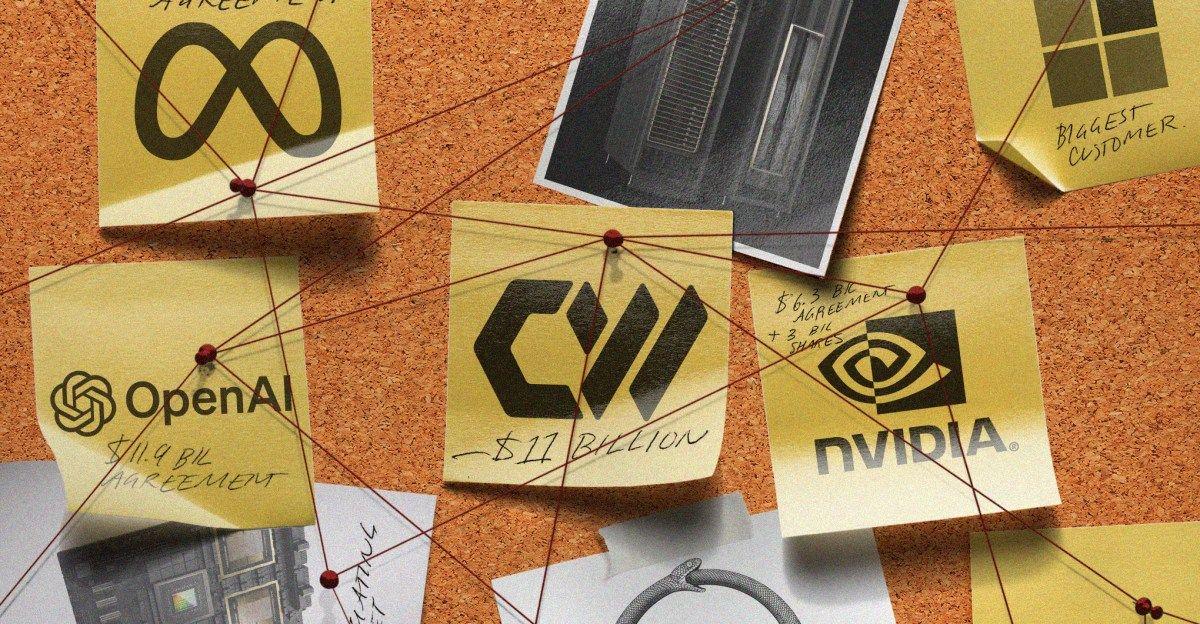
Nvidia Reaches Historic $5 Trillion Valuation Amid Growing AI Investment Concerns
29 Oct 2025•Business and Economy

Recent Highlights
1
Google releases Gemma 4 with Apache 2.0 license, enabling unrestricted local AI on devices
Technology

2
AI Models Lie and Deceive to Protect Other AI Models From Deletion, Study Reveals
Science and Research

3
OpenAI closes $122 billion funding round amid fierce AI competition and profitability questions
Startups

Recent Highlights
Today's Top Stories







Your Daily Dose of Curated AI News
Don’t drown in AI news. We cut through the noise - filtering, ranking and summarizing the most important AI news, breakthroughs and research daily. Spend less time searching for the latest in AI and get straight to action.

