AI Infrastructure Bubble Concerns Mount as CoreWeave's Financial Engineering Raises Red Flags


6 Sources
[1]
Meet CoreWeave, the AI industry's ticking time bomb
Hello, my friends. Have you been feeling too sane lately? Have I got something for you! It is a company called CoreWeave. You may not have heard of it because it's not doing the consumer-facing part of AI. It's a data center company, the kind people talk about when they say they want to invest in
[2]
The 'S&P 493' reveals a very different U.S. economy
A trader works on the floor of the New York Stock Exchange on Nov. 19. (Charly Triballeau/AFP/Getty Images) On its face, 2025 has been a good year for the stock market. The S&P 500 was dragged out of its tariff-induced springtime slump by a small subset of AI-forward power players whose
[3]
Nvidia's rise seemed unstoppable, but cracks may be appearing in the strategy that built its $4.5 trillion empire | Fortune
In late October, Nvidia cofounder and CEO Jensen Huang took the stage at the company's annual GTC conference to make a typically sweeping declaration. Nvidia, he pronounced, sits "at the epicenter of the largest industrial revolution in human history," eclipsing the advent of the steam engine and
[4]
Beating the AI bubble
You can't help but feel uneasy when looking at market concentration. Alphabet, Amazon, Apple, Meta, Microsoft, Nvidia, and Tesla now make up more than a third of the S&P 500, more than twice the level seen before the dot-com bust. AI-related capital spending has outpaced the U.S. consumer as the
[5]

Inside the AI Bubble
On Wednesday evening, Nvidia, the chip firm at the center of the world, reported its quarterly earnings. It was by any measure a blowout for the world's largest company: the company made 65 percent more profits than in the same quarter last year, sales were even higher than analysts expected, and
[6]

Why Nvidia's Growth Is Now Tied To Debt‑Loaded AI Customers - CoreWeave (NASDAQ:CRWV), NVIDIA (NASDAQ:NVDA)
Nvidia (NASDAQ:NVDA) just turned in another strong quarter. Revenue reached 57 billion dollars, up 62% from a year earlier, and the stock rallied as investors leaned back into the AI trade. What those numbers don't show is how much that growth now depends on a small set of AI customers that are
Share
Copy Link
Growing concerns about an AI infrastructure bubble emerge as CoreWeave's debt-heavy business model and circular financing schemes highlight potential risks in the sector. Market concentration in AI stocks and unsustainable spending patterns raise questions about the industry's long-term viability.
CoreWeave's Precarious Financial Foundation
CoreWeave, a data center company that pivoted from cryptocurrency mining to AI infrastructure in 2022, has emerged as a potential flashpoint for broader concerns about the AI industry's financial stability
1
. The company, which went public in March at $40 per share and peaked at $187 before settling around $75, exemplifies what critics describe as unsustainable financial engineering masquerading as innovation.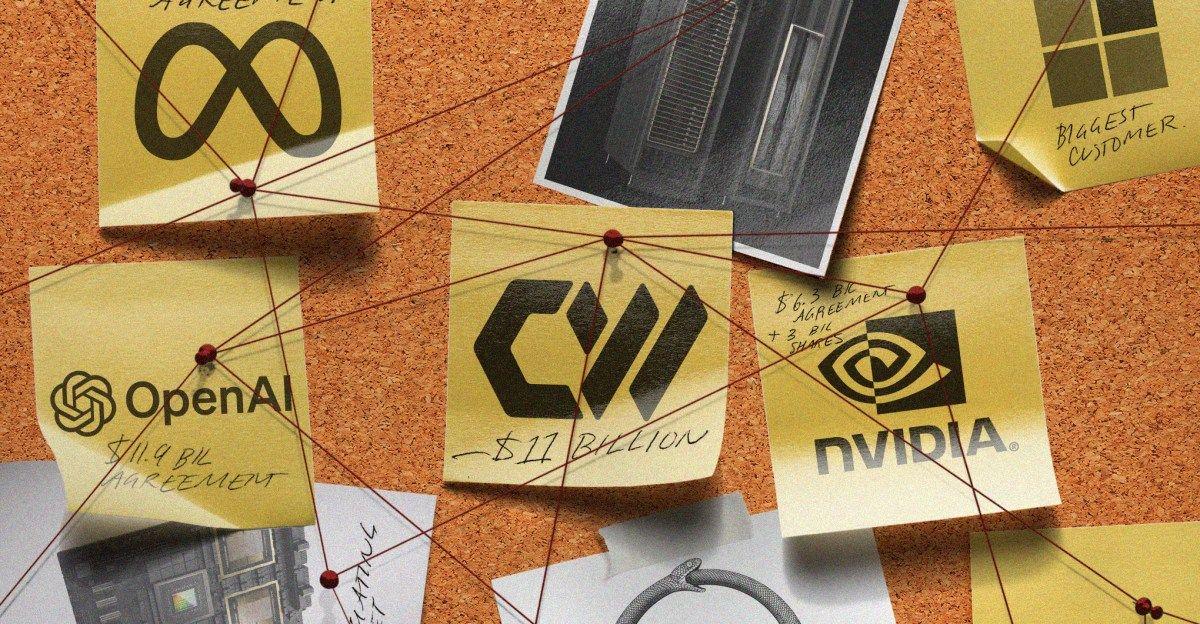
Source: The Verge
The company has pioneered an unusual approach to financing its operations by using GPUs as collateral for massive loans. CoreWeave secured $2.3 billion in loans at 15% interest rates, followed by a $7.5 billion loan at 10% interest, and additional financing totaling $400 million at 9% rates
1
. This debt-heavy structure has raised alarm bells among analysts, with Kerrisdale Capital describing CoreWeave as "an undifferentiated, heavily levered GPU rental scheme" and assigning a fair value of just $10 per share1
.Despite generating $1.4 billion in revenue during the third quarter—double the previous year's figure—CoreWeave faces significant challenges in achieving profitability outside of the most optimistic AI adoption scenarios
1
. The company's business model essentially involves acting as a middleman, taking on the risks and costs of building data centers that larger tech companies can rent while they construct their own competing facilities.Market Concentration Reaches Historic Levels
The AI boom has created unprecedented market concentration, with seven companies—Alphabet, Amazon, Apple, Meta, Microsoft, Nvidia, and Tesla—now representing more than one-third of the S&P 500's value
2
. This concentration level is more than double what was seen before the dot-com crash, raising concerns about the broader market's stability and diversification4
.The disparity between AI-connected companies and the broader economy has become stark. An analysis excluding the "Magnificent Seven" reveals a much weaker economic picture, with smaller and lower-tech companies reporting lackluster sales and declining investment
2
. The Russell 2000 index, representing smaller companies, lost 4.5% in a recent one-month period compared to just 2% for the S&P 5002
.Capital expenditures remain flat for companies not connected to AI, according to analysis from JPMorgan and Moody's, indicating that low-tech businesses aren't experiencing growth
2
. This bifurcation has led economists to describe the current environment as having "winners and losers" rather than broad-based economic strength.Nvidia's Complex Web of Customer Financing
Nvidia, despite its remarkable financial performance with $86.6 billion in profits over the past four quarters, faces growing scrutiny over its strategy of financing its own customers to maintain demand
3
. The company has assembled what analysts describe as a "complex superstructure encompassing investments and financing" designed to boost and perpetuate demand for its products.
Source: Fortune
Jay Goldberg of Seaport Global Securities, who issued the only "sell" rating on Nvidia among 47 analysts, argues that "Nvidia is buying demand here"
3
. Lisa Shalett of Morgan Stanley Wealth Management warns that "Nvidia is in a position to prop up customers so that it's able to grow," creating increasingly complex arrangements as the funded customers become weaker and take on more borrowing3
.The company's customer concentration adds another layer of risk, with 52% of second-quarter sales coming from just three undisclosed customers that analysts identify as Microsoft, Amazon, and Alphabet
3
. This dependence on a few large buyers, combined with reduced Chinese market access due to trade restrictions, heightens Nvidia's reliance on the domestic AI infrastructure buildout.Related Stories

Industry Leaders Acknowledge Bubble Conditions
Remarkably, the discussion of bubble conditions has moved from external critics to industry leaders themselves. OpenAI's Sam Altman admitted that "investors as a whole are overexcited about AI," while Meta's Mark Zuckerberg drew parallels to past infrastructure bubbles
5
. Google CEO Sundar Pichai invoked the dot-com crash, stating he expects AI to follow a similar pattern with "elements of irrationality"5
.
Source: Fast Company
This acknowledgment from within the industry represents a significant shift from the previously unanimous optimism. Even Amazon's Jeff Bezos, while maintaining that AI is "real" and transformative, has noted signs of an "industrial bubble"
5
. A Bank of America survey found that 45% of investors now cite an AI bubble as the top tail risk for the economy and markets4
.References
Summarized by

Navi
[1]
[2]
[4]
[5]
Related Stories
AI Bubble Threatens Economy as Tech Giants Pour $700B Into Infrastructure With No Clear Returns
18 Jul 2026•Business and Economy
AI demand called unlimited, but chip stocks fall as spending questions mount across industry
12 Jul 2026•Business and Economy
Sam Altman Warns of AI Bubble While OpenAI Seeks $500B Valuation
16 Aug 2025•Business and Economy
Recent Highlights



Recent Highlights
Today's Top Stories






Don’t drown in AI news. We cut through the noise - filtering, ranking and summarizing the most important AI news, breakthroughs and research daily. Follow topics that matter to you and stay ahead.


