Trump administration pressures tech companies to fund $15B power plants amid AI energy crisis


16 Sources
16 Sources
[1]
Trump administration wants tech companies to buy $15B of power plants they may not use | TechCrunch
The Trump administration wants the largest electricity grid to add $15 billion worth of new power generation -- and he wants tech companies to pay for it, even if they don't need the capacity. The White House and the governors of several states in the region want grid operator PJM to hold an auction for 15-year contracts for new generating capacity. The administration said it wants tech companies to bid on the contracts even if they don't ultimately need the power for their data centers. Demand from data centers is expected to increase nearly threefold over the next decade. PJM said it was reviewing the "statement of principles" and that it would soon release the results of a months-long planning process that is looking to add new capacity to the grid. The statement is nonbonding, though, and behind the scenes, PJM doesn't appear to be jazzed about the administration attempting to force its hand. "We don't have a lot to say on this," PJM spokesman Jeffrey Shields told Bloomberg yesterday. "We were not invited to the event they are apparently having tomorrow and we will not be there." PJM Interconnection, which covers 13 states in the Mid-Atlantic and the Midwest, serves more than 65 million people and includes the data center hotspot of northern Virginia. Electricity rates in 2025 were up about 10% to 15% in the region compared with the year before. In the last decade, PJM's peak load has increased 10%, according to Monitoring Analytics, and it's expected to increase another 6.5% in 2027. Much of the blame has been laid at the feet of tech companies and data center operators, which have been using increasing amounts of power for AI. The price of natural gas is also to blame. PJM is heavily dependent on the fossil fuel, and the price has soared recently. Monitoring Analytics, PJM's independent monitor, says that about 60% of 2025's price increases are the result of high prices for fossil fuels. Grid operators have been put in a bind as data centers have ramped up demand for electricity after more than a decade of zero growth. Building new fossil fuel power plants is a years-long proposition costing hundreds of millions of dollars. Many utilities and power providers are hesitant to commit to those timelines and outlays. If the AI boom fizzles, they could be left with unprofitable power plants that are built to operate for decades. Tech companies, which haven't traditionally been in the power business, have instead been turning to renewables, which are cheaper, more modular, and faster to deploy. Solar and batteries have been an early winner. A typical solar farm can be built in about 18 months, and because it can be built in phases, can start delivering power before it's complete. That aligns more closely with data center construction, allowing companies to manage risk on similar timelines.
[2]
Trump wants big tech to pay for big beautiful power plants
It just needs PJM Interconnection, one of the US's biggest grid operators, to green light the auction The Trump administration says it wants big tech companies to take more accountability for the power their datacenters consume in an effort to shield voters from higher power bills at home. On Friday, US Energy Secretary Chris Wright and US Interior Secretary (and former Microsoft exec) Doug Burgum met with mid-Atlantic governors to pressure PJM Interconnection - one of the largest grid operators in the country - to hold an emergency auction to address rising energy demand from AI datacenter developments to the tune of $15 billion. PJM is home to the largest concentration of datacenters in the US. Many new bit barns now exceed 100 megawatts of power capacity, with the likes of OpenAI and Meta already eyeing multi-gigawatt campuses. These buildouts have sparked fears of higher power bills for local residents, something that hasn't sat well with politicians on either side of the aisle. Last month, a trio of Democratic senators launched a probe into why consumers were seeing higher rates despite datacenter operators' claims otherwise. Rising energy prices haven't been popular with the US president either. On Monday, Trump used his personal echo chamber Truth Social to declare "I never want Americans to pay higher electricity bills because of datacenters." The initiative launched on Friday seeks to secure new baseload power generation, with US tech titans putting up the cash for 15-year contracts. The DoE argues such an auction is justified after PJM's decision to take 17 gigawatts of capacity offline between 2020 and 2025. Much of the capacity which was already retired or slated for retirement was produced by coal-fired steam generators, for which Trump has shown a particular affinity. "In the coming years, America's reindustrialization and the AI race will require a significantly larger supply of around-the-clock, reliable, and uninterrupted power," an Energy.gov fact sheet reads. "The United States cannot afford to continue down the unstable and dangerous path of energy subtraction previous leaders pursued, forcing the closure of baseload power sources like coal and natural gas." In response to the Trump administration's demands, PJM's board of managers released a plan Friday directing the grid operator's staff to "develop a proposal to both accelerate and execute" a backstop procurement to supplement the company's last capacity auction. The idea of datacenters bringing their own power has gained momentum in recent months, as operators have grappled with both long-term and immediate energy demands. These efforts have included commissioning new gas generator plants along with portable generators to serve as stopgaps. Meanwhile, hyperscalers have placed bets on nuclear power startups like Oklo or X-Energy to satisfy their long-term power demands. In a blog post on Tuesday, Microsoft formalized its commitments to "pay its way" to ensure local utility customers didn't end up footing the bill. In spite of these initiatives, supply chain challenges continue to dog operators. Gas generators offer an easy path to addressing demand, but the equipment necessary to build and deploy them is locked up, with waitlists stretching out to 2030. Meanwhile, even the most optimistic forecasts won't see the first commercial small modular reactors come online until the end of the decade. Having said that, Microsoft has had some luck backing efforts to restart the Three Mile Island Unit 1 reactor. Don't worry, it's the one that didn't partially melt down in the late '70s. The reactor is set to resume operations later next year. ®
[3]
Trump to Direct Key US Grid Operator to Hold Emergency Auction
President Donald Trump and US Northeast governors will direct the nation's largest grid operator to hold an emergency power auction that would force technology giants to pay for the construction of a fleet of new plants. The unprecedented move, set to come Friday, aims to quell concerns about data centers driving up energy costs. Under the initiative, the administration and governors whose states are supplied by PJM Interconnection LLC will direct the grid operator to hold a reliability power auction in which tech companies would bid on 15-year contracts for new electricity generation. If PJM goes along with the plan, it could be mammoth in scale, delivering contracts that would support the construction of some $15 billion worth of new power plants, said a White House official granted anonymity to detail the approach. The push -- which will come in the form of a "statement of principles" signed by Trump's National Energy Dominance Council and the governors of Pennsylvania, Ohio, Virginia and other states -- responds to growing worry about power demand far outpacing supply in the region managed by PJM, which serves more than 67 million people from the Mid-Atlantic to the Midwest. And it seeks to address building tension over how the nation can supply electricity to power-hungry data centers seen as necessary to help win a global competition to dominate artificial intelligence without simultaneously hiking utility bills for American consumers. Trump has repeatedly described power plants being built alongside data centers, and on Monday, he doubled down on the idea, insisting in a social media postBloomberg Terminal that the big technology companies that build data centers must "pay their own way." "I never want Americans to pay higher Electricity bills because of Data Centers," Trump said. Cost-of-living concerns are already weighing heavily on Republicans' bid to maintain control of the House and Senate in this November's elections. While Trump has stressed the plummeting cost of oil and gasoline since he took office last January, electricity prices have climbed due to rising demand -- and there's a building backlash against data centers that are fueling the surge. The average US retail price for electricity gained 7.4% in September to a record 18.07 cents per kilowatt-hour, the biggest gain since December 2023. Residential prices have jumped even higher, rising by 10.5% between January and August 2025, marking one of the largest increases in more than a decade, according to the National Energy Assistance Directors Association. The action Friday is being cast as a one-time emergency intervention into the PJM market, necessary because of the rapid rise in electricity prices in the Mid-Atlantic. The Trump administration and governors will urge the grid operator to return to market fundamentals after the acute problem is addressed, the White House official said. Yet representatives of PJM will not be in attendance when the plan is laid out Friday. "We don't have a lot to say on this," PJM spokesman Jeffrey Shields said by email. "We were not invited to the event they are apparently having tomorrow and we will not be there." The White House did not immediately respond to requests for comment about its interaction with the grid operator. The administration's prescription for PJM is what's known as a reliability backstop auction -- something the grid operator already envisioned in the wake of repeated failed sales. But the administration and governors' plan would mean holding the emergency auction right away after one clear failure - with unusual terms meant to foster a wave of rapid, new construction and the only bidders being data center owners and operators. While PJM currently holds auctions procuring electricity supplies for a 12-month period, the sale encouraged by Trump and governors would involve 15-year contracts, with start-up times for the new power plants likely staggered. The White House and governors are urging PJM to hold the special one-time auction by the end of September. Tech giants would pay for the prices locked in for the duration whether they use the power or not. This auction sets payouts to generators, which would also get paid for real-time electricity that they produce. "It sounds like a significant improvement and a logical extension of bring-your-own new generation," Joe Bowring, president of PJM' s independent watchdog Monitoring Analytics LLC, said in a telephone interview. The approach would provide secure revenues for years in a market notoriously known for price volatility and generator bankruptcies. "While a 'statement of principles' doesn't appear to include a legal mandate for PJM to act, pressure from the Trump administration and a bipartisan coalition of PJM states is very likely to motivate a considerable response" from the grid operator, said Timothy Fox, with the research firm ClearView Energy Partners. This plan also could fast track the development of natural gas generation and potentially nuclear plants by guaranteeing revenues - and profits - specifically to support data campuses needed to deploy artificial intelligence. PJM is already home to the world's biggest concentration of data centers, in northern Virginia, and is expecting peak demand across the 13-state eastern US system to jump 17% by 2030 from this year's high. The approach could benefit larger tech companies at the expense of smaller firms. Amazon.com Inc., Alphabet Inc.'s Google and Microsoft Corp. are less exposed to electricity price fluctuations since they can pass those costs on to customers, said Gil Luria, analyst at DA Davidson & Co. However, dozens of smaller companies, including Nebius and CoreWeave that offer artificial intelligence infrastructure to cloud-computing companies on multi-year contracts, could be more exposed to big price swings since they are on the hook to absorb higher electricity costs, he said. "If they have to pay more for electricity, their margins will get squeezed," Luria said. The effort had the potential to help PJM tackle a significant roadblock: improving the accuracy of its forecasts for demand growth. With tech giants paying for the power plants they need, the approach could weed out speculative projects that have skewed demand growth projections. The involvement of governors - including at least one Democrat, Pennsylvania's Josh Shapiro - is seen by the Trump administration as helping to anchor the effort, since state policies have driven recent changes in the power mix, including the retirement of coal and gas plants. The initiative is also seen aiding hyperscalers by ensuring reliable power supply, and it could be a model for other parts of the country, the White House official said. Governors are committing to implement and assign these costs to the data centers, ensuring the price of these new power plants doesn't land on the average household, the White House official said. The AI boom, in many ways, is taking place at the best and worst time for America's aging power infrastructure. Soaring demand is straining grids already taxed by extreme storms and an overhaul of how power is flowing to homes. The data-center buildout now threatens to drive up household power bills that were already at record levels. It isn't just a PJM problem. Almost all US power grids will lack spare capacity by 2030, while consumers saw an average inflation of 9% in their utility bills over the previous two years, according to Goldman Sachs Group Inc. PJM's auctions have emerged as a political flashpoint in the national debate about affordability after prices reached record levels in 2024. Although Pennsylvania's Shapiro struck a deal with PJM to cap prices in future auctions, costs hit new highs in two subsequent sales. The most recent auction, in December, also fell 6.6 gigawatts short of supplies, which PJM blamed on the frenzy to build massive data centers. PJM is now being asked to extend the price cap through this year, the White House official said. While the statement of principles being signed Friday isn't a binding legal document, administration officials have discussed the plan with a host of stakeholders, from PJM executives and state officials, to utilities, power-plant developers, Wall Street and the hyperscalers building these data centers, the official said. The action comes just before a Monday deadline for PJM to respond to the Federal Energy Regulatory Commission about its plan going forward. And the expectation is that the auction plan will be included in PJM's reply to FERC. The bipartisan agency would need to approve the measures.
[4]
Trump wants tech companies to foot the bill for new power plants because of AI
U.S. President Donald Trump gestures, before boarding Air Force One en route to Detroit, Michigan, at Joint Base Andrews, Maryland, U.S., January 13, 2026. The Trump administration on Friday will push the largest electricity grid in the U.S. to make the big technology companies pay for new power plants. Electricity prices have exploded in recent years on PJM Interconnection due in large part to the data centers that tech companies are building to train and power artificial intelligence. The PJM grid serves more than 65 million people across 13 states and Washington, D.C. Its service area includes northern Virginia, the largest data center market in the world. President Donald Trump wants PJM to hold an emergency auction in which the tech companies would bid on contracts for new electricity generation, a White House official told CNBC. Energy Secretary Chris Wright, Interior Secretary Doug Burgum and bi-partisan governors will unveil the proposal Friday morning. "Under President Trump's leadership, the administration is leading a unprecedented bi-partisan effort urging PJM to fix the energy subtraction failures of the past, prevent price increases, and reduce the risk of blackouts," White House spokeswoman Taylor Rogers said. Bloomberg first reported the news. Utility bills are rising in many parts of the U.S. despite Trump's promise to lower energy prices during his presidential campaign. The issue played a major role in the landslide victories of Democrats Mikie Sherrill and Abigail Spanberger in the New Jersey and Virginia governors' races. The price to secure power capacity in PJM has exploded in recent years with $23 billion attributable to data centers, according to watchdog Monitoring Analytics. Those costs are passed down to consumers. This amounts to a "massive wealth transfer," the watchdog told PJM in a November letter. PJM was six gigawatts short of its reliability requirement for 2027 in its most recent auction. Six gigawatts is equivalent to six large nuclear plants. The power shortage makes blackouts more likely, said Abe Silverman, who served as general counsel for the public utility board in New Jersey from 2019 until 2023 under Democrat Gov. Phil Murphy. "Instead of a blackout happening every one in 10 years, we're looking at something more often," the analyst said.
[5]

How the White House and governors want to fix AI-driven power shortages and price spikes
The White House and a bipartisan group of governors are pressuring the operator of the mid-Atlantic power grid to take urgent steps to boost energy supply and curb price hikes, holding a Friday event aimed at addressing a rising concern among voters about the enormous amount of power used for artificial intelligence ahead of elections later this year. The White House said its National Energy Dominance Council and the governors of several states, including Pennsylvania, Ohio and Virginia, want to try to compel PJM Interconnection to hold a power auction for tech companies to bid on contracts to build new power plants, The Trump administration and governors will sign a statement of principles toward that end Friday. The plan was first reported by Bloomberg. "Ensuring the American people have reliable and affordable electricity is one of President Trump's top priorities, and this would deliver much-needed, long-term relief to the mid-Atlantic region," said Taylor Rogers, a White House spokeswoman. Pennsylvania Gov. Josh Shapiro is expected to be at the White House, a person familiar with Shapiro's plans said, speaking on condition of anonymity ahead of the announcement. Shapiro, a Democrat, made his participation in Friday's event contingent on including a provision to extend a limit on wholesale electricity price increases for the region's consumers, the person said. But the operator of the grid won't be there. "PJM was not invited. Therefore we would not attend," said spokesperson Jeff Shields. It was not immediately clear whether President Donald Trump would attend the event, which was not listed on his public schedule. Trump and the governors are under pressure to insulate consumers and businesses alike from the costs of feeding Big Tech's energy-hungry data centers. Meanwhile, more Americans are falling behind on their electricity bills. Consumer advocates say ratepayers in the mid-Atlantic electricity grid -- which encompasses all or parts of 13 states stretching from New Jersey to Illinois, as well as Washington, D.C. -- are already paying billions of dollars in higher bills to underwrite the cost to supply power to data centers, some of them built, some not. However, they also say that the billions of dollars that consumers are paying isn't resulting in the construction of new power plants necessary to meet the rising demand. Pivotal contests in November will be decided by communities that are home to fast-rising electric bills or fights over who's footing the bill for the data centers that underpin the explosion in demand for artificial intelligence. In parts of the country, data centers are coming online faster than power plants can be built and connected to the grid. Electricity costs were a key issue in last year's elections for governor in New Jersey and Virginia, a data center hotspot, and in Georgia, where Democrats ousted two Republican incumbents for seats on the state's utility regulatory commission. Voters in New Jersey, Virginia, California and New York City all cited economic concerns as the top issue, as Democrats and Republicans gird for a debate over affordability in the intensifying midterm battle to control Congress. Gas and electric utilities sought or won rate increases of more that $34 billion in the first three quarters of 2025, consumer advocacy organization PowerLines reported. That was more than double the same period a year earlier.
[6]

Trump says he'll make tech firms pay for power. They'd love to | Fortune
"They have no shortage of money," said Bloomberg Intelligence analyst Anurag Rana of the tech giants powering the global artificial intelligence race. "They really don't have a problem with funding this thing." Amazon, Microsoft, Alphabet and Meta collectively spend hundreds of billions of dollars on capital investments annually, far exceeding the budgets of the entire utility segment. Data center developers have in fact already said they'd like to buy electricity off the nation's power grids as opposed to signing contracts directly with power generators. That's because grid rates can be cheaper, grids are equipped with backup resources and such systems can help stabilize supplies during extreme weather events. Hyperscalers have also been signing contracts to help bring back nuclear or build new nuclear. Either way, the reality is tech companies have been trying to secure power from every source they can find -- both on and off the grids -- with data center power demand set to triple by 2035. Read More: AI Data Center Energy Needs Are Straining Global Power Systems "We agree data centers should pay their own way," a Google spokesperson told Bloomberg. "For us, it is table stakes. When built responsibly, data centers can provide long-term, reliable demand that stimulates new investments in energy production and transmission in a way that helps all consumers." In calling for an auction, Trump may be solving a public relations problem for tech companies, according to analysts. The industry and their power suppliers have drawn criticism over rising electricity bills and the potential environmental impacts of new plants. An auction like the one Trump's proposing would allow them to circumvent the political headwinds facing individual projects. "This could be a more expeditious way to simply address the issue, as opposed to dealing with all this resistance and problems that are associated with it," said Paul Patterson, a utility analyst at Glenrock Associates LLC. Under Trump's plan, grid operator PJM Interconnection LLC will hold an auction for tech companies to bid on 15-year contracts for new electricity generation capacity. Such contracts are exactly what data center developers are after, offering "more stability, more certainty and more predictability about what the price is going to be," Patterson said.
[7]

Trump wants AI companies to pay $15 billion for electricity
The Trump administration and a coalition of Northeast governors are moving toward a dramatic overhaul of how new power plants get built, pushing a plan that would make Big Tech directly finance new electricity generation for their artificial intelligence build-out. The proposal would ask PJM Interconnection, the country's largest grid operator, to run an emergency electricity auction designed to fast-track new power supply, Bloomberg reported Thursday. The process would give data center operators and other major tech electricity users the option to bid for 15-year contracts that would support the construction of new power plants, rather than spreading costs across all ratepayers. The "statement of principles" will be released later today, and is set to be signed by Trump's National Energy Dominance Council and the governors of 13 states, including Pennsylvania, Ohio, and Virginia. "I never want Americans to pay higher Electricity bills because of Data Centers," President Donald Trump wrote this week on social media, adding that technology companies must "pay their own way." White House officials say the move could ultimately support around $15 billion in new generation capacity if PJM agrees to participate, making it one of the most significant interventions into U.S. electricity markets in recent years. The effort reflects mounting anxiety that power demand is running far ahead of supply across the Mid-Atlantic and Midwest, where PJM manages the grid for more than 67 million people. Utilities have warned that without fresh investment, the region could face tightening margins in coming years. At the same time, the plan speaks to a growing political backlash over data centers -- massive, energy-hungry facilities that are expanding rapidly as companies race to build AI infrastructure. Local communities and consumer advocates increasingly argue that households are footing the bill for tech's electricity appetite through higher rates. An analysis by the Center for American Progress found that households paid 9.6% more for utilities in 2025 compared to 2024, outpacing both wage growth and overall inflation. Trump has tried to turn that tension to his advantage. In recent weeks, he has framed the issue as one of fairness, repeatedly insisting that tech giants rather than ordinary Americans should pay for the grid upgrades their facilities require. The planned auction would, in theory, align with that stance by tying new generation directly to the companies driving demand growth, rather than socializing the costs across all customers. The timing is also political. With congressional control at stake in November, Republicans are keenly aware that rising household expenses, including utility bills, are a vulnerability. While Trump has touted falling gasoline prices since taking office, electricity costs have continued to climb in many parts of the country. Whether PJM ultimately embraces the administration's plan is uncertain. The grid operator has traditionally resisted overt political pressure and could push back on the design of any new auction. Still, Friday's expected statement signals that Washington and state leaders are prepared to lean hard on the grid operator, and on tech companies, to reshape how America powers its data center boom.
[8]

Trump administration calls on tech companies to pay energy bill for new AI power plants
Washington -- The Trump administration and a bipartisan group of governors called for reforms in the largest electric grid in the country to make sure the development of new artificial intelligence plants doesn't drive up electric costs. Federal and state officials signed onto a statement of principles that's focused on the PJM Interconnection grid, which serves over 67 million people in 13 states in the Mid-Atlantic and Midwest. The pact calls on technology companies to foot the bill for new power plants in PJM's region, to address the surge of artificial intelligence data centers that the White House wants to see built. The administration says the National Energy Dominance Council reached an agreement with several states for over $15 billion in new power-generation projects. The statement also calls on PJM to hold an emergency capacity auction for this power -- and to protect residential customers from capacity price increases. Energy Secretary Chris Wright and Interior Secretary Doug Burgum signed onto the plan near the White House, at the Eisenhower Executive Office Building with Republican Gov. Glenn Youngkin of Virginia and Democratic Govs. Wes Moore of Maryland and Josh Shapiro of Pennsylvania. Wright said in a statement that President Trump had "asked governors across the Mid-Atlantic to come together and call upon PJM to allow America to build big reliable power plants again." He promised that the directives would "restore affordable and reliable electricity so American families thrive and America's manufacturing industries once again boom." PJM's grid serves over 65 million people and operates in parts or all of Pennsylvania, New Jersey, Ohio, West Virginia, Virginia, Maryland, Washington, D.C., Michigan, Indiana, Illinois, North Carolina, Delaware, Kentucky and Tennessee. Governors from every state signed onto the statement of principles. The Board of Managers for PJM announced Friday it would take actions to address the additional load to the grid new AI data centers would bring. It says they'd have an "immediate initiation" to secure more power, and hold a "backstop generation procurement process to address short-term reliability needs." PJM's announcement also says it expects the "data center community ... to play a constructive role in addressing the reliability and affordability challenges associated with the scale and pace of the forecasted load additions in the PJM region." Friday's announcement also revealed a little bipartisanship between the Republican White House and potential 2028 presidential Democratic candidates Moore and Shapiro, who have both been calling for an increased power supply and lower energy prices. "We cannot build a 21st-century economy on an energy market that blocks new supply," Moore said in a statement. "This moment calls for urgency. Maryland families and businesses must be served by a reliable grid without shouldering the cost of sky-high energy bills." Shapiro sued PJM in 2024 to stop price hikes, and said he's been working with governors and federal energy officials for months to push PJM to make reforms. "I'm glad the White House is following Pennsylvania's lead and adopting the solutions we've been pushing for," Shapiro said in a statement.
[9]

Trump wants Big Tech to pay for new power plants as electricity prices surge
The data centers that power the AI boom also need power themselves - and a lot of it. Now, the Trump administration wants the tech companies cashing in on AI to foot a bigger part of the bill. The Trump administration said Friday that it would urge major East Coast power grid operator PJM Interconnection to hold an emergency auction for tech companies, inviting them to bid on 15-year contracts for new electricity generation. Under the plan, the power auction would raise billions of dollars that would then go directly toward building out $15 billion in new power plants. Tech companies would be locked into paying for the power they buy at auction over the lifetime of the long-term contracts whether they wind up using the electricity or not, a measure designed to smooth out spikes in electricity costs and offer "15-year revenue certainty" for new plants. The governors of Virginia, Maryland, Ohio and Pennsylvania and other states in PJM's area also signed onto the proposal to remake America's power supply. U.S. Secretary of Energy Chris Wright and U.S. Secretary of the Interior Doug Burgum also supported the plan, which urges the power grid operator to make changes but isn't binding.
[10]

How the White House and governors want to fix AI-driven power shortages and price spikes
The White House and a bipartisan group of governors are pressuring the operator of the mid-Atlantic power grid to take urgent steps to boost energy supply and curb price hikes, holding a Friday event aimed at addressing a rising concern among voters about the enormous amount of power used for artificial intelligence ahead of elections later this year. The White House said its National Energy Dominance Council and the governors of several states, including Pennsylvania, Ohio and Virginia, want to try to compel PJM Interconnection to hold a power auction for tech companies to bid on contracts to build new power plants, The Trump administration and governors will sign a statement of principles toward that end Friday. The plan was first reported by Bloomberg. "Ensuring the American people have reliable and affordable electricity is one of President Trump's top priorities, and this would deliver much-needed, long-term relief to the mid-Atlantic region," said Taylor Rogers, a White House spokeswoman. Pennsylvania Gov. Josh Shapiro is expected to be at the White House, a person familiar with Shapiro's plans said, speaking on condition of anonymity ahead of the announcement. Shapiro, a Democrat, made his participation in Friday's event contingent on including a provision to extend a limit on wholesale electricity price increases for the region's consumers, the person said. But the operator of the grid won't be there. "PJM was not invited. Therefore we would not attend," said spokesperson Jeff Shields. It was not immediately clear whether President Donald Trump would attend the event, which was not listed on his public schedule. Trump and the governors are under pressure to insulate consumers and businesses alike from the costs of feeding Big Tech's energy-hungry data centers. Meanwhile, more Americans are falling behind on their electricity bills. Consumer advocates say ratepayers in the mid-Atlantic electricity grid -- which encompasses all or parts of 13 states stretching from New Jersey to Illinois, as well as Washington, D.C. -- are already paying billions of dollars in higher bills to underwrite the cost to supply power to data centers, some of them built, some not. However, they also say that the billions of dollars that consumers are paying isn't resulting in the construction of new power plants necessary to meet the rising demand. Pivotal contests in November will be decided by communities that are home to fast-rising electric bills or fights over who's footing the bill for the data centers that underpin the explosion in demand for artificial intelligence. In parts of the country, data centers are coming online faster than power plants can be built and connected to the grid. Electricity costs were a key issue in last year's elections for governor in New Jersey and Virginia, a data center hotspot, and in Georgia, where Democrats ousted two Republican incumbents for seats on the state's utility regulatory commission. Voters in New Jersey, Virginia, California and New York City all cited economic concerns as the top issue, as Democrats and Republicans gird for a debate over affordability in the intensifying midterm battle to control Congress. Gas and electric utilities sought or won rate increases of more that $34 billion in the first three quarters of 2025, consumer advocacy organization PowerLines reported. That was more than double the same period a year earlier.
[11]

How the White House and governors want to fix AI-driven power shortages and price spikes
The White House and a bipartisan group of governors are pressuring the operator of the mid-Atlantic power grid to take urgent steps to boost energy supply and curb price hikes, holding a Friday event aimed at addressing a rising concern among voters about the enormous amount of power used for artificial intelligence ahead of elections later this year. The White House said its National Energy Dominance Council and the governors of several states, including Pennsylvania, Ohio and Virginia, want to try to compel PJM Interconnection to hold a power auction for tech companies to bid on contracts to build new power plants, The Trump administration and governors will sign a statement of principles toward that end Friday. The plan was first reported by Bloomberg. "Ensuring the American people have reliable and affordable electricity is one of President Trump's top priorities, and this would deliver much-needed, long-term relief to the mid-Atlantic region," said Taylor Rogers, a White House spokeswoman. Pennsylvania Gov. Josh Shapiro is expected to be at the White House, a person familiar with Shapiro's plans said, speaking on condition of anonymity ahead of the announcement. Shapiro, a Democrat, made his participation in Friday's event contingent on including a provision to extend a limit on wholesale electricity price increases for the region's consumers, the person said. But the operator of the grid won't be there. "PJM was not invited. Therefore we would not attend," said spokesperson Jeff Shields. It was not immediately clear whether President Donald Trump would attend the event, which was not listed on his public schedule. Trump and the governors are under pressure to insulate consumers and businesses alike from the costs of feeding Big Tech's energy-hungry data centers. Meanwhile, more Americans are falling behind on their electricity bills. Consumer advocates say ratepayers in the mid-Atlantic electricity grid -- which encompasses all or parts of 13 states stretching from New Jersey to Illinois, as well as Washington, D.C. -- are already paying billions of dollars in higher bills to underwrite the cost to supply power to data centers, some of them built, some not. However, they also say that the billions of dollars that consumers are paying isn't resulting in the construction of new power plants necessary to meet the rising demand. Pivotal contests in November will be decided by communities that are home to fast-rising electric bills or fights over who's footing the bill for the data centers that underpin the explosion in demand for artificial intelligence. In parts of the country, data centers are coming online faster than power plants can be built and connected to the grid. Electricity costs were a key issue in last year's elections for governor in New Jersey and Virginia, a data center hotspot, and in Georgia, where Democrats ousted two Republican incumbents for seats on the state's utility regulatory commission. Voters in New Jersey, Virginia, California and New York City all cited economic concerns as the top issue, as Democrats and Republicans gird for a debate over affordability in the intensifying midterm battle to control Congress. Gas and electric utilities sought or won rate increases of more that $34 billion in the first three quarters of 2025, consumer advocacy organization PowerLines reported. That was more than double the same period a year earlier.
[12]

AI data centers and average electricity users need separate checks
Under pressure for rising electricity rates as a result of data centers that demand massive amounts of power, AI developers are now maintaining that rates for the average consumer will go down as future data centers come online. Levi Patterson, Nvidia's Director of Energy, Science and AI Infrastructure Policy, claimed at a December congressional program on the future of AI that "we're all sharing costs," and "if you add more demand to share those costs with the grid, then prices will actually go down." A recent study by the Berkeley National Laboratory seems to endorse this theory and says it explains in part why, from 2019 to 2024, states with large-load customers tended to have lower average rates. That's great in theory but wrong on the facts. Additional users will lower overall rates only if there is excess capacity. But there is no spare capacity on the electric grid anymore -- the "low hanging fruit" is gone at this point. As Ryan Hledik, one of the authors of the Berkeley study, explained "what we're starting to see is that a lot of utilities that did have spare capacity are starting to run into capacity constraints." Despite the industry's claim that "we are all sharing costs," utilities will have to build new generation, transmission and distribution facilities just to meet astronomical energy demand from AI data centers. This need for additional investment for data centers will persist even if the AI companies agree to reduce demand during peak hours. Ratepayers shouldn't have to pay for any of these additional investments. To understand what is wrong with the data center developers' claim that prices will fall when they come online, imagine a group of 10 friends who periodically go out for pizza and beer. In theory, the addition of two new people would bring costs down, since the bill would now be split 12 ways. But what if those two people order the most expensive appetizers and wines on the menu? If the total cost is shared equally, everybody is going to pay more. That is the equivalent of what happens when hyper-scalers build an enormous new data center, demand that a utility provides 1 gigawatt or more of electric power and then make the ordinary ratepayer help pay the bill. Data center developers' demands for power are also of a magnitude, timing and level of financial and operational risk that exceeds that of other customers. For example, data center developers favor the most expensive generation facilities -- natural gas and nuclear -- instead of the less expensive solar, wind and coal alternatives. Extending existing transmission lines to serve new data centers is also more expensive than connection costs for non-data center customers. Providing data centers with uninterrupted power 24/7 requires significant upgrades to transmission infrastructure. And data center demand is highly uncertain because many proposed facilities might never be built or will cease operation as the AI marketplace changes. Interestingly, the response for the pizza group's high-spending new diners provides a policy model for state utility commissions -- separate checks. The first step to protecting average ratepayers from data center-driven rate increases is to establish a separate tariff class for large data centers. Hledik thinks this is beginning to happen around the country as utilities "introduce new rate structures specifically for large customers like data centers," to "recover those incremental costs that are being introduced by the data centers," and "avoid having those costs shifted to other customers." Some hyper-scalers have said that they want electricity rates set so that "the cost of our infrastructure required to serve us, is paid by us and not by others." Separate checks -- separate tariffs -- is a start on ensuring that they live up to this promise and pay the full costs of the facilities built for them. Mark MacCarthy is the author of "Regulating Digital Industries" (Brookings, 2023), an adjunct professor at Georgetown University's Communication, Culture and Technology Program, a nonresident senior fellow at the Institute for Technology Law and Policy at Georgetown Law and a nonresident senior fellow at the Brookings Institution. David M. Klaus is a consultant on energy issues who served as deputy undersecretary of the U.S. Department of Energy during the Obama administration and as a political appointee to two other Democratic presidents.
[13]

Surging electricity rates put data centers on 2026 ballot. Here's why.
As the world is in the midst of an ongoing energy crisis, people are looking for ways to reduce electricity consumption. Here are five instant changes you can make to reduce your electricity bill. Voter anger over surging electricity prices is spreading across the country and across partisan lines as energy-guzzling data centers put increasing strain on the power grid and ratepayers' wallets. Now analysts warn rising opposition to the massive warehouses powering the artificial intelligence revolution is shaping up to be a major factor in the 2026 midterm elections. Data centers that provide the computing capacity and storage needed to power AI models like ChatGPT are emerging as the "villain" as Americans face high utility bills, Jefferies analysts said in a report this week. Every political candidate running for office this election year will be forced "to take a position whether they are pro or con data centers/AI." "It is not just an issue at the state and local levels but a federal topic as the election narrative forces the subject in every domain," they said. "Not only will this feature prominently in state level elections, particularly those where there will be Gubernatorial turnover (term limits and not running again) but also nationally where we think many still underestimate the pivot in the Trump administration to focus on these issues." Trump: Tech must 'pay their own way' on data centers President Donald Trump has championed data centers as critical to the U.S. economy and to the AI race with China, but he's facing growing pressure to lower costs for Americans who have soured on his handling of the economy. Trump addressed voters' data center concerns on Monday, Jan. 12, saying his administration was working on deals with technology companies to ensure that Americans would not pick up the tab. "I never want Americans to pay higher Electricity bills because of Data Centers," Trump said in a post on his Truth Social platform. "We are the 'HOTTEST' Country in the World, and Number One in AI. Data Centers are key to that boom, and keeping Americans FREE and SECURE but, the big Technology Companies who build them must 'pay their own way.'" Electricity rates have spiked in recent years as utility companies replace aging infrastructure and upgrade the power grid. Data centers only increase energy demands. A study last year from Carnegie Mellon University and North Carolina State University estimated that data centers and cryptocurrency mining could lead to an 8% increase in the average electricity bill by 2030 and could exceed 25% in major data-center markets such as northern Virginia. Companies fear of backlash as electricity prices soar Regions with a high concentration of data centers have seen sharp increases in electricity prices. "In rural America right now, where data centers are being built, everyone's already angry because their electricity prices have risen a lot," Energy Secretary Chris Wright recently told the North American Gas Forum. Democrat Abigail Spanberger won the Virginia governor's race in November by promising to lower utility bills amid steep rate hikes that voters blamed on the state's data-center boom. Sometimes referred to as the "data center capital of the world" or "data center alley," Northern Virginia hosts a huge share of the globe's internet traffic. "I do think it's important that the brunt of data centers not be put on ratepayers and, in fact, that they pay their own way and their fair share," Spanberger said during her campaign. Technology companies fear the backlash against data centers threatens AI expansion. Community pushback jumped between April and June last year. In just three months, 20 projects valued at $98 billion were delayed or blocked, more than the total for all previous quarters since 2023, according to Data Center Watch, which tracks the pushback. Microsoft this week pledged to cover the costs associated with its data centers. "Especially when tech companies are so profitable, we believe that it's both unfair and politically unrealistic for our industry to ask the public to shoulder added electricity costs for AI," Microsoft's vice chair and president Brad Smith wrote in a blog post. "Instead, we believe the long-term success of AI infrastructure requires that tech companies pay their own way for the electricity costs they create." Last year Microsoft scrapped plans to build a data center in Wisconsin after community pushback.
[14]

How the White House and governors want to fix AI-driven power shortages and price spikes
The White House and a bipartisan group of governors are pressuring the operator of the mid-Atlantic power grid to take urgent steps to boost energy supply and curb price hikes, holding a Friday event aimed at addressing a rising concern among voters about the enormous amount of power used for artificial intelligence ahead of elections later this year. The White House said its National Energy Dominance Council and the governors of several states, including Pennsylvania, Ohio and Virginia, want to try to compel PJM Interconnection to hold a power auction for tech companies to bid on contracts to build new power plants, The Trump administration and governors will sign a statement of principles toward that end Friday. The plan was first reported by Bloomberg. "Ensuring the American people have reliable and affordable electricity is one of President Trump's top priorities, and this would deliver much-needed, long-term relief to the mid-Atlantic region," said Taylor Rogers, a White House spokeswoman. Pennsylvania Gov. Josh Shapiro is expected to be at the White House, a person familiar with Shapiro's plans said, speaking on condition of anonymity ahead of the announcement. Shapiro, a Democrat, made his participation in Friday's event contingent on including a provision to extend a limit on wholesale electricity price increases for the region's consumers, the person said. But the operator of the grid won't be there. "PJM was not invited. Therefore we would not attend," said spokesperson Jeff Shields. It was not immediately clear whether President Donald Trump would attend the event, which was not listed on his public schedule. Trump and the governors are under pressure to insulate consumers and businesses alike from the costs of feeding Big Tech's energy-hungry data centers. Meanwhile, more Americans are falling behind on their electricity bills. Consumer advocates say ratepayers in the mid-Atlantic electricity grid - which encompasses all or parts of 13 states stretching from New Jersey to Illinois, as well as Washington, D.C. - are already paying billions of dollars in higher bills to underwrite the cost to supply power to data centers, some of them built, some not. However, they also say that the billions of dollars that consumers are paying isn't resulting in the construction of new power plants necessary to meet the rising demand. Pivotal contests in November will be decided by communities that are home to fast-rising electric bills or fights over who's footing the bill for the data centers that underpin the explosion in demand for artificial intelligence. In parts of the country, data centers are coming online faster than power plants can be built and connected to the grid. Electricity costs were a key issue in last year's elections for governor in New Jersey and Virginia, a data center hotspot, and in Georgia, where Democrats ousted two Republican incumbents for seats on the state's utility regulatory commission. Voters in New Jersey, Virginia, California and New York City all cited economic concerns as the top issue, as Democrats and Republicans gird for a debate over affordability in the intensifying midterm battle to control Congress. Gas and electric utilities sought or won rate increases of more that $34 billion in the first three quarters of 2025, consumer advocacy organisation PowerLines reported. That was more than double the same period a year earlier.
[15]

President Trump Orders Data Centers to Pay for Power as AI Strains the Grid | PYMNTS.com
By completing this form, you agree to receive marketing communications from PYMNTS and to the sharing of your information with our sponsor, if applicable, in accordance with our Privacy Policy and Terms and Conditions. The proposal lands as AI-driven data center construction accelerates in the PJM (Pennsylvania-New Jersey-Maryland) transmission region, a key hub for cloud infrastructure that underpins payments and commerce. Bloomberg reported that Trump and governors in the PJM footprint will direct PJM Interconnection to run a one-time reliability auction in which data center operators bid for 15-year contracts supporting new generation. A White House official told Bloomberg the auction could underpin about $15 billion in new plants. The initiative will be presented Friday as a nonbinding "statement of principles" signed by Trump's National Energy Dominance Council and governors in states including Pennsylvania, Ohio and Virginia. PJM serves more than 67 million people. Trump has argued that tech companies building power-hungry facilities should "pay their own way," linking the plan to consumer bills. "I never want Americans to pay higher Electricity bills because of Data Centers," he said in a social media post cited by Bloomberg. Bloomberg noted the average U.S. retail electricity price hit a record 18.07 cents per kilowatt-hour in September, up 7.4%. The administration is pushing PJM to hold the special auction by the end of September. Unlike PJM's standard auctions that procure supplies for a 12-month period, this backstop sale would lock in long-term payments to generators -- and require data center companies to pay for the contracted capacity for the full term whether they use it or not. Bloomberg said the approach could accelerate new natural gas generation and potentially nuclear projects, while tilting the playing field toward large hyperscalers over smaller AI infrastructure providers with less ability to absorb higher power costs. PJM is not expected at Friday's event; a spokesman told Bloomberg the grid operator was not invited.
[16]

Trump and governors unveil plan to fight AI electric price hikes by...
WASHINGTON -- President Trump and a bipartisan group of governors joined forces Friday to pressure electricity giant PJM to halt soaring residential power costs by forcing new artificial intelligence data centers to generate their own supply. Energy Secretary Chris Wright, Interior Secretary Doug Burgum and Govs. Wes Moore (D-Md.), Josh Shapiro (D-Pa.) and Mike DeWine (R-Ohio) inked the pact at the White House after voter frustration became a major issue in Mid-Atlantic elections last year. Although the agreement will not necessarily have an immediate impact on prices, federal and state regulators have significant powers to pressure the country's largest power grid operator, whose PJM acronym initially stood for Pennsylvania-New Jersey-Maryland. The pact calls on PJM, whose capacity price increased about 22% over the past year, to invest $15 billion in new power plants to increase supply and to "require data centers to pay for the new generation built on their behalf - whether they show up and use the power or not." The agreement also urges the provider to "protect ratepayers by capping the amount existing power plants can charge in the PJM capacity market," according to the Energy Department. Burgum said the plan "will ensure we usher in the age of artificial intelligence with new power plants funded by the technology companies, not taxpayers, securing the steel of Pennsylvania, the manufacturing of Ohio and the ships of Virginia." Wright blamed the Biden administration's "forceful closures of coal and natural gas plants without reliable replacements" and said that "perhaps no region in America is more at risk than in PJM." The Energy Department said: "During the Biden administration, PJM forced nearly 17 gigawatts of reliable baseload power generation offline. For the first time in history, PJM's capacity auction failed to secure enough generation resources to meet basic reliability requirements. If not fixed, it will lead to further rising prices and blackouts." An Energy Department report found that data centers consumed about 4.4% of total U.S. electricity in 2023, and that rate is expected to jump to 6.7-12% of total U.S. electricity by 2028. Trump has previously described his efforts to allow data centers to generate their own electricity, but the new agreement seeks to make that a requirement. PJM released a statement saying it was "reviewing the principles set forth by the White House and governors." "The PJM Board's decision, resulting from a multi-month stakeholder process on integrating large load additions, will be released later today," the statement said. "The Board has been deliberating on this issue since the end of that stakeholder process. We will work with our stakeholders to assess how the White House directive aligns with the Board's decision." Trump, who did not attend the White House meeting, has unfurled a number of significant new policies aimed at addressing voters' affordability concerns ahead of the November midterm elections, which will dictate whether he faces congressional obstruction and investigations for his final two years in office. In the past month, Trump has pressured credit card companies to cap interest rates at 10%, announced he plans to ban large investors from buying residential housing and directed a $200 billion federal purchase of mortgages to drive down borrowing rates. Moore and Shapiro are believed to be likely 2028 Democratic presidential contenders and their participation in the electricity initiative demonstrates its political salience. Shapiro said that his actions already had saved PJM customers $18 billion, citing his role negotiating a prior price cap, and that "we're going to keep fighting to lower costs." Moore said: "The cost of energy is just too high and it is one of Marylanders top concerns. Together, we are making strides towards more affordable energy for our state." PJM currently supplies power to about 67 million people in 13 states as far west as Illinois. States in its service area include Delaware, DC, Virginia and West Virginia and parts of Indiana, Kentucky and North Carolina.
Share
Share
Copy Link
The Trump administration is pushing the nation's largest grid operator to hold an emergency auction forcing tech giants to pay for $15 billion in new power generation. The move targets surging energy demands from AI data centers that have driven electricity prices up 10-15% in the Mid-Atlantic region, sparking voter backlash ahead of midterm elections.
Trump Demands Tech Giants Fund New Power Generation Capacity
The Trump administration is pressuring PJM Interconnection, the nation's largest electricity grid operator, to hold an emergency power auction that would force tech companies to fund approximately $15 billion worth of new power plants
1
. On Friday, Energy Secretary Chris Wright and Interior Secretary Doug Burgum met with mid-Atlantic governors to unveil a "statement of principles" directing PJM to conduct this unprecedented sale2
. The initiative targets AI power demand that has strained the grid serving more than 65 million people across 13 states, including the data center hotspot of northern Virginia4
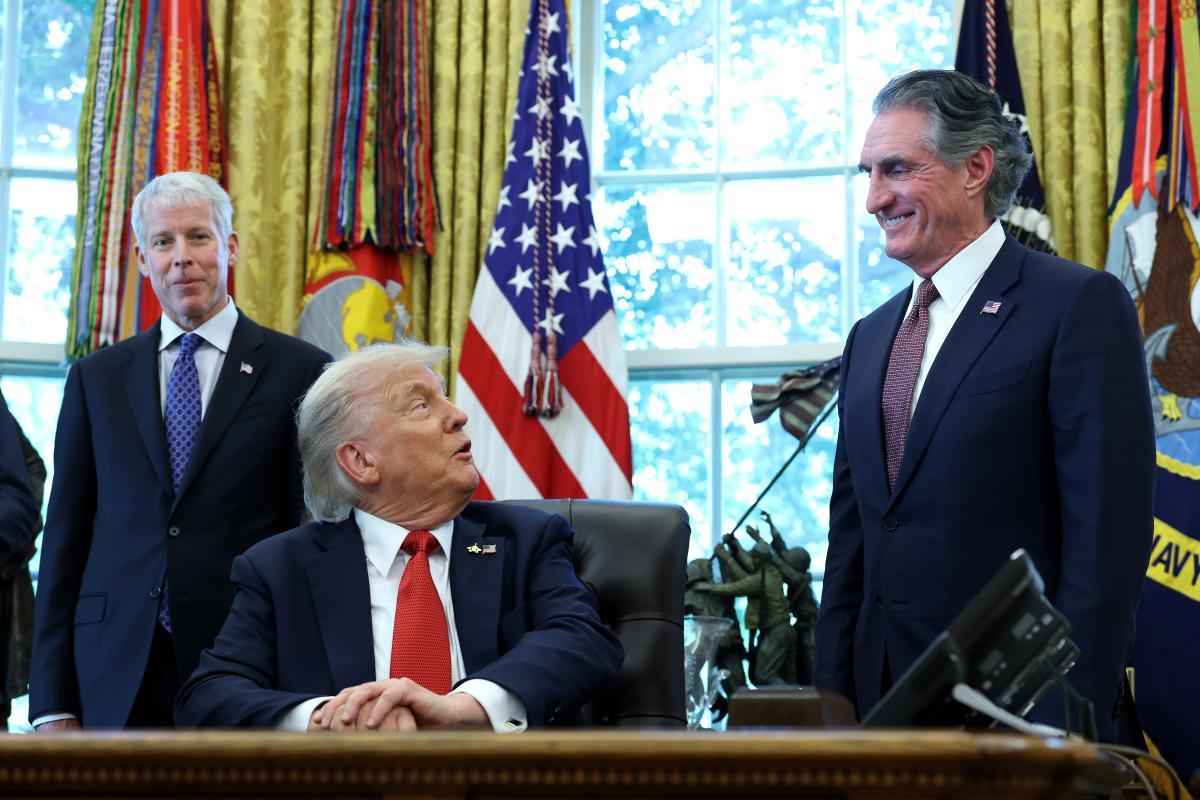
.
Source: New York Post
Under the proposed plan, tech companies would bid on 15-year contracts for new electricity generation, paying for the capacity whether they ultimately use the power or not. Donald Trump emphasized the urgency on Truth Social, declaring "I never want Americans to pay higher Electricity bills because of Data Centers"
2
. The administration wants PJM to hold the special auction by the end of September, with staggered start-up times for new power plants.Rising Electricity Costs Fuel Political Pressure
Electricity prices in the PJM region surged 10% to 15% in 2025 compared to the previous year, with data centers accounting for $23 billion in costs passed down to consumers according to watchdog Monitoring Analytics
4
. The average US retail electricity price jumped 7.4% in September to a record 18.07 cents per kilowatt-hour, while residential prices climbed 10.5% between January and August 2025, marking one of the largest increases in over a decade. These rising electricity costs for consumers have become a critical political issue ahead of November's midterm elections, with utility bills playing a major role in Democratic victories in New Jersey and Virginia gubernatorial races4
.Bipartisan governors from Pennsylvania, Ohio, and Virginia are supporting the initiative, with Pennsylvania Governor Josh Shapiro making his participation contingent on including provisions to limit wholesale electricity price increases for regional consumers
5
. Gas and electric utilities sought or won rate increases exceeding $34 billion in the first three quarters of 2025, more than double the same period a year earlier5
.AI-Driven Power Shortages Threaten Grid Reliability
The significant power consumption of AI has created urgent capacity challenges. PJM's most recent auction revealed the grid was six gigawatts short of its reliability requirement for 2027, equivalent to six large nuclear plants
4
. This deficit increases blackout risks, with analysts warning that instead of blackouts occurring once every 10 years, they could become more frequent4
. PJM's peak load has increased 10% over the last decade and is expected to climb another 6.5% in 20271
.
Source: AP
Many new data centers now exceed 100 megawatts of power capacity, with companies like OpenAI and Meta planning multi-gigawatt campuses
2
. The Department of Energy argues the emergency power auction is justified after PJM took 17 gigawatts of capacity offline between 2020 and 2025, much of it from retired coal-fired generators2
.
Source: PYMNTS
Related Stories

Grid Operator Responds Coolly to Administration Push
Despite the political pressure, PJM Interconnection appears reluctant to comply with the administration's directive. Grid operator spokesman Jeffrey Shields stated bluntly: "We were not invited to the event they are apparently having tomorrow and we will not be there"
1
. The statement of principles is nonbinding, though PJM's board of managers released a plan Friday directing staff to "develop a proposal to both accelerate and execute" a backstop procurement2
.Consumer advocates warn that while ratepayers are already paying billions in higher consumer bills to underwrite power supply for data centers, this money isn't resulting in the construction of new power plants necessary to meet surging energy demands from AI data centers
5
. Joe Bowring, president of PJM's independent watchdog Monitoring Analytics, called the approach "a significant improvement and a logical extension of bring-your-own new generation," noting it would provide secure revenues for years in a market known for price volatility.Tech Industry Explores Alternative Power Solutions
While the administration pushes for baseload power from fossil fuel plants, tech companies have been pursuing different strategies. Microsoft formalized commitments to "pay its way" to ensure local utility customers don't foot the bill, including backing efforts to restart the Three Mile Island Unit 1 reactor, set to resume operations later in 2026
2
. Hyperscalers have also placed bets on nuclear power startups like Oklo and X-Energy to satisfy long-term power demands2
.Many tech companies prefer renewable energy solutions, which are cheaper, more modular, and faster to deploy than fossil fuel plants
1
. Solar farms can be built in approximately 18 months and deliver power before completion, aligning with data center construction timelines and allowing companies to manage risk more effectively1
. However, supply chain challenges continue to constrain all options, with waitlists for gas generators stretching to 2030 and small modular reactors unlikely to come online until the end of the decade2
.References
Summarized by

Navi
[1]
[2]
Related Stories
Trump demands Big Tech cover AI data center power costs as electricity prices surge 6% nationwide
25 Feb 2026•Policy and Regulation

Trump Administration Prepares Executive Orders to Boost AI Infrastructure and Energy Supply
27 Jun 2025•Technology

Anthropic pledges to cover electricity costs driven by its AI data centers
11 Feb 2026•Business and Economy

Recent Highlights
1
Apple Plans Major Siri AI Overhaul in iOS 27 With Third-Party Chatbot Integration
Technology

2
OpenAI shuts down Sora after six months, ending Disney's $1 billion licensing partnership
Technology

3
AI chatbots validate you too much, making you less kind to others, Stanford study reveals
Science and Research

Recent Highlights
Today's Top Stories







Your Daily Dose of Curated AI News
Don’t drown in AI news. We cut through the noise - filtering, ranking and summarizing the most important AI news, breakthroughs and research daily. Spend less time searching for the latest in AI and get straight to action.

