AI boosts breast cancer detection by 10% in major UK screening studies, flags hidden cancers


6 Sources
[1]
Diagnostic accuracy, fairness and clinical implementation of AI for breast cancer screening: results of multicenter retrospective and prospective technical feasibility studies - Nature Cancer
The retrospective evaluation covered five breast screening services from across the UK, representing three distinct clinical workflows, including 125,000 women aged 50-70, who were screened in 2015-2016, as summarized in Table 1. The final analysis included 115,973 women after applying inclusion
[2]
Prospective evaluation of artificial intelligence integration into breast cancer screening in multiple workflow settings: the GEMINI study - Nature Cancer
For healthcare settings wanting to reduce workload, using AI for triage enables single human reading for a subset of cases where AI can serve as the second reader. Compared to routine screening, one modeled 'triage' workflow (OP1) would result in the highest workload savings of 44%, with a 5.8%
[3]
Impact of using artificial intelligence as a second reader in breast screening including arbitration - Nature Cancer
In conclusion, this study explored the effect of introducing AI as a second reader in a double-reader workflow, crucially including the process of specialist arbitration. It showed that AI-enabled reading was noninferior to a standard two-reader workflow. It highlighted that, when replacing a
[4]
AI model flags hidden breast cancers years before diagnosis in routine mammograms
By Hugo Francisco de SouzaReviewed by Susha Cheriyedath, M.Sc.Mar 9 2026 A large NHS screening study shows that artificial intelligence can detect subtle signals in "normal" mammograms that reveal which women are most likely to develop aggressive interval cancers years before they appear. Study:
[5]
Breast cancer detection 'up by 10% with use of AI' - study
Breast cancer detection can be improved by more than 10% with the use of an AI tool, according to the results of a new study. The evaluation was led by the University of Aberdeen following an NHS Grampian project. The team assessed how the AI software could be used to support healthcare workers
[6]
How AI can improve breast cancer detection in the UK
Breast cancer affects one in every eight women in the UK. In this fight, early detection is crucial to giving people the best chance of overcoming the disease. New research from Google, Imperial College London and the UK's National Health Service (NHS), published as a pair of studies in Nature
Share
Copy Link
Major UK studies show AI integration into breast cancer screening increases detection rates by 10.4% and identifies up to 27.5% of interval cancers before they become visible. The technology also reduces radiologist workload by up to 44% while maintaining accuracy across diverse populations, marking a shift in how screening programs could operate.
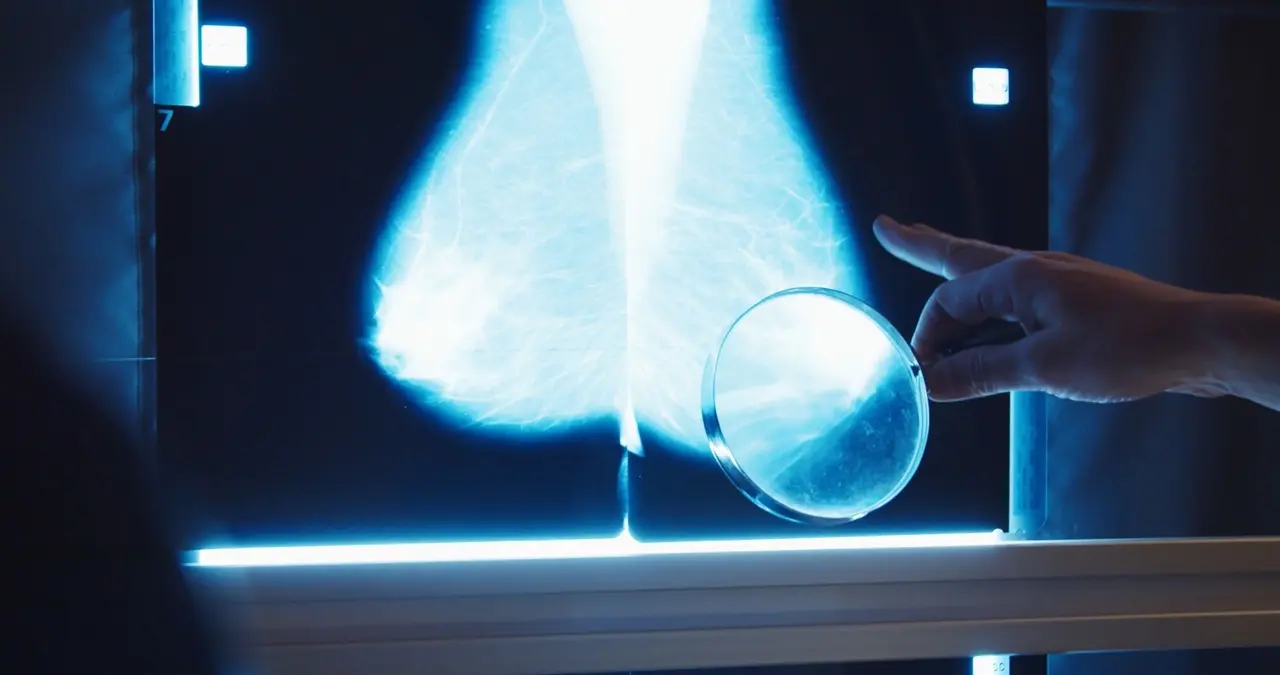
AI Integration Into Breast Cancer Screening Shows Superior Performance
AI has demonstrated the ability to detect breast cancer more effectively than human readers in multiple large-scale UK studies involving over 125,000 women. The technology achieved a cancer detection rate of 9.33 per 1,000 women compared to 7.54 per 1,000 for first human readers, representing a 10.4% increase in cancer detection
1
. This superior performance was maintained across five breast screening services from the NHS (National Health Service), despite varying clinical workflows and patient populations.The retrospective evaluation covered women aged 50-70 who were screened between 2015 and 2016, with the AI system achieving superior sensitivity and noninferior specificity compared to first reader, second reader, and consensus decisions after arbitration
1
. The diagnostic accuracy remained consistent across different mammography equipment from Hologic, GE, and Siemens, demonstrating the technology's adaptability to existing infrastructure.AI as a Second Reader Reduces Workload Without Compromising Accuracy
One of the most significant findings involves the potential to reduce workload for radiologists while maintaining or improving cancer detection. The GEMINI study showed that AI integration into breast cancer screening could reduce workload by up to 44% when used in a triage workflow, where AI serves as a second reader for a subset of cases
2
. A primary AI workflow demonstrated workload savings of up to 31% without increasing the number of women recalled for further investigation.In Denmark, where AI is routinely used in one region, workload has been reduced by 33.5% and recall rates by 20.5%
2
. The technology enables single human reading for cases where AI can confidently serve as the second reader, addressing critical staffing challenges facing screening programs. Different implementation strategies allow sites to prioritize based on their specific needs, whether detecting more cancers, reducing recalls, or saving on workload.Identifying Interval Cancers Years Before Clinical Diagnosis
Perhaps most striking is AI's ability to identify interval cancers—those diagnosed after a negative screening mammogram but before the next scheduled screening. These cancers account for approximately 30% of cancers in screening programs and are often more aggressive with worse prognosis
4
.The academic model Mirai, developed by MIT, achieved the best performance with an interval cancer AUC of 0.77, identifying about 27.5% of interval cancers by flagging the top 4% of "normal" mammogram scans as highest risk
4
. The AI system correctly identified 25.0% of future interval cancer cases, with 88.0% localized to the correct breast and 58.1% to the precise lesion1
. For cancers only identified at the subsequent screening visit three years later, AI correctly flagged 25.1% of cases.Real-World Impact: Earlier Detection Enables Better Outcomes
The practical implications became clear through individual patient experiences. Yvonne Cook, a woman in her 60s from Aberdeen, had breast cancer detected through the AI tool Mia during what she thought would be a routine mammogram in 2023
5
. The AI flagged a small, Grade 2 tumor that was too small to be detected by the human eye. "Had the AI not picked up the small tumour when it did, then either it would have been discovered at my next routine mammogram three years later, or I would have picked it up when it had grown to a stage that I was able to feel it," she explained5
.The University of Aberdeen study involving more than 10,000 women found that AI could also reduce the time to notify women of results
5
. Prof Gerald Lip, clinical director for breast screening in northeast Scotland, stated: "The bottom line here is without AI, doctors would not have caught these cancers as early"5
.Performance Across Diverse Populations and Cancer Types
The AI demonstrated consistent performance across multiple demographic subgroups, including age, index of multiple deprivation, ethnicity, and breast density, with no notable differences compared to first human readers
1
. Sensitivity and specificity remained within acceptable margins across most groups, with AI particularly excelling for women over 65 years of age.The technology showed a preference for detecting higher-risk cancers. Compared to the first reader, AI achieved higher sensitivity for higher-risk cancers (0.55 versus 0.44) and noninferior sensitivity for lower-risk cancers
1
. For invasive cancers alone, the AI system achieved superior sensitivity compared to first, second, and consensus decisions (0.54 versus 0.43, 0.46, and 0.46, respectively)1
.Related Stories


Implementation Strategies and Clinical Workflows
The AIMS study, which included 50,000 women from two NHS breast screening centers, explored AI as a second reader including the arbitration process
3
. The study showed that AI-enabled reading was noninferior to a standard two-reader workflow, with overall reading workload reduced when AI replaced a second reader3
.Multiple workflow options exist for healthcare settings. A "triage negatives" workflow would reduce workload by 37% and recall rates by 12.2% while identifying all cancers detected by routine screening, with positive predictive value increasing by 13.8%
2
. These flexible implementation strategies allow screening programs to align AI deployment with their operational goals and capacity.Comparing AI Models and Future Directions
A head-to-head comparison of four advanced models—Mirai (MIT), iCAD ProFound AI Risk, Transpara Risk, and Google Health's Risk Model—revealed varying performance levels across a dataset of 112,621 mammogram scans
4
. While Mirai achieved the highest AUC of 0.72, all models demonstrated notable predictive performance on mammograms previously interpreted as "normal" during routine screening.The findings will inform expanded trials examining AI use in breast screening at sites throughout the UK
5
. However, limitations remain, including the need for three-year follow-up data to assess actual sensitivity, the exclusion of 8.7-10.8% of cases that fell outside AI's intended use, and questions about how radiologist behavior might change with AI support in live clinical settings2
3
. Further development in explainability and acceptance by mammography readers will be essential for widespread adoption.References
Summarized by

Navi
Related Stories
Recent Highlights



Recent Highlights
Today's Top Stories









Don’t drown in AI news. We cut through the noise - filtering, ranking and summarizing the most important AI news, breakthroughs and research daily. Follow topics that matter to you and stay ahead.


