Nvidia pulls back from OpenAI investment as Jensen Huang cites IPO plans and complex dynamics


52 Sources
52 Sources
[1]
Jensen Huang says Nvidia is pulling back from OpenAI and Anthropic, but his explanation raises more questions than it answers | TechCrunch
At the Morgan Stanley Technology, Media and Telecom conference in downtown San Francisco Wednesday, Nvidia CEO Jensen Huang said his company's recent investments in OpenAI and Anthropic are likely to be its last in both, saying that once they go public, the opportunity to invest in a "consequential company like this" closes. It could be that simple. While firms sometimes pile into companies until practically the eve of their public debut in search of more upside, Nvidia is minting money selling the chips that power both companies -- it's not like it needs to goose its returns by pouring even more money into either one. Asked for comment earlier today following Huang's remarks, a spokesman pointed TechCrunch to a transcript from Nvidia's fourth-quarter earnings call, where Huang said all of Nvidia's investments are "focused very squarely, strategically on expanding and deepening our ecosystem reach" -- which it has presumably already accomplished with its earlier stakes in both companies. Still, a few other dynamics might also explain the pullback. Industry watchers have repeatedly flagged that investing heavily in your own biggest customers creates circular, conflicted arrangements that could have negative downstream effects. When Nvidia first announced it would invest up to $100 billion in OpenAI last September, MIT Sloan professor Michael Cusumano described it to the Financial Times as "kind of a wash," observing that "Nvidia is investing $100 billion in OpenAI stock and OpenAI is saying they are going to buy $100 billion or more of Nvidia chips." That circular logic may help explain why Nvidia ultimately pared back that commitment. The investment it finalized just last week, as part of a $110 billion round, came in at $30 billion -- well short of the $100 billion it had once pledged. On Wednesday, Huang acknowledged as much, saying investing the full amount is "probably not in the cards." Some have posited that bad blood between the two companies could also be a factor, a suggestion Huang has called "nonsense." Whatever the case, Nvidia's relationship with Anthropic has looked fraught in its own right. Just two months after Nvidia announced a $10 billion investment in November alongside a "deep technology partnership" with Anthropic, CEO Dario Amodei took the stage at Davos and, without naming Nvidia directly, compared the act of U.S. chip companies selling high-performance AI processors to approved Chinese customers to "selling nuclear weapons to North Korea." (Those chip companies are Nvidia and AMD.) It's also worth noting what else happened this week. Huang's comments come just days after the Trump administration blacklisted Anthropic, barring federal agencies and military contractors from using its tech after the company refused to allow its models to be used for autonomous weapons or mass domestic surveillance. Within hours of that announcement, OpenAI struck its own deal with the Pentagon -- a move Anthropic has called "mendacious" and the public appears to have viewed similarly. Within 24 hours, Claude had shot to the top of Apple's U.S. App Store, overtaking ChatGPT. (At the end of January, Anthropic was outside the top 100, according to Sensor Tower data.) Where that leaves Nvidia is holding stakes in two companies that, at this particular moment, are pulling in very different directions -- one newly aligned with the Defense Department, and the other blacklisted by it. Whether Huang saw any of this coming, given Nvidia's web of partnerships, is impossible to know. But his stated reason on Wednesday for likely pulling the plug on future investments -- that the IPO window closes the door on this kind of deal -- is hard to square with how late-stage private investing actually works. What's looking more probable, given everything that's unfolded in recent days, is that this is an exit from a situation that has gotten really complicated, really fast.
[2]
OpenAI raises $110B in one of the largest private funding rounds in history | TechCrunch
OpenAI has raised $110 billion in private funding, the company announced Friday morning, commencing one of the largest private funding rounds in history. The new funding consists of a $50 billion investment from Amazon as well as $30 billion each from Nvidia and SoftBank, against a $730 billion pre-money valuation. Notably, the round remains open, and OpenAI expects more investors to join as it proceeds. "We are entering a new phase where frontier AI moves from research into daily use at global scale," OpenAI said. "Leadership will be defined by who can scale infrastructure fast enough to meet demand, and turn that capacity into products people rely on." As part of the investment, OpenAI is launching significant infrastructure partnerships with both Amazon and Nvidia. As in previous rounds, it is likely that a significant portion of the dollar amount comes in the form of services rather than cash, although the precise split was not disclosed. Together with Amazon, OpenAI plans to develop a new "stateful runtime environment" where OpenAI models will run on Amazon's Bedrock platform. The company will also expand its previously announced AWS partnership, which committed $38 billion in compute services, by $100 billion. OpenAI has committed to consuming at least 2GW of AWS Tranium compute as part of the deal, and also plans to build custom models to support Amazon consumer products. "We have lots of developers and companies eager to run services powered by OpenAI models on AWS," said Amazon CEO Andy Jassy in a statement, "and our unique collaboration with OpenAI to provide stateful runtime environments will change what's possible for customers building AI apps and agents." The Information had previously reported that $35 billion of Amazon's investment could be contingent on the company either achieving AGI or making its IPO by the end of the year. OpenAI's announcement confirms the funding split, but says only that the additional $35 billion will arrive "in the coming months when certain conditions are met." OpenAI gave fewer details on the Nvidia partnership, but said it had committed to using "3GW of dedicated inference capacity and 2GW of training on Vera Rubin systems" as part of the deal.
[3]
OpenAI snags $110 billion in investments from Amazon, Nvidia, and Softbank
OpenAI has closed another round of funding, totalling $110 billion being newly committed to the maker of ChatGPT, which it says has more than 900 million weekly active users and over 50 million consumer subscribers. Amazon is investing $50 billion and striking a deal that includes custom models for it to use with Alexa. Nvidia and SoftBank are each contributing $30 billion, as well, even as the Wall Street Journal notes that Nvidia's previous $100 billion investment plan is "on ice." This marks another massive influx of cash for the company that's now valued at $730 billion, and previously closed a $40 billion round in 2025. At the time, it was the largest private tech deal on record. The investment from Amazon is more than just an injection of cash. The companies are entering a partnership that will potentially allow Amazon to play catch-up in the AI market. The two companies will be collaborating on custom models intended to power "customer-facing applications" like Alexa. It will also make AWS a third-party provider of OpenAI Frontier, its enterprise-facing platform for building, deploying, and managing AI agents that will run on Amazon's Trainium chips. Amazon is investing just $15 billion up front, with the additional $35 billion being delivered as certain milestones are met. Rumors have indicated that, like its deal with Microsoft, those milestones include mentions of reaching AGI. OpenAI went out of its way to reiterate its commitment to its partnership with Microsoft. But a reworking of the deal between the two companies is what has allowed OpenAI to pursue the partnership with Amazon, as Microsoft has also reached farther afield and begun working with Anthropic. In the midst of all this, the company is rumored to be launching a smart speaker in early 2027, striking content deals with Disney, and fending off growing competition from the likes of Anthropic and Google. It's also potentially working towards an IPO, as CEO Sam Altman told CNBC that, "We are open to going public at the right time."
[4]
Amazon invests $50 billion in OpenAI, comitting to 2 gigawatts of Trainium silicon -- AWS to become exclusive cloud distributor for Frontier enterprise platform
The deal, part of a $110 billion funding round also backed by Nvidia and SoftBank, commits OpenAI to 2 gigawatts of Amazon's custom Trainium silicon. Amazon and OpenAI have announced a sweeping multi-year strategic partnership, with Amazon committing $50 billion in investment, AWS securing exclusive third-party distribution rights for OpenAI's enterprise agent platform Frontier, and OpenAI agreeing to consume approximately 2 gigawatts of Amazon's custom Trainium compute capacity, according to a press release. The investment is part of a $110 billion funding round that values OpenAI at $730 billion pre-money, with Nvidia and SoftBank each contributing $30 billion. The companies will also co-develop custom AI models for Amazon's own products, including Alexa, and jointly build a new stateful agent runtime on Amazon Bedrock. Split between Trainium 3 and 4 Amazon's $50 billion commitment is structured in two parts: $15 billion upfront, with the remaining $35 billion contingent on conditions that, according to sources cited by The Information, may require OpenAI to complete an IPO or reach an as-yet-undefined "AGI milestone." The deal also expands OpenAI's prior $38 billion AWS compute agreement, struck in November 2025, by an additional $100 billion over eight years. Meanwhile, the 2 gigawatts of Trainium compute will span both the current Trainium 3 generation and the upcoming Trainium 4, which is expected to ship next year. Amazon launched Trainium3 -- a 3nm chip delivering four times the performance of its predecessor at 40% better energy efficiency -- at its re:Invent conference in December 2025. AWS has stated that customers can achieve cost savings of 30 to 40% running training and inference workloads on Trainium compared to equivalent Nvidia GPU configurations. Each Trainium3 UltraServer holds 144 chips, and up to 1 million of them can be linked in a single cluster. Trainium4, meanwhile, is being designed with support for Nvidia's NVLink Fusion interconnect, which allows Trainium4-based systems to interoperate with Nvidia GPUs within the same server rack. Nvidia's CUDA software stack remains the de facto standard, which nearly all large AI workloads are built on, and migrating away from it means rewriting significant portions of a codebase. Anthropic, in which Amazon has invested at least $8 billion, already trains its Claude models on Trainium at scale -- Project Rainier, Amazon's largest dedicated AI data center, houses more than 500,000 Trainium2 chips running Anthropic workloads exclusively. But Anthropic is financially entangled with Amazon. OpenAI is not, which makes its decision to commit 2 gigawatts to Trainium a notably independent validation of the platform. Let's not forget that OpenAI also has a separate deal with Broadcom to develop its own custom ASICs, uses Nvidia GPUs through both Azure and AWS, and has committed to AMD chips -- so, again, its willingness to stake 2 gigawatts on Trainium is a weighty decision. Stateful Runtime Environment Beyond compute commitments, Amazon and OpenAI have announced that they're co-developing a so-called "Stateful Runtime Environment" (SRE) built on Amazon Bedrock and expected to launch within the next few months. Most AI agents run on Retrieval-Augmented Generation (RAG) architectures that effectively use a model as an advanced search engine over a set of embedded documents. The issue with this architecture is that the agents can't retain memory between sessions or carry context across different software tools, and they reset with every new interaction. SRE, Amazon says, keeps context across calls, retains memory of prior work, integrates with AWS data sources, including S3 storage and IAM identity controls, and allows agents to operate persistently across ongoing projects rather than treating each call as isolated. Frontier, OpenAI's enterprise agent platform for building and deploying coordinated AI agent teams across business systems, will be distributed exclusively through AWS as its third-party cloud provider, and the SRE on Bedrock is where that infrastructure will sit. Microsoft-OpenAI partnership 'strong and central' Several initial reports following the announcement have framed the deal as AWS displacing Microsoft's position with OpenAI, but that's not accurate. Azure, per Microsoft, "maintains its exclusive license and access to intellectual property across OpenAI models and products," with Azure remaining the exclusive cloud provider for OpenAI's stateless API calls. Microsoft also retains the option to participate in the current funding round, with both companies issuing joint statements affirming the partnership remains "strong and central." In terms of the Amazon-OpenAI deal, AWS gains the enterprise agent deployment side, while stateless API traffic stays on Azure. AWS holds approximately 30% of the global cloud market heading into this announcement, compared to Azure's roughly 20% and Google Cloud's 13%. Despite that market position, Amazon had been widely characterized as trailing in the generative AI race relative to Microsoft's early OpenAI integration and Google's push with Gemini. Exclusive distribution rights for Frontier, combined with Trainium's cost positioning, fit Amazon's consistent approach to cloud competition, whereby it prioritizes infrastructure scale and cost efficiency over all else. Amazon is now financially backing both of the leading independent frontier AI labs simultaneously -- OpenAI and Anthropic -- which positions it as infrastructure for the industry, regardless of which organization's models prove most durable commercially. This comes with significant financial exposure for Amazon, which is spending approximately $200 billion in capital expenditure in 2026, the majority directed at data centers and AI infrastructure. Its stock had fallen about 8% on the year as investors weighed the return timeline on those outlays. Andy Jassy told CNBC today that he expected OpenAI to be "one of the very big winners" over the long term, but added that Amazon "still has a very strong relationship with Anthropic." OpenAI CEO Sam Altman said the company now has more than 900 million weekly active users and more than 50 million consumer subscribers, and described an IPO as its "most likely path" given ongoing capital demands back in October. The FTC issued subpoenas to Amazon, Microsoft, Google, OpenAI, and Anthropic in early 2024 to examine AI partnerships, with particular attention to exclusivity arrangements, and AWS's exclusive rights to distribute Frontier will no doubt give regulators a concrete point of focus. It's still too early for a legal challenge, but it's understood that the FTC's investigation is ongoing, and these new terms could lead to a bite. However, the $35 billion contingent tranche means a meaningful share of Amazon's headline commitment depends on a trigger -- an IPO or AGI breakthrough -- that comes with no known or guaranteed timeline. Until one of those conditions is met, the investment stands at $15 billion.
[5]
Nvidia's Jensen Huang Rules Out $100 Billion OpenAI Investment
Huang also addressed concerns about his investments in AI companies, arguing that the deployment of AI computing is already generating profitable revenue for companies. Nvidia Corp. Chief Executive Officer Jensen Huang doesn't see his company's investments in OpenAI reaching $100 billion -- the maximum amount that the chipmaking giant had once pledged to spend on the startup. "I think the opportunity to invest $100 billion in OpenAI is probably not in the cards," Huang said at a Morgan Stanley conference in San Francisco Wednesday. He cited OpenAI's plans to go public, potentially by the end of the year. "So this might be the last time we'll have the opportunity to invest in a consequential company like this," Huang said. Nvidia contributed $30 billion to a massive $100 billion funding round for OpenAI last month that valued the ChatGPT creator at $730 billion. While it was the chipmaker's largest single bet on a startup to date, the investment fell far below the up to $100 billion in funding that the company was considering as part of a pact with OpenAI in September. The smaller-than-anticipated investment stoked concerns about relations between the leading AI company and the world's dominant chipmaker. But, as recently as Jan. 31, Huang was describing OpenAI's work as "incredible" and called the firm "one of the most consequential companies of our time." OpenAI declined to comment on Huang's remarks. Huang said Nvidia's recent $10 billion investment in OpenAI rival Anthropic was also probably "the last" one in that company. Anthropic, maker of the Claude AI platform, has similarly laid the groundwork for its own initial public offering. In his appearance at the conference, Huang went on to address concerns that some investors have expressed about his investments in such companies -- and the fears that the use of capital is evidence of a bubble. He reiterated his argument that the deployment of AI computing is already generating profitable revenue for companies, including large publicly traded operators of data centers such as Microsoft Corp. If these customers could get more computing power, they'd be growing even quicker, he argued. Having three times the computing capacity would triple their sales, he said. He also said companies such as Cadence Design Systems Inc. and Synopsys Inc. -- two providers of automated design software and computers -- will become much bigger and more important in the future. Those remarks briefly lifted the stocks. And Huang touted his own company's historic results and said that the industry is only at the beginning of a large growth run. The comments helped send Nvidia shares up as much as 2.6% in New York trading on Wednesday -- even though the company's latest earnings report previously drew a chilly response from investors. "We just had the best earnings of earnings in the history of earnings," he said. "I'm sure somebody had better returns. But anyways, we had a very good quarter. Listen, you can't hold a stock back."
[6]

Amazon, Nvidia open their wallets to lock in OpenAI orders
ChatGPT maker announces $110B in new investment amid flurry of self-serving deals The headlines say OpenAI on Friday announced $110 billion in new investment from Amazon, Nvidia, and SoftBank at a $730 billion pre-money valuation, though terms and conditions apply. Both Amazon's $50 billion and Nvidia's $30 billion investments are tied to massive customer commitments by OpenAI and its partners. Of Amazon's investment, $35 billion will only be paid out "when certain conditions are met." From what we gather, those conditions include renting out two gigawatts worth of Amazon's Trainium AI accelerators and the deployment of OpenAI models and services in AWS. The cloud provider will also be the "exclusive third-party cloud distribution provider for OpenAI Frontier." Announced earlier this month, Frontier is OpenAI's new agent builder aimed at enterprise customers. Curiously, OpenAI was quick to emphasize that "nothing about today's announcements in any way changes the terms of the Microsoft and OpenAI relationship," and that Azure remains the exclusive cloud provider of its stateless OpenAI APIs and first party products, like Frontier. Nvidia's $30 billion investment appears to have similar provisions. In a blog post published on Friday, the AI flag bearer announced an expanded partnership with Nvidia that would see the deployment of three gigawatts of inference and two gigawatts of training capacity built on the GPU slinger's Vera Rubin systems. Announced at CES in January, the racks are expected to begin shipping in the second half of 2026. The economics of datacenters can be tricky to pin down as it varies by region, but at a power usage effectiveness of 1.1, a gigawatt is enough for about 3,600 Vera Rubin NVL72 systems, assuming 250 kW per rack. At an estimated cost of $8.4 million each, that's roughly $30 billion per gigawatt. However, compute only accounts for about half the cost of standing up a modern AI datacenter. The land, shell, power, and plumbing costs make up the remainder. This puts the cost of building and deploying 5 gigawatts worth of Vera Rubin accelerators at more than $300 billion. OpenAI is unlikely to take this on itself. Instead, we expect CEO Sam Altman to broker purchase agreements through its hyperscaler and neocloud partners, as it has done with Oracle and Crusoe for its Stargate facility in Abilene, Texas. Amazon is one of those partners. While OpenAI may be playing up Trainium in today's disclosures, its existing $38 billion tie-up with Amazon, announced back in November, was specific to Nvidia GB200 and GB300 systems. That contract has now been extended to $100 billion over the next eight years. Both Amazon's and Nvidia's investments are structured in such a way as to guarantee a return on every dollar invested in OpenAI. The funding is essentially a discount on compute infrastructure that doesn't dilute their revenues while driving up OpenAI's valuation. This kind of circular dealing has become commonplace amid the AI boom, and all the big boys are taking part. Back in October, Nvidia rival AMD issued OpenAI a warrant for roughly 10 percent of its stock. To claim it, all Altman needs to do is deploy six gigawatts of the chip designer's Instinct accelerators. This week, AMD copied and pasted that deal, extending the same offer to social media and would-be AI magnate Meta. While Nvidia and Amazon are clearly engaged in financial engineering, the same doesn't appear to be the case for SoftBank. Infamous spendthrift Masayoshi Son plans to invest another $30 billion into the company to keep the lights on while Altman and crew continue their search for artificial general intelligence. SoftBank's contribution will be paid out in three tranches of $10 billion beginning in April and wrapping up in October. Even with annualized recurring revenue reportedly exceeding $20 billion and more than 50 million paying subscribers on the books, OpenAI is going to be reliant on outside funding for a while. The company isn't expected to achieve profitability until at least 2029. ®
[7]

Nvidia CEO hints at end of investments in OpenAI, Anthropic
March 4 (Reuters) - Nvidia (NVDA.O), opens new tab CEO Jensen Huang said the latest investments in OpenAI and Anthropic might be the chipmaker's last in those companies, as the AI companies prepare to go public this year. The opportunity to invest $100 billion in OpenAI is probably not in the cards as the ChatGPT creator is set to go public later this year, Huang said at the Morgan Stanley Technology, Media and Telecom conference on Wednesday. Nvidia and OpenAI had announced a $100 billion deal in September last year. Nvidia has instead finalized a $30 billion investment in OpenAI, which might be the last time it has the opportunity to "invest in a consequential company like this," Huang said. OpenAI is laying the groundwork for an IPO that could value the company at up to $1 trillion, Reuters exclusively reported last year. Nvidia's $10 billion investment in Anthropic probably will be the last as well, Huang added. The startup is reportedly looking to go public this year. Anthropic, which is embroiled in a dispute with the Pentagon, has said it has not finalized an IPO decision. OpenAI and Anthropic did not immediately respond to Reuters requests for comment. The Financial Times reported in February that Nvidia and OpenAI had abandoned their $100 billion deal amid doubts about the health of the AI sector. Some analysts had raised concerns about the circular arrangement, as the large investment in Anthropic would have made Nvidia a major investor in one of its biggest customers and the money it would pour into the startup was likely to be spent on its own AI processors. Reporting by Juby Babu in Mexico City; Editing by Shinjini Ganguli Our Standards: The Thomson Reuters Trust Principles., opens new tab
[8]

How Amazon's massive stake in OpenAI could boost its AI and cloud businesses
As part of the deal, OpenAI will use more Amazon Web Services infrastructure, including a commitment to deploy 2 gigawatts of the company's Trainium artificial intelligence chips for its new enterprise platform, called Frontier. "Today, we now have the two largest AI labs who are both significantly betting on Trainium," Amazon CEO Andy Jassy told CNBC's Andrew Ross Sorkin on Friday. The pact marks a significant shift for Amazon, which has forged a strong relationship with OpenAI's primary rival, Anthropic. Amazon has pumped billions of dollars into Anthropic since 2023, and put up an $11 billion data center campus for the company in Indiana called Project Rainier. The company also partly relies on Anthropic's Claude models for some of its AI products, including shopping aide Rufus, and Alexa+, a revamped version of its digital assistant. Jassy told CNBC Friday that the OpenAI deal doesn't change its relationship with Anthropic. "[Anthropic has] always had multiple partners, and we do too," Jassy said. "And so that relationship will stay strong, and we're really excited about the partnership we're building over a long period of time with OpenAI." Amazon and OpenAI also agreed to jointly develop "customized models" for Amazon's engineering teams to power its consumer products. OpenAI will spend $100 billion on AWS over the next eight years, an expansion of its existing $38 billion agreement signed last November. The partnership was announced in tandem with OpenAI's broader $110 billion funding round, which also includes $30 billion from Nvidia and $30 billion from SoftBank. The deal continues a trend of OpenAI diversifying beyond its longstanding partnership with Microsoft, Amazon's top cloud computing rival. Microsoft first backed OpenAI in 2019, and has committed to invest more than $13 billion in the startup. Microsoft also invested $5 billion in Anthropic last November. In a joint statement on Friday, OpenAI and Microsoft said their partnership remains "strong and central." "Microsoft maintains its exclusive license and access to intellectual property across OpenAI models and products," the companies wrote. "Collaborations like the partnership between OpenAI and Amazon were always contemplated under our agreements and Microsoft is excited to see what they build together."
[9]

OpenAI gets $110 billon in funding from a trio of tech powerhouses, led by Amazon
ChatGPT maker OpenAI has received $110 billion in funding from Amazon, SoftBank and Nvidia, putting the technology company's pre-money valuation at $730 billion. Amazon is leading the trio of tech heavyweights in commitments, putting up $50 billion, followed by $30 billion each from Nvidia and SoftBank, said OpenAI co-founder and CEO Sam Altman on Friday. Other investors are anticipated to join as the funding round progresses. Amazon will start with an initial $15 billion investment and will invest another $35 billion in the coming months under preset conditions. "These partnerships expand our global reach, deepen our infrastructure, and strengthen our balance sheet so we can bring frontier AI to more people, more businesses, and more communities worldwide," he wrote. Altman said that ChatGPT has more than 900 million weekly active users, and more than 50 million consumer subscribers. "We are entering a new phase where frontier AI moves from research into daily use at global scale," he said. "Leadership will be defined by who can scale infrastructure fast enough to meet demand, and turn that capacity into products people rely on. This funding and these partnerships let us do both, and move faster on our mission to ensure AGI benefits all of humanity." OpenAI and Amazon's multiyear partnership will include bringing new advanced AI capabilities to enterprises and having Amazon Web Services serve as the exclusive third-party cloud distribution provider for OpenAI Frontier. OpenAI and AWS will expand their current $38 billion multiyear deal by $100 billion over eight years. The companies will partner on developing customized models available to Amazon developers to power Amazon's customer-facing applications. OpenAI said it is also expanding its partnership with Nvidia. OpenAI and Microsoft have had a partnership since 2019. OpenAI said in a statement that nothing about the funding or new partners announced Friday "in any way changes the terms" of its relationship with Microsoft. "The partnership remains strong and central," OpenAI said.
[10]

OpenAI secures another $110 billion in funding from Amazon, NVIDIA and SoftBank
OpenAI just announced a , which is one of the in Silicon Valley history. The investors feature many of the usual suspects, including Amazon with $50 billion, NVIDIA with $30 billion and SoftBank with $30 billion. This investment brings OpenAI to a $730 billion valuation "We're super excited about this deal," OpenAI CEO Sam Altman . "AI is going to happen everywhere." That last statement seems more like a threat than a boast, but I digress. Beyond the funding round, OpenAI has announced strategic partnerships with both NVIDIA and Amazon. This will involve Amazon Web Services (AWS) running OpenAI models for enterprise customers to "build generative AI applications and agents at production scale." It also names AWS as the for OpenAI Frontier, which is an agentic enterprise platform. OpenAI has also committed to consuming 2 gigawatts of Amazon's Trainium capacity, which is the company's custom-designed AI training accelerator. In other words, Amazon is spending a lot of money on OpenAI and then OpenAI will turn around and spend a lot of money with Amazon. The AI . It's also worth noting that Amazon's investment in OpenAI will be staggered. The funding begins with $15 billion, but the remaining $35 billion will only be invested when certain conditions are met. Oddly, it's been reported that one condition is that . AGI is when AI evolves to or beyond human-level abilities, at which point the entire world turns into rainbows and everyone gets a pony. This could happen later this year, according to those , or never, . Sam Altman but has . The new partnership with NVIDIA evolves the . OpenAI has pledged to consume 2 gigawatts of training capacity on NVIDIA's Vera Rubin systems and an additional 3 gigawatts of computing resources, likely in the form of GPUs, to run specific AI inference tasks. In other words, NVIDIA is spending a lot of money on OpenAI and then OpenAI will turn around and spend a lot of money with NVIDIA. .
[11]

OpenAI lands record $110 billion investment backed by Nvidia, Amazon, and SoftBank
Serving tech enthusiasts for over 25 years. TechSpot means tech analysis and advice you can trust. What just happened? OpenAI has secured commitments for a funding round of up to $110 billion, pushing its valuation to $730 billion. The investment - anchored by Nvidia, Amazon, and SoftBank - cements the ChatGPT developer's position as the most heavily backed company in the global artificial intelligence race. People familiar with the matter told the Financial Times that the deal marks a major step toward a potential initial public offering later this year, even amid warnings of speculative excess across the AI sector. The scale dwarfs previous records, including Anthropic's $30 billion funding earlier this year and OpenAI's own $41 billion raise in 2025, which at the time was the largest in the startup world. Unlike traditional venture rounds, most of OpenAI's new financing comes from strategic corporate investors rather than venture capital firms. Nvidia and SoftBank each committed $30 billion, to be paid in three installments, while Amazon pledged $15 billion upfront and another $35 billion contingent on either an IPO or the development of artificial general intelligence. That investment ties directly to a sweeping new partnership unveiled Friday: OpenAI will spend $100 billion over eight years on Amazon's chips and computing power, supplementing an existing $38 billion agreement. The companies also plan to co-develop a custom AI model for Amazon's consumer ecosystem. OpenAI said that its long-standing arrangement with Microsoft, its largest shareholder, remains intact, including Microsoft's exclusive license to OpenAI's core intellectual property. Image credit: the Financial Times A portion of the new funding, roughly $10 billion, is expected to come from sovereign wealth funds and global investment firms now finalizing commitments. OpenAI's balance sheet already holds about $40 billion, money that will continue to fund losses through the end of the decade. Executives project positive free cash flow by 2030, contingent on securing enough compute capacity to support expansion. Most of the incoming capital will be funneled into data center buildouts, chip purchases, and cloud contracts with investors like Amazon and Nvidia. The company's non-profit affiliate, the OpenAI Foundation, may also sell up to $10 billion worth of its $180 billion stake to finance additional grantmaking and recruitment efforts. OpenAI was valued at $500 billion as recently as October during an employee stock sale, and its financial forecasts remain ambitious. Revenues reached roughly $13 billion last year and are expected to double to $30 billion in 2026, possibly surpassing $60 billion by 2027, according to a person with knowledge of internal projections. These figures depend heavily on OpenAI's access to computational resources.
[12]

OpenAI Raises $110 Billion to Fuel Growth, Extending A.I. Boom
OpenAI said on Friday that it had raised $110 billion from investors to pay for its continued growth and fuel the development of artificial intelligence, valuing the company at $730 billion. Amazon is investing $50 billion in the deal, and SoftBank and Nvidia each also invested $30 billion, OpenAI said. OpenAI was previously valued at $500 billion, and the deal cements its place as one of the most valuable private companies in the world. OpenAI's business is unprofitable and needs immense amounts of capital to pay for computing power, A.I. talent and other needs. The company, which owns ChatGPT, is facing intense competition from A.I. start-ups like Anthropic and tech giants like Google, as business and consumers increasingly adopt A.I. tools. "We are entering a new phase where frontier A.I. moves from research into daily use at global scale," Sam Altman, OpenAI's chief executive, said in a statement. "Leadership will be defined by who can scale infrastructure fast enough to meet demand, and turn that capacity into products people rely on." OpenAI said it now has more than 900 million weekly active users, and more than 50 million subscribers who pay for its services. OpenAI has relied on partnerships with other big tech companies to help fuel its growth. At first, Microsoft played a huge role providing the computing power needed to train its A.I. models. (The New York Times sued OpenAI and Microsoft in 2023 for copyright infringement of news content related to A.I. systems. The two companies have denied those claims.) OpenAI is now tightening its relationship with Amazon. As part of the deal, the company will use semiconductors made by Amazon and data centers operated by Amazon Web Services. The two companies will also develop new products specifically for Amazon's cloud computing customers. OpenAI said it would also use semiconductors made by Nvidia as part of the deal. The investment illustrates the circular deal making at the center of the A.I. boom. Companies like Nvidia, Amazon and Microsoft have invested huge sums in OpenAI, Anthropic and others. In exchange, those young companies purchase computing power from those same investors.
[13]

The $100 Billion OpenAI-Nvidia Deal Is Not Happening
The whopping $100 billion investment that Nvidia said it will make in OpenAI is probably not happening, according to Nvidia CEO Jensen Huang. Nvidia's latest finalized investment of $30 billion, which was part of a $110 billion OpenAI funding round last month that also involved a $50 billion investment from Amazon and $30 billion from SoftBank, will likely be the last. That's due to OpenAI's plans to go public later this year, Huang said at the Morgan Stanley Technology, Media and Telecom conference on Wednesday, per Reuters. OpenAI and Nvidia unveiled the $100 billion deal in September. Nvidia promised to build 10 gigawatts of AI data centers for OpenAI, investing a total of $100 billion in the company in 10 installments, with each gigawatt that comes online. The first gigawatt would come online in the second half of 2026. In turn, OpenAI would reinvest some of those dollars to lease Nvidia's chips. At the time, the announcement sparked an industry-wide discussion on the dangers of circular dealmaking and fears of a growing AI bubble. As a handful of top AI companies signed multibillion-dollar deals over and over again with each other, some experts raised worries that the financial dependencies could be a sign of instability. If one deal goes down or demand does not pan out as expected, the domino effect could take the whole system down. Then, the agreement just failed to materialize, and rumors of drama between the two companies began to swirl. In a November earnings report, Nvidia only characterized the deal as "a letter of intent with an opportunity to invest." In a January report, the Wall Street Journal claimed that talks had failed to move past early stages. The report also claimed that Huang had been privately criticizing a lack of discipline in OpenAI's business approach and was worried it could fall behind competitors like Google and Anthropic, ultimately impacting Nvidia's sales. The WSJ article came on the heels of a Reuters report, this time claiming that OpenAI was not pleased with the inference capabilities of Nvidia chips and had, in fact, been blaming some of the weaknesses of its AI coding assistant Codex on Nvidia hardware. Both parties denied rumors of a fallout following the reports, and Huang even claimed that "everything's on track." But a few days later, The Financial Times reported that the two giants would, in fact, abandon the deal, citing anonymous sources. In Nvidia's earnings report last week, the company refused to give any assurance that "a transaction will be completed," while Huang had said that they were continuing "to work with OpenAI toward a partnership agreement, and believe we are close."
[14]

OpenAI secures record-breaking $110B funding
OpenAI announced a landmark funding round and strategic alliances on February 27, 2026, aimed at expanding the reach of artificial intelligence across consumers, developers, and enterprises while cementing its leadership in global AI infrastructure. The initiative, framed under the banner "Scaling AI for everyone," signals a new phase in the commercialization and deployment of frontier AI technologies. The company disclosed $110 billion in new investment, led by major industry players including SoftBank ($30B), Nvidia ($30B) and Amazon ($50B), alongside ongoing infrastructure collaborations across the ecosystem. This capital infusion and these partnerships position OpenAI among the most aggressively funded technology projects in history and mark a profound escalation in the financial stakes around artificial intelligence. OpenAI's announcement outlines a strategy built on three pillars: compute capacity, distribution reach, and capital support to meet accelerating demand for AI tools. According to the company, usage of its consumer-facing products has surged, with ChatGPT reaching more than 900 million weekly active users and over 50 million paid subscribers, metrics that bolster its claim that AI is transitioning from research labs into everyday economic use. The investment round doubles as a strategic push to expand infrastructure capable of supporting both training and inference at global scale. OpenAI also reaffirmed long-standing collaborations with partners such as Nvidia to secure next-generation compute and Amazon for strategic integration across cloud and enterprise use cases. Alongside this funding milestone, OpenAI has been deepening partnerships aimed at driving adoption within the business world. Only days earlier, the company launched the OpenAI Frontier Alliance with top consulting firms including BCG, McKinsey, Accenture, and Capgemini. This initiative is designed to help companies move AI from exploratory pilots to fully integrated, production-grade deployments, a crucial step in monetizing AI technology at scale. The news coincides with other OpenAI developments reinforcing its competitive posture. The company announced a significant expansion of its London research hub, set to become its largest center outside the United States and focused on areas like safety evaluation and model performance. The push for talent and global footprint reflects the wider arms race in AI, where access to world-class researchers and strategic regional presence are increasingly strategic assets. OpenAI's "Scaling AI for everyone" initiative represents a structural shift in how AI innovation is financed and deployed. With unprecedented capital, expanded partnerships, intensified enterprise focus, and global R&D footprints, the company aims to make AI pervasive, not just powerful. Whether this strategy will deliver broad societal benefit, and how it will shape the balance of power in the AI ecosystem, remains a defining question for the remainder of 2026 and beyond.
[15]
OpenAI's $110 billion funding round draws investment from Amazon , Nvidia, SoftBank
Feb 27 (Reuters) - Amazon (AMZN.O), opens new tab will invest $50 billion in OpenAI, starting with an initial $15 billion and followed by another $35 billion in the coming months, the companies said on Friday. The investment is part of a massive funding round for OpenAI, which is raising $110 billion in new investment at a pre-money valuation of $730 billion. The round also includes $30 billion from SoftBank and $30 billion from Nvidia. Amazon's cloud computing platform, AWS, will be the exclusive third-party cloud provider for OpenAI Frontier, the ChatGPT maker's enterprise platform for building, deploying and managing AI agents. OpenAI will consume 2 gigawatts of capacity powered by Amazon's in-house Trainium chips to support computing demand, the companies said. Reporting by Deborah Sophia in Bengaluru; Editing by Arun Koyyur Our Standards: The Thomson Reuters Trust Principles., opens new tab
[16]

Amazon and NVIDIA fuel $110B OpenAI raise as value hits $840B
The company also signed a multi-year strategic partnership with Amazon and secured next-generation inference capacity with NVIDIA. OpenAI says the funding will expand infrastructure, deepen global distribution, and strengthen its balance sheet as AI demand accelerates. Demand for AI tools continues to surge across consumers, developers, and enterprises. OpenAI says meeting that demand requires three things: compute, distribution, and capital. This round aims to secure all three at scale. The growth shows in its products. Codex now serves 1.6 million weekly users, more than triple the number at the start of the year. Developers use the system to build and ship software that once required full engineering teams. More than 9 million paying business users rely on ChatGPT for work. Startups, enterprises, and governments use the OpenAI platform to redesign products and services.
[17]
OpenAI closes $110 billion funding round with backing from Amazon, Nvidia, Softbank
OpenAI has closed a $110 billion funding round, a financing that's more than double the size of its last raise a year ago, which was a record for a private tech company. Amazon invested $50 billion, Nvidia invested $30 billion and SoftBank invested $30 billion in the round, OpenAI said in a release on Friday. The investment boosts OpenAI to a $730 billion pre-money valuation, which marks a big jump from its $500 billion valuation in a secondary financing in October. Other investors are expected to join as the round progresses, OpenAI said. "These partnerships expand our global reach, deepen our infrastructure, and strengthen our balance sheet so we can bring frontier AI to more people, more businesses, and more communities worldwide," OpenAI said. In addition to its participation in the funding round, Amazon announced a multi-year strategic partnership with OpenAI. OpenAI said it is expanding its existing $38 billion agreement with Amazon Web Services by $100 billion over the next eight years, according to a release. AWS will also serve as the exclusive third-party cloud distribution provider for OpenAI's enterprise platform Frontier, which it unveiled earlier this month. The companies said Amazon's $50 billion investment in OpenAI will start with an initial commitment of $15 billion, followed by another $35 billion "in the coming months when certain conditions are met." In the three-plus years since launching ChatPGT, OpenAI has reshaped the technology industry and defined the era of generative artificial intelligence. But the company has to keep reeling in cash in order to finance its ambitions, particularly in paying for graphics processing units and other infrastructure. OpenAI has been telling investors that it's now targeting roughly $600 billion in total compute spend by 2030, months after CEO Sam Altman touted $1.4 trillion in infrastructure commitments, CNBC was first to report last week. The company is providing a lower number and more defined timeline for its planned spending, sources told CNBC, as broader concerns mounted that expansion ambitions were too great for the potential revenue that would follow.
[18]

OpenAI's New $110B Raise At A $840B Valuation Marks The Largest Venture Deal Ever
The AI rounds just keep getting bigger and bigger. OpenAI announced Friday that it has closed on a staggering $110 billion fundraise at an $840 billion post-money valuation. The financing marks the largest raise ever, according to Crunchbase data. The money comes from three sources, with SoftBank and Nvidia each ponying up $30 billion. Amazon is contributing the biggest share, with a $50 billion investment. However, OpenAI says additional investors are expected to join as the round progresses. The next-largest raise ever, per Crunchbase, was also raised by OpenAI in a $40 billion funding round in 2025. The third-largest was raised by rival Anthropic -- a $30 billion Series G haul at a $380 billion post-money valuation that was announced on Feb. 12. The new valuation for OpenAI increases the value of the OpenAI Foundation's stake in OpenAI group to over $180 billion, according to the company. Subscriber growth The company says it's also inked a strategic partnership with Amazon and "secured next generation inference compute" with Nvidia as part of an expansion of its partnership with the chip giant. OpenAI claims that it now has more than 900 million weekly active users and over 50 million consumer subscribers. Subscriber momentum has picked up significantly so far in 2026, according to CEO and co-founder Sam Altman, with January and February on track to be the company's largest months for new subscribers in its history. "We are entering a new phase where frontier AI moves from research into daily use at global scale," he wrote in a blog post. "Leadership will be defined by who can scale infrastructure fast enough to meet demand, and turn that capacity into products people rely on. This funding and these partnerships let us do both."
[19]

Amazon deal with OpenAI shakes up AI landscape
Why it matters: The tech giant's new $50 billion bet on OpenAI reshuffles the AI power map, in what could amount to a win for Amazon, a loosening of power for Microsoft and potential long-term risk for Nvidia as chip competition heats up. Driving the news: Amazon Friday said it will invest $50 billion in OpenAI as part of its $110 billion funding round, while the ChatGPT maker commits to spending $138 billion on Amazon's chips and hardware over the next eight years. * Amazon's investment will be phased, with an initial $15 billion today followed by $35 billion in the coming months as specific conditions are met. The big picture: The deal widens OpenAI's funding base to include more cash from Amazon, less cash than expected from Nvidia and no change to Microsoft's investment. * Microsoft was originally OpenAI's main partner. Now, it is sidelined to a degree as OpenAI is making deals with whoever it can to fund its AI ambitions. * Nvidia was set to commit as much as $100 billion in OpenAI in this deal. That dropped to $30 billion, and now OpenAI is using chips from a potential long-term competitor in Amazon. Zoom in: Through the new deal, OpenAI is committing to 2 gigawatts of capacity on Amazon's custom Trainium3 and Trainium4 chips -- chip power expected to go toward serving up the new services Amazon is offering. * Anthropic's training its upcoming model on Trainium chips as well, meaning the top AI labs are both using Amazon's hardware. * Amazon Web Services -- the cloud arm of Amazon battling Microsoft's Azure -- becomes the exclusive third-party distributor for OpenAI Frontier, a new platform for building teams of AI agents that can accomplish more specific work tasks, which is part of OpenAI's enterprise push. Market impact: Microsoft shares fell 2% Friday, while Nvidia fell 4%. Amazon finished up 1%. State of play: Amazon and Google have been seeing increased demand from the AI labs for their homegrown chips, which the cloud providers say offers better "price performance" than Nvidia -- industry shorthand for bang for your buck. * To a degree, the AI labs will "take whatever they can get," John Belton of Gabelli Funds told Axios, noting demand still far outstrips supply. * To this point, Nvidia has publicly downplayed competitive threats, arguing its software ecosystem and performance lead keep it ahead of rivals. But for OpenAI, sourcing chips from Amazon offers the chance to be more competitive on price longer term. * For the AI labs, the cost of your chip stack could can define your competitive edge. What we're watching: Even though OpenAI is private (for now) investors are clamoring for signs that AI labs care about business fundamentals like cash in vs cash out -- and this could be an example of the company prioritizing that. * Lately, the company's been viewed as a "lurking risk" for investors, Belton said. * Stocks with ties to OpenAI have seen more downside pressure year-to-date than companies with ties to Anthropic due to concerns about OpenAI's ability to fulfill its revenue obligations. What they're saying: It may not be a bad thing for a company like Microsoft to limit its ties to the company, given it's unclear how long OpenAI can be a quality customer, Belton added. * "Microsoft's not going to let OpenAI become 70% of their cloud business. That's just not good business practice," he said. The bottom line: The monogamous era of the AI race is over.
[20]

OpenAI's big investment from AWS comes with something else: new 'stateful' architecture for enterprise agents
The landscape of enterprise artificial intelligence shifted fundamentally today as OpenAI announced $110 billion in new funding from three of tech's largest firms: $30 billion from SoftBank, $30 billion from Nvidia, and $50 billion from Amazon. But while the former two players are providing money, OpenAI is going further with Amazon in a new direction, establishing an upcoming fully "Stateful Runtime Environment" on Amazon Web Services (AWS), the world's most used cloud environment. This signals OpenAI's and Amazon's vision of the next phase of the AI economy -- moving from chatbots to autonomous "AI coworkers" known as agents -- and that this evolution requires a different architectural foundation than the one that built GPT-4. For enterprise decision-makers, this announcement isn't just a headline about massive capital; it is a technical roadmap for where the next generation of agentic intelligence will live and breathe. And especially for those enterprises currently using AWS, it's great news, giving them more options with a new runtime environment from OpenAI coming soon (the companies have yet to announce a precise timeline for when it will arrive). At the heart of the new OpenAI-Amazon partnership is a technical distinction that will define developer workflows for the next decade: the difference between "stateless" and "stateful" environments. To date, most developers have interacted with OpenAI through stateless APIs. In a stateless model, every request is an isolated event; the model has no "memory" of previous interactions unless the developer manually feeds the entire conversation history back into the prompt. OpenAI's prior cloud partner and major investor, Microsoft Azure, remains the exclusive third-party cloud provider for these stateless APIs. The newly announced Stateful Runtime Environment, by contrast, will be hosted on Amazon Bedrock -- a paradigm shift. This environment allows models to maintain persistent context, memory, and identity. Rather than a series of disconnected calls, the stateful environment enables "AI coworkers" to handle ongoing projects, remember prior work, and move seamlessly across different software tools and data sources. As OpenAI notes on its website: "Now, instead of manually stitching together disconnected requests to make things work, your agents automatically execute complex steps with 'working context' that carries forward memory/history, tool and workflow state, environment use, and identity/permission boundaries." For builders of complex agents, this reduces the "plumbing" required to maintain context, as the infrastructure itself now handles the persistent state of the agent. The vehicle for this stateful intelligence is OpenAI Frontier, an end-to-end platform designed to help enterprises build, deploy, and manage teams of AI agents, launched back in early February 2026. Frontier is positioned as a solution to the "AI opportunity gap" -- the disconnect between model capabilities and the ability of a business to actually put them into production. Key features of the Frontier platform include: While the Frontier application itself will continue to be hosted on Microsoft Azure, AWS has been named the exclusive third-party cloud distribution provider for the platform. This means that while the "engine" may sit on Azure, AWS customers will be able to access and manage these agentic workloads directly through Amazon Bedrock, integrated with AWS's existing infrastructure services. For now, OpenAI has launched a dedicated Enterprise Interest Portal on its website. This serves as the primary intake point for organizations looking to move past isolated pilots and into production-grade agentic workflows. The portal is a structured "request for access" form where decision-makers provide: By submitting this form, enterprises signal their readiness to work directly with OpenAI and AWS teams to implement solutions like multi-system customer support, sales operations, and finance audits that require high-reliability state management. The scale of the announcement was mirrored in the public statements from the key players on social media. Sam Altman, CEO of OpenAI, expressed excitement about the Amazon partnership, specifically highlighting the "stateful runtime environment" and the use of Amazon's custom Trainium chips. However, Altman was quick to clarify the boundaries of the deal: "Our stateless API will remain exclusive to Azure, and we will build out much more capacity with them". Amazon CEO Andy Jassy emphasized the demand from his own customer base, stating, "We have lots of developers and companies eager to run services powered by OpenAI models on AWS". He noted that the collaboration would "change what's possible for customers building AI apps and agents". Early adopters have already begun to weigh in on the utility of the Frontier approach. Joe Park, EVP at State Farm, noted that the platform is helping the company accelerate its AI capabilities to "help millions plan ahead, protect what matters most, and recover faster". For CTOs and enterprise decision-makers, the OpenAI-Amazon-Microsoft triangle creates a new set of strategic choices. The decision of where to allocate budget now depends heavily on the specific use case: Despite the massive infusion of Amazon capital, the legal and financial ties between Microsoft and OpenAI remain remarkably rigid. A joint statement released by both companies clarified that their "commercial and revenue share relationship remains unchanged". Crucially, Microsoft continues to maintain its "exclusive license and access to intellectual property across OpenAI models and products". Furthermore, Microsoft will receive a share of the revenue generated by the OpenAI-Amazon partnership. This ensures that while OpenAI is diversifying its infrastructure, Microsoft remains the ultimate beneficiary of OpenAI's commercial success, regardless of which cloud the compute actually runs on. The definition of Artificial General Intelligence (AGI) also remains a protected term in the Microsoft agreement. The contractual processes for determining when AGI has been reached -- and the subsequent impact on commercial licensing -- have not been altered by the Amazon deal. Ultimately, OpenAI is positioning itself as more than a model or tool provider; it is an infrastructure player attempting to straddle the two largest clouds on Earth. For the user, this means more choice and more specialized environments. For the enterprise, it means that the era of "one-size-fits-all" AI procurement is over. The choice between Azure and AWS for OpenAI services is now a technical decision about the nature of the work itself: whether your AI needs to simply "think" (stateless) or to "remember and act" (stateful).
[21]

OpenAI announces $110bn funding round that would value firm at $840bn
Deal signals feverish pace of AI investment with multibillion-dollar backings from Nvidia, Amazon and more OpenAI said on Friday it is raising $110bn in a blockbuster funding round that would value the ChatGPT maker at $840bn, in a deal that signals the feverish pace of investment in artificial intelligence. It's more than double the amount the company raised last year, when it racked up $40bn in the largest private tech deal on record. This year's funding round, which is still open, includes a $30bn investment from SoftBank, $30bn from Nvidia, and $50bn from Amazon, and comes ahead of the AI startup's expected mega-IPO later this year. Even more investors are expected to join. "We're super excited about this deal," OpenAI CEO Sam Altman told CNBC on Friday. "AI is going to happen everywhere. It's transforming the whole economy, and the world needs a lot of collective computing power to meet the demand." Big tech executives have signaled to their investors in recent weeks that they are doubling down on investing in AI, despite fears that the AI boom could come with heavy costs. AI's expansion is dependent on the creation of massive datacenters, which are facing scrutiny by lawmakers and communities for driving up energy prices and draining water supplies. There are also fears of AI driving up unemployment, as companies try to replace workers with automated processes. On Thursday, fintech company Block announced that it would be laying off 4,000 of its 10,000 employees because of gains in AI productivity. That dramatic reduction in workforce appears to be part of a broader trend, as Goldman Sachs noted in February that AI resulted in 5,000 to 10,000 monthly net job losses last year. Big tech companies and large tech investors such as SoftBank are racing to forge partnerships with OpenAI - which is spending heavily on datacenters - betting that closer ties with the company would give them a competitive edge in the AI race. "We are entering a new phase where frontier AI moves from research into daily use at global scale," OpenAI said in a company blog post on Friday. "Leadership will be defined by who can scale infrastructure fast enough to meet demand, and turn that capacity into products people rely on. ChatGPT now has more than 900 million weekly active users and more than 50 million consumer subscribers. OpenAI also highlighted the power of its products like Codex, its cloud-based software engineering agent that's available to paid ChatGPT subscribers - describing its output as equivalent to a "top engineer". "Weekly Codex users have more than tripled since the start of the year to 1.6M," the company wrote. "More people are now creating, automating, and shipping software that once required a full engineering team." Amazon will start with an initial $15bn investment, followed by another $35bn in the coming months "when certain conditions are met", OpenAI wrote, without elaborating on what they were. Along with the investment, OpenAI and Amazon have also struck a deal, in which OpenAI will utilize two gigawatts of computing capacity powered by Amazon's in-house Trainium chips, the companies said. "This agreement lowers the cost and improves the efficiency of producing intelligence at scale," OpenAI said in a statement on Friday. Amazon's cloud computing platform, AWS, will also be the exclusive third-party cloud provider for OpenAI Frontier, the ChatGPT maker's enterprise platform for building, deploying and managing AI agents. The partnership does not change OpenAI's existing relationship with Microsoft. Microsoft Azure still remains the exclusive cloud provider for OpenAI's APIs that provide access to OpenAI's models, the companies said. OpenAI's first party products will continue to be hosted on Azure, and Microsoft holds its exclusive license and access to intellectual property across OpenAI models and products. It was not immediately clear whether Nvidia's $30bn investment replaced its earlier commitment announced in September under which Nvidia would invest up to $100bn in the startup. OpenAI said in its statement that this expansion would strengthen its ability to "train and deploy frontier models at global scale". Nvidia CEO Jensen Huang affirmed his commitment to working with OpenAI in January in response to reports of tension between the two companies.
[22]

Amazon, Nvidia Flood OpenAI With Cash as ChatGPT Maker's Valuation Hits $730 Billion - Decrypt
Microsoft and OpenAI said the addition of new investors and partnerships doesn't change their deal at all. OpenAI has announced $110 billion in new investment at a $730 billion pre-money valuation, securing $30 billion each from Nvidia and SoftBank, with Amazon adding $50 billion to the pot. The ChatGPT maker has also revealed broader strategic alliances with Amazon and Nvidia. ChatGPT now has over 900 million weekly active users and 50 million consumer subscribers, OpenAI said in a Friday blog post. The firm added that its Codex AI coding tool has seen its weekly user base more than triple to 1.6 million since the start of the year, suggesting a strong growth area as more people use AI for coding purposes. The Amazon partnership focuses on accelerating AI adoption for enterprises and startups, while the expanded Nvidia collaboration includes dedicated inference and training capacity on next-gen hardware systems. "We're pushing the frontier across infrastructure, research, and products to make AI more capable, reliable, and broadly useful," said OpenAI CEO Sam Altman, in a statement. "SoftBank, Nvidia, and Amazon are long-term partners who share our ambition to turn real scientific progress into systems that deliver meaningful benefits for people at global scale," he added. "Building AI that works for everyone will require deep collaboration across the stack, and we're excited to do this together." OpenAI said that additional investors are expected in the round, with only the three backers and $110 million investment announced so far on Friday. The raise also boosts the OpenAI Foundation's stake in the company to over $180 billion, expanding its philanthropic capacity in areas like health and AI resilience. "Artificial intelligence is the most consequential technology of our time, and OpenAI is at the forefront," said Nvidia founder and CEO Jensen Huang, in a statement. "We have been privileged to partner with OpenAI since its earliest days, as it delivered one breakthrough after another. Together, we will continue to push the frontier -- building the infrastructure for the age of AI and scaling its benefits to serve industries and societies worldwide." In a separate joint statement, OpenAI and Microsoft said that the addition of new investors doesn't impact their existing relationship. "Microsoft and OpenAI continue to work closely across research, engineering, and product development, building on years of deep collaboration and shared success," they wrote. "Microsoft maintains its exclusive license and access to intellectual property across OpenAI models and products. Collaborations like the partnership between OpenAI and Amazon were always contemplated under our agreements and Microsoft is excited to see what they build together."
[23]

OpenAI raises $110 bn in record funding round
San Francisco (United States) (AFP) - OpenAI announced Friday a massive $110 billion funding round valuing the ChatGPT maker at $730 billion, with SoftBank, Nvidia and Amazon each making multi-billion-dollar commitments as the artificial intelligence company races to meet surging global demand. The investment round -- one of the largest in Silicon Valley history -- includes $30 billion from Japanese conglomerate SoftBank, $30 billion from chip giant Nvidia, and up to $50 billion from Amazon, with additional investors expected to join as the round progresses. Alongside the capital injection, OpenAI announced strategic partnerships with both Amazon, the world's biggest cloud company through its AWS division, and Nvidia, whose AI chips remain unparalleled in their capacity for AI training. "SoftBank, Nvidia, and Amazon are long-term partners who share our ambition to turn real scientific progress into systems that deliver meaningful benefits for people at global scale," OpenAI said in a statement. The eye-watering level of funding reflects the soaring costs of computing power and comes amid lingering questions about whether OpenAI and other AI companies can generate sufficient revenue to cover those costs. The Amazon investment will begin with $15 billion, followed by another $35 billion in the coming months when certain conditions are met, the companies said. According to reports, these include OpenAI going public or achieving artificial general intelligence, a sometimes ill-defined standard of AI capability that more closely matches human-level ability. OpenAI and Amazon also struck a deal in which the ChatGPT maker will use two gigawatts of computing capacity powered by Amazon's in-house Trainium chips. Amazon's cloud computing rival Microsoft, which did not participate in the funding round, remains a major shareholder of OpenAI and a strategic partner. In the announcement, OpenAI cited a series of user metrics pointing to a breakneck pace of AI adoption. Even if short of its previous forecasts, ChatGPT now counts more than 900 million weekly active users and over 50 million paying consumer subscribers, with January and February on track to be the platform's biggest-ever months for new subscriptions, the company said. It added that more than nine million businesses pay to use ChatGPT for workplace tasks, while its Codex software development tool has seen weekly users more than triple since the start of the year to 1.6 million. The figures are intended to reassure more skeptical investors who have questioned OpenAI's ability to secure revenue, with user growth for its flagship ChatGPT slowing. The company this month began rolling out advertising for its non-premium users in a bid to bring in more revenue. According to The Information tech news, OpenAI now predicts that it will burn more than twice as much cash through 2030 than previously predicted, spending $665 billion on the costs of running and training its AI. Competition has ramped up too. Arch-rival Anthropic, founded by former OpenAI employees, continues to gain ground and grab headlines for its well-regarded Claude AI models. Anthropic earlier this year secured a $30 billion funding round. Google's AI model Gemini has also emerged as a potent competitor, with Elon Musk's xAI also attracting investment and users.
[24]

OpenAI announces another $110 billion in investment funding including $30 billion from Nvidia, but says Microsoft is still its best friend forever
Aww. Isn't it sweet when multi-billion, sometimes multi-trillion dollar businesses buddy up? More money for the money god. OpenAI has announced a new $110 billion investment in its business, which breaks down to include $30 billion from Nvidia, $30 billion from Japanese investment titan SoftBank, and $50 billion from everything-else-giant, Amazon. "We've also signed a strategic partnership with Amazon and secured next-generation inference compute with Nvidia", says the company. "Additional financial investors are expected to join as the round progresses." On the Nvidia news, OpenAI says that its "long standing collaboration" with the company now includes the use of "3 GW of dedicated inference capacity and 2 GW of training on Vera Rubin systems." "This builds on Hopper and Blackwell systems already in operation across Microsoft, OCI, and CoreWeave." Nvidia's Vera Rubin AI superchips are scheduled for release in the second half of this year, but it looks like OpenAI is leaping ahead of the queue and securing a fair amount of training capacity already. In terms of rhetoric, it's certainly a different tone to the one struck earlier this month where rumours persisted that OpenAI was unhappy with team green's AI GPUs, and that Nvidia was having second thoughts about pumping $100 billion into the company. On that note, it's not clear as to whether Nvidia's $30 billion investment is a new adjustment of that overall figure, or merely what the company plans to invest in this particular round. Watch this space, I guess. Still, while OpenAI, Nvidia, and Amazon are now strengthening their ties in the ever-spinning merry-go-round that is AI investment, it looks like the former is keen to get the jump on any suggestions that its relationship with Microsoft is any worse off. In a separate post, OpenAI said: "As conversations around AI investments and partnerships grow and as OpenAI announces new funding and new partners as they did today, we want to ensure these announcements are understood within the existing construct of our [Microsoft] partnership." "Nothing about today's announcements in any way changes the terms of the Microsoft and OpenAI relationship", OpenAI continues. "The partnership remains strong and central." As if to really ram that message home, the next few points come under bolded headings that include: "Our IP relationship continues unchanged." "Our commercial and revenue share relationship remains unchanged." "Azure remains the exclusive cloud provider of stateless OpenAI APIs." "The partnership supports OpenAI's growth." Is all that understood? OpenAI, Nvidia, and Amazon are definitely mates, but Microsoft remains its best friend forever, and there should be absolutely no speculation otherwise. I'm glad we could clear all that up.
[25]
Amazon strikes $50B OpenAI deal
Driving the news: Amazon and OpenAI on Friday announced a multi-pronged deal that calls for Amazon to invest up to $50 billion in OpenAI, with Amazon getting access to a variety of OpenAI services. * The most notable piece: Amazon would be first to offer a new kind of computing they are calling "stateful runtime environment." * Basically that means that Amazon would deliver OpenAI's algorithms to businesses along with context, such as which user made the request and what they've asked before -- similar to how ChatGPT remembers past queries. * That distinction matters because Microsoft has the exclusive right to deliver traditional API calls, which is where developers pay to query OpenAI services without sharing who is asking or for what purpose. The big picture: OpenAI and Amazon argue so-called "stateful" systems better reflect how AI agents will operate in production. * "A lot of agent prototypes based on stateless APIs tackle simple use cases: one prompt, one answer, maybe one tool call," OpenAI said in a blog post. * "Production work is different. Real workflows unfold across many steps, require context from previous actions, depend on multiple tool outputs, approvals, and system state, and need trusted guardrails in secure environments." Yes, but: These systems must be structured so they're usable for customers -- without violating the terms of Microsoft's OpenAI agreement. The big picture: Amazon's web services unit, while still growing, has trailed Microsoft and Google, which have leaned into their own AI services. * AWS has largely delivered others' models, competing mainly on cost and infrastructure. What's inside: Amazon also gains the ability to resell some OpenAI services and to tailor models for its own use. * Amazon can now resell OpenAI Frontier, a service designed to deploy full AI agents to businesses. Microsoft remains involved in delivering Frontier regardless of whether customers buy it through Amazon or OpenAI. * Under the terms of the deal, Amazon has the right to offer custom versions of OpenAI models directly -- a potential boost for both its enterprise efforts and its ongoing Alexa revamp. * OpenAI will use more Amazon chips and cloud infrastructure to power the offerings. The bottom line: The agreement positions Amazon as a central player in the generative AI race rather than a cloud provider competing mainly on price.
[26]

OpenAI raises $110B at $730B valuation, expands AWS and Nvidia partnerships - SiliconANGLE
OpenAI Group PBC today announced that it has raised $110 billion in funding at a pre-money valuation of $730 billion. Nvidia Corp. and SoftBank Group PBC provided $30 billion each. The remaining $50 billion came from Amazon Web Services Inc., which has also expanded its technical partnership with OpenAI. In November, the ChatGPT developer committed to using $38 billion worth of AWS services. The deal announced today will add another $100 billion worth of cloud consumption over 8 years. In particular, the Amazon.com Inc. unit will use its AWS Trainium artificial intelligence chips to provide OpenAI with 2 gigawatts of computing capacity. OpenAI is adopting not only the newest chip in the product series, Trainium3, but also a planned successor called Trainium4. The companies disclosed today that Trainium4 will provide a "major performance gain," particularly when running FP4 workflows. FP4 is a data format commonly used by AI models. OpenAI expects its Trainium4 clusters to start coming online in 2027. The company will use some of the chips' computing capacity to power a new offering called the Stateful Runtime Environment. It will run on AWS' Amazon Bedrock managed AI service. The offering is intended to power AI agents that can perform multi-step tasks. According to OpenAI, the Stateful Runtime Environment will enable agents to carry over data from one step to another. The company will also use its Trainium computing capacity to power Frontier, a software platform it debuted this month. The platform makes it easier to build and maintain AI agents. AWS will become the "exclusive third-party cloud distribution provider" of Frontier under the partnership. The Amazon unit's largest competitor in the cloud market, Microsoft Corp., is also a major OpenAI backer. It has provided the ChatGPT developer with $13 billion worth of funding and infrastructure since 2019. The companies said in a joint statement today that their "partnership remains strong and central." Their revenue sharing agreement will remain in place following the funding round, as will a contract that gives Microsoft access to some of OpenAI's intellectual property. The tech giant will also continue providing infrastructure to OpenAI. The ChatGPT developer uses Nvidia Corp. chips installed in Microsoft, Oracle Corp. and CoreWeave Inc. data centers to power many of its workloads. Nvidia will broaden its chip partnership with OpenAI following the funding round. Currently, the LLM developer's graphics card clusters mainly use Hopper and Blackwell chips. The expanded partnership will see OpenAI add 5 gigawatts of computing capacity powered by the Vera Rubin architecture. The architecture comprises the Rubin graphics card, which Nvidia debuted last month, and a central processing unit called Vera. OpenAI says that it expects several more backers to join the funding round. CNBC cited a source as saying that Microsoft has the option to participate. The raise could be OpenAI's last before its initial public offering, which is expected to take place as soon as this year. "Through this additional investment, we will accelerate OpenAI's research and ecosystem expansion, while advancing our own ASI strategy," said SoftBank Chief Executive Officer Masayoshi Son. OpenAI disclosed that more than 50 million consumers and 9 million business users are now paying for ChatGPT. It added that January and February are "on track to be the largest months for new subscribers in our history." Some of that growth is driven by OpenAI's Codex programming tool, which has seen its weekly user count more than triple since the start of the year.
[27]

OpenAI raises $110bn in round double the size of previous goal
Alongside the investment, OpenAI and Amazon have also reached a deal in which OpenAI will utilize 2 gigawatts of computing capacity powered by Amazon's in-house Trainium chips. US artificial intelligence platform OpenAI has today (27 February) announced a $110bn funding round, reportedly a record for the private technology company, with a figure that is double that of its previous funding round. Retail giant Amazon invested $50bn, semiconductor manufacturer Nvidia invested $30bn, and internet services company SoftBank invested $30bn. The investment brings OpenAI from a $500bn valuation to $730bn and OpenAI have stated that the organisation expects additional investors to join, as the round progresses. Commenting on the news, Sam Altman, the CEO of OpenAI, told CNBC, "We're super excited about this deal. AI is going to happen everywhere. It's transforming the whole economy and the world needs a lot of collective computing power to meet the demand." OpenAI also confirmed that the funding announcement will not impact the terms of a current partnership it holds with tech giant Microsoft, having established the deal in 2019. In a previous joint statement, both organisations agreed that the deal is strong and central to operations. CNBC also reported that Microsoft has the option to participate in OpenAI's funding round. Amazon's $50bn investment in OpenAI will begin with an initial commitment of $15bn, followed by another $35bn over the course of the next few months, depending on OpenAI meeting certain, undisclosed conditions. OpenAI also has an additional deal with Amazon in which the organisation will utilize two gigawatts of computing capacity powered by Amazon's in-house trainium chips. The announcement comes at a time when many of the globe's most influential technology companies are vying for dominance in the AI space. Earlier this week, Intrinsic, an Alphabet-owned software and AI company, announced plans to join Google, as a means of enabling Google to move further into the physical AI space. Japan's SoftBank was also recently announced as the first to deploy the new SN50 chips, while Intel is partnering with SambaNova to roll out its Intel-powered AI cloud. Don't miss out on the knowledge you need to succeed. Sign up for the Daily Brief, Silicon Republic's digest of need-to-know sci-tech news.
[28]

OpenAI's valuation tops $1trn after closing its latest funding round
OpenAI has raised $US110 billion ($155 billion) in a deal that values the startup at $US730 billion, representing the ChatGPT maker's largest funding round to date and bolstering its costly push to secure more computing power and talent for AI development. Amazon is investing $US50 billion in the financing round, OpenAI said on Friday (Saturday AEDT), by far the largest amount the e-commerce giant has put into any company. SoftBank Group and Nvidia each invested $US30 billion, the company said. The firm's new $US730 billion valuation doesn't include the money raised. Post-money, it's now valued at $US840 billion.
[29]
OpenAI secures $110B funding round
Why it matters: There seems to be no end to the ChatGPT maker's need for cash, or its ability to set new fundraising records. * For context, venture capitalists invested a total of $170 billion into U.S. startups in 2023. Zoom in: Amazon is investing $50 billion, $35 billion of which is conditioned on OpenAI meeting certain milestones. * The companies also announced a multi-year strategic partnership that will deepen OpenAI's use of AWS infrastructure, including its custom AI chips, and bring OpenAI's enterprise AI tools more directly to AWS customers. * Nvidia and SoftBank are both investing $30 billion. * The new round gives OpenAI an $840 billion valuation (including the capital raised). OpenAI and Microsoft issued a separate statement saying that their existing partnership remains unchanged -- and that the Amazon deal does not alter the core terms of collaboration. What to watch: A major question is if federal antitrust regulators will care. This isn't a merger or acquisition, but the FTC did look into the relationship between OpenAI and Microsoft a couple of years ago.
[30]

OpenAI Gets $110 Billon in Funding From a Trio of Tech Powerhouses, Led by Amazon
ChatGPT maker OpenAI has received $110 billion in funding from Amazon, SoftBank and Nvidia, putting the technology company's pre-money valuation at $730 billion. Amazon is leading the trio of tech heavyweights in commitments, putting up $50 billion, followed by $30 billion each from Nvidia and SoftBank, said OpenAI co-founder and CEO Sam Altman on Friday. Other investors are anticipated to join as the funding round progresses. Amazon will start with an initial $15 billion investment and will invest another $35 billion in the coming months under preset conditions. "These partnerships expand our global reach, deepen our infrastructure, and strengthen our balance sheet so we can bring frontier AI to more people, more businesses, and more communities worldwide," he wrote. Altman said that ChatGPT has more than 900 million weekly active users, and more than 50 million consumer subscribers. "We are entering a new phase where frontier AI moves from research into daily use at global scale," he said. "Leadership will be defined by who can scale infrastructure fast enough to meet demand, and turn that capacity into products people rely on. This funding and these partnerships let us do both, and move faster on our mission to ensure AGI benefits all of humanity." OpenAI and Amazon's multiyear partnership will include bringing new advanced AI capabilities to enterprises and having Amazon Web Services serve as the exclusive third-party cloud distribution provider for OpenAI Frontier. OpenAI and AWS will expand their current $38 billion multiyear deal by $100 billion over eight years. The companies will partner on developing customized models available to Amazon developers to power Amazon's customer-facing applications. OpenAI said it is also expanding its partnership with Nvidia. OpenAI and Microsoft have had a partnership since 2019. OpenAI said in a statement that nothing about the funding or new partners announced Friday "in any way changes the terms" of its relationship with Microsoft. "The partnership remains strong and central," OpenAI said.
[31]

OpenAI Just Raised a Record $110 Billion. Here's What Happens Next.
Amazon led with $50 billion while Nvidia and SoftBank each contributed $30 billion to the historic funding round. The money flowing into AI just hit historic levels. OpenAI announced Friday it raised $110 billion -- one of the largest private funding rounds ever. Amazon kicked in $50 billion and Nvidia and SoftBank each added $30 billion. The round values OpenAI at $730 billion, doubling its $300 billion valuation from just 11 months ago. OpenAI's numbers keep scaling. ChatGPT now has 900 million weekly active users and 50 million paying subscribers, while 9 million businesses rely on the platform for work. Weekly users of Codex, its coding assistant, have tripled this year to 1.6 million. "Building AI that works for everyone will require deep collaboration across the stack," CEO Sam Altman said. The funding includes major infrastructure partnerships with Amazon and Nvidia, with OpenAI committing to consume billions in cloud services and computing power. Read more
[32]

Nvidia CEO hints at end of investments in OpenAI, Anthropic - The Economic Times
Jensen Huang said Nvidia may not invest again in OpenAI or Anthropic as both prepare possible IPOs this year. Nvidia finalised a $30 billion stake in OpenAI and earlier invested $10 billion in Anthropic. OpenAI could reach a $1 trillion valuation, while analysts questioned the earlier proposed $100 billion arrangement.Nvidia CEO Jensen Huang said the latest investments in OpenAI and Anthropic might be the chipmaker's last in those companies, as the AI companies prepare to go public this year. The opportunity to invest $100 billion in OpenAI is probably not in the cards as the ChatGPT creator is set to go public later this year, Huang said at the Morgan Stanley Technology, Media and Telecom conference on Wednesday. Nvidia and OpenAI had announced a $100 billion deal in September last year. Nvidia has instead finalized a $30 billion investment in OpenAI, which might be the last time it has the opportunity to "invest in a consequential company like this," Huang said. OpenAI is laying the groundwork for an IPO that could value the company at up to $1 trillion, Reuters exclusively reported last year. Nvidia's $10 billion investment in Anthropic probably will be the last as well, Huang added. The startup is reportedly looking to go public this year. Anthropic, which is embroiled in a dispute with the Pentagon, has said it has not finalised an IPO decision. OpenAI and Anthropic did not immediately respond to Reuters requests for comment. The Financial Times reported in February that Nvidia and OpenAI had abandoned their $100 billion deal amid doubts about the health of the AI sector. Some analysts had raised concerns about the circular arrangement, as the large investment in Anthropic would have made Nvidia a major investor in one of its biggest customers and the money it would pour into the startup was likely to be spent on its own AI processors.
[33]

Jensen Huang Says Nvidia's $30 Billion OpenAI Investment 'Might Be The Last' Before IPO - Amazon.com (NASDAQ:AMZN), Microsoft (NASDAQ:MSFT)
NVIDIA Corporation (NASDAQ:NVDA) CEO Jensen Huang has indicated that the firm's latest $30 billion investment in OpenAI "might be the last time" before the AI startup goes public. At the Morgan Stanley Technology, Media & Telecom Conference in downtown San Francisco on Wednesday, Huang said he doesn't foresee the possibility of investing $100 billion in OpenAI, a figure previously proposed as part of a large-scale infrastructure deal in September. The reason behind this, he clarified, is OpenAI's impending IPO. Marked Shift From Prior Deal NVIDIA's latest $30 billion equity investment in OpenAI was a significant pivot from the "non-binding" letter of intent signed in September. The original plan envisioned a $100 billion investment linked to deploying 10 gigawatts of computing power. Instead, the new $30 billion commitment represents a direct stake in OpenAI's current funding round, which is being raised at a $730 billion pre-money valuation. OpenAI CEO, Sam Altman, dismissed reports of a rift with Nvidia as "insanity," reassuring investors that his company will remain Nvidia's "gigantic customer" for the long term. Altman added that while OpenAI is exploring its own chips, it will continue using a broad mix of hardware, including Nvidia's upcoming Vera Rubin platform. Critic Pushes Back According to him, the arrangement was vendor financing disguised as venture capital, arguing that companies like Amazon and Nvidia invest in OpenAI while the startup commits to spending far larger sums on their services and hardware. "Amazon and Nvidia are essentially paying OpenAI to buy their own products," he stated. Disclaimer: This content was partially produced with the help of AI tools and was reviewed and published by a Benzinga editor. Image via Shutterstock Market News and Data brought to you by Benzinga APIs To add Benzinga News as your preferred source on Google, click here.
[34]

OpenAI to get $110 billion investment from SoftBank and others
U.S. artificial intelligence developer OpenAI said Friday that it has secured $110 billion in new investment, including $30 billion from Japanese technology investor SoftBank Group. The owner of the ChatGPT generative AI chatbot said it will receive $50 billion from U.S. tech giant Amazon and $30 billion from U.S. semiconductor powerhouse Nvidia. The investment will be used to boost its AI infrastructure amid intensifying competition over AI development. According to U.S. media reports, OpenAI is preparing for an initial public offering as early as the second half of this year. CEO Sam Altman said in an interview on U.S. broadcaster CNBC on Friday that he is open to going public at the right time. ChatGPT has more than 900 million weekly users. According to SoftBank Group, which began investing in OpenAI in September 2024, the planned move raises its total investment in the AI powerhouse to $64.6 billion, boosting its stake to around 13%. The investment will occur in three stages by October through a group fund. "OpenAI is a clear leader, with world-class technology and an unparalleled global user base, and we have strong conviction in its continued growth," SoftBank Group Chairman Masayoshi Son said in a statement. Also on Friday, OpenAI announced a multiyear strategic partnership with Amazon, which includes the use of Amazon's Trainium semiconductors developed for AI-related applications.
[35]
Microsoft, OpenAI reaffirm ties after $110 billion raise - The Economic Times
Microsoft and OpenAI, in a joint statement, have tried to calm speculation on any possible change in direction for OpenAI following its massive fundraise from Amazon, Nvidia, and SoftBank. Both firms reiterated their long-term commitment to shared AI development and responsible deployment.Microsoft and OpenAI have moved quickly to calm speculation that OpenAI's mega funding round could change the dynamics of the tech world's most closely watched partnerships. In a joint statement, the two companies stressed that nothing about OpenAI's new partnerships with Amazon, Nvidia, and SoftBank changes the structure of their existing alliance. They said the relationship remains exactly as set out in their October 2025 update. In a blog post, the companies said, "As conversations around AI investments and partnerships grow and as OAI announces new funding and new partners as they did today, we want to ensure these announcements are understood within the existing construct of our partnership. Nothing about today's announcements in any way changes the terms of the Microsoft and OpenAI relationship that have been previously shared in our joint blog in October 2025." They reiterated that the core pillars of their partnership remain unchanged. The companies said their 2025 agreement was deliberately designed to give both sides room to pursue other opportunities while continuing to collaborate closely on core priorities. "We remain committed to our partnership and to the shared mission that brought us together. We continue to work side-by-side to deliver powerful AI tools, advance responsible development, and ensure that AI benefits people and organisations everywhere," the post said. Taking to X, OpenAI chief executive Sam Altman also echoed the message. "We continue to have a great relationship with Microsoft. Our stateless API will remain exclusive to Azure, and we will build out much more capacity with them," he wrote. OpenAI's $110 billion fundraise The reassurance comes as OpenAI pulled off one of the largest private capital infusions in history. The company has raised $110 billion at a pre-money valuation of $730 billion. The round was led by Amazon, with participation from Nvidia and SoftBank. Amazon committed $50 billion in total, including $15 billion upfront, with the rest tied to certain undisclosed conditions, which reports suggest could include a potential IPO or progress towards artificial general intelligence. SoftBank and Nvidia each invested $30 billion. The scale of the deal highlights both the rapid commercial expansion of artificial intelligence and the enormous capital required to sustain it. "OpenAI... is an extremely talented team with great products, IP, and vision for how they can continue to serve customers and enterprises. We think they'll be one of the big winners in AI, we can help them grow, and we believe we'll earn a strong return for Amazon over the long term," said Amazon chief executive Andy Jassy in a post on X. Altman, in turn, thanked Nvidia "for their continued trust" and described SoftBank as "an incredible and high-conviction partner."
[36]

Nvidia Signals Final Investments in OpenAI and Anthropic | PYMNTS.com
Instead, Nvidia has finalized an agreement to invest $30 billion in OpenAI, Huang said during a discussion at the Morgan Stanley Technology, Media & Telecom Conference. "I'm fairly sure that if we provide the compute capacity they need, which we're ramping up hard to go do, the revenues will more than follow, and they're going to go public toward the end of the year," Huang said. "So, this might be the last time we'll have the opportunity to invest in a consequential company like this." Nvidia's $10 billion investment in another AI company, Anthropic "probably will be the last as well," Huang said. It was reported Feb. 20 that Nvidia was close to finalizing a $30 billion investment in OpenAI that would replace the company's earlier commitment to invest up to $100 billion, which was announced in September. On Feb. 1, it was reported that Huang said Nvidia's proposed $100 billion investment into OpenAI was "never a commitment" and that "we will invest one step at a time." Days before that, it was reported that the planned investment had stalled after some people within Nvidia began having doubts about the deal. Responding to reports that he was unhappy with OpenAI, Huang said in the Feb. 1 report: "We will invest a great deal of money. I believe in OpenAI. The work that they do is incredible. They're one of the most consequential companies of our time." It was reported Jan. 29 that OpenAI was accelerating its plans for a potential initial public offering as soon as the fourth quarter. Anthropic, Nvidia and Microsoft announced in November that Nvidia and Microsoft had pledged to invest up to $10 billion and $5 billion, respectively, in Anthropic. "We are increasingly going to be customers of each other," Microsoft CEO Satya Nadella said in a video statement accompanying the announcement, in which he was joined by Huang and Anthropic CEO Dario Amodei.
[37]

OpenAI Secures $110 Billion Investment from NVIDIA, Amazon and SoftBank
Commenting on the announcement, Sam Altman, Co-founder and CEO of OpenAI, said "We're pushing the frontier across infrastructure, research, and products to make AI more capable, reliable, and broadly useful. SoftBank, NVIDIA, and Amazon are long-term partners who share our ambition to turn real scientific progress into systems that deliver meaningful benefits for people at global scale. Building AI that works for everyone will require deep collaboration across the stack, and we're excited to do this together."
[38]
OpenAI Lines Up $110B In Private Round -- What's Driving the Long-Term Bet
What just happened? There is no sugar-coating it, the artificial intelligence (AI) arms race just hit a new gear! In a shocking announcement on Friday, OpenAI said it had lined up a staggering $110 billion in new funding from three of the most powerful players in the tech industry, Amazon, NVIDIA, and SoftBank, giving the AI firm a pre-money valuation of $730 billion ahead of what could be a blockbuster IPO later this year. The deal doubles the size of OpenAI's last funding round, which raised a record-setting $40 billion in March 2025. This time, the stakes are bigger, the partners are more strategic, and the implications for the AI industry can only be best explained as they come. Amazon, Nvidia, and SoftBank are Betting Big CEO Sam Altman did not mince words when describing what this moment means for the company. "We're super excited about this deal," he told CNBC's Squawk Box Friday morning. Amazon is leading this charge by investing $50 billion in this round ($15 billion upfront, and the other $35 billion will be invested after satisfactory progress. Both NVIDIA and SoftBank are committing $30 billion each. Other investors are not exempt from this fundraising and are welcome to join as the project progresses. "AI is going to happen everywhere. It's transforming the whole economy, and the world needs a lot of collective computing power to meet the demand," he said. For Altman, this is not just a fundraiser. It is a declaration that OpenAI is ready to play at a scale no private AI company has ever attempted. Why Invest So Much? The trio of investors is not writing these checks out of charity. Amazon Web Services (AWS) automatically replaces OpenAI Frontier as the exclusive third-party cloud distribution partner for OpenAI's enterprise solution for deploying AI agents. Furthermore, Amazon (through AWS) will benefit from an extra $100 billion over a period of eight years, in addition to the previous $38 billion deal with OpenAI. The two companies co-develop a "Stateful Runtime Environment" for agents that runs natively in Amazon Bedrock. This is built to assist enterprises in running AI applications at a faster time to production for multi-step workflows, as well as offer a better fit for long-horizon work. Altman highlighted that OpenAI and Amazon share a belief that AI should show up in ways that are practical and genuinely useful for people. He said, "Combining OpenAI's models with Amazon's infrastructure and global reach helps us put powerful AI into the hands of businesses and users at real scale." The deal with NVIDIA provides OpenAI access to the next generation of computing infrastructure at a time when access to GPUs is one of the most contested resources in tech. Meanwhile, OpenAI expects to ride on SoftBank's willingness to make big bets early, offers distribution expertise, and global access to capital. Altman summarized the value proposition of the deal as this: "SoftBank, Nvidia, and Amazon are long-term partners who share our ambition to turn real scientific progress into systems that deliver meaningful benefits for people at global scale." The Market Prospect OpenAI's user metrics give context to why these investors are lining up. ChatGPT now has more than 900 million weekly active users and over 50 million consumer subscribers. More than 9 million paying business users rely on the platform for work, and January and February 2026 are on track to be the largest months for new subscriber sign-ups in the company's history. The user metrics provided by OpenAI provide some context for why these investors are risking it all. One of the company's generative AI, ChatGPT, currently boasts more than 900 million weekly active users and over 50 million consumer subscribers. In addition, over 9 million paying business users rely on the platform, with February 2026 showing record numbers in the company's history in response to the new investment. The company is projecting a figure of over $280 billion in total revenue by 2030, roughly split between consumer and enterprise businesses. OpenAI also expects approximately $600 billion in total compute spend by 2030, and this again illustrates the enormous capital required to achieve AGI. Despite all this, OpenAI clarified that there might not be a return on investment until 2030; thus, the partners are betting on a company that is currently losing money. What This Means for the AI Ecosystem The investment involves multiple strategic partnerships that are capable of not just disrupting the AI infrastructure but also altering its market dynamics. With this development, Amazon now has a cloud infrastructure partner that helps it speed up its AI product pipeline, while NVIDIA can attract large customers for its future-generation chips. Similarly, this enables SoftBank to expand its AI technologies ahead of what many see as a generation-defining shift in the industry. This deal comes at a time when OpenAI is facing its toughest competition since its inception. Google's Gemini is quickly becoming the go-to option for consumers, whereas Anthropic is what business enterprises prefer. OpenAI is fighting back by speeding up both its research and its sales efforts. Altman captured the urgency in a statement on Friday: "We are entering a new phase where frontier AI moves from research into daily use at a global scale. Leadership will be defined by who can scale infrastructure fast enough to meet demand, and turn that capacity into products people rely on." He added that the funding will not compromise the company's existing partnership with Microsoft. Microsoft Azure remains the sole provider of cloud services for OpenAI's APIs and first-party products, with no changes to its intellectual property arrangements. With $110 billion freshly committed, an IPO possibly on the horizon, and three tech giants on its side, OpenAI is making a bold statement that it is well-positioned to win the race to AGI. Benzinga Disclaimer: This article is from an unpaid external contributor. It does not represent Benzinga's reporting and has not been edited for content or accuracy. Market News and Data brought to you by Benzinga APIs To add Benzinga News as your preferred source on Google, click here.
[39]
OpenAI Raises $110 Billion to Build Global AI Infrastructure | PYMNTS.com
The round includes $50 billion from Amazon, $30 billion from Nvidia and $30 billion from SoftBank Group. OpenAI said it now serves more than 900 million weekly active users, including over 50 million paying consumer subscribers and more than 9 million business users. In a blog post announcing the new funding, OpenAI framed it as part of a broader effort to industrialize artificial intelligence, arguing that the next phase of AI progress depends on expanding compute capacity, lowering inference costs and building durable global infrastructure. The company said it is entering a period where scaling laws, data center investment and chip supply chains will shape competitive advantage as much as model architecture. The funding is tightly linked to infrastructure commitments. As part of the deal, Amazon Web Services will become the exclusive third-party cloud provider for OpenAI's Frontier program, and OpenAI will expand prior infrastructure agreements with AWS that could total $100 billion over eight years. OpenAI also said it will use dedicated inference and training capacity on Nvidia's next-generation systems, deepening its reliance on specialized AI hardware. The scale of the raise reflects how expensive frontier AI has become. According to PYMNTS, OpenAI's compute spending could approach $600 billion by 2030 as models grow larger and usage expands across consumer and enterprise markets. That projection underscores why access to capital and long-term infrastructure agreements are increasingly strategic assets in the AI race. OpenAI's consumer momentum remains strong. PYMNTS previously reported that ChatGPT leads global consumer AI usage as the company rolls out higher-priced subscription tiers aimed at professionals and power users. Those tiers are designed to convert widespread usage into recurring revenue streams that can help offset infrastructure costs. Competition, however, is intensifying. PYMNTS also reported that Anthropic's valuation has climbed to $380 billion amid accelerating enterprise demand for AI systems, signaling that large language model providers are competing not only on research but on distribution, pricing and ecosystem partnerships.
[40]
Amazon Partners with OpenAI to Expand AI Capabilities and Cloud Integration
AWS will be the exclusive third-party cloud distribution provider for OpenAI Frontier, which enables organizations to build, deploy, and manage teams of AI agents. OpenAI to consume 2 gigawatts of Trainium capacity through AWS infrastructure to support demand for Stateful Runtime Environment, Frontier, and other advanced workloads. OpenAI and Amazon will develop customized models available to power Amazon's customer-facing applications. Amazon will invest $50 billion in OpenAI. OpenAI and Amazon today announced a multi-year strategic partnership to accelerate AI innovation for enterprises, startups, and end consumers around the world. Amazon will also invest $50 billion in OpenAI, starting with an initial $15 billion investment and followed by another $35 billion in the coming months when certain conditions are met.
[41]
OpenAI raises $110 billion at post-money valuation of $840 billion
This is the largest funding round for any AI startup to date. Led by Amazon, with participation from Nvidia and SoftBank, the deal underscores the massive capital backing of frontier AI as it moves from research to large-scale commercial deployment. OpenAI has raised $110 billion in a new funding round, at a pre-money valuation of $730 billion. The funding round was led by Amazon, with Nvidia and SoftBank joining the round. "We are entering a new phase where frontier AI moves from research into daily use at a global scale. This funding and these partnerships let us do both and move faster on our mission to ensure AGI benefits all of humanity," OpenAI wrote in a blog post. Amazon invested the highest amount of $50 billion, including an upfront investment of $15 billion and a second tranche of $35 billion. The second tranche is subject to certain conditions, which remain undisclosed. Reportedly, these conditions may include a potential IPO or progress toward artificial general intelligence (AGI). SoftBank and Nvidia have invested $30 billion each in the round. It is not yet clear whether Nvidia's funding is included in the latter's September $100 billion commitment in the Sam Altman-led startup. Despite the investment by Amazon, OpenAI has maintained that Microsoft will remain its longtime partner and a major shareholder. Microsoft, however, did not participate in this round. OpenAI reportedly expects to spend $665 billion through 2030 on training and operating its models, more than double previous projections. OpenAI's ChatGPT currently has over 900 million weekly users with almost 50 million paid subscribers. Currently, over nine million enterprises are using ChatGPT. Meanwhile, the company has also begun rolling out ads for non-premium users to boost revenue. The latest funding round may take OpenAI's post-money valuation to $840 billion, the highest for any AI startup. Anthropic was valued at $380 billion post-money in its Series G funding round led by GIC and Coatue. Meanwhile, xAI was acquired by SpaceX at a $250 billion valuation. The deal underscores both the scale of AI's commercial boom and the immense costs required to sustain it. Under the latest valuation, the stake of OpenAI's philanthropic fund, OpenAI Foundation, in the company has also risen to over $180 billion. The nonprofit fund is used to fund philanthropy initiatives in health and AI resilience. As of October 2025, the Foundation held a 26% equity stake in the Group.
[42]

OpenAI clinches $840 billion valuation with new funding from Amazon, Nvidia, SoftBank
Image credit: Getty Images OpenAI's latest funding round valued the ChatGPT maker at $840bn as Big Tech piled into the $110bn blockbuster round, signaling the AI investment race is alive and well despite recent fears of a valuation bubble. The funding round, one of the largest private capital raises on record, includes a $30bn investment from SoftBank, $30bn from Nvidia, and $50bn from Amazon. It comes ahead of the AI startup's expected mega-IPO this year, and Wall Street expects more funding rounds before the debut. More investors are expected to join the round as it progresses, OpenAI said in a statement on Friday. Funding boost as competition heats up The infusion will help OpenAI secure advanced AI chips and the computing capacity it needs to maintain its lead position in the AI industry, especially as competition heats up from Anthropic and Alphabet's Google. Read more-Tata and OpenAI to build 1GW AI infrastructure in India It also exacerbates Wall Street concerns about "circular" financing agreements, where firms invest in and sign supply deals with each other, inflating demand and revenue. After years of outsized gains, tech stocks have suffered sharp declines in 2026 as investors question whether AI investments will generate sufficient returns to justify lofty valuations. Nvidia was punished by shareholders this week after the chipmaker said it would pour money into the AI ecosystem, instead of returning cash to shareholders. Nvidia's investment in OpenAI gives the chip company a financial stake in one of its largest customers, tightening their already intertwined relationship. OpenAI said on Friday it would use Nvidia's latest Rubin systems, representing five gigawatts of computing capacity, enough energy to power millions of US households. It was not immediately clear whether Nvidia's $30bn investment replaced its earlier commitment announced in September under which Nvidia was set to invest up to $100bn in the startup. OpenAI and Nvidia did not immediately respond to Reuters' requests for clarification. With the latest injection, SoftBank's investment in OpenAI is set to be $64.6bn, representing an ownership interest of about 13 per cent, the Japanese conglomerate said. Amazon partnership The new investment is crucial for OpenAI. The launch of Google's Gemini 3 in November has given the Alphabet-owned company a stronger footing, while Anthropic has cemented its lead in the enterprise AI market with its specialized coding tool. OpenAI, which is yet to turn a profit, is targeting roughly $600bn in total compute spend through 2030, a source told Reuters last week. Along with the $50bn investment, OpenAI and Amazon have also struck a deal in which OpenAI will utilize two gigawatts of computing capacity powered by Amazon's in-house Trainium AI chips. The companies are also expanding their $38bn cloud deal signed last year, with OpenAI saying it would spend an additional $100bn on Amazon Web Services over the next eight years. As well, OpenAI will work with Amazon to develop customized models for the e-commerce company's engineering teams. Amazon will start with an initial $15bn investment, followed by another $35 billion in the coming months when certain conditions are met, the companies said. AWS will be the exclusive third-party cloud provider for OpenAI Frontier, the ChatGPT maker's enterprise platform for building and running AI agents. The partnership does not change OpenAI's relationship with Microsoft, with Microsoft Azure still the exclusive cloud provider for OpenAI's APIs that provide access to OpenAI's models, the companies said. ChatGPT serves more than 900 million weekly active users, OpenAI said, adding that it has surpassed 50 million consumer subscribers. January and February are on track to become the largest months for new subscriber additions, it said.
[43]
Amazon Bets $50 Billion On OpenAI In Landmark AI Partnership - Amazon.com (NASDAQ:AMZN)
Amazon.com Inc. (NASDAQ:AMZN) and OpenAI announced a sweeping multi-year strategic partnership Friday morning, with Amazon committing to invest $50 billion in the ChatGPT maker, starting with an initial $15 billion, followed by another $35 billion when certain conditions are met. A New Layer For Cloud AI At the heart of the deal is a jointly developed Stateful Runtime Environment powered by OpenAI's models, set to be available through Amazon Bedrock. Unlike traditional cloud AI integrations, stateful environments allow models to retain context, access memory, work across software tools and data sources, and handle ongoing workflows -- a meaningful step up from today's request-response AI setups. The environment is expected to launch within the next few months. AWS Becomes OpenAI's Exclusive Enterprise Cloud Partner AWS will serve as the exclusive third-party cloud distribution provider for OpenAI Frontier, the company's advanced enterprise platform. Frontier allows organizations to build and manage teams of AI agents across real business systems, complete with governance and enterprise-grade security, without needing to manage underlying infrastructure. Trainium Gets A $100 Billion Vote Of Confidence OpenAI and AWS are also expanding their existing $38 billion compute agreement by $100 billion over eight years. OpenAI will consume roughly 2 gigawatts of Trainium capacity -- spanning both Trainium3 and the next-generation Trainium4 chips, with Trainium4 delivery expected in 2027. "We continue to be impressed with what OpenAI is building, and we're excited not only about their choosing to go big on our custom AI silicon (Trainium), but also our opportunity to invest in the company and partnership over the long-term," said Andy Jassy, President and CEO of Amazon. Dual Bets On AI: OpenAI And Anthropic The OpenAI deal is notable given Amazon has already invested $8 billion in Anthropic, OpenAI's chief rival. That investment, completed in late 2024, made AWS Anthropic's primary training and cloud partner. OpenAI is reportedly preparing for a public debut, aiming to raise as much as $100 billion at a valuation of about $830 billion to fund expansion and growing data center demands. AMZN Price Action: Amazon.com shares were down 0.84% at $206.18 during premarket trading on Friday, according to Benzinga Pro data. Image via Shutterstock This content was partially produced with the help of AI tools and was reviewed and published by Benzinga editors. Market News and Data brought to you by Benzinga APIs To add Benzinga News as your preferred source on Google, click here.
[44]

NVIDIA Pulls Back From OpenAI and Anthropic Deal, Jensen Huang's Explanation Sparks Fresh Questions
A Huang's spokesman pointed to a transcript from the company's fourth-quarter earnings call, where Huang said all of Nvidia's investments are "focused very squarely, strategically on expanding and deepening our ecosystem reach," a goal its earlier stakes in both companies have arguably met. Sam Altman announced to the world that OpenAI had just "raised afrom Amazon, NVIDIA, and SoftBank." "We are grateful for the support from our partners, and have a lot of work to do to bring you the tools you deserve," Altman wrote on his X (previously Twitter) account. According to reports, OpenAI received $110 billion in funding from several tech giants. Amazon has pitched in $50 billion, with NVIDIA and SoftBank committing US$30 billion each. The current funding round for OpenAI is over, and more investors are expected to participate in the ChatGPT maker's next round. "NVIDIA has long been one of our most important partners, and their chips are the foundation of AI computing," Altman wrote on his X handle. "We are grateful for their continued trust in us, and excited to run their systems in AWS. Their upcoming generations should be great." NVIDIA's relationship with Anthropic now looks fraught. Just two months after Nvidia announced a $10 billion investment in November, Anthropic CEO Dario Amodei took the stage at Davos and dropped a comment that raised quite a few eyebrows. Without naming the chip giant directly, he compared the act of US chip companies selling high-performance AI processors to approved Chinese customers to "selling nuclear weapons to North Korea."
[45]

Nvidia CEO hints at end of investments in OpenAI, Anthropic
Nvidia (NVDA.O) CEO Jensen Huang said the latest investments in OpenAI and Anthropic might be the chipmaker's last in those companies, as the AI companies prepare to go public this year. The opportunity to invest US$100 billion in OpenAI is probably not in the cards as the ChatGPT creator is set to go public later this year, Huang said at the Morgan Stanley Technology, Media and Telecom conference on Wednesday. Nvidia and OpenAI had announced a $100 billion deal in September last year. Nvidia has instead finalized a $30 billion investment in OpenAI, which might be the last time it has the opportunity to "invest in a consequential company like this," Huang said. OpenAI is laying the groundwork for an IPO that could value the company at up to $1 trillion, Reuters exclusively reported last year. Nvidia's $10 billion investment in Anthropic probably will be the last as well, Huang added. The startup is reportedly looking to go public this year. Anthropic, which is embroiled in a dispute with the Pentagon, has said it has not finalized an IPO decision. OpenAI and Anthropic did not immediately respond to Reuters requests for comment. The Financial Times reported in February that Nvidia and OpenAI had abandoned their $100 billion deal amid doubts about the health of the AI sector. Some analysts had raised concerns about the circular arrangement, as the large investment in Anthropic would have made Nvidia a major investor in one of its biggest customers and the money it would pour into the startup was likely to be spent on its own AI processors. (Reporting by Juby Babu in Mexico City; Editing by Shinjini Ganguli)
[46]

Nvidia's Huang: demand went "from very high to higher than that" By Investing.com
Investing.com -- Nvidia CEO Jensen Huang on Wednesday said that a $100 billion investment in OpenAI is "not in the cards," reflected on "higher than very high" demand for the company's products, and shared his vision that compute will equal revenue for every firm in the world in the near future. Speaking at the Morgan Stanley Technology, Media and Telecom conference, Huang said that Nvidia has completed a $30 billion investment in OpenAI, which he described as potentially the last chance to invest in a company of this significance. He added that the previously touted $100 billion deal was not possible, as the artificial intelligence company is gearing up for an IPO later this year. Follow every story as it unfolds with InvestingPro -- upgrade now for 50% off. The chipmaker's $10 billion investment in Anthropic, another AI giant, will likely be "the last one" in the company, Huang added. Speaking more broadly about the company's direction, Huang said that Nvidia has been expanding OpenAI's capacity across multiple cloud platforms, including Microsoft Azure, Oracle Cloud Infrastructure, and Amazon Web Services. It is also ramping up AWS operations rapidly and expanding Anthropic's capacity on AWS and Azure. Huang described the demand profile as moving from very high to even higher than that, and said that Nvidia is well-positioned at the frontier of physical AI and digital biology AI. Nvidia's head also emphasized that the company has secured its supply chain, including memories, wafers, CoWos, packaging, connectors, cables, copper to multi-layer ceramic capacitors. "When Satya (Nadella, CEO of Microsoft) asks me to stand up a few gigawatts, the answer is no problem," Huang said, underscoring Nvidia's ability to scale quickly. Commenting on how he sees the AI economy evolve, Huang stated that "compute equals revenues," emphasizing that every company will need compute, and compute will equal GDP. He predicted that there will be no shortage of intelligence, just the need to have enough compute to execute.
[47]
Amazon's $50 Billion OpenAI Investment Could Hinge on AGI | PYMNTS.com
By completing this form, you agree to receive marketing communications from PYMNTS and to the sharing of your information with our sponsor, if applicable, in accordance with our Privacy Policy and Terms and Conditions. As The Information reported Wednesday (Feb. 25), sources in contact with OpenAI executives say the decision to invest could depend on whether the artificial intelligence (AI) startup goes public, or if it achieves "artificial general intelligence (AGI)," a term for AI that functions at the same level as humans. Previous report have said OpenAI is targeting the fourth quarter of 2026 for its initial public offering (IPO). While the investment is still being negotiated, the terms say Amazon would invest an initial $15 billion in OpenAI, with the remainder turning on whether the company reached AI or listed, the sources said. PYMNTS has contacted both Amazon and OpenAI for comment but has not yet received replies. Amazon's proposed investment is part of OpenAI's current round of funding, which could exceed $100 billion and value the company at $730 billion before the financing. Softbank and Nvidia are also planning to each invest $30 billion in three installments, the sources said. While past reports had Microsoft planning to invest "low billions" of dollars, the report added, sources said the company could invest even less, or not contribute at all. Microsoft had for years been OpenAI's biggest patron, investing roughly $13 billion into the startup in exchange for a 20% share in its revenue and the right to resell OpenAI's models, the Information noted. But as OpenAI began spending more on compute costs, it struck deals with companies for additional cloud services, Amazon included, while also raising increasingly large amounts of money. The company has forecast a need for $665 billion over the next five years to cover its compute costs, the report added. In other AI news, PYMNTS spoke Thursday (Feb. 26) with Mladen Vladic, head of product, payment networks at FIS, about the way that agentic AI is shifting the balance of innovation in the payments world. It's a model in which software agents act on behalf of shoppers to seek out products, evaluate choices, negotiate terms and carry out transactions within predefined parameters. "We are seeing something different with agentic commerce where you have the largest brands in the marketplace announcing first," Vladic told PYMNTS during a conversation for the February edition of the What's Next in Payments series, "Word of the Year." "This is a transformational inflection point in the industry," Vladic said. "Not only in this country, but globally."
[48]
OpenAI gets $110 billon in funding from a trio of tech powerhouses, led by Amazon
ChatGPT maker OpenAI has received $110 billion in funding from Amazon, SoftBank and Nvidia, putting the technology company's pre-money valuation at $730 billion. Amazon is leading the trio of tech heavyweights in commitments, putting up $50 billion, followed by $30 billion each from Nvidia and SoftBank, said OpenAI co-founder and CEO Sam Altman on Friday. Other investors are anticipated to join as the funding round progresses. Amazon will start with an initial $15 billion investment and will invest another $35 billion in the coming months under preset conditions. "These partnerships expand our global reach, deepen our infrastructure, and strengthen our balance sheet so we can bring frontier AI to more people, more businesses, and more communities worldwide," he wrote. Altman said that ChatGPT has more than 900 million weekly active users, and more than 50 million consumer subscribers. "We are entering a new phase where frontier AI moves from research into daily use at global scale," he said. "Leadership will be defined by who can scale infrastructure fast enough to meet demand, and turn that capacity into products people rely on. This funding and these partnerships let us do both, and move faster on our mission to ensure AGI benefits all of humanity." OpenAI and Amazon's multiyear partnership will include bringing new advanced AI capabilities to enterprises and having Amazon Web Services serve as the exclusive third-party cloud distribution provider for OpenAI Frontier. OpenAI and AWS will expand their current $38 billion multiyear deal by $100 billion over eight years. The companies will partner on developing customized models available to Amazon developers to power Amazon's customer-facing applications. OpenAI said it is also expanding its partnership with Nvidia. OpenAI and Microsoft have had a partnership since 2019. OpenAI said in a statement that nothing about the funding or new partners announced Friday "in any way changes the terms" of its relationship with Microsoft. "The partnership remains strong and central," OpenAI said.
[49]

Jensen Huang raises the possibility of an OpenAI IPO
Nvidia Chief Executive Jensen Huang said the recent $30bn investment in OpenAI could be the last before a possible IPO by the artificial intelligence start-up by the end of the year. He said it was unlikely that the plan floated in September for a total $100bn investment in OpenAI would materialize. Speaking at Morgan Stanley's Technology, Media & Telecom Conference, Huang said the prospect of an IPO reduced the need for additional funding from Nvidia. He also said the group's $10bn investment in Anthropic, another major AI player, would likely be its last in that company. Nvidia's $30bn stake is part of a $110bn fundraising round announced by OpenAI, which also includes a $50bn commitment from Amazon and a $30bn investment from SoftBank. Nvidia had already said in regulatory filings that no definitive agreement on a broader investment partnership with OpenAI was guaranteed.
[50]
OpenAI's $110 billion funding round draws investment from Amazon, Nvidia, SoftBank
Feb 27 (Reuters) - Amazon will invest $50 billion in OpenAI, starting with an initial $15 billion and followed by another $35 billion in the coming months, the companies said on Friday. The investment is part of a massive funding round for OpenAI, which is raising $110 billion in new investment at a pre-money valuation of $730 billion. The round also includes $30 billion from SoftBank and $30 billion from Nvidia. Amazon's cloud computing platform, AWS, will be the exclusive third-party cloud provider for OpenAI Frontier, the ChatGPT maker's enterprise platform for building, deploying and managing AI agents. OpenAI will consume 2 gigawatts of capacity powered by Amazon's in-house Trainium chips to support computing demand, the companies said. (Reporting by Deborah Sophia in Bengaluru; Editing by Arun Koyyur)
[51]
Amazon's $50 billion OpenAI investment may depend on IPO or AGI, The Information reports
Feb 25 (Reuters) - Amazon's plan to invest up to $50 billion in OpenAI could depend on whether the AI developer goes public or achieves an artificial general intelligence (AGI) milestone, The Information reported on Wednesday, citing people familiar with the matter. Under terms still being negotiated, Amazon would invest $15 billion upfront, with an additional $35 billion contingent on Microsoft-backed OpenAI hitting an AGI milestone or pursuing an IPO, according to the report. Additionally, SoftBank and Nvidia each plan to invest $30 billion in three installments over the year as part of the funding round, the Information added. Reuters could not immediately verify the report. OpenAI and Amazon did not immediately respond to a Reuters' request for comments outside regular business hours. OpenAI is laying the groundwork for an IPO that could value the company at up to $1 trillion, Reuters exclusively reported last year. Major tech companies and investors are racing to forge partnerships with OpenAI, which is spending heavily on data centers, betting that closer ties with the artificial-intelligence startup would give them a competitive edge in the AI race. Amazon has been in talks to invest tens of billions of dollars in OpenAI, and the amount could reach $50 billion, a source told Reuters last month. Investing up to $50 billion could make Amazon the biggest contributor to the AI company's ongoing fundraising round. (Reporting by Mihika Sharma in Bengaluru; Editing by Sherry Jacob-Phillips)
[52]

OpenAI gets 110 billion dollar boost: How much Amazon, NVIDIA invested?
Sam Altman explains what investment means for OpenAI and partners A couple of hours ago, Sam Altman announced to the world that OpenAI had just "raised a $110 billion round of funding from Amazon, NVIDIA, and SoftBank." For Elon Musk and ChatGPT detractors baying for Sam Altman's blood, with ominous predictions circulating on how OpenAI will go bankrupt by 2027, this must be a punch in the gut - for now. For Sam Altman and his team at OpenAI, needless to say this is great news. But there's no time to bask in this momentary win, with this massive cash infusion, as there's serious work to be done ahead. "We are grateful for the support from our partners, and have a lot of work to do to bring you the tools you deserve," Altman wrote on his X.com account. According to CNBC, the $110 billion funding round is split like so - Amazon has pumped in $50 billion, with NVIDIA and SoftBank both committing $30 billion each. The current funding round for OpenAI isn't over yet, as more investors are expected to invest in the ChatGPT maker, according to reports. This appears to be the largest private funding round of any startup or company in history. The cash infusion has taken OpenAI's value to somewhere between $730 billion and $840 billion, depending on whom you ask, which is still a significant jump from the $500 billion valuation from October 2025. Amazon's $50 billion investment into OpenAI is expected to happen in two stages, where $15 billion is infused immediately and the remaining $35 billion expected in the coming months, contingent on certain conditions. Sam Altman tweeted OpenAI's excitement on partnering with Amazon "to bring a new generation of products to market, especially around new enterprise products like the stateful runtime environment." Altman also confirmed that OpenAI will make use of Amazon's Tranium AI chips for ChatGPT's compute infrastructure with 2 gigawatts of capacity. In return, OpenAI is expected to expand its existing $38 billion deal with AWS with $100 billion over the next 8 years. AWS will also become an exclusive third-party cloud provider for Frontier, OpenAI's enterprise platform. What happens to OpenAI's exclusivity deal with Microsoft Azure? Sam Altman was quick to allay any fears on that regard, tweeting how OpenAI continues to have "a great relationship with Microsoft." And how the ChatGPT maker's "stateless API will remain exclusive to Azure," and they will continue to build out much more capacity on Microsoft's Azure cloud. NVIDIA CEO Jensen Huang recently sent tongues wagging when he appeared to back track on the chip maker's commitment to invest up to $100 billion in OpenAI - which was initially reported back in September 2025. Whether the current $30 billion investment from NVIDIA is part of that $100 billion overall package isn't clear right now. What is clear is that Sam Altman needs NVIDIA, even when he's courting Amazon on top of Microsoft. "NVIDIA has long been one of our most important partners, and their chips are the foundation of AI computing," Altman wrote on his X.com handle. "We are grateful for their continued trust in us, and excited to run their systems in AWS. Their upcoming generations should be great." In case you were wondering, ChatGPT now has over 900 million weekly active users (of which 100 million are in India) and more than 50 million consumer subscribers, according to latest reports. Surely this fresh round of funding will only help OpenAI and Sam Altman get those ChatGPT numbers up even more, right?
Share
Share
Copy Link
Nvidia CEO Jensen Huang announced the chipmaker won't pursue its planned $100 billion investment in OpenAI, citing the company's upcoming IPO. The decision follows a massive $110 billion funding round where Nvidia contributed just $30 billion. Industry observers point to circular investment dynamics, conflicted customer relationships, and recent geopolitical tensions as potential factors behind the strategic pullback.
Nvidia Scales Back OpenAI Investment Amid IPO Plans
Nvidia CEO Jensen Huang confirmed at the Morgan Stanley Technology, Media and Telecom conference that the chipmaker's $30 billion contribution to OpenAI's recent funding round will likely be its last investment in the AI startup
1
. The announcement marks a significant retreat from Nvidia's earlier pledge to invest up to $100 billion in OpenAI, with Huang stating that "the opportunity to invest $100 billion in OpenAI is probably not in the cards"5
. The Nvidia CEO cited OpenAI's plans to go public, potentially by year-end, as the primary reason, noting that once companies reach an Initial Public Offering (IPO), the opportunity to invest in "a consequential company like this" closes1
.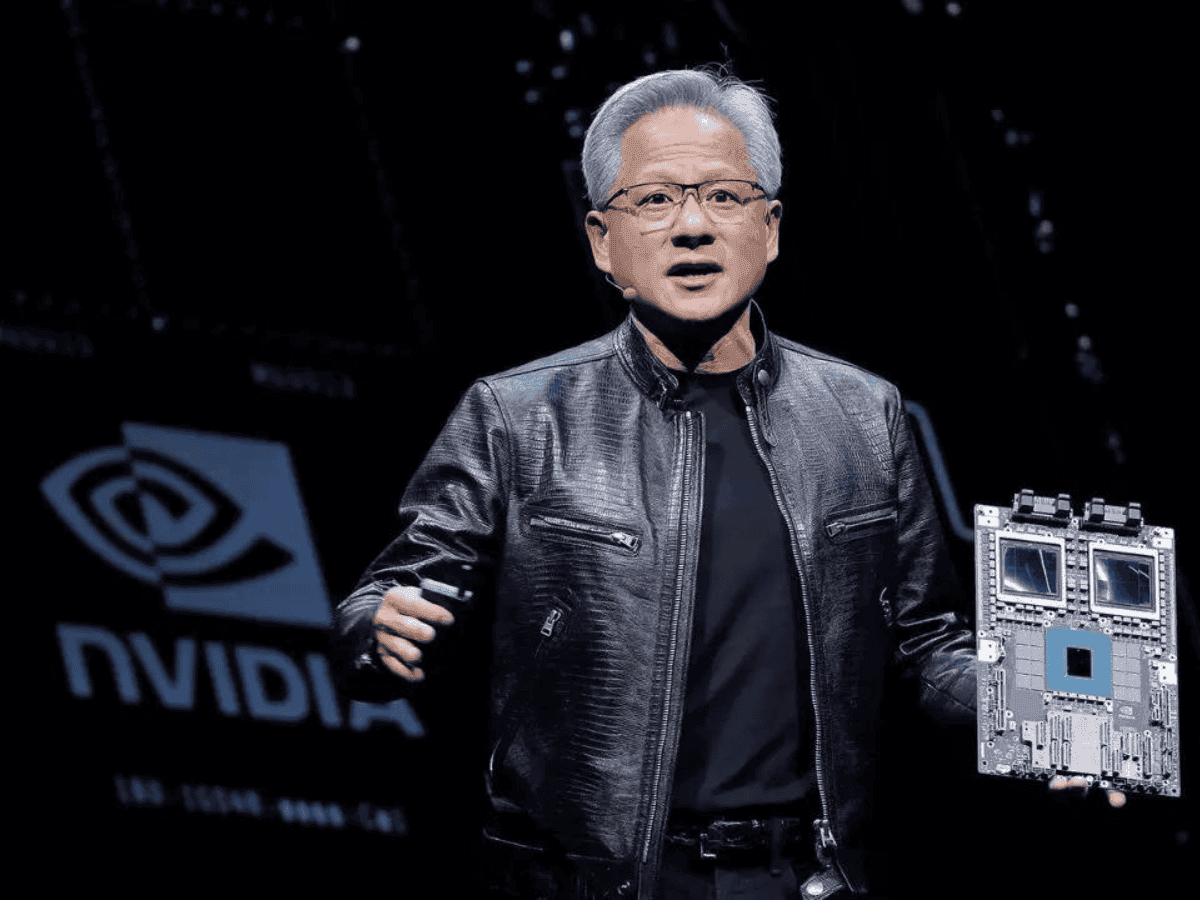
Source: ET
OpenAI Funding Round Brings $110 Billion Investment
The context for Nvidia's pullback centers on OpenAI's historic $110 billion private funding rounds, one of the largest in history
2
. The massive capital injection includes a $50 billion Amazon investment in OpenAI, with SoftBank contributing $30 billion alongside Nvidia's $30 billion stake2
. The round values OpenAI at $730 billion pre-money, representing a substantial leap for the ChatGPT creator, which now boasts more than 900 million weekly active users and over 50 million consumer subscribers3
.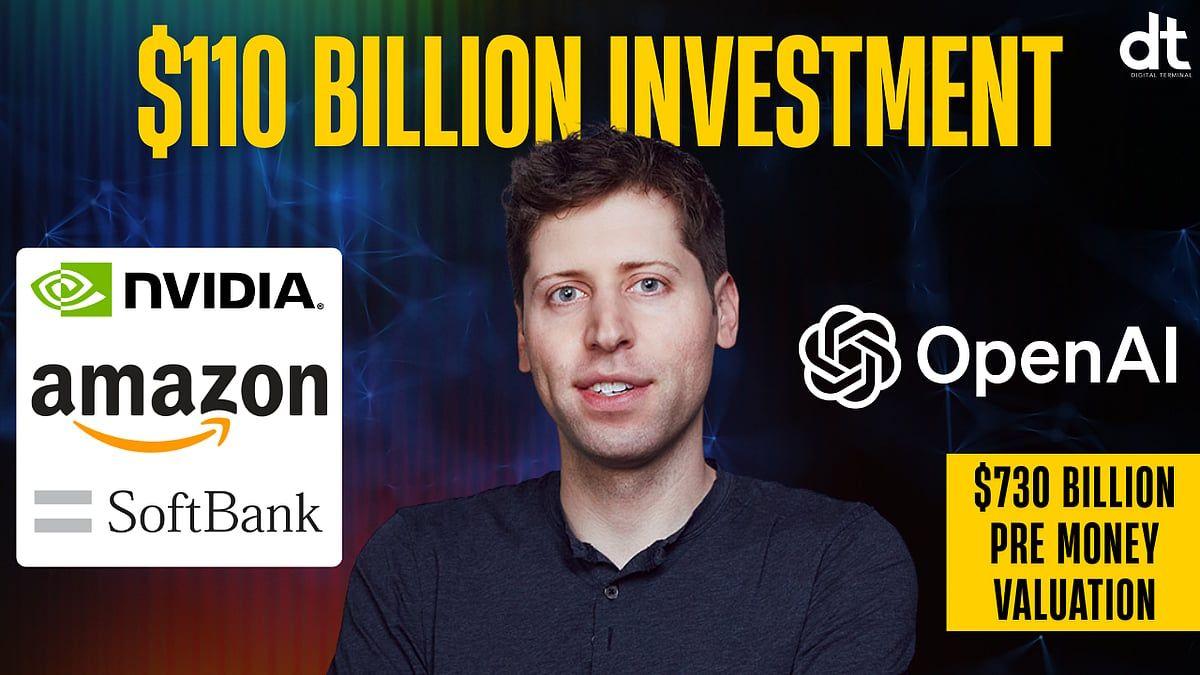
Source: DT
Amazon Strategic Partnership Reshapes OpenAI's Infrastructure
The Amazon investment in OpenAI extends beyond capital, establishing AWS as the exclusive third-party cloud distributor for OpenAI's Frontier enterprise platform
4
. Amazon CEO Andy Jassy emphasized that the strategic partnership will enable developers to run services powered by OpenAI models on AWS through a unique "stateful runtime environment"2
. OpenAI has committed to consuming at least 2 gigawatts of AWS Trainium compute capacity, with Amazon's $50 billion structured as $15 billion upfront and $35 billion contingent on conditions potentially tied to achieving AGI or completing an IPO4
. The companies will also co-develop custom AI models for Amazon consumer products, including Alexa3
.
Source: DT
Circular Investment Logic Raises Industry Concerns
Industry watchers have flagged concerns about Nvidia's AI investment strategy, particularly the circular dynamics of investing heavily in companies that are simultaneously major customers. MIT Sloan professor Michael Cusumano described the arrangement as "kind of a wash," observing that "Nvidia is investing $100 billion in OpenAI stock and OpenAI is saying they are going to buy $100 billion or more of Nvidia chips"
1
. This circular logic may explain why Nvidia ultimately pared back its commitment from the initially pledged $100 billion to just $30 billion in the finalized deal1
.Related Stories

Nvidia CEO Jensen Huang Addresses Anthropic Investment
Jensen Huang also indicated that Nvidia's recent $10 billion investment in Anthropic would probably be "the last" in that company, citing similar IPO considerations
5
. The relationship with Anthropic has faced its own complications, with CEO Dario Amodei comparing U.S. chip companies selling high-performance AI processors to approved Chinese customers to "selling nuclear weapons to North Korea" just two months after Nvidia announced its investment and "deep technology partnership"1
. Recent developments saw Anthropic blacklisted by the Trump administration after refusing to allow its models for autonomous weapons or mass domestic surveillance, while OpenAI struck a Pentagon deal within hours1
.AI Computing Deployment Drives Profitable Revenue
Defending Nvidia's AI investment approach, Huang argued that AI computing deployment is already generating profitable revenue for companies, including large publicly traded data center operators like Microsoft
5
. He maintained that if customers could access more computing power, they would grow even quicker, claiming that tripling computing capacity would triple their sales5
. Huang also emphasized that Nvidia's investments are "focused very squarely, strategically on expanding and deepening our ecosystem reach," which the company has presumably already accomplished with its earlier stakes in both OpenAI and Anthropic1
. Sam Altman told CNBC that OpenAI remains "open to going public at the right time," while Microsoft maintains its exclusive license and access to intellectual property across OpenAI models, with Azure remaining the exclusive cloud provider for OpenAI's stateless API calls3
.References
Summarized by

Navi
[2]
[4]
Related Stories
Nvidia steps back from AI investment as OpenAI and Anthropic prepare for public listings
06 Mar 2026•Business and Economy

Nvidia CEO calls reports of stalled $100 billion OpenAI investment 'nonsense,' pledges major funding
31 Jan 2026•Business and Economy

Nvidia's $100 billion OpenAI investment shrinks to $20 billion as chip tensions surface
02 Feb 2026•Business and Economy

Recent Highlights
1
Meta unveils Muse Spark AI model as Superintelligence Labs makes its debut
Technology

2
Anthropic restricts Mythos AI model release, citing unprecedented cybersecurity capabilities
Technology

3
Anthropic sends Claude AI to psychiatrist, discovers functional emotions that shape behavior
Science and Research

Recent Highlights
Today's Top Stories



Your Daily Dose of Curated AI News
Don’t drown in AI news. We cut through the noise - filtering, ranking and summarizing the most important AI news, breakthroughs and research daily. Spend less time searching for the latest in AI and get straight to action.

