AMD unveils new AI chips at CES as Lisa Su predicts massive surge in global compute demand


10 Sources
10 Sources
[1]
AMD Unveils New Chip For Corporate Data Centers, Talks Up Demand
Su said the rate and pace of AI innovation has been incredible and that the company is just getting started, with a new multibillion-dollar business created out of AI chips in the last couple of years. Advanced Micro Devices Inc., aiming to make a dent in Nvidia Corp.'s stranglehold on the AI hardware market, announced a new chip for corporate data center use and talked up the attributes of a future generation of products for that market. The company is adding a new model to its current lineup - one called the MI440X - for use in smaller corporate data centers where customers can deploy local hardware and keep data inside their own facilities. The announcement came as part of a keynote at the CES trade show, where Chief Executive Officer Lisa Su also touted AMD's top-of-the-line MI455X, saying systems based on that chip are a leap forward in the capabilities on offer. Su also added her voice to a chorus of US tech executives, including her counterpart at Nvidia, arguing that the AI surge will continue because of the benefits it's bringing and the heavy computing requirements of that new technology. "We don't have nearly enough compute for what we could possibly do," Su said. "The rate and pace of AI innovation has been incredible over the last few years. We are just getting started." AMD is widely regarded as the closest rival to Nvidia in the market for chips that create and run artificial intelligence software. The company has created a new multibillion-dollar business out of AI chips in the last couple of years, boosting its revenue and earnings. Investors who've bid up its stock want it to show greater progress in winning some of the tens of billions of dollars in orders that Nvidia rakes in. AMD's Helios system based on the MI455X and the new Venice central process unit design will go on sale later this year. OpenAI co-founder Greg Brockman joined Su on the CES stage in Las Vegas to talk up its partnership with AMD and plans for future deployment of its systems. The two talked about their shared belief that future economic growth will be tied to the availability of AI resources. The new chip, MI440X, will fit in compact computers in existing smaller data centers. Su also gave a preview of the forthcoming MI500 series of processors that will debut in 2027. That range will deliver up to 1,000 times the performance of the MI300 series that were first rolled out in 2023, Su said.
[2]
AMD unveils new AI chips at CES event in Las Vegas
Jan 5 (Reuters) - Advanced Micro Devices (AMD.O), opens new tab CEO Lisa Su showed off the company's MI455 GPU chips on Monday at the CES trade show in Las Vegas. The advanced AI processors are a component in the data center server racks that the company is selling to firms like ChatGPT maker OpenAI. In October, AMD signed a deal with OpenAI worth tens of billions of dollars. OpenAI President Greg Brockman joined Su on stage and touted the benefits of the company's products. Reporting by Max Cherney in San Francisco and Gnaneshwar Rajan in Bengaluru; Editing by Janane Venkatraman and Thomas Derpinghaus Our Standards: The Thomson Reuters Trust Principles., opens new tab
[3]
CES 2026 AMD keynote highlights: AI chips for everyone
Dr. Lisa Su wants you to think AMD when you think AI. Credit: David Becker/Getty Images CES 2026 was AMD's moment to shine in the light of the ongoing AI boom, offering more chips to drive AI compute and bringing industry luminaries on stage to talk about the future. The Santa Clara, Calif.-based chipmaker has already surpassed local rival Intel in revenue. But if it's ever going to catch its other local rival, Nvidia -- now the world's most valuable company, thanks to its data center-friendly GPU chips -- AMD has to prove it is just as relevant to big tech's big moment, if not more so. The world's largest tech show was a chance to prove that. After all, Nvidia didn't unveil any new GPU chips, just a forthcoming family of chips named Rubin. Dr. Lisa Su, AMD CEO, was given the spotlight of the show's main keynote. As she noted, AMD products -- the Helios rack introduced in 2025, the Epyc CPU chips -- are used by every major AI company already. And she had some new PC-level AI-friendly processors, the Ryzen AI 400, waiting in the wings. But as we've seen over the past three years, elbowing your way into the AI boom isn't just about new product. It's about making bombastic predictions, and showing lots of charts where the line goes up. And in this respect, Su delivered. "You ain't seen nothing yet" when it comes to AI, Su said -- showing off a graph that predicted AI would go from 1 billion active users to 5 billion active users within 5 years. She didn't explain where either figure came from (expert estimates vary wildly, with at least one 2030 estimate coming in below one billion users). Of course, no company can make huge hopeful predictions like OpenAI, makers of ChatGPT. Su brought an OpenAI luminary up on stage before she announced any brand-new chips. Not its CEO Sam Altman (who isn't at CES, but did offer an endorsement of Nvidia's Rubin), but co-founder Greg Brockman. "I would love to have a GPU running in the background for every single person in the world," Brockman says, explaining why he's constantly asking Su for "more compute." More compute is what Su had to offer, along with multiple attempts to make strips of silicon seem exciting. "Helios is a monster of a rack," she said, showing off a "double-wide design" developed in collaboration with Meta. She noted it weighed 7,000 pounds, or "more than two compact cars." The announcement follows an October 2025 report that OpenAI is making an investment worth "tens of billions of dollars in revenue" in AMD, relying on the company to provide six gigawatts of AI infrastructure in the years ahead as part of a deal that could see the AI giant owning up to 10 percent of AMD. On the "bigger is better" front, Su invited White House science advisor Michael Kratsios on stage to talk about how AMD was helping the U.S. "win" the "AI race" via the Genesis Mission, a public-private partnership that aims to use AI for scientific discoveries. Kratsios was short on specifics on what exactly an AI race is and how any country can win it. And then there was "AI for everyone," AMD's tagline for its PC processors. The Ryzen AI 400 is an upgrade to the Ryzen AI 300, announced in 2024 and finally arriving in on-sale PCs this quarter. AMD says the new chip will allow for 1.3x faster multitasking and is 1.7x faster at "content creation" than its competitors. What that means exactly, we'll have to wait and see. But in the meantime, Su offered a dizzying array of guest CEOs to talk up how AI will transform everything from healthcare to spaceflight. None of that seems to have made much difference to investors, at least. They drove AMD stock down slightly earlier in the day; it flatlined in after-hours trading.
[4]
What's the 'Next Big Thing' in AI? Here's What Nvidia and AMD Execs Say It Could Be
Nvidia CEO Jensen Huang earlier this week suggested a pivotal moment in robotics with AI may have already arrived. The AI boom is only getting started, according to the industry's biggest players, with some predicting that the next wave of innovations will come in the physical world. So-called physical AI, which powers autonomous machines like humanoid robots and self-driving cars, could be the "next big thing," Advanced Micro Devices (AMD) CEO Lisa Su told CNBC in an interview Tuesday. The company, Su said, is making physical AI a key part of its strategy. Nvidia (NVDA) CEO Jensen Huang, who's told investors he expects AI-driven robotics to transform industries and Nvidia to be a leading beneficiary of that shift, said Monday that he believes a pivotal "ChatGPT moment" for robotics may have arrived, with the company's release of several new AI models for developers meant to unlock applications in the physical world. "Robotaxis are among the first to benefit," Huang said, with Nvidia's AI-powered driver assistance software set to be used in a new Mercedes-Benz car to enter production this year. Analysts at Wedbush and Bernstein applauded Huang's autonomous vision, with Bernstein telling clients physical AI could be "set for an inflection with Autonomous Driving leading the charge." Su's comments come after AMD unveiled its newest AI products for data centers and PCs, as well as physical AI at CES in Las Vegas on Monday. Rival and industry leader Nvidia also showed off its latest chips at the conference. Analysts surveyed by Visible Alpha are overwhelmingly upbeat about Nvidia's stock, which on Tuesday reversed early gains to finish less than 1% lower despite broader market gains. They're also largely bullish on shares of AMD, which slipped about 3% Tuesday.
[5]

AMD CEO Lisa Su Says AI Is Entering 'Yottascale' Era At CES 2026: Predicts 'Massive Increase' In Global Compute Demand, Far Beyond Data Centers - Advanced Micro Devices (NASDAQ:AMD)
At CES 2026, Advanced Micro Devices Inc. (NASDAQ:AMD) CEO Lisa Su laid out a sweeping vision for the next phase of artificial intelligence, offering a clear and much-needed signal that the global demand for new compute resources is only set to accelerate going forward. AI Is Entering The 'Yottascale' Era During her keynote speech at the event on Monday night, Su said that the world is entering what she called the "yottascale" era of computing, a period in which the deployment of increasingly powerful AI models will require an unprecedented expansion of global computing capacity. "This moment in tech not only feels different, AI is different," Su said. "AI is the most powerful technology that has ever been created and it can be everywhere for everyone." See Also: This AI Training Startup CEO Says Synthetic Data Can't Replace Human Judgment 'For Decades To Come' Meeting that demand, Su emphasized, will require a far broader computing footprint than in previous technology cycles. She said it will involve "solutions from the largest systems in the cloud, to AI PCs, to embedded computing." Su stated that this transformation cannot be achieved in isolation. "It takes an open ecosystem built on industry standards," she said, adding that the future of AI will depend on collaboration across the entire technology sector. The AMD chief executive framed the shift as a long-term structural change rather than a short-lived product cycle. "The world's most important challenges can only be solved by bringing the industry ecosystem together," she said. Will AI Capex Continue To Soar? Su's comments come amid growing concerns regarding a potential slowdown in the multi-billion-dollar AI spending spree in recent years. While the big tech companies are showing no signs of slowing down on their AI capex, analysts believe that power shortages and financial constraints can create a hard cap on how fast they can deploy new infrastructure to meet soaring demand. Last week, Perplexity AI CEO Aravind Srinivas echoed a similar theme, warning that the rapid advance of embedded AI could eventually upend the traditional data-center-centric model. As intelligence becomes increasingly compressed and capable of running directly on devices, Srinivas said the need for centralized inference could shrink dramatically. "The biggest threat to a data center is if the intelligence can be packed locally on a chip that's running on the device," he said. Shares of AMD were down 1.07% on Monday, closing at $221.08, but are up 0.4% overnight. The stock scores high on Momentum in Benzinga's Edge Stock Rankings, with a favorable price trend in the Medium and Long terms. Click here for deeper insights into the stock, its peers, and competitors. Read More: What To Expect At CES 2026: Nvidia, AMD, Joby, Archer, D-Wave And More Photo courtesy: Shutterstock AMDAdvanced Micro Devices Inc$221.30-%OverviewMarket News and Data brought to you by Benzinga APIs
[6]
Nvidia and AMD Showcased Their Newest AI Chips at CES -- Here's What You Need to Know
Nvidia CEO Jensen Huang said his company's latest chips can be used for a wide range of applications, including robotics and self-driving cars along with creating and training AI models. Tech investors got a fresh look at the product roadmaps of two leading AI chipmakers on Monday. Nvidia (NVDA) CEO Jensen Huang and Advanced Micro Devices (AMD) CEO Lisa Su each spoke at the Consumer Electronics Show in Las Vegas Monday, where they unveiled their companies' newest AI chips. Huang showcased Nvidia's next-generation AI chip platform called Rubin, which uses chips supporting a wide range of applications, from model creation and training to enabling robotics and self-driving cars. Wedbush analysts told clients after the event that it underscored how robotics and self-driving could present another market opportunity for Nvidia to "tap into," and that they believe the new avenues could help Nvidia's market capitalization rise to $6 trillion over time, from its current level near $4.7 trillion. Nvidia said its AI-powered driver assistance software will be used in a new Mercedes-Benz car available later this year. Analysts have previously suggested Nvidia could be a key beneficiary of the rise of self-driving robotaxis. Su's Monday evening keynote also highlighted AMD's newest chips for data centers as well as physical AI applications like robotics. Nvidia shares climbed about 2% in recent trading, while AMD slipped 2% after both stocks posted small declines on Monday.
[7]

AMD's CES AI Push Shows How It Plans to Compete at Scale. Here's Why It Matters. | The Motley Fool
Investors now have good reason to believe AMD will be able to achieve its lofty goals first laid out in November. If there was any doubt that Advanced Micro Devices (AMD 0.67%) was serious about serving the artificial intelligence (AI) data center market, it was wiped away on Monday at the 2026 CES gathering in Las Vegas. That's the undeniable takeaway from CEO Lisa Su's opening keynote speech, anyway. While the company featured new consumer-oriented technologies like gaming-friendly graphics cards and personal computer processors, AI took center stage -- figuratively and literally. For instance, AMD's new Ryzen AI Halo processor puts the power of artificial intelligence into individuals' local devices rather than forcing them to rely on remote access to a cloud platform. The proverbial show-stopper, however, was the sheer number of large-scale solutions that Advanced Micro Devices unveiled, like its "Helios" rack-scale platform. Powered by its Instinct MI455X accelerators, Helios is the "blueprint for yotta-scale infrastructure, delivering up to 3 AI exaflops of performance in a single rack." (For reference, 1 exaflop is 1 quintillion operations per second -- a 1 followed by 18 zeros -- while one yotta is 1 septillion -- a 1 followed by 24 zeros -- operations per second. AMD says the computing capacity of the entire AI industry today is nearly 100 zettaflops, or 100,000 exaflops.) In other words, Advanced Micro Devices clearly intends to become a serious competitor to Nvidia, which currently dominates the artificial intelligence computing space. Of course, none of this should come as a surprise to any investor who's been keeping close tabs on the company since November. That's when AMD first unveiled its strategy to better penetrate the $1 trillion AI industry, leveraging the aforementioned Helios systems built around the also aforementioned Instinct MI450 Series GPUs (graphics processing units). That's also when it publicly committed to a growth target for its artificial intelligence arm as well as for the entire company. Although it didn't offer a specific time frame other than to call these "long-term" targets, AMD is aiming for 80% annualized growth from its AI data center hardware business, setting the stage for annualized companywide growth of 35%. Perhaps more important to interested investors, the company can likely hit these impressive targets. During the third fiscal quarter ending in September last year, AMD's data center business grew 22% year over year, and that was without the help of its new Helios platform and the underlying MI455X accelerators. Rather, the company's fifth-generation AMD Epyc server processors and its AI-capable Instinct MI350 series GPUs -- which would soon be topped by newer tech -- did most of that heavy lifting. This early growth driven by lesser technology underscores the growing demand for large-scale artificial intelligence solutions as well as Advanced Micro Devices' ability to meet it.
[8]

AMD shows off new higher performing AI chip at CES event
Advanced Micro Devices CEO Lisa Su showed off a number of the company's AI chips on Monday at the CES trade show in Las Vegas, including its advanced MI455 AI processors, which are components in the data center server racks that the company is selling to firms like ChatGPT maker OpenAI. Su also unveiled the MI440X, a version of the MI400 series chip designed for on-premise use at businesses. The so-called enterprise version is designed to fit into infrastructure that is not specifically designed for AI clusters. The MI440X is a version of an earlier chip that the U.S. plans to use in a supercomputer. AMD is one of Nvidia's strongest rivals but has struggled to have as much success. In October, AMD signed a deal with OpenAI that, in addition to the financial upside, was a major vote of confidence in AMD's AI chips and software. But it is unlikely to dent Nvidia's dominance, as the market leader continues to sell every AI chip it can make, analysts said. At the Monday event, OpenAI President Greg Brockman joined Su on stage and said chip advancements were critical to OpenAI's vast computing needs. Looking to the future needs of companies like OpenAI, Su previewed the MI500 and said it offered 1,000 times the performance of an older version of the processor. The company said the chips would launch in 2027. At the event, Su hosted Daniele Pucci, CEO of Generative Bionics, an Italian AI developer, who unveiled GENE.01, a humanoid robot. "Our first commercial humanoid robot will be manufactured in the second half of 2026," Pucci said at the event. Earlier on Monday, Nvidia showed off its next-generation Vera Rubin platform, which is made up of six separate chips. CEO Jensen Huang said it was in full production. It is expected to debut later this year. In October, AMD signed the deal with ChatGPT maker OpenAI that will add billions of dollars to the company's annual revenue. The first deployment of AI chips that incorporate AMD's MI400 series will roll out this year. Nvidia has generated tens of billions of dollars in quarterly revenue from its AI chip sales, a feat that AMD has struggled to achieve thus far. OpenAI is a key customer of AMD and executives at the Santa Clara, California-based company expect the deal to lead to significant additional new sales. Also on Monday, AMD launched its Ryzen AI 400 Series processors for AI PCs, alongside Ryzen AI Max+ chips for advanced local inference and gaming. Intel held a launch event earlier for its Panther Lake chips that it said would be available for order on Tuesday.
[9]

AMD unveils new AI processors at CES Las Vegas, targets big performance jump By Investing.com
Investing.com-- AMD (NASDAQ:AMD) CEO Lisa Su unveiled a new line of PC and artificial intelligence processors at the CES event in Las Vegas on Monday evening, and said that the company was on track to deliver a thousandfold increase in the AI performance of its chips. Su unveiled the AMD Ryzen AI 400 series- a new line of PC chips, and also showed off the company's MI455 AI processors, which are a key component of the data centers that power AI programs. AMD has a deal with OpenAI to supply data center chips to the ChatGPT maker. Subscribe to InvestingPro for Wall Street's top AI stock picks for 2026. Get 55% off your subscription today! OpenAI President Greg Brockman joined Su on stage to tout OpenAI's offerings and their dependence on advanced processors. The AMD CEO showed off the MI500 processor, which she claimed offers 1,000 times the performance of an older version. The chip will be released in 2027. The AMD reveal comes just hours after NVIDIA Corporation (NASDAQ:NVDA) CEO Jensen Huang previewed a host of advanced AI chips at CES. Huang showed off Nvidia's next-generation Vera Rubin AI processor platform, which he said was in full production and expected to debut later in 2026. AMD has struggled to match the stellar success of Nvidia in developing and selling the most advanced AI chips in the market. While the company has benefited from increased AI-fueled demand, it has lagged larger rival Nvidia in terms of sales. The company signed a major deal with OpenAI in October, which stands to bring in hundreds of billions in revenue if successfully executed. AMD will supply key processors for OpenAI's data centers.
[10]

AMD unveils new AI chips at CES event in Las Vegas
Jan 5 (Reuters) - Advanced Micro Devices CEO Lisa Su showed off a number of the company's AI chips on Monday at the CES trade show in Las Vegas. The advanced MI455 AI processors are a component in the data center server racks that the company is selling to firms like ChatGPT maker OpenAI. Su also unveiled the MI440X, a version of the MI400 series chip designed for on-premise use at businesses. The so-called enterprise version is designed to fit into infrastructure that is not specifically designed for AI clusters. The MI440X is a version of an earlier chip that the U.S. plans to use in a supercomputer. OpenAI President Greg Brockman joined Su on stage and said chip advancements were critical to OpenAI's vast computing needs. Looking to the future needs of companies like OpenAI, Su previewed the MI500 and said it offered 1,000 times the performance of an older version of the processor. The company said the chips would launch in 2027. Earlier on Monday, Nvidia showed off its next-generation Vera Rubin platform, which is made up of six separate chips. CEO Jensen Huang said it was in full production. It is expected to debut later this year. Nvidia has generated tens of billions of dollars in quarterly revenue from its AI chip sales, a feat that AMD has struggled to achieve thus far. In October, AMD signed a deal with ChatGPT maker OpenAI that will add billions of dollars to the company's annual revenue. The first deployment of AI chips that incorporate AMD's MI400 series will roll out this year. OpenAI is a key customer of AMD and executives at the Santa Clara, California-based company expect the deal to lead to significant additional new sales. (Reporting by Max Cherney in San Francisco and Gnaneshwar Rajan in Bengaluru; Editing by Janane Venkatraman and Thomas Derpinghaus)
Share
Share
Copy Link
AMD CEO Lisa Su unveiled new AI chips including the MI440X for corporate data centers at CES 2026, declaring AI is entering the 'yottascale' era. With OpenAI co-founder Greg Brockman on stage, Su emphasized that the world doesn't have nearly enough compute for AI's potential. The company revealed its MI500 series will deliver up to 1,000 times the performance of 2023's MI300 series.
AMD Challenges Nvidia with New AI Chips for Corporate Data Centers
AMD unveiled a strategic lineup of new AI processors at the CES trade show in Las Vegas, positioning itself to compete with Nvidia in the rapidly expanding AI hardware market. CEO Lisa Su introduced the MI440X, a new chip designed specifically for smaller corporate data centers where companies can deploy local hardware and maintain data within their own facilities
1
. The announcement comes as AMD works to capture a larger share of the tens of billions of dollars in orders that Nvidia currently dominates.
Source: Reuters
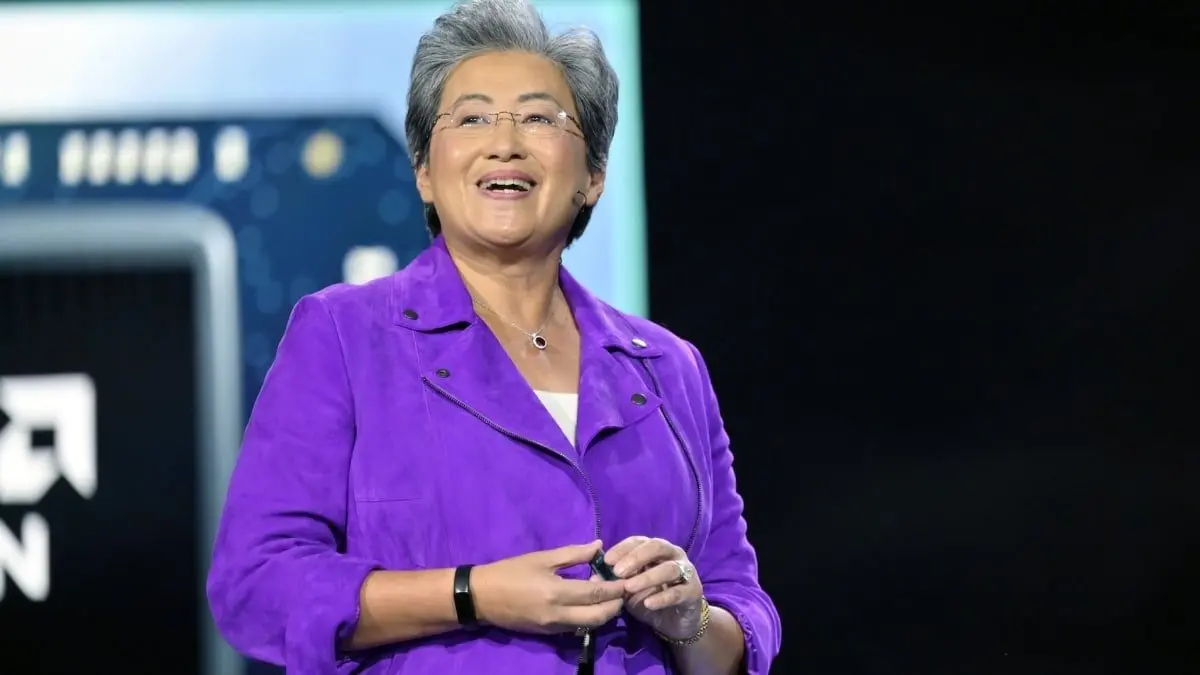
During her keynote speech, Lisa Su showcased the company's top-of-the-line MI455X chip, describing systems based on this processor as a leap forward in available capabilities
1
. The MI455X forms the foundation of AMD's Helios system, which Su characterized as "a monster of a rack" with a double-wide design developed in collaboration with Meta, weighing more than 7,000 pounds3
. These new AI processors are components in data center server racks that AMD is selling to firms like ChatGPT maker OpenAI2
.
Source: Mashable
OpenAI Partnership Signals Growing Momentum
The OpenAI partnership took center stage when co-founder Greg Brockman joined Su to discuss their collaboration and future deployment plans. "I would love to have a GPU running in the background for every single person in the world," Brockman stated, explaining his constant requests to Su for "more compute"
3
. This appearance follows an October 2025 deal where OpenAI committed to an investment worth tens of billions of dollars in AMD, relying on the company to provide six gigawatts of AI infrastructure in the coming years3
.The two executives shared their belief that future economic growth will be directly tied to the availability of AI resources
1
. Su emphasized that AMD has already created a new multibillion-dollar business out of AI chips in the last couple of years, significantly boosting revenue and earnings1
.The Yottascale Era and Physical AI
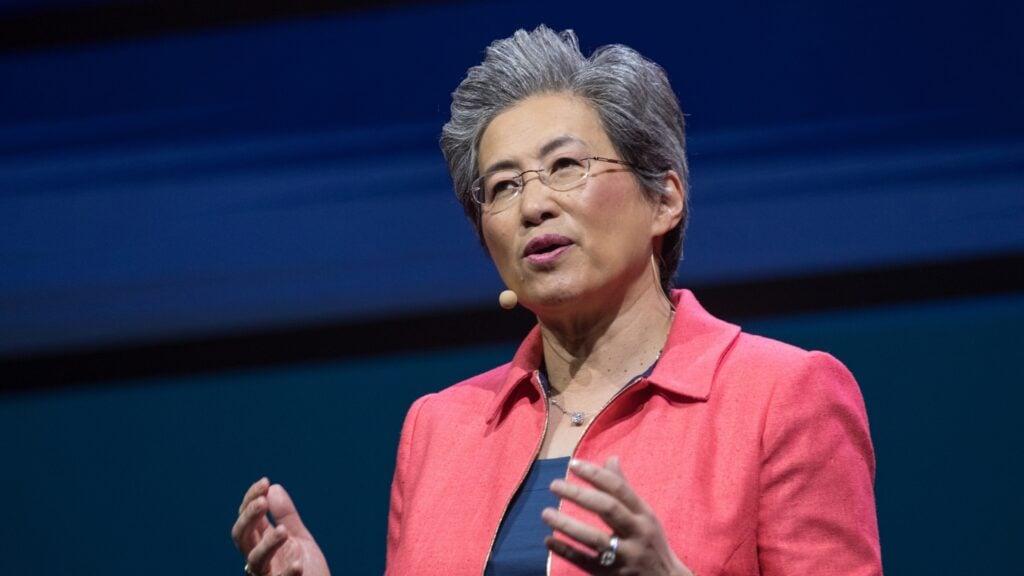
Lisa Su declared that AI is entering the "yottascale" era of computing, a period requiring unprecedented expansion of global computing capacity. "We don't have nearly enough compute for what we could possibly do," Su stated. "The rate and pace of AI innovation has been incredible over the last few years. We are just getting started"
1
. She predicted AI would grow from 1 billion active users to 5 billion within five years3
.
Source: Benzinga
In an interview with CNBC, Su identified physical AI as potentially the "next big thing," stating that AMD is making it a key strategic priority
4
. Physical AI powers autonomous machines like humanoid robots and self-driving cars, representing a shift toward AI applications in the physical world. This vision aligns with comments from Nvidia CEO Jensen Huang, who suggested that a pivotal "ChatGPT moment" for robotics may have arrived4
.Related Stories



Future Roadmap and Broader Computing Footprint
Su provided a preview of the forthcoming MI500 series of processors set to debut in 2027, promising to deliver up to 1,000 times the performance of the MI300 series first rolled out in 2023
1
. The Helios system based on the MI455X and the new Venice central processing unit design will go on sale later this year1
.Meeting global compute demand will require "solutions from the largest systems in the cloud, to AI PCs, to embedded computing," Su emphasized
5
. AMD also unveiled the Ryzen AI 400 for PCs, an upgrade to the Ryzen AI 300 announced in 2024, promising 1.3x faster multitasking and 1.7x faster content creation than competitors3
. Su stressed that this transformation requires "an open ecosystem built on industry standards" and collaboration across the entire technology sector5
. Despite the announcements, AMD stock slipped approximately 3% following the CES presentation4
.References
Summarized by

Navi
Related Stories
Recent Highlights



Recent Highlights
Today's Top Stories










Your Daily Dose of Curated AI News
Don’t drown in AI news. We cut through the noise - filtering, ranking and summarizing the most important AI news, breakthroughs and research daily. Spend less time searching for the latest in AI and get straight to action.

