AMD unveils Ryzen AI 400 Series with 60 TOPS, challenging Intel and Qualcomm in AI PC race


27 Sources
27 Sources
[1]
AMD unveils new AI PC processors for general use and gaming at CES | TechCrunch
AMD Chair and CEO Lisa Su kicked off her keynote at CES 2026 with a message about what compute could deliver: AI for everyone. As part of that promise, AMD announced a new line of AI processors as the company thinks AI-powered personal computers are the way of the future. The semiconductor giant revealed AMD Ryzen AI 400 Series processor, its latest version of its AI-powered PC chips, at the yearly CES conference on Monday. The company says the latest version of its Ryzen processor series allows for 1.3x faster multitasking than its competitors and are 1.7x times faster at content creation. These new chips feature 12 CPU Cores, individual processing units inside a core processor, and 24 threads, independent streams of instruction This is an upgrade to the Ryzen AI 300 Series processor that was announced in 2024. AMD started producing the Ryzen processor series in 2017. Rahul Tikoo, senior vice president and general manager of AMD's client business, said AMD has expanded to over 250 AI PC platforms on the company's recent press briefing. That represents a growth 2x over the last year, he added. "In the years ahead, AI is going to be a multi-layered fabric that gets woven into every level of computing at the personal layer," Tikoo said. "Our AI PCs and devices will transform how we work, how we play, how we create and how we connect with each other." AMD also announced the release of the AMD Ryzen 7 9850X3D, the latest version of its gaming-focused processor. "No matter who you are and how you use technology on a daily basis, AI is reshaping everyday computing," Tikoo said. "You have thousands of interactions with your PC every day. AI is able to understand, learn context, bring automation, provide deep reasoning and personal customization to every individual." PCs that include either the Ryzen AI 300 Series processor or the AMD Ryzen 7 9850X3D processor become available in the first quarter of 2026. The company also announced the latest version of its Redstone ray tracing technology, which simulates physical behavior of light, which allows for better video game graphics without a performance or speed lag. Follow along with all of TechCrunch's coverage of the annual CES conference here.
[2]
AMD Speeds Up Its Mobile Processors
Ah, the tween years for chip announcements: Those periods when companies roll out tweaked versions of the big architectural changes we saw over the previous year (or earlier). In AMD's case, some of the updates to its chip lines were essential. But since it made its big announcements at last CES, what should we realistically expect at CES 2026? The answer is refreshed Ryzen AI lines focused primarily on mobile processors, moving from the 300 series to the 400 series, and a bit more. Don't miss any of our unbiased tech content and lab-based reviews. Add CNET as a preferred Google source. The "bit more" comes in the form of an addition to the Ryzen X3D lineup within AMD's gaming-focused 9000X series desktop processors. The new Ryzen 7 9850X3D slots in above the Ryzen 7 9900X3D and is essentially the same processor, using slightly better-performing dies from the same pool and boosting the clock speed by 100MHz. In practical terms, the 9850X3D runs at 5.6GHz, compared with 5.5GHz for the 9900X3D. AMD says this translates to roughly a 7% performance improvement. In the same vein, AMD has added two processors to the Ryzen AI Max Plus 300 series: the Ryzen AI Max Plus 392 and Ryzen AI Max Plus 388, which slide in above the plain old Ryzen AI Max 390 and 385, respectively. The one change is to the GPU: It jumps from 32 compute units to 40 CUs, effectively "Plus-ifying" the chips with the 8090S graphics. That upgrade boosts GPU performance for both gaming and AI and provides more affordable alternatives to the Ryzen AI Max Plus 395. People don't always notice when their CPU is slow, but gamers definitely notice when their GPU is. Finally, there's the Ryzen AI 400 series, which are generally somewhat faster versions of their 300-series equivalents. The HX versions of the 300 series are older -- they launched in June 2024 -- but they retain mostly the same specs, with only minor speed bumps, such as the 100MHz tweak mentioned earlier. They do get a boost in NPU performance as well, topping out at 55 TOPS and 60 TOPS for the HX 470 and 475, respectively, up from the 50 TOPS found across the rest of the XDNA 2 chips. The remaining models just gain some minimal clock-speed improvements and support for slightly faster memory.
[3]
AMD Ryzen AI 400 official: Will these laptop chips maintain AMD's lead?
We were rightly skeptical of AMD's Ryzen AI 300 "Strix Point" laptop chips in 2024. Now they're in some of the very best laptops you can buy, arguably hitting the sweet spot of price, performance, and battery life. Today at CES, AMD is announcing its successor, the Ryzen AI 400 line -- but there's nothing particularly next-gen about "Gorgon Point." They're based on the exact same Zen 5 and Zen 5c CPU cores, with the same RDNA 3.5 graphics, and have the same exact number of cores as their predecessors, too -- a "475" has 12 cores, 24 threads, and 16 graphics CUs like a "375" did, and so on down the stack. The main differences are a slight boost to CPU and GPU frequency, more memory bandwidth, and a faster NPU for AI tasks in the top two models. The HX 475 now offers 60 TOPS, while the HX 470 offers 55. They're similar enough that AMD largely dodged a question about how much faster they are when we asked, instead comparing them against Intel's Lunar Lake (not the new Panther Lake) chips: But AMD client CPU boss Rahul Tikoo claims AI 400 is somewhat faster than AI 300, and that improvements in manufacturing, firmware, software, and frequency and memory bumps should make a performance difference. With AMD's AI 300 chips already doing well, it's possible that any improvement will be enough. But when laptops ship this quarter (Q1 2026) from all the usual suspects (including Acer, Asus, Dell, HP, and Lenovo), these chips will start going up against Intel's just-unveiled Panther Lake and Qualcomm's new Snapdragon X2 line. All three sets of laptops will begin shipping in the same time frame. AMD is also announcing two new lower-end Ryzen AI Max Plus "Strix Halo" chips today, which we hope will bring its beefy integrated graphics to more affordable price points. (Handhelds like the GPD Win 5 keep trying to cram Strix Halo in with awesome but pricey results!) AMD isn't really talking price today amid the RAM crunch, though, beyond suggesting that Ryzen AI systems typically start as low as $499 and Ryzen AI Max ones are more in the $1,000-to-$1,500 range.
[4]
AMD's new Ryzen chipset promises faster performance, better gaming, and smarter AI
AMD revealed the Ryzen AI 400 series.The company introduced new high-gaming CPUs. AMD also revealed the Ryzen AI Max+ for workstations. At CES 2026, AMD unveiled its upcoming next-generation of processors and new AI-powered software, all set to improve your workflow and gaming experience. The centerpiece of the announcements was the Ryzen AI 400 Series, a collection of mobile CPUs designed to power many 2026 laptops. Leading the seven chipsets is the AMD Ryzen AI 9 HX 475, which features 12 Zen 5 CPU cores, 24 CPU threads, 16 AMD RDNA 3.5 GPU cores, and an updated XDNA 2 NPU (neural processing unit) capable of up to 60 AI TOPS. Also: CES 2026 live blog: Latest news on TVs, AI, phones, more AMD said the chip will deliver up to 1.3x faster multitasking and 1.7x content creation compared to the previous generations. If you're familiar with AMD's hardware, you may not know that the Ryzen AI 9 HX 475 has similar specifications to the Ryzen AI 9 HX 375. Just about everything is the same, apart from the NPU. Does this mean the new processor is going to run just like the old one? No, but it won't be a significant upgrade either. AMD also used the show to introduce its next wave of gaming processors, led by the Ryzen 9 9950X3D. This chip packs 16 Zen 5 CPU cores, 32 CPU threads, a huge 144MB cache, and a top clock speed of 5.7GHz, making it perfect for high-end gaming. A major feature of this series is AMD FSR Redstone, a new suite of AI-powered features designed to improve visual quality and frame rate. With Redstone enabled, AMD said certain games can average around 109 FPS, although support will be limited to around 200 titles. Also: The 4 most exciting CES products you can buy right now For the final bit of hardware news, AMD announced the Ryzen AI Max+ Series, a new class of processor meant for workstations and content creators. The flagship Ryzen AI Max+ 395 includes 16 Zen 5 CPU cores, 32 CPU threads, 40 AMD RDNA 3.6 CPU cores, and an NPU capable of hitting 50 AI TOPS. Computers with this chipset can prove to be serious rivals to the M5 MacBook Pro. AMD said a laptop housing the Max+ 395 will deliver up to 1.8x faster multitasking, nearly double the content creation performance, and 1.4x faster AI workloads compared to Apple's machine. Alongside the hardware, AMD revealed several AI-powered features, including a Personal AI Finance Manager, Liquid AI for building custom local models, and expanded support for AMD ROCm to improve LLM (large language model) performance. Ahead of CES, a leak surfaced hinting at AMD's plans for the event. There was some correct information, like the announcement of the Ryzen AI 400 series, but some were a no-show, such as the Ryzen 9000G desktop APUs (accelerated processing unit). Although none of the leaked hardware appeared, it's possible that they could show up later in the year.
[5]

AMD Unleashes Ryzen AI 400 Series: 60 TOPS of AI Power Hits Laptops and Mini PCs
At CES this year, AMD is making a major step in its push toward AI-optimized computing. The company introduced its latest line of processors for laptops and mini desktops, the Ryzen AI 400 series, set to launch in Q1 of this year. The chips promise faster and more efficient handling of AI workloads while delivering notable improvements in traditional CPU and graphics performance. The so-called "Red Team" also introduced some new additions to its buzzy Ryzen AI Max family of top-end mobile AI system chips. These CPUs utilize an unconventional shared-memory design to enhance graphics and GPU-based AI performance. The new CPUs supplement AMD's flagship "Strix Halo" processor that created a stir at last year's CES, and they'll also land in systems before the end of this quarter. Here are all the details we know so far. Meet the Ryzen AI 400: 'Zen 5' and 60 TOPS of AI Juice for the Mainstream The headline story of the Ryzen AI 400 series is the hardware triad hiding inside: "Zen 5" CPU cores, RDNA 3.5 graphics, and the XDNA 2 neural processor (NPU) architecture. While all of these technologies were part of AMD's Ryzen AI 300 series announced in mid-2024, the new chips refine this stack with faster clock speeds and upgraded NPUs. The NPUs now deliver up to 60 trillion AI operations per second (TOPS) in the highest-end chip in the line (the Ryzen AI 9 HX 475), and 50 TOPS at minimum. This marks a notable jump from the previous generation's maximum of 50 TOPS, positioning AMD's top-end 400-series chips safely ahead of current competitors, such as Intel's "Panther Lake" (50 TOPS), in raw AI-compute metrics. However, this is well below Qualcomm's mammoth 80 TOPS claim for its upcoming Snapdragon X2 Elite Extreme, X2 Elite, and X2 Plus processors, placing AMD firmly in second place in terms of raw AI speeds. Beyond raw numbers, AMD will leverage its ROCm software stack to unify AI development from cloud servers down to these local devices, supporting both Windows and Linux environments. Parts and Performance: Taking On the Competition The Ryzen AI 400 series represents an evolution of the "Strix Point" architecture introduced in the Ryzen AI 300 series, pushing clock speeds and memory bandwidth to new limits for integrated solutions. And AMD didn't hold back on the comparisons during its press briefing. Using the example of the new Ryzen AI 9 HX 470 (the second-fastest chip in the new lineup), the firm claims up to 1.3 times faster multitasking compared with the "Lunar Lake" Intel Core Ultra 9 288V, and 29% faster on average when running a 10-person Microsoft Teams call alongside standard office productivity applications. Content creators are also in for a treat, with AMD bragging of 1.7 times faster performance in common content-creation benchmark tests. Gaming hasn't been forgotten, either; the integrated Radeon graphics units are optimized to provide near-native image quality from lower-resolution frames using the new AMD FSR "Redstone" technology. AMD claims the Ryzen AI 400 series will drive 10% more performance than an Intel Core Ultra 9 288V processor running at 30 watts. Despite the power gains, efficiency remains a core pillar. Built on TSMC's 4nm process, these chips feature an optimized low-power architecture that AMD says can deliver "multi-day" battery life -- up to 24 hours of local video playback on a single charge. That claim likely refers to multiple workdays of average use. Ryzen AI Max+ Is Back AMD will also update its workstation-level Ryzen AI Max+ mobile processors with two new chip models in the AI 300 Max line: the Ryzen AI Max+ 392 (12-core), and the Ryzen AI Max+ 388 (eight-core). The Ryzen AI Max processors stand out for their unique, APU-style system-on-a-chip (SoC) designs. They employ a bank of shared memory that can be allocated on the fly between main system memory and graphics. With support for up to 192GB of shared memory, these chips can deliver excellent integrated graphics performance, as well as robust AI processing assisted by the GPU cores. The CPU performance is also robust, and includes support for multi-threading. You can see the two new AI Max+ chips, in gold, and where they fit into the existing Ryzen AI Max+ and Max line... The AI Max+ chips have more graphics hardware onboard than the AI Max (non-"+") ones, with 40 GPU cores compared with 32 cores on the AI Max, and just 16 (at most) in the top chips of the upcoming Ryzen AI 400 line. This additional graphics silicon enables an effective increase in the GPU-powered AI potential, measured in GPU TFLOPS, separate from the AI processes handled on the 50 TOPS NPU (which remains the same across the Max and Max+ family). AMD is introducing these two new SKUs to offer system makers greater choice and flexibility in incorporating the AI Max+ into their systems. Announced at CES 2025, the top-end Ryzen AI Max+ 395 has appeared in a handful of compelling PCs, such as the compact Framework Desktop and the 2025 Asus ROG Flow Z13, which we reviewed in 2025. Both are powerful systems, but pricey; this aims to bring the Max+ model to more users, more affordably. When Will AMD's New AI Chips Become Available? Laptops and mini PCs featuring chips from AMD's Ryzen AI 400 and updated AI Max+ series will be available in Q1 2026, with the processors expected to appear in systems from Acer, Asus, Dell, HP, and Lenovo. We'll be checking out all of these systems and more as part of our CES coverage, so stay tuned to PCMag throughout this week and in the coming months to see where this capable AI PC silicon will show up.
[6]

AMD's Ryzen AI 400 series includes the first Copilot+ desktop CPU -- Team Red refreshes Zen 5 APUs and Strix Halo
AMD's upcoming Ryzen AI 400 series of laptop APUs, dubbed 'Gorgon Point,' will arrive in the first quarter of 2026, the company announced at CES. The refreshed lineup still sports up to 12 Zen 5 CPU cores and up to 16 RDNA 3.5 GPU cores, but comes with increased frequency and memory support, as well as a souped-up XDNA 2 NPU. Alongside the laptop lineup, AMD announced the first Copilot+ desktop processor, as well as two new entries in its Strix Halo lineup. There are seven chips in the laptop range, with the highest-end SKU being the Ryzen AI 9 HX 475. That chip comes with the full Gorgon Point die, including 12 Zen 5 cores, 24 threads, 36MB of combined L2 and L3 cache, 60 NPU TOPS, 16 RDNA 3.5 GPU cores that can boost up to 3.1 GHz, and support for memory speeds up to 8,533 MT/s. Ryzen AI 300 chips, dubbed 'Strix Point,' topped out at LPDDR5X-8000. You can see the full mobile lineup from AMD below (we don't have much information on that desktop chip). Although AMD has bumped memory speeds on some of the range, the bottom three SKUs still top out at 8,000 MT/s. AMD uses the same mixture of Zen 5 and Zen 5c cores on its Gorgan Point SKUs as it did on Strix Point SKUs across most of the lineup. The Zen 5c cores are roughly 25% smaller than a standard Zen 5 core, and they deliver the same performance with like-for-like clock speeds. However, it's a space-optimized design. They're clocked lower than standard Zen 5 cores, and peak frequency is designed around the few full-fat Zen 5 cores available on Gorgan Point. All of the Ryzen AI 9 models, as well as the Ryzen AI 7 450, come with four Zen 5 cores, with the remaining core count comprised of Zen 5c. The Ryzen AI 7 445 and Ryzen AI 4 435, both six-core/12-thread chips, have two Zen 5 and four Zen 5c cores, while the four-core Ryzen AI 5 430 comes with a single full Zen 5 core. Read our technical deep-dive on the Zen 5 architecture to learn more about the differences between Zen 5 and Zen 5c. AMD uses the same process as it did with Strix Point, which is TSMC's N4X node. It's an enhanced version of TSMC's 5nm process with higher density. Although AMD is light on gen-on-gen benchmarks, Gorgon Point looks like a minor refresh. The flagship Ryzen AI 9 HX 475 features just a minor 100MHz bump in boost clock speed alongside increased memory speed support. We've seen similar lateral spec moves from AMD with its past mobile releases, such as when the company moved from the Ryzen 9 7940HS to the Ryzen 9 8945HS. We'll have to wait and see if there are any major performance improvements, however. Based on the spec sheet, Gorgon Point chips look mostly like a frequency bump. The CPU and GPU cores are clocked higher, and they'll be paired with faster memory. In instances where there isn't a frequency bump, AMD has pushed up other specs. For instance, the Ryzen AI 5 430 matches the Ryzen AI 4 330 across the board, but the Gorgon Point offering comes with a more capable Radeon 840M iGPU. Compared to the Intel Core Ultra 9 288V running at 30W, AMD says the Ryzen AI 9 HX 470 running at 28W is 1.3x faster at multitasking, 1.7x faster at content creation, and 1.1x faster in gaming. AMD said its multitasking results are based on an average Procyon Office Suite while running Microsoft Teams. The content creation results from Blender, Cinebench, Handbrake, PugetBench for Photoshop and DaVinci Resolve, and 7-Zip, while the gaming results were gathered from Black Myth: Wukong, Borderlands 3, Counter-Strike 2, Cyberpunk 2077, F1 25, Monster Hunter Wilds, and Civilization V at 1080p with Low settings. AMD thankfully broke down these results individually, providing a bit more context. In content creation apps, you can see that applications that favor a heavy thread count see the highest boost, such as Blender and Handbrake, while editing apps like Photoshop and DaVinci Resolve see a smaller bump. Multitasking performance is up across the board, but that's hardly surprising. In the previous generation, Strix Point chips handily beat Lunar Lake in raw performance. Intel's winning corner with Lunar Lake was efficiency and battery life. AMD is claiming up to 24 hours of battery life, particularly with the Ryzen AI 7 445. But the company notably didn't include any competitive comparisons in its battery life benchmarks. In addition to clock-speed bumps, AMD also updated the NPU on its Gorgon Point range, which is now capable of up to 60 TOPS. Compared to Intel in Procyon's AI Vision benchmark, AMD would have you believe its NPU is far ahead of Intel. The graph shared, which you can see above, is deceptive, however. The NPU performance is just 5% ahead of the Core Ultra 9 288V. Unfortunately for AMD, it's comparing its Gorgon Point range to Lunar Lake, Intel's last-gen architecture as of a few hours ago at the time of writing. Intel finally pulled the curtain back on its long-awaited Panther Lake range at CES, so we'll have to see where the performance gap between Intel and AMD lands once laptops sporting these chips finally arrive. In addition to the main Gorgon Point range, AMD will release Pro variants for businesses. The lineup is identical, minus the Ryzen AI 5 430. This lineup will come late in the first quarter of 2026. As for the first Copilot+ desktop processor, that's the only name we know of the chip by now. AMD tells us that it isn't announcing any specific products or release dates, and it didn't provide any specs. The chip technically falls in the Gorgon Point range, however, so it will likely sport Zen 5 CPU cores, RDNA 3.5 GPU cores, and, of course, a built-in XDNA 2 NPU to earn its Copilot+ certification. AMD isn't adding a new generation for its Ryzen AI Max series, otherwise known as Strix Halo. AMD admits that "Ryzen AI Max chips are not for the vast majority of use cases," so we likely won't see the annual generational bump that AMD uses for its main mobile lineup. The Ryzen AI Max+ 395 remains AMD's flagship Strix Halo offering, but it's adding two SKUs lower down the stack. The Ryzen AI Max+ 392 and Ryzen AI Max+ 388 are identical to two lower offerings in the original Strix Halo lineup (Ryzen AI Max 390 and Ryzen AI Max 385, respectively), but they come with 40 RDNA 3.5 CUs, matching the flagship chip in the range. In addition to rehashed benchmarks for the Ryzen AI Max+ 395, AMD shared some competitive comparisons to Intel with the Ryzen AI Max+ 392 and Ryzen AI Max+ 388. AMD unsurprisingly wins across the board, particularly in games. One of the strongest elements of Strix Halo is the iGPU performance, and Intel doesn't currently have a competent counterpoint. The bigger question for Strix Halo is availability. Even with three chips already available, we haven't seen a major influx of products sporting these chips. They're niche, even AMD admits it, so you shouldn't expect to see Strix Halo everywhere. Although AMD says the five SKUs will live together, we'll likely see the 392 and 388 replace the 390 and 385 eventually.
[7]
AMD's New Ryzen AI 400 CPUs Will Put More AI Muscle Into Laptops, Mini Desktops
At CES 2026, AMD announced its latest line of processors for laptops and mini desktops, the Ryzen AI 400 series, signaling a continued focus on AI-ready silicon to keep pace in the growing AI PC category. The Ryzen AI 400 series, which is slated for a Q1 2026 release, introduces higher throughput for AI task processing and iterative improvements to CPU and graphics performance. The company is also introducing some new additions to its buzzy Ryzen AI Max family of high-end mobile chips. These CPUs utilize an unconventional shared-memory design to enhance graphics and GPU-based AI performance. The new chips supplement AMD's flagship "Strix Halo" processor that created a stir at last year's CES. Meet the Ryzen AI 400: 'Zen 5' and 60 TOPS of AI Juice for the Mainstream The headline story of the Ryzen AI 400 series is the hardware triad hiding inside: "Zen 5" CPU cores, RDNA 3.5 graphics, and the XDNA 2 neural processor (NPU) architecture. While all of these technologies were part of AMD's Ryzen AI 300 series announced in mid-2024, the new chips refine this stack with faster clock speeds and upgraded NPUs. The NPUs now deliver up to 60 trillion AI operations per second (TOPS) in the highest-end chip in the line (the Ryzen AI 9 HX 475), and 50 TOPS at minimum. This marks a notable jump from the previous generation's maximum of 50 TOPS, positioning AMD's top-end 400-series chips safely ahead of current competitors, such as Intel's "Panther Lake" (50 TOPS), in raw AI-compute metrics. However, this is well below Qualcomm's mammoth 80 TOPS claim for its upcoming Snapdragon X2 Elite Extreme, X2 Elite, and X2 Plus processors, placing AMD firmly in second place in terms of raw AI speeds. Beyond raw numbers, AMD will leverage its ROCm software stack to unify AI development from cloud servers down to these local devices, supporting both Windows and Linux environments. Parts and Performance: Taking On the Competition The Ryzen AI 400 series represents an evolution of the "Strix Point" architecture introduced in the Ryzen AI 300 series, pushing clock speeds and memory bandwidth to new limits for integrated solutions. And AMD didn't hold back on the comparisons during its press briefing. Using the example of the new Ryzen AI 9 HX 470 (the second-fastest chip in the new lineup), the firm claims up to 1.3 times faster multitasking compared with the "Lunar Lake" Intel Core Ultra 9 288V, and 29% faster on average when running a 10-person Microsoft Teams call alongside standard office productivity applications. Content creators are also in for a treat, with AMD bragging of 1.7 times faster performance in common content-creation benchmark tests. Gaming hasn't been forgotten, either; the integrated Radeon graphics units are optimized to provide near-native image quality from lower-resolution frames using the new AMD FSR "Redstone" technology. AMD claims the Ryzen AI 400 series will drive 10% more performance than an Intel Core Ultra 9 288V processor running at 30 watts. Despite the power gains, efficiency remains a core pillar. Built on TSMC's 4nm process, these chips feature an optimized low-power architecture that AMD says can deliver "multi-day" battery life -- up to 24 hours of local video playback on a single charge. That claim likely refers to multiple workdays of average use. Ryzen AI Max+ Is Back AMD will also update its workstation-level Ryzen AI Max+ mobile processors with two new chip models in the AI 300 Max line: the Ryzen AI Max+ 392 (12-core), and the Ryzen AI Max+ 388 (eight-core). The Ryzen AI Max processors stand out for their unique, APU-style system-on-a-chip (SoC) designs. They employ a bank of shared memory that can be allocated on the fly between main system memory and graphics. With support for up to 192GB of shared memory, these chips can deliver excellent integrated graphics performance, as well as robust AI processing assisted by the GPU cores. The CPU performance is also robust, and includes support for multi-threading. You can see the two new AI Max+ chips, in gold, and where they fit into the existing Ryzen AI Max+ and Max line... The AI Max+ chips have more graphics hardware onboard than the AI Max (non-"+") ones, with 40 GPU cores compared with 32 cores on the AI Max, and just 16 (at most) in the top chips of the upcoming Ryzen AI 400 line. This additional graphics silicon enables an effective increase in the GPU-powered AI potential, measured in GPU TFLOPS, separate from the AI processes handled on the 50 TOPS NPU (which remains the same across the Max and Max+ family). AMD is introducing these two new SKUs to offer system makers greater choice and flexibility in incorporating the AI Max+ into their systems. Announced at CES 2025, the top-end Ryzen AI Max+ 395 has appeared in a handful of compelling PCs, such as the compact Framework Desktop and the 2025 Asus ROG Flow Z13, which we reviewed in 2025. Both are powerful systems, but pricey; this aims to bring the Max+ model to more users, more affordably. When Will AMD's New AI Chips Become Available? Laptops and mini PCs featuring chips from AMD's Ryzen AI 400 and updated AI Max+ series will be available in Q1 2026, with the processors expected to appear in systems from Acer, Asus, Dell, HP, and Lenovo. We'll be checking out all of these systems and more as part of our CES coverage, so stay tuned to PCMag throughout this week and in the coming months to see where this capable AI PC silicon will show up.
[8]

AMD's Ryzen AI 400 chips are a big boost for laptops and desktops alike
The whole AI PC trend didn't exactly set the world on fire last year, but, like clockwork, AMD is still ready to deliver a new batch of AI chips at CES 2026. The Ryzen AI 400 processors will offer some slight speed upgrades over last year's chips, and notably, they also include AMD's first Copilot+ processors for desktops. Sure, the Copilot+ program didn't really go anywhere, but as I've argued, it at least served as a template for building capable AI PCs. Now we just need some genuinely useful AI features in Windows -- Recall and Copilot's voice commands aren't really compelling enough on their own. AMD's first AI desktop chips, the Ryzen 8000G series, arrived in 2024 with relatively underpowered neural processing units (NPUs) for AI tasks. The Ryzen AI 400 chips, on the other hand, feature 60 TOPS XDNA 2 NPUs (up from the 50 to 55 TOPS in Ryzen AI 300 hardware). That places them well above the 40 TOPS NPU minimum for Copilot+ systems. For most consumers, NPU speeds don't really mean much yet, but if you're running AI models on your system you can expect slightly faster inferencing from AMD's previous chips. The top-end Ryzen AI 9 HX 475 offers up to 12 Zen 5 CPU cores, 5.2GHz max boost speeds and up to 8,533 MT/s memory speeds. The line scales down to the four-core Ryzen AI 5 430, but even that model supports speedy 8,000 MTS RAM and offers a 50 TOPS NPU. AMD isn't giving us many specific details on the Ryzen AI 400 chips at CES, but broadly, it claims they'll offer up to 30 percent faster multi-tasking, 70 percent faster content creation and 10 percent faster gaming than its previous chips. The company also says you'll see 70 percent better "unplugged connectivity" on Cinebench nT, which is hopefully a sign that you'll see improved performance overall on battery.
[9]

AMD unveils Ryzen AI 400 "Gorgon Point" and Ryzen AI Max+ "Strix Halo" processors
Serving tech enthusiasts for over 25 years. TechSpot means tech analysis and advice you can trust. What just happened? AMD announced a range of new laptop and desktop processors across multiple lineups at CES 2026. The new SKUs include a couple of additions to the existing Ryzen AI Max 300 "Strix Halo" series, as well as Ryzen AI 400 and 400 Pro series chips that succeed last year's Ryzen AI 300 family. AMD also announced the Ryzen 7 9850X3D for gaming desktops. The new Ryzen AI Max+ "Strix Halo" chips include the Ryzen AI Max+ 392 and Ryzen AI Max+ 388. Both feature boost speeds up to 5GHz, XDNA 2 NPUs that offer 50 TOPS of AI compute, and RDNA 3.5 GPUs with 60 TOPS of peak performance. The only difference between them is the core and thread counts: while the former features 12 cores and 24 threads, the latter comes with eight cores and 16 threads. Also announced was the Ryzen AI 400 "Gorgon Point" lineup packing Zen 5 CPU cores, RDNA 3.5 graphics, and XDNA 2 NPUs. The architectures are the same as last year's Ryzen AI 300 family, but the new chips have higher CPU clock speeds and upgraded NPU performance, offering up to 60 TOPS of AI compute. The Ryzen AI 400 family comprises seven chips, led by the 12-core, 24-thread Ryzen AI 9 HX 475. It features max boost speeds up to 5.2GHz, 36MB of cache, 8533 MT/s memory speed, 16 GPU compute units, and 60 TOPS of AI compute. The entry-level SKU is the Ryzen AI 5 430, featuring a 4-core/8-thread CPU, a 4 CU GPU, and a 50 TOPS NPU. AMD also announced Ryzen AI Pro 400 processors for the enterprise sector. The lineup, which will roll out later this year, is led by the Ryzen AI 9 HX 475. It features 12 cores, 24 threads, up to 5.2GHz of boost speed, a 16 CU integrated GPU clocked at up to 3.1GHz, and a 60 TOPS NPU. Finally, the Ryzen 9000 desktop series got a new member. The Ryzen 7 9850X3D is a new Zen 5-based processor with eight cores, 16 threads, 104MB of combined L2 and L3 cache, and a 120W TDP. Specs-wise, the 9850X3D is pretty similar to the existing 9800X3D, but with a slight bump in peak frequency from 5.2GHz to 5.6GHz.
[10]

AMD's next-gen laptop processors have arrived
Corbin Davenport is the News Editor at How-To Geek and an independent software developer. He also runs Tech Tales, a technology history podcast. Send him an email at [email protected]! Corbin previously worked at Android Police, PC Gamer, and XDA before joining How-To Geek. He has over a decade of experience writing about tech, and has worked on several web apps and browser extensions. AMD has just revealed the Ryzen AI 400 series at CES 2026. It's the company's new lineup of premium laptop processors, with a Zen 5 architecture, CPU boost clocks up to 5.2 GHz, and even more TOPS. Last year's Ryzen AI 300 series chips combined a Zen 5-based processor (up to 12 cores), AMD RDNA 3.5 graphics, and (in some cases) on-chip memory to squeeze even more performance out of the x86 architecture. Local AI performance was also a focus, much like recent processors from Intel and Apple -- higher-end models like the Ryzen AI 9 HX 375 could reach up to 85 TOPS (Tera Operations per Second) across the NPU and GPU. That's helpful for Copilot+ features in Windows, or apps using local AI models for features like video editing or local chatbots. The new Ryzen AI 400 series is a slightly better version of AMD's 2025 lineup. The processors still range from 4 cores/8 threads to 12 cores/24 threads, with boost clocks ranging from 4.5 GHz to 5.2 GHz. That's a slight bump at the high end, as the older Ryzen AI 9 HX 370 and HX 375 could only hit 5.1 GHz. Model Cores / Threads Max Boost (up to) Cache (L2+L3) Memory Speed (up to) NPU TOPs (up to) Graphics CUs Ryzen AI 9 HX 475 12 / 24 5.2 GHz 36 MB 8533 MT/s 60 16 Ryzen AI 9 HX 470 12 / 24 5.2 GHz 36 MB 8533 MT/s 55 16 Ryzen AI 9 465 10 / 20 5.0 GHz 34 MB 8533 MT/s 50 12 Ryzen AI 7 450 8 / 16 5.1 GHz 24 MB 8533 MT/s 50 8 Ryzen AI 7 445 6 / 12 4.6 GHz 14 MB 8000 MT/s 50 4 Ryzen AI 5 435 6 / 12 4.5 GHz 14 MB 8000 MT/s 50 4 Ryzen AI 5 430 4 / 8 4.5 GHz 12 MB 8000 MT/s 50 4 The only indication of real-world performance provided by AMD is a comparison between the Ryzen AI 9 HX 470 at 28W (the second-place chip in the lineup) and the Intel Core Ultra 9 288V at 30W. The company claims 1.3x faster multitasking, 1.7x faster content creation, a 1.1x boost in gaming, and 1.7x "higher unplugged productivity" as determined by Cinebench nT. It's not clear how the chips stack up against their previous-generation AI 300 counterparts, but there's probably not much of a difference in real-world usage. Every processor in the lineup has an NPU (Neural Processing Unit) with at least 50 TOPS of performance, and the NPU in the highest-end Ryzen AI HX 475 can hit 60 TOPS. That's more than enough for the Copilot+ PC features in Windows 11, like Cocreator, Recall, Live Captions, and the camera/microphone effects -- Windows only needs 40 TOPS. Even if you don't care about those features, apps like Adobe Photoshop and Lightroom, Davinci Resolve Studio, and OBS Studio can use the NPU for certain workloads instead of the GPU or CPU. AMD says the Ryzen AI 400 series will be available in the first quarter of 2026, and they will be used in both laptops and desktops. Subscribe to the newsletter for Ryzen AI 400 analysis Gain deeper context by subscribing to the newsletter: detailed breakdowns, head-to-head comparisons, and practical buying guidance focused on Ryzen AI 400-series performance and NPU use in PC apps and creative workflows. Subscribe By subscribing, you agree to receive newsletter and marketing emails, and accept Valnet's Terms of Use and Privacy Policy. You can unsubscribe anytime. Source: AMD
[11]
AMD's new Ryzen AI Max+ chips and Ryzen 7 9850X3D court desktop enthusiasts at CES 2026
While it's nice to see desktop support in AMD's new Ryzen AI 400 chips, demanding gamers and enthusiasts will likely be more intrigued by the company's next batch of Ryzen AI Max+ chips, as well as the new Ryzen 7 9850X3D with 3D V-Cache. The former will make its way into small desktops and a handful of workhorse laptops, while the latter is another option for gamers who want the speed bump of 3D V-cache without shelling out for the $700 9950X3D. Last year, AMD debuted its Ryzen AI Max chips as a way to create a single piece of silicon with powerful CPU cores, GPU cores, NPUs and integrated memory, similar to Apple's home-brewed chips. At the time, AMD VP Joe Macri also noted that the existence of Apple Silicon helped make the Ryzen AI Max chips possible. "Many people in the PC industry said, well, if you want graphics, it's gotta be discrete graphics because otherwise people will think it's bad graphics," Macri said at last year's CES. "What Apple showed was consumers don't care what's inside the box. They actually care what the what the box looks like. They care about the screen, the keyboard, the mouse. They care about what it does." At CES this year, AMD is unveiled the 12-core Ryzen AI Max+ 392 and eight-core Ryzen AI Max+ 388. Both chips feature boost speeds up to 5GHz, 50 TOPS NPUs and GPUs capable of 60 TFLOPs. We've seen the earlier Ryzen AI Max chips in the Framework Desktop and the ROG Flow Z13, and we were generally impressed with its performance. For small systems, it was powerful enough that we really didn't miss having dedicated GPUs. As for the Ryzen 7 9850X3D, it's an 8-core chip that can reach up to 5.6GHz boost speeds with 104MB of combined L2 and L3 cache. Like all of AMD's X3D chips, it uses 3D V-cache technology to vertically stack additional cache memory. In comparison, the standard 9850HX chip has 76MB of L2 and L3 cache. AMD says the new Ryzen AI Max+ chips and the 9850X3D will ship in the first quarter. There's no pricing information on the latter, yet, but recent leaked listings suggest it may go for around $200. Rumors also point to a massive dual-cache (192MB!) 9950X3D2 chip coming soon.
[12]

AMD Q&A at CES 2026: We talk Ryzen and more
The company expects over 250 designs across Ryzen AI 300, 400, and Halo products by mid-year, leveraging TSMC's 4nm technology for reliable supply. A day after AMD announced the Ryzen AI 400 (Gorgon Point) processor for laptops, PCWorld and a handful of other reporters sat down with Rahul Tikoo, senior vice president and general manager of the client business at AMD, to ask about AMD's client processors: its mobile Ryzen processors, the Ryzen AI Max, desktop processors, and more. Below are excerpts of the interview, edited for space and clarity. Client played a very minimal role in Lisa Su's keynote last night. What does that mean? Tikoo: It was supposed to be about a 75-minute keynote, and client was about 15 of the 75 minutes, right? So if that gives you a clue, it's roughly 25% to 30% of the time, and client business is roughly 30% of our revenue right now, right? I mean, so it's an important part of our revenue profile, and it's very, very important to us. This is just my characterization, but it appears that the Ryzen AI 400 is a modest upgrade to the Ryzen AI 300, which was a very good chip. How do you see it? I mean Qualcomm, kudos to them for continuing to fight the good fight. But you know, Arm is a big challenge in this marketplace, just because of the application compatibility, I feel really good about our [Gorgon Point] portfolio. Of course, we haven't had a chance to get our hands on the competitive products yet, but everything that we heard yesterday did not surprise us, because, you know, we have our own market intelligence and what's happening and what the competitive landscape look like, and so we didn't see any surprises there. Based on that, what I would say is we have a pretty good head [of steam]. You had a certain number of design wins heading into the Ryzen AI 300, and a number of wins with the Ryzen AI 400. If you can't give us specifics, which are larger? It's about the same. What we're going to see is about between the Ryzen AI 300 and 400 product, and the Ryzen Halo product, we have roughly a little over 250 designs that will be in the market. That's all three chips. All three chips, yeah, roughly a little over 250 designs, give or take, that will be in the marketplace by the middle of this year, right? Because we just have notebooks that are coming out this month. Desktops will come out in early Q2. [The additional] Strix Halo is also coming out this month. Pro is March. So let's just call it, the first three-to-four months of the year are going to be busy for us launching the portfolio. You mentioned the AI 400 desktop. It's going to be a socketed AM5 part? Yeah. It's a socketed AM5 part. I think the interesting thing about the desktop Gorgon part is that it's going to be the first Copilot+ part, so the first part with a 60 TOPS NPU. We've been working with Microsoft and our partners on optimizing for desktop, because you can imagine desktop has a different set of challenges, right? I think we have a lot of opportunity in that space, and we weren't there two years ago. We weren't playing as heavily. We didn't have enough of a portfolio last year, we had a really reasonable portfolio. This year, we're going to have even better portfolio. What we're seeing is a lot of interest in mobile on desktop, even small desktops and even in large desktops, they're actually putting mobile on because the socket infrastructure is cheaper on mobile. Even traditional desktops? Okay, yeah, even traditional desktops, we're seeing mobile on desktop now. It's more relevant in the smaller form factors, like, you know, you have the one liter boxes, the eight liter boxes, the small form factor. So that's where it's more relevant, right? But we've seen all kinds of desktops use mobile parts. There was a time a few years back where mobile shifted into two categories, high performance and thin-and-light, right? And it's sort of the same inflection that you see in desktops. Let's talk about what the prices of RAM and storage are doing, and the effects they'll have. What are your customers telling you about how they're going to configure their systems? Are they going to continue on pushing upwards to 2TB SSDs or 16GB of RAM? It depends on the market segment. If you think about creators, they want all the capabilities they can get. Let's talk about a car company. They're designing a car. They're running wind tunnel simulations on a car. Are they going to sweat a 20% or 30% increase in price and say, well, you know, my seven-year research on the car is going to have to be slower? No, they're going to invest. Now, consumers, on the other hand, you and I, you know, when we sit at home and we're using the laptop for basic internet, web browsing, or email, we're going to have to make a choice, right? Do we really need the highest end components in the laptop, or not? Now, we do know there's a floor. A floor has been set where people like 1TB SSDs are the norm. Nobody buys anything smaller, you know? I mean, even phones, nobody tends to buy anything smaller than a certain capacity, right? So, I think consumers will have to make a choice based on that. But I do expect gamers will continue to invest. Creators will continue to invest. There's a rumor that AMD was going to launch a Ryzen X3DX2, which didn't materialize. What's going on there? X3D dual-cache, right? Stay tuned. Stay tuned. I just came back from Intel, where they planned to invest heavily into the handheld space, which you've dominated. They claim that you're selling "ancient silicon." What's your strategy going forward in the handheld space? We're very committed to the handheld [space]. I mean, we created the space, so it's a space that we're very committed to. Here's the beauty, though, of AMD and why we have a much higher chance of success in that space: because of our console business, or how we develop semi-custom silicon for the console business. You can't just use mobile silicon and put it in the handheld. You can, but the handheld or the consoles, they care about high graphics. They don't care about as much compute, and they don't care about the I/O. So, if you're putting a notebook chip like Panther Lake in there, and you're not purpose building it, you have all this baggage that Panther Lake is going to carry around their chiplet architecture. You know, the interconnects of the chiplet architecture, the I/O that they have in there. I mean, it's a Swiss army knife, and it's good for certain things. We can do that, too. In fact, we do that in the handheld space in some segments. But when you think about the core of the handheld space, they want purpose-designed, purpose-built chips that have great graphics technology, great software like FSR, integration with game developers on Xbox, PlayStation, etc. We can have high battery life, good fidelity of content, high frame rate, and we do that very well. Intel believes their low-power E-cores give them an advantage, as they extend battery life. Does AMD have a response to that? We haven't seen any issues there. I'll tell you this, Intel does play games sometimes, and it's very interesting. We had a customer. They said the same thing. They're like, hey, I can get more battery life with Lunar Lake against the 300 series. So, we're like, okay, let's do a quick experiment. And we did this in the lab. And actually, Qualcomm did a video on this too, because we didn't want to go out and do a video and everything. Qualcomm did a video on this: Lunar Lake has great battery life when measured with MobileMark with the power connected. As soon as you go in DC Mode, battery life climbs and performance drops. The Core i7 performs like a Core i3. So, the E-cores are very good for efficiency, very bad for performance. We balance the two, and we're already making those choices for our customers and saying, hey, you don't have to worry about it. Can you talk about the desktop X3D processor and the direction that it's going? It's a very critical part of our portfolio. I mean, the channel market overall. If you look at IDC, the DIY market is about 30, 35 million units. And give or take, we're close to 60 points of share in that market, right? We're pretty high. And then as you look at X3D, which is the top of that market, we have over 80 points of share in that market, and it's driven by the fact that there's really nothing else that comes even close in terms of performance. And then with the new X3D part that we just announced, the new part to the stack that, with that boost clock you see on it, it now separates us even more, right? We used to be about 20% better now, or 27% better, when you look at average game performance, and so we're very committed to that space. That customer base is very demanding, as you can imagine, right? And they're very vocal. Do you have anything to say about AMD's ability to supply chips to its customers? We're using the biggest and the best supplier in the world, TSMC. And our Gorgon portfolio is based on four nanometer technology and is a fully ramped, highly yielding, very proven technology. So, we don't have the same challenges our competition has where they're bringing up a new technology. We feel very good about it. No challenges. Threadripper, X3D, and the Ryzen AI Max: these are all innovative though niche products. Does AMD remain committed to all three? We are very committed to those spaces. We're very, very committed to those spaces. How do you see the Ryzen AI Max going forward? First of all, we will continue to invest in that space. That's an important space for us. Stay tuned. There will be more announcements in that space over the course of this year. Our focus has been in ramping developers and gamers around that product. You know, thin-and-light gaming is a space where that product has done well. Creative users is another space that product has done well, and now AI.
[13]

Two new AMD Ryzen AI Max+ chips just dropped and they could change mid-range gaming laptops forever
So far, my team and I have been blown away by the AMD Ryzen AI Max+ 395 (codenamed Strix Halo) -- packing integrated graphics so powerful they match up to dedicated Nvidia laptop GPUs. In fact, it's one of the more crucial chips to 2026 being the year of the laptop. And in response, Team Red is bringing this prowess to more mid-range options with two new Strix Halo chips. These reduce the total CPU cores and the clock speed, while giving you that same 40-core GPU, and I'm so excited to see these capabilities come at better prices. Meet the AMD Ryzen AI Max+ family A gaming powerhouse Over the course of 2025, one thing became abundantly clear -- that AMD Radeon 8060S GPU built into the Ryzen AI Max+ chip is the key reason why "integrated" is no longer a dirty word in PC gaming. Whether it's the Asus ROG Flow Z13 or the Framework Desktop, we've been stunned at just what that RDNA 3.5 architecture can pull off in AAA games running at buttery smooth framerates. Turn on FSR and that potential gets even higher. And this year, by compromising a little on the CPU side, that same fully-loaded GPU can come to cheaper systems. Price was always one of the main obstacles here, so it's great to see the company tackle this head on. A true workhorse And one of the key things that grew in the background of all this is the ability to support huge offline large language models via this chipset's GPU cores. In fact, it can run ChatGPT-OSS 120B 1.7x faster than Nvidia's own DGX Spark AI mini supercomputer (according to AMD's own testing). In a more apples-to-apples comparison, it has 1.4x faster AI performance than an M5 MacBook Pro, and 1.8x faster content creation performance to boot. Put simply, Strix Halo drove a lot more of the AI PC era than any chip's NPU ever did, in terms of actually getting stuff done. And I'm excited to see the systems this chip ends up in from the likes of Asus, Acer, HP, Lenovo and more. Follow Tom's Guide on Google News and add us as a preferred source to get our up-to-date news, analysis, and reviews in your feeds.
[14]

The AMD Ryzen 7 9850X3D is only one of the chips Team Red announced at CES 2026 -- and the others might have Intel sweating
The AMD Ryzen 7 9850X3D looks great, but the Ryzen AI 400 series is the big news out of CES 2026 for AMD AMD's next-generation desktop processors still don't have a confirmed launch date, but Team Red isn't done with this generation just yet, unveiling the Ryzen 7 9850X3D at CES 2026 along with a host of other chips. Starting with the 9850X3D, it is essentially a faster version of the AMD Ryzen 7 9800X3D, featuring the same number of cores, the same cache and TDP, but with an extra 400MHz max frequency. That might not sound like a whole lot, but the Ryzen 7 9800X3D is arguably the best gaming processor ever released, so making it even faster is going to garner a lot of interest. I will say, though, that the Ryzen 7 9850X3D is going to be largely overshadowed by the other major CES announcement from AMD, specifically the Ryzen AI 400 series laptop processors. As Team Red's answer to the new Intel Core Ultra 300 series processors announced last year, these chips are looking to take some of the wind out of Intel's sails to start off the year. With a lot of anticipation around the new Intel Core Ultra 300 series, AMD is picking the right time to launch its new lineup of mobile chips. At the top of the stack, you have the Ryzen AI 9 HX 475, a 12-core/24-thread chip with a boost clock of 5.2GHz, up to 54W cTDP, 36MB of cache, and a 60 TOPS NPU, which AMD notes is the most powerful x86 NPU you can get. Rounding it out is a Radeon 890M iGPU with 16 compute units and a GPU boost clock of 3.1GHz. The next step down is the Ryzen AI 9 HX 470, which looks almost identical to the HX 475 except for a slightly slower NPU with 55 TOPS. The rest of the stack fills out as expected, as you can see below. I can't say much about the performance claims AMD is making for these processors in their presentations and press materials, such as the purported 71% faster average performance in content creation or the 29% faster average multitasking performance for the HX 470 versus the Intel Core Ultra 9 288V. It's a bit of an odd comparison, since the 288V is an Intel Lunar Lake chip meant for thin and light laptops, as opposed to the more powerful Intel Core Ultra 9 285HX, which is really the more appropriate comparison here, since these are the chips you'd find in gaming and creator laptops. Will that make all that much difference in the end? We'll see once we get them all in for testing in the coming months, as the numbers will ultimately tell the tale. As expected, the new lineup of AMD processors at CES 2026 leans heavily into the current AI 'environment' and for a lot of PC enthusiasts and gamers out there hoping for more, the Ryzen 7 9850X3D might not be enough to fully satisfy consumers. However, the mobile landscape certainly looks much more competitive for Intel as laptop makers get ready to launch Intel Panther Lake-powered laptops over the next few months, and there's a lot to be excited about if you're looking to upgrade your laptop in 2026.
[15]
AMD has two new Ryzen AI Max processors to fight Apple Silicon
Corbin Davenport is the News Editor at How-To Geek and an independent software developer. He also runs Tech Tales, a technology history podcast. Send him an email at [email protected]! Corbin previously worked at Android Police, PC Gamer, and XDA before joining How-To Geek. He has over a decade of experience writing about tech, and has worked on several web apps and browser extensions. The AMD Ryzen AI Max series is already an excellent option for compact and powerful PCs, and now AMD introducing more of them at CES 2026. The company just revealed the Ryzen AI Max+ 392 and AI Max+ 388, coming to a compact PC near you. The existing Ryzen AI Max processors have the CPU, GPU, RAM, and VRAM combined into a single chipset package, much like Apple Silicon processors. That means your upgrade potential is more limited than a traditional PC, but you get better power efficiency than most PCs (allowing for smaller designs without overheating) and excellent performance. The Framework Desktop, various HP Z2 Mini workstations, Beelink GTR9 Pro, and other PCs are using the current-generation Ryzen AI Max processors. AMD is adding two more chips to the lineup this year: the Ryzen AI Max+ 392 and Ryzen AI Max+ 388. Neither of them will outperform the existing Ryzen AI Max+ 395, as both models have fewer CPU cores and threads. Model Cores/Threads Max Boost (up to) NPU (up to) Graphics CUs GPU TFLOPS (up to) Ryzen AI Max+ 395 16/32 5.1 GHz 50 TOPS 40 60 Ryzen AI Max+ 392 12/24 5.0 GHz 50 TOPS 40 60 Ryzen AI Max 390 12/24 5.0 GHz 50 TOPS 32 48 Ryzen AI Max+ 388 8/16 5.0 GHz 50 TOPS 40 60 Ryzen AI Max 385 8/16 5.0 GHz 50 TOPS 32 48 The new chips also have a dedicated NPU (Neural Processing Unit) for running local AI workloads, at "up to" 50 TOPS. That allows Windows Copilot+ PC features to work, such as camera and microphone effects, Recall, and real-time subtitles with Live Captions. Some applications can also use the NPU for tasks that would otherwise use the CPU or GPU, such as Adobe Photoshop and DaVinci Resolve Studio. The dedicated NPU and 128GB unified memory would also be a great setup for running local AI models, with apps like LM Studio. AMD didn't provide any TDP information or benchmark numbers for the new chips, so it's not clear how they stack up against the existing Max+ 395, 390, and 385 in real-world usage. They are likely just providing more options for PCs at different price backets. We also don't know how much unified memory will be available for PCs using these chips. They probably can support 128GB (because the lowest-end Ryzen AI Max 385 can use that much), but given the ongoing memory price hikes, we probably won't see many PCs choosing to max out on RAM. You'll be able to find the new AMD Ryzen AI Max+ processors starting in the first quarter of 2026. Newsletter: Subscribe for clearer Ryzen AI hardware insights By subscribing to the newsletter you'll get focused, expert coverage of Ryzen AI Max+ developments -- deep dives into NPU performance, unified-memory tradeoffs, and what the specs mean for compact AI PCs. Subscribe By subscribing, you agree to receive newsletter and marketing emails, and accept Valnet's Terms of Use and Privacy Policy. You can unsubscribe anytime. Source: AMD
[16]
AMD adds Ryzen 7 9850X3D, new AI Max+ chips to boost PC punch
AMD is doubling down on some of its most successful processor lines. AMD is using CES 2026 as a launch vehicle to add several of its popular Ryzen AI Max+ and Ryzen 9000 X3D processors to its stack, but the real story might be the performance improvements AMD is claiming as part of its updated ROCm software instead. AMD is adding two processors to its Ryzen AI Max+ series: the Ryzen AI Max+ 392, and the Ryzen AI Max+ 388. It is also tucking the Ryzen 7 9850X3D inside its matrix of Ryzen 9000 X3D gaming processors, hopefully adding a more affordable alternative. AMD did not disclose any of the prices of its new processors, however. A year ago, AMD launched the Ryzen AI Max+ (Strix Halo) chip, a unique combination of a massive amount of level-3 SRAM cache for running LLM workloads locally, combined with a robust graphics engine for gaming and AI work, and an NPU to boot. Ryzen AI Max+ chips debuted in both laptops and tablets as well as mini PCs like the Framework Desktop, where the chip shone. AMD might score more design wins with its Ryzen AI 300 series of laptop chips, but the Ryzen AI Max lineup attracted Acer, Asus, HP, and Lenovo, among others. AMD's new Ryzen AI Max+ chips offer more powerful alternatives, sticking with the processor's 60 AI TOPS and offering the same 40 graphics CUs as the existing top-of-the-line Ryzen AI Max+ 395. Note that AMD hasn't disclosed prices on these new chips. The new Ryzen 7 9850X3D improves upon the Ryzen 7 9800X3D, however, which costs $479 from AMD directly. While the existing 9800X3D offers a max boost of just 5.2GHz, the 9850X3D bumps that up to 5.6GHz, which is more in line with the other Ryzen 9000 X3D processors at the top of AMD's stack. Although some believed that AMD might launch a Ryzen 9000 X3D2 at CES, with cache populating both CCDs, AMD doesn't appear to have done so. AMD said that it believes that the 9850X3D will outperform the competing Intel Core Ultra 9 285K by an average of about 27 percent across multiple games, ranging from Call of Duty: Black Ops 7 (a 5 percent boost) on up to Baldur's Gate 3 (a 60 percent increase.) AMD's Ryzen 9000 X3D processors have been critical to AMD's continued market-share increases on the desktop, and a string of profitable quarters. Under the hood, however, lies AMD's ROCm software, the open-source software stack that developers can use to address AMD GPUs and CPUs. AMD has said previously that it neglected ROCm while its competitors used it to eke out performance gains. Now, AMD has made ROCm a priority, and it's paid off: AMD released ROCm 6.4 in February 2024, and ROCm 7.1 this past October. Between the two, AMD measured up to a 5X improvement in AI image and video generation: 2.6X faster in SDXL, 5.2X faster in Flux S, and 5.4X faster in Wan 14b, executives said. Users can easily add the updated ROCm support by downloading and updating AMD's Adrenalin Edition software, the company said. ROCm now is integrated within the ComfyUI stack, and now supports the Ryzen AI 400 chip, AMD's next-generation mobile processor that was also announced at CES 2026.
[17]

AMD Ryzen AI 400 CPUs Bring AI Acceleration to Laptops and Desktops
AMD has announced the Ryzen AI 400 series, a new lineup of processors that will be available for both laptops and desktop PCs. Unveiled during the company's CES keynote, the series introduces modest updates for mobile systems while delivering a major platform expansion by bringing AI-enabled APUs to the desktop AM5 socket. The Ryzen AI 400 family is based on the Gorgon Point design and combines Zen 5 CPU cores, RDNA 3.5 integrated graphics, and an XDNA 2 neural processing unit. Compared to the Ryzen AI 300 series, architectural changes are limited, with AMD focusing on slightly higher clock speeds and improved memory support. The previous Ryzen AI 300 processors were exclusive to laptops. Desktop availability is the most significant change. AMD positions Ryzen AI 400 as the successor to the Ryzen 8000G APUs for socket AM5 systems. According to the company, these processors are the first desktop CPUs certified for Microsoft Copilot+, enabled by NPUs delivering up to 60 TOPS of AI performance. Existing mainstream desktop CPUs from AMD and Intel do not yet meet this requirement. The lineup consists of seven models across the Ryzen 5, Ryzen 7, and Ryzen 9 tiers. The flagship Ryzen AI 9 HX 475 offers 12 cores and 24 threads, boost clocks up to 5.2 GHz, 36 MB of cache, and an integrated GPU with 16 compute units. AI performance peaks at 60 TOPS on this model. Lower-tier SKUs reduce core counts, cache sizes, and GPU resources, but all models retain a dedicated NPU. Memory support reaches up to 8533 MT/s on higher-end parts, while entry-level models support up to 8000 MT/s. AMD has confirmed that all seven processors will be available in both laptop and desktop configurations, including Pro variants aimed at business users. The first devices powered by Ryzen AI 400 CPUs are expected to launch later in the first quarter of 2026. With AI acceleration, Copilot+ certification, and desktop support, the Ryzen AI 400 series represents a strategic expansion of AMD's AI-focused processor portfolio. Source: AMD CES keynote
[18]
AMD's Ryzen AI 400 processors play it safe, but add desktops too
AMD's Gorgon Point nudges up in CPU and GPU frequency and AI TOPS. AMD is launching the Ryzen AI 400 at CES 2026 as the next chip in the company's CPU roadmap, with what appears to be a similar goal as the current Ryzen AI 300: Aim high on CPU performance, but with sufficient AI TOPS and battery life to attract mainstream laptop buyers, too. AMD said that the Ryzen AI 400 chips will power both Copilot+ laptops as well as "socketed desktops," bringing their AI capabilities to desktop PCs as well. AMD also announced "Pro" configurations of most of the chips, designed to power enterprise PCs. AMD executives didn't refer to the AI 400 by its expected codename, Gorgon Point, but the chip's specs matched up with a leak inadvertently published last year: up to 12 cores and 24 threads using the Zen 5 architecture, with a boost clock that can hit 5.2GHz. The Ryzen AI 400 will achieve 60 AI TOPS, AMD promises, with 16 RDNA 3.5 GPU cores. On paper, that's very similar to the current Ryzen AI 300 chip, which in PCWorld testing of the Ryzen AI 300 emerged as a surprisingly powerful competitor to the Intel Core Ultra 200 "Lunar Lake" as well as the Qualcomm Snapdragon X Elite: somewhat comparable in battery life, but at the top of the heap in CPU benchmarks. Rahul Tikoo, senior vice president and general manager of AMD's client business, said in a call with reporters that AMD aimed for "leadership performance across the CPU, the GPU, and the NPU," plus "multi-day mobility" as well as "AI performance to enable the next wave of experiences." The new Ryzen AI 400 series has higher CPU and GPU boost clocks, a higher supported memory speed, and extra TOPS. Still, it's close enough to the Ryzen AI 300 that reporters asked if it was just "rebadged" silicon. It's not, according to Rakesh Anigundi, director of product management at AMD, though improved performance arrives via improved firmware as well as manufacturing changes. The process technology used in the AI 400 is 4nm, or basically the same process technology used in the Ryzen AI 300. AMD is launching a total of seven Ryzen AI 400-series chips, ranging from a specialized Ryzen AI 9 HX 475 processor at the top of the stack, designed for gaming, down to the Ryzen AI 5 430 at the low end. The cores will be a mix of the full-fledged Zen 5 cores as well as the more efficient Zen 5c cores, in various configurations differentiated by core count, clock speed, and the number of graphics CUs as well as their speed. All of the Ryzen AI 400 chips tolerate anywhere from 15 to 54 watts of thermal design power, or TDP. AMD's new Ryzen AI 400 chips include substantially more offerings than the original AI 300 series, which didn't reveal the base clock speed at launch. It's also interesting that all of the processors run at 2.0 GHz, but boost to different speeds. And yes, the Ryzen AI 9 HX 475 and 470 are nearly identical, save for the difference in NPU TOPS: 60 versus 55 TOPS. * Ryzen AI 9 HX 475: 12 cores/ 24 threads, 2.0GHZ base clock/5.2GHz boost clock; Radeon 890M/16 CUs/3.1GHz * Ryzen AI 9 HX 470: 12 cores/ 24 threads, 2.0GHZ base clock/5.2GHz boost clock; Radeon 890M/16 CUs/3.1GHz * Ryzen AI 9 465: 10 cores/ 20 threads, 2.0GHZ base clock/5.0GHz boost clock; Radeon 880M/12 CUs/2.9GHz * Ryzen AI 7 450: 8 cores/ 16 threads, 2.0GHZ base clock/5.1GHz boost clock; Radeon 860M/8 CUs/3.1GHz * Ryzen AI 7 445: 6 cores/ 12 threads, 2.0GHZ base clock/4.6GHz boost clock; Radeon 840M/4 CUs/2.9GHz * Ryzen AI 5 435: 6 cores/ 12 threads, 2.0GHZ base clock/4.5GHz boost clock; Radeon 840M/4 CUs/2.8GHz * Ryzen AI 5 430: 4 cores/ 8 threads, 2.0GHZ base clock/4.5GHz boost clock; Radeon 840M/4 CUs/2.8GHz The question is whether the Ryzen AI 400 will remain at the top of the heap in terms of performance. In this, AMD was somewhat vague, claiming that in "responsive multitasking," such as running a Microsoft Teams call with background blur enabled, the Ryzen AI 400 was 1.3X faster than the competition, or 1.7X faster in content creation. In this, AMD can only compare to the silicon its competitors have shipped; in this case, it refers to Intel's Lunar Lake or Core Ultra 200 silicon. Head-to-head comparisons will have to wait until both companies ship their silicon in early 2026; AMD is claiming that Asus, Acer, Dell, HP and Lenovo, among others, have signed up. AMD said laptops from its customers would be available beginning in the first quarter, from thin-and-light laptops to gaming and content-creation PCs to, yes, desktops. Still, AMD's benchmarks are impressive, both in content creation and in gaming. In gaming, however, AMD isn't saying whether the games listed are technically "playable" (over 60 frames per second, generally) or whether any frame enhancement technologies were used. In a sense, however, its a win for gamers just to be able play some of these games on integrated graphics. (AMD's configuration notes say that the Ryzen AI 9 HX 470 was used, with its integrated Radeon 890M GPU.) Clearly, the increased clock speed and NPU TOPS will be of benefit to consumers. However, the support for faster DRAM -- 8533 MT/s -- will be dependent on PC makers actually finding and buying that high-speed DRAM to add to customer devices. What's not clear is whether AMD will be able to increase its market share in mobile, as it has done in desktops with its superb Ryzen X3D parts. Traditionally, AMD has held on to about 20 percent of the mobile market, according to analysts. "With this range of processors, OEMs can deliver AI PCs that are tailored to your specific need, while offering the best performance and robust on-device AI," AMD's Tikoo said.
[19]

AMD's new Ryzen AI 400 series laptops will hit the market in next couple of months
TL;DR: AMD's Ryzen AI 400 series CPUs, launching in Q1 2026, feature Zen 5 cores, RDNA 3.5 GPUs, and XDNA 2 NPUs for advanced AI workloads. The flagship Ryzen AI 9 HX 475 offers 12 cores, 24 threads, and 60 TOPS NPU performance, delivering powerful, energy-efficient AI computing for next-gen desktops and laptops. AMD has officially launched its new Ryzen AI 400 series CPUs ready to power the next wave of AI desktops and laptops, with the flagship Ryzen AI 9 HX 475 processor leading the charge. AMD announced its new Ryzen AI 400 series processors will be available starting in Q1 2026 from partners including Acer, ASUS, Dell, HP, Lenovo, GIGABYTE, MSI, and more. Inside, they all feature AMD Zen 5 cores, RDNA 3.5 GPU cores, XDNA 2-based NPUs, ROCm support, and they're Copilot+ PC ready. The flagship Ryzen AI 9 HX 475 processor rolls out with 12 cores and 24 threads of Zen 5 processing power that boosts at up to 5.2GHz, it has 36MB of cache, 60 TOPS from the NPU for AI workloads, 16 CUs of RDNA 3.5 GPU power, and memory speed support of up to 8533MT/s. AMD has new mobile design targets with its Ryzen AI 400 series processors, with the best-in-class full stack CPU + GPU + NPU performance, allowing for multi-day battery life with an optimized low-power architecture with workload optimizations. For those of you that actually use an NPU for any AI workloads, you'll enjoy "next-gen AI experiences" using the new Ryzen AI 400 series processors, says AMD. The new Ryzen AI 400 series CPUs come short of the Strix Halo APU which packs the full 16C/32T of CPU power, and massive 40 CUs of RDNA 3.5 GPU cores. However, for multi-day battery life and enough CPU performance depending on your workload, this is a great range of laptop processors for a new wave of laptops between now and Computex 2026 later in the year.
[20]

AMD Unveils Ryzen 7 and Next-Gen AI Chips With a New Developer Platform
* AMD launches Ryzen AI 400 Series with up to 60 TOPS AI compute * The Ryzen 7 9850X3D CPU is built on Zen 5 architecture * AMD's Ryzen AI Halo is a mini-PC aimed at AI developers At the Consumer Electronics Show (CES) 2026, AMD expanded its artificial intelligence (AI)-focused portfolio. The Santa Clara, California-based chipmaker introduced several new processors for AI workloads, gaming, and developer-focused tasks. Among the newly unveiled products, the highlights are a new Ryzen 7 gaming CPU, the Ryzen AI 400 and Ryzen AI Pro 400 series processors, and the Ryzen AI Halo mini-PC for developers. The new chipsets can handle more complex as well as larger volumes of on-device AI performance. Additionally, the AMD ROCm 7.2 software update for Windows and Linux was also announced. AMD Ryzen 7 9850X3D Desktop Processor AMD introduced the new Ryzen 7 9850X3D desktop processor targeting gamers. Calling it the "fastest gaming processor in the Ryzen 9000X3D lineup," the company revealed that the gaming CPU will be available via original equipment manufacturers (OEMs), system integrators (SI), and retail partners, starting in the first quarter of 2026. The Ryzen 7 9850X3D is built on Zen 5 architecture, featuring second-generation AMD 3D V-Cache technology. It also comes with a boost frequency of up to 5.6GHz and 104MB of total cache. The company claims the new CPU allows for smooth gameplay and multitasking across AAA gaming titles, streaming, and background applications. AMD also claims the new Ryzen 7 CPU offers up to 27 percent better gaming performance compared to the Intel Core Ultra 9 285K. AMD Ryzen AI 400, AI Pro 400 Series The chipmaker's AI tech stack witnessed an expansion with the Ryzen AI 400 series and Ryzen AI Pro 400 series chipsets. These are aimed at consumer and commercial Copilot+ PC-branded AI PCs. Both processors are built on the company's Zen 5 CPU architecture and powered by second-generation AMD XDNA 2 neural processing units (NPUs). These chips are designed to deliver up to 60 trillion operations per second (TOPS) of AI compute for tasks such as local model inference and AI-powered Windows experiences. Both chipsets also feature 12 high-performance CPU cores and integrated AMD Radeon 800M series graphics. The company says the processors support faster memory speeds, multi-day battery life, and compute for AI workloads across a wide range of systems and form factors. The Ryzen AI Pro 400 series is aimed at the company's enterprise customers. It is said to be built for modern IT environments and delivers higher performance without compromising security. It uses AMD Pro technologies for multilayered security, unified manageability, and long-term platform stability. AMD said systems powered by Ryzen AI 400 and Ryzen AI Pro 400 series processors will be available via major OEMs, such as Acer, Asus, Dell, HP, Gigabyte, and Lenovo, starting Q1 2026. Desktops powered by the Ryzen AI 400 series will be launched in the second quarter of the year. AMD also announced Ryzen AI Max+ processors, intended for premium ultra-thin notebooks, small form-factor desktops and workstation-class systems. These chips combine high-performance AI compute with integrated desktop-class graphics, enabling more demanding workloads like content creation, 3D modelling and immersive gaming without offloading computation to external devices or the cloud. Ryzen AI Halo Developer Platform The chipmaker also introduced Ryzen AI Halo, a compact AI developer platform designed to accelerate on-device AI development workflows and local model execution. It is essentially an AMD-branded mini-PC which enables developers to build, test, and deploy AI models and applications. Out of the box, the AMD Ryzen AI Halo features up to 128GB of unified memory, up to 60TFLOPS of AMD RDNA 3.5 graphics performance, and support for both Windows and Linux. It is also optimised for the latest ROCm software. It comes with pre-installed support for leading open-source models such as GPT-OSS, FLUX.2 and SDXL, along with tooling that simplifies experimentation and iteration. It will be available in Q2 2026. In addition to hardware announcements, AMD revealed ROCm 7.2 software support for both Windows and Linux, extending its open compute ecosystem to cover the new Ryzen AI 400 Series processors. The update includes integration with popular AI development tools such as ComfyUI and an AI bundle in AMD Software: Adrenalin Edition, which the company said will help developers and end users deploy and run AI workloads more seamlessly.
[21]
AMD unveils a new class of Ryzen AI Max CPUs, the new powerhouse is here
TL;DR: AMD unveiled the Ryzen AI Max and AI Max Pro processors at CES 2026, featuring up to 16 cores, 50 TOPS neural processing, and advanced graphics performance. These chips deliver up to 1.8x faster AI, multitasking, content creation, and gaming compared to Apple's M5 MacBook Pro, targeting the future of AI software. AMD has kicked off CES 2026 by pulling the curtain back on a new family of processors designed to power the ambitious exponentially evolving future of artificial intelligence software. Team Red gave details on the new AMD Ryzen AI Max and AI Max Pro series processors, which will be coming in the form of five SKUs. At the top of the list is the AMD Ryzen AI Max+, which sports 16 cores 32 threads with up to 5.1 GHz max boost clocks, 80MB of cache, 50 peak TOPS, 40 graphics cores, and 60 TFLOPS. The Max+ will be coming in three SKUs, the 395, 392, and 388. The Ryzen AI Max has two SKUs, the 390 and 385, with the 390 being the beefier out of the two with 12 cores and 24 threads, a boost clock of 5.0GHz, 50 TOPS, 32 graphics cores, and 48 GPU TFLOPS. AMD is also touting the Max+ series of the processors to have 1.4x faster AI performance in tokens per second, 1.8x faster at multitasking, 1.8x faster at content creation, and 1.6x faster at gaming. Those figures are directly from AMD and were generated from comparisons with an Apple M5 MacBook Pro. AMD also announced the Ryzen 9850X3D, the CPU to replace the highly esteemed Ryzen 7 9800X3D, a chip renowned for providing the best gaming performance.
[22]

AMD Confirms Ryzen AI 400 & Ryzen AI PRO 400 APUs Are Coming To AM5 Desktops: Powered By Zen 5 CPU, RDNA 3.5 iGPU, & XDNA 2 NPU Cores
AMD will be launching its Ryzen AI 400 & Ryzen AI PRO 400 Desktop AM5 APUs in the first half of 2026, featuring brand new architectures. AMD Gorgon Point Is Coming To AM5 Desktop PCs With Ryzen AI 400 & Ryzen AI PRO 400 Family At CES 2026, AMD officially introduced its Ryzen AI 400 family of processors codenamed Gorgon Point. The official announcement only mentioned the mobile parts, but during the pre-brief with AMD, they did showcase a Ryzen AI 400 Desktop variant, which we confirmed with them to be featured on the next-gen AM5 desktop PC platform. In the same slides where AMD showcased the Ryzen AI 400 CPUs, they had both a mobile and a desktop chip. The desktop chip was hidden in plain sight, but AMD further confirmed during Lenovo's Tech World event that the Ryzen AI 400 Desktop lineup will also be available in the PRO series. The interesting thing is that AMD's AM5 platform features just one Ryzen APU family, and that's the Ryzen 8000G series. These chips have demonstrated incredible memory overclocking capabilities thanks to their stronger IMC, making them the go-to choice for overclocking on 2DIMM AM5 motherboards such as the MSI MEG X870E Unify-X MAX, which was recently unveiled at CES 2026. With Ryzen AI 400 and Ryzen AI PRO 400, AMD will be adding new architectural capabilities with up to 12 Zen 5 CPU cores, 16 RDNA 3.5 GPU cores, and up to 60 TOPS XDNA 2 NPUs. This will be a major step up from the existing Ryzen 8000G lineup, which features up to 8 Zen 4 cores, 12 RDNA 3 GPU cores, and up to a 16 TOPS XDNA 1 NPU. While AMD has yet to confirm the exact SKUs or official specifications, we have already seen motherboard makers prep initial support through their AGESA BIOS updates. These updates have been rolling out since last year, and will only be strengthened by the time Ryzen AI 400 APUs hit shelves, which will be in the first half of this year. AMD Desktop CPU/APU Generations Comparison: News Source: Videocardz Follow Wccftech on Google to get more of our news coverage in your feeds.
[23]

AMD Refreshes Ryzen AI Chips, Goes After Nvidia's DGX Spark
In addition to announcing Ryzen AI 400 chips that AMD says can outperform Intel's latest for laptops and small form factor PCs, the company says its beefier Ryzen AI Max processors can best the chip inside Nvidia's DGX Spark mini PC when it comes to performance per dollar. AMD used CES 2026 to announce a new line-up of Ryzen AI processors to go up against Intel's latest in thin-and-light laptops -- and show how it's fighting Nvidia in a new arena. The Santa Clara, Calif.-based chip designer revealed that its Ryzen AI 400 series will push the maximum CPU frequency to 5.2GHz and NPU performance to 60 trillion operations per second (TOPS) for laptops compatible with Microsoft's Copilot+ PC program. In contrast, the Ryzen AI 300 chips maxed out at 5.1GHz and 55 TOPS, respectively. [Related: Qualcomm: Snapdragon X2 Plus PC Chips Bring Big Speed Boosts For 'Modern Professionals'] The company also teased that it plans to release socketed Ryzen AI 400 models for desktop PCs, which would mark a first for AMD's AI PC chip brand. The Ryzen AI 400 processors are expected to debut in laptops and other small form factor devices from Dell Technologies, HP Inc., Lenovo and other OEMs by March. AMD is pitching the new wave of Ryzen AI chips for those who want devices with the best CPU, GPU and NPU performance in combination with multi-day battery life and "leading AI performance and experiences." The Ryzen AI 400 processors also boost graphics frequency to as much as 3.1 GHz and memory speed to a maximum 8,533 megatransfers per second (MT/s), up from the 2.9 GHz graphics frequency and 8,000 MT/s memory speed of the previous generation. The specs that aren't changing from the Ryzen AI 300 series are the maximum 16 cores and 32 threads based on AMD's Zen 5 architecture as well as the maximum 16 GPU cores based on the RDNA 3.5 architecture. Compared to Intel's 30-watt, 8-Core Ultra 9 288V, AMD claimed that its 28-watt, 16-core Ryzen AI 9 HX 470 is 30 percent faster for multitasking, 70 percent faster for content creation, 10 percent faster for gaming and 70 percent faster on the Cinebench 2024 nT bench while running on the laptop's battery in balanced power mode. "With the Ryzen AI 400 series processors, we're leading across every use case, no matter what you use your PC for," said Rahul Tikoo, senior vice president and general manager of AMD's client business unit, in a briefing with journalists. AMD also expanded its lineup of Ryzen AI Max processors that debuted a year ago and came out with new claims about how they compare to the chips inside Nvidia's DGX Spark mini workstation and Apple's M5-based MacBook Pro. These chips are larger and more powerful than the standard Ryzen AI processors, mainly thanks to the maximum of 40 GPU cores based on the RDNA 3.5 architecture, which helps make the integrated GPU capable of performing up to 60 teraflops. The top chip maxes out to 16 Zen 5 cores, 32 threads and a 5.1 GHz boost frequency. All others reach 5.0GHz, and the NPU performance is 50 TOPS for every model. A key feature of the Ryzen AI Max series is how the processors can allocate up to 128 GB of system memory for the large, integrated GPU, which can make them a good fit for running large AI models and other heavy workloads. "When we designed the Ryzen AI Max processors, this was the ultimate processor that we could design for content creators and gamers and bringing it into a common design point. But we also created a brand-new category of PCs for AI developers that wanted [a] large amount of performance," Tikoo said. With the expanded lineup, AMD has added 8- and 12-core models that reach 40 GPU cores and 60 teraflops, going beyond the 32 GPU cores and 40 teraflops in the existing 8- and 12-core products that came out last year. In new claims, AMD compared the HP Z2 Mini G1a mini workstation, powered by its flagship Ryzen AI Max+ 395 Pro and equipped with 128 GB of system memory to Nvidia's DGX Spark, powered by the GB10 system-on-chip with the same amount of memory. Nvidia released DGX Spark last year as a new class of workstation PC for AI developers. The company said the HP device provides 50 percent more tokens per second per dollar for OpenAI's 20-billion-parameter GPT-OSS large language model and 70 percent more tokens per second per dollar for the 120-billion-parameter version of the same model. "If you compare the Ryzen AI Max platform to the latest Nvidia DGX Spark, you'll notice you'll get fantastic AI performance at a much better price point than the DGX Spark in what's shown here in the latest GPT-OSS models," Tikoo said. AMD also noted that in contrast to DGX Spark, which runs on a customized version of the Linux-based Ubuntu operating system, Ryzen AI Max systems run on both Windows and Linux operating systems, supporting thousands of Windows applications. Taking aim at Apple, the company said the Asus ROG Flow Z13 laptop, powered by the same Ryzen AI Max+ 395 Pro, can outperform a MacBook Pro based on Apple's latest M5 system-on-chip by 40 percent in AI inference, 80 percent in multitasking, 80 percent in content creation and 60 percent in gaming, based on benchmarks it ran internally. While the positioning of the Ryzen AI Max series against chips inside the DGX Spark and M5-based MacBook Pro shows the opportunity AMD sees in powering performant PCs in small form factors, Tikoo indicated that the processors won't see the same broad adoption that the company expects for its standard Ryzen AI chips. "We are certainly seeing a lot of interest in the Ryzen AI Max chips across content creation and across AI development. But the Ryzen AI Max chips are not for the vast majority of use cases, which are everyday use cases, whether you're an office worker, whether you're a road warrior, whether you are a consumer [or] gamer," he said.
[24]
AMD's new Ryzen AI 400 Series includes the first desktop Copilot+ processor
TL;DR: At CES 2026, AMD unveiled the Ryzen AI 400 Series processors featuring integrated XDNA 2 NPUs with up to 60 AI TOPS, 12 Zen 5 cores, and Radeon RDNA 3.5 GPUs. These CPUs deliver enhanced multitasking, gaming, and content creation performance with up to 24-hour battery life for laptops and desktops. At CES 2026, AMD announced a new lineup of client processors, including the Ryzen AI 400 Series, which will power a wide range of laptops and even desktops this year. Building on the success of the Ryzen AI 300 Series, these CPU, GPU, and NPU chips are Copilot+ and AMD ROCm-ready with the integrated AMD XDNA 2 NPU offering up to 60 AI TOPS of performance. The 60 AI TOPS is only available in the flagship Ryzen AI 9 HX 475 model, which includes 12 Zen 5 Cores with 24 Threads, a Max Boost clock speed of 5.2 GHz, 36MB of Cache, and 16 RDNA 3.5 Compute Units. AMD notes that the integrated Radeon GPU features an impressive GPU Boost Clock speed of 3.1 GHz, which should deliver faster gaming performance than previous generations. As part of its announcement, AMD provided benchmark results and performance comparisons between the Ryzen AI 9 HX 470 (which is also a 12 Core 24 Thread processor but with 55 TOPs) and the Intel Core Ultra 9 288V running at an efficient 30W. And with that, AMD confirms 1.3x faster multi-tasking, 1.25x NPU TOPs performance, 1.1x faster gaming, and 1.7x faster content creation. Plus, up to 24 hours of uninterrupted battery life for web browsing and video playback. You can find the benchmark charts below. And here are the full specs for the AMD Ryzen AI 400 Series Processors - which will be coming to a range of laptops and desktops starting sometime in Q1 2026.
[25]
MSI Launches AI Edge Series Desktop Powered By Ryzen AI Max+ 395 And Up To 128 GB Memory
MSI has also joined the race to deliver a powerful mainstream AI mini PC that offers the best Zen 5 chip inside a compact chassis. Since many PC manufacturers have already debuted their flagship AI mini PC, MSI too, has introduced its flagship AI mini PC called the AI Edge desktop. The mini PC uses a compact 4 litre chassis that accommodates AMD's flagship Zen 5 chip from the Strix Halo lineup to deliver an impressive 126 TOPS of AI performance. The AI Edge desktop utilizes the 16-core/32-thread AMD Ryzen AI Max+ 395 processor, which brings a dedicated XDNA 2 NPU capable of delivering 50 TOPS of AI performance. Apart from an impressive NPU, the processor and its iGPU can deliver a total of 76 TOPS of AI performance, further accelerating AI workloads. Ryzen AI Max+ 395 brings the RDNA 3.5-based Radeon 8060S iGPU, which offers 40 Compute Units for impressive gaming and AI performance. Without needing much space on the desk, the AI Edge series desktop can do both gaming and AI operations quickly and consume significantly less power than similar desktops equipped with dedicated GPUs. The AI Edge Series is a powerhouse solution for developers, engineers, and creators who require maximum AI performance and data privacy for their cutting-edge on-device AI workloads. The first product launching under this series is the AI Edge desktop model. - MSI Since intensive AI workloads can easily gobble up huge amounts of memory, the AI Edge series desktop will be available with up to 128 GB LPDDR5X-8000 memory to speed up the operations. This will be an onboard unified memory, accessible by both the CPU and GPU. According to MSI, the AI Edge can handle the memory requirements of large-scale model inference to deliver an output of 15 Tokens per second when running LLMs of up to 120B parameters. Apart from intensive AI apps, the AI Edge desktop is also designed to carry out day-to-day tasks and can run both Windows and Linux OS. To ensure it can run cooler for a longer duration, it brings MSI's Glacier Armor thermal solution and has heatsinks deployed on most components to improve heat dissipation.
[26]
AMD Ryzen AI 400 Laptop CPUs Launch: Up To 12 "Zen 5" Cores, 5.2 GHz CPU Clocks, 60 TOPS, 8533 MT/s Memory & 70% Faster Than Lunar Lake At Same TDP
AMD has officially launched its next-gen Ryzen AI 400 "Gorgon Point" CPUs for laptops, bringing better performance & improved features. AMD Ryzen AI 400 "Gorgon Point" Refreshes Strix With 10-12% Faster Performance, Upgraded Features, & Even More Copilot+ Options To Choose From AMD's Ryzen AI 400 "Gorgon Point" CPUs are now official. These chips are offered as a refresh to the existing Ryzen AI 300 "Strix Point" lineup, which has been available for a year now. The chips utilize the same CPU, GPU, and NPU architectures, such as Zen 5, RDNA 3.5, and XDNA 2, respectively. What AMD has done is essentially extract more performance through optimizations. The AMD Ryzen AI 400 "Gorgon Point" Mobile family is aimed at users who want best-in-class CPU, GPU, NPU performance, multi-day mobility, and next-gen AI experiences. You will find mainstream, high-end & even enthusiast-level laptops featuring these chips, so there's something for all. So what are the major updates with the Ryzen AI 400 lineup? Well, first of all, you will see some SKUs with updated core configurations, some with faster clocks, and some retaining similar capabilities as their older Strix Point predecessors. Certain highlights include: * Up To 12 "Zen 5" Cores * Up To 5.2 GHz Clocks (New) * Up To 60 AI TOPS XDNA 2 NPU (New) * Up To 16 RDNA 3.5 GPU Cores * Up To 3.1 GHz GPU Boost Clock (New) * Up To 8533 MT/s LPDDR5X Memory (New) * AMD ROCm Support (New) * Copilot+ PC Compliant As you can see from the list, most of the features remain the same, and the clocks have been ticked up here and there. The 8533 MT/s memory is a nice upgrade over the 8000 MT/s support on the Strix Point line & ROCm support is also great. In terms of SKUs, there are a total of 7 CPUs offered within the AMD Ryzen AI 400 lineup. The Ryzen AI 9 HX 475 is the flagship, featuring 12 cores (4 Zen 5 + 8 Zen 5C), 24 threads, up to 5.2 GHz boost clocks, 36 MB of combined cache, 60 NPU TOPs, and 16 RDNA 3.5 cores clocked at up to 3.1 GHz. This is also the fastest iGPU clock speeds that AMD has offered to date. Certain models also recieve a iGPU bump, while 50 TOPS NPU performance is standard across all Non-HX models. Following is the full spec sheet of the Ryzen AI 400 lineup: AMD Ryzen AI 400 "Gorgon Point" Mobile Lineup (Official): For performance, AMD is first of all comparing the overall TOPS offered by its Ryzen AI CPUs, and Gorgon leads the charts with up to 60 TOPS versus up to 50 TOPS offered by Intel's Panther Lake chips. Compared to the 48 TOPS NPU on Lunar Lake, Gorgon delivers a 5.5% improvement in UL Procyon AI Vision test, & also leads in multi-tasking performance by up to 29%. The Ryzen AI 9 HX 470 is being compared at a 28W TDP versus a 30W TDP for the Lunar Lake Core Ultra 9 288V. Moving over to creation performance, the AMD Ryzen AI 9 HX 470 leads by 71% on average and over 2x in applications such as Blender and 7-Zip. Gaming performance is crucial for these chips, and with the integrated NPU running at 3.1 GHz, users can expect a 12% boost on average versus the Intel Lunar Lake Xe2 iGPUs. Certain games, such as CS2, Black Myth Wukong, Monster Hunter Wilds, and Civilization V, showcase double-digit gains. AMD also claims up to 24 hours of video playback and up to 20 hours of web browsing battery life, which means that users will be able to run the laptops for a longer duration without worrying about charging them. The AMD Ryzen AI 400 "Gorgon Point" CPUs will be available in laptops, Mini PCs, AIOs, and even more platforms from leading partners. AMD will also introduce Ryzen AI 400 PRO series processors, which will be available in late Q1 2026, and aim at the Enterprise PC segment. Follow Wccftech on Google to get more of our news coverage in your feeds.
[27]

CES 2026: AMD Ryzen AI 400 chip revealed, 5 key features explained
HIGHLIGHTS AMD Ryzen AI 400 unveiled at CES 2026 60 TOPS NPU Ryzen AI 400 brings Copilot plus desktops Zen5 RDNA3.5 efficiency CES 2026 AMD Ryzen AI chips promise multi day battery At CES 2026 in Las Vegas, AMD officially took the wraps off its latest generation of mobile and desktop processors: the Ryzen AI 400 Series. Building on the foundation of the Ryzen AI 300 "Strix Point" chips, the new 400 series (codenamed "Gorgon Point") doubles down on the AI PC trend, pushing NPU performance even higher while refining power efficiency to battle Intel's latest Core Ultra offerings. Here are the confirmed specifications and the 5 key features that define AMD's new silicon. Also read: Nvidia DLSS 4.5 is here to enhance your gaming sessions: What it does and all you should know The flagship of the new lineup is the Ryzen AI 9 HX 475, which leads a stack of seven new APUs. The headlining feature of the Ryzen AI 400 series is the upgraded XDNA 2 NPU, which now delivers up to 60 TOPS (Trillion Operations Per Second) of AI performance. This is a roughly 20% increase over the previous generation's 50 TOPS. This bump is significant because it comfortably exceeds Microsoft's 40 TOPS requirement for the Copilot+ PC certification. While the previous generation also met this standard, the extra headroom allows for faster local inferencing on tasks like live translation, image generation, and context-aware assistants without bogging down the main CPU or draining the battery. While not a complete architectural overhaul, the 400 series refines the Zen 5 and Zen 5c core design. The top-tier Ryzen AI 9 HX 475 features a hybrid configuration of 4 Zen 5 cores and 8 Zen 5c cores. Also read: AMD Ryzen AI 300 Series: How Zen 5 Architecture Boosts CPU Performance On the graphics side, AMD continues to use the RDNA 3.5 architecture but has optimized clock speeds and efficiency. The integrated Radeon 890M iGPU now boosts up to 3.1 GHz. AMD claims this results in 10% faster gaming performance and 30% faster multitasking compared to the previous generation, positioning these chips as viable options for 1080p gaming on thin-and-light laptops. Efficiency was a major talking point at the CES keynote. AMD claims the Ryzen AI 400 series offers "multi-day" battery life, specifically citing up to 24 hours of local video playback on a single charge. This efficiency gain comes from the optimized 4nm process and better power management between the high-performance Zen 5 cores and the compact Zen 5c cores. AMD also touted a 70% improvement in "unplugged connectivity" performance, suggesting that the laptop won't throttle as aggressively when running on battery power compared to competitors. In a strategic shift, AMD confirmed that the Ryzen AI 400 series will not be limited to laptops. The company announced that these will be the first Copilot+ processors available for desktop PCs. This brings the dedicated NPU capability to the desktop form factor, allowing users to run heavy local AI workloads on their main rigs. It signals a move to standardize "AI PC" features across all form factors, not just mobile devices. AI and integrated graphics are hungry for memory bandwidth, and AMD has responded by upgrading the memory controller. The Ryzen AI 400 series supports LPDDR5X memory at speeds up to 8533 MT/s, up from the 8000 MT/s limit of the Ryzen AI 300 series. This bandwidth increase directly benefits the RDNA 3.5 iGPU and the NPU, as both rely on system memory to function. The faster RAM allows for quicker data shuttling during gaming and AI token generation, reducing latency in bandwidth-heavy applications. The Ryzen AI 400 series is scheduled to launch in laptops in Q1 2026, with major OEMs like ASUS, Lenovo, and HP already confirming upcoming models. With Intel's Panther Lake also making waves at CES, 2026 is shaping up to be a fierce battleground for the AI PC.
Share
Share
Copy Link
AMD introduced its Ryzen AI 400 Series processors at CES 2026, featuring up to 60 TOPS of AI performance and improved multitasking capabilities. The new AI PC processors include Zen 5 cores and XDNA 2 NPU technology, alongside gaming-focused chips like the Ryzen 7 9850X3D. AMD now faces direct competition from Intel's Panther Lake and Qualcomm's Snapdragon X2 lineup.
AMD Launches Ryzen AI 400 Series with Enhanced NPU Performance
AMD Chair and CEO Lisa Su opened CES 2026 with a vision of AI accessibility for everyone, announcing the company's latest Ryzen AI 400 Series processors designed to power the next generation of AI-enabled personal computers. The semiconductor giant positioned these new AI PC processors as a significant step forward in making artificial intelligence capabilities mainstream across consumer devices
1
.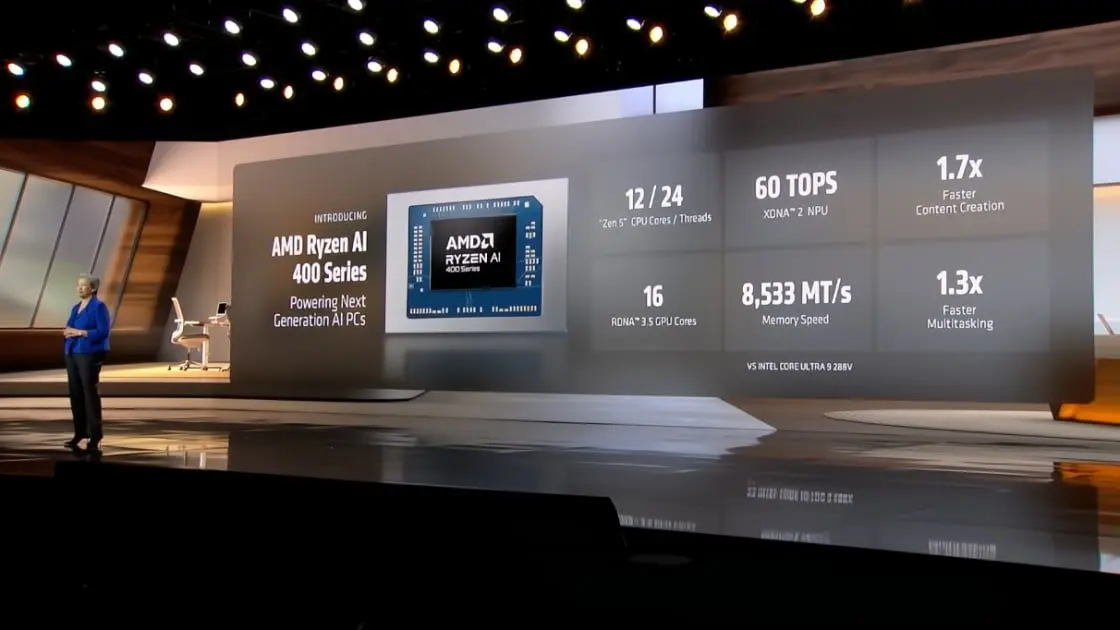
Source: PC Magazine
The flagship Ryzen AI 9 HX 475 features 12 Zen 5 CPU cores, 24 threads, and 16 RDNA 3.5 GPU cores, but the standout upgrade comes from its XDNA 2 NPU capable of delivering 60 TOPS of AI Power
4
. This marks a notable jump from the previous Ryzen AI 300 Series maximum of 50 TOPS, positioning AMD ahead of Intel's newly unveiled Panther Lake processors in raw AI-compute metrics5
. However, Qualcomm's Snapdragon X2 Elite Extreme claims a massive 80 TOPS, placing AMD firmly in second place for raw AI performance.Incremental Improvements Over Previous Generation
The Ryzen AI 400 Series represents an evolutionary rather than revolutionary update to AMD's laptop chips. Based on the same Zen 5 and Zen 5c CPU cores with identical RDNA 3.5 graphics as their predecessors, these mobile processors primarily offer boosted CPU and GPU frequency, increased memory bandwidth, and faster NPU capabilities in the top two models
3
. The HX 470 delivers 55 TOPS, while the HX 475 reaches 60 TOPS.AMD claims the latest chips enable 1.3x faster multitasking and 1.7x faster content creation compared to competitors
1
. When compared specifically against Intel's Lunar Lake Core Ultra 9 288V, the Ryzen AI 9 HX 470 demonstrates 29% faster performance running a 10-person Microsoft Teams call alongside standard office productivity applications5
. Built on TSMC's 4nm process, these chips feature optimized low-power architecture that AMD says can deliver up to 24 hours of local video playback, translating to multi-day battery life for average users.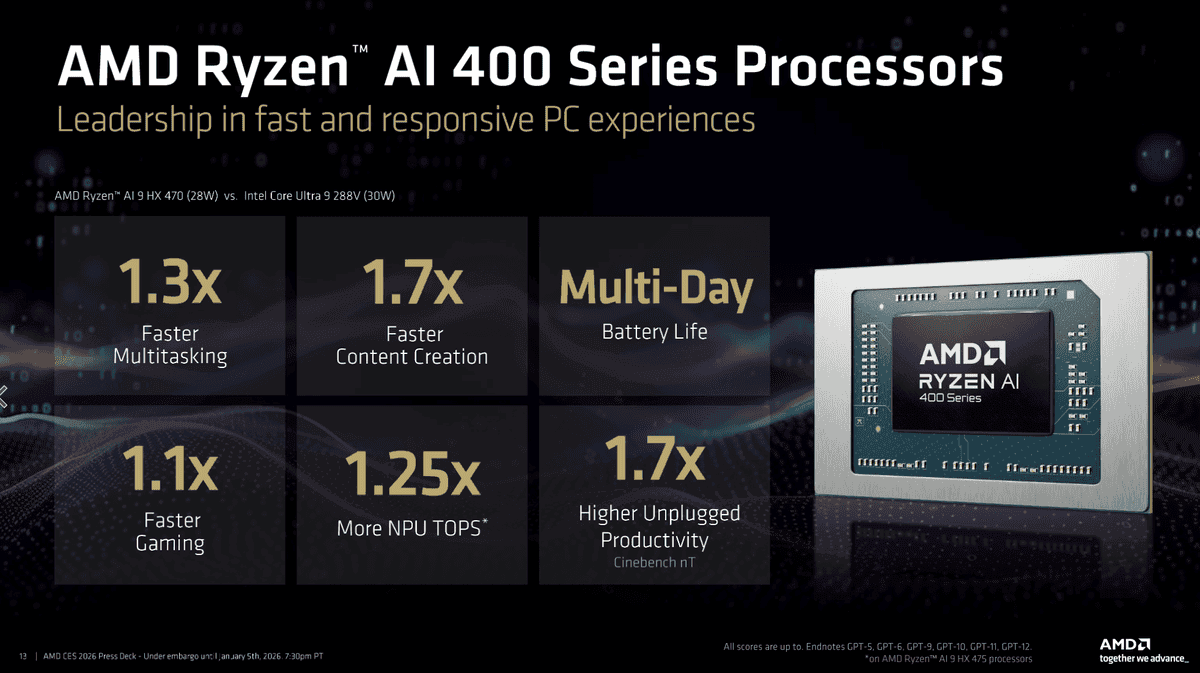
Source: Tom's Hardware
Gaming Processors Join the Lineup
AMD also announced the Ryzen 7 9850X3D, a new addition to its gaming-focused processor lineup that slots above the Ryzen 7 9900X3D
2
. The gaming processors feature essentially the same architecture but use slightly better-performing dies with a 100MHz clock speed boost, running at 5.6GHz compared to 5.5GHz for the 9900X3D. This translates to roughly 7% performance improvement for high-end gaming applications.The company unveiled its latest Redstone ray tracing technology, which simulates the physical behavior of light to deliver better video game graphics without performance or speed lag
1
. With Redstone enabled, AMD claims certain games can average around 109 FPS, though support will initially be limited to approximately 200 titles4
. The integrated Radeon graphics units are optimized to provide near-native image quality from lower-resolution frames using this new AMD FSR Redstone technology.Related Stories


Expanding the Ryzen AI Max Plus Portfolio
AMD introduced two new lower-end Ryzen AI Max Plus chips—the Ryzen AI Max Plus 392 (12-core) and Ryzen AI Max Plus 388 (8-core)—designed to bring beefy integrated graphics to more affordable price points
3
. These processors slide in above the plain Ryzen AI Max 390 and 385, respectively, with the primary upgrade being a jump from 32 compute units to 40 CUs, effectively boosting GPU performance for both gaming and AI workloads2
.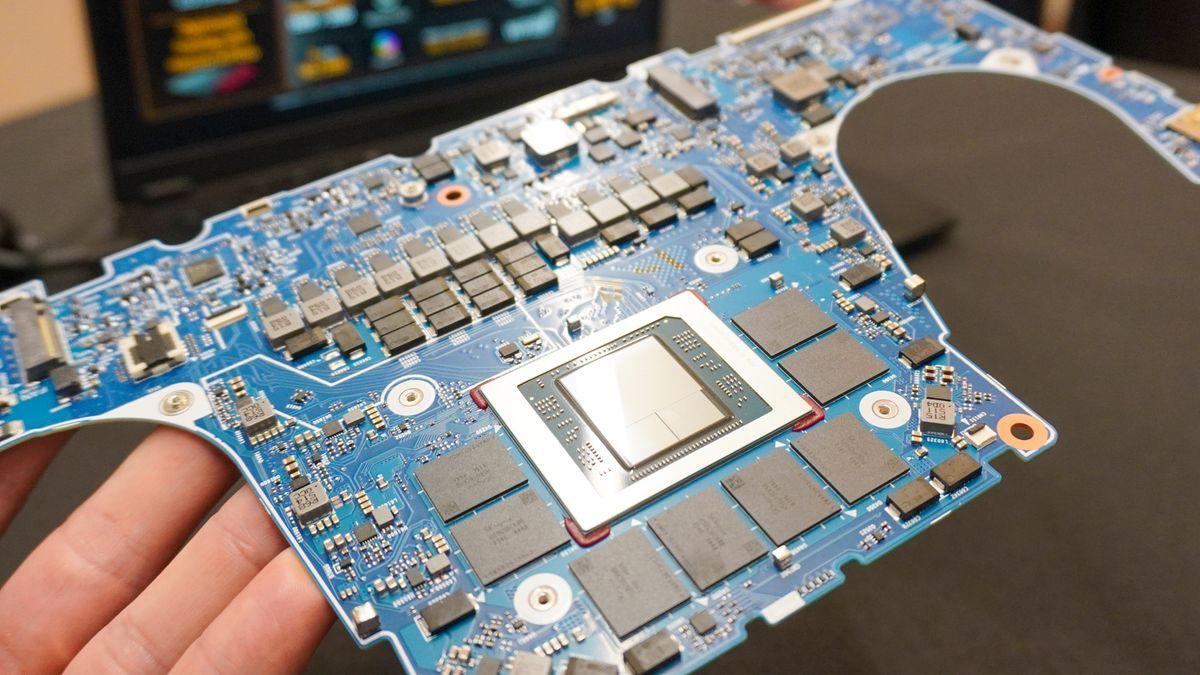
Source: Tom's Guide
The Ryzen AI Max processors stand out for their unique APU-style system-on-a-chip designs, employing a bank of shared memory that can be allocated dynamically between main system memory and graphics. With support for up to 192GB of shared memory, these chips deliver excellent integrated graphics performance alongside robust AI processing assisted by GPU cores
5
.Market Positioning and Competitive Landscape
Rahul Tikoo, senior vice president and general manager of AMD's client business, revealed that AMD has expanded to over 250 AI PC platforms, representing 2x growth over the last year
1
. AMD suggests that Ryzen AI systems typically start as low as $499, while Ryzen AI Max systems fall in the $1,000-to-$1,500 range, though exact pricing remains fluid amid the ongoing RAM crunch3
.When laptops and mini PCs featuring these processors ship in Q1 2026 from manufacturers including Acer, Asus, Dell, HP, and Lenovo, they will directly compete against Intel's Panther Lake and Qualcomm's Snapdragon X2 lineup, all launching within the same timeframe
3
. With AMD's Ryzen AI 300 chips already performing well in the market and hitting the sweet spot of price, performance, and battery life, the company appears positioned to maintain its competitive edge, though the incremental nature of these updates may test whether modest improvements suffice against fresh competition.AMD will leverage its ROCm software stack to unify AI development from cloud servers down to local devices, supporting both Windows and Linux environments for handling AI workloads
5
. This software ecosystem, combined with the hardware improvements, aims to deliver what Tikoo described as AI that can "understand, learn context, bring automation, provide deep reasoning and personal customization to every individual."References
Summarized by

Navi
Related Stories
Recent Highlights


Recent Highlights
Today's Top Stories








Your Daily Dose of Curated AI News
Don’t drown in AI news. We cut through the noise - filtering, ranking and summarizing the most important AI news, breakthroughs and research daily. Spend less time searching for the latest in AI and get straight to action.

