Anthropic closes gap with OpenAI as enterprise adoption surges and business use triples


7 Sources
7 Sources
[1]
Anthropic closes in on OpenAI as US business use surges
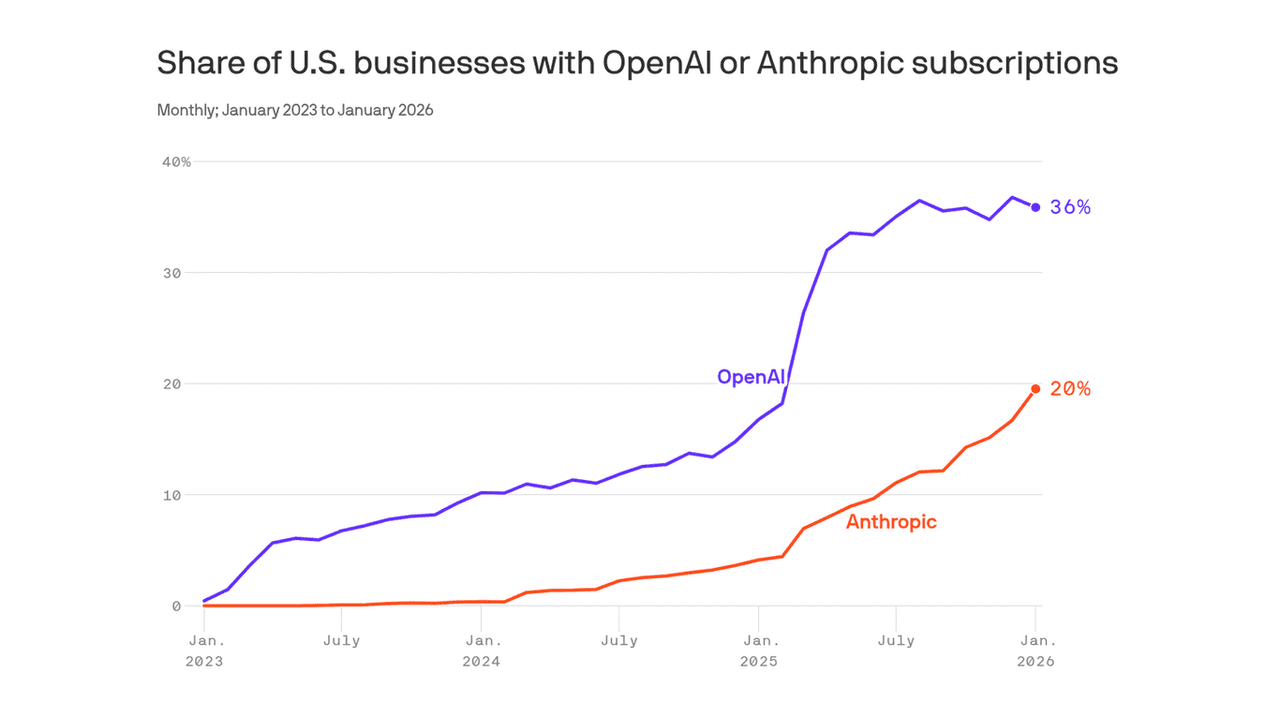
Anthropic is gaining ground on OpenAI in the race for paying customers, as new data points to rising business adoption and a levelling-off in its rival's growth. Nearly one in three US businesses paid for Anthropic's tools in March, according to data from payments group Ramp, marking a rise of more than 6 percentage points from the previous month. OpenAI retains its early lead in the US, but business adoption of the ChatGPT-maker's tools was flat at 35 per cent, according to Ramp's data based on $100bn in annual card and invoice spending from 50,000 customers. The divergence reflects Anthropic's recent rapid growth owing to strong interest in its Claude Code products and array of "plug-ins" designed to help automate aspects of white-collar jobs. OpenAI's surge following the launch of ChatGPT in November 2022 has given it a strong lead, particularly in the consumer market. OpenAI has said it currently has 900mn weekly active users with just over 5 per cent paying for its services. Its early, explosive growth is proving hard to sustain. Downloads of ChatGPT rose 5 per cent in the month to March, according to data from market researchers Sensor Tower. Over the same period, global downloads of Anthropic's Claude chatbot tripled to 21mn. In March, ChatGPT's weekly active users fell month-on-month in the US for the first time since the start of 2024, according to figures from Apptopia. OpenAI said it did not recognise the data cited by the FT. The company said that its AI coding agent Codex hit 3mn weekly users, up from 2mn last month. It said: "Our APIs now process more than 15bn tokens per minute. ChatGPT has six times the monthly web visits and mobile sessions of the next largest AI app. Our ads pilot reached $100mn run rate in six weeks. That's growth." Anthropic's business appears to have been unaffected by its row with the US defence department over recent weeks, with a US court temporarily blocking the Pentagon's effort to label the start-up a supply-chain risk. The company said this week it had reached $30bn in annualised revenue, up from $9bn at the end of 2025. Charlie Dai, VP and principal analyst at Forrester, said the data points to a "clear shift in momentum" towards Anthropic. "What's notable is that this growth is continuing even after the US government flagged potential supply-chain risks," he said. "For many companies, factors like how well the models perform, how easy they are to work with, and how well they fit enterprise needs matter more than short-term political or regulatory concerns." OpenAI is making a series of changes designed to boost its prospects ahead of its own plans for a blockbuster IPO. This includes a recent management shake-up, with a greater focus on core business lines over "side quests", which led it to shutter its Sora video generation platform. Anthropic's recent growth demonstrates that its strategy to initially target software developers and other professionals before moving to a wider audience is paying off, said Ara Kharazian, economist at Ramp. "Anthropic has been extremely successful at going from power users and early adopters to something that is applicable outside of that ecosystem." Anthropic's products are now more widely adopted across US information, financial and professional services than OpenAI's, but are also growing quickly in sectors such as construction and hospitality, Ramp's data showed. OpenAI has previously disputed the accuracy of Ramp's numbers, saying that "multimillion-dollar contracts" at large enterprises were not captured by Ramp's data. "It's a bit like saying global lemon sales can be calculated based on my kid's lemonade stand," the company told the FT last month. Ramp's co-founder Eric Glyman responded on X that its corporate payments platform processes up to 1 per cent of US GDP and its numbers are "consistent" with OpenAI and Anthropic's revenue figures. Anthropic said it does not comment on third-party data.
[2]
Anthropic in talks to invest $200m in private equity venture to push Claude into enterprise
In short: Anthropic is in negotiations to anchor a new joint venture with Blackstone, Hellman & Friedman, and Permira that would embed Claude across private equity portfolio companies, investing roughly $200m of its own capital into a vehicle that could raise up to $1bn from buyout firms, and taking Palantir's forward-deployed engineer model as its template. Anthropic is in talks to invest roughly $200m in a new private-equity-backed joint venture designed to accelerate enterprise adoption of its Claude models, according to reporting from the Wall Street Journal. The proposed structure would see buyout firms, including Blackstone, Hellman & Friedman, and Permira, take equity stakes totalling approximately $1bn in the venture, which would operate as a consulting and implementation arm helping businesses integrate Claude into their operations. No final terms have been agreed and no timeline has been announced. But the talks represent the most aggressive step Anthropic has yet taken to turn its model leadership into a distribution network, and they arrive at a moment of intensifying competition with OpenAI for the enterprise clients who will ultimately determine whether the economics of frontier AI hold together. The proposed joint venture is modelled, by multiple accounts, on Palantir's forward-deployment playbook: engineers embedded inside customer organisations, driving not just adoption but workflow transformation. Rather than relying on software subscriptions alone, Anthropic would bundle model access with advisory and implementation services, the kind of hands-on work that drives the sticky, recurring revenue that AI companies need to justify their infrastructure commitments. The strategic logic of using private equity as the distribution layer is elegant. PE firms control thousands of portfolio companies. Rather than Anthropic approaching each enterprise independently, a joint venture with Blackstone or Hellman & Friedman gives it access to those entire portfolios in one negotiation. Each buyout firm becomes, in effect, a channel partner with both a financial incentive to see Claude adopted and direct operational influence over the companies in which it is being deployed. Blackstone already has skin in the game beyond this new venture: the firm holds approximately $1bn in Anthropic equity, having invested $200m at a $350bn valuation in February 2026 as part of Anthropic's Series G round. That position gives Blackstone both a strategic and a financial reason to want Claude embedded as widely as possible in the corporate world, a conflict of interest, if you want to call it that, or an alignment of incentives, depending on your vantage point. Anthropic is not alone in pursuing this model. OpenAI is in parallel discussions with Advent International, Bain Capital, Brookfield Asset Management, and TPG for a comparable enterprise AI venture, with total fundraising reportedly targeting approximately $4bn. The structural differences between the two pitches are telling. OpenAI is offering private equity firms a guaranteed minimum return of 17.5%, an incentive designed to make the investment proposition simpler for LPs and investment committees that might otherwise treat an AI joint venture as too speculative. Anthropic is offering ordinary equity in the venture, with no floor on returns. That difference is both a financial signal, Anthropic is more confident in the commercial upside, or less willing to subsidise investor risk, and a cultural one: a company founded explicitly around AI safety is unlikely to be comfortable packaging its equity in instruments that prioritise investor protection over genuine shared risk. The Axios description of the competitive dynamic cuts to the point: "It's a whole lot faster for OpenAI and Anthropic to partner with PE firms than to approach each of their portfolio companies independently." Enterprise AI adoption has entered a race in which distribution, not model quality alone, will determine market share. Both companies have concluded that private equity is the fastest route to scale. The new venture, if it closes, would be the third major enterprise initiative Anthropic has launched within a single quarter. In March 2026, the company committed $100m to Anthropic's $100M Claude Partner Network, a programme anchored by Accenture, Deloitte, Cognizant, and Infosys that provides implementation support, technical architects, and co-marketing for enterprise Claude deployments. Separately, Xero has integrated Claude directly into its accounting platform in what Xero's partnership with Anthropic brings Claude into small business finance , a model that illustrates how deeply Claude is being embedded into software products far beyond the chat interface. By April 2026, more than 1,000 businesses are spending over $1m per year on Anthropic services on an annualised basis, up from roughly 500 two months earlier. Enterprise customers now represent approximately 80% of Anthropic's revenue, according to reporting based on the company's internal figures. The proposed PE venture is designed to accelerate that concentration, and to reach the segment of the enterprise market (private-equity-owned mid-market companies) that the Claude Partner Network's large-system-integrator anchors do not typically serve. Context matters here: Anthropic is reported to be in discussions with Goldman Sachs and JPMorgan Chase about a public listing targeting October 2026, with estimates of a $60bn fundraise. At $380bn valuation, the post-money figure on the Series G, a successful IPO requires Anthropic to demonstrate not just model capability but durable, scalable enterprise revenue. A joint venture that deploys Claude across the portfolio companies of three or four major buyout firms creates both a revenue channel and a narrative: that Claude is not merely a model but an enterprise infrastructure layer. The financial architecture that underlies all of this is worth noting. SoftBank's $40bn bridge loan to fund its OpenAI commitment illustrated the lengths to which AI infrastructure finance has stretched; Anthropic's own $30bn Series G was the second-largest venture funding deal in history. The PE venture adds another dimension to this picture: Anthropic is not merely raising money from PE firms as passive investors but is now proposing to build distribution vehicles with them, a shift from capitalisation to commercialisation. The talks are ongoing and the structure is not final. Key open questions include which PE firms will ultimately participate, how governance of the joint venture will work, and whether Anthropic will retain pricing and access controls over Claude deployments made through the vehicle. That last question is not trivial: Anthropic has shown it is willing to set boundaries around how Claude is accessed, having recently moved to restrict access to Claude via certain third-party frameworks where it judged the cost and safety dynamics to be misaligned. A joint venture that gives PE firms commercial incentives to deploy Claude as broadly as possible across their portfolios introduces a tension with that kind of granular control. Whether Anthropic can maintain its approach to model governance independent of its commercial partners while simultaneously using those partners as its primary distribution channel is the most interesting unresolved question in this story, and perhaps the most important one for anyone who cares about what responsible AI deployment actually looks like at enterprise scale.
[3]
Anthropic and OpenAI target big businesses with enterprise-grade controls and lower pricing - SiliconANGLE
Anthropic and OpenAI target big businesses with enterprise-grade controls and lower pricing Artificial intelligence leaders Anthropic PBC and OpenAI Group PBC are stepping up their efforts to compete for the enterprise, making their most advanced agentic tools more accessible to the largest organizations. In its update today, Anthropic revealed new "organization-wide controls" to help corporate teams deploy its autonomous Claude Cowork service. Meanwhile, OpenAI took a different path, slashing the cost of the "Pro" subscription to access its popular Codex programming tools. Anthropic said Claude Cowork is getting a variety of new administrative tools designed to help organizations manage its rollout. Claude Cowork, first announced in January, is an autonomous AI agent that's able to handle complex, multistep tasks on employee's computers. Unlike standard chatbots that just answer questions, it's more like a proactive teammate, capable of organizing files, creating reports and documents and running browser tasks, rather than just talking about them. While Claude Cowork is every bit as good as Claude Code at writing software, most early adopters can be found in non-engineering departments such as marketing, financial and legal teams, where they're using it to help with project updates and research tasks. To facilitate this reality, Anthropic has introduced role-based access controls for Enterprise subscribers, which enable admins to choose exactly which Cowork capabilities employees can access. There are also new group spend limits to support per-team budgeting, delivering the cost predictability that financial teams need. On the technical side, the company is enhancing observability by expanding Cowork's OpenTelemetry support. This means companies can now monitor Claude events such as tool calls and file modifications directly within their security information and event management pipelines. In addition, the company announced a new Zoom Model Context Protocol connector that allows Claude Cowork to pull meeting summaries and action items into its workflows, and more precise controls for other MCP connectors. Not to be outdone, OpenAI is pushing to entice the heaviest enterprise users to engage with Codex, its rival to Claude Code. The company is lowering the barrier to entry with the availability of a new $100 per month Pro plan, effectively slashing the cost of its most premium subscription in half. The new tier is aimed at Codex power users, offering five times as much usage as the existing $20 pricing tier. It's aimed at professional developers who keep finding themselves hitting limits during intensive coding sessions, and it dramatically undercuts the cost of rival coding services. For instance, the top-tier subscriptions of Claude Code and Google LLC's Gemini Code Assist both start at $200 per month. In addition to the lower costs, Pro Codex users will also be able to access experimental preview features enabled by OpenAI's latest frontier models, including GPT-5.4 Pro. Today's updates underline the strategic shift as AI's top model makers scramble to sign up more enterprises in the belief that businesses will ultimately become a major source of revenue in the years to come. They're fighting tooth and nail to win over customers, and that means they cannot only compete on model performance, but also areas such as utility and integration. The biggest beneficiaries are enterprises themselves. With Anthropic helping to solve the logistical headaches and OpenAI perhaps kicking off a deflationary trend in AI compute, it becomes easier for big businesses to adopt the most powerful AI agents and start accelerating automation.
[4]
Anthropic Commits $200 Million To AI Venture With Private Equity Titans
Anthropic is gearing up to invest $200 million in a new venture that plans to sell artificial intelligence tools to portfolio companies. The broader fundraising target under discussion is $1 billion, including Anthropic's $200 million. The new company would serve as a consulting arm for Anthropic and would focus on getting the company's AI tools embedded in day-to-day operations. The new entity would show management teams how to work the AI products into workflows rather than simply selling subscriptions. The move comes as AI developers compete to convert corporate interest in automation into recurring revenue. OpenAI is exploring a similar partnership model with private-equity firms TPG, Advent International, Bain Capital and Brookfield Asset Management to accelerate adoption of its own software, Reuters reported last month. With a pre-money valuation of approximately $10 billion, the deal could help OpenAI fast-track its entry into the corporate market while offering private equity firms a way to support portfolio companies facing AI-driven disruption. OpenAI has shifted its Chief Operating Officer, Brad Lightcap, to that internal project, known inside the company as DeployCo, the WSJ reported. In February, Fidji Simo, an executive at OpenAI made a post on X describing a plan to send engineers into companies to help staff learn and apply the technology. "We are launching a dedicated deployment arm tasked with embedding Forward Deployed Engineers deeply inside of enterprises. This project has been in the works with our investor and alliance partners since last December, and we are grateful for them and their partnership." "We're still early, but the speed of adoption is a clear signal of where this is headed. We're excited to not just be building these technologies but also building many ways for companies to deploy them and get impact," Simo wrote. Photo: Shutterstock This content was partially produced with the help of AI tools and was reviewed and published by Benzinga editors. Market News and Data brought to you by Benzinga APIs To add Benzinga News as your preferred source on Google, click here.
[5]

Anthropic Hits $30 Billion Run Rate as Enterprise Demand Accelerates | PYMNTS.com
By completing this form, you agree to receive marketing communications from PYMNTS and to the sharing of your information with our sponsor, if applicable, in accordance with our Privacy Policy and Terms and Conditions. That growth is being driven largely by enterprise demand. Companies are integrating Anthropic's models into internal workflows and customer-facing tools via APIs, while a smaller share of revenue comes from subscriptions to premium chatbot features, according to The Information. The momentum is also showing up in customer spend. Anthropic now counts more than 1,000 enterprise clients paying over $1 million annually, a figure that has more than doubled in recent months, signaling a shift from experimentation to full-scale deployment. At the same time, the surge is tightening the competitive race. Anthropic's trajectory is closing the gap with larger competitors like OpenAI, which generated an estimated $25 billion annualized revenue earlier this year. This underscores how enterprise AI spending is expanding quickly across multiple providers rather than consolidating around one. The expansion comes even as Anthropic faces regulatory scrutiny in the United States, as PYMNTS previously reported. The company is contesting a federal designation that labeled it a potential supply chain risk, a move it has warned could cost billions in lost revenue. The dispute has introduced uncertainty among some enterprise customers, with more than 100 reportedly raising concerns about continuing their relationships with Anthropic, according to Bloomberg. Anthropic's growth reflects broader enterprise adoption of AI tools. Companies are moving beyond early chatbot experiments and deploying models across functions such as software development, customer support and internal data operations. The rise in customers spending more than $1 million annually suggests that AI usage is shifting from limited pilots to larger, production-level deployments. That demand is also shaping how AI companies structure their offerings. Rather than focusing solely on consumer-facing chat interfaces, Anthropic has leaned into developer tools and enterprise integrations, where usage scales with business activity. The company's growth strategy is also extending beyond its core model business. Anthropic is reportedly planning a $200 million investment into a new private equity-backed venture aimed at distributing AI tools across portfolio companies, as covered by PYMNTS. At the same time, it is expanding into industry-specific applications. Anthropic has agreed to acquire biotech startup Coefficient Bio for roughly $400 million, targeting the use of AI in drug discovery and clinical workflows, according to PYMNTS.
[6]
Anthropic Making $200 Million Bet on New Enterprise Arm | PYMNTS.com
By completing this form, you agree to receive marketing communications from PYMNTS and to the sharing of your information with our sponsor, if applicable, in accordance with our Privacy Policy and Terms and Conditions. This effort would see the artificial intelligence (AI) startup try to sell its tools to the private equity (PE) outfits portfolio companies as it tries to strengthen its enterprise customer base, The Wall Street Journal (WSJ) reported Monday (April 6). Blackstone, General Atlantic and Hellman & Friedman are among the PE firms in talks to back the project, sources familiar with the matter told the WSJ. Anthropic is in discussions to raise $1 billion for the project, a figure that includes its $200 million, the sources said. The new venture would act as a consulting arm for Anthropic that helps businesses incorporate the company's AI tools in their operations, per the report. The WSJ story follows previous reporting from The Information about Anthropic's efforts to recruit PE clients. As the WSJ notes, both Anthropic and rival OpenAI are racing to claim revenue from business clients hoping to boost productivity with AI. Both companies, the report added, view themselves as well-placed to capitalize on the wider use of their products in U.S. workplaces. "Anthropic has been repositioning Claude from a conversational assistant into a tool embedded in enterprise operations," PYMNTS wrote last month, referencing the company's flagship artificial intelligence product. As covered here, the company is expanding Claude beyond chat "into structured enterprise workflows, integrating the model into coding, document analysis and business process automation." OpenAI is also reportedly working on a $10 billion joint venture with PE firms to expand the use of its AI tools. The company reassigned its chief operating officer to work on this effort. The WSJ report also points out that Fidji Simo, a top OpenAI executive, wrote in a post on social media X last month that the company aims to send engineers to work at these companies to instruct them how to use the technology. PYMNTS wrote late last year about the way PE firms are employing AI within their own operations, testing whether it can improve forecasting and identify risks earlier. "The shift signals that AI is becoming less of an experiment and more of an operational requirement," that report said. This evolution, the report continued, is most visible in the earliest phases of investment work. For example, Boston-based PE company BayPine has started integrating AI into its investment and operating workflows. "Underwriting value creation from data and AI at the outset significantly increases the likelihood of successful implementation during the ownership period," Cory A. Eaves, partner and head of Portfolio Operations at BayPine, wrote in a June Private Markets Insights report.
[7]

Anthropic Hits $30 Billion Revenue, Edges Past OpenAI
Anthropic has surpassed OpenAI in annual revenue. It signals a major shift in the AI market and intensifies global competition among leading AI companies. Earlier in 2025, OpenAI had a wider revenue gap; however, Anthropic's expansion into business-focused applications appears to have narrowed and reversed that lead. reported annualized revenue exceeding $30 billion. The AI startup has overtaken OpenAI's reported $2 billion in monthly revenue, or about $24 billion annually, as disclosed during its recent fundraising. The AI startup had reported approximately $9 billion at the end of 2025. The company said that in February, over 500 business customers were spending more than $1 million annually. That number has now exceeded 1,000, doubling in less than two months. The development reflects Anthropic's rapid growth, driven in part by demand for its enterprise-focused AI tools, including coding products. "We shared that over 500 business customers were each spending over $1 million on an annualized basis. Today that number exceeds 1,000, doubling in less than two months," the latest Anthropic blog read. In an earlier post, the company attributed the rising run-rate revenue to the number of customers spending over $100,000 annually on Claude (as represented by run-rate revenue), which has grown 7x in the past year. And businesses that start with Claude for a single use case, API, Claude Code, or Claude for Work, are expanding their integrations across their organizations. "Two years ago, a dozen customers spent over $1 million with us on an annualized basis. Today that number exceeds 500. Eight of the Fortune 10 are now Claude customers," the blog post read. Anthropic has recently raised $30 billion in Series G funding, led by GIC and Coatue, valuing the Company at $380 billion post-money. The round was co-led by D. E. Shaw Ventures, Dragoneer, Founders Fund, ICONIQ, and MGX.
Share
Share
Copy Link
Anthropic is rapidly gaining market share against OpenAI, with nearly one in three US businesses now paying for its Claude AI models. The company hit a $30 billion annualized revenue run rate while OpenAI's growth plateaus. Both AI leaders are racing to attract enterprise clients through new ventures with private equity firms and aggressive pricing strategies.
Anthropic Closes Gap as Enterprise Adoption Accelerates
Anthropic is gaining market share against OpenAI at an unprecedented pace, with new data revealing a dramatic shift in the competitive landscape for enterprise AI tools. Nearly one in three US businesses paid for Anthropic's Claude AI models in March, marking a rise of more than 6 percentage points from the previous month, according to payments data from Ramp based on $100 billion in annual card and invoice spending from 50,000 customers
1
. Meanwhile, OpenAI's business adoption remained flat at 35 per cent, suggesting the ChatGPT maker's early explosive growth is proving difficult to sustain1
.
Source: SiliconANGLE
The momentum reflects accelerating enterprise demand for Anthropic's services, driven by strong interest in its Claude Code products and array of plug-ins designed to automate white-collar work. Global downloads of Anthropic's Claude chatbot tripled to 21 million in the month to March, while ChatGPT downloads rose just 5 per cent over the same period
1
. More significantly, ChatGPT's weekly active users fell month-on-month in the US for the first time since the start of 2024, according to figures from Apptopia1
.Revenue Run Rate Hits $30 Billion as Enterprise Clients Scale
Anthropic announced it had reached $30 billion in annualized revenue, up from $9 billion at the end of 2025
1
. That growth is being driven largely by enterprise customers integrating the company's AI models into internal workflows and customer-facing applications via APIs, with a smaller share coming from subscriptions to premium chatbot features5
. More than 1,000 businesses are now spending over $1 million per year on Anthropic services on an annualized basis, up from roughly 500 two months earlier2
. Enterprise customers now represent approximately 80 per cent of Anthropic's revenue2
.
Source: Analytics Insight
Anthropic's products are now more widely adopted across US information, financial and professional services than OpenAI's, but are also growing quickly in sectors such as construction and hospitality, according to Ramp's data
1
. Charlie Dai, VP and principal analyst at Forrester, said the data points to a "clear shift in momentum" towards Anthropic, noting that factors like model performance, ease of integration, and enterprise fit matter more than short-term political or regulatory concerns1
.AI Venture with Private Equity to Push Claude into Enterprise
Both Anthropic and OpenAI are pursuing aggressive strategies to embed artificial intelligence tools across corporate America through joint ventures with private equity firms. Anthropic is in talks to invest roughly $200 million in a new private-equity-backed joint venture designed to accelerate the push Claude into enterprise environments
2
. The proposed structure would see buyout firms including Blackstone, Hellman & Friedman, and Permira take equity stakes totalling approximately $1 billion in the venture, which would operate as a consulting and implementation arm helping businesses integrate Claude into their operations2
.The strategic logic is elegant: private equity firms control thousands of portfolio companies, giving Anthropic access to entire portfolios in one negotiation rather than approaching each enterprise independently
2
. The proposed joint venture is modelled on Palantir's forward-deployment playbook, with engineers embedded inside customer organizations driving not just adoption but workflow transformation2
. Blackstone already holds approximately $1 billion in Anthropic equity, having invested $200 million at a $350 billion valuation in February 2026 as part of Anthropic's Series G round2
.OpenAI is pursuing a similar partnership model with private equity firms including TPG, Advent International, Bain Capital, and Brookfield Asset Management, with total fundraising reportedly targeting approximately $4 billion
2
. OpenAI is offering private equity firms a guaranteed minimum return of 17.5 per cent, while Anthropic is offering ordinary equity in the venture with no floor on returns2
.Related Stories
Enterprise-Grade Controls and Pricing Moves to Attract Enterprise Clients
Anthropic introduced new organization-wide controls to help corporate teams deploy its autonomous Claude Cowork service, including role-based access controls for Enterprise subscribers that enable admins to choose exactly which capabilities employees can access
3
. The company is also enhancing observability by expanding Cowork's OpenTelemetry support, allowing companies to monitor Claude events such as tool calls and file modifications directly within their security information and event management pipelines3
.OpenAI is taking a different approach, slashing the cost of its Pro subscription to access Codex programming tools to $100 per month, effectively cutting its most premium subscription in half
3
. The new tier offers five times as much usage as the existing $20 pricing tier and dramatically undercuts rival coding services, with top-tier subscriptions of Claude Code and Google's Gemini Code Assist both starting at $200 per month3
. OpenAI said its APIs now process more than 15 billion tokens per minute, and that its AI coding agent Codex hit 3 million weekly users, up from 2 million last month1
.
Source: FT
The competition between these AI leaders signals a strategic shift as model makers scramble to sign up more enterprises in the belief that businesses will ultimately become a major source of revenue. They're fighting to win over customers not only on model performance but also on utility, integration, and developer tools
3
.References
Summarized by

Navi
[2]
[3]
Related Stories
Anthropic doubles funding target to $20B as enterprise AI revenue surges toward $18B in 2026
27 Jan 2026•Business and Economy

OpenAI vs Anthropic: Diverging Strategies in the AI Race
28 Oct 2025•Technology

Anthropic's Meteoric Rise: Tripling Revenue to $3 Billion in Just 5 Months
31 May 2025•Business and Economy

Recent Highlights
1
Meta unveils Muse Spark AI model as Superintelligence Labs makes its debut
Technology

2
Anthropic restricts Mythos AI model release, citing unprecedented cybersecurity capabilities
Technology

3
Anthropic sends Claude AI to psychiatrist, discovers functional emotions that shape behavior
Science and Research

Recent Highlights
Today's Top Stories









Your Daily Dose of Curated AI News
Don’t drown in AI news. We cut through the noise - filtering, ranking and summarizing the most important AI news, breakthroughs and research daily. Spend less time searching for the latest in AI and get straight to action.

