Anthropic releases Claude Opus 4.6 as AI model advances rattle software stocks and cybersecurity


23 Sources
23 Sources
[1]
Anthropic's Powerful Claude Opus AI Model Is Getting an Upgrade
Expertise Artificial intelligence, home energy, heating and cooling, home technology. Anthropic's most powerful Claude model is leveling up, with the company saying in a blog post Thursday that Claude Opus 4.6 will be even better at coding and creating projects on the first go. Claude Opus 4.5 is already a powerful coding model, with its release in November setting up Claude Code's viral vibe-coding moment over the holidays. Claude's proven coding prowess and new Cowork feature have Wall Street anxious, with many tech stocks falling in recent weeks, over concerns that people won't need software products in the future. Anthropic said the new model is more focused on solving the biggest challenges, like the inner workings of complex apps, while also handling the easy steps more quickly. As a reasoning model, Opus 4.6 works by breaking down the steps it needs to take to do what you ask it to and putting together a plan before starting on it. It'll also go back and check its work on those steps, sometimes making multiple attempts without you asking for it. Sometimes the model can spend too much effort on a task, which Anthropic said can be resolved by reducing its effort level from the default "high" setting. Read more: Anthropic Super Bowl Commercials Pinky Promise No Ads in Claude The Claude Opus models are available for paying Claude users on the Pro, Max, Team and Enterprise plans. The cheapest of those, Pro, costs $20 a month (or $17 a month if you pay annually). The Pro plan comes with usage limits for Opus, which users can hit after a few hours of vibe coding and then have to wait several hours for it to reset.
[2]
Anthropic says its new Claude Opus 4.6 can nail your work deliverables on the first try
Anthropic today announced Claude Opus 4.6, which the company says is its most capable model for enterprise and knowledge work. This new large language model is an upgrade to Opus 4.5, with broader autonomy and more accurate first-try results. Also: Claude Code made an astonishing $1B in 6 months - and my own AI-coded iPhone app shows why Anthropic describes Opus 4.6 as a "frontier model" designed to handle complex end-to-end enterprise workflows. The term "frontier model" is used by the AI industry to describe AI systems that are at the leading edge of current AI capabilities. Using Opus 4.6, "Documents, spreadsheets, and presentations will need less back-and-forth on iterations," according to an email ZDNET received from a company representative. Anthropic says, "For AI to truly tackle enterprise work, it must succeed at three key outcomes: finding information, analyzing it, and producing something from it." According to the company, 4.6 performs well across all three key outcomes. All this indicates a jump in the AI's agentic capabilities, with an ability to handle complex, long-run tasks in addition to isolated subtasks. Using travel as an analogy, a simple subtask might be telling a driver to "turn right at the next light," while a more complex task would be to tell that driver located in New York City to drive to Faneuil Hall in Boston. It would be up to the driver to determine the steps and get there. Likewise, the idea with Opus 4.6's broader autonomy is that it can plan and execute the complex series of steps for larger-scale assignments. Also: How to install and configure Claude Code, step by step According to the company, Opus 4.6 also reduces the number of corrections and reframes required for "common enterprise deliverables." According to Yashodha Bhavnani, head of AI at cloud storage vendor Box, "Claude Opus 4.6 excels in high-reasoning tasks, like multi-source analysis, across legal, financial, and technical content. Box's eval showed a 10% lift in performance, reaching 68% vs. a 58% baseline, and near-perfect scores in technical domains." Anthropic is also positioning Claude Opus 4.6 as a valuable resource for financial modeling. The AI can help with regulatory filings, market reports, and internal data, producing rapid results for projects that would previously take analysts days to complete. Anthropic says Opus 4.6 "handles the nuance required for compliance-sensitive output." Opus 4.6 is proving to be powerful for legal reasoning as well. According to Niko Grupen, head of AI research at legal AI company Harvey, "Claude Opus 4.6 achieved the highest BigLaw Bench score of any Claude model at 90.2%. With 40% perfect scores and 84% above 0.8, it's remarkably capable for legal reasoning." Another intriguing new capability is Claude's integration with PowerPoint. Once released, Claude will be able to work directly inside PowerPoint (presumably as a plugin) and be able to read layouts, fonts, and slide masters. This way, edits by the AI can stay "on-brand and on-template." Also: I tried a Claude Code alternative that's local, open source, and completely free - how it works According to the company, Claude Opus 4.6 can "build slides from a corporate template, restructure a storyline, convert bullets into diagrams, or generate a full deck from a description -- all without leaving the app." The PowerPoint capability is in research preview, available via a waitlist. ZDNET has requested access. As soon as we get it, we'll create some spiffy slides and report back to you. Claude is particularly well known for its agentic coding capabilities. Claude Opus 4.6 builds on the strengths of Opus 4.5 with more agentic behavior. The company says that autonomous coding improvements will particularly benefit developers with large code bases, long-horizon tasks, and complex implementations. Also: Stop using ChatGPT for everything: My go-to AI models for research, coding, and more (and which I avoid) As a user of Claude Code, this brings to mind a key question. Claude Code using Opus 4.5 often needs to run compaction sequences that free up available resources. This process not only takes a long time, but it often interrupts project flow. If 4.6 is supposed to be able to address even larger code bases, then the context window needs to grow. Anthropic says that "Claude Opus 4.6 will support 1M context (in beta) at launch. This is the first Opus model with long context." It'll be very interesting to see that in action. The company is offering a research preview of agent teams in Claude Opus 4.6 to API and subscription Claude users. The company says teams "let Claude Code work the way a real engineering team does. Instead of one agent working through tasks sequentially, you can split the work across multiple agents -- each owning its piece and coordinating directly with the others." Also: I let Anthropic's Claude Cowork loose on my files, and it was both brilliant and scary I've been struggling with Claude running multiple parallel agents in Claude Code using Opus 4.5, particularly in the Xcode 26.3 preview. I've found that once the primary agent kicks off a series of subagents, they're not visible for my hands-on management. When one or more of them gets stuck (as they seem to do with disturbing regularity), the whole agentic coding process just hangs. I'm hoping that agent teams in Claude Opus 4.6 provide better transparency, better overall management, and better damage control, so if they get stuck, they report back and ask for help. Stay tuned. I'll do some testing and report back on overall performance. That said, Michele Catasta, president of AI no-code company Replit says, "Claude Opus 4.6 is a huge leap for agentic planning. It breaks complex tasks into independent subtasks, runs tools and subagents in parallel, and identifies blockers with real precision." Anthropic says, "Claude Opus 4.6 is available today on claude.ai, our API, and all major cloud platforms." Token pricing hasn't changed from the previous release for API users. Some features like PowerPoint, the 1M context, and agent teams are described as research previews or beta, and are not available for wide release at launch. But Anthropic is working on AI time. So items in research preview and beta are more likely to be weeks away than months away. After all, it does have an AI to help it code its products. Also: Want local vibe coding? This AI stack replaces Claude Code and Codex - and it's free What do you think about Claude Opus 4.6 and Anthropic's push toward more autonomous, enterprise-focused AI? Do you see real value in features like agent teams, 1M context, or deep integrations like PowerPoint? Would you trust an AI to handle complex work end-to-end with less human oversight, or do you still prefer tighter control? How do you think this compares to other frontier models you've used? What questions do you still have about availability or real-world performance? Let us know in the comments below.
[3]
Anthropic Releases New Model That's Adept at Financial Research
Anthropic plans to focus on improving its AI models to carry out work related to areas like cybersecurity, life sciences, health care and financial services, according to Scott White, the company's head of product for Claude AI models. Anthropic is releasing a new version of its most powerful AI model that's designed to carry out financial research, days after the company's push into legal services upended the stocks of legacy software makers. The company on Thursday unveiled Claude Opus 4.6, which it says can scrutinize company data, regulatory filings and market information to come up with detailed financial analyses that would normally take a person days to complete. Opus 4.6 is also meant to be better at a range of other work-related functions, including making spreadsheets and presentations, as well as software development. Shares of financial services companies slumped following the release, with FactSet Research Systems Inc. falling as much as 10%, while S&P Global Inc., Moody's Corp and Nasdaq, Inc. all turned sharply lower. Anthropic and rival OpenAI have spent much of the past year developing artificial intelligence tools to streamline a wider range of professional tasks - from financial services to health care - with the goal of courting more business customers and justifying their lofty valuations. Anthropic is currently in talks to raise a new round of funding at a $350 billion valuation and OpenAI is in fundraising discussions at a valuation of up to $830 billion. OpenAI also introduced an update on Thursday to its AI coding agent, Codex, that's meant to further streamline the process of writing and debugging code, and can be used to build software like complicated games and apps. The ChatGPT maker stressed that the product's capabilities extend beyond writing software to a range of other related documentation and presentation work, such as helping to create slide decks and analyze user data. Anthropic, for its part, has more than 300,000 business customers who use its models to streamline workplace responsibilities, particularly in the field of computer programming where it has emerged as a market leader with Claude Code. The Claude maker's expansion beyond coding has recently rattled Wall Street. Anthropic's quiet release of a tool to automate certain legal work helped spark a trillion-dollar market meltdown this week, particularly among software stocks that investors fear may eventually be rendered obsolete. The product has become a proxy for concerns about which companies and services will eventually be disrupted by AI. The legal feature is a plug-in for Claude Cowork, an AI agent released as a "research preview" earlier this year. Cowork quickly made waves among technology enthusiasts for being a more intuitive tool for building apps, creating spreadsheets and sorting through troves of data. Anthropic said Cowork was built in a matter of days, with most of the code written by Claude's own AI. Scott White, Anthropic's head of product for Claude AI models, said the company plans to focus on improving the capability to carry out work related to areas like cybersecurity, life sciences, health care and financial services. "Those are areas where we're going to lean in really hard," he said. Bloomberg LP, the parent of Bloomberg News, competes with firms including S&P Global Inc. and FactSet Research Systems Inc. in providing financial data and news. Bloomberg Law sells legal research tools and software.
[4]
Claude Opus 4.6 Finds 500+ High-Severity Flaws Across Major Open-Source Libraries
Claude Opus 4.6, which was launched on Thursday, comes with improved coding skills, including code review and debugging capabilities, along with enhancements to tasks like financial analyses, research, and document creation. Stating that the model is "notably better" at discovering high-severity vulnerabilities without requiring any task-specific tooling, custom scaffolding, or specialized prompting, Anthropic said it is putting it to use to find and help fix vulnerabilities in open-source software. "Opus 4.6 reads and reasons about code the way a human researcher would -- looking at past fixes to find similar bugs that weren't addressed, spotting patterns that tend to cause problems, or understanding a piece of logic well enough to know exactly what input would break it," it added. Prior to its debut, Anthropic's Frontier Red Team put the model to test inside a virtualized environment and gave it the necessary tools, such as debuggers and fuzzers, to find flaws in open-source projects. The idea, it said, was to assess the model's out-of-the-box capabilities without providing any instructions on how to use these tools or providing information that could help it better flag the vulnerabilities. The company also said it validated every discovered flaw to make sure that it was not made up (i.e., hallucinated), and that the LLM was used as a tool to prioritize the most severe memory corruption vulnerabilities that were identified. Some of the security defects that were flagged by Claude Opus 4.6 are listed below. They have since been patched by the respective maintainers. "This vulnerability is particularly interesting because triggering it requires a conceptual understanding of the LZW algorithm and how it relates to the GIF file format," Anthropic said of the CGIF bug. "Traditional fuzzers (and even coverage-guided fuzzers) struggle to trigger vulnerabilities of this nature because they require making a particular choice of branches." "In fact, even if CGIF had 100% line- and branch-coverage, this vulnerability could still remain undetected: it requires a very specific sequence of operations." The company has pitched AI models like Claude as a critical tool for defenders to "level the playing field." But it also emphasized that it will adjust and update its safeguards as potential threats are discovered and put in place additional guardrails to prevent misuse. The disclosure comes weeks after Anthropic said its current Claude models can succeed at multi-stage attacks on networks with dozens of hosts using only standard, open-source tools by finding and exploiting known security flaws. "This illustrates how barriers to the use of AI in relatively autonomous cyber workflows are rapidly coming down, and highlights the importance of security fundamentals like promptly patching known vulnerabilities," it said.
[5]

Anthropic releases AI upgrade as market punishes software stocks
SAN FRANCISCO, Feb 5 (Reuters) - Technology startup Anthropic on Thursday launched what it called an improved artificial intelligence model, days after its product advances helped kick-start a selloff of traditional software stocks. The San Francisco-based lab, which is backed by Amazon.com (AMZN.O), opens new tab and Alphabet's (GOOGL.O), opens new tab Google, said its Claude Opus 4.6 model is an upgrade to the Opus 4.5 model released in November. The new AI can work on tasks for longer and more reliably, while showing gains related to coding and finance, Anthropic said. Anthropic also teased how this tech could process 1 million pieces of data known as "tokens" in a single prompt, matching a capability earlier claimed by Google and a less powerful Claude model. And it previewed how this AI, in the computer programming tool Claude Code, could divvy up tasks among multiple autonomous agents and get work done faster. Seen as a disruptor in the software industry, Anthropic is aiming to stay at technology's frontier ahead of its highly anticipated initial public offering, at a time of competition from Google and OpenAI. Software developers have embraced its AI for coding. Anthropic is meanwhile making a push for business deals with products like Claude Cowork, which executes computer tasks for white-collar workers. The AI companies' swift deployments have stoked market moves that predict older software businesses will lose relevance as AI beats them at their own game. Shares of Salesforce (CRM.N), opens new tab, Workday (WDAY.O), opens new tab and Thomson Reuters (TRI.TO), opens new tab each traded around 3% lower Thursday, extending declines over the past week. Still, technology industry figures, including Nvidia CEO Jensen Huang, have dismissed such concerns about disruption, arguing that the specialized products, vast data and AI adoption of older software companies will provide a moat. Scott White, Anthropic's head of product for enterprise, also said the goal was to connect AI to older software tools to make them more useful. "We are excited to partner and actually lower the floor to get more value out of those tools," White told Reuters. Claude Cowork, he said, is more like "the front door to getting hard work done." Reporting by Jeffrey Dastin in San Francisco; Editing by Lisa Shumaker Our Standards: The Thomson Reuters Trust Principles., opens new tab * Suggested Topics: * Retail & Consumer Jeffrey Dastin Thomson Reuters Jeffrey Dastin is a correspondent for Reuters based in San Francisco, where he reports on the technology industry and artificial intelligence. He joined Reuters in 2014, originally writing about airlines and travel from the New York bureau. Dastin graduated from Yale University with a degree in history. He was part of a team that examined lobbying by Amazon.com around the world, for which he won a SOPA Award in 2022.
[6]

Anthropic launches Claude Opus 4.6 as AI moves toward a 'vibe working' era
Dario Amodei, CEO and co-founder of Anthropic, speaks during the 56th annual World Economic Forum meeting in Davos, Switzerland, Jan. 20, 2026. Anthropic on Thursday announced the launch of Claude Opus 4.6, its latest artificial intelligence model that's better at coding, sustaining tasks for longer and creating higher-quality professional work products and outputs, the company said. Claude Opus 4.6 marks Anthropic's first major model launch of the year, but it comes just months after the company released three others -- Claude Opus 4.5, Claude Sonnet 4.5 and Claude Haiku 4.5 -- late last year. Anthropic's models are particularly popular with enterprise customers, which make up roughly 80% of Anthropic's business, CEO Dario Amodei told CNBC last month. The company's AI coding tool, Claude Code, as well as advancements within its productivity tool, Claude Cowork, have also started to spook software investors, many of whom are growing worried about the potential for disruption within the sector. The WisdomTree Cloud Computing Fund is down more than 20% year to date. "Everybody has seen this transformation happen with software engineering in the last year and a half, where vibe coding started to exist as a concept, and people could now do things with their ideas," Scott White, Anthropic's head of product for enterprise, told CNBC in an interview. "I think that we are now transitioning almost into vibe working."
[7]

Anthropic Launches New Model That Spots Zero Days, Makes Wall Street Traders Lose Their Minds
Anthropic, the makers of the popular and code-competent chatbot Claude, released a new model Thursday called Claude Opus 4.6. The company is doubling down on coding capabilities, claiming that the new model "plans more carefully, sustains agentic tasks for longer, can operate more reliably in larger codebases, and has better code review and debugging skills to catch its own mistakes." It seems the model is also pretty good at catching other people's mistakes. According to a report from Axios, Opus 4.6 was able to spot more than 500 previously undisclosed zero-day security vulnerabilities in open-source libraries during its testing period. It also reportedly did so without receiving specific prompting to go hunting for flawsâ€"it just spotted and reported them. That's a nice change of pace from all of the many developments that have been happening around OpenClaw, an open-source AI agent that most users have been running with Claude Opus 4.5. A number of vibe-coded projects that have come out of the community have had some pretty major security flaws. Maybe Anthropic's upgrade will be able to catch those issues before they become everyone else's problem. Claude's calling card has been coding for some time now, but it seems Anthropic is looking to make a splash elsewhere with this update. The company said Opus 4.6 will be better at other work tasks like creating PowerPoint presentations and navigating documents in Excel. Seems those features will be key to Cowork, Anthropic's recent project that it is touting as "Claude Code" for non-technical workers. It's also boasting that the model will have potential use in financial analysis, and it sure seems like the folks on Wall Street could use some help there. The general consensus among financial analysts this week is that Anthropic's Cowork models are spooking the stock market and playing a major factor in sending software stocks into a spiral. It's possible that this is what the market has been responding toâ€"after all, the initial release of DeepSeek, the open-source AI model out of China, tanked the AI sector for a day or so, so it's not like these markets aren't overly sensitive. But it seems unlikely that Opus 4.6 will fundamentally upend the market. Anthropic already holds a solid lead on the plurality of the enterprise market, according to a recent report from Menlo Ventures, and is well ahead of its top (publicly traded) competitors in the spaceâ€"though OpenAI made its own play to cut into some market share earlier today with the launch of its Frontier platform for managing AI agents. If anything, Anthropic's new model seems like it'll help the company maintain its top spot for the time being. But if the stock market shock is any indication, one thing is for sure: the entire economy is completely pot-committed to the developments in AI. Surely that won't have any repercussions.
[8]

Anthropic reveals new Opus 4.6 model with more autonomy and better focus - 9to5Mac
Anthropic has announced its latest AI model with Claude Opus 4.6. The new version arrives just two months after the previous model upgrade. Anthropic described its previous model in late November as "intelligent, efficient, and the best model in the world for coding, agents, and computer use." This time around, Claude Opus "plans more carefully, stays on task longer, and works more autonomously, so you can do more with less back-and-forth." Here's what the company has to say about its new Claude Opus 4.6 model: The new Claude Opus 4.6 improves on its predecessor's coding skills. It plans more carefully, sustains agentic tasks for longer, can operate more reliably in larger codebases, and has better code review and debugging skills to catch its own mistakes. And, in a first for our Opus-class models, Opus 4.6 features a 1M token context window in beta. Opus 4.6 can also apply its improved abilities to a range of everyday work tasks: running financial analyses, doing research, and using and creating documents, spreadsheets, and presentations. Within Cowork, where Claude can multitask autonomously, Opus 4.6 can put all these skills to work on your behalf. Anthropic is also investing in its Microsoft Excel integration and introducing PowerPoint integration.
[9]

I spent 24 hours with Claude Opus 4.6 -- here's why it feels more human than any other AI I've tested
From reasoning to creativity, Claude 4.6 changes what you should expect from an AI As someone who spends every day reviewing AI and probing where models break, I've been waiting for a system that does more than just process information well. We've seen what Gemini Flash 3 can do and how ChatGPT-5 is trying to keep up, but ultimately, we've moved beyond the era where "it works" is enough; now we need nuance, meta-awareness and the ability to wrestle with the messy contradictions of human thought. After 24 hours with Anthropic's newly released Claude Opus 4.6, it feels like something has genuinely shifted. This isn't just a faster or smarter model -- it's one that thinks in a noticeably different way. What struck me most about Claude 4.6 is what I'd call its principle-driven intelligence. Where many models optimize for speed or clean answers, Claude often slows down, reasons through tradeoffs and tries to surface the why behind its responses. When asked to explain a "true but unbelievable" fact, for example, Claude didn't just state the science -- it leaned into storytelling and analogy in a way that made the idea feel vivid and convincing, not just correct. It's the kind of response that doesn't just inform you, but changes how you see the problem. On complex or ethically fraught topics -- like AI tradeoffs, benchmarks or real-world consequences -- Claude 4.6 feels unusually careful and reflective. It tends to treat choices (speed vs. privacy vs. accuracy, for instance) as human risks rather than abstract variables, and it's comfortable explaining concepts like "graceful degradation" instead of pretending there's a perfect answer. I've also been impressed by its self-awareness. Claude is unusually willing to articulate where it might be overconfident or too cautious, which gives its answers a level of meta-awareness that feels rare among AI models right now. Another interesting and human-like response I've seen from Claude 4.6 came during a classic logic puzzle I tested. It didn't just give the correct answer -- it walked through the intuitive trap most people fall into and offered a quick "sanity check." Creatively, it's fluid. Whether it's constrained writing, storytelling or breaking down tricky reasoning problems, Claude often produces responses that feel cohesive and conceptually elegant rather than patchworked together. That depth isn't always a perfect fit for every situation. If you want quick, crisp bullet points or ultra-minimal answers, Claude can sometimes give you more than you asked for. Its strength -- thoughtful nuance -- can occasionally feel like verbosity when you're in a hurry. What makes Opus 4.6 feel especially significant isn't just the model itself -- it's what Anthropic is pairing it with on the Claude Developer Platform and in Claude Code. One of the biggest upgrades is the 1 million-token context window (beta) in the Claude Developer Platform -- the first Opus-class model to support this scale. In practice, that means Claude can work with vastly larger documents, codebases and datasets without losing track of the thread. For researchers, writers and developers, this feels like a step toward AI that can truly reason over entire projects instead of just snippets. The model is not free, however. Users need to upgrade to Claude Pro ($20/month) to use it. After a full day with Claude Opus 4.6, my takeaway is that this model isn't just about raw capability. Its edge is in how it reasons. It feels more three-dimensional than many competitors -- better at explaining uncertainty, weighing tradeoffs and surfacing the deeper logic behind its answers. Whether it's forecasting the social implications of AI or examining its own blind spots, Claude 4.6 often feels less like a tool and more like a thoughtful collaborator. For writers, researchers and thinkers who care about nuance over sheer speed, Claude Opus 4.6 is shaping up to be a standout.
[10]

Anthropic's newest AI model uncovered 500 zero-day software flaws in testing
Why it matters: The advancement signals an inflection point for how AI tools can help cyber defenders, even as AI is also making attacks more dangerous. Driving the news: Anthropic debuted Claude Opus 4.6, the latest version of its largest AI model, on Thursday. * Before its debut, Anthropic's frontier red team tested Opus 4.6 in a sandboxed environment to see how well it could find bugs in open-source code. * The team gave the Claude model everything it needed to do the job -- access to Python and vulnerability analysis tools, including classic debuggers and fuzzers -- but no specific instructions or specialized knowledge. * Claude found more than 500 previously unknown zero-day vulnerabilities in open-source code using just its "out-of-the-box" capabilities, and each one was validated by either a member of Anthropic's team or an outside security researcher. What they're saying: "It's a race between defenders and attackers, and we want to put the tools in the hands of defenders as fast as possible," Logan Graham, head of Anthropic's frontier red team, told Axios. * "The models are extremely good at this, and we expect them to get much better still." Zoom in: The previously unknown vulnerabilities that Claude Opus 4.6 found ranged from ones that could be exploited to crash a system to others that could corrupt memory. * According to a blog post, Claude uncovered a flaw in GhostScript, a popular utility that helps process PDF and PostScript files, that could cause it to crash. * Claude also found buffer overflow flaws in OpenSC, a utility that processes smart card data, and CGIF, a tool that processes GIF files. The big picture: Anthropic believes Opus 4.6's capabilities will be a huge win for the security world, which has long struggled with how to secure open-source code that underpins everything from enterprise software to critical infrastructure. * "I wouldn't be surprised if this was one of -- or the main way -- in which open-source software moving forward was secured," Graham said. The intrigue: In many cases, Claude used its new advanced reasoning skills to come up with new ways to find bugs even after traditional security tools failed to turn up anything. * For the GhostScript flaw, Claude turned to the project's Git commit history after both fuzzing -- a common security practice that injects random and invalid data into code -- and manual analysis failed to turn up any bugs. * Once it discovered the flaw, the new model took proactive steps to determine if a similar bug existed elsewhere in the code. * In the CGIF case, Claude even proactively wrote its own proof-of-concept to prove the vulnerability was real. Reality check: Anthropic added new security controls to the latest Claude Opus model to quickly identify and respond to adversaries who might abuse the new cyber capabilities. * That may include implementing real-time detection tools that could block traffic that Anthropic believes could be malicious, according to the blog post. * "This will create friction for legitimate research and some defensive work, and we want to work with the security research community to find ways to address it as it arises," the company warned in the post. What's next: Graham said the company is now eyeing ways to bring the vulnerability detection powers to the broader cybersecurity community, including potential new tools.
[11]

Anthropic rolls out Claude Opus 4.6 with 1 million-token context support - SiliconANGLE
Anthropic PBC today debuted the next upgrade to its flagship large language model Claude Opus, its largest frontier artificial intelligence model, with 4.6, a direct upgrade over 4.5, which the company says raises the bar for knowledge work and complex tasks. In addition to the launch of Opus 4.6, Anthropic announced a bevy of other updates, including AI agents that work in teams and Claude in PowerPoint. Opus 4.6 will support 1 million tokens of context in beta on the Claude Developer Platform at launch, making it the first Opus model with long context. That makes it a contender against models such as Google LLC's Gemini 1.5 Pro and Flash, which also support up to 1 million tokens per prompt. This allows the model to process massive amounts of information in a single prompt, including up to 1,500 pages of text, up to 30,000 lines of code, or over an hour of video. The current context window size of Claude Opus 4.5 is a not-too-shabby 200,000-token window, equivalent to several hundred pages of text. To handle longer conversations, which is common for users who continue to converse over long periods of time or have lengthy coding tasks, the system will compress previous conversations in order to maintain the window's integrity. Anthropic also expanded Sonnet 4, the high-performance and efficiency model, to a 1 million-token context window in August. With this new development, Anthropic rolled out "Agent Teams." With these teams, agents operate the way the software engineers work together to split work into multiple tasks. The company said that can help distribute work and shorten time. The company added that with a team of agents, no single agent will become a bottleneck; each agent owns its own task and is capable of working independently, while still coordinating with others. Agent teams can also work across dozens of tools in a single task and recover from errors discovered along the way. It's available now for subscription and application programming interface users. Claude in PowerPoint will launch in preview for Max, Team and Enterprise plan customers where it will work directly in Microsoft PowerPoint. The LLM will be able to read layouts, fonts and slide masters. This will allow users to ask the model to stay on brand and build slides based on corporate templates, restructure storylines, convert bullets into diagrams or generate full decks from descriptions, with no need to leave the app.
[12]

Anthropic's new Claude Opus 4.6 aims to think through bigger codebases
Anthropic says Opus 4.6 improves on its predecessor's coding skills, planning, and, perhaps most importantly, its ability to reason more clearly when handling large amounts of information. When Opus 4.6 powers Claude Code, the coding agent can comprehend larger codebases and make more thoughtful decisions about how and where to add new code, the company says. More long-term memory AI labs have been racing to build models with longer context windows, meaning the amount of information a model can consider for a given task. But models have often struggled to use that information effectively in their outputs, a limitation Anthropic acknowledges. "Previously, we would see things like, maybe the model gets lost in the middle, or it might forget details," Opus product manager Dianne Penn tells Fast Company. "I wouldn't say Opus 4.6 is perfect -- humans or other past models aren't perfect -- but we think that the quality improvement is pretty significant."
[13]

Opus 4.6 allows multiple AI agents to work in parallel
Anthropic released Opus 4.6, its latest flagship AI model, on Thursday to expand capabilities for Claude Code users. The update introduces agent teams, a one-million-token context window, and direct PowerPoint integration, building on Opus 4.5 from November. Opus serves as Anthropic's most advanced model and plays a key role in Claude Code, the company's coding-focused tool. The release of Opus 4.6 follows closely after Opus 4.5, which launched in November of the previous year. This rapid iteration reflects the company's efforts to widen the model's applications beyond initial domains, targeting a diverse range of users and tasks. The standout feature in Opus 4.6 is "agent teams," which enable multiple AI agents to divide large tasks into smaller, segmented jobs. The company explains, "Instead of one agent working through tasks sequentially, you can split the work across multiple agents -- each owning its piece and coordinating directly with the others." Scott White, Head of Product at Anthropic, likened this setup to employing a talented team of humans. He stated that segmenting responsibilities among agents allows them "to coordinate in parallel and work faster." This functionality appears in a research preview, accessible to API users and subscribers. Opus 4.6 expands the context window to one million tokens, aligning with the capacity of Anthropic's Sonnet models in versions 4 and 4.5. This larger window permits the model to retain and process more information during a single session. Practical benefits include managing extensive code bases, which demand substantial memory for analysis and modification. It also supports handling voluminous documents, facilitating tasks like reviewing lengthy reports or contracts without truncation. Another enhancement embeds Claude directly into Microsoft PowerPoint via a side panel. Users can now generate and refine presentations entirely within the application, receiving real-time assistance from the AI. Previously, the integration required a two-step process: Claude would produce a PowerPoint deck, which users then imported into the software for edits, according to White. The new side-panel approach streamlines this workflow, eliminating file transfers and enabling seamless iteration. White described to TechCrunch how Opus has transitioned from excelling primarily in software development to serving a wider array of knowledge workers. He said, "We noticed a lot of people who are not professional software developers using Claude Code simply because it was a really amazing engine to do tasks." Beyond software engineers, Claude Code now attracts product managers, financial analysts, and professionals across various industries who leverage its strengths for their specific workflows.
[14]

Anthropic's Claude Opus 4.6 AI Model Is Here: Know What It Can Do
It outperforms Claude Opus 4.5 on benchmarks like Terminal-Bench 2.0 Anthropic released the Claude Opus 4.6 artificial intelligence (AI) model on Thursday, bringing a major update to its Opus 4 foundation model. The new model addresses key limitations in the predecessor by improving sustained performance across complex tasks, particularly in software engineering and knowledge-intensive domains. The Claude Opus 4.5 model was adept at handling advanced reasoning-based tasks, but often struggled with long-horizon contexts and edge cases in large databases. A beta version of Opus 4.6 fixes that with a context window of one million tokens. Claude Opus 4.6 AI Model Is Here In a newsroom post, Anthropic announced and detailed the latest frontier model. Marking a first for the Opus lineup, a beta version of the model now supports a context window of up to one million tokens, allowing it to process vast amounts of information while minimising performance degradation during long interactions. This is a step up from the 2,00,000 token limits in earlier Opus models. Claude Opus 4.6 also comes with new features like context compaction that summarise and refresh older data during prolonged tasks. The architecture incorporates adaptive thinking, where the model assesses query complexity to allocate deeper reasoning as needed, and effort controls ranging from low to max for optimising speed, intelligence and cost. On benchmarks, Claude Opus 4.6 sets new highs. Based on internal evaluations from the company, the post claims that the AI model leads frontier models on Terminal-Bench 2.0 for command-line proficiency, and Humanity's Last Exam for multidisciplinary reasoning. In agentic evaluations like GDPval-AA, it surpasses OpenAI's GPT-5.2 by about 144 Elo points and its own Opus 4.5 by 190 points, focusing on finance and legal tasks. SWE-bench Verified scores average 81.42 percent with optimised prompting, while CyberGym tests show strong no-thinking baseline performance. Anthropic highlights that safeguards remain a core priority with the new model. It is said to match or exceed peers in safety audits, with low rates of deception or sycophancy and the lowest over-refusal tendencies among recent releases. The company said it added six new cybersecurity probes to detect potential misuse, accelerating defensive applications like vulnerability hunting in open-source code. In coding, Opus 4.6 manages large repositories autonomously, conducts code reviews and debugs with high accuracy. It also assembles agent teams for parallel development via Claude Code's research preview. For business workflows, it runs financial analyses, generates documents and handles multi-step searches in tools like Claude in Excel, now upgraded for unstructured data and long-running tasks. A research preview for Claude in PowerPoint extends this to presentations. In domains like computational biology, it delivers nearly double the performance of Opus 4.5, aiding scientific discovery. Claude Opus 4.6 is available now via the website, mobile and desktop apps, Anthropic's application programming interface (API), and major cloud providers. API pricing starts at $5 (roughly Rs. 453) per million input tokens and $25 (roughly Rs. 2,300) for output, with premiums for extended contexts.
[15]

Claude Opus 4.6 launched days after Claude Cowork crashed software stocks - here's what Anthropic's most powerful AI can do
Opus 4.6: Days after its push into legal automation rattled software stocks, Anthropic has unveiled what it calls its most powerful artificial intelligence model yet, signaling a deeper move into high-value professional work. On Thursday, the AI startup announced the launch of Claude Opus 4.6, a new version of its flagship model designed to handle complex financial research and a wide range of enterprise tasks that would typically take humans days to complete. The release comes shortly after Anthropic's Claude Cowork tool drew attention for automating parts of legal work, fueling investor fears about disruption across traditional software businesses. According to Anthropic, Claude Opus 4.6 can analyze company data, regulatory filings and market information to generate detailed financial analyses. Beyond finance, the model is built to perform other work-focused functions, including creating spreadsheets and presentations, reviewing and debugging code, and operating reliably within large software codebases. Also read: ETH price crashes below $2,000 today: Why Ethereum's founder sold ETH worth $6.6 million amid massive crypto sell-off The launch marks Anthropic's first major model release of the year, following a wave of updates late last year that included Claude Opus 4.5, Sonnet 4.5 and Haiku 4.5. As with previous generations, Opus remains the largest and most capable model in the Claude family, with Sonnet positioned as the midsize option and Haiku as the smallest. Anthropic said Opus 4.6 improves on its predecessor's coding abilities and is stronger at planning, code review and sustained task execution. The model is also better at extracting relevant insights from large document sets and conducting research-heavy work, including financial analysis. Notably, Claude Opus 4.6 now holds the top ranking on the Finance Agent benchmark, which measures how well AI agents perform core financial analyst tasks. The new model is available through Anthropic's Claude.ai chatbot, its API, and across major cloud platforms. Also read: Coding to become obsolete? Aditya Agarwal, ex-Dropbox CTO, shares heartfelt message on Anthropic's Claude Cowork -- top experts respond The release underscores Anthropic's broader strategy to move beyond coding-focused tools and capture more enterprise use cases. The company currently has more than 300,000 business customers, with enterprise clients accounting for roughly 80% of its business, according to CEO Dario Amodei. Claude Cowork, released earlier this year as a research preview, gained attention for helping users build apps, generate spreadsheets and sort through large datasets. Anthropic has said Cowork was built in a matter of days, with most of its code written by Claude itself. Its legal automation features recently became a focal point for investor anxiety, contributing to a sharp sell-off in software stocks amid concerns that AI could render parts of the sector obsolete. Scott White, Anthropic's head of product for Claude AI models, said the company plans to double down on areas such as cybersecurity, life sciences, health care and financial services, as per a Bloomberg report. White described the shift as part of a broader transition in how people use AI at work. White told CNBC in an interview that, "Everybody has seen this transformation happen with software engineering in the last year and a half, where vibe coding started to exist as a concept, and people could now do things with their ideas," adding, "I think that we are now transitioning almost into vibe working." Anthropic's rapid expansion comes as competition intensifies. OpenAI recently announced updates to its AI coding agent, Codex, emphasizing its ability to streamline not just software development but also documentation, presentations and data analysis. Both companies are racing to build tools that automate large portions of professional workflows across industries. The stakes are high. Anthropic is reportedly in talks to raise new funding at a valuation of around $350 billion, while OpenAI is seeking funding at valuations as high as $830 billion, as per the Bloomberg report. Meanwhile, concerns about AI-driven disruption continue to weigh on public markets, with the WisdomTree Cloud Computing Fund down more than 20% year to date, as per CNBC. What is Claude Opus 4.6? Claude Opus 4.6 is Anthropic's most powerful AI model, built for financial analysis, coding, and enterprise work. What can Claude Opus 4.6 do differently? It can analyze financial data, review and debug code, create spreadsheets and presentations, and handle long, complex tasks.
[16]

Claude Opus 4.6 Arrives : With a 1M-token Window & Sharper Reasoning
What if you could hand off your most complex coding challenges, research tasks, or creative projects to an AI that not only understands the full scope of your needs but executes them with precision and autonomy? That's exactly the promise of Claude Opus 4.6, the latest innovation from Anthropic. WorldofAI takes a closer look at how this new model redefines what's possible in artificial intelligence, boasting a staggering 1 million token context window and advanced agentic capabilities. Whether you're debugging intricate systems, analyzing massive datasets, or designing entire simulations, Claude Opus 4.6 is positioned as a fantastic option, outperforming competitors like GPT-5.2 and Gemini 3 Pro in critical benchmarks. In this breakdown, we'll explore the features that make Claude Opus 4.6 a standout in the AI landscape, from its autonomous multi-step problem-solving to its ability to handle long-term, complex workflows with ease. You'll discover how its capabilities extend far beyond coding, offering fantastic solutions for creative industries, financial analysis, and even multi-agent collaboration. But there's more to this story, how does it balance innovative innovation with accessibility, and what limitations should users keep in mind? As you read on, consider how this model could reshape not only your workflow but the broader possibilities of AI in the years to come. Claude Opus 4.6 Overview Defining Features of Claude Opus 4.6 Claude Opus 4.6 introduces a suite of advanced features that distinguish it from its predecessors and competitors, offering unparalleled functionality and efficiency: * 1 Million Token Context Window: This feature, currently in beta, allows the model to process extensive datasets, documents, or codebases without losing context. While premium pricing applies beyond 200,000 tokens, this capability is invaluable for large-scale projects requiring comprehensive data analysis. * Agentic Capabilities: The model autonomously executes complex workflows, such as multi-step problem-solving, iterative debugging, and strategic planning, with minimal supervision. This makes it an indispensable tool for tackling intricate and time-intensive tasks. * Enhanced Reasoning and Planning: Claude Opus 4.6 excels in strategic decision-making, error detection, and long-term task execution, making sure reliability and precision in addressing complex challenges. Performance Benchmarks: Setting New Standards Claude Opus 4.6 achieves state-of-the-art results across key AI benchmarks, solidifying its position as a leader in the field: * ARC AGI 2 Test: The model scores 68.8%, marking a significant improvement over its predecessor, Opus 4.5, and demonstrating its enhanced reasoning capabilities. * Terminal Bench 2.0: It showcases exceptional performance in agentic coding tasks, excelling in multi-disciplinary reasoning and long-term task management. * Comparison to Competitors: When evaluated against models like GPT-5.2 and Gemini 3 Pro, Claude Opus 4.6 consistently outperforms in reasoning, planning, and coding, achieving higher ELO scores across various metrics. Claude Opus 4.6 : 1M Context, Agentic, & More! Learn more about Anthropic's Claude Opus AI models with the help of our in-depth articles and helpful guides. Applications Across Diverse Fields Claude Opus 4.6 is a versatile tool designed to meet the needs of professionals across multiple industries. Its capabilities extend far beyond coding, offering practical solutions for a wide range of applications: * Coding and Development: The model can analyze extensive codebases, debug complex systems, and simulate environments such as traffic systems or planetary orbits. It has even been used to create functional games, including Minecraft and Pokémon clones. * Knowledge Work: From financial analysis to academic research and document creation, Claude Opus 4.6 provides precise, actionable insights for data-intensive tasks. * Creative Projects: The model generates animations, simulations, and front-end designs, allowing users to produce visually compelling outputs with minimal effort. * Multi-Agent Collaboration: By supporting parallel task execution, Claude Opus 4.6 allows multiple agents to work simultaneously on complex projects, significantly reducing time and resource requirements. Real-World Use Cases Anthropic has demonstrated the practical applications of Claude Opus 4.6 through various real-world examples. The model has been used to design animated SVG outputs, simulate solar systems, and create front-end designs for web applications. These demonstrations highlight its ability to combine technical precision with creative problem-solving, making it a valuable asset for professionals in diverse fields. Pricing and Accessibility The pricing structure for Claude Opus 4.6 is based on token usage, reflecting its advanced capabilities: * Input Tokens: $5 per million tokens. * Output Tokens: $25 per million tokens. While the cost may be a consideration for extensive use, the model's efficiency and accuracy often justify the investment. Additionally, some platforms offer free testing credits, allowing users to explore its capabilities before committing to a subscription. This ensures that potential users can evaluate its performance and determine its suitability for their specific needs. Limitations and Considerations Despite its impressive features, Claude Opus 4.6 has certain limitations that users should consider: * 1 Million Token Context Window Availability: This feature is still in beta and not yet widely accessible, which may limit its immediate utility for some users. * Cost Implications: The pricing structure may pose challenges for users with limited budgets, particularly for large-scale projects requiring extensive token usage. However, for professionals and organizations requiring advanced capabilities, the benefits of Claude Opus 4.6 often outweigh these drawbacks, making it a worthwhile investment for demanding applications. Advancements Over Opus 4.5 Claude Opus 4.6 builds upon the strengths of its predecessor, Opus 4.5, introducing several key improvements: * Faster and more efficient reasoning and strategic planning. * Enhanced handling of long-running and complex tasks. * Optimized resource allocation for greater efficiency in multi-step workflows. These advancements make Claude Opus 4.6 a more powerful and reliable tool, capable of addressing the evolving needs of professionals across various industries. Integration and Accessibility Claude Opus 4.6 is accessible via API through platforms such as Arena, Open Router, and Kilo Code. These integrations enable seamless incorporation of the model into existing workflows, enhancing productivity and efficiency. Additionally, free testing credits are available through select providers, allowing users to explore its capabilities risk-free and determine its suitability for their specific requirements. Claude Opus 4.6 represents a significant advancement in AI technology, offering unparalleled capabilities for coding, research, and creative tasks. Its innovative features, such as the 1 million token context window and agentic capabilities, make it a powerful tool for professionals across diverse industries. While its cost and limited availability may pose challenges, the model's exceptional performance and versatility ensure it remains a top choice for those seeking innovative AI solutions.
[17]

Anthropic Launches Claude Opus 4.6
Anthropic has released an upgraded version of its artificial intelligence model, launching Claude Opus 4.6. The latest version "plans more carefully, sustains agentic tasks for longer, can operate more reliably in larger codebases, and has better code review and debugging skills to catch its own mistakes," the company said in a statement Thursday. The model now includes a one‑million‑token context window in beta and applies its improved capabilities across everyday tasks such as financial analysis, research, and creating or working with documents, spreadsheets, and presentations. "Claude Opus 4.6 is the strongest model Anthropic has shipped. It takes complicated requests and actually follows through, breaking them into concrete steps, executing and producing polished work even when the task is ambitious. For Notion users, it feels less like a tool and more like a capable collaborator," said Sarah Sachs, AI Lead at Notion. 'More Focus, Better Judgment' The software is available today on all major cloud platforms. The upgraded version of Opus is "much better" at retrieving relevant information from large sets of documents, according to the release. "We've found that the model brings more focus to the most challenging parts of a task without being told to, moves quickly through the more straightforward parts, handles ambiguous problems with better judgment, and stays productive over longer sessions," the company said. The model introduces adaptive thinking, where it can pick up on contextual clues about how much to use its extended thinking, as well as new effort controls to give developers more control over intelligence. The model has also made "substantial upgrades" to Claude in Exel, and is releasing Claude in PowerPoint in a research preview for Max, Team and Enterprise plans. More Safeguards Anthropic also developed safeguards within Opus 4.6, adding six more cybersecurity probes -- methods of detecting harmful responses to help them track different forms of potential misuse. "We think it's critical that cyberdefenders use AI models like Claude to help level the playing field. Cybersecurity moves fast, and we'll be adjusting and updating our safeguards as we learn more about potential threats; in the near future, we may institute real-time intervention to block abuse," the company said. Benzinga reported on Monday that internal forecasts for Anthropic point to $18 billion in revenue by 2026 and a path to $50 billion-plus by 2027 -- implying a nearly 180% jump in a single year. Anthropic is embedding Claude into corporate tech stacks -- across platforms like ServiceNow and deployments at JPMorgan -- where contracts are long-term and measured in eight- or nine-figure commitments. Photo: Shutterstock Market News and Data brought to you by Benzinga APIs To add Benzinga News as your preferred source on Google, click here.
[18]
Anthropic unveils latest AI model as OpenAI rivalry intensifies - The Economic Times
Anthropic on Thursday released its latest high-performing artificial intelligence model, escalating its challenge to OpenAI and Google in the intensifying AI race. Anthropic says its latest model, Claude Opus 4.6, represents a fundamental shift in how AI handles complex workplace tasks.Anthropic on Thursday released its latest high-performing artificial intelligence model, escalating its challenge to OpenAI and Google in the intensifying AI race. Founded by former OpenAI staffers in 2021, Anthropic has gained significant momentum in recent months with a series of product releases that have impressed Silicon Valley -- and rattled Wall Street. Releases including an AI automation tool and a legal field product contributed this week to a broad selloff in software stocks, as they exacerbated concerns that AI models can replace the utility of stand-alone business apps and platforms. While its archrival OpenAI targets consumers directly with the hugely popular ChatGPT, Anthropic appeals to computer coders and enterprises seeking AI products that prioritize data security and predictability alongside raw performance. Anthropic says its latest model, Claude Opus 4.6, represents a fundamental shift in how AI handles complex workplace tasks. The company highlighted use cases including financial modeling that synthesizes complicated regulatory filings and market data, plus document and presentation outputs that require minimal refinement. "Claude Opus 4.6 gets much closer to production-ready quality on the first try than what we've seen with any model," Anthropic said, adding that deliverables will require "less back-and-forth" to finalize. The launch caps a productive stretch of more than 30 product releases in recent months. In November, Claude Code -- a highly regarded coding tool -- surpassed $1 billion in revenue just six months after its public launch. However, that revenue comes with massive computing costs. Like OpenAI, Anthropic remains far from profitability. The rivalry between the two companies extends beyond technical features. Anthropic has publicly committed to keeping its Claude chatbot ad-free, calling advertisements "incongruous" with the personal nature of user conversations. This was in veiled contrast to OpenAI's decision to introduce ads to the non-premium portion of its roughly 800 million ChatGPT users, a move that critics say will create distrust for the technology. Anthropic relies instead on enterprise deals and paid subscriptions for revenue, a distinction it's highlighting in its first Super Bowl ad campaign airing this weekend. According to US media reports, Anthropic is planning a tender offer for its staff that would value the company at approximately $350 billion -- staggering growth for a four-year-old company but below OpenAI's reported target valuation of $800 billion in its next fundraising round. Both companies are widely rumored to be preparing for IPOs in the near future.
[19]

Anthropic Announces Claude Opus 4.6 as Next Step in Enterprise AI Development | PYMNTS.com
By completing this form, you agree to receive marketing communications from PYMNTS and to the sharing of your information with our sponsor, if applicable, in accordance with our Privacy Policy and Terms and Conditions. The model is built around three outcomes Anthropic considers critical for enterprise use, including finding information, analyzing it and producing finished outputs, according to a Thursday announcement emailed to PYMNTS. Claude Opus 4.6 is intended to execute those steps end-to-end, generating documents, spreadsheets and presentations with fewer revisions and outputs closer to production-ready quality on the first attempt. The release also includes a set of technical and workflow-focused updates intended to support deeper integration of AI into business processes, per the announcement. Claude Opus 4.6 is the first Opus model to support a 1 million-token context window, available in beta through the company's developer platform. The longer context window is intended to allow the model to work with larger collections of documents, internal data or extensive codebases within a single task, the announcement said. Anthropic also introduced a feature called Agent Teams. It allows multiple AI agents to work on different parts of a task in parallel rather than sequentially, with each agent coordinating directly with others, according to the announcement. The feature is slated to be available in research preview for API users and subscription customers. In addition, Claude Opus 4.6 will be integrated directly into Microsoft PowerPoint in a research preview. In that setting, the model can read existing slide layouts, fonts and templates, and then generate or edit slides in a way that preserves those design elements, the announcement said. The integration will be available in beta to Max, Team and Enterprise plan customers. In outlining use cases, Anthropic said in the announcement that the model delivers improved performance across areas that have been focal points for enterprise AI, including financial modeling, coding and enterprise workflows. Claude Opus 4.6 can combine regulatory filings, market reports and internal data to produce analyses that would otherwise take analysts days. It can also work across dozens of tools in a single task, recovering from errors along the way. The model builds on prior capabilities in coding, particularly for large codebases, long-horizon tasks, bug detection and complex implementations. Anthropic described it in the announcement as "more agentic" in software workflows. The Claude Opus 4.6 announcement arrived amid wider interest in enterprise AI tools that can be customized for specific job functions. In January, Anthropic added support for plugins to Cowork, its AI collaborator platform, enabling users to tailor Claude to particular workflows by specifying how tasks should be done, which tools and data to use, and what commands to expose to the user's team. Competition for enterprise AI customers is intensifying. It was reported last month that both Anthropic and OpenAI are increasingly focused on winning enterprise deployments.
[20]

Anthropic Launches Claude Opus 4.6 as AI Race With OpenAI Intensifies
"Claude Opus 4.6 gets much closer to production-ready quality on the first try than what we've seen with any model," Anthropic said, adding that deliverables will require "less back-and-forth" to finalize. According to initial tests, Opus 4.6 outperformed OpenAI's most powerful model, GPT-5.2, in an independent benchmark measuring performance on knowledge work tasks in finance, law, and other sectors. Michael Truell, co-founder and chief executive of AI coding company Cursor, one of Anthropic's biggest customers, said Opus 4.6 stands out on "harder problems". "Stronger tenacity, better code review, and it stays on long-horizon tasks where others drop off," he added. can work directly inside PowerPoint to build and edit slides and pull together regulatory filings, market reports, and internal data to produce financial analysis.
[21]

Anthropic releases AI upgrade as market punishes software stocks
SAN FRANCISCO, Feb 5 (Reuters) - Technology startup Anthropic on Thursday launched what it called an improved artificial intelligence model, days after its product advances helped kick-start a selloff of traditional software stocks. The San Francisco-based lab, which is backed by Amazon.com and Alphabet's Google, said its Claude Opus 4.6 model is an upgrade to the Opus 4.5 model released in November. The new AI can work on tasks for longer and more reliably, while showing gains related to coding and finance, Anthropic said. Anthropic also teased how this tech could process 1 million pieces of data known as "tokens" in a single prompt, matching a capability earlier claimed by Google and a less powerful Claude model. And it previewed how this AI, in the computer programming tool Claude Code, could divvy up tasks among multiple autonomous agents and get work done faster. Seen as a disruptor in the software industry, Anthropic is aiming to stay at technology's frontier ahead of its highly anticipated initial public offering, at a time of competition from Google and OpenAI. Software developers have embraced its AI for coding. Anthropic is meanwhile making a push for business deals with products like Claude Cowork, which executes computer tasks for white-collar workers. The AI companies' swift deployments have stoked market moves that predict older software businesses will lose relevance as AI beats them at their own game. Shares of Salesforce, Workday and Thomson Reuters each traded around 3% lower Thursday, extending declines over the past week. Still, technology industry figures, including Nvidia CEO Jensen Huang, have dismissed such concerns about disruption, arguing that the specialized products, vast data and AI adoption of older software companies will provide a moat. Scott White, Anthropic's head of product for enterprise, also said the goal was to connect AI to older software tools to make them more useful. "We are excited to partner and actually lower the floor to get more value out of those tools," White told Reuters. Claude Cowork, he said, is more like "the front door to getting hard work done." (Reporting by Jeffrey Dastin in San Francisco; Editing by Lisa Shumaker)
[22]

Anthropic debuts Claude 4.6 fast mode: 2.5x speed for a 6x price premium
In the rapidly evolving landscape of large language models, the "Iron Triangle" of AI - speed, quality, and cost - has typically forced developers to pick two. With the release of the Claude 4.6 research preview, Anthropic is betting that for high-stakes enterprise workflows and elite developers, speed is the variable worth paying for. The headline feature of this release is "Fast Mode," a tier that offers a 2.5x increase in generation speed over the standard Opus 4.6, albeit at a staggering 6x price premium. Also read: Claude Opus 4.6 explained: 5 major upgrades you should know about Standard Claude 4.6 Opus is already a formidable model, priced at $5 per million input tokens and $25 per million output tokens. Fast Mode pushes these boundaries significantly. Without promotional discounts, the cost jumps to $30 per million input and $150 per million output tokens. While a 600% price increase for a 250% speed boost might seem lopsided on paper, the value proposition isn't about token efficiency, it's about human latency. For developers using "Claude Code" or integrated IDEs like Windsurf and GitHub Copilot Pro+, the difference between a 30-second wait for a complex refactor and a 12-second wait is the difference between staying "in the zone" and losing focus. Anthropic is essentially selling a "productivity tax" aimed at those whose time is more expensive than their API bills. Also read: Claude Opus 4.6 vs GPT-5.3 Codex: Who is leading the coding agent race Fast Mode arrives alongside a massive expansion of Claude's context window, which has been bumped to 1 million tokens. However, this expansion comes with its own tiered pricing logic. Once a prompt exceeds the 200,000-token threshold, a surcharge is applied ($10/$37.50). When Fast Mode is applied to these massive prompts, the costs scale into uncharted territory. At the high end, running a full-context window in Fast Mode could cost upwards of $60 per million input tokens. This makes Claude 4.6 Fast Mode the most expensive commercially available inference tier in the industry, signaling a shift in how frontier AI companies monetize their most compute-heavy innovations. Anthropic's strategy here is clear: segment the market by urgency. Much like the airline industry offers "Business Class" for those who need comfort and efficiency regardless of price, Anthropic is offering a premium lane for the AI-heavy lifting of the future. The immediate adoption of Fast Mode by third-party platforms like Lovable and GitHub suggests there is a hungry market for this tier. In autonomous coding agents, where a single task might require dozens of sequential model calls, the cumulative time saved by Fast Mode could reduce task completion from minutes to seconds. Claude 4.6 Fast Mode is a bold experiment in AI economics. It suggests that for the first time, we have reached a point where the "frontier" of intelligence is stable enough that the next major competitive advantage is purely temporal. While the price tag will keep it out of reach for casual users, for the power users described by Simon Willison and others, the "turbo button" for Claude has finally arrived and it has a premium price to match.
[23]
Claude Opus 4.6 explained: 5 major upgrades you should know about
Anthropic releases Claude Opus 4.6 featuring autonomous zero day discovery Anthropic has officially launched Claude Opus 4.6, marking a pivotal shift in the intelligence landscape. This model isn't just a slight improvement over its predecessor; it represents a fundamental change in how AI processes complex information, works within professional ecosystems, and even secures the software that runs our world. For tech enthusiasts and developers alike, these five upgrades define the new frontier of what an AI assistant can achieve. Also read: OpenAI brings GPT 5.3 Codex model and Frontier platform: What it means for AI users The headline feature of Claude Opus 4.6 is its massive 1 million token context window, a first for an Opus-class model. This upgrade effectively gives the AI a "photographic memory" for massive amounts of data, allowing it to ingest entire technical libraries, several long novels, or sprawling codebases without losing its place. Beyond just the size, the reliability is unprecedented. Testing shows a 76% success rate in retrieving specific "hidden" information within that 1 million token span, which is a qualitative leap over previous models that often suffered from "context rot" as conversations grew longer. Also read: Meta memo claims Avocado AI better performing than Llama 4 models In a move that could redefine digital safety, Opus 4.6 has demonstrated an extraordinary ability to find high-severity vulnerabilities in well-tested codebases. Unlike traditional security tools that use brute force to break software, Claude reasons through code like a human researcher, often identifying bugs that have gone undetected for decades. Anthropic's red team has already used the model to validate over 500 zero-day vulnerabilities in open-source projects. This upgrade also includes new "cyber-specific probes" that monitor the model's internal reasoning to prevent malicious misuse while accelerating defensive patching at scale. Opus 4.6 introduces a more efficient way to process tasks called Adaptive Thinking. The model can now sense when a query is simple and move quickly, or when it requires deep, multi-step reasoning and pause to "think" before responding. To give users even more control, Anthropic has introduced a four-tier effort slider -- Low, Medium, High, and Max. This allows developers to prioritize speed and cost for routine work or maximize the model's reasoning power for high-stakes projects like legal analysis or complex engineering problems. The release introduces a research preview for Agent Teams within Claude Code, transforming the AI from a solo performer into a conductor. Users can now spin up multiple autonomous agents that work in parallel on the same project. For instance, while one sub-agent is reviewing a repository for bugs, another can be writing documentation, with a lead agent coordinating the entire workflow. This ability to multitask across different repositories and domains allows the model to manage organizational-level tasks that were previously too complex for a single AI instance. Anthropic is moving Claude beyond the chat box and directly into the apps where work happens. The model now features significant upgrades for Claude in Excel, where it can ingest unstructured data and infer the correct structure without human guidance. Furthermore, the new research preview of Claude in PowerPoint allows the model to generate entire presentations from a simple description. It doesn't just put text on slides; it reads your existing layouts, fonts, and brand assets to ensure the final output looks like it was created by your internal design team.
Share
Share
Copy Link
Anthropic unveiled Claude Opus 4.6, its most capable AI model yet, with significant improvements in coding, financial analysis, and vulnerability detection. The release found 500+ high-severity flaws in open-source libraries and triggered market concerns about traditional software companies. The upgrade handles complex enterprise workflows with broader autonomy and includes new features like agent teams and PowerPoint integration.
Anthropic Unveils Claude Opus 4.6 With Major Capability Upgrades
Anthropic announced Claude Opus 4.6 on Thursday, positioning the AI model as its most capable system for enterprise and knowledge work
1
2
. The large language model represents a significant upgrade to Opus 4.5, which was released in November and helped establish Claude Code's viral momentum over the holidays. As an AI reasoning model, Claude Opus 4.6 breaks down complex tasks into manageable steps, creates execution plans, and reviews its own work through multiple attempts without user prompting1
.
Source: Digit
The San Francisco-based lab, backed by Amazon.com and Alphabet's Google, describes the new release as a "frontier model" designed to handle complex end-to-end enterprise workflows
2
. According to Anthropic, the system excels at three critical outcomes: finding information, analyzing it, and producing deliverables from it. Scott White, Anthropic's head of product for Claude AI models, emphasized the company's focus on improving capabilities in cybersecurity, life sciences, healthcare, and financial services3
.Enhanced Coding Capabilities Drive Developer Adoption
Claude Opus 4.6 builds on the enhanced coding capabilities that made its predecessor popular among software developers
2
. The model now supports a 1 million token context window in beta at launch, marking the first Opus model with long context capability2
. This expanded context window addresses a persistent challenge faced by users of Claude Code using Opus 4.5, which frequently required time-consuming compaction sequences to free up resources.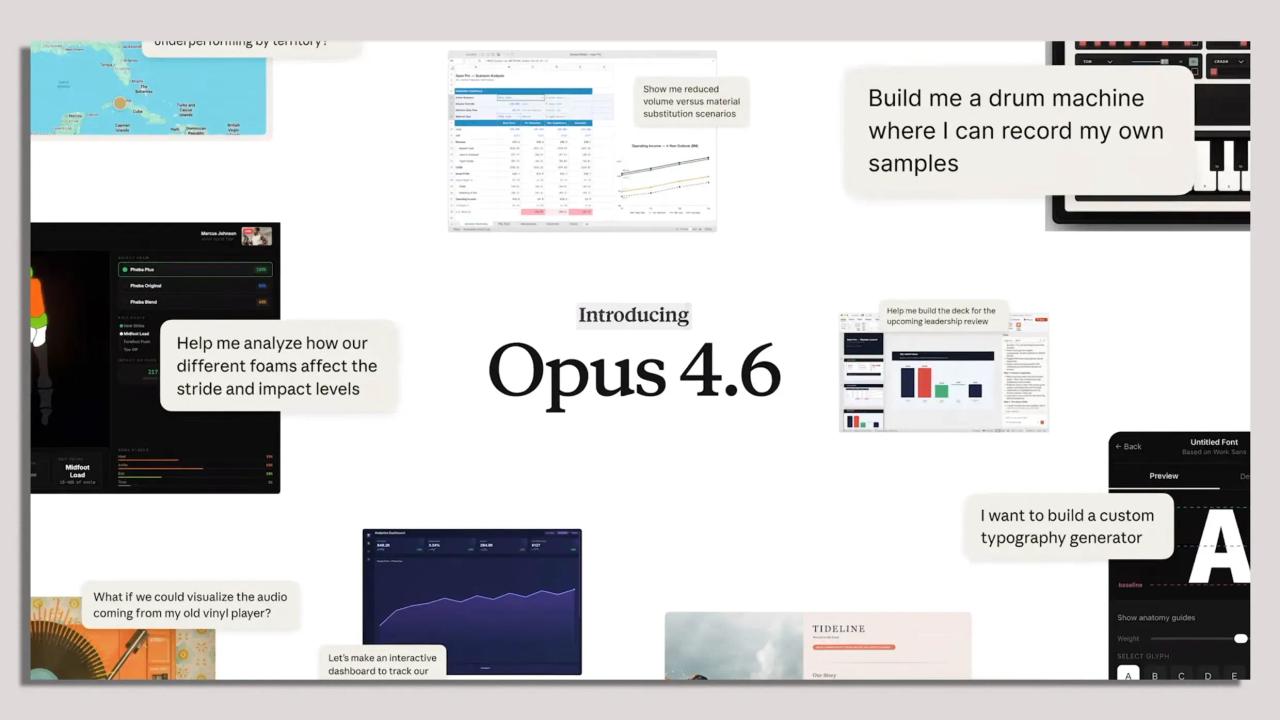
Source: Fast Company
The company introduced a research preview of agent teams for collaborative tasks, allowing multiple agents to split work and coordinate directly with each other rather than working sequentially
2
. This feature lets Claude Code "work the way a real engineering team does," with each agent owning its piece of a project. Anthropic has more than 300,000 business customers using its models to streamline workplace responsibilities, particularly in computer programming where it has emerged as a market leader3
.Financial Research and Modeling Capabilities Expand
Claude Opus 4.6 demonstrates significant advances in financial research and modeling, capable of scrutinizing company data, regulatory filings, and market information to produce detailed analyses that would typically take analysts days to complete
3
. The model handles the nuance required for compliance-sensitive output, making it particularly valuable for financial institutions2
.Yashodha Bhavnani, head of AI at Box, reported that Claude Opus 4.6 excels in high-reasoning tasks across legal, financial, and technical content. Box's evaluation showed a 10% lift in performance, reaching 68% versus a 58% baseline, with near-perfect scores in technical domains
2
. For legal reasoning, Niko Grupen, head of AI research at Harvey, noted that the model achieved the highest BigLaw Bench score of any Claude model at 90.2%, with 40% perfect scores2
.Cybersecurity Vulnerabilities Discovery Demonstrates Advanced Reasoning
In a striking demonstration of its capabilities, Claude Opus 4.6 identified over 500 high-severity cybersecurity vulnerabilities across major open-source libraries before its official launch
4
. Anthropic's Frontier Red Team tested the model in a virtualized environment with debugging and fuzzing tools, assessing its out-of-the-box capabilities without specialized prompting or task-specific scaffolding.The model "reads and reasons about code the way a human researcher would," according to Anthropic, examining past fixes to find similar unaddressed bugs and spotting patterns that cause problems
4
. One particularly notable discovery involved a CGIF vulnerability that required conceptual understanding of the LZW algorithm and its relationship to the GIF file format—a type of flaw that traditional fuzzers struggle to detect even with 100% code coverage4
.Market Impact on Software Stocks Reflects Disruption Concerns
The release of Claude Opus 4.6 intensified market concerns about traditional software companies facing disruption from AI
3
5
. Financial services companies saw immediate stock declines, with FactSet Research Systems falling as much as 10%, while S&P Global, Moody's, and Nasdaq all turned sharply lower3
. Software stocks including Salesforce, Workday, and Thomson Reuters each traded around 3% lower, extending declines over the past week5
.Anthropic's quiet release of tools to automate legal work through the Claude Cowork feature helped spark a trillion-dollar market meltdown this week, particularly among software stocks that investors fear may be rendered obsolete
3
. However, technology industry figures, including Nvidia CEO Jensen Huang, have dismissed disruption concerns, arguing that specialized products, vast data, and AI adoption by established software companies will provide protection5
.Related Stories

Complex Enterprise Workflows and PowerPoint Integration
Claude Opus 4.6 reduces the number of corrections and reframes required for common enterprise deliverables, with Anthropic stating that "documents, spreadsheets, and presentations will need less back-and-forth on iterations"
2
. The model demonstrates broader autonomy in handling complex, long-run tasks beyond isolated subtasks, similar to directing someone to navigate from New York City to Boston rather than just executing single turns2
.An intriguing new capability involves Claude's integration with PowerPoint, currently in research preview via waitlist
2
. The model can work directly inside PowerPoint to read layouts, fonts, and slide masters, enabling it to build slides from corporate templates, restructure storylines, convert bullets into diagrams, or generate full decks from descriptions while maintaining brand consistency2
.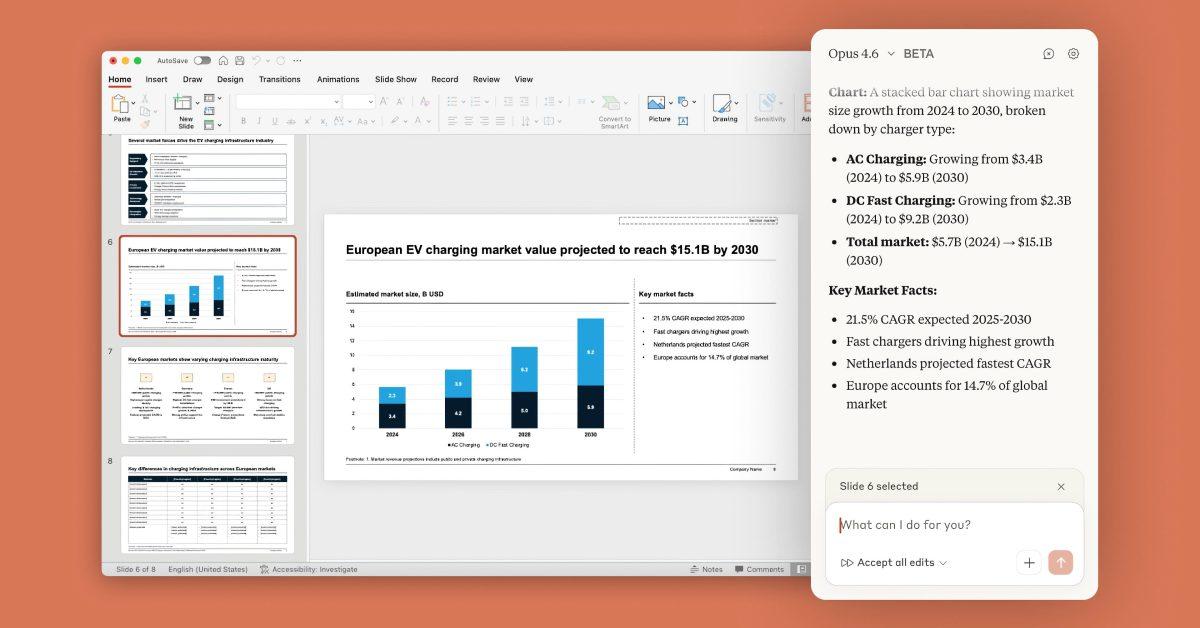
Source: 9to5Mac
Competitive Landscape and Valuation Implications
Anthropic is currently in talks to raise funding at a $350 billion valuation, while rival OpenAI pursues fundraising discussions at valuations up to $830 billion
3
. OpenAI also introduced an update on Thursday to its AI coding agent, Codex, designed to streamline writing and debugging code for building complicated games and apps3
.The Claude Opus models are available to paying users on Pro, Max, Team, and Enterprise plans, with the Pro plan costing $20 per month or $17 monthly with annual payment
1
. Pro plan users face usage limits for Opus, which can be reached after several hours of intensive coding work, requiring several hours for limits to reset1
. Scott White emphasized that Anthropic aims to connect AI to existing software tools as "the front door to getting hard work done" rather than replacing them entirely5
.References
Summarized by

Navi
Related Stories
Anthropic Boosts Claude AI with Massive Context Window and Improved Opus Model
06 Aug 2025•Technology

Anthropic Launches Claude Opus 4.5 with Major Price Cut and Enhanced Enterprise Focus
24 Nov 2025•Business and Economy

Anthropic's Claude 4: A Leap Forward in AI Coding and Extended Reasoning
23 May 2025•Technology

Recent Highlights
1
Tennessee Teens Sue Elon Musk's xAI Over Grok AI-Generated Child Abuse Images
Policy and Regulation

2
Supermicro Co-Founder Indicted in $2.5 Billion Nvidia AI Chip Smuggling Scheme to China
Policy and Regulation

3
Val Kilmer to appear posthumously in As Deep as the Grave through AI-generated performance
Entertainment and Society

Recent Highlights
Today's Top Stories



Your Daily Dose of Curated AI News
Don’t drown in AI news. We cut through the noise - filtering, ranking and summarizing the most important AI news, breakthroughs and research daily. Spend less time searching for the latest in AI and get straight to action.

