Apple to begin mass production of in-house AI server chips in H2 2026 as Google deal buys time


4 Sources
4 Sources
[1]
Apple could unveil in-house AI server chips later this year to reduce reliance on partners
Serving tech enthusiasts for over 25 years. TechSpot means tech analysis and advice you can trust. In a nutshell: Apple is preparing to shift more of its artificial intelligence operations in-house, with plans to begin mass production of its first AI server chips in the second half of 2026. The company's long-standing silicon division, credited with advancing the performance and efficiency of the iPhone, iPad, and Mac, is now expanding its design expertise into server-class hardware. Analyst Ming-Chi Kuo's latest report points to a multistage rollout: Apple's self-developed AI server chips will begin production in late 2026, while the new Apple data centers equipped to run them are expected to begin construction and operation the following year. The timeline suggests Cupertino is preparing for a major increase in on-device AI activity by 2027, supported by its own large-scale cloud infrastructure to handle the heavier computation. Although Apple recently confirmed a partnership with Google to integrate Gemini models into new Siri features, the company's investment in proprietary AI hardware indicates it is building a dual strategy - leveraging external models while maintaining fuller control over long-term performance and privacy through internal systems. Apple's hardware record shows a clear trajectory toward deeper silicon integration. After several generations of Apple Silicon chips transforming its consumer devices, the company successfully shipped its own in-house cellular modems, the C1 and C1X, and a wireless connectivity chip dubbed the N1. These projects proved Apple's ability to replace key third-party components with its own designs - an approach now extending to backend AI infrastructure. Within that broader roadmap, Apple's AI server chip effort has been reported to be a distinct project, rather than a simple extension of the Mac-focused M-series line used today in its data centers. The chip is said to be internally codenamed Baltra and developed with Broadcom, separate from the M-series processors that currently power Apple Intelligence servers and Private Cloud Compute. Those M-series chips handle AI tasks as part of more general-purpose compute platforms, while Baltra is framed as server silicon built first and foremost around AI. The current production schedule positions Apple to begin small-scale deployment within existing data centers before new facilities come online, creating a bridge between its present M-series-based cloud infrastructure and the next generation of AI-focused servers. If Apple's rollout proceeds as described, the company could gain tighter control over AI data processing, reduce dependence on external compute providers, and better align its hardware ecosystem with its privacy and optimization standards. For a company often criticized for its deliberate pace in AI deployment, this move suggests a long-term architectural bet: that its future AI experiences - from Siri to system-level intelligence - will increasingly rely on silicon designed and tightly integrated in-house, from edge devices to custom chips deep in its data centers.
[2]
Kuo: Apple's AI Deal With Google Is Temporary and Buys It Time
Apple is preparing to mass-produce its own AI-focused server chips in the second half of 2026 amid reliance on a short-term partnership with Google to meet immediate AI expectations, according to analyst Ming-Chi Kuo. In a new post on X, Kuo said that Apple is facing mounting short-term pressure in artificial intelligence that is shaping its current strategy, even as it continues to pursue long-term control over core AI technologies. Kuo explained that Apple has encountered two immediate challenges in its in-house AI development that have effectively pushed it toward partnering with Google. The first is the need for a credible AI showing at WWDC later this year after previously announcing Apple Intelligence and significant Siri upgrades that have yet to materialize. The second is the rapid pace of improvement in cloud-based AI systems, which has raised expectations to a level where simply delivering on earlier promises may no longer be enough. Kuo argues that as AI capabilities have advanced, user perceptions of what constitutes a competitive assistant or system-level AI have shifted. In that context, even a fully delivered version of Apple Intelligence as it was originally presented could struggle to stand out, particularly without access to more powerful large-scale models. This has apparently driven an urgent need for Apple to supplement its current approach with more capable AI models from other companies. Kuo described Apple's AI deal with Google as a way to ease short-term pressure rather than a long-term strategic shift. He said on-device AI is unlikely to drive hardware sales in the near term, but the partnership gives Apple time to manage expectations across its platforms while continuing its own AI development. Over the longer term, Kuo said AI is expected to become central to hardware differentiation, operating system design, and the overall user experience, making ownership of core AI technologies increasingly important. He added that Apple's in-house AI server chips are expected to enter mass production in the second half of 2026, with Apple-operated data centers coming online in 2027. Kuo said this timing suggests Apple expects demand for on-device and hybrid AI workloads to grow more meaningfully from 2027, as it gains greater control over its server-side computing and infrastructure.
[3]
Apple Could Begin Mass Production of In-House AI Server Chips Later This Year
It is unclear if Apple wants to provide the AI server chips to others Apple might soon launch self-developed artificial intelligence (AI) server chips. Noted analyst Ming-Chi Kuo claimed that the Cupertino-based tech giant could begin the mass production of these processors in the second half of the year. The information comes at a time when the iPhone-maker has forged a partnership with Google to use its AI model to power Siri. While it cannot be said for certain, Apple's current playbook appears to be focusing on developing AI infrastructure and collaborating on the core technology. Apple Could Start Making AI Server Chips Soon In a post on X (formerly known as Twitter), TF Securities analyst Kuo said, "Apple's self-developed AI server chip is expected to enter mass production in the second half of the year (translated from Chinese via Google)." Additionally, it was also said that the tech giant could construct and operationalise its in-house data centres next year. For the unaware, AI server chips are specialised processors used in data centres to train and run AI models. They are designed to handle large volumes of mathematical calculations in parallel, making them far more efficient than standard CPUs for machine learning tasks. Common forms include GPUs and dedicated AI accelerators, which power applications such as chatbots, image recognition and data analysis at scale. If the information is true, then it is clear that the iPhone-maker has decided to heavily invest in the infrastructure of AI technology. Apple has already released multiple AI-enabled chipsets for its smartphones and laptops, created the Private Cloud Compute for secure server-based data processing, and might soon build out and handle end-to-end AI deployment and inference with the server chip and data centres. The timing is also interesting. Apple has just announced a partnership with Google, which will allow it to use a custom Gemini AI model to power Siri and certain Apple Intelligence features. With the OpenAI deal already in place and the company's self-developed Foundation Models, it is also in a good position, core technology-wise. However, when it comes to the end-product, Apple's AI offerings have not impressed the users much. If the company does have interesting and innovative AI features under development, the earliest we might hear about them is in June, when it will host its annual Worldwide Developers Conference (WWDC).
[4]
Apple's In-House Server Chips Reportedly Entering Mass Production In H2 2026, But The Company Is Expected To Face Two Short-Term Challenges With AI Development
* 0-20%: Unlikely - Lacks credible sources * 21-40%: Questionable - Some concerns remain * 41-60%: Plausible - Reasonable evidence * 61-80%: Probable - Strong evidence * 81-100%: Highly Likely - Multiple reliable sources The Apple Silicon transition isn't just stopping at mass producing workstation-based chipsets, because the technology giant is said to be working on a new chip codenamed 'Baltra,' with its primary function focused on AI inference. Now, according to one analyst, the Cupertino firm will commence the mass production of these in-house server chips in the second half of 2026. The update arrives shortly after it was reported that Apple had entered into an agreement with Google to leverage its Gemini model for the revamped version of Siri. The development of these in-house server SoCs has been talked about for a couple of years, with the same analyst pointing out two challenges for the iPhone maker concerning its AI development roadmap. In short, artificial intelligence is expected to become a pivotal element of hardware and software, with the technology titan severely missing out at this time. The proper rollout of Apple Intelligence in on-device AI form could arrive from 2027 onward Similar to how Apple maintained its relationship with Qualcomm until it had a potent 5G solution that eventually found its way into the iPhone 16e, the company has established a similar tag-team with Google, until it is successful in launching its own Large Language Model. According to TF International Securities analyst Ming-Chi Kuo, Apple is facing two short-term challenges in its in-house AI development quest. Even if the company fulfills its past promises around Apple Intelligence and offering a revamped Siri, it may not be sufficient, as there is a need to deliver a more capable on-device AI model. Of course, as witnessed by surging sales of the iPhone 17 lineup, which resulted in Apple surpassing Samsung to become the number one smartphone brand for 2025 with a 10 percent shipment growth, Kuo notes that on-device AI isn't expected to drive shipments in the near term. However, Google's partnership with Apple will only relieve pressure for a small period, and it is only a matter of time before AI 'becomes central to hardware, the OS and the overall user experience.' Kuo also states that long-term, Apple continues to face the challenge of gaining stronger control over its core AI technologies. Fortunately, the development of in-house server chips can eliminate various bottlenecks, as Apple has proven that its custom silicon delivers sufficient firepower and flaunts impressive memory bandwidth, both of which are crucial for AI processing. Best of all, these in-house server chips can operate at practically half the power, as demonstrated by the top-tier M3 Ultra, which consumes 55 percent less juice compared to x86 processors when running HandBrake. Kuo also predicts that, while mass production of Apple's in-house server chips will commence in H2 2026, the proper rollout of on-device AI could grow more meaningfully from 2027 onward. News Source: Ming-Chi Kuo Follow Wccftech on Google to get more of our news coverage in your feeds.
Share
Share
Copy Link
Apple plans to start mass production of custom AI server chips in the second half of 2026, with proprietary data centers expected in 2027. Analyst Ming-Chi Kuo reveals the move aims to reduce reliance on partners like Google, whose Gemini deal is temporary. The chips, codenamed Baltra, mark Apple's push for control over core AI technologies.
Apple Accelerates Plans for Custom AI Server Chips
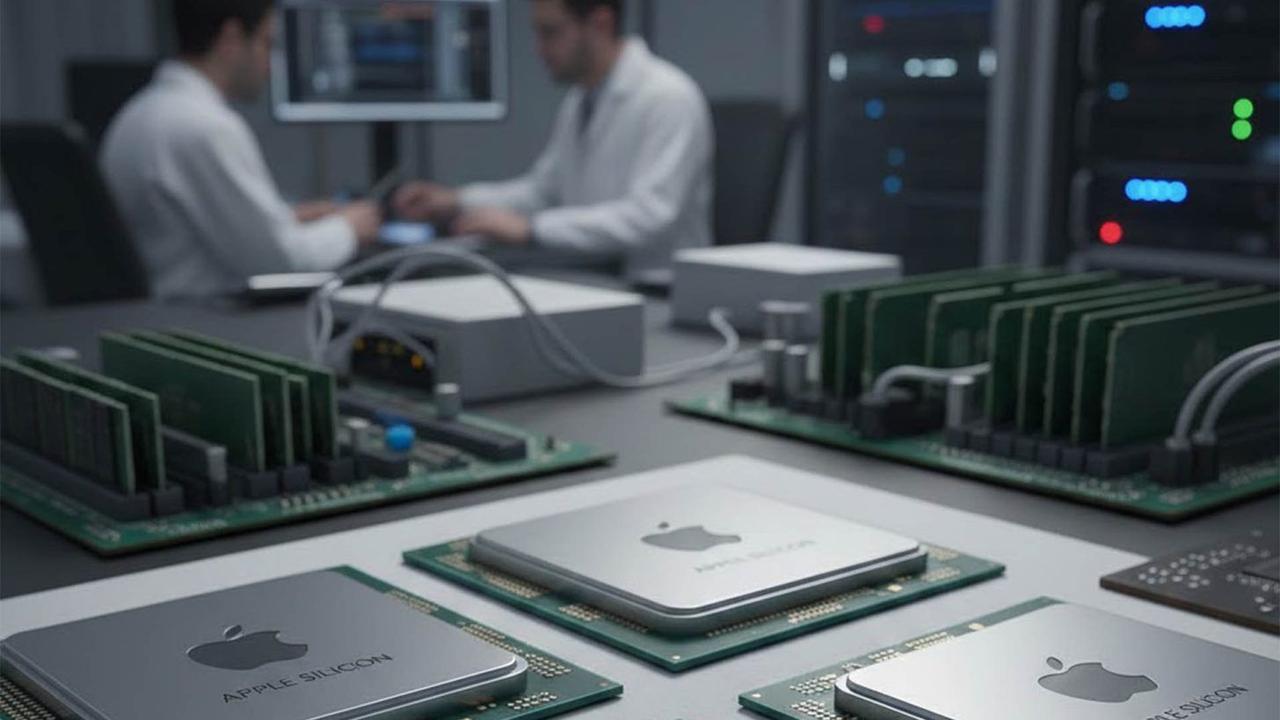
Apple is preparing to launch mass production of in-house AI server chips in the second half of 2026, marking a significant expansion of its silicon capabilities beyond consumer devices into backend AI infrastructure
1
. According to analyst Ming-Chi Kuo, this strategic move aims to reduce reliance on partners and establish greater control over core AI technologies that will shape the company's future products2
. The chips, internally codenamed Baltra and developed with Broadcom, represent a distinct project separate from the M-series processors currently powering Apple Intelligence servers and Private Cloud Compute1
.
Source: Wccftech
The timeline positions Apple-operated data centers to begin construction and operation in 2027, creating infrastructure capable of handling increased on-device AI activities
1
. These specialized processors are designed for AI model training and execution, handling large volumes of mathematical calculations in parallel with far greater efficiency than standard CPUs3
. Apple's custom silicon has already demonstrated impressive capabilities, with the M3 Ultra consuming 55 percent less power compared to x86 processors when running demanding workloads4
.Google Partnership Provides Temporary Relief
Apple's AI deal with Google serves as a short-term solution while the company builds its own AI infrastructure, Kuo explained
2
. The partnership allows Apple to integrate Gemini models into new Siri features and certain Apple Intelligence capabilities, addressing immediate pressure ahead of WWDC later this year2
. This collaboration comes after Apple previously announced significant Siri upgrades that have yet to materialize, creating mounting expectations for a credible AI showing2
.Kuo identified two critical short-term challenges facing Apple in its in-house AI development. First, the company needs to deliver meaningful AI capabilities at its annual developer conference to maintain credibility. Second, the rapid pace of improvement in cloud-based AI systems has raised user expectations to levels where even fully delivered Apple Intelligence features as originally presented may struggle to compete without access to more powerful large-scale models
2
. The Google deal, alongside an existing OpenAI partnership, provides Apple breathing room to manage expectations while continuing proprietary development3
.Long-Term Strategy Mirrors Silicon Integration Success
Apple's hardware trajectory demonstrates a consistent pattern toward deeper silicon integration across its product ecosystem. After transforming consumer devices through multiple generations of Apple Silicon chips, the company successfully shipped its own cellular modems—the C1 and C1X—and a wireless connectivity chip dubbed the N1
1
. These projects proved Apple's ability to replace key third-party components with proprietary designs, an approach now extending to cloud infrastructure1
.Baltra represents server silicon built specifically for AI inference, distinct from general-purpose M-series chips currently handling AI tasks in data centers
1
. The current production schedule enables Apple to begin small-scale deployment within existing facilities before new Apple-operated data centers come online, creating a bridge between present M-series-based cloud infrastructure and the next generation of AI-focused servers .
Source: TechSpot
Related Stories
AI Expected to Drive Hardware Differentiation from 2027
While on-device AI is unlikely to drive hardware sales in the near term—as evidenced by the iPhone 17 lineup's 10 percent shipment growth that helped Apple surpass Samsung as the number one smartphone brand for 2025—Kuo predicts AI will become central to hardware differentiation, operating system design, and overall user experience from 2027 onward
2
4
. This timing aligns with when Apple expects demand for on-device and hybrid AI workloads to grow more meaningfully, as it gains greater control over server-side computing2
.The investment in proprietary AI hardware indicates Apple is building a dual strategy: leveraging external models from Google and OpenAI while maintaining control over long-term performance and privacy through internal systems
1
. If the rollout proceeds as described, Apple could gain tighter control over AI data processing, better align its hardware ecosystem with privacy and optimization standards, and handle end-to-end AI deployment from edge devices to custom chips deep in its data centers1
3
. For a company often criticized for its deliberate pace in AI deployment, this represents a long-term architectural bet that future AI experiences—from Siri to system-level intelligence—will increasingly rely on tightly integrated, proprietary silicon1
.References
Summarized by

Navi
[1]
Related Stories
Apple Collaborates with Broadcom on Custom AI Server Chip for Enhanced Cloud Processing
12 Dec 2024•Technology

Apple in Talks with Foxconn and Lenovo to Build AI Servers for Apple Intelligence
07 Nov 2024•Business and Economy

Apple's cautious AI approach could turn fortunes around with revamped Siri arriving in 2026
30 Dec 2025•Technology

Recent Highlights


Recent Highlights
Today's Top Stories











Your Daily Dose of Curated AI News
Don’t drown in AI news. We cut through the noise - filtering, ranking and summarizing the most important AI news, breakthroughs and research daily. Spend less time searching for the latest in AI and get straight to action.

