BuzzFeed launches AI apps through Branch Office spinoff to combat $57.3M loss


4 Sources
4 Sources
[1]
BuzzFeed debuts AI slop apps in bid for new revenue | TechCrunch
BuzzFeed, the U.S.-based media company known best for its quizzes, listicles, and, for a time, a Pulitzer Prize-winning journalism division, is reinventing itself for the AI era. At least, that's the pitch. At the SXSW conference in Austin, BuzzFeed co-founder and CEO Jonah Peretti introduced the company's next media foray: a spin-off called Branch Office, which will explore artificial intelligence in consumer-facing apps designed for creativity and connection. The new company is an extension of the experiments BuzzFeed has run for years using AI technology, Peretti explained, in a halting presentation that began with slideshow glitches, before moving on to app demos met with silence or a polite tittering of laughter. "We've been working on this secretly for over a year, and we've learned a lot from the BuzzFeed platform about what is coming with new kinds of AI formats," Peretti said. "Using AI is the way of connecting people, building community around these pillars of culture, and taste, and community." Bill Shouldis, a director of product at BuzzFeed and the founder of Branch Office, presented two of the company's new apps: BF Island and Conjure. The first product, BF Island, is a group chat platform offering features for changing and editing photos using AI. This is not exactly groundbreaking tech, in and of itself, but that's not the point. The key feature here is not the AI toolset but the in-app library of online trends and memes, created by an editorial team, which could inspire users to create AI photos referencing blink-and-you-miss-it trends like the McDonald's CEO taste-testing a burger, or the "frame-mogging" drama. (If you don't know what these are, you're probably not the "very online" audience that's being targeted.) Another app, Conjure, is an app similar to BeReal -- the once-a-day temporary photo app -- except that it instead appears to guide users to take daily photos of things besides themselves. (As a reminder, BeReal itself didn't stick, ultimately exiting to Voodoo after losing traction.) In the demo, for instance, the photo prompt was "What lies between the trees and the moon?", leading the users to snap a photo of the night sky. A series of spooky images flashed on the screen, followed by a whisper, "What will you conjure?" We don't get it, and clearly the audience didn't either. After the demo, a lone cough could be heard among the silence, followed by uncomfortable laughter. Shouldis then noted that AI is involved in Conjure, too, as the app has an "AI spirit for a CEO." (Again, what?) Peretti also introduced Quiz Party, a social app that lets you take BuzzFeed quizzes with friends and share your results. BuzzFeed's underwhelming presentation comes only days after the media company shared that it has "substantial doubt" about its ability to continue as a business, and was engaging in strategic conversations focused on fixing its liquidity challenges. The company, which had a net loss of $57.3 million last year, said it would focus this year on its Studio IP and new AI apps, like these. But even the tech-forward audience at SXSW was not convinced. As one person pointed out during the Q&A session after the presentation, BeReal had struggled to get people to come back after the novelty wore off. What would an app like Conjure do to combat the same sort of retention problem? Shouldis said that the app would evolve, "and have different types of things happening and not just be exactly what it is today." He referenced the potential to integrate things like video, audio, and prototyping with Claude Code to build community. The premise behind the new apps is not unreasonable: AI can lead to faster software development, which makes it possible for companies to more quickly iterate and keep people engaged. "In a way, software is the new content," Peretti noted. Of course, before you can iterate, you have to attract users. With its new apps, BuzzFeed seems to have thought more about what AI can do than what people want to do with AI, which is not a recipe for success.
[2]
BuzzFeed's New Spinoff Is a 'Creative Studio' Trying to Make the Internet Fun Again
Macy has been working for CNET for coming on 2 years. Prior to CNET, Macy received a North Carolina College Media Association award in sports writing. BuzzFeed, known for its many quirky quizzes of the 2010s, has launched a company called Branch Office, an independent spinoff built to rethink how people connect on the internet in the age of AI. BuzzFeed founder and CEO Jonah Peretti and Branch Office founder Bill Shouldis announced at South by Southwest in Austin, Texas, that the team has been developing a slate of experimental apps in secret, with the first two launching now and more on the way this year. The project grew out of years of BuzzFeed AI experiments, from strange little games to chaotic chatbots, where the company began to see a different path for the technology. Instead of using AI to flood the internet with more content or trap people inside algorithmic feeds, the idea was to build new types of social experiences that help people create things together and connect with their friends. Read more: Social Media and AI Want Your Attention at All Times. This New Documentary Says That's Bad Branch Office runs more like a creative studio than a traditional tech startup, the founders said. The guiding influence is Nintendo and its philosophy of creating surprising things from existing technology. The first apps follow that spirit. Conjure sends you a daily photography prompt wrapped in strange unfolding lore. BF Island turns the language of group chats into a collaborative playground for inside jokes and visual riffs. Quiz Party brings the classic BuzzFeed quiz into a shared space where friends compare results and roast each other in real time. The bet behind it all is quite simple. Buzzfeed predicts that as AI makes content infinite, cheap and easy to produce, the real value online will come from community, culture and taste. "We're accelerating into an era of infinite fake news, slop, personalization bubbles and cuts at the organizations that actually care about content," Peretti said. "We need a solution. Branch Office is that solution."
[3]
Buzzfeed Hopes AI Apps Can Help Solve Its Financial Woes
"We're accelerating into an era of infinite fake news, slop, personalization bubbles, and cuts at the organizations that actually care about content," said Jonah Peretti, CEO of Buzzfeed. "We need a solution. Branch Office is that solution." At the SXSW conference, Peretti premiered Buzzfeed's new creative studio, Branch Office, alongside new apps that will come with it: Conjure, BF Island, and Quiz Party. Buzzfeed AI Apps Conjure will be the most physically interactive of all the apps. The platform sends users a daily "summons," a prompt to photograph something specific, turning each submission into a creative offering meant to pull people out of their feeds and back into the real world.
[4]
Inside BuzzFeed's Secret Lab: Three Apps, A New Company, And A Bet On The Future Of The Internet
AUSTIN, TX -- March 13, 2026 -- BuzzFeed, Inc. (Nasdaq: BZFD) today unveiled Branch Office, a new spinoff company that has been secretly developing a slate of apps designed to reinvent how people connect on the internet. The first two are launching now. More are coming this year. Branch Office operates independently, with its own founders, its own mandate, and a product philosophy built for a world where AI has blurred the lines between software and content. BuzzFeed saw a gap no one else was filling, and built a dedicated company, quietly, to move fast enough to actually fill it. "We're accelerating into an era of infinite fake news, slop, personalization bubbles, and cuts at the organizations that actually care about content," said Jonah Peretti. "We need a solution. Branch Office is that solution." BuzzFeed has been running AI experiments for years -- a game where you raised a nepo baby, a chatbot that lets you attempt to talk a Karen down in a Starbucks line. Through hundreds of projects the team learned what AI could do when it wasn't trying to replicate existing models of static content production, but building totally new experiences that would not have been possible before the advent of GenAI. While most social media companies are using AI to keep people isolated in their own algorithmic feeds, BuzzFeed's projects were built on the premise that creativity and engagement can bring people closer together, help them connect with their friends. THE PHILOSOPHY: NINTENDO, NOT BIG TECH Led by founder Bill Shouldis, Branch Office operates with a clear vision: treat software as a creative medium. Build fast. Iterate constantly. Let real communities, real culture, and genuine taste shape what gets made. The guiding philosophy comes from an unlikely place: Nintendo. The gaming giant's principle of "lateral thinking with withered technology," taking maximum creativity out of what already exists, is Branch Office's north star. We don't need to build our own foundational models or compete with Big Tech. We just ask one question: what's already here, and how do we make it genuinely fun? When Branch Office looked at the market, they saw two camps: companies building AI to replace humans, and companies building AI to simulate them. Branch Office is doing neither.
Share
Share
Copy Link
BuzzFeed unveiled Branch Office at SXSW, an independent spinoff company developing AI apps including Conjure, BF Island, and Quiz Party. The struggling media company, which posted a $57.3 million net loss last year and has "substantial doubt" about continuing as a business, is betting on AI-powered consumer apps to solve financial woes. But the Austin presentation met with silence and skepticism from the tech-forward audience.
BuzzFeed Bets on AI Apps to Solve Financial Woes
BuzzFeed is attempting to reinvent itself through artificial intelligence as the media company faces serious financial challenges. At SXSW in Austin, Texas, CEO and co-founder Jonah Peretti introduced Branch Office, an independent spinoff company that has been secretly developing AI apps for over a year
1
. The announcement comes just days after BuzzFeed disclosed "substantial doubt" about its ability to continue as a business, with the company reporting a net loss of $57.3 million last year1
. The struggling media company plans to focus this year on its Studio IP and these new AI apps as part of strategic conversations aimed at addressing liquidity challenges.
Source: CNET
Branch Office Introduces Three AI-Powered Consumer Apps
The new creative studio operates independently with its own founders and mandate, built to rethink how people connect on the internet in the age of AI
2
. Bill Shouldis, a director of product at BuzzFeed and founder of Branch Office, presented three apps during the presentation: BF Island, Conjure, and Quiz Party. BF Island functions as a group chat platform with AI-powered photo editing features, but its distinguishing element is an in-app library of online trends and memes curated by an editorial team1
. The platform targets "very online" audiences who follow blink-and-you-miss-it trends. Conjure takes a different approach, sending users a daily photography prompt wrapped in mysterious lore, aiming to pull people out of their feeds and back into the real world3
. Quiz Party brings the classic BuzzFeed quiz format into a shared space where friends can compare results in real time2
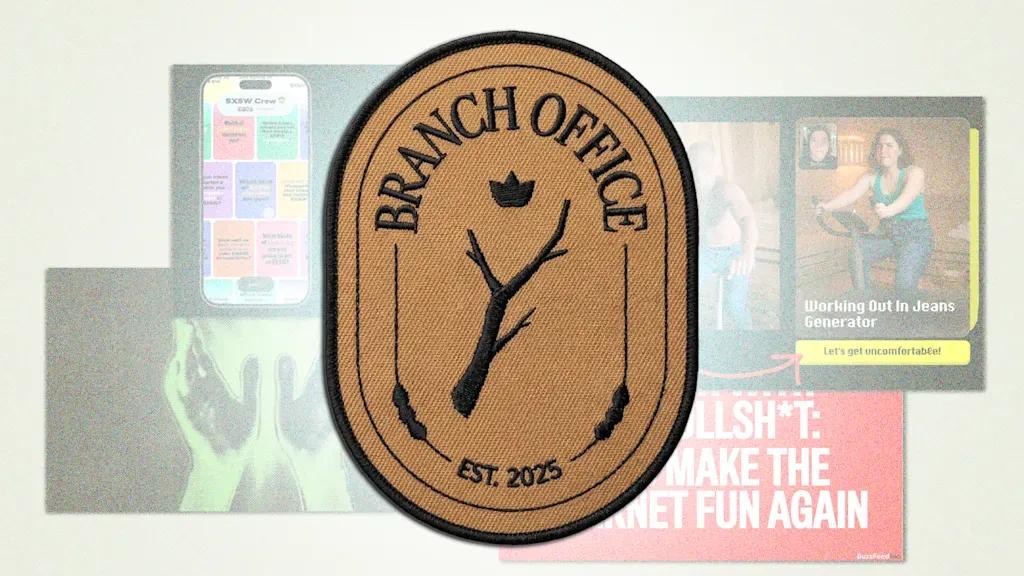
.
Source: Inc.
Creative Software Development Inspired by Nintendo Philosophy
Branch Office runs more like a creative studio than a traditional tech startup, with Nintendo serving as its guiding influence
2
. The gaming giant's principle of "lateral thinking with withered technology" shapes the spinoff's approach to taking maximum creativity out of what already exists4
. "In a way, software is the new content," Peretti noted during the presentation1
. The premise centers on AI enabling faster software development, making it possible for companies to iterate quickly and maintain user interaction. Branch Office grew out of years of BuzzFeed AI experiments, from games where users raised a "nepo baby" to chatbots simulating difficult customer service encounters4
. Through hundreds of projects, the team learned what AI could accomplish when building totally new social experiences rather than replicating existing content production models.Related Stories

SXSW Presentation Met with Skepticism and Silence
The presentation at SXSW began with technical difficulties, including slideshow glitches, before moving on to app demos that were met with silence or polite, uncomfortable laughter from the tech-forward audience
1
. After the Conjure demo, which featured spooky images and a whispered "What will you conjure?", a lone cough could be heard among the silence. Shouldis mentioned that Conjure has an "AI spirit for a CEO," a statement that only added to the confusion1
. During the Q&A session, attendees raised concerns about user retention, pointing out that BeReal had struggled to keep people engaged after the novelty wore off. Shouldis responded that the apps would evolve with different features, including video, audio, and prototyping with Claude Code to foster community1
.Future of the Internet Through Community and Culture
Peretti positioned Branch Office as a solution to what he describes as an accelerating era of "infinite fake news, slop, personalization bubbles, and cuts at the organizations that actually care about content"
4
. The bet behind these digital experiences is straightforward: as AI makes content infinite, cheap, and easy to produce, the real value online will shift toward community, culture, and taste2
. While most social media companies use AI to keep people isolated in algorithmic feeds, BuzzFeed's approach focuses on creativity and engagement to bring people closer together. However, critics note that BuzzFeed appears to have prioritized what AI can do over what people actually want to do with AI, which may not be a recipe for revenue generation1
. The company must first attract users before it can iterate and improve these experimental apps, and the lukewarm reception at SXSW suggests significant challenges ahead for the struggling media company's latest pivot.References
Summarized by

Navi
Related Stories
BuzzFeed Challenges AI-Driven Social Media with New 'Joyful' Platform
12 Feb 2025•Technology

BuzzFeed's AI-Powered Social Media Platform: A New Approach to Digital Interaction
12 Feb 2025•Technology

BuzzFeed CEO Jonah Peretti Criticizes AI's Impact on Media, Launches New AI-Powered Platform
13 Feb 2025•Technology

Recent Highlights
1
Tennessee Teens Sue Elon Musk's xAI Over Grok AI-Generated Child Abuse Images
Policy and Regulation

2
Supermicro Co-Founder Indicted in $2.5 Billion Nvidia AI Chip Smuggling Scheme to China
Policy and Regulation

3
Val Kilmer to appear posthumously in As Deep as the Grave through AI-generated performance
Entertainment and Society

Recent Highlights
Today's Top Stories










Your Daily Dose of Curated AI News
Don’t drown in AI news. We cut through the noise - filtering, ranking and summarizing the most important AI news, breakthroughs and research daily. Spend less time searching for the latest in AI and get straight to action.

